Steven J. van Beurden,a,bDerek Gatherer,cKaren Kerr,cJulie Galbraith,dPawel Herzyk,dBen P. H. Peeters,aPeter J. M. Rottier,b
Marc Y. Engelsma,aand Andrew J. Davisonc
Central Veterinary Institute of Wageningen UR, Lelystad, The Netherlandsa; Department of Infectious Diseases and Immunology, Faculty of Veterinary Medicine, Utrecht University, Utrecht, The Netherlandsb; MRC—University of Glasgow Centre for Virus Research, Glasgow, United Kingdomc; and Glasgow Polyomics Facility, Institute of Molecular, Cell and Systems Biology, College of Medical, Veterinary and Life Sciences, University of Glasgow, Glasgow, United Kingdomd
We used deep sequencing of poly(A) RNA to characterize the transcriptome of an economically important eel virus, anguillid
herpesvirus 1 (AngHV1), at a stage during the lytic life cycle when infectious virus was being produced. In contrast to the
tran-scription of mammalian herpesviruses, the overall level of antisense trantran-scription from the 248,526-bp genome was low,
amounting to only 1.5% of transcription in predicted protein-coding regions, and no abundant, nonoverlapping, noncoding
RNAs were identified. RNA splicing was found to be more common than had been anticipated previously. Counting the
10,634-bp terminal direct repeat once, 100 splice junctions were identified, of which 58 were considered likely to be involved in
the expression of functional proteins because they represent splicing between protein-coding exons or between 5
=
untranslated
regions and protein-coding exons. Each of the 30 most highly represented of these 58 splice junctions was confirmed by RT-PCR.
We also used deep sequencing to identify numerous putative 5
=
and 3
=
ends of AngHV1 transcripts, confirming some and adding
others by rapid amplification of cDNA ends (RACE). The findings prompted a revision of the AngHV1 genome map to include a
total of 129 protein-coding genes, 5 of which are duplicated in the terminal direct repeat. Not counting duplicates, 11 genes
con-tain integral, spliced protein-coding exons, and 9 concon-tain 5
=
untranslated exons or, because of alternative splicing, 5
=
untrans-lated and 5
=
translated exons. The results of this study sharpen our understanding of AngHV1 genomics and provide the first
detailed view of a fish herpesvirus transcriptome.
T
he order
Herpesvirales
consists of three families,
Herpesviridae
,
Alloherpesviridae
, and
Malacoherpesviridae
(
18
). Most of the
more than 50 species in this order for which genome sequences are
available belong to the family
Herpesviridae
, which contains
agents infecting mammals, birds, and reptiles. In contrast,
ge-nome sequences are available for members of only five species in
the family
Alloherpesviridae
(termed alloherpesviruses), namely,
two frog viruses (
4
) and the fish herpesviruses ictalurid
herpesvi-rus 1 (IcHV1; channel catfish viherpesvi-rus) (
3
), cyprinid herpesvirus 3
(CyHV3; koi herpesvirus) (
1
), and anguillid herpesvirus 1
(AngHV1; eel herpesvirus) (
25
). These viruses differ substantially
from each other in sequence relatedness and gene content.
Annotation of predicted functional protein-coding regions in
a herpesvirus genome sequence generally commences with
iden-tification of ATG-initiated open reading frames (ORFs) above a
minimum size, modified according to generally perceived features
of herpesvirus gene arrangement, such as rarity of extensively
overlapping protein-coding regions and splicing.
Alignment-based sequence comparisons among related genes may then be
used to enhance the predictions. However, the assumptions that
are made to sharpen discrimination may lead to the exclusion of
genuine genes, especially if they are small or expressed by splicing,
are translated from alternative initiation codons, have lengthy
overlapping protein-coding regions, or lack similarity to other
genes. Also, analyses based on coding potential cannot identify
transcripts that do not encode functional proteins. Consequently,
an annotation produced by bioinformatic means, especially one
for a virus that has no sequenced close relatives, is likely to require
significant improvements in light of experimental data.
Among the alloherpesviruses that have been sequenced, the
expression of a limited number of predicted protein-coding
re-gions has been investigated experimentally. For IcHV1, several
ORFs have been shown to be transcribed in cell culture (
11
,
21
,
22
,
23
) or in channel catfish (
24
). Also, ORFs encoding a dozen virion
proteins have been identified by mass spectrometry (
5
), and an
additional ORF encodes a mucin-like glycoprotein (
29
).
Probabi-listic proteogenomic mapping has demonstrated the expression of
37 ORFs in cell culture and led to the prediction of 17 additional
small protein-coding ORFs, and transcription of 23 ORFs has
been confirmed (
13
). For CyHV3, the transcription of 20 ORFs
has been demonstrated in cell culture (
6
), the expression of an
envelope protein has been confirmed (
19
), and 40 virion proteins
have been identified by mass spectrometry (
16
). A similar number
of proteins has been identified in AngHV1 virions by mass
spec-trometry (
27
).
To extend the knowledge of alloherpesvirus genome
expres-sion, we have characterized the transcriptome of AngHV1 by deep
sequencing methods, relying on experience gained during a
simi-lar exercise conducted on a mammalian herpesvirus, human
cy-tomegalovirus (
7
). AngHV1 is of economic importance because it
causes a hemorrhagic disease in cultured European eels (
Anguilla
anguilla
) and Japanese eels (
Anguilla japonica
) and is one of the
factors thought to be responsible for the decline of wild European
eel stocks since the 1980s (
8
,
9
). AngHV1 belongs to the genus
Cyprinivirus
and has CyHV3 as its closest completely sequenced
relative, although the phylogenetic distance is appreciable and the
majority of genes are not detectably conserved between the two
Received23 May 2012Accepted3 July 2012
Published ahead of print11 July 2012
Address correspondence to Andrew J. Davison, [email protected].
Supplemental material for this article may be found athttp://jvi.asm.org/.
Copyright © 2012, American Society for Microbiology. All Rights Reserved.
doi:10.1128/JVI.01271-12
on November 7, 2019 by guest
http://jvi.asm.org/
viruses (
25
). As a result of our analysis, a substantial amount of
information was garnered on transcript layout, and the AngHV1
genome annotation was adjusted accordingly in regard to gene
location and splicing patterns. The results have direct
conse-quences as a vital underpinning of future functional studies on
AngHV1, including those directed at diagnostic and therapeutic
advances. They also point a way for similar studies on other
her-pesviruses whose genomics are not yet well developed.
MATERIALS AND METHODS
Virus and cells.The AngHV1 reference strain CVI500138 was isolated in 1998 from diseased eels at an eel farm in the Netherlands (30). This virus was propagated in 1 day-old confluent EK-1 (eel kidney) cell monolayers that were approximately 80% confluent (2). The cells were cultured at 26°C in 5% (vol/vol) CO2using a growth medium (GM) consisting of
Leibovitz’s L-15 medium, 2% (vol/vol) fetal bovine serum, 0.075% (wt/ vol) NaHCO3, 2 mML-glutamine, 0.012% (wt/vol) kanamycin, and 270
U/ml penicillin G. For propagation of virus in 6- or 96-well plates, 0.26% instead of 0.075% NaHCO3was used. Viral titers were determined as
described previously (28).
Preparation of infected-cell RNA.Total cell RNA was isolated from AngHV1-infected cells at 12 h postinfection (p.i.). This stage was chosen because real-time RT-PCR analysis has shown that late transcription is well underway (S. J. van Beurden, B. P. H. Peeters, P. J. M. Rottier, A. J. Davison, and M. Y. Engelsma, submitted for publication), and one-step growth curves have demonstrated that infectious virus production is in mid-logarithmic phase (20; data not shown). A monolayer of EK-1 cells (approximately 80% confluent) in a 150-cm2flask was washed once with
GM and infected with 5 50% tissue culture infective doses (TCID50) of
AngHV1 per cell in a total of 25 ml GM at 26°C for 30 min. The monolayer was washed three times with GM and incubated with 50 ml GM at 26°C. At 12 h p.i., the medium was discarded and the cells were washed with 25 ml phosphate-buffered saline (PBS). The cells were dislodged by using 4 ml 0.01% (wt/vol) trypsin in PBS and resuspended in 25 ml GM. The sample was divided into two. The cells were pelleted by centrifugation at 300⫻gfor 5 min, the supernatants were discarded, and the pellets were loosened by flicking the tubes thoroughly. RNA was extracted from each suspension with an RNeasy midikit (Qiagen, Hilden, Germany) after dis-ruption by adding 4 ml RTL buffer from the kit and homogenization by vortexing for 10 s and passaging 10 times through a 20-gauge needle. RNA was finally eluted from each extract in two 250-l volumes of water. The RNA concentration was determined by spectrophotometry (Nanodrop, Wilmington, DE), and RNA integrity was assessed by using a Bioanalyzer (Agilent Technologies, Santa Clara, CA).
Deep sequencing of RNA.Deep sequencing of poly(A) RNA isolated from the RNA preparation was performed as described previously (7). An mRNA-Seq library prep kit and a small RNA sample prep kit (Illumina, San Diego, CA) were used to prepare material for sequencing, and data were derived by using a Genome Analyzer IIx (Illumina). The data were single ended and directional (i.e., they imparted information on tran-script orientation). A data set of unaligned 76-base reads in fastq format, with associated phred quality scores, was generated by using SCS 2.6 or 2.8, RTA 1.12, and CASAVA 1.7 (Illumina).
Transcriptome profile.The read data set was assembled against a reference sequence by using Maq 0.7.1 (15) with default alignment set-tings, and the assembly was visualized by using Tablet 1.10.05.21 (17). Alignment utilized the published AngHV1 strain CVI500138 genome se-quence initially (25) and a corrected version subsequently. Reads were sorted into those originating from the positive and negative strands in order to generate directional transcription profiles, which were calculated from the number of reads commencing in contiguous 10-base windows and summed over 100-base windows with 10-base increments.
Splice site identification.Potential splice sites were identified from the read data set as described previously (7). Briefly, reads potentially representing splice junctions were detected on the basis that they must
match two regions in the AngHV1 genome located between 50 bases and 32 kb apart, that the potential splice sites must be located on the same strand with the donor upstream from the acceptor, and that the interven-ing sequence must begin with GT and end with AG (the canonical splice site dinucleotides). By this approach, spliced poly(A) RNAs that con-tained very short exons, that consisted of exons mapping⬍50 bases or
⬎32 kb apart, or that utilized noncanonical splicing might not have been detected. Nonpoly(A) RNAs would not have been identified.
Having compiled sets of potential donor and acceptor sites from this analysis, the data set was examined exhaustively for reads supporting each possible splice junction, regardless of the order and orientation of the contributing donor and acceptor sites in the genome. The set of potential splice junctions produced by this process was designated set I. The deri-vation of sets II and III from set I is described in Results and Discussion. RT-PCR analysis of splice junctions.For splice junctions in set II that were supported by⬎10 reads, 20-base oligonucleotide primers were de-signed exactly 100 bases upstream and 100 bases downstream, so that they would putatively generate products of 200 bp. A Titanium one-step RT-PCR kit (Clontech Laboratories, Mountain View, CA) was used to gener-ate products in 50-l reaction mixtures containing 72 ng RNA. The ther-mal cycling conditions consisted of 1 h at 50°C, 5 min at 94°C, 35 cycles of 30 s at 94°C, 30 s at 65°C, and 1 min at 68°C, and a final extension step of 2 min at 68°C.
Products were visualized on agarose gels stained with ethidium bro-mide and either photographed under shortwave UV illumination or ex-cised under longwave UV illumination. The region of the gel containing DNA molecules of 200 bp was excised, whether or not a band was visible, and DNA was extracted by using a QIAEX II gel extraction kit (Qiagen). DNA was capillary sequenced directly by using the RT-PCR primers. Data were considered supportive of a splice junction if at least one good-quality sequence obtained per RT-PCR product spanned the junction.
If sequencing was not successful, RT-PCR was repeated using a de-creased annealing temperature (60°C). If this also failed, RT-PCR was carried out using alternative primers that matched exactly 120 or 80 bases upstream and 80 or 120 bases downstream, respectively. In one instance of unsuccessful RT-PCR due to dominant alternative splicing, a primer spanning the alternative splice site was used. The primers are listed in Table S1 in the supplemental material.
Construction and analysis of cDNA libraries.cDNA libraries were generated from the RNA preparation by using an ExactSTART eukaryotic mRNA 5=and 3=rapid amplification of cDNA ends (RACE) kit (Epicentre Biotechnologies, Madison, WI). The method involved attaching an RNA adaptor to the 5=ends of decapped, phosphorylated RNA (thus contrib-uting a 5=-PCR priming site), synthesizing first-strand cDNA by reverse transcription by using a tagged, oligo(dT)-containing primer (thus con-tributing a 3=-PCR priming site), and amplifying full-length cDNAs by PCR using primers matching the 5=and 3=priming sites. Two cDNA libraries (I and II) were made, differing in the 5=primer used: the primers were 5=-TCA TAC ACA TAC GAT TTA GGT GAC ACT ATA GAG CGG CCG CCT GCA GGA AA-3=, supplied in the kit, for library I, and 5=-TCA TAC ACA TAC GAT TTA GAC AGT GCT ATA GAG CGG CCG CCT GCA GG-3=for library II; the differing internal nucleotides are under-lined. 5=- and 3=-RACE products from a selection of viral transcripts were generated by PCR from library I by using the relevant 5=primer or 3= primer from the kit plus a gene-specific primer (see Table S2 in the sup-plemental material). Specific RACE products (see Table S2) were isolated by agarose gel electrophoresis, and the inserts in plasmid clones were capillary sequenced.
In addition to analyzing transcript ends by RACE, deep sequencing was performed on cDNA libraries I and II as an indexed pair by standard techniques using a Genome Analyzer IIx (Illumina). Data sets of 73-base reads were analyzed by using appropriate Perl scripts (7). To identify the locations of transcript 5=ends, the data sets were filtered separately for reads containing a sub-sequence of the appropriate 5=primer, and the portions that represented putative 5=-end sequences were assembled
on November 7, 2019 by guest
http://jvi.asm.org/
against the AngHV1 reference sequence. To identify the locations of tran-script 3=ends, the reads in the directional RNA sequence data set were trimmed at their 3=ends to 73 bases and combined with those in cDNA libraries I and II. The combined data set was filtered for reads containing 12 consecutive A residues, which potentially originated from the poly(A) tract at the 3=end of transcripts. The portions that represented putative 3=-end se-quences were assembled against the AngHV1 reference sequence.
A cDNA library was also generated by using a SMARTer RACE kit (Clontech Laboratories, Mountain View, CA). This method involved syn-thesizing first-strand cDNA by reverse transcription by using a tagged, oligo(dT)-containing primer (thus contributing a 3=-PCR priming site) and a polymerase that adds a few nontemplated residues to the 3=end of the cDNA. The second DNA strand was synthesized by using a tagged oligonucleotide (thus contributing a 5=PCR priming site) that primes
from the nontemplated residues. Regions containing 5=ends were ampli-fied by using a primer matching the 5=priming site and gene-specific primers. Most 5=-end RACE products were then subjected to a second round of PCR using an alternative primer matching the 5=priming site and alternative gene-specific primers (i.e., nested PCR). Regions contain-ing 3=ends were amplified similarly, using a primer matching the 3= prim-ing site and gene-specific primers. The primers used are listed in Table S2 in the supplemental material. RACE products were isolated by agarose gel electrophoresis, and the inserts in plasmid clones were capillary se-quenced.
Accession numbers.The Illumina read data sets reported in this paper have been deposited in the European Nucleotide Archive under accession numbers ERP001424 (data sets from cDNA libraries I and II) and ERP001425(RNA sequence data set).
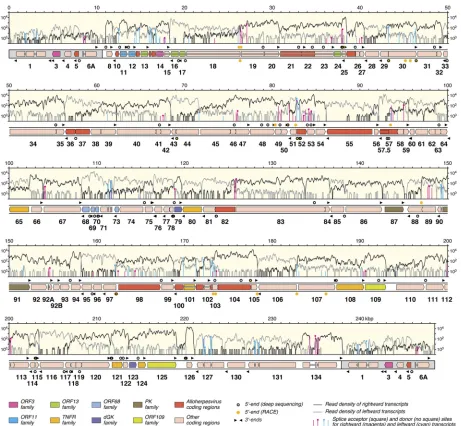
FIG 1Map of the AngHV1 genome showing transcription and splicing of ORFs predicted to encode functional proteins. The terminal direct repeats are shaded gray. ORFs are depicted as color-shaded arrows, with names (lacking the ORF prefix) below. The ORF colors indicate conservation among alloherpesviruses or families of related genes (see the key). Introns connecting spliced ORFs are shown as narrow white bars. The locations of transcript 5=and 3=ends (Tables 2and 3) are marked, rightward above the genome and leftward below. The light-yellow windows contain the transcriptome profile as two traces, separated into rightward (black) and leftward (gray) transcripts. The vertical lines indicate the locations of splice donor and acceptor sites supported by⬎10 reads (Table 1; also see data set S1 [set II] in the supplemental material), divided into rightward (magenta) and leftward (cyan) splicing. The height of each line indicates the number of reads supporting transcription of the splice site, plotted on a log10scale.
on November 7, 2019 by guest
http://jvi.asm.org/
[image:3.585.63.524.63.489.2]RESULTS AND DISCUSSION
Corrections to the AngHV1 genome sequence.
Deep sequencing
of the poly(A) fraction of total infected-cell RNA yielded a data set
of 34,021,601 reads. Initial alignments showed that the published
AngHV1 genome sequence (GenBank accession no.
FJ940765.1
;
248,531 bp) contained four erroneous regions. These were
cor-rected by (i) deletion of ATG at position 82560 to 82562, (ii)
replacement of CC by GT at position 157991 to 157992, (iii)
re-placement of A by T at position 157997, and (iv) deletion of TG at
position 203749 to 203750. Correction (i) is located in ORF51 and
results in the deletion of an amino acid residue from the encoded
protein. Corrections (ii) and (iii) are located in ORF94 and result
in two amino acid substitutions. Correction (iv) is located in
ORF116 and results in a C-terminal extension of the large subunit
of ribonucleotide reductase (
25
). In addition to these errors, six
polymorphisms were detected where the nucleotide in the
pub-lished sequence is in the minority, at positions 35824, 37970,
38114, 38201, 74192, and 150546. The genome sequence was
cor-rected to incorporate the majority variant at five of these
posi-tions. The exception, at 37970, results in an alteration (ATG to
GTG) of the initiation codon of ORF25, which encodes a
ho-molog of interleukin-10 (
25
,
26
). This nucleotide was left as the
minority variant in order to retain the amino acid sequence of
ORF25 in the GenBank file. The corrected AngHV1 genome
sequence (GenBank accession no.
FJ940765.3
; 248,526 bp) was
used in subsequent analyses. A total of 1,786,554 reads in the
data set (5.25%) aligned with this sequence.
AngHV1 transcriptome profile.
The analysis resulted not only
in a corrected AngHV1 genome sequence but also in an updated
genetic map, as described below.
Figure 1
depicts this map aligned
with the transcriptome profile shown as the densities (on a log
10scale) of reads representing rightward and leftward transcription.
Almost all regions of the genome were transcribed, although the
level was low in some (particularly the terminal direct repeat). In
nearly all locations, most transcription corresponded to
expres-sion of predicted protein-coding regions. Indeed, antisense
tran-scripts were rare, amounting to only 1.5% of total transcription
from protein-coding regions. The region containing ORF89 and
ORF90 is exceptional in that antisense transcription was about five
times more abundant than sense transcription. This transcript
(ORF89as) accounted for approximately half of the total amount
of antisense transcription from the genome. However, ORF89as
may not be entirely antisense, as it probably contains ORF91 in its
3
=
portion.
Identification of splice sites in the AngHV1 genome.
The
no-tation (e.g., D
⫹
199826^A
⫹
200193) used below to denote a splice
junction is as follows: D (donor) or A (acceptor),
⫹
(rightward
transcription) or
⫺
(leftward transcription), the nucleotide
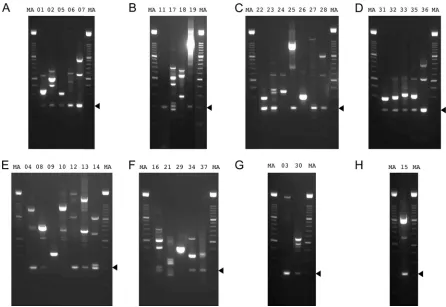
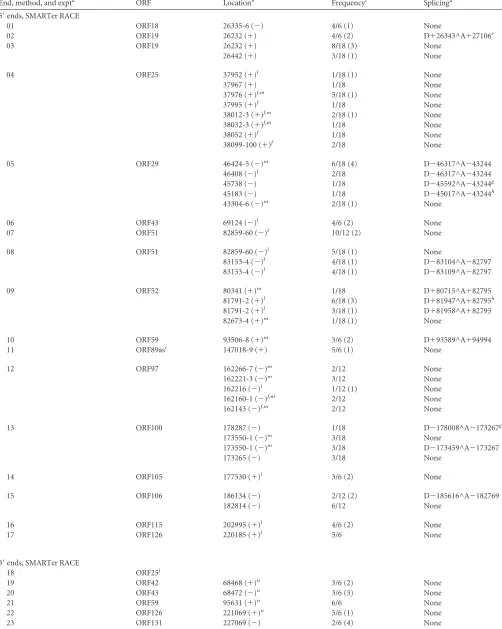
loca-FIG 2RT-PCR products generated from AngHV1 splice junctions supported by⬎10 reads in data set S1 (set II) in the supplemental material and visualized by agarose gel electrophoresis. The lane numbers correspond to the experiments listed in Table S1 in the supplemental material. (A to D) RT-PCR was carried out under standard conditions. (E, F) RT-PCR was carried out using the same primers but under relaxed conditions. (G) RT-PCR was carried out using alternative primers under standard conditions. (H) RT-PCR was carried out under standard conditions using alternative primers, one of which spanned a dominant alternative donor site. Experiment 20 failed under all conditions tried, and data are not shown. “MA” denotes a 100-bp DNA marker ladder with major bands at 500 and 1,000 bp. The 200-bp band, which indicates the region of the gel excised for DNA sequencing, is shown by an arrowhead in each panel.
on November 7, 2019 by guest
http://jvi.asm.org/
[image:4.585.68.514.65.372.2]tions of the exon ends, and ^ (splice junction). The initial splicing
analysis identified 160 potential splice junctions involving 124
do-nor and 64 acceptor sites (see set I in data set S1 in the
supplemen-tal material). Set II (see data set S1) was generated by excluding
probable artifactual junctions from set I, namely, 59 for which the
two cognate genome locations fell within a tandem reiteration and
thus had been mapped ambiguously and 1 for which the two
ge-nome locations were characterized by local repeats (two closely
located 8-bp regions) that may have promoted template switching
during reverse transcription. Set II contains 100 junctions
repre-senting the 92 donor and 52 acceptor sites marked in
Fig. 1
.
All 37 of the splice junctions in set II supported by
⬎
10 reads
were assessed by RT-PCR and sequencing. When amplification
was conducted under standard conditions, the cognate sequences
of 21 junctions were detected, even in instances where a DNA
band was not visible by agarose gel electrophoresis (
Fig. 2A
to
D
).
Decreasing the annealing temperature to 60°C resulted in success
for 12 of the remaining junctions (
Fig. 2E
and
F
). Two junctions
were resolved by using alternative primers shifted 20 bases to the
left or right (
Fig. 2G
) and one by using an alternative primer that
spanned a nearby dominant alternative donor site (
Fig. 2H
). One
junction (D
⫹
104012^A
⫹
104119) was not confirmed in these
ex-periments. Thus, all but one of the junctions in set II that were
supported by
⬎
10 reads were detected by RT-PCR.
[image:5.585.297.546.80.239.2] [image:5.585.43.284.92.709.2]Set III (see data set S1 in the supplemental material) was
generated by excluding junctions (which are not considered
artifactual) from set II that are not associated with in-frame
splicing between predicted protein-coding regions or splicing
of 5
=
untranslated regions (5
=
UTRs) to protein-coding
re-gions. All but two of the excluded junctions (the exceptions
being D
⫺
26117^A
⫺
16702 and D
⫹
199826^A
⫹
200193) were
supported by low proportions of reads in comparison with the
support for unspliced transcripts (data not shown). Set III
con-tains 58 junctions contributed by splicing of 57 donor and 29
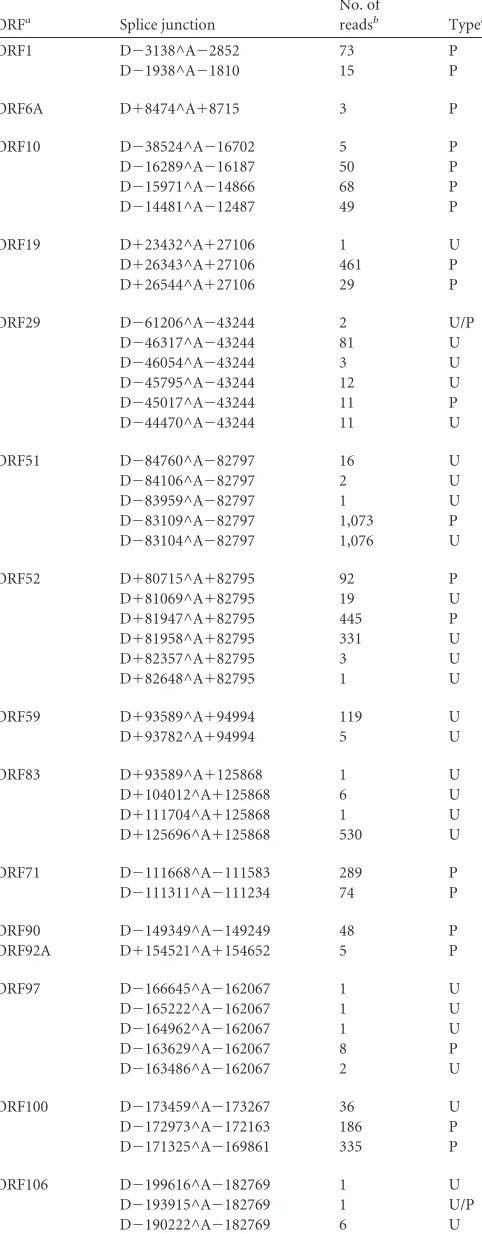
TABLE 1AngHV1 ORFs transcribed by splicing between protein-coding exons or between 5=UTRs and protein-coding exons
ORFa Splice junction
No. of
readsb Typec
ORF1 D⫺3138^A⫺2852 73 P
D⫺1938^A⫺1810 15 P
ORF6A D⫹8474^A⫹8715 3 P
ORF10 D⫺38524^A⫺16702 5 P
D⫺16289^A⫺16187 50 P
D⫺15971^A⫺14866 68 P
D⫺14481^A⫺12487 49 P
ORF19 D⫹23432^A⫹27106 1 U
D⫹26343^A⫹27106 461 P
D⫹26544^A⫹27106 29 P
ORF29 D⫺61206^A⫺43244 2 U/P
D⫺46317^A⫺43244 81 U
D⫺46054^A⫺43244 3 U
D⫺45795^A⫺43244 12 U
D⫺45017^A⫺43244 11 P
D⫺44470^A⫺43244 11 U
ORF51 D⫺84760^A⫺82797 16 U
D⫺84106^A⫺82797 2 U
D⫺83959^A⫺82797 1 U
D⫺83109^A⫺82797 1,073 P
D⫺83104^A⫺82797 1,076 U
ORF52 D⫹80715^A⫹82795 92 P
D⫹81069^A⫹82795 19 U
D⫹81947^A⫹82795 445 P
D⫹81958^A⫹82795 331 U
D⫹82357^A⫹82795 3 U
D⫹82648^A⫹82795 1 U
ORF59 D⫹93589^A⫹94994 119 U
D⫹93782^A⫹94994 5 U
ORF83 D⫹93589^A⫹125868 1 U
D⫹104012^A⫹125868 6 U
D⫹111704^A⫹125868 1 U
D⫹125696^A⫹125868 530 U
ORF71 D⫺111668^A⫺111583 289 P
D⫺111311^A⫺111234 74 P
ORF90 D⫺149349^A⫺149249 48 P
ORF92A D⫹154521^A⫹154652 5 P
ORF97 D⫺166645^A⫺162067 1 U
D⫺165222^A⫺162067 1 U
D⫺164962^A⫺162067 1 U
D⫺163629^A⫺162067 8 P
D⫺163486^A⫺162067 2 U
ORF100 D⫺173459^A⫺173267 36 U
D⫺172973^A⫺172163 186 P
D⫺171325^A⫺169861 335 P
ORF106 D⫺199616^A⫺182769 1 U
D⫺193915^A⫺182769 1 U/P
D⫺190222^A⫺182769 6 U
TABLE 1(Continued)
ORFa Splice junction
No. of
readsb Typec
D⫺186050^A⫺182769 2 P
D⫺185616^A⫺182769 10 U
D⫺183047^A⫺182769 1 U
ORF112 D⫹200109^A⫹200193 79 P
ORF127 D⫺223119^A⫺222990 262 P
D⫺222245^A⫺222143 76 P
ORF131 D⫺228535^A⫺228420 18 P
D⫺228091^A⫺227970 28 P
ORF134 D⫹234296^A⫹234913 338 P
D⫹235104^A⫹235251 133 P
aDerived from data set S1 (set III) in the supplemental material.
b
The numbers of reads in the data set containing a 20-base sequence (10 bases on each side) at the splice junction. These provide estimates of relative abundance of spliced transcripts. Derived from data set S1 (set III) in the supplemental material. cP, splicing between predicted protein-coding exons (5=UTR has appropriate ATG
codon); U, splicing of a 5=UTR to a predicted protein-coding exon (5=UTR lacks appropriate ATG codon); U/P, not determined (5=UTR has appropriate ATG codon but 5=end was not mapped). Derived from the locations of splice sites (Table 1) and 5=
ends (Tables 2 and 3).
on November 7, 2019 by guest
http://jvi.asm.org/
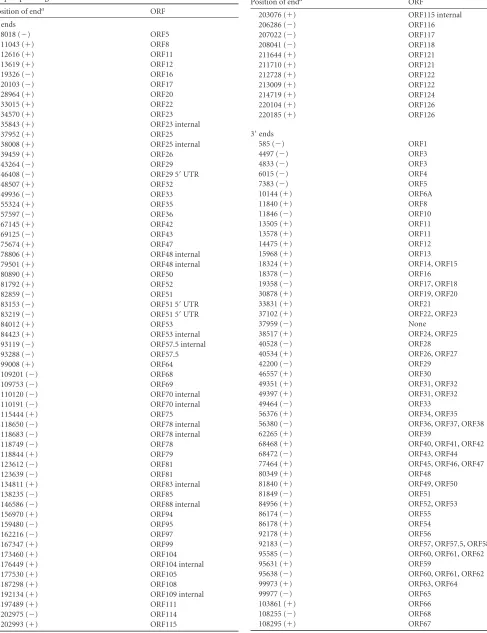
TABLE 2Locations of 5=and 3=ends of AngHV1 RNAs identified by deep sequencing
Position of enda ORF
5=ends
8018 (⫺) ORF5
11043 (⫹) ORF8
12616 (⫹) ORF11
13619 (⫹) ORF12
19326 (⫺) ORF16
20103 (⫺) ORF17
28964 (⫹) ORF20
33015 (⫹) ORF22
34570 (⫹) ORF23
35843 (⫹) ORF23 internal
37952 (⫹) ORF25
38008 (⫹) ORF25 internal
39459 (⫹) ORF26
43264 (⫺) ORF29
46408 (⫺) ORF29 5=UTR
48507 (⫹) ORF32
49936 (⫺) ORF33
55324 (⫹) ORF35
57597 (⫺) ORF36
67145 (⫹) ORF42
69125 (⫺) ORF43
75674 (⫹) ORF47
78806 (⫹) ORF48 internal
79501 (⫹) ORF48 internal
80890 (⫹) ORF50
81792 (⫹) ORF52
82859 (⫺) ORF51
83153 (⫺) ORF51 5=UTR
83219 (⫺) ORF51 5=UTR
84012 (⫹) ORF53
84423 (⫹) ORF53 internal
93119 (⫺) ORF57.5 internal
93288 (⫺) ORF57.5
99008 (⫹) ORF64
109201 (⫺) ORF68
109753 (⫺) ORF69
110120 (⫺) ORF70 internal
110191 (⫺) ORF70 internal
115444 (⫹) ORF75
118650 (⫺) ORF78 internal
118683 (⫺) ORF78 internal
118749 (⫺) ORF78
118844 (⫹) ORF79
123612 (⫺) ORF81
123639 (⫺) ORF81
134811 (⫹) ORF83 internal
138235 (⫺) ORF85
146586 (⫺) ORF88 internal
156970 (⫹) ORF94
159480 (⫺) ORF95
162216 (⫺) ORF97
167347 (⫹) ORF99
173460 (⫹) ORF104
176449 (⫹) ORF104 internal
177530 (⫹) ORF105
187298 (⫹) ORF108
192134 (⫹) ORF109 internal
197489 (⫹) ORF111
202975 (⫺) ORF114
202993 (⫹) ORF115
TABLE 2(Continued)
Position of enda ORF
203076 (⫹) ORF115 internal
206286 (⫺) ORF116
207022 (⫺) ORF117
208041 (⫺) ORF118
211644 (⫹) ORF121
211710 (⫹) ORF121
212728 (⫹) ORF122
213009 (⫹) ORF122
214719 (⫹) ORF124
220104 (⫹) ORF126
220185 (⫹) ORF126
3=ends
585 (⫺) ORF1
4497 (⫺) ORF3
4833 (⫺) ORF3
6015 (⫺) ORF4
7383 (⫺) ORF5
10144 (⫹) ORF6A
11840 (⫹) ORF8
11846 (⫺) ORF10
13505 (⫹) ORF11
13578 (⫹) ORF11
14475 (⫹) ORF12
15968 (⫹) ORF13
18324 (⫹) ORF14, ORF15
18378 (⫺) ORF16
19358 (⫺) ORF17, ORF18
30878 (⫹) ORF19, ORF20
33831 (⫹) ORF21
37102 (⫹) ORF22, ORF23
37959 (⫺) None
38517 (⫹) ORF24, ORF25
40528 (⫺) ORF28
40534 (⫹) ORF26, ORF27
42200 (⫺) ORF29
46557 (⫹) ORF30
49351 (⫹) ORF31, ORF32
49397 (⫹) ORF31, ORF32
49464 (⫺) ORF33
56376 (⫹) ORF34, ORF35
56380 (⫺) ORF36, ORF37, ORF38
62265 (⫹) ORF39
68468 (⫹) ORF40, ORF41, ORF42
68472 (⫺) ORF43, ORF44
77464 (⫹) ORF45, ORF46, ORF47
80349 (⫹) ORF48
81840 (⫹) ORF49, ORF50
81849 (⫺) ORF51
84956 (⫹) ORF52, ORF53
86174 (⫺) ORF55
86178 (⫹) ORF54
92178 (⫹) ORF56
92183 (⫺) ORF57, ORF57.5, ORF58
95585 (⫺) ORF60, ORF61, ORF62
95631 (⫹) ORF59
95638 (⫺) ORF60, ORF61, ORF62
99973 (⫹) ORF63, ORF64
99977 (⫺) ORF65
103861 (⫹) ORF66
108255 (⫺) ORF68
108295 (⫹) ORF67
(Continued on following page)
on November 7, 2019 by guest
http://jvi.asm.org/
acceptor sites. This set, which we infer to be the most likely to
be involved in the expression of functional proteins, is also
listed in
Table 1
. All 30 of the junctions in set III supported by
⬎
10 reads were detected by RT-PCR, as described above.
Identification of 5
=
and 3
=
ends of AngHV1 RNAs.
The set of
5
=
ends shown in
Table 2
was derived by deep sequencing cDNA
libraries I and II, which were generated by using an ExactSTART
kit. Totals of 12,025/22,282,533 and 4,212/10,488,384 reads,
re-spectively, originated from potential 5
=
ends, which were scored
when supported by
⬎
10 reads in library I. The most likely
artifac-tual 5
=
ends would have been caused by mispriming during library
construction and were excluded on the basis of possessing one or
more of the following characteristics: (i) close proximity to the 3
=
end of a highly expressed RNA, (ii) extended (but not necessarily
perfect) complementarity of the 5
=
primer to the genome
se-quence immediately upstream, and (iii) absence from library II
(which utilized an alternative 5
=
primer) in instances where the 5
=
end was highly represented in library I. This resulted in a
conser-vative set of 71 candidate 5
=
ends, one of which is duplicated in the
direct terminal repeat. Of these, 53 are located close to and
up-stream from an ORF, three could serve to initiate a 5
=
UTR spliced
to a protein-coding region (see below), and 15 are located within
ORFs and might generate N-terminally truncated proteins. This
set of 5
=
ends is bound to be incomplete, as the approach favored
short, abundant RNAs. It is also possible that some artifactual
occurrences have been retained.
One of the 5
=
ends located within an ORF was postulated to
define an abundant transcript encoding a distinct function. This
transcript was specified by ORF57.5 (
Fig. 1
), which encodes an
N-terminally truncated form of the ORF57 protein. The argument
for this assignment rests on evidence that ORF57 specifies the
capsid maturation protease (
25
,
27
). The ORF corresponding to
ORF57 in mammalian herpesviruses encodes an internally
initi-ated RNA specifying an abundant protein that lacks the protease
domain and functions as the major capsid scaffold protein. This
nested arrangement is potentially common to all herpesviruses. It
is possible that functional, truncated proteins are encoded by the
other AngHV1 ORFs in which internal 5
=
ends are present, but
there are insufficient data at present to support their annotation.
The set of 3
=
ends of AngHV1 RNAs shown in
Table 2
was
derived from combined deep sequencing data sets from cDNA
libraries I and II and the directional RNA sequencing experiment.
A total of 17,700/66,792,518 reads originated from potential 3
=
ends, which were scored when supported by
ⱖ
1 reads. The most
likely artifactual 3
=
ends were excluded on the basis of possessing
one of the following characteristics: (i) lack of any contributing
reads that fully matched the genome sequence, (ii) being
identi-fied by a single read indicating a 3
=
end that is not located close to
and downstream from an ORF or a canonical poly(A) signal
(AATAAA or ATTAAA), or (iii) being identified by reads
indicat-ing a 3
=
end that is located at a poly(A) tract (
⬎
5 residues) in the
genome and not close to and downstream from a poly(A) signal.
This resulted in a conservative set of 96 candidate 3
=
ends, 7 of
which are duplicated in the direct terminal repeat. All but one of
these are located close to and downstream from a canonical
poly(A) signal, the exception being that for ORF71 (TTTAAA). All
identified ends but one are located appropriately to terminate the
transcription of at least one ORF, as is visibly the case in many
instances from the transcriptome profile (
Fig. 1
). The exception,
at position 37959, is located downstream from a poly(A) signal
but is also adjacent to a poly(A) tract of 7 residues and may be
artifactual.
[image:7.585.42.286.75.574.2]In order to confirm the 5
=
and 3
=
ends mapped by deep
se-quencing (
Table 2
), RACE experiments were carried out by using
an ExactSTART kit and a SMARTer RACE kit. This dual approach
was taken because the ExactSTART kit was used to generate cDNA
libraries for both deep sequencing and RACE, whereas the
SMARTer RACE kit works in a different way.
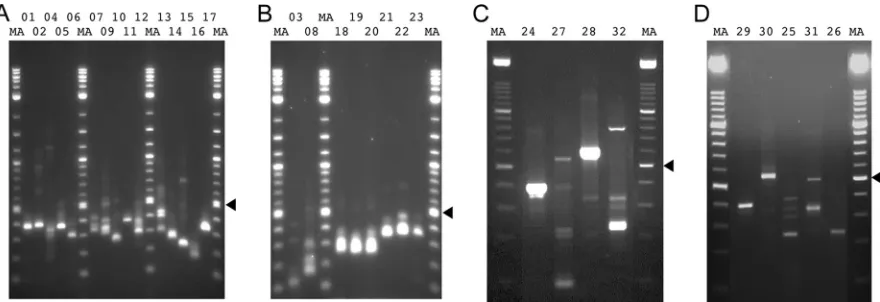
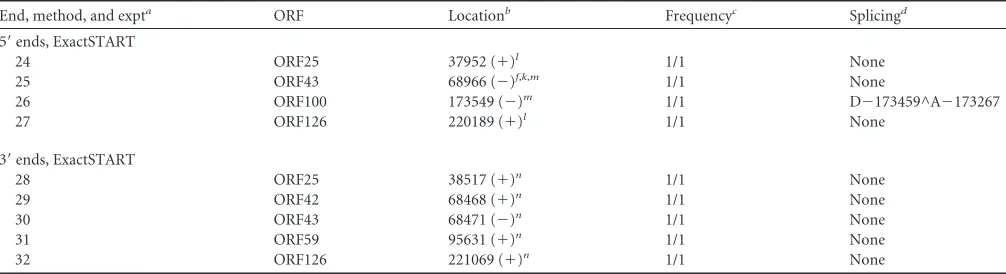
Figure 3
shows the
TABLE 2(Continued)
Position of enda ORF
109204 (⫺) ORF69, ORF70
110348 (⫺) ORF71
111957 (⫺) ORF73, ORF74
116447 (⫹) ORF75
116452 (⫺) ORF76
116518 (⫹) ORF75
116523 (⫺) ORF76
117520 (⫺) ORF77, ORF78
119726 (⫹) ORF79
119734 (⫺) ORF80
122033 (⫺) ORF81, ORF82
136575 (⫺) ORF85
136580 (⫹) ORF83, ORF84
142583 (⫹) ORF86
145080 (⫹) ORF87
145410 (⫺) ORF88, ORF89
148814 (⫺) ORF90
152499 (⫹) ORF91
155002 (⫹) ORF92, ORF92A
155830 (⫹) ORF92B
158201 (⫺) ORF95
158264 (⫹) ORF93, ORF94
159533 (⫺) ORF96
160682 (⫺) ORF97
168795 (⫹) ORF98, ORF99
168802 (⫺) ORF100
171336 (⫹) ORF101
172962 (⫹) ORF102
178357 (⫹) ORF103, ORF104, ORF105
178392 (⫺) ORF106
187348 (⫹) ORF107
190548 (⫹) ORF108
193002 (⫹) ORF109
199700 (⫹) ORF110, ORF111
202302 (⫹) ORF112, ORF113
202307 (⫺) ORF114
203433 (⫹) ORF115
203448 (⫺) ORF116
206376 (⫺) ORF117
206983 (⫺) ORF118
211537 (⫹) ORF119, ORF120
213652 (⫹) ORF121, ORF122
215604 (⫹) ORF123, ORF124
219125 (⫹) ORF125
221069 (⫹) ORF126
221281 (⫺) ORF127
224617 (⫺) ORF130
238020 (⫹) ORF134
a⫹, rightward transcription;⫺, leftward transcription. Duplicates in the direct terminal repeat are not included. Some ends exhibited heterogeneous distribution over closely located nucleotides, and in these instances, the most frequently identified location is listed.
on November 7, 2019 by guest
http://jvi.asm.org/
RACE products that were sequenced, and
Table 3
summarizes the
ends that were identified. The ends mapped by deep sequencing
and RACE show a high degree of concordance.
Of the four 5
=
ends assessed by ExactSTART, those for ORF25
and ORF126 are located at or very close to the positions
deter-mined by deep sequencing. The 5
=
end for ORF100 was not
iden-tified by deep sequencing, and that for ORF43 did not match,
perhaps because the RACE product analyzed was a result of PCR
mispriming. The five 3
=
ends assessed by ExactSTART are located
very close to the positions determined by deep sequencing. The 5
=
ends of nine of the ORFs assessed by SMARTer RACE (ORF25,
ORF29, ORF43, ORF51, ORF52, ORF97, ORF105, ORF115, and
ORF126) are located very close to those determined by deep
se-quencing. Those of the other six (ORF18, ORF19, ORF59,
ORF89as, ORF100, and ORF106) were not detected by deep
se-quencing. The SMARTer RACE experiments indicated that
cer-tain ORFs may have multiple 5
=
ends. Some of these reflect the
occurrence of multiple 5
=
UTRs for certain ORFs, as discussed
below. The possibility that others may also represent alternative,
nonspliced 5
=
ends rather than artifacts is suggested by their
iden-tification among the deep sequencing data (analysis not shown)
but supported by
ⱕ
10 reads and, hence, they are not included in
Table 2
(these occurrences are indicated in
Table 3
). In addition to
indicating the locations of transcript ends, the RACE experiments
also confirmed some of the splicing patterns identified by deep
sequencing, this depending on the locations of the PCR primers.
The 3
=
ends of four of the ORFs identified by SMARTer RACE
(ORF42, ORF43, ORF59, and ORF126) are located very close to
those mapped by ExactSTART and deep sequencing. The 3
=
end of
the poorly expressed ORF131 transcript [with a canonical poly(A)
signal] was detected by SMARTer RACE but not by deep
sequenc-ing, thus bringing the total number of mapped poly(A) sites to 97
(not counting duplicates).
The locations of 5
=
and 3
=
ends are shown in
Fig. 1
, along with
those of splice sites. The structures and sizes of intact RNAs may
be inferred from this information but are not shown because they
are not proven directly by the data.
Spliced AngHV1 genes.
Table 1
lists 11 ORFs that the analysis
implied are expressed by splicing between protein-coding exons,
ORF1, ORF6A, ORF10, ORF71, ORF90, ORF92A, ORF100,
ORF112, ORF127, ORF131, and ORF134. Splicing has been
pre-dicted previously only for ORF10 and ORF100 (
25
). The pattern
in ORF10 (which encodes the putative ATPase subunit of
termi-nase) was confirmed, and that in ORF100 (which encodes a
low-abundance capsid protein [
27
]), was extended by the
confirma-tion of a previously predicted intron and the addiconfirma-tion of another.
Among the remaining ORFs, the proportion of spliced to
un-spliced transcripts is high (these may be estimated from the
num-bers of reads in data set S1 in the supplemental material [set III]
representing the splice junction and donor and acceptor sites), but
in ORF6A and ORF92A, it is not. ORF1 and ORF6A, which are
located in the terminal direct repeat and, hence, are duplicated in
the genome, were transcribed at low levels. The former
incorpo-rates the original ORF1 and ORF2 plus an additional exon, and the
latter replaces the original ORF6 and ORF7, which are located on
the complementary strand. The original ORF72 has been replaced
by an extended, spliced version of ORF71 that is encoded on the
complementary strand and specifies a virion type 1 membrane
protein (
27
). ORF90, which encodes a nucleoside diphosphate
kinase, was found to contain an intron. ORF92A is one of two
additional genes introduced between ORF92 and ORF93, though,
as mentioned above, most transcripts traversing the splice sites are
not spliced. Despite this, the functional ORF92A protein is likely
to be expressed by splicing, since the unspliced transcript lacks an
ATG initiation codon and would not encode the type 1 membrane
protein predicted to be specified by the spliced transcript. ORF112
was originally predicted to consist of a single exon encoding a
protein related to chloride channel CLIC-like 1 protein (
25
) and
has been extended by a second exon. ORF127 incorporates the
original ORF127, ORF128, and ORF129, ORF131 the original
ORF131, ORF132, and ORF133, and ORF134 the original
ORF134 and ORF136, plus an exon that replaces ORF135 on the
complementary strand.
Table 1
also lists nine ORFs that are expressed by splicing from
additional exons at the 5
=
ends of predicted protein-coding
re-gions, ORF19, ORF29, ORF51, ORF52, ORF59, ORF83, ORF97,
ORF100, and ORF106. In most instances, splicing patterns are
complex, with multiple alternative 5
=
exons spliced individually to
the main protein-coding region, a phenomenon that is
reminis-cent of a number of human cytomegalovirus ORFs (
7
).
Table 1
summarizes conclusions on whether particular alternative 5
=
ex-ons are likely to be protein coding (i.e., N-terminally extending
FIG 3RACE products generated from AngHV1 transcripts and visualized by agarose gel electrophoresis. The lane numbers correspond to the experi-ments listed inTable 3and Table S2 in the supplementary material. “MA” denotes a 100-bp DNA marker ladder with major bands at 500 bp (arrowheads) and 1,000 bp. The sizes of the bands analyzed are listed in Table S2 in the supplementary material.
on November 7, 2019 by guest
http://jvi.asm.org/
[image:8.585.73.513.66.217.2]TABLE 3Locations of 5=and 3=ends of AngHV1 RNAs identified by RACE
End, method, and expta ORF Locationb Frequencyc Splicingd
5=ends, SMARTer RACE
01 ORF18 26335-6 (⫺) 4/6 (1) None
02 ORF19 26232 (⫹) 4/6 (2) D⫹26343^A⫹27106e
03 ORF19 26232 (⫹) 8/18 (3) None
26442 (⫹) 3/18 (1) None
04 ORF25 37952 (⫹)l 1/18 (1) None
37967 (⫹) 1/18 None
37976 (⫹)f,m 5/18 (1) None
37995 (⫹)f 1/18 None
38012-3 (⫹)f,m 2/18 (1) None
38032-3 (⫹)f,m 1/18 None
38052 (⫹)f 1/18 None
38099-100 (⫹)f 2/18 None
05 ORF29 46424-5 (⫺)m 6/18 (4) D⫺46317^A⫺43244
46408 (⫺)l 2/18 D⫺46317^A⫺43244
45738 (⫺) 1/18 D⫺45592^A⫺43244g
45183 (⫺) 1/18 D⫺45017^A⫺43244h
43304-6 (⫺)m 2/18 (1) None
06 ORF43 69124 (⫺)l 4/6 (2) None
07 ORF51 82859-60 (⫺)l 10/12 (2) None
08 ORF51 82859-60 (⫺)l 5/18 (1) None
83153-4 (⫺)l 4/18 (1) D⫺83104^A⫺82797
83153-4 (⫺)l 4/18 (1) D⫺83109^A⫺82797
09 ORF52 80341 (⫹)m 1/18 D⫹80715^A⫹82795
81791-2 (⫹)l 6/18 (3) D⫹81947^A⫹82795h
81791-2 (⫹)l 3/18 (1) D⫹81958^A⫹82795
82673-4 (⫹)m 1/18 (1) None
10 ORF59 93506-8 (⫹)m 3/6 (2) D⫹93589^A⫹94994
11 ORF89asi 147018-9 (⫹) 5/6 (1) None
12 ORF97 162266-7 (⫺)m 2/12 None
162221-3 (⫺)m 3/12 None
162216 (⫺)l 1/12 (1) None
162160-1 (⫺)f,m 2/12 None
162143 (⫺)f,m 2/12 None
13 ORF100 178287 (⫺) 1/18 D⫺178008^A⫺173267g
173550-1 (⫺)m 3/18 None
173550-1 (⫺)m 3/18 D⫺173459^A⫺173267
173265 (⫺) 3/18 None
14 ORF105 177530 (⫹)l 3/6 (2) None
15 ORF106 186134 (⫺) 2/12 (2) D⫺185616^A⫺182769
182814 (⫺) 6/12 None
16 ORF115 202995 (⫹)l 4/6 (2) None
17 ORF126 220185 (⫹)l 5/6 None
3=ends, SMARTer RACE
18 ORF25j
19 ORF42 68468 (⫹)n 3/6 (2) None
20 ORF43 68472 (⫺)n 3/6 (3) None
21 ORF59 95631 (⫹)n 6/6 None
22 ORF126 221069 (⫹)n 5/6 (1) None
23 ORF131 227069 (⫺) 2/6 (4) None
(Continued on following page)
on November 7, 2019 by guest
http://jvi.asm.org/
the protein sequence) or noncoding (i.e., forming a 5
=
UTR),
as-suming that translational initiation is restricted to in-frame ATG
codons. The relative abundance of individual spliced transcripts
can be estimated from the number of reads containing the relevant
splice junctions listed in
Table 1
, and the relative abundance of
unspliced transcripts can be estimated from the number of reads
containing the unspliced acceptor sites (see data set S1, set III, in
the supplemental material). The existence of splicing near the 5
=
ends of ORFs does not rule out expression also occurring from
unspliced transcripts, and indeed, this was confirmed for several
ORFs. Below, we present detailed examples of splicing at the 5
=
ends of three ORFs (ORF19, ORF51, and ORF52).
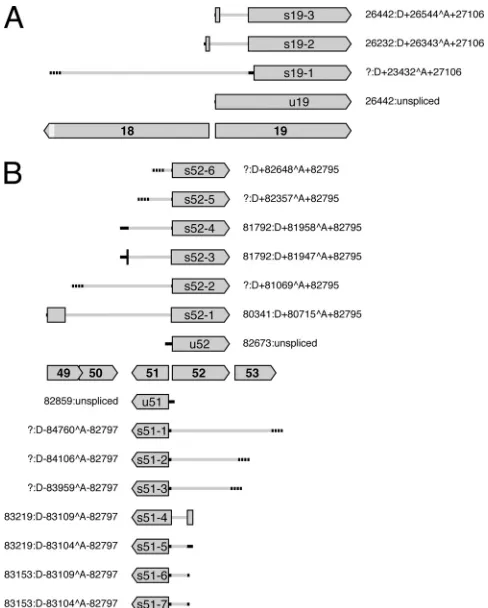
ORF19 encodes an abundant tegument protein (
27
) and is
transcribed divergently with respect to ORF18 (
Fig. 4A
). ORF19
transcripts are 3
=
coterminal with those of ORF20, and ORF18
transcripts are 3
=
coterminal with those of ORF17 (
Table 2
).
ORF19 is expressed in unspliced form and as three spliced forms
(
Tables 1
and
3
and
Fig. 4A
, transcripts u19 and s19-1 to s19-3).
Transcript u19 would be translated into the full-length ORF19
protein. Trancript s19-1 is rare and would generate a truncated
form of the ORF19 protein lacking the first 252 residues.
Tran-script s19-2 is abundant and would be translated into a form of the
ORF19 protein in which residues 1 to 215 are replaced by 24
res-idues specified by a region antisense to the 5
=
region of ORF18.
Transcript s19-3 would be translated into a form of the ORF19
protein from which residues 29 to 215 are absent.
ORF51 encodes an abundant type 3 membrane glycoprotein
(
27
) and is transcribed divergently with respect to ORF52 (
Fig.
4B
), which is conserved among alloherpesviruses (
25
). ORF51
transcripts terminate downstream from the protein-coding
re-gion, and ORF52 transcripts are 3
=
coterminal with those of
ORF53 (
Table 2
). ORF51 is expressed in unspliced form and as
seven spliced forms (
Tables 1
and
3
and
Fig. 4B
, transcripts u51
and s51-1 to s51-7). The unspliced RNA and six of the spliced
transcripts (of which s51-1, s51-2, and s51-3 are rare) would be
translated into the full-length ORF51 protein. Transcript s51-4
would generate a form of the ORF51 protein extended by 55
res-idues, 36 of which are encoded antisense to ORF52. ORF52 is
expressed in unspliced form and as six spliced forms (
Tables 1
and
3
and
Fig. 4B
, u52 and s52-1 to s52-6). The unspliced RNA and
four of the spliced transcripts (of which s52-2, s52-5, and s52-6 are
rare) would be translated into the full-length ORF52 protein.
Transcript s52-1 would generate a form of the ORF52 protein
extended by 123 residues, 116 of which correspond to the N
ter-minus of the ORF49 protein. Transcript s52-3 is abundant and
would generate a form of the ORF52 protein extended by 14
res-idues, 7 of which are encoded by the region between ORF50 and
ORF51.
These examples indicate the potential complexity of protein
expression by a subset of AngHV1 ORFs, with the examples of
ORF19, ORF51, and ORF52 specifying at least four, two, and three
forms differing in their N-terminal sequences.
[image:10.585.41.544.77.214.2]Revision of the genetic map of AngHV1.
The analysis led to
significant revisions of the map of predicted functional
protein-coding regions in the AngHV1 genome, at length implying a total
of 129 genes, 5 of which are duplicated in the terminal direct
repeat (
Fig. 1
). This number does not take into account the effects
of alternative splicing. As described above, corrections to
sequenc-ing errors affected 3 genes, 11 genes were redefined on the basis of
splicing between protein-coding regions, and 4 previously
unrec-ognized genes (ORF6A, ORF57.5, ORF92A, and ORF92B) were
added. Reanalyses (not shown) of the mass spectrometry data
from a previous study (
27
) did not identify ORF6A, ORF92A, or
ORF92B as encoding virion proteins. Eleven previously annotated
TABLE 3(Continued)
End, method, and expta ORF Locationb Frequencyc Splicingd
5=ends, ExactSTART
24 ORF25 37952 (⫹)l 1/1 None
25 ORF43 68966 (⫺)f,k,m 1/1 None
26 ORF100 173549 (⫺)m 1/1 D⫺173459^A⫺173267
27 ORF126 220189 (⫹)l 1/1 None
3=ends, ExactSTART
28 ORF25 38517 (⫹)n 1/1 None
29 ORF42 68468 (⫹)n 1/1 None
30 ORF43 68471 (⫺)n 1/1 None
31 ORF59 95631 (⫹)n 1/1 None
32 ORF126 221069 (⫹)n 1/1 None
a
These numbers correspond to the lane numbers in Fig. 3 and the experiment numbers in Table S2 in the supplemental material.
bThe most frequently detected genome coordinate is shown; (⫹), rightward transcription; (⫺), leftward transcription. Ambiguity is due to the SMARTer RACE method. c
Number of plasmids that supported the location/total number sequenced. Parenthetical numbers are the number of additional plasmids from which ends were mapped within a few nucleotides.
d
D, donor site; A, acceptor site;⫹, rightward transcription;⫺, leftward transcription; ^, splice junction. ePredicted to replace the N-terminal portion of the full-length protein.
f
Downstream from the first ATG codon. For ORF25, truncated proteins would lack a signal peptide. gDonor site not detected by deep sequencing.
h
Predicted to extend the N-terminal portion of the annotated protein. iAntisense to ORF89 and ORF90.
j
No viable bacterial clones were obtained. kA probable artifactual product was analyzed.
l
Candidate 5=end also identified from deep sequencing at or within a few nucleotides, supported by⬎10 reads in library I and included in Table 2. mCandidate 5=end also identified from deep sequencing at or within a few nucleotides, supported byⱕ10 reads in library I and excluded from Table 2.
n
Candidate 3=end also identified from deep sequencing at or within a few nucleotides, and included in Table 2.
on November 7, 2019 by guest
http://jvi.asm.org/
genes were deleted (ORF2, ORF6, ORF7, ORF9, ORF72, ORF128,
ORF129, ORF132, ORF133, ORF135, and ORF136). In addition,
the 5
=
ends of 12 ORFs were amended, and information on
pre-dicted protein characteristics and functions was updated in the
GenBank accession.
Concluding remarks.
Our analysis provides the first
high-res-olution view of poly(A) transcripts generated by an
alloherpesvi-rus at a time during infection when virions are being produced.
This will provide a firmer foundation for work on AngHV1 than
was available solely from bioinformatic analysis of the genome
sequence. One important finding is that splicing is more common
in AngHV1 than had been predicted. In particular, it is possible
that alternative expression patterns at the 5
=
ends of several ORFs
provide subtlety in transcriptional control and add to protein
di-versity. A similar situation pertains to human cytomegalovirus at
this stage during infection (
7
).
Overall, the AngHV1 transcriptome profile closely matches the
locations of predicted functional protein-coding regions. This is
in contrast to mammalian herpesviruses, where RNAs that are
predicted not to encode functional proteins contribute
signifi-cantly (
7
,
10
,
12
,
14
,
31
,
32
). Some of these apparently noncoding
poly(A) RNAs occupy regions of the genome that are dedicated to
their synthesis and are therefore likely to be functional. Others are
transcribed antisense to recognized ORFs and, if functional,
would indicate the dual use of genomic sequences. We found no
examples of dedicated noncoding poly(A) RNAs in AngHV1, and
antisense transcripts are rare. This finding possibly indicates that
mammalian herpesviruses are functionally more complex than
alloherpesviruses. The extent to which this is the case, especially in
regard to antisense transcription, is a matter of great interest that
remains to be elucidated.
ACKNOWLEDGMENTS
This study received financial support from the Dutch Ministry of Eco-nomic Affairs, Agriculture and Innovation and from the UK Medical Re-search Council.
We thank Ineke Roozenburg and Michal Voorbergen-Laarman (Cen-tral Veterinary Institute [CVI] of Wageningen UR) for technical assis-tance in cell and virus culture, José Harders-Westerveen (CVI) for tech-nical assistance in cloning and sequencing, and Ruddy Wattiez for performing reanalyses of published mass spectrometry data from AngHV1 virions in light of the updated genome map.
REFERENCES
1.Aoki T, et al.2007. Genome sequences of three koi herpesvirus isolates representing the expanding distribution of an emerging disease threaten-ing koi and common carp worldwide. J. Virol.81:5058 –5065.
2.Chen SN, Ueno Y, Kou GH.1982. A cell line derived from Japanese eel (Anguilla japonica) kidney. Proc. Natl. Sci. Counc. Repub. China B6:93– 100.
3.Davison AJ.1992. Channel catfish virus: a new type of herpesvirus. Vi-rology186:9 –14.
4.Davison AJ, Cunningham C, Sauerbier W, McKinnell RG.2006. Ge-nome sequences of two frog herpesviruses. J. Gen. Virol.87:3509 –3514. 5.Davison AJ, Davison MD.1995. Identification of structural proteins of
channel catfish virus by mass spectrometry. Virology206:1035–1043. 6.Dishon A, Davidovich M, Ilouze M, Kotler M. 2007. Persistence of
cyprinid herpesvirus 3 in infected cultured carp cells. J. Virol.81:4828 – 4836.
7.Gatherer D, et al.2011. High-resolution human cytomegalovirus tran-scriptome. Proc. Natl. Acad. Sci. U. S. A.108:19755–19760.
8.Haenen OLM, et al.2002.Herpesvirus anguillae(HVA) isolations from disease outbreaks in cultured European eel,Anguilla anguillain the Neth-erlands since 1996. Bull. Eur. Assoc. Fish Pathol.22:247–257.
9.Haenen OLM, et al.2010. The health status of European silver eels,Anguilla anguilla, in the Dutch River Rhine Watershed and Lake IJsselmeer. Aquacul-ture309:15–24.
10. Hitt MM, et al.1989. EBV gene expression in an NPC-related tumour. EMBO J.8:2639 –2651.
11. Huang S, Hanson LA.1998. Temporal gene regulation of the channel catfish virus (Ictalurid herpesvirus 1). J. Virol.72:1910 –1917.
12. Johnson LS, Willert EK, Virgin HW.2010. Redefining the genetics of murine gammaherpesvirus 68 via transcriptome-based annotation. Cell Host Microbe7:516 –526.
13. Kunec D, Nanduri B, Burgess SC.2009. Experimental annotation of channel catfish virus by probabilistic proteogenomic mapping. Proteom-ics9:2634 –2647.
14. Lacaze P, et al.2011. Temporal profiling of the coding and noncoding murine cytomegalovirus transcriptomes. J. Virol.85:6065– 6076. 15. Li H, Ruan J, Durbin R.2008. Mapping short DNA sequencing reads and
calling variants using mapping quality scores. Genome Res.18:1851–1858. 16. Michel B, et al.2010. The genome of cyprinid herpesvirus 3 encodes 40
proteins incorporated in mature virions. J. Gen. Virol.91:452– 462. 17. Milne I, et al.2010. Tablet—next generation sequence assembly
visual-ization. Bioinformatics26:401– 402.
18. Pellett PE, et al.2011.Herpesvirales, p 99 –107.InKing AMQ, Adams MJ, Carstens EB, Lefkowitz EJ (ed), Virus taxonomy, ninth report of the In-ternational Committee on Taxonomy of Viruses. Elsevier Academic Press, London, United Kingdom.
FIG 4Diagram illustrating splicing patterns at the 5=ends of ORF19 (A) and ORF51 and ORF52 (B) and their predicted effects on protein expression. Protein-coding regions are shaded gray, with names (lacking the ORF prefix) in bold type. ORF18 is shortened near its 3=end, as depicted by the lighter gray shading. 5=UTRs in unspliced transcripts (u19, u51, and u52) and spliced transcripts (s19-1 to s19-3, s51-1 to s51-7, and s52-1 to s52-6) are shown by solid or broken black lines, the former where 5=ends were mapped and the latter where they were not. Introns are depicted as gray lines. Transcripts s19-2, s19-3, s51-4, s52-1, and s52-3 contain two protein-coding exons, whereas other transcripts contain one. Each set of coordi-nates indicates the location of the 5=end (a question mark denotes lack of data), followed by the intron location or a description as unspliced. The 3=regions of transcripts are not shown.
on November 7, 2019 by guest
http://jvi.asm.org/
[image:11.585.41.285.65.369.2]19. Rosenkranz D, et al.2008. Identification of envelope protein pORF81 of koi herpesvirus. J. Gen. Virol.89:896 –900.
20. Sano M, Fukuda H, Sano T.1990. Isolation and characterization of a new herpesvirus from eel.InPerkins FO, Cheng TC (ed), Pathology in marine sciences, 1st ed, p 15–31. Academic Press, San Diego, CA.
21. Silverstein PS, Bird RC, van Santen VL, Nusbaum KE.1995. Immedi-ate-early transcription from the channel catfish virus genome: character-ization of two immediate-early transcripts. J. Virol.69:3161–3166. 22. Silverstein PS, van Santen VL, Nusbaum KE, Bird RC.1998. Expression
kinetics and mapping of the thymidine kinase transcript and an immedi-ate-early transcript from channel catfish virus. J. Virol.72:3900 –3906. 23. Stingley RL, Gray WL.2000. Transcriptional regulation of the channel
catfish virus genome direct repeat region. J. Gen. Virol.81:2005–2010. 24. Stingley RL, Griffin BR, Gray WL. 2003. Channel catfish virus gene
expression in experimentally infected channel catfish,Ictalurus punctatus
(Rafinesque). J. Fish Dis.26:487– 493.
25. van Beurden SJ, et al.2010. Complete genome sequence and taxonomic position of anguillid herpesvirus 1. J. Gen. Virol.91:880 – 887.
26. van Beurden SJ, et al.2011. The alloherpesviral counterparts of
interleu-kin 10 in European eel and common carp. Fish Shellfish Immunol.31: 1211–1217.
27. van Beurden SJ, et al.2011. Identification and localization of the struc-tural proteins of anguillid herpesvirus 1. Vet. Res.42:105.
28. van Beurden SJ, et al.2011. Development and validation of a two-step real-time RT-PCR for the detection of eel virus European X in European eel,Anguilla anguilla. J. Virol. Methods171:352–359.
29. Vanderheijden N, Hanson LA, Thiry E, Martial JA. 1999. Channel catfish virus gene 50 encodes a secreted, mucin-like glycoprotein. Virology
257:220 –227.
30. van Nieuwstadt AP, Dijkstra SG, Haenen OLM.2001. Persistence of herpesvirus of eelHerpesvirus anguillaein farmed European eelAnguilla anguilla. Dis. Aquat. Organ.45:103–107.
31. Xu Y, Ganem D.2010. Making sense of antisense: seemingly noncoding RNAs antisense to the master regulator of Kaposi’s sarcoma-associated herpesvirus lytic replication do not regulate that transcript but serve as mRNAs encoding small peptides. J. Virol.84:5465–5475.
32. Zhang G, et al.2007. Antisense transcription in the human cytomegalo-virus transcriptome. J. Virol.81:11267–11281.
on November 7, 2019 by guest
http://jvi.asm.org/