© Office for Students 2019
Written by Robin Mellors-Bourne and Keith Williams Careers Research & Advisory Centre (CRAC)
Careers Research & Advisory Centre (CRAC) Ltd 22 Signet Court
Cambridge CB5 8LA
Contact: Robin Mellors-Bourne Director, Research & Intelligence
[email protected] Tel: 01223 460277
www.crac.org.uk www.vitae.ac.uk
Contents
1 Executive summary ... 1
Background ... 1
Overall findings ... 1
Emerging issues ... 3
2 Context and introduction ... 5
2.1 Background ... 5
2.2 Engineering and computing conversion masters pilots scheme ... 6
3 Evaluation aims and methodology ... 8
4 Institutions’ approaches and models ... 11
4.1 Approaches to conversion and course development ... 11
4.2 Case studies ... 14
5 Outputs – courses and participation ... 23
5.1 Courses launched ... 23
5.2 Enrolments ... 25
5.3 Course participants ... 28
5.4 Student trajectories and rationales for participation ... 34
6 Experiences and outcomes ... 42
6.1 Students’ experiences of the courses ... 42
6.2 Student outcomes and next steps ... 45
6.3 Institutional reflections on teaching and learning ... 48
6.4 Wider institutional benefits ... 49
7 Overall findings and issues ... 51
7.1 Key evaluation findings ... 51
7.2 Emerging issues ... 53
7.2.1 Projections, timing of course launches and marketing ... 53
7.2.2 Delivery experiences and the feasibility of conversion ... 55
7.2.3 Accreditation ... 56
7.3 Recommendations ... 57
1 Executive summary
Background
In 2015 the Department for Business, Innovation & Skills and the Higher Education Funding Council for England (HEFCE), augmented by the Department for Culture, Media and Sport, made funds available to English higher education (HE) institutions to develop pilot conversion courses at Masters level in engineering, data science, cybersecurity and computing. The aim was to explore whether conversion courses at this level could contribute to increasing the number and diversity of highly-skilled graduates entering careers in engineering- and computing-related sectors. There were 28 successful bids which together proposed development of 45 conversion MSc courses, either as new provision (in most cases) or enhancement of existing provision. Funding was essentially catalytic with institutions making additional contributions to development costs.
CRAC has carried out an evaluation of the institutions’ activities under this funding. A genuine summative evaluation would aim to assess the extent to which these conversion courses delivered an increase in the number and diversity of graduates successfully pursuing technical or professional careers in these areas but would require longer-term measures beyond the timeframe of the research. However, in the limited timeframe available it has proven possible to provide a range of early insights into potential outcomes from the scheme. Formative evaluation work was also conducted to support the institutions’ development work and share with others the learning and experiences that were emerging. This document is the final report of the evaluation study.
Overall findings
The engineering- and computing-related pilot conversion courses scheme has been at least partially successful in terms of achieving a range of its intended outputs and there are some signals aligned with potential intended longer-term outcomes:
All but one of the funded institutions that proposed to do so have developed, validated and made available new MSc conversion courses on engineering, computing or data science themes (between them 41 new courses), while others that sought funding to broaden intakes to existing MSc provision have achieved that to some extent;
A total of 31 new courses are actively being delivered to enrolled students in the 2018/19 year – 21 in engineering, six in computing and four in data science;
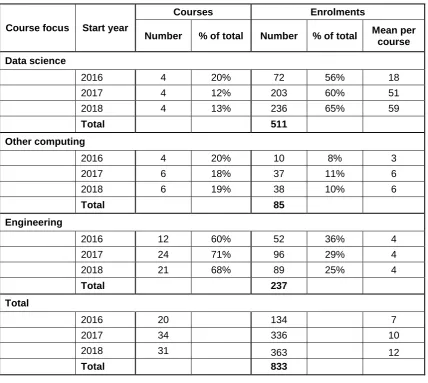
A total of 833 students are recorded to have enrolled in this provision to date, of which over 500 have studied data science courses, just over 230 engineering courses and almost 90 other computing-related courses. The total for engineering includes an estimate of additional conversion students enrolled in pre-existing MSc provision as a result of enhancement activity funded through the scheme;
The number of students starting these courses in 2018/19 was 363, the highest of the three years spanned by this evaluation, suggesting that there continues to be some growth in student participation;
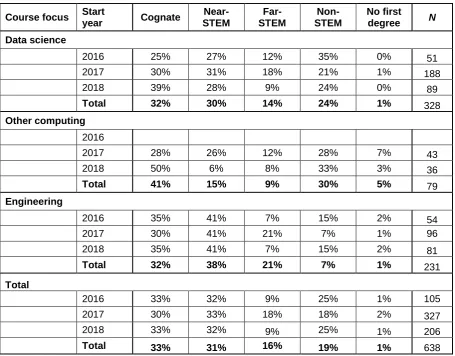
subjects (such as physics or maths) to ‘Non-STEM’ subjects, with a range of mixes in different cohorts;
60% of the students to date have been of UK domicile, which is higher than the proportion in most existing UK provision in these disciplines. Even when one particularly large course, comprising mostly UK domiciles studying part-time, is excluded, the proportion remains significantly higher than the norm;
There was no evidence that the diversity (in terms of gender or ethnicity) of students on the new courses was substantially different to that of typical cohorts of existing UK provision in these disciplines;
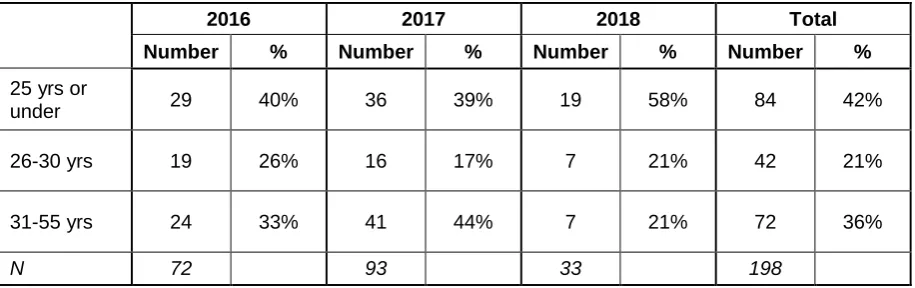
In all, over one third were mature students (over 30 years old), with evidence that many were returning to HE study to up-skill or re-skill, some of whom studied part-time while in employment. This was the case for three quarters of those studying data science or other computing-related courses (i.e. they were ‘returners’ rather than having progressed directly after a first degree), whereas over half of those studying an engineering conversion course did so immediately after their first degree. Very few of either group (<5%) had been unemployed before the course;
Average cohort sizes for data science courses have grown very strongly while for engineering and other computing topics, including cybersecurity, cohorts have been very modest in size and in many cases have not yet reached financial sustainability (although this may be congruent with the slow growth pattern of many new MSc courses);
Based on the available evidence to date, the vast majority of enrolled students are progressing to the end of their course, successfully completing and obtaining their degrees;
It is too early for robust assessment of long-term outcomes of the scheme, in terms of impact on entry to engineering/computing careers. However, on the basis of students’ anticipated next steps after completion, up to 90% of participants indicated an intention that was aligned with the broad purpose of the funding scheme (and most of those who did not were still undecided about their next step). These intentions were largely borne out in the very modest number of responses from graduates who had completed their course;
A range of course delivery approaches (including both full-time and part-time models) have been deployed, mostly using a combination of newly developed and existing modules along with provision of some additional support for conversion students. A number of new flexible learning resources developed to support students from varying backgrounds are being used not only in teaching of the new courses as they evolve, but also in some cases to enhance other pre-existing provision;
Broadly, we infer that much of this new provision could become sustainable in future years, subject to sustained effort to promote the courses leading to further growth in enrolments. Mixed cohorts, comprising both cognate and conversion students, and UK and international students, are likely to be required for financial sustainability.
Several of the data science courses developed have achieved large numbers of students very quickly, thought in large part to be due to current perceptions of very healthy career prospects for those qualified in this area. This success suggests that graduates are basing decisions to undertake further study on perceptions of labour market potential. Many used a new conversion course to re-skill or up-skill from existing employment.
A range of additional outcomes also ensued from the development work funded by the project, including a rise in the level of awareness within some institutions of the concept of conversion. This has resulted in some widening of intake to existing MSc provision and additional conversion-style provision being postulated in other disciplines. Conceptually, conversion appears to be feasible based on teaching that is either bespoke to conversion students or comprises an introductory module to underpin study of existing MSc teaching, together with additional support on a personalised basis.
Institutions are beginning to use of some of the new modules created more widely, along with the more personalised approaches to learning and student support developed, in their other programmes. Much MSc provision involves sharing modules between different courses, so there is scope for the new modules and content to be used widely.
Emerging issues
Aside from the data science courses, which have exceeded student enrolment expectations, the majority of new engineering- and computing-related courses have not secured the number of students projected in funding proposals. This was partly due to delays in the timing of course launches, as around half of the institutions were unable to develop new provision and have it validated quickly enough for marketing and launch for 2016/17 delivery. To some extent this related to some mismatch between the timing of scheme funding and the conventional cycle of course development and launch, in addition to over-optimism. Most institutions are now in the second or third cycle of delivery so there has now been time for implementation of the full range of conventional marketing activities. On this basis, the slow growth of the new courses could reflect very modest demand from graduates for conversion courses in engineering and some areas of computing, or a lack of awareness of this type of provision, or lack of perception of a strong labour market, unlike in data science. More generally, anecdotal evidence from institutions suggested that it could also reflect low awareness of the idea that a postgraduate conversion course could enable career change or the up-skilling needed to enter a chosen career.
2 Context and introduction
2.1 Background
Irrespective of their political hue, UK governments have for several decades persistently sought expansion in the number of people who study science, technology, engineering and maths (STEM) subjects in higher education (HE). This is principally to satisfy an evolving labour market that is believed progressively will require higher levels of skills and serve industrial sectors that are increasingly knowledge- and technology-focused. Recent growth in participation in HE in the UK has resulted in an increased number of STEM graduates emerging from education but they do not all enter STEM industries or occupations as their skills are also valuable in other sectors.1 Despite that growth in the number of STEM
graduates in the UK, policies seek further increases.
Employers and professional bodies in engineering continue to report skills shortages in the UK engineering sector, including at high skill levels. Engineering UK, for example, considers that a substantial proportion of the estimated 2.6 million job openings in engineering predicted in the decade 2014-2024 will require graduate-level skills, but that the current rate of supply of engineering graduates is insufficient to fill this need.2 It predicts annual shortfalls
of tens of thousands of STEM graduates per year, to satisfy new and replacement demand for labour within engineering and related sectors. Paradoxically, this is not always necessarily evident at the point of graduate recruitment, at least into larger engineering firms, where applications are reported to remain healthy and competitive.3
Engineering UK’s broad view of an overall skills shortfall was endorsed in the current government’s Industrial Strategy4 and 2018 was designated ‘The year of engineering’ in a
campaign to promote engineering in all its respects. At a more specific level, trends of supply and demand vary within different sectors and sub-sectors in engineering and other STEM-related industries. Some sectors can experience rapid surges in demand as a result of sudden maturation or deployment of a particular technology and/or growth in a particular market. The Industrial Strategy recognised cybersecurity, artificial intelligence and data science as three aspects of the information technology (IT) sector that are currently experiencing rapid growth. It seeks an increase in the extent and level of computing skills so that the UK can take advantage of that growth; amongst the recommendations were new policies to develop higher level digital skills, including changes to educational curricula.5
To date, one of the main strategies in response to graduate-level skill shortages has been to try to increase the number of people leaving secondary education with the STEM qualifications that enable progression to HE to read a first degree in a STEM subject (who will become the graduates capable of transition into STEM employment). However, increasingly, it is realised that fulfilment of the demand for high-level skills in engineering or IT/computing, as examples, will require not only more new engineering or computing/IT graduates to enter from education but also other new entrants to these sectors. The potential
1STEM graduates in non-STEM jobs, BIS Research Paper 30, 2011 2Engineering 2017 – The state of engineering, Engineering UK, 2017
3Engineering employer graduate recruitment practice: Investigating barriers to diversity, Royal Academy of
Engineering (in press)
4Industrial Strategy: Building a Britain fit for the future. HM Government, 2017
for intersectoral mobility is therefore increasingly visible in policy, i.e. the movement of existing STEM graduates – working in other sectors or not currently in the labour market – into these target sectors. In many cases, this will require some re-skilling and/or up-skilling of graduates who are existing employees or returners to work. A National Retraining Scheme has been proposed to trial approaches to up-skill adults, which has a focus on the digital and construction sectors, while STEM skills feature prominently in pilot projects under the ‘Returners Fund’ which seeks to bring skilled people back into the labour market.6
One such pathway which could increase the total flow of graduates into the engineering- and computing-related sectors could be through ‘conversion’ courses at postgraduate (PG) level, which could provide an entry mechanism for those who studied first degrees in other disciplines. Such students could be recent first-degree graduates who have not yet entered the labour market long-term, who recognise that their career prospects could be better if they had an engineering or computing PG qualification rather than just their current first degree. Alternatively, they could be graduates seeking a return to HE study after a period in the labour market as a strategy to re-skill to upgrade their career or to change sector.
A further angle of interest in such a pathway is diversity. The under-representation of women in engineering has been an issue of concern to the sector for decades. As highlighted by former Department for Business, Innovation and Skills (BIS)7 Chief Scientist John Perkins,8
widening the gender and ethnicity profile of entrants to engineering occupations would be beneficial in trying to increase the total flow of skills. The same applies to IT/computing. It has been noted that the gender profile of PG engineering courses is somewhat more balanced (roughly one in three or four are women) than for undergraduate courses (where around one in eight of students are female).
Recent research has revealed that employment outcomes for UK engineering first-degree graduates of ethnic minority background are weaker than for comparable white graduates, and that this differential appears to be greater for engineering graduates than across all graduates as a whole.9 There is also concern to increase the proportion of entrants from less
advantaged socio-economic backgrounds.10 It is possible that an additional PG route into the
engineering or IT/computing labour force could contribute positively to efforts to diversify these sectors.
2.2 Engineering and computing conversion masters pilots scheme
In December 2014, the Government’s Science and Innovation Strategy invited the Higher Education Funding Council for England (HEFCE)11 to support HE institutions to develop andpilot PG engineering conversion courses for non-engineering graduates. Subsequent research identified certain engineering sub-sectors where an enhanced supply of graduates through specific conversion courses would be particularly welcome, including agricultural
6Industrial Strategy: op cit.
7 Subsequently the Department for Business, Energy & Industrial Strategy
8Professor John Perkins’ Review of Engineering Skills, BIS, 2013
9Employment outcomes of engineering graduates: key factors and diversity characteristics, CRAC report for Royal Academy of Engineering, 2016
10 Royal Academy of Engineering Graduate Engineering Engagement Programme:
https://www.raeng.org.uk/policy/diversity-in-engineering/employers/graduate-engineering-engagement-programme
engineering, additive manufacturing and civil engineering.12 It confirmed that some
conversion MSc courses already existed in engineering which were targeting graduates from maths and physics – degree disciplines from which graduates might most readily ‘convert’ – but proposed that additional provision could support a wider range of STEM graduates to convert to engineering.
Funding was made available to HE institutions by BIS and HEFCE in autumn 2015 to support development of pilot conversion courses in engineering, augmented by Department for Culture, Media and Sport (DCMS) funds to extend this to data science, cybersecurity and software engineering. The focus for this specific data science theme was the computing and analytical science that underpins ‘big data’ – an area of very rapid growth and high demand for skills, highlighted in the Industrial Strategy, across a multitude of industry sectors.
A total of 28 bids to the fund were successful, mostly from individual HE institutions but in a few cases from institutional collaborations. Between them they proposed development of 45 conversion MSc courses, either as wholly new provision (in most cases) or enhancement of existing provision. The funding was essentially catalytic (generally around £50,000 per project) so most institutions contributed significantly themselves to development costs. CRAC was appointed in 2016 to conduct an evaluation of institutions’ development and provision of proposed conversion courses, and to provide some initial assessment of the extent to which this approach might contribute to increasing the number and range of highly skilled graduates in careers in engineering- and computing-related areas. In order to accommodate both recent graduates emerging from HE and potentially the re-skilling or up-skilling of graduates already in employment, institutions were encouraged to consider a range of delivery approaches and modes, including full-time (FT), part-time (PT) and distance learning. Informed by the development trajectories of many participating institutions, the duration of our evaluation project was subsequently extended by a year, to end on 31 December 2018, from its originally anticipated period (summer 2016 to December 2017). This document is the final report of our evaluation work.
3 Evaluation aims and methodology
In our original proposal to HEFCE for this evaluation project, we recognised that there would be benefit in both formative and summative aspects to the work. A very simple logic model for impacts of the scheme identifies that from the project inputs (essentially the funding that allowed courses to be designed and developed), there were a range of outputs (relating to the courses that were developed and provided by the institutions and the students participating on them) and potential longer-term project outcomes (more graduates working in engineering- or computing-related occupations and careers as a result of their participation on the courses). The main aims of the study were:
In relation to project outputs:
o To understand how institutions developed and delivered courses under the scheme and the educational approaches they took to develop the desired skills and knowledge;
o To capture and share effective educational innovation and practice across the scheme;
o To understand how institutions marketed the courses and which types of graduate they targeted, and how well it worked in terms of recruiting participants onto the new courses;
o To observe how the conversion courses worked in practice, from the point of view of course leaders and students;
o To assess the ‘success’ of the courses in terms of the number of student enrolments (i.e. participants in this new provision);
o To identify the profile of participants on the new courses (to assess the potential contribution of these courses to widening access to engineering- and computing-and related careers, including ‘returners’ to study from later career stages).
In relation to outcomes of the scheme (that were potentially observable within the timeframe of the evaluation):
o To understand whether students successfully completed their courses and obtained the resultant qualifications:
o To obtain any insights available into participants’ subsequent career-related decisions and employment outcomes;
o To assess the extent to which institutions would sustain this provision beyond the period of funding of the scheme;
o To make some initial predictions of the potential impact of PG conversion courses in terms of a response to skills gaps or shortages in the relevant sectors, and/or suggest how this might be monitored in the longer term.
o To highlight any other impacts observed within the operation of the scheme including the potential for related developments;
o To provide recommendations for the HE sector and institutions about future provision of conversion courses, and how they might be developed, targeted, marketed and delivered.
Three main sources of information were available to the evaluation project: the proposal documents and progress reports submitted by the institutions to HEFCE in relation to their participation in the scheme; the institutions themselves (through course leaders and other staff involved in developing the courses); and participants on the conversion courses. The research methodology selected was based around these three potential sources but was also specifically designed to maximise opportunities for institutions to share their learning during the scheme.
Desk research was undertaken initially to study the proposals submitted by the institutions to HEFCE for funding under the scheme, to understand the approach they planned to undertake, their target market and the outcomes they had projected (in terms of courses they intended to develop and subsequently numbers and types of student participating on them).
The institutions were split into three groups, each of which was allocated to a member of our research team. During summer 2016, our researchers visited each institution to conduct detailed interviews and discussions with course leaders and other staff involved. This provided us with greater insight into their plans and, especially, more understanding of the approaches they were taking in practice and the context within which they were taking place, as well as the progress being made. These visits were followed by periodic planned contact by telephone or Skype, across the lifetime of the evaluation (roughly 2.5 years). Information was also drawn from monitoring forms and final reports completed by institutions submitted to HEFCE in December 2016 and autumn 2017, respectively. We also requested specific information about student enrolments on an annual basis. It was notable that the alacrity with which some course leaders engaged with us waned somewhat over time, particularly beyond the period of HEFCE funding. In some cases, institutions engaged consultants to lead the project design and implementation, so termination of their contracts at the end of the funding resulted in a lack of continuity of contact with potential key informants. We do not believe that this reflected any lack of enthusiasm in developing the new course provision, but more that they were already expending a lot of personal time and effort running the courses (and providing additional support to some students) and struggled to prioritise the additional tasks we asked of them. We were interested to note one senior HE staff member’s comment that the amount of monitoring and information that we were seeking from them in relation to income of £50,000 was more than they had to divulge for monitoring of other grants in excess of a million pounds in value.
insights from marketing and development strategies, from both those who had launched courses and those who were yet to do so at that point.
The workshops were very well attended, with 20 institutions represented (through 29 staff) at the first and 25 institutions (32 staff) at the second. The workshop programmes were based on facilitated, thematic round-table discussions. Discussion points were then synthesised into summary outputs which were circulated to participants and those unable to attend. Although institutional contacts were asked to report certain characteristics of the students who enrolled on their pilot courses, this provided less complete information than we had originally envisaged. Course leaders in many cases did not have ready access to some details about their students, as these were retained centrally within their institutions – within the function which presumably generates data returns to the Higher Education Statistics Agency (HESA), and/or the admissions or marketing departments. In particular, key information for this project was the discipline of a student’s first degree but this was not available at department level and would need to be retrieved from individuals’ application forms, which are held in admissions departments. The extent and depth of information about students we gained from this type of reporting was therefore somewhat variable, although comprised a key aspect of our monitoring of participation.
In addition, we wanted to investigate independently with the students who they were, their motivations and, where possible, at a later stage their experiences and outcomes. Online surveys for students (referred to here as ‘participants’) were undertaken annually in October 2016, 2017 and 2018, targeting students who enrolled on newly launched courses (or subsequent delivery) in those academic years. In addition, further surveys were conducted in October 2017 and 2018 which specifically targeted students who were completing their courses and/or had just graduated (‘completers’), to gain any insights possible into their experiences, outcomes and next steps, to assess potential future career impacts at an individual level. Response numbers to the surveys were in all cases modest, not least because the total number of students that could be surveyed was very modest, especially in the first year of delivery. This had a knock-on effect in that responses to the completers surveys were inherently relatively few, as these surveys could only be conducted with students who had undertaken FT courses at institutions which had launched their courses early in the project. For data protection reasons, we did not have direct access to students’ contact details and so were totally reliant on course leaders to send out survey invitations on our behalf, which was dependent on their level of engagement with us (which, as noted above, in many cases dropped somewhat beyond over time) as well as being subject to approval from those guarding such data in the institutions.
4 Institutions’ approaches and models
4.1 Approaches to conversion and course development
Institutions’ approaches to developing and delivering engineering- or computing/data-related conversion courses were varied. We investigated these by studying their proposals to HEFCE for funding, their reports to HEFCE during the project and our periodic discussions with course leaders and other staff involved. The approach taken by most was to attempt to match ‘conventional’ engineering/computing MSc output by additional learning activity and support, while a very small number of institutions instead considered what was possible within the study volume of a course and defined a different level of output that would fulfil skills demands.
There are no defined syllabi for Masters degrees in engineering but the design of programmes is subject to a range of constraints. Two such constraints are the broad specification for a Masters programme of 150 credit points of learning at Level 713, of which
up to 30 points may be at a lower level, and the benchmark expectations of engineering professional bodies relating to subject knowledge and professional competence. The UK formulation of internationally agreed professional standards is defined in the requirements for recognition at Chartered Engineer level. The two major academic routes to such recognition are currently:
An approved integrated Masters (MEng) programme designed to provide integrated academic and professional development comprising 360 credit points at undergraduate level and 120 credit points at postgraduate level;
A 360-point first degree in engineering followed by an MSc in engineering. There is flexibility in this route for recognition of a range of first degrees, most commonly including physics and other physical sciences with significant mathematical content.
Whilst the detail of permissible (acceptable) routes to professional recognition is complex it is important to recognise that Masters-level study is an integral requirement and not an alternative to study of engineering at undergraduate level.
Thus, the challenge facing programme designers within the pilot conversion course scheme was in balancing institutional and professional output expectations with potential student entry characteristics. Adherence to a specific established Masters output would inevitably constrain the extent of conversion that was achievable within the study span of a Masters programme.
As described in the next chapter in relation to the characteristics of enrolled students, we considered student type in terms of the ‘distance’ of their first degree from the engineering or computing/data focus of the conversion course (which we considered as core STEM subjects). Thus, students’ first-degree subjects could range from ‘Near-STEM’ disciplines (such as maths or physics) through ‘Far-STEM’ disciplines like chemistry or a biological science out to ‘Non-STEM’ disciplines such as business or a social science.
For students from a Far-STEM or Non-STEM background, achievement of the standards expected of Chartered Engineers would be extremely challenging whereas conversion to a
lower, but potentially nonetheless industrially relevant, level of engineering qualification could be much more feasible.
Constraints of time and resource resulted in the majority of projects adopting an approach based on reverse engineering from the benchmark Masters output definitions. In practice this meant restricting potential applicants to those who had first degrees in the Near-STEM domain. A much smaller number of institutions designed their programmes around the output behaviours that they believed were practically achievable by those from Far-STEM or Non-STEM backgrounds, which could fall short of what professional engineering institutions would feel they could recognise.
These constraints are less severe in the data sciences domain, where the knowledge base and professional practice are both in rapid evolution.
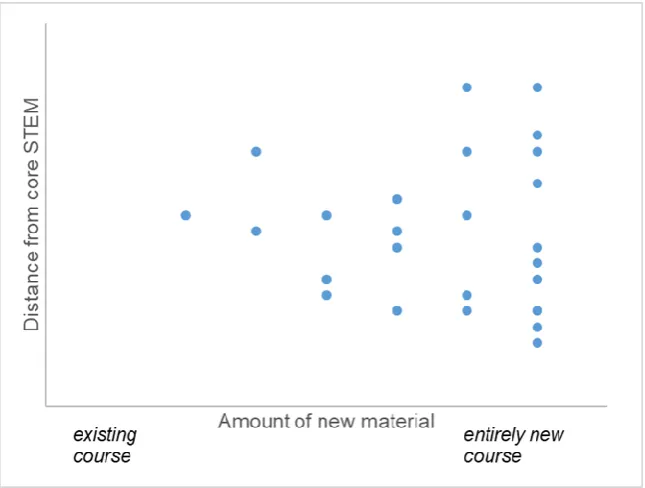
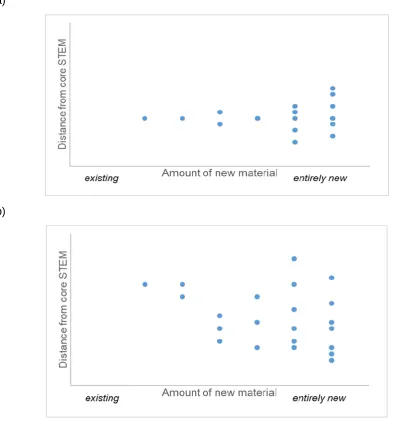
With that context, we considered the approaches of the institutions in two dimensions. One was the extent to which institutions developed new teaching and learning, content and materials, or used pre-existing content and teaching modules. Approaches varied from those which essentially used only pre-existing content to those which developed new courses using entirely new, bespoke content, which they devised and developed utilising the scheme’s funding. The level of funding available would in most cases not have been sufficient on its own to generate entirely new and innovative provision, so many institutions committed additional resources and investment themselves. It is likely that the requirement to do so impacted to some extent on the approach they took, as they will have sought to develop materials with the potential for value not only for these specific new courses but more widely in their provision.
The second dimension was the nature of the students (in terms of first-degree subject) that they targeted, i.e. the ‘distance’ of the first degree from the engineering or computing/data focus of the conversion course as described above. A cognate first degree would plot as zero in terms of this distance. When it came to implementation of their new courses, some institutions were essentially more ambitious in trying to target a wide range of students including those who were much more ‘distant’ in terms of first-degree subject, while others were more conservative in restricting their targets to disciplines closer to engineering or computing, such as physics. It should be stressed that this discussion is based on the original targeting as expressed in institutions’ proposals, because in reality most achieved cohorts including at least some cognate students.
Figure 4.1 Schematic of course/content and targeting approaches taken by institutions
The depiction is similar to analysis of a new product proposition using an Ansoff Matrix, which traditionally considers product development strategies in terms of novelty of the product and whether the market is existing or new. Conventional wisdom is that the most ambitious business development strategy is for a new product in a new market, which is generally the top right segment of the Ansoff matrix. In the context of this project, that would be developing an entirely new course which targeted Non-STEM graduates.
The chart demonstrates that a wide range of strategies was proposed. Many proposals for new courses were based on development of entirely new content and material. Of these, some were ambitiously targeted at a wide range of graduates, while others were more cautious in their targeting of students in terms of discipline. All proposals were written on the basis of targeting UK graduates rather than international in domicile.
Perhaps most popular as an approach were those institutions which proposed a new course (or more than one) which leveraged modules and content already in place for teaching of existing MSc provision but added new modules or content. These institutions devised and developed bespoke, new modules to provide the underpinning engineering or computing background that conversion students would need in order to study the existing modules. In some cases, some existing undergraduate level content was included, as the requirement for Masters level study is 150 credits at Level 7, allowing for up to 30 credits at a lower level. All provision included a project and dissertation.
Certain institutions proposed new courses that comprised new pathways for students but that were entirely made up of existing modules or teaching. One identified two potential routes that could be appropriate for either ‘Near-STEM’ or ‘Far-STEM’ students, respectively, while another offered bespoke pathways depending on individual student background. These pathways included both undergraduate modules as well as Masters-level modules from existing provision to deliver the learning needed by a conversion student. This approach, which avoided development of substantive new content, was relatively rare, as most institutions preferred an approach of developing at least some bespoke new content. At the left-hand end of the chart, a small number of institutions utilised the scheme funding either entirely or mainly to adjust its marketing and selection processes to widen the range of students attracted to and/or enrolling on existing MSc courses. Their strategy was to widen the ‘funnel’ to their existing MSc provision by attracting conversion students in addition to the flow of cognate students to their courses.
In practice, the most common models were a combination of several of these approaches, i.e. development of one or more specific new conversion or bridging modules for conversion students together with some extent of new marketing or recruitment to attract such students. One factor underpinning the strategy adopted by institutions was the extent of existing engineering- or computing-related MSc provision. Those with more extensive pre-existing provision had more opportunity to preface existing modules with an introductory or conversion module, or devise a new conversion pathway, whereas those with little or no existing relevant MSc provision had to develop all content anew. All institutions acknowledged, to some extent, in their proposals, that they would have to provide more substantive and personalised support for conversion students than cognate students, and some underpinned this with additional staff capacity within their proposed models.
In almost all cases, the proposals stated that courses would be offered on both FT and PT modes, with a handful of exceptions where only a single mode was envisaged. Full-time provision was anticipated in most cases to be of a year’s duration (potentially plus additional time to undertake a project), with a few exceptions where a two-year FT course was devised. A variety of models, including flexible delivery and elements of distance learning, were postulated for PT students, as many institutions anticipated that they would need their course to appeal to those who remained in full-time employment. All models could be considered to be blended, as is almost invariably the position for UK taught PG courses.
4.2 Case studies
Case study 1: Data Science, Birkbeck, University of London
Birkbeck specialises in educating mature PT students, most of whom work while they study. Its Department of Computer Science and Information Systems developed a new MSc Data Science course through the conversion pilots fund, to complement an existing conversion MSc in Computer Science. The new two-year PT course was structured as four compulsory modules covering fundamentals of software engineering design and development, plus applied modules on data science and analytics, all at Level 7. Although some are shared with other courses, new material on data science was developed. Students use Python and R programming languages, in line with employers’ reported needs. A new pre-course online module was developed for applicants to provide a feeder and widen access, which included maths, probability and statistics. Birkbeck already offers several study skills workshops to help students move and/or return to PG study and develop or refresh maths skills.
Most module content is delivered through face-to-face lectures and labs in the evenings, supplemented by material on a virtual learning environment (VLE). Industry speakers contribute inspiration, motivation and insight through guest lectures, case studies for use in teaching and supervision of student projects. Engaging employers sufficiently was expected to be challenging and funding was used to hire a part-time employer liaison officer.
The new course targeted graduates in and around London considering a career change into IT and/or a wider skillset including data science. Entry requirements are a good first degree in any subject (other than computer science) together with demonstrable aptitude for computing languages – this is tested during the application process. A bespoke marketing campaign, highlighting career prospects, was run using traditional media and online, utilising existing links with employers and targeting Birkbeck’s own non-computing graduates. Four new videos were commissioned, promoting the subject and its prospects but also reassuring non-computer science graduates that they could engage with the course and achieve a recognised qualification. The videos proved to be very popular, with one being served to over 100,000 people, and were therefore cost-effective.
The new MSc was approved by the college in February 2016 and 110 applications led to 34 students enrolled (exceeding the target of 16) for 2016/17 start, 26 of whom were UK-domiciled. Practically, all first-year modules were pre-existing, enabling time to develop the new content for use in the second year of the programme. Since then, a new programming module and a data analytics module have been introduced into the first year for the second cohort, to give earlier exposure to data science topics.
Enrolments have easily exceeded recruitment targets: 88 new students (almost 80 from the UK) enrolled in September 2017 and 93 a year later. Such is the popularity that Birkbeck has introduced a FT version in parallel, with a further 34 students. Around half of all students have first degrees in STEM subjects, but significant proportions have economics, business and management, and also arts and humanities, backgrounds. A small number of students have been sponsored by employers, including the Office for National Statistics.
Case study 2: Data science, University of Salford
Salford’s new Data Science programme was designed to expand access to data sciences as there is worldwide demand for staff capable of working in the expanding realm of ‘big data’. Its existing provision of data-focused conversion programmes focused on those from either computing or business degrees. The opportunity was taken to develop a teaching strategy designed for intakes of graduates from a mix of disciplines provided they had mathematical underpinning, an enquiring mind and an analytical approach to problem-solving. The aim is to enable them to become effective data science practitioners in business.
Programme design was assisted by Salford’s close collaboration with SAS, a US-based data analytics software specialist which has 24,000 employees worldwide. SAS offers professional certifications related to the use of their software products (analogous to Microsoft or CISCO certifications) which have established acceptance by employers. Salford is classified as a SAS Academy and has access to SAS proprietary teaching materials. The connection also enables Salford to gain insights into skills requirements of employers that use SAS products. There were established arrangements for students studying appropriate modules at Salford to be awarded SAS Certification, on achievement of a certain score in Salford’s assessment. This was planned to continue on the conversion programme, providing both academic and industry certifications.
An initial two-week intensive session brings students to a common starting point, with formative assessment providing diagnostics for likely future support needs.
Validation and development of the course followed a tight schedule but use of SAS proprietary materials helped the development team move sufficiently quickly. 21 students enrolled in September 2016, which exceeded expectations in both number and subject diversity. The students were drawn from 13 subject areas (including from biomedical science and pharmaceutical science, areas of strong potential for big data) with a maximum of three students from any single discipline. Initial marketing efforts focused on graduating students at Salford, using presentations to students negotiated with other departments. Existing industrial links were also exploited. Demand was such that a second intake of 32 students entered in January 2017, again with three quarters from the UK. The number of companies working with Salford and providing live projects for students expanded from 19 to 44 that year.
Strong recruitment has continued with 24 more students starting in September 2017, 54 in September 2018 and sufficient demand for another start of 30+ in January 2019. Application numbers are the highest of any Salford Masters programme, and it is second on the basis of confirmed enrolments. The course received the Salford Vice-Chancellor’s Distinguished Teaching Award for excellence and innovation in a ‘real-world’ student experience with evidence of cross-departmental, interdisciplinary working, undertaken in partnership with external stakeholders.
Case study 3: Cybersecurity, University of Chester
The University of Chester acquired the Thornton Science Park (between Chester and Ellesmere Port) and developed it as the base from 2014 for an expansion of its STEM provision alongside companies engaged in research and innovation activity on the site. The university’s recent strategy, following consolidation of undergraduate provision, is for a future focus on apprenticeship-based programmes and expanded Masters provision.
Chester recruited new staff, including the project lead, to enable the introduction of cybersecurity-related programmes, in order to leverage experience of cybersecurity in the public and private sectors. An undergraduate programme was launched in 2015 and, using the conversion pilots funding, the new Masters programme was designed and validated to a tight schedule for launch in October 2016.
Industry experience is that computer science graduates do not necessarily have the skills needed for cybersecurity work, with its blend of human and organisational factors. It is not as mathematically demanding, so a cybersecurity programme should be accessible to students from a broad range of disciplines. The aim is to enhance the computing capacities of non-cognate graduates and the human factors dimensions of non-cognate graduates. The assumption in entry requirements is that students must have the capability to undertake some form of technical task using skills developed in their prior education. Previous coding experience is not necessary and additional introductory materials have been developed to enable students to attain a common starting point. To provide flexibility, the programme is available in FT and PT modes.
The team established industrial links through active engagement with the North Wales Cyber Security Cluster, which specialises in the nuclear industry. The industries of NE Wales and the Chester/Warrington economic area are intimately linked with the university’s strong aerospace, automotive, chemical and optoelectronics specialisms. These industry links provide projects and placement opportunities spanning diverse business and industry sectors.
Teaching input from the university’s Institute of Policing had been planned, as an integral component of initial delivery of the programme, but staffing pressures at the institute forced the use of alternative module materials in the first two presentations of the programme. The short lead-in time to first delivery also rendered impossible the commissioning and use of a virtualised server network, although this was remedied midway through the year so that students had access to this network both on- and off-campus.
Case study 4: Computing MSc courses, Southampton Solent University
Southampton Solent has been delivering computing-related undergraduate degrees for over 20 years but only had a single Applied Computing MSc course prior to the scheme. One of its rationales for participation was to increase MSc-level provision in strategic areas. It also recognised that there were few ‘conversion’ opportunities on the south coast, and Solent has a mission to provide HE that is vocationally relevant to local needs. It also has a strong ethos of flexible provision and wide diversity of participation in its programmes.
Three new course titles were proposed although this evolved to four in practice. All were launched in autumn 2016 and all have run every year since: Computer Engineering; Cyber Security Engineering; Digital Design; and Data Analytics Engineering.
The courses aimed to appeal both to employed professionals wanting to upskill or change career and new or recent graduates from Solent itself or resident in the region. The development team were conscious that some degree subjects, including psychology and business, generate large numbers of graduates but have weaker graduate employment outcomes. Solent has experience of teaching computing- and data-focused first degrees to students from very diverse backgrounds, and/or with little or no prior knowledge/experience of technology, so extending this approach to Masters level seemed logical.
The delivery model is a ‘pick and mix’ approach so students attend existing provision at Levels 4-6 for up to 30 credits to gain the necessary basics and study newly created Level 7 modules (and some shared with the Applied Computing MSc) for the remainder. All the courses have core elements to build skills in areas like object-oriented programming, databases and systems architecture, while each course also encompasses specialist elements, and all have professional practice and project management elements too.
The approach entails bespoke mixes of content per student, necessitating understanding of the student’s strengths to enable them to fast-track through the undergraduate-level content, although initial contact time can be quite substantial. Throughout, there is a focus on applications and minimising the extent of background theoretical content. With courses open to students of all backgrounds, it is important to be able to assess aptitude for study in these disciplines during the application process. This is assisted by diagnostic evaluations using the university’s VLE and also apps, which both assess and encourage prospective applicants – including some gamification to encourage interest and stimulate demand.
Case study 5: Medical Engineering Design, Keele University
Keele has a longstanding background in the engineering of medical devices and more recently in sustainable engineering. The university does not formally have an engineering department but has demonstrable strength in depth in relation to the engineering associated with these two specialist areas. Project leader Peter Ogrodnik, based in the School of Medicine, had a clear vision of the objectives of a conversion scheme and also the roles that its graduates might fulfil. The approach is based on Keele’s experience of working at the interface between medical and engineering professionals and of active involvement in the formation and management of university spin-out companies.
The strategy formulated aims to enable graduates from a disparate range of disciplines to make the transition to fulfil graduate-level functions in engineering but not to enable them to undertake the analytical roles undertaken by Chartered Engineers. Practically, this means the programme should prepare its students to act as intermediaries between medical professionals and analytical engineers, conceptualising and developing design briefs based on medical requirements and then overseeing the transfer to analytical engineers for realisation. The approach to programme design focused on building from the input capabilities of graduates with ‘Far-STEM’ backgrounds (typically biomedical sciences, pharmacy or product design) rather than trying to reverse engineer from the output knowledge and behaviours required of Chartered Engineers.
Professional accreditation issues were explored with both the Institute of Engineering Designers (IED) and the Institution of Mechanical Engineers. It was believed that most students completing the programme would be prepared to IEng level but that a minority would reach CEng level. At the time of development, the IED was exploring additional levels of professional accreditation below full Chartership, which could be appropriate in terms of accrediting Registered Product Designer qualifications.
Whilst 15 credit modules are the norm at Keele, the programme includes 30 point modules in core subjects of engineering design and engineering applications, which offer more flexibility in implementing project-based teaching strategies. As the programme aimed to recruit from a broad subject base, an optional 15 credit Level 6 package was also created to serve the needs of students from biomedical or other biosciences or similar backgrounds.
The programme launched for the academic year 2017/18 following marketing in relevant journals as well as postgraduate recruitment fairs and websites. A small cohort of four students was achieved, studying full-time and evenly split between ‘Near-STEM’ and ‘Far-STEM’ backgrounds. Links with medical industries provided a source of projects for all students, who additionally undertook a study visit to Germany. All students from this cohort gained relevant employment on completion of the course.
Case study 6: Robotics and Autonomous Systems, University of Sussex
Sussex was in the process of developing a Computing Robotics Electronics and Mechatronics Centre, part-funded with a STEM teaching capital investment, when the conversion course pilots scheme was announced. The new fund was an opportunity to develop an MSc that used the facilities and staff expertise in the centre, complementing existing MSc provision (which was dominantly pursued by international students). The aim was to provide non-engineering graduates with knowledge and skills they could utilise in employment developing or applying devices or systems for robotics, automation or smart systems with autonomous capability, or ubiquitous and wearable computing. Sussex has strong links to engineering companies utilising these devices/systems in different sectors. Existing MSc provision is to a mix of MEng, BEng and BSc/MSc engineering students from different countries, who vary widely in their depth and range of knowledge. With that experience, the team chose to construct the new course from 10 brand new modules, plus an existing management module, and focus on highly practical and application content. It would launch initially as a one-year FT course, potentially followed by PT options.
To check aptitude and motivation, all applicants are interviewed during recruitment (locally or by Skype if overseas), unlike for many other MSc programmes. Enrolled students also have to pass a two-week pre-course introduction module (not assessed as part of the MSc) to check their grasp of what the course is about and whether they will cope. They can leave at this point, without cost. The module is mostly practical robotics work but also to re-awaken their maths; practically it can be accommodated as the first fortnight of other MSc provision tends only to deliver taster content because many international students arrive late. Delivery style ensures a lot of staff-student interaction, with each student allocated an Academic Advisor. Where a suitable company-based project can be identified, the students complete their project within that company, potentially enhancing their employability.
The course was validated in July 2016 although preliminary marketing had started in spring 2016, including a strong, bespoke online campaign. This targeted graduates in STEM subjects (initially maths, physics, chemistry, biology or agricultural engineering) with an interest in robotics, although other graduates with logical/analytical skills are considered. In 2016/17, the course launched with six students (four from the UK). They displayed excellent participation and involvement, which led to very good results – only one student failed a single module. Peer support was also noted, with students helping their peers in areas where they had more personal experience, such as programming or prototyping. For 2017/18, 14 new students enrolled (11 full-time). Almost all have successfully completed and, notably, several students obtained internships and long-term jobs during or after the course, as hoped.
Case study 7: Food Processing Engineering, Teesside & Sheffield Hallam Universities
This project originated as a collaboration between Teesside University and the Department of Chemical Engineering at Sheffield Hallam University (SHU) and was designed to address the challenges faced by the food industry in recruiting appropriately qualified engineers. The two universities had complementary specialisms that enabled them to collaborate effectively in development of a common core of new MSc programmes but allow for differentiation in subject specialisms and marketing, to serve the needs of this large and diverse sector. Teesside’s strengths lay in food safety and hygiene, already offering Food Science and Biotechnology MSc, while SHU’s strengths lay in its ‘centre of excellence’ in Food Engineering. Both identified target populations for their respective (independent) marketing activities: Teesside focused on graduates of science-based programmes, such as Forensic Science, while SHU targeted those with physics, maths or engineering degrees seeking a more distinct specialism. Additional funding for the collaborative venture was provided by industry and the Local Enterprise Partnership (LEP), while existing industry links at local and national levels were supportive of the development.
The institutions worked together on a joint curriculum but there were significant differences in their approach, requiring totally separate approval and validation processes. For example, in detail, there were differing norms for module size: 20 or 30 credits at Teesside in contrast with the 15 credit point norm at SHU.
With their larger module sizes, Teesside was able to integrate conversion aspects within each module, reflecting the view that students registering for these modules would be highly motivated and rise to the challenge of adjusting to new concepts. They also planned a blended learning approach making extensive use of online materials to enable flexible study patterns both on-campus and by distance learning students. The content of these materials was developed by subject experts and transposed to online formats using in house expertise in e-learning. Where appropriate, these materials were made available for use within the SHU programme too.
At SHU, the programme developed was planned to achieve a degree of integration with a more general engineering conversion programme also funded through the pilots scheme. It focused on developing support materials and services for students seeking conversion into mechanical and electrical engineering subject strands; these materials (with concentration on engineering principles and maths) were well suited for the induction to the SHU Food Processing programme with its engineering-based specialism. Subsequent to launch, management of the new Food Processing programme has been integrated with that of the more general engineering conversion MSc programme.
The two courses were both launched for the 2016/17 academic year and have recruited students in small numbers each year (around four students per year, per course) since then, although a larger cohort of 15 was achieved at Teesside in 2018/19 primarily of international students. The nature of the UK students enrolled has to some extent reflected the respective targeting of the two institutions, although many have been students with a first engineering degree looking to move to a different specialist area.
Case study 8: Automatic Control & Systems Engineering, University of Sheffield
This case study demonstrates a different approach to the majority of projects, as it focused on broadening the intake to Sheffield’s existing MSc provision, although development of a new Data Analytics course was included in the overall package of activity within the initiative. Increasing diversity in engineering has been a longstanding interest and concern at Sheffield with previous scholarship initiatives demonstrating the feasibility of conversion. An earlier ‘women into engineering’ initiative enabled students without previous engineering education to graduate in chemical or bio-engineering or computer science. Given the marketing focus of the project, this case study takes a student journey perspective, in relation to Sheffield’s Automatic Control & Systems Engineering (ACSE) MSc programme in particular.
The core thesis is that students have little prior knowledge of the nature of specialist subjects such as materials engineering. This problem also exists at school level where students have little exposure to engineering, and through the school curriculum are more conditioned to regard chemistry or physics as more ‘natural’ choices for HE study. At graduate level, there is similar reluctance to break from familiar subjects despite anecdotal evidence of successful transitions and sector needs for these specialist skills.
Sheffield’s marketing strategy focuses on final-year undergraduates in science subjects such as chemistry, physics and maths. Slots in lectures are used to introduce the possibilities of conversion, supported by fliers presenting case studies illuminating alumni experiences. The case studies exemplify projects students worked on, their impact and the high earnings that professional engineers can expect. Students are offered the prospect of industrial mentors during their MSc programme, to enhance their experience. An industry-related project which is integral to the MSc programme is regarded as a strong motivator.
5 Outputs – courses and participation
5.1 Courses launched
In their proposals for funding within the scheme, 25 of the 28 institutions14 had proposed to
launch at least one of their intended new pilot conversion courses (or an enhancement of an existing course) in the autumn of 2016, anticipating an intake for the 2016/17 academic year. The remainder all proposed launch of their courses the following year.
Table 5.1 summarises the position for each institution and its course/s in terms of launch (i.e. approval and availability, and/or active provision) or enhancement of each course, across the years covered by the evaluation.
In practice, 11 institutions launched a total of 20 new pilot courses in autumn 2016 and a further three reported that they had enhanced existing engineering courses. Of the new courses launched, four were focused on data science and four others computing-related, while the remaining 12 were engineering-focused. One further institution launched a taster module for undergraduates, as a pre-cursor to its planned new MSc course launch in 2017. This picture had changed significantly by autumn 2017. All 27 institutions15 had developed
and made available at least one new course (or had enhanced an existing course, if that had been the intention). The total of 41 courses comprised 31 essentially engineering-related courses, while four were data-focused and six were computing-related (including three on cybersecurity). However, five of the institutions did not successfully recruit eligible students to this new provision although these courses were available for delivery; thus, seven of the 31 engineering courses received no students that year. In contrast, all the new computing-focused and data sciences courses had enrolments.
By autumn 2018, the position had changed slightly again, with a total of 37 courses being available of which 31 had successfully enrolled a new student cohort. Within that total picture, while some additional institutions had achieved enrolments for the first time to their engineering courses for 2018/19 delivery, two others had chosen to withdraw availability of a particular new engineering course. Our understanding is that three institutions remain that are yet to enrol any students on new courses developed through the scheme. The overall situation is likely to remain somewhat dynamic, as some courses evolve towards long-term sustainability but institutions may withdraw others where they are not sustainable and/or merge provision in response to market demand. One institution reported that in addition to its on-campus course, it had also launched a parallel transnational education (TNE) course through a partner college in the West Indies (which had received 15 enrolments in 2018).
Table 5.1 (overleaf) New MSc courses and enhanced MSc provision within the scheme (tick: course active; A: course available; C: course now ceased; –: no current information)
14 The term ‘institutions’ (considered to be 28 in the scheme) will be used for brevity, although there were a few partnerships involving more than one institution within the 28 projects receiving funding.
Institution Course title 2016 2017 2018
Anglia Ruskin University Additive Manufacturing
Aston University Computer Science
Birkbeck, Univ. of London Data Science
University of Chester Cybersecurity
Coventry University Digital Technology for Engineering
A
University of Derby Advanced Materials & Additive Manufact. Eng.
-
-
University of Greenwich Cybersecurity
Harper-Adams University Automotive Engineering (off Highway)
A
Agricultural Engineering (Mobile Machinery)
A
University of Hertfordshire General Transition Masters in Engineering
University of Hull, working with 3 colleges
Chemical & Energy Engineering
C
Energy Engineering
Keele University Medical Engineering Design
University of Kent, with University of Bath
Advanced Digital Systems Eng. (IC design)
A
C
Adv. Dig. Systems Eng. (Embedded Comms)
Queen Mary, University of London
Biomedical Engineering
Electrical and Electronic Engineering
Sustainable Energy Engineering
Mechanical Engineering
A
Middlesex University Mechatronic Systems Engineering
A
-
University of Salford Data Science
University of Sheffield Data Analytics
Sheffield Hallam University
Mechanical Engineering
A
Electrical and Electronic Engineering
A
C
Food Processing Engineering
Southampton Solent University
Computer Engineering
Data Analytics Engineering
Digital Design
Cyber Security Engineering
University of Staffordshire Industrial Engineering
A
A
University of Sunderland Manufacturing Engineering
University of Sussex Robotics and Autonomous Systems
Teesside University Food Processing Engineering
Univ. of West of England Building Services Engineering
A
A
University of Westminster Elec. Eng. for Sustainable Transport Systems
A
A
Enhanced activity
Univ. Kent with Univ. Bath Conversion to existing eng. MSc course/s
University of Sheffield Conversion to existing eng. MSc course/s
Univ. of Southampton Conversion to existing eng. MSc course/s
University of Exeter Conversion to existing eng. MSc course/s
Viewed overall, a number of institutions launched new courses in line with the timescale they predicted in their funding proposals, but these were the exceptions. The overall pattern, of course development, availability and delivery lagged significantly in comparison with what had been projected in institutions’ proposals. The second of the two workshops we held with course leaders and other staff was particularly useful in understanding the reasons for this lag, much of which related to a lack of alignment between the timing of the project funding and the cycle for course development and approval within universities (see Section 7.1).
5.2 Enrolments
5.2.1 Enrolment information
In their original project proposals, institutions had between them projected to have around 450 students enrolled on their new courses that started delivery in 2016/17, growing to around 800 (more) new entrants in 2017/18. Projected student numbers had been sought by HEFCE on a full-time equivalent (FTE) basis, but it was not clear in all proposals that projections were stated on this basis. For simplicity, however, all our reporting here of enrolment data is on a headcount basis (not FTE).
A further cautionary note in relation to our reporting of enrolments relates to ‘eligibility’. For