R E S E A R C H A R T I C L E
Open Access
Using the method of judgement analysis to
address variations in diagnostic decision making
Helen C Hancock
1*†, James M Mason
1†and Jerry J Murphy
1,2†Abstract
Background:Heart failure is not a clear-cut diagnosis but a complex clinical syndrome with consequent diagnostic uncertainty. Judgment analysis is a method to help clinical teams to understand how they make complex
decisions. The method of judgment analysis was used to determine the factors that influence clinicians’diagnostic decisions about heart failure.
Methods:Three consultants, three middle grade doctors, and two junior doctors each evaluated 45 patient scenarios. The main outcomes were: clinicians’decisions whether or not to make a diagnosis of suspected heart failure; the relative importance of key factors within and between clinician groups in making these decisions, and the acceptability of the scenarios.
Results:The method was able to discriminate between important and unimportant factors in clinicians’diagnostic decisions. Junior and consultant physicians tended to use patient information similarly, although junior doctors placed particular weight on the chest X-Ray. Middle-grade doctors tended to use information differently but their diagnostic decisions agreed with consultants more frequently (k = 0.47) than junior doctors and consultants (k = 0.23), or middle grade and junior grade doctors (k = 0.10).
Conclusions:Judgment analysis is a potentially valuable method to assess influences upon diagnostic decisions, helping clinicians to manage the quality assurance process through evaluation of care and continuing professional development.
Background
Heart failure is not a disease per se, but a complex clini-cal syndrome [1]. Unlike kidney or lung failure there is no easily measured organ function parameter to deter-mine a diagnosis. Diagnosis and management are based on clinicians’decisions, informed by a number of factors including the patient’s medical history, physical exami-nation, electrocardiogram and chest x-ray [2]. With early accurate diagnosis and appropriate treatment prog-nosis can be substantially improved. However, there is evidence to suggest that diagnosis is missed in up to half of cases [3-5]. Diagnosis and management are com-plex; symptoms are often non-specific and physical signs are difficult to elicit. An echocardiogram, measuring left ventricular ejection fraction, is used to classify common
forms of heart dysfunction although various methods of measurement give different results, and there is no defi-nitive result below which heart failure can be confirmed [6]. Managing uncertainty is central to clinical practice and requires the linking of experience and evidence: this places specialists at an advantage, but junior doctors, nurses and general practitioners often make diagnostic decisions about heart failure.
National Service Frameworks (NSFs) and clinical guidelines are fundamental to clinical governance pro-grammes, aiming to improve standards and reduce unacceptable variations in clinical practice [7]. However, neither can be easily applied to complex decision-mak-ing and their recommendations need contextualisdecision-mak-ing to be relevant: no process exists to ensure this routinely occurs and variation in care remains common. The lack of information about the sources of variability in diagno-sis and care means that variability may be simplistically viewed as inappropriate, but may appropriately reflect * Correspondence: [email protected]
†Contributed equally 1
School of Medicine and Health, Durham University, Queen’s Campus, Wolfson Research Institute, University Boulevard, Stockton-on-Tees, UK Full list of author information is available at the end of the article
individual patient needs, activity recording variations or alternative but valid traditions of care.
Existing methods of assessing clinicians’ ing tend to polarise around the process of decision-mak-ing (e.g. sociological enquiry) or on its outcome (e.g. audit). Clinical examinations or Objective Structured Clinical Examinations (OSCEs) are popular [8], but are removed from real life situations [9]. Observations of clinicians in practice aim to address these concerns [10], but the focus is on the decision rather than on the information that informs it. Similarly, 360° appraisals are used to assess performance [11] although they also focus on decisions made and are vulnerable to poorly informed or biased reports from colleagues [12]. Clinical decisions often involve evaluating multiple cues in situa-tions of uncertainty, thus, to understand and address unacceptable variations in care, assessment should link the process of decision-making (i.e. the factors that inform a decision) and the decision made.
Judgement analysis links the process (i.e. how clini-cians use information to reach a decision) and outcome of clinical decisions [13,14], The method involves identi-fying information used in a diagnostic or treatment con-text. This information is expressed as a number of variables or factors used within a series of scenarios. Judgement analysis offers a means of examining the information used by clinicians in their decision making: it can be used to compare a decision to an agreed stan-dard, such as a protocol or guideline, or to that of another clinician or reference group. Results can be used to direct education and training and to help deter-mine practical limitations of guidelines. In essence, judg-ment analysis provides a systematic variation of the factors that affect decisions and, thus, provides insight about how doctors use information in their decision making, and how and why they vary. Inappropriate var-iation in health care is of primary concern but is very poorly researched. While it might seems obvious that, in general, senior clinicians might be better diagnosticians than their junior colleagues, seniority is not a marker of accuracy per se. Furthermore it is not obvious how senior clinicians use information to make better deci-sions; this information could be used to guide education and training. The method of judgment analysis offers an important way of addressing variation in decision mak-ing, but is relatively unused. This paper describes pilot work necessary to develop its use and will be of help to other research teams considering using the technique.
Applying judgment analysis to diagnostic decisions about heart failure
The example used in this paper demonstrates how jud-gement analysis can be used to assess clinicians’ diag-nostic decisions about heart failure:
(i) quantifying how a range of factors inform clini-cians’diagnostic decisions about heart failure
(ii) measuring any differences in these factors within and between groups of consultant, middle grade and junior doctors
(iii) assessing the acceptability and feasibility of using the scenarios.
Methods
Ethical guidance was obtained from County Durham and Tees Valley 1 Research Ethics Committee. Given the nature of the study, ethical approval was deemed by the Chair of this committee not to be required. The research was partially funded by an academic grant from Darlington Memorial Hospital. Study conduct con-formed to the principles of The Declaration of Helsinki.
Phase 1. Developing clinical scenarios
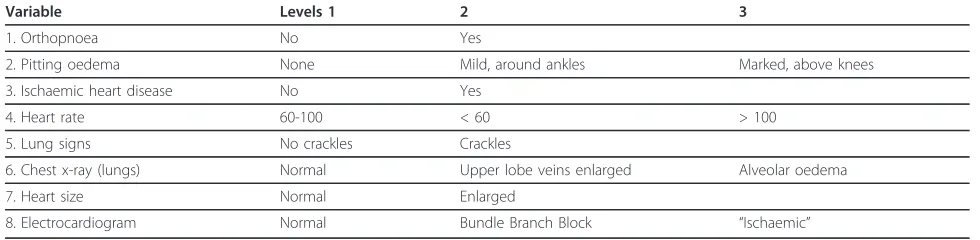
Clinical variables affecting diagnosis were identified by a consensus panel of 6 cardiology consultants who identi-fied eight factors as key variables in the diagnosis of heart failure; these are listed in Table 1. For each vari-able, levels of normality (e.g. normal and abnormal (low or high)) were also agreed (see Table 1). These variables were used to generate a number of clinical scenarios; a key decision is whether scenarios should present infor-mation as found in every day clinical practice or whether to use more artificial, non-correlated, orthogon-ally-based scenarios [15]. The latter may be better at determining the importance of variables affecting deci-sions but may lose some clinical relevance. Applying the principle of representativeness [16] (i.e. typical of real world scenarios), variables and their levels were entered into SPSS (version 14) and scenarios were generated using an orthogonal design, random number generator. From this, 81 different scenarios were produced; these were transposed into clinical scenarios.
In order that as much ecological validity as possible was retained, the variables were presented so that the scenarios reflected the format found in practice. Thus, while, for example, a heart rate of 60-100 beats per min-ute (bpm) was considered normal, < 60 bpm low and > 100 bpm high, a scenario which included ‘heart rate: high’ might read HR 126 bpm. The following is an example:
The 81 scenarios were discussed with a Consultant Cardiologist to ensure that the format reflected real sce-narios and which, if any, should be excluded. 41 scenar-ios were excluded on the basis that they were not plausible, or that they represented a healthy person. Five scenarios were duplicated in order to determine the consistency of individual responses; these repeated sce-narios, called‘hold out’ cases, were not included in the analysis. Thus, a total of 45 scenarios were included.
Phase 2. Completion of scenarios by participants
Three cardiology consultants, three middle grade doc-tors (two Registrars and one Senior House Officer), and two junior doctors (Foundation year 1) were sent the same 45 scenarios in the same order in one document, they were asked to note the time it took to complete the scenarios and evaluate the format. Clinicians were encouraged to make decisions as they would in practice. For each scenario they were asked whether or not they would make a diagnosis of suspected heart failure (where heart failure becomes the‘working diagnosis’).
In addition to the scenarios, the doctors were asked to complete a number of other questions. These were: (i) participant demographics; (ii) a list of factors to be rated by participants according to their importance in estab-lishing a diagnosis of heart failure, where 1 = not impor-tant, 2 = slightly (or occasionally) imporimpor-tant, 3 = moderately (or often) important, and 4 = very (or always) important and the variables were: gender, age, orthopnoea, pitting oedema, history of IHD, heart rate, lung signs, CXR (lungs, heart size, ECG, JVP, Gallop rhythm, out of hours consultation (6 pm-6 am), others (specify); (iii) feedback about the scenarios including: how long it took to complete the scenarios; to what extent the scenarios adequately reflected the information used when making diagnoses with real patient [exactly, very well, quite well, not very well or not at all]; how the scenarios could be improved; any other information that would have been useful in the scenarios; whether or not participants would have preferred to have
received the scenarios by email; final comments and suggestions.
Phase 3. Data analysis
The dependent variable within the analyses was the decision whether or not to make a diagnosis of sus-pected heart failure. Data analysis used the Conjoint procedure within SPSS [17], which generated a relative utility (importance) score for each variable and variable level [17]. As utility scores share a common metric, it is possible to calculate the relative influence of each vari-able. Utility scores vary between -1 and 1 with zero denoting no influence and larger magnitudes corre-sponding to a greater negative or positive contribution. Repeated scenarios were not included in the Conjoint analysis.
Statistical comparisons
Descriptive and inferential statistical analyses were con-ducted using SPSS version 14. Decision repeatability and consistency within and between clinician groups were analysed using categorical agreement analysis (kappa). The kappa score indicates the level of agreement between or within raters on a scale from zero to one, where the level of agreement is poor (< 0.2), fair (≥ 0.2 to < 0.4), moderate (≥ 0.4 to < 0.6), good (≥0.6 to < 0.8) or very good (≥0.8).
Results
Clinicians’decisions about whether or not to make a diagnosis of suspected heart failure
[image:3.595.54.544.101.221.2]The repeatability of diagnostic decisions within clinician groups for the five repeat scenarios was between moderate and very good (Table 2). The consistency of diagnostic decision-making across the 40 scenarios was variable both within and between clinical groups, never exceeding mod-erate agreement. Agreement was higher between consul-tants and middle grade doctors (k = 0.47) than between consultants and junior grade doctors (k = 0.23) or middle grade and junior grade doctors (k = 0.10), suggesting that
Table 1 The Eight Key Variables Included in the Scenarios and their Levels
Variable Levels 1 2 3
1. Orthopnoea No Yes
2. Pitting oedema None Mild, around ankles Marked, above knees
3. Ischaemic heart disease No Yes
4. Heart rate 60-100 < 60 > 100
5. Lung signs No crackles Crackles
6. Chest x-ray (lungs) Normal Upper lobe veins enlarged Alveolar oedema
7. Heart size Normal Enlarged
8. Electrocardiogram Normal Bundle Branch Block “Ischaemic”
there were important diagnostic variations that should be explored within the clinical team as a quality assurance issue.
Between Groups: consistency of categorical diagnostic decisions (ordinal levels) for 40 scenarios comparing dif-ferent level of seniority using weighted Kappa
The relative importance of the variables within and between clinician groups
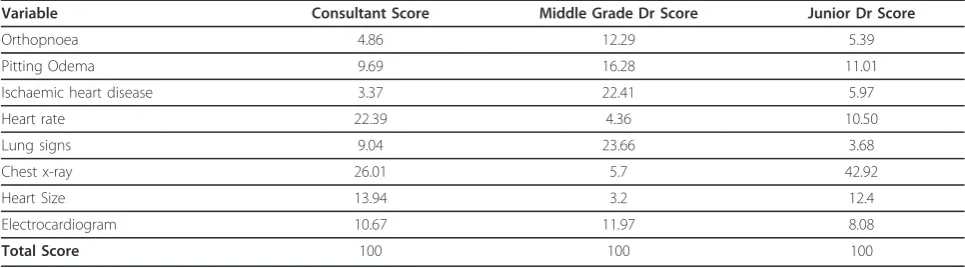
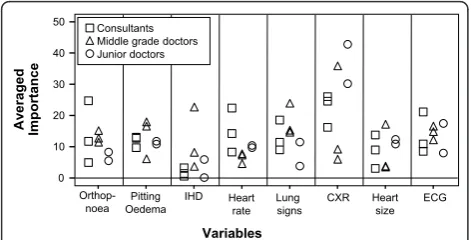
The average importance of the variables influencing deci-sions for each group is presented in Table 3 permitting visual comparisons between groups. Importance scores sum to 100 showing the relative importance of each vari-able for each group. As a demonstration project, no for-mal statistical comparisons were planned but an interesting trend was apparent. Junior doctors’use of information reflected more closely that of the consultants while middle grade doctors often differed substantially. The two most important variables for consultants were chest x-ray and heart rate; and, for middle grade doctors lung signs and ischaemic heart disease. These two profes-sional groups used a broader range of information, whereas junior doctors focused on chest x-ray findings. Average utility scores by group provide valuable informa-tion about the use of informainforma-tion but conceals variability within groups. Despite all clinicians receiving the same scenarios, there was considerable variation within clini-cian groups as illustrated in Figure 1.
The acceptability of the scenarios (i) Time Taken
Time taken to complete the scenarios varied substan-tially: a mean of 28 min and range of 10 to 45 min. Consultants ranged from 10 to 25 min and junior doc-tors from 25 to 45 min. All three middle grade docdoc-tors reported taking 30 min.
(ii) Overall Format
Consultant cardiologists and middle grade doctors reported that the scenarios reflected clinical situations ‘quite well’(n = 5) or ‘very well’(n = 1), while junior doctors (n = 2) reported that they did so‘exactly’. (iii) Preference for Email or Hard Copy of Scenarios
Half of all respondents (n = 6) reported a preference for a hard copy rather than electronic copy of the scenarios. There was variability within and between groups.
Discussion
Clinical judgment analysis links how clinicians make diagnostic decisions with what decisions are made. This study demonstrated considerable variations in heart fail-ure diagnostic decision-making within and between clin-ical grades. The method was able to discriminate between influential and uninfluential factors diagnostic decisions both within and between clinician groups. The development, completion and analysis of the scenarios was feasible and acceptable to clinicians.
[image:4.595.57.292.112.181.2]Without a reference standard answer for each scenario it is not possible to assess the accuracy of diagnoses made, or appropriateness of variations. One possible explanation for variability is that senior clinicians pos-sessed experience and extant knowledge to inform their decisions, junior doctors followed protocols and middle grade doctors employed a combination of the two. Clini-cal guidelines and protocols seek to standardise practice and to eliminate variability in patient care. However, evidence-based guidelines only provide for ‘usual’ or ‘average’ clinical scenarios. Some diagnostic variation may have resulted from clinicians’ perceptions about individual patient needs within the scenarios.
Table 2 Agreement Scores (Kappa) for Repeatability and Consistency of Diagnoses of Suspected Heart Failure
Repeatability+ Consistency*
Seniority N Within group Consultant Middle Grade Junior
Consultant 3 0.53 0.25
Middle Grade 3 0.73 0.47 0.16
Junior 2 1 0.23 0.10 0.47
+ Repeatability of categorical diagnostic decisions (yes/no) for 5 repeated scenarios using Kappa
* Within Group: consistency of categorical diagnostic decisions (yes/no) for 40 scenarios within each level of seniority using Kappa
Table 3 The Average Importance of the Variables by Clinician Group
Variable Consultant Score Middle Grade Dr Score Junior Dr Score
Orthopnoea 4.86 12.29 5.39
Pitting Odema 9.69 16.28 11.01
Ischaemic heart disease 3.37 22.41 5.97
Heart rate 22.39 4.36 10.50
Lung signs 9.04 23.66 3.68
Chest x-ray 26.01 5.7 42.92
Heart Size 13.94 3.2 12.4
Electrocardiogram 10.67 11.97 8.08
[image:4.595.56.539.597.731.2]Notwithstanding the different weight placed on the fac-tors informing diagnostic decisions, consultant and mid-dle grade doctor decision-making was similar. However agreement between junior doctors and more senior grades was only poor to fair - a finding that cannot be disregarded as it may reflect real differences in clinical care.
It is unclear why middle grade doctors made markedly different use of diagnostic information. The method’s strength is that it unmasks values used in decision-mak-ing that may be incorporated into the traindecision-mak-ing context to explore quality-of-care issues.
Limitations
This demonstration study is based on a small sample and precludes definitive conclusions. Clinicians were asked to complete the scenarios in the same way as they would in practice. While the scenarios were constructed to reflect real clinical situations faced by them, it is not possible to recreate the same pressures as life in clinical practice. Participants’responses to questions about the acceptability of the scenarios supported their current format.
Relevance to practice
Changing roles within health care, with more junior staff taking on greater responsibility, have been accompanied by increased public and professional scrutiny [18,19]. This has occurred, in part, because patients, society, and the professions need to be assured that individual clini-cians are not only qualified, but consistently provide high quality, safe care for patients. All clinical practise involves uncertainty in diagnosis, prognosis and treat-ment, and adverse health care events causing physical or psychological injury to patients are surprisingly common [20]. In the UK, adverse events take place in about 10% of NHS admissions and cost £2 billion a year; 400 peo-ple die or are seriously injured in adverse events; and, over £500 million was paid out in clinical negligence claims in 2004/2005 [21]. Judgement analysis offers a
means of quantifying the factors that influence complex decisions made in clinical practice, thus potentially reducing the likelihood of adverse events when linked to continuing professional development.
Clinical judgement analysis has been applied pre-viously in a number of contexts, supporting our findings of substantial clinical variability when decisions involve complexity [15,22-26]. The method needs developing beyond measuring variations to demonstrate improved consistency and quality of care. Our findings are the first part of a research programme to develop a targeted education and training tool to promote quality and safety within clinical teams.
Conclusions
Variable clinical decision-making has important implica-tions for diagnosis and management. This is particularly important for heart failure in the hospital setting, since junior and middle grade doctors often make diagnostic decisions. While judgement analysis may help explain and quantify diagnostic variation permitting its discus-sion as a quality issue within the clinical team. Findings may subsequently positively shape future clinical guide-lines, in particular identifying areas of variation and con-tention. Rather than the imposition of an external clinical governance agenda, the use of this method represents an opportunity for clinical teams to lead the quality assur-ance process and to differentiate between unacceptable and acceptable variability in care. Judgment analysis use-fully captures the determinants of clinicians’diagnostic decisions about heart failure. This pilot study demon-strates the potential for the method to facilitate quality assurance within the clinical team by enabling teams to explore variations, reassess educational support, and make appropriate use of (or modify) guidelines. Further adequately-powered research is required to realize this potential and inform clinical management.
Acknowledgements
We are grateful to the clinicians who gave their time to participate in this study and who provided valuable feedback.
Author details
1School of Medicine and Health, Durham University, Queen’s Campus, Wolfson Research Institute, University Boulevard, Stockton-on-Tees, UK. 2
Darlington Memorial Hospital, County Durham & Darlington NHS Foundation Trust, Hollyhurst Road, Darlington, UK.
Authors’contributions
The named authors made the following contributions: HH and JM: substantial contributions to the conception and design, analysis and interpretation of data; drafting the article and revising it critically for important intellectual content; and final approval of the version to be published. JM: substantial contributions to study design and the acquisition of data, drafting the article and revising it critically for important intellectual content; drafting the article and revising it critically for important intellectual content; and final approval of the version to be published. All authors read and approved the final manuscript.
A
ve
ra
g
ed
Importance
50
40
30
20
10
0
Variables
ECG Heart
size CXR Lung signs Heart
rate IHD Pitting Oedema
[image:5.595.56.292.89.209.2]Orthop-noea Consultants Middle grade doctors Junior doctors
Figure 1The Importance of Variables: Comparison Between
Competing interests
The authors declare that they have no competing interests.
Received: 21 December 2011 Accepted: 13 March 2012 Published: 13 March 2012
References
1. McDonagh TA, Dargie HJ:What is Heart Failure?InManaging Heart Failure in Primary Care.Edited by: Dargie HJ, McMurray JJV, Poole-Wilson PA. London: Blackwell Healthcare Communications Ltd; 1996:1-10.
2. The task force on acute heart failure of the European Society of Cardiology:
Guidelines on Acute Heart Failure.Eur Hear J2005,26(4):384-416. 3. Davies MK, Hobbs FDR, Davis RC,et al:Prevalence of left ventricular
systolic dysfunction and heart failure in the Echocardiographic Heart of England Screening study: A population based study.Lancet2001,
358:439-444.
4. Khand A, Shaw M, Gemmel I,et al:Do discharge codes underestimate hospitalisation due to heart failure? Validation study of hospital discharge coding for heart failure.Eur J Hear Fail2005,7(5):792-797. 5. Barents M, van der Horst I, Voors A,et al:Prevalence and misdiagnosis of
chronic heart failure in nursing home residents: the role of B-type natruiretic peptides.Neth Hear J2008,16(4):123-128.
6. Dargie HJ:What is heart failure?British Society for Heart Failure Newsletter
Spring; 1998,2.
7. Department of Health:.Draft: Research Governance Framework for Health and Social Care.2 edition. London: The Stationary Office; 2003. 8. Major DA:OSCEs - seven years on the bandwagon: The progress of an
objective structured clinical evaluation programme.Nurse Edu Today
2005,25(6):442-454.
9. Newble D:Techniques for measuring clinical competence: objective structured clinical examinations.Med Edu2004,38:199-200.
10. LaDuke S:Competency assessments: a case for the nursing interventions classification and the observation of daily work.J Nurs Adm2000,
30:339-40.
11. Whitehouse A, Walzman M, Wall D:Pilot study of 360° assessment of personal skills to inform record of in training assessments for senior house officers.Hosp Med2002,63(3):172-175.
12. McKinley RK, Fraser RC, Baker R:Model for directly assessing clinical competence and performance in revalidation of clinicians.BMJ2001,
322:712-715.
13. Heverly MA, Fitt DX, Newmand FL:Constructing case vignettes for evaluating clinical judgments: an empirical model.Eval Programme Plann
1984,7:45-55.
14. Hammond KR, Stewart TR, Brehmer B,et al:Social Judgment Theory.In
Human Judgment and Decision Processes.Edited by: Katz MF, Schwartz S. New York: Academic; 1975:271-312.
15. Backlund L, Danielsson B, Bring J,et al:Factors influencing GPs decisions on the treatment of hypercholesterolaemia.Scand J Primary Health Care
2000,18:87-93.
16. Brunswik E:Perception and the representative design of psychological experiment.2 edition. University of California Press: Berkeley; 1956. 17. Statistical Package for Social Scientists (SPSS):SPSS Conjoint 14.0.USA SPSS
Inc; 2005.
18. Department of Health:Guidance on Working Hours for Junior Doctor
London: The Stationery Office; 2002.
19. European Directive:Directive 2003/88/EC of the European Parliament and of the Council of 4th November 2003 concerning certain aspects of the organisation of working time.Council of the European Union; 2003. 20. Department of Health:An Organisation With A Memory. Report of an expert
group on learning from adverse events in the NHS chaired by the Chief Medical OfficeLondon: The Stationery Office; 2000.
21. Department of Health:National Health Service Redress Bill.The Stationery Office, London; 2005 [http://www.dh.gov.uk/en/Publicationsandstatistics/ Legislation/Regulatoryimpactassessment/DH_4138881].
22. Vancheri F, Alletto M, Curcio M:Is clinical diagnosis of heart failure reliable? Clinical judgment of cardiologists versus internists.Eur J Intern Med2003,14:26-31.
23. Skaner Y, Bring J, Bengt U,et al:Heart Failure Diagnosis in primary health care: clinical characteristics of problematic patients. A clinical judgment analysis study.BMC Fam Pract2003,4:12.
24. Thompson CA, Foster A, Cole I,et al:Using social judgment theory to model nurses’use of clinical information in critical care education.Nurse Edu Today2005,25:68-77.
25. Harries C, Evans J, Dennis I:Measuring Doctors’Self-insight into their Treatment Decisions.Appl Cogn Psychol2000,14:455-477.
26. Kushniruk AW, Patel VL:Cognitive and usability engineering for the evaluation of clinical information systems.J Biomed Inf2004,37:56-76. doi:10.1186/1756-0500-5-139
Cite this article as:Hancocket al.:Using the method of judgement analysis to address variations in diagnostic decision making.BMC Research Notes20125:139.
Submit your next manuscript to BioMed Central and take full advantage of:
• Convenient online submission
• Thorough peer review
• No space constraints or color figure charges
• Immediate publication on acceptance
• Inclusion in PubMed, CAS, Scopus and Google Scholar
• Research which is freely available for redistribution