Open Access
Research article
Primary health care delivery models in rural and remote Australia
– a systematic review
John Wakerman*
1, John S Humphreys
2, Robert Wells
3, Pim Kuipers
1,
Philip Entwistle
1and Judith Jones
2Address: 1Centre for Remote Health, a joint Centre of Flinders University & Charles Darwin University, PO Box 4066, Alice Springs, Northern Territory, 0870, Australia, 2Monash University School of Rural Health, PO Box 666, Bendigo, Victoria, 3550, Australia and 3Menzies Centre for Health Policy and College of Medicine and Health Sciences, Australian National University, Building 131 Garran Rd, Acton, ACT, 0200, Australia
Email: John Wakerman* - [email protected]; John S Humphreys - [email protected];
Robert Wells - [email protected]; Pim Kuipers - [email protected]; Philip Entwistle - [email protected]; Judith Jones - [email protected]
* Corresponding author
Abstract
Background: One third of all Australians live outside of its major cities. Access to health services and health outcomes are generally poorer in rural and remote areas relative to metropolitan areas. In order to improve access to services, many new programs and models of service delivery have been trialled since the first National Rural Health Strategy in 1994. Inadequate evaluation of these initiatives has resulted in failure to garner knowledge, which would facilitate the establishment of evidence-based service models, sustain and systematise them over time and facilitate transfer of successful programs. This is the first study to systematically review the available published literature describing innovative models of comprehensive primary health care (PHC) in rural and remote Australia since the development of the first National Rural Health Strategy (1993–2006). The study aimed to describe what health service models were reported to work, where they worked and why.
Methods: A reference group of experts in rural health assisted in the development and implementation of the study. Peer-reviewed publications were identified from the relevant electronic databases. 'Grey' literature was identified pragmatically from works known to the researchers, reference lists and from relevant websites. Data were extracted and synthesised from papers meeting inclusion criteria.
Results: A total of 5391 abstracts were reviewed. Data were extracted finally from 76 'rural' and 17 'remote' papers. Synthesis of extracted data resulted in a typology of models with five broad groupings: discrete services, integrated services, comprehensive PHC, outreach models and virtual outreach models. Different model types assume prominence with increasing remoteness and decreasing population density. Whilst different models suit different locations, a number of 'environmental enablers' and 'essential service requirements' are common across all model types.
Conclusion: Synthesised data suggest that, moving away from Australian coastal population centres, sustainable models are able to address diseconomies of scale which result from large distances and small dispersed populations. Based on the service requirements and enablers derived from analysis of reported successful PHC service models, we have developed a conceptual framework that is particularly useful in underpinning the development of sustainable PHC models in rural and remote communities.
Published: 29 December 2008
BMC Health Services Research 2008, 8:276 doi:10.1186/1472-6963-8-276
Received: 5 March 2008 Accepted: 29 December 2008
This article is available from: http://www.biomedcentral.com/1472-6963/8/276
© 2008 Wakerman et al; licensee BioMed Central Ltd.
Background
One third of Australia's population lives outside its major cities [1]. Of this non-metropolitan population, almost twenty percent is dispersed across more than 1,500 rural and remote communities with fewer than 5,000 residents. Collectively these communities have a population the size of Sydney, Australia's largest city. Almost three-quarters of these small communities lie in the rural and remote areas furthest from large population centres [2]. More than one-third of these small communities are losing population and experiencing economic hardship [3-5].
People living in small rural and remote communities of Australia face significant health disadvantage. Generally, mortality and illness levels increase with distance from major cities [1]. Moreover, these communities are charac-terised by higher hospitalization rates and higher preva-lence of health risk factors compared with metropolitan areas [1,6,7]. These rural and remote communities are fur-ther disadvantaged by reduced access to primary health care (PHC) providers and health services (in part a func-tion of health and medical workforce shortages), leading in turn to lower utilisation rates than in urban areas and consequent poorer health status for rural residents [1].
Often these isolated rural and remote communities are too small to support traditional models of health delivery locally, so residents must access care from larger urban centres. Unfortunately, access to health services provided in larger centres remains a problem for many residents of isolated settlements. In many cases, their inability to access health services when required results in health needs not being adequately met, lack of continuity of care and an absence of monitoring of the effectiveness of serv-ices in terms of health outcomes [1]. It is clear that 'mod-els of care in rural and remote areas must differ from those in metropolitan communities, incorporating strategies to account for these problems' [8].
In order to address these access and service problems, spe-cific measures targeting rural health featured in annual national government budgets from the early 1990s. In 1994 the Australian Health Ministers' Conference (AHMC) endorsed the first National Rural Health Strategy [9], which was renewed in 1999 with the release of 'Healthy Horizons, a framework to guide the development of health programs and services in rural, regional and remote Australia'[6]. Since 1999 the Commonwealth has made two major budgetary commitments to rural health: in 2000 (More Doctors-Better Services) and 2004 (Rural Health Strategy) [10,11]. These initiatives constitute a series of workforce enhancement measures, principally targeting the medical workforce.
Policy-makers are under increasing pressure to strengthen the link between evidence, policy development and
pro-gram implementation. Although numerous approaches and models of service delivery have been trialled in rural and remote areas since the first National Rural Health Strategy, inadequate evaluation of these initiatives has resulted in failure to garner knowledge, which would facilitate the establishment of evidence-based service models, sustain and systematise them over time and facil-itate transfer of successful programs to other jurisdictions [12-14].
The objective of this research was therefore to systemati-cally review the available published literature describing innovative models of comprehensive primary health care in rural and remote Australia since the development and publication of the first National Rural Health Strategy in order to identify what rural and remote primary health care models work well, where and why.
Methods
Whilst systematic reviews of mixed qualitative and quan-titative papers aimed at informing policy can be complex and do not always accord with a pure methodological approach, our experience shows how they can still be con-ducted rigorously and effectively within constraining cir-cumstances [15]. This systematic review adopted some elements of a 'realist synthesis' approach in its engage-ment with policymakers, reliance on 'grey' literature and in the development of a theoretical framework to explain what health service models worked well, in which loca-tion they worked and why they worked [16]. To assist in the development and implementation of the study a Ref-erence Group was formed, comprising eleven recognised experts in rural and remote health, health economics, consumer issues, evaluation, PHC service provision and government policy making. Two international health services researchers were included in the Reference Group.
This paper addresses two key aspects of the systematic review. What were the key remote and rural PHC models in Australia since the first National Rural Health Strategy, and what specific structural or financial issues did they address? Secondly, what are the characteristics of appro-priate PHC service models for rural and remote Australia?
universities and similar organisations. The search for and review of literature was divided across two research sites – one rural and one remote – based on familiarity with spe-cific literature. (The full detailed search strategy is availa-ble in the funder's web version report http:// www.anu.edu.au/aphcri/Domain/RuralRemote/
Final_25_Wakerman.pdf).
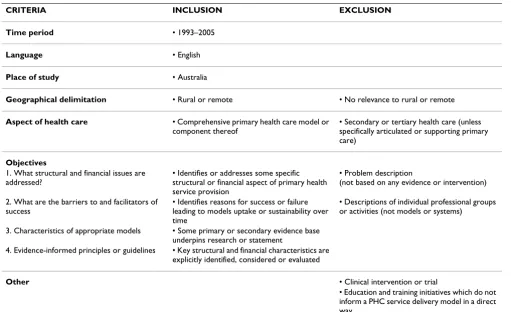
[image:3.612.59.553.407.736.2]Table 1 shows the final inclusion/exclusion criteria which defined the scope and number of publications reviewed.
Figure 1 summarises the selection process. Two reviewers independently read a total of 5,391 non-duplicate abstracts, comprising 3,830 'rural' and 1,561 'remote' abstracts. A sample comparison of 324 abstracts noted 80% concurrence between two readers. In instances where reviewers failed to reach initial agreement, a decision regarding selection was made on the basis of discussion and consensus.
As a result, 111 'rural' and 113 'remote' full papers were retrieved. Nine rural papers could not be retrieved due to inaccurate or incomplete citations. A further 35 'rural' papers and 96 'remote' papers were discarded as the full papers did not satisfy inclusion criteria. The remaining 76
rural papers and 17 remote papers were read and data extraction forms were completed. Data included location, service population size and model description. Data were assessed for quality and relevance. While quality was a consideration, relevance (as reflected in the inclusion and exclusion criteria) rather than quality was adopted as the principal decision criterion for inclusion.
A total of 59 items of 'grey' literature were also retrieved as full documents for 'rural' and 47 for 'remote'. Of the 'rural' documents, 49 dealt with models of service delivery. A further eight contained context-relevant information and two did not meet the inclusion criteria. Of the 47 'remote' documents, 19 met the inclusion criteria. Data were extracted using data extraction tables specifically devel-oped for the systematic review. Of the total of 161 papers reviewed and analysed, only an indicative subset is refer-enced here. The full list is available in the funder's web version report (URL detailed above).
Results
[image:3.612.53.564.409.721.2]Synthesis of these data comprised progressive readings of each document, and the identification, categorisation and comparison of recurring themes across documents, involving the research team and the Reference Group. This
Table 1: Inclusion and exclusion criteria
CRITERIA INCLUSION EXCLUSION
Time period • 1993–2005
Language • English
Place of study • Australia
Geographical delimitation • Rural or remote • No relevance to rural or remote
Aspect of health care • Comprehensive primary health care model or component thereof
• Secondary or tertiary health care (unless specifically articulated or supporting primary care)
Objectives
1. What structural and financial issues are addressed?
• Identifies or addresses some specific structural or financial aspect of primary health service provision
• Problem description
(not based on any evidence or intervention)
2. What are the barriers to and facilitators of success
• Identifies reasons for success or failure leading to models uptake or sustainability over time
• Descriptions of individual professional groups or activities (not models or systems)
3. Characteristics of appropriate models • Some primary or secondary evidence base
underpins research or statement
4. Evidence-informed principles or guidelines • Key structural and financial characteristics are
explicitly identified, considered or evaluated
Other • Clinical intervention or trial
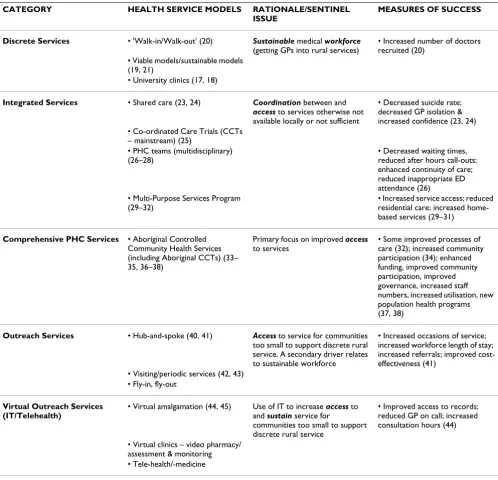
allowed the development of a typology of models of PHC within five broad categories, each with a different ration-ale and addressing particular sentinel issues (see Table 2). Thirty six of the 161 papers constituted evaluations.
Eval-uation measures varied widely between studies. Some of these are summarised in Table 2.
Drawing on information about model type, location and service population size, it was evident that in general the
[image:4.612.73.527.97.606.2]Selection process for inclusion of papers in systematic review Figure 1
Selection process for inclusion of papers in systematic review.
Titles and abstracts remaining
Rural n=3830
Remote n= 1561
Total n=5391
Full papers retrieved
Rural n=111
Remote n=113
Total n=224
Duplicates removed
Rural n=2451
Remote n=1607
Total n=4058
Each abstract read by
two reviewers
Abstracts not meeting
inclusion criteria discarded
Rural n=3719
(including 9 inadequately
referenced for retrieval)
Remote n=1448
Total n=5167 Titles and abstracts retrieved
Rural n=6281
Remote n=3168
Total n=9449
Full papers not meeting
inclusion criteria
Rural n=35
Not models n=22
Papers included in the review
Rural n=76
Remote n=17
Total n=93
Not PHC n=6
Not evidence-based n=7
Remote n=96
Not models n=87
Not PHC n=5
Personal accounts n=4
different categories of models relate to different geograph-ical contexts, with a notable association with population size and remoteness. While larger rural communities are generally able to support a greater variety of local, discrete, more specialised health care services, increasing remote-ness and diminishing population size and density con-strain service model options and increase the impetus for the development of more integrated and comprehensive primary health services in order to maximise the econo-mies of scale and use of existing health workforce.
'Discrete primary care services' are delivered from an identi-fiable site located in the community they serve (for
[image:5.612.56.554.99.579.2]exam-ple, [17-22]). Their primary purpose is to sustain a general practitioner service in those rural and larger remote com-munities experiencing significant difficulties in recruiting and in retaining an adequate general practitioner work-force. They accomplish this through ensuring attractive practice opportunities for doctors and continuity of med-ical care for the community when doctors leave. Exem-plars of this type are characterised by practice infrastructure owned and maintained by an entity such as a local council, university or other incorporated body, such that incoming general practitioners can execute both an 'easy entry' on recruitment and 'gracious exit' free of concern about return on capital investment.
Table 2: Typology of rural and remote PHC models
CATEGORY HEALTH SERVICE MODELS RATIONALE/SENTINEL
ISSUE
MEASURES OF SUCCESS
Discrete Services • 'Walk-in/Walk-out' (20) Sustainable medical workforce
(getting GPs into rural services)
• Increased number of doctors recruited (20)
• Viable models/sustainable models (19, 21)
• University clinics (17, 18)
Integrated Services • Shared care (23, 24) Coordination between and
access to services otherwise not available locally or not sufficient
• Decreased suicide rate; decreased GP isolation & increased confidence (23, 24) • Co-ordinated Care Trials (CCTs
– mainstream) (25)
• PHC teams (multidisciplinary) (26–28)
• Decreased waiting times, reduced after hours call-outs; enhanced continuity of care; reduced inappropriate ED attendance (26)
• Multi-Purpose Services Program (29–32)
• Increased service access; reduced residential care; increased home-based services (29–31)
Comprehensive PHC Services • Aboriginal Controlled Community Health Services (including Aboriginal CCTs) (33– 35, 36–38)
Primary focus on improved access
to services
• Some improved processes of care (32); increased community participation (34); enhanced funding, improved community participation, improved governance, increased staff numbers, increased utilisation, new population health programs (37, 38)
Outreach Services • Hub-and-spoke (40, 41) Access to service for communities too small to support discrete rural service. A secondary driver relates to sustainable workforce
• Increased occasions of service; increased workforce length of stay; increased referrals; improved cost-effectiveness (41)
• Visiting/periodic services (42, 43) • Fly-in, fly-out
Virtual Outreach Services (IT/Telehealth)
• Virtual amalgamation (44, 45) Use of IT to increase access to
and sustain service for
communities too small to support discrete rural service
• Improved access to records; reduced GP on call; increased consultation hours (44)
'Integrated services' offer a range of integrated primary health care services from sites located in the communities they serve [23-32]. Their scope is significantly broader than general practitioner services, but may include coordi-nation with general practitioner services. Integrated serv-ices provide single point access to a range of servserv-ices and sufficient numbers of health professionals to ensure mutual professional support. Because these communities cannot usually sustain necessary allied health and special-ist services in a discrete form, this model enables the pop-ulation to sustain such a service.
'Integrated services', which usually emerge from a com-munity health service or allied health team approach to primary health care services, comprise a variety of models. For example, the 'shared care' model of mental health care addresses access to and co-ordination of service across pri-mary and specialist care [23,24]. The Multi Purpose Serv-ices (MPS) program provides a specific model of Commonwealth/state financing which allows for the co-location and common administration of acute care, resi-dential aged care, community and allied health services, rehabilitation and health education activities [29-32].
'Comprehensive primary health care services' (CPHC) are best typified in Australia by the Aboriginal Community Con-trolled Health Services (ACCHSs). ACCHSs have adopted a primary health care approach to healthcare delivery over the past 30 years, and provide some of the best examples of this model [33-39]. CPHC services aim to improve health outcomes through better access to services and by addressing underlying social determinants of health. The main impetus for the development of ACCHSs has come from poor service access and availability, inadequate funding of services, low acceptance of mainstream services by Aboriginal patients, the poor health status of the Abo-riginal population, and a desire for community control of these services. CPHC services are broader in scope than most 'Integrated Services' models. They include primary clinical care, preventive and health promotion activity, as well as education and development in relation to work-force training and governance/community capacity build-ing.
'Outreach models' are characterised by the periodic supply of services from one location which has services to other locations which do not [40-43]. The arrangement may be either centrally located services providing services to satel-lite communities though a 'hub and spoke' arrangement, or some other visiting mechanism, such as where a gen-eral practitioner resident in one community may visit a second community for short periods, or services are sup-plied on a fly-in fly-out basis. Outreach services thus improve access to health services for widely dispersed and
isolated populations and often co-exist with other inte-grated and comprehensive PHC services.
'Telehealth' and 'telemedicine' have been widely used in Australia over the past decade as a means of overcoming problems of access to health care and the shortage of health professionals in rural and remote areas [44-49]. The extent to which telehealth and telemedicine consti-tute a 'model' of care in its own right is a moot point. In many cases, telemedicine and telehealth are used to aug-ment other service delivery models.
Discussion
This review represents the first comprehensive synthesis of published literature relating to Australian rural and remote models of PHC. The resultant typology of these models indicates that with increasing remoteness and decreasing population size and density, different model types assume prominence in addressing key PHC princi-ples relating to accessibility, appropriateness and sustain-ability. The different models provide some guidance as to appropriate options for different settlement patterns in rural and remote areas. Where discrete general practice models can be sustained in sufficiently large country towns, alternative hub-and-spoke models may be required for delivering a full range of PHC services to smaller, more isolated communities. The need for ensur-ing that a comprehensive range of well-coordinated PHC services is locally accessible has become increasingly important as the prevalence of chronic disease grows with the ageing of Australia's rural and remote population. This typology is not prescriptive, nor are these models mutu-ally exclusive, nor are they necessarily unique to rural and remote areas. Hence, for example, a hub-and-spoke model may share some aspect of shared care or similar collaborative arrangement, while a discrete GP model may provide an outreach service to outlying populations.
BMC Health Services Research
2
008
,
8
:276
http://ww
w.b
iomed
central.com/1
472
-6
963
Pa
ge 7 of
(page number not for citation purposes)
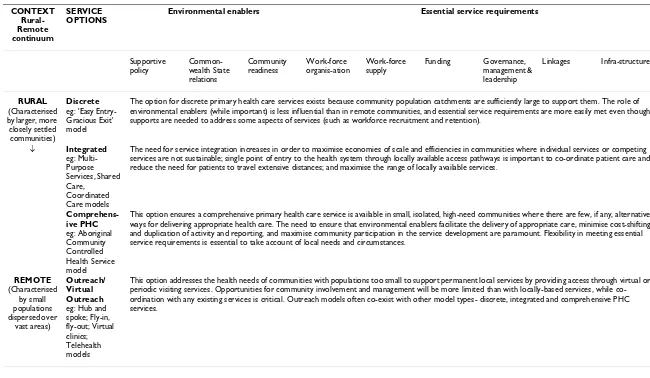
Rural-Remote continuum
OPTIONS
Supportive policy
Common-wealth State relations
Community readiness
Work-force organis-ation
Work-force supply
Funding Governance, management & leadership
Linkages Infra-structure
RURAL
(Characterised by larger, more closely settled communities)
Discrete
eg: 'Easy Entry-Gracious Exit' model
The option for discrete primary health care services exists because community population catchments are sufficiently large to support them. The role of environmental enablers (while important) is less influential than in remote communities, and essential service requirements are more easily met even though supports are needed to address some aspects of services (such as workforce recruitment and retention).
↓ Integrated
eg: Multi-Purpose Services, Shared Care,
Coordinated Care models
The need for service integration increases in order to maximise economies of scale and efficiencies in communities where individual services or competing services are not sustainable; single point of entry to the health system through locally available access pathways is important to co-ordinate patient care and reduce the need for patients to travel extensive distances; and maximise the range of locally available services.
Comprehens-ive PHC
eg: Aboriginal Community Controlled Health Service model
This option ensures a comprehensive primary health care service is available in small, isolated, high-need communities where there are few, if any, alternative ways for delivering appropriate health care. The need to ensure that environmental enablers facilitate the delivery of appropriate care, minimise cost-shifting and duplication of activity and reporting, and maximise community participation in the service development are paramount. Flexibility in meeting essential service requirements is essential to take account of local needs and circumstances.
REMOTE
(Characterised by small populations dispersed over
vast areas)
Outreach/ Virtual Outreach
eg: Hub and spoke; Fly-in, fly-out; Virtual clinics; Telehealth models
[image:7.792.84.734.75.453.2]requires a model with characteristics that enable it to cap-ture the necessary population aggregation required to sup-port minimum service threshold requirements and thereby ensure adequate access to care.
Whilst there are different models that have been devel-oped for different locations, a number of key environ-mental enablers and essential service requirements are common across the model types. Our synthesis has used the best available evidence to develop a conceptual frame-work that includes these service requirements and ena-blers for sustainable PHC services in small rural and remote communities (Tables 3 &4). This framework, endorsed and validated by the Reference Group, is partic-ularly useful in underpinning the development of sustain-able rural and remote PHC models.
Essential elements of sustainable PHC services for small rural and remote communities include a number of signif-icant environmental enablers which are crucial in prepar-ing an environment for change, together with a number of
essential requirements that need to be met in order to improve access to PHC services. The enablers are: a sup-portive policy which ensures sustained service funding; co-ordination of policy and funding across national and state governments; and an appropriate level of
commu-nity readiness for involvement in planning, implementa-tion and monitoring of health service activity. The essential service requirements focus specifically on work-force – numbers and mix of staff; funding; governance, management and leadership; linkages, which include integration of services within an organisation and external linkages with other key organisations to ensure continuity of care; and infrastructure – physical infrastructure as well as adequate information and communication technology. These essential requirements are inter-related. Impor-tantly, evidence from the systematic review showed that apparently successful examples of these models addressed the full range of essential requirements, with workforce, the focus of much current rural health policy in Australia, diminishing as such a critical barrier to sustainability. An example of how these factors apply to one discrete model is presented in Table 4.
[image:8.612.51.561.99.399.2]This evidence-based framework provides principles or guidelines to guide the decisions of policy-makers in plan-ning appropriate PHC service for small rural and remote communities [50,51]. These principles are important if policy is to provide an appropriate systematic framework for the design and delivery of PHC services, rather than a collection of ad hoc responses to felt needs.
Table 4: Environmental enablers and essential service requirements for the 'Easy entry-gracious exit' discrete model
Environmental enablers
Supportive policy Initial Commonwealth grant funds enabled provision of practice equipment & furnished doctor housing.
Following this, the Rural Medical Infrastructure Fund supported the model.
Commonwealth/State relations Commonwealth and State agencies negotiated contracts of service to cash out some services, enabling a
reliable income stream which enabled more specific income estimates for prospective doctors
Community readiness There was a strong community commitment to finding solutions to the GP recruitment problem and local
champions to drive the change to community ownership of infrastructure.
Essential service requirements
Workforce Recruits from a larger pool due to limited infrastructure investment requirement. Expanded GP role
provides additional positions so can provide self-cover for after hours and on-call work.
Funding Cashing out of hospital Visiting Medical Officer services, population health activity, Extended Primary
Care (EPC) items, other Medicare and Retention Grants fund bulk-billing service.
Governance, management & leadership Community, agencies (eg Division of General Practice, Area Health Service, Rural Workforce Agency)
represented on Board. Professional business management instituted.
Linkages Provides a platform for integration. Strong community & other linkages as above. Enables EPC activity
involving allied health team.
Infrastructure Community ownership through Rural Medical Infrastructure Fund, local government, Practice Incentives
Conclusion
This study was predicated on (1) the ongoing need to improve poor health outcomes in rural and remote com-munities through improved access to health services and (2) the belief that the time is ripe to build upon the signif-icant achievements in relation to innovative models of PHC since the first National Rural Health Strategy. Rather than seeking more and more innovation, progress will be made by garnering the knowledge gained since 1993 and enhancing service access through the wider implementa-tion of models that have been shown to be successful.
Unfortunately, despite many descriptive accounts, com-prehensive service evaluations have been lacking. As a result, our systematic review of the Australian literature does not reflect a well-established body of knowledge based on rigorous and comprehensive evaluations but rather a preponderance of largely descriptive studies in the published literature. This paucity of evaluations is hardly surprising given a policy environment that has been char-acterised by a notable absence of a national PHC policy, continual funding of 'innovative' pilots, and a dominant focus on workforce issues, rather than the strategic devel-opment of comprehensive models of PHC service deliv-ery.
The systematic review did, however, highlight a number of exemplary models of PHC service delivery which have been evaluated and shown to be successful in meeting their stated goals [20,24,26,31,37,41]. The conceptual framework that emerged from this review provides an important paradigm to underpin future policy develop-ment and program funding. The identified 'environmen-tal enablers' assist us to understand what a policy context conducive to positive change might look like. The 'essen-tial service requirements' which characterise the success of these exemplars are amenable to generalisation, adapta-tion and evaluaadapta-tion in other regions. This is the current policy challenge and currently the subject of further research.
Competing interests
The authors declare that they have no competing interests.
Authors' contributions
JW, JSH, RW and PK conceptualised and designed the study. All authors were involved in the literature searches, extraction and analysis of data. JW wrote the first draft and all authors contributed to the final draft.
Acknowledgements
We acknowledge the Australian Primary Health Care Research Institute (APHCRI) and its Director, Professor Nicholas Glasgow. APHCRI is sup-ported by a grant from the Australian Government Department of Health and Ageing under the Primary Health Care Research, Evaluation and Devel-opment Strategy. APHCRI has pioneered a research approach which has
entailed interaction with the other research 'spokes' working on systematic reviews, as well as key Department of Health and Ageing staff, in order to facilitate the research transfer process.
We also acknowledge the expert assistance of Jessica Tyndall, Liaison Librarian at the School of Medicine Library at Flinders University, and the contribution of Lisa Lavey at Monash University.
Finally, we are very grateful to the members of our Reference Group for their active and enthusiastic participation. They were Kim Snowball, Chris O'Farrell, Mick Gooda, Alma Quick, Chris Harrington, Gordon Gregory, Brita Pekarsky, Ian Cameron, David Lyle, Raymond Pong and Martha MacLeod.
References
1. Australian Institute of Health and Welfare: Rural, regional and remote health – Indicators of health. In Cat. No. PHE 59 Can-berra: AIHW; 2005.
2. Australian Institute of Health and Welfare: Rural, regional and remote health, a guide to remoteness classifications. Can-berra: AIHW; 2004.
3. Humphreys J: Rural health and the health of rural communi-ties. In Worner Research Lecture Bendigo: La Trobe University; 1998. 4. Rural and Remote Mental Health Services Working Party: Report for Western Australia's State Mental Health Strategic Plan 2003 – 2008. Perth 2003.
5. Vinson T: Community Adversity and Resilience: the distribu-tion of social disadvantage in Victoria and New South Wales and the mediating role of social cohesion. Richmond: The Igna-tius Centre for Social Policy and Research; 2004.
6. National Rural Health Policy Forum and National Rural Health Alli-ance: Healthy Horizons: a framework for improving the health of rural, regional and remote Australians Canberra: National Rural Health Policy Forum; 1999.
7. Sadkowsky K, Hagan P, Kelman C, Liu C: Health services in the city and the bush: measures of access and use derived from linked administrative data. Canberra: Commonwealth Depart-ment of Health and Aged Care; 2001.
8. Nissen L, Tett S: Community pharmacists improving health outcomes in rural and remote Queensland. Australian Pharma-cist 2002, 21:874-6.
9. Australian Health Ministers' Conference: National Rural Health Strategy Canberra: Australian Government Publishing Service; 1994. 10. Department of Health and Ageing: Regional Health Strategy – Fact Sheet
3 Canberra: Australian Government Department of Health and Age-ing; 2000.
11. Department of Health and Ageing: Health Fact Sheet 4 – A Continuing Commitment to Rural, Regional and Remote Australians Canberra: Aus-tralian Government Department of Health and Ageing; 2004. 12. Asthana S, Halliday J: What can rural agencies do to address the
additional costs of rural services? A typology of rural service innovation. Health and Social Care in the Community 2004, 12:457-65. 13. Shannon C, Wakerman J, Hill P, Barnes T, Griew R: Achievements in Aboriginal and Torres Strait Islander Health. Darwin: Cooperative Research Centre for Aboriginal and Tropical Health; 2003.
14. Eagar K, Pirkis J, Owen A, Burgess P, Posner N, Perkins D: Lessons from the national mental health integration program. Aus-tralian Health Review 2005, 29:189-200.
15. Kuipers P, Humphreys JS, Wakerman J, Wells R, Jones J, Entwistle P:
Collaborative review of pilot projects to inform policy: A methodological remedy for pilotitis? Australia and New Zealand Health Policy 2008, 5:17.
16. Pawson R, Greenlagh T, Harvey G, Walshe K: Realist review – a new method of systematic review designed for complex pol-icy interventions. J Health Serv Res Policy 2005, 10(Suppl):21-34. 17. Taylor J, Blue I, Misan G: Approach to sustainable primary
health care service delivery for rural and remote South Aus-tralia. Australian Journal of Rural Health 2001, 9:304-10.
Publish with BioMed Central and every scientist can read your work free of charge "BioMed Central will be the most significant development for disseminating the results of biomedical researc h in our lifetime."
Sir Paul Nurse, Cancer Research UK
Your research papers will be:
available free of charge to the entire biomedical community
peer reviewed and published immediately upon acceptance
cited in PubMed and archived on PubMed Central
yours — you keep the copyright
Submit your manuscript here:
http://www.biomedcentral.com/info/publishing_adv.asp
BioMedcentral
19. Rural Doctors Association of Australia, Monash University School of Rural Health: Viable Models of Rural and Remote Practice. Stage 1 and Stage 2 Reports Canberra: Rural Doctors Association of Australia; 2003.
20. Cameron I: Finding solutions in North West NSW:"Easy Entry, Gracious Exit" and the Rural and Remote Medical Services (RARMS) experience. In Proceedings of Practice Made Perfect? Coffs Harbour: NSW Rural Doctors Network; 2005. 21. Down G, Jeffries F, Seward M: Towards Northern Wheatbelt GP
sustainability. Perth: Western Australian Centre for Rural and Remote Medicine; 2000.
22. Rose G: Primary Health Care Services University Led Prac-tice made perfect? -The sequel. Sydney: NSW Rural Doctors Network; 2006.
23. Malcolm H: Primary mental health-care model in rural Tas-mania: outcomes for patients. Australian Journal of Rural Health 2002, 10:20-25.
24. Campbell A: The evaluation of a model of primary mental health care in rural Tasmania. Australian Journal of Rural Health 2005, 13:142-8.
25. Harvey P: The impact of coordinated care: Eyre region, South Australia 1997–1999. Australian Journal of Rural Health 2001,
9:69-73.
26. Cromwell D, Senior K, Owen A, Gordon R, Eagar K: Can the National Palliative Care Strategy be translated into a model of care that works for rural Australia? An answer from the Griffith Area Palliative Care Service (GAPS) experience.
Wollongong: Centre for Health Service Development, University of Wollongong; 2003.
27. Smith D, Wilkin C: A round peg in a square hole: changes in a rural health service. Australian Journal of Primary Health Interchange 1996, 2:63-71.
28. Hawke M, Byrne J: Community-based early childhood assess-ment and intervention in rural settings: Transdisciplinary case management of developmental delay in children. Aus-tralian Journal of Primary Health Interchange 2000, 6:130-40.
29. Nicoll P, Jackson D, Then E-L, Matyk P: Department of Health and Ageing's management of the Multipurpose Services Pro-gram and the Regional Health Services ProPro-gram. Canberra: Australian National Audit Office, Audit Report 40; 2003–04. 30. Hoodless M, Evans F: The multipurpose service program: The
best health service option for rural Australia. Australian Journal of Primary Health 2001, 7:90-6.
31. Sach & Associates, Centre for Applied Gerontology: Multi-Purpose Services Program Evaluation (Victoria) Commonwealth Department of Health and Aged Care and (Victorian) Department of Human Serv-ices; 2000.
32. Snowball K: Multipurpose services – a potential solution for rural health and aged care. Australian Journal of Rural Health 1994,
2:37-40.
33. Bailie RS, Si D, Robinson GW, Togni SJ, d'Abbs PHN: A multifac-eted healthservice intervention in remote Aboriginal com-munities: 3-year follow-up of the impact on diabetes care.
Medical Journal of Australia 2004, 181:195-200.
34. Local Evaluation Team: Jirntangku Miyrta Katherine West Coordinated Care Trial Final Report Darwin: Menzies School of Health Research; 2000.
35. Robinson G, d'Abbs P, Togni S, Bailie R: Aboriginal participation in health service delivery: Coordinated care trials in the Northern Territory of Australia. International Journal of Health-care Technology and Management 2003, 5:45-62.
36. Burns CB, Clough AR, Currie BJ, Thomsen P, Wuridgal R: Resource requirements to develop a large, remote Aboriginal health service: whose responsibility? Australian and New Zealand Journal of Public Health 1995, 22:133-9.
37. Katherine West Health Board: Something Special: The inside story of the Katherine West Health Board Canberra: Aboriginal Studies Press; 2003. 38. KPMG Consulting: The Aboriginal & Torres Strait Islander Coordinated Care Trials – National Evaluation Report (Volume 1) – Volume 1 Main Report Canberra: Office for Aboriginal and Torres Strait Islander Health; 1999.
39. Boffa J, Fisher M: Aboriginal and Torres Strait Islander Health: implementation of the Primary Health Care Access Pro-gram (PHCAP) in four remote health zones in Central Aus-tralia and in the Northern Territory. Canberra: Public Health Association of Australia; 2000.
40. Battye KM, McTaggart K: Development of a model for sustaina-ble delivery of outreach allied health services to remote North-West Queensland, Australia. Rural Remote Health 2003,
3(3):194.
41. Stanley-Davies P, Battye K: The Division with the Vision: Devel-opment of the North West Queensland Allied Health Serv-ice by North and West Queensland Primary Health Care. Evaluation of Stage 1. 2004.
42. Neville N: A model of allied health service delivery to country communities in the Upper Eyre Peninsula. Proceedisngs of the 2nd National Rural Health Conference, Armidale 1993.
43. Booth A: Health service delivery to outback South Australia: a story of organizational change. International Journal of Health Care Quality Assurance 1996, 9:15-19.
44. Misan G, White P, McKenzie W, Paskett E: Final Report on the Whyalla General Practice Virtual Amalgamation Project.
Whyalla: Spencer Gulf Rural Health School; 2002.
45. Rural Workforce Agency Victoria: A Snapshot of Sustainable Rural Gen-eral Practice Projects in Victoria (Issues Paper No. 6 Workforce Issues Paper) Melbourne: Rural Workforce Agency Victoria; 2001. 46. Dillon E, Loermans J: Telehealth in Western Australia: the
chal-lenge of evaluation. Journal of Telemedicine and Telecare 2003,
9(Suppl 2):S15-9.
47. Leversha A, Pendergast C, Humphreys J, Colley C, Scavone M, Marty S: An evaluation of videoconferencing in a rural community pharmacy. Australian Pharmacist 2003, 22:154-7.
48. Meade BJ, Dunbar JA: A virtual clinic: telemetric assessment and monitoring for rural and remote areas. Rural Remote Health 2004, 4(3):296.
49. Trott P, Blignault I: Cost evaluation of a telepsychiatry service in northern Queensland. Journal of Telemedicine and Telecare 1998,
4(Suppl 1):66-8.
50. Wakerman J, Humphreys J, Wells R, Kuipers P, Entwistle P, Jones J: A Systematic Review of Primary Health Care Delivery Models in Rural and Remote Australia 1993–2006. [http:// www.anu.edu.au/aphcri/Domain/RuralRemote/
Final_25_Wakerman.pdf].
51. Humphreys JS, Wakerman J, Wells R, Kuipers P, Jones J, Entwistle P:
Beyond workforce: a systemic solution for health service provision in small rural and remote communities. Medical Journal of Australia188(8 Suppl):S77-S80.
Pre-publication history
The pre-publication history for this paper can be accessed here: