This is a repository copy of
Polar Spinel-Perovskite Interfaces : an atomistic study of
Fe3O4(111)/SrTiO3(111) structure and functionality
.
White Rose Research Online URL for this paper:
http://eprints.whiterose.ac.uk/102934/
Version: Published Version
Article:
Gilks, D., McKenna, K.P. orcid.org/0000-0003-0975-3626, Nedelkoski, Z. et al. (8 more
authors) (2016) Polar Spinel-Perovskite Interfaces : an atomistic study of
Fe3O4(111)/SrTiO3(111) structure and functionality. Scientific Reports. 29724. pp. 1-7.
ISSN 2045-2322
https://doi.org/10.1038/srep29724
[email protected]
https://eprints.whiterose.ac.uk/
Reuse
This article is distributed under the terms of the Creative Commons Attribution (CC BY) licence. This licence
allows you to distribute, remix, tweak, and build upon the work, even commercially, as long as you credit the
authors for the original work. More information and the full terms of the licence here:
https://creativecommons.org/licenses/
Takedown
If you consider content in White Rose Research Online to be in breach of UK law, please notify us by
www nature com scientificreports
Polar Spinel-Perovskite Interfaces:
an atomistic study of Fe O
SrTiO
structure and
functionality
Daniel Gilks , Keith P. McKenna , Zlatko Nedelkoski , Balati Kuerbanjiang ,
Kosuke Matsuzaki , Tomofumi Susaki , Leonardo Lari , Demie Kepaptsoglou ,
Quentin Ramasse , Steve Tear & Vlado K. Lazarov
Atomic resolution scanning transmission electron microscopy and electron energy loss spectroscopy combined with ab initio electronic calculations are used to determine the structure and properties of the Fe O SrTiO polar interface The interfacial structure and chemical composition are shown to be atomically sharp and of an octahedral Fe SrO nature. Band alignment across the interface pins the Fermi level in the vicinity of the conduction band of SrTiO . Density functional theory calculations demonstrate very high spin-polarization of Fe O in the interface vicinity which suggests that this system may be an excellent candidate for spintronic applications.
Oxide heterostructures are of interest for developing new functional materials due to their rich physical proper-ties1–5. Many oxides are insulators, but oxide materials also provide wide band gap semiconductors6,
superconduc-tors7, ionic conductors8, ferrimagnetic9 and antiferromagnetic10 materials. As such, oxide multilayer structures
provide a broad platform for devices with multifunctional properties. he functionality of oxide devices depends strongly on the atomic scale structural and electronic discontinuities across multilayer heterostructure inter-faces; therefore we need an atomic scale understanding of their interfacial properties. In this work we focus on spinel-perovskite heterostructures that have great potential for the development of multiferroic devices by using Fe3O4/SrTiO3 as a model system11,12.
One of the main issues in semiconductor spintronics is the efective spin injection into semiconductors due to the large conductivity mismatch between the ferromagnetic ilm and semiconducting substrate. his can be overcome i) if the ferromagnetic electrode is 100% spin-polarised i.e. halfmetallic, ii) by tailoring the conductiv-ity of the semiconducting substrate to match that of the ferromagnetic ilm. Both conditions in principle can be addressed by considering the Fe3O4/SrTiO3 heterostructure due to the low conductivity and half-metallic
prop-erties of Fe3O413–15 as well as tunable conductivity of SrTiO3(STO), making this structure an excellent candidate
for spintronic applications.
Along the [111] direction both Fe3O4 and STO are chemically layered polar materials, hence the growth along
this direction is much more challenging16 compared to the growth along the neutral [100] direction for which
num-ber of studies have been reported12. STO is deined by alternating SrO
3 and Ti planes. he complex arrangement
of Fe sites in the Fe3O4 spinel structure gives tetrahedral (FeA) and octahedral (FeB) sites with six unique atomic
planes described by “… 4O/3FeB/4O/FeA-FeB-FeA/4O… ” along the [111] direction (Supplementary Figure S1).
his leads to twelve nominal interfacial terminations between the STO substrate and the Fe3O4 ilm which could
be exploited for the purpose of interfacial atomic engineering. he variety of possible atomic structures at the polar Fe3O4/STO(111) interface could be explored to understand the interface electronic structure efects on
spin tunnelling/injection in semiconductors, a crucial phenomenon for spin injection in semiconductors that is still poorly understood. Furthermore, an additional beneit of using two oxides to form such a heterostructure is their chemical stability compared to metallic ferromagnetic/SC systems (where SC is either a III-V (e.g. GaAs) or
Department of Physics University of York Heslington York YO DD UK Secure Materials Center, Materials and Structures Laboratory Tokyo Institute of Technology Nagatsuta Midori ku Yokohama Japan SuperSTEM STFC Daresbury Laboratories Keckwick Lane Warrington WA AD UK Correspondence and requests for materials should be addressed to V K L email vlado lazarov york ac uk
Received April Accepted June
www.nature.com/scientificreports/
elemental (e.g. Si) semiconductor) whose performance oten sufers through the formation of unwanted interfa-cial phases. he experimental realisation of polar oxides heterostructures is challenging, since the main obstacle is the divergent electrostatic potential of the grown ilm. It is well known that the bulk terminated polar metal-oxide surfaces are generally unstable; they have very high surface energy due to the large electrostatic contribution from the presence of a dipole moment in the repeat unit normal to the surface17. In a simpliied picture, the ionic
crystal along the polar direction can be viewed as a system of parallel opposite charged planes, thus even for polar ilms with small thickness the electric dipole moment is huge, and in the limit of number of layers N→∝, leads to
the so-called ‘electrostatic catastrophe’. In the case of polar heterostructures the interface ‘electrostatic catastrophe’ has to be mitigated by stabilisation mechanisms such as atomic mixing, interface roughening and faceting and/or pure electronic interface reconstructions16–20. he relative chemical stability of oxide/oxide interfaces compared
to ferromagnet/semiconductor interfaces21 opens the possibility of tailoring metastable interface structures with
potential for device applications.
In contrast to previous studies on Fe3O4 ilms grown on STO12, in this work we focus on interface atomic
structure determination by advanced electron microscopy methods. By employing pulsed laser deposition (PLD) growth and atomically-resolved aberration corrected scanning transmission electron microscopy (STEM) and electron energy loss spectroscopy (EELS) we demonstrate that atomically sharp polar oxide spinel (Fe3O4
)/per-ovskite (SrTiO3) junctions can be achieved experimentally. Band alignment across the Fe3O4/SrTiO3 interface
calculated by Density Functional heory (DFT) shows that the Fermi level is pinned in the vicinity of the conduc-tion band of the SrTiO3. Moreover, the spin polarisation of Fe3O4 is preserved even at the interface suggesting that
this system could be an excellent candidate for spintronic applications. Finally, this work provides an example of a class of materials that can host ferromagnetic and ferroelectric properties, which can be potentially coupled by suitable interface engineering.
Fe3O4 crystalizes in the inverse spinel structure with a lattice constant of 0.834 nm and space group Fd-3m22.
he oxygen sublattice forms a fully occupied FCC lattice with Fe occupying interstitial sites. he dominant super-exchange interaction in Fe3O4 between tetrahedral (FeA) and octahedral (FeB) sublattices results in their
antiferromagnetic alignment23,24. Since there are twice as many Fe atoms on B sites compared to A sites this gives
an overall magnetisation of 4.08 µB/formula unit. Recent interest in magnetite as a spin-polarised electrode and
therefore its use within this model heterostructure stems from band structure calculations which predict 100% spin polarisation at the Fermi level, a property highly desirable for spintronic applications. In contrast, SrTiO3 is
an insulating oxide (band gap 3.25 eV) with perovskite structure; however with Nb doping STO can become an efective semiconducting material and even a metallic conductor25,26. herefore STO could be used either as a spin
tunnel barrier or a medium for spin current difusion in the insulating and semi-conducting phase respectively.
Results and Discussion
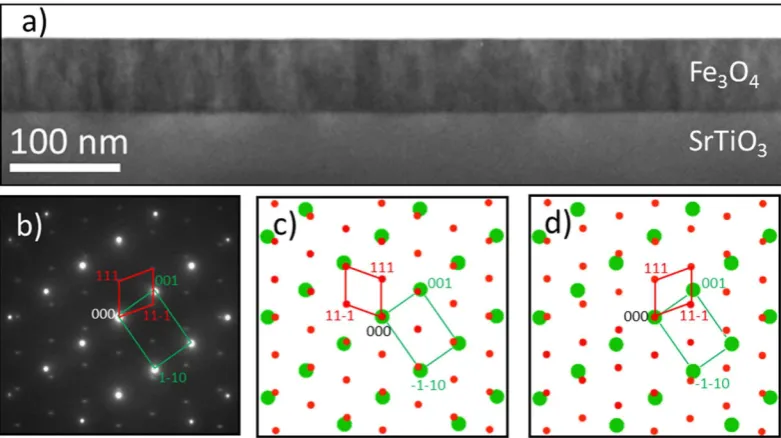
he structural quality of Fe3O4 (111) ilm grown by PLD is shown in Fig. 1, with further characterization
[image:3.595.158.549.46.265.2]pro-vided in the Supplementary Figure S2. he ilm has a single crystal structure and uniform thickness. he long
Figure 1. (a) HRTEM overview image of the Fe3O4/SrTiO3 heterostructure showing uniform ilm thickness of
~80 nm and a sharp interface between ilm and substrate. (b) SAD pattern from the interface region. he Fe3O4
and SrTiO3 motifs are outlined (Fe3O4 in red, SrTiO3 in green). (c,d) show SAD simulations of Fe3O4 (red) and
SrTiO3 (green) depending on whether the Fe3O4 structure is mirrored around the vertical axis. (c) SAD along
the [−110] viewing direction for both SrTiO3 and Fe3O4. (d) SAD along the [−110] viewing direction for SrTiO3
and the [1−10] viewing direction for Fe3O4. he correspondence between (b,d) shows that the Fe3O4 is mirrored
www.nature.com/scientificreports/
range single crystal nature of the ilm and the parallel (111) planes shared between the ilm and substrate can be identiied from the XRD θ -2θ patterns, as shown in Supplementary Figure S2. he clearly deined crystallographic orientation between the Fe3O4(111) ilm and STO(111) substrate was additionally conirmed by selected area
electron difraction (SAD) given in Fig. 1b. Comparison of simulated SAD patterns for a simple cube-on-cube epitaxy (Fig. 1c) and a twinned cube-on-cube epitaxial relationship (Fig. 1d) with the experimental SAD pattern (Fig. 1b) shows that the Fe3O4/STO epitaxy is determined by a twinned cube-on-cube epitaxial relation given by
the following relationship: Fe3O4(111)||STO(111) and Fe3O4(−110)||STO(1−10).
A high angle annular dark ield (HAADF) STEM image of the interfacial region along the [1−10] zone axis is shown in Fig. 2. he distinction between the projected atomic structures of the perovskite (substrate) and the spinel (ilm) is clearly observed. he HAADF image shows that the interface between the perovskite (STO) and spinel (Fe3O4) structure is atomically abrupt. Based on the HAADF intensities we can identify the positions of the
atomic columns of Fe, Ti and Sr; note that in the imaging conditions used, the intensity of O atomic columns is negligible compared to that of Sr, Ti and Fe and therefore O columns cannot be clearly identiied in the HAADF image. he brighter sites in the STO region are identiied as the projection of mixed Sr-O atomic columns (pur-ple), while the lower intensity sites are the Ti atomic columns (green dots). In the [1−10] viewing direction octahedral and tetrahedral Fe atoms in Fe3O4 are in separate atomic columns. In order to visually distinguish the
octahedral (FeB) and tetrahedral (FeA) atomic columns, the FeA sites are labelled with yellow while the FeB sites
with red dots in the overlaid ball model in Fig. 2. he intensity variation between FeB sites on the ‘3FeB’ plane is
due to alternating double and single occupation of the octahedral atomic sites in this projection. By following the bulk-like stacking of STO and magnetite, the interface region can be identiied as the region between the white and yellow dashed lines drawn in Fig. 2 as a guide to the eye. It can be clearly seen that the atomic planes just above the white and below the yellow dashed line nominally correspond to magnetite’s ‘3FeB’ and STO’s ‘Sr-O’
atomic planes, respectively. he inset in Fig. 2 is a magniied view of the interface and reveals the atomic structure within the interface region with two distinctive atomic columns labelled as ‘a’ and ‘b’. he lower intensities of these interface atomic columns rules out the Sr-O as a plane in the interface region, suggesting that these columns are either Fe or Ti. However, based solely on the HAADF intensities the chemical nature of these atomic planes can-not be uniquely determined.
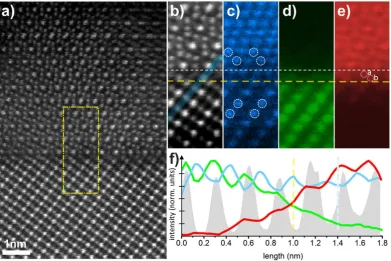
[image:4.595.157.394.44.278.2]Further insight into the chemical nature of the interface atomic columns can be provided by atomic level elemental mapping using STEM – EELS measurements (Fig. 3). One of the advantages of the technique is that it allows a simultaneous acquisition of the spectroscopic and HAADF imaging signals and therefore direct cor-relation of the image contrast with chemical information, as illustrated in Fig. 3. he HAADF survey image of the interface region used for atomically-resolved chemical mapping is shown in Fig. 3a. Elemental maps were acquired by rastering the electron probe serially across the region outlined by the yellow rectangle (Fig. 3a) and collecting an EEL spectrum at each position. Figure 3b shows the HAADF signal intensity acquired during EELS acquisition. his image forms a reference position for the atomically-resolved elemental maps shown in Fig. 3c–e.
Figure 2. HAADF STEM image of the Fe3O4 ilm and SrTiO3 substrate viewed along the [−110] and [1−10]
zone axis, respectively. Overlaid structural models identify the magnetite and SrTiO3 atomic columns;
octahedral (FeB) and tetrahedral (FeA) atomic columns are shown in red and yellow, respectively; Sr-O with
www.nature.com/scientificreports/
Figure 3c shows that O planes between the STO and Fe3O4 are continuous. he lower intensity observed on
alternate positions in the STO is due to the shared atomic columns with Sr. he twinning of the FCC stacking sequence (outlined by the open white circles) which has been also deduced from the SAD (Fig. 1b) is conirmed in this map with the twin structure occurring across a single (111) atomic plane, which we use as a reference inter-face plane (outlined with yellow dashed line which corresponds to the yellow dashed line from Fig. 2). Figure 3d shows the Ti L2,3 edge intensity map relecting the Ti atomic columns positions in the STO. his map
demon-strates that the Ti signal abruptly decreases across the interface without any considerable presence of Ti above the reference plane. his in turn excludes the presence of Ti as the predominant chemical species within the interface ‘a’ and ‘b’ atomic columns. Figure 3e shows the elemental map of iron atomic columns, obtained using the Fe L2,3
ionisation edge. While the Ti L2,3 signals disappears sharply above the reference plane the Fe L2,3 signal is clearly
present just above the reference plane. By comparing this map with the simultaneously acquired HAADF image (Fig. 3b), it can be seen that the Fe signal peaks at the ‘a’ and ‘b’ structural positions, thus suggesting these corre-spond to Fe atomic sites. Based on the above analysis a unique determination of the Fe3O4/STO interface, and in
particular the chemical nature of the two atomic planes located just above the interface reference plane, can be obtained. he atomic columns ‘a’ and ‘b’ are located in the structural positions of a tetrahedral FeA and octahedral
FeB atomic columns, respectively; when the interface is fully relaxed. he strong Fe L2,3 signal from STEM-EELS
in both ‘a’ and ‘b’ sites provides strong evidence that the interface atomic structure is deined by a FeA-FeB/SrO3
atomic stacking. It is worth noting that the structural position of the O plane (outlined with the white dashed line in Fig. 3c) is located just above the ‘a’ (i.e. tetrahedral Fe) and below the ‘3FeB’ plane, as expected for bulk-like
magnetite structure.
A small amount of inter-difusion may be also present at the interface as indicated by the EELS line pro-iles in Fig. 3f taken along the Ti atomic columns as outlined in Fig. 3b. hese propro-iles suggest a relatively small inter-difusion within two atomic planes (with respect to the interface reference plane) of both Fe and Ti. It should be noted however that these observations of small EELS intensity (Fig. 3f) could also arise from surface steps or channelling efects through the sample.
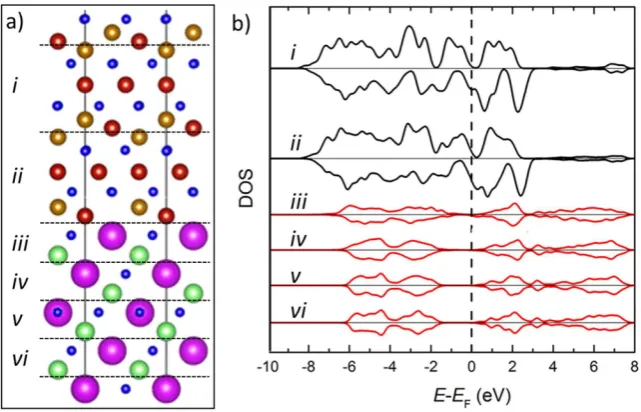
Based on the above EELS analysis we create an atomic model (Fig. 4a) of the interface as follows: … 3FeB/4O/
FeAFeB-SrO3/Ti… This model has been structurally optimized using density functional theory (DFT). The
[image:5.595.160.552.46.307.2]spin-resolved layer-by-layer density of states (SDOS) across the interface are shown in Fig. 4b. Partial SDOS are calculated by projecting onto atoms within speciic regions in the supercell as indicated by the labels i–vi in
Figure 3. HAADF-STEM and STEM-EELS from interfacial region. (a) Region of interest selected from
HAADF-STEM imaging. (b) HAADF-STEM signal showing atomic resolution imaging produced concurrently
with EELS acquisition. (c) Spatially resolved intensity of O K edge signal. Lower intensity observed on alternate positions in the substrate is due to the shared (with Sr) atomic columns: Sr-O. Open circles outline the twinning (also demonstrated by the SAD pattern) of the O sublattice across the interface. Note that the positions of the dashed yellow and white line are the same as in Fig. 2. (d) Spatially resolved intensity of Ti L2,3 signal.
(e) Spatially resolved intensity of Fe L2,3 edge signal. (f) Line proiles along the area outlined in (b) for O, Ti and
www.nature.com/scientificreports/
Fig. 4a. hese structural regions represent complete formula units of the respective materials, i.e. the upper black plots, (i and ii) represent Fe3O4 layers and the lower red plots (iii–vi) represent SrTiO3 layers. Aside from the two
SDOS projections on either side of the interface (ii and iii) the non-interfacial projections show a rapid return to bulk-like electronic structure in both Fe3O4 and STO (Supplementary Figure S1), suggesting that the interfacial
efects are conined to ~1 nm interface vicinity. By analysing the SDOS in Fig. 4b we observe that the band align-ment across the interface puts the Fermi level within the STO band gap, close to the conduction band. his prop-erty could allow eicient spin tunnelling across a suitably thin STO barrier, as well as spin injection into STO, without significant injection of holes into Fe3O4. In addition, the SDOS show that very near the interface
(~6 layers) the Fe3O4 band gap and the spin-polarisation (~90%) are only slightly reduced compared to the
corre-sponding bulk values.
In summary, understanding the electronic and the atomic/chemical structure of the spinel/perovskite inter-face is an important step in creating multifunctional devices, due to the rich functional properties of materials that crystalize into these two structures. In this work on the Fe3O4(111)/STO(111) model system, we have
demon-strated that atomically sharp spinel-perovksite heterojunctions are feasible. A STEM/EELS atomic study of the Fe3O4/STO interface has shown that the interface is determined by FeA-FeB/SrO3 atomic planes. his particular
atomic coniguration retains the negative spin polarisation of the magnetite ilm even at the interface, demon-strating that the experimentally realised Fe3O4(111)/STO(111) interface can be used as a platform for studying
spin injection from half-metals. Hence it provides an opportunity for studying fundamental properties such as spin injections and tunneling in model devices.
Methods
Fe3O4 ilms have been grown on (111) oriented Nb 0.05 wt% doped SrTiO3 substrates (Shinkosha LTD) by PLD
using a KrF excimer laser (λ = 248 nm) incident on a Fe3O4 target with 3N purity, with a pulse duration of 20 ns
and power density of 2.3 J cm−2 cycling at 10 Hz27. Substrates have been prepared for deposition with a bufered
NH4F-HF solution etch28 and a 60 minute anneal at 1050 °C in air to reduce surface roughness and remove surface
contaminants. Prior to deposition the substrate condition and orientation has been checked using relection high energy electron difraction (RHEED). Deposition was performed with the substrate held at 300 °C by the ablation of a sintered Fe3O4 target in a background oxygen atmosphere of 2 × 10⁻⁴ Pa. In order to improve crystalline
ordering as well as decrease the number of defects such as antiphase boundaries and twin defects29 we have
per-formed postdeposition annealing at 1000 °C for 60 minutes in a CO2/CO gas atmosphere27. he partial pressure
ratio of CO2/CO was set to 1000 which gives an efective O2 partial pressure of ~10−4 Pa. Deposited specimens
have been characterised with θ -2θ X-ray Difraction (XRD) scans to identify the relections of Fe3O4 and STO and
to ensure the growth mode has given correctly oriented, epitaxial growth.
Cross-sectional transmission electron microscopy (TEM) specimens have been prepared by conventional methods that include mechanical thinning/polishing and inishing with low angle Ar ion milling using a cold stage equipped PIPS 691 (Gatan Inc.) to achieve electron transparency30. hese specimens have been prepared in
[image:6.595.156.477.48.254.2]the [1−10] viewing direction with respect to the STO substrate crystallography. Structural characterisation has been performed by high resolution transmission electron microscopy (HRTEM) and Selected Area Difraction (SAD) using a JEOL 2011 and a double-aberration-corrected JEOL JEM-2200FS operating at 200 keV. Scanning transmission electron microscopy has also been performed using bright ield (BF-STEM), medium angle annular dark ield (MAADF-STEM) and high angle annular dark ield (HAADF-STEM) detectors implemented in the
www.nature.com/scientificreports/
double aberration corrected JEOL JEM 2200-FS operating at 200 keV and a C5 corrected Nion UltraSTEM100
operating at 100 keV in UHV conditions (typical pressures < 2 × 10⁻⁹ Torr at the sample). Various image
col-lection methods have been used to enhance image quality and suppress noise in the resultant data including the acquisition of series of sequential images of the sample region of interest, which are aligned using the SDSD plugin for Digital Micrograph to correct for any image drit and then summed31.
Atomically resolved chemical analysis has been performed using a Gatan UHV Enina spectrometer for elec-tron energy loss spectroscopy (EELS) concurrently with HAADF-STEM imaging using the Nion UltraSTEM100 as above. STEM-EELS was performed using a 1340 channel detector with 0.3 eV/channel energy resolution com-parable to the energy spread of the cold FEG electron gun. Elemental maps are created by integrating at each point of the EELS spectrum images over a ~ 50 eV window above the Ti L2,3, O K, and Fe L2,3 EELS edge onsets,
ater applying a background subtraction using a power law model. he integrated EEL spectra collected during this scanning period from the region of interest is shown in Supplementary Figure S3. he data was irst de-noised using Principle Component Analysis, although raw data were systematically checked to ensure the same informa-tion was present (albeit noisier).
By selecting an energy window for EELS acquisition ranging from 370 eV to 772 eV the characteristic peaks for Ti, Fe and O are included. Note that the Sr EELS edge which can be found at ~1200 eV has very weak signal-to-noise ratio hence has not been presented. he Sr atomic columns are easily identiied by HAADF STEM images, since Sr is the heaviest element in the studied heterostructure.
DFT calculations have been performed using the projector augmented wave method and the
Perdew-Burke-Ernzerhof (PBE) functional as implemented in the VASP code32–34. he Fe
3O4/STO interface
has been modelled as an inversion symmetric periodic layered structure with ~20 Å blocks of Fe3O4 and STO.
Wavefunctions are expanded in a plane wave basis with energies up to 350 eV and a 2 × 2 × 1 Monkhorst-Pack k-point grid is employed.
Data Availability.
All data created during this research are available by request from the University of York Data Catalogue https://dx.doi.org/10.15124/7f353710-f933-4d31-b5dd-1e992ef84299.References
1. Ramesh, R. & Schlom, D. G. Whither oxide electronics? MRS Bull. 33, 1006 (2008).
2. Martin, L. W. et al. Multiferroics and magnetoelectrics: thin ilms and nanostructures. J. Phys. Condens. Matter20, 434220 (2008). 3. Mannhart, J. & Schlom, D. G. Oxide Interfaces—An Opportunity for Electronics. Science327, 1607 (2010).
4. Dagotto, E. When Oxides Meet Face to Face. Science318, 1076 (2007).
5. Blamire, M. G., MacManus-Driscoll, J. L., Mathur, N. D. & Barber, Z. H. he Materials Science of Functional Oxide hin Films. Adv. Mater.21, 3827 (2009).
6. Robertson, J. Band ofsets of wide-band-gap oxides and implications for future electronic devices. J. Vac. Sci. Technol. B18, 1785 (2000).
7. Yamane, H. et al. Y‐Ba‐Cu‐O superconducting ilms prepared on SrTiO3 substrates by chemical vapor deposition. Appl. Phys. Lett.
53, 1548 (1988).
8. Li, M. et al. A family of oxide ion conductors based on the ferroelectric perovskite Na0.5Bi0.5TiO3. Nat. Mater.13, 31 (2014). 9. Ramos, A. V., Matzen, S., Moussy, J.-B., Ott, F. & Viret, M. Artiicial antiphase boundary at the interface of ferrimagnetic spinel
bilayers. Phys. Rev. B79, 014401 (2009).
10. Sugiyama, I. et al. Ferromagnetic dislocations in antiferromagnetic NiO. Nat. Nanotechnol.8, 266 (2013).
11. Ghosh, K. et al. Positive giant magnetoresistance in a Fe3O4/SrTiO3/La0.7Sr0.3MnO3 heterostructure. Appl. Phys. Lett.73, 689 (1998). 12. Zheng, J. G., Sterbinsky, G. E., Cheng, J. & Wessels, B. W. Epitaxial Fe3O4 on SrTiO3 characterized by transmission electron
microscopy. J. Vac. Sci. Technol. B25, 1520 (2007).
13. Yanase, A. & Siratori, K. Band Structure in the High Temperature Phase of Fe3O4J. Phys. Soc. Jpn.53, 312 (1984). 14. Yanase, A. & Hamada, N. Electronic Structure in High Temperature Phase of Fe3O4. J. Phys. Soc. Jpn.68, 1607 (1999). 15. Zhang, Z. & Satpathy, S. Electron states, magnetism, and the Verwey transition in magnetite. Phys. Rev. B44, 13319 (1991). 16. Lazarov, V. K., Chambers, S. A. & Gajdardziska-Josifovska, M. Polar Oxide Interface Stabilization by Formation of Metallic
Nanocrystals. Phys. Rev. Lett.90, 216108 (2003).
17. Noguera, C. & Goniakowski, J. Polarity in oxide ultrathin ilms. J. Phys. Condens. Matter20, 264003 (2008).
18. Lazarov, V. K. et al. Dynamically Stabilized Growth of Polar Oxides: he Case of MgO(111). Phys. Rev. Lett.107, 056101 (2011). 19. Harrison, W. A., Kraut, E. A., Waldrop, J. R. & Grant, R. W. Polar heterojunction interfaces. Phys. Rev. B18, 4402 (1978). 20. Pentcheva, R. & Pickett, W. E. Avoiding the polarization catastrophe in LaAlO3 overlayers on SrTiO3(001) through a polar distortion.
Phys. Rev. Lett.102, 107602 (2009).
21. Kohn, A., Lazarov, V. K., Singh, L. J., Barber, Z. H. & Petford-Long, A. K. he structure of sputter-deposited Co2MnSi thin ilms deposited on GaAs(001). J. Appl. Phys.101, 023915 (2007).
22. Eerenstein, W., Palstra, T. T. M., Saxena, S. S. & Hibma, T. Spin-Polarized Transport across Sharp Antiferromagnetic Boundaries. Phys. Rev. Lett.88, 247204 (2002).
23. Mazo-Zuluaga, J., Restrepo, J. & Mejía-López, J. Surface anisotropy of a Fe3O4 nanoparticle: A simulation approach. Physica B: Condens. Matter398, 187 (2007).
24. Uhl, M. & Siberchicot, B. A irst-principles study of exchange integrals in magnetite. J. Phys. Condens. Matter7, 4227 (1995). 25. Hashimoto, S., Poulsen, F. W. & Mogensen, M. Conductivity of SrTiO3 based oxides in the reducing atmosphere at high temperature.
J. Alloys Compd.439, 232 (2007).
26. Guo, X. G. et al. Electronic band structure of Nb doped SrTiO3 from irst principles calculation. Phys. Lett. A317, 501 (2003). 27. Matsuzaki, K., Lazarov, V. K., Lari, L., Hosono, H. & Susaki, T. Fe3O4(1 1 1) thin ilms with bulk-like properties: growth and atomic
characterization. J. Phys. D: Appl. Phys.46, 022001 (2013).
28. Biswas, A. et al. Universal Ti-rich termination of atomically lat SrTiO3 (001), (110), and (111) surfaces. Appl. Phys. Lett.98, 051904 (2011).
29. Gilks, D. et al. Atomic and electronic structure of twin growth defects in magnetite. Sci. Rep.6, 20943 (2016).
30. Lari, L., Lea, S., Feeser, C., Wessels, B. W. & Lazarov, V. K. Ferromagnetic InMnSb multi-phase ilms study by aberration-corrected (scanning) transmission electron microscopy. J. Appl. Phys.111, 07C311 (2012).
31. Schafer, B., Grogger, W. & Kothleitner, G. Automated spatial drit correction for EFTEM image series. Ultramicroscopy102, 27 (2004).
www.nature.com/scientificreports/
33. Kresse, G. & Furthmüller, J. Eiciency of ab-initio total energy calculations for metals and semiconductors using a plane-wave basis set. Comp. Mater. Sci.6, 15 (1996).
34. Kresse, G. & Furthmüller, J. Eicient iterative schemes for ab initio total-energy calculations using a plane-wave basis set. Phys. Rev. B54, 11169 (1996).
Acknowledgements
The authors acknowledge funding from EPSRC via research grants EP/K013114/1 EP/K03278X/1 and EP/
K003151/1. SuperSTEM is the U.K. National Facility for Aberration-Corrected STEM funded by the EPSRC. his work made use of the facilities of Archer, the UK’s national high-performance computing services, via our membership in the UK HPC Materials Chemistry Consortium, which is funded by EPSRC (EP/L000202). his work was inancially supported by JSPS KAKENHI Grant No. 26870188 and by Ministry of Education, Culture, Sports, Science and Technology, Japan (Elements Strategy Initiative to Form Core Research Center).
Author Contributions
K.M. and T.S. conducted the materials growth experiments; D.G., L.L., D.K., Q.R., B.K. and V.K.L. conducted the electron microscopy experiments; K.Mc. performed the modelling; D.G., K.Mc., Z.N., D.K., S.T. and V.K.L. analysed the data; V.K.L. conceived the experiment and drat the manuscript; All authors contributed to the manuscript.
Additional Information
Supplementary information accompanies this paper at http://www.nature.com/srep
Competing inancial interests: he authors declare no competing inancial interests.
How to cite this article: Gilks, D. et al. Polar Spinel-Perovskite Interfaces: an atomistic study of Fe3O4(111)/
SrTiO3(111) structure and functionality. Sci. Rep.6, 29724; doi: 10.1038/srep29724 (2016).
![Figure 2. HAADF STEM image of the Fe3O4 ilm and SrTiO3 substrate viewed along the [−110] and [1−10]zone axis, respectively](https://thumb-us.123doks.com/thumbv2/123dok_us/7839497.176362/4.595.157.394.44.278/figure-haadf-stem-image-srtio-substrate-viewed-respectively.webp)