UNIVERSITI TEKNIKAL MALAYSIA MELAKA
FILTRATION TEST RIG PERFORMANCE BASED ON
DIMENSIONAL ANALYSIS AND SIMILARITY CHECK
This report is submitted in accordance with requirement of the Universiti Teknikal Malaysia Melaka (UTeM) for the Bachelor of Mechanical Engineering Technology
(Refrigeration and Air Conditioning Systems) with Honours.
By
MOHAMAD HAFEZ BIN SA’BAN B071310434
911203-08-6025
DECLARATION
I hereby, declared this report entitled “Filtration Test Rig Based on Dimensional Analysis and Similarity Check” is the results of my own research except as cited in
references.
APPROVAL
This report is submitted to the Faculty of Engineering Technology of UTeM as a partial fulfilment of the requirements for the degree of Bachelor of Mechanical Engineering Technology (Refrigeration and Air Conditioning Systems) with Honours. The member of the supervisory is as follow.
...
i
ABSTRAK
ii
ABSTRACT
iii
DEDICATION
iv
ACKNOWLEDGEMENT
Thankful us to Allah S.W.T because still gives us health that is good and perfect so that can go through life as usual. The most thanks were also given to Allah with His grace and revelation to research these studies about Filtration Test Rig Performance Based on Dimensional Analysis and Similarity Check. Thankful again because it has been simplified all business by that Most Powerful Creator and special thanks to my beloved parents that give me a moral support to achieve what their son have right now. Thanks a Million also is expressed to our project supervisor, Mr. Amir Abdullah Bin Muhamad Damanhuri, Mr. Zulfattah Bin Zakaria and Engineer Instructor that already help a lot and oversee during this project implementation. Support and inducement that they give into this project was very value. Not to forget, also their merit for not bored given coaching and all advice during this research. Well done and congratulation also is expressed to member that indirectly help solely to complete this project. Thank you forall efforts and idea all of you and really appreciate to those that been directly involved or indirect in this project implementation.
v
TABLE OF CONTENT
Abstrak i
Abstract ii
Dedication iii
Acknowledgement iv
Table of Content v
List of Tables ix
List of Figures x
List Abbreviations, Symbols and Nomenclatures xii
CHAPTER 1: INTRODUCTION 1
1.1 Introduction 1
1.2 Background of Study 1
1.3 Problem Statement 3
1.4 Objectives 3
1.5 Scope 4
CHAPTER 2: LITERATURE REVIEW 5
vi
2.2 Air Filter 6
2.2.1 Type of Air Filter 8
2.2.1.1 Pleated Filter 8
2.2.1.2 Bag Air Filter 9
2.2.2 Air Filter Media 10
2.2.3 Standard Air Filter Porosity 10
2.2.4 Selection of the Air Filter 12
2.3 Comparison between American and Europe Air filter Test Standard 14
2.3.1 American Standard (ASHRAE) 14
2.3.2 Europe Standard (EN) 15
2.3.3 Comparison and Problems between American standard and Europe
Standard 16
2.3.4 Testing Procedure Comparison 18
2.3.5 Final Pressure Drop Comparison 19
2.4 Indoor Air Quality 20
2.5 Dimensional Analysis and Similarity 21
CHAPTER 3: METHODOLOGY 23
3.1 Introduction 23
3.2 Flow Chart of the Project Implementation 24
vii 3.2.2 Dimensional Analysis and Similarity and Case Study Selection 25
3.2.3 Data Validation 25
3.2.3.1 Atmospheric Dust Spot Efficiency 26
3.2.3.2 Pressure Drop 26
3.2.3.3 Air Permeability through the Air Filter 27
3.2.3.4 Energy Demand 29
3.2.4 Result and Discussion 29
3.2.4.1 Particulate Air Quality Monitor 29
3.2.4.2 Pitot Tube 30
3.2.4.2 Anemometer 31
3.2.4.2 Tachometer 32
3.3 Fabrication Procedure 33
3.4 Data Taken Procedure 44
CHAPTER 4: RESULT AND DISCUSSION 47
4.1 Data of Actual Air Filter 47
4.2 Calculation of Data Validation 56
4.2.1 Atmospheric Dust Spot Efficiency 56
4.2.2 Pressure Drop 57
4.2.3 Air Filter Permeability 57
viii
4.3 Data of the Prototype Air Filter Test Rig 59
4.4 Calculation of Data Validation 69
4.4.1 Atmospheric Dust Spot Efficiency 69
4.4.2 Pressure Drop 70
4.4.3 Air Filter Permeability 71
4.4.4 Energy Demand 72
4.5 Similarity Data Calculation 73
4.6 Comparison Air Filter Between Actual and Test Rig 74
CHAPTER 5: CONCLUSION AND DISCUSSION 76
5.1 Summary of Research 76
5.2 Suggestion for Future Work and Analysis 77
REFFERENCES 78
ix
LIST OF TABLES
2.2.3a ASHRAE Application Guideline 11
2.3.3a The comparison between ASHRAE 52.1, AHSRAE 52.2 and
EN 779:2002 26
4.1a Amount of Dust 48
4.1b Fan Speed 50
4.1c List of the Average Air Flow Rate between Each Point 51
4.1d Pressure 53
4.1e Air Velocity 54
4.3a Amount of Dust 60
4.3b Fan Speed 62
4.3c List of the Average Air Flow Rate between Each Point 63
4.3d Pressure 65
4.3e Air Velocity 67
x
LIST OF FIGURE
2.2a Four Primary Filter Mechanisms 7
2.2.1.1a Pleated Air Filter 8
2.2.1.2a Bag Air Filter 9
2.2.3a Porosity of the Air Filter That Captured Air Contaminant 11
3.1a Isometric ViewDrawing of Air Filter Test Rig 30
3.2.4.1a Dust Particle Counter 30
3.2.4.2a Pitot Tube 31
3.2.4.2a Anemometer 31
3.2.4.2a Tachometer 32
3.3a Acrylic Marking Process 34
3.3b Hand Jigsaw 35
3.3c Fresh Acrylic after Cutting into Several Parts 36 3.3d Acrylic Drilling Hole to Make the Jigsaw Bit Fit Easier 37 3.3e Acrylic Cutting Process by Using Hand Jigsaw 38
3.3f Acrylic Drilling Process 39
3.3g Acrylic Damper Shaft and Hook Pin 40
xi
3.3i Fan Wiring Installation 41
3.3j G Type Plug for the Fan Supply 42
3.3k Looping for Fan Regulator 42
3.3l Return Ducting with Fan 43
3.3m Ducting Filler Gap Process 43
4.1a AHU system detail 47
4.1b Graph of Amount of Dust for Actual Air Filter 49
4.1c Graph of Fan Speed for Actual Air Filter 50
4.1d Location of Air Flow Rate Data Taken 51
xii
LIST OF ABBREVIATIONS, SYMBOLS AND
NOMENCLATURE
HEPA - High Efficiency Particulate Air Filter ULPA - Ultra-Low Penetration Air Filter CFM - Cubic Feet per Minute
RPM - Rotation Per Minute
HP - Horse Power
FLA - Full Load Ampere
LRA - Locked Rotor Amperage
V - Volts
ASHRAE - American Society of Heating, Refrigerating, And Air Conditioning Engineers
HVAC - Heating Ventilation and Air Conditioning AHU - Air Handling Unit
IAQ - Indoor Air Quality
MERV - Minimum Efficiency Reporting Value
Std - Standard
> - More than
xiii
µm - Micrometer
≤ - Less than or Equal
Eurovent - Committee of Manufacturers of Ventilation, Air Conditioning and Refrigeration, Industrial Heating and Ventilation, and Air
Handling equipment in Europe EU - Classification of European Air filter EN - Standard of European Air Filter
CEN - European Committee for Standardization
n/a - Not Applicable
°C - Degree Celsius
m3/s - meter cubic per second m3/h - meter cubic per hour DEHS - Di-Ethyl-Hexyl-Sebacat
Pa - Pascal’s
US - United States
1
CHAPTER 1
INTRODUCTION
1.1 Introduction
This chapter will explain the overview of the case study and the purpose of this case study. For this chapter includes the background of the study, problem statement, objectives that is expected to be achieved and the scope of the case study that going to be conducted.
1.2 Background of Study
2
tobacco smoke, fuels used for heating and cooking, confine and poorly ventilated spaces, overcrowded homes and insufficient living space(WHO 2005). That mean the higher of the efficiency of the air filter is really helps the consumer to removes the unwanted contaminants from their space. That why the air filter needed to be test to ensure their efficiency.
The air filter also needed to control the performance of the worker at the working area. For example, if the building area has bad air ventilation, the workers are easily having a sick building syndrome such as nasal manifestations, ocular manifestations, oropharyngeal manifestations, cutaneous manifestations, and general manifestations (Molina et al. 1989). The sick building syndrome can affect the productivity of the company because the worker can’t give the 100% effort to job that they are do.
The air filter type nowadays also have many type of ability such as throwaway filter, permanent filter, contour pleated filter, roll filter, HEPA and ULPA filter(Jung 1987). Every air filter has own ability that has been measured by the manufacturer such as easy when doing the maintenance procedure, the porosity of the air filter has large and small to filtered the unwanted contaminant at the conditioned area, design of the air filter also can make the efficiency of the air filter and the maintenance period are changing. The media of the air filter also can be the issues when we wanted to calculated or find the efficiency of the air filter and it life cycle of the air filter.
3
1.3 Problem Statement
At this century, the developing of the technology and industry are really growth faster. While the technology and industry are growing fast, the pollution at the environment are also increasing. For big industry and residential house nowadays was normal if they have the air conditioning system to ventilate their conditioned space. Every air conditioning system nowadays, equipped with air filter devices that was filtered the air from the unwanted contaminant. The efficiency of the air flow that through at the air filter was really important to be measured to ensure the performance of the air conditioning flow while filtering the air. To make the measuring of the parameter for the air filter is easier, the prototype of AHU need to build. From this condition, the dimensional and similarity analysis concept is needed to fulfill the requirement of actual AHU. From this concept, the dimension of the AHU can be build and resize for the new prototype. After the prototype has been build, the parameter data can be measured to compare with the actual AHU. This concept was been create to reduce, time, money and energy. This concept also useful because the current unit or system can be still operates and the test for the prototype can been repeated to gain the data.
1.4 Objectives
The main objectives of these cases studies are too proved or to find the data performance between model and prototype of the air filter test rig. For more specific objectives for this project and the aims were shown as below.
i. To develop and fabricate the prototype of air filter test rig based on dimensional analysis and similarity check for primary and secondary HVAC filter.
4
1.5 Scope
5
CHAPTER 2
LITERATURE REVIEW
2.1 Introduction
6
indoor air quality and the contaminant that will be effect the human when too much exposed to it.
2.2 Air Filter
In industrial nowadays, the requirement of air filter for their air conditioning is widely needed. It is because the clean air that wanted to be supply to the conditioned space are very importance to gain their comfort or maybe the clean air that been filtered by the air filter is needed to maintain their own equipment. Air filter is a device to remove the particle from the air that will may causes the uncomforted situation to the consumer of the air conditioning system. The purpose of the air filter is to improving the ventilation of the closed space building, to protecting the facility wall, ceiling, equipment from the airborne particle damage, protecting the content of occupied building spaces such as item of artistic, historic or cultural value, removing the airborne mould to improve shelf-life of perishable food product and the last purpose of the air filter is to removing the airborne microorganisms from controlled environments such as operating rooms (Tech & Eng 2010).
7
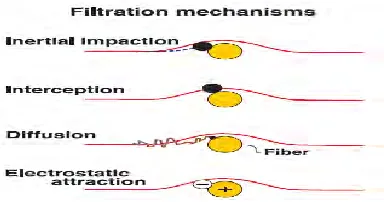
stretched membrane material(Schoen et al. 2015) to remove the unwanted contaminant in the air flow and the work principle of the Mechanical Air Filter is filtered the air that entering the airstream that flow through by attached the filter at the ducting or the air flow way while the Electronic Air Filter is a device that are connect with the electrical charging by using corona wires or through of the ions and collecting the particle on oppositely charged deposition plate (Schoen et al. 2015). While the filtration the unwanted contaminant in the air flow, there have four different collection mechanisms that have been govern the particulate air filter performance such as internal impaction, interception, diffusion, and electrostatic attraction (Niosh 2003) shown at figure 1 below. The effectiveness of the air filter also related of the class of the air filter (Schoen et al. 2015). That mean the air that must been supply must cleaned before it reaches to the conditioned space.
Impaction mechanism happen when the particle that flow through the air stream that passing through around a fiber, it will deviates from the air stream (due to particle inertia) and collides with a fiber (Niosh 2003).
Interception mechanisms happen when a large particle collides with a fiber in the filter that the air stream is passing through (Niosh 2003).
Diffusion mechanisms happen when the random motion of a particle causes that particle to contact a fiber (Niosh 2003).
Electrostatic mechanisms in mechanical filtration have a minor role. When the fiber contact with the particle, then the smaller particles are retained on the fibers by a weak electrostatics force (Niosh 2003).
[image:23.612.251.443.549.650.2]8
2.2.1 Type of Air Filter
Type of the air filter was too many in industrial nowadays, the classification of the air filter has been divided into two variables. It was the media of the fibrous that created the air filter and the porosity of the air filter. The media of air filter is most to the material that been chosen to make the fiber of the air filter. It is importance because the material of the air filter will be decided the life of the air filter to be clean or replace while the porosity or the mesh size of the air filter will decide the size of the air contaminant size that will been allowed to going through to the conditioned space.
2.2.1.1 Pleated Filter
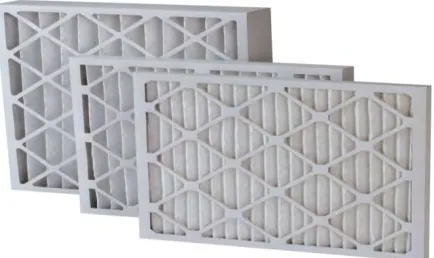
[image:24.612.276.493.442.571.2]Pleated Filter is commonly being in shaped into inflatable bags. This filter also can be attached into frame or basket or it is also come with their own frame (Jung 1987).