• ISSN 0378-3693
Bulletin
of the European
Communities
Commission
The Bulletin of the European Communities reports on the activities of the Commission and the other Community institutions. lt is edited by the Secretariat-General of the Commission (rue de la Loi 200, B-1 049 Brus-sels) and published 11 times a year (one issue covers July and August) in the official Community languages.
The following reference system is used: the first digit indicates the part number, the second digit the chapter number and the subsequent digit or digits the point number. Citations should therefore read as follows: Bull. EC 1-1987, point 1.1.3 or 2.2.36.
Supplements to the Bulletin are published in a separate series at irregular intervals. They contain official Commission material (e.g. communications to the Council, programmes, reports and proposals).
©
ECSC-EEC-EAEC, Brussels • Luxembourg, 1989Bulletin
of
the European
Communities
Commission
ECSC- EEC- EAEC
Commission of the European Communities Secretariat -General
Brussels
Bulletin information service
Readers can obtain information on developments since this issue went to press (date of adoption of instruments by the Council, of opinions given by Parliament or the Economic and Social Committee, of publication in the Official Journal, etc.) by telephoning the document services of the Information Offices at the following numbers:
London Belfast Cardiff Edinburgh Dublin
222 8122 240708 371631 225 2058 712244
References in text and footnotes
References to other parts of the same issue of the Bulletin are given in parentheses in text, thus (-+ point 2.1.53).
References to other issues of the Bulletin, to a Bulletin Supplement, to an Official Journal etc. are given in footnotes.
Standardized abbreviations for the designation of certain monetary units in the different languages of the Community:
ECU European currency unit
BFR Belgische frank I Franc beige OKR Oansk krone
OM Oeutsche Mark OR Greek drachma
ESC Escudo
FF Franc fram,:ais
HFL Nederlandse gulden (Hollandse florijn) IRL Irish pound I punt
LFR Franc luxembourgeois LIT Lira italiana
PTA Peseta UKL Pound sterling
contents
PART ONE
SPECIAL FEATURES1. Report of the Committee for the Study of Economic and Monetary Union
2. Fundamental rights and freedoms
3. The Uruguay Round after the mid-term review
4. News in brief
p RT
TWO
ACTIVITIESIN APRIL 1989
1. Building the Community
- Economic and monetary policy - Internal market
- Customs union -Taxation - Enterprise
- Industrial strategy and services - Research and technology
- Telecommunications, information technology and innovation
- Competition
- Employment and social policy
- Human resources, education, training and youth - Information, communication and culture - Regional policy
- Environment -Consumers - Agriculture - Fisheries -Transport
8
10
11
14
16 16 16
22 24 24
25 25
27
29 34 35 37
38
40
42
43
59
2. External relations 64
- Commercial policy 64
- Industrialized countries 65
- Mediterranean, Gulf and Arabian Peninsula countries 68
-Asia 69
- Latin America 70
- African, Caribbean and Pacific (ACP) countries and
overseas countries and territories (OCTs) 71
- Development cooperation 73
- International organizations and conferences 77
- Diplomatic relations 77
3. Intergovernmental cooperation 78
- European political cooperation 78
4. Human rights and fundamental freedoms 79
5. Financing Community activities 81
- Budgets 81
- Financial operations 86
- Anti-fraud measures 87
6. Statistics 88
7. Institutions and organs of the Communities 90
- Parliament 90
-Council 92
- Commission 94
- Court of Justice 95
- Economic and Social Committee 111
- European Investment Bank 111
p RT THREE
DOCUMENTATION1. The ecu 116
2. Declaration of fundamental rights and freedoms 118
3. Infringement procedures 121
4 Additional references in the Official Journal 122
Supplements 1988
4/88 The future of rural society
5/88 Disclosure requirements for branches. Single-member private limited companies
6/88 Public procurement in the excluded sectors
Supplements 1989
1 /89 Statement on the broad lines of Commission policy and reply to the ensuing Parliamentary debate
2/89 Programme of the Commission for 1989
p
E
1.
Report of the Committee for the Study
of Economic and Monetary Union
1.1.1. The European Council meeting in
Hanover on 27 and 28 June 1988 1 recalled
that in adopting the Single Act the Member States confirmed the objective of progress-ive realization of economic and monetary union. The Heads of State or Government therefore decided to examine at the Euro-pean Council meeting in Madrid in June 1989 the means of achieving this union. To this end they decided to entrust to a Committee chaired by Mr Delors, President of the Commission, the task of studying and proposing concrete stages leading towards economic and monetary union. In April the Committee produced the report on econ-omic and monetary union in the European Community.
Developments in economic and monetary integration in the Community
1.1.2. The first part of the report briefly outlines past and present developments in economic and monetary integration in the Community. Recent developments are lead-ing to an increaslead-ing degree of economic integration. Maintaining this will require more intensive and effective policy coordi-nation.
Economic and monetary union, however, implies far more than the single market
programme. It requires further major steps
in all areas of economic policymaking, and presupposes a high degree of integration, a common monetary policy and consistent economic policies. These policies should be geared towards price stability, balanced growth and converging standards of living, high employment and external equilibrium.
The final stage of economic and monetary union
1.1.3. In the second part of the report the
Committee considered it essential to define
clearly the main features of economic and monetary union and to fully discuss its implications before examining how it should be achieved.
The realization of the objective would require an amendment of the Treaty and consequent changes in national legislation. Amongst the reasons for this is that within the union there could be only one monetary policy, the conduct of which would require the creation of a European System of Cen-tral Banks (ESCB). This institution, which would be independent from instructions from national governments and Community authorities, would consist of a new Com-munity institution and the existing national central banks coexisting within a federal structure. Its primary objective would be to ensure price stability and to support the Community's general economic policy.
A single currency is not strictly necessary to monetary union, but it would demonstrate full commitment to the irreversible locking of exchange rate parities. The Committee considered that the ecu has the potential to develop into the single currency without any break in its value.
No new institution would be needed, how-ever, for the conduct of non-monetary econ-omic policy, as the necessary institutional framework has already been set up by the Treaty of Rome. Ther would, however, have to be some extension and modification of the functions of the existing institutions, and relationships between them and the ESCB would have to be organized.
The new Treaty would also have to clearly specify areas in which decision-making authority would be transferred from the national to the Community level. This should be done in strict accordance with the principle of subsidiarity.
As well as the completion of the internal market programme, further action would
be needed in three other areas in order to achieve economic and monetary union:
(i) competition policy and other measures
to improve market mechanisms;
(ii) common policies aimed at structural adjustment and regional development;
(iii) tighter macroeconomic policy coordi-nation, including binding budgetary rules, especially for the financing of budget defi-cits.
These measures are necessary to ensure that tensions do not build up within the union and that, in the absence of the possibility of exchange rate changes, the mobility of factors of production does not become the principal instrument of adjustment.
The stages towards economic and monetary union
1.1.4. The third part of the report lays out
the concrete stages leading towards econ-omic and monetary union. Each stage is distinct, but the process is a unified whole. The decision to begin the first stage would therefore be a decision to embark on the entire process (paragraph 39 of the report), and commitment by the political authorities to open negotiations on a new treaty would ensure continuity. The new arrangements coming into effect at the start of each stage would gradually develop, paving the way for the next stage. In each stage and between stages there would have to be broadly paral-lel developments bn the economic and on the monetary fronts.
Experience has taught that it is not possible to define precisely in advance the conditions for moving from one stage to another or to foresee the progress that will be made. The Committee has therefore not thought it advisable to set out a precise timetable or to give explicit deadlines.
Stage one would mark the beginning of the process of creating economic and monetary
Economic and monetary union
union. The process could be started between now and July 1990, the date on which the Directive on the full liberalization of capital
movements comes into force. It would
involve both strengthening economic and monetary policy coordination within the existing institutional framework and the preparation and ratification of the necessary amendments to the Treaty. The possibility that a European Reserve Fund should be set up in this stage was also considered.
Stage two, which would come into force with the implementation of the new Treaty, would involve the setting-up of the new monetary institution and the strengthening of the provisions governing economic policy coordination. This stage would provide a training ground before full authority is transferred from the national to the Com-munity level.
Stage three would start with the irreversible locking of exchange rates, and the transfer of the economic and monetary authority described in the second part of the report to the Community institutions, including the European System of Central Banks. At some point, the national currencies would be replaced by a single common currency. The report recommends that this should take place as soon as possible after the locking of parities.
Proposed follow-up
1.1.5. The Committee takes the view that,
2.
Fundamental rights
and freedoms
European Parliament declaration
1.2.1. On 12 April Parliament passed a
resolution adopting the Declaration of fun-damental rights and freedoms by 183 votes in favour, nine against and six
absten-tions. 1 The other Community institutions
and the Member States were invited to associate themselves formally with the dec-laration, which applies to all Community nationals.
1.2.2. The rights listed in the 28 Articles of the Declaration derive from the Treaties establishing the European Communities, the constitutions of the Member States, the case-law of the Court of Justice, the Euro-pean Convention for the Protection of Human Rights and Fundamental Freedoms and the international instruments in force.
1.2.3. At this stage, such a declaration has
a merely symbolic value, representing the fullest compendium of the values and tra-ditions from which the Community should draw inspiration and guidance. Neverthe-less, Parliament's goal is to eventually see the declaration:
(i) adopted by the other Community
insti-tutions;
(ii) included in the Treaties and in due
course in a Treaty of European Union;
(iii) endorsed by the Court of Justice as
an instrument of reference, thereby becom-ing an integral part of the Community's legal system.
1.2.4. The declaration constitutes an
important step in the process initiated in 1969, when the Court of Justice ruled that fundamental human rights were enshrined in the general principles of law which it
was its duty to uphold, 2 and noted that
international instruments for the protection of human rights to which the Member States
were parties could also provide guidance in the context of Community law.
1.2.5. In April 1977 Parliament, the
Council and the Commission adopted a joint declaration on the protection of funda-mental human rights, stressing the import-ance they attached to the respect of the rights deriving notably from the consti-tutions of the Member States and the Euro-pean Convention for the Protection of Human Rights and Fundamental
Free-doms.3 ·
1.2.6. In 1979 the Commission presented
a memorandum on the accession of the
Communities to that Convention. 4
The memorandum was addressed to the other Community institutions and aimed at encouraging debate on the possibility of adopting the protection mechanisms pro-vided for under the Convention in order to:
(i) improve the standard of human rights
protection in the Community,
(ii) maintain internal cohesion,
(iii) affirm European identity.
1.2.7. The issue of the adoption of a
dec-laration of fundamental rights and freedoms has cropped up regularly in the parliamen-tary agenda, for instance when the draft Treaty establishing the European Union was discussed. In the draft Treaty adopted by Parliament on 14 February 1984,5 the Union was called upon to make a decision within the following five years on its accession to European or international instruments relevant to it, and to draw up at the same time its own catalogue of funda-mental rights and freedoms.
1 0 J C 120, 16.5.1989. The full text of the declaratton
can be found under point 3.2.1.
2 Case 26/69 Stauder v Ulm [1969] ECR 419.
3 OJ C 103, 24.4.1977.
3. The Uruguay Round
after the mid-term review
1.3.1. The Uruguay Round is the eighth in
the series of multilateral trade negotiations held within the framework of the General Agreement on Tariffs and Trade (GATT). It was launched in September 1986 by the then 92 Contracting Parties meeting at
min-isterial level in Punta del Este, Uruguay. 1
The aim of the negotiations is to halt and reverse protectionism, remove distortions to trade, preserve the basic principles and further the objectives of GATT, and develop a more open, viable and durable multilateral trading system which would promote growth and development. The negotiations cover a wide range of issues closely affecting international trade; these are divided into 15 main 'chapters', each with its own separate negotiating group. Scheduled to last four years, the Uruguay Round has just been through a 'mid-term review' to take stock of progress and pro-vide a common basis for relaunching the negotiations.
1.3.2. Meeting at ministerial level in
Mon-treal in December 1988,2 the participants
agreed on the framework within which negotiations on 11 of the 15 chapters could be pursued until the end of the Round in 1990. At the second meeting of the Trade Negotiations Committee, which was held in Geneva from 5 to 8 April, senior officials reached agreement on the remaining four chapters (i.e. textiles and clothing, agri-culture, safeguards, and intellectual prop-erty rights).
1.3.3. The Community itself had
reser-vations about a mid-term review, feeling that it undermined the 'globality' of the negotiations. Some of its partners wanted to take advantage of the opportunity to obtain quick results in specific sectors, thus removing them from the final, overall evalu-ation. However, without such an evaluation it will be impossible to properly assess the overall balance and acceptability of the final package. Consequently, the Community was active in steering attention away from
the initial results and toward the fixing of guidelines for the negotiators for the remainder of the Round.
New sectors
1.3.4. The mid-term review has
undoubt-edly been most successful in the new nego-tiating areas. At the Punta del Este confer-ence, the whole idea of including in the negotiations intellectual property rights, trade-related investment measures and trade
in services was controversial. It is now
accepted that these subjects, which have traditionally lain outside GA TT's remit, should be discussed in the Uruguay Round. Indeed, the negotiating guidelines estab-lished at the mid-term review envisage the elaboration of substantive rules and disci-plines for multilateral regulation of subjects previously left to the discretion of individual governments.
As regards intellectual property, the final text represents an important landmark. Negotiations can now focus on the formu-lation of substantive rules and implement-ing procedures. These negotiations should ensure effective protection for trade in goods subject to patents or copyrights or bearing marks or designations of origin. However, the exact content of the rules still has to be worked out, and the developing countries have yet to be persuaded that the General Agreement needs amending to include intellectual property rights.
The framework decided for trade-related investment measures means that local con-tent and export performance conditions, together with other such measures which seriously interfere with the activities of Community operators, can now be sub-jected to multilateral discipline.
Uruguay Round
With regard to trade in services- the most promising sector in the post-industrial
econ-omy - the negotiating group expects to
have laid the foundations by the end of 1989 for a multilateral agreement promoting pro-gressive liberalization on the basis of GATT principles such as non-discrimination or national treatment.
Market access
1.3.5. Tariffs and non-tariff barriers to
trade in goods have long been a concern of GATT and still constitute a real impedi-ment to the Community's foreign trade, especially as regards exports to new trading partners such as the most advanced develop-ing countries.
All the participants, including those who had made little or no contribution to pre-vious liberalization exercises, committed themselves to reducing tariffs and increasing the scope of bindings so as to provide greater security and predictability in inter-national trade.
Substantial progress still needs to be made in reducing or eliminating non-tariff meas-ures. Increased participation by developing
countries in the Codes 1 negotiated during
the Tokyo Round will be encouraged, and the Codes, which cover such areas as techni-cal barriers to trade, government procure-ment and licensing procedures, improved.
In the natural resources sector, the main objective is the liberalization of trade in semiprocessed and processed products -a me-asure of cruci-al import-ance for the economy of raw materials exporters, among them many developing countries. As the Community hoped, this liberalization will, however, take full account of the specific aspects of trade in natural resource-based products.
The textiles and clothing sector, which has been governed for more than a decade by
the Multifibre Arrangement 2 (a special
agreement under GATT), will gradually be integrated into the General Agreement. As the Community wished, this will be done
on the basis of strengthened GATT rules; moreover, all the participants, including exporting countries, will be expected to contribute to market liberalization. The negotiation on textiles and clothing will thus be an important step in the integration of developing countries in the GATT system.
The Community was instrumental in achieving reductions in tariffs and non-tariff measures affecting tropical products. In addition to nine other industrialized countries, 11 of the developing countries -the main beneficiaries of more open markets
in this sector - were, for the first time,
prepared to contribute to trade
liberaliza-tion. It is likely, therefore, that the circle of
participants will grow, and that barriers will be further reduced as a result.
Agriculture
1.3.6. Since GATT's earliest days, trade
in agricultural products has been exempted from certain multilateral trade disciplines and is therefore something of a special case as regards market access negotiations. Although most participants protect and support their farm sectors, international criticism has tended to focus on the Com-munity's agricultural policy, putting it in a difficult position at the outset of nego-tiations.
The projected reform involves substantial progressive reductions in support and pro-tection levels in the long term, but no com-mitment to their elimination before the year 2000, a victory for common sense and fully consistent with Community objectives. In the short term, the commitment to freeze support does not conflict with the basic mechanisms of the common agricultural policy. When reductions come up on the agenda, the Community will be able to point to the internal reform measures al-ready taken.
1 Thtrteenth General Report, pomts 494 and 495.
Rules and institutional matters
1.3.7. After 40 years of operation,
GA TT's rules and institutional provisions, the pillars of the multilateral trading system and the main defence against the ever-pre-sent threat of protectionism, need to be adapted to today's international trading environment.
The new agreement on safeguards, which will be negotiated on the basis of general GATT principles and will aim to re-estab-lish multilateral control of trade protection measures, is central to the goal of strength-ening the multilateral trading system.
If disciplines can be elaborated to cope with any crisis that might emerge within GA TT's legal framework, this would provide an effective check on the development of uni-lateral or biuni-lateral 'grey area' measures. The integration of the most advanced develop-ing countries - one of the Community's main objectives in the Uruguay Round-means that the provisions governing excep-tions in the case of balance-of-payments difficulties will have to be revised. More-over, a review of Article XVII of the General Agreement could give rise to a more respon-sible attitude from the State-trading countries. There was no expectation, how-ever, that the mid-term review would pro-vide rulings on all these matters.
As regards the negotiations on subsidies, the framework agreed should enable a bal-ance to be struck between strengthening both the rules on subsidies constituting unfair competition and those on counter-vailing duties.
There is general agreement that the dispute settlement system needs improving, particu-larly the conciliation and arbitration pro-cedures; greater compliance with the rec-ommendations of the panels which
adjudi-Uruguay Round
cate trade disputes is also required. Although the details have yet to be worked out, some progress toward this was made at Montreal, 1 e.g. on time limits.
The negotiations on the functioning of the GATT system basically cover three main areas: enhanced surveillance of trade poli-cies, greater ministerial involvement in GATT, and closer relationships with the IMF and the World Bank, so as to achieve greater coherence in financial, monetary and trade policies. As a result of these nego-tiations, GATT looks like taking on its intended role in guiding the trade policies of its 100 or so contracting parties.
Achievements of the mid-term review
1.3.8. Much remains to be done before the
Uruguay Round comes to its scheduled close at the end of 1990. The Community, like other participants in the negotiations, will inevitably have to make further concessions, some of which may be seen as sacrifices. However, the trends apparent at the end of the mid-term review clearly point toward more freedom, more security, more responsibility and more fairness in inter-national trade. The Community, which played a crucial role in the negotiations, welcomes these developments as they tie in with its own efforts to create a single market by 1992. The new Europe 2 will have no
internal frontiers and, far from closing in on itself, will be more open than ever to non-member countries.
1.3.9. On 24 April, the Council expressed
broad satisfaction with the outcome of the revtew.
Bull. EC 12-1988, point 2.2.3.
News in brief
4.
News in brief
Telecommunications
The Council adopts a Decision on a European standard for high-definition television (-+ point 2.1.62).
The Commission adopts a proposal for a recommendation and a proposal for a Directive on the introduction of pan-European land-based public radiopaging (-+ point 2.1.64).
Human resources, education, training and young people
The Commission adopts a proposal for a Decision on Erasmus 11 (-+point 2.1.93).
Information, communication and culture
The Commission adopts a communication on books and reading: a cultural challenge for Europe (-+ point 2.1.102).
Environment
The Commission adopts a recommendation concerning a voluntary agreement between the Commission and Community aerosol manufacturers for a reduction in the use of CFCs (-+ point 2.1.112).
Consumers
The Commission adopts a proposal for a Directive on general product safety (-+ point 2.1.121).
Agriculture
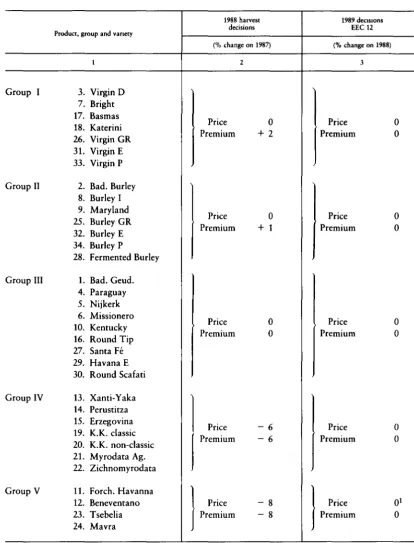
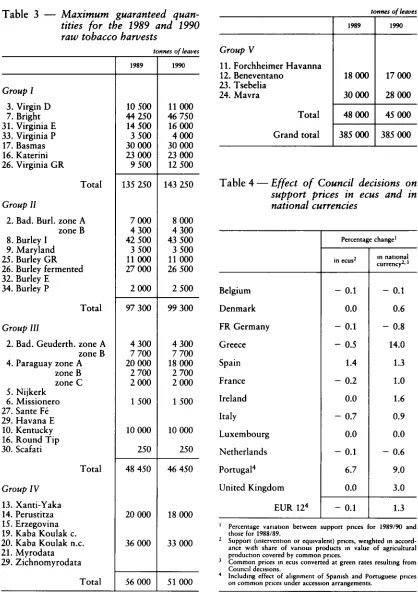
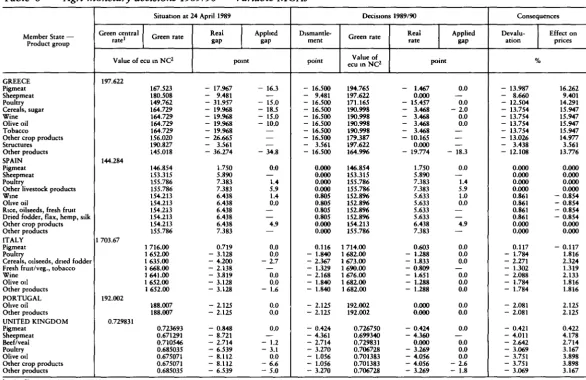
Unanimous Council agreement on the prices and related measures for 1989/90 (-+ points 2.1.124 to 2.1.138).
External relations
The Council adopts conclusions on an overall approach to relations with the East European countries(-+ point 2.2.11).
PA
0
ACTIVITIES
1.
Building the Community
Economic and monetary policy
Economic and monetary union
2.1.1. The Committee for the Study of Economic and Monetary Union, chaired by Mr Delors, submitted its report in April, in accordance with the terms of reference given
by the Hanover European Council (--+ point
1.1.1 et seq.).
2.1.2. On 14 April Parliament adopted a
resolution 1 on the process of European
monetary integration. It notes the major
progress achieved in the 10 years since the inception of the European Monetary System and emphasizes the fundamental precon-ditions for establishing economic and mon-etary union, and the likely benefits. Parlia-ment indicates the progress that needs to be made as regards integration of economic and monetary policies and the measures to
be adopted as a result. It calls upon the
Commission and the Council to promote the establishment of economic and monet-ary union by strengthening the Com-munity's structural and regional policies and by preparing and adopting the pro-visions required to complete the internal market. Parliament indicates the measures which it considers should be taken with a view to achieving economic and monetary
union. It attaches to its resolution the
sug-gested statutes of the European Central Bank.
Community borrowings
Six-monthly report
2.1.3. In accordance with the Council
Decision of 19 April 1983 empowering it to contract loans under the New Community
Instrument (NCI), 2 on 18 April the
Com-mission adopted, 3 for transmission to
the Council and Parliament, its 10th
six-monthly report 4 on the rate of utilization
of NCI tranches (1 January to 30 June 1988). Effective authorizations for NCI Ill
borrow-ings currently total ECU 2.9 billion, with an ECU 100 million margin held in reserve. The geographical breakdown of loans signed shows that most of the operations are in Italy (even if reconstruction oper-ations are excluded), followed by France.
As regards total NCI loans signed for ordi-nary operations, there was an increasing shift towards the productive sectors, while the proportion of loans signed under NCI Ill for the energy and infrastructure sectors showed a fall.
Internal market
People's Europe
Freedom of movement
Removal of restrictions
2.1.4. On 11 April Parliament adopted a resolution on the freedom of movement of professional footballers in the
Com-munity. 1 Parliament regards the transfer
fee system as a violation of freedom of contract and the freedom of movement guaranteed by Article 48 of the EEC Treaty, and an infringement of Article 85 of the Treaty. Parliament also considers that, in so far as nationals of Member States of the Community are concerned, the restriction on the number of foreign players entitled to play for a professional football team
constitutes - illegal discrimination on
grounds of nationality and an infringement of the principle of freedom of movement of workers. Parliament calls on the Com-mission to initiate legal proceedings against UEFA, the national football associations and individual clubs in the Community and
I OJ c 120, 16.5.1989.
2 OJ L 112, 28.4.1983; Bull. EC 4-1983, point 2.1.8.
3 COM(89) 161 final.
to do everything within its power to ensure complete freedom of movement.
2.1.5. On 27 April the Economic and
Social Committee endorsed the two pro-posals amending 1 Council Regulation (EEC) No 1612/68 of 15 October 1968 on freedom of movement for workers within the Community and Council Directive 68/ 360/EEC of 15 October 1968 on the abol-ition of restrictions on movement and resi-dence within the Community for workers of Member States and their families. 2 Deploring the long administrative delays
experienced by Community nationals
entitled to social security benefits who move within the Community, the Committee approved the new approach reflected in the Commission's proposals. The Committee also called on the Commission to send it as soon as possible a full report on the meas-ures to be taken to ensure implementation of the right of the individual to move freely within the Community.
Mutual recognition of diplomas -Access to economic activities
2.1.6. On 19 April the Commission
decided, pursuant to Council Decision 85/ 368/EEC of 16 July 1985 on the compara-bility of vocational training qualifications between Member States, 3 to publish in the Official Journal the results of the work car-ried out in respect of the following occu-pations: receptionist, porter, storeman/ storewoman, assistant housekeeper, res-taurant employee, barman/barmaid, cook and wine waiter/waitress.
Special rights
2.1.7. On 12 April the Presidents of
Parlia-ment, the Council and the Commission signed an interinstitutional agreement on
the right to petition Parliament (---+ point
2.4.2).
2.1.8. On 26 April the Commission
adopted for transmission to the Council a communication on the general right of residence. 4 Following discussions in the
Internal market
Council on the proposal for a Directive on a right of residence for nationals of Member States in the territory of another Member State, 5 the communication suggests a new approach to the issue within the limits of the proposal.
2.1.9. On 26 April the Economic and
Social Committee issued an opinion on the proposal for a Directive on the driving licence. 6 The Committee approved the pro-posal as a whole, but felt that the licence should have on it a photograph with a good likeness of the holder and his or her precise address, whereas the Commission is propos-ing that it be left to the Member States whether they insist on a photograph or not and whether the permanent place of resi-dence is replaced by the postal address.
Freedom to provide services
Financial services
Banks and other financial institutions
2.1.10. On 17 April, acting on a
Com-mtsswn proposal, 7 which had been
amended 8 in the light of Parliament's opin-ion 9 (second reading) of 15 March, the Council (Economic and Financial Affairs) adopted Directive 89/299/EEC on own funds of credit institutions.10
This Directive is a key element in achieving an internal market in the banking sector. It lays down common rules which have been defined in a sufficiently general manner to cover all elements comprising own funds in
I OJ C 100, 21.4.1989; Bull. EC 12-1988, point 2.1.6. OJ L 257, 19.10.1968.
OJ L 199, 31.7.1985; Bull. EC 7/8-1985, pomt 2.1.88.
4 COM(89) 237 final.
5 OJ C 207, 17.8.1979; Bull. EC 7/8-1979, point 2.1.14;
OJ C 188, 25.7.1980; OJ C 171, 10.7.1985; Bull. EC
6-1985, pomt 2.1.15.
6 OJ C 48, 27.2.1989; Bull. EC 11-1988, pomt 2.1.7.
7 OJ C 243, 27.9.1986; Bull. EC 9-1986, pomt 2.1.56;
OJ C 32, 5.2.1988; Bull. EC 1-1988, point 2.1.43.
8 OJ C 131, 27.5.1989; COM(89) 208 final.
9 OJ C 96, 17.4.1989; Bull. EC 3-1989, point 2.1.4.
Internal market
the various Member States. Details of cer-tain elements making up own funds will be provided later. The Member States may still apply stricter provisions for some elements.
2.1.11. On 13 April the Commission
adopted amendments 1 to the proposed
second banking Directive, 2 which would
amend Council Directive 77 /780/EEC of 12 December 1977.3 The amendments will
simplify application of the Directive and will clarify the reciprocity provisions governing the establishment in the Com-munity of subsidiaries of banks from non-Community countries.
The following revised version of Article 7 has been incorporated into the proposal:
1. The competent authorities of the Member States shall inform the Commission (a) of any request for authorization of a subsidiary whose parent undertaking or undertakings is governed by the laws of a third country and of the identity of the ultimate parent, or (b) whenever such an undertaking acquires participation in a credit insti-tution of the Community, so that the latter would become its subsidiary. The Commission shall inform the other Member States.
When authorization is granted to a subsidiary, the identity of the ultimate parent undertaking or undertakings must be specified in the notification which the competent authorities must address to the Commission, according to Article 3(7) of Direc-tive 77 /780/EEC.
2. The Member States shall inform the Com-mission of any general difficulties encountered by their credit institutions in establishing or carrying out banking activities in any third country.
3. The Commission shall, initially not later than six months before the Directive enters into force and then periodically, draw up a report examining the treatment of Community credit institutions, in the terms referred to in paragraphs 4 and 5 below, regarding the establishment and carrying out of banking activities, and the acquisition of partici-pations in credit institutions of third countries. The Commission shall submit these reports to the Council of Ministers.
4. Where it appears to the Commission, either on the basis of the reports referred to in paragraph 3 or at any other time, that a third country is not granting to credit institutions of the Community effective market access and competitive oppor-tunities comparable to those accorded by the Com-munity to credit institutions of that third country,
the Commission may submit suitable proposals to the Council with a view to achieving such compar-able access and competitive opportunities through negotiations between the Community and the third country in question.
5. Where it appears to the Commission, either on the basis of the reports referred to in para-graph 3 or at any other time, that credit institutions of the Community do not enjoy national treatment and the same competitive opportunities as dom-estic credit institutions in a third country and that the condition of effective market access has not been secured the Commission may in addition to the proposals for negotiations referreq to in paragraph 4 decide that the competent authorities of the Member States shall limit or suspend their decision regarding requests for new authorizations and acquisitions by a parent undertaking governed by the third country in question, using the pro-cedure provided for in Article 20.
The duration of the measures concerned may not exceed one year, though the Commission may propose their renewal.
6. Measures taken under this Article shall be subject to their conformity with the Community's obligations under any international agreements, whether bilateral or multinational, which cover the operation of credit institutions.
2.1.12. On 26 April the Economic and
Social Committee delivered an opinion on the proposal for a Regulation on guarantees issued by credit institutions or insurance undertakings. 4
2.1.13. The Committee by and large
endorses the Commission proposal to ensure that responsibility for assessing the creditworthiness of credit institutions and insurance undertakings henceforth rests exclusively with the supervisory authorities concerned and is not left to public authori-ties in other Member States. However, the Committee wonders whether all the practi-cal legal implications have been fully appreciated, especially as regards the national law applicable and the competent court.
I COM(89) 190 final.
2 OJ C 84, 31.3.1988; Bull. EC 1-1988, points 1.2.1 to
1.2.3.
3 OJ L 322, 17.12.1977.
Insurance
2.1.14. On 26 April the Economic and
Social Committee delivered an opinion on the proposal for a third Council Directive on the approximation of the laws of the Member States relating to insurance against civil liability in respect of the use of motor vehicles. 1 The Committee notes that the
Commission proposal is ba~ed on the Green Card system. It hopes that the Commission will take every possible step to ensure that the guarantee funds pay the compensation without delay once liability has been estab-lished and the amount of compensation determined. The Committee also calls upon the Commission to take steps to ensure that, in their contracts, insurance companies only take into consideration factors relating to risks, and not the nationality of clients.
Stock exchanges and securities
2.1.15. In the light of Parliament's
opin-ion 2 (second reading) of 15 February, the
Council adopted on 17 April, acting on a Commission proposal, 3 Directive 89/298/
EEC coordinating the requirements for the drawing-up, scrutiny and distribution of the prospectus to be published when transfer-able securities are offered to the public. 4
This Directive will apply to transferable securities offered for the first time to the public in a Member State before being quoted on the stock exchange in that State.
It supplements Council Directive 80/390/ EEC of 17 March 1980, which requires a prospectus to be published at the time of application for admission to official stock exchange trading, by bringing forward the time of provision of information to the point at which the securities are first offered to the public. 5
The Directive has a twofold aim: to protect the investor through the provision of appro-priate and complete information on trans-ferable securities, on the basis of which he can evaluate the risks entailed, and to encourage investment. The Directive pro-vides for relief in the case of small and medium-sized undertakings and lays down
Internal market
that certain types of offer or security are, by their nature and volume, excluded from its scope. Where Euro-issues are concerned, the Council decided that the Directive should not apply to transferable Euro-securities which are not the subject of a full-scale campaign of advertising or canvassing.
Audiovisual services
2.1.16. On 13 April the Council (Internal
Market) adopted by a qualified majority a common position on the proposal, amended by the Commission in April 1988, 6 for a
Directive concerning broadcasting activi-ties. 7
The common position reflects to a large extent the agreement in principle which emerged from the Council meeting of 13 March. 8 The Directive seeks to ensure the
free movement of television broadcasts within the Community. It sets out rules covering the promotion of television pro-gramme distribution and production, as well as such questions as publicity, sponsor-ship, the protection of minors and the right of reply. The Council decided, however, to limit the scope of the Directive to television, but observed that the exclusion of radio broadcasts did not alter the position with regard to ensuring the free movement of such broadcasts on the basis of the Treaty. The Directive contained no chapter on copyright, but this issue will be reviewed in the light of experience gained in implement-ing the Directive. Two provisions were inserted on the sequentiality of the media (priority for cinema distribution) and on the possibility of linguistic quotas for national broadcasters. The Council also redefined European works, for which television
chan-OJ C 16, 20.1.1989; Bull. EC 12-1988, point 2.1.144. OJ C 69, 20.3.1989; Bull. EC 2-1989, point 2.1.73.
3 0] C 355, 31.12.1980; Bull. EC 12-1980, pomt 2.1.41;
OJ C 226, 31.8.1982; Bull. EC 7/8-1982, point 2.1.53.
4 OJ L 124, 5.5.1989.
s 0] L 100, 17.4.1980; Bull. EC 3-1980, point 2.1.34.
6 OJ C 110, 27.4.1988; Bull. EC 4-1988, point 2.1.11.
7 OJ C 179, 17.7.1986; Bull. EC 3-1986, point 1.2.1 et
seq.; Supplement 5/86- Bull. EC.
Internal market
nels must, where practicable, reserve a majority of their transmission time.
2.1.17. On 27 April the Economic and
Social Committee delivered an additional opinion 1 on this proposal. 2
While recogmzmg that the Directive restricts itself to television broadcasts, the Committee stressed that provisions similar to those contained in the proposed Directive should be applied to radio broadcasts also, though taking account of the specific nature of such broadcasts. The Committee reiter-ated its call for Community action to pro-mote the production of programmes of Community origin. In this connection it expressed the hope that all television net-works would undertake to devote a majority of transmission time to European programmes. It repeated its wish to see the adoption of a Directive regulating copy-right, the entry into force of which should be coordinated with the present Directive. With regard to advertising, the Committee welcomed the introduction of the concept of illicit advertising and the definition of sponsorship, but regretted that the Council had exceeded the threshold of 10% rec-ommended in its previous opinion.
Free movement of goods
Removal of trade barriers
Industrial products
Motor vehicles
2.1.18. On a proposal from the
Com-mission, 3 as amended on 12 April 4 follow-ing Parliament's decision 5 on the Council's common position, 6 the Council (Internal
Market) ad~ted, on 13 April, Directive
89/297 /EEC on the approximation of the laws of the Member States relating to the lateral protection (side guards) of certain motor vehicles and their trailers. This Direc-tive provides for the lateral protection of heavy commercial vehicles and their trailers in order to reduce the danger to
'unprotec-ted road users' (pedestrians, cyclists and motorcyclists).
Wheeled agricultural and forestry tractors
2.1.19. On 12 April 8 Parliament delivered
three favourable opinions (first reading) on the proposals to amend 9 Council Directives 77/536/EEC10 of 28 June 1977, 86/298/ EEC11 of 27 May 1986 and 87 /402/EEC12 of 25 June 1987 on roll-over protection structures.
Dangerous substances
2.1.20. At its meeting on 13 April the
Council (Internal Market) reached agree-ment on a common position on the proposal amending for the eighth timel3 Council Directive 76/769/EEC14 of 27 July 1976 relating to restrictions on the marketing and use of certain dangerous substances and preparations. The purpose of the amend-ment is to add a number of requireamend-ments to Directive 76/769/EEC regarding the market-ing and use of various products includmarket-ing benzene, waste oils, benzidine, lead salts and certain anti-fouling preparations.
Implantable
electromedical equipment
2.1.21. On 12 April 8 Parliament
deliv-ered a favourable opinion (first reading)
1 Opmion: OJ C 232, 31.8.1987; Bull. EC 7/8-1987, pomt
2.4.40.
2 OJ C 179, 17.7.1986; Bull. EC 3-1986, pomt 1.2.1 et
seq.; Supplement 5/86-Bull. EC.
3 0] C 265, 5.10.1987: Bull. EC 7/8-1987, pomt 2.1.15;
0] C 230, 6.9.1988; Bull. EC 7/8-1988, pomt 2.1.6.
0] C 116, 9.5.1989; COM (89) 200 fmal.
0] C 69, 20.3.1989; Bull. EC 2-1989, point 2.1.6.
6 Bull. EC 11-1988, point 2.1.17.
7 0] L 124, 5.5.1989. s OJ C 120, 16.5.1989.
9 0] C 305, 30.11.1988; OJ C 311, 6.12.1988; OJ C 385,
17.12.1988; Bull. EC 11-1988, pomt 2.1.21.
10 OJ L 220, 29.8.1977.
11 OJ L 186, 8.7.1986; Bull. EC 5-1986, pomt 2.1.13. 12 OJ L 220, 8.8.1987; Bull. EC 6-1987, point 2.1.12.
13 OJ C 43, 16.2.1988; Bull. EC 1-1988, pomt 2.1.11.
on the proposal for a Directive 1 on active implantable electromedical equipment.
2.1.22. This proposal was also the subject <;>f an opinion delivered on 26 April by the Economic and Social Committee. The
I Committee commented on the definition of a medical device, the prototypes, the reference to the Community mark and the penalty for unwarranted use of the mark. The Committee stressed that the provisions should also apply to equipment from non-member countries and recommended that the Commission also include provisions giv-ing firms which have not obtained the cer-tificate of approval the right to appeal.
Units of measurement
2.1.23. On 12 ApriJl Parliament deliv-ered a favourable opinion (first reading) approving the proposal for a Directive 3
amending Council Directive 80/181/EEC 4 of 20 December 1979 relating to units of measurement.
2.1.24. On 26 April the Economic and
Social Committee also delivered a favour-able opinion on this proposal.
Foodstuffs
2.1.25. On 12 April2 Parliament adopted
(second reading) a decision on the common position 5 adopted by the Council on 18 November 1988 on the proposal for a Direc-tive 6 amending for the third time Council Directive 75/726/EEC 7 of 17 November 1975 on fruit juices and certain similar prod-ucts.
2.1.26. On the same .day 2 Parliament
adopted (second reading) four decisions on the common positions adopted by the Council on 21 December 1988 8 on:
(i) the proposal for a Directive 9 relating
to foodstuffs intended for particular nutritional uses,
(ii) the proposal for a Directive10 on the official inspection of foodstuffs,
Internal market
(iii) the proposal for a Regulation11 on
indications or marks identifying the lot to which a foodstuff belongs,
(iv) the proposal for a Directive12
amend-ing Council Directive 79/112/EEC13 of 18
December 1988 on the labelling, presen-tation and advertising of foodstuffs.
2.1.27. Following these decisions, on 28 April the Commission adopted, for trans-mission to the Council, three re-examined proposals on official inspection, 14 identifi-cation of the lot to which a foodstuff belongs, 15 and the labelling and
presen-tation of foodstuffs.16
2.1.28. On 26 April the Economic and
Social Committee delivered an opinion on two proposals for Directives, 17 one relating to the introduction of compulsory nutrition labelling of foodstuffs intended for sale to the final consumer and the other nutrition labelling rules. The Committee wishes to encourage discussion between all parties concerned with a view to establishing har-monized, compulsory labelling. It stressed that advertising had an important role to play in strengthening the impact of such labelling and called on the Commission to send it a report on the subject. It also asked the Commission to organize a conference on the specific topic of nutrition labelling.
*
0] C 14, 18.1.1989; Bull. EC 12-1988, point 2.1.23.
0] c 120, 16.5.1989.
3 OJ C 31, 7.2.1989; Bull. EC 12-1988, point 2.1.26.
4 OJ L 39, 15.2.1980.
5 Bull. EC 11-1988, point 2.1.26.
6 OJ C 24, 31.1.1987; Bull. EC 12-1986, point 2.1.27;
0] C 214, 16.8.1988; Bull. EC 6-1988, point 2.1.40.
0] L 311, 1.12.1975. Bull. EC 12-1988, pomt 2.1.29.
9 0] C 124, 23.5.1986; Bull. EC 4-1986, point 2.1.10; OJ C 161, 19.6.1987; Bull. EC 5-1987, point 2.1.14.
to 0] C 20, 27.1.1987; Bull. EC 12-1986, point 2.1.28; OJ C 88, 5.4.1988; Bull. EC 2-1988, point 2.1.9.
11 OJ C 310, 20.11.1987; Bull. EC 11-1987, pomt 2.1.24. 12 0] C 124, 23.5.1986; Bull. EC 4-1986, point 2.1.10;
0] C 154, 12.6.1987; Bull. EC 5-1987, point 2.1.14.
13 OJ L 33, 8.2.1979.
14 OJ C 131, 27.5.1989; COM(89) 225 fmal.
15 OJ C 129, 25.5.1989; COM(89) 224 final.
16 COM(89) 223 final.
Customs union
2.1.29. On 14 April1 Parliament adopted
a resolution on the food industry. It reiter-ated its support for the new approach adopted with an eye to completion of the internal market, provided that this did not lead to the adoption of low common denominator standards. With regard to Community policymaking in the food sec-tor, Parliament called for closer integration of the various aspects of food policy, such as agricultural policy and public health. It
stressed that the Commission must be given sufficient resources and called for the event-ual establishment of a Community body similar to the United States Food and Drug Administration.
Parliament once again welcomed the fact that the amendment to Directive 83/189/ EEC 2 of 28 March 1983 adopted by the
Council on 22 March 1988 3 now required
the Member States to notify the Com-mission of all new draft technical regu-lations relating to food. It also stressed the importance of setting up a food legislation data base which would provide all the necessary information on the conditions under which a given product can be mar-keted in each Member State.
Pharmaceutical products
2.1.30. On 12 April1 Parliament
approved (second reading) the common positions adopted by the Council on 18 November 4 and 21 December 1988 5 on :
(i) the proposal to amend 6 Council
Direc-tives 65/65/EEC 7 of 26 January 1965, 751
318/EEC 8 and 75/319/EEC 8 of 20 May 1975 on proprietary medicinal products, (ii) the three proposals 6 extending the
scope of Directives 65/65/EEC 7 and 75/
319/EEC 8 and laying down additional
pro-visions for immunological medicinal prod-ucts, radiopharmaceuticals and medicinal products derived from human blood or plasma.
Fertilizers
2.1.31. Following the opmwn (second
reading) delivered by Parliament on 18
Jan-uary, 9 on 13 April the Council ado~ted, on
a proposal from the Commission, 1
Direc-tive 89/284/EEC11 supplementing and
amending Council Directive 76/116/EEC12 of 18 December 1975 in respect of the cal-cium, magnesium, sodium and sulphur con-tent of fertilizers. The purpose of the amendments was to extend the rules govern-ing the marketgovern-ing of solid fertilizers to include the calcium, magnesium, sodium and sulphur contents of such fertilizers.
2.1.32. On 12 April1 Parliament
deliv-ered an opinion (first reading) approving the proposal for a Directive13
supplement-ing and amendsupplement-ing Directive 76/116/EEC12
in respect of the trace elements boron, cobalt, copper, iron, manganese, molyb-denum and zinc contained in fertilizers.
Customs union
Simplification of customs formalities
Community transit
2.1.33. On 28 April the Commission
adopted Regulation (EEC) No 1159/8914
amending Regulation (EEC) No 1062/87 of 27 March 1987 on provisions for the implementation of the Community transit procedure and for certain simplifications of that procedure, 15 Regulation (EEC) No
OJ C 120, 16.5.1989.
OJ L 109, 26.4.1983; Bull. EC 3-1983, point 2.1.8.
3 OJ L 81, 26.3.1988; Bull. EC 3-1988, point 2.1.12.
Bull. EC 11-1988, point 2.1.32. Bull. EC 12-1988, point 2.1.33.
6 OJ C 36, 8.2.1988; Bull. EC 12-1987, point 2.1.18;
OJ C 308, 3.12.1988; Bull. EC 11-1988, point 2.1.32.
7 OJ 22, 9.2.1965.
8 OJ L 147, 9.6.1975.
9 OJ C 47, 27.2.1989; Bull. EC 1-1989, point 2.1.6.
10 OJ C 20, 26.1.1988; Bull. EC 12-1987, point 2.1.19.
11 OJ L 111, 22.4.1989.
12 0 J L 24, 30.1.1976.
13 OJ C 304, 29.11.1988; Bull. EC 10-1988, point 2.1.16.
14 OJ L 119, 29.4.1989.
2855/85 of 18 September 1985 1 and Regu-lation (EEC) No 2793/86 of 22 July 1986. 2 The amendments, mostly of a formal and technical nature, concerned both the Com-munity transit procedure and the single administrative document.
General legislation
Customs debt
2.1.34. On 26 April, in the light of
Parlia-ment's opinion on second reading, 3 the
Commission amended 4 its proposal 5 for a
Regulation on the terms of payment of the import duties or export duties resulting from a customs debt.
Temporary use
2.1.35. On 12 April Parliament approved
on second reading 6 the Council's common
position 7 on the proposal 8 for the
amend-ment of Council Regulation (EEC) No 3/84 of 19 December 1983 introducing arrange-ments for movement within the Community of goods for temporary use. 9
International conventions
2.1.36. On 5 April the Commission
adopted for transmission to the Council a proposal for a Decision authorizing the Member States to accept an amendment to the Customs Convention on the AT A carnet for the temporary admission of goods (AT A Convention, 1961), together with a rec-ommendation for a Decision concerning Community participation in the nego-tiations on a further amendment enabling the Community to become a contracting party to the Convention.10
2.1.37. On a proposal from the
Com-mission, 11 the Council adopted on 13 April Decision 89/285/EEC accepting Resolution No 46 of the Group of Experts on Customs Questions Affecting Transport of the Econ-omic Commission for Europe concerning
Customs union
the compliance of containers with the stan-dards for transport of goods under customs seals. 12
Common Customs Tariff
I
Combined NomenclatureCommon Customs Tariff
Measures related to accession
2.1.38. On 25 April the Commission
adopted for transmission to the Council a proposal for a Regulation totally suspend-ing the residual customs duties which the Community of Ten would otherwise apply to manufactured and fisheries products imported from Spain and Portugal.13 This proposal is aimed at reducing the trade defi-cits of the new Member States. The EFT A countries intend to apply similar measures.
Combined Nomenclature
2.1.39. With a view to the uniform
appli-cation of the Combined Nomenclature, 14
the Commission adopted on 17 April Regu-lation (EEC) No 989/89 on the classification of goods. 15
Integrated tariff (Taric)
2.1.40. In April the Commission published
the second edition of the integrated tariff of
0] L 274, 15.10.1985.
OJ L 263, 15.9.1986; Bull. EC 7/8-1986, point 2.1.47.
3 OJ C 96, 17.4.1989; Bull. EC 3-1989, point 2.1.24.
4 OJ C 135, 1.6.1989; COM(89) 215 final.
5 OJ C 41, 13.2.1985; Bull. EC 12-1984, point 2.1.40.
6 OJ C 120, 16.5.1989.
7 Bull. EC 2-1989, point 2.1.46.
OJ C 324, 17.12.1988; Bull. EC 11-1988, point 2.1.83. OJ L 2, 4.1.1984; Bull. EC 12-1983, point 2.1.25. 10 COM(89) 144 final.
11 Bull. EC ll-1988,pomt 2.1.84.
12 OJ L 111, 22.4.1989.
13 COM(89) 169 final.
14 OJ L 256, 7.9.1987; Bull. EC 7/8-1987, point 2.1.80.
Enterprise
the European Communities (Taric), 1 now
fully based on the Combined Nomencla-ture 2 as last amended by Commission Regulation (EEC) No 3174/88 of 21 September 1988. 3 T aric gives a complete
picture of:
(i) temporary suspensions of the auton-omous CCT duties;
(ii) tariff preferences, autonomous and conventional quotas and tariff ceilings;
(iii) anti-dumping duties and countervail-ing duties;
(iv) monetary compensatory amounts (MCAs) and accessiOn compensatory amounts (ACAs) and variable components and reference prices for wine;
(v) unit values;
(vi) textile categories;
(vii) import licences, surveillance and pro-tective measures and Cites restrictions;
(viii) measures concerning Spain and Por-tugal.
Assistance to Member States
2.1.41. On 20 April the Commission
approved a pilot training scheme for national customs officials. Called Mat-thaeus after the patron saint of customs officials, the programme will initially involve 1 700 customs officials. The aim is to prepare national officials for the com-pletion of the single market and to make them aware of their role in the customs union, particularly as regards the appli-cation of Community law at the Com-munity's external borders. The pilot scheme will cost ECU 2.5 million, funded entirely from the Community budget, and will get under way in 1990; it will provide the necessary experience to ensure that the main programme - to be financed jointly by the Member States and the Community - runs smoothly.
Taxation
Indirect taxation
Turnover tax
Sixth VAT Directive
2.1.42. On 3 April the Commission
adopted, 4 for transmission to the Council,
a proposal for a Decision authorizing the United Kingdom, pursuant to Article 27(1-4) of Council Directive 77/388/EEC of 17 May 1977 (Sixth VAT Directive), 5 to
extend for 12 months a measure derogating from Article 21 of that Directive with regard to certain transfers of assets to groups of undertakings.
Enterprise
Business environment
Intellectual property
2.1.43. On 13 Arril, acting on a
Com-mission proposal, the Council authorized the Commission to conduct negotiations on behalf of the Community for the prep-aration of an international treaty on the protection of layout designs (topographies) of microchips at the Diplomatic Conference to be held in Washington from 8 to 26 May.
2.1.44. On 26 April the Economic and
Social Committee adopted an opinion on the proposed Directive on the legal protec-tion of biotechnological invenprotec-tions. 7 The Committee endorsed the proposal in
gen-1 This document is available from the Office for Official
Publications of the European Communities.
2 OJ L 256, 7.9.1987; Bull. EC 7/8-1987, point 2.1.80.
3 OJ L 298, 31.10.1988.
4 COM(89) 158 final.
s OJ L 145, 13.6.1977. Bull. EC 2-1989, point 2.1.14.
eral, but felt that the text needed to be clarified in some places. It noted in particu-lar that some inventions and their appli-cations could give rise to ethical problems unrelated to patent law.
The Committee regretted that no explicit mention was made that human beings are excluded from patenting. As regards the objective of putting European inventors on an equal footing with their Japanese and US competitors, it felt that additional measures were necessary, such as an 'inventor's char-ter' on the lines of Japanese legislation on the protection of inventions.
Small business
Small business action programme
2.1.45. On 26 April the Economic and
Social Committee adopted a favourable opinion on the proposal for a Directive relating to the improvement of the business environment and the promotion of the development of enterprises. 1 While it
sup-ported the approach advocated, the Com-mittee decided to study this dossier more closely at a subsequent session.
Industrial strategy and services
Sectoral policies
Steel
Surveillance and control
Penalties
2.1.46. The Commission decided 2 on
21 April to drop the fine imposed on 10 November 1987 on LAS (Laminazione Acciai Speciali SpA) 3 and to reduce the fine
imposed on 8 December 1988 on Bisider from ECU 84 200 to ECU 42 100. 4
Research and technology
Forward programme
2.1.47. On 4 April the Commission
adopted, 5 on second reading, 6 the forward
programme for steel for the second quarter.
Market situation
2.1.48. The surveillance system 7
estab-lished in July 1988 indicates a greater Com-munity demand than predicted in the for-ward programme for the first quarter of 1989, If while exports have been well below the forecasts for most products. On the whole the forecasts for deliveries have been exceeded by far.
2.1.49. Crude steel production in the
Community remains high because of a very considerable Community and world demand for steel products. In March pro-duction amounted to 12.188 million tonnes, 3.7% more than in March 1988, and for the first quarter the increase is 4.5% up on 1988. Over the first three months of the year the United States has recorded an increase of 2.6%, whereas in Japan production has fallen by 0.1 % and in the other countries surveyed by the International Iron and Steel Institute (IISI) there has been a drop of 6.1 %.
Research and technology
Community R&TD
Joint Research Centre (JRC)
2.1.50. On 13 April the Commission
adopted, 9 for transmission to the Council,
I OJ C 79, 30.3.1989; Bull. EC 2-1989, pomt 2.1.12. OJ C 125, 20.5.1989.
OJ C 321, 1.12.1987; Bull. EC 11-1987, point 2.1.39.
4 OJ C 8, 11.1.1989; Bull. EC 12-1988, pomt 2.1.46.
5 OJ C 94, 14.5.1989.
6 Bull. EC 3-1989, point 2.1.32.
7 OJ L 212, 5.8.1988; Bull. EC 7/8-1988, pomt 2.1.11.
8 OJ C 11, 14.1.1989; Bull. EC 12-1988, pomt 2.1.48.
Research and technology
a report on the implementation of the research programme (1988-91) of the Joint Research Centre. This report, which covers 1988, was drawn up pursuant to Council Decisions 88/521/EEC, 88/522/Euratom and 88/523/Euratom of 14 October 1988 1
adopting specific research programmes to be implemented by the JRC for the EEC and for Euratom, and a supplementary research programme to be implemented by the JRC for the EEC.
2.1.51. On 14 April Parliament
approved 2 the proposal for a Council
Decision concerning work for third parties performed by the Joint Research Centre relevant to the European Economic Com-munity. 3
Coordination of national policies
2.1.52. Meeting in Brussels on 27 and 28
April, the Scientific and Technical Research Committee (Crest) held a detailed exchange of views on the basis of information sup-plied by the Commission's departments concerning the status and future prospects of Community R&TD activities in the fields of information technology (Esprit) 4 and
telecommunications (RACE). 5 The
Com-mittee expressed a broadly favourable opin-ion on the progress of these activities.
The Committee also examined the con-clusions of its ad hoc working group on
transport and expressed its general satisfac-tion with the group's report. The Commit-tee recommended that the Commission should be selective in choosing the pro-posals which could be submitted to the Council by mid-1989.
International cooperation
Framework agreements with the EFT A countries
2.1.53. On 12 April Parliament
approved 2 (cooperation procedure: first
reading) . the proposals for Council Decisions concerning the conclusion on
behalf of the EEC and concerning the approval, for the purposes of conclusion by the Commission on behalf of the European Atomic Energy Community, of the Frame-work Agreement for scientific and technical cooperation between the European Com-munities and the Republic of Iceland. 6
•
2.1.54. On 14 April Parliament
approved 2 two proposals for Council
Decisions concerning the conclusion of cooperation agreements with Finland 7 and
Norway 8 on research and development in
the field of the protection of the environ-ment.
COST
2.1.55. Meeting in Brussels on 20 and 21
April, the COST Committee of Senior Officials agreed, further to the discussions in Reading on the future of cooperation in COST, 9 to reduce the number of categories
of COST projects from four to two. The Committee also approved the principle of a draft revised terms of reference for an ad hoc committee in the field of so