R E V I E W
Open Access
Recent insights into the tick microbiome
gained through next-generation
sequencing
Telleasha L. Greay
*, Alexander W. Gofton, Andrea Paparini, Una M. Ryan, Charlotte L. Oskam and Peter J. Irwin
Abstract
The tick microbiome comprises communities of microorganisms, including viruses, bacteria and eukaryotes, and is being elucidated through modern molecular techniques. The advent of next-generation sequencing (NGS) technologies has enabled the genes and genomes within these microbial communities to be explored in a rapid and cost-effective manner. The advantages of using NGS to investigate microbiomes surpass the traditional non-molecular methods that are limited in their sensitivity, and conventional non-molecular approaches that are limited in their scalability. In recent years the number of studies using NGS to investigate the microbial diversity and composition of ticks has expanded. Here, we provide a review of NGS strategies for tick microbiome studies and discuss the recent findings from tick NGS investigations, including the bacterial diversity and composition, influential factors, and implications of the tick microbiome.
Keywords:Ticks, Microbiome, Next-generation sequencing, Bacteria, Protozoa, Viruses
Background
A microbiome, or microbiota, can be defined as a com-munity of commensal, symbiotic, and pathogenic
micro-organisms [1–3]. The tick microbiome consists of
communities of viruses, bacteria and eukaryotes [4], and tick-borne pathogens (TBPs) of humans and animals are among the most important microorganisms that have been characterised within these arthropod vectors. Such pathogens of medical and veterinary importance include Crimean-Congo haemorrhagic fever virus (CCHFV), Kyasanur Forest disease virus (KFDV), and species of Anaplasma, Borrelia, Coxiella, Ehrlichia, Francisella, Rickettsia, Babesia and Theileria [5–7]. Importantly, however, the most dominant microorganisms that reside in ticks are obligate endosymbionts [8–10].
As microbiomes are typically composed of hundreds of microbial species [11, 12], laboratory methods that are capable of identifying multiple species simultaneously in a single assay offer great advantages. The development of next-generation sequencing (NGS) technologies in the last decade has enabled the genes and genomes of single cells
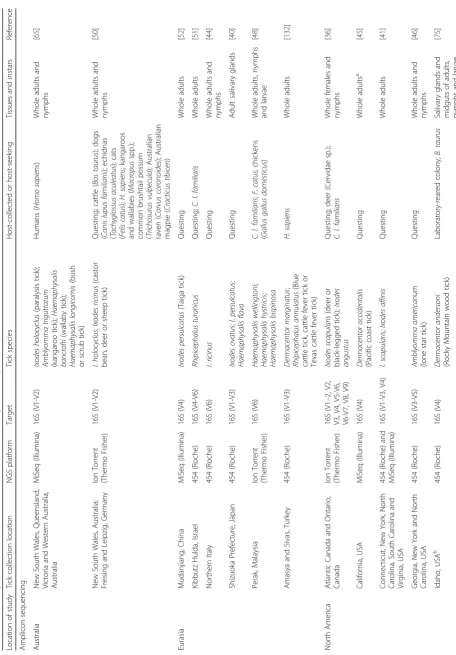
and communities of microorganisms to be explored in a massively parallel, rapid, and cost-effective manner. Fol-lowing the first NGS study of a tick microbiome in 2011 [13], the number of studies that have used NGS to investi-gate tick microbiomes has expanded (Table 1). Despite the growing number of studies, the microbiomes of most tick species remain unexplored, and further research into the functional role of these microorganisms in ticks at an indi-vidual and community level is needed.
This review compares the advantages and disadvantages associated with NGS platform selection and sequencing methods (amplicon and shotgun sequencing). The use of NGS data to characterise the tick microbiome through measures of diversity and composition is discussed and re-cent discoveries of bacteria that are pathogenic, symbiotic, novel and associated with tick organs are highlighted. We also consider aspects of the tick microbiome that are largely unexplored and factors that influence the structure and organisation of the microbiome.
Microbiome next-generation sequencing strategies
Two types of NGS can be applied to investigate micro-biomes, amplicon sequencing and shotgun sequencing * Correspondence:[email protected]
Vector and Waterborne Pathogens Research Group, School of Veterinary and Life Sciences, Murdoch University, Perth, WA, Australia
(which includes metagenomics and transcriptomics). There are nine hypervariable regions (V1-V9) of the bac-terial 16S ribosomal RNA gene (16S) that can be tar-geted to identify bacterial taxa in 16S amplicon NGS studies, and regions V1-V4 have been most commonly sequenced in ticks (Table 1). 16S amplicon sequencing in ticks has been performed with 454 (Roche) pyrose-quencing, Ion Torrent (Thermo Fisher) sequencing by semiconductor ion detection, and MiSeq (Illumina) plat-forms that use fluorescent dye detection sequencing methods (Table 1). Most of the published bacterial microbiome studies on ticks have used 454 platforms, such as the 454 GS Junior + and 454 GS FLX Titanium XL+, which have the advantage of longer read lengths (up to 1 kbp) compared to the Ion Torrent and MiSeq platforms [14], however, these sequencers have been dis-continued. The longest read lengths achieved by Illu-mina platforms are up to 600 bp (single-end reads; 300 bp paired-end reads) on the MiSeq (with v3 chemis-try) [15], and read lengths of up to 400 bp (single-end reads) can be sequenced on the Ion Torrent platforms Ion PGM and Ion S5 [16]. Greater 16S read lengths can improve taxonomic resolution of the sequences, and al-though almost full length 16S sequencing has been achieved on other platforms such as PacBio (Pacific Bio-sciences) [17], the cost of sequencing long amplicons is considerably more, and longer reads are provided at the expense of output read number [18], which is an equally important consideration for microbiome studies. The output read number is important for capturing adequate microbiome diversity, and the read numbers provided by the MiSeq are much greater than the Ion Torrent plat-form with comparable maximum read lengths; the MiSeq is capable of up to 50 million paired-end reads [15], whereas the Ion S5 530 platform can achieve up to 20 million single-end reads [16]. For shotgun sequen-cing, the HiSeq X (Illumina) sequences 150 bp paired-end reads and has the highest read output (2.6–3 billion reads) and lowest cost of sequencing (US$7 per Gbp) compared to other shotgun sequencing platforms [18, 19]. A large number of output reads is important in shotgun sequencing for better metagenome (or tran-scriptome) coverage. PacBio [20] and MinION (Oxford
Nanopore) [21] are single-molecule long-read
se-quencers, with read lengths of ~20 kbp and 200 kbp, re-spectively, that can be used for metagenomics. Although the output number of reads are low on these plat-forms (< 350,000 sequences), superior genome cover-age is afforded by greater read lengths; however, these platforms are considerably more expensive than short-read sequencing technologies [18]. At present, only short-read sequencers have been used for shotgun se-quencing of tick metagenomes, transcriptomes and viromes (Table 1).
Shotgun sequencing offers some advantages over amplicon sequencing such as the assessment of whole or partial genomes, transcriptomes, or viromes of the microbiome [22], and the sequencing of genes that are transcribed in microbes implies that they are actively replicating within the tick [23]. Furthermore, library preparation kits that are PCR-free can be used for shot-gun sequencing library preparation [24], which elimi-nates the issues of PCR bias that amplicon sequencing is subjected to. However, at the current time, shotgun se-quencing is considerably more expensive than amplicon sequencing [18], which may explain why the latter has been more widely used. Also, the nucleic acid extraction procedures for shotgun sequencing are more complex and require additional purification or enrichment steps compared to genomic DNA (gDNA) extraction methods for 16S amplicon sequencing. Purification or enrichment of microbial DNA needs to be performed for shotgun se-quencing of viral and microbial metagenomes, as well as metatranscriptomes, to increase the genome, virome, or transcriptome coverage by reducing eukaryotic DNA from the tick and from the tick’s host [25–28]. Shotgun sequencing also results in significantly larger datasets than amplicon sequencing, which requires much more powerful computational tools for data storage and bio-informatic analyses. The approaches and software pack-ages for NGS bioinformatics have been reviewed elsewhere [19, 29]. A schematic of the workflow for tick microbiome NGS studies is outlined in Fig. 1.
Bacterial diversity
The diversity of the microbiome can be assessed through measures of alpha and beta diversity; alpha diversity measures the number of species in a sample and their proportion (species richness), while beta diversity mea-sures the dissimilarity between samples (genetic
related-ness) [30–32]. Diversity metrics depend on the
hypervariable regions of 16S are highly conserved be-tween species, which limits species-level identification,
e.g. the genus Rickettsia, especially the spotted fever
group rickettsiae (SFGR) [37]. Additionally, the choice of similarity cut-offs and clustering algorithms used to pick operational taxonomic units (OTUs) [38, 39] and se-quencing error rates [33] can also affect taxonomic resolution.
Obtaining a sufficient number of reads per sample (re-ferred to as depth, or coverage, in amplicon NGS stud-ies) is required for adequate measurements of diversity [33]. Alpha diversity rarefaction plots, which compare the number of OTUs obtained to sequencing depth, should be assessed to determine whether adequate se-quencing depth was achieved for each sample, and these plots can be produced using Quantitative Insights Into Microbial Ecology (QIIME) software. A plateau in the plot suggests that adequate depth was achieved, whereas increasing trends suggest that further sequencing depth is required. Since the microbial diversity can vary in ticks based on factors such as species [40–43] and geo-graphical location [41, 44–47], the required sequencing depth differs between studies. For example, the alpha di-versity rarefaction plots from the study by Rynkiewicz et
al. [43] plateau at ~20,000 reads for Ixodes scapularis
(deer or black-legged tick) and Dermacentor variabilis
(American dog or wood tick), whereas the alpha diver-sity rarefaction plots for most samples in the study by Khoo et al. [48] have an increasing trend up to 40,000
reads for Haemaphysalis spp. However,
under-estimation of diversity can result when highly abundant sequences are overrepresented, regardless of sequencing depth. In such situations, PCR may not be sufficiently sensitive to amplify less abundant species. Blocking primers, which are primers that are modified with a DNA oligonucleotide or clamping probe that do not prime amplification, can be designed to reduce the amount of amplification of abundant template DNA
during PCR [49]. This approach in Ixodesspp. has been
shown to result in a significant increase in the total de-tectable bacterial diversity [50].
Bacterial composition
[image:6.595.59.540.85.406.2]life stage, host). The most abundant bacterial species that have been identified frequently in ticks include en-dosymbionts such asCoxiellaspp. [13, 40, 51],Rickettsia spp. [42, 44, 51–54],Francisellaspp. [42, 53] and “ Can-didatusMidichloria mitochondrii”[50]. However, patho-genic, environmental and skin-associated bacteria have
also been reported as highly abundant [13, 44]. The
number of reads obtained for each bacterial species are not necessarily representative of the number of microor-ganisms that were present in the tick due to the multi-copy nature of 16S [55]. Estimates of the number of bac-terial species initially present could be made by correct-ing for the number of 16S copies in each species, or by
targeting a single copy gene (e.g. rpoB gene). However,
PCR amplification bias occurs when the amplification ef-ficiency of templates differ, which leads to over- or under-representation of template DNA sequences [56, 57], and this can impact diversity measures of the data-set [38]. PCR conditions can be optimised to reduce, but not eliminate, the levels of PCR bias, such as reducing temperature ramping speeds, extending the denaturation step to provide sufficient time for GC-rich DNA frag-ments to denature, adding betaine to keep GC-rich tem-plates single-stranded and using different enzymes such as AccuPrime Taq HiFi (Thermo Fisher) to improve priming specificity [58]. Alternative nucleic acid amplifi-cation methods exist, but due to the lack of commercial availability [59], PCR is the mainstay of amplicon NGS library preparation procedures.
The bacterial microbiome of ticks Bacterial pathogens
Some of the most important bacterial TBPs include
spe-cies of Anaplasma, Borrelia, Ehrlichia, Francisella and
Rickettsia. Ixodes ricinus, the castor bean (or deer or sheep) tick, is prevalent throughout Europe and is re-sponsible for transmitting a range of bacterial pathogens. Due to its significant role as a bacterial vector,I. ricinus has been commonly investigated using 16S NGS [22, 23,
44, 50]. Ixodes ricinus ticks sampled from Lyme disease
endemic regions were found to carry pathogenic species within the Borrelia burgdorferi (sensu lato) (s.l.) gen-ogroup, includingB. burgdorferi(sensu stricto) (s.s.), Bor-relia garinii and Borrelia afzelii [23, 44, 50]; as well as Anaplasma phagocytophilum, Rickettsia helvetica and “Candidatus Neoehrlichia mikurensis” [23, 60]. Known TBPs are usually identified at species-specific loci with sensitive qPCR or multiplex PCR screening procedures that are faster and more affordable compared to NGS in diagnostic settings, i.e. when a tick has been removed from a patient with clinical illness [61]. Since 16S NGS can be harnessed as a broad screening tool for bacteria, it is a useful technique for non-hypothesis driven sur-veillance of bacterial TBPs. Although greater sensitivity
with qPCR compared to NGS has been demonstrated in some studies [62, 63], other studies have shown that in-creasing the sequencing depth can increase the chances of detecting rare species [64].
Sequencing of universal genes with NGS also allows for novel species identification [50, 65]. Determining the pathogenicity of newly discovered bacteria is then chal-lenging as the direct association between a particular clinical illness and the bacterial species, once within the vertebrate host, must be proven. To a limited extent, the potential for pathogenicity of novel species can be esti-mated at the molecular level, e.g. by how they cluster genetically with known TBPs and by the presence of ‘pathogenicity islands’that code for virulence genes [66, 67]. Paradoxically, however, pathogenicity islands have also been found in non-pathogenic species [68]. The identification of novel microorganisms in ticks using NGS may lead in time to an increase in what has been
termed ‘reversed discovery of disease’, whereby the
microorganism is identified in ticks before its pathogen-icity to animals or humans is established [69].
Endosymbiotic bacteria
Endosymbiotic bacteria that reside in hard ticks (ixodids) include species of Coxiella, Francisella, Rickettsia and “Candidatus Midichloria mitochondrii” [70]. Coxiella-like endosymbionts (CLEs) have been found in a variety
of ixodids using NGS, including Amblyomma
ameri-canum (lone star tick) [71], Haemaphysalis flava [40], Ixodes ovatus [40], Rhipicephalus (Boophilus) microplus (cattle tick) [13],Rhipicephalus turanicus[51] and Rhipi-cephalus sanguineus (sensu lato) (s.l.) (brown dog tick) [51], and have also been found in soft tick (argasid) spe-cies, e.g.Ornithodoros spp. [60, 72]. Andreotti et al. [13]
found that a CLE was most abundant in femaleR.
micro-plus ovaries. Transovarial transmission of this CLE was
recently demonstrated in Ornithodoros maritimus, A.
americanum, R. sanguineus (s.l.) and R. microplus [72]. Although these CLEs purportedly have a symbiotic rela-tionship with their tick hosts, a recent study by
Angela-kis et al. [73] detected a CLE from Rhipicephalus spp.
(“Candidatus Coxiella massiliensis”) in skin biopsies from people with clinical signs of fever, skin eschar and local lymph node enlargement, and this organism is now therefore linked with human infection [73]. The causa-tive agent of Q fever in humans, Coxiella burnetii, is a relatively recent descendant of CLEs of ticks [72], and seven tick species have been experimentally demon-strated as competent vectors ofC. burnetii[74].
Endosymbionts are an important component of the microbiome that can benefit tick survival. Rickettsial
en-dosymbionts of Dermacentor andersoni (Rocky
Moun-tain wood tick) andA. americanum, and the CLE of A.
essential for the survival and reproductive fitness of their
host. Studies that exposed D. andersoni and A.
ameri-canum to antibiotics found that the exposed colony’s progeny had lower numbers of their respective endo-symbionts, which reduced the survival, feeding and
moulting competence inD. andersoni[75], and reduced
fecundity in A. americanum [75, 76]. Although a
complete understanding of the mechanisms that cause endosymbionts to promote tick survival and fecundity is lacking, endosymbionts may play a key role in providing essential nutrients and cofactors that are absent from the blood meal. For example, Smith et al. [77] sequenced
the genome of the CLE ofA. americanumto investigate
the potential for nutrient-provisioning, and found that the genome encodes for major vitamin and cofactor bio-synthesis pathways [77].
Environmental and skin-associated bacteria
It remains uncertain whether ubiquitous bacteria associ-ated with soil, plants and skin that are frequently re-ported in NGS studies of ticks are contaminants from environmental or host sources, or whether they are genuinely associated with the tick microbiome. The tick’s exoskeleton can be sterilised with bleach prior to nucleic acid extraction in an attempt to remove contam-inant DNA, or bioinformatics pipelines can be used to remove contaminating reads that are present in extrac-tion and no-template controls [23]. Studies that have used sterilisation techniques (e.g. washing the ticks with 10% sodium hypochlorite) have, however, still detected environmental and skin bacteria in ticks [44, 50, 78]. This may be due to inadequate sterilisation (i.e. bacteria may remain hidden in crevices that are not exposed to the bleach solution during washing), or these bacteria may be ingested by ticks during feeding, therefore may be present in the tick midgut. As ticks spend the major-ity of their lives in the environment, saprophytic bacteria may be acquired at some point during their life cycle.
Bacterial contamination is a widespread issue among NGS datasets due to the sensitivity of this technology [79]. Stringent laboratory procedures must be followed during sample handling to minimise laboratory-derived contamination; the use of sterile gloves, workstations, laminar flow hoods, PCR grade water and pipette tips with filters are some examples of laboratory practices that can reduce contamination. Library preparation re-agents can also be a source of contamination, e.g. ligases, polymerases and nucleotides are purified from bacteria, and Bradyrhizobium spp. have been reported in ultra-pure water systems [79]. To ensure that these contami-nants are controlled for, extraction and no-template controls should be included so that the contaminant se-quences can be identified and removed bioinformatically from the dataset.
Organ-associated bacteria
While most 16S NGS studies of ticks have extracted DNA from entirely homogenised ticks (Table 1), some researchers have examined bacterial profiles of tick or-gans [13, 40, 53, 80, 81]. Microbial communities differ between anatomical regions within the tick, such as the midgut, reproductive tract and the salivary glands [13,
17, 53, 75, 80–83]. Most TBPs are transmitted to the
vertebrate host via salivary secretions during blood feed-ing. An assessment with 16S NGS of the bacteria present
in the salivary glands of I. ovatus, Ixodes persulcatus
(Taiga tick) and H. flava collected in Japan revealed a
surprisingly large number of bacterial genera: 71 (I. ova-tus), 127 (I. persulcatus) and 59 (H. flava) [40], and some of the medically important genera that were detected in-cludedCoxiella,EhrlichiaandRickettsia[40].
Rickettsia parkeri, one of the causes of human
rickett-siosis [84], is transmitted by Amblyomma maculatum
(Gulf Coast tick), and has been detected in the midguts, salivary glands and saliva of questing ticks with NGS [53]. The study suggested that the bacteria may migrate from the midgut to the salivary glands prior to feeding [53], which differs from the transmission route of other pathogens, such asB. burgdorferi, which develops in the tick midgut of Ixodesspp. then translocates to the saliv-ary glands during feeding [85, 86].
It is possible that dissected tick organs may be con-taminated with microbes from surrounding tissues or adjacent organs. Methodologies to control for this should be implemented, otherwise alternative assays may need to be utilised e.g. fluorescence in situ hybridization (FISH) [87]. Immunofluorescence assays have provided insights into the transstadial transmission of a novel
re-lapsing fever Borreliasp. found inAmblyomma
geoemy-dae in Japan, which was visualised in the midgut and
salivary glands of instars after moulting [88].
Neglected facets of the tick microbiome Viruses
Viral species transmitted by ticks include tick-borne en-cephalitis virus [89], CCHFV [90], KFDV [91], Alkhurma virus, severe fever with thrombocytopenia syndrome virus (SFTSV) [92], Heartland virus (HRTV) [93], Powassan and Colorado tick fever viruses [94, 95], Africa swine fever virus, Nairobi sheep disease virus (NSDV) and Louping ill virus [5, 6]. Shotgun sequencing of viral cDNA is a more comprehensive approach than amplicon sequencing for studying the tick virome due to the lack of universal genes in viruses [96]. Thus far, only four shotgun NGS studies have investigated the virome of ticks
[97–100]. Xia et al. [97] sequenced the virome of
phages and invertebrate viruses [97]. Most of the recog-nised nairoviruses are transmitted by ticks, and some that impact human and animal health, such as CCHFV and
NSDV, have been identified in Rhipicephalus spp.
previ-ously [101]. Tokarz et al. [100] discovered eight previprevi-ously uncharacterised viral sequences in I. scapularis, D. varia-bilis and A. americanum from the USA that were most similar to nairovirus, phlebovirus, invertebrate-like virus, mononegavirus and tetravirus-like virus, and also identi-fied Powassan virus inI. scapularis[100]. Li et al. [98] and Shi et al. [99] investigated the viromes of a wide variety of invertebrates, including ticks from China, and their results suggest that arthropods are major reservoir hosts for negative-sense RNA viruses that are found in vertebrates, plants, fungi and protists. The considerable number of known tick-borne viruses and the growing number of dis-coveries of novel viruses potentially transmitted by ticks warrants a wider investigation of tick viromes.
Eukaryotes
Protozoan tick-borne diseases (TBDs), such as babesiosis
and theileriosis, are caused by the piroplasms Babesia
spp. and Theileria spp., respectively [102]. To date, no 18S ribosomal RNA gene (18S) NGS studies on ticks have been published, and there have been no protozoan discoveries reported in shotgun sequencing studies on ticks. Shotgun sequencing could be used to identify pro-tists in addition to viruses and bacteria; however, the relative abundance of eukaryotic tick DNA is much greater than protist DNA, and so a great sequencing depth would be required for protist detection. 18S ranges from 1.5 kbp to more than 4.5 kbp [103], and like bacterial 16S, 18S contains nine hypervariable regions (V1-V9). The use of universal 18S primers for identifying eukaryotic DNA with amplicon sequencing in ticks is challenging as other eukaryotic species from soil flora contaminants, animals and the tick itself will also be amplified. It may be possible to address this issue with blocking primers [50], or the use of protist-specific
primers for NGS [104]. In addition toBabesiaand
Thei-leria, other Eukarya that require further characterisation at the community level in ticks include other
apicom-plexan species (e.g. Hepatozoon spp.), trypanosomes
[105], fungi [106] and helminths [107].
Factors influencing the microbiome
Several studies have assessed the effect of environmental and host-related factors on tick microbiome diversity and composition. Environmental factors such as
geo-graphical location [41, 44–47], temperature, humidity
[71], season [51], habitat type and soil type have been shown to influence the bacterial diversity and compos-ition of ticks. Microbiome diversity and composcompos-ition can also vary depending on vertebrate host and
arthropod-related factors such as tick species [40–43], instar and sex [41, 44–47, 51, 54, 71, 81], anatomical location (e.g. midguts and salivary glands) [13, 53, 75, 81] and blood-feeding [52, 108, 109].
Other studies have assessed additional factors, such as the role of proteins in the microbiome that are encoded by the tick’s genome, and their effect on pathogen acqui-sition. Silencing of transcripts using RNA interference (RNAi) of the antioxidant selenoproteins thioredoxin ductase (TrxR) and glutathione peroxidase (GPx)
re-duced the bacterial load of Rickettsiaceae in A.
maculatum midguts and salivary glands [82], and B. burgdorferi in I. scapularis saliva [110], respectively.
RNAi-mediated knockdown of the
selenocysteine-specific elongation factor (SEF) gene in A. maculatum,
which is important for selenoprotein translation,
re-sulted in no detectableR. parkeriinA. maculatum
mid-guts [111]. Other protein-encoding genes also affect pathogen acquisition and development, and are
differen-tially regulated in ticks in response to Anaplasma
mar-ginaleinfection [112].
NGS investigations of ticks have also revealed that microbe-microbe interactions can influence microbiome composition. For example, Gurfield et al. [45] found that there was an inverse relationship between the number of Francisella-like endosymbionts (FLEs) and SFGR in Der-macentor occidentalis, which suggests that FLEs have an ability to interfere with SFGR colonisation [45]. Other non-NGS studies have demonstrated that endosymbi-onts can interfere with TBP transmission by affecting pathogen acquisition and colonisation [70, 113, 114].
Narasimhan et al. [83] altered the gut microbiota of I.
scapularis by rearing larvae in sterile containers, and 16S 454 sequencing showed that the dysbiosed larvae had a higher abundance of Proteobacteria, including the
genera Rickettsia, Thioclava and Delftia, compared to
control larvae reared under normal conditions. In that study, qPCR assessments of larvae fed onB.
burgdorferi-infected mice and pathogen-free mice showed that B.
burgdorferi colonisation in dysbiosed larvae, as well as gentamycin-exposed larvae, was significantly reduced compared to the control larvae [83].
Similarly, a study by Gall et al. [17] showed that higher
proportions of the endosymbiont Rickettsia bellii in D.
andersoni were correlated with decreased acquisition of
the pathogen A. marginale. However, generalisations
glycoprotein (IAFGP) [115], and was shown in a study by Abraham et al. [108] to decrease the abundance of
the genera Enterococcus and Rickettsia and increase
Pseudomonas in I. scapularis midguts. The study by
Abraham et al. [108] also showed that A.
phagocytophi-lum decreased the expression levels of peritrophin-1,
peritrophin-2 and peritrophin-4, which are genes that encode for peritrophin, a major component of peri-trophic matrix (PM) glycoproteins that form a layer sep-arating epithelial cells from the tick gut lumen, and this caused a decrease in the thickness of the PM. This study
demonstrated thatA. phagocytophilum induced changes
in the gut barrier by decreasing peritrophin expression,
which enhanced the colonisation ofA. phagocytophilum
in the tick midgut [108].
Macroparasites of ticks may also influence the
micro-biome. It has been suggested that Wolbachia pipientis
may not be a naturally occurring endosymbiont of ticks, but rather has been introduced to the tick microbiome by a parasitic wasp [116]. Further studies are required to establish the extent to which environmental, tick and vertebrate host-related factors influence the microbiome. Other variables that could also be considered include degree of engorgement, gut protein expression responses to a blood meal [117, 118], host immune molecules present in blood meals [119], tick gut changes in re-sponse to feeding [120], tick copulation and egg
fertilisa-tion [120, 121], vertebrate host skin microflora,
microorganisms in the vertebrate host’s blood and com-munity changes brought about by microbial interactions within the tick.
Implications of microbiome studies
Not only is NGS a comprehensive tool for studying tick
microbiomes, it can also be used for TBP or ‘
patho-biome’ surveillance to improve TBD diagnostics [122]
and for the reversed discovery of human and animal TBDs. Importantly, an understanding of the factors that influence the microbiome, and the role of the micro-biome, provides new avenues to be explored for TBD control. Most tick and TBD control strategies focus on the use of acaricides and vaccines [123–125]; however, tick populations can become resistant to chemical acari-cides [123], and vaccine development takes an average of ten years [126]. Strategies could be developed to ma-nipulate the tick microbiome to decrease the vectorial capacity of ticks by hindering pathogen acquisition, de-velopment, and horizontal and vertical transmission, which could have a long-term impact on TBP transmis-sion and could ultimately reduce morbidity and mortal-ity caused by TBDs. In the field of human microbiome research, investigations of metabolic, signaling and im-mune interactions between gut microbes and host
physiology have led to the concept of therapeutic micro-bial manipulation to treat or prevent diseases [127–129]. For example, faecal microbiota transplantations have been successfully used to reestablish colonic microbial populations that fight against intestinal infections with Clostridium difficile[130].
Microbiome alterations have also been induced in arthropod vectors to combat vector-borne diseases. The
endosymbiont W. pipientis causes cytoplasmic
incom-patibility and has been introduced into mosquito vectors
such as Culex pipiens, Aedes aegypti, Aedes albopictus
andAedes polynesiensisto control their populations with the aim to reduce the transmission of diseases such as filariasis, dengue fever, yellow fever, chikungunya and Zika fever. There are ongoing trials and evaluations of
releasing Wolbachia-infected Ae. aegypti in Brazil,
Colombia, Indonesia, Singapore and Vietnam [131]. Similar microbial management strategies could be devel-oped for ticks that promote the growth of endosymbiotic bacteria, such asR. bellii, to reduce acquisition of patho-gens, such asA. marginaleinD. andersoni, or strategies could be developed to the hinder the growth of FLEs in D. andersoni to reduce F. novidica acquisition [17]. Genes that could be manipulated to hinder pathogen ac-quisition and development include antioxidant seleno-protein genes and PM glycoseleno-protein genes. Silencing of
TrxR in A. maculatum and GPx inI. scapularis
nega-tively affects R. parkeri and B. burgdorferi
develop-ment, respectively [82, 110, 111]. Preventing A.
phagocytophilum from decreasing the expression
levels of 1, 2 and
peritrophin-4 would impede A. phagocytophilum growth in the
tick midgut [108].
Conclusions
improves, novel microbial management strategies for TBDs may be developed in the future.
Abbreviations
16S:16S ribosomal ribonucleic acid gene; 18S: 18S ribosomal ribonucleic acid gene; CCHFV: Crimean-Congo haemorrhagic fever virus;
cDNA: complementary DNA; CLE:Coxiella-like endosymbiont;
FISH: fluorescence in situ hybridization; FLE:Francisella-like endosymbiont; Gbp: gigabase pairs; gDNA: genomic deoxyribonucleic acid; GPx: glutathione peroxidase; HRTV: Heartland virus; IAFGP:Ixodes scapularisantifreeze glycoprotein; Kbp: kilobase pairs; KFDV: Kyasanur Forest disease virus; NGS: next-generation sequencing; NSDV: Nairobi sheep disease virus; OTU: operational taxonomic unit; PM: peritrophic matrix; QIIME: Quantitative Insights Into Microbial Ecology; qPCR: real-time polymerase chain reaction; RNAi: ribonucleic acid interference; SEF: selenocysteine-specific elongation factor; SFGR: spotted fever group rickettsiae; SFTSV: severe fever with thrombocytopenia syndrome virus; TBD: tick-borne disease; TBP: tick-borne pathogen; TrxR: thioredoxin reductase; V1-V9: hypervariable regions 1–9
Acknowledgements
We thank the Australian Research Council (Linkage Project 130100050), Bayer Australia Ltd., Bayer AG (Germany) and Murdoch University for supporting our tick microbiome research.
Funding
This research is funded by the Australian Research Council (Linkage Project 130,100,050), Bayer Australia Ltd. and Bayer AG (Germany). TLG is supported by a Murdoch University Postgraduate Research scholarship.
Availability of data and materials
Not applicable.
Authors’contributions
TLG developed and wrote the manuscript. AWG and AP provided critical reviews and suggestions for the content. UMR, CLO and PJI guided and assisted in writing the manuscript. All authors read and approved the final manuscript.
Ethics approval and consent to participate
Not applicable.
Consent for publication
Not applicable.
Competing interests
The authors declare that they have no competing interests.
Publisher’s Note
Springer Nature remains neutral with regard to jurisdictional claims in published maps and institutional affiliations.
Received: 18 September 2017 Accepted: 21 November 2017
References
1. Whipps JM, Lewis K, Cooke RC. Mycoparasitism and plant disease control. In: Burge MN, editor. Fungi in biological control systems. Manchester: Manchester University Press. 1988:176.
2. Peterson J, Garges S, Giovanni M, McInnes P, Wang L, Schloss JA, et al. The NIH human microbiome project. Genome Res. 2009;19:2317–23.
3. Ursell LK, Metcalf JL, Parfrey LW, Knight R. Defining the human microbiome. Nutr Rev. 2012;70:38–44.
4. Narasimhan S, Fikrig E. Tick microbiome: the force within. Trends Parasitol. 2015;31:315–23.
5. de la Fuente J, Estrada-Pena A, Venzal JM, Kocan KM, Sonenshine DE. Overview: ticks as vectors of pathogens that cause disease in humans and animals. Front Biosci. 2008;13:6938–46.
6. Dantas-Torres F, Chomel BB, Otranto D. Ticks and tick-borne diseases: a one health perspective. Trends Parasitol. 2012;28:437–46.
7. Brites-Neto J, Duarte KMR, Martins TF. Tick-borne infections in human and animal population worldwide. Vet World. 2015;8:301–15.
8. Noda H, Munderloh UG, Kurtti TJ. Endosymbionts of ticks and their relationship toWolbachiaspp. and tick-borne pathogens of humans and animals. Appl Environ Microbiol. 1997;63:3926–32.
9. Sacchi L, Bigliardi E, Corona S, Beninati T, Lo N, Franceschi A. A symbiont of the tickIxodes ricinusinvades and consumes mitochondria in a mode similar to that of the parasitic bacteriumBdellovibrio bacteriovorus. Tissue Cell. 2004;36:43–53.
10. Scoles GA. Phylogenetic analysis of theFrancisella-like endosymbionts of
Dermacentorticks. J Med Entomol. 2004;41:277–86.
11. Berlec A. Novel techniques and findings in the study of plant microbiota: search for plant probiotics. Plant Sci. 2012;193–194:96–102.
12. Kim Y, Koh I, Rho M. Deciphering the human microbiome using next-generation sequencing data and bioinformatics approaches. Methods. 2015; 79–80:52–9.
13. Andreotti R, Pérez de León AA, Dowd SE, Guerrero FD, Bendele KG, Scoles GA. Assessment of bacterial diversity in the cattle tickRhipicephalus
(Boophilus)microplusthrough tag-encoded pyrosequencing. BMC Microbiol.
2011;11:6.
14. Roche Diagnostics Corporation. http://http://www.my454.com//. Accessed 15 May 2017.
15. Illumina. http://www.illumina.com/. Accessed 15 May 2017.
16. Thermo Fisher Scientific. http://www.thermofisher.com/. Accessed 15 May 2017.
17. Gall CA, Reif KE, Scoles GA, Mason KL, Mousel M, Noh SM, et al. The bacterial microbiome ofDermacentor andersoniticks influences pathogen susceptibility. ISME J. 2016;
18. Goodwin S, McPherson JD, McCombie WR. Coming of age: ten years of next-generation sequencing technologies. Nat Rev Genet. 2016;17:333–51.
19. Roumpeka DD, Wallace RJ, Escalettes F, Fotheringham I, Watson MA. Review of bioinformatics tools for bio-prospecting from metagenomic sequence data. Front Genet. 2017;8:23.
20. Pacific Biosciences of California. http://www.pacb.com/. Accessed 15 May 2017. 21. Oxford Nanopore Technologies. https://nanoporetech.com/. Accessed 15
May 2017.
22. Nakao R, Abe T, Nijhof AM, Yamamoto S, Jongejan F, Ikemura T, et al. A novel approach, based on BLSOMs (batch learning self-organizing maps), to the microbiome analysis of ticks. ISME J. 2013;7:1003–15.
23. Vayssier-Taussat M, Moutailler S, Michelet L, Devillers E, Bonnet S, Cheval J, et al. Next generation sequencing uncovers unexpected bacterial pathogens in ticks in Western Europe. PLoS One. 2013;8:e81439. 24. Jones MB, Highlander SK, Anderson EL, Li W, Dayrit M, Klitgord N, et al.
Library preparation methodology can influence genomic and functional predictions in human microbiome research. Proc Natl Acad Sci USA. 2015; 112:14024–9.
25. Lim YW, Haynes M, Furlan M, Robertson CE, Harris JK, Rohwer F. Purifying the impure: sequencing metagenomes and metatranscriptomes from complex animal-associated samples. J Vis Exp. 2014:52117.
26. Carpi G, Walter KS, Bent SJ, Hoen AG, Diuk-Wasser M, Caccone A. Whole genome capture of vector-borne pathogens from mixed DNA samples: a case study ofBorrelia burgdorferi. BMC Genomics. 2015;16:434.
27. Moen AEF, Tannæs TM, Vatn S, Ricanek P, Vatn MH, Jahnsen J. Simultaneous purification of DNA and RNA from microbiota in a single colonic mucosal biopsy. BMC Res Notes. 2016;9:328.
28. Mertes F, ElSharawy A, Sauer S, van Helvoort JM, van der Zaag PJ, Franke A, et al. Targeted enrichment of genomic DNA regions for next-generation sequencing. Brief Funct Genomics. 2011;10:374–86.
29. Siegwald L, Touzet H, Lemoine Y, Hot D, Audebert C, Caboche S. Assessment of common and emerging bioinformatics pipelines for targeted metagenomics. PLoS One. 2017;12:e0169563.
30. Whittaker RH. Evolution and measurement of species diversity. Taxon. 1972;21:213–51.
31. Lozupone C, Knight R. UniFrac: a new phylogenetic method for comparing microbial communities. Appl Environ Microbiol. 2005;71:8228–35. 32. Lozupone CA, Hamady M, Kelley ST, Knight R. Quantitative and qualitative
beta diversity measures lead to different insights into factors that structure microbial communities. Appl Environ Microbiol. 2007;73:1576–85. 33. Claesson MJ, Wang Q, O'Sullivan O, Greene-Diniz R, Cole JR, Ross RP, et al.
highly complex microbiota composition using tandem variable 16S rRNA gene regions. Nucleic Acids Res. 2010;38:e200-e.
34. Clarridge JE. Impact of 16S rRNA gene sequence analysis for identification of bacteria on clinical microbiology and infectious diseases. Clin Microbiol Rev. 2004;17:840–62.
35. Chakravorty S, Helb D, Burday M, Connell N, Alland DA. Detailed analysis of 16S ribosomal RNA gene segments for the diagnosis of pathogenic bacteria. J Microbiol Methods. 2007;69:330–9.
36. Sperling JL, Silva-Brandão KL, Brandão MM, Lloyd VK, Dang S, Davis CS, et al. Comparison of bacterial 16S rRNA variable regions for microbiome surveys of ticks. Ticks Tick Borne Dis. 2017;8:453–61.
37. Raoult D, Roux V. Rickettsioses as paradigms of new or emerging infectious diseases. Clin Microbiol Rev. 1997;10:694–719.
38. Sun Y, Cai Y, Huse SM, Knight R, Farmerie WG, Wang X, et al. A large-scale benchmark study of existing algorithms for taxonomy-independent microbial community analysis. Brief Bioinform. 2012;13:107–21.
39. Schmidt TSB, Matias Rodrigues JF, von Mering C. Ecological consistency of SSU rRNA-based operational taxonomic units at a global scale. PLoS Comput Biol. 2014;10:e1003594.
40. Qiu Y, Nakao R, Ohnuma A, Kawamori F, Sugimoto C. Microbial population analysis of the salivary glands of ticks; a possible strategy for the surveillance of bacterial pathogens. PLoS One. 2014;9:e103961. 41. Van Treuren W, Ponnusamy L, Brinkerhoff RJ, Gonzalez A, Parobek CM,
Juliano JJ, et al. Variation in the microbiota ofIxodesticks with regard to geography, species, and sex. Appl Environ Microbiol. 2015;81:6200–9. 42. Hawlena H, Rynkiewicz E, Toh E, Alfred A, Durden LA, Hastriter MW,
et al. The arthropod, but not the vertebrate host or its environment, dictates bacterial community composition of fleas and ticks. ISME J. 2013;7:221–3.
43. Rynkiewicz EC, Hemmerich C, Rusch DB, Fuqua C, Clay K. Concordance of bacterial communities of two tick species and blood of their shared rodent host. Mol Ecol. 2015;24:2566–79.
44. Carpi G, Cagnacci F, Wittekindt NE, Zhao F, Qi J, Tomsho LP, et al. Metagenomic profile of the bacterial communities associated withIxodes
ricinusticks. PLoS One. 2011;6:e25604.
45. Gurfield N, Grewal S, Cua LS, Torres PJ, Kelley ST. Endosymbiont interference and microbial diversity of the Pacific coast tick,Dermacentor occidentalis, in San Diego County, California. PeerJ. 2017;5:e3202.
46. Williams-Newkirk AJ, Rowe LA, Mixson-Hayden TR, Dasch GA. Characterization of the bacterial communities of life stages of free living lone star ticks (Amblyomma americanum). PLoS One. 2014;9:e102130. 47. Trout Fryxell RT, DeBruyn JM. The microbiome ofEhrlichiainfected and
uninfected lone star ticks (Amblyomma americanum). PLoS One. 2016;11:e0146651.
48. Khoo JJ, Chen F, Kho KL, Ahmad Shanizza AI, Lim FS, Tan KK, et al. Bacterial community inHaemaphysalisticks of domesticated animals from the orang Asli communities in Malaysia. Ticks Tick Borne Dis. 2016;7:929–37. 49. Vestheim H, Jarman SN. Blocking primers to enhance PCR amplification of
rare sequences in mixed samples - a case study on prey DNA in Antarctic krill stomachs. Front Zool. 2008;5:12.
50. Gofton AW, Oskam CL, Lo N, Beninati T, Wei H, McCarl V, et al. Inhibition of the endosymbiont "CandidatusMidichloria mitochondrii" during 16S rRNA gene profiling reveals potential pathogens inIxodesticks from Australia. Parasit Vectors. 2015;8:345.
51. Lalzar I, Harrus S, Mumcuoglu KY, Gottlieb Y. Composition and seasonal variation ofRhipicephalus turanicusandRhipicephalus sanguineusbacterial communities. Appl Environ Microbiol. 2012;78:4110–6.
52. Zhang X-C, Yang Z-N, Lu B, Ma X-F, Zhang C-X, H-J X. The composition and transmission of microbiome in hard tick,Ixodes persulcatus, during blood meal. Ticks Tick Borne Dis. 2014;5:864–70.
53. Budachetri K, Browning RE, Adamson SW, Dowd SE, Chao C-C, Ching W-M, et al. An insight into the microbiome of theAmblyomma maculatum(Acari: Ixodidae). J Med Entomol. 2014;51:119–29.
54. Ponnusamy L, Gonzalez A, Van Treuren W, Weiss S, Parobek CM, Juliano JJ, et al. Diversity of rickettsiales in the microbiome of the lone star tick,Amblyomma americanum. Appl Environ Microbiol. 2014;80:354–9. 55. Kembel SW, Wu M, Eisen JA, Green JL. Incorporating 16S gene copy
number information improves estimates of microbial diversity and abundance. PLoS Comput Biol. 2012;8:e1002743.
56. Hong S, Bunge J, Leslin C, Jeon S, Epstein SS. Polymerase chain reaction primers miss half of rRNA microbial diversity. ISME J. 2009;3:1365–73.
57. Nadkarni MA, Martin FE, Hunter N, Jacques NA. Methods for optimizing DNA extraction before quantifying oral bacterial numbers by real-time PCR. FEMS Microbiol Lett. 2009;296:45–51.
58. Aird D, Ross MG, Chen W-S, Danielsson M, Fennell T, Russ C, et al. Analyzing and minimizing PCR amplification bias in Illumina sequencing libraries. Genome Biol. 2011;12:R18-R.
59. Fakruddin M, Mannan KSB, Chowdhury A, Mazumdar RM, Hossain MN, Islam S, et al. Nucleic acid amplification: alternative methods of polymerase chain reaction. J Pharm Bioallied Sci. 2013;5:245–52.
60. Almeida AP, Marcili A, Leite RC, Nieri-Bastos FA, Domingues LN, Martins JR, et al.Coxiellasymbiont in the tickOrnithodoros rostratus(Acari: Argasidae). Ticks Tick Borne Dis. 2012;3:203–6.
61. Mediannikov O, Fenollar F. Looking in ticks for human bacterial pathogens. Microb Pathog. 2014;77:142–8.
62. Lecuit M, Eloit M. The diagnosis of infectious diseases by whole genome next generation sequencing: a new era is opening. Front Cell Infect Microbiol. 2014;4:25.
63. Wylie KM, Mihindukulasuriya KA, Sodergren E, Weinstock GM, Storch GA. Sequence analysis of the human virome in febrile and afebrile children. PLoS One. 2012;7:e27735.
64. Salipante SJ, Sengupta DJ, Rosenthal C, Costa G, Spangler J, Sims EH, et al. Rapid 16S rRNA next-generation sequencing of polymicrobial clinical samples for diagnosis of complex bacterial infections. PLoS One. 2013;8:e65226.
65. Gofton AW, Doggett S, Ratchford A, Oskam CL, Paparini A, Ryan U, et al. Bacterial profiling reveals novel“Ca. Neoehrlichia”,Ehrlichia, andAnaplasma
species in Australian human-biting ticks. PLoS One. 2015;10:e0145449. 66. Knapp S, Hacker J, Jarchau T, Goebel W. Large, unstable inserts in the
chromosome affect virulence properties of uropathogenicEscherichia coli
O6 strain 536. J Bacteriol. 1986;168:22–30.
67. Hacker J, Bender L, Ott M, Wingender J, Lund B, Marre R, et al. Deletions of chromosomal regions coding for fimbriae and hemolysins occur in vitro and in vivo in various extraintestinalEscherichia coliisolates. Microb Pathog. 1990;8:213–25.
68. Gennari M, Ghidini V, Caburlotto G, Lleo MM. Virulence genes and pathogenicity islands in environmentalVibriostrains nonpathogenic to humans. FEMS Microbiol Ecol. 2012;82:563–73.
69. Tijsse-Klasen E, Koopmans MPG, Sprong H. Tick-borne pathogen - reversed and conventional discovery of disease. Front Public Health. 2014;2:73. 70. Ahantarig A, Trinachartvanit W, Baimai V, Grubhoffer L. Hard ticks and their
bacterial endosymbionts (or would be pathogens). Folia Microbiol. 2013;58:419–28.
71. Menchaca AC, Visi DK, Strey OF, Teel PD, Kalinowski K, Allen MS, et al. Preliminary assessment of microbiome changes following blood-feeding and survivorship in theAmblyomma americanumnymph-to-adult transition using semiconductor sequencing. PLoS One. 2013;8:e67129.
72. Duron O, Noel V, McCoy KD, Bonazzi M, Sidi-Boumedine K, Morel O, et al. The recent evolution of a maternally-inherited endosymbiont of ticks led to the emergence of the Q fever pathogen,Coxiella burnetii. PLoS Pathog. 2015;11:e1004892.
73. Angelakis E, Mediannikov O, Jos S-L, Berenger J-M, Parola P, Raoult D.
CandidatusCoxiella massiliensis infection. Emerging. Infect Dis. 2016;22:285.
74. Duron O, Sidi-Boumedine K, Rousset E, Moutailler S, Jourdain E. The importance of ticks in Q fever transmission: what has (and has not) been demonstrated? Trends Parasitol. 2015;31:536–52.
75. Clayton KA, Gall CA, Mason KL, Scoles GA, Brayton KA. The characterization and manipulation of the bacterial microbiome of the Rocky Mountain wood tick,Dermacentor andersoni. Parasit Vectors. 2015;8:632. 76. Zhong J, Jasinskas A, Barbour AG. Antibiotic treatment of the tick vector
Amblyomma americanumreduced reproductive fitness. PLoS One. 2007;2:e405.
77. Smith TA, Driscoll T, Gillespie JJ, Raghavan RA.Coxiella-like endosymbiont is a potential vitamin source for the lone star tick. Genome Biol Evol. 2015;7:831–8. 78. Heise SR, Elshahed MS, Little SE. Bacterial diversity inAmblyomma
americanum(Acari: Ixodidae) with a focus on members of the genus
Rickettsia. J Med Entomol. 2010;47:258–68.
79. Strong MJ, Xu G, Morici L, Splinter Bon-Durant S, Baddoo M, Lin Z, et al. Microbial contamination in next generation sequencing: implications for sequence-based analysis of clinical samples. PLoS Path. 2014;10:e1004437. 80. Budachetri K, Gaillard D, Williams J, Mukherjee N, Karim SA. Snapshot of
81. Zolnik CP, Prill RJ, Falco RC, Daniels TJ, Kolokotronis S-O. Microbiome changes through ontogeny of a tick pathogen vector. Mol Ecol. 2016;25:4963–77.
82. Budachetri K, Karim S. An insight into the functional role of thioredoxin reductase, a selenoprotein, in maintaining normal native microbiota in the Gulf coast tick (Amblyomma maculatum). Insect Mol Biol. 2015;24:570–81. 83. Narasimhan S, Rajeevan N, Liu L, Zhao Yang O, Heisig J, Pan J, et al. Gut
microbiota of the tick vectorIxodes scapularismodulate colonization of the Lyme disease spirochete. Cell Host Microbe. 2014;15:58–71.
84. Paddock CD, Fournier P-E, Sumner JW, Goddard J, Elshenawy Y, Metcalfe MG, et al. Isolation ofRickettsia parkeriand identification of a novel spotted fever groupRickettsiasp. from Gulf Coast ticks (Amblyomma maculatum) in the United States. Appl Environ Microbiol. 2010;76:2689–96.
85. De Silva AM, Fikrig E. Growth and migration ofBorrelia burgdorferiinIxodes
ticks during blood feeding. Am J Trop Med Hyg. 1995;53:397–404. 86. Gray JS. Review the ecology of ticks transmitting Lyme borreliosis. Exp Appl
Acarol. 1998;22:249–58.
87. Klyachko O, Stein BD, Grindle N, Clay K, Fuqua C. Localization and visualization of aCoxiella-type symbiont within the lone star tick,
Amblyomma americanum. Appl Environ Microbiol. 2007;73:6584–94.
88. Takano A, Sugimori C, Fujita H, Kadosaka T, Taylor KR, Tsubota T, et al. A novel relapsing feverBorreliasp. infects the salivary glands of the molted hard tick,Amblyomma geoemydae. Ticks Tick Borne Dis. 2012;3:259–61.
89. Havlikova S, Lickova M, Klempa B. Non-viraemic transmission of tick-borne viruses. Acta Virol. 2013;57:123–9.
90. Bente DA, Forrester NL, Watts DM, McAuley AJ, Whitehouse CA, Bray M. Crimean-Congo hemorrhagic fever: history, epidemiology, pathogenesis, clinical syndrome and genetic diversity. Antivir Res. 2013;100:159–89.
91. Holbrook MR. Kyasanur Forest disease. Antivir Res. 2012;96:353–62. 92. XJ Y, Liang MF, Zhang SY, Liu Y, Li JD, Sun YL, et al. Fever with
thrombocytopenia associated with a novel bunyavirus in China. N Engl J Med. 2011;364:1523–32.
93. McMullan LK, Folk SM, Kelly AJ, MacNeil A, Goldsmith CS, Metcalfe MG, et al. A new phlebovirus associated with severe febrile illness in Missouri. N Engl J Med. 2012;367:834–41.
94. Meagher KE, Decker CF. Other tick-borne illnesses: tularemia, Colorado tick fever, tick paralysis. Dis Mon. 2012;58:370–6.
95. Stromdahl EY, Hickling GJ. Beyond Lyme: aetiology of tick-borne human diseases with emphasis on the south-eastern united states. Zoonoses Public Health. 2012;59:48–64.
96. Uyaguari-Diaz MI, Chan M, Chaban BL, Croxen MA, Finke JF, Hill JE, et al. A comprehensive method for amplicon-based and metagenomic characterization of viruses, bacteria, and eukaryotes in freshwater samples. Microbiome. 2016;4:20.
97. Xia H, Hu C, Zhang D, Tang S, Zhang Z, Kou Z, et al. Metagenomic profile of the viral communities inRhipicephalusspp. ticks from Yunnan, China. PLoS One. 2015;10:e0121609.
98. Li C-X, Shi M, Tian J-H, Lin X-D, Kang Y-J, Chen L-J, et al. Unprecedented genomic diversity of RNA viruses in arthropods reveals the ancestry of negative-sense RNA viruses. elife. 2015;4:e05378.
99. Shi M, Lin X-D, Tian J-H, Chen L-J, Chen X, Li C-X, et al. Redefining the invertebrate RNA virosphere. Nature. 2016; doi:https://doi.org/10.1038/ nature20167.
100. Tokarz R, Williams SH, Sameroff S, Sanchez Leon M, Jain K, Lipkin WI. Virome analysis ofAmblyomma americanum,Dermacentor variabilis, andIxodes
scapularisticks reveals novel highly divergent vertebrate and invertebrate
viruses. J Virol. 2014;88:11480–92.
101. Labuda M, Nuttall PA. Tick-borne viruses. Parasitology. 2004;129(Suppl 1): S221–45.
102. Jongejan F, Uilenberg G. The global importance of ticks. Parasitology. 2004;129(Suppl 1):S3–14.
103. Xie Q, Lin J, Qin Y, Zhou J, Structural BW. Diversity of eukaryotic 18S rRNA and its impact on alignment and phylogenetic reconstruction. Protein Cell. 2011;2:161–70.
104. Ishaq SL. Wright A-DG. Design and validation of four new primers for next-generation sequencing to target the 18S rRNA genes of gastrointestinal ciliate protozoa. Appl Environ Microbiol. 2014;80:5515–21.
105. Austen JM, Ryan UM, Friend JA, Ditcham WG, Reid SA. Vector ofTrypanosoma copemaniidentified asIxodessp. Parasitology. 2011;138:866–72.
106. Greengarten PJ, Tuininga AR, Morath SU, Falco RC, Norelus H, Daniels TJ. Occurrence of soil- and tick-borne fungi and related virulence tests for pathogenicity toIxodes scapularis(Acari: Ixodidae). J Med Entomol. 2011;48:337–44.
107. Otranto D, Brianti E, Latrofa MS, Annoscia G, Weigl S, Lia RP, et al. On a
Cercopithifilariasp. transmitted byRhipicephalus sanguineus: a neglected, but
widespread filarioid of dogs. Parasit Vectors. 2012;5:1.
108. Abraham NM, Liu L, Jutras BL, Yadav AK, Narasimhan S, Gopalakrishnan V, et al. Pathogen-mediated manipulation of arthropod microbiota to promote infection. Proc Natl Acad Sci USA. 2017;114:E781–E90.
109. Swei A, Kwan JY. Tick microbiome and pathogen acquisition altered by host blood meal. ISME J. 2017;11:813–6.
110. Narasimhan S, Sukumaran B, Bozdogan U, Thomas V, Liang X, DePonte K, et al. A tick antioxidant facilitates the Lyme disease agent's successful migration from the mammalian host to the arthropod vector. Cell Host Microbe. 2007;2:7–18.
111. Adamson SW, Browning RE, Budachetri K, Ribeiro JM, Karim S. Knockdown of selenocysteine-specific elongation factor inAmblyomma maculatum
alters the pathogen burden of rickettsia parkeri with epigenetic control by the Sin3 histone deacetylase corepressor complex. PLoS One. 2013;8:e82012. 112. de la Fuente J, Blouin EF, Manzano-Roman R, Naranjo V, Almazan C, Perez
de la Lastra JM, et al. Functional genomic studies of tick cells in response to infection with the cattle pathogen,Anaplasma marginale. Genomics. 2007;90:712–22.
113. Dib L, Bitam I, Tahri M, Bensouilah M, De Meeus T. Competitive exclusion between piroplasmosis and anaplasmosis agents within cattle. PLoS Pathog. 2008;4:e7.
114. Telford SR, Wormser GP.Bartonellaspp. transmission by ticks not established. Emerg Infect Dis. 2010;16:379–84.
115. Heisig M, Abraham NM, Liu L, Neelakanta G, Mattessich S, Sultana H, et al. Antivirulence properties of an antifreeze protein. Cell Rep. 2014;9:417–24. 116. Plantard O. Detection ofWolbachiain the tickIxodes ricinusis due to the presence of the hymenoptera endoparasitoidIxodiphagus hookeri. PLoS One. 2014;7:e30692.
117. Anderson JM, Sonenshine DE, Valenzuela JG. Exploring the mialome of ticks: an annotated catalogue of midgut transcripts from the hard tick,
Dermacentor variabilis(Acari: Ixodidae). BMC Genomics. 2008;9:552.
118. Hajdusek O, Sima R, Ayllon N, Jalovecka M, Perner J, de la Fuente J, et al. Interaction of the tick immune system with transmitted pathogens. Front Cell Infect Microbiol. 2013;3:26.
119. Grigor'eva LA. Morphofunctional changes in the midgut of tick females of the genusIxodes(Acari: Ixodidae) during and after feeding. Parazitologia. 2003;37:169–76.
120. Afzelius BA, Alberti G, Dallai R, Godula J, Witalinski W. Virus- andRickettsia -infected sperm cells in arthropods. J Invertebr Pathol. 1989;53:365–77. 121. Otti O, Naylor RA, Siva-Jothy MT, Reinhardt K. Bacteriolytic activity in the
ejaculate of an insect. Am Nat. 2009;174:292–5.
122. Vayssier-Taussat M, Kazimirova M, Hubalek Z, Hornok S, Farkas R, Cosson J-F, et al. Emerging horizons for tick-borne pathogens: from the‘one pathogen-one disease’vision to the pathobiome paradigm. Future Microbiol. 2015;10:2033–43.
123. de la Fuente J, Contreras M. Tick vaccines: current status and future directions. Expert Rev Vaccines. 2015;14:1367–76.
124. Ghosh S, Azhahianambi P, Yadav MP. Upcoming and future strategies of tick control: a review. J Vector Borne Dis. 2007;44:79–89.
125. de la Fuente J, Kopáček P, Lew-Tabor A, Maritz-Olivier C. Strategies for new and improved vaccines against ticks and tick-borne diseases. Parasite Immunol. 2016;38:754–69.
126. Pronker ES, Weenen TC, Commandeur H, Claassen EHJHM, Osterhaus ADME. Risk in vaccine Research and Development quantified. PLoS One. 2013;8:e57755.
127. Nicholson JK, Holmes E, Wilson ID. Gut microorganisms, mammalian metabolism and personalized health care. Nat Rev Micro. 2005;3:431–8. 128. Nicholson JK, Holmes E, Kinross J, Burcelin R, Gibson G, Jia W, et al. Host-gut
microbiota metabolic interactions. Science. 2012;336:1262–7.
129. Boulangé CL, Neves AL, Chilloux J, Nicholson JK, Dumas M-E. Impact of the gut microbiota on inflammation, obesity, and metabolic disease. Genome Med. 2016;8:42.
130. Li YT, Cai HF, Wang ZH, Xu J, Fang JY. Systematic review with meta-analysis: long-term outcomes of faecal microbiota transplantation forClostridium
131. Huang Y-JS, Higgs S, Vanlandingham DL. Biological control strategies for mosquito vectors of arboviruses. Insects. 2017;8:21.
132. Tekin S, Dowd SE, Davinic M, Bursali A, Keskin A. Pyrosequencing based assessment of bacterial diversity in TurkishRhipicephalus annulatusand
Dermacentor marginatusticks (Acari: Ixodidae). Parasitol Res. 2017;116:1055–61. 133. Budachetri K, Williams J, Mukherjee N, Sellers M, Moore F, Karim S. The
microbiome of neotropical ticks parasitizing on passerine migratory birds. Ticks Tick Borne Dis. 2017;8:170–3.
• We accept pre-submission inquiries
• Our selector tool helps you to find the most relevant journal
• We provide round the clock customer support
• Convenient online submission
• Thorough peer review
• Inclusion in PubMed and all major indexing services
• Maximum visibility for your research
Submit your manuscript at www.biomedcentral.com/submit