This work is made available under
a Creative Commons Attribution 4.0 International licence.
ASCILITE 2017 UNIVERSITY OF SOUTHERN QUEENSLAND 83
Face-to-face and virtual mathematics enrichment for rural
schools: Intersection of teachers, students, technology and
pedagogy
Linda Galligan
University of
Southern Queensland
Ron Addie
University of
Southern Queensland
Linda Stern
University of Melbourne
Taryn Axelsen
University of
Southern Queensland
In this paper the authors report on the University of Southern Queensland’s (USQ) Mathematics Rural
and Regional Communities (MRRC) project. This project is an extension to the Mathematics Enrichment
Program (MEP), which has been running since 2007. Since the MEP’s inception, more than 500 students,
29 schools, 15 pre-service teachers (who are involved to gain practical teaching experience) and many
volunteer university lecturers and other mathematics and education professionals have been involved.
The MRRC project builds on USQ’s MEP to offer content in an online or virtual format. Through an
interactive virtual environment, the MRRC project connects regional high schools to USQ’s two
campuses to build the capacity of the teachers and students involved. The authors describe the overall
aim and structure of the MRRC program, preliminary evaluations of the program, analysis of the virtual
space and future plans for the program.
Introduction
Research has shown that nowadays students typically hold negative attitudes towards mathematics; however research has also demonstrated that such negative perceptions can be addressed by showing students how mathematics can be relevant to their lives (Galligan & Woolcott, 2015). Indeed studies in Science, Technology, Engineering and Mathematics (STEM) education have found that students become more interested in engaging in science, technology and mathematics if the learning opportunities presented to them are more personally relevant and presented in a manner that involves active learning and a student-centred rather than teacher-centred learning focus (Christensen, Knezek, & Tyler-Wood, 2015; Maass & Artigue, 2013; McGregor, 2016). From a learning perspective, student-centred active learning has also been shown to improve long-term knowledge retention and create a deeper understanding (Bonwell & Eison, 1991; Gallagher, 1997). Thus, to engender such deep understanding and to present content that has relevance to students’ lives, the program reported in this paper has been designed to incorporate an active learning approach that is presented through regionally relevant group-based learning activities.
Literature review
evaluations into its effectiveness are yet to be reported. Research conducted in the U.S.A. has provided some preliminary evidence that extra-curricular summer programs can have positive effects on middle school students’ mathematics achievement (Somers, Welbeck, Grossman, & Gooden, 2015) and while similar programs in Australia have proved to be popular (for example see http://acems.org.au/mathscraft/), these programs are typically presented in a face-to-face format. Given access is often an issue for communities in regional and remote areas (Lyons, Cooksey, Panizzon, Parnell, & Pegg, 2006), more appropriate online and interactive-based
enrichment opportunities need to be designed for use in these areas.
In addition to the need to develop programs that better address the learning needs of rural and remote
communities, there is also a need to design more effective mathematics-teacher education programs that help mathematics teachers develop the skills to deliver these programs. Teaching modelling and problem solving is difficult and there is evidence that these areas of mathematics are currently not taught well in Australian schools (Office of the Chief Scientist, 2012). Recent Australian reports have highlighted the negative effects a shortage of appropriately trained mathematics teachers is having on student interest and engagement in
mathematics and hence highlight the concomitant need to design more effective mathematics-teacher education programs (Australian Academy of Science, 2006;
Australian Mathematical Sciences Institute, 2012;
Marginson et al., 2013; Office of the Chief Scientist, 2012). What’s more, as problem solving is one of the four proficiency strands of the F-10 Australian Curriculum: Mathematics, and modelling and problem solving is one of the objectives of the senior QCAA mathematics syllabi, more attention needs to be given to ensure teachers have the confidence and competency to deliver this important area of mathematics. Recent research has indeed demonstrated that participation by pre-service teachers in the modelling process can help to improve the confidence and competence of these professionals in identifying and using problems as mathematical activities for teaching (Axelsen, Galligan, & Woolcott, 2017).
Although there have been numerous education programs designed for and conducted in regional communities that focus on STEM and enrichment-type activities, the MRRC project being reported in this paper is the first to simultaneously combine mathematics education,
enrichment activities, online education opportunities and a focus on teacher education. The authors report on the program structure, preliminary evaluations of the program, analysis of the virtual space and future plans for the program.
Aims
The MRRC project has multiple aims and these are to:
• develop communication channels between isolated school communities;
• give students and teachers from rural and remote areas the opportunity to access mathematics enrichment activities through either face-to-face or virtual methods; • improve teachers’ and students’ problem
solving abilities; and extend their understanding of mathematics through problem solving activities based on local issues; • encourage students to use mathematics to
solve ‘real-life’ problems and to inspire more students to study mathematics beyond their compulsory school programs;
• contribute to ongoing education of pre-service mathematics teachers by connecting these pre-service teachers with local mathematics and education experts for learning purposes; • improve the confidence and competence of
both pre-service teachers and practicing teachers in utilising modelling and
mathematical problem solving as activities for teaching develop an effective online (virtual) method that can be utilised to offer schools in remote and regional areas the same
opportunities as schools that participate in the traditional face-to-face method for engaging in extra-curricular mathematics enrichment programs.
The MRRC project is also innovative in three main aspects. Firstly, it connects school students with ‘real life’ practicing mathematicians and statisticians. By
connecting with these professionals, the year 9 and 10 students are able to observe how these professionals use mathematics to solve real-world problems, as well as what it is like to think like a mathematician or statistician. Secondly, it reaches out to the community beyond the Toowoomba and Ipswich regions (e.g. Chinchilla, Kingaroy, Monto, Nanango) to offer these rural and remote communities the opportunity to access resources that may otherwise be inaccessible. Thirdly, it
incorporates an educational component for pre-service teachers studying at the university involved.
With regards to this third aspect, the university
educational component of the project, in 2015 and 2016, with the support of an Australian Government funded project (http://itspartofmylife.scu.edu.au), pre-service teachers were invited to participate in the project by presenting the mathematics sessions to the year 9 and 10 students with the assistance of professional
involving the pre-service teachers was to strengthen the competence and confidence of these teaching
professionals in the teaching of mathematics. Combining the educational element for pre-service teachers not only added value to an already successful mathematics enrichment project but it also enabled the development of a series of videos and other resources that are useful for helping both school students and pre-service teachers see the usefulness of mathematics in their everyday life (Axelsen et al., 2017). The project also benefits the participant teachers from the regional and remote schools by demonstrating evidence of the Australian Professional Standards for Teachers (an increase in content knowledge {Standard 2}; and community engagement {Standard 7}) (AITSL, 2014).
Structure of the program
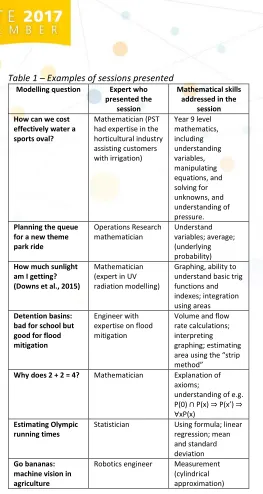
Each year students from the region are invited to participate in five two-hour sessions at the University of Queensland (in Toowoomba or Springfield). The sessions are led by either a mathematician, statistician or by a pre-service teacher under the guidance of a mathematician or statistician. Each session typically attracts up to 50 students from schools in the region. Table 1 provides some examples of sessions that have been run in the past. These sessions are designed to combine problems of a regional interest (e.g. detention basins) with mathematics extension of mathematical concepts that the students’ may not yet have encountered or be familiar with (e.g. capture-recapture simulation) and/or with pure mathematics investigations (e.g. why does 2 + 2 = 4?).
[image:3.595.308.571.14.508.2]While all of the teaching sessions are presented using the traditional classroom face-to-face format, there has been an attempt to develop an online or virtual aspect to the program and on several occasions schools in the region have been able to link in virtually to the teaching sessions. Since 2010 there have been four sessions that have presented the content in both the tradition face-to-face method as well as virtually. In 2010 and 2012, two and four schools respectively were linked virtually using the Education Queensland portal as the interface. For these sessions a mathematics teacher was employed at the participating remote schools to act as a contact point between the school and the university. The main reason for involving a liaison person was to ensure no firewalls impeded the process and to ensure a seamless link to the school was created. The participating schools were sent any relevant handouts or PowerPoint files beforehand. The tutorial room at the university gave students access to live discussion with the presenter. While active questioning was possible, the dynamic nature of the classroom meant that any communication was usually via the liaison teacher and usually using a chat facility.
Table 1 – Examples of sessions presented
Modelling question Expert who presented the
session
Mathematical skills addressed in the
session How can we cost
effectively water a sports oval?
Mathematician (PST had expertise in the horticultural industry assisting customers with irrigation)
Year 9 level mathematics, including understanding variables, manipulating equations, and solving for unknowns, and understanding of pressure.
Planning the queue for a new theme park ride
Operations Research
mathematician Understand variables; average; (underlying probability)
How much sunlight am I getting? (Downs et al., 2015)
Mathematician (expert in UV radiation modelling)
Graphing, ability to understand basic trig functions and indexes; integration using areas
Detention basins: bad for school but good for flood mitigation
Engineer with expertise on flood mitigation
Volume and flow rate calculations; interpreting graphing; estimating area using the “strip method”
Why does 2 + 2 = 4? Mathematician Explanation of axioms;
understanding of e.g. P(0) ∩ P(x) ⇒ P(x’) ⇒ ∀xP(x)
Estimating Olympic
running times Statistician Using formula; linear regression; mean and standard deviation
Go bananas: machine vision in agriculture
Robotics engineer Measurement (cylindrical approximation)
In 2015 and 2016, Zoom, a video conferencing program, replaced the use of the Education Queensland portal to link with the schools that were participating online. An advantage of utilising Zoom was the ability it presented for enabling students to utilise tablet screens to
While the virtual classroom was successful, there were a number of impediments to the process:
• it still needs a dedicated liaison person to ensure the virtual students are well seen and heard;
• the teacher in the virtually-linked school needs to have competent IT skills in order to be able to actively engage in the process and to ensure the session proceeds smoothly;
• it needs a presenter who is cognisant of the virtual students to ensure those students are not lost in the moment-to-moment activities of the session.
Evaluation
Since its inception, USQ’s MEP, and more recently the MCCP, has consistently been evaluated through: end-of-semester surveys given to participants (students, participating teachers, and pre-service teachers); end-of-session “emotion diaries” completed by student
participants; and unsolicited emails received from people involved in the program (students, pre-service teachers, teachers, and the experts involved). Through these evaluations, the success the program has had in engaging with students and increasing their interest in
mathematics is indeed evident. For example, of the students who participated in the 2016 iteration of the program, 95.1% (N = 43) agreed they would recommend fellow students participate in the program (the remaining 4.9% were neutral). In addition to the quantitative question regarding recommended participation, survey participants were asked to provide some qualitative feedback about their satisfaction with the program. The following responses to this open-ended question illustrate the general endorsement participants gave to the
program. The first quote particularly epitomises what the program is trying to achieve:
The sessions really opened my eyes as to what maths could be. We were given the chance to explore so many interesting and varied sub-topics of maths and the group setting and open
atmosphere really allowed us to get involved in what we were learning. The sessions were so engaging that they stayed with me and influenced my decisions from there on out. I am now in my third and final year of my Bachelor of Science at USQ, majoring in Mathematics and Statistics. I’m very lucky to have had many invaluable experiences and opportunities in my life but if I had to narrow them down to the one thing that got me started on this mathematical path, it would be the Maths Enrichment program from five years ago. (3rd year USQ student, 2015)
The maths enrichment program gave me
exposure to all sorts of maths problems and ways of solving them. The program has made me more confident in maths and has been very enjoyable. (Student, 2010)
School is a small rural high school situated in the [rural area] of Queensland. Opportunities for our teachers and students to collaborate with colleagues and peers to solve mathematical problems are rare. For the past two years our students have participated in USQ’s Mathematics Enrichment program and have benefitted enormously from this interaction. Our students have the opportunity to solve complex, real-life problems in real time with students from across the [rural] region. Our teachers have the opportunity to interact with University Staff and Students providing excellent professional development opportunities. (Teacher: rural high school, 2015)
In 2015 participating students were asked to complete an emotion diary after completing the sessions. Emotional diaries capture self-analysis of affect (emotion-related responses) during certain critical moments of the lesson (Yeigh et al., 2016). In these diaries two common themes emerged: the first theme involved meeting and discussing mathematics with new, like-minded, and ‘respectful’ peers; and the second was undertaking new, different, ‘real-life’ problems that opened the students’ minds and made them think and thus feel (and express) pride in being able to complete complicated mathematics
problems. On average students rated their interest (out of 10) during the lesson between 7.3 and 8.1.
Conclusion and future direction
and finally, it provides value for money as it provides teachers with a link to free university professional development, as well as enrichment for school students (both through face-to-face and virtual classroom contact), while also providing universities with an avenue through which to improve student teacher education through access to relevant ‘real world’ teaching experiences. Arguably, the outcomes of this project and research will provide practical examples and innovative methods that can be utilised by curriculum developers, teacher educators and those responsible for professional development.
In 2018 the program is being extended to include a virtual hub that provides access for students through
synchronous sessions and asynchronous follow-up sessions. After participating in their virtual lesson, students will be presented with opportunities to continue working on their problem/model and collaborate
asynchronously using an online forum. In addition, more formal research and analyses with is being conducted to better understand student participants’ perceptions of both the program and about mathematics as a subject and as a potential future career option. The project will continue to operate as an action-based research project with both qualitative and quantitative components and iterative cycles of the mathematics enrichment sessions.
References
AITSL. (2014). Australian Professional Standards for Teachers. Retrieved from
https://www.aitsl.edu.au/australian-professional-standards-for-teachers/standards/list
Australian Academy of Science. (2006). Mathematics and statistics: Critical skills for Australia's future: The national strategic review of mathematical sciences research in Australia. Parkville, Vic.: Dept. of Mathematics and Statistics, University of Melbourne.
Australian Mathematical Sciences Institute. (2012). Senate Inquiry: Teaching and learning - Maximising our investment in Australian schools. Retrieved from
http://www.amsi.org.au/images/stories/download
s/pdfs/general-outreach/AMSI_Sub_Teaching_and_learning_Oct2
012.pdf.
Axelsen, T., Galligan, L., & Woolcott, G. (2017). The Modelling Process and Pre-service Teacher Confidence. In A. Downton & S. Livy (Eds.), 40 years on: We are still learning! (Proceedings of the 40th annual conference of the Mathematics Education Research Group of Australasia) (pp. not yet available). Melbourne: MERGA.
Bonwell, C. C., & Eison, J. A. (1991). Active Learning: Creating Excitement in the Classroom. 1991 ASHE-ERIC Higher Education Reports: ERIC.
Christensen, R., Knezek, G., & Tyler-Wood, T. (2015). Alignment of hands-on STEM engagement activities with positive STEM dispositions in secondary school students. Journal of Science Education and Technology, 24(6), 898-909.
Downs, N., Parisi, A. V., Galligan, L., Turner, J., Amar, A., King, R., Butler, H. (2015). Solar radiation and the UV index: An application of numerical integration, trigonometric functions, online education and the modelling process. International Journal of Research in Education and Science, 2(1), 179-189.
Gallagher, S. A. (1997). Problem-based learning: Where did it come from, what does it do, and where is it going? Journal for the Education of the Gifted, 20(4), 332-362.
Galligan, L., & Woolcott, G. (2015). It’s part of my life. Engaging university and community to enhance mathematics education: the USQ experience. Paper presented at the Building the Culture of Evidence-based Practice in Teacher Preparation for Mathematics Teaching (CEMENT) project steering committee, Conversations on Knowledge for Teaching Conference, Launceston.
http://conversationsonkft.weebly.com/parallel-conversations-contributors.html
Maass, K., & Artigue, M. (2013). Implementation of inquiry-based learning in day-to-day teaching: a synthesis. ZDM Mathematics Education, 45(6), 779-795.
Marginson, S., Tytler, R., Freeman, B., & Roberts, K. (2013). STEM: country comparisons: international comparisons of science, technology, engineering and mathematics (STEM) education. Final report. Melbourne: Australian Council of Learned Academies Retrieved from
http://dro.deakin.edu.au/eserv/DU:30059041/tytl
er-stemcountry-2013.pdf.
McGregor, D. (2016). Exploring the Impact of Inquiry Learning on Students’ Beliefs and Attitudes towards Mathematics. (PhD), The University of Queensland, St Lucia.
Office of the Chief Scientist. (2012). Mathematics, engineering & science in the national interest. Canberra: Australian Government, Office of the Chief Scientist. Retrieved from
http://www.chiefscientist.gov.au/category/archive
Somers, M. A., Welbeck, R., Grossman, J. B., & Gooden, S. (2015). An Analysis of the Effects of an Academic Summer Program for Middle School Students. New York City and Oakland, CA: MDRC Retrieved from
http://www.mdrc.org/sites/default/files/Bell_FR_0
.pdf.
Yeigh, T., Woolcott, G., Donnelly, J., Whannell, R., Snow, M., & Scott, A. (2016). Emotional literacy and pedagogical confidence in pre-service science and mathematics teachers. Australian Journal of Teacher Education, 41(6), 107-121.
Note: All published papers are refereed, having undergone a double-blind peer-review process.
Contact author: Linda Galligan,