Using Gamification to Create Opportunities for
Engagement, Collaboration and Communication in a
Peer-to-peer Environment for Making and Using
Remote Access Labs
Lindy Orwin
Digital Futures Collaborative Research Network: Project 4 University of Southern Queensland
Toowoomba, Queensland, Australia [email protected]
Alexander A. Kist, Andrew D. Maxwell, Ananda Maiti Faculty of Health, Engineering and Sciences
University of Southern Queensland Toowoomba, Queensland, Australia [email protected], [email protected],
Abstract— The RALfie Project began in 2013 with the goal of engaging children and youth with Science, Technology, Engineering and Math learning in formal and informal settings using Remote Access Labs (RAL). A design based research approach is being used to develop and test a peer-to-peer system that incorporates gamification of the system to engage learners in collaboration and communication. The key game mechanics used are: Narrative with a group of characters who play key roles in the community; a maker approach where the participants build the RAL as opposed to expert-built rigs; communities of practice based on video game style ‘guilds’; tasks and activities designed as quests with opportunities for collaboration; and a reputation and achievement system to track mastery that uses points, levels and badges. An iterative approach is being used to test and refine the gamification elements and technical system that form the environment. This paper provides a summary of the theoretical educational foundations of this project; discusses design-based research as the methodology in the context of the RALfie project; and presents initial results. It includes design decisions and feedback from expert review.
Keywords—gamification; quest-based learning; e-learning; Remote Laboratories; pedagogy; education
I. INTRODUCTION
Remote Access Labs (RAL) are a valuable resource in Science, Technology, Engineering and Mathematics (STEM) education. They use the Internet and control systems to give learners remote access to experiments that are unavailable locally. This paper addresses a work in progress in which gamification is being used to foster engagement, communication and collaboration between RAL users and makers in a unique, online community of learners. The Remote Access Labs for Fun, Innovation and Education (RALfie) Project links young experiment makers and their mentors with users of the RAL via a gamified system that uses quest-based activities within a narrative storyline; an
achievement and reputation management system; and community groups called guilds. The learning community and resources created in this environment support STEM learning in schools and out-of-school informal learning contexts such as clubs, makerspaces and individuals. A Design Based Research methodology investigates the role that gamification can play in generating and maintaining engagement with the environment and the STEM content; pedagogical design for collaboration; and community building for communication.
This paper provides a summary of the theoretical educational foundations of this project; discusses design-based research as the methodology in the context of the RALfie project; and presents initial results. It includes design decisions and feedback from expert review.
II. BACKGROUND
The RALfie Project aims to develop children’s STEM concepts whilst fostering a positive attitude towards STEM learning.
Benefits for learners of using RAL in STEM education have been well documented [1]. These include: convenient access due to flexible timing and duration of experiment access and the ability to return for multiple repetitions [2]; and increase motivation and understanding of concepts [3]. There are also benefits for institutions in cost sharing for the development of RAL and the sharing of expertise and lesson plans.
to involve students in experiment construction process using remotely controlled robots [6]. Many RAL systems were, and still are, used exclusively by higher education. However, in both Australia (Labshare [7]) and Europe (Go-Lab [8]), client/server models of RAL are being developed and evaluated for use by school-aged children in formal education settings.
RAL creation comes at great expense to the host institution. The high production costs of the professionally made labs means the number and diversity of labs is limited. This inspired the research question whether it might be possible to make low cost experiments using programmable technologies such as Lego and Arduino that would still provide a high fidelity learning experience. This hypothesis was supported by the emergence of low cost, consumer versions of tools such as 3D printing, desktop CNC and laser cutters and the freely accessible CAD, connectivity, communication and design software that complement them. Making has become recognized as a global social, technological and economic movement.
With the global trend of the maker approach extending to youth [9] and the opportunity for design thinking and applied learning, the research team began to question whether many of the higher order learning opportunities were being denied to learners because the adult experts did all the design and making of RAL experiments [10]. The hypothesis was raised that young people and enthusiasts might be capable of applying their STEM knowledge or acquiring new knowledge to create these low cost RAL for their peers if they had access to appropriate support and mentors and a technical system to connect them. In other communities of practice around the maker approach, makers engage in exploring and questioning; tinkering, testing and iterating; hacking and repurposing; combining and making more complex; seeking out resources; and customizing; and sharing [11]. The RALfie project began investigating if youth can make RAL and share them.
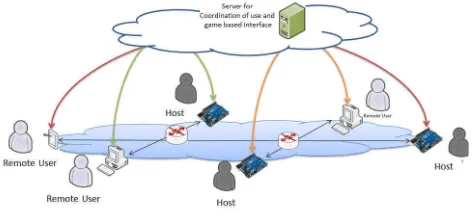
The question then arose about alternatives to the client/server model for delivery of low cost, RAL content created by young makers. The development of this distributed peer-to-peer (P2P) system by the project’s Technical Team has been the subject of numerous papers [12-14]. See Figure 1: Diagram of the Peer-to-peer Technical System
below for an overview of the technical system [14].
The intended audience also came into question. The AfterSchool Alliance organization stresses the vital role after-school groups can play in learning.
“While improvements in formal K 12 education are necessary, children spend less than 20 percent of their waking hours in school. Opportunities lie in all aspects of their education, including enrichment programs that take place during the afterschool hours and the summer.” [15]
This project is designing an environment of user-generated, distributed RAL aimed at actively engaging youth in STEM learning that is accessible to both formal education through schools and informal learning in extra-curricular programs and at home.
III. FRAMEWORK
Although consensus on the definition of gamification is in dispute, in general the term gamification is used to describe the use of game mechanics and experience design that aims to engage and motivate people to achieve goals [16] [17]. It involves “the use of game design elements in non-game contexts” [18]. Gamification popularity has risen from the success of video games in the flourishing digital entertainment industry. The intent is to take what digital games have learnt about harnessing the power of play and motivation and apply it to non-entertainment contexts to increase motivation and engagement.
In the context of the RALfie Project, gamification is being investigated as a method for unifying the various systems into a learning environment by providing structures and tools that have the potential to motivate users to participate and stay engaged; to support collaboration in design, development, use and management of user-created RAL; enable communication between RAL users and makers for the purposes of learning and support; and contextualize learning material to make it more meaningful.
In a review of the RAL literature, Lowe, Murray, Liu, Lindsay and Bright [10] identified the absence of the development of design and social skills when using remote labs compared to the opportunities afforded learners using experiments in the classroom. The lack of social context and the need to develop of design skills have been identified as key pedagogical challenges facing the development of remote laboratories [19]. The move from group work in class to individual work online has significant consequences for the nature of the learning.
[image:2.595.326.562.139.247.2]Pedagogically, there is a lack of communication and collaboration in the use of RAL [10]. Users are isolated, conduct the experiments alone and rarely communicate about the experience of using the RAL or share their data. Using a narrative storyline based on a group of characters on the website called RALfie’s CoLLAB [20] and the pedagogical
design of quests (challenge based activities) is intended to provide valid reasons to collaborate and communicate. For example, in Croc Quest, the users must group up to observe the crocodile for a period of twelve hours: a task that would not be easily achieved alone. In a quest that requires many data points, the collection of data from many locations or many participants could provide a series of data points for analysis with opportunities for online discussion to explain outliers in the data or the trends.
To address the missing social aspects of constructivist learning paradigms identified in previous research [10] p21, the researchers investigated online maker communities. Whether they center on digital products such as art (eg DeviantArt [21]), or programming (eg. Scratch [22]) or a mixture of digital and non-digital products (eg. Make [23]), these online communities of practice (CoP) have mechanisms to support sharing, learning, collaboration and communication. This is important in a social constructivist model of computer supported collaborative learning and teaching that engages learners actively through the maker process [24].
Gamer guilds in massively multiplayer online games (MMOG) are a significant example of large user-oriented CoP that provide friendship and learning support to their members as they engage in shared pursuits. Their roles are similar to CoPs but with the added role as a tool for grouping-up before a team challenge. CoPs and gamer guilds both use social learning as a means of knowledge sharing and learning support.
Lave and Wenger [25] describe three dimensions of communities that formed the basis of the design process around the Maker communities in RALfie’s CoLLAB. These are (1) the domain dimension that addresses the topic of their shared experience (in this case being makers of RAL and STEM learners); (2) the practice dimension , the personal experience they have in common where they can learn from and with each other in formal and informal activities; and (3) the community dimension, the ability for a diverse group of people to “hang out” together who develop trusted relationships that allow them to learn together and support one another in shared and individual endeavors. This may involve extremely active participation or be limited to lurking at the periphery in what is termed ‘legitimate peripheral participation’.
IV. METHODOLOGY AND CONTEXT
The gamification research of the RALfie Project employs a Design Based Research (DBR) approach using Bannan Ritland’s Integrative Learning Design Framework (ILDF) [26]. The purpose of DBR is to improve not prove and is based on the assumption that existing practices can be improved [27]. This paper reports on the expert reviews of a design that uses gamification techniques to promote engagement, communication and collaboration within the learning environment called RALfie’s CoLLAB which engages youth as both makers and users of RAL in a distributed network. This research sits within the broader research agenda of the RALfie Project which also deals with
the technical aspects of a system for user-generated RAL; the Maker Approach in the RAL context [28]; and use of RAL for the development of pre-service STEM teacher self-efficacy [29].
Bannan Ritland’s ILDF provides a four stage, iterative process by which stakeholders can be actively engaged in the design, implementation and refinement of new methods. The four stages are:
• Informed Exploration identifies gaps/ problems/ opportunities in current practice; characterizes the learners’ needs; identifies the systemic, social, cultural and organizational influences and constraints on the design;
• Enactment begins with articulation of the design and associated research and leads to the development of a working prototype;
• Evaluation: Local Impact encompasses iterative cycles of testing and reviewing of the design in practice for usability, validity, relevance, accessibility, efficiency for delivering the learning followed by modification based on the results; and
• Evaluation: Broad Impact addresses diffusion, adoption and adaptation of the innovation.
Within the Informed Exploration and Enactment stages of the RALfie Project, feedback about both the conceptual design and the working prototype has been gathered from expert reviewers that include experienced RAL users in tertiary education; primary and secondary teachers; and expert STEM outreach program leaders. Some feasibility testing of technical concepts was trialed with children to ensure the children were capable of completing the technical tasks involved.
After refinement of the system based on these expert reviews is complete, the project will enter the next stage Evaluation: Local Impact. In early 2015 a group of school-aged children will use the prototype and provide feedback through the system’s rating and commenting tools and in interviews and questionnaires. The trial participants will include children in an extra-curricular group that operate out of school hours. After system refinement based on these results, a final stage is planned to engage children in formal school settings and their teachers.
V. THEORETICAL BASIS FOR THE DESIGN DECISIONS
motivation, the Octalysis Framework links game-inspired elements to the core drives (CD) to which they appeal. By aligning the intended outcomes of engagement, communication and collaboration to game-inspired elements capable of generating these desired behaviors in the RAL context, a suite of elements were designed into the environment.
The key gamification elements selected in the first iteration of RALfie’s CoLLAB and their roles in the learning environment are listed below with the associated core drive.
• Narrative with characters to engage users in the environment using CD1 Epic Meaning and Calling;
• Points, levels and badges to target CD2
Development and Accomplishment by
authenticating progress, acknowledge the development of skills and overcoming challenges;
• Maker Approach (as the gamification element of building from scratch) engages users in the creative process, expresses their creativity and provides opportunities to receive feedback achieving CD3 Empowerment of Creativity & Feedback;
• Quests (activities in the form of challenges) appeal to CD2 Development and Accomplishment and group quests engage CD 5 Social Influence and Relatedness; and
• Guilds, social groups that act as a community of practice, target CD5 Social Influence and Relatedness.
Many other gamification elements play more minor roles in overall system.
Not only are the motivations of the users taken into account in the design process, the journey of the user from discovery, through orientation to mastery and achievement of the endgame status influences the design [16, 30, 31]. Different game elements and different applications of the elements are intended to support users at various stages of their journey from novice to expert and, in community based environments like this, to elder of the community.
Another framework informing the design process is the User Type Hexad developed by Marczewski [32]. This framework identifies six user types and the gamification elements that motivate them most effectively. The four basic user types are: Achiever who is motivated by mastery; the Socialiser who is motivated by Relatedness; the Philanthropist who is motivated by purpose; and the Free Spirit who is motivated by autonomy. The Player, who is motivated by rewards, and the Disruptors, who are motivated by change, complete the user types hexad. This framework is being used to aid design to ensure all user types are catered for within the gamification of the environment. Elements have been mapped to user types as well as Core Drives and player journey stage to create a robust design.
VI. RESULTS AND DISCUSSION
When reporting Design Based Research, there are three types of outputs: (1) the scientific artifacts are design principles; (2) the practical outputs are the designed artifacts; and (3) the societal output is the professional development of the participants [27].
A series of expert reviews were conducted at two stages of the design process. Firstly reviews were conducted when the concept diagrams were first developed that described the design of the system. Secondly when the system prototype was developed which consisted of a website, forums for the guilds, sample experiments and their management system, quests and an achievement system delivered through the Game Management System (GMS) called 3D GameLab [33].
Expert reviews of the design and prototype were conducted with eleven expert reviewers:
• A middle school English teacher and teacher librarian who is also a games in learning expert practitioner and international speaker;
• An elementary (primary) school Technology Education specialist teacher and games in learning expert practitioner;
• A higher education lecturer in pre-service Science Teacher education and researcher in Science education;
• A researcher and consultant in games based learning, game inspired learning, developer of a
successful STEM-themed, Internet-based
curriculum project; Project Officer for an immersive curriculum-based 3D game world; Project Officer and co-developer of a gamified professional learning community for teachers.
• A lecturer of pre-service Technology teachers and private technology consultant.
• A high school mathematics teacher and curriculum and assessment advisor and private technology consultant.
• A group of five volunteers who conduct Lego robotics workshops in schools and community locations.
The overall concept of a game-inspired approach to a STEM learning environment that engages young makers and users of RAL was well accepted by all the expert reviewers. All reviewers stressed the need for ease of use for both children and especially technically challenged teachers. They expected the use of the actual RAL to be straight forward for children as long as the interface was intuitive with minimal use of text and, when necessary, the use of age-appropriate language or substituting multimedia such as videos and audio.
A. Maker Approach
would be highly engaging for students. If well scaffolded and with access to support, this student-centered approach was seen as having potential to change the engagement with content from passive to active. Expert reviewers compared the potential of RALfie’s CoLLAB to the powerful learning unleashed by computer games, such as Minecraft and virtual worlds such as OpenSim or Second Life, that put the maker controls in the hands of the users.
On the other hand, for less technical teachers, reviewers agreed making RAL may be seen as complex and potentially time consuming, requiring deep knowledge of the content area and the control technologies or a willingness to give students the freedom to take the initiative and seek support from the online community. They felt that high quality teacher resources would be required to provide adequate scaffolding for novices. This would need to include plans, guides, video tutorials and curriculum resources that are accessible to both teachers and children. These recommendations are guiding the development of the maker resource section of the current iteration under development. Other maker communities online, such as Scratch [22], littleBits Electronics Maker Hub [34] and MakerEd [35] are being analyzed to build a requirements list for a web based maker community. This is undergoing usability trials as makers come onboard.
When presented with the evidence from the first trials, all reviewers were confident that the networking concepts were within children’s technical expertise and capability
Although seen as highly motivating for students by the reviewers, they indicated that the maker activities would need to achieve many curriculum outcomes to warrant the time investment, the effort and the cost required to obtain materials. Getting value from using the RAL would depend on the availability and reliability of the experiments. The technical team has been upgrading the features that indicate availability in the latest iteration to indicate availability more accurately. Curriculum mapping to the Australian curriculum is also in progress.
The reviewers identified opportunities beyond the STEM content outcomes for the achievement of valuable general capabilities and essential skills such as literacy; numeracy; personal and social capabilities such as team work, collaboration and communication; and information and communication technology capability. All felt making RAL was perfectly suited to home users and extra-curricular groups, such as Science or robotics clubs, who had more time available for such activities.
B. Guilds
Reviewers supported the use of guilds, the online community approach supporting collaboration between peers, could be well supported by knowledgeable adult mentors if enough volunteers were available. The recruitment of mentors has been made a priority and a “Friends of RALfie” group has begun to engage with the project as support for makers. The use of forums was seen as a useful tool to support just-in-time training and support but the reviewers also recommended having adequate support
materials, especially for makers, in video format because, for the intended age group of users, YouTube is the search engine of choice not Google and literacy levels may challenge engagement with text based content.
C. Quests
The pedagogical structure of the “Quest” as a challenge-based task was perceived favorably as both a motivator and as providing context for the content. This would be both familiar terminology for children who were already gamers and a consistent structure across a diverse range of topics within the system. Reviewers supported the idea of designing quests that require both individual work as well as group activities.
D. Narrative
The use of a narrative to provide context to the environment was seen as a positive addition but the four anthropomorphized animal characters, as depicted in the first iteration, were seen as too babyish for eleven to seventeen year olds. The consensus from their experience in a range of games, virtual worlds and gamified learning contexts was that the characters needed to appear to be aged in their late teens. It was recommended that as many quests as possible draw on the narrative for consistency but that quest designers should be cautious about making the contexts too artificial. The project has identified a partner with expertise in the area of contextualizing learning through narratives who will assist in the redevelopment of the storyline and quests.
E. Achievement and Reputation System
There were mixed reactions to the use of points that accumulated to achieve badges. Some reviewers, especially those with extensive personal gaming experience outside of the educational context, felt there was a large enough number of children who would find the points and badges motivating and that it provided both children and teachers a quick way of gauging use of the system and identifying leaders amongst the community. Others wondered if this was an unnecessary competitive structure that might undermine the intention to foster a collaborative culture in the community.
The use of a rating system for the RAL and quests was seen as a useful tool to inform creators about user reactions as well as to help users to select content. The reviewers also saw these as a guide for mentors to identify opportunities to help participants.
F. General feedback about the overall concept and design.
less impact on those users in informal learning settings as availability could drive use.
Child safety and privacy issues were raised when considering the community design included interaction between adults (enthusiasts and mentors) and children and that children might have webcams installed to view experiments. However due to the educational nature of the community and the anonymity of the children through the use of avatars, this risk was seen as far less than in the recreational gaming environments that a large percentage of children in this age group already inhabit. It was recommended that engaging participants in digital citizenship training and the development of a code of conduct was very important but that this could be generated by the community in the same vein as the maker approach. Carefully vetting of volunteer moderators of the community spaces such as forums and providing a system for reporting inappropriate behavior were also recommended. Many of these features would not be deployed in the prototype during the early trials but will form part of the feature requirements of a production system. Additional expert advice will be sought relating to this concern.
Some reviewers questioned the cost of participation for makers with the need to buy equipment to construct an experiment, the need for a webcam to view experiments and the RALfie Box to connect an experiment to the system. Extensive investigation is underway by the technical team to identify low cost alternatives to more costly items such as the Lego EV3 programmable brick. This was seen as less of a barrier by the group who conduct the Lego workshops in schools because they found that there was a lot of under-used equipment in schools that would suit this type of activity. Additionally the current hardware device for connecting the experiments, the RALfie Box, could potentially be replaced by software in future iterations.
G. Next steps
The next step in the gamification research will be trials with children in informal learning contexts. This will involve user testing with observation in laboratory conditions and field testing with follow-up interviews for remote users and some of their parents. This will address questions about all aspects of the gamification system. An analysis of forum discussions will be used to identify support requirements and patterns of user communication. The rating system for quests will be used to determine successful use of the narrative and learning designs. Log files will be used to determine the use of support materials.
VII.CONCLUSIONS
At the time of writing, several key trials of the technical system and the expert reviews of the gamification system have provided data to inform the next iteration of the all systems within the environment. The transition in 2015 to the use of as many Google tools as possible to support the gamification aspects of the environment will simplify log on, user generation of content, friending and guilds; scalability of the user generated content; and provide analytics.
Usability testing will continue and new technical challenges related to access through gatekeeper systems for schools will be addressed over the coming months by working closely with school systems.
The robust ILDF design research approach has proved a flexible and practical methodology. The capacity to combine qualitative and quantitative methods of data gathering and analysis provides enough versatility for end to end research of the design, implementation and evaluation of all aspects of the project.
ACKNOWLEDGMENT
This project is supported through the Australian Government's Collaborative Research Networks (CRN) program.
REFERENCES
[1] D. Lowe, S. Murray, D. Li, and E. Lindsay, "Project report: Remotely accessible laboratories – Enhancing learning outcomes," Australian Learning and Teaching Council 2008. [2] E. Lindsay and B. Stumpers, "Remote laboratories: enhancing
accredited engineering degree programs," in 22nd AAEE Conference, Fremantle, WA, 2011, pp. 588-593.
[3] M. C. C. Lobo, G. R. Alves, M. A. Marques, C. Viegas, R. G. Barral, R. J. Couto, et al., "Using Remote Experimentation in a Large Undergraduate Course: Initial Findings," in 41st ASEE/IEEE Frontiers in Education Conference, Rapid City, SD, 2011.
[4] A. Maiti, A. D. Maxwell, and A. A. Kist, "Features, trends and characteristics of remote access laboratory management systems," Journal of Online Engineering (iJOE), vol. 10, pp. 30 - 37, 2014.
[5] A. Maxwell, R. Fogarty, P. Gibbings, K. Noble, A. A. Kist, and W. Midgley, "Robot RAL-ly International – Promoting STEM in elementary school across international boundaries using remote access technology," in REV 2013: 10th International Conference on Remote Engineering and Virtual Instrumentation, 2013, pp. 1-5.
[6] A. A. Kist, A. Maxwell, P. Gibbings, R. Fogarty, W. Midgley, and K. Noble, "Engineering for primary school children: Learning with robots in a remote access laboratory," in SEFI 2011: Global Engineering Recognition, Sustainability and Mobility, Lisbon, Portugal, 2011, pp. 586-591.
[7] D. Lowe, P. Newcombe, and B. Stumpers, "Evaluation of the Use of Remote Laboratories for Secondary School Science Education," Research in Science Education, vol. 43, pp. 1197-1219, 2013/06/01 2013.
[8] Go-Lab Project. (7 October 2014). Go-Lab project: Global online science labs for inquiry learning at school [Online]. Available: http://www.go-lab-project.eu/
[9] S. L. Martinez and G. Stager, Invent To Learn: Making, tinkering, and engineering in the classroom Constructing Modern Knowledge Press, 2013.
[10] D. Lowe, S. Murray, D. Liu, E. Lindsay, and C. Bright, "Literature Review: Remotely accessible laboratories – Enhancing learning outcomes," Australian Learning and Teaching Council, Canberra, ACT October 2007.
[11] L. J. Brahms, "Making as a learning process: Identifying and supporting family learning in informal settings," Doctor of Philosophy, Graduate Faculty of School of Education, University of Pittsburgh, Pittsburgh, 2014.
laboratory," in REV 2014: Remote Engineering and Virtual Instrumentation, Porto, Portugal, 2014.
[13] A. Maiti, A. Maxwell, A. A. Kist, L. Orwin, W. Midgley, K. Noble, et al., "Overlay Network Architectures for Peer-to-Peer Remote Access," in REV 2014: Remote Engineering and Virtual Instrumentation Porto, Portugal, 2014, pp. 274-280.
[14] A. Maiti, A. D. Maxwell, A. A. Kist, and L. Orwin, "Merging remote laboratories and enquiry-based learning for STEM education," International Journal of Online Engineering (iJOE), vol. 10, pp. 50-57, 2014.
[15] Afterschool Alliance, "STEM Learning in Afterschool: An analysis of impact and outcomes," Afterschool Alliance, Washington DCSeptember 2011.
[16] K. Werbach, "Gamification MOOC: Games and Play," vol. 2, ed. Philadelphia: University of Pennsylvania, 2013.
[17] Y. Chou, "Octalysis: Complete gamification framework," in Yu-kai chou and gamification, Y.-k. Chou, Ed., ed. USA: Yu-kai Chou, 2014.
[18] S. Deterding, D. Dixon, R. Khaled, and L. Nacke, "From game design elements to gamefulness: Defining gamification," in 15th International Academic MindTrek Conference: Envisioning Future Media Environments, Tampere, Finland, 2011, pp. 9-15. [19] E. D. Lindsay, S. Naidu, and M. C. Good, "A different kind of
difference: Theoretical implications of using technology to overcome separation in remote laboratories.," International Journal of Engineering Education, vol. 23, 2007.
[20] The RALfie Project. (2014, 9 February 2015). RALfie's CoLLAB [Online]. Available: http://www.ralfie.org
[21] Deviantart. (2000, 12 August). Deviant Art [Online]. Available: http://www.deviantart.com/
[22] Lifelong Kindergarten Group. (5 October). Scratch. Available: http://scratch.mit.edu/
[23] Make Media. (2004, 24 February). Make [Online]. Available: http://makezine.com/
[24] D. A. Fields, M. Giang, and Y. B. Kafai, "Understanding collaborative practices in the scratch online community:
Patterns of participation among youth designers," in To see the world and a grain of sand: Learning across levels of space, time, and scale: CSCL 2013 Conference Proceedings, Madison, WI, 2013, pp. 200-207.
[25] J. Lave and E. Wenger, Situated learning: Legitimate peripheral participation. Cambridge: Cambridge University Press, 1991. [26] B. Bannan-Ritland, "The role of design in research: The
integrative learning design framework," Educational Researcher, vol. 32, January/February 2003.
[27] J. Herrington, S. McKenney, T. Reeves, and R. Oliver, "Design-based research and doctoral students: Guidelines for preparing a dissertation proposal," presented at the Proceedings of World Conference on Educational Multimedia, Hypermedia and Telecommunications 2007, Chesapeake, VA, 2007.
[28] A. D. Maxwell, L. Orwin, A. A. Kist, A. Maiti, W. Midgley, and T. Wu, "An inverted remote laboratory - makers and gamers," in AAEE 2013: Work Integrated Learning - Applying Theory to Practice in Engineering Education, Gold Coast, Queensland, 2013.
[29] T. Wu and P. Albion, "Remote access laboratories enhancing STEM education," in Rhetoric and Reality: Critical perspectives on educational technology (ASCILITE), Dunedin, NZ, 2014.
[30] Y. Chou, Actionable gamification: Beyond points, badges and leaderboards. USA: Yu-Kai Chou, 2015.
[31] A. J. Kim, "The player's journey," in Amy Jo Kim vol. 2014, ed. USA, 2014.
[32] A. Marczewski. (2013, 10 October). 6 User Types for Gamification Design – Hexad [Online].
[33] L. Dawley and C. Haskell. (10 October). 3D Game Lab. Available: http://3dgamelab.com/
[34] littleBits Electronics. (2014). littleBits Electronics [Online]. Available: http://littlebits.cc/