David C. Bloom,aJoyce Feller,aPeterjon McAnany,aNuria Vilaboa,b,cRichard Voellmyd,e
Department of Molecular Genetics and Microbiology, University of Florida College of Medicine, Gainesville, Florida, USAa
; Hospital Universitario La Paz, IdiPAZ, Madrid, Spainb
; CIBER de Bioingenieria, Biomateriales y Nanomedicina, Barcelona, Spainc
; HSF Pharmaceuticals SA, La Tour-de-Peilz, Switzerlandd
; Department of Physiological Sciences, University of Florida College of Veterinary Sciences, Gainesville, Florida, USAe
ABSTRACT
We present the development and characterization of a replication-competent controlled herpes simplex virus 1 (HSV-1).
Repli-cation-essential ICP4 and ICP8 genes of HSV-1 wild-type strain 17syn
ⴙ
were brought under the control of a dually responsive
gene switch. The gene switch comprises (i) a transactivator that is activated by a narrow class of antiprogestins, including
mife-pristone and ulipristal, and whose expression is mediated by a promoter cassette that comprises an HSP70B promoter and a
transactivator-responsive promoter and (ii) transactivator-responsive promoters that drive the ICP4 and ICP8 genes.
Single-step growth experiments in different cell lines demonstrated that replication of the recombinant virus, HSV-GS3, is strictly
de-pendent on an activating treatment consisting of administration of a supraphysiological heat dose in the presence of an
antipro-gestin. The replication-competent controlled virus replicates with an efficiency approaching that of the wild-type virus from
which it was derived. Essentially no replication occurs in the absence of activating treatment or if HSV-GS3-infected cells are
exposed only to heat or antiprogestin. These findings were corroborated by measurements of amounts of viral DNA and
tran-scripts of the regulated ICP4 gene and the glycoprotein C (gC) late gene, which was not regulated. Similar findings were made in
experiments with a mouse footpad infection model.
IMPORTANCE
The alphaherpesviruses have long been considered vectors for recombinant vaccines and oncolytic therapies. The traditional
approach uses vector backbones containing attenuating mutations that restrict replication to ensure safety. The shortcoming of
this approach is that the attenuating mutations tend to limit both the immune presentation and oncolytic properties of these
vectors. HSV-GS3 represents a novel type of vector that, when activated, replicates with the efficiency of a nonattenuated virus
and whose safety is derived from deliberate, stringent regulation of multiple replication-essential genes. By directing activating
heat to the region of virus administration, replication is strictly confined to infected cells within this region. The requirement for
antiprogestin provides an additional level of safety, ensuring that virus replication cannot be triggered inadvertently.
Replica-tion-competent controlled vectors such as HSV-GS3 may have the potential to be superior to conventional attenuated HSV
vac-cine and oncolytic vectors without sacrificing safety.
V
iruses or viral vectors administered to human or animal
sub-jects for purposes of vaccination or therapies such as oncolytic
therapies must be reasonably safe. At a minimum this means that
they must be essentially incapable of causing the disease or
condi-tion they would normally cause. This safety is typically achieved by
attenuation, which involves the genetic disablement of functions
essentially connected to replication of a virus or viral vector.
At-tenuation may be obtained by adaptation in cell culture or by
more purposeful mutagenesis. In the case of an oncolytic virus,
reduced replication capability would be expected to be directly
reflected in lower oncolytic activity. For vaccine viruses,
attenua-tion is expected to dampen activaattenua-tion of the innate immune
sys-tem that is important to promote strong and lasting B and T cell
responses (
1
,
2
). For obvious reasons it is not possible to evaluate
the difference in immune responses elicited by a wild-type virus
and an attenuated version thereof. However, a number of studies
compared immune responses to matching pairs of attenuated
vi-ruses that maintained some of their replication ability and the
corresponding nonreplicating viruses (
3–6
). Viruses that retained
some of their replication ability were found to induce more potent
and more complete immune responses than the nonreplicating
viruses. Based on these results, one may reasonably extrapolate
that viruses that retain their full replication ability, e.g., wild-type
viruses, would be even more potent immunogens. If this
hypoth-esis were correct, immunogenicity of a virus could be optimized,
without compromising the safety of an immunized subject, by
subjecting the replication ability of the virus to a control
mecha-nism that can be activated to induce unimpaired replication of the
virus in a chosen location and for a desired time and that safely
represses replication in the absence of activation (see reference
7
for a broader presentation of this novel immunization concept).
The present paper reports on our attempts to generate such
rep-lication-competent controlled viruses and the characterization of
their regulated replication
in vitro
and
in vivo
in the mouse model.
It is well known that, upon topical administration, viruses tend
to distribute throughout the host organism (see, e.g., reference
8
).
Received30 June 2015 Accepted5 August 2015
Accepted manuscript posted online12 August 2015
CitationBloom DC, Feller J, McAnany P, Vilaboa N, Voellmy R. 2015.
Replication-competent controlled herpes simplex virus. J Virol 89:10668 –10679.
doi:10.1128/JVI.01667-15.
Editor:R. M. Longnecker
Address correspondence to Richard Voellmy, [email protected].
Copyright © 2015, American Society for Microbiology. All Rights Reserved.
doi:10.1128/JVI.01667-15
on November 7, 2019 by guest
http://jvi.asm.org/
Hence, restriction of the proliferation of a replication-competent
controlled virus to the chosen inoculation region is critical to
avoid disease and/or viremia. To achieve this type of control, a
gene switch that can be activated in a reversible fashion by a
tar-getable physical stimulus but is essentially inactive in the absence
of activation will be needed. A gene switch activated by a
small-molecule regulator (SMR) is not indicated because it would not be
possible to confine the regulator to the inoculation region.
Tar-getable physical stimuli include different types of radiation, such
as visible light, infrared (IR), UV, ultrasound, microwave, and
electromagnetic radiation, and heat/cold. Obviously, the gene
switch would have to be triggered at levels of locally administered
radiation or of heat/cold which are readily tolerated by the host
but are well beyond levels to which the host is naturally exposed.
Based on available knowledge (
9
,
10
), a promoter of a heat shock
gene such as that of the human HSP70B (HSPA7) gene appeared
to be the most suitable gene switch of this type (
11
,
12
). The
HSP70B promoter is activated in a reversible fashion by heat or
other proteotoxic stress. It is essentially silent at host body
tem-perature and is at most weakly activated during pyrexia. Targeted
heat can be delivered by focused ultrasound, IR, or microwave
irradiation or by contact with a heated body/liquid for a short
period of time. The last method of heating may be most practical
(technically simple and inexpensive) for gene activation near the
body surface (e.g., in an immunization setting). It is noted that
activation is mediated by heat doses that are readily supported
(e.g., 44 to 45°C/10 min) but are sufficiently elevated to virtually
preclude accidental activation.
While the HSP70B promoter will function essentially as an
on/off switch of controlled gene activity, it cannot be guaranteed
that there may be circumstances, such as possibly
pyrexia/hyper-pyrexia as mentioned before, ischemic events, ingestion of heavy
metals and other toxicants, certain pharmacological
interven-tions, and strenuous exercise (
13–20
), under which the promoter
may become at least weakly active. Therefore, it may be prudent to
subject replication of a controlled virus to dual regulation. One or
more replication-essential genes may be placed under the control
of both an HSP70B promoter and an SMR-activated gene switch
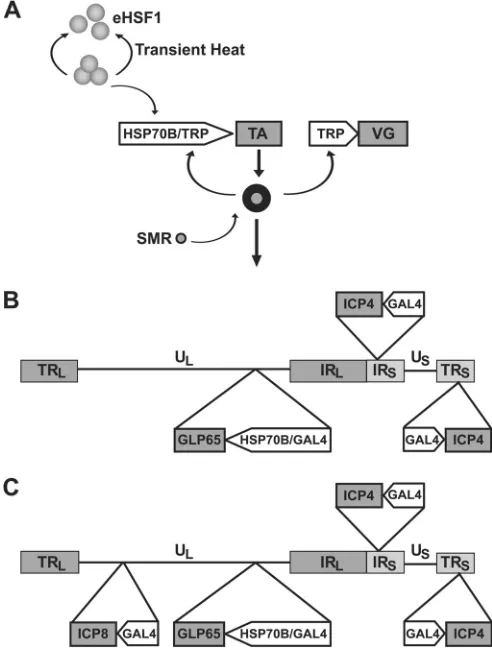
(
Fig. 1A
). A somewhat less desirable solution would be to subject
a first replication-essential gene to the control of the HSP70B
pro-moter and a second to the control of a constitutively expressed (or
auto-activated) SMR-activated gene switch. Gene switches of the
type outlined in
Fig. 1A
were described previously (
21
). They
con-sist of (i) an SMR-activated transactivator that is expressed from a
promoter cassette that is activated both by heat and the
transacti-vator and (ii) a transactitransacti-vator-responsive promoter for driving a
target gene. Upon transient or stable introduction into cells
in
vitro
or
in vivo
, such a gene switch activates its target gene
subse-quent to heat treatment of the cells in the presence of the SMR.
Once the gene switch is activated, expression of the target gene
continues, unless the SMR is removed (or,
in vivo
, administration
is discontinued). It is noted that HSP promoters are inactivated
within hours of heat activation, a kinetic feature that limits their
usefulness. The dually responsive gene switch of
Fig. 1A
extends
the duration of heat-activated target gene expression, which may
be an important feature if a combination of early and late viral
genes or a gene whose continuous activity is required is to be
regulated. The gene switch is not appreciably activated by either
heat treatment or the SMR alone. Versions of the gene switch
employing different SMR-activated transactivators are available
(
21–23
).
It is presumed that gene switches of the type shown in
Fig. 1A
can only regulate genes of viruses such as herpesviruses that use
the host machinery for transcription of their genes. Transcription
from the HSP70B promoter is mediated by host cell transcription
factor HSF1 that is normally present in an inactive form but is
transiently activated when the cell receives a triggering heat dose
(
9
,
10
). A herpes simplex virus (HSV), i.e., an HSV-1 wild-type
strain, was chosen as the backbone for constructing
replication-competent controlled viruses for several reasons. The virus has a
double-stranded DNA genome of
⬎
150 kbp that tolerates large
insertions, supports stable expression of passenger genes, and can
be manipulated readily (
24–27
). High titers are reached
in vitro
.
Furthermore, the virus is replicated by a high-fidelity polymerase,
is not integrated in the host genome, infects a broad range of host
cells, and causes efficient lysis. Latent infection of sensory nerve
cells is not considered a problem and may well be an asset in
situations in which induction of effector memory T cells is desired
(
28
). Moreover, the virus is widespread in the human population,
FIG 1Dually responsive gene switch and the construction of replication-competent controlled viruses. (A) Scheme illustrating the operation of a gene switch coactivated by heat and an SMR. (B) Outline showing the changes made to the HSV-1 17syn⫹genome to generate recombinant HSV-GS1. (C) Scheme to generate HSV-GS3. eHSF1, endogenous heat shock transcription factor; TRP, transactivator-responsive promoter; TA, transactivator; VG, replication-essential viral gene; SMR, small-molecule regulator; TRLand TRS, long and short terminal repeats, respectively; ULand US, long and short unique regions, respectively; IRLand IRS, long and short internal repeats, respectively.on November 7, 2019 by guest
http://jvi.asm.org/
[image:2.585.297.543.68.392.2]with a seroprevalence that increases in an age-dependent manner
and reaches
⬎
70% in 70-year-olds in the United States. While
90% of seropositive individuals are asymptomatic, the remaining
10% largely experience periodic clinical lesions referred to as “cold
sores.” Serious complications such as infectious blindness are rare,
and HSV encephalitis occurs only under exceptional
circum-stances. The virus responds to drugs such as acyclovir. Several
studies have examined the effects of preexisting immunity to HSV
(
29–37
). Most studies reported little or only minor effects on
im-mune responses to HSV-delivered antigens or on the efficacy of
oncolytic HSV (
29–34
,
37
). The results of the two studies that
reported substantial reductions of immune responses (
35
,
36
)
may be particular to the unusual models employed. All studies
concluded that vaccine/immunization uses of HSV are possible in
the presence of preexisting immunity.
MATERIALS AND METHODS
Chemicals.Progestins and mifepristone were obtained from Sigma-Al-drich Co. Ulipristal acetate was from D-Innovation Pharmaceutical Co., Chengdu, Sichuan, People’s Republic of China. Telapristone was pro-vided by the Eunice Kennedy Shriver National Institute of Child Health and Human Development. Compound PF-02367982 was obtained from Pfizer Global Research and Development, Sandwich, United Kingdom. Stock solutions of medroxyprogesterone 17-acetate, megestrol acetate, norgestimate, and PF-02367982 were prepared in dimethyl sulfoxide (DMSO). All other progestins and antiprogestins were initially dissolved in ethanol (EtOH).
Cells, plasmids, and viruses.Rabbit skin (RS) cells were a gift from E. Wagner and were propagated in minimal essential medium Eagle (MEME) supplemented with 5% calf serum, 292 mg/mlL-glutamine, 250 U of penicillin/ml, and 250g of streptomycin/ml (Life Technologies). HeLa-derived J55 cells (21), Vero cells (procured from the American Type Culture Collection [ATCC]), Vero-derived E5 cells (38) (obtained from N. DeLuca), and the human squamous cell carcinoma line SCC-15 (pro-cured from the ATCC) were grown in Dulbecco’s modified Eagle’s me-dium with 10% fetal calf serum and 250 U of penicillin/ml and 250g of streptomycin/ml. All cells were cultured at 37°C under 5% CO2.
HSV-1 strain 17syn⫹and deletion strain KD6 (39) were obtained from J. Stevens. It is noted that stocks of KD6, HSV-GS1, and HSV-GS3 were prepared using E5 cells. For HSV-GS3, medium was supplemented with 10 nM mifepristone, and infected cultures were subjected to daily heat treatment at 43.5°C for 30 min for three successive days.
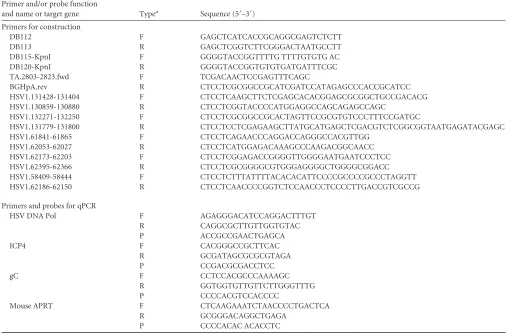
Virus construction. All viruses were constructed using wild-type HSV-1 strain 17syn⫹as the backbone. This strain is fully virulent and well characterized, and the complete genomic sequence is available. The gen-eration of the viral recombinants was performed by homologous recom-bination of engineered plasmids along with purified virion DNA in RS cells transfected by the calcium phosphate precipitation method, as pre-viously described (27). All plasmids used to engineer the insertions of the transactivator cassette or the GAL4-responsive promoters comprised HSV-1 sequences cloned from strain 17syn⫹. Plasmid IN994 was created as follows: an HSV-1 upstream recombination arm was generated by am-plification of HSV-1 (17syn⫹) DNA (from bp 95,441 to 96,090) with DB112 and DB113 (Table 1gives primer sequences). The product was digested with SacI and inserted into the SacI restriction site of pBluescript to create pUP. An HSV-1 downstream recombination arm was generated using primers DB115-KpnI and DB120-KpnI to amplify HSV-1 (17syn⫹) DNA sequence between bp 96,092 and 96,538. The PCR product was digested with KpnI and cloned into KpnI-digested pUP to create pIN994, which recombines with HSV-1 at the UL43/44 intergenic region.
Replication-competent controlled virus HSV-GS1.A first recombi-nation plasmid, pIN:TA1, was constructed by inserting a transactivator (TA) cassette containing a GLP65 gene under the control of a promoter cassette that combined a human HSP70B promoter and a
GAL4-respon-sive promoter (21) into the multiple cloning site of plasmid pIN994, be-tween flanking sequences of the HSV-1 UL43 and UL44 genes. The TA cassette was isolated from plasmid HSP70/GAL4-GLP65 (21) and was cloned by three-piece ligation to minimize the region that was amplified by PCR. For the left insert, HSP70/GAL4-GLP65 was digested with BamHI and BstX1, and the resulting 2,875-bp band was gel purified. This fragment contains the HSP70/GAL4 promoter cassette as well as the GAL4 DNA-binding domain, the progesterone receptor ligand-binding do-main, and part of the P65 activation domain of GLP65. The right insert was generated by amplifying a portion of pHSP70/GAL4-GLP65 with primers TA.2803-2823.fwd and BGHpA.rev. The PCR product was di-gested (within the primer regions) with BstX1 and NotI, and the resultant 676-bp fragment was gel purified. This fragment contained the 3=end of the P65 activation domain and the bovine growth hormone (BGH) 3=
nontranslated region. For the vector, pIN994 was digested with BamHI and NotI, and the resulting 4,099-bp fragment was gel purified and shrimp alkaline phosphatase (SAP) treated. The two inserts were then simultaneously ligated into the vector to create pIN:TA1. One microgram of pIN:TA1 was cotransfected with 2g of purified HSV-1 (17syn⫹) virion DNA into RS cells by calcium phosphate precipitation. The result-ing pool of viruses was screened for recombinants by the pickresult-ing of plaques, amplification of these plaques on 96-well plates of RS cells, and dot blot hybridization with a32P-labeled DNA probe prepared by labeling
a TA fragment by random-hexamer priming. A positive well was re-plaqued and reprobed five times and verified to contain the TA cassette by PCR and sequence analysis. This intermediate recombinant was desig-nated HSV-17GS43. A second recombination plasmid, pBS-KS:GAL4-ICP4, was constructed that contained a GAL4-responsive promoter in-serted in place of the native ICP4 promoter by cloning it in between the HSV-1 ICP4 recombination arms of plasmid pBS-KS:ICP4⌬promoter. The GAL4-responsive promoter was excised from plasmid pGene/v5-HisA (Invitrogen Corp.) with AatII and HindIII, and the resulting 473-bp fragment was gel purified. For the vector, pBS-KS:ICP4⌬promoter was digested with AatII and HindIII, and the resulting 3,962-bp fragment was gel purified and SAP treated. Ligation of these two fragments placed the GAL4 promoter in front of the ICP4 transcriptional start site. Subsequent to transformation, a colony was expanded, test digested, and verified by sequencing. One microgram of pBS-KS:GAL4-ICP4 was cotransfected with 4g of purified HSV-17GS43 virion DNA into cells of the ICP4-complementing cell line E5 by calcium phosphate precipitation. The re-sulting pool of viruses was screened for recombinants by the picking of plaques, amplification of these plaques on 96-well plates of E5 cells, and dot blot hybridization with a32P-labeled DNA probe prepared by labeling
the GAL4-responsive promoter fragment by random-hexamer priming. A positive well was replaqued and reprobed seven times and verified to contain the GAL4-responsive promoter in both copies of the short repeat sequences by PCR and sequence analysis. This recombinant was desig-nated HSV-GS1. To obtain pBS-KS:⌬SacI, the SacI site was deleted from the polylinker of plasmid vector pBluescript-KS⫹by digesting the plas-mid with SacI. The resulting 2,954-bp fragment was gel purified, treated with T4 DNA polymerase to produce blunt ends, recircularized, and self-ligated. Recombination plasmid BS-KS:ICP4⌬promoter was constructed as follows: to generate a first insert, cosmid COS48 (a gift of L. Feldman) was subjected to PCR with the primers HSV1.131428-131404 and HSV1.130859-130880. The primers, respectively, placed HindIII and XhoI sites on the 5=end of the region and NcoI and KpnI sites on the 3=
end. The 600-bp primary PCR product was digested with HindIII and KpnI, and the resulting 587-bp fragment was gel purified. Vector pBS-KS: ⌬SacI was digested with HindIII and KpnI, and the resulting 2,914-bp fragment was gel purified and SAP treated. Ligation placed the first insert into the vector’s polylinker, creating pBS-KS:ICP4-3=end. To generate a second insert, cosmid COS48 was subjected to PCR with the primers HSV1.132271-132250 and HSV1.131779-131800. These primers, respec-tively, placed NotI and SpeI sites on the 5=end of the region and AatII, SacI, NsiI, HindIII and XhoI sites on the 3=end. The 549-bp primary PCR
on November 7, 2019 by guest
http://jvi.asm.org/
product was digested with NotI and XhoI, and the resulting 530-bp band was gel purified. This fragment also contained the 45-bp OriS hairpin. Plasmid BS-KS:ICP4-3=end was digested with NotI and XhoI, and the resulting 3,446-bp band was gel purified and SAP treated. Ligation gener-ated pBS-KS:ICP4⌬promoter. The inserts in pBS-KS:ICP4⌬promoter were verified by sequence analysis.
Replication-competent controlled virus HSV-GS3.HSV-GS1 was used as the backbone for the construction of the recombinant HSV-GS3. To construct the ICP8 recombination plasmid pBS-KS:GAL4-ICP8, a GAL4-responsive promoter was excised from the plasmid pGene/v5-HisA with AatII and HindIII, and the resulting 473-bp fragment was gel puri-fied. For the vector, pBS-KS:ICP8⌬promoter was digested with AatII and HindIII, and the resulting 4,588-bp fragment was gel purified and SAP treated. Ligation of the latter two DNA fragments placed the GAL4-re-sponsive promoter cassette in front of the ICP8 transcriptional start site. Subsequent to transformation, a colony was expanded, test digested, and verified by sequencing. One microgram of pBS-KS:GAL4-ICP8 was cotransfected with 10g of purified HSV-GS1 virion DNA into E5 cells by calcium phosphate precipitation. Subsequent to the addition of mifepri-stone to the medium, the transfected cells were exposed to 43.5°C for 30 min and then incubated at 37°C. Subsequently, on days 2 and 3, the cells were again incubated at 43.5°C for 30 min and then returned to 37°C. Plaques were picked and amplified on 96-well plates of E5 cells in medium supplemented with mifepristone. One hour after infection, the plates were incubated at 43.5°C for 30 min and then further incubated at 37°C. Sub-sequently, on days 2 and 3, the plates were also shifted to 43.5°C for 30 min and then returned to 37°C. After the wells showed 90 to 100% cytopathic effect, the plates were dot blotted, and the dot blot membrane was
hybrid-ized with a32P-labeled DNA probe prepared by labeling the HSV-1 ICP8
promoter fragment that was deleted. A faintly positive well was replaqued and reprobed eight times and verified to have lost the ICP8 promoter and to contain the GAL4-responsive promoter in its place by PCR and se-quence analysis. This recombinant was designated HSV-GS3. The recom-bination plasmid pBS-KS:ICP8⌬promoter was constructed using essen-tially the same strategy as that described above for the creation of pBS-KS: ICP4⌬promoter: a first insert was PCR amplified from HSV-1 17syn⫹ virion DNA using the primers HSV1.61841-61865 and HSV1.62053-62027 and subcloned to yield intermediate vector pBS-KS:ICP8-3=end. A second insert was similarly obtained using primers HSV1.62173-62203 and HSV1.62395-62366 and was subcloned into pBS-KS:ICP8-3=end to yield pBS-KS:ICP8⌬promoter.
Construction of expression plasmid pICP8.A 3,777-bp fragment containing the entire ICP8 coding sequence and the native promoter of the ICP8 gene was PCR amplified from HSV-1 17syn⫹virion DNA using primers HSV1.58409-58444 and HSV1.62186-62150 and subcloned into pBS-KS:⌬SacI. The plasmid insert was verified by sequence analysis.
Gene switch activation in J55 cells.Cells were seeded in 24-well plates at 4⫻104cells per well. One day later compounds or vehicle was added to
the cultures, and the plates were either exposed to heat of 43°C for 2 h (by immersion in a temperature-controlled water bath) or continued at 37°C for the same time. The plates were then incubated at 37°C for an addi-tional 24 h, after which time cultures were harvested. Firefly luciferase activities were determined using a luciferase assay system (Promega), and protein amounts in extracts were determined using a Bio-Rad protein assay kit (Bio-Rad Laboratories). Activity values were calculated as rela-TABLE 1Primers and probes
Primer and/or probe function
and name or target gene Typea Sequence (5=–3=)
Primers for construction
DB112 F GAGCTCATCACCGCAGGCGAGTCTCTT
DB113 R GAGCTCGGTCTTCGGGACTAATGCCTT
DB115-KpnI F GGGGTACCGGTTTTG TTTTGTGTG AC
DB120-KpnI R GGGGTACCGGTGTGTGATGATTTCGC
TA.2803-2823.fwd F TCGACAACTCCGAGTTTCAGC
BGHpA.rev R CTCCTCGCGGCCGCATCGATCCATAGAGCCCACCGCATCC
HSV1.131428-131404 F CTCCTCAAGCTTCTCGAGCACACGGAGCGCGGCTGCCGACACG
HSV1.130859-130880 R CTCCTCGGTACCCCATGGAGGCCAGCAGAGCCAGC
HSV1.132271-132250 F CTCCTCGCGGCCGCACTAGTTCCGCGTGTCCCTTTCCGATGC
HSV1.131779-131800 R CTCCTCCTCGAGAAGCTTATGCATGAGCTCGACGTCTCGGCGGTAATGAGATACGAGC
HSV1.61841-61865 F CTCCTCAGAACCCAGGACCAGGGCCACGTTGG
HSV1.62053-62027 R CTCCTCATGGAGACAAAGCCCAAGACGGCAACC
HSV1.62173-62203 F CTCCTCGGAGACCGGGGTTGGGGAATGAATCCCTCC
HSV1.62395-62366 R CTCCTCGCGGGGCGTGGGAGGGGCTGGGGCGGACC
HSV1.58409-58444 F CTCCTCTTTATTTTACACACATTCCCCGCCCCGCCCTAGGTT
HSV1.62186-62150 R CTCCTCAACCCCGGTCTCCAACCCTCCCCTTGACCGTCGCCG
Primers and probes for qPCR
HSV DNA Pol F AGAGGGACATCCAGGACTTTGT
R CAGGCGCTTGTTGGTGTAC
P ACCGCCGAACTGAGCA
ICP4 F CACGGGCCGCTTCAC
R GCGATAGCGCGCGTAGA
P CCGACGCGACCTCC
gC F CCTCCACGCCCAAAAGC
R GGTGGTGTTGTTCTTGGGTTTG
P CCCCACGTCCACCCC
Mouse APRT F CTCAAGAAATCTAACCCCTGACTCA
R GCGGGACAGGCTGAGA
P CCCCACAC ACACCTC
a
F, forward primer; R, reverse primer; P, probe.
on November 7, 2019 by guest
http://jvi.asm.org/
[image:4.585.39.545.81.415.2]tive light units (RLU) per microgram of protein and are presented herein as relative values.
Single-step growth experiments.Confluent monolayers of target cells were infected with virus at a multiplicity of infection (MOI) of 3. Virus was allowed to adsorb for 1 h at 37°C; then the inoculum was re-moved, and the cells were overlaid with complete medium. Mifepristone treatment (10 nM) was initiated at the time of the initial infection. Heat treatment was performed either immediately after infection or 4 h later by floating the sealed dishes in a 43.5°C water bath for 30 min. The dishes were then incubated for 72 h at 37°C. At 0, 4 or 8, 12 or 16, and 24 or 28 h postinfection, two dishes were removed, and the cells were scraped into medium for harvesting and subjected to two freeze-thaw cycles. Infectious virus was then determined by titrating the lysate of each dish in triplicate on 24-well plates of confluent E5 cells. Plaques were visualized after 2 days by staining with crystal violet. For titration of HSV-GS3, E5 cells in 24-well plates were transfected 24 h prior to infection with expression plas-mid pICP8 using Lipofectamine 2000 (Life Technologies). Plaques were visualized 2 days after infection using an antibody plaque assay, essentially as previously described (41). Briefly, medium was removed, and the monolayers were fixed with cold 100% methanol for 20 min at 20°C. The monolayers were then washed with phosphate-buffered saline (PBS) and, subsequent to addition of 100l of a 1/1,000 dilution of a polyclonal anti-HSV antiserum (rabbit anti-HSV horseradish peroxidase [HRP] conjugate; Dako Labs), were incubated for 1 h at room temperature. The antiserum was aspirated, the monolayers were rinsed twice with PBS, and the plaques were visualized by adding 200l of Immunopure diamino-benzidine (DAB) substrate (Pierce Chemicals), which was removed after approximately 10 min by rinsing with PBS.
Viral DNA replication and transcription. (i)In vitro. Confluent Vero cells in 35-mm dishes of were infected at an MOI of 3 with the HSV-GS3 vector. Each treatment group consisted of three replicate dishes (for each time point). Virus was adsorbed for 1 h at 37°C, the inoculum was removed, and the cells were overlaid with complete medium. Anti-progestin (i.e., mifepristone or ulipristal) treatment was initiated at the time of the initial infection. Heat treatment was performed by floating the sealed dishes in a 43.5°C water bath for 30 min on a submerged platform (initiated 4 h postinfection). Dishes were incubated further at 37°C. At 1, 4, 12, and 24 h after heat treatment, medium was removed, and the DNA and RNA were extracted using TRIzol (Life Technologies). Extracted DNA was subjected to TaqMan real-time quantitative PCR (qPCR) for quantitative analysis of HSV-1 DNA (using HSV DNA polymerase [Pol] primers and probe) (42). Extracted RNA was analyzed by TaqMan real-time reverse transcription-qPCR (RT-qPCR) for the presence of ICP4 and glycoprotein C (gC) transcripts (42). DNA and RNA quantities were nor-malized relative to the cellular adenine phosphoribosyltransferase (APRT) gene and are presented as relative quantities.
(ii)In vivo.Swiss Webster outbred female mice (4 to 6 weeks old) were anesthetized and inoculated with 1⫻105PFU of HSV-GS3
vec-tor following saline pretreatment and light abrasion of both rear foot-pads essentially as previously described (27). Each treatment group consisted of five mice. The animal studies were approved by the Uni-versity of Florida Institutional Animal Care and Use Committee (IACUC) and were performed in accordance with the approved pro-tocols. Ulipristal treatment was administered intraperitoneally at the time of infection. Heat treatment was performed at 45°C for 10 min (by immersion of hind feet in a water bath) 3 h after virus administra-tion. Mice were allowed to recover at 37°C for 15 min. Mice were sacrificed 24 h (or 4 days in one type of experiment) after heat induc-tion, and the feet and the dorsal root ganglia (DRG) were dissected and snap-frozen in RNAlater (Sigma-Aldrich). DNA and RNA were ex-tracted by grinding the tissues in TRIzol and back-extracting the DNA from the interface. DNA and RNA were analyzed, and data are pre-sented as described in the preceding paragraph.
RESULTS
Heat- and antiprogestin-activated gene switch.
The dually
re-sponsive gene switch that was to be employed for controlling
rep-lication of an HSV-1 strain contains the highly heat-inducible
HSP70B promoter and a transactivator activated by a
small-mol-ecule regulator (SMR) (
Fig. 1A
). Several different versions of the
gene switch were assembled and characterized (
21–23
). It appears
that the choice of transactivator is not particularly limited by
func-tional constraints. More important considerations may relate to
potential toxicity of an SMR associated with a particular
transac-tivator, dysregulation of host genes that may be caused by a
trans-activator or its SMR, presence in the environment or use in
med-icine of an SMR or of related compounds that can substitute for
the SMR, and the like. The best-characterized dually responsive
gene switch employs transactivator GLP65, a chimeric factor
con-taining a DNA-binding domain from
Saccharomyces cerevisiae
transcription factor GAL4, a truncated ligand-binding domain
from a human progesterone receptor (PR), and transcriptional
activation domains from human NF-
B P65 that is activated by
the antiprogestin mifepristone but not by several progestins (
21
,
43
,
44
). Ligand-independent activation of PR can occur and
in-volves enhanced phosphorylation of PR or a coactivator
interact-ing with PR activation function 1 (AF-1) or AF-2 (see reference
7
and references cited therein). The PR sequence in GLP65 lacks all
PR AFs, the unique PR sumoylation site, and all known PR sites
whose phosphorylation can enhance PR activity (
7
,
44
). Hence,
ligand-independent activation should not occur and, to the best of
our knowledge, has not been observed during the many years that
this transactivator has been tested in diverse animal models.
Therefore, the main concern with the use of GLP65 would be the
possibility of inadvertent activation by one of the many progestins
that are in extensive use in long-term control medications. (For
possibly interfering medical uses of antiprogestins, see the
Discus-sion.) To address this concern, we attempted to compile a
com-plete list of medically used progestins, procured the compounds
identified, and tested their ability to coactivate a heat- and
anti-progestin-activated (GLP65-based) gene switch. In these
experi-ments, cell line J55 was utilized that stably contained the gene
switch and a luciferase target gene (
21
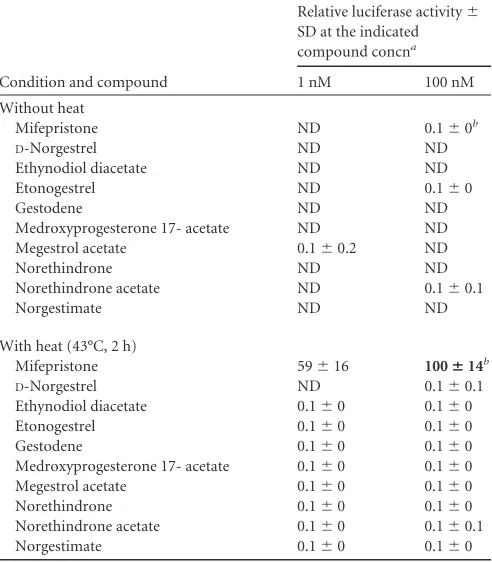
). Results showed
unequiv-ocally that none of the progestins had measurable activity (
⬎
0.1%
of the activity of mifepristone) (
Table 2
). Note that the
antipro-gestin mifepristone was included in the experiment as both a
pos-itive control and a reference. To more completely characterize the
gene switch, we also tested several available antiprogestins. As is
shown in
Table 3
, the activity of telapristone (CDB-4124) was
similar to that of mifepristone, and ulipristal (CDB-2914) was
more active. No activity was recorded for the synthetic
antipro-gestin PF-62367982 (
45
).
Replication of HSV-GS1 is stringently regulated in cultured
cells.
Recombinant virus HSV-GS1 was derived from wild-type
HSV-1 strain 17syn
⫹
by insertion of transactivator cassette
pHSP70/GAL4-GLP65 (comprising a GLP65 gene functionally
linked to a promoter cassette containing a human HSP70B and a
GAL4 promoter) and replacement of the viral promoters driving
the replication-essential ICP4 genes with GAL4 promoters,
sub-jecting the replication-essential ICP4 genes to gene switch control
(
Fig. 1B
).
In a first experiment, replication of HSV-GS1 in the permissive
E5 cells (that express ICP4) was compared with that in the
on November 7, 2019 by guest
http://jvi.asm.org/
permissive RS cells (
Table 4
). While HSV-GS1 replicated as
effi-ciently as wild-type strain 17syn
⫹
in the E5 cells, it did not appear
to replicate in the RS cells. This result suggested that replication of
HSV-GS1 was stringently controlled by the dually responsive gene
switch.
To corroborate the latter result as well as to find out whether
activation of the ICP4 genes was dependent on both heat and
SMR, single-step growth experiments were carried out in Vero
cells using the procedure described in Materials and Methods. It is
noted that these experiments were performed at an MOI of 3 to
sensitively detect recombinant virus replication in the absence of
activation. Sets of cultures of HSV-GS1-infected cells were either
exposed to 10 nM mifepristone (from the time of infection) and
heat treated at 43.5°C for 30 min (activating treatment), exposed
to mifepristone in the absence of a heat treatment, heat treated in
the absence of mifepristone, or left untreated. Cultures were
har-vested at various time points, extracts were prepared, and
infec-tious virus present in the extracts was titrated on E5 cells. Results
showed vigorous replication of the recombinant virus after
acti-vating treatment (
Fig. 2A
). No replication was observed in the
absence of a heat treatment and/or mifepristone. Hence,
replica-tion of HSV-GS1 was stringently controlled by the dually
respon-sive gene switch. Another experiment compared replication
effi-ciencies of HSV-GS1 and the wild-type parent 17syn
⫹
. This
experiment demonstrated that, subsequent to activating
treat-ment, HSV-GS1 replicated essentially as efficiently as the
wild-type virus (
Fig. 2B
). It was noted that the activating treatment
modestly reduced wild-type virus yield.
Tightly controlled replication of HSV-GS3 in different cell
lines.
While the dually responsive gene switch provides HSV-GS1
with a safeguard against inadvertent activation, a single mutation
or recombination event may be sufficient to remove the ICP4
genes from regulation. In HSV-GS3, both ICP4 and ICP8 genes
are under gene switch control. Subjecting two
replication-essen-tial genes to gene switch control ensures that no single mutation or
recombination event can result in uncontrolled viral replication.
HSV-GS3 was derived from HSV-GS1 by replacing the promoter
of the ICP8 gene with a GAL4 promoter (
Fig. 1C
). Single-step
growth experiments were carried out to characterize HSV-GS3.
To determine whether HSV-GS3 was capable of robust
repli-cation, a single-step growth experiment was conducted in which
replication of HSV-GS3 and that of wild-type virus were
com-pared in the presence or absence of an activating treatment. In this
experiment, parallel cultures of E5 cells (or E5 cells transfected
with ICP8 expression plasmid in the case of infection with
HSV-GS3 in the absence of an activating treatment) were infected with
HSV-GS3 or wild-type virus at an MOI of 3. The cultures were
untreated or subjected to an activating treatment (heat treatment
administered immediately after infection). Cultures were
har-vested at different times, extracts were prepared, and infectious
virus present in the extracts was titrated on E5 cells transfected
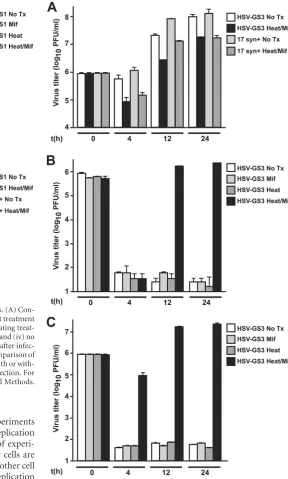
with an ICP8 expression plasmid. Results revealed that HSV-GS3
replicated nearly as efficiently as wild-type virus (
Fig. 3A
). The
activating treatment had only a minor effect on the replication
efficiencies of HSV-GS3 and wild-type virus. Additional
single-TABLE 2Gene switch coactivation by progestinsCondition and compound
Relative luciferase activity⫾ SD at the indicated compound concna
1 nM 100 nM
Without heat
Mifepristone ND 0.1⫾0b
D-Norgestrel ND ND
Ethynodiol diacetate ND ND
Etonogestrel ND 0.1⫾0
Gestodene ND ND
Medroxyprogesterone 17- acetate ND ND
Megestrol acetate 0.1⫾0.2 ND
Norethindrone ND ND
Norethindrone acetate ND 0.1⫾0.1
Norgestimate ND ND
With heat (43°C, 2 h)
Mifepristone 59⫾16 100ⴞ14b
D-Norgestrel ND 0.1⫾0.1
Ethynodiol diacetate 0.1⫾0 0.1⫾0
Etonogestrel 0.1⫾0 0.1⫾0
Gestodene 0.1⫾0 0.1⫾0
Medroxyprogesterone 17- acetate 0.1⫾0 0.1⫾0
Megestrol acetate 0.1⫾0 0.1⫾0
Norethindrone 0.1⫾0 0.1⫾0
Norethindrone acetate 0.1⫾0 0.1⫾0.1
Norgestimate 0.1⫾0 0.1⫾0
a
In the controls (no compound) no activity was detected without heat treatment, and an activity of 0.1⫾0 was detected with heat treatment. Boldface indicates the reference value. ND, none detected.
[image:6.585.298.547.78.141.2]bFor mifepristone, the concentration was 10 nM.
TABLE 3Gene switch coactivation by antiprogestins
Treatment and compound
Relative luciferase activity⫾SD at the indicated compound concna
1 nM 10 nM 1M
Without heat
Mifepristone 0.3⫾0.1 0.3⫾0.1 —b
Telapristone ND 0.1⫾0 —
Ulipristal 0.3⫾0.1 0.4⫾0 —
PF-02367982 ND 0.2⫾0 0.3⫾0.1
With heat (43°C, 2 h)
Mifepristone 74⫾14 100ⴞ20 —
Telapristone 92⫾12 107⫾14 —
Ulipristal 422⫾36 504⫾95 —
PF-02367982 ND 0.4⫾0.1 0.4⫾0
aControl values (no compound) were 0.2⫾0 without heat and 0.4⫾0.1 with heat
treatment. Boldface indicates the reference value. ND, none detected.
[image:6.585.41.287.79.360.2]bNot determined.
TABLE 4Titration of viruses in RS and E5 cellsa
Virus
Viral load in RS cells (PFU/ml)
Viral load in E5 cells
(PFU/ml)
Expt 1 Expt 2 Expt 1 Expt 2
17syn⫹ 7.2⫻108 9.5⫻108 1.2⫻107 1.2⫻107
HSV-GS1 NDb ND 5.5⫻107 2.5⫻107
aConfluent monolayers of either RS or E5 cells in 60-mm dishes were infected with
HSV-GS1 or 17syn⫹at an MOI of 5, incubated for 48 h, harvested by scraping cells into the medium, subjected to two rounds of freeze-thawing, and titrated on E5 cells for infectious virus. Two independent replicates were performed.
bND, none detected. The detection limit in this experiment was about 100 PFU/ml.
on November 7, 2019 by guest
http://jvi.asm.org/
[image:6.585.40.286.546.697.2]step growth experiments were carried out. These experiments
were aimed primarily at finding out whether HSV-GS3 replication
was tightly controlled in diverse cell types. Examples of
experi-ments in monkey Vero cells or human SCC-15 tumor cells are
shown in
Fig. 3B
and
C
. Robust replication in these and other cell
types occurred subsequent to activating treatment. Replication
could not be observed in the absence of heat treatment and/or
exposure to mifepristone.
For historical reasons the earlier experiments utilized
mifepri-stone as a coactivator. Ulipristal is a more selective antiprogestin
than mifepristone and for this reason would be a preferred
coacti-vator (
46
). After ulipristal was found to be capable of coactivating
the dually responsive gene switch in J55 cells (
Table 3
), an
exper-iment was carried out to determine whether ulipristal was as
ef-fective as mifepristone as a coactivator of HSV-GS3 replication.
Parallel cultures of Vero cells were infected with HSV-GS3.
Mife-pristone or ulipristal was added at the time of infection, and heat
treatments at 43.5°C for 30 min were performed immediately after
infection. Cultures were harvested at different times after
infec-tion, and DNA and RNA were extracted and analyzed by qPCR
and RT-qPCR, respectively. Results presented in
Fig. 4
show that
ulipristal and mifepristone are equivalent coactivators. As
ex-pected based on the results of the single-step growth experiments,
HSV-GS3 DNA replication was strictly dependent on activation in
host cells by heat treatment in the presence of antiprogestin
(
Fig. 4A
). Consistent with the expected time course of HSV-1
replication, elevated DNA levels were measured in cells harvested
12 or 24 h after infection but not in cells harvested after 1 or 4 h.
Corresponding data were obtained for the expression of the ICP4
FIG 2Single-step growth experiments with HSV-GS1 in Vero cells. (A)Con-trollability of replication. Four basic conditions were tested: (i) heat treatment at 43.5°C for 30 min in the presence of 10 nM mifepristone (activating treat-ment), (ii) heat treatment alone, (iii) mifepristone exposure alone, and (iv) no treatment (No Tx). Heat treatment was administered immediately after infec-tion (i.e., immediately after removal of the viral inoculum). (B) Comparison of replication efficiencies of wild-type strain 17syn⫹and HSV-GS1 with or with-out activating treatment. Heat treatment was applied 4 h after infection. For other details on single-step growth experiments, see Materials and Methods. Mif, mifepristone. Error bars indicate standard deviations.
FIG 3Single-step growth experiments with HSV-GS3. (A) Comparison of the replication efficiencies of wild-type strain 17syn⫹and HSV-GS3 with or with-out activating treatment in E5 cells (17syn⫹) or E5 cells transfected with an ICP8 expression plasmid (GS3). (B) Regulation of replication of HSV-GS3 in Vero cells. See the legend ofFig. 2for a description of the four basic conditions tested. (C) Analogous experiment in SCC-15 cells. In these exper-iments, heat treatments were administered immediately after infection. Error bars indicate standard deviations.
on November 7, 2019 by guest
http://jvi.asm.org/
[image:7.585.42.300.66.368.2] [image:7.585.252.540.67.546.2]and gC genes (
Fig. 4B
and
C
). Mifepristone and ulipristal similarly
coactivated transcription of the viral genes. As expected,
tran-scripts of the regulated ICP4 genes appeared earlier than
transcripts of the late gC gene. DNA replication and viral gene
transcription did not occur in the absence of heat treatment and,
subsequent to heat treatment, were dependent on antiprogestin
concentration.
Replication of HSV-GS3
in vivo
is strictly dependent on an
activating treatment.
Groups of adult female mice were
inocu-lated with HSV-GS3 on both rear footpads. Different doses of
ulipristal were administered intraperitoneally at the time of
infec-tion. Heat treatment was performed at 45°C for 10 min (by
im-mersion of hind feet in a water bath) 3 h after virus administration.
Mice were sacrificed 24 h after heat induction. The feet and DRG
were dissected, and DNA and RNA were extracted and subjected
to qPCR for quantitative analysis for HSV-1 DNA. RNA was
ana-lyzed by RT-qPCR for the presence of ICP4 and gC transcripts.
HSV-1 is a neurotropic virus and capable of establishing latency in
sensory nerve cells. In the interest of a more complete
character-ization, the analysis was carried out on both feet and DRG. Viral
DNA levels in feet and, to a much more limited extent, in DRG
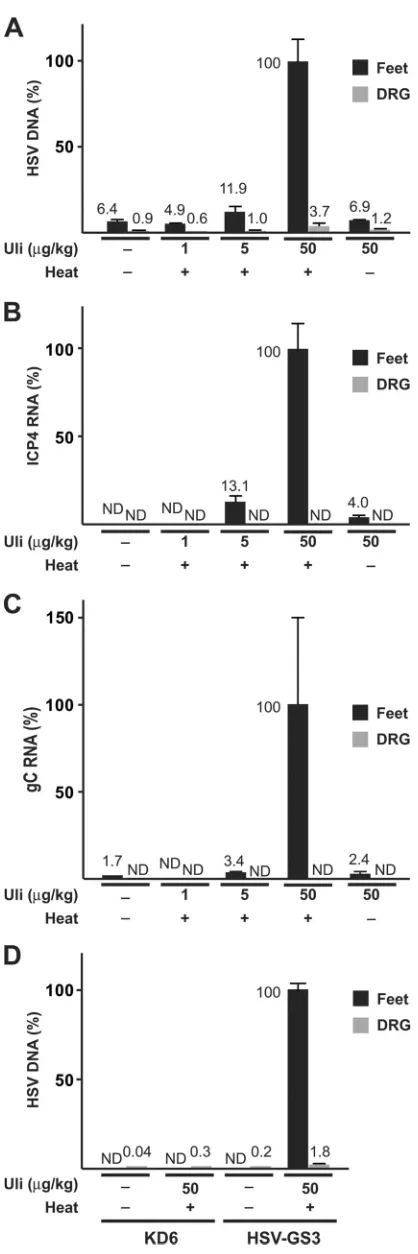
increased with ulipristal dose in heat-treated animals (
Fig. 5A
).
Heat treatment alone (
Fig. 5A
, the condition heat plus 1
g/kg
ulipristal) or administration of ulipristal alone did not result in
increased DNA levels. These results were mirrored at the level of
ICP4 and gC transcripts, at least in feet (
Fig. 5B
and
C
).
Tran-scripts were undetectable in DRG. These findings strongly
sug-gested that replication
in vivo
of HSV-GS3 was stringently
con-trolled by the heat- and antiprogestin-activated gene switch.
Finally, we wished to compare the
in vivo
replicative yields
between HSV-GS3 and the replication-defective (ICP4-deficient)
HSV-1 recombinant KD6. Mice were virus infected on the rear
footpads and were either untreated or subjected to activating
treatment (45°C for 10 min, 50
g/kg ulipristal). Four days later,
ganglia and feet were dissected and homogenized. Homogenates
were divided into two fractions. From one fraction DNA was
ex-tracted for qPCR analysis. The other fraction was assayed for
in-fectious virus by plaque assay (on E5 cells transfected with an ICP8
expression plasmid). Elevated levels of viral DNA were detected in
feet from HSV-GS3-infected animals that had been subjected to
heat treatment in the presence of ulipristal but not from animals
that had not received such activating treatment or from animals
that had been infected with KD6 (
Fig. 5D
). Low levels of HSV-1
DNA were found in DRG of KD6- and HSV-GS3-infected
ani-mals, suggesting that both viruses were capable of latently
infect-ing the ganglia (albeit at low levels). Infectious virus could be
isolated only from feet of HSV-GS3-infected animals that had
been subjected to an activating treatment and not from untreated
HSV-GS3-infected animals or from KD6-infected animals.
DISCUSSION
The results presented here describe the construction and testing of
novel conditionally replication-competent HSV-1 recombinants
in which replication can be induced both
in vitro
and
in vivo
by a
transient heat treatment of infected cells in the presence of an
antiprogestin (i.e., mifepristone or ulipristal). We show that in the
absence of either or both coactivators, viral transcription and
rep-lication are tightly suppressed. This provides the basis for future
exploration of such replication-competent controlled viruses as
HSV vaccines or tumor vaccines.
The potential advantage of replication-competent controlled
viruses is the ability to induce one or more initial rounds of robust
viral replication in the target tissue (e.g., the skin) where viral
antigens are efficiently presented to the host antigen-presenting
cells in the natural context of the infection. This is in contrast to
replication-defective or attenuated HSV vectors that, because of
their nature, are not expected to be similarly effective
immuno-gens. Even in the case of disabled infectious single-cycle
(DISC)-type vaccines (such as gD mutants), replication is limited to the
initially infected cell. HSV-GS3 affords additional rounds of
rep-lication if heat and antiprogestin are reapplied and also provides
FIG 4Regulation of viral DNA replication and transcription in Vero cellsinfected with HSV-GS3. Multiple infected cultures were subjected to the treat-ments indicated on the panels. Heat treatment (43.5°C for 30 min) was admin-istered 4 h after infection, and sets of cultures were harvested 1, 4, 12, and 24 h later, and DNA and RNA, as indicated on the left of each panel, were extracted and analyzed by qPCR and RT-qPCR, respectively. For other details, see Ma-terials and Methods. Uli, ulipristal. Values and standard deviations were nor-malized relative to the highest value in each panel.
on November 7, 2019 by guest
http://jvi.asm.org/
[image:8.585.41.288.64.506.2]the potential for boosting the immunogen. Therefore, this type of
replication-competent controlled virus could provide substantial
advantages in efficacy as an immunization vector over previously
investigated vaccines. From a safety point of view,
replication-competent controlled viruses such as HSV-GS3 should exhibit
similar safety profiles as existing HSV vaccine vectors, and one
may argue that the conditional nature of their controlled
replica-tion may make them safer than some attenuated vectors,
espe-cially in the immunocompromised.
While we show here that our replication-competent controlled
HSV recombinants have the potential to establish a latent
infec-tion (
Fig. 5D
, HSV-GS3), this is not surprising since even
nonrep-licating HSV vectors are known to do so (
47
) (
Fig. 5D
, KD6 virus).
The replication-competent controlled HSV should not be able to
reactivate in the absence of heat and antiprogestin. Should this be
desirable, derivative vectors may be constructed that should be
incapable of reactivation even in the presence of the coactivators,
e.g., by subjecting the controlled replication-essential gene(s) to
additional repression by a latency-specific factor.
It is noted that HSV-GS1 and HSV-GS3 should be regarded as
first examples of replication-competent controlled herpesviruses.
Variants may be explored in which other replication-essential
vi-ral genes than ICP4 and ICP8 are subjected to the control of a
dually responsive gene switch. Additional genes may be brought
under gene switch control, which may further increase the
strin-gency of regulation of virus replication. Essentially any two or
more replication-essential viral genes may be so controlled,
pro-vided that the sustained presence of the protein products of the
selected genes does not negatively affect replication efficiency and
that the activated gene switch is capable of transactivating the
genes at nonlimiting rates. There is no reason why components of
immune evasion mechanisms, e.g., transporter associated with
antigen processing (TAP) inhibitor gene ICP47, could not be
dis-abled or why immune-modulating genes could not be introduced
to further boost or direct immune responses. GS1 and
HSV-GS3 were derived from HSV-1 wild-type strain 17syn
⫹
.
Analo-gous replication-competent controlled viruses may be
con-structed based on other HSV-1 strains or other suitable viruses,
which may include the alphaherpesviruses HSV-2 and
varicella-zoster virus (VZV) and the betaherpesviruses, including
cytomeg-alovirus (CMV) and the roseola viruses (HSV-6 and -7). In the
present study, use was made of a dually responsive gene switch
comprising an antiprogestin-activated artificial transactivator.
This transactivator was chosen because its activity is strictly
de-pendent on its SMR, i.e., an antiprogestin such as ulipristal or
mifepristone. The antiprogestins are readily available, are unlikely
to have negative effects on the immune system if used at low
con-centrations, have been safety tested in humans, are not considered
essential active ingredients by the WHO, and are utilized only
sporadically and in single dose in human subjects. It is noted that
tight dual regulation of replication of a controlled herpesvirus will
FIG 5Regulation of HSV-GS3 DNA replication and transcription and com-parison of replicative yields between HSV-GS3 and KD6 in the mouse footpad model. Adult outbred mice were inoculated on the slightly abraded footpads of their hind legs with 1⫻105PFU of HSV-GS3 or KD6. The indicated doses of
ulipristal (Uli) were administered intraperitoneally at the time of infection. Localized heat treatment at 45°C for 10 min was performed 3 h after virus administration. Mice were sacrificed 24 h (panels A to C) or 4 days (panel D) after heat treatment, and DNA and RNA, as indicated on the left of each panel, were isolated from feet and dorsal root ganglia (DRG) and analyzed by qPCR and RT-qPCR, respectively. For other details, see Materials and Methods. Val-ues and standard deviations were normalized relative to the highest value shown in each panel. ND, none detected.
on November 7, 2019 by guest
http://jvi.asm.org/
[image:9.585.60.269.61.688.2]be particularly important at the time of administration and for
several weeks thereafter when virus is abundant and systemically
present. After this period, sporadic, single uses of antiprogestins
would likely pose minimal risks, especially if the treated subject
had normal or nearly normal body temperature. Other
SMR-de-pendent transactivators may be utilized in replication-competent
controlled viruses such as, for example, the well-characterized
Tet-on transactivators. Of particular interest would be
transacti-vators whose SMR is not used at all in human therapy. At this time,
this would include dimerizer-based transactivators activated by
nonimmunosuppressive analogs of rapamycin (rapalogs) and the
ecdysone receptor-based RheoSwitch transactivator activated by
synthetic ligand RSL-1 (
48–51
). A heat- and rapalog-activated
gene switch has been developed recently (
22
,
23
).
Replication-defective or attenuated viruses have long been
used as vehicles for the delivery of heterologous antigens (i.e.,
antigens of other organisms) (
52–54
). Experience was gathered
with a variety of different viruses, including adenoviruses, HSV,
poxviruses, measles virus, lentiviruses, and yellow fever virus.
Hence, replication-competent controlled HSVs such as HSV-GS3
not only may be considered potential HSV candidate vaccines but
may also serve as platforms for expressing heterologous antigens.
As has been argued previously for antigens of the controlled virus
itself, superior and more balanced immune responses against
het-erologous antigens may be induced if these antigens are expressed
and presented in the context of vigorous viral replication.
De-pending on the duration of expression desired, a gene for a
heter-ologous antigen may be subjected to the control of the dually
responsive gene switch or to an unregulated (or differently
regu-lated) promoter.
The results presented here support the further testing of
repli-cation-competent controlled herpesviruses such as HSV-GS3 as a
new generation of regulated and robust immunization vectors.
Interest in oncolytic HSV vectors has been rekindled by the recent
clinical development by Amgen of talimogene laherparepvec (also
known as T-VEC), which resulted in an application for a biologics
license in the United States. A phase 3 study on melanoma patients
revealed a statistically significant better response to intralesional
injection of T-VEC than to control treatment (subcutaneous
granulocyte-macrophage colony-stimulating factor [GM-CSF])
(
55
). T-VEC is an attenuated derivative of HSV-1 wild-type strain
JS1 and carries a GM-CSF passenger gene (
56
). We suggest that a
replication-competent controlled HSV may have significant
ad-vantages over a vector such as T-VEC. Because the safety of a
controlled virus relies on spatiotemporal regulation rather than
attenuation, such a virus could be derived from the most potent
oncolytic wild-type virus without diminishing its oncolytic
activ-ity. The controlled virus could be directly administered to lesions
and specifically activated within the lesions. Highly localized
acti-vation of virus-mediated oncolysis could be achieved by
high-intensity focused ultrasound (HIFU) heating in the systemic
pres-ence of the appropriate SMR. Magnetic resonance (MR)-guided
HIFU devices have been developed for medical uses (ExAblate
Systems; InSightec, Ltd.) and are capable of heat-ablating small
tissue volumes with high accuracy. A device of this type was also
shown to be capable of activating a heat shock protein (HSP)
promoter in a narrowly defined tissue region of a small animal
(
57
). We note that the activating heat treatment may provide an
additional independent benefit: activating HSF1 in tumor cells
(which results in enhanced accumulation of HSPs) prior to their
killing has been reported to enhance their immunogenicity (
58
).
ACKNOWLEDGMENTS
This work was supported by contracts from HSF Pharmaceuticals (to D.C.B. and N.V.), an award from the UF Opportunity Fund (to D.C.B.), and grant PI12/01698 (to N.V.) from Fondo de Investigaciones Sanitarias (Spanish Ministry of Economy and Competitiveness, MINECO, Spain).
We also acknowledge technical assistance by L. Watson (University of Florida) and A. Boré (CIBER-BBN and Hospital Universitario La Paz-IdiPAZ).
R.V. is the founder of HSF Pharmaceuticals SA, a company with an exclusive focus on research and early development activities.
REFERENCES
1.Pulendran B, Ahmed R.2006. Translating innate immunity into immu-nological memory: implications for vaccine development. Cell124:849 – 863.http://dx.doi.org/10.1016/j.cell.2006.02.019.
2.Boonnak K, Paskel M, Matsuoka Y, Vogel L, Subbarao K.2012. Eval-uation of replication, immunogenicity and protective efficacy of a live attenuated cold-adapted pandemic H1N1 influenza virus vaccine in non-human primates. Vaccine 30:5603–5610. http://dx.doi.org/10.1016/j .vaccine.2012.06.088.
3.Peng B, Wang LR, Gomez-Roman VR, Davis-Warren A, Montefiori DC, Kalyanaraman VS, Venzon D, Zhao J, Kan E, Rowell TJ, Murthy KK, Srivastava I, Barnett SW, Robert-Guroff M.2005. Replicating rather than nonreplicating adenovirus-human immunodeficiency virus recom-binant vaccines are better at eliciting potent cellular immunity and prim-ing high-titer antibodies. J Virol79:10200 –10209.http://dx.doi.org/10 .1128/JVI.79.16.10200-10209.2005.
4.Halford WP, Weisend C, Grace J, Soboleski M, Carr DJJ, Balliet JW, Imai Y, Margolis TP, Gebhardt BM. 2006. ICP0 antagonizes Stat I-dependent repression of herpes simplex virus: implications for the regulation of viral latency. Virol J3:44.http://dx.doi.org/10.1186/1743 -422X-3-44.
5.Huang X, Lu B, Yu W, Fang Q, Liu L, Zhuang K, Shen T, Wang H, Tian P, Zhang L, Chen Z.2009. A novel replication-competent vaccinia vector MVTT is superior to MVA for inducing high levels of neutralizing anti-body via mucosal vaccination. PLoS One4:e4180.http://dx.doi.org/10 .1371/journal.pone.0004180.
6.Liu H, Yu X, Tang X, Wang H, Ouyang W, Zhou J, Chen Z.2010. The route of inoculation determines the tissue tropism of modified vaccinia Tiantan expressing the spike glycoprotein of SARS-CoV in mice. J Med Virol82:727–734.http://dx.doi.org/10.1002/jmv.21667.
7.Voellmy R, Bloom DC, Vilaboa N.2015. A novel approach for address-ing diseases not yieldaddress-ing to effective vaccination? Immunization by repli-cation-competent controlled virus. Expert Rev Vaccines 14:637– 651.
http://dx.doi.org/10.1586/14760584.2015.1013941.
8.Bramson JL, Hitt M, Gauldie J, Graham FL. 1997. Pre-existing immunity to adenovirus does not prevent tumor regression following intratumoral administration of a vector expressing IL-12 but inhibits virus dissemination. Gene Ther 4:1069 –1076. http://dx.doi.org/10 .1038/sj.gt.3300508.
9.Vilaboa N, Boellmann F, Voellmy R.2011. Gene switches for deliberate regulation of transgene expression: recent advances in system develop-ment and uses. J Genet Syndr Gene Ther2:107.
10. Vilaboa N, Voellmy R.2015. Deliberate regulation of therapeutic trans-genes: recent advances in system development and uses, p 628 – 675.In Smyth Templeton N (ed), Gene and cell therapy: therapeutic mechanisms and strategies, 4th ed. CRC Press, Boca Raton, FL.
11. Voellmy R, Ahmed A, Schiller P, Bromley P, Rungger D.1985. Isolation and functional analysis of a human 70,000-dalton heat shock protein gene segment. Proc Natl Acad Sci U S A82:4949 – 4953.http://dx.doi.org/10 .1073/pnas.82.15.4949.
12. Dreano M, Brochot J, Meyers A, Cheng-Meyer C, Rungger D, Voellmy R, Bromley P.1986. High-level, heat-regulated synthesis of proteins in eukaryotic cells. Gene49:1– 8.http://dx.doi.org/10.1016 /0378-1119(86)90380-X.
13. Mehta HB, Popovich BK, Dillmann WH. 1988. Ischemia induces changes in the level of mRNAs coding for stress protein 71 and creatine
on November 7, 2019 by guest
http://jvi.asm.org/
kinase M. Circ Res63:512–517.http://dx.doi.org/10.1161/01.RES.63.3 .512.
14. Benjamin IJ, Kröger B, Williams RS.1990. Activation of the heat shock transcription factor by hypoxia in mammalian cells. Proc Natl Acad Sci U S A87:6263– 6267.http://dx.doi.org/10.1073/pnas.87.16.6263. 15. Locke M, Noble EG, Tanguay RM, Field MR, Ianuzzo SE, Ianuzzo CD.
1995. Activation of heat-shock factor in rat heart after heat shock and exercise. Am J Physiol268:C1387–C1394.
16. Salminen WF, Jr, Voellmy R, Roberts SM.1997. Differential heat shock protein induction by acetaminophen and a nonhepatotoxic regioisomer, 3=-hydroxyacetanilide, in mouse liver. J Pharmacol Exp Ther282:1533– 1540.
17. Moseley PL.1998. Heat shock proteins and the inflammatory response. Ann N Y Acad Sci856:206 –213.http://dx.doi.org/10.1111/j.1749-6632 .1998.tb08327.x.
18. Bajramovic JJ, Bsibsi M, Geutskens SB, Hassankhan R, Verhulst KC, Stege GJ, de Groot CJ, van Noort JM.2000. Differential expression of stress proteins in human adult astrocytes in response to cytokines. J Neuroimmunol 106:14 –22.http://dx.doi.org/10.1016/S0165-5728(99)00260-X.
19. Shastry S, Toft DO, Joyner MJ.2002. Hsp70 and Hsp90 expression in leucocytes after exercise in moderately trained humans. Acta Physiol Scand 175:139 –146.http://dx.doi.org/10.1046/j.1365-201X.2002.00979.x. 20. Zou J, Salminen WF, Roberts SM, Voellmy R.1998. Correlation between
glutathione oxidation and trimerization of heat shock factor 1, an early step in the stress induction of the Hsp response. Cell Stress Chaperones3:130 –141.
http://dx.doi.org/10.1379/1466-1268(1998)003⬍0130:CBGOAT⬎2.3.CO;2. 21. Vilaboa N, Fenna M, Munson J, Roberts SM, Voellmy R.2005. Novel gene switches for targeted and timed expression of proteins of interest. Mol Ther12:290 –298.http://dx.doi.org/10.1016/j.ymthe.2005.03.029. 22. Martin-Saavedra FM, Bore A, Voellmy R, Vilaboa N. 2009.
Heat-activated, rapamycin-dependent gene switches for tight control of trans-gene expression. Hum Gene Ther20:1060 –1061.
23. Martín-Saavedra FM, Wilson CG, Voellmy R, Vilaboa N, Franceschi RT.2013. Spatiotemporal control of vascular endothelial growth factor expression using a heat shock and rapamycin-dependent gene switch. Hum Gene Ther Methods24:160 –170.http://dx.doi.org/10.1089/hgtb .2013.026.
24. Roizman B.1996. The familyHerpesviridae: a brief introduction, p 2297– 2342.InFields BN, Knipe DM, Howley PM, Chanock RM, Melnick JL, Monath TP, Roizman B, Straus SE (ed), Fields virology, 3rd ed. Lippincott Williams & Wilkins, Philadelphia, PA.
25. Roizman B.Herpes simplex viruses and their replication, p 2399 –2460.In Fields BN, Knipe DM, Howley PM, Chanock RM, Melnick JL, Monath TP, Roizman B, Straus SE (ed), Fields virology, 3rd ed. Lippincott Williams & Wilkins, Philadelphia, PA.
26. Lou E.2003. Oncolytic herpes viruses as a potential mechanism for cancer therapy. Acta Oncol42:660 – 671.http://dx.doi.org/10.1080/02841860310 00518.
27. Bloom DC.1998. HSV vectors for gene therapy, p 369 –386.InBrown S, MacLean A (ed), Herpes simplex virus protocols. Humana Press, Totowa, NJ.
28. Hansen SG, Ford JC, Lewis MS, Ventura AB, Hughes CM, Coyne-Johnson L, Whizin N, Oswald K, Shoemaker R, Swanson T, Legasse AW, Chiuchiolo MJ, Parks CL, Axthelm MK, Nelson JA, Jarvis MA, Piatak M, Jr, Lifson JD, Picker LJ.2011. Profound early control of highly pathogenic SIV by an effector memory T-cell vaccine. Nature473:523– 527.http://dx.doi.org/10.1038/nature10003.
29. Steffensen MA, Jensen BA, Holst PJ, Bassi MR, Christensen JP, Thom-son AR.2012. Pre-existing vector immunity does not prevent replication-deficient adenovirus from inducing efficient CD8 T-cell memory and re-call responses. PLoS One 7:e34884. http://dx.doi.org/10.1371/journal .pone.0034884.
30. Brockman MA, Knipe DM.2002. Herpes simplex virus vectors elicit durable immune responses in the presence of preexisting host immu-nity. J Virol 76:3678 –3687.http://dx.doi.org/10.1128/JVI.76.8.3678 -3687.2002.
31. Chahlavi A, Rabkin S, Todo T, Sundaresan P, Martuza R.1999. Effect of prior exposure to herpes simplex virus 1 on viral vector-mediated tu-mor therapy in immunocompetent mice. Gene Ther6:1751–1758.http: //dx.doi.org/10.1038/sj.gt.3301003.
32. Delman KA, Bennett JJ, Zager JS, Burt BM, McAuliffe PF, Petrowsky H, Kooby DA, Hawkins WG, Horsburgh BC, Johnson P, Fong Y.2000. Effects of preexisting immunity on the response to herpes simplex-based
oncolytic therapy. Hum Gene Ther11:2465–2472.http://dx.doi.org/10 .1089/10430340050207957.
33. Hocknell PK, Wiley RD, Wang X, Evans TG, Bowers WJ, Hanke T, Federoff HJ, Dewhurst S.2002. Expression of human immunodeficiency virus type 1 gp120 from herpes simplex virus type 1-derived amplicons results in potent, specific, and durable cellular and humoral immune re-sponses. J Virol76:5565–5580.http://dx.doi.org/10.1128/JVI.76.11.5565 -5580.2002.
34. Lambright ES, Kang EH, Force S, Lanuti M, Caparrelli D, Kaiser LR, Albelda SM, Molnar-Kimber KL.2000. Effect of preexisting anti-herpes immunity on the efficacy of herpes simplex viral therapy in a murine intraperitoneal tumor model. Mol Ther2:387–393.http://dx.doi.org/10 .1006/mthe.2000.0133.
35. Herrlinger U, Kramm CM, Aboody-Guterman KS, Silver JS, Ikeda K, Johnston KM, Pechan PA, Barth RF, Finkelstein D, Chiocca EA, Louis DN, Breakefield XO.1998. Pre-existing herpes simplex virus 1 (HSV-1) immunity decreases, but does not abolish, gene transfer to experimental brain tumors by a HSV-1 vector. Gene Ther5:809 – 819.http://dx.doi.org /10.1038/sj.gt.3300643.
36. Lauterbach H, Ried C, Epstein AL, Marconi P, Bricker T.2005. Reduced immune responses after vaccination with a recombinant herpes simplex virus type 1 vector in the presence of antiviral immunity. J Gen Virol 86:2401–2410.http://dx.doi.org/10.1099/vir.0.81104-0.
37. Watanabe D, Brockman MA, Ndung’u T, Mathews L, Lucas WT, Murphy CG, Felber BK, Pavlakis GN, Deluca NA, Knipe DM.2007. Properties of a herpes simplex virus multiple immediate-early gene-deleted recombinant as a vaccine vector. Virology357:186 –198.http://dx .doi.org/10.1016/j.virol.2006.08.015.
38. DeLuca NA, Schaffer PA.1987. Activities of herpes simplex virus type 1 (HSV-1) ICP4 genes specifying nonsense peptides. Nucleic Acids Res15: 4491– 4511.http://dx.doi.org/10.1093/nar/15.11.4491.
39. Dobson AT, Margolis TP, Sedarati F, Stevens JG, Feldman LT.1990. A latent, nonpathogenic HSV-1-derived vector stably expresses -galactosi-dase in mouse neurons. Neuron 5:353–360. http://dx.doi.org/10.1016 /0896-6273(90)90171-B.
40. Reference deleted.
41. Bewig B, Schmidt WE.2000. Accelerated tittering of adenoviruses. Bio-techniques28:870 – 873.
42. Kubat NJ, Amelio AL, Giordani NV, Bloom DC.2004. The herpes simplex virus type 1 latency-associated transcript (LAT) enhancer/rcris hyperacety-lated during latency independently of LAT transcription. J Virol78:12508 – 12518.http://dx.doi.org/10.1128/JVI.78.22.12508-12518.2004.
43. Burcin MM, Schiedner G, Kochanek S, Tsai SY, O’Malley BW.1999. Adenovirus-mediated regulable target gene expression in vivo. Proc Natl Acad Sci U S A96:355–360.http://dx.doi.org/10.1073/pnas.96.2.355. 44. Ye X, Schillinger K, Burcin MM, Tsai SY, O’Malley BW.2002.
Ligand-inducible transgene regulation for gene therapy. Methods Enzymol346: 551–561.http://dx.doi.org/10.1016/S0076-6879(02)46076-4.
45. de Giorgio-Miller A, Bungay P, Tutt M, Owen J, Goodwin D, Pullen N. 2008. The translational pharmacology of a novel, potent, and selective nonsteroidal progesterone receptor antagonist, 2-[4-(4-cyano-phenoxy)-3,5-dicyclopropyl-1H-pyrazol-1-yl]-N-methylacetamide (PF-02367982). J Pharmacol Exp Ther 327:78 – 87. http://dx.doi.org/10.1124/jpet.108 .140467.
46. Attardi BJ, Burgenson J, Hild SA, Reel JR.2004. In vitro antiprogesta-tional/antiglucocorticoid activity and progestin and glucocorticoid re-ceptor binding of the putative metabolites and synthetic derivatives of CDB-2914, CDB-4124, and mifepristone. J Steroid Biochem Mol Biol 88:277–288.http://dx.doi.org/10.1016/j.jsbmb.2003.12.004.
47. Sedarati F, Margolis TP, Stevens JG. 1993. Latent infection can be established with drastically restricted transcription and replication of the HSV-1 genome. Virology 192:687– 691.http://dx.doi.org/10.1006/viro .1993.1089.
48. Rivera VM, Clackson T, Nateson S, Pollock R, Amara JF, Keenan T, Magari SR, Phillips T, Courage NL, Cerasoli F, Jr, Holt DA, Gilman M. 1996. A humanized system for pharmacologic control of gene expression. Nat Med2:1028 –1032.http://dx.doi.org/10.1038/nm0996-1028. 49. Pollock R, Issner R, Zoller K, Natesan S, Rivera VM, Clackson T.2000.
Delivery of a stringent dimerizer-regulated gene expression system in a single retroviral vector. Proc Natl Acad Sci U S A97:13221–13226.http: //dx.doi.org/10.1073/pnas.230446297.
50. Palli SR, Kapitskaya MZ, Kumar MB, Cress DE.2003. Improved
on November 7, 2019 by guest
http://jvi.asm.org/
sone receptor-based inducible gene regulation system. Eur J Biochem270: 1308 –1315.http://dx.doi.org/10.1046/j.1432-1033.2003.03501.x. 51. Kumar MB, Potter DW, Hormann RE, Edwards A, Tice CM, Smith HC,
Dipietro MA, Polley M, Lawless M, Wolohan PRN, Kethidi DR, Palli SR.2004. Highly flexible ligand binding pocket of ecdysone receptor. A single amino acid change leads to discrimination between two groups of nonsteroidal ecdysone agonists. J Biol Chem279:27211–27218. 52. Draper SJ, Heeney JL.2010. Viruses as vaccine vectors for infectious
diseases and cancer. Nat Rev Microbiol8:62–73.http://dx.doi.org/10.1038 /nrmicro2240.
53. Smith GL, Mackett M, Moss B.1983. Infectious vaccinia virus recombi-nants that express hepatitis B virus surface antigen. Nature302:490 – 495.
http://dx.doi.org/10.1038/302490a0.
54. Moss B, Smith GL, Gerin JL, Purcell RH. 1984. Live recombinant vaccinia virus protects chimpanzees against hepatitis B. Nature311:67– 69.http://dx.doi.org/10.1038/311067a0.
55. Food and Drug Administration.2015. Cellular, Tissue and Gene Thera-pies Advisory Committee and Oncologic Drugs Advisory Committee
briefing document: BLA 125518, talimogene laherparepvec (Amgen). Food and Drug Administration, Silver Spring, MD.http://www.fda.gov /downloads/AdvisoryCommittees/Committe