Infrastructure Development
Dissertation
T. Wager
(0061058499)
Faculty of Health, Engineering & Sciences
University of Southern Queensland
Supervisor:
N. Mahmood
As projects become larger the complexity faced by engineers increases and the importance of successful project management techniques has never been greater. In most cases (up to 75 percent of complex projects), the project with budgets greater than $500 million is consid-ered as complex projects (Engineers Australia, 2014). Engineers Australia (2014) identified that the massive failure rates of complex projects are due to inadequate communication, critical skill and knowledge gaps, or poor conceptual planning as well as “ineffective transfer of lessons learnt between similar projects”. All the factors are linked with the effective and efficient decision-making during planning faces of a complex project. The planning support system can assist decision-makers to make decisions under uncertainty. The aim of this thesis is to provide a basis for beginning and experienced engineers exposure to complex project management methods, and support systems that can be followed.
University of Southern Queensland Faculty of Health, Engineering and Sciences
ENG4111/ENG4112 Research Project
The Council of the University of Southern Queensland, its Faculty of Health, Engineering & Sciences, and the staff of the University of Southern Queensland, do not accept any respon-sibility for the truth, accuracy or completeness of material contained within or associated with this dissertation. Persons using all or any part of this material do so at their own risk, and not at the risk of the Council of the University of Southern Queensland, its Faculty of Health, Engineering & Sciences or the staff of the University of Southern Queensland.
University of Southern Queensland Faculty of Health, Engineering and Sciences
ENG4111/ENG4112 Research Project
I certify that the ideas, designs and experimental work, results, analyses and conclusions set out in this dissertation are entirely my own effort, except where otherwise indicated and acknowledged.
I further certify that the work is original and has not been previously submitted for assess-ment in any other course or institution, except where specifically stated.
I would like to express my gratitude to Dr. Nateque Mahmood for his support of my dissertation. He has provided truly appreciated guidance, motivation, and addressed all questions and concerns I have had throughout the process of my thesis. I would gladly recommend Dr. Nateque Mahmood to any future student who is fortunate enough to have that opportunity.
Thank you to my parents for their continuing support, encouragement, and tolerance of me throughout not just my dissertation but also my undergraduate studies. Thank you to my sister for her academic guidance, and allowing me to discuss my dissertation with her.
1 Introduction 1
1.1 What is Complex Project Management . . . 1
1.2 History of Project Management . . . 2
1.3 Motivation . . . 3
1.4 Aims and Objectives . . . 4
1.5 Project Failure . . . 4
1.6 Thesis Structure . . . 6
2 Literature Review 8 2.1 Introduction . . . 8
2.2 Leading Complex Projects . . . 8
2.3 Tools for Complex Projects . . . 9
2.4 Mastering Complex Projects . . . 10
2.5 PRINCE2 . . . 11
2.6 The Guide to the Project Management Body of Knowledge . . . 11
2.7 On Faith, Fact, and Interaction within projects . . . 12
2.8 Effective Sponsorship . . . 12
2.9 Systems Engineering Principles and Practice . . . 12
2.10 Towards a complexity framework for managing projects . . . 12
2.11 Project Management applications of Theory of Constraints . . . 13
2.12 Project Management: The managerial approach . . . 13
3.2 Qualitative Data Analysis . . . 14
3.3 Data Collection . . . 15
3.4 Data Analysis . . . 16
3.5 Limitations of Methodology . . . 16
4 Findings 18 4.1 Introduction . . . 18
4.2 General Project Complexity . . . 23
4.2.1 Business Case . . . 23
4.2.2 Governance . . . 24
4.2.3 Collaborative Project Structures . . . 32
4.2.4 Work Breakdown Structures . . . 33
4.2.5 Earned Value . . . 33
4.2.6 Risk Controls . . . 38
4.2.7 Shaping . . . 40
4.2.8 Effective Leadership . . . 42
4.3 Uncertainty . . . 43
4.3.1 Stanislavsky’s Method . . . 43
4.3.2 Project Scoping . . . 44
4.3.3 Project Controls . . . 45
4.3.4 Scheduling . . . 45
4.3.5 Independent Assurance . . . 46
4.3.8 Contractual Arrangements . . . 47
4.4 Technological Uncertainty . . . 48
4.4.1 Bottom-Up Approach . . . 48
4.4.2 Time-Linked Semi-Structures . . . 48
4.4.3 Project Oversight . . . 49
4.4.4 Roles and Responsibilities . . . 49
4.4.5 Functional Analysis . . . 50
4.5 Cause and Effect . . . 50
4.5.1 Target Out-turn Cost . . . 51
4.5.2 Systems Engineering . . . 52
4.5.3 Critical Path Method . . . 53
4.5.4 Decision Gates . . . 53
4.5.5 Managing Project Teams . . . 55
4.6 Conclusion of Findings . . . 56
5 Conclusion 59 5.1 Recommendations for Future Work . . . 61
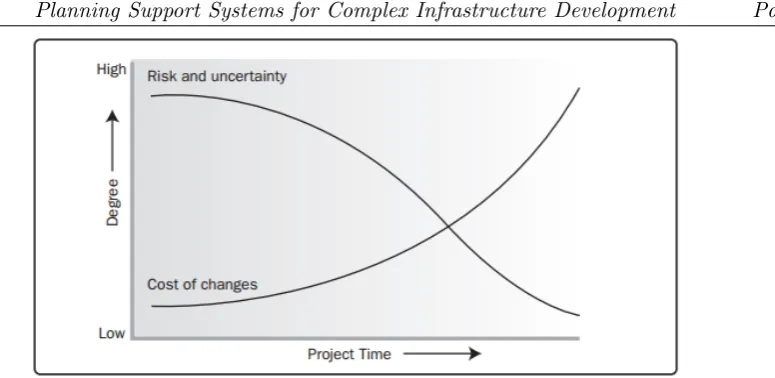
1 Cost of Changes vs Project Time . . . 5
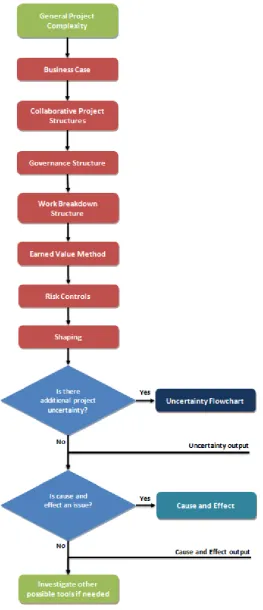
2 General Project Complexity Flowchart . . . 19
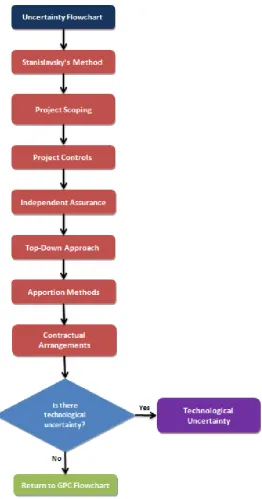
3 Project Uncertainty Flowchart . . . 20
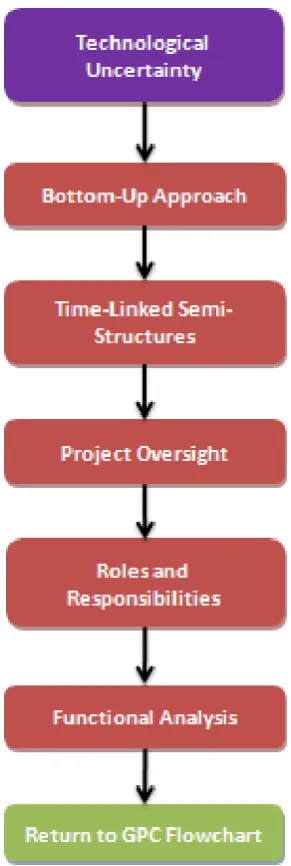
4 Project Technological Uncertainty Flowchart . . . 21
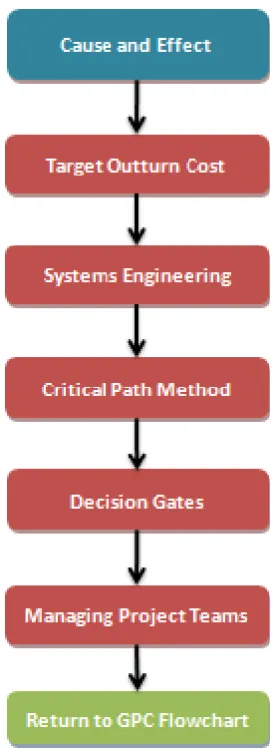
5 Project Cause and Effect Flowchart . . . 22
6 PRINCE2 Governance (retrieved from Murray 2009) . . . 27
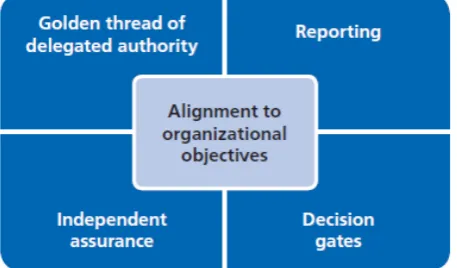
7 Principles for Collaboration (retrieved from Mastering Complex Projects) . . 32
8 Example Work Breakdown Structure (reprinted from PMBoK) . . . 34
9 Example of Earned Value (retrieved from AS 4817 - 2006) . . . 35
10 NASA Earned Value Management Process . . . 37
11 Role of Project Shaping (retried from Bear 2015) . . . 41
12 Schedule Density Concept (retrieved from Mastering Complex Projects) . . . 46
1 Literature Review Key Words . . . 15
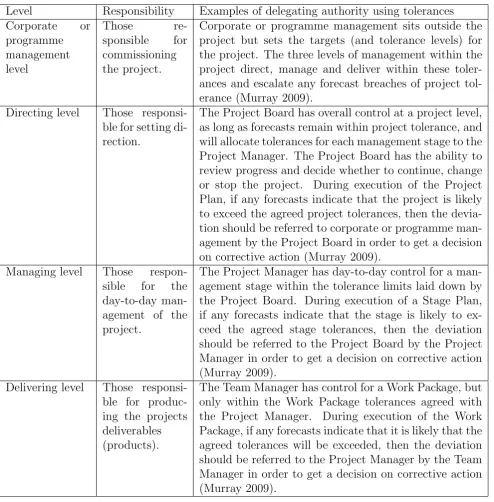
2 PRINCE2 Governance Delegations . . . 31
3 Summary of Project Tools Part 1 . . . 57
1
Introduction
Complex project management has been gaining prominence in the field of project man-agement in recent years and continuing research and improvements have been sought to improve project outcomes. Traditional project management has been built around rigid, inflexible frameworks where round pegs are forced through square holes. This can work for smaller, low-complexity projects, however as complexity and budget begins to increase, it is necessary for flexibility to be available for the project management team to succeed.
The primary objective of this dissertation is to provide beginning and experienced engineers with potential tools, processes and considerations that should be made when planning for complex infrastructure projects. The focus of this has been around tools and support processes that can be employed to assist in efficient, effectual, and consistently managed projects.
1.1
What is Complex Project Management
How is a complex project different to a complicated one? With general project management, projects are approached from the beginning of a project with assumptions being made and the task is defined. When any issues arise the process of Monitoring and Controlling is used to return a project to its initial goal. A project is in a continuum between control and chaos, with simple projects at the control end and out of control projects at the chaotic end (Remington 2011). A complex project is one where the outcomes become difficult to predict with certainty, due to difficulty in defining the projects goals or a lack of knowledge of methods needed to deliver the project. This also means that as a project manager becomes more experienced, complexity can reduce because of their awareness of responses available to them.
The following areas that contribute to a projects complexity have been identified (Remington 2011).
Uncertainty which requires being identified when the path or destination of the project is no longer clear. It can occur when information is lacking or inadequate, details are ambiguous, complicated or unpredictable (Brashers 2001) also found that project members doubting their personal knowledge or the knowledge of their field on the subject. A projects lack of certainty will also lead to issues with trust with personnel lacking confidence in the team and their leadership. (Geraldi & Adlbrecht 2007)
Project Factors Complexity factors include the key personnels experience, project size, organizations structure, technical challenges and time-related issues. A lack of expe-rience with executives and unwillingness to employ expeexpe-rienced personnel along with optimism, pressure to begin projects and lack of acknowledging risks.
Technical Difficulties Perhaps the most expected project complexity comes from tech-nological uncertainty and novelty (Pundir, Ganapathy & Sambandam 2007). When projects begin to face technological uncertainty teams can often start feeling issues with trust.
One of the most important aspects of successful project management is recognizing when complexity occurs (Remington 2011). When key people involved in the project are made aware that a project is more than simply complicated, the desired outcomes of a project become more likely. As project managers gain more experience they can recognize the complexity however other people associated with a project can struggle to comprehend the potential issues. This is why the use of tools or framework to identify not only how to deal with complex project management but also when a project is likely to become complex.
A large obstacle for project managers of complex projects can come from company executives or stakeholders can be unable to grasp the complexity and (Helm & Remington 2005) found that leaders of successful complex projects succeeded by working around executives, rather than with. A complex project can result in teams becoming confused, distressed or losing confidence when a problem cannot be simplified.
1.2
History of Project Management
The fundamentals of project management have been used since 2570BC with the construc-tion of the great pyramids. In 1922 Henry Gantt, known as one of the forefathers of mod-ern project management, developed his self-named ‘Gantt Chart’ to aid project scheduling (Clark, Polakov & Trabold 1922). One of the earliest major uses of the Gantt Chart was the Hoover Dam in 1931. In 1940 Dupont Corporation developed the Critical Path Method man-agers use to analyse flexibility of activities, originally developed to streamline the shutting down of chemical plants it was later used with for the Manhattan Project(Thayer 1996). Seeing the growing scale and importance of successful project management in 1956 The Association for the Advancement of Cost Engineering (ACEE) formed. This non-profit association began publishing technical journals for project management and now provides certifications for project managers (Haughey 2010).
and work packages. WBS focuses on the end products or outcomes rather than the work required, allowing costs to be better planned and easy assignment of tasks (Haughey 2010).
The International Project Management Association (IPMA) founded in 1956. The first project management specific association, formed in Vienna to enable sharing of informa-tion. The Project Management Institute (PMI) was launched in 1969 as a non-profit to promote Project Management (PMI Founders n.d.), PMI are now the publishes of the Project Management Body of Knowledge (PMBOK), which is one of the essential tools for modern project managers.
The Theory of Constraints (TOC) was developed by Eliyahu Goldratt in 1990. TOC is a process to identify project constraints and restructure an organisation following the stems he outlined (Goldratt 1990). TOC was later used as a basis of Critical Chain Project Man-agement (CCPM) in 2000. CCPM unlike PERT or Critical Path is used to keep resources evenly loaded, for projects with more flexibility with time management with less flexibility of resources (Steyn 2002).
PR(ompt II) IN the C(CTA) E(nvironment) PRINCE was developed from the earlier method of PROMPT II in 1989. The United Kingdom Government developed PRINCE pushed the idea of ‘assuring progress’ however it gained a reputation for being too rigid and lacking usability with smaller projects leading to the 1996 revision PRINCE2 (Haughey 2010). Also in 1996 the first ‘A Guide to the Project Management Body of Knowledge (PMBOK Guide)’ was published by the PMI. The PMBOK contains generally recognised best practice and forms the basis of knowledge for many modern Project Managers. In 2008 the American National Standards Institute (ANSI) and in 2011 the Institute of Electrical and Electronics Engineers (IEEE) recognised PMBOK as a standard for management (Haughey 2010).
In 2012 the International Organisation for Standardisation published ‘ISO 21500:2012, Guid-ance on Project Management’. The standard was developed for all organisations and project complexities, size and durations (Haughey 2010).
1.3
Motivation
1.4
Aims and Objectives
Project complexity continues to rise and project management approaches have not kept pace with profession developments. The necessary tools and processes to successful manage a complex project already exist, however project managers are often unaware or overwhelmed by them. The aims of this dissertation are to create a suite of project tools and processes that will contribute to a reduction in project complexity and improvement of complex project outcomes, and to provide an introduction to complex projects and raise awareness to the potential issues that can be encountered when managing them.
The research objectives are:
1. Research existing Complex Project Management tools and techniques to establish a basis for their implementation.
2. Analyse the various tools and attempt to select Complex Project Management methods that only apply specifically to Civil and Structural Engineering management.
3. Outline existing Complex Project Management tool and link them to identified cate-gories.
4. Design a useful flowchart that an Engineer without any necessary previous knowledge would be able to use to implement Complex Project Management methods.
1.5
Project Failure
A project can fail for many reasons, if the project delivers the wrong thing for the purpose, typically caused by issues with initial requirements analysis, impossible goals it’s important that the requirements are thought through past the high level. By exploring assumptions that have been made rather than listing them it can be possible to reduce that risk. Ensuring interface issues are discussed, adequate contingency has been requested, it is important that the plan is realistic but it needs to be thorough because changing a project becomes more difficult as time goes on.
Scope creep can lead to uncertainty of the project team members. Scope creep is often a result of poorly defined requirements from project initiation. The project manager must understand the clients ideas. The client tells the project manager their wants but the project manager must work with the client to clearly understand their needs. This action helps to minimise scope creep as the client tries to modify their original scopes. Creep can also result from poor change control, communication, and weak project management resulting in the potential for cost overruns and scheduling.
Figure 1. Cost of Changes vs Project Time
• 32% of all projects were successful, meaning delivered on time, on budget, with re-quired features and functions.
• 44% were challenged; these projects were late, over budget, and/or with less than the required features and functions.
• 24% failed which was denoted by those projects that were canceled prior to completion or delivered and never used.
“These numbers represent a downtick in the success rates of the previous study, as well as a significant increase in the number of failures, they are the low point in the last five study periods (1994-2009). This years results represent the highest failure rate in over a decade.” (Crear, 2009)
“Up to 75 percent of complex projects with budgets greater than $500 million fail.” (Engineers Australia et al. 2014) Which they defined as exceeding the original budget or schedule by 25%. The Mastering Complex Projects: Principles for Success and Reliable Performance: White Paper, 2015 identified many reasons for project failure, lack of communication among stakeholders and participants; critical skills and knowledge gaps for key personnel, poor con-ceptual planning, insufficient implementation of project controls and risk management; and the ineffective transfer of lessons learnt between similar projects.
The white paper also identified the common properties of the 25% of complex projects that succeed “emphasis placed by project leaders on collaboration, communication, monitoring and integration: from initiation to project commissioning.” They added that it can be crucial to success that a project is separated into two stages: shaping, and implementation. Shaping is the stage that internal and external stakeholders are brought together to define the requirements, this act can have a large effect on scope creep and mitigating the risk. The implementation stage is achieving objectives identified within the shaping stage with the Project Shaper role providing assistance to the project manager.
showstoppers during project initiation can be crucial for project success. Differing perspec-tives of project stakeholders should be taken into account. A showstopper is defined as “a situation or issue that is blocking progress partially or fully and needs immediate attention from one or more stakeholders to clear and move forward.” (Lexicon 2012). Project re-sources should be allocated to establish initial conditions and potential failures.(Bear 2015) Complex projects are inherently higher risk projects and provision for unexpected risks in scheduling and budget.
Monitoring a projects progress is important to report progress to stakeholders and identify areas of concern or possible optimization. Identifying thresholds for when a control is needed can help minimise the risk of issues going unnoticed, uncorrected or ignored. A projects failure may be (Bear 2015)
• failure to meet stakeholder expectations or needs
• failure to meet performance, technical or functional specifications
• significant overruns in either the schedule of the project, its cost or both of these factors
• collapse of the project before completion
Failure to correctly define the projects boundaries and scope at project initiation, groups op-erating in isolation, inadequate engagement of stakeholders, high level management, schedul-ing failschedul-ing to clearly link to deliverables, and focus on analysschedul-ing risk rather than mitigatschedul-ing.
1.6
Thesis Structure
Chapter 2: Literature Review The literature review is the research conducted on the literature across each source of information used for the project.
Chapter 3: Methodology The methodology chapter presents how this thesis has been undertaken. The review of secondary sources to ensure they are appropriate for this thesis and the qualitative approach used.
Chapter 4: Findings The findings chapter is the core of the dissertation. The chapter includes discussion on:
[General Project Complexity] Possible causes of project complexity include the key personnel’s experience, project size, organizations structure, technical challenges and time-related issues. A lack of experience with executives and unwillingness to employ experienced personnel along with excessive project optimism, and pressure to begin projects while failing to acknowledge the associated risks. This chapter addresses tools that may be used to reduce this ‘general’ source of complexity.
information is lacking or inadequate, details are ambiguous, complicated or unpre-dictable (Brashers 2001) it has also been found that project members doubting their personal knowledge or the knowledge of their field on the subject can greatly im-pact the projects uncertainty. A projects lack of certainty will also lead to issues of trust with personnel lacking confidence in the team and their leadership. (Geraldi & Adlbrecht 2007)
[Technical Uncertainty] Perhaps the most common form of project complexity comes from technological uncertainty and novelty (Pundir et al. 2007). When projects begin to face technological uncertainty teams can often begin to have issues with internal project trust, self-doubt, and struggle to maintain their motivation.
[Cause and Effect] As the scale of a project increases and multiple key decisions between stakeholders and the project team occur throughout the project, the project can become ‘non-linear’ where cyclical chains of events reinforce each other, often caused by technical complicacy, unclear decision-making or unexpected environmental changes. The non-linearity of the project makes it difficult to evaluate actual project progress, recognise where resourcing is needed, and respond to issues appropriately. The ‘effect’ of ’cause and effect’ can lead to massive budget and scheduling overruns, and even failure to solve the projects original need. (Geraldi & Adlbrecht 2007)
2
Literature Review
2.1
Introduction
This dissertations literature review describes the sources used in the process of this research. The targeted literature and the methods used to refine the sources used is discussed in the project methodology, this section specifically examines the specific key sources referenced throughout the dissertation.
2.2
Leading Complex Projects
The work compiled by Kaye Remington in Leading Complex Projects explores the impor-tance of key personnel with empirical research into successful complex projects. The project was informed by interviews with 70 leaders of complex projects and explains best practice. Remington discusses the challenge of dealing with uncertainty inherent in accelerating so-cial, organisational and technological change and expanding cultural diversity. A holistic approach is recommended in dealing with this complexity. The human factor including the people involved, the ways in which they communicate and the relationships they forge con-stitute the behaviour and combined culture of any organisation or project creates challenges unless leadership can transform these factors.
Remington (2011) states indicators of project complexity, including uncertainty, trust and difficulty in linking cause and effect. In a complex project environment, communication is the most frequently cited cause of project failure and can be promoted by modeling of skills such as using a problem/challenge frame, self-reflection and articulating meaning.
Accountability and the ability to define success criteria are issues that can be managed by a flexible structure with a foundation of trust that supports flexible problem solving in order to make success possible. Clarke (2010) finds that the emotional awareness of project managers may be a factor that helps to explain how project managers may arrive at decisions that affect their interpersonal relationships on projects and therefore, traditionally rational approaches to project management are limited.
for mastering increased complexity in society, economics, and technology and that a new paradigm in project management is necessary.
Kreiner (1995) explores the situation where the original outcomes of a project may be-come irrelevant over time, presenting challenges to project management that stem from the possibility of relevance becoming eroded in the course of implementation. This may re-flect changes in customer preference, competitor strategies or corporate commitments, but displays the need for managers to be flexible.
2.3
Tools for Complex Projects
Tools for complex projects is another publication by Remington and written before Leading Complex Projects, this book utlises modern project management and complexity theory to provide fourteen project tools applicable to different project stages. There are four dimensions of complexity defined structurally, technically, directionally and temporally complex projects. Managing these complexities is an important consideration that has traditionally been linearly managed , which, while often successful, does not meet the needs of all projects and should not be unilaterally applied. Rather than a linear model, conceiving projects as systems may assist the project manager in drawing flexibly and dynamically from a range of methods in order to deliver satisfactory outcomes to stakeholders. This idea is supported in Winter and Checkland (2003) which states that a ‘hard’ system thinking, or conventional approach, is no longer sufficient, and that ‘soft’ systems thinking is increasingly necessary and demanded.
The goals-and-methods matrix for coping with projects with ill-defined goals asserts that projects can be judged against two parameters: how well defined are the goals, and how well defined are the methods of achieving them (Turner, Cochrane, 1993). This method outlines four types of projects: (1) Goals and methods are well defined; (2) Goals are well defined, methods are not; (3) Goals are not well defined but methods are; and (4) neither goals nor methods are well defined.
Using this view, Turner and Cochrane assert that three breakdown structures are rele-vant the Product Breakdown Structure defining deliverables, the Organisational Breakdown Structure identifying resources, and the Work Breakdown Structure, a matrix of products and activities. Turner and Cochrane argue that only on Type -1 projects is it possible to plan the project in terms of the activities to be undertaken. For types 2, 3 and 4, Turner and Cochrane suggest milestone planning.
that the theory of project management continues to evolve.
Building on the idea that uncertainty could be considered a dimension of project complexity (Williams), Geraldi distinguishes the complexity of fact and the complexity of faith (Geraldi and Adlbrecht, 2007) as well as the complexity of interaction. The authors examine the complexity of the interface between people and organisations which contribute to overall project complexity. Aspects of this interface which add to complexity include number of contractors, influence of politics, technological newness of the project and dependency on other departments (Geraldi and Adlbrecht, 2007) which are important considerations for the project manager.
Brashers (2001) discusses the complexity of human communication, and the challenges of dealing with uncertainty in life. Pertinent to this thesis is the discussion of organisational communication where uncertainty about how to do a job, what to expect in performance appraisals and how to manage relationships with others (Teboul, 1994, in Brashers, 2001) is able to be managed through structure, routines and social support, and are therefore an important consideration for project managers.
2.4
Mastering Complex Projects
The ‘Mastering complex projects conference’ white paper foregrounds the importance of collaboration, communication, monitoring and integration: from initiation to project com-missioning for a successful complex project. Conversely, project failures can occur for many reasons including lack of communication among stakeholders and participants; critical skills and knowledge gaps for key personnel; poor conceptual planning; insufficient implementa-tion of project controls and risk management; and the ineffective transfer of lessons learned between similar projects. These are industry-wide concerns.
Issues around the reflectiveness of practitioners as an approach to address the challenges of developing competent project managers in a world exhibiting increasingly complex project challenges, and when skilled resources at all levels are often increasingly scarce are explored in Crawford, Morris, Thomas and Winter (2006) and further reflect a move to a more people-focused approach to project management.
2.5
PRINCE2
The PRINCE2 guide is an interdisciplinary guide for project management. Used for PRINCE2 certification. PRINCE2 is described as a structured method for effective project manage-ment and provides a common language between organisations and with external suppliers providing a mechanism to define what the project is trying to achieve and the rationale and business justification behind it (PRINCE2). The manual identifies characteristics that define a project change, temporary nature, cross-functional, unique and uncertain. The PRINCE2 manual further states the benefits of a management structure as promoting effective com-munication explicit recognition of project responsibilities. There are seven principles which form the basis of a project:
- Continued business justification - Learn from experience - Defined roles and responsibilities - Manage by stages - Manage by exception - Focus on products - Tailor to suit to project environment
These principles define a PRINCE2 managed project. The manual defines roles that can be divided according to the project’s needs, for example, team manager who ensures production of those products assigned to the project manager or project support which may include :administrative services or advice and guidance on the use of project management tools or configuration management planning or risk assessment. The manual is clear that people are crucial to the success of a project. It is not enough to have the required processes and systems in place; if the people on a project do not work effectively together, then the chances of the project’s success are severely limited.
2.6
The Guide to the Project Management Body of Knowledge
The Guide to the Project Management Body of Knowledge is an industry standard in project management, recognised by IEE and ANSI and is overseen by the Project Man-agement Institute. The PMBOK Guide distills 47 project manMan-agement processes into five Process Groups: Initiating, Planning, Executing, Monitoring and Controlling, and Closing (PMBOK) as well as identifying thirteen Knowledge Areas (Integration, Scope, Time, Cost, Quality, Human Resource, Communications, Risk, Procurement, Stakeholder). In a com-parison of PRINCE2 and PMBOK, Wideman (2002) states that the PMBOK guide takes the best approach for purposes of teaching the subject content of each knowledge area, but is not so affective when it comes to providing guidance for running a particular project and that the PMBOK is written from the project manager, rather than the supplier or seller, perspective.
Zwikael further analyses the PMBOK using a field study of 783 project managers to identify the most impactful Knowledge Areas on project success. These were found to be Time, Risk, Scope and Human Resources (Zwikael, 2009).
2.7
On Faith, Fact, and Interaction within projects
On faith, fact, and interaction in projects was written by Geraldi, Joana G and Adlbrecht, Gerald and published in 2007. The article is focused on the management of project com-plexity caused by three factors: Faith, Fact, and Interaction. The journal authors conducted a study of seven different engineering and construction projects to analyse the evolution of project complexity through a projects life.
Geraldi is a senior research fellow at the International Centre for Programme Management in the UK, Adlbrecht is a professor of the University of Siegen, Germany, and Head of Department of International Project Management.
2.8
Effective Sponsorship
Effective Sponsorship: An Evaluation of the Role of the Executive Sponsor in Complex Infrastructure Projects by Senior Project Managers was published in the Project Manage-ment Institute, 2005. The journal explains the importance and requireManage-ments of effectively sponsor a project and encourage success. The article examines existing literature through Grounded Theory and interviews with 30 project managers and directors.
2.9
Systems Engineering Principles and Practice
Systems engineering principles and practice is a foundational textbook on systems engineer-ing. The textbook was originally an expansion on the John Hopkins University Master of Science Program in Engineering. The graduate-level textbook provides fundamental expla-nations on systems engineering approaches. Written by Kossiakoff, Alexander and Sweet, William N and Seymour, Sam and Biemer, Steven M, and published by John Wiley & Sons in 2011.
2.10
Towards a complexity framework for managing projects
between successful and unsuccessful projects. The paper makes suggestions on project ap-proaches.
2.11
Project Management applications of Theory of Constraints
Project management applications of the theory of constraints beyond critical chain schedul-ing written by Steyn, Herman and published in the International Journal of Project Manage-ment in 2002. The research suggests a method for the application of Theory of Constraints for more than just project scheduling.
2.12
Project Management: The managerial approach
3
Methodology
3.1
Introduction
The methodology outlined in this section was used as the basis for the analysis of literature for the research presented. The dissertations methodology formed assisted in creating a rigidity of processes and improving the quality of outcomes. A systemic literature review has been used to provide the means by which current best evidence from research can be in-tegrated with practical experience and human values in the decision making process.(Dyb¨a, Kitchenham, Jorgensen et al. 2005) Systemic literature reviews involve several discrete ac-tivities, planning the review, conducting the review, and documenting the review. By aggregating evidence through different techniques with different contexts it is necessary to create a structure around assessing the literature and how decisions on what literature will be used is going to made.
To perform this process more than 80 sources were examined and reduced to 42 ultimately used. The process in which the sources were compiled and reduced is detailed throughout this chapter.
3.2
Qualitative Data Analysis
This dissertation will use a systemic qualitative literature review. This method is useful in collecting and judging the findings of primary studies and has become a cornerstone of the evidence-based practice and policy movement (Dixon-Woods, 2006) and further, qualitative methods such as this can enhance the link between evidence and practice (Dixon-Woods, 2008). Project management is an important consideration for modern organisations and the structuring of projects is a key challenge as the pace of change accelerates projects are the means by which we introduce change (PRINCE2). As such, the examination of methods and models for complex project management is an important task. There are several guides for complex project management that will be examined in this dissertation.
The overall questions are:
What considerations does a project manager need to be aware of when selecting an ap-proach to complex project management?
What existing tools are available for project managers to use?
What is the major source of complex projects failing? and,
Where can this research be improved in the future?
literature, distilled into themes and analysed. This integrated approach is used in Floersch, Longhofer, Kranke and Townsend, and produces a “multidimensional view”. The method-ology is ideal to produce a view which uses the knowledge used and created - seeing patterns (with thematic analysis), relating and connecting patterns (grounded theory) and with “tem-porality and plot” (narrative analysis) (Floersch, Longhofer, Kranke & Townsend 2010).
Kincheloe and Tobin describe knowledge as ‘stripped of its meaning when it stands alone’ (2006: 11), knowledge which is situated in context and within relationships is rich in mean-ing, and thus research should be considered with this in mind. In a qualitative research project which uses analysis, deep reflection is necessary to establish an accurate, defensible and credible picture of the scenario or experience described.
3.3
Data Collection
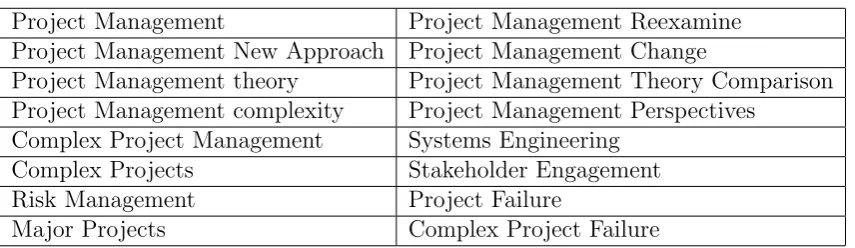
The process of researching this dissertation began with the question: What are the most important considerations for a project manager? To write something which was accessible, relevant and useful to project managers in real contexts required deep reflection on source quality. The first decision was my key concepts. I decided that these would be reexamin-ing project management and new approaches for project management. Next, I developed appropriate search strings.
[image:25.595.61.489.504.628.2]Each source that was found was read through and identified if the literature addressed one of the guiding questions. For literature regarding project failure there was a weighting ap-plied to Australian based papers due to their relevance to the dissertations target audience. Project tools that were heavily focused on Information Technology project management were also excluded due to the dissertations focus on infrastructure projects.
Table 1. Literature Review Key Words
Project Management Project Management Reexamine Project Management New Approach Project Management Change
Project Management theory Project Management Theory Comparison Project Management complexity Project Management Perspectives
Complex Project Management Systems Engineering Complex Projects Stakeholder Engagement Risk Management Project Failure
Major Projects Complex Project Failure
Once the sources had been accessed they were evaluated by considering their title, keywords and abstract. They were then examined using the perspective described in Svejvig et al which contrasts classical and ‘new’ project management approaches.
The key data from each study was the Source, question the source addressed, authors country they were located, quality evaluation, and if the study was theoretical of practiced.
• USQ electronic library
• Google Scholar
• Engineers Australia Technical Journals
• IEEE Explore
• Science Direct
3.4
Data Analysis
Thematic, inductive analysis is primarily used to categorise data into key themes, or as a process of “encoding qualitative information” (Boyatzis, 1998). The sources were grouped and the items were coded. Connections between certain statements were used to connect ideas to start collecting similar notions and created some initial ‘themes’. A focused thematic analysis was used, where the major considerations for a project manager were sought out, in order to answer the research question.
The categories which emerged were:
1. Alternative perspectives
2. Reality of projects
3. Complexity and uncertainty
4. Social and political impacts
5. Context (environment, organisational strategy)
Upon examination of the literature as well as the themes which became apparent after analysis, it is clear that it is not only the technical or technological elements in a project which make a project complex. De Bruijn et al. (1996) determined three dimensions of complexity: technical, social and organisational. As such, a framework which covers all three of these elements which add to project complexity is recommended.
3.5
Limitations of Methodology
project. The field of complex project management is also very new, and emerging trends and research being undertaken may come to very different conclusions.
4
Findings
4.1
Introduction
Existing best practice for project management is not always appropriate for complex projects. Complex projects need a project structure to be tailored to the individual project to meet stakeholder requirements. Monitoring and communication must be maintained throughout the project to ensure the project continues towards the objectives. (Bear 2015)
Flowcharts of FindingsTo assist in the usage of this dissertations findings four flowcharts have been created to assist project managers and members of project teams in their identi-fication and application of the tools. The flowcharts have been created too help guide the usage of the project tools.
General Project Tools These tools or processes have been identified as required for all complex projects. They are generally tools that are currently used in all levels of project management, with the exception of earned value methods, shaping, and col-laborative project structures. If none of the other project tools are used on a complex project, these will still contribute positively to a projects success and outcomes.
Project Uncertainty When a project manager identifies the project is encountering project uncertainty the tools and processes in this flowchart help to reduce that uncertainty. Clearly setting expectations, assessing issues, and other processes assist in reducing or removing project uncertainty.
Technological Uncertainty Within project uncertainty a subset of complexity exists for technological uncertainty. These tools and processes assist in reducing the issues that are caused by having technological unknowns. Clearly defining roles to minimise project team uncertainty, analysing what is known about the uncertainty faced and other actions can help in the mitigation of this complexity.
4.2
General Project Complexity
Possible causes of project complexity include the key personnel’s experience, project size, organizations structure, technical challenges and time-related issues. A lack of experience with executives and unwillingness to employ experienced personnel along with excessive project optimism, and pressure to begin projects while failing to acknowledge the associated risks. This chapter addresses tools that may be used to reduce this ‘general’ source of complexity.
4.2.1 Business Case
Prior to the project scoping, it is recommended that a business case is carried out (Murray et al. 2009). The business case should contain the need to undertake the project, the risks, potential budget, project duration (Murray et al. 2009), market demand, organizational need, customer request (if applicable), technological advances, legal requirements, ecological impact, or social needs of the project (Project Management Institute 2013). For considering potential solutions to the deficiency, it is recommended that at least three options are considered:
• Do nothing,
• do the minimum,
• or do something(Project Management Institute 2013).
The risk analysis should be high level and focus on effects on business objectives, and possible impacts on costs to mitigate the risks. The project schedule should also be considered when comparing options, and the earliest or latest start and finish times for the options should be considered. One of the most important components of a business case is confirmed there is an actual need for a project. Needs analysis examines whether there is a gap within the organisation, and that the amount of effort to resolve the issue is feasible (Kossiakoff, Sweet, Seymour & Biemer 2011). The needs analysis can help organisations assign budgets to future potential projects and minimizes the risk of totally unfeasible works being attempted. The analysis with typically examine existing market solutions, deficiencies, and possible new solutions.
The information for the needs analysis can be broken down into four steps (Kossiakoff et al. 2011).
Operations Analysis Analyse the need for a new solution, this may be due to a deficiency or potentially greater efficiencies. Examine the solutions whole of useful life, and attempt to define quantitative operational objectives.
Feasibility Definition Visual the subsystems needed for the project to function and define a feasible concept with estimated costs against performance.
Needs Validation Consider operational scenarios and external factors, define selection criteria, demonstrate why the solution is the best choice, and formulate a case for why the project is needed.
4.2.2 Governance
Project Governance is different to Corporate Governance. The basic goals of project gover-nance is to realise the planned benefits through evaluation of proposals in relation to strategic alignment, defining critical success factors, gathering business support, defining key roles and responsibilities of the project, enabling project resourcing, managing key stakeholders, monitoring progress, and enhancing delivery capacity. (Remington 2011)
For effective project management it is critical that the position is provided with appropriate governance structure. The governance structure should establish a process for the team to follow from as early in the process as possible. (Kevin Fickenscher & Michael Bakerman 2011) The governance structure should provide clear accountability for all roles. The project sponsor or director should make it clear to the project manager what the out-comes are, their financial delegations, scheduling requirements, and any other constraints of the project. It is important to note that project governance is different to corporate gover-nance, and is solely concerned with appropriate provision for the project. Key components the governance include clear definitions of key roles and responsibilities, enabling resources, managing stakeholders, monitor the scope, quality, budget and scheduling, define critical success factors, gather organisational support,and continue to improve delivery capability. (Remington 2011).
Governance in complex projects can require more than the single key person to be ac-countable for a project. Joint ventures or international partnerships governance structures are typically influenced by four main variables, corporate cultural differences, trust, pro-curement autonomy, and motivation. For projects involving large organisational cultural differences in practices and values it is critical that an appropriate governance structure is established. Traditional governance has several weaknesses when dealing with complex projects. It can be difficult to define a single point of accountability, assess the projects actual progress, provide systemic decision making, ensure truthful reporting, and a great deal of other issues. (Remington 2011)
The governance team determines whether a project is meeting success criteria, however it can be difficult for them to know the true status of a complex project. Effective governance depends on successful communication, through relationships with the project teams and encouraging free and open dialog between the project team and the governance body. It is also the governance teams responsibility to make the project team aware of organisational progress that may impact the project, as changes to a projects strategic alignment can greatly impact a projects potential to succeed.
If the relationship between contractors and the project manager breakdown, enforceable and mutually acceptable legal frameworks can greatly help with a resolution. Cross cultural issues can also occur. The governance structures suggested by the PMI or APM are infused with liberal democratic principles (Verspaandonk 2001). The difference in cultural values between different countries can be very substantial, complex project involving a single nation can have difficulty in establishing effective governance, but in multi-national projects it can be almost insurmountable(Remington 2011). Developing a shared understanding of the projects motivation and local political processes can greatly aid project governance and accountability. (Remington 2011)
Governance also needs to be established from the project initiation. It is important that the project manager is provided with enough delegated power that they can effectively manage. Difficult project sponsors can cause many difficulties and if the sponsor lacks a real interest in the project then more rigid and invested people should be used to balance the steering group.
The selection of the project manager is a critical part of projects. The experience and relation to a project can drive it to completion but the manager shouldn’t be the service owner. If the service owner also becomes the project manager other stakeholders can be-come neglected, there is less scrutiny on the project, and contingencies may be allocated to scope creep for the owners wants (Murray 2009). Environmental changes to a project may mean the planned benefits are no longer needed, which will lead to a necessary review of requirements and change in project scope. Good communication of a projects progress and identifying any issues early on can save a project (Murray et al. 2009).
The project management handbook PRINCE2 puts great emphasis on a projects governance. The PRINCE2 methodology can be used for projects of any scale, complexity or culture. PRINCE2 was developed from lessons learned and provides a framework of best practice. PRINCE2 focuses on seven principles they consider a must for success (Murray et al. 2009):
• Have continued business justification,
• learn from previous experience: lessons are sought, recorded and acted upon through-out the life of the project,
• have defined and agreed roles and responsibilities within an organization structure that engages the business, user and supplier stakeholder interests,
• have defined tolerances for each project objective to establish limits of delegated au-thority,
• focus on the definition and delivery of products, in particular their quality require-ments,
• be tailored to suit the projects environment, size, complexity, importance, capability and risk.
The seven principles provide a solid basis of governance and can be used to assess a projects management. APM has a special interest group that is entirely focused on a projects governance that has established their own 11 principles of governance (Weaver n.d.):
• The main board has overall responsibility for governance of project management
• The roles, responsibilities and performance criteria for the governance of project man-agement are clearly defined.
• Disciplined governance arrangements, supported by appropriate methods and controls, are applied throughout the project life cycle
• A coherent and supportive relationship is demonstrated between the overall business strategy and the project portfolio
• All projects have an approved plan containing authorization points at which the business case is reviewed and approved. Decisions made at authorization points are recorded and communicated.
• Members of delegated authorization bodies have sufficient representation, competence, authority and resources to enable them to make appropriate decisions.
• The project business case is supported by relevant and realistic information that pro-vides a reliable basis for making authorization decisions
• The board or its delegated agents decide when independent scrutiny of projects and project management systems is required, and implement such scrutiny accordingly
• There are clearly defined criteria for reporting the project status and for the escalation of risks and issues to the levels required by the organization
• The organization fosters a culture of improvement and of frank internal disclosure of project information
• Project stakeholders are engaged at a level that is commensurate with their importance to the organization and in a manner that fosters trust.
Figure 6. PRINCE2 Governance (retrieved from Murray 2009)
project can demonstrate its alignment (Project Management Institute 2013). PRINCE2 addresses alignment issues with ongoing justification to ensure continued monitoring and informed decisions for management.
Golden thread of delegated authority: As Kaye Remington discussed the importance (and often difficulty) of a well defined single accountable person, a ‘golden thread’ rep-resents the chain of responsibility from top to bottom and should clearly demonstrate what an individuals authority is. The purpose is to prevent decisions being overturned which can lead to losses of confidence, trust and uncertainty. When power is not del-egated appropriately organisations can lose control of work or prevent a project from being able to change. PRINCE2 addresses responsibilities with the importance of clearly defined roles and a ‘management by exception’ principle (Murray 2009).
Reporting: Reporting is critical to keep the directing and corporate management levels aware of the projects progress. PMBoK and PRINCE2 measure a projects progress by establishing methods to monitor and compare actual progress against planned scheduling and forecast viability. The project will also be given thresholds at which control measures or approval may be required to correct issues. A common method of measuring and assessing progress with scheduling and scope is the Earned Value method. Two types of reporting are time-based which involves progress against a pre-viously agreed interval with Checkpoint Reports and Highlight Reports. Event-based reporting is completed when a stage is reached, a request for change or exceptions or a new risk has been identified. Exception reporting is based on the Event-based method and occurs when a project has deviated from a projects tolerance. The controls on reporting requirements will be captured in the projects documentation (Murray 2009).
supplier. The PA role may be filled by members of the corporate organisation taking specific roles (Murray 2009).
Decision Gates: A formal control point in a projects life cycle The delegated authority will only extend until the next decision gate and the authority is extended after review. They form a ‘fail safe’ for issues missed in ongoing reporting. The project is broken into management stages allows control points where projects status, Business Case, and plans are reviewed. PRINCE2 recommends four stages: approval to initiate, after initiation, one at each stage boundary and one at project closure (Murray 2009).
Senior management must be committed to governance of projects and ANDY MUR-RAY states Nearly every study into project management performance shows that ap-propriate senior management involvement directly correlates with successful projects. (Murray 2009)
The governance team is responsible for the identification and updating of key stakeholders, and managing their expectations. Often projects will communicate with the key stake-holders, ask them for input and then not engage with them at all throughout the project. (Remington 2011) Stakeholders can be categorized into either primary stakeholders, or sec-ondary stakeholders. A primary stakeholder will usually be internal to the organisation or someone who interacts directly with the business which may include customers, employees or suppliers. The secondary stakeholders are those considered external to the project, they may be affected by the project but not engage directly with the product which can include media, or activist groups.
Typical stakeholders involved in a project are members of the project team, who complete or manage work for the project. Project sponsors who support the project and are invested in the success of the project, and project customers who help to guide the projects scoping and will ultimately be the user or owners of the projects product.
The governances implementation is critical to its success. The governance needs to sit between all key parties to prevent difficulties later in the project (Remington 2011). Pro-fessionally run workshops at project initiation to share values can prevent many complex projects risks. It will be more difficult to implement governance structures during the project than earlier. (Remington 2011).
The following governance standards have been suggested (Remington 2011).
• Standards of interpersonal behavior (honesty, trust, transparency).
• Problem-solving under conditions of certainty and uncertainty.
• Decision-making frameworks.
• Dealing with emergence (risk and learning opportunities).
• Procurement methods.
• Reporting protocols (owners, sponsors, project teams, stakeholders, including the me-dia - internal and external reporting pathways).
• Security provisions (level of access to documents).
• Organisational values (safety, quality, budget, schedule).
Complex projects rely on a flexible structure that will allow the project teams to respond quickly. Adding restrictive controls to projects that are getting out of control can make the project more difficult to manage (Plowman & Duchon 2008).
Governance may be formed with existing management teams or governance boards within an organisation. Upper management should determine the most closely aligned body and secure agreement on the governance role, providing them with a charter, scope, and how they are integrated into the approval process. (Project Management Institute 2013)
The governance team then needs to set project boundaries for the organisations and stake-holders values. The governance body can then establish or approve appropriate KPI’s. The governance should be inclusive at all levels and non-political. For large scale infrastructure with multi-owner or multi-national governance teams understanding of local networks and integration of agents is important (Remington 2011).
The two most critical roles requiring definitions have been identified (Remington & Pollack 2007).
Project Manager Research was conducted into the most important aspects of the project manager and identified the following attributes of successful managers (Remington & Pollack 2007).
• Developing creative project direction.
• Highly skilled with communication between all levels of the project.
• Comfortable working with ambiguity.
• Able to select appropriate methodologies to manage the project.
• Able to view issues from multiple perspectives.
• Allowed creative thinking and problem solving.
• Treated the project as smaller more manageable projects.
Executive Sponsor Typically project sponsors can be treated as purely responsible for the
projects finance, however additional responsibilities to the role have been suggested(Remington & Pollack 2007).
• Establish communication channels for the project manager to follow.
• Advocate for the project.
• Allow key resources to be procured easily.
• Motivate the project team.
• Provide objective criticism to the project team.
Table 2. PRINCE2 Governance Delegations
Level Responsibility Examples of delegating authority using tolerances Corporate or programme management level Those re-sponsible for commissioning the project.
Corporate or programme management sits outside the project but sets the targets (and tolerance levels) for the project. The three levels of management within the project direct, manage and deliver within these toler-ances and escalate any forecast breaches of project tol-erance (Murray 2009).
Directing level Those responsi-ble for setting di-rection.
The Project Board has overall control at a project level, as long as forecasts remain within project tolerance, and will allocate tolerances for each management stage to the Project Manager. The Project Board has the ability to review progress and decide whether to continue, change or stop the project. During execution of the Project Plan, if any forecasts indicate that the project is likely to exceed the agreed project tolerances, then the devia-tion should be referred to corporate or programme man-agement by the Project Board in order to get a decision on corrective action (Murray 2009).
Managing level Those respon-sible for the day-to-day man-agement of the project.
The Project Manager has day-to-day control for a man-agement stage within the tolerance limits laid down by the Project Board. During execution of a Stage Plan, if any forecasts indicate that the stage is likely to ex-ceed the agreed stage tolerances, then the deviation should be referred to the Project Board by the Project Manager in order to get a decision on corrective action (Murray 2009).
Delivering level Those responsi-ble for produc-ing the projects deliverables (products).
4.2.3 Collaborative Project Structures
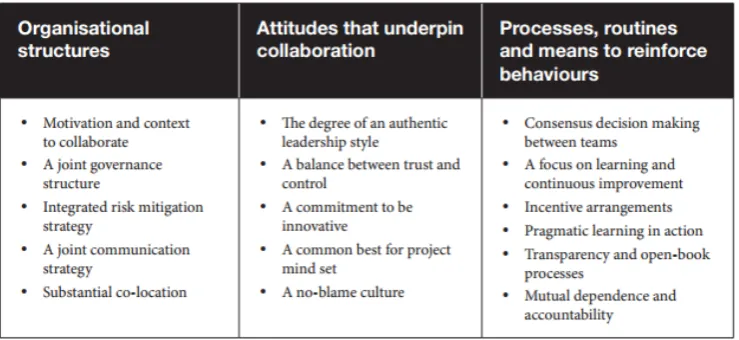
[image:42.595.109.479.194.364.2]Collaborative project structures are one suggested method of complex project governance. The three main principles for collaboration to achieve project success are “organisational structures that facilitate collaboration, attitudes that underpin collaboration, and processes, routines and means to reinforce behaviors, which are supported by the organisational struc-tures.” (Bear 2015)
Figure 7. Principles for Collaboration (retrieved from Mastering Complex Projects)
In collaborative structures the set of shared values and commitment to common project goals can create close project teams. Basing the goals and values on project performance criteria can assist in team selection, induction and training. (Bear 2015) Human resources are critical for a projects success and the right people need to be retained. Because of the teams need to function it may be better to reassign tasks than to fill a vacancy with an unsuitable candidate. (Bear 2015)
Some key differences to traditional structuring are “breaking down traditional silos by basing team structure on tasks, rather than specialisation or function, co-locating the core project team where possible, or implementing measures to allow formation of virtual teams with frequent communication and interaction, designing induction training to reinforce shared values and pass them on to new team members, empowering team members to challenge accepted procedures and norms to achieve excellence, involving project owners and external stakeholders in face-to-face meetings with the project team, implementing incentives that reward achievement above ‘business as usual’ these can be financial where appropriate, but can also be recognition based for team members.” (Bear 2015)
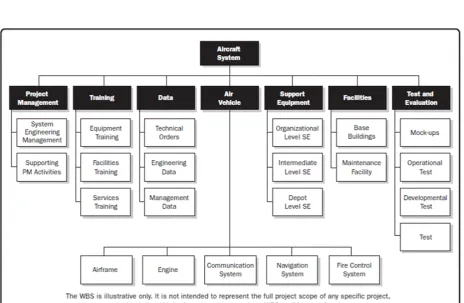
1.1 System Product
1.2 System Support
1.3 System Testing
1.4 Project Management
1.5 Systems Engineering
4.2.4 Work Breakdown Structures
A work breakdown structure is used to identify essential tasks to assist in scheduling, cost-ing, and planning. The work breakdown structure defines all tasks the project needs to accomplish in a hierarchal structure. As more about a project becomes known, the WBS should become more detailed as tasks are identified.
The following are a suggested systems engineering approach to a general structure for the WBS (Kossiakoff et al. 2011):
From each heading, there may be subsystems, components of those subsystems, breakdown of tasks within component. Not all subsystems and components will go to the same level, and the WBS should go to the level at which program control, detailed specifications, interfaces, and work assignments are available (Kossiakoff et al. 2011). The WBS can have as many different levels as appropriate.
Once a detailed WBS has been produced, cost controls and estimating can be efficiently applied. Each work package can have a budget allocated and from project initiation each cost is distributed between work packages. From these allocations cost controls can be effectively used by analysing actuals against estimated costs. When these values deviate outside of a certain threshold, the governance structure may be required for approvals or project changes may be necessary. By capturing these costs organisations can more accurately estimate future projects more accurately than comparing entire work packages (Kossiakoff et al. 2011).
4.2.5 Earned Value
The following terms form the basis for earned value.(Australian Standards 2006)
Actual Cost (AV) The actual costs incurred for works completed to date.
Earned Value (EV) The value of the work completed. The earned value will always be equal to the budgeted amount for completed work.
Budget The amount budgeted for completion of the activity.
Budget at Completion (BAC) The total budget for an activity, work package, entire project, etc.
Cost Variance (CV) The difference between the earned value and actual cost.
Estimate to Completion (ETC) The expected additional cost to complete an activity, based on the projects performance to date and anticipated budget.
Estimate at Completion (EAC) The expected total cost of an activity. The sum of the Estimate to Complete and the Actual Cost.
Planned Value (PV) The sum of the budget for work scheduled to be completed.
[image:45.595.136.444.424.607.2]Schedule Variance (SV) A review metric, the difference between the Earned Value and the Planned Value.
Figure 9. Example of Earned Value (retrieved from AS 4817 - 2006)
The earned value measure requires objective performance measures to allow analysis. The performance measures are used to express the earned value of sub-tasks, and should allow consistent measurement with only one measure per activity (Australian Standards 2006).
1 means the project is ahead of schedule, and less than 1 the activity is behind(Kossiakoff et al. 2011).
The second commonly used index is the Cost Performance Index (CPI): CPI = EV/AV. A CPI greater than 1 means the activity is over budget, and less than 1 the activity is under budget (Kossiakoff et al. 2011).
Earned value integrates a projects scope of work with schedule and cost elements to allow for efficient project planning and control (Kwak & Anbari 2012) NASA Earned value man-agement provides improvements for not just contractor work, but also internal work. EVM allows timely and accurate analysis of a projects progress on individual WBS deliverables for early detection and mitigation of issues that begin to arise within the project. Effective EVM will incorporate the projects Risk Management with consideration for scheduling and costs of risks, where estimating the risks may be too difficult the projects contingencies can capture them.(Kwak & Anbari 2012)
The combination of cost and schedule into value allows a practical method to measure a projects progress, four examples commonly used for EVM are:
The project is ahead of schedule and under budget No controls necessary
The project is ahead of schedule and over budget. The project can have the works slowed to return to budget, or the early completion may mean a consistent cost with the completed budget totals and the decision may be to proceed at the current rate.
The project is behind schedule and under budget. The project may require additional spending to get back on to the projects baseline schedule.
The project is behind schedule and over budget. The project may need to have a reduction in scope delivered.
The implementation of Earned Value Management requires additional rigor in establishing the project initially, however the increased control over large projects justifies those con-straints. The additional work required to manage EVM makes it impractical to implement for smaller projects.For the projects initiation phase an initial WBS, Integrated Baseline Review, Baseline Project Plan.
4.2.6 Risk Controls
Risk management must be an integral part of project initiation. Risks to a project’s financial viability, scheduling, improving public perception, reliability or failing to meet the agreed scope must be identified. Different project stakeholders may be interested in different project risks. After key risks have been identified the risk controls must be considered. Risk controls may include transferring risks through contractual arrangements, thresholds for controls, contingencies and other management plans. (Bear 2015)
Complex projects require sufficient resource allocation for the evaluation and identification of critical risks. Allowing sufficient time for risk management can reduce the chance of project failure. The process needs to carry through from initiation to completion and treatment of risk must embed all decisions of the project.
A common method of risk management is to share the risk through partnerships. Some countries have begun promoting alternative procurement methods for dealing with pub-lic infrastructure projects (Shen, Platten & Deng 2006). The pubpub-lic private partnerships are intended to improve the efficiency of management by incorporating the private sector. A typical public private partnership will include the operation of the facility. The part-nerships offer the benefits of accelerating the delivery of the projects, encouraging more efficient project delivery, reducing the whole life costs incurred by including operation and maintenance of the project as a responsibility of the private sector creates an incentive for the design to minimise ongoing costs, the risks are allocated to the organisation that will be most able to manage the risks and ensuring performance through ongoing payment (Delmon 2009).
AS/NZS ISO 31000 is based on analysing the likelihood and consequences of risks rather than whether or not they are critical to project success. Complex projects require early identification of show stoppers no matter how unlikely. Project leaders have a legal obli-gation to ensure clear treatments are provided to personnel responsible for risk mitiobli-gation and critical risks are dealt with at project start.
A common method of risk identification is holding ‘Risk Workshops’. Due to the risk of group think an effective approach is to encourage creative thinking. The divergent/convergent thinking model is an example of the thinking model. Identified risks are presented as “What if..” and controls are presented as “Can we..”. Convergent thinking is a logical convergence on a single decision, and divergent is creative thinking with many possibilities. Risk management requires both to succeed. We are often conditioned to think logically but creative thinking is required. (Bear 2015)
Critical risks may be known to a stakeholder but not communicated, these are titled “un-known “un-knowns”. Complex projects must manage risks, uncertainty, and ambiguity. A collaborative approach to the project can allow resolution of ambiguities, uncertainties and better inform the team.
treatment is “retaining and managing the risk, avoiding the risk, transferring the risk to another party by contract.” If risks are contracted out despite the affect on collaboration, the risk management process should inform the best placed party to manage the risk.
After planning for all the identified risks, unknown unknowns are still a possibility to derail complex projects. A top down functional vulnerability analysis to identify critical success factors and threats for project failure, continue vulnerability analysis throughout the project, seek threats and incorrect assumptions out rather than ignoring them, use external experts to provide advice with adequate provisions.(Bear 2015)
Cost estimations of risk control should be generous. If a high risk information technology cannot withstand a 400% budget overrun, it should not commence.(Flyvbjerg & Budzier 2011)
At every step of a project, unpredictable outcomes can occur that may pose a risk to the projects success. Systems engineering approaches risk through the System Life Cycle. The life cycle recognises that risk decreases throughout a project as the uncertainty is reduced. The life cycle acknowledges the importance that it is critical to a project for adequate scoping to occur at initiation. New technologies also add to a projects risk as it can be difficult to ensure they meet the performance criteria(Kossiakoff et al. 2011).
Risk management is a major component of the Systems Engineering Management Plan. Systems Engineering approaches risks with the view of eliminating alternative solutions that are based on uncertain or ambitious but unwarranted so