CURRENT PRACTICE IN ACADEMIC WORKLOAD ALLOCATION
PROCESSES IN AUSTRALIA
Richard Watson1, Rachel King1, Stijn Dekeyser1, Liz Baré2, Clive Baldock3
1University of Southern Queensland, 2University of Melbourne, 3University of Tasmania
[email protected], [email protected], [email protected], [email protected], [email protected]
ABSTRACT
Embarking on a large-scale research project to investigate aspects of academic workload management, it was first necessary to gain some understanding of current practice in that context within Australia. With that aim a pilot survey was conducted in 2013 that targeted Deans of Science on the one hand, and workload managers on the other. Survey questions covered three key areas related to workload management: models and rules; process and policy; and systems and software. Comparisons between different types of university, different allocation models for teaching, research and service components of academic
workload, and different sizes of academic unit were explored. While the number of responses in absolute terms was relatively limited, and hence the outcomes were not always statistically testable or generalisable, broad trends were readily identifiable.
This paper reports on the method and outcomes of the survey, and describes how the
information that was obtained has informed the development of an in-depth research project.
KEY WORDS
Academic workload management, academic workload models
INTRODUCTION
Academic work in Australia, and also in many other countries, has become increasingly regulated. There have always been more or less formal rules within institutions that describe work expectations for academics, and attendant processes of varying formality. Drivers such as larger student enrollments and decreased funding have contributed to higher teaching loads which in turn require closer regulation in order to avoid overloading staff which can lead to a range of personal and professional issues (Hemer, 2014; Boyd, 2014). With increasing regulation, those rules and processes have become more clearly defined, and have begun to appear, in part at least, in the enterprise agreements negotiated at universities (Rea, 2012). The rules are commonly called a ‘workload model’ or henceforth just ‘model’.
Because models and their deployment can have a huge effect on staff, students, and
organisations, they have become the subject of numerous studies (see Dekeyser et al., (2014) for a useful introduction). Most studies investigate some aspects of model usage such as staff satisfaction (e.g. Vardi, 2008; Houston et al., 2006)) or are case studies within a single institution or at most a small number of institutions (e.g. Barrett & Barrett, 2010; Dobele et al., 2010). The survey reported here is part of an ongoing study of much larger scope, to inventory a wide range of models seeking to understand and compare models on a
The pilot survey was intended to inform the authors in the design of a further more detailed and extensive survey, and to guide them in the acquisition of information about actual models that are available for study. It was anticipated that some questions would provide expected answers, others would expose novel results, but that a third group would result in
inconclusive or ambiguous results. These are all seen as excellent outcomes in the context of planning for subsequent investigation.
The paper first briefly describes the survey methodology. Results are then presented and discussed; some of the ambiguous or inconclusive results are omitted so that the noteworthy can be presented. A discussion of overall conclusions follows the results, and the paper concludes with a presentation of ongoing work informed in part by this survey.
THE SURVEY
The survey consisted of 39 multiple choice and 4 open ended questions related to three main areas: Models and Rules (21 questions); Process and Policy (10 questions); System and Software (6 questions). Two additional questions were related to the respondent’s role within their institution and the type of institution within which they are employed. All multiple choice questions required the selection of one categorical response from a varying number of options, depending on the question.
The Models and Rules group of questions focused on identifying the specific workload model used by the respondent’s academic unit and the rules that make up that model. The Policy and Process group of questions focused on the how academic workload policy at an institutional level is implemented through business processes at the academic unit level. The Software and Systems group of questions related to the software used to manage academic workload allocations.
Because of wide variation in understanding of the term ‘workload model’ a clear definition was provided as part of the survey introduction. A model was defined as ‘a collection of detailed rules that determine workload allocations for staff and/or units or courses’; this was further amplified by examples such as ‘assessment of one student in a semester course/unit attracts 1 hour of workload’.
The survey was created by the authors based on their experiences managing academic workload and assisting others to do so across a range of models and disciplines. It was also informed by informal discussions with academic managers from Australian universities who participated in LHMartin Institute for Leadership and Management in Higher Education (LHMI) workshops prior to the survey.
Over half of the questions related to the models, as understanding the range of approaches was seen as fundamental to determining the direction that more focussed research could take. Questions were designed to elicit information about the overall style of model, especially with regards to the ways of dealing with teaching, research, and service, as well as the kinds of rules that make up a model. The respondents were also asked to evaluate aspects of the model’s deployment.
The survey instrument used was a Google Docs spreadsheet presented as a web form, open to any person who obtained its link. All questions were shown in a single web page, with drop-down boxes and radio buttons to enable easy data entry as well as ensure consistency. The web survey also presented a link to a short document explaining terminology used. After the survey closing date, the data was exported in spreadsheet format and subsequently loaded into SPSS version 21.0 for analysis.
In March 2013 the online survey link was sent via email to 37 Deans of Science across Australian universities and 63 past attendees of three LHMI workshops run between 2010 and 2012. No information which would enable direct identification of respondents was collected in this survey. Ethics clearance was obtained from the Melbourne Graduate School of Education Human Ethics Advisory Group. Two reminders were sent prior to the survey closing on 5 April, at which point 34 of the 100 recipients had responded.
RESULTS
In this section the more significant results of the survey are presented. Responses to individual questions are presented where they appear to show an interesting result. Associations between pairs of questions are also presented: an association is considered significant if, for a particular response to question A, a high proportion (greater than 80 per cent) of those that chose that response also chose a particular response to question B. It is acknowledged that it is impossible to attach statistical significance to these results due to the small sample size. However that was not the aim of the pilot survey; rather the survey has identified areas of interest that should be explored further in a variety of wider and more systematically designed investigations.
Demographics
The survey response rate was 34 per cent, the majority of whom (74 per cent) identified their role within their university as one associated with academic management e.g. Dean or
Associate Dean of Faculty or School, Head of Department or School, Faculty Manager or Workload Co-ordinator. Respondents were from a range of institution types including: Group of Eight members (Go8, four respondents), Innovative Research Universities (IRU, five), Regional Universities Network members (RUN, nine), Australian Technology Network (ATN, six). A further ten respondents were from unaligned universities.
Respondents managed predominantly larger organisational units (68 per cent with at least 100 academic staff) and unsurprisingly the units were quite diverse (82 per cent of units managed comprised at least three disciplines, with half of the units including at least five disciplines).
Twenty two respondents (64 per cent) identified the dominant discipline within their unit as Science, Engineering, ICT or Health, which reflects the bias introduced by directly inviting Deans of Science to participate.
Models and Rules
‘variable’ scheme, while the ‘fixed’ method accounted for almost all (24 per cent) of the remainder. This challenges a commonly-heard assumption that most Australian universities still follow a long established fixed 40/40/20 per cent distribution.
Work allocated within the research and service categories are similar in that associated duties are not as simple to identify and in particular quantify compared to work allocated within the teaching category. Respondents were asked, for both research and service, whether work was allocated as a single non-specific ‘block’, to specifically identified duties, or by using another method. Just over half (56 and 52 per cent respectively for research and service) of the
models used a block allocation, with a strong association between the two results. Specific duty allocation accounted for most of the remaining responses, being used in 32 per cent (research) and 44 per cent (service) of the cases. It would be useful to know more about the specific duties in these two cases, and indeed to have a clearer definition of the research and service categories. If academic administration roles such as program coordinator, and research-related roles such as student supervision were excluded from the categories it may well show a much more common use of block allocations.
A much wider range of options exist for allocating teaching workload. Five ways of allocation teaching workload have been identified in the literature:
1. constant per-course/unit allocation (Hull, 2006), 2. contact/lecture hour based (Burgess, 1996),
3. based on estimated hours to perform the task (Vardi, 2009),
4. points-based—like the estimated hours method but using a notional point value (Ringwood et al., 2005), and
5. cost based: depending on income generated by course/unit (Filby and Higson, 2005).
Respondents showed a range of responses, with the majority (85 per cent) relatively evenly spread between methods 2, 3 and 4 (24, 32 and 29 per cent respectively). However if the estimated hours and points based responses are combined, because they both attempt to estimate the relative effort required to complete a specific academic task (albeit using different units), they together account for 61 per cent of the responses. Both these methods account for work at a relatively low (task specific) level, which places an onus on the workload manager and requires appropriate accounting systems.
Respondents were asked to judge the complexity of their model and also to estimate how many distinct rules the workload model contained. The results appear in Figure 1. It would be expected that the more complex models have more rules, which is largely borne out by the results, though there were some apparent inconsistencies. Almost half of the respondents thought their model was complex, yet only 32 per cent of models had more than 30 rules. This could imply that the minimum number of rules to render a model ‘complex’ is
Figure 1. Model size and complexity
The complexity of individual rules was estimated based on whether or not all rules could be expressed as a linear function of a single variable. Linear rules are deemed relatively simple. The question gave as an example of a linear rule: ‘workload hours [that] scale with the number of enrollments or with the number of contact/delivery hours’. While the majority (68 per cent) thought their rules linear (i.e. simple) a significant proportion did not. This
contradicts the authors’ subsequent experience of examining over 25 detailed institutional models (almost all of them using linear rules only), and points to the need for more investigation.
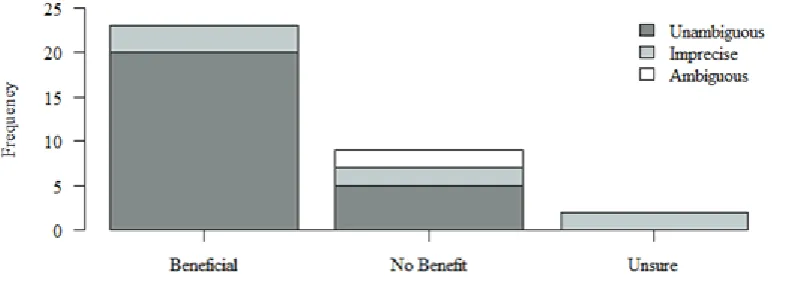
The respondents’ view of model clarity (‘is it unambiguous?’) was solicited, as well as the very subjective ‘Does your unit’s workload model work for you?’. The second question specifically asked if the respondent believed that the model’s deployment was ‘beneficial to the academic unit’. Figure 2 shows the combined results of these two questions. There is a very strong association between clear unambiguous rules and the perceived benefit of the use of the model.
Figure 2. Model utility and clarity
[image:5.595.75.468.507.650.2]One question addressed the perceived relationship between workload model and the cost of running the academic unit; four responses were possible: that model usage increased costs, decreased costs, had no effect, or that the respondent was unable to judge. Interestingly this had a very even range of responses, between 21 and 29 per cent for each possible response. When comparing answers to the question about generosity, 90 per cent of the ‘decreases costs’ respondents believed their model was ungenerous. However, the reverse did not hold as only 11 per cent of ‘increases costs’ respondents believed the model to be generous.
Process and policy
The questions in this part of the survey were somewhat exploratory or speculative in nature, as the issues associated with applying a workload model are unclear. The responses in general were unsurprising and so will be reported mostly without comment.
The majority (88 per cent) of models were deemed to be either fully or mostly compliant with the institution’s enterprise agreement. However the authors’ subsequent experience, based on interviews with workload managers, indicates that practice at institutions that officially state a fixed 40/40/20 per cent of distribution of teaching, research and service, is often much more flexible and hence only matches policy to a degree.
Almost half the models (47 per cent) were deployed in a single academic unit, and a further 32 per cent were used across a small number of units. The smallest grouping was for institution-wide deployment (21 per cent).
Respondents were asked how well workload management processes were integrated with other traditional HR processes such as promotion or performance management. There was an equal division between ‘not integrated or unsure’ responses and the ‘integrated’ responses.
A question asked whether managers were adequately trained in either the workload policy or in the process aspects including supporting software systems. A surprisingly large proportion (41 per cent) of respondents believed that managers were not well trained in either aspect and only 35 per cent answered that managers were trained in both aspects.
Workload allocation was performed mostly by the head of the academic unit (62 per cent) with a workload coordinator—who is identified as an academic staff member—accounting for another 26 per cent of responses. There were two instances of a deputy/associate dean being involved but only one instance of management being performed by a non-academic staff member.
The majority (71 per cent) of respondents believed that the workload allocation process is relatively efficient while 21 per cent thought it took too long. There was no association found between these answers and possible influencing factors such as model complexity or the kind of model used to allocate teaching.
System and software
The kinds of supporting software used to support the workload allocation process are of particular interest as two of the authors have had experience in both developing workload management software and in using it while in the department head role.
accessed by multiple users. The use of spreadsheets is anecdotally widespread but they are notoriously error prone, while single-user applications preclude both cooperation between a group managing workloads and easy dissemination of individualised information to staff. The use of spreadsheets predominates (68 per cent) while almost half (44 per cent) of the
applications are single-user. This shows clearly that the majority of respondents are managing their staff workload with systems that are far from optimal.
Most of the software (71 per cent) used was developed within the institution as compared with commercial off-the-shelf software (24 per cent). No clear associations were found to link either kind of software with aspects of model or process.
Respondents were asked about the breadth of deployment of the software system that they use. The frequency of answers was inversely proportional to the size of the academic unit. The proportions of use within a single unit, a group of units (e.g. a faculty) and the entire institution are respectively 41, 29 and 18 per cent, with 12 per cent unsure. Unsurprisingly, all of the ‘institution wide’ software users also had an institution wide model. The reverse was almost true, with a single exception: one of the seven institution wide model users reported the use of ‘faculty level’ software.
Transparency can be seen as a either a model, process or system issue. Transparency has a number of interpretations, but in this survey it was defined as the degree to which staff in the respondent’s unit can see the workload allocations of their peers. It is becoming common to see the principle of transparency enshrined in university enterprise agreements. Some 29 recent EBAs from different universities agreed since 2009, available from the Fairwork Australia website, have been examined. All require the workload allocation process to be fair and equitable, and 24 require transparency, though only four of these EBAs mandate the publication of workload allocations of all staff in an academic unit to other members of that academic unit. Local rules made within the framework of the EBA may require publication to demonstrate transparency but this is not mandated by an Agreement.
Almost half (47 per cent) of the systems allow full transparency and a further 26 per cent can see some of their peers’ workload (e.g. that associated with units/courses that both staff members teach into). Some 24 per cent reported an opaque system where staff were by design unable to access any details of their peers’ workload.
Free-form survey questions
Four questions asked for a free text response. The questions sought the respondents’ views on
1. issues with their current workload model (16 responses),
2. what alternatives/improvements would they suggest (8 responses, 7 expressed dissatisfaction with current model)),
3. issues with current policy/process (13 responses) and 4. issues with overall workload tool (9 responses).
workload managers. Comments have been reworded for clarity, and in order to unify a number of related responses.
Current model issues. The following are representative of responses.
The use of performance based research allocations can have a negative effect on teaching quality. It is difficult to quantify and model the resources required for non-traditional modes of delivery such as online teaching. Rigid and explicit models can impact staff behaviour. For instance they may be unwilling to do some requested task (by a peer or supervisor) unless it is listed specifically in their workload. Also tight teaching allocations discourage
experimentation with pedagogy that could be beneficial. It is difficult to identify and quantify all aspects of academic work.
Alternative and improvements. Most respondents indicated that the workload model worked for them, though they stressed the importance of equity and the need for a consistent system. Simplicity was a common theme—respondents would prefer a simpler system. Another theme related to model rules: how could the relative value of different types of work be established, and the need for flexibility to cater for new types of work?
Issues with policy and process. Time constraints were identified: both the amount of time required to perform the allocations, and the need to allocate work before final enrolments are known. Different models across schools, departments and faculties within a university lead to inequity or at least a perception thereof. Processes to review the model are not seen to be timely or effective. Workload allocation systems need to be better integrated with other university systems such as performance management.
Transparency was a common concern from a number of respondents. This applied within a unit, where individuals’ workload was opaque, as well as across an institution where comparison of different models in place was not possible.
Associations
While only a few notable associations between question results have been reported above, a very widespread association appeared that was related to one particular response. Seventy four per cent of respondents answered ‘Yes’ when asked ‘Do you, in your current role, believe that having the model in place is beneficial to the academic unit?’ (see Figure 2). For many other questions, a particular answer was very well associated with this response. For example, over 80 percent of the respondents who answered that their model was generous also believed that use of their model was beneficial. Other responses in the over 80 percent category include:
respondent was a dean,
very heterogeneous model,
estimated hours used to allocate teaching work,
moderately complex model and between 10—30 rules,
deployed within a single unit,
work allocation tied in with performance,
head of unit allocates workload,
acceptable efficiency and
DISCUSSION
The small sample size of the survey makes it impossible to make statistically supported statements about the results and especially about relationships between the responses to pairs of questions. The results do however identify apparent dominant practice in the sector such as
use of individually variable proportions for teaching, research and service allocations,
teaching allocations use task-based allocations (either estimated hours or points),
models are mostly compliant with enterprise agreements,
systems are mostly transparent and
most systems are spreadsheet-based.
Many results were unsurprising, such as workload management being performed by academic supervisors, the respondents’ views on model generosity, and the strong association between institution-wide model and system deployment.
Other results were somewhat unexpected, and warrant further investigation or at least monitoring to determine whether the situation is changing over time. For instance, the continued use of inflexible and error prone spreadsheet software, and the lack of integration of workload systems and processes with other institutional systems and processes seems problematic and likely to change in the future. The rate of use of institutional models is quite low (21 per cent); this may increase over time as pressure for better budgetary control and transparency across an institution increases.
There are still many open questions which could not be answered given the small sample size. It was not possible to find any associations between, for example, model complexity and other process issues like perceived efficiency. Likewise the kind of institution or size of unit was not associated with any of the answers reported in the survey.
Another issue is the way research and service allocations are managed, in particular the role of ‘block’ allocations compared to specific task allocations. The survey did not look at these in detail, but they can be very important as, for the dominant variable allocation scheme, staff members’ teaching allocations can vary greatly depending on these allocations.
The relationship between workload allocation systems and institutional budgets and financial models is largely unexplored and only touched upon lightly here, with little useful result. It would be interesting to test the hypothesis that models influence costs only when the model is created at the same level of the institution where budgets are set.
SHAPING THE DIRECTION OF THE RESEARCH PROJECT
As mentioned in the introduction, the pilot survey was originally intended to inform the authors in the design of a further, more detailed and extensive survey. However, some of the outcomes necessitated a review of that objective. Firstly, it was clear that obtaining a
significantly larger sample set would be non-trivial; workload managers are relatively few in number compared to the overall academic body, and the nature of their duties possibly precludes having capacity to complete a detailed list of questions.
questions, driven by the local context, may explain the even range of responses in such cases. The authors concluded that any attempt to create a common understanding of a wide range of aspects of academic workload management among respondents in a larger scale survey would be problematic, and would likely reduce the response rate in any case.
While the plan of a subsequent large-scale survey was hence abandoned, the outcomes of the pilot were nonetheless instrumental in the further development of a revised in-depth research project. The overall, ambitious objective of the project remains the same: understanding current practice in academic workload allocation processes in the Australian higher education sector, and their effects on a wide range of issues such as research productivity and
casualisation of teaching.
Instead of attempting to gain that understanding through asking managers a set of standard questions, the authors have decided to first create an inventory of workload models currently used in Australian universities. This phase of the project is proceeding well, with descriptions of more than 25 models now stored in the project repository. The original textual descriptions of these models are being translated into standardised or canonical representations so that direct comparisons can be made. Where uncertainty of interpretation of the published institutional models exist, managers at the associated institution are interviewed to seek clarification.
While canonicalisation is labour-intensive, it has already led to new insights into the creation of workload models (Dekeyser et al., 2014).
Two of the authors have developed workload management software, called WAMS, that employs a web interface, fine grained role based access control, and a sophisticated generic database design. The teaching components of some of the models that have been gathered have been recorded using WAMS. A number of ‘standard’ units or courses have been defined, with parameters such as enrollment, number of lecture and tutorial hours and marking time allocation. The WAMS software can calculate the effort required for each model-course pairing. These imaginary standard courses/units form a benchmark suite: by using WAMS the relative ‘cost’ of the teaching component of models can be calculated and compared. Preliminary results indicate a surprisingly wide range of resource allocation for the same input, and are identifying a number of open questions that will require additional study.
ACKNOWLEDGEMENT
The authors wish to thank the survey respondents for their contribution to this work.
REFERENCES
Barrett, L. & Barrett, P. (2010). Cycles of Innovation in Managing Academic Workloads. Higher Education Quarterly, 64(2), 183-199. doi: 10.1111/j.1468-2273.2009.00436.x
Boyd, L. (2014). Exploring the utility of workload models in academe: a pilot study, Journal of Higher Education Policy and Management, 36(3), 315-326.
Dekeyser, S., Watson, R., and Bare, E. (2014). Designing an academic workload model in the age of blended learning. Proceedings of the Tertiary Education and Management Conference (TEMC2014), Cairns, Australia, 31 Aug-3 Sept 2014.
Dobele, A., Rundle-Theile, S., Kopanidis, F., and Steel, M. (2010). All things being equal: observing Australian individual academic workloads, Journal of Higher Education Policy and Management, 32(3), 225-237.
Filby, J. & Higson, H. (2005). The contribution model: A school-level funding model. Perspectives: Policy and Practice in Higher Education, 9(3), 86-91.
Hemer, S. (2014). Finding time for quality teaching: an ethnographic study of academic workloads in the social sciences and their impact on teaching practices, Higher Education Research & Development, 33(3), 483-495.
Hull, R. (2006). Workload allocation models and ‘collegiality’ in academic departments, Journal of Organizational Change Management, 19(1), pp.38 - 53. doi:
10.1108/09534810610643677.
Rea, J. (2012). Key academic claim: Control workloads and create new jobs, NTEU Advocate,19(2), 19-20.
Ringwood, J., Devitt, F., Doherty, S., Farrell, R., Lawlor, B., McLoone, S.C., McLoone, S.F., Rogers, A., Villing, R., and Ward, T. (2005). A resource management tool for implementing strategic direction in an academic department. Journal of Higher Education Policy and Management, 27(2), 273-283.