Role of LAMP1 Binding and pH Sensing by the Spike Complex of
Lassa Virus
Hadas Cohen-Dvashi, Hadar Israeli, Orly Shani, Aliza Katz, Ron Diskin
Department of Structural Biology, Weizmann Institute of Science, Rehovot, Israel
ABSTRACT
To effectively infect cells, Lassa virus needs to switch in an endosomal compartment from its primary receptor,
␣
-dystroglycan,
to a protein termed LAMP1. A unique histidine triad on the surface of the receptor-binding domain from the glycoprotein spike
complex of Lassa virus is important for LAMP1 binding. Here we investigate mutated spikes that have an impaired ability to
in-teract with LAMP1 and show that although LAMP1 is important for efficient infectivity, it is not required for spike-mediated
membrane fusion
per se
. Our studies reveal important regulatory roles for histidines from the triad in sensing acidic pH and
preventing premature spike triggering. We further show that LAMP1 requires a positively charged His230 residue to engage with
the spike complex and that LAMP1 binding promotes membrane fusion. These results elucidate the molecular role of LAMP1
binding during Lassa virus cell entry and provide new insights into how pH is sensed by the spike.
IMPORTANCE
Lassa virus is a devastating disease-causing agent in West Africa, with a significant yearly death toll and severe long-term
compli-cations associated with its infection in survivors. In recent years, we learned that Lassa virus needs to switch receptors in a
pH-dependent manner to efficiently infect cells, but neither the molecular mechanisms that allow switching nor the actual effects of
switching were known. Here we investigate the activity of the viral spike complex after abrogation of its ability to switch
recep-tors. These studies inform us about the role of switching receptors and provide new insights into how the spike senses acidic pH.
V
iral hemorrhagic fevers (VHFs) are a devastating global health
problem with a significant yearly death toll. One of the
caus-ative agents of VHFs in Africa is Lassa virus (LASV), which
be-longs to the
Arenaviridae
family. LASV is an enveloped,
negative-strand RNA virus that naturally resides in rodents from the
Mastomys
genus (
1
) and can spread to humans (
2
). The primary
cellular receptor of LASV is
␣
-dystroglycan (
␣
-DG) (
3
,
4
), which
is recognized by a trimeric class 1 viral glycoprotein complex
(spike complex) on the viral surface (
5
,
6
). Following successful
attachment to
␣
-DG on cells, LASV is internalized via
macropi-nocytosis (
7
), and the spike complex facilitates membrane fusion
at the acidic environment of a late endosomal compartment (
5
,
8
).
The LASV spike complex is expressed as a glycoprotein
precur-sor (GPC) that is cleaved into three segments by a signal peptidase
and subtilisin-kexin-isozyme 1/site 1 protease (
9
). The functional
spike complex consists of a receptor-binding subunit (GP1), a
membrane-anchored fusion protein (GP2), and a unique and
sta-ble structured signal peptide (SSP) (
10
). Three fully processed
glycoprotein moieties comprise the functional trimeric spike
complex. It was recently shown that successful infection by LASV
requires it to switch in a pH-dependent manner from the primary
␣
-DG receptor to lysosome-associated membrane protein 1
(LAMP1) (
11
). LAMP1 (also called CD107a) is a major
constitu-ent of the lysosome membrane (
12
) and is thought to play an
important role in maintaining lysosome integrity (
13
). Only a
basal level of LAMP1 could be detected on the plasma membrane
for some cell lines, and it is typically restricted to lysosomes and, to
some degree, late endosomes (
14
,
15
).
We recently solved the crystal structure of GP1 from LASV
(
16
). This structure revealed a unique cluster of three histidine
residues that are highly conserved among the Old World
arenavi-ruses. This histidine triad is located on the surface of the protein,
and we showed that mutating each of the histidine residues to
tyrosine either reduces (H92Y) or completely prevents (H93Y and
H230Y) binding to LAMP1 (
16
). Thus, the histidine triad
consti-tutes part of the LAMP1-binding site of Lassa virus GP1,
provid-ing a possible explanation for the pH dependence of LAMP1
bind-ing. However, we do not know the molecular role of this histidine
triad for the function of the spike, and we also do not know why
binding to LAMP1 is needed during infection. Here we investigate
the modulation of the spike’s membrane fusion activity as well as
the entire process of infection upon mutating the histidine triad
and abrogating the interaction with LAMP1. Our studies reveal
important mechanistic roles of the histidine triad in pH sensing
and triggering of the spike complex and provide a mechanistic role
for binding of LAMP1.
MATERIALS AND METHODS
Materials.HEK293T cells (human embryonic kidney cells; ATCC CRL-11268) were maintained in Dulbecco’s modified Eagle medium (DMEM; Gibco) supplemented with minimal essential medium (MEM) nonessen-tial amino acids (Biological Industries), 1% (vol/vol) 200 mML -glu-tamine solution (Biological Industries), 1% (vol/vol) Pen-Strep solution (10,000 U/ml penicillin, 10 mg/ml streptomycin; Biological Industries), and 10% (vol/vol) fetal bovine serum (FBS; Gibco), here referred to as 293
Received16 August 2016 Accepted31 August 2016
Accepted manuscript posted online7 September 2016
CitationCohen-Dvashi H, Israeli H, Shani O, Katz A, Diskin R. 2016. Role of LAMP1 binding and pH sensing by the spike complex of Lassa virus. J Virol
90:10329 –10338.doi:10.1128/JVI.01624-16.
Editor:S. R. Ross, University of Illinois at Chicago
Address correspondence to Ron Diskin, [email protected].
Copyright © 2016, American Society for Microbiology. All Rights Reserved.
on November 7, 2019 by guest
http://jvi.asm.org/
full medium (293 FM). The GP2-293 retroviral packaging cell line (Ta-KaRa, Clontech) was maintained in DMEM with the same supplements as those described above, except for the addition of 1% (vol/vol) 100 mM sodium pyruvate (Biological Industries) instead of nonessential amino acids. Vero cells were maintained in RPMI medium (Gibco) supple-mented with 10% FBS and 1% Pen-Strep. Anti-LAMP1 antibody (CD107a) was obtained from Millipore, anti-green fluorescent protein (anti-GFP) antibody was from MBL, anti-␣-tubulin clone DM1A was from Millipore, anti-transferrin receptor (CD71) was from Thermo Fisher Scientific, anti-␣-dystroglycan (IIH6 C4) was obtained from the DSHB hybridoma bank, and anti-Flag polyclonal antibody (pAb) was from Thermo Fisher. Anti-rabbit and anti-mouse IgGs conjugated to horseradish peroxidase (HRP) were obtained from Jackson, and Strep-Tactin conjugated to HRP was purchased from Iba. A monoclonal anti-body against Lassa virus GP1 (Ab482) (16) was prepared in our laboratory from a hybridoma.
Construction of expression vectors.The LASV GPC coding DNA sequence was chemically synthesized (Genescript) and subcloned into the pcDNA3.1 expression vector by use of BamHI-NotI restriction sites. Mu-tated variants of LASV GPC were generated by PCR, using Kapa HiFi DNA polymerase (Kapa Biosystems) according to instructions of the QuikChange site-directed mutagenesis manual. GP1LASV-Fc fusion
proteins were generated as previously described (16). Point mutations of histidine residues 92, 93, and 230 of Lassa virus GP1 were intro-duced by PCR mutagenesis. Flag-tagged and Strep-tagged Lassa virus GPCs were prepared by amplifying the GPC sequence with primers containing a C-terminal Flag/Strep tag and cloning it into pcDNA3.1 by use of BamHI-NotI restriction sites. LAMP1-mGFP was a gift from Esteban Dell’Angelica (Addgene plasmid 34831) (17). LAMP1-pENTR221 was obtained from the Weizmann Institute Forscheimer plas-mid bank and was subcloned into pcDNA3.1 by use of BamHI-NotI re-striction sites. LAMP1-⌬384 mGFP and LAMP1-⌬384-pcDNA mutants were generated using PCR-based site-directed mutagenesis. The pEGFP-N1 vector (Clontech) was a kind gift from Y. Yarden (Weizmann Institute of Science).
Cell fusion assay.HEK293T cells were seeded into a 24-well plate precoated with poly-L-lysine (Sigma). Seeded cells were transfected 24 h later with 0.2g of Lassa virus GPC plasmid DNA by use of linear poly-ethylenimine (PEI) (25 kDa; Polysciences). Twenty-four hours after transfection, cells were rinsed once with 293 FM supplemented with 20 mM morpholinoethanesulfonic acid (MES; Acros Organics) that was titrated to pH 5.5 or lower. Cells were then incubated with the same medium for 10 min or as indicated, followed by washing and incubation with 293 FM for 2 h at 37°C. Following incubation, cells were fixed in prewarmed 3.7% formaldehyde solution (J. T. Baker) in phosphate-buff-ered saline (PBS) (Biological Industries) for 10 min. Phase images of syn-cytia were taken at a magnification of⫻10 by using a phase microscope. Syncytia were manually spotted and selected on images. The boundaries and coverage area were automatically traced and calculated using the Ver-satile Wand tool of ImageJ (18).
Pseudoviral particle production and RT-qPCR quantification.Lassa virus GPC-pseudotyped viruses were produced by transfecting the retro-viral transfer vector pQCXIP-Vx3K0-mEGFP (Addgene plasmid 35527; a gift from Robert Cohen) (19) along with the Lassa virus GPC-pcDNA envelope plasmid or its mutant derivatives into the GP2-293 retroviral packaging cell line (Clontech). Briefly, GP2-293 cells were seeded at 4⫻ 106to 5⫻106in 100-mm culture dishes. The next day, cells were
trans-fected with the retroviral vector and the envelope plasmid at a 1:1 ratio by using the calcium phosphate transfection method. After 5 h, the transfec-tion medium was replaced with GP2-293 FM, and supernatants contain-ing viral particles were harvested 48 h later. For viral quantification, re-verse transcription-quantitative PCR (RT-qPCR) was used to determine the RNA levels of the murine enhanced green fluorescent protein (mEGFP) reporter gene. Media were centrifuged at 19,000⫻gat 4°C for 10 min, and 50-l aliquots from the supernatants were treated with 2
g/ml RNase A (Bio Basic Inc.) for 10 min at room temperature. To inhibit RNase A activity, 40 U of RNasin RNase inhibitor (Promega) was added, and the reaction mixture was incubated for 10 min at 37°C. RNA was then extracted from viral particles by use of an RNeasy minikit (Qia-gen). To eliminate remnants of the mEGFP-containing retroviral vectors, RNA was treated with RNase-free DNase I (NEB) for 10 min at 37°C, followed by heat inactivation at 75°C for 10 min. Thereafter, cDNA was prepared from RNA by use of a high-capacity cDNA reverse transcription kit (Applied Biosystems). cDNA was diluted 1:40 and subjected to qPCR using specific primers for EGFP and Fast SYBR green master mix (Applied Biosystems).
Infectivity assays.HEK293T or Vero cells were seeded onto poly-L -lysine-precoated coverslips in 24-well plates. Cells were infected 24 h later with 2 ml pseudovirus-containing supernatant, and the medium was re-placed after 24 h. At 48 h postinfection, cells were fixed with prewarmed 3.7% formaldehyde solution in PBS and mounted on slides using fluores-cence mounting medium with DAPI (4=,6-diamidino-2-phenylindole) (GBI Labs). Raw images were taken in a fluorescence microscope at a magnification of⫻10 and further processed using ImageJ. For quantifi-cation of infection events, HEK293T cells were seeded and infected in a 6-well plate. At 48 h postinfection, cells were detached using trypsin-EDTA solution (BI), resuspended in DMEM, and analyzed using an LSR II flow cytometer (BD Biosciences) to detect GFP-positive cells and deter-mine the infectivity levels.
LAMP1 pulldown assay.Wild-type (WT) GP1 and the various mu-tants fused to Fc were expressed by transfection of plasmid DNA into HEK293T cells in monolayers by use of linear PEI 25-kDa transfection reagent (Polysciences), and fusion protein-containing media were col-lected after 5 days and assessed for expression of secreted protein by dot blotting using anti-human Fc. GP1-Fc proteins were captured from the medium by incubation with protein A Sepharose beads (Santa Cruz Bio-technology) at 4°C for 1 h, followed by 3 washing steps in NETI buffer (50 mM Tris-HCl, pH 8.0, 150 mM sodium chloride, 1 mM EDTA, 0.5% [vol/vol] octylphenoxypolyethoxyethanol [IGEPAL; Sigma]). Beads were then incubated with whole-cell lysates from HEK293T cells prepared in NETI buffer and adjusted to pH 5.0 at 4°C for 1 h. Proteins were eluted in 20 mM Tris-HCl, pH 8.0, 150 mM sodium chloride. Eluted protein sam-ples were precipitated using cold acetone. Protein pellets were recovered in sample buffer and subjected to SDS-PAGE and immunoblot analysis.
Biotinylation and pulldown of cell surface proteins.To detect sur-face levels of Lassa virus GPC complexes, we cotransfected HEK293T cells with GFP (pEGFP-N1) and Lassa virus GPC-pCDNA3.1 or its mutant variants by using PEI. At 48 h postinfection, cells were washed twice with ice-cold PBS and were gently agitated for 30 min at 4°C with 0.25 mg/ml EZ-Link sulfo-NHS-SS-biotin (Thermo Scientific) dissolved in ice-cold PBS. To quench the reaction, cells were washed with cold PBS followed by a cold Tris-buffered saline (TBS) wash. Cells were then lysed using Triton lysis buffer, and the lysate was centrifuged at 10,000⫻gfor 2 min. Biotin-labeled proteins were then isolated from clarified supernatant by batch purification by agitation with 50l of NeutrAvidin beads (Thermo Sci-entific). Biotinylated proteins were eluted by boiling of beads with dithio-threitol (DTT)-containing sample buffer. To assess the levels of GPC, eluted samples were subjected to SDS-PAGE and immunoblotting with anti-Lassa virus GP1, anti-transferrin receptor, or anti-GFP, as a control for nonsurface proteins.
␣-DG pulldown assay.HEK293 cells were transfected with Flag-tagged Lassa virus GPC and its mutant variants. At 48 h posttransfection, whole-cell lysates were prepared using Triton lysis buffer. Lysates were clarified by centrifugation, and supernatants were incubated with EZview Red anti-Flag beads (Sigma-Aldrich). Beads were then washed and incu-bated with whole-cell lysates of nontransfected cells prepared in NETI buffer. Beads were washed, and proteins were eluted using a 3⫻Flag peptide (Sigma-Aldrich). Eluents were boiled in sample buffer and sub-jected to SDS-PAGE and immunoblotting using anti-␣-DG and anti-Flag.
on November 7, 2019 by guest
http://jvi.asm.org/
Generation of GFP⌬384-LAMP1 stable cell line.HEK293T cells were transfected with the⌬〈384-LAMP1-mGFP or pEGFP-N1 vector. At 48 h posttransfection, the medium was replaced with selective antibiotic-containing medium (800g/ml G418). Cells were grown in the presence of the antibiotic for 2 weeks. Resistant colonies of stable cells were col-lected as a polyclonal cell line.
Pseudovirus cell attachment assay.Lassa pseudoviruses were treated with 2g/ml RNase A and DNase I for 10 min at 37°C, followed by treatment with RNasin RNase inhibitor (Promega) for 10 min at 37°C. Treated pseudoviruses were then diluted 1:10 in DMEM and applied to cells on ice. Following 30 min of incubation, cells were washed twice with PBS and lysed for RNA preparation and RT-qPCR with primers against GFP and glyceraldehyde-3-phosphate dehydrogenase (GAPDH). For each experiment, the 2⌬⌬CTvalue was calculated for each sample, and
expression was normalized to that of the WT.
Immunofluorescence assay.HEK293T cells were seeded onto poly-L -lysine-precoated coverslips in 24-well plates. Cells were fixed 24 h later with prewarmed 3.7% formaldehyde solution in PBS and blocked with 3% bovine serum albumin (BSA) in PBS. Cells were stained with anti-LAMP1 and fluorescein isothiocyanate (FITC)-conjugated wheat germ agglutinin (WGA). Cells were imaged at a magnification of⫻100 by using an Olympus IX83 microscope coupled to a Yokogawa CSU-W1 spinning disc confocal scanner. Images were processed using ImageJ.
Detection of incorporated spikes into pseudoviruses.To analyze the incorporation of Lassa virus GP into pseudoviruses, we followed a previ-ously described protocol (20). C-terminally Flag-tagged Lassa virus GPC-pseudotyped viruses were prepared as we previously mentioned, without the addition of serum to the medium. Supernatants containing the viruses were collected at 48 h posttransfection, clarified by centrifugation at 200⫻gfor 5 min, filtered through a 0.45-m filter, and clarified again by centrifugation at 19,000⫻gfor 10 min. Clarified viral stocks were then layered onto a cushion of 20% sucrose in PBS and centrifuged at 367,000⫻gfor 30 min. Pelleted pseudoviruses were lysed in Triton buf-fer, and Flag-GP2 was immunoprecipitated using anti-Flag beads. Pro-teins were eluted from beads by boiling of beads in sample buffer and were subjected to SDS-PAGE and immunoblotting with anti-Flag.
RESULTS
Spike-mediated cell fusion.
Cell fusion events result in the
for-mation of multinucleated cells (syncytia) that are easily identified
by simple bright-field light microscopy. We monitored syncytium
formation in HEK293T cells following transfection with the spike
GPC gene, as an indicator of the fusogenic activity of the LASV
spike complex. HEK293T cells naturally present the LASV
recep-tor
␣
-DG on the plasma membrane (
21
), but not other molecules
that may serve as entry receptors for LASV (
22
). To verify that
these cells indeed display a negligible level of LAMP1 on the
plasma membrane, as expected (
14
,
15
), we used confocal
micros-copy with immunofluorescence labeling to visualize the cellular
localization of LAMP1 (
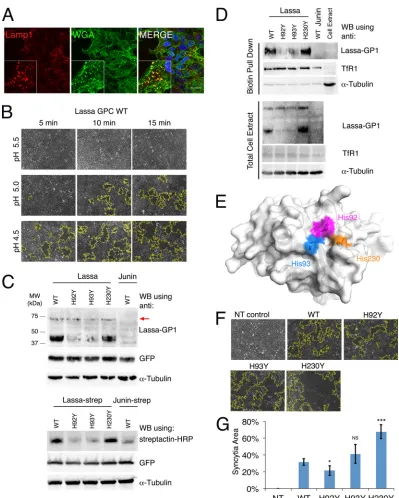
Fig. 1A
). LAMP1 in HEK293T cells
ap-peared inside the cells, with a punctate staining pattern (
Fig. 1A
).
LAMP1 staining colocalized with wheat germ agglutinin staining
only at intracellular compartments, not at the plasma membrane
(
Fig. 1A
).
We first optimized the cell fusion assay by using the wild-type
spike complex from LASV (
Fig. 1B
). Three buffer conditions,
ad-justed to different pH values, and the incubation times in these
respective buffers were tested. Syncytium formation was
moni-tored using bright-field imaging. This experiment revealed a clear
correlation between syncytial area and acidity levels as well as
be-tween syncytial area and incubation times (
Fig. 1B
). Whereas no
syncytia formed at pH 5.5, pH 5.0 was sufficient to induce cell
fusion after incubation for 10 min, and robust cell fusion at pH 4.5
was already observed after 5 min of incubation (
Fig. 1B
). Thus, the
fraction of syncytial area as we measure it is indicative of the
fu-sogenic activity of the spike, and we can modulate this activity by
using different buffer conditions. The results from this
experi-ment generally agree with previous studies (
23
,
24
) reporting that
fusion starts at pHs of
⬍
5.0 and that maximal activity is obtained
at pH 4.0 or pH 3.0 when cells are exposed to the low-pH buffer for
15 min (
23
) or 2 min (
24
), respectively.
Cell fusion activity of histidine triad mutants.
To reveal the
functional role of the histidine triad, we constructed three
mu-tated GPC genes, each bearing a single histidine-to-tyrosine point
mutation. We already demonstrated that in the context of isolated
GP1, these mutations give rise to properly folded, soluble, and
secreted proteins with circular dichroism (CD) spectra similar to
that of GP1
WT, which are equally recognized by an anti-GP1
an-tibody (Ab482) (
16
). In the current study, we tested the influence
of these mutations on the expression and maturation of the
com-plete spike complex. For this purpose, we transiently transfected
HEK293T cells with vectors encoding the WT and mutated GPCs
and monitored the levels of matured spikes by using our
anti-Lassa virus GP1 monoclonal antibody (
Fig. 1C
). GPC
H230Ywas
present at a level similar to that of GPC
WT, as can be judged from
the GP1 levels (
Fig. 1C
). Mutating His92 and His93, on the other
hand, resulted in a decrease in GP1 levels (
Fig. 1C
). Since the levels
of the GPC precursors were similar for all mutants (
Fig. 1C
, upper
bands at
⬃
75 kDa), we wanted to see if the lower GP1 levels were
due to enhanced GP1 dissociation or to overall decreased levels of
mature spikes. We fused Strep tags to the C termini of the GPC
variants and monitored the levels of the GP2 subunits (
Fig. 1C
). As
observed with the levels of GP1, the His92 and His93 mutations
reduced the amount of GP2, whereas the His230 mutation did
not. Next, we tested whether these mutations interfered with the
ability of the spikes to reach the cell surface. Cell surface proteins
were biotinylated by exposing intact cells to sulfo-NHS-SS-biotin,
which reacts with exposed amine groups. We then pulled down
the biotinylated fraction and analyzed for the presence of GP1
(
Fig. 1D
). All mutated GPCs were present at the cell surface, in the
same relative quantities as those observed in the total cell extracts
(
Fig. 1C
). As expected, the band corresponding to the precursor
GPC was visible only in the total cell extract. Thus, mutating His92
and His93 reduces the overall levels of mature spikes compared
to those with GPC
WTbut does not prevent cell surface
presen-tation or selectively increase GP1 dissociation from the spikes.
The differences in expression levels indicate that changes at
His230 are better tolerated than changes at His92 and His93
(
Fig. 1E
), probably due to a structural function of His92 and
His93 in the context of the native GPC. Regardless of the
dif-ferences in levels of matured spikes, all mutants were able to
induce cell fusion after 10 min of incubation at pH 5.0 (
Fig. 1F
).
By repeating these assays and calculating the fractions of
syn-cytial area, we could quantify the activities of the mutated
spikes (
Fig. 1G
). Despite their relatively low expression levels,
GPC
H92Yand GPC
H93Yachieved fusion levels comparable to or
slightly greater than that of GPC
WT. In this assay, GPC
H230Ydisplayed significantly enhanced activity compared to that of
GPC
WT(
Fig. 1G
). The ability of the various GPCs to facilitate
cell fusion may imply that the mutated GPCs retained their
capacity to interact with their cellular receptor.
Cell infection mediated by mutated spike complexes.
We
next evaluated the ability of the histidine triad mutants to facilitate
on November 7, 2019 by guest
http://jvi.asm.org/
FIG 1Fusogenic activity of histidine triad mutants. (A) Confocal microscopy imaging of HEK293T cells. DAPI staining is shown in blue, anti-LAMP1 staining is shown in red, and wheat germ agglutinin staining is shown in green. Bar, 20m. Insets show higher-magnification views of a selected region. (B) Cell fusion assay using the WT spike complex of LASV. Transiently transfected, confluent HEK293T cells were exposed to the indicated pH values for 5, 10, and 15 min. Bright-field images of the cells are shown. Syncytial boundaries were traced using ImageJ and are marked with yellow lines. (C) Western blot (WB) analysis of HEK293T cell lysates for cells transfected with the various WT and mutated LASV spikes (upper panel) and the same spikes fused to a Strep tag at the C terminus (lower panel). Transfection of the spike complex from Junin virus is shown as a negative control (upper panel) and as a reference with a Strep tag (lower panel). A plasmid encoding GFP was cotransfected to monitor transfection efficiency. For the anti-Lassa virus GP1 antibody, higher-molecular-weight bands are visible and correspond to unprocessed GPCs (marked with a red arrow). As a loading control, we stripped each membrane twice and used it for detection of␣-tubulin and GFP. (D) Pulldown assay of cell surface biotinylated proteins. Cells were transfected with the indicated GPC and exposed to sulfo-NHS-SS-biotin to specifically tag proteins at the cell surface. Cells were lysed, and the levels of GP1 in the total cell extract (lower panel) and the biotinylated pulldown fraction (upper panel) were analyzed. Levels of transferrin receptor 1 (TfR1), which resides on the cell surface, were monitored to control for the efficiency of the biotinylation reactions and for the load levels. The levels of␣-tubulin were monitored to detect the exposure of cytoplasmic content to the biotinylating reagent. (E) Histidine triad on the surface of Lassa virus GP1 (PDB ID4ZJF), shown in magenta, blue, and orange for His92, His93, and His230, respectively. (F) Cell fusion assay with pH 5.0 buffer for 10-min exposures of transiently transfected HEK293T cells to the WT, H92Y, H93Y, and H230Y spike complexes of LASV. Fusion of nontransfected cells (NT) is shown as a negative control. Representative images from multiple experimental repeats are shown. (G) Areas of syncytia as fractions of the total area of the field of view were measured using ImageJ and averaged over 6 independent experiments. Error bars show standard deviations. Statistical significance, determined using Student’sttest, is indicated as follows: NS, not significant; *,P⬍0.05; and ***,P⬍0.005.
on November 7, 2019 by guest
http://jvi.asm.org/
[image:4.585.92.491.61.559.2]infection. Using a retroviral packaging cell line (GP2-293;
Clon-tech), we generated pseudotyped viruses carrying the desired GPC
and a GFP reporter gene. We used RT-qPCR to quantify the RNA
levels of the GFP reporter gene as a means to measure the levels of
the pseudoviruses. Infectivity in this regard cannot be used for
quantification due to the potential differences in activity of the
various GPCs. We first treated the pseudovirus stock solutions
with RNase A and DNase I to eliminate nucleic acid
contamina-tions that are not protected inside virus-like particles. Analyzing
the number of cycles needed to cross the detection threshold (
C
T)
revealed maximal averaged differences (
⌬
C
T) of less than one
cy-cle between the reporter gene levels in the mutated pseudoviral
stocks and those for the WT (
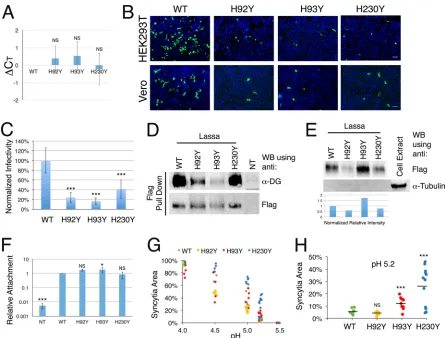
Fig. 2A
), which translates to average
⬍
2-fold differences in the RNA levels. The average
⌬
C
Tvalues
were obtained by determining individual
⌬
C
Tvalues for several
independently produced batches of pseudoviruses. The efficiency
FIG 2Infectivity and pH-dependent fusion by histidine triad mutants. (A) RNA quantification by RT-qPCR analysis of the indicated pseudoviral stocks. We produced 4 different batches of pseudoviral stocks. For each batch of viruses, we extracted RNA and performed reverse transcription and qPCR analysis. TheCT
value for GPCWTwas subtracted from the values measured for the mutated GPCs from the same batch to give the net differences (⌬C
T) in RNA levels.⌬CTvalues
were averaged, and error bars show standard deviations. (B) HEK293T (upper row) and Vero (lower row) cells were exposed to equal volumes of the pseudoviral stocks, and positively infected cells that expressed the GFP reporter gene were visualized by fluorescence microscopy. Nuclei were stained with DAPI. Bars, 50m. Infectivity experiments were repeated multiple times, and representative images are shown. (C) Infected HEK293T cells were analyzed using FACS to quantify the levels of infection. We repeated the quantification 6 times, using 4 different batches of pseudoviral stocks. The averaged infectivity of GPCWTwas defined as 100% to normalize the results. Averaged relative infection levels of the indicated mutants are shown. Error bars show standard deviations, and statistical significance compared to the WT is indicated with asterisks (***,P⬍0.005; Student’sttest). (D) Pulldown of␣-DG by GPC-Flag variants, detected using anti-Flag M2 resin. Loading volumes were adjusted to have similar levels of Flag. Nontransfected cells (NT) were used as a negative control. (E) Incorporation of spike complexes into pseudoviruses. Flag-tagged spikes that were incorporated into pseudoviruses were detected using anti-Flag antibody following isolation of the pseudoviruses by ultracentrifugation and capture by anti-Flag beads. Equal volumes of the lysed pseudovirus solutions were analyzed by Western blotting for the presence of tubulin as a control for cell-derived contaminations. The anti-Flag signals from two Western blot analyses were quantified using densitometry and normalized to the RNA levels of the reporter gene in the concentrated pseudovirus samples as determined using RT-qPCR. The normalized intensities are displayed relative to the WT level. (F) Cell attachment assay. Equal dilutions of the indicated pseudoviruses that were validated to have the sameCTby RT-qPCR
were applied to cells, and the levels of attached viruses were quantified by monitoring GFP levels by RT-qPCR after lysis of the cells. The levels of GAPDH were also quantified using RT-qPCR to serve as a reference. The relative and normalized levels of pseudoviruses bearing either mutated or WT GPC were obtained by calculating⌬⌬CT(see Materials and Methods). Nontreated (NT) cells were used as a negative control and indicate detection of background levels. The
experiment was independently repeated three times, and average values are shown. Error bars show standard deviations, and Student’sttest results indicate statistical significance compared to the WT, as follows: NS, not significant; *,P⬍0.05; and ***,P⬍0.005. (G) Quantification of cell fusion assay results for GPCWT, GPCH92Y, GPCH93Y, and GPCH230Yat various pH values. For each mutant, individual experimental values for the fraction of syncytial area coverage are shown. (H) Cell fusion by GPCWT, GPCH92Y, GPCH93Y, and GPCH230Yat pH 5.2. Individual experimental values are shown for each variant, and the horizontal line shows the average value (***,P⬍0.005; Student’sttest).
on November 7, 2019 by guest
http://jvi.asm.org/
[image:5.585.69.514.63.401.2]of pseudovirus production as measured by
C
Tvalues varied
ac-cording to the passage number of the packaging cell line, but the
differences (
⌬
C
T) between viruses that were produced at the same
time were minute (
Fig. 2A
). Equal volumes of all pseudoviral
stocks were applied to HEK293T and Vero cells, and GFP-positive
cells were visualized 48 h later using fluorescence microscopy (
Fig.
2B
). Compared to that of GPC
WT, the histidine triad mutants
exhibited a noticeably reduced capacity to infect cells (
Fig. 2B
).
Quantification of infected HEK293T cells by
fluorescence-acti-vated cell sorter (FACS) analysis further demonstrated that
differ-ence (
Fig. 2C
).
The observed decrease in cell infectivity prompted us to test
various aspects of the production of the pseudoviruses and of the
GPCs that may account for it. We first tested if the mutations in
the histidine triad abrogated the ability of the spikes to attach to
␣
-DG. We constructed GPCs with a Flag tag attached at the C
terminus, performed a pulldown assay using M2 anti-Flag beads,
and used Western blot analysis to detect
␣
-DG (
Fig. 2D
). For this
analysis, we adjusted the loading volumes to have comparable
amounts of GPCs as estimated using anti-Flag antibody (
Fig. 2D
).
All the GPC mutants retained some capacity to interact with
␣
-DG (
Fig. 2D
), which agrees with their ability to promote
cell-cell fusion (
Fig. 1F
and
G
). Although it is not a quantitative
method, this Western blot analysis further indicates that whereas
GPC
H230Yeffectively pulled down
␣
-DG, like GPC
WT, the
inter-actions of GPC
H92Yand GPC
H93Ywith
␣
-DG were impaired. This
observation supports the above-mentioned notion that the H92Y
and H93Y mutations may undesirably affect the structure of the
spike. We next addressed the possible caveat that mutations in the
histidine triad affect the incorporation of the spikes into
pseudo-viruses. We first pelleted pseudoviruses by ultracentrifugation but
failed to detect the spike complexes by using the GP1
anti-body. We thus generated pseudoviruses using the Flag-tagged
GPCs, pelleted them by ultracentrifugation, and used anti-Flag to
detect the incorporated GP2 proteins (
Fig. 2E
). The mutations
introduced into the histidine triad did not prevent the
incorpora-tion of the spike complexes into the pseudoviruses (
Fig. 2E
). We
further quantified and averaged the intensities of the anti-Flag
signals from two independent analyses and normalized them to
the RNA levels of the pelleted pseudoviruses as a proxy for the
incorporation levels of the GPCs (
Fig. 2E
). The incorporation
lev-els of the various mutated GPCs relative to that of GPC
WT, as
estimated from this analysis, were in the range of
⫾
50% and were
not correlated with the infectivity levels of the pseudoviruses (
Fig.
2C
). Since cell attachment may involve factors other than
␣
-DG
(
22
), we further wanted to compare the abilities of the WT and
mutated GPCs to mediate attachment to cell surfaces. For that
purpose, we generated various pseudovirus stocks, verified the
equal RNA levels (data not shown), diluted the stocks, and applied
them to cells in monolayers for 30 min of incubation on ice. After
incubation and washing, we lysed the cells and quantified the RNA
levels (
Fig. 2F
). The mutations in the histidine triad did not affect
the attachment of the pseudoviruses to cells compared to that with
GPC
WT(
Fig. 2F
). Based on the above-mentioned results and since
GPC
H230Yand GPC
WTwere expressed at similar levels (
Fig. 1C
),
there is a
bona fide
impairment in infectivity that is mediated by
the GPC
H230Ymutated spike, and perhaps by the other two
mu-tants as well.
Histidine triad mutants are more sensitive to acidic pH.
The
apparent increase in membrane fusion activity of GPC
H93Yand
GPC
H230Y(
Fig. 1F
and
G
) prompted us to further investigate the
molecular roles of these histidines during spike-mediated and
pH-dependent membrane fusion. First, we examined the
pH-depen-dent fusion activity of the histidine triad mutants (
Fig. 2G
). In
comparison to the WT spike complex, the onset of triggering by
acidification for GPC
H93Yand GPC
H230Yoccurred at a higher pH;
at pH 5.2, GPC
H230Yand, to some degree, GPC
H93Yshowed
sig-nificant fusion activity with a stochastic appearance, whereas
GPC
WTand GPC
H92Yconsistently showed very low levels of
fu-sion (
Fig. 2H
). At pH 5.0, the areas of syncytia formed by GPC
H93Yand GPC
H230Ywere larger (
Fig. 2G
), as already reported above
(
Fig. 1F
), but at a sufficiently low pH (i.e., pH 4.0) the fusogenic
activity by all the spikes was saturated and approached complete
coverage of the field of view by syncytia (
Fig. 2G
). Thus, GPC
H93Yand GPC
H230Yare more sensitive to acidic pH than the WT spike
complex, with a higher probability of being activated at a less
acidic pH. Importantly, the intrinsic abilities to sense pH and to
induce membrane fusion were maintained in all mutants.
His230 functions as a negative regulator of fusion.
Histidine
residues have an imidazole side chain with a theoretical pK
aof
⬃
6.0. Below this pH, they favor the protonated, positively charged
state. From our above-mentioned results, eliminating the
poten-tial to bear a positive charge in His93 and His230 by mutating
them to tyrosine seems to increase the propensity of the spikes for
triggering. To further investigate this notion, we mutated His230
to both a positively charged arginine and a negatively charged
glutamate. The decision to mutate His230 was based on our
ob-servation that this residue better tolerates alterations than His93
(
Fig. 1C
). First, by expressing GP1
H230E-Fc and GP1
H230R-Fc
fu-sion proteins, we were able to verify that GP1 recognition by the
anti-GP1 antibody (Ab482) was not affected by these mutations
(
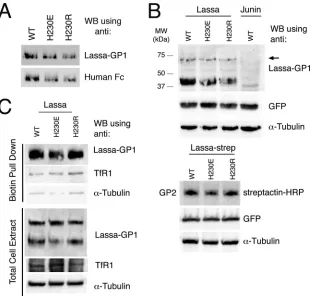
Fig. 3A
). We then transiently transfected HEK293T cells with
vectors encoding the mutated GPCs, lysed them, and probed for
the levels of expression of the new His230 mutants by monitoring
GP1 levels as well as GP2 levels, using Strep-tagged versions of the
GPCs (
Fig. 3B
). GPC
H230Eand GPC
H230Rdisplayed levels of
ex-pression comparable to that of GPC
WT(
Fig. 3B
). We further
ver-ified that these mutants reached the cell surface by using
biotiny-lation of the surface proteins and a subsequent pulldown assay
(
Fig. 3C
). Next, we tested the fusogenic activity of the mutants.
The positively charged GPC
H230Rmutant showed a significantly
delayed onset of fusion compared to GPC
WT(
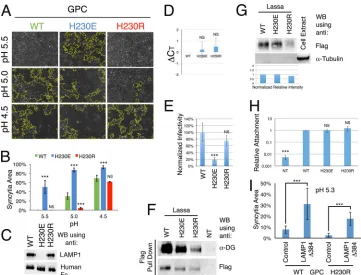
Fig. 4A
and
B
). At
pH 5.0, only minor fusion activity was observed with GPC
H230R,
whereas GPC
WTdisplayed substantial fusion activity. At pH 4.5,
GPC
H230Rcatalyzed massive cell fusion, indicating that this
mu-tation affected the pH triggering point but not the fusogenic
ac-tivity itself. Surprisingly, the negatively charged GPC
H230Emutant
became hypersensitive to acidic pH, as significant cell fusion was
already induced at pH 5.5 (
Fig. 4A
and
B
).
A positive charge at position 230 is required for LAMP1
binding and for efficient cell infectivity.
Mutating His230 to a
tyrosine prevented LAMP1 binding to GP1 (
16
). We were
in-trigued to see whether it was the tyrosine substitution
per se
that
interfered with binding or rather the elimination of the positive
charge at this position. To address this question, we performed a
pulldown assay using protein A beads at pH 5.0 in the presence of
the GP1
WT-Fc, GP1
H230E-Fc, or GP1
H230R-Fc fusion protein (
Fig.
4C
). GP1
H230R-Fc was able to effectively pull down LAMP1
simi-larly to GP1
WT-Fc, but GP1
H230E-Fc was not (
Fig. 4C
). Next, we
tested the ability of pseudoviruses bearing GPC
H230Eand
on November 7, 2019 by guest
http://jvi.asm.org/
GPC
H230Rto infect cells. We used the same packaging cell line as
that mentioned above to produce pseudoviruses bearing
GPC
H230Eand GPC
H230Rand used RT-qPCR to measure their
RNA content compared to that of GPC
WT-containing viruses (
Fig.
4D
). The variations in RNA levels between the pseudoviruses were
⬍
2-fold (average
⌬
C
T⬍
1) across different batches of viruses (
Fig.
4D
). We used these pseudoviruses to infect HEK293T cells and
monitored positively infected cells by FACS analysis (
Fig. 4E
). A
negative charge at position 230 (H230E) was deleterious for
infec-tivity, and only low levels of positive cells were identified (
Fig. 4E
).
On the other hand, a positive charge at position 230 (GPC
H230R)
allowed efficient infection that was close to the level seen for
pseu-doviruses with GPC
WT(
Fig. 4E
). Importantly, the mutations of
His230 to glutamic acid and arginine did not change the ability of
the spikes to interact with
␣
-DG (
Fig. 4F
) or to be incorporated
into pseudoviruses (
Fig. 4G
). Furthermore, we did not observe
any change in the ability of these pseudoviruses to attach to cell
surfaces compared to that of GPC
WT(
Fig. 4H
).
LAMP1 binding triggers the GPC spike complex.
Our results
indicate that LAMP1 requires a positive charge at position 230
that can equally be provided by either a histidine or arginine
res-idue (
Fig. 4C
). This observation strongly implies that LAMP1
do-nates a negative charge for this interaction. Positioning a negative
charge in the vicinity of His230 may emulate to some degree the
H230E mutant, which has a higher propensity to be triggered at
moderate pH values (
Fig. 4B
). To investigate this notion, we
gen-erated a stable cell line that expresses a LAMP1-
⌬
384 mutant that
ectopically accumulates on the cell surface (
25
) and is conjugated
to GFP at its cytoplasmic C terminus. In conjunction, we
gener-ated a similar cell line that expresses only GFP as a control. We
performed cell fusion assays using these cell lines and found that in
the presence of overexpressed LAMP1 on the cell surface, the
probability of both GPC
WTand GPC
H230Rbeing triggered at pH
5.3 was significantly higher than that for control fusion in the GFP
control cell line (
Fig. 4I
).
DISCUSSION
The crystallographic structure of GP1 from LASV that we
previ-ously determined allowed us to identify a unique cluster of three
histidines that contribute to the interaction with LAMP1 (
16
).
Cell fusion assays clearly showed that tyrosine mutations in this
histidine triad in the context of the complete spike complex do not
hinder pH-induced membrane fusion (
Fig. 1F
). Since the
histi-dine triad mutants have an impaired capability to bind LAMP1
(
16
), we can conclude that LAMP1 binding is not required for
spike fusogenic activity
per se
. Unlike the fusogenic activity,
dis-FIG 3Expression and surface display of GP1H230Eand GP1H230R. (A) GP1WT, GP1H230E, and GP1H230Rfused to the Fc portion of a human IgG were transiently expressed in HEK293T cells, and equal volumes of medium were subjected in duplicate to SDS-PAGE followed by Western blotting, using the anti-LASV GP1 antibody (Ab482) for one half of the membrane and anti-human Fc as a loading control for the second half of the membrane. (B) Western blot analysis using anti-GP1 antibody, showing the expression levels of GPCH230Eand GPCH230Rrelative to that of GPCWTfollowing transient transfection of HEK293T cells (upper panel) and by following the levels of GP2 using Strep-tagged versions of the spikes (lower panel). A plasmid encoding GFP was cotransfected to monitor transfection efficiency, and GFP and␣-tubulin (as a loading control) were detected on the same membrane after stripping. An arrow indicates unprocessed GPCs. (C) Pulldown assay of cell surface biotinylated proteins, similar to that inFig. 1D. Cell surface proteins were biotinylated as described above, and levels of GP1 in the total cell extract (lower panel) and in the biotinylated pulldown fraction (upper panel) were analyzed on one single membrane, resulting in identical exposures of the two panels to the various antibodies. After stripping of the membrane, levels of TfR1 and␣-tubulin were also monitored as controls.
on November 7, 2019 by guest
http://jvi.asm.org/
[image:7.585.138.453.65.362.2]rupting the ability of the spikes to engage LAMP1 lowered but did
not completely abrogate their capacity to mediate infection (
Fig.
2B
). Thus, although it is not required for membrane fusion,
LAMP1 binding is needed for efficient infection.
Compared to GPC
WT, two of the histidine triad mutant spikes
displayed enhanced fusogenic activity (
Fig. 1F
and
G
), which
could be explained by a higher sensitivity to acidic pH (
Fig. 2G
and
3B
). This observation suggests a possible regulatory role for these
histidines during the triggering of the spike. Surface-exposed
his-tidine residues have the potential to assume a positive charge at an
acidic pH, with a theoretical pK
aof
⬃
6.0. Accordingly, as the pH
in the endocytic pathways drops, the histidine triad assumes some
partial positive charge. Given the higher propensity of GPC
H93Yand GPC
H230Yto be triggered by acidic pH, a positive charge on
His93 or His230 might act as a negative regulator that inhibits
premature triggering. Indeed, when we mutated His230 to a
pos-itively charged arginine, it significantly lowered the pH needed for
triggering of the spike (
Fig. 4A
and
B
). Thus, His230 is a negative
regulator that inhibits premature triggering when protonated and
assumes a positive charge upon acidification.
The conformation of GP1 in the context of the native spike
complex may differ from the currently known crystallographic
structure of Lassa virus GP1 due to conformational changes (
16
).
The reduced levels of matured spikes that resulted from mutation
of His92 and His93 (
Fig. 1C
) indicate a possible structural role for
these residues in the native spike. In a recently described structure
of the GPC protein from lymphocytic choriomeningitis virus
(LCMV) in a prefusion conformation (
26
), the histidines that are
homologous to His92 and His93 are in a slightly different
orien-tation compared to that seen for isolated Lassa virus GP1 and have
close contacts with other residues. Although LCMV enters cells
independently of LAMP1 (
11
,
26
), the GP1 subunit of LASV may
adopt a prefusion conformation similar to that observed in the
LCMV structure. If this is true, it may explain the lower tolerance
for mutation of His92 and His93. The putative structural role of
His92 and His93 in the context of native GPC complicates their
FIG 4Molecular function of the histidine triad. (A) Cell fusion assay with GPCWT, GPCH230E, and GPCH230Rat various pH values. (B) Quantification of the fractions of syncytial area coverage by GPCWT, GPCH230E, and GPCH230R. Values are the means from three independent experiments, and error bars show standard deviations. ***, statistically significant (P⬍0.005; Student’sttest) differences compared to GPCWT; NS, not significant. (C) Pulldown assay from HEK293T cell lysate at pH 5.0 by the indicated GP1-Fc fusion proteins, using protein A-conjugated beads. Western blotting was used to detect LAMP1 and Fc, as a loading control. (D) RNA quantification by RT-qPCR, performed similarly to the procedure forFig. 2A. We produced 4 different batches of pseudoviral stocks, extracted RNA, and performed reverse transcription and qPCR analysis. TheCTvalue for GPCWTwas subtracted from the values measured for the
mutated GPCs from the same batch to calculate the⌬CTvalue.⌬CTvalues were averaged, and error bars show standard deviations. (E) Quantification of
infection in HEK293T cells by FACS analysis, performed similarly to the procedure forFig. 2C. Data were collected from 6 independent experiments conducted with the 4 batches of pseudoviruses. The average infectivity of GPCWTwas defined as 100% infectivity to normalize the results, and relative average infection levels for the indicated mutants are shown. Error bars show standard deviations, and statistical significance is indicated as follows: ***,P⬍0.005 (Student’sttest); NS, not significant. (F) Pulldown of␣-DG by GPC-Flag variants, with detection by use of anti-Flag M2 resin, as inFig. 2D. Nontransfected cells (NT) were used as a negative control. (G) Detection of incorporation of Flag-GPCs into pseudoviruses following isolation via ultracentrifugation, performed similarly to the procedure forFig. 2E. Normalized intensities of anti-Flag signals were calculated as described forFig. 2E. (H) Quantification of attachment of the indicated pseudoviruses to cells by RT-qPCR as described forFig. 2F. (I) Quantification of syncytial area following cell fusion, using a stable cell line expressing LAMP1-⌬384 or a control cell line and conducted at pH 5.3. Averaged values of syncytial areas for 3 independent experiments (each consisting of 2 or 3 technical replicates) are shown. Statistical significance is indicated by asterisks (***,P⬍0.005; Student’sttest) and was calculated for each GPC based on the values obtained for the control and the LAMP1-⌬384 cell lines.
on November 7, 2019 by guest
http://jvi.asm.org/
[image:8.585.111.472.64.339.2]functional analysis by mutagenesis as was done in the case of
His230.
How might His230 regulate the triggering of the spike? As
re-ported before, the optimal pH for membrane fusion by the LASV
spike complex measured on the cell surface is pH 4.0 (
23
) or pH
3.0 (
24
), which is low compared to that for other viruses (
23
) and
is even below the pH of the lysosome (
27
). Although we do not
know the actual pK
aof His230, it is likely that the surface-exposed
His230 residue starts to become protonated and charged at or
even slightly above pH 6.0. When charged, His230 may lower the
propensity (pK
a) of nearby histidine residues from the triad (or
others in the context of the native spike) to assume a positive
charge by making it energetically less favorable (
28
). The
involve-ment of other histidine residues in this process is further
sup-ported by the fact that a sufficiently low pH can effectively
over-ride the inhibition that a positive charge at position 230 imposes
on the spike complex. In such a scenario, a negatively charged
group that will interact with His230 is likely to mask the positive
charge and raise the pK
aof adjacent histidine residues, which
would allow them to protonate in a sharp transition. This
hypoth-esis will need to be investigated further. Other sites on the spike
may take part in pH sensing and triggering. In this regard, Lys33
from the stable signal peptide was shown to be important for pH
triggering in Junin virus (
29
), but GP1 from Junin virus lacks
histidines equivalent to the histidine triad of LASV.
We demonstrated that effective LAMP1 binding requires a
positive charge at position 230 in the context of GP1 (
Fig. 4C
) and
that histidine as well as arginine may equally provide this charge.
Thus, it is likely that LAMP1 donates a negatively charged group
for this interaction. Hence, positively charged His230 inhibits
spike triggering until it is neutralized by a countercharge from
LAMP1 that promotes triggering even at the late endosome, where
the acidity is well above the optimal pH for fusion. This notion is
further supported by the fact that a negatively charged glutamate
at position 230 strongly potentiates pH-induced triggering, to the
point that robust cell fusion is observed even at pH 5.5 (
Fig. 4A
and
B
). Indeed, ectopically expressing LAMP1 on the cell surface
enabled cell fusion by GPC
WTand GPC
H230Rof LASV at a pH that
was otherwise not acidic enough for effective triggering of fusion
(
Fig. 4I
).
The first encounter of LASV with LAMP1 in an acidic
environ-ment will happen in the late endosomes, where 5% to 8% of the
total LAMP1 resides (
15
). In the vicinity of the endosomal
mem-brane, multiple binding events between spikes and LAMP1
mol-ecules may occur. This, consequently, would cause multiple spikes
to be triggered. Notably, multiple spikes need to act in a concerted
fashion to efficiently catalyze membrane fusion (
30
). Thus, the
binding of LAMP1 and the release of His230 inhibition could
serve as the molecular mechanism that allows multiple spikes to be
triggered in a coordinated fashion. The low infectivity of viruses
with GPC
H230Yand GPC
H230Emutants (
Fig. 2C
and
4E
) may
ac-cordingly result from premature and noncoordinated spike
trig-gering. In this regard, a recent electron microscopy (EM) study
demonstrated that the spike complex of LASV undergoes some
conformational changes when transitioned from neutral pH to
pH 5.0 (
6
). This observation, together with our data, suggests that
the spikes are initially primed but are arrested during the gradual
acidification in the endocytic pathway, in a process that may
in-volve conformational changes of GP1 that would allow LAMP1
binding and may exclude
␣
-DG (
16
). After priming, triggering
may then be achieved either by binding to LAMP1 or by a
suffi-ciently low and nonphysiologic pH. This series of events provides
a mechanistic explanation for the ability of LASV to enter cells via
late endosomes that are not acidic enough to reach the optimal
triggering pH as determined on the cell surface.
ACKNOWLEDGMENTS
We thank Joseph Georgeson for helping us to record confocal microscopy images.
Ron Diskin is the incumbent Tauro Career Development Chair in Biomedical Research.
The Diskin lab is supported by research grants from the Enoch Foun-dation, the Abramson Family Center for Young Scientists, Rudolfine Steindling, and the I-CORE Program of the Planning and Budgeting Committee and The Israel Science Foundation (grant 1775/12). This re-search was further supported by a grant from the Mizutani Foundation for Glycoscience.
The␣-DG (IIH6) antibody developed by Kevin P. Campbell was ob-tained from the Developmental Studies Hybridoma Bank, created by the NICHD of the NIH and maintained at The University of Iowa.
FUNDING INFORMATION
This work, including the efforts of Ron Diskin, was funded by CHE | Israeli Centers for Research Excellence (I-CORE) (1775/12). This work, including the efforts of Ron Diskin, was funded by Mizutani Foundation for Glycoscience (Mizutani Foundation).
REFERENCES
1.Oldstone MB.2002. Arenaviruses. I. The epidemiology molecular and cell biology of arenaviruses. Introduction. Curr Top Microbiol Immunol262:
V–XII.
2.Oldstone MB.2002. Arenaviruses. II. The molecular pathogenesis of arenavirus infections. Introduction. Curr Top Microbiol Immunol
263:V–XII.
3.Cao W, Henry MD, Borrow P, Yamada H, Elder JH, Ravkov EV, Nichol ST, Compans RW, Campbell KP, Oldstone MB.1998. Identification of alpha-dystroglycan as a receptor for lymphocytic choriomeningitis virus and Lassa fever virus. Science282:2079 –2081.http://dx.doi.org/10.1126 /science.282.5396.2079.
4.Kunz S, Rojek JM, Perez M, Spiropoulou CF, Oldstone MB. 2005. Characterization of the interaction of Lassa fever virus with its cellular receptor alpha-dystroglycan. J Virol79:5979 –5987.http://dx.doi.org/10 .1128/JVI.79.10.5979-5987.2005.
5.Eschli B, Quirin K, Wepf A, Weber J, Zinkernagel R, Hengartner H.
2006. Identification of an N-terminal trimeric coiled-coil core within are-navirus glycoprotein 2 permits assignment to class I viral fusion proteins. J Virol80:5897–5907.http://dx.doi.org/10.1128/JVI.00008-06. 6.Li S, Sun Z, Pryce R, Parsy ML, Fehling SK, Schlie K, Siebert CA,
Garten W, Bowden TA, Strecker T, Huiskonen JT.2016. Acidic pH-induced conformations and LAMP1 binding of the Lassa virus glycopro-tein spike. PLoS Pathog12:e1005418.http://dx.doi.org/10.1371/journal .ppat.1005418.
7.Oppliger J, Torriani G, Herrador A, Kunz S.2016. Lassa virus cell entry via dystroglycan involves an unusual pathway of macropinocytosis. J Virol
90:6412– 6429.http://dx.doi.org/10.1128/JVI.00257-16.
8.Pasqual G, Rojek JM, Masin M, Chatton JY, Kunz S.2011. Old World arenaviruses enter the host cell via the multivesicular body and depend on the endosomal sorting complex required for transport. PLoS Pathog
7:e1002232.http://dx.doi.org/10.1371/journal.ppat.1002232.
9.Pasquato A, Burri DJ, Traba EG, Hanna-El-Daher L, Seidah NG, Kunz S.2011. Arenavirus envelope glycoproteins mimic autoprocessing sites of the cellular proprotein convertase subtilisin kexin isozyme-1/site-1 pro-tease. Virology417:18 –26.http://dx.doi.org/10.1016/j.virol.2011.04.021. 10. Burri DJ, da Palma JR, Kunz S, Pasquato A.2012. Envelope glycoprotein of
arenaviruses. Viruses4:2162–2181.http://dx.doi.org/10.3390/v4102162. 11. Jae LT, Raaben M, Herbert AS, Kuehne AI, Wirchnianski AS, Soh TK,
Stubbs SH, Janssen H, Damme M, Saftig P, Whelan SP, Dye JM, Brummelkamp TR.2014. Virus entry. Lassa virus entry requires a
on November 7, 2019 by guest
http://jvi.asm.org/
induced receptor switch. Science 344:1506 –1510. http://dx.doi.org/10 .1126/science.1252480.
12. Winchester BG.2001. Lysosomal membrane proteins. Eur J Paediatr Neurol5(Suppl A):11–19.http://dx.doi.org/10.1053/ejpn.2000.0428. 13. Eskelinen EL.2006. Roles of LAMP-1 and LAMP-2 in lysosome
biogen-esis and autophagy. Mol Aspects Med27:495–502.http://dx.doi.org/10 .1016/j.mam.2006.08.005.
14. Amos B, Lotan R.1990. Modulation of lysosomal-associated membrane glycoproteins during retinoic acid-induced embryonal carcinoma cell dif-ferentiation. J Biol Chem265:19192–19198.
15. Lippincott-Schwartz J, Fambrough DM.1987. Cycling of the integral membrane glycoprotein, LEP100, between plasma membrane and lyso-somes: kinetic and morphological analysis. Cell49:669 – 677.http://dx.doi .org/10.1016/0092-8674(87)90543-5.
16. Cohen-Dvashi H, Cohen N, Israeli H, Diskin R.2015. Molecular mech-anism for LAMP1 recognition by Lassa virus. J Virol89:7584 –7592.http: //dx.doi.org/10.1128/JVI.00651-15.
17. Falcon-Perez JM, Nazarian R, Sabatti C, Dell’Angelica EC.2005. Dis-tribution and dynamics of Lamp1-containing endocytic organelles in fi-broblasts deficient in BLOC-3. J Cell Sci118:5243–5255.http://dx.doi.org /10.1242/jcs.02633.
18. Schneider CA, Rasband WS, Eliceiri KW.2012. NIH Image to ImageJ: 25 years of image analysis. Nat Methods9:671– 675.http://dx.doi.org/10 .1038/nmeth.2089.
19. Sims JJ, Scavone F, Cooper EM, Kane LA, Youle RJ, Boeke JD, Cohen RE.2012. Polyubiquitin-sensor proteins reveal localization and linkage-type dependence of cellular ubiquitin signaling. Nat Methods9:303–309.
http://dx.doi.org/10.1038/nmeth.1888.
20. Wool-Lewis RJ, Bates P.1998. Characterization of Ebola virus entry by using pseudotyped viruses: identification of receptor-deficient cell lines. J Virol72:3155–3160.
21. Rojek JM, Campbell KP, Oldstone MB, Kunz S. 2007. Old World arenavirus infection interferes with the expression of functional alpha-dystroglycan in the host cell. Mol Biol Cell18:4493– 4507.http://dx.doi .org/10.1091/mbc.E07-04-0374.
22. Shimojima M, Stroher U, Ebihara H, Feldmann H, Kawaoka Y.2012. Identification of cell surface molecules involved in dystroglycan-independent Lassa virus cell entry. J Virol86:2067–2078.http://dx.doi.org /10.1128/JVI.06451-11.
23. Klewitz C, Klenk HD, ter Meulen J.2007. Amino acids from both N-terminal hydrophobic regions of the Lassa virus envelope glycopro-tein GP-2 are critical for pH-dependent membrane fusion and infec-tivity. J Gen Virol 88:2320 –2328. http://dx.doi.org/10.1099/vir.0 .82950-0.
24. Cosset FL, Marianneau P, Verney G, Gallais F, Tordo N, Pecheur EI, ter Meulen J, Deubel V, Bartosch B.2009. Characterization of Lassa virus cell entry and neutralization with Lassa virus pseudoparticles. J Virol83:
3228 –3237.http://dx.doi.org/10.1128/JVI.01711-08.
25. Rohrer J, Schweizer A, Russell D, Kornfeld S.1996. The targeting of Lamp1 to lysosomes is dependent on the spacing of its cytoplasmic tail tyrosine sorting motif relative to the membrane. J Cell Biol132:565–576.
http://dx.doi.org/10.1083/jcb.132.4.565.
26. Hastie KM, Igonet S, Sullivan BM, Legrand P, Zandonatti MA, Rob-inson JE, Garry RF, Rey FA, Oldstone MB, Saphire EO.2016. Crystal structure of the prefusion surface glycoprotein of the prototypic arenavi-rus LCMV. Nat Struct Mol Biol23:513–521.http://dx.doi.org/10.1038 /nsmb.3210.
27. Mellman I, Fuchs R, Helenius A.1986. Acidification of the endocytic and exocytic pathways. Annu Rev Biochem55:663–700.http://dx.doi.org/10 .1146/annurev.bi.55.070186.003311.
28. Pace CN, Grimsley GR, Scholtz JM.2009. Protein ionizable groups: pK values and their contribution to protein stability and solubility. J Biol Chem284:13285–13289.http://dx.doi.org/10.1074/jbc.R800080200. 29. York J, Nunberg JH.2009. Intersubunit interactions modulate
pH-induced activation of membrane fusion by the Junin virus envelope glycoprotein GPC. J Virol 83:4121– 4126. http://dx.doi.org/10.1128 /JVI.02410-08.
30. Harrison SC.2008. Viral membrane fusion. Nat Struct Mol Biol15:690 – 698.http://dx.doi.org/10.1038/nsmb.1456.
on November 7, 2019 by guest
http://jvi.asm.org/