and underserved communities in Nigeria Research.
White Rose Research Online URL for this paper:
http://eprints.whiterose.ac.uk/138544/
Version: Accepted Version
Article:
Bawa, Samuel, McNab, Christine, Nkwogu, Loveday et al. (19 more authors) (Accepted:
2018) Achieving universal health coverage : implementation of a polio eradication
intervention to deliver integrated primary health services to hard-to-reach and underserved
communities in Nigeria Research. WHO Bulletin. BLT/2018/211565. (In Press)
[email protected] https://eprints.whiterose.ac.uk/ Reuse
Items deposited in White Rose Research Online are protected by copyright, with all rights reserved unless indicated otherwise. They may be downloaded and/or printed for private study, or other acts as permitted by national copyright laws. The publisher or other rights holders may allow further reproduction and re-use of the full text version. This is indicated by the licence information on the White Rose Research Online record for the item.
Takedown
If you consider content in White Rose Research Online to be in breach of UK law, please notify us by
Samuel Bawa et al.
Primary care for hard-to-reach communities, Nigeria
This online first version has been peer-reviewed, accepted and edited, but not formatted and finalized with corrections from authors and proofreaders.
Using the polio programme to deliver primary health care
in Nigeria: implementation research
Samuel Bawa,
aChristine McNab,
bLoveday Nkwogu,
aFiona Braka,
aEsther Obinya,
cMichael Galway,
dAndrew J Mirelman,
eKulchumi Isa
Hammanyero,
aGarba Safiyanu,
cMartin Chukwuji,
aKennedy Ongwae,
fPascal Mkanda,
gMelissa Corkum,
hLea Hegg,
dDeanna Tollefson,
dSani
Umar,
iSunday Audu,
jHassan Gunda,
kModu Chinta,
lAnne Eudes Jean
Baptiste,
aMurtala Bagana
m& Faisal Shuaib
ma World Health Organization, Nigeria Country Office, UN House, 617/618 Diplomatic Drive, Central
Area District, Abuja. 900001, Nigeria.
b Independent Public Health Consultant, Toronto, Canada.
c United Nations Children’s Fund, Nigeria Country Office, Abuja, Nigeria. d Bill & Melinda Gates Foundation, Seattle, United States of America. e Centre for Health Economics, University of York, York, England. f United Nations Children’s Fund, Islamabad, Pakistan.
g World Health Organization, Regional Office for Africa, Brazzaville, Congo. h United Nations Children’s Fund, Kabul, Afghanistan.
i World Health Organization, Kano Office, Kano, Nigeria. j World Health Organization, Borno Office, Maiduguri, Nigeria. k World Health Organization, Bauchi Office, Bauchi, Nigeria. l World Health Organization, Yobe Office, Damaturu, Nigeria.
m National Primary Health Care Development Agency, Ministry of Health, Abuja, Nigeria.
Correspondence to Samuel Bawa (email: [email protected]).
(Submitted: 5 March 2018 – Revised version received: 1 October 2018 – Accepted: 2 October 2018 – Published online: 6 November 2018)
Abstract
Objective To evaluate a project that integrated essential primary health-care services into the oral polio vaccine programme in hard-to-reach, underserved communities in northern Nigeria.
Findings From June 2014 to September 2015 mobile health teams delivered 2 979 408 doses of oral polio vaccine and dewormed 1 562 640 children younger than 5 years old; performed 676 678 antenatal consultations and treated 1 682 671 illnesses in women and children, including pneumonia, diarrhoea and malaria. The baseline survey found that 758 (19.6%) of 3872 children younger than 5 years had routine immunization cards and 690/3872 (17.8%) were fully immunized for their age. The endline survey found 1757/3575 children (49.1%) with routine immunization cards and 1750 (49.0%) fully immunized. Children vaccinated with 3 or more doses of oral polio vaccine increased from 2133 (55.1%) to 2666 (74.6%). Households’ use of mobile health services in the previous 6 months increased from 509/1472 (34.6%) to 2060/2426(84.9%).
Conclusion Integrating routine primary-care services into polio eradication activities in Nigeria resulted in increased coverage for supplemental oral polio vaccine doses and essential maternal, newborn and child health interventions.
Introduction
The World Health Organization (WHO) has called for universal health coverage (UHC) to be available for all people and communities, emphasizing the need for promotive, preventive, curative, rehabilitative and palliative health services that do not expose the user to financial hardship.1 Achieving UHC, including quality essential service coverage and financial
protection for all, is a target of sustainable development goal (SDG) 3 to ensure healthy lives and promote well-being for all at all ages.2 Furthermore, the Global Vaccine Action Plan also
seeks to realize a world in which all individuals and communities enjoy the full benefit of immunization, including use of immunization systems for delivery of other primary health-care programmes.3 Given their global reach (98.8 of 116.2 million infants receiving three
doses of diphtheria–tetanus–pertussis vaccine), immunization programmes provide a platform on which to strengthen UHC.4 Notably, Nigeria’s national polio eradication programme’s
emphasis on reaching every household is an opportunity to reduce inequities in health by reaching the most vulnerable groups of the population.5
According to the milestones of the Polio Eradication and Endgame Strategic Plan 2013–2018, poliovirus transmission was to be stopped globally by the end of 2014.6 In 2013,
Nigeria was one of three remaining polio-endemic countries worldwide.7 However,
challenges remained in achieving adequate polio vaccine coverage in Nigeria, putting the polio eradication goal at risk. The country reported 53 people with poliovirus that year, 46 (86.8%) in the northern states of Bauchi, Borno, Kano and Yobe, and five people with vaccine-derived poliovirus isolated from Borno and Adamawa states.8 Most were children
People in hard-to reach settlements generally experience low coverage of basic public health services including routine immunization and maternal, newborn and child health services. In 2013, Nigeria had made progress in maternal and child health but continued to record high estimates of newborn, under-five and maternal mortality.9 The country also had
the 10th highest under-five mortality rate globally and the 15th highest maternal mortality of 560 per 100 000 live births (contributing to 14% of global maternal deaths, with 40 000 estimated deaths).10 For each of the indicators, the rates in the northern zones where polio
transmission continued were as much as twice as high or more than the national figures.11
Nigeria had been implementing traditional polio eradication strategies, including increasing immunity through routine immunization, regularly scheduled house-to-house oral polio vaccine supplemental immunization activities and sensitive surveillance for acute flaccid paralysis. Additionally, through the polio emergency operations centre, the polio programme had been continuously innovating to improve vaccine coverage (e.g. through use of satellite mapping and vaccine carrier trackers to identify unreached areas).12,13 Monitoring
data showed that these efforts were achieving good results and that campaigns were reaching more children with every vaccination round. However, there were still a high number of unvaccinated children, especially in underserved communities and hard-to-reach areas, demonstrated by monitoring data and the presence of polio cases.14 In late 2013, to address
this problem, the polio emergency operations centre adopted a new approach with technical and financial support from its partners: the WHO, the United Nations Children’s Fund (UNICEF) and the Bill & Melinda Gates Foundation. The aim was to reach more children with routine immunizations, including oral polio vaccine, while also providing maternal and child health survival interventions during mobile outreach sessions in six priority northern states of Nigeria. This integrated approach became known as the Hard to Reach communities project. The project aimed to raise population immunity to polio and enable hard-to-reach and vulnerable communities to access essential primary health-care services including maternal, newborn and child health care.
This manuscript presents the evaluation of the project. We aimed to measure the project’s effectiveness by assessing changes in immunization coverage, basic public health knowledge and access to and use of public health services in the selected communities.
Methods
We implemented the project for 18 months between 1 June 2014 and 30 September 2015. The project proposed to expand on an existing mobile outreach strategy for routine immunization that was part of Nigeria’s national policy but not consistently implemented. The enhanced strategy provided routine immunization together with a basic integrated package of primary health-care interventions focused on maternal, newborn and child health.
The emergency operations centre selected a total of 3176 settlements in six northern states (Bauchi, Borno, Kaduna, Kano, Katsina and Yobe). Hard-to-reach settlements were communities that had geographically difficult terrain with any local or state border, scattered households, nomadic populations, waterlogged or riverine areas, or where it was difficult to access the health-care facilities due to insecurity. UNICEF managed implementation in Kano and Katsina, and WHO managed implementation in Bauchi, Borno, Kaduna and Yobe.
Each of the 84 mobile health teams comprised at least one nurse or midwife, a community health extension worker and a health records assistant. Staff were identified, trained and equipped with weighing scales, stethoscope, health commodities (e.g. essential drugs and consumables as contained in the UNICEF Emergency Health Kit) and recording tools. The 3-day training was provided within each state by facilitators using materials adapted from the Integrated Management of Childhood Illnesses and the Maternal, Neonatal and Child Health Week modules, with opportunities for refresher sessions during regular, monthly review meetings. Each team was assigned a specific number of settlements. Teams conducted mobile outreach visits to three to four settlements each week, and were expected to visit their assigned settlements once every 3 months. Their salaries were paid directly by UNICEF and WHO under non-staff consultancy contracts.
The teams coordinated closely with local health-care personnel and the community. They worked directly with the routine immunization focal person of the health facility in the settlement catchment area. Volunteer community mobilizers, usually women from the settlements, were engaged and paid a small stipend to announce the outreach dates and promote basic public health behaviours. These volunteers were trained in their respective wards of residence on community engagement and defaulter tracking.
purposes of monitoring settlement coverage and team security. Supervisors from partner organizations and the government project focal persons made supervisory field visits. There was an established programme review through monthly and quarterly review meetings at the state and subnational levels, respectively.
We summarized the records generated during each outreach session (numbers of children vaccinated, vitamin A provided, children dewormed and nutritional screenings done; numbers of people seen and treated for ailments) and sent them via mobile devices to a server domiciled with an independent geographical information system provider. Weekly summaries were collated to monitor the sessions conducted and coverage of services; and transmitted to the local and state government levels.
During the mobile outreach sessions, women and children in hard-to-reach settlements received a range of integrated health services. For example, pregnant women received antenatal care, malaria preventive therapy, iron folate, tetanus toxoid vaccine and treatment of illnesses (e.g. malaria and respiratory infections) or referral for care. Children aged 0–59 months received a full complement of routine immunizations (including oral polio vaccine), vitamin A supplements, deworming, diagnosis and referral for malnutrition,
treatment of diarrhoea, pneumonia and malaria and additional referrals as required. In addition, all women attending outreach session were provided with health education on key household practices (hand washing, personal hygiene and infant feeding including exclusive breastfeeding).
Study design
To assess changes in coverage for polio immunization and maternal, newborn and child health services, we conducted cross-sectional surveys at the start (baseline, March 2014) and after the implementation of the project (endline, November 2015). We used a simple random sampling method to select 317 (10%) of the 3176 hard-to-reach settlements where the project was implemented.
Data collection
selected settlements with more than 10 households, the surveyor randomly selected the first household to be sampled and continued in a systematic way until 10 eligible mothers were obtained.
A total of 206 independent, trained surveyors administer the standardized
questionnaires. The questionnaire asked about the women’s demographic characteristics; knowledge of common preventable diseases; household’s access to services and coverage; and household member’s use of the mobile health sessions in their communities. The women were also asked about vaccinations for children younger than 5 years old in the household. Interviewers asked to see the vaccination card and records of polio vaccinations, asked the reason why any child had not been vaccinated and verified children’s tuberculosis vaccine scars. Surveys were administered over a period of 7–10 days at baseline (15–24 March 2014) and endline (3–16 October 2015). Due to population dynamics, for example nomadic
populations and displacement due insecurity, the survey participants were not the same at baseline and endline. Households and respondents were not included in our second survey if they had not lived in the community for more than 6 months. Similarly, the settlements were not always the same, but must have been in the sampling frame, i.e. the selected settlements where the intervention was implemented.
We also collected data from the project records on the services provided during the mobile outreaches session, which included summaries of children vaccinated, numbers of clients seen and the diseases treated.
Data analyses
Analysis for the baseline and endline surveys were conducted separately to determine outcomes and to evaluate the integration of services. Analyses included comparisons of reported data across the six states during the studied periods. Descriptive analyses were used to compare information across the selected variables.
Ethical considerations
We obtained ethical clearance from the Bauchi state health research ethics committee. The survey assistants obtained informed consent from each survey participant after
interpreting and explaining the consent section of the questionnaire in the participant’s local language. Those who gave their consent continued with the interview.
Results
Project outcomes
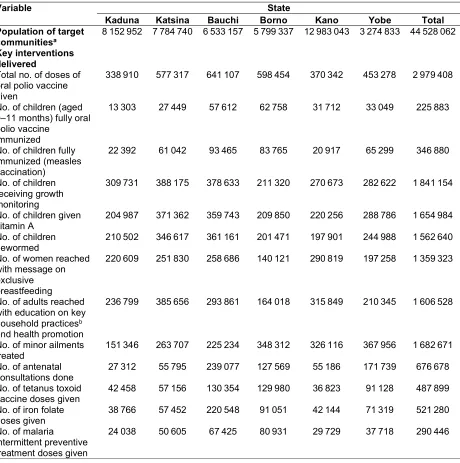
During the project period, the mobile outreach sessions delivered 2 979 408 supplemental doses of oral polio vaccine to children younger than 5 years and 346 880 children were fully immunized (measles vaccine was used as a proxy for full immunization). More than 1.5 million children were dewormed; 676 678 antenatal care consultations were performed; 1 359 323 women were provided information on exclusive breastfeeding and more than 1.68 million illnesses among women and children were treated, including pneumonia, diarrhoea and malaria (Table 1).
Demographic characteristics
At baseline, we interviewed 3166 women with 3873 children younger than 5 years old. The endline survey included interviews with 2426 women with 4651 children younger than 5 years old.
Table 2 presents the demographic characteristics of the women. In the baseline sample, Fulani were the major ethnic group (1077; 37.1 %) and one-quarter of women (730; 25.1%) were from nomadic populations. At baseline, many women (1216; 41.8%) had no education and 1382 (47.6%) had Koranic rote learning only. Most of the women were crop farmers (1112; 38.3%). In the endline sample, the distribution of occupational characteristics was similar, but there was a lower proportion of women with no education (912; 37.6%) and Hausa were the majority ethnic group (987; 40.7%).
Awareness of diseases
At endline there was higher awareness about vaccine-preventable diseases and use of mobile outreach services among household caregivers. In the baseline survey, of the 2204 (75.8%) women aware of vaccine-preventable diseases, 523 (23.7%) were aware of measles and 484 (22.0%) of polio. In the endline survey, of 2105 (86.8%) women aware of
baseline and 156 (7.4%) at endline. An increase in the mothers’ level of awareness was also recorded for tuberculosis, yellow fever and pertussis (Table 3).
Immunizations
At baseline, 758 out of 3872 children in the sample (19.6%) had routine immunization cards and 690 (17.8%) children were fully immunized for their age. At endline, 1757 of 3575 children (49.1%) had routine immunization cards and 1750 (49.0%) were fully immunized. The number of children with zero doses of polio immunization decreased from 445 (11.5%) at baseline to 167 (4.7%) at endline. The main reason for zero doses was caregivers refusing vaccination, with numbers reducing from 152 (36.9%) to 23 (13.9%; Table 3).
Access to services
Table 4 shows that the reported provision of mobile routine immunization outreach services coordinated through the nearest health facility in the 6 months before the survey increased from 34.6% (509/1472) to 84.9% (2060/2426). There was also an increase in reported access to free health services in the 2 weeks before the survey from 8.4% (122/1447) at baseline to 75.9% (858/1130) at endline.
Discussion
The integration of the polio eradication platform with additional primary health services to underserved communities demonstrates how an integration of outreach services can increase coverage and knowledge, reinforcing efforts to attain UHC and SDG 3.1,15,16 The model could
be applied in areas where polio vaccine and routine immunization mobile outreach
programmes could reach normally hard-to-reach and vulnerable communities with maternal, newborn and child health services they might not otherwise access.
The project appeared successful in increasing polio vaccination coverage as well as routine immunization and basic maternal, newborn and child health services among the selected communities, some of whom may never had had contact with the health system. There have been no polio cases or poliovirus-positive environmental samples in any of the settlements since the project began.17 The inclusion of volunteer community mobilizers
helped to foster community involvement and demand for polio vaccine and other health-care services.16,18 Communities accessed free primary health care at mobile services. Knowledge
fact that with the drive for polio eradication, sensitization on other disease conditions may have been down-played.
Critical to the success of the project was securing the resources needed to train, equip, transport, supervise and remunerate the workforce. Of course, the additional staffing,
transport, community mobilizers and costs of maternal, newborn and child health supplies required more funds than would oral polio vaccine or routine immunization sessions alone. However, by packaging these additional services together with polio vaccines and routine immunization outreach, economies of scale may be achieved. This hypothesis would benefit from further cost–benefit and cost–effectiveness studies.19
Another key component was stakeholder engagement and national and state government involvement in project design, monitoring, supervision and reviews, together with community and traditional leaders. This is similar to Cambodia’s integrated
immunization programme, which has planned a national level monitoring strategy aimed at provision of adequate management support to provinces and districts.19
A longer-term impact evaluation would be required to measure outcomes in terms of reduction in morbidity and mortality associated with the interventions offered.20,21
We experienced some challenges, however, which may or may not arise if such an approach were applied in other country settings. Security, for example, proved to be a major challenge particularly in Borno and Yobe states where the Boko Haram militant group insurgency caused insecurity and population displacement.22,23 The project adjusted by using
funds to deliver integrated services to camps of internally displaced persons. Armed robbery and intercommunal clashes were also concerns. In Kaduna state, for example, the project could no longer serve one local government area due to prolonged intercommunal clashes, and UNICEF had to select another local government area in its place. A lesson is that programme implementation should be reviewed regularly so it can be adjusted flexibly, especially where health systems are affected by protracted humanitarian crises.
Health workers also observed that people from non-targeted settlements routinely arrived to seek services from the mobile teams, suggesting strong community demand. However, this also made target populations more difficult to enumerate and created challenges for stock management.
differently, hindering comparative analysis across all data points. For instance, while the teams in WHO used registers to capture treatment of clients, the UNICEF teams used tally sheets. Project reviews found health workers were not uniformly aware of the package of services to be offered and at times lacked sufficient skills to deliver the full package. This was similar to other findings where coverage and other quality indicators of integrated services were not always disaggregated by the service delivery approach.24 Future efforts
should address the need for uniformity of data collection variables for comparison and more uniformity in training materials and supervision of the mobile health teams.
Given the demanding nature of the work and the scarcity of health-care workers in some areas, it was at times difficult to identify and retain qualified staff and ensure a full complement of services per mobile team. Finally, there was the challenge of not depleting the mainstream health personnel by employing health workers seeking additional income, also reported in other studies.19
While the project promoted referrals (arising from severe acute malnutrition, for example) these were not always possible if there was no referral centre nearby or if fees at the health facility were prohibitively costly for clients.
Overall, the project demonstrated how the polio platform could be used to deliver an integrated mobile health strategy that helps to achieve greater equity for marginalized and vulnerable populations. Funding a dedicated, trained and equipped team of health workers to target hard-to-reach communities will have an impact in improving equitable access to basic health services. As a polio legacy project, it has also demonstrated how an integrated routine immunization mobile strategy could be planned, implemented and monitored to achieve greater equity for marginalized and vulnerable populations living in hard-to-reach areas.
As the project in some of the states improved delivery of health care to underserved areas, some state governments (Kano and Yobe) are offering continued support to sustain funding for its delivery. Furthermore, WHO’s emergency programme, with funding from Borno and Yobe states, are conducting ongoing outreach in those states. The Canadian government is funding an ongoing collaboration with UNICEF in Niger, Jigawa, Taraba and Zamfara states.
include outreach sessions in their immunization strategy can integrate essential maternal, newborn and child health services and deliver them together with routine immunization. These efforts will require additional resources and continued commitment from governments. The Hard-to-Reach communities project demonstrates that those resources can result in more equitable access to health care for the most vulnerable – a key to UHC and achievement of SDG 3.
Acknowledgements
We thank the mobile health team members, the community mobilizers and the community leaders for their support.
Funding:
This work was funded by the Bill & Melinda Gates Foundation as part of support to the Global Polio Eradication Initiative.
Competing interests:
None declared.
References
1. What is universal coverage? Geneva: World Health Organization; 2018. Available from: http://www.who.int/health_financing/universal_coverage_definition/en/
[cited 2018 Jan 23].
2. World health statistics – monitoring health for the SDGs. Geneva: World Health Organization; 2016. Available from:
http://www.who.int/gho/publications/world_health_statistics/2016/en/ [cited 2018 Jan 23].
3. Global Vaccine Action Plan 2011–2020. Geneva: World Health Organization; 2015. Available from:
http://www.who.int/immunization/global_vaccine_action_plan/Global Vaccine Action Plan_doc_2011_2020/en/ [cited 2018 Jan 23].
4. 9 in 10 infants worldwide received vaccinations in 2017 [internet]. Geneva: World Health Organization; 2018. Available from:
http://www.who.int/immunization/newsroom/2018_infants_worldwide_vaccinat ions/en/ [cited 2018 Oct 11].
5. Nigeria polio eradication emergency plan 2014. Abuja: National Primary Healthcare Development Agency; 2014. Available from:
http://polioeradication.org/wp-content/uploads/2016/07/4.2_10IMB.pdf [cited 2018 Nov 2].
6. Global Polio Eradication Initiative. Polio eradication and endgame strategic plan 2013–2018. Geneva: World Health Organization; 2013. Available from:
http://polioeradication.org/wp-content/uploads/2016/07/PEESP_EN_A4.pdf
7. Wassilak SGF, Oberste MS, Tangermann RH, Diop OM, Jafari HS, Armstrong GL. Progress toward global interruption of wild poliovirus transmission, 2010 2013, and tackling the challenges to complete eradication. J Infect Dis. 2014 Nov 1;210 Suppl 1:S5–15. https://doi.org/10.1093/infdis/jiu456
PMID:25316873
8. Ado JM, Etsano A, Shuaib F, Damisa E, Mkanda P, Gasasira A, et al. Progress toward poliomyelitis eradication in Nigeria. J Infect Dis. 2014 Nov 1;210 Suppl 1:S40–9. https://doi.org/10.1093/infdis/jiu318 PMID:25316862
9. Monitoring the situation of children and women. Nigeria: Multiple Indicator Cluster Survey 2011. Abuja: National Bureau of Statistics, United Nations Children’s Fund, United Nations Population Fund; 2011. Available from:
https://www.unicef.org/nigeria/Multiple_Indicators_Cluster_Survey_4_Report. pdf [cited 2018 Jan 23].
10. Trends in maternal mortality 1990–2013. Estimates by WHO, UNICEF, UNFPA, The World Bank and the United Nations Population Division. Geneva: World Health Organization; 2014. Available from:
http://www.who.int/reproductivehealth/publications/monitoring/maternal-mortality-2013/en/ [cited 2018 Jan 25].
11. Mother, newborn and child health and mortality Nigeria – general facts. Key facts 1–2 (2013) [internet]. New York: United Nations Children’s Fund; 2013.
Available from:
https://www.unicef.org/nigeria/ng_publications_advocacybrochure.pdf [cited 2018 Aug 31].
12. Hamisu AW, Johnson TM, Craig K, Mkanda P, Banda R, Tegegne SG, et al. Strategies for improving polio surveillance performance in the
security-challenged Nigerian states of Adamawa, Borno, and Yobe during 2009–2014. J Infect Dis. 2016 May 1;213 Suppl 3:S136–9.
https://doi.org/10.1093/infdis/jiv530 PMID:26655842
13. Touray K, Mkanda P, Tegegn SG, Nsubuga P, Erbeto TB, Banda R, et al.
Tracking vaccination teams during polio campaigns in northern Nigeria by use of geographic information system technology: 2013–2015. J Infect Dis. 2016 May 1;213 Suppl 3:S67–72. https://doi.org/10.1093/infdis/jiv493
PMID:26609004
14. Gidado SO, Ohuabunwo C, Nguku PM, Ogbuanu IU, Waziri NE, Biya O, et al.; N-STOP Outreach Team. Outreach to underserved communities in northern Nigeria, 2012-2013. J Infect Dis. 2014 Nov 1;210 Suppl 1:S118–24.
https://doi.org/10.1093/infdis/jiu197 PMID:25316825
15. Chapman AR. Assessing the universal health coverage target in the sustainable development goals from a human rights perspective. BMC Int Health Hum Rights. 2016 12 15;16(1):33. https://doi.org/10.1186/s12914-016-0106-y PMID:27978827
2017 Jul 1;216 suppl_1:S267–72. https://doi.org/10.1093/infdis/jiw520 PMID:28838155
17. Global Polio Eradication Initiative [internet]. Geneva: World Health Organization. Available from: http://polioeradication.org/ [cited 2018 Jan 23].
18. Warigon C, Mkanda P, Muhammed A, Etsano A, Korir C, Bawa S, et al. Demand creation for polio vaccine in persistently poor-performing communities of Northern Nigeria: 2013–2014. J Infect Dis. 2016 May 1;213 Suppl 3:S79–85. https://doi.org/10.1093/infdis/jiv511 PMID:26908717
19. Partapuri T, Steinglass R, Sequeira J. Integrated delivery of health services during outreach visits: a literature review of program experience through a routine immunization lens. J Infect Dis. 2012 Mar;205 Suppl 1:S20–7. https://doi.org/10.1093/infdis/jir771 PMID:22315382
20. Luckow PW, Kenny A, White E, Ballard M, Dorr L, Erlandson K, et al.
Implementation research on community health workers’ provision of maternal and child health services in rural Liberia. Bull World Health Organ. 2017 Feb 1;95(2):113–20. https://doi.org/10.2471/BLT.16.175513 PMID:28250511 21. Byrne A, Hodge A, Jimenez-Soto E, Morgan A. What works? Strategies to
increase reproductive, maternal and child health in difficult to access mountainous locations: a systematic literature review. PLoS One. 2014 02 3;9(2):e87683. https://doi.org/10.1371/journal.pone.0087683 PMID:24498353 22. Shuaibu SS, Salleh MA, Shehu AY. The impact of Boko Haram insurgency on
Nigerian national security. Int J Acad Res Bus Soc Sci. 2015;5(6):254–66. Available from:
http://hrmars.com/hrmars_papers/The_Impact_of_Boko_Haram_Insurgency_ on_Nigerian_National_Security.pdf [cited 2018 Jan 23].
23. Emmanuelar I. Insurgency and humanitarian crises in Northern Nigeria: the case of Boko Haram. Afr J Polit Sci Int Relat. 2015 Jul;9(7):284–96.
http://dx.doi.org/10.5897/AJPSIR2015.0789
Table 1. Results of programme interventions in six states in the hard-to-reach communities project in Nigeria, June 2014 to September 2016
Variable State
Kaduna Katsina Bauchi Borno Kano Yobe Total Population of target
communitiesa 8 152 952 7 784 740 6 533 157 5 799 337 12 983 043 3 274 833 44 528 062
Key interventions delivered
Total no. of doses of oral polio vaccine given
338 910 577 317 641 107 598 454 370 342 453 278 2 979 408
No. of children (aged 0–11 months) fully oral polio vaccine
immunized
13 303 27 449 57 612 62 758 31 712 33 049 225 883
No. of children fully immunized (measles vaccination)
22 392 61 042 93 465 83 765 20 917 65 299 346 880
No. of children receiving growth monitoring
309 731 388 175 378 633 211 320 270 673 282 622 1 841 154
No. of children given
vitamin A 204 987 371 362 359 743 209 850 220 256 288 786 1 654 984 No. of children
dewormed 210 502 346 617 361 161 201 471 197 901 244 988 1 562 640 No. of women reached
with message on exclusive breastfeeding
220 609 251 830 258 686 140 121 290 819 197 258 1 359 323
No. of adults reached with education on key household practicesb
and health promotion
236 799 385 656 293 861 164 018 315 849 210 345 1 606 528
No. of minor ailments
treated 151 346 263 707 225 234 348 312 326 116 367 956 1 682 671 No. of antenatal
consultations done 27 312 55 795 239 077 127 569 55 186 171 739 676 678 No. of tetanus toxoid
vaccine doses given 42 458 57 156 130 354 129 980 36 823 91 128 487 899 No. of iron folate
doses given 38 766 57 452 220 548 91 051 42 144 71 319 521 280 No. of malaria
intermittent preventive treatment doses given
24 038 50 605 67 425 80 931 29 729 37 718 290 446
Table 2. Demographic profile of household caregivers surveyed in the hard-to-reach communities project in Nigeria, at baseline (March 2014) and endline (November 2015)
Category No. (%) of respondents Baseline
n= 2906 nEndline = 2426 Ethnic group
Fulani 1077 (37.1) 931 (38.4)
Hausa 981 (33.8) 987 (40.7)
Kanuri 540 (18.6) 172 (7.1)
Shuwa or Arab 34 (1.2) 2 (0.1)
Margi 47 (1.6) 0 (0.0)
Other 227 (7.8) 334 (13.8)
Residential status
Nomadic 730 (25.1) 769 (31.7)
Settled 2126 (73.2) 1657 (68.3)
No response 50 (1.7) 0 (0.0)
Educational level
None 1216 (41.8) 912 (37.6)
Koranic 1382 (47.6) 1312 (54.1)
Primary 143 (4.9) 158 (6.5)
Secondary 95 (3.3) 42 (1.7)
Post-secondary 13 (0.4) 2 (0.1)
No response 57 (2.0) 0 (0.0)
Occupation
Home keeper 461 (15.9) 467 (19.2) Animal product seller 600 (20.6) 511 (21.1) Casual labourer 96 (3.3) 171 (7.0) Civil servant 31 (1.1) 26 (1.1) Crop farmer 1112 (38.3) 715 (29.5)
Trader 283 (9.7) 482 (19.9)
Other 304 (10.5) 54 (2.2)
No response 19 (0.7) 0 (0.0)
Table 3. Vaccination coverage for children younger than 5 years old and household caregivers’ awareness of vaccine-preventable diseases in the hard-to-reach communities project in Nigeria, at baseline (March 2014) and endline (November 2015)
Variable No. (%) of respondents
Baseline Endline
Children’s vaccination history
Total children sampled 3872 (100.0) 3575 (100.0) Age of children sampled, months
< 6 518 (13.4) 330 (9.2)
6–8 275 (7.1) 330 (9.2)
9–23 1259 (32.5) 1271 (35.6)
24–35 572 (14.8) 575 (16.1)
36 1210 (31.3) 1069 (29.9)
No response 38 (1.0) 0 (0.0)
Children with routine immunization
card 758 (19.6) 1757 (49.1)
Children fully immunized for age at
the time of survey 690 (17.8) 1750 (49.0)
Children with visible BCG scar 904 (23.3) 580 (16.2) Children given supplemental oral
polio vaccine, no. of doses
0 445 (11.5) 167 (4.7)
1–3 1045 (27.0) 742 (20.8)
> 3 2133 (55.1) 2666 (74.6)
Don’t know 249 (6.4) 0 (0.0)
Reasons for zero dose of oral polio vaccinea
Caregiver refused vaccination 152 (36.9) 23 (13.8)
Awareness of vaccine-preventable diseases
Total caregivers interviewed 2906 (100.0) 2426 (100.0) Caregiver aware of any
vaccine-preventable diseases 2204 (75.8) 2105 (86.8)
Caregiver aware of specific diseasesb
Cerebrospinal meningitis 18 (0.8) 156 (7.4)
Tuberculosis 46 (2.1) 250 (11.9)
Yellow fever 40 (1.8) 619 (29.4)
Pertussis 101 (4.6) 843 (40.0)
Polio 484 (22.0) 1544 (73.3)
Measles 523 (23.7) 1806 (85.8)
BCG: bacille Calmette–Guérin.
a The denominator for percentages is the number of children with zero doses of supplemental oral
polio vaccine.
b The denominator for percentages is the number of caregivers aware of any vaccine-preventable
disease.
[image:17.612.120.498.128.541.2]Table 4. Access to and use of health-care services reported by household caregivers in the hard-to-reach communities project in Nigeria, at baseline (March 2014) and endline (November 2015)
Variable Baseline Endline
Total
respondents agreeing No. (%) respondents Total agreeing No. (%)
Used mobile routine immunization service in the previous 6 months
1472 509 (34.6) 2426 2060 (84.9)
Aware of availability of free
mobile health-care service 1830 396 (21.6) 2426 1975 (81.4) Any member of the family
accessed mobile health-care service in the previous 2 weeks