Int. J. Electrochem. Sci., 9 (2014) 3181 - 3189
International Journal of
ELECTROCHEMICAL
SCIENCE
www.electrochemsci.org
Determination of Vanillin in Infant Formula Using Poly Valine
Modified Electrode
MA Xinying
Department of Chemistry and Chemical Engineering, Heze University, Heze 274015, China E-mail: [email protected]
Received: 24 January 2014 / Accepted: 17 February 2014 / Published: 23 March 2014
A poly valine modified electrode was prepared by cyclic voltammetry. The electrochemical behavior of vanillin at the modified electrode was studied in detail. A new method for measuring vanillin was established. It was found that in pH 7.0 phosphate buffer solution, the oxidation peak current is linearly propertional to its concentration of vanillin in a range of 9.60×10⁻⁸
~6.61×10⁻⁵ mol L-1, with a limit of detection of 1.00×10⁻⁸
mol L-1. This method is simple, highly sensitive and shows good reproducibility. The method has been demonstrated in the determination of vanillin in infant formula samples.
Keywords: vanillin, infant formula, valine, electrochemical determination
1. INTRODUCTION
Vanillin is 3- methoxy -4- hydroxy benzaldehyde. Chemical structure of vanillin is shown in figure 1. It is the world's biggest product of synthetic spices, which is widely used in producing confectionery, beverage and medicine as fragrance agent and flavoring agent [1]. However, excessive ingestion of vanillin can trigger allergic reactions [2], migraine headaches [3] and it can also affect the function of liver and kidney [4]. In china, according to the “national food safety standards for use of food additives” provisions of GB2760-2011 requirements, all covered by the use of 0 to 6 months of infant formula foods may not add any edible spices. Because the infant body organs of immature, metabolic detoxification ability is rather poor, eat food additives food will increase their daily metabolic burden [5]. Hence, it is necessary to detect and control the content of vanillin.
technique could be used for the determination of vanillin. Thus, procedures based on electroanalytical methods for the detection of vanillin in food samples have been reported [4, 10-15].
These electroanalytical methods have advantages of being inexpensive and operating simply. Amino acid as the modifying material can be aggregated onto a glassy carbon electrode surface by covalent bond, has chemical stability, good reproducibility, and can be used for determination of electrochemical active material. Poly valine modified electrode was prepared and used for the electrochemical determination of vanillin in this paper. The electrode exhibited a good electrocatalytic activity for the oxidation of vanillin and it was applied for the first time to the determination of infant formula samples. The new method was developed for the determination of vanillin, which can provides technical support for infant food quality and safety monitoring and inspection.
OHC
OCH
3OH
Figure 1. Chemical structure of vanillin
2. EXPERIMENTAL PART
2.1. Apparatu sand Chemicals
Vanillin was brought from Aladdin Reagents (Shanghai) Co., LTD; Valine, disodium hydrogen phosphates and citric acid were brought from Tianjin Guangfu Fine Chemical Research Institute (Tianjin, China). All chemicals were used as received without any further purification. Infant formula foods were brought from local market (Heze, China). Disodium hydrogen phosphates - citric acid buffer solutions were prepared by mixing the stock solutions of 0.2 mol L-1 disodium hydrogen phosphates and 0.1 mol L-1 citric acid. All aqueous solutions were prepared in double distilled water
All the electrochemical experiments were carried out by a CHI660C electrochemical workstation with three electrodes system (CH Instruments, China); KQ-100DB type ultrasonic cleaning equipment (Kunshan, China) and 79-1 type magnetic stirrer was used (Jiangsu, China). All experiments were performed at room temperature.
2.2 Preparation of samples
2.3 Preparation of poly valine modified electrode
A glassy carbon electrode (Φ=3.8 mm) was polished with metallographic sandpaper (grit 1000) and wet alumina powder (0.05µm). Next, the electrode was flushed with distilled water. Then, to flush thoroughly, the electrode was rinsed ultrasonically with 1:1 HNO3, absolute ethanol, and distilled
water, respectively. After rinsing, the prepared GCE as working electrode, a Ag/AgCl electrode as reference electrode, and a platinum as counter electrode, the poly valine modified electrode was prepared by immersing the GCE into an aqueous solution prepared by mixing 10.00 mL of disodium hydrogen phosphates - citric acid buffer solution (pH 6.0), 3.50 mL of 0.01 mol L-1 valine, and 6.50 mL of water and swept in a potential range from -1.5 to 2.2V for 10 cycles at a scan rate of 100 mV s-1 without stirring; then the surface of modified electrode was washed with double distilled water to be used.
2.4 Method for determination of vanillin
To a 50-ml electrochemical cell, 20 ml of disodium hydrogen phosphates - citric acid buffer solution (pH 7.0) and a certain mount of standard solution of vanillin or infant formula milk powders samples was added. After stirring for 50 s, it was swept in a certain potential. After the end of each scan, the modified electrode was placed in the blank solution and scanned until the peaks disappeared to be used again.
3. RESULTS AND DISCUSSION
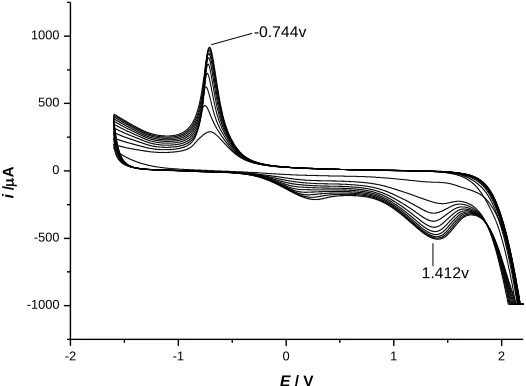
3.1 Electrochemical polymerization conditions
-2 -1 0 1 2
-1000 -500 0 500 1000
1.412v -0.744v
i
/
A
E / V
Figure 2. Cyclic voltammograms of valine on the glass carbon electrode
NH2
COOH
NH
COOH H+ + e
-NH
COOH NH
COOH
GCE GCE
Polymerization NH
OC GCE
OC NH
[image:4.596.168.431.86.279.2]nNH COOH
Figure 3. The electro-polymerization of valine on the GCE.
3.2 The electrochemical characteristics of vanillin at the poly valine modified electrode
[image:4.596.159.437.333.506.2]
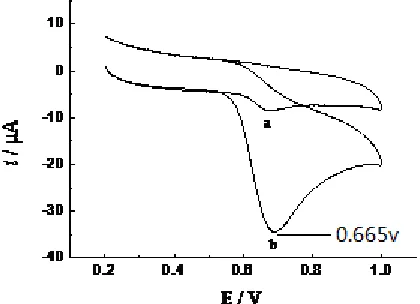
Figure 4. Cyclic voltammograms of vanillin (1.20 × 10⁻⁵mol/ L) at the bare electrode (a) and the valine modified electrode (b) (pH7.0). Scan rate: 120mV/s
HO
H3CO
CHO
H2O
+2H+ + 2e HO
H3CO
COOH
Figure 5..Oxidation reaction of vanillin
3.3 The best condition for the determination of vanillin 3.3.1 Effect of pH on the oxidation of vanillin
0.2 0.4 0.6 0.8 1.0 1.2 1.4
-65 -60 -55 -50 -45 -40 -35 -30 -25 -20 -15 -10 -5 0 5 10
2 3 4 5 6 7 8
0.60 0.65 0.70 0.75 0.80 0.85 0.90 0.95
E
/
V
pH
7 1
i
/
A
E / V
Figure 4. Effect of pH on the potential for the oxidation of vanillin (1.20×10⁻⁵mol/L) in the citric acid-phosphate buffer (2.2~8.0). Insert is the oxidation peak potential of vanillin versus pH value
[image:5.596.184.394.75.227.2] [image:5.596.175.428.480.672.2]
the reaction involves a transfer process of protons. There is a linear relationship between Epa and pH
and the regression equation is expressed as Epa=1.01-0.051pH, r=0.9964. It also can be seen from Fig.
4 that the oxidation peak current of vanillin increased slightly with increase in the solution pH until it reaches 7.0. Therefore, pH 7.0 was used in this study.
3.3.2 Effect of scan rate and stirring time
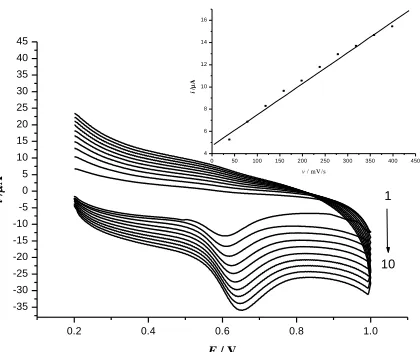
When all other conditions remained unchanged and only changed the scanning rate, the results showed that the oxidation peak current increased as scan rate is increased (Fig. 5). .
0.2 0.4 0.6 0.8 1.0
-35 -30 -25 -20 -15 -10 -5 0 5 10 15 20 25 30 35 40 45
0 50 100 150 200 250 300 350 400 450
4 6 8 10 12 14 16
i
/
A
v / mV/s
10 1
i
/
A
E / V
Figure 5. Cyclic voltammograms of vanillin (1.20×10⁻⁵ mol L-1) at different scanning rates. Inset is the plot of oxidation vanillin peak currents versus scan rates. 1-10: 40, 80, 120, 160, 200, 240, 280, 320, 360, 400 mV s-1
There is a linear relationship between the oxidation peak current and the scan rate in the 40~400 mV s-1. The regression equation is expressed as ipa = 4.71 × 10⁻⁶ + 2.79 × 10⁻⁸ v, r=0.9944
which shows that the oxidation of vanillin was adorption controlled. The peak shape is good and has high sensitivity at scan rate of 120 mV s-1, so120 mV s-1 was chosen in this experiment. In addition, with the stirring time increasing, the oxidation peak current increased first and then stabilized, so 50 s was chosen in this experiment.
3.4 Linear range and detection limit
[image:6.596.192.402.261.437.2]
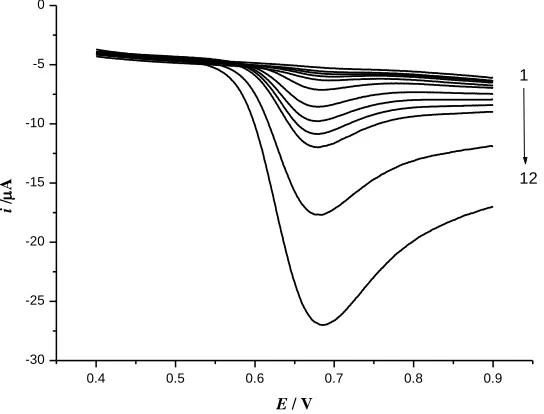
vanillin in a ranging from 9.60 × 10⁻⁸ ~ 6.61 × 10⁻⁵
mol L-1, and the linear equation and correlation coefficient can be expressed as ipa = 0.04c +1.07×10⁻⁶, r = 0.9972. The detection limit of a standard
solution was estimated to be 1.00×10⁻⁸
mol L-1 with DPV.
0.4 0.5 0.6 0.7 0.8 0.9
-30 -25 -20 -15 -10 -5 0
12 1
i
/
A
E / V
Figure 5. Curves of differential pulse voltammetry of vanillin at different concentrations. 1-12: 8.00×10⁻⁸
, 1.20×10⁻⁷, 4.80×10⁻⁷, 9.60×10⁻⁷, 1.20×10⁻⁶, 2.40×10⁻⁶, 4.80×10⁻⁶, 7.20×10⁻⁶, 9.60×10⁻⁶, 1.20×10⁻⁵, 3.53×10⁻⁵, 6.61×10⁻⁵
[image:7.596.165.437.158.365.2]mol L-1
Table 1. Comparison of different electrodes for vanillin determination.
Electrode Linear range (mol/L) Detection limit (mol/L) References AuPd Nanoparticles
-graphene composite modified electrode
0.1×10⁻⁶–7×10⁻⁶ and 10×10-6–40 ×10-6
2.0×10⁻⁸ 4
PVC-graphite composite electrode
6.60×10⁻⁴
~ 9.20×10⁻³ 2.90×10⁻⁴ 10
GCE 5.00×10⁻⁵ ~ 3.00×10⁻⁴ 1.60×10⁻⁷ 11
Graphite electrode 5.00×10⁻⁶ ~ 4.00×10⁻⁴ 4.00×10⁻⁷ 12 graphene/GCE 6.00×10⁻⁷-4.80×10⁻⁵ 5.60×10⁻⁸ 13 CDAb/Au–
AgNPs/GCE
0.2×10⁻⁶–50×10-6 0.04 ×10⁻⁶ 14
Lysine/CPE 1.00×10⁻⁵ ~ 100×10-3 2.88 ×10⁻⁶ 15
Valine/GCE 9.60×10⁻⁸ ~ 6.61×10⁻⁵ 1.00×10⁻⁸ This work
[image:7.596.70.527.477.670.2]
3.5 Stability, reproducibility and selectivity of poly valine modified electrode
To test the stability of the poly valine modified electrode, the storage stability of the poly valine electrode was evaluated by storing the electrode in air for two weeks. It was found that the electrode retained 96% of its initial current response after stored in air for two weeks indicating good stability of poly valine modified electrode. In addition, to test the reproducibility of poly valine modified electrode, six modified electrodes were fabricated based on the same procedure and used for the determination of 1.20× 10⁻⁵ mol L−1 vanillin standard solution. The relative standard deviation (RSD) of the peak currents was 5.3% (n = 6). This indicates that the electrode had good reproducibility.
The selectivity of poly valine modified electrode was also investigated by cyclic voltammetry. The results show that the 100 times of K+, Na+, Ca2+, Fe3+, Cu2+, Cl-, NO3-, sucrose, glucose, fructose,
citric acid or ascorbic acid had no obvious influence on the results of the determination of vanillin within the ±5 % error.
3.6 Determination of recovery
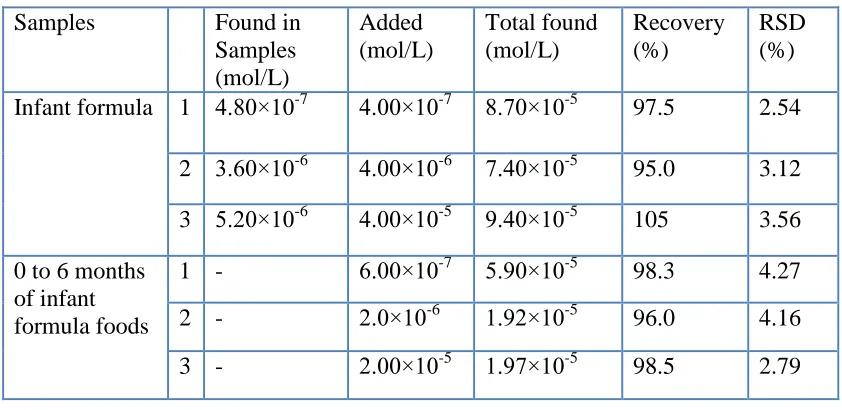
[image:8.596.88.509.477.682.2]The samples were pre-treated according to the method of preparation of samples in section 2.2 and analyzed using the method for the determination of vanillin in section 2.4. The present method was used for the determination of vanillin in real samples of infant formula. The results are listed in Table 2. From the table 2 we can see that the proposed method can be successfully applied for the determination of vanillin.
Table 2. Determination of vanillin in infant formula
Samples Found in
Samples (mol/L)
Added (mol/L)
Total found (mol/L)
Recovery (%)
RSD (%) Infant formula 1 4.80×10⁻⁷ 4.00×10⁻⁷ 8.70×10⁻⁵ 97.5 2.54
2 3.60×10⁻⁶ 4.00×10⁻⁶ 7.40×10⁻⁵ 95.0 3.12 3 5.20×10⁻⁶ 4.00×10⁻⁵ 9.40×10⁻⁵ 105 3.56 0 to 6 months
of infant formula foods
1 - 6.00×10⁻⁷ 5.90×10⁻⁵ 98.3 4.27
2 - 2.0×10⁻⁶ 1.92×10⁻⁵ 96.0 4.16
3 - 2.00×10⁻⁵ 1.97×10⁻⁵ 98.5 2.79
4. CONCLUSION
applied to the determination of vanillin in real samples. The method is simple, rapid, sensitive and provides a safe and effective new method for the detection of vanillin in food.
ACKNOWLEDGEMENT
This work was supported by the Shandong Province High School Science and Technology Fund Planning Project of China (J12LD53).
References
1. N. J. Walton, M. J. Mayer, A. Narbad, Phytochemistry 63 (2003) 505 2. A. H. van Assendelft. British Medical Journal 294(1987): 576
3. M. Saint-Denis, M. W. Coughtrie, J. C. Guilland, B. Verges, M. Lemesle, M. Giroud, Presse Médicale 25(1996)2043
4. L. Shang, F. G. Zhao, B. Z. Zeng. Food Chem. 151(2014) 53
5. GB 2760 - 2011, national food safety standards for use of food additives [S]. Ministry of health of the people's Republic of China (2011) (in Chinese)
6. K. N. Waliszewski, V. T. Pardio, S. L. Ovando, Food Chem.101 (2006)1059 7. G. Lamprect, F. Pichlmayer, E.R. Schmid, J. Agric. Food Chem. 42(1994) 1722 8. T. Sostaric, M. C. Boyce, E. E. Spickett, J Agric Food Chem. 48(2000)5802 9. M. C. Boyce, P. R. Haddad, T. Sostaric, Anal. Chim. Acta 485 (2003)179
10.M. Luque, E. u ue- re , . os, M.Valcárcel, Anal. Chim. Acta 410(2000) 127 11.J. L. Hardcastle, C. J. Paterson, R. G. Compton, Electroanal.13 (2001) 899
12.F. Bettazzi, I. Palchetti, S. Sisalli, M. Mascini, Anal. Chim. Acta, 555 (2006)134 13.J. Y. Peng, C. T. Hou, X. Y. Hu, Int. J. Electrochem. Sci. 7 (2012)1724
14.D. Y. Zheng, C. G. Hu, T. Gan, X. P. Dang, S. S. Hu, Sensor. Actuat. B-Chem.148 (2010) 247 15.B. K. Chethana, S. Basavanna, Y..Arthoba Naik. Journal of Chemical and Pharmaceutical
Research, 4(2012)538
16.G. Z. Luo, X. Liu, Y. C. Meng, Chinese Journal of Analysis Laboratory 30 (2011) 84 (in Chinese) 17. Z. Y. Yu, X. C. Li, X. L. Wang, X. Y. Ma, X. Li , K. W. Cao, J. Chem. Sci. (124) 2012 537 18. L.J. Li, L. B. Yu, H. Cheng, Q. F. Chen, F. M. Wu, T. Chen, X. Y. Zhu, H. X. Kong, J. L. Wu, Analytical Letters, 40 (2007) 3290