Int. J. Electrochem. Sci., 10 (2015) 6924 - 6934
International Journal of
ELECTROCHEMICAL
SCIENCE
www.electrochemsci.orgCu(II)-All Solid State Sensor Ion Selective Electrode (ASS-ISE)
with a Nano-molar Detection Limit and its Use for the Analysis
of Waste Water Samples
M. R. Ganjali1,2,*, M. Rezapour3, M. Pirali-Hamedani4,5, H. Rashedi6
1
Center of Excellence in Electrochemistry, Faculty of Chemistry, University of Tehran, Tehran, Iran
2
Biosensor Research Center, Endocrinology & Metabolism Molecular-Cellular Sciences Institute, Tehran University of Medical Sciences, Tehran, Iran
3
IP Department, Research Institute of Petroleum Industry (RIPI), P.O. Box 14665-137, Tehran, Iran
4
Department of Medicinal Chemistry, Faculty of Pharmacy, Tehran University of Medical Sciences, Tehran, Iran
5
Pharmaceutical Sciences Research Center, Tehran, Iran
6
Department of Chemical Engineering, Faculty of Engineering, University of Tehran, Tehran, Iran
*
E-mail: [email protected]; [email protected]
Received: 29 May 2015 / Accepted: 9 July 2015 / Published: 28 July 2015
The present work focuses on the development of an all-solid-state electrode (ASSE) for the determination of Cu2+ ions in complex matrices. The ASSE is made of a layer of a conductive graphite-epoxy resin, coated on a copper wire. The composite layer is further covered with a Cu2+ selective PVC membrane composed of 33% PVC as the base material, 58% nitrobenzene (NB) as a plasticizing solvent, 3% of potassium tetrakis (p-chlorophenyl) borate (KpClTPB) which acts as an ionic additive, and 6% of a copper selective ionophore (L). The ASSE was found to have a Nernstian potential response of 29.4±0.4 mV/decade over a dynamic linear range from 1.0×10⁻⁸ M to 1.0×10⁻³
M of Cu2+ and the detection limit of the sensing device was also evaluated to be 2.4×10⁻⁹ mol L-1. The selectivity of the sensor towards the target ion in the presence of different commonly occurring interfering ions was found to be very good, and to test its applicability in the analysis of real samples with complex matrices the ASSE was applied for the determination of Cu2+ in waste water samples of copper electroplating, and the results were found to be very satisfactory.
Keywords: All solid state, Potentiometry, Copper, Sensor, Waste water
1. INTRODUCTION
human health, and even trace amounts of the ion can have toxicological effects on various organisms [3, 4], the analysis of the ion is an important analytical task. The importance is further highlighted due to the increased levels of Cu2+ in the environment due to its emission from various industrial sources, which pronounce the dangers posed to public health [5], and in turn enhances the significance of monitoring even the trace amounts of Cu2+ has become more and more important because of the increased interest in environmental pollution [6].
Other reasons behind the importance of monitoring in biological and environmental systems is its role in the absorption and function of iron especially in the process of production of hemoglobin, as well as the role Cu2+ in enzymes with fundamental effects in preventing the oxidation, and manufacturing collagen and generating energy [7].
It is clear that sensitive, reproducible and accurate analytical methods are always the basic need for the evaluation of any analyte, Cu2+ included, in different samples [8]. The conventional methods used to this end, in the case of copper ions include instrumental techniques like spectrophotometry [9,10] dispersive liquid–liquid microextraction [11,12], adsorptive stripping voltammetry [13], sequential injection analysis [14], high performance liquid chromatography [15], anodic stripping voltammetry [16, 17], but the advantages of ion selective electrodes (ISEs) including accuracy, portability, sensitivity and selectivity, low cost and ease of use have led to the development and application of some ISEs based on the application of different ionophores, for the determination of Cu2+ ions [18-24].
Advantages of ASSEs [25], including absence of limitations associated with the presence of an internal solution in symmetrical devices leading to limitations in the limit of detection, life time and applications position of the devices, in addition to the possibility of using different intermediary materials in the construction of the devices have attracted an increasing interest to these devices, in recent years [26-37]. Other more distinct advantages of all solid-state ion-selective electrodes (ASS-ISEs), include their modified detection limits and mechanical stability. The former, as mentioned earlier, arises from the elimination of the inner filling reference solution which in turn the need for its optimization and leaking [38–40]. The latter advantage provides the possibility of more flexible mechanical design of the electrodes as well as production of disposable ones.
Given the advantages of polymeric membrane ISEs, and the need of precise, accurate and selective determination of low amounts of Cu2+ in water samples, different ligands have been tested and some have been to act selective ionophores for the construction of polymeric based copper-selective electrodes [41]. There is no need to mention that devising a portable, yet powerful device with a low detection limit and easy application procedure, for the online monitoring of Cu2+ concentration in diverse samples, which can be achieved through the development of an ASS-ISE device can be of great interest for quality control, environmental and biological applications.
2. MATERIALS AND METHODS
Tetrahydrofuran (THF), dibutyl phthalate (DBP), nitrobenzene (NB), benzyl acetate (BA), o-nitrophenyloctylether (NPOE), oleic acid (OA), potassium tetrakis (p-chlorophenyl) borate (KpClTPB) and sodium tetrapenyl borate (NaTPB), graphite powder (1–2 μm particle size), the MWCNTs and all salts (nitrate or chloride form) were of analytical reagent grade and were obtained from Merck Co., High-molecular weight polyvinylchloride (PVC) was from Fluka Co. and the ionophore L (Scheme 1) was synthesized as described earlier [42]. Macroplast Su 2227 epoxy was from Henkel Co. and the desmodur RFE hardener was obtained from Bayer Ag.
N N
O O
NH HN
O O
Scheme 1. Chemical structure of the used selectophore
To prepare the CPC which is a MWCNTs-loaded epoxy resin in nature, and is used as the internal contact and transducer, different proportions of graphite powder, MWCNTs, epoxy, and hardener were mixed in a THF solvent, let to rest for about 20-30 minutes in air and tested. After the mentioned period which was marked by reaching a viscose mixture, a section of a shielded copper wire (0.5 mm diameter and 15 cm length) was polished and soaked into the viscose solution so as to be coated with it and was left to dry for half a day.
The ASS-ISEs were next used as an indicator electrode in a potentiometric cell consisting of an Ag/AgCl double junction reference electrodes (Azar-Elelectrode Co., Iran) as the external reference electrode. The potentiometric cell can hence be illustrated as bellow:
Cu wire/ASS layer/ion selective PVC membrane | sample solution || Ag-AgCl, KC1 (satd.) An ion analyzer with a 250 pH/mV meter with ±0.1 mV precision was used to connect the two electrodes in all experiments, and the measurements were carried out through the calibration method.
3. RESULTS AND DISCUSSION
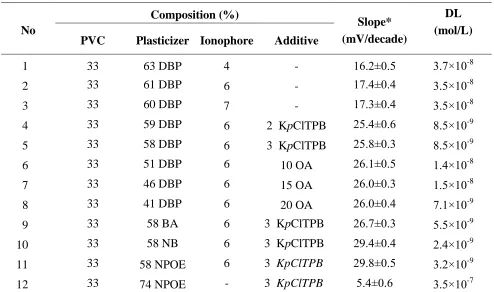
[image:4.596.52.546.380.672.2]Interestingly, the majority of previously reported ISEs are symmetrical membranes where the polymeric ion selective electrode interfaces the internal standard and external test solutions. In asymmetrical ISEs like ASS-ISE devices [43-46], however, only the exterior side of the ISE membrane contacts with the test solution while the internal surface is in adheres to the solid-state contact.
Table 1. Various membrane ingredients used in making ASS-PVC membrane sensor
No
Composition (%)
Slope* (mV/decade)
DL (mol/L) PVC Plasticizer Ionophore Additive
1 33 63 DBP 4 - 16.2±0.5 3.7×10⁻⁸
2 33 61 DBP 6 - 17.4±0.4 3.5×10⁻⁸
3 33 60 DBP 7 - 17.3±0.4 3.5×10⁻⁸
4 33 59 DBP 6 2 KpClTPB 25.4±0.6 8.5×10⁻⁹
5 33 58 DBP 6 3 KpClTPB 25.8±0.3 8.5×10⁻⁹
6 33 51 DBP 6 10 OA 26.1±0.5 1.4×10⁻⁸
7 33 46 DBP 6 15 OA 26.0±0.3 1.5×10⁻⁸
8 33 41 DBP 6 20 OA 26.0±0.4 7.1×10⁻⁹
9 33 58 BA 6 3 KpClTPB 26.7±0.3 5.5×10⁻⁹
10 33 58 NB 6 3 KpClTPB 29.4±0.4 2.4×10⁻⁹
11 33 58 NPOE 6 3 KpClTPB 29.8±0.5 3.2×10⁻⁹
12 33 74 NPOE - 3 KpClTPB 5.4±0.6 3.5×10⁻⁷
*The results are based on five replicate measurements.
with the capabilities required for the applications in medicinal, biological, environmental and even in vivo systems. The application of conductive epoxy supports in ASS-ISEs allows for the use of PVC membrane, with variable and adjustable compositions, which acts as the main components of the sensing device. There is no need to mention that each component of the PVC membrane and its absolute and relative amounts in the overall composition plays a distinct part in the response of the resulting sensor [47-53].
As a result the important information on the optimization of the membrane composition is given in Table 1, to provide the reader with better insight. It has been established in the literature that generally a plasticizer/PVC ratio of around 2.0 leads to optimal responses by PVC membranes, and consequently, for all compositions illustrated in Table 1 the ratio is true. Hence the amount of the PVC, i.e. 33%wt is not mentioned in any case. The plasticizer, is used to enhance the mobility of the free and complexed ligand throughout the membrane.
The materials used as the plasticizer need to be very non- volatile and able to physically dissolve PVC, possess no chemically active functional groups and have proper polarity (which is determined by the nature of the target species). Conventional plasticizers of various dielectric constants including dibutyl phthalate (DBP), nitrobenzene (NB), o-nitrophenyloctylether (NPOE) and benzylacetate (BA) were tested in this work and NPOE and NB led to better responses, which can be attributed to the relatively high polarity of Cu2+ ions which prefers a high polarity medium.
A third generally used, yet very critical membrane ingredient is the ionic additive. Although the proper polarity of the plasticizer facilitates the extraction and exchange of the target ions into the membrane, incorporation of small amounts of such ionic additives has been found not only to improve the exchange mechanism but also to reduce the Ohmic resistance of the PVC membrane.
The effect of the amount of the ionophore on the potential response of the sensor was depicted in Table 1. As it can be seen from Table 1, 6% L is the best amount of ionophore (membrane no. 2). The response of the sensor was also evaluated in absence of the ionophore. As can be seen, a blank membrane, the membrane without the sensing ionophore, responds too poor (membrane no. 12). Hence, membrane no. 10 showed the best Nernstian slope (29.4±0.4 mV/decade) was selected for further studies.
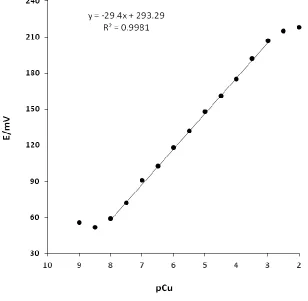
Further evaluation of the ASS-ISEs included studying their potential response at different Cu2+ concentration (i.e. from 1.0×10⁻⁹ to 1.0×10⁻¹ mol L-1) and drawing the potential vs. –log [Cu2+]. The response attributed to the sensor with the optimal PVC membrane concentration is illustrated in Figure 1, the linear segment of which (i.e. from 1.0×10⁻⁸-1.0×10⁻³ mol L-1) represents the linear range of the sensor.
Figure 1. Calibration curve of Cu ASS PVC membrane sensor; the results are based on 5 replicate measurements.
To further evaluate the ASS-ISE its dynamic response time, defined as the time required for the response to reach ±1 mV of its equilibrium potential upon a 10 fold increase in the concentration of the test solution [54-55] created by its successive immersion into various sample solutions in the range of 1.0×10⁻⁸
to 1.0×10⁻³ mol L-1. The results (Figure 2) revealed the sensor to be able to quickly reach the equilibrium response in the whole range and the average time for doing, or the response time of the ASS-ISE membrane sensor was evaluated to be about 7 s.
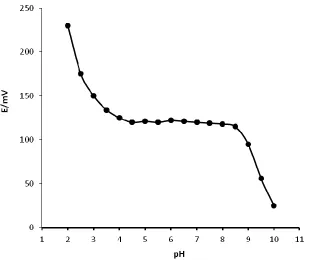
The effect of sample solution pH on the response is also crucial in evaluating a potentiometric sensor. To study the range in which the response of the ASS-ISE is independent of pH, the response of the sensor towards a fixed and known concentration of Cu2+ (1.0×10⁻⁵ mol L-1) was monitored while altering the pH of the sample solution from 2.0 to 10.0 (the alterations were done using concentrated NaOH or HCl solutions to avoid considerable volume and concentration changes). The results (Fig. 3) showed that no considerable potential changes occur upon changing the pH in the range of 4.0 to 8.5. The rather considerable potential fluctuations on the two sides of the range render the device not applicable outside it. Above 8.5 pH values lead to the formation of Cu(OH)+ or Cu(OH)2, lowering the
[image:6.596.142.450.101.402.2][image:7.596.134.445.80.332.2]
Figure 2. Dynamic response time of the Cu ASS PVC membrane sensor
Figure 3. pH effect on potential response of the sensor
[image:7.596.133.443.382.645.2]
conditions, a gradual decrease in the slope and some increase in the LOD were detected. This can be attributed to the leakage and loss of the plasticizer, the ionophore, or the ionic additive from the PVC membrane due to extensive use.
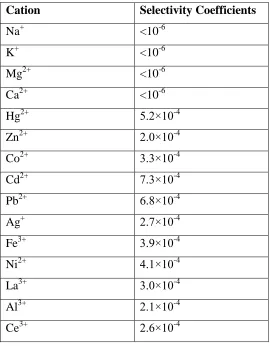
[image:8.596.164.434.266.612.2]The most important characteristic of the ASS-ISEs (like any other ion selective electrode), i.e. their selectivity was also evaluated. This parameter is defined as the ISEs’ specific response to the target ion in the presence of interfering ions. The method applied to the evaluation of this parameter was the so-called matched potential method (MPM) [60-63] and the resulting selectivity coefficients are given in Table 2. The results show that none of the tested interfering ions has a considerable influence on the response of the sensor.
Table 2. The selectivity coefficients of various interfering cations for Cu2+ ASS PVC membrane sensor Selectivity Coefficients Cation <10-6 Na+ <10-6 K+ <10-6 Mg2+ <10-6 Ca2+ 5.2×10⁻⁴ Hg2+ 2.0×10⁻⁴ Zn2+ 3.3×10⁻⁴ Co2+ 7.3×10⁻⁴ Cd2+ 6.8×10⁻⁴ Pb2+ 2.7×10⁻⁴ Ag+ 3.9×10⁻⁴ Fe3+ 4.1×10⁻⁴ Ni2+ 3.0×10⁻⁴ La3+ 2.1×10⁻⁴ Al3+ 2.6×10⁻⁴ Ce3+
To prove that the ASS-ISE can be applied to real samples, the concentration of Cu2+ n some industrial wastewater samples was evaluated using the device. The samples were only acidified with HNO3 after acquisition, and three analyses were performed on each sample, through the calibration
Table 3. Results of copper analysis in waste water samples
Sample Found by the sensor* (ppm)
Found by ICP-OES (ppm)
Sample 1 1.7±0.1 1.6±0.1
Sample 2 3.4±0.2 3.3±0.1
Sample 3 0.9±0.1 0.9±0.1
* The results are based on five replicate measurements.
4. CONCLUSION
An All-solid-state ion selective electrode (ASS-ISE) potentiometric PVC membrane sensor has been devised and used for facile and rapid determination of Cu2+ in waste water samples. The solid conductive polymeric composite (CPC) used as the transducer, composed of graphite powder, MWCNTs, and epoxy resin and was coated on a copper wire. The overall solid contact was then covered with a thin layer PVC membrane, composed of 33% PVC, 58% NB, 3% ionic additive, and 6% ionophore L. The ASS-ISE had A dynamic linear range from 1.0×10⁻⁸ to 1.0×10⁻³ M of Cu2+and the detection limit was evaluated at 2.4×10⁻⁹ M. The proposed ASS-ISE was successfully applied to the analysis of Cu2+ in waste water samples.
ACKNOWLEDGEMENTS
Authors are grateful to the research council of University of Tehran for the financial support of this work.
Reference
1. A. Zirino, D.A. VanderWeele, S.L. Belli, R. Demarco, and D.J. Mackey, Mar. Chem., 61 (1998) 173.
2. R.S. Eriksen, D.J. Mackey, R. van Dam, and B. Nowak, Mar. Chem., 74 (2001) 99. 3. I. Durukan, C.A. Şahin, and S. Bektaş, Microchem. J. 98 (2011) 215
4. J. Schwarcz, and J.A. Schwarcz, The Fly in the Ointment: 70 Fascinating Commentaries on the Science of Everyday Life; ECW Press: Toronto, Canada (2004) p. 180.
5. A.M. Jamaluddin, M. Saifuddin, T. Jannat, and S.C. Bhattacharjee, Green Page (2010), available online at: http://www.eco-web.com/edi/100412.html.
6. M.R. Shishehbore, N. Nasirizadeh, S.A.M. Haji, and M. Tabatabaee, Can. J. Anal. Sci. Spectrosc. 50 (2005) 130.
7. [online] available at: http://www.nutrition.org/nutinfo/content/copp.shtml.
8. S. Jignesh, K. Vineeta, S. Abhay, and K. Vilasrao, Int. J. Res. Pharm. Chem. 2 (2012) 146. 9. P.H. Ahmad, M. Karimi, E. Moniri, and H. Soudi, Afr. J. Pure Appl. Chem. 2 (2008) 096. 10.J. Karthikeyan, P.P. Naik, and A.N. Shetty, Environ. Monit. Assess. 176 (2010) 419.
11.J. Škrlíková, V. Andruch, I.S. Balogh, L. Kocúrová, L. Nagy, and Y. Baze, Microchem. J. 99 (2011) 40.
13.S. Abbasi, H. Khani, and R. Tabaraki, Food Chem. 123 (2010) 507.
14.T. Leelasattarathkul, S. Liawruangrath, M. Rayanakorn, W. Oungpipat, and B. Liawruangrath, Talanta 70 (2006) 656.
15.V. Kaur, and A.K. Malik, Ann. Chim. 97 (2007) 1279. 16.T. Rohani, and M.A. Taher, J. AOAC Int. 91 (2008) 1478.
17.B.C. Janegitz, L.H. Marcolino-Junior, S.P. Campana-Filho, R.C. Faria, and O. Fatibello-Filho, Sens. Actuators B 142 (2009) 260.
18.V.K. Gupta, A.K. Singh, M. Al Khayat, Barkha Gupta, Anal. Chim. Acta, 590 (2007) 81.
19.H. A. Zamani, M. Mohammadhosseini, S. Haji-Mohammadrezazadeh, F. Faridbod, M. R. Ganjali, S. Meghdadi and A. Davoodnia, Mater. Sci. Eng. C, 32 (2012) 712.
20.V. K. Gupta, A. K. Singh and B. Gupta, Anal. Chim. Acta, 575 (2006) 198.
21.M. R. Ganjali, P. Norouzi, A. Atrian, F. Faridbod, S. Meghdadi, and M. Giahi, Mater. Sci. Eng. C, 29 (2009) 205.
22.H. A. Zamani, M. R. Ganjali, P. Norouzi, and M. Adib, Mater. Sci. Eng. C, 28 (2008) 157.
23.M. R. Ganjali, A. Karimi, S. J. Shahtaheri, and P. Norouzi, Int. J. Electrochem. Sci., 8 (2013) 1999. 24.A. K. Singh, V. K. Gupta and B. Gupta, Anal. Chim. Acta, 1 (2007) 171.
25.B.P. Nikolskii, and E.A. Materowa, Ion. Sel. Electrode Rev., 7 (1985) 3.
26.J.M.C.S. Magalhaes, F. Cespedes, S. Alegret, and A.A.S.C. Machado, Anal. Chim. Acta 355 (1997) 241.
27.H.J. Yoon, J.H. Shin, S.D. Lee, H. Nam, G.S. Cha, T.D. Strong, and R.B. Brown, Sens. Actuators B 64 (2000) 8.
28.S. Walsh, D. Diamond, J. McLaughlin, E. McAdams, D. Woolfson, D. Jones, and M. Bonner, Electroanalysis 9 (1997) 1318
29.O. Lutze, R.K. Meruva, A. Frielich, N. Ramamurthy, R.B. Brown, R. Hower, and M.E. Meyerhoff, Fresenius J. Anal. Chem. 364 (1999) 364
30.A. Cadogan, Z. Gao, A. Lewenstam, A. Ivaska, and D. Diamond, Anal. Chem. 64 (1992) 2496 31.A. Michalska, A. Hulanicki, and A. Lewenstam, Microchem. J. 57 (1997) 59
32.T. Lindfors, and A. Ivaska, Anal. Chim. Acta 400 (1999) 101 33.T. Lindfors, and A. Ivaska, Anal. Chim. Acta 404 (2000) 111 34.J. Bobacka, Anal. Chem. 71 (1999) 4932
35.P. Sjoberg, J. Bobacka, A. Lewenstam, and A. Ivaska, Electroanalysis 11 (1999) 821
36.F. Song, J.H. Ha, B.H. Park, T.H. Kwak, I.T. Kim, H.N. Nam, and G.S. Cha, Talanta 57 (2002) 263
37.N. Tinkilic, O. Cubuk, and I. Isildak, Anal. Chim. Acta 452 (2002) 29.
38.M. R. Ganjali, Z. Memari, F. Faridbod, and P. Norouzi, Int. J. Electrochem. Sci. 3 (2008) 1169. 39.C.Z. Lai, M.M. Joyer, M.A. Fierke, N.D. Petkovich, A. Stein, and P. Bühlmann, J. Solid State
Electrochem. 13 (2009) 123.
40.K. Wang, J.J. Xu, K.S. Tang, and H.Y. Chen, Talanta 67 (2005) 798. 41.S. Sadeghi, and F. Fathi, J. Incl. Phenom. Macrocycl. Chem. 67 (2010) 91.
42.M. R. Ganjali, M. Emami and M. Salavati-Niasari, Bull. Korean Chem. Soc. 23 (2002) 1394. 43.M.R. Ganjali, F. Faridbod, N. Davarkhah, S.J. Shahtaheri, and P. Norouzi, Int. J. Environ. Res. 9
(2015) 333.
44.F. Faridbod, M. R. Ganjali, B. Larijani, P. Norouzi, S. Riahi and F. S. Mirnaghi, Sensors 7 (2007) 3119.
45.M. R. Ganjali, P. Norouzi, F. S. Mirnaghi, S. Riahi, and F. Faridbod, IEEE Sensors J. 7 (2007) 1138.
46.M. R. Ganjali, N. Motakef-Kazami, F. Faridbod, S. Khoee, and P. Norouzi, J. Hazard. Mater. 173 (2010) 415.
49.F. Faridbod, M. R. Ganjali and P. Norouzi, Int. J. Electrochem. Sci. 8 (2013) 6107.
50.H.A. Zamani, M. Nekoei, M. Mohammadhosseini, and M.R. Ganjali, Mater. Sci. Eng. C, 30 (2010) 480.
51.M. Javanbakht, S. E. Fard, A. Mohammadi, M. Abdouss, M. R. Ganjali, P. Norouzi, and L. Safaraliee, Anal. Chim. Acta, 612 (2008) 65.
52.M. R. Ganjali, M. Qomi, A. Daftari, P. Norouzi, M. Salavati-Niasari and M. Rabbani, Sens. Actuators B 98 (2004) 92.
53.H. A. Zamani, G. Rajabzadeh and M. R. Ganjali, Sensor Lett. 7 (2009) 114. 54.H. A. Zamani, M. R. Ganjali, P. Norouzi and M. Adib, Sensor Lett. 5 (2007) 522.
55.M. Shamsipur, S. Rouhani, H. Shaghi, M. R. Ganjali, and H. Eshghi, Anal. Chem. 71 (1999) 4938. 56.M. Javanbakht, M. R. Ganjali, P. Norouzi, A. Badiei, A. Hasheminasab, and M. Abdouss,
Electroanalysis 19 (2007) 1307.
57.H. A. Zamani, M. R. Ganjali, and M. Adib, Sensor Lett.6 (2006) 345.
58.M. R. Ganjali, P. Norouzi, F. Faridbod, S. Riahi, J. Ravanshad, J. Tashkhourian, M. Salavati-Niasari and M. Javaheri, IEEE Sensors J. 7 (2007) 544.
59.M. R. Ganjali, P. Norouzi, M. Adib and A. Ahmadalinezhad, Anal. Lett. 39 (2006) 1075. 60.H. A. Zamani, J. Abedini-Torghabeh, and M. R. Ganjali, Electroanalysis 18 (2006) 888. 61.H. A. Zamani, M. R. Ganjali, P. Norouzi, and S. Meghdadi, Anal. Lett. 41 (2008) 902. 62.H. A. Zamani, G. Rajabzadeh, M. Masrornia, A. Dejbord, M. R. Ganjali, and N. Seifi,
Desalination, 249 (2009) 560.