Int. J. Electrochem. Sci., 10 (2015) 4105 - 4115
International Journal of
ELECTROCHEMICAL
SCIENCE
www.electrochemsci.orgElectrochemical Behavior and the Detection Limit of Ascorbic
Acid on a Pt Modified Electrode
H. M. Rageh1, M. M. Abou-Krisha1,2,*, A. M. Abo-bakr1, and M. Abd-Elsabour1
1
Faculty of Science, Chemistry Department, South Valley University, Qena, 83523, Egypt.
2
College of Science, Chemistry Department, Al Imam Mohammad Ibn Saud Islamic University (IMSIU), Riyadh 11623, KSA.
*
E-mail: [email protected]
Received: 20 January 2015 / Accepted: 5 March 2015 / Published: 23 March 2015
The electrochemical behavior of ascorbic acid (AA) at the DL-Alanine (DL-Ala) polymer film modified platinum electrode (DL-Ala/Pt electrode) had been studied by using cyclic voltammetry. The main proposition of the research is also to indicate the detection limit of AA on the used modified electrode. The modified electrode shows an excellent electrocatalytical effect on oxidation of AA in 0.1 M KH2PO4 using cyclic voltammetry. The effect of DL-Ala/Pt modified electrode increases clear
by the anodic current peak about 13.67 µA while the peak potential shifts to negative values as compared to the bare Pt electrode. The anodic current increased with an increase in AA concentration from 2 mM to 7.5 mM and with increasing scan rate from 20-200 mV/s and it is potential shifted to more positive values. The detection limit of this modified electrode with AA was calculated to be 9.24x10⁻⁶ M. Chronoamperometric measurements were used to find the diffusion coefficient of AA with a value of 6.92 x 10⁻⁶ cm2s-1.
Keywords: Electrochemical behavior; Ascorbic acid; Cyclic voltammetry; DL-Ala/Pt modified electrode; Chronoamperometric
1. INTRODUCTION
can give to taste deterioration; added to apple pulp (250 mg/kg), vitamin C inhibits oxidation processes responsible for apple juice aroma [3].
Applications of modified electrodes in electrocatalysis and sensors have been enriched by the specific properties of conducting polymers. These properties - such as good stability, reproducibility, selectivity, activity and large service area – lead to decrease the normally large overpotential and raise the current encountered in the electrooxidation of materials.
It is very difficult to determine AA directly at ordinary (carbon or metal) electrodes, because of its high overpotential and consequent fouling by oxidation products [4]. Therefore, some chemically modified electrodes with various active mediators immobilized on the electrode surface have been used as the catalyst of electrooxidation of AA [5-7]. These include a glassy carbon electrode (GCE) and a carbon paste electrode with complexes and organic compounds, such as cobalt hexacyanoferrate [8] ruthenium (III) diphenyldithiocarbamat [9], cobalt pentacyanonitrosylferrate [10], ferrocene with b-cyclodextrin [11], norepinephrine [12], Ni[Me2(CH3CO)], tetraeno N4 complex [13] and aniline [14].
Fabrication of chemically modified electrode (CME) has been widely reported to improve sensitivity and selectivity in determining amino acids, vitamins, DNA and etc. in recent years [15-18]. Many studies have indicated that a polymer film modified electrodes show an enhanced response for determination of various important biological and clinical species [19]. It was found that some amino acids such as cysteine and alanine have been used for electrocatalysis of AA, UA and DA [20,21]. But the electrochemical oxidation of AA at the DL-alanine polymer film in the service of platinum electrode has been not reported yet. On the other hand the electropolymerization of L-alanine on smooth electrodes such as platinum and glassy carbon electrodes was studied in literature [22].
Many analytical methods used for AA determination. Classic (conventional) techniques are represented by volumetric methods titration with an oxidizing solution such as potassium iodate [23], or bromate [24]. Volumetric techniques can suffer from lack of specificity [14] which limits their use to samples not containing other reducing agents. Square-wave voltammetry was used to determine AA based on its oxidation at a zeolite modified carbon paste electrode [25], and the method was applied to the AA determination in citrus juice. Cyclic and differential pulse voltammetries were used for AA electrocatalytical determination at a carbon paste electrode modified by 2, 7-bis (ferrocenylethynyl) fluoren-9-one [26].
The present study aims to investigate the electrochemical behavior and detection limit of AA at a DL-Ala/Pt modified electrode by using cyclic voltammetry. Also study the influence of AA concentration and scan rate on the oxidation behavior of AA. Moreover, find the diffusion coefficient of AA by using chronoamperometric technique.
2. EXPERIMENTAL 2.1. Reagents and solutions
Stock solution of 0.1M KH2PO4 (Cablo Erba Co. Code No. 455100) was prepared by
dissolving 3.4 gm in 250 mL double distilled Water. While stock solution of 0.01 M AA was ready by dissolving 0.44 gm in 250 mL of double distilled water at room temperature.
2.2. Electrochemical equipment
The apparatus used in these experiments is EG&G PRINCETON APPLIED RESEARCH POTENTIOSTAT/GALVANOSTAT MODEL 263 (made in USA). The cell consists of three electrodes (model K0264 micro-cell), the working and counter (model K0266) electrodes were of high purity platinum wire, while an Ag/AgCl saturated KCl (model K0265) electrode was used as the reference electrode and chemically modified Pt electrode as working electrode.
2.3. Preparation of the DL-alanine polymer film modified Pt Electrode
A platinum electrode (2 mm in diameter) was polished to a mirror finished with polish paper, followed by washing in nitric acid, ethanol and distilled water. Then, a Pt electrode was electrochemically cleaned by cycling the electrode potential between −1 to 1 V in 1 M H2SO4 (pH =
0.61) [27,28], until a stable voltammogram was obtained. After that it was washed with doubly distilled water and dried, the electropolymerization of DL-Alanine on a platinum electrode was carried out in 0.1 M Na2HPO4 containing 0.01 M DL-Alanine with potential cycling between −0.6 to 2.0 V.
After 20 cycles the surface of the film modified electrode was washed with doubly distilled water to remove the physically adsorbed material and for drying, it was heated for 5 min. at 55ºC in oven. Then, the film electrode was transferred to an electrochemical cell.
All experiments have been carried out in duplicate; the measurements have shown good reproducibility.
2.4. Electrochemical measurement
Unless otherwise mentioned, all electrochemical measurements were performed with 6 mM AA in 0.1 M potassium dihydrogen phosphate KH2PO4 as a supporting electrolyte at DL-Ala/Pt
modified electrode. Cyclic voltammetry was used to detect the electrochemical response of AA. A potential cycling between -0.3 to 1.1 V, was applied to the working electrode at room temperature.
3. RESULTS AND DISCUSSION 3.1. Electrochemical behavior of AA
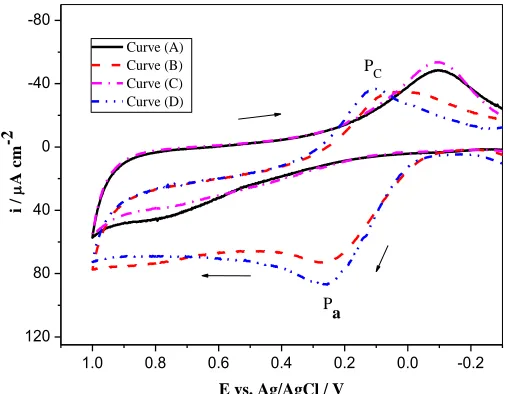
0.1M KH2PO4; curve B is obtained in 0.1M KH2PO4 containing 6 mM of AA; curve C represents the
electrode containing the polymer film of DL-Alanine in 0.1M KH2PO4 without AA and curve D refers
to the electrode with the polymer film of DL-Alanine in 0.1M KH2PO4 containing 6 mM of AA.
1.0 0.8 0.6 0.4 0.2 0.0 -0.2
120 80 40 0 -40 -80
PC
P
a Curve (A)
Curve (B) Curve (C) Curve (D)
i
/
A
c
m
-2
E vs. Ag/AgCl / V
Figure 1. Cyclic voltammograms obtained with the platinum electrode in 0.1 M KH2PO4 at scan rate
100 mV/s under different conditions: curve (A) electrode without polymer film and without AA; curve (B) electrode without polymer film and with AA; curve (C) electrode with polymer film and without AA, and curve (D) electrode with polymer film and with AA.
As can be seen from Figure 1, for the bare Pt electrode in 0.1M KH2PO4in absence AA (curve
A), only one cathodic peak appears at about -0.1 V, corresponding to reduction of water. After addition, AA to the solution curve B is obtained and an anodic peak of current appears around +0.26 V, which in a good agreement with the reported data [29-31], about oxidation of AA at a bare platinum electrode. The return sweeping shows only the water reduction peak. This means that the process is not reversible. In addition, the cathodic peak associated with water reduction and shifted to more positive potential in presence AA. This may be related to adsorption of molecules of AA on the surface of the electrode, preventing the interaction between platinum and the solvent molecules. In the potential sweeping of the platinum electrode containing the polymer film of DL-Alanine without ascorbic AA (curve C), no anodic current peak appears. Absence of an anodic peak was expected due to absence of AA.
The last voltammogram of Figure 1, curve D, corresponds to the electrode with the polymeric film in presence AA. As observed, the anodic current peak increases about 13.67 µA while the peak potential shifts to negative values. This means that the electrode containing the polymer film of DL-Alanine presents electro-catalytic activity to AA. The increase of current peak indicates that a higher amount of species was oxidized, while the shift in potential shows higher facility in oxidizing these species.
The overall reaction of AA oxidation expressed by the following reaction [32]:
[image:4.596.164.419.147.344.2]
Reaction of AA oxidation revealed that AA electrochemical oxidation reactions (eq. 1), is diffusion controlled-two electrons and two protons-process. Moreover, also during the cathodic potential scans no significant currents were detected, this oxidation process is irreversible [31].
3.2. Effect of AA concentration
1.0 0.8 0.6 0.4 0.2 0.0 -0.2 80
60 40 20 0 -20
f e
d c b
a
i
/
A
c
m
-2
E vs. Ag/AgCl/ V
Figure 2. Cyclic voltammograms of DL-Ala/Pt modified electrode in 0.1 M KH2PO4 at scan rate 50
mV/s with increasing AA concentration as (a) 2, (b) 3.33, (c) 4, (d) 5, (e) 6 and (f) 7.5 mM.
2 3 4 5 6 7 8
20 30 40 50 60 70 80
y = 9.90 x + 5.71 ipa
/
A
c
m
-2
Concentration of AA/mM
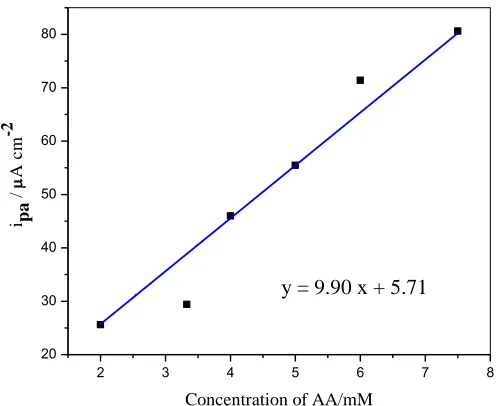
Figure 3. Calibration graph for different concentrations of AA in 0.1 M KH2PO4 using a DL-Ala/Pt
[image:5.596.164.420.203.426.2] [image:5.596.165.414.508.711.2]
Concentration of AA was determined using DL-Ala/Pt modified electrode as shown in Figure 2. The anodic current increased with an increase concentration of AA from 2 mM to 7.5 mM, and it is potential shifted to more positive values.
[image:6.596.80.515.245.368.2]The calibration graph of AA in different concentrations was obtained by using a DL-Ala/Pt modified electrode shows in Figure 3. A linear response was achieved in the concentration range of 2 to 7.5 mM, with a sensitivity response of 9.90 mA/M obtained from the linear equation slope, which is in the same order of size with previously reported value of 13.7 µA/mM [33].
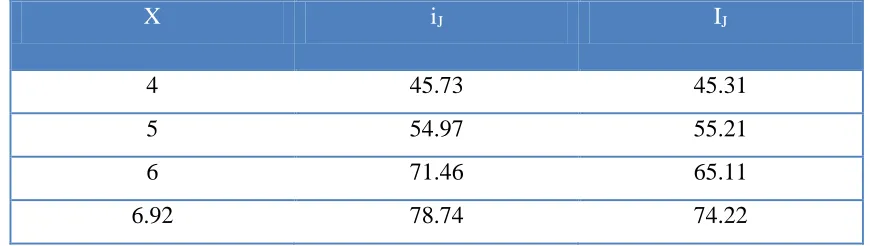
Table 1. The data used to calculate the value of SD taken from figure 3
X iJ IJ
4 45.73 45.31
5 54.97 55.21
6 71.46 65.11
6.92 78.74 74.22
Table 1 shows the data used to calculate the value of standard deviation of the mean current applying on Figure 3. This value calculated according to equation 2 [34]:
SD = 1 / (n-2) ∑ (ij - Ij) 2 ………..(2)
Where SD is the standard deviation which is the square root of the variance, ij is the
experimental value of the experiment number j and Ij is the corresponding recalculated value, at the
same concentration using the regression line equation 3:
Y = 9.90 x + 5.71 ………….……….(3)
The calculated SD was used in determining the detection limit (DL, 3 x SD / slope). From these values, the detection limit of determination of AA by using a DL-Ala/Pt modified electrode was calculated to be 9.24x10⁻⁶ M. This value is very clothing to the value reported in literature [33].
3.3. Effect of scan rate
The effect of a varying scan rate in the oxidation process of AA was studied. Cyclic voltammograms of 6 mM AA in 0.1 M KH2PO4 supporting electrode using a DL-Ala/Pt modified
electrode was obtained for the scan rate from 20-200 mV/s (Figure 4). It noted from Figure 4 that, with an increasing scan rate, the anodic current peak for the electrooxidation of AA increases due to more molecules of AA are oxidized and it is potential shifts to more positive values.
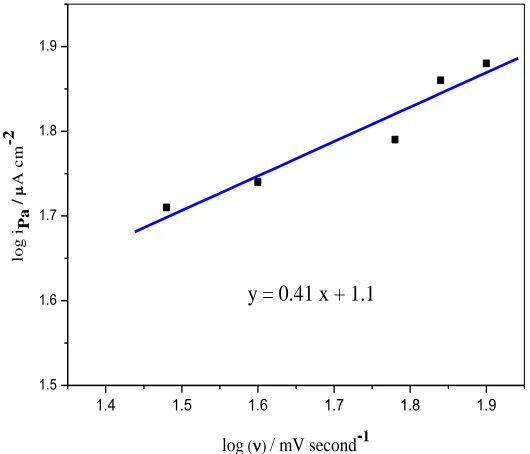
Figure 5 shows the plot of log Ipa (peak current) vs. log v (scan rate). The linear correlation
The observed increase in the oxidative current of AA is due to heterogeneous kinetics. The obtained slope (0.48) is in a good agreement with the theoretical slope (0.5) for a diffusion controlled process [30]. Good linearity between the anodic peak current and the square root of scan rate (Figure 6) which obtained by the equation 5:
Y = 7.51 X + 47.42.……… (5)
This supports the idea that the electrode reactions of AA were under diffusion control [33].
1.0 0.8 0.6 0.4 0.2 0.0 -0.2
80 60 40 20 0 -20 -40
g
f e d
c b
a
i
/
A
c
m
-2
E vs. Ag/AgCl/ V
Figure 4. Cyclic voltammograms of 6 mM AA in 0.1 M KH2PO4 at a DL-Ala/Pt modified electrode, at scan rates (a) 20, (b) 30, (c) 40, (d) 50, (e) 60, (f) 70 and (m) 80 mV/s.
1.4 1.5 1.6 1.7 1.8 1.9
1.5 1.6 1.7 1.8 1.9
y = 0.41 x + 1.1
lo
g
iP
a
/
A
c
m
-2
[image:7.596.159.421.198.412.2]log / mV second-1
[image:7.596.157.422.484.711.2]
3.4. Chronoamperometric measurements
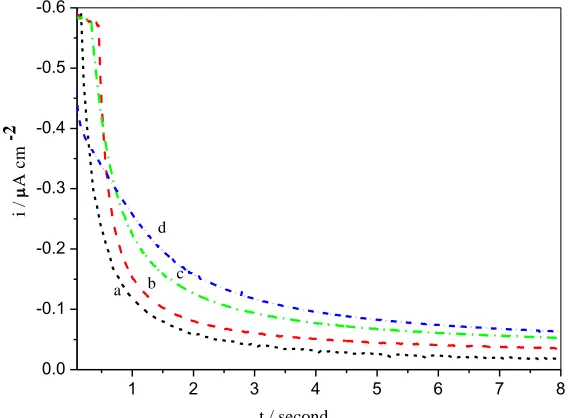
The chronoamperometry was employed along with other electrochemical methods for the investigation of electrode processes at chemically modified electrodes. Figure 7 shows chronoamperometric measurements of AA at a DL-Ala/Pt obtained by setting the working electrode potential at -0.6 V (first potential step) and at +1 V (second potential step) for the various concentrations of AA in 0.1 M KH2PO4.
5 6 7 8 9 10
45 50 55 60 65 70 75 80
y = 7.51 x + 10.6 i Pa
/
A
c
m
-2
Square root of scan rate / (mV/second)-0.5
Figure 6. Plot of peak current vs. square root of v., other parameters same as in figure 4.
1 2 3 4 5 6 7 8
0.0 -0.1 -0.2 -0.3 -0.4 -0.5 -0.6
d
c b a
i
/
A
c
m
-2
t / second
Figure 7. Chronoamperometric response at a DL-Ala/Pt modified electrode in 0.1 M KH2PO4 for
[image:8.596.142.437.210.449.2] [image:8.596.146.430.497.706.2]
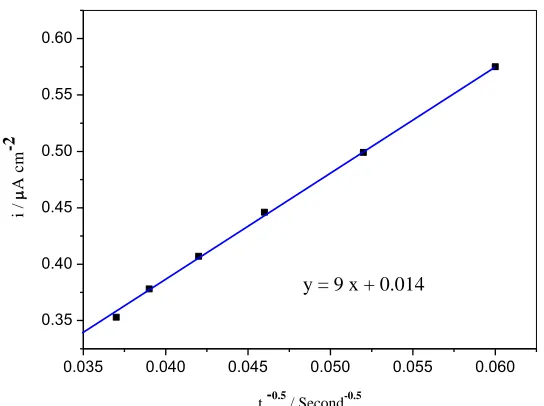
In chronoamperometric studies, we have determined the diffusion coefficient of AA for a DL-Ala/Pt modified electrode. For an electroactive material (AA in this case) with a diffusion coefficient of D, the current for the electrochemical reaction (at a mass transport limited rate) is described by Cottrell equation 6 [35].
I = n F A D1/2 Cb –1/2 t–1/2 ………. (6)
Where, D and Cbare the diffusion coefficient (cm2 s–1) and the bulk concentration (mM). Under
diffusion control, a plot of I vs. t–1/2 will be linear (Figure 8), and from the slope the value of D obtained. The mean value of the D of AA was found to be 6.92 x 10⁻⁶ cm2 s–1; this value is compared with the values obtained by other literature [30].
3.5. Stability of DL-Ala/Pt modified electrode
0.035 0.040 0.045 0.050 0.055 0.060 0.35
0.40 0.45 0.50 0.55 0.60
y = 9 x + 0.014
i
/
A
c
m
-2
t -0.5 / Second-0.5
Figure 8. Cottrell’s plot for potential step chronoamperometry of 5 mM AA acid in 0.1 M KH2PO4.
The DL-Ala/Pt modified electrode has high stability while kept in double distilled water at room temperature. Where there is no clear change in values of oxidation peak currents of AA with using this electrode after two weeks.
4. CONCLUSION
[image:9.596.150.422.301.504.2]
9.24x10⁻⁶ M. From the chronoamperometric measurements, the value of diffusion coefficient of AA was found to be 6.92 x 10⁻⁶ cm2 s-1 using a DL-Ala/Pt modified electrode.
References
1. J. Wang, Analytical Electrochemistry. 2nd Edition. John Wiley & Sons, Inc. Publication, (2000). 2. R.N. Castro, L.C. Azeredo, M.A.A. Azeredo and C.S.T. de Sampaio, J. Liq. Chrom. Rel. Technol.,
24 (2001) 1015.
3. J. Wawrzyniak, A. Ryniecki and W. Zembrzuski, J. Acta Sci. Pol. - Technol. Aliment., 4 (2005) 5. 4. V.S. Ijeri, P.V. Jaiswal and A.K. Srivastava, J. Anal. Chim. Acta, 439 (2001) 291.
5. K. Barman and S. Jasimuddin, Indian J. Chem., 53A (2014) 57.
6. J.B. Raoof, R. Ojani, R. Hosseinzadeh and V. Ghasemi, J. Anal. Sci., 19 (2003) 1251. 7. T. Selvaraju and R. Ramaraj, J. Electrochem. Commun., 5 (2003) 667.
8. C.X. Cai, K.H. Xue and S.M. Xu, J. Electroanal. Chem., 486 (2000) 111. 9. B. Nalini and S.S. Narayanan, J. Anal. Chim. Acta, 405 (2000) 93.
10.R.E. Sabzi and M.H. Pournaghi-Azar, J. Anal. Sci., 21 (2005) 689.
11.Z. Guorong, W. Xiaolei, S. Xingwang and S. Tianling, J. Talanta, 51 (2000) 1019. 12.X. Han, J. Tang, J. Wang and E. Wang, J. Electrochim. Acta, 46 (2001) 3367. 13.M. Khorasani-Motlagh and M. Noroozifar, J. Anal. Sci., 19 (2003) 1671.
14.P.J. O’Connell, C. Gormally, M. Pravda and G.G. Guilbault, J. Anal. Chim. Acta, 431 (2001) 239. 15.Z.S. Yang, Y.L. Wang and Y.Z. Zhang, J. Electrochem. Commun., 6 (2004) 158.
16.J. Okuno, K. Maehashi, K. Matsumoto, K. Kerman, Y. Takamura and E. Tamiya, J. Electrochem. Commun., 9 (2007) 13.
17.R.N. Goyal, V.K. Gupta and N. Bachheti, J. Anal. Chim. Acta, 597 (2007) 82. 18.L. Tang, Y. Zhu, X. Yang, C. Li, J. Anal. Chim. Acta, 597 (2007) 145.
19.M. Trojanowicz, J. Microchim. Acta, 143 (2003) 75.
20.Y. Zhao, J. Bai, L. Wang, E. XuHong, P. Huang, H. Wang and L. Zhang, Int. J. Electrochem. Sci., 1 (2006) 363.
21.Ongera Gilbert, Umesh Chandra, B.E. Kumara Swamy, M. Panduranga Char, C. Nagaraj and B.S. Sherigara, Int. J. Electrochem. Sci., 3 (2008) 1186.
22.T. Alhedabi, G. Herlem, H. Cattey, V. Blondeau-Patissier and T. Gharbi, J. Phys. Chem. C118 (2014) 25041.
23.D. Balan, M. Pele, M. Artimon and G. Luta, J. Cytol. Biol. Vegetal-Bot., 28 (2005) 364. 24.N. Matei, V. Magearu, S. Birghila and S. Dobrinas, J. Revista de Chimie, 55 (2004) 294. 25.A. Gut´es, A.B. Ib´a˜nez, M. Del Valle, F. C´espedes, J. Electroanal. Chem., 18 (2006) 82. 26.A. Nezamzadeh, M.K. Amini and H. Faghihian, Int. J. Electrochem. Sci., 2 (2007) 583. 27.M.A. Kamyabi, O. Narimani and H.H. Monfared, J. Electroanal. Chem., 644 (2010) 67. 28.M.A. Kamyabi, O. Narimani and H.H. Monfared, J. Braz. Chem. Soc., 22 (2011) 468.
29.A.M. Pisoschi, A.F. Danet and S. Kalinowski, J. Autom. Methods Manag. Chem., 2008 (2008) ID937651, 1.
30.M. Zidan, W.T. Tan, Z. Zainal, A.H. Abdullah and J.K. Goh, Int. J. Electrochem. Sci., 6 (2011) 279.
31.E. Colín-Orozco, S. Corona-Avendaño, M.T. Ramírez-Silva, M. Romero-Romo and M. Palomar-Pardavé, Int. J. Electrochem. Sci., 7 (2012) 6097.
32.S. Chairam, W. Sriraksa, M. Amatatongchai and E. Somsook, J. Sensors, 11 (2011) 10166. 33.K.S. Ngai, W.T. Tan, Z. Zainal, R.M. Zawawi and M. Zidan, Int. J. Electrochem. Sci., 8 (2013)
10557.
35.A.J. Bard and L.R. Faulkner, Electrochemical Methods: Fundamentals and Applications, Wiley: New York, (2007).