This is a repository copy of
LUX trigger efficiency
.
White Rose Research Online URL for this paper:
http://eprints.whiterose.ac.uk/136068/
Version: Accepted Version
Article:
Akerib, D.S., Alsum, S., Araújo, H.M. et al. (94 more authors) (2018) LUX trigger efficiency.
Nuclear Instruments and Methods in Physics Research Section A: Accelerators,
Spectrometers, Detectors and Associated Equipment, 908. pp. 401-410. ISSN 0168-9002
https://doi.org/10.1016/j.nima.2018.07.094
Article available under the terms of the CC-BY-NC-ND licence
(https://creativecommons.org/licenses/by-nc-nd/4.0/).
Reuse
This article is distributed under the terms of the Creative Commons Attribution-NonCommercial-NoDerivs (CC BY-NC-ND) licence. This licence only allows you to download this work and share it with others as long as you credit the authors, but you can’t change the article in any way or use it commercially. More
information and the full terms of the licence here: https://creativecommons.org/licenses/
Takedown
If you consider content in White Rose Research Online to be in breach of UK law, please notify us by
arXiv:1802.07784v3 [physics.ins-det] 5 Sep 2018
LUX Trigger Efficiency
D.S. Akeriba,b,c, S. Alsumd, H.M. Ara´ujoe, X. Baif, J. Balajthyg,
P. Beltrameh, E.P. Bernardi, A. Bernsteinj, T.P. Biesiadzinskia,b,c,
E.M. Boultoni,k,l, B. Boxerm, P. Br´asn, S. Burdinm, D. Byramo,p,
M.C. Carmona-Benitezq, C. Chanr, J.E. Cutterg, T.J.R. Davisonh,
E. Druszkiewiczs, S.R. Fallont, A. Fanb,c, S. Fioruccik,r, R.J. Gaitskellr,
J. Genovesit, C. Ghagu, M.G.D. Gilchriesek, E. Graceq, C. Gwilliamm,
C.R. Hallv, S.J. Haselschwardtw, S.A. Hertelx,k, D.P. Hogani, M. Hornp,i,
D.Q. Huangr, C.M. Ignarrab,c, R.G. Jacobseni, W. Jia,b,c, K. Kamdini,k,
K. Kazkazj, D. Khaitans, R. Knochev, E.V. Korolkovay, S. Kravitzk,
V.A. Kudryavtsevy, B.G. Lenardog,j, K.T. Leskok, J. Liaor, J. Lini,
A. Lindoten, M.I. Lopesn, A. Manalaysayg, R.L. Manninoz,d, N. Marangoue,
M.F. Marzionih, D.N. McKinseyi,k, D.-M. Meio, M. Moongweluwans,∗,
J.A. Moradg, A.St.J. Murphyh, C. Nehrkornw, H.N. Nelsonw, F. Nevesn,
K.C. Oliver-Malloryi,k, K.J. Palladinod, E.K. Peasei,k, G.R.C. Rischbietert,
C. Rhyner, P. Rossitery, S. Shaww,u, T.A. Shutta,b,c, C. Silvan, M. Solmazw,
V.N. Solovovn, P. Sorensenk, T.J. Sumnere, M. Szydagist, D.J. Taylorp,
W.C. Taylorr, B.P. Tennysonl, P.A. Termanz, D.R. Tiedtf, W.H. Toaa,
M. Tripathig, L. Tvrznikovai,k,l, U. Utkuu, S. Uvarovg, V. Velani,
J.R. Verbusr, R.C. Webbz, J.T. Whitez,1, T.J. Whitisa,b,c, M.S. Witherellk,
F.L.H. Wolfss, D. Woodwardq, J. Xuj, K. Yazdanie, C. Zhango
aCase Western Reserve University, Department of Physics, 10900 Euclid Ave, Cleveland, OH 44106, USA
bSLAC National Accelerator Laboratory, 2575 Sand Hill Road, Menlo Park, CA 94205, USA cKavli Institute for Particle Astrophysics and Cosmology, Stanford University, 452 Lomita
Mall, Stanford, CA 94309, USA
dUniversity of Wisconsin-Madison, Department of Physics, 1150 University Ave., Madison, WI 53706, USA
eImperial College London, High Energy Physics, Blackett Laboratory, London SW7 2BZ, United Kingdom
fSouth Dakota School of Mines and Technology, 501 East St Joseph St., Rapid City, SD 57701, USA
gUniversity of California Davis, Department of Physics, One Shields Ave., Davis, CA 95616, USA
hSUPA, School of Physics and Astronomy, University of Edinburgh, Edinburgh EH9 3FD, United Kingdom
iUniversity of California Berkeley, Department of Physics, Berkeley, CA 94720, USA jLawrence Livermore National Laboratory, 7000 East Ave., Livermore, CA 94551, USA
kLawrence Berkeley National Laboratory, 1 Cyclotron Rd., Berkeley, CA 94720, USA lYale University, Department of Physics, 217 Prospect St., New Haven, CT 06511, USA
mUniversity of Liverpool, Department of Physics, Liverpool L69 7ZE, UK nLIP-Coimbra, Department of Physics, University of Coimbra, Rua Larga, 3004-516
Coimbra, Portugal
∗Corresponding author
Email address: [email protected](M. Moongweluwan)
1
oUniversity of South Dakota, Department of Physics, 414E Clark St., Vermillion, SD 57069, USA
pSouth Dakota Science and Technology Authority, Sanford Underground Research Facility, Lead, SD 57754, USA
qPennsylvania State University, Department of Physics, 104 Davey Lab, University Park, PA 16802-6300, USA
rBrown University, Department of Physics, 182 Hope St., Providence, RI 02912, USA sUniversity of Rochester, Department of Physics and Astronomy, Rochester, NY 14627,
USA
tUniversity at Albany, State University of New York, Department of Physics, 1400 Washington Ave., Albany, NY 12222, USA
uDepartment of Physics and Astronomy, University College London, Gower Street, London WC1E 6BT, United Kingdom
vUniversity of Maryland, Department of Physics, College Park, MD 20742, USA wUniversity of California Santa Barbara, Department of Physics, Santa Barbara, CA
93106, USA
xUniversity of Massachusetts, Amherst Center for Fundamental Interactions and Department of Physics, Amherst, MA 01003-9337 USA
yUniversity of Sheffield, Department of Physics and Astronomy, Sheffield, S3 7RH, United Kingdom
zTexas A & M University, Department of Physics, College Station, TX 77843, USA aaCalifornia State University Stanislaus, Department of Physics, 1 University Circle,
Turlock, CA 95382, USA
Abstract
The Large Underground Xenon experiment (LUX) searches for dark matter
using a dual-phase xenon detector. LUX uses a custom-developed trigger system
for event selection. In this paper, the trigger efficiency, which is defined as the
probability that an event of interest is selected for offline analysis, is studied
using raw data obtained from both electron recoil (ER) and nuclear recoil (NR)
calibrations. The measured efficiency exceeds 98% at a pulse area of 90 detected
photons, which is well below the WIMP analysis threshold on the S2 pulse area.
The efficiency also exceeds 98% at recoil energies of 0.2 keV and above for ER,
and 1.3 keV and above for NR. The measured trigger efficiency varies between
99% and 100% over the fiducial volume of the detector.
1. The LUX Trigger
The Large Underground Xenon experiment (LUX) searches for dark matter
particles using a dual-phase xenon detector, described in detail in Ref. [1].
The primary goal of LUX is to search for Weakly Interacting Massive Particles
(WIMPs). An energy deposition from an incident particle produces prompt
scintillation light, called S1, and ionization electrons. The ionization electrons
drift to the liquid surface and are extracted into the gas region by electric fields
to produce electroluminescence light, called S2. The S1 and S2 signals are
detected by two photomultiplier tube (PMT) arrays, located at the top and
bottom of the detector. Each array consists of 61 Hamamatsu R8778 PMTs.
Further details on the PMTs can be found in Ref. [2].
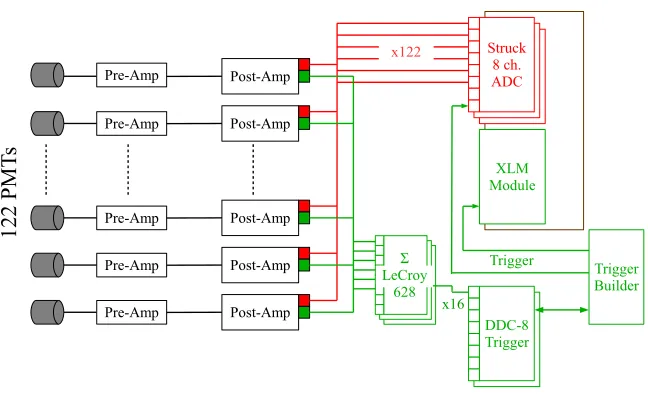
A diagram of the LUX electronics is shown in Fig. 1. The PMT signals
are first amplified by pre-amplifiers that are installed as close as possible to
the PMTs to minimize the cable capacitance, and thus noise. Post-amplifiers
are responsible for pulse shaping and amplification to match the requirements
of the digitizers of the data acquisition (DAQ) and the LUX trigger systems,
such as the sampling frequency. All individual PMT signals are digitized by the
DAQ digitizers without requiring the presence of trigger signals and recorded
onto dedicated data storage disks [3]. In a separate trigger chain, the PMT
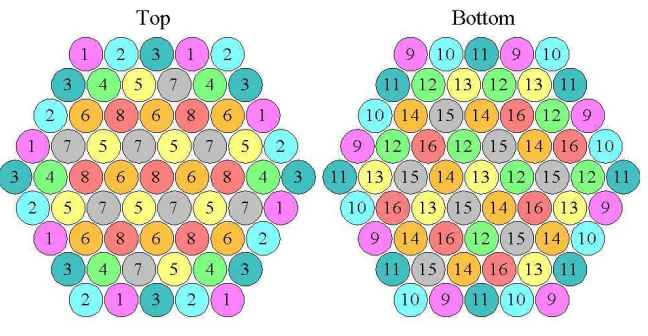
signals are summed into 16 trigger groups, using the patterns shown in Fig. 2.
Each group contains 6-8 PMT signals. The summing configuration is chosen
such that no neighboring PMTs belong to the same trigger group to minimize
signal saturation during a large energy deposition event. The trigger system
processes these signals to identify the periods in which pulses of interest occur.
Trigger signals from the trigger system are recorded along with the PMT signals,
digitized by the DAQ digitizers. The waveforms in the trigger chain, from which
the trigger signals are obtained, are not recorded. An event is defined by a time
window of 0.5 ms before and after a trigger signal. A detailed discussion of the
LUX DAQ system and the LUX trigger system can be found in Refs. [3] and
Figure 1: Diagram of the LUX electronics. The LUX trigger system consists of three separate
modules, i.e. the DDC-8, the trigger builder, and the XLM modules.
The LUX trigger system is responsible for event selection, based on pulse
shape characteristics, utilizing computing power provided by the Spartan-6
FPGA. The pulse area in each trigger group is calculated using two digital
filters, called the S1 and S2 filters, that perform baseline subtraction and pulse
area running integration. Depictions of the S1 and S2 filters are shown in Fig. 3.
In this work, pulse areas are presented in units of detected photons (phd) which
accounts for the possibility that two photoelectrons are created at the PMT
photocathode by one incident photon. Further discussion on this effect can be
found in Ref. [5, 6]. The S1 and S2 filters are designed to select events based on
the presence of S1 and S2 signals, respectively. The S1 filter is used when the
S1 is the dominant signal, such as when operating without electric fields. The
S2 filter is used when S2 signals are expected as part of events of interest. Both
filters can also be used at the same time to select events consisting of S1 and
S2 signals. During LUX WIMP searches, the total event rate in the detector
was sufficiently low to ensure minimum dead-times of both DAQ and trigger
Figure 2: Trigger group summing configurations of the top and bottom PMT arrays. Each
circle represents each PMT, and the number inside indicates the assigned trigger group. The
difference between the top and bottom patterns is for the maximum-based trigger. The
maximum-based trigger is discussed in Ref. [4], and are not used in LUX WIMP searches.
produce very small S1 signals, only the S2 filter was implemented in the trigger
decision.
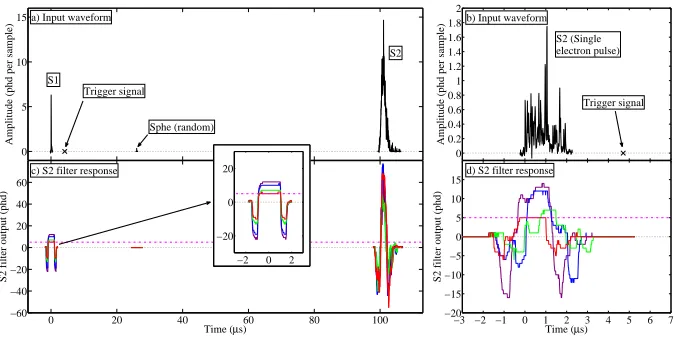
The S2 filter can respond to both S1 and S2 signals, as demonstrated in
Fig. 4. Two thresholds can be applied to the output of the S2 filter. The first
threshold is called the low filter threshold and the second threshold is called
the veto threshold. A valid event requires a filter output above the low filter
threshold and below the veto threshold. During WIMP searches, the low filter
threshold was set at approximately 5 phd, equivalent to approximately 1
5 of
the measured average pulse area of a signal associated with a single electron
extracted from the liquid xenon surface [5]. The veto threshold was disabled
to maintain sensitivity to high energy events. The S2 filter width was set at
2µs, which was the anticipated largest S2 pulse width. Throughout this work,
the pulse width is defined as the time difference between the times at which the
cumulative pulse area of the pulse crosses 2% and 98% of the total pulse area.
These crossing times define the pulse start and the pulse end times used in this
S2 filter width is kept at 2µs to minimize baseline noise pick-up. The effect of
the S2 pulse width being larger than the S2 filter width is discussed in section
3.3. An event of interest was required to have at least two trigger groups with
S2 filter outputs greater than the low filter threshold within a time window,
called the trigger search window, which was set at 2µs. If pulses meeting these
requirements are found, a trigger signal is sent to the DAQ and the trigger
system is put in an inactive mode for a user-defined time period, called the
hold-off time. The hold-off time is used to ensure that pulses that are part of
the same event do not generate multiple triggers and to prevent data overflow
during a large energy deposition event. Prior to May 23rd, 2013, the hold-off
time was conservatively set to 4 ms. It was reduced to 1 ms on May 23rd, 2013,
to maximize the acquisition live-time [4]. This change increases the trigger
system live-time from 96% to 99% and has been verified to have no negative
impact on the data quality.
LUX was operated at the Sanford Underground Research Facility (SURF) in
Lead, SD, between October 2012 and October 2016. Dark matter search results
from LUX can be found in Refs. [5, 7, 8, 9, 10, 11].
In this paper, the trigger efficiency measurement is described in Section 2.
The dependence of the trigger efficiency on various pulse shape characteristics
is discussed in Section 3. The dependence of the trigger efficiency on event
properties is discussed in Section 4. The paper is summarized in Section 5.
2. Measuring Trigger Efficiency
The trigger efficiency is an important parameter required for the
interpre-tation of dark matter search results. The trigger efficiency is defined as the
probability that an event of interest is selected for offline analysis. In this work,
the trigger efficiency associated with the LUX WIMP analysis is presented. The
efficiency is measured and studied as a function of various parameters to ensure
a full understanding of the LUX trigger system. Throughout this work, raw
−50 0 50 100 −3
−2 −1 0 1 2
62.5 ns
31.25 ns a) S1 Filter
Arbitary time (ns)
Amplitude (a.u.)
−1000 0 1000 2000 3000
2 µs
0.5 µs
b) S2 Filter
[image:8.612.180.427.126.243.2]Arbitary time (ns)
Figure 3: Depictions of the S1 and S2 filters. The central lobes of both filters are responsible for
pulse area running integration and the two side lobes are responsible for baseline subtraction.
The length of the central lobe, the so-called filter width, is designed to be similar to the
respective pulse type; 62.5 ns for the S1 filter and 2µs for the S2 filter. The pulse area
corresponds to the value of the filter output when the entire pulse is enclosed within the
central lobe.
during LUX WIMP searches, are used to determine the trigger efficiency.
The waveforms from each PMT are reconstructed from the data stored in
the raw data files and then processed with the same data analysis framework
as is used in the LUX WIMP analysis. In this work, each entire data set is
processed, independently of the presence of trigger signals, while only the time
windows around the trigger signals are processed in the LUX WIMP analysis.
The analysis framework performs waveform analysis to locate and extract the
properties of each pulse, such as pulse type (e.g., S1 or S2), pulse area, pulse
timing, and pulse width. In addition, for each pulse found, it is determined
whether that pulse generated a trigger, based on its timing and the presence of
a nearby trigger signal. The trigger system takes a well-defined time to make a
trigger decision once an S2 filter output crosses the low filter threshold, and a
trigger signal is generated at the end of the trigger decision process. The trigger
latency time is measured to be 4µs, as shown in Fig. 5. Due to the short
rise time of the S1 signals, the associated S2 filter outputs promptly cross the
threshold and start the trigger decision process. For these signals, the latency
0 5 10 15 S1 S2 a) Input waveform
Trigger signal
Sphe (random)
Amplitude (phd per sample)
0 20 40 60 80 100
−60 −40 −20 0 20 40 60
c) S2 filter response
Time (µs)
S2 filter output (phd)
−2 0 2 −20 0 20 0 0.2 0.4 0.6 0.8 1 1.2 1.4 1.6 1.8 2 S2 (Single electron pulse) b) Input waveform
Trigger signal
Amplitude (phd per sample)
−3 −2 −1 0 1 2 3 4 5 6 7 −20 −15 −10 −5 0 5 10 15
d) S2 filter response
Time (µs)
[image:9.612.137.474.125.294.2]S2 filter output (phd)
Figure 4: S2 filter responses of example S1 and S2 signals. a) An input waveform of an event
consists of an S1 and an S2 signal with a trigger signal denoted with a cross. The trigger signal
is generated by the S1 signal. The small feature between the S1 and the S2 signals at around
27µs is a random single photoelectron pulse (sphe). b) An input waveform corresponding to
an S2 signal associated with a single electron extracted from the liquid xenon surface. The
waveforms in a) and b) are from the DAQ digitizers, which digitize waveforms at 100 MHz
sampling frequency. The amplitude is calibrated in units of phd per sample, such that the
integral of the waveforms yields pulse areas in phd. The S2 filter outputs from the four trigger
groups with the four largest pulse areas associated with the pulse that generates the trigger of
the input waveform in a) and b) are shown in c) and d), respectively, demonstrating typical
S2 filter responses of S1 and S2 signals. In both examples, at least two trigger groups have the
S2 filter outputs greater than the low filter threshold which is represented with the horizontal
dash-dotted line (color available online).
time than S1 signals, the S2 filter outputs can cross the threshold much later
than the pulse start time, and the latency time covers a larger time window.
A pulse is considered as having generated a trigger if there is a trigger signal
within a time window of 4µs after the pulse start time to 4µs after the pulse
end time.
A population of small S2 signals, associated with single electron pulses (SEs),
is observed which have relative times to the trigger signals between 2.0 and
3.0µs. These SEs have a strong temporal correlation with the trigger signals,
decision process [4]. Each of the SEs follows a large S1 signal. The time between
the S1 signals and the trigger signals is found to be 4µs, which implies that
the trigger signals are generated by the S1 signals. The time between these SEs
and the preceding large S1 signals is 1.0-2.0µs, suggesting that these electrons
originate from the region between 2 and 6 mm below the liquid xenon surface.
This region is consistent with the position of the high voltage grid (gate grid)
which is located at about 5 mm below the liquid xenon surface [1]. In this
region, the electric field strength is 3.1 kV/cm [7], and the electron drift velocity
in liquid xenon at this electric field is about 2-3 mm/µs [12]. These observations
suggest that these electrons are very likely ionized from the high voltage grid
by the S1 photons. Pulses of this character are therefore removed from the
subsequent analysis.
The LUX trigger system makes the trigger decision based on individual
pulses. The efficiency of this process is called the pulse-based efficiency. Many
important WIMP-search parameters require both S1 and S2 signals to be present
and considered together. The trigger efficiency evaluated based on a
combina-tion of S1 and S2 signals is called the event-based trigger efficiency. In both
cases, the trigger efficiency is defined as,
E(A) = NT rg(A)
NT ot(A)
×100%, (1)
whereA is the property of interest,E(A) is the pulse-based(event-based)
trig-ger efficiency for pulses(events) with properties A, NT rg(A) is the number of
pulses(events) that generate triggers with properties A, and NT ot(A) is the
number of all pulses(events) with propertiesA. The properties of interest can
be a single property, such as pulse area, pulse width, and recoil energy, or a
combination, such as having pulse areas of 50-60 phd and pulse widths of
0.5-1.0µs. The trigger efficiency measurement is limited by the efficiencies of the
LUX analysis framework involved in performing its function. For example, if the
analysis framework fails to recognize a pulse, that pulse will not be accounted
0 2 4 6 8 0
0.2 0.4 0.6 0.8 1
Relative time to the nearest preceding pulse (µs)
Normalized count
S1 S2
Figure 5: Time difference between the trigger signal and pulse start time of the nearest
preceding pulse. The histogram uses a bin size of 0.1µs. The height of the peaks of the
distributions are normalized to one. Only a subset of the ER data that is used in this work is
included in this analysis. For a signal that generates a trigger, the trigger signal occurs at the
end of the trigger decision process, which takes a specific time after the process is started. For
S1 signals which have a short rise time, the trigger signal latency times are clustered together
because the associated S2 filter outputs promptly cross the threshold and start the trigger
decision process. For S2 signals which have a longer rise time than S1 signals, the associated
S2 filter outputs may cross the threshold at different times after the pulse start time. The
trigger decision process of these signals do not always start at the pulse start time.
is miscalculated due to limitations, such as having a small pulse area, that pulse
will contribute incorrectly to the measurement. The impact of the above
fac-tors on the overall performance and efficiency of the LUX analysis framework
have been thoroughly examined [13], and are based on both ER and NR
cal-ibration data. The measurement of the trigger efficiency utilizes a subset of
both ER and NR calibration data, tritiated methane (CH3T), and D-D (DD),
respectively [14, 15], collected between November and December of 2013.
Dur-ing these calibrations, the trigger settDur-ings were identical to the trigger settDur-ing
used during the LUX WIMP searches. A benchmark of 98% for the trigger
[image:11.612.187.410.136.311.2]factor in the overall system inefficiency. A measurement shows that the
base-line fluctuation crosses the S2 low filter threshold at a rate of about 10−6Hz for
each trigger group. Therefore, the contribution from baseline noise is expected
to be subdominant when the efficiency has reached 98%, and is not explicitly
studied further. A binomial confidence interval at 95% confidence level is used
to represent the uncertainty associated with the efficiency. The trigger system
is not saturated due to high event rates during WIMP searches and calibrations.
Event rate saturation in the trigger system is dominated by the hold-off time,
corresponding to rate limits reaching 50% dead time at 1 kHz for a 1 ms
hold-off time and 125 Hz for 4 ms. Average event rates during WIMP searches were
9 Hz, when a 4 ms hold-off was used, and 12 Hz, when a 1 ms hold-off was used.
The increase in the trigger rate is mostly due to the delayed electrons emission
following large S2 signals [5]. Peak event rates during calibrations, where a 1 ms
hold-off was used, were less than 100 Hz. Thus, in all cases, the event rates are
significantly lower than the limit from the hold-off time. When the hold-off time
is disabled, the trigger system is capable of handling more than 1 kHz of event
rate without significant dead time [16].
3. Pulse-based Trigger Efficiency
The LUX trigger system responds differently to pulses with different pulse
shape characteristics. In this section, the effects of pulse area and pulse width
on the trigger efficiency are discussed. S1 and S2 signals are studied separately
due to differences in their pulse shapes.
3.1. Dependence on Pulse Area
Many detector-dependent effects impact the measurement of the S1 and the
S2 pulse areas. Examples are the probability that an S1 photon is detected by
the PMTs, called the light collection efficiency, electron losses due to impurities
in the liquid xenon, and non-uniform extraction fields. Consequently, a precise
measurement of the energy deposition requires pulse area corrections. The
the strong dependence on liquid xenon purity, the correction is approximately
20-30% [17, 18]. Since the LUX trigger system makes trigger decisions based on
the uncorrected signals, this study uses the pulse areas found by the analysis
framework without any detector-dependent corrections.
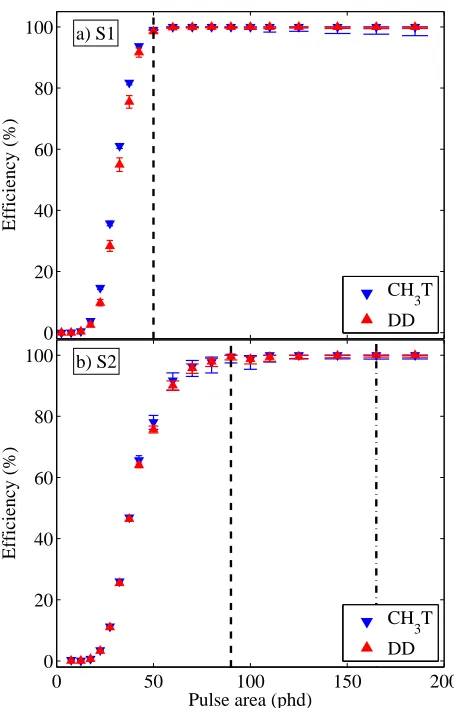
The measured trigger efficiency, as a function of pulse area, is shown in
Fig. 6. This figure shows that the S2 filter trigger efficiency for S1 (ES1(phd))
is greater than 98% when the S1 pulse area is larger than 50 phd. The S2 filter
trigger efficiency for S2 (ES2(phd)) exceeds 98% for S2 pulse areas larger than
90 phd, which is equivalent to approximately 4 extracted electrons from the
liquid xenon surface. The consistency of efficiencies measured from CH3T and
DD data for S1 and S2 trigger indicates that the LUX trigger system performs
its functions in S2 search mode essentially independently of the recoil types.
ES1(phd) starts to rise from zero toward 100% efficiency at lower pulse area
than ES2(phd). For instance, ES1(phd) reaches 50% at an S1 pulse area of
approximately 30 phd, while ES2(phd) reaches that point at an S2 pulse area
of approximately 40 phd. Both 50% efficiency points are greater than 10 phd,
which is twice the threshold requirement used per trigger group. Since the
coincidence requirement is used, the trigger decision does not only depend on
the total pulse area, but also on the pulse area distribution among the trigger
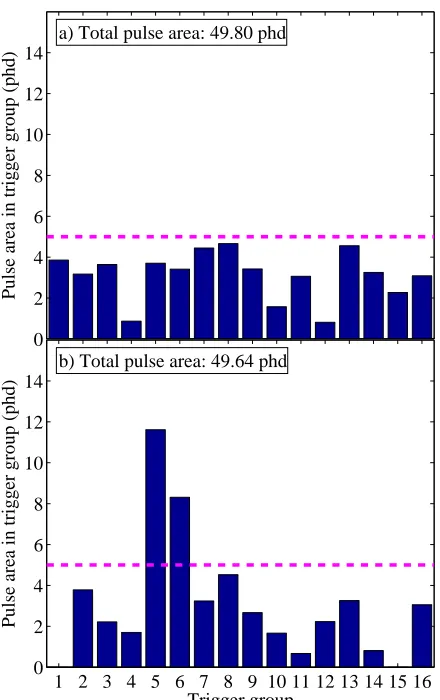
groups. Two S2s of similar pulse area but different pulse area distribution are
shown in Fig. 7 to demonstrate this dependency. For a pulse to have a pulse
area in two trigger groups greater than 5 phd on average, its total pulse area
has to be much larger than 10 phd. The difference of pulse areas at which
the efficiencies exceed 50% is not understood. Further study of this behavior,
discussed in Section 3.3, rules out the width of the S2 signal being longer than
the S2 filter width as the cause. This pulse area range is well below the WIMP
analysis threshold on the S2 pulse area of 165 phd [5], and does not effect the
3.2. Dependence on the Second Largest Pulse Area
The LUX trigger system generates a trigger when at least two trigger groups
have an S2 filter output greater than the 5 phd threshold. In other words, a
trigger will be generated when the two largest pulse areas among the 16 trigger
groups are both greater than 5 phd. Thus, the parameter that drives the trigger
decision is the pulse area in the trigger group that has the second largest pulse
area among the 16 trigger groups (SLPA). Studying the trigger efficiency based
on this parameter shows the influence of the coincidence requirement on the
trigger efficiency.
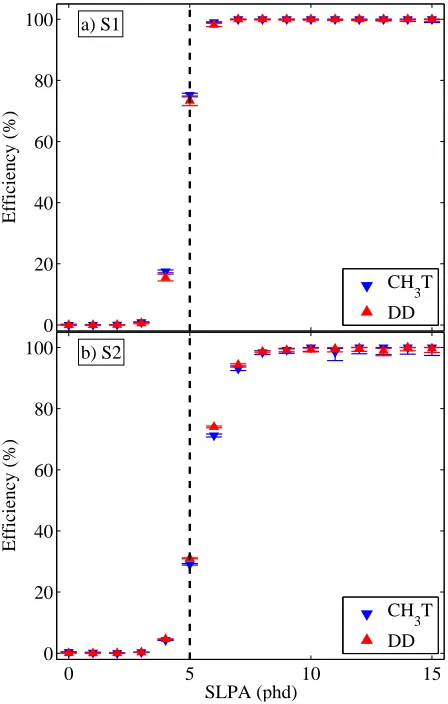
The trigger efficiency as a function of the SLPA is shown in Fig. 8, and
demonstrates that the efficiencies exceed 98% for SLPA values above 7 phd for
S1 signals and 8 phd for S2 signals. BothES1(SLP A) andES2(SLP A) are not
zero for SLPA values less than 5 phd which is the threshold. The baseline noise
contribution from the LeCroy 628 Linear Fan-in/Fan-out used in the trigger
chain and the overall differences between the waveforms in the DAQ digitizers
and the trigger chains are expected to be the causes of this behavior.
ES1(SLP A) starts to rise from zero toward 100% at a lower SLPA value than
ES2(SLP A), a behavior that is similar to that seen in Fig. 6. In this parameter
space, ES1(SLP A) and ES2(SLP A) reach 50% at an SLPA value of
approxi-mately 4.5 and 5.5 phd, respectively. Since the exact waveforms processed by
the LUX trigger system are not preserved, further study of this behavior is not
possible.
3.3. Dependence on Pulse Width
The pulse area integration region in the trigger system is defined by the filter
width. When an input pulse is wider than the S2 filter width, the pulse area
reported by the S2 filter (AreaS2F) will be less than the actual pulse area of the
input pulse returned by the LUX analysis framework [4]. In LUX, the dispersion
of the ionization electrons as they drift through the liquid xenon [19] to the liquid
xenon surface can cause the S2 width to be as large as 4µs, which corresponds
the S2 filter width also increases the baseline noise pick-up. An analysis shows
that the low filter threshold would need to be increased significantly to suppress
the noise pick-up, and thus reducing the efficiency for low-energy recoils [16].
Therefore, the S2 filter width was kept at 2µs.
To study the dependence of the S2 filter response on pulse width, a
simula-tion has been carried out. Figure 9 shows the relasimula-tion between theAreaS2F of
Gaussian-shaped pulses of area one and the input pulse width, defined as the
time difference between the pulse start and pulse end times. We observe that
theAreaS2F becomes smaller than the actual pulse area when the pulse width
is comparable to the S2 filter width.
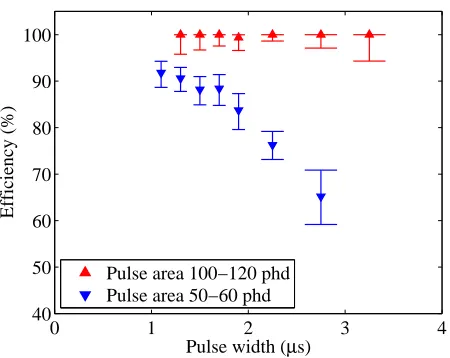
The effect of pulse width on the trigger efficiency is studied by comparing
the pulse width dependence of efficiencies in two S2 pulse area ranges, as shown
in Fig. 10. For S2 signals with an area between 50 and 60 phd, the trigger
efficiency decreases as the pulse width increases beyond 2µs. The impact of
the pulse width is reduced for larger pulse areas, as can be seen in Fig. 10
where the efficiency stays above 98% for all pulse widths when the S2 pulse
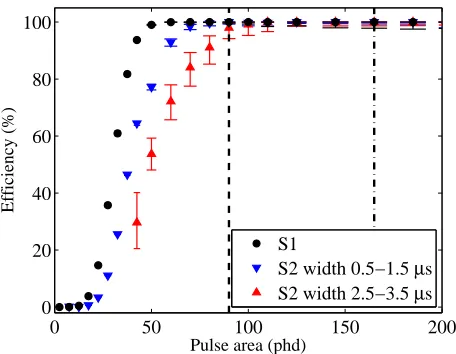
area is between 100 and 120 phd. The efficiency for two S2 pulse width ranges
as a function of the total pulse area is shown in Fig. 11. This demonstrates
the impact on efficiency when the S2 signal is narrower (0.5-1.5µs) and wider
(2.5-3.5µs) than the S2 filter width. For reference, ES1(phd) is also shown.
For pulse areas above 90 phd, all trigger efficiencies are above 98%. Figure 11
clearly shows that the inefficiency associated with the S2 pulse width does not
impact the LUX WIMP search results, which requires the S2 signal to be greater
than 165 phd. In addition, the comparison betweenES1(phd) andES2(phd) for
widths between 0.5 and 1.5µs indicates that the pulse area difference at which
the efficiencies start to rise from zero toward 100%, as seen in Fig. 6, is not due
to the pulse width of the S2 signals being larger than the S2 filter width.
The trigger efficiency fall-off seen in Fig. 10 is consistent with the reduction
factor of the AreaS2F when the pulse is wider than the S2 filter, shown in
Fig. 9, and the measured trigger efficiencies, shown in Fig. 11. For instance, at
Thus, theAreaS2F of the S2 signals with an area of 55 phd and width of 3µs is
approximately 33 phd. According to Fig. 11,ES2(phd) of the S2s of the width
less than 2µs is about 50% at 33 phd, which is consistent with the measured
efficiency shown in Fig. 10.
4. Event-based trigger efficiency
Some physical quantities are meaningful only when both S1 and S2 signals
are considered. Examples are the recoil energy and event location. The trigger
efficiencies as a function of these parameters are evaluated for events with valid
S1 and S2 signals. A valid S2 signal is required to have a pulse area of at least
100 phd. Identical conditions to those used in the LUX WIMP analysis, as
discussed in Ref. [5], are enforced for each S1-S2 pair to be considered as a valid
event. In addition, there must be no other pulses identified as valid S1 or S2
pulses within the window between 0.5 ms (about 1.5 times of the maximum drift
length) before the S1 signal and 0.5 ms after the S2 signal. This requirement
ensures that only single scatter events for which the S1 and the S2 signal are
paired correctly, are included. The event-based trigger efficiency associated with
events with this definition is greater than 98%, since the pulse-based trigger
efficiency is already above 98% at an S2 pulse area of 100 phd.
4.1. Dependence on Recoil Energy
The dependence of the trigger efficiency on recoil energy is studied with two
different approaches; by converting the S1 and S2 pulse areas to equivalent recoil
energy, and by direct measurement. The conversion approach relies on NEST
[20, 21] to predict expected detected S1 and S2 pulse areas for different recoil
energies which are not corrected for detector effects such as liquid xenon purity.
This provides a mapping between the recoil energies and the uncorrected pulse
areas to convert the pulse-based trigger efficiencies of S1 and S2 from pulse area
(ES1(phd) andES2(phd)) to equivalent recoil energy. Since the S1 signal always
the S2 signal only if the S1 signal fails to generate a trigger. If the S1 signal
generates a trigger, the hold-off time will prevent the S2 signal from generating
a duplicate trigger for the same event. Thus, the event-based trigger efficiency
in this approach can be defined as,
EEvt(E) =ES1(E) + (1−ES1(E)
100 )× ES2(E), (2)
whereEEvt(E) is the event-based trigger efficiency of an event of recoil energy
E andES1(E) and ES2(E) are the pulse-based trigger efficiencies of S1 and S2
corresponding to an event of recoil energyE, respectively. The trigger efficiency
is studied with this method at the equivalent recoil energy between 0.1 and
13.0 keV for both ER and NR.
The dominant uncertainties in the conversion are the correction for photon
loss due to light collection efficiency for the S1 signal and the electron loss due
to impurities in the liquid xenon for the S2 signal. The correction factors for
these two uncertainties are position-dependent. Thus, they cannot be corrected
for in the conversion since the event location, which can only be obtained from
evaluating the S1 and S2 signals of the same event, is unknown. The
uncer-tainty associated with the light collection efficiency does not change over time.
However, the uncertainty associated with the electron loss due to impurities can
change over time, depending on the purity of the liquid xenon. Therefore, the
trigger efficiency obtained this way represents only the efficiency during the time
period for which the liquid xenon purity correction is used in the conversion.
Nevertheless, the efficiency obtained from a period of lower xenon purity can
be interpreted as a lower bound of any measurement at higher xenon purity.
The efficiency during the LUX WIMP search is the focus of this work, thus, the
conversion from pulse area to equivalent recoil energy is done using the
correc-tion factor associated with the light colleccorrec-tion efficiency and the xenon purity
as reported in Ref. [7]. Two separate assumptions are made to account for
these uncertainties. The first is to assume a maximum loss in both S1 and S2
correspond to the lower and the upper bounds of the trigger efficiency at any
given time during the LUX WIMP search.
In the direct measurement approach, ER and NR events are searched for
as described previously. The recoil energy of an ER event is reconstructed
according to the relation shown in Eq. 3 [22].
E[keVee]
W =
S1c
g1
+S2c
g2
(3)
E[keVee] is the reconstructed energy in ER equivalent scale. The values
g1 and g2 are measured to be 0.117 ± 0.003 phd per photon and 12.1 ±
0.8 phd per ionization electron, respectively [5]. The value of the work function
W is taken to be 13.7 ±0.2 keV [23]. The S1c andS2c are position-corrected
S1 and S2 pulse areas, respectively. For NR events, the recoil energy is
recon-structed according to Lindhard’s theory [24]. The recoil energy is reconrecon-structed
in an ER equivalent energy scale using Eq. 3, then converted to an NR
equiva-lent scale using Eq. 4.
E[keVnr] =
E[keVee]
L[keVnr]
(4)
E[keVnr] is the reconstructed energy in NR equivalent scale. The factorL[keVnr]
is the Lindhard’s factor, described in Ref. [24]. A detailed discussion of this
procedure is described in Ref. [5, 15].
Figure 12 shows the trigger efficiency as a function of the reconstructed
recoil energy for both approaches. It was found that the lower bound of the
trigger efficiency from the conversion approach exceeds 98% at a recoil energy
of 0.2 keVee and 1.3 keVnr for ER and NR, respectively. Due to the 100 phd
threshold used in defining a valid S2 in the measurement approach, recoil events
that produce S2s with an area below 100 phd are excluded from the efficiency
measurement. The lowest recoil energies that are found in the data included in
this analysis are 0.3 keVee and 1.1 keVnr for ER and NR events, respectively.
The bins used in this analysis start from these two numbers with a bin size of
these two energies are greater than 99% for ER and 92% for NR. For ER, the
efficiency from the direct measurement varies between 99% and 100% between
recoil energies of 0.3 and 13.0 keVee. The average lower uncertainty is 0.1%
with the largest value of 0.2% at the last energy bin. For NR between 1.1 and
13.0 keVnr, the efficiency from the direct measurement varies between 99% and
100%. The average lower uncertainty is 1.6% with the largest value of 4.5%.
A comparison with the efficiency curves obtained from the conversion approach
shows excellent agreement.
4.2. Dependence on S1-S2 time separation
A reduction in the trigger efficiency associated with the reset time of the LUX
trigger system is expected to be observed. This inefficiency occurs when only
one trigger group has an S2 filter output greater than the low filter threshold
during the trigger search window. Since the coincidence requirement is not
met, no trigger signal is generated, and the LUX trigger system is reset to idle
state at the end of the search window. The reset process is estimated to take
approximately 4.1µs [16]. During this period, the LUX trigger system will not
process any input signals.
To study this effect, the trigger efficiency was measured as a function of
time separation between the start times of the S1 and the S2 signals for ER
events from CH3T. The ER events are chosen because the events from CH3T are
uniformly distributed inside the detector, and thus have all possible S1-S2 time
separations within the maximum drift time, including very short separations.
NR events from DD have a fixed drift time due to the location of the neutron
beam in the liquid xenon and the S1-S2 separation is not within the time range
of interest. The energy range of 3.0-7.0 keVee is chosen because ER events in
this energy range produce S1 signals between 20 and 50 phd [14] which have
trigger efficiencies below 100%, as shown in Fig. 6. At energies below 3.0 keVee,
the S1 signals are too small to start the search window, while at energies above
7.0 keVee, the S1 signals are large enough to generate the trigger. The result
7µs agrees very well with the estimate of the trigger reset-time. The main
contributions to the 7µs are 2µs from the trigger search window, 4.1µs from
the reset time, and approximately 1µs for an S2 filter output of an S2 signal
to cross the threshold, as shown in Fig. 5. The trigger decision process, which
is started by the S1 signal, always finishes before the S2 signal if the S1-S2
separation is greater than 7µs. The S1 and S2 signals in this case are treated
independently by the trigger system, except if the S1 signal generates a trigger,
the S2 signal will occur within the hold-off time period. However, the effect of
the hold-off time does not impact the trigger efficiency.
4.3. Dependence on event location
Since the LUX detector is large, events that have the same recoil energy, but
occur at different positions, can have different characteristics and the trigger
ef-ficiency can vary across the detector. This effect is studied using the CH3T
data by partitioning the liquid xenon region inside the detector into many
ring-shaped sub-volumes based on depth (z-position) and radius (r-position). Each
sub-volume has a vertical thickness of 5 cm and a radial thickness of 5 cm. The
same LUX WIMP analysis quality cuts previously described are used. The
re-sults are shown in Fig. 14. Apart from the inefficiency found in the topmost
sub-volumes, which are outside of the fiducial volume used in the LUX WIMP
analysis [5], the trigger efficiency is essentially uniform across the detector
vol-ume varying between 99% and 100%. The average lower uncertainty, which is
obtained by averaging the lower uncertainties of all data points from the same
sub-volume, varies from 1.1% to 7.7%. The striking feature in the topmost
rings at all radial positions is directly related to the reset-time as mentioned
previously. Events that have S1-S2 separation less than 7µs occur at less than
1.3 cm below the liquid xenon surface and, thus, are included in the topmost
5. Summary
The trigger efficiency of the LUX trigger system is fully understood in the
entire WIMP search region. Both pulse-based and event-based efficiencies are
sufficiently high for WIMP searches. The pulse-based trigger efficiency is
mea-sured to be greater than 98% for both S1 and S2 signal with pulse areas greater
than 90 phd, which is lower than the analysis threshold used in the LUX WIMP
analysis (165 phd for S2 signals). The event-based trigger efficiency obtained
from conversion approach indicates that the trigger efficiency exceeds 98% at
the recoil energy of 0.2 keVee and above for ER, and 1.3 keVnr and above for
NR. The direct measurement approach also shows an excellent agreement. It
is confirmed that the trigger efficiency is essentially uniform within the fiducial
volume of the liquid xenon for the WIMP searches.
6. Acknowledgments
This work was partially supported by the U.S. Department of Energy
(DOE) under award numbers DE-AC02-05CH11231, DE-AC05-06OR23100,
DE-AC52-07NA27344, DE-FG01-91ER40618, DE-FG02-08ER41549,
11ER41738, 91ER40674, 91ER40688,
DE-FG02-95ER40917, DE-NA0000979, DE-SC0006605, DE-SC0010010, DE-SC0015535,
and DE-SC0017891; the U.S. National Science Foundation under award numbers
PHYS-0750671, PHY-0801536, PHY-1003660, PHY-1004661, PHY-1102470,
PHY-1312561, PHY-1347449, PHY-1505868, and PHY-1636738; the Research
Corporation grant RA0350; the Center for Ultra-low Background
Experi-ments in the Dakotas (CUBED); and the South Dakota School of Mines
and Technology (SDSMT). LIP-Coimbra acknowledges funding from Funda¸c˜ao
para a Ciˆencia e a Tecnologia (FCT) through the project-grant
PTDC/FIS-NUC/1525/2014. Imperial College and Brown University thank the UK Royal
Society for travel funds under the International Exchange Scheme (IE120804).
The UK groups acknowledge institutional support from Imperial College
& Technology Facilities Council for PhD studentships ST/K502042/1 (AB),
ST/K502406/1 (SS) and ST/M503538/1 (KY). The University of Edinburgh is
a charitable body, registered in Scotland, with registration number SC005336.
The83Rb isotope used in this research were supplied by the United States
Department of Energy Office of Science by the Isotope Program in the Office of
Nuclear Physics.
This research was conducted using computational resources and services at
the Center for Computation and Visualization, Brown University.
The collaboration gratefully acknowledge the logistical and technical support
and the access to laboratory infrastructure provided to us by the Sanford
Un-derground Research Facility (SURF) and its personnel at Lead, South Dakota.
SURF was developed by the South Dakota Science and Technology Authority,
with an important philanthropic donation from T. Denny Sanford, and is
oper-ated by Lawrence Berkeley National Laboratory for the Department of Energy,
Office of High Energy Physics.
References
[1] D. S. Akerib et al. (LUX), Nucl. Instrum. Meth. A704 (2013) 111–126.
doi:10.1016/j.nima.2012.11.135. arXiv:1211.3788.
[2] D. S. Akerib et al., Nucl. Instrum. Meth. A703 (2013) 1–6.
doi:10.1016/j.nima.2012.11.020. arXiv:1205.2272.
[3] D. S. Akerib et al., Nucl. Instrum. Meth. A668 (2012) 1–8.
doi:10.1016/j.nima.2011.11.063. arXiv:1108.1836.
[4] D. S. Akerib et al. (LUX), Nucl. Instrum. Meth. A818 (2016) 57–67.
doi:10.1016/j.nima.2016.02.017. arXiv:1511.03541.
[5] D. S. Akerib et al. (LUX), Phys. Rev. Lett. 116 (2016) 161301.
[6] C. H. Faham, V. M. Gehman, A. Currie, A. Dobi,
P. Sorensen, R. J. Gaitskell, JINST 10 (2015) P09010.
doi:10.1088/1748-0221/10/09/P09010,10.1088/1748-0221/2015/9/P09010.
arXiv:1506.08748.
[7] D. S. Akerib et al. (LUX), Phys. Rev. Lett. 112 (2014) 091303.
doi:10.1103/PhysRevLett.112.091303.arXiv:1310.8214.
[8] D. S. Akerib et al. (LUX), Phys. Rev. Lett. 118 (2017) 021303.
doi:10.1103/PhysRevLett.118.021303.arXiv:1608.07648.
[9] D. S. Akerib et al. (LUX), Phys. Rev. Lett. 116 (2016) 161302.
doi:10.1103/PhysRevLett.116.161302.arXiv:1602.03489.
[10] D. S. Akerib et al. (LUX), Phys. Rev. Lett. 118 (2017) 251302.
doi:10.1103/PhysRevLett.118.251302.arXiv:1705.03380.
[11] D. S. Akerib et al. (LUX), Phys. Rev. Lett. 118 (2017) 261301.
doi:10.1103/PhysRevLett.118.261301.arXiv:1704.02297.
[12] L. S. Miller, S. Howe, W. E. Spear, Phys. Rev. 166 (1968) 871–878.
doi:10.1103/PhysRev.166.871.
[13] D. S. Akerib et al. (LUX), , Phys. Rev. D97 (2018) 102008.
doi:10.1103/PhysRevD.97.102008. arXiv:1712.05696.
[14] D. S. Akerib et al. (LUX), Phys. Rev. D93 (2016) 072009.
doi:10.1103/PhysRevD.93.072009. arXiv:1512.03133.
[15] D. S. Akerib et al. (LUX) (2016).arXiv:1608.05381.
[16] E. Druszkiewicz, Ph.D. thesis, University of Rochester, 2017.
[17] A. Dobi, Ph.D. thesis, University of Maryland, College Park, 2014.
[18] R. Knoche, Ph.D. thesis, University of Maryland, College Park, 2016.
[19] P. Sorensen, Nucl. Instrum. Meth. A635 (2011) 41–43.
[20] M. Szydagis, N. Barry, K. Kazkaz, J. Mock, D. Stolp, M. Sweany,
M. Tripathi, S. Uvarov, N. Walsh, M. Woods, JINST 6 (2011) P10002.
doi:10.1088/1748-0221/6/10/P10002.arXiv:1106.1613.
[21] M. Szydagis, A. Fyhrie, D. Thorngren, M. Tripathi, JINST 8 (2013)
C10003. doi:10.1088/1748-0221/8/10/C10003.arXiv:1307.6601.
[22] T. Shutt, C. E. Dahl, J. Kwong, A. Bolozdynya, P. Brusov, Nucl.
In-strum. Meth. A579 (2007) 451–453. doi:10.1016/j.nima.2007.04.104.
arXiv:astro-ph/0608137.
[23] C. E. Dahl, Ph.D. thesis, Princeton University, 2009.
[24] J. Lindhard et al., Kgl. Danske Videnskab., Selskab. Mat. Fys. Medd. Vol:
0 20 40 60 80
100 a) S1
Efficiency (%)
CH 3T DD
0 50 100 150 200
0 20 40 60 80 100
Pulse area (phd) b) S2
Efficiency (%)
[image:25.612.185.412.173.527.2]CH 3T DD
Figure 6: Measured trigger efficiency as a function of total pulse area. The results from CH3T
and DD data are compared. a) The S2 filter trigger efficiency for S1 (ES1(phd)). b) The S2
filter trigger efficiency for S2 (ES2(phd)). The vertical dashed lines represent the pulse areas
at whichES1(phd) andES2(phd) exceed 98%. They are at 50 phd and 90 phd, respectively.
The dash-dotted line represents the lowest analysis threshold on the S2 signal used in the
0 2 4 6 8 10 12 14
a) Total pulse area: 49.80 phd
Trigger group
Pulse area in trigger group (phd)
1 2 3 4 5 6 7 8 9 10 11 12 13 14 15 16 0
2 4 6 8 10 12 14
Trigger group b) Total pulse area: 49.64 phd
[image:26.612.190.410.180.530.2]Pulse area in trigger group (phd)
Figure 7: Examples of two small S2 signals of similar size demonstrating the dependence of
the trigger decision on the pulse area distribution among the 16 trigger groups. The low
threshold of 5 phd is denoted with the horizontal dashed lines. a) None of the trigger groups
have a pulse area greater than the threshold; this pulse does not generate a trigger. b) Two
0 20 40 60 80
100 a) S1
Efficiency (%)
CH 3T DD
0 5 10 15
0 20 40 60 80 100
SLPA (phd) b) S2
Efficiency (%)
[image:27.612.185.409.191.543.2]CH 3T DD
Figure 8: Measured trigger efficiencies as a function of the SLPA. The results from CH3T and
DD data sets are compared. a) The S2 filter trigger efficiency for S1 (ES1(SLP A)). b) The
S2 filter trigger efficiency for S2 (ES2(SLP A)). The vertical dashed lines represent the low
0 1 2 3 4 0
0.2 0.4 0.6 0.8 1
Pulse width (µs)
[image:28.612.187.410.161.336.2]S2 filter reported pulse area (a.u.)
Figure 9: Simulation results of theAreaS2F of a Gaussian-shaped pulse of area one when the
width of the input pulse is varied.
0 1 2 3 4
40 50 60 70 80 90 100
Pulse width (µs)
Efficiency (%)
[image:28.612.186.411.443.622.2]Pulse area 100−120 phd Pulse area 50−60 phd
0 50 100 150 200 0
20 40 60 80 100
Pulse area (phd)
Efficiency (%)
S1
S2 width 0.5−1.5 µs
S2 width 2.5−3.5 µs
Figure 11: Trigger efficiency as function of S2 pulse area for two different width ranges.
ES1(phd) is also shown for comparison. The dashed line shows the pulse area of 90 phd
at which the efficiencies exceed 98%. The dash-dotted lines represent the lowest analysis
[image:29.612.186.414.281.458.2]0 2 4 6 8 10 12 0
20 40 60 80 100
a) CH 3T
Electron recoil energy (keV ee)
Efficiency (%)
Lower limit Upper limit
0 2 4 6 8 10 12
0 20 40 60 80 100
b) DD
Nuclear recoil energy (keV nr)
Efficiency (%)
[image:30.612.184.409.154.520.2]Lower limit Upper limit
Figure 12: Event-based trigger efficiency as a function of reconstructed recoil energy. a)
Trig-ger efficiency for ER. b) TrigTrig-ger efficiency for NR. In both panels, the black(gray) solid curves
indicate the lower(upper) limit of the efficiency from an assumption of having lowest(highest)
light collection efficiency and liquid xenon purity level during the LUX WIMP search. They
are obtained from converting the pulse area associated withES1(phd) andES2(phd) to
equiv-alent recoil energy using Eq. 2. The data points are obtained from the direct measurement
from CH3T and DD calibration data. The vertical dashed lines indicate the lower-end of the
bin that contains the event with the lowest energy found in the data sets used in the direct
0 5 10 15 50
60 70 80 90 100
Efficiency (%)
S1−S2 separation (µs)
[image:31.612.187.412.289.467.2]ER 3.0−7.0 keV ee
Figure 13: Event-based trigger efficiency as a function of the time separation between the
start times of the S1 and the S2 signals of ER events from CH3T with reconstructed recoil
80 90 100
R = 0−5 cm R = 5−10 cm R = 10−15 cm R = 15−20 cm R = 20−25 cm
Z = 0−5 cm
80 90 100
Z = 5−10 cm
80 90 100
Z = 10−15 cm
80 90 100
Z = 15−20 cm
80 90 100
Efficiency (%)
Z = 20−25 cm
80 90 100
Z = 25−30 cm
80 90 100
Z = 30−35 cm
80 90 100
Z = 35−40 cm
80 90 100
Z = 40−45 cm
0 2 4 6 8 10 12 80
90 100
Electron recoil energy (keVee)
0 2 4 6 8 10 12 Electron recoil energy (keVee)
0 2 4 6 8 10 12 Electron recoil energy (keVee)
0 2 4 6 8 10 12 Electron recoil energy (keVee)
0 2 4 6 8 10 12
Z = 45−50 cm
[image:32.792.131.657.123.392.2]Electron recoil energy (keVee)
Figure 14: The trigger efficiency as a function of the reconstructed recoil energy from the CH3T data measured at different positions inside the LUX
detector. The panels from left to right within the same row are from the same z-position, but different radial positions from innermost sub-volume to
the outermost sub-volume as indicated above the plot. The panels from the top to the bottom of the same column are measured from the same radial
position, but different z-positions from the top of the detector to the bottom of the detector as indicated on the right-handed side. The absence of
data points and limited statistics in some panels are due to their corresponding sub-volumes are small or close to the boundary of the active region.
The vertical dashed lines at 0.3 keVeeindicate the lowest recoil energy observed in the data set included.
3