Int. J. Electrochem. Sci., 7 (2012) 5939 - 5950
International Journal of
ELECTROCHEMICAL
SCIENCE
www.electrochemsci.org
Application of Polypyrrole/Humic Acid Composite Electrode for
Copper Ion Extraction from Drinking Water
Monica Antilen1,3,* Diego Guzman1, M. Angelica del Valle1, Rodrigo del Rio1, Maria Victoria Letelier2,Gustavo Lagos2, Mauricio Escudey3, Carmen Pizarro3.
1 Pontificia Universidad Católica de Chile, Facultad de Química, Vicuña Mackenna 4860, 7820436, Macul, Santiago, Chile.
2 Escuela de Ingeniería, Centro de Minería, Vicuña Mackenna 4860, Macul, Santiago, Chile.
3 Centro para el Desarrollo de la Nanociencia y Nanotecnología (CEDENNA). Av. L. B. O`Higgins 3363, Santiago, 725475. Chile
*
E-mail: [email protected]
Received: 10 May 2012 / Accepted: 13 June 2012 / Published: 1 July 2012
Copper is a metal commonly used to transport water systems due to its stability and advantageous properties. At the same time, corrosion may be a problem affecting these systems, for instance, causing the leaching of metal (Cu (II)) in water. In this study we have applied an electrochemical method for extracting this element. The use of humic acid and of a conductive polymer (polypyrrole) in a PIGE/HA/PPy modified electrode was evaluated for the electrochemical extraction of Cu(II) from drinking water. Synthetic water samples were contacted with Cu(0) pipes during 24 h (leaching yielded Cu(II)). Modified electrodes were prepared by mechanical transfer of humic acid (HA) to the base electrode (PIGE) and then depositing a polypyrrole (PPy) coating by potentiostatic electropolymerization. The modified electrode was subsequently utilized for Cu(II) electrochemical extraction from water samples using a chronocoulometric method, with a removal rate of up to 72%. Thus, the feasibility of decreasing Cu(II) concentration in drinking water systems was proven, corroborating the usefulness of the PIGE/HA/PPy surface modified electrode. Besides, the application in systems of this kind can be further improved by considering the different variables involved, e.g. PIGE electrode area, HA amount, PPy thickness, etc.
Keywords: Humic Acid, Ion Extraction, Drinking water, Modified Electrode
1. INTRODUCTION
and molecule diffusion [1-4]. Cuprite remains in contact with the surface of metallic copper [5]. Oxidation of cuprous to cupric ion also occurs in Cu oxidation [6].
As for inorganic compounds present in drinking water and their effect on Cu corrosion [7,8], it is known that species such as bicarbonate, carbonate and dissolved carbonic acid, ammonium, sulfate and chloride are the principal inorganic species affecting the corrosion process. Variables such as time of stagnation, age of the pipes, among others, also influence the process of Cu release. Closely related to this, there is agreement that pH would be the most significant variable in Cu corrosion. Corrosion rates are observed to increase with pH decrease, [6, 9, 10]. At pH below 5, Cu corrodes quickly and evenly. At values above 9, Cu is usually protected. Between pH 5 and 9, if no protective film on Cu surface exists, localized corrosion is likely to occur, which is also significantly affected by this pH factor [11].
Controlling and decreasing Cu(II) concentration in drinking water, involves different types of treatments or strategies. The most used one is the adjustment of parameters such as pH, alkalinity and corrosion inhibitors that are regulated for various drinking water systems, usually working ex situ [12]. For low concentrations of Cu(II) present, the use of more sensitive electrochemical techniques, more sensitive than methods mentioned above, may be useful.
mechanisms associated to positively charged metal centers [24], as well as to the existence of phenolates in the HA. In this context, other variables, e.g. anion nature and size, exist that permit the obtention of a surface with ion-exchange properties [21,22]. On the other hand, polymers doped with chloride and acetate anions showed weak adhesion on the electrode surface, being unstable at high temperatures. Another important variable is the synthetic route used for the electropolymerization. The potentiostatic approach allows for a greater cross-linked polymer, which would favor the inclusion of anions such as arsenate [17]. The modified electrode prepared was evaluated utilizing As(V) solutions because this type of polymer can undergo p-doping undoping processes [18], which accounts for its good extractant abilities toward the analyte. Since humic acids are negatively charged, it would be expected that the presence of HA in the modified electrode was independent of its origin, its acid-base features and in addition of a very weak character. However, the differences between the two modified electrodes bearing HA in their composition enable postulating that interactions would be not so weak and an effect of the existing functional groups do exists. In this regard, as proposed for AsO43 functional groups such as phenolics [23, 24], could interact with Cu(II) positive formal charge in the CuCl42complex. This proposal is based on the fact that complexes with coordination number less than 6 may develop exchange mechanisms associated to positively charged metal centers [24] along with the existence of phenolates in the HA.
Therefore, considering problems of drinking water systems concerning to Cu(II) content as well as the described advantages of HA and PPy modified electrodes, a study of their applicability to drinking water samples is proposed in this work. At this earlier stage synthetic samples will be employed. The study also embraces the effect of potentiostatic polymer preparation on the efficiency of analyte extraction, considering that, although not unique, this is one of the relevant variables in the morphology of the modified electrode, consequently it may have a significant impact on its extraction capacity.
2. MATERIALS AND METHODS
2.1 Samples
2.1.1 Humic Substances
Humic acid (Sigma-Aldrich) was purified by precipitation as follows. A suitable concentrated solution was adjusted to pH 1 with HCl. The obtained precipitate was filtered off and then re-dissolved in NaOH. The precipitation was repeated and a second precipitate was collected, washed, air-dried, and used.
2.1.2 Drinking water
[image:4.596.38.561.235.544.2]
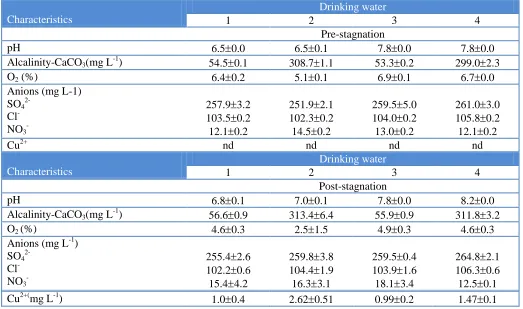
air (HEPA) filters. Alkalinity adjustment was accomplished with NaHCO3, while for pH gaseous carbon dioxide and/or oxygen (O2, 32.0 g mol-1) flushed directly into the solution was used. A suitable amount of sulfate, nitrate and sodium chloride was next added, to follow the composition quoted in Table 1. The different synthetic water samples prepared were poured into a Cu pipe system and kept during 24 h. This process is called stagnation. Subsequently to this process, triplicate samples in three different pipe cuts were collected [25].
Table 1. Chemical characterization of drinking water pre and post- stagnation
Characteristics
Drinking water
1 2 3 4
Pre-stagnation
pH 6.50.0 6.50.1 7.80.0 7.80.0
Alcalinity-CaCO3(mg L-1) 54.50.1 308.71.1 53.30.2 299.02.3
O2 (%) 6.40.2 5.10.1 6.90.1 6.70.0
Anions (mg L-1) SO4
2-Cl -NO3
-257.93.2 103.50.2 12.10.2
251.92.1 102.30.2 14.50.2
259.55.0 104.00.2 13.00.2
261.03.0 105.80.2 12.10.2
Cu2+ nd nd nd nd
Characteristics
Drinking water
1 2 3 4
Post-stagnation
pH 6.80.1 7.00.1 7.80.0 8.20.0
Alcalinity-CaCO3(mg L -1
) 56.60.9 313.46.4 55.90.9 311.83.2 O2 (%) 4.60.3 2.51.5 4.90.3 4.60.3
Anions (mg L-1) SO4
2-Cl -NO3
-255.42.6 102.20.6 15.44.2
259.83.8 104.41.9 16.33.1
259.50.4 103.91.6 18.13.4
264.82.1 106.30.6 12.50.1 Cu2+(mg L-1) 1.00.4 2.620.51 0.990.2 1.470.1
2.2 Chemical characterization 2.2.1 Humic Substances
Functional groups determination was accomplished for total and carboxylic acidity, while phenolic acidity was obtained by difference [26, 27].
2.2.2 Drinking water
Cu (II) content was quantified after 24 h stagnation by atomic absorption spectrometry (GBC Scientific Equipment, Model SensAA), using EPA 7000B Method for traces. The samples were digested with 2-10% HNO3, (m/m).
Alkalinity was determined by acid-base titrimetry following EPA 310.1 method [30]. pH was measured according to EPA 150.1 method and percent dissolved O2 following EPA 360.1 method [30].
2.3 Electrochemical experiments 2.3.1 Apparatus
All electrochemical experiments were carried out on a potentiostat system VoltaLab PGZ100 in a three-compartment/three-electrode glass cell under high purity argon atmosphere. Paraffin-impregnated graphite (PIGE) was prepared and used as working electrode. The graphite exposed surface of the electrode was mechanically regenerated prior to each experiment with emery paper (grain size 2000 and 2500), and thorough washing with double-distilled water. A Pt wire (20 cm2) was the counter electrode. All potentials quoted in this work are referred to an Ag|AgCl reference electrode.
All electrodic surfaces were studied in drinking water and solutions containing Cu(II) in 20 mM HCl + 100 mM KCl (solution A), that were prepared by dissolving the appropriate amount of CuCl2 in double-distilled water according to standard procedures. Pyrrole (Sigma-Aldrich) was purified by distillation, stored at 4º C and protected from light. All other chemicals used were analytical grade (Merck). All solutions were prepared and subsequently deaerated with high purity Ar for at least 20 min.
2.3.2 Preparation of modified PIGE
As for PIGE, four electrodic surfaces were characterized by cyclic voltammetry: (1) PIGE; (2) PIGE modified with HA (Aldrich) (PIGE/HA); (3) PIGE electrochemically modified with pyrrole (PIGE/PPy); and (4) PIGE modified with HA and then electropolymerized with pyrrole (PIGE/HA-D/PPy; PIGE/HA/PPy). Humic acid was transferred and immobilized onto the electrode surface using the abrasive transfer technique described elsewhere [31].
PPy electrochemical coating was conducted on PIGE or PIGE/HA from 1.4 mM pyrrole + 50 mM Na2SO4 + 30 mM H2SO4 solutions utilizing the potentiostatic method. To evaluate its effect on extraction efficiency, an initial potential of 0 V for 30 seconds, followed by 1 to 4 min at 1.0 V, was respectively applied.
2.3.3 Extractions
the doping–undoping potentials to perform the extraction. The overall volume of electrolyte in each cell was always 10.0 mL. Each extraction was accomplished as follows. The modified PIGE/HA/PPy electrode was dipped into drinking water and potentiostatically perturbed at 0.4 V for 5 min. Subsequently the device was kept into solution B at -0.6 V for 5 min. Initially and after several extractions, the copper concentration in drinking water and solution B was determined by inductively coupled plasma/optical emission spectrometry (ICP–OES) on a Varian Liberty series II instrument.
3.RESULTS AND DISCUSSION
3.1 Chemical characterization
Acid-base humic acid characterization indicated that an important content of carboxylic (5.5 ± 0.2 mEq g -1) and phenolic (1.9 ± 0.2 mEq g-1) groups exist, validating thus the likely interactions with anions such as AsO43 and CuCl42 [18, 19], known as bridging metals.
Table 1 exhibits the results of the chemical characterization of drinking water samples pre- and post-stagnation. In general, pH and alkalinity remained without significant variation, while for O2 (%) content a decrease occurred in all samples, probably due to its participation in corrosion processes during stagnation.
Regarding to anions, they remained nearly constant, with no significant changes. Hence, every drinking water sample maintained its original characteristics.
Table 1 demonstrates that Cu(II) exists only in post-stagnation samples, which is consistent with sample preparation, purity and quality of utilized reagents. Samples 2 and 4, which are considered highly corrosive towards Cu(0), presented the highest Cu(II) concentration. These results clearly showed that sample 2 conditions in terms of dissolved O2, pH and alkalinity are sufficient to cause metal pipe largest corrosion.
According to results, pH variation between samples of higher alkalinity has a negative effect above pH 7 (to overcome the barrier of neutrality), while alkalinity increase would generate an increased presence of Cu(II). However, it is also evident that the combination of higher alkalinity and neutrality caused the greatest corrosion.
3.2 Electrochemical experiments
E (mV)
-800 -600 -400 -200 0 200 400 600
I (
A)
-30 -20 -10 0 10 20 30
[image:7.596.79.508.75.392.2]PIGE PIGE/HA
Figure 1. Potentiodynamic response of PIGE and PIGE/HA in 20 mM HCl and 100 mM KCl between -0.6 and 0.4 V at 0.01 V s-1.
This is a consequence of the slow scan rate used in the characterization of both electrodes. This fact brings about low voltammetric response (Randles-Sevcik equation) and further growth of the diffusion layer at the surface, allowing the occurrence of redox phenomena [34].
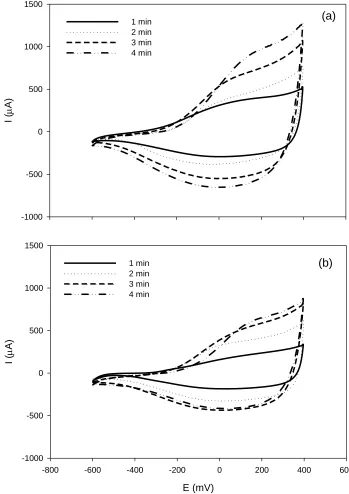
In Fig. 2(a) and (b) voltammetric response of PIGE/HA/PPy and PIGE/PPy modified electrodes at different electropolymerization times (1 to 4 min) are depicted. As for this variable, a current increase with polymerization time is observed, but at higher times the electropolymerization response is not reproducible because of polymer fall off.
Time analysis enables stating; in general, that longer electropolymerization leads to a greater voltammetric response. This affords larger amount of PPy deposite on the electrode surface. Nonetheless, at times 3 and 4 min the above relationship no longer holds since no current increase was obtained. This may be ascribed to ions diffusion hindrance to get into the polymeric matrix to counteract the charge formed during polymer oxidation. Thus, a thicker polymer film will generate an impediment to the entry of anionic species [34].
(a)
I (
A)
-1000 -500 0 500 1000 1500
1 min 2 min 3 min 4 min
(b)
E (mV)
-800 -600 -400 -200 0 200 400 600
I (
A)
-1000 -500 0 500 1000 1500
[image:8.596.117.466.84.578.2]1 min 2 min 3 min 4 min
Figure 2. Potentiodynamic response of PIGE/HA/PPy (a) and PIGE/PPy (b), in 20 mM HCl and 100 mM KCl at different electropolymerization time between -0.6 and 0.4 V at 0.1 V s -1
The PIGE electrode surface morphology presents an irregular surface structure [32, 35] and PIGE/Ppy a nodular one [36, 37], whose porosity and roughness depend on coating thickness [37]. Therefore, the presence of HA affected both surfaces [31, 32].
HA in the PIGE/HA electrode is found as irregular aggregates of heterogeneous forms [32], affecting thus Ppy deposition on the PIGE/HA/Ppy electrode surface. This arises by the inclusion and surface blockage of the PIGE electrode high-energy sites [24, 32], generating further polymer growth, with a PPy film of less regularity and thickness at the time nucleation and electropolymerization take place [31, 32].
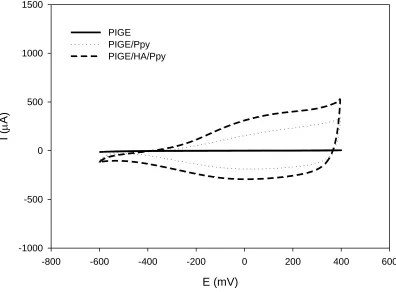
Hence, it can be stated that HA presence brings about a higher voltammetric response at the PIGE/HA/Ppy modified electrode versus the PIGE/Ppy one at identical polymerization time. Consequently, the surface becomes more conductive [18] and suitable for Cu(II) extraction from water synthetic solutions and real samples.
E (mV)
-800 -600 -400 -200 0 200 400 600
I (
A)
-1000 -500 0 500 1000 1500
PIGE PIGE/Ppy PIGE/HA/Ppy
Figure 3. Comparative response of potentiodynamic electropolymerization of PIGE, PIGE/PPy and at 0.1 Vs-1.
3.3 Extractions
[image:9.596.97.493.307.599.2]
modified electrode was used in synthetic solutions, in order to assess its efficiency and reversibility after multiple successive extractions. The obtained results (not shown) exhibit high extraction accuracy, coefficient of variation 2.5%, and similar values of the transferred charge in the p-doping/undoping process, indicating that the extraction process is reversible.
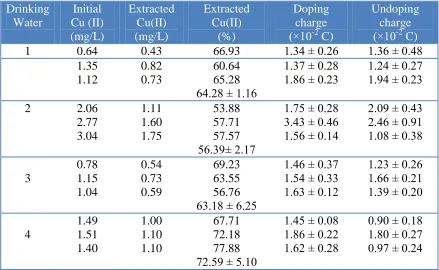
[image:10.596.79.518.241.511.2]Extraction results in different drinking water samples are summarized in Table 2, wherein extraction efficiency and transferred charges may be evaluated.
Table 2. Drinking water Cu(II) extraction and doping-undoping charges after 10 successive extractions utilizing a PIGE/HA/Ppy modified electrode.
Drinking Water Initial Cu (II) (mg/L) Extracted Cu(II) (mg/L) Extracted Cu(II) (%) Doping charge (×10-2 C) Undoping charge (×10-2 C)
1 0.64 0.43 66.93 1.34 ± 0.26 1.36 ± 0.48
1.35 1.12 0.82 0.73 60.64 65.28 64.28 ± 1.16
1.37 ± 0.28 1.86 ± 0.23
1.24 ± 0.27 1.94 ± 0.23
2 2.06
2.77 3.04 1.11 1.60 1.75 53.88 57.71 57.57 56.39± 2.17
1.75 ± 0.28 3.43 ± 0.46 1.56 ± 0.14
2.09 ± 0.43 2.46 ± 0.91 1.08 ± 0.38
3 0.78 1.15 1.04 0.54 0.73 0.59 69.23 63.55 56.76 63.18 ± 6.25
1.46 ± 0.37 1.54 ± 0.33 1.63 ± 0.12
1.23 ± 0.26 1.66 ± 0.21 1.39 ± 0.20
4 1.49 1.51 1.40 1.00 1.10 1.10 67.71 72.18 77.88 72.59 ± 5.10
1.45 ± 0.08 1.86 ± 0.22 1.62 ± 0.28
0.90 ± 0.18 1.80 ± 0.27 0.97 ± 0.24
From these data and their one way Anova analysis, all extraction percentages are significantly different among them (P <0.0001). The largest percentage of extraction was for sample 4 and the lowest for sample 2, precisely the one with the highest Cu(II) content.
In this regard, pH is a critical parameter. A review of Cu(II) speciation shows, from a global analysis, that a pH variation from 7.0 to 8.0 causes the Cu(II), chiefly complexed as Cu(OH)+, Cu(OH)2 and Cu(OH)3, to increase up to 99%. This has an impact on the extraction efficiency because during doping this modified electrode incorporates anionic species in order to counteract its charge while oxidation proceeds. On this matter, background exists [20] that permits assuming that as the extracted species concentration decreases, a shift of the equilibrium of the involved species would take place, originating thus the high extraction rate of the analyte under survey. The extraction has an acceptable accuracy, with coefficient of variance in the range 2 -10 % (n = 30).
in the modified electrode, existing non-proportionality in the release during undoping, with respect to the efficiency obtained for values of the transferred charge. This behavior might be ascribed to a synergistic effect of HA + PPy, as described elsewhere [18]. In fact, as HA bears, among others, carboxylic and phenolic functional groups, this makes these species very chelating amidst natural organic substances (partly responsible for cation exchange in soils and aquifer systems), conferring them additional affinity toward ions or metallic species to be extracted [39]. These functional groups allow interaction with Cu(II) positive formal charge, analogous to what happened in arsenate extraction conducted with the same modified electrode [32]. Hence, mass transfer would be compensated by anions present in solution, enabling reversibility of the transferred charges.
In addition, it has been shown that, despite Cu(II) retention, the electrode continued functioning properly, remaining stable during the performed extractions, which permitted postulating that it would be possible to improve extraction performance by increasing the number of successive extractions using the same electrode, or investigating the influence of other variables such as supporting electrode area.
4.CONCLUSIONS
The potentiostatic HA-PPy electrode modification made possible complexed Cu(II) extraction from drinking water synthetic samples with an efficiency of up to 72%. Besides, pH and alkalinity dependence of the assayed samples was verified. Thus, the high efficiency exhibited by this electrode permits regarding it as a likely solution to corrosion problems with copper pipes employed for potable water transportation. Consequently, it is justified to attempt optimization of its design and application to real samples.
ACKNOWLEDGEMENTS
Support from Pontificia Universidad Católica de Chile through PROYECTO INTERDISCIPLINARIO 2009 and Financiamiento Basal para Centros Científicos y Tecnológicos de Excelencia FB0807 CEDENNA is kindly acknowledged.
References
1. D.Ives, A. Rawson, J. Electrochem. Soc. 109 (1962) 447. 2. D.Ives, A. Rawson, J. Electrochem. Soc. 109 (1962) 452. 3. D.Ives, A. Rawson, J. Electrochem. Soc. 109 (1962) 458. 4. D.Ives, A. Rawson, J. Electrochem. Soc. 109 (1962) 462.
5. T. Merkel, HJ Groß, W. Werner, T. Dahlke, S. Reicherter, G. Beuchle, S. Eberle, Water Res. 36 (2002) 1547.
6. H. Cruse, O.von Franque, R. Pomeroy, Corrosion in Potable Water Systems, Chapter 5 of Corrosion in Pipes, American Water Works Association (1988).
9. M.R. Schock, D.A. Lytle, J.A. Clement, Effect of pH, DIC, orthophosphate and sulphate cuprosolvency on drinking water, EPA/600/R-95/085, U.S. EPA Press (1995).
10.T.J.J. van Den Hoven, M.W. Van Eekeren, Optimal Composition of Drinking Water. Kiwa Report 100, Holand (1988)
11.American Water Works Association, Water Quality and Treatment. Chapter on Corrosion. McGraw-Hill, Inc. (1999).
12.N. Senesi, T.M. Miano, G. Brunetti. Humic-like Substances in Organic Amendments and effect on native soil humic substances. Elsevier (1996)
13.A.J. Heeger, Synth. Targets 125 (2002) 23.
14.Y. Wanga, J. Zhanga, D. Sheng, Ch. Suna, J. Chromatogr. A 1217 (2010) 4523 15.J.C. Wu, W.M. Mullett, J. Pawliszy, Anal. Chem. 74 (2002) 4855
16.H. Bagheri, E. Babanezhad, A. Is-Haghi, J. Chromatogr. A 1152 (2007) 168
17.M.A. del Valle, G.M. Soto, L. Guerra, J.H. Velez, F.R. Diaz, Polym. Bull. 51 (2004) 301. 18.M. Antilén, F. Armijo, J. Appl. Polymer. Sci. 113 (2009) 3619.
19.M. Antilén, M.A. Gonzalez, M. Perez-Ponce, M. Gacitúa, M.A. del Valle, F. Armijo, R. del Río, G. Ramirez, Int. J. Electrochem. Sci. 6 (2011) 901.
20.G.C. Arteaga, M.A. Valle, M. Antilen, M. Faundez, Gacitua M., F. Diaz, J. Bernède, L. Cattin, Int J. Electrochem. Sci. 6 (2011) 5209.
21.J. Wu, X. Yu, H. Lord, J. Pawliszyn, Analyst 125 (2000) 391. 22.T. Lewis, G.Wallace, M. Smyth, Analyst 124(1999) 213.
23.M. Schnitzer, H. Schulten, Soil Sci. Soc. Am. J. 56 (1992) 1811.
24.J. Huheey, E. Keiter, R. Keiter, Anorganische Chemie, Walter de Gruyer Press (1995) 25.G.E. Lagos, C.A. Cuadrado, M.V. Letelier, J. AWWA 93 (2001)
26.M. Pansu, J. Gautheyrou, Handbook of Soil Analysis, Mineralogical, Organic and Inorganic Methods, Springer-Verlag Press (2006)
27.R. Zbytniewski, B. Buszewski, Biores. Technol. 96 (2005) 471.
28.U.S. Environmental Protection Agency. Determination of inorganic anions by ion chromatography. Method 300.0 (1993).
29.U.S. Environmental Protection Agency. Alkanity (Titrimetic, pH = 4.5). Method 310.1 (1978). 30.U.S. Environmental Protection Agency. Oxygen, dissolved (Membrane Electrode). Method 360.1
(1971).
31.U. Klaus, T. Pfeifer, M. Spiteller, Environ. Sci Technol. 34 (2000) 3514. 32.F. de Paolis, J. Kukkonen, Chemosphere 34 (1997) 1693.
33.N.E. Palmer, J.H. Freudenthal, R. von Wandruszka, Environ. Chem 3 (2006) 131.
34.F. Scholz, U. Schroder, R. Gulaboski, Electrochemistry of Immobilized Particles and Droplets, Springer-Verlag Press (2005).
35.S. Miranda Colombo, L. Bagdeve de Oliveira dos Santos, J. Masini, Quim. Nova 30 (2007) 1261. 36.C. Hernandez, C. Garcia, Waste Manag. 26 (2006) 1370.
37.A.Buschmann, J. Kappeler, U. Lindaeur, D. Kistler, M. Berg, L.Sigg, Environ. Sci Technol. 40 (2006) 6015.
38.R.T. Lee, G. Shaw, P. Wadey, X. Wang, Chemosphere 43 (2001) 1063.
39.D.T. Scott, D.M. Mc Knight, E.L. Blunt-Harris, S.E. Kolesar, D.R. Lovley, Environ. Sci Technol. 32 (1998) 2984.