
Elliptic Curve Arithmetic for
Cryptography
Srinivasa Rao Subramanya Rao
August 2017
A Thesis submitted for
the degree of Doctor of Philosophy
of The Australian National University
c
Declaration
I confirm that this thesis is a result of my own work, except as cited in the references. I also confirm that I have not previously submitted any part of this work for the purposes of an award of any degree or diploma from any University.
Previously Published Content
During the course of research contributing to this thesis, the following papers were published by the author of this thesis. This PhD thesis contains material from these papers:
1. Srinivasa Rao Subramanya Rao, A Note on Schoenmakers Algorithm for Multi Exponentiation, 12th International Conference on Security and Cryptography (Colmar, France), Proceedings of SECRYPT 2015, pages 384-391.
2. Srinivasa Rao Subramanya Rao,Interesting Results Arising from Karatsuba Multiplication - Montgomery family of formulae, in Proceedings of Sixth International Conference on Computer and Communication Technology 2015 (Allahabad, India), pages 317-322.
3. Srinivasa Rao Subramanya Rao, Three Dimensional Montgomery Ladder, Differential Point Tripling on Montgomery Curves and Point Quintupling on Weierstrass’ and Edwards Curves, 8th International Conference on Cryptology in Africa, Proceedings of AFRICACRYPT 2016, (Fes, Morocco), LNCS 9646, Springer, pages 84-106.
4. Srinivasa Rao Subramanya Rao,Differential Addition in Edwards Coordinates Revisited and a Short Note on Doubling in Twisted Edwards Form, 13th International Conference on Security and Cryptography (Lisbon, Portugal), Proceedings of SECRYPT 2016, pages 336-343
and
Acknowledgments
I would like to sincerely thank Prof Richard Brent for his guidance and support in my research, without which, this thesis would not have been possible.
I wish to thank all of my colleagues at the Mathematical Sciences Institute(MSI) with whom I may have interacted and learnt from, at various points in time. I also thank the ANU for providing me with resources, including financial support at various points in time.
I also thank all of the excellent teachers that I was blessed with since my school days. They inspired me to understand that asking questions is more important than the answers to those questions.
Abstract
The advantages of using public key cryptography over secret key cryptography include the convenience of better key management and increased security. However, due to the complexity of the underlying number theoretic algorithms, public key cryptography is slower than conventional secret key cryptography, thus motivating the need to speed up public key cryptosystems.
Contents
1 Cryptography and Elliptic Curves 11
1.1 Cryptography and the Discrete Logarithm Problem . . . 11
1.2 Elliptic Curves . . . 15
1.2.1 What are Elliptic Curves? . . . 15
1.2.2 Why the nameElliptic Curve? . . . 16
1.3 Group Law on Elliptic Curves and the ECDLP . . . 17
1.4 Roadmap . . . 20
2 Arithmetic on Elliptic Curves and some improvements 23 2.1 Weierstrass Curves . . . 23
2.1.1 Affine Coordinates . . . 24
2.1.2 Projective Coordinates . . . 25
2.1.3 2P +Q/Double-Add Method . . . 27
2.1.4 Enhanced 2P +Q Method . . . 28
2.1.5 Jacobian Coordinates . . . 30
2.2 Montgomery Curves . . . 32
2.3 Edwards Curves . . . 33
2.4 Huff’s Model . . . 34
2.5 Selmer Curves . . . 34
2.6 Scalar Multiplication . . . 35
2.6.1 Double Base Number System . . . 37
2.6.2 Quintupling Formulae for Weierstrass Curves . . . 38
3 Differential Arithmetic on Elliptic Curves 45
3.1 Introduction to Differential Arithmetic . . . 45
3.2 Differential Tripling Formulae for Montgomery Curves . . . 47
3.3 Differential Arithmetic Generalized . . . 51
3.3.1 Differential Arithmetic on Generalized Edwards’ Curves revisited . . . 52
3.3.2 Alternate Algorithms and Newer Operation Counts . . 55
4 Multi Exponentiation and Differential Chains 63 4.1 Addition Chains and Exponentiation . . . 63
4.2 Montgomery’s PRAC . . . 64
4.3 Algorithms for Multiexponentiation . . . 66
4.4 Schoenmakers’ Algorithm . . . 67
4.5 Schoenmakers’ Algorithm for Triple Scalar Multiplication . . 75
4.6 Three-Dimensional Scalar Multiplication on a Montgomery Curve . . . 80
5 Precomputation of Elliptic Curve Points for Jacobian Coordinates for Double Scalar Multiplication 87 5.1 Point Arithmetic Formulae for Jacobian Coordinates on Elliptic Curves . . . 88
5.2 Conjugate Addition . . . 90
5.2.1 Conjugate Mixed Addition . . . 91
5.3 Co-Z Addition . . . 91
5.3.1 Point Tripling with Co-Z Update . . . 92
5.4 Precomputation of Elliptic Curve points to compute kP +lQ. 93 5.4.1 Jacobian Coordinates, a=−3 . . . 93
5.4.2 Jacobian Coordinates, a6=−3 . . . 94
6 Pairing based cryptography 101 6.1 Introduction . . . 101
6.2.2 Improvement to Stange’s Algorithm . . . 108
6.3 Selmer Curves . . . 110
6.3.1 Point Arithmetic on Selmer Curves . . . 111
6.3.2 Cost of Tate Pairing on Selmer Curves . . . 112
7 Some Results Arising from Karatsuba Multiplication 115 7.1 Review of Karatsuba’s Algorithm . . . 116
7.2 3-way KA from 2-way KA . . . 117
7.3 New Family of Formulae to multiply two quadratics . . . 121
7.4 Extension of 2-way KA and 3-way KA to multiply three numbers . . . 123
7.5 Extended Karatsuba Algorithm: Uses and comparison with the School Book Algorithm . . . 127
8 Conclusion 131
Appendix 133
Bibliography 143
Chapter 1
Cryptography and Elliptic
Curves
This chapter provides an overview of the use of elliptic curves in cryptography. We first provide a brief background to public key cryptography and the Discrete Logarithm Problem, before introducing elliptic curves and the elliptic curve analogue of the Discrete Logarithm Problem.
1.1
Cryptography and the Discrete Logarithm
Problem
While the history of cryptography is probably as old as the history of our species and has used diverse techniques, contemporary cryptography is the design, development and analysis of mathematical techniques for secure communication in the presence of adversaries [51]. The book [92] provides a very readable account of cryptography.
they agree upon a secret key k which is known only to Alice and Bob and is a secret to the rest of the world. Given a plaintext p, Alice would use a function f(p, k) to produce the ciphertext cand this is transmitted to Bob. Bob uses the functiong(c, k) to recover the plaintextp. While efficiency is the main advantage of secret key cryptosystems, the key used by Alice and Bob should first be exchanged using a secure communication channel. This would require a second secret key to ensure secrecy of the first and this would then require a third secret key to ensure secrecy of the second and so on. Even if this problem were to be resolved by using a physically secure channel such as a trusted courier, if n entities need to communicate amongst themselves and if each of these n communications is to be a secret, each communicating entity should ensure that the n−1 secret keys are appropriately exchanged with the othern−1 entities with whom it communicates. Moreover, a digital signature scheme where a participant cannot deny previous commitments cannot be easily constructed using secret key cryptography techniques. The above problems are satisfactorily overcome by using public key cryptography, initially introduced in [39].
In public key cryptography, Alice and Bob have two keys each, called a key pair. Each key pair consists of a private and a public key and it is not easy to derive the private key from the public key. The relationship between the private and the public key must be such that it is computationally difficult to derive the private key, given that the public key is known to the whole world. The computational difficulty usually depends on the assumed intractability of number theoretic problems such as integer factorization, the discrete logarithm problem and its elliptic curve analog. These number theoretic problems are assumed to be intractable (in the absence of quantum computers), but intractability is an open problem. They are conjectured to be neither in complexity class P nor in NP-Complete.
(i) Closure: If x and y∈G, thenx+y∈G.
(ii) Associativity: Ifx, y and z ∈G, then (x+y) +z =x+ (y+z).
(iii) Identity: There exists an element 0∈G such that x+ 0 =x= 0 +x for allx∈G.
(iv) Inverse: For every element x ∈ G, there exists −x ∈ G, such that
x+ (−x) = 0 = (−x) +x, the identity element of G.
Some of the conditions above may be redundant. If Gis a group such that
a+b=b+a for all a, b∈G, then G is called a commutative or anAbelian group. For instance, if pis a prime number, Fp ={0,1,2, ....p−1} is the set of integers modulopand if + is the addition modulopoperation, then (Fp,+) is a finite Abelian group where the identity element equals 0. Further, if∗ is the multiplication modulo poperation, then (F∗p,∗) is a multiplicative group whereF∗p =Fp\{0}and the identity element equals 1. The triple (Fp,+,∗) is usually written as Fp in the literature and is a Finite Field, where for all
x, y, z∈Fp, (x+y)∗z = (x∗z) + (y∗z). Theorder of a group is the number of elements in the group (if finite) or ∞ (if number of elements is infinite). Thus the order of (Fp,+) is p while the order of (F∗p,∗) is p−1.
Now, we formulate the Discrete Logarithm Problem. Assume that the group operation is ∗. Given a fixed element a ∈ G and x a positive integer, it is possible to computeb ∈G, where b=ax using a polynomial time algorithm (ax is defined asax = a∗a(x−1) ifx >0 anda0 = 1). However, if it is the other
than sub-exponential algorithms to compute the DLP in finite fields of small characteristic [6]. The computational complexity of the DLP depends on the properties of the underlying group such as the order of the group and the prime factorisation of the order. The order of a is the order of the subgroup hai generated by a∈G. Groups suitable for public key cryptosystems should be such that the order of the fixed/base element a should be either a large prime or the product of a large prime and a very small integer [63, Section 5]. It can be conjectured that the DLP in (F∗p,∗) where p−1 has large prime factors is as hard as factoring integers of size about the same as that of p[83]. A very accessible introduction to computation of discrete logarithms is [87].
The success of public key cryptosystems such as the Diffie-Hellman key exchange algorithm and the ElGamal encryption algorithm rely on the assumed intractability of the DLP in a finite cyclic group, sometimes called the generalized discrete logarithm problem in the literature [77], which can be stated as follows: Given a finite cyclic group G with a generator a and group order n and some b ∈ G, compute the integer x, 1 ≤ x ≤ (n −1) such that ax = b. (If b is the identity element in G, then x = 0). In the Diffie-Hellman key exchange algorithm, Alice and Bob intend to exchange a secret key between themselves. As part of the initial setup, they choose a finite cyclic group G with order n and generator a. Then Alice chooses an integer xat random (1≤x≤(n−1)) and without revealing the value of x
to anybody, computes ax and transmits it to Bob over a public channel. Bob chooses an integer y at random (1≤y≤(n−1)) and without revealing the value ofy to anybody, computes ay and transmits it to Alice. Alice computes (ay)x and Bob computes (ax)y, thus resulting in both Alice and Bob sharing the secret key axy between themselves. An intruder Eve with access to both
exchange algorithm, but also compromise cryptosystems such as the ElGamal encryption system. It is conjectured that solving the GDHP is equivalent in difficulty to solving the DLP. However, this conjecture has not been proved yet.
1.2
Elliptic Curves
An elliptic curve is a mathematical object that can be studied from a variety of perspectives: Number Theory, Diophantine Problems, Algebra, Algebraic Geometry and so on. In the foreword to his book on elliptic curves [65], Lang writes
It is possible to write endlessly on elliptic curves (This is not a threat).
Recently, elliptic curves played a major role in graduating the celebrated Fermat’s Last Theorem from the status of a conjecture to a theorem, leading to a renewed interest in elliptic curves and their study. The use of elliptic curves in cryptography has led to a commercial interest in elliptic curves. Thus it is possible to write endlessly and beyond on elliptic curves. In this
thesis, however, we confine ourselves to computational aspects of elliptic curve cryptography. We now proceed to provide a very short introduction to elliptic curves and their utility in public key cryptography.
1.2.1
What are Elliptic Curves?
An introduction to elliptic curves can be found in Poonen’s article [88]. Curves of the form{(x, y) : f(x, y) = 0}wheref(x, y) is a polynomial in two variables are calledplane curves. The degree of the curve is the maximum of (i+j) when cxiyj is any monomial occurring inf with c6= 0. While plane curves of degree 1 are called lines, plane curves of degree 2 are called conic sections or conics. Plane curves of degree 3 are calledcubics. The general form of a cubic is
Nonsingular cubic curves with a distinguished rational point defined over the base field are called Elliptic curves. Equation (1.1) can be transformed into an equation with the following form [36]:
y2+a1xy+a3y=f(x) (1.2)
wheref(x) is a polynomial of degree 3 andf(x) has no multiple roots. In a finite field F with identity element 1, the smallest value of n such that
1 + 1 +· · ·+ 1 | {z }
(n-1) additions
= 0
is called the characteristic of the field. Over a finite fieldKwhose characteristic is not equal to 2 or 3, one can transform any elliptic curve into one of the form
y2 =x3 +Ax+B (1.3)
where A and B ∈K [51]. Any curve of the above form is an elliptic curve (i.e., without multiple roots) if and only if (4A3+ 27B3)6= 0.
1.2.2
Why the name
Elliptic Curve
?
A brief historical introduction to elliptic curves is provided in [102]. For about one and a half millennia, from the time of Diophantus to Newton, mathematical properties of certain cubic equations that are today known as elliptic curves were seen to be generalizations of those of conics. However the advent of calculus helped highlight marked differences between conics and elliptic curves. While conic sections can be parameterized by rational functions, elliptic curves cannot be parameterized by rational functions. The simplest functions that can parameterize elliptic curves are elliptic functions encountered in calculus as the inverses of so called elliptic integrals. Elliptic integrals are called so, as a typical example is the integral for the arc length of an ellipse. Thus the name elliptic curve.
1.3
Group Law on Elliptic Curves and the
ECDLP
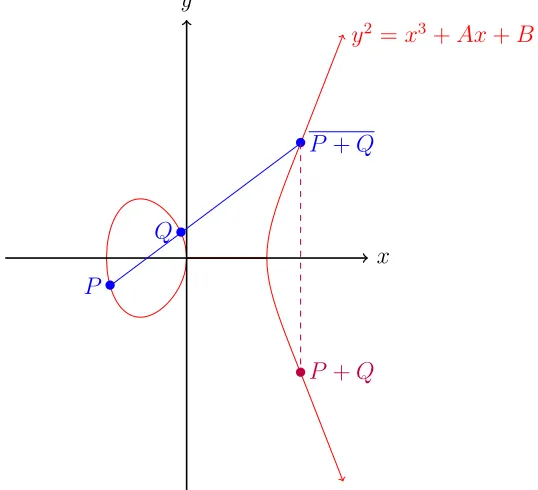
If we denote the elliptic curve in equation (1.3) as E, we can define the addition of two pointsP and Q onE, denoted as P +Q, as follows: Draw a line connectingP and Q and intersectingE at another point denoted by
P +Q, which in turn is reflected through thex-axis to obtain the point P+Q.
P +Q exists provided P and Qare distinct and not on a vertical line, and is unique because the equation is a cubic. This is shown below when the field under consideration isR.
y2 =x3+Ax+B
x y
P•
Q•
•P +Q
[image:17.612.199.468.277.522.2]•P +Q
Figure 1.1: Elliptic Curve Point Addition
y2 =x3+Ax+B
x y
P•
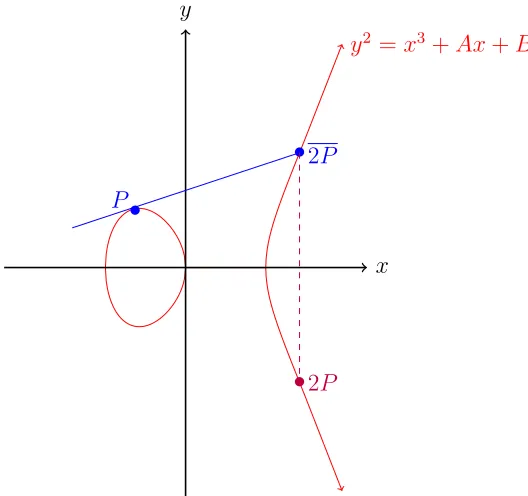
•2P
[image:18.612.140.404.96.344.2]•2P
Figure 1.2: Elliptic Curve Point Doubling
Along with all other points (x, y) ∈K2, where K is the field in which E is defined, the inclusion of the point (∞,∞), denoted by O is necessary in order to obtain a group.
We will take the lines through (∞,∞) to be vertical. Thus whenP +O is computed, the line through P = (x, y) and O should intersect E at (x,−y). Similarly when (x,−y) +O is computed, the line through P = (x,−y) andO should intersect E at (x, y). Thus P +O =P and P + (−P) =O. We can also show that ifP, Q and Rare points onE, then (P+Q) +R =P+ (Q+R). Also, P +Q = Q+P. Thus the operation of point addition satisfies the properties of Closure, Associativity, Identity, Inverse and Commutativity thereby ensuring that the set of points on E with the addition operation 0+0 constitutes an Abelian group.
The earliest use of elliptic curves in areas related to Cryptology was not in traditional encryption and decryption but in constructing a sub-exponential algorithm for integer factorization. This algorithm was introduced by Lenstra in [70] and further enhanced by Brent and Montgomery. For instance, see [15] [16], [80]. A good reference on elliptic curve factorization is the paper [43].
We can now set up the Elliptic curve analogue of the DLP. If P and Q are two points on an elliptic curve and given that P = xQ for some integer x
(xQis defined as xQ= (x−1)Q+Qif x >0 andxQ= O whenx= 0), then the problem of findingx given P and Q onE is the Elliptic Curve Discrete Logarithm Problem(ECDLP). One of the advantages of using the ECDLP as compared to integer factorization or just the DLP is that while there are sub-exponential algorithms to solve the integer factorization problem and the DLP, there are no known subexponential algorithms (subexponential in the bit-length of the curve group order) to solve the ECDLP. (Some instances of the ECDLP may not be hard. For instance, when the group order can be written as a product of only small primes, it may be easy to solve the ECDLP using the Pohlig-Hellman algorithm). This advantage translates into smaller key sizes in an ECDLP based system as compared to key sizes in integer factorization based systems such as RSA, for the same level of security. Smaller key sizes make it suitable for elliptic curve cryptosystems to be deployed in constrained environments such as mobile platforms. The notions of exponential and subexponential algorithms can be formalized using thebig-O notation [86]. However, in this thesis, we focus on operation counts to compare point arithmetic algorithms rather than comparing algorithms from the perspective of classical computational complexity.
in the underlying group in which the ECDLP is setup should be made as fast as possible. This thesis focuses on speeding up elliptic curve arithmetic including scalar multiplication algorithms. Faster elliptic curve arithmetic not only facilitates faster cryptography but may also enhance the performance of cryptanalytic methods.
1.4
Roadmap
The rest of the thesis is structured as follows:
In Chapter 2, we provide an introduction to point arithmetic formulae for various forms of elliptic curves such as Weierstrass, Montgomery, Edwards, Huff and Selmer curves with point representations such as affine, projective coordinates etc. We motivate the need for fast quintupling algorithms and then (i) show that Giorgi’s quintupling algorithm for Weierstrass curves can be derived from Mishra’s and Dimitov’s algorithm and (ii) provide new quintupling formulae for Edwards curves.
In Chapter 3, we provide new differential point tripling formulae for Montgomery curves and then provide faster differential arithmetic algorithms for Generalized Edwards and a variant of Binary Edwards curves.
In Chapter 4, we provide new algorithms for triple scalar multiplication in the context of differential addition chains and compare these algorithms with the straight-forward method for triple scalar multiplication. In this chapter, we also provide a context in which the differential tripling formulae for Montgomery curves can be used.
Making use of results from Chapter 2, we review two algorithms for double scalar multiplication in Chapter 5. One is based on conjugate addition and the other on co-Z addition. Whilst reviewing the algorithm based on co-Z
In Chapter 6, we provide an improvement to Stange’s Elliptic Net algorithm for the Tate pairing and then improve the Tate pairing computation on Selmer curves.
Chapter 2
Arithmetic on Elliptic Curves
and some improvements
In the previous chapter, we looked at the formulation of the group law for the set of points on an elliptic curve. In this chapter, we look at some formulae that are used to compute the group operation, that is the formulae related to elliptic curve point arithmetic. There are various forms of elliptic curves, such as the Weierstrass curves, Montgomery curves etc and then there are various forms of point representation on these elliptic curves, such as affine coordinates, projective coordinates etc. In this chapter, we also review some formulae for Weierstrass and Edwards curves. We start with Weierstrass curves.
2.1
Weierstrass Curves
Assume that K is a finite field, char(K)6= 2,3. An elliptic curve of the form
E :y2 =x3+a4x+a6 where a4 and a6 ∈K and (4a4+ 27a6)6= 0
in the most natural way, which is (x, y). This is the affine coordinate system and in this system −(x, y) = (x,−y).
2.1.1
Affine Coordinates
If P = (x1, y1) andQ= (x2, y2) are any two distinct points on E,P 6=O, Q6=
O and P 6=±Q, then P +Q= (x3, y3) is given by
x3 =λ2−x1−x2
and y3 =λ(x1−x3)−y1
)
where λ = (y1−y2) (x1−x2)
If P =Q= (x1, y1) and P 6=−P, then 2P = (x3, y3) is defined as
x3 =λ2−2x1
and y3 =λ(x1−x3)−y1
)
where λ = 3x
2 1+a4
2y1
TakingI to be the cost of one inversion,M to be the cost of one multiplication and S to be the cost of one squaring in the field K, then
Addition requires 1I+ 2M + 1S operations and Doubling requires 1I + 2M + 2S operations.
betweenM and Mc as special purpose algorithms can be used for constant multiplication [17, Section 1.3.7].
Next, we look at projective coordinates. The use of projective coordinates (and its many variants) avoids the use of the inverse operation, whereas when affine coordinates are used, it is not easy to do away with the inverse operation.
2.1.2
Projective Coordinates
The homogeneous projective form of the Weierstrass equation can be written as
E :Y2Z =X3+a4XZ2+a6Z3
In this system, (x, y) is replaced with any triple (X, Y, Z) = (xζ, yζ, ζ) where
ζ ∈ K∗. From a triple (X, Y, Z), the affine coordinates can be written as Affine(X, Y, Z) = (x = X/Z, y = Y /Z). The negative of −(X, Y, Z) is (X,−Y, Z) while the identity element O corresponds to (0,1,0) (This is a special case havingZ = 0, otherwiseZ 6= 0). If pointsP = (X1, Y1, Z1) and
Q= (X2, Y2, Z2) correspond to affine points (X1/Z1, Y1/Z1) and (X2/Z2, Y2/Z2)
respectively,P 6= ±Q,P 6=OandQ=6 O, then the pointP+Q= (X3, Y3, Z3)
can be computed as follows:
Computing A=Y2Z1−Y1Z2,
B =X2Z1−X1Z2
and C =A2Z1Z2−B3−2B2X1Z2,
we get X3 =BC,
Y3 =A(B2X1Z2−C)−B3Y1Z2
Similarly, if 2P = (X3 :Y3 :Z3),
Computing A=a4Z12+ 3X 2 1,
B =Y1Z1,
C =X1Y1B
and D=A2−8C
we get X3 = 2BD,
Y3 =A(4C−D)−8Y12B 2
and Z3 = 8B3
Addition requires (12M+ 2S) operations and doubling requires (7M + 5S) operations
Since every addition or a doubling in affine coordinates requires one inversion operation, the number of inversions increases with the number of point additions or doublings required. Use of projective coordinates avoids this problem, but at the cost of additional memory, as Z-coordinates for all of the points being processed need to be stored as well. In this context, it may be appropriate to quote the research problem 7.25 posed by Crandall and Pomerance in [35] which states
“ . . . One looks longingly at expressions x3 = λ2−x1 −x2, y3 =λ(x1−
x3)−y1, in the realization that if only inversion were ‘free’, the affine approach
would be superior. However, known inversion methods are quite expensive. One finds in practice that inversion times tend to be one or two orders of magnitude greater than multiply-mod times . . . it is very hard to bring down the cost of inversion(modulo a typical cryptographic prime p ≈ 2200) to 20
multiplies . . . ”.
Whilst one way of overcoming the costs of inversion is to reduce the cost of computing the inversion, a complementary way to do this is to try to reduce the number of inversions required. In recent years, there has been some research in this direction.
To begin with, the authors in [45] introduced a new method to reduce the number of operations required to be computed when affine coordinates are used. This method may be called the 2P +Q method or “Double-Add” method. We next look at this method.
2.1.3
2
P
+
Q
/Double-Add Method
If P = (x1, y1), Q= (x2, y2) are two points on E : y2 = x3+a4x+a6, then
2P +Q= (x4, y4) can be computed as below:
We could first computeP +Q= (x3, y3) as
x3 =λ21−x1−x2
and y3 = (x1 −x3)λ1−y1
)
where λ1 =
(y2−y1)
(x2−x1)
To obtain 2P+Q= (x4, y4), P +Q= (x3, y3) can be added toP = (x1, y1).
Thus
x4 =λ22−x1 −x3
y4 = (x1−x4)λ2−y1
)
where λ2 =
(y3−y1)
(x3−x1)
Now λ2 can be written as
λ2 =
y3−y1
x3−x1
= (x1−x3)λ1−y1 (x3−x1)
=−λ1−
2y1
(x3−x1)
A straightforward computation ofP+Q= (x3, y3) would require (1I+2M+1S)
and similarly computing (P +Q) +P would require another (1I+ 2M+ 1S), thus requiring a total of (2I+ 4M + 2S). However, in the above equation for
using (2I + 3M + 2S) operations. This can be extended to computing 3P
and (3P +Q) as well.
2P +Q requires (2I+ 3M + 2S) operations 3P requires (2I+ 3M + 3S) operations 3P +Q requires (3I+ 4M + 3S) operations
Thus whilst the2P+Q method reduces the number of multiplications required, it does not reduce the number of inversions required. However, in a subsequent paper [27], Ciet, Joye, Lauter and Montgomary reduce the number of inversions required by using the trick of simultaneous inverse computation. This can be called the Enhanced 2P+Q method, which we describe below:
2.1.4
Enhanced
2
P
+
Q
Method
As seen previously, whilst computing (2P +Q) as ((P +Q) +P), y3 need
not be computed. It turns out that x3 need not be computed as well.
2P +Q= (x4, y4) can be computed directly as follows:
x4 can be equated to (λ2−λ1)(λ1 +λ2) +x2
Lettingd= (x2−x1)2(2x1+x2)−(y2−y1)2, we see thatd= (x2−x1)2(x1−x3)
Defining D=d(x2−x1) and I =D−1 we have
1
x2−x1
=dI and 1
(x1−x3)
= (x2−x1)3I
Counting the number of operations required to compute x4 and y4 results
method could be extended to compute 3P,(3P +Q),4P and (4P +Q). 2P +Q requires (1I + 9M + 2S) operations 3P requires (1I+ 7M + 4S) operations 3P +Q requires (2I + 9M + 4S) operations 4P requires (1I+ 9M + 9S) operations 4P +Q requires (2I + 11M + 4S) operations
Whilst the ideas in [45, 27] were further extended and generalized in a 2007 paper [37] by Dahmen, Okeya and Schapers(DOS), where the authors precompute all odd points 3P,5P . . .(2k−1)P, k ≥2 in affine coordinates for elliptic curves over a prime field, whilst requiring (10k−11)M+ (4k)S+ 1I
operations to compute these points and they use 2(k−1) registers, the authors in [67] used the same ideas to provide a faster affine point Quadrupling scheme for Weierstrass curves over a prime field costing (1I + 8M + 8S). The DOS algorithm was then adapted by the authors in [42] to precompute 2P,3P,5P . . .(2k−1)P, k ≥2 in affine coordinates for elliptic curves over a field of char 2 and their algorithm required (11k−13)M+(2k)S+1Ioperations.
There are other ways using which the number of inversion computations can be reduced. The story of reducing the number of inversions in affine representation did not begin with [27]. One of the earliest attempts at doing this can be seen in [29]. Using the well known Montgomery inversion trick, the authors in [29] first compute 2P, and then subsequently compute
(3P,4P), (5P,7P,8P). . . ,((k.2−2+ 1)P, . . . ,(k.2−1−1)P,(k.2−1P)),
((k.2−1+ 1)P, . . . ,(k−1)P) thus reducing the number of inverses required to
be computed from k to (dlog2ke+ 1).
Further, Okeya, Takagi and Vuillaume in [85] introduced the idea of computing
curves. A precomputation algorithm structurally similar to that of in [72] was constructed by Le and Tan in [68]. We revisit some of these precomputation schemes further in Chapter 5 of this thesis.
The motivation in using the 2P +Q or the enhanced 2P +Q method or the DOS algorithm to precompute 3P,5P . . .(2k −1)P is to trade field inversions for multiplications when elliptic curve points, for efficiency reasons, are represented in affine coordinates. The 2P +Q method can also be used to efficiently compute 3P [27]. These methods can be used in cryptographic protocols where the elliptic curve points such as P and Q are not fixed, and thus the precomputations cannot be performed offline [37].
Next we look at Jacobian coordinates, a derivative of projective coordinate point representation.
2.1.5
Jacobian Coordinates
The weighted projective form of the Weierstrass equation is written as
E :Y2 =X3+a4XZ4+a6Z6
In this system, (x, y) is replaced with any triple (X, Y, Z) = (xλ2, yλ3, λ)
where λ∈K∗. From a triple (X, Y, Z), the affine coordinates can be written as Affine(X, Y, Z) = (x = X/Z2, y = Y /Z3). The negative of −(X : Y : Z)
is (X : −Y : Z) while the identity element O corresponds to (1,1,0). If points P = (X1, Y1, Z1) and Q = (X2, Y2, Z2) correspond to affine points
(X1/Z12, Y1/Z13) and (X2/Z22, Y2/Z23) respectively, P 6= ±Q, P 6= O, Q 6= O,
follows:
Setting A=X1Z12,
B =X2Z12,
C =Y1Z23,
D=Y2Z13 and
E = (B−A), F = (D−C) we can write X3 =−E3−2AE2+F2,
Y3 =−CE3+F(AE2−X3) and
Z3 =Z1Z2E
Similarly, if 2P = (X3,:Y3, Z3), we can compute 2P as follows:
Setting A= 4X1Y12 and
B = 3X12+a4Z14
we can write X3 =−2A+B2
Y3 =−8Y14+B(A−X3)
Z3 = 2Y1Z1
Addition requires (12M + 4S) operations and doubling requires (4M + 6S) operations.
Other derivatives of projective coordinate systems are Chudnovsky Jacobian coordinates and Modified Jacobian coordinates. In Chudnovsky Jacobian coordinates, an affine point (X/Z2, Y /Z3) is represented as a quintuple (X, Y, Z, Z2, Z3). Point Addition requires (11M + 3S) operations and point
doubling requires (5M + 6S) operations and this representation ensures faster addition and doubling when compared to Projective coordinate point representation. In Modified Jacobian coordinates, an affine point (X/Z2, Y /Z3)
is represented as (X, Y, Z, a4Z4) The operation counts for modified Jacobian
co-ordinates are (13M + 6S) for point addition and (4M + 4S) for point doubling.
curves in Section 2.6.2 of this chapter and then in Chapter 5. We now turn to other forms of elliptic curves.
2.2
Montgomery Curves
In a landmark paper [80], an elliptic curve of the form
Em :By2 =x3+Ax2+x
was introduced by Peter Montgomery. Over a field K where char(K)6= 2, curve parameters A, (B 6= 0) for Em satisfy A, B ∈K, andB(A2−4)6= 0. A Montgomery curve overK can be written in Weierstrass form, whilst it is not always possible for a Weierstrass curve to be written in Montgomery form as the order of a Montgomery curve is divisible by 4. The Weierstrass curve
y2 =x3+a4x+a6 over K can be written in Montgomery form if and only if
the polynomial x3+a4x+a6 has a root xp in K and (3x2p+a4) is a square
in K [28]. If P = (x1, y1) and Q = (x2, y2) are points on Em and x1 6= x2,
then the x-coordinate of P +Q= (x3, y3) can be computed (provided the
x-coordinate of P −Q= (x4, y4) is known) as follows:
x3 =
1
x4
.(x2x1−1)
2
(x1 −x2)2
, which requires (1I+ 2M + 2S) operations.
2.3
Edwards Curves
In 2007, Edwards [44] introduced a new form of an elliptic curve, now known as Edwards curves. An Edwards curve, defined over a fieldKwherechar(K)6= 2, is given by the following equation [11]
EE :x2 +y2 = 1 +dx2y2, where d∈K\ {0,1}
IfP = (x1, y1) and Q= (x2, y2) are two point onEE, then P +Q= (x3, y3)
is given by
x3 =
x1y2+y1x2
1 +dx1x2y1y2
and y3 =
y1y2−x1x2
1−dx1x2y1y2
The formulae for doubling and tripling are as follows:
If 2P = (x3, y3), then x3 =
2x1y1
x2 1+y21
and y3 =
y2 1−x21
2−(x2 1+y12)
If 3P = (x4, y4), then x4 =
(x2
1+y21)2 −(2y1)2
4(x21−1)x21−(x21−y12)2
and y4 =
(x2
1 +y21)2−(2x1)2
−4(y2
1 −1)y12+ (x21−y21)2
The group operation on an Edwards’ curve(a plane quartic) is not defined using the chord-tangent construction given earlier in section 1.3. A proof of the group law on an Edwards curve is given in [12]. Not all elliptic curves can be written in Edwards form over K, as an Edwards curve always has points of order 4, see [12]. To avoid computing inverses, the equation for
EE could be homogenized and then transformed [12] to a curve of the form (X2+Y2)Z2 =c2(Z4+dX2Y2) such thatc, d∈K\ {0,1}anddc4 6= 1. Using
projective coordinates, on an Edwards curve,
Addition requires (10M + 1S) operations Doubling requires (3M + 4S) operations
Using an efficient (computationally) birational equivalence from the Edwards form to the Montgomery form [23], the operation count for doubling on a Montgomery form elliptic curve can be reduced from (2M + 2S+ 1Mc) to (1M + 3S+ 3Mc) when the curve parameterd is a square in K. While not all Montgomery curves can be written in Edwards form, every Montgomery curve can be written in a generalized form of Edwards curves called twisted Edwards curves (a curve of the form ax2 +y2 = 1 +dx2y2 over a field K
where non zero elementsa, d ∈K and char(K)6= 2) [10].
2.4
Huff ’s Model
Another model of the elliptic curve introduced by Huff in 1948 has been adapted for use in cryptography [57]. An elliptic curve in Huff’s form (defined over a field k) is given by
EH :aX(Y2−X2) =bY(X2 −Z2) where a2 6=b2
If P1 = (X1 : Y1 : Z1) and P2 = (X2 : Y2 : Z2) are two points on EH and
P3 = (X3 :Y3 :Z3) =P1+P2 then
X3 = (X1Z2+X2Z1)(Y1Y2+Z1Z2)2(Z1Z2−X1X2)
Y3 = (Y1Z2+Y2Z1)(X1X2+Z1Z2)2(Z1Z2−Y1Y2)
Z3 = (Z12Z 2 2 −X
2 1X
2 2)(Z
2 1Z
2 2 −Y
2 1Y
2 2)
The above computation of addition on an Huff’s elliptic curve can be achieved by an algorithm costing 12M. The same formulae can be used for doubling as well and can be performed in (7M + 5S). When S >0.75M, a dedicated doubling algorithm costing (10M + 1S) was presented in [57].
2.5
Selmer Curves
Following [30], we provide the following definition.
A Selmer curve over K is defined by an equation of the form
ax3+by3 =c
wherea, b, c∈K and abc 6= 0.Along with point arithmetic formulae, we will further look at Selmer curves in the context of pairings in Chapter 6.
[image:35.612.182.490.304.460.2]The costs for point addition and doubling for various coordinate systems/curve forms reviewed in this chapter until now can be summarized as below:
Table 2.1: Point Addition and Doubling Summary
Coordinate system/
Elliptic curve form Addition Doubling Affine 1I+ 2M+ 1S 1I+ 2M+ 2S
Projective 12M + 2S 7M + 5S
Jacobian 12M + 4S 4M + 6S
Chudnovsky 11M + 3S 5M + 6S
Modified Jacobian 13M + 6S 4M + 4S
Edwards Curve 10M + 1S 3M + 4S
Huff’s Curve 12M 7M + 5S
2.6
Scalar Multiplication
One of the most important aspects of elliptic curve cryptography is that of Scalar multiplication. This is the quantitynP, where n is an integer and P
is a point on an Elliptic curve defined over a finite field. The quantity nP is given by
[n]p=P +P +· · ·+P
| {z }
(n-1) point additions
implementing elliptic curve cryptosystems. Efficient implementation of elliptic curve cryptography is dependent on the following:
(i) scalar multiplication technique (ii) point arithmetic formulae and (iii) field arithmetic.
This hierarchy can be visualized as below:
Underlying Finite Field Arithmetic Point Arithmetic Formulae
Scalar multiplication Cryptographic Protocols
representation ofninto window lengths of sand a sliding window algorithm that makes use of suitable precomputed values can be utilized to computenP.
One of the techniques of computing a scalar multiplication when n is fixed is to write n in the Double Base Number System format as depicted below.
2.6.1
Double Base Number System
The Double Base Number System (DBNS) introduced initially by Dimitrov and Cooklev in [40] was utilized later in the context of elliptic curves in [41]. With this system, the scalar n is written as
n= l X
i=1
si2ai3bi or n= l X
i=1
si2ai5bi where si =±1 .
The above idea can be generalized to a triple base number system where an integer n is represented as
n= l X
i=1
si2ai3bi5ci where si =±1.
Double and Triple base number system representations, though very short, are not immediately suitable for use in scalar multiplication algorithms. However, if we could somehow ensure that the three exponents are all simultaneously decreasing, i.e., a1 ≥ a2 ≥ . . . al and b1 ≥ b2 ≥ . . . bl and c1 ≥ c2 ≥ . . . cl, then using Horner’s rule, a scalar multiplication algorithm can be developed to computenP. The simultaneously decreasing exponents can be computed using greedy algorithms. An example of such a greedy algorithm was provided by Mishra and Dimitrov in [79, Algorithm 1].
From the double, triple and quintuple base representations of a scalar k
computation of nP when the DBNS is employed. Thus, there has been a keen interest in obtaining faster point tripling and quintupling algorithms amongst researchers.
2.6.2
Quintupling Formulae for Weierstrass Curves
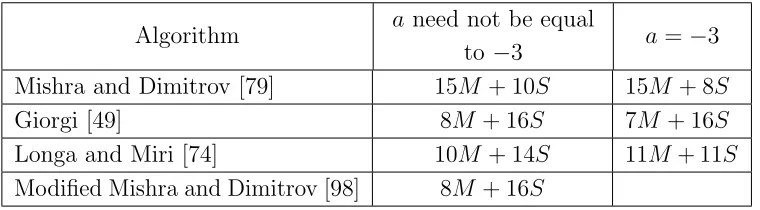
In [79] the authors provide a fast quintupling algorithm for Affine coordinates on binary Weierstrass curves. In the same paper, the authors also propose a fast quintupling algorithm in Affine and Projective Jacobian coordinates for Weierstrass curves over Fp. In Jacobian coordinates, the cost of the quintupling algorithm provided in [79] is (15M + 10S). Another algorithm costing (7M + 16S) was provided by Giorgi et al in [49]. The authors in [79] take into account the multiplication by the curve parameter a while computing the cost of their algorithm, whereas the authors in [49] do not take into account the multiplication by the curve parameter a while computing the costs of their algorithm. Thus for comparison purposes we can take the cost of the algorithm in [49] to be (8M + 16S). In [74], Longa and Miri provide a quintupling algorithm (Jacobian coordinates, Weierstrass curve over Fp) with costs equal to (10M + 14S). When the curve parameter
a =−3, Mishra’s algorithm in [79] costs (15M + 8S), Giorgi’s algorithm in [49] costs (7M+ 16S) and Longa’s algorithm in [74] costs (11M+ 11S). Thus while Longa’s algorithm in [74] performs better than Mishra’s algorithm in [79], Giorgi’s algorithm in [49] is the best option.
Giorgi’s 8M + 16S point quintupling algorithm in [49] was derived using an automaton implementing a directed acyclic graph structure looking for common subexpressions in the formulae and executing several arithmetic transformations. However using the simple transformation
2XY = (X+Y)2−X2−Y2 (2.1)
Mishra and Dimitrov’s Algorithm for Quintupling on Weierstrass Curves
We recall the equation for Weierstrass curve over a prime fieldK given by
Hw(K) :y2 =x3+ax+b
wherea, b∈K, 4a3+ 27b2 6= 0 and the point P = (X :Y :Z) corresponds to
the point (X/Z2, Y /Z3) in Jacobian coordinates. Given that P is a point on
Hw and if 5P = 5(X : Y : Z) = (X5, Y5, Z5), Mishra and Dimitrov, using
Division Polynomials, provide the following formulae in [79] to compute
X5, Y5 and Z5.
X5 =XV2−2Y U W,
Y5 =Y(E3(12V L2−V2−16L4)−64T L5) and
Z5 =ZV
where
T = 8Y4; (Cost = 2S),
M = 3X2+aZ4; (Cost = 3S+ 1M), E = 12XY2−M2; (Cost = 1S+ 1M),
2L= 2M E−2T; (Cost = 1M),
U = 4Y L; (Cost = 1M),
V = 4T L−E3; (Cost = 1S+ 2M), N =V −4L2; (Cost = 1S),
2W = 2EN; (Cost = 1M),
X5 = 4(X.V2−2Y.U.W); (Cost = 3M + 1S),
Y5 = 8Y.[E3.(12V.L2−V2
−16(L2)2)−64(T L.(L2)2)]; (Cost = 4M + 1S) and Z5 = 2Z.V; (Cost = 1M).
computed as
12X.Y2 = 6[(X+Y2)2−X2−Y4]; (Cost = 1S traded for 1M),
4Y L= 2[(Y +L)2−Y2−L2]; (Cost = 1S traded for 1M),
12V.L2 = 6[(V +L2)−V2−L4]; (Cost = 1S traded for 1M),
2M E = [(M+E)2−M2−E2]; (Cost = 1S traded for 1M) and 2ZV = [(Z+V)2−Z2−V2]; (Cost = 1S traded for 1M) .
Thus the cost of the Mishra and Dimitrov Quintupling algorithm can be reduced from 15M + 10S to 10M + 15S. It turns out that one multiplication can further be eliminated from the Mishra and Dimitrov Algorithm. Indeed, in the computation of
X5, Y U W is computed where U = 4Y L and thus Y U W = 4Y2LW.
Thus we could alterU to be equal to 4Y2L instead of 4Y L. Now, we could write 4Y2Las
U = 4Y2L= 2[(Y2+L)2−Y4−L2]; and thus
X5 = 4(XV2−2U W); (New Cost = 2M + 1S) .
Thus the cost of the modified Mishra and Dimitrov Algorithm can be reduced to 9M + 15S which is just slightly better than the 10M + 14S cost of the Longa and Miri Quintupling Algorithm. Further we could compute N2 as
N2 = (V −4L2)2 =V2 + 16L4−8V L2 .
Now N2 could be computed without using any extra squarings or multiplications, as V2, L4 and V L2 are computed for other steps in the
algorithm, as shown above. Thus 2W = 2EN could be computed as
2W = [(E+N)2−E2−N2] .
Now, E2 is also computed in another step in the algorithm, thus effectively
The costs for point quintupling on Jacobian coordinates can be summarized as below:
Table 2.2: Jacobian Coordinates Quintupling
Algorithm a need not be equal
to −3 a=−3 Mishra and Dimitrov [79] 15M + 10S 15M + 8S
Giorgi [49] 8M + 16S 7M + 16S
Longa and Miri [74] 10M + 14S 11M + 11S
Modified Mishra and Dimitrov [98] 8M + 16S
2.6.3
Quintupling
Formulae
for
Edwards
Curves
Revisited
In [11], Bernstein et al, amongst other things, provide two fast algorithms for point quintupling on Edwards curves defined overFp. As in Section 2.3, an Edwards curveEd defined over a field K is given by x2+y2 = 1 +dx2y2 where d∈K\{0,1}.
The two quintupling algorithms provided in [11], (we call them Algorithm A and Algorithm B for convenience) cost (17M + 7S) and (14M + 11S) respectively. The authors in [11] conclude that Algorithm A performs better if the S/M ratio i.e., S/M > 0.75 while Algorithm B performs better ifS/M <0.75. When S/M = 0.75, both algorithms share the same complexity. Here we modify Algorithm B slightly to provide an alternate algorithm (Algorithm C). If the affine point (X1/Z1, Y1/Z1) represents the
point (X1, Y1, Z1) on the homogenized equation of Ed, and if (X5, Y5, Z5) =
5(X1, Y1, Z1), the new quintupling algorithm (Algorithm C) is as below:
A = X2
1; B = Y12; C = Z12; D = A +B; E = 2C −D; F = A2;
G = B2; H = F +G; I = D2 −H; J = E2; K = G −F; L = K2;
M = 2I.J; N = L+M; O = L−M; P = N.O; Q = (E+K)2 −J −L;
W = U−T; X5 = 2X1.(P +B.S).W; Y5 = 2Y1.(P −A.S).V; Z5 =Z1.V.W
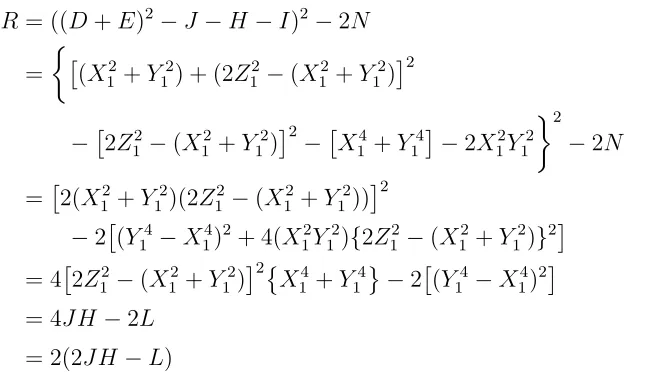
Algorithm A and Algorithm B were verified by the authors in [11]. The only difference between Algorithm C above and Algorithm B in [11] is in the computation of R. In [11], R was computed as
R = ((D+E)2−J−H−I)2−2N
In Algorithm C we employ R= 2(2J H−L), as we can rewrite R as follows:
R = ((D+E)2−J−H−I)2−2N
=
(X12+Y12) + (2Z12 −(X12+Y12)2
−
2Z12−(X12+Y12)2 −
X14+Y14−2X12Y12
2 −2N
=2(X12 +Y12)(2Z12−(X12+Y12))2 −2
(Y14−X14)2+ 4(X12Y12){2Z12−(X12+Y12)}2 = 42Z12−(X12+Y12)2X14+Y14 −2(Y14−X14)2 = 4J H−2L
= 2(2J H−L)
Algorithm C above for quintupling costs (15M + 9S) and is better than both the quintupling algorithms provided in [11] as long as M > S and M < 2S
[image:42.612.120.443.245.435.2]and irrespective of whether S/M <0.75 or S/M >0.75.
Table 2.3: Edwards Curve Quintupling Formulae Summary
Algorithm Quintupling Costs Algorithm A [11] 17M + 7S
Algorithm B [11] 14M + 11S
2.7
Side Channel Attacks
Side channel attacks are a group of techniques using which an adversary can obtain the key (or a part of the key) by using information related to power consumption, time taken for a cryptographic operation, electromagnetic radiation etc [18, 31, 48, 85]. For example, ifkP were computed wherek is a scalar and also a secret with P being an Elliptic curve point, and if the double-and-add algorithm were to be used for scalar multiplication, then it is possible to deduce information about the key from a power/timing analysis corresponding to the computation of kP as there is a difference between the point doubling and point addition operations. A countermeasure to this type of attack is the double-and-always-add algorithm of Coron [31]. Another counter measure is the Montgomery Ladder which ensures that there is no relation between the Hamming weight of the secret k and the execution time of the algorithm. Implementing an Atomic Block is one way to overcome side channel attacks. Atomic blocks consist of structuring various point arithmetic operations using a homogeneous sequence of operations. An introduction to atomic blocks can be found in [28, Chapter 29].
Chapter 3
Differential Arithmetic on
Elliptic Curves
In Chapter 2 of this thesis, we introduced x −coordinate only formulae for Montgomery curves with the points in affine representation. This x−
coordinate only arithmetic is usually known as differential arithmetic. In some cases,y−coordinate only arithmetic orw−coordinate arithmetic are used and such formulae are also known as differential arithmetic formuale. We first provide Projective coordinate formulae for Montgomery curves and then provide x−coordinate only tripling formulae for Montgomery curves. We then speed up differential addition formulae for Generalised Edwards coordinates and Binary Edwards curves.
3.1
Introduction to Differential Arithmetic
The projective form of the Montgomery curve defined over a finite field Fp can be written as
formulae below: Addition: (n6=m):
Xm+n=Zm−n((Xm−Zm)(Xn+Zn) + (Xm+Zm)(Xn−Zn))2
Zm+n=Xm−n((Xm−Zm)(Xn+Zn)−(Xm+Zm)(Xn−Zn))2
Doubling: (n=m):
X2n = (Xn+Zn)2(Xn−Zn)2 4XnZn = (Xn+Zn)2−(Xn−Zn)2
Z2n = 4XnZn((Xn−Zn)2 + ((A+ 2)/4)(4XnZn)) = 4XnZn((Xn+Zn)2+ ((A−2)/4)(4XnZn))
Point addition requires 4M + 2S operations and a point doubling requires 3M + 2S operations. If Zm−n = 1, then point addition requires 3M + 2S operations. The well known Montgomery ladder that can be used to compute
nP is as below:
Algorithm 3.1: Left-to-Right Montgomery ladder for scalar multiplication
INPUT: A point P on Em and a positive integer n= (nt. . . n0)2 with nt= 1 OUTPUT: The point nP
P1 ←P and P2 ←2P
for i=t−1 down to 0 do if ni = 0 then
P2 ←P2+P1 (P); P1 ←2P1
else
P1 ←P2+P1 (P); P2 ←2P2
In all algorithms in this thesis, whenever the difference between two points is required to compute the sum of those points, the difference is indicated in brackets immediately after the addition formula. In Algorithm 3.1, we have
P1 ←P2+P1 (P) (3.1)
The notation in equation (3.1) means that when P2 is added to P1 and the
result is stored inP1 the difference required between these two points is P
i.e., P2−P1 =P. Clearly, the above algorithm is a Left-to-Right algorithm.
If (nt. . . n1n0)2 is the binary representation of n and (nt = 1), to compute [n]P, we proceed as follows: we hold {miP,(mi+ 1)P} for mi = (nt. . . ni)2.
If ni = 0, miP = 2mi+1P and (mi + 1)P = (mi+1 + 1)P + mi+1P else
miP = (mi+1+ 1)P +mi+1P and (mi + 1)P = 2(mi+1+ 1)P. Beginning
from{P,2P}, Algorithm 3.1 computes {nP,(n+ 1)P}.
Until now, in this chapter, we have had a look at x-coordinate only point addition and doubling formulae. We proceed to look at x-coordinate only tripling formulae for Montgomery curves.
3.2
Differential Tripling Formulae for
Montgomery Curves
Let P1 = (X1, Y1, Z1), P2 = (X2, Y2, Z2) and P3 = (X3, Y3, Z3) be points on a
Montgomery curveEm with P2 = 2P1 andP3 = 3P1. Then the tripling can
be computed as
X3 =X1 X12−Z 2 1
2
− X12+Z12+AX1Z1
(2Z1)2
2 and
Z3 =Z1 X12−Z 2 1
2
− X12+Z12+AX1Z1
(2X1)2
2
.
The above tripling formulae require 6M + 5S operations. As the Tripling formulae is x-coordinate only formulae, we use the term Differential Tripling to distinguish the new formulae from usual tripling formulae where both x
We derive the above differential point tripling formulae for Montgomery curves. Let P1 = (X1, Y1, Z1), P2 = (X2, Y2, Z2) and P3 = (X3, Y3, Z3) be
points on a Montgomery curve Em with P2 = 2P1 andP3 = 3P1. We can
write P3 = 3P1 = 2P1 +P1 =P2+P1. Then
X2 = (X1+Z1)2(X1−Z1)2 (3.2)
Z2 = 4X1Z1((X1−Z1)2+ ((A+ 2)/4)(4X1Z1)) (3.3)
X3 =Z1[(X1−Z1)(X2+Z2) + (X1+Z1)(X2−Z2)]2 (3.4)
Z3 =X1[(X1−Z1)(X2+Z2)−(X1+Z1)(X2−Z2)]2 (3.5)
From equations (3.2), (3.3), (3.4) and (3.5) we can write
X3 =Z1
h
(X1−Z1)
(X1 +Z1)2(X1−Z1)2+ 4X1Z1(X1−Z1)2+ ((A+ 2)/4) (4X1Z1)2
+ (X1+Z1)
(X1 +Z1) 2
(X1−Z1) 2
−4X1Z1(X1−Z1) 2
−((A+ 2)/4) (4X1Z1) 2 i2
=Z1
h
(X1+Z1) (X1−Z1)
2
2X1 −4X1Z1(X1−Z1)2
2Z1
− (A+ 2)/4
(4X1Z1)2
2Z1
i2
= 4X12Z1
h
(X1+Z1) (X1 −Z1)
2
−4Z12(X1−Z1)2
− (A+ 2)/4 16X1Z13
i2
= 4X12Z1 X12−Z 2 1
2
− X12+Z12+AX1Z1
(2Z1)
Similarly,
Z3 =X1
h
(X1−Z1)
(X1+Z1) 2
(X1−Z1) 2
+ 4X1Z1(X1−Z1) 2
+ ((A+ 2)/4) (4X1Z1) 2
−(X1+Z1)
(X1+Z1)2(X1−Z1)2−4X1Z1(X1−Z1)2−((A+ 2)/4) (4X1Z1)2
i2
=X1
(X1+Z1) (X1−Z1)
2
−2Z1 −4X1Z1(X1−Z1)2
2X1
− (A+ 2)/4(4X1Z1)2
2X1
2
= 4X1Z12
− (X1+Z1) (X1−Z1)
2
+ 4X12(X1−Z1)2
+ (A+ 2)/4 16X13Z1
2
= 4X1Z12 − X 2 1 −Z
2 1
2
+ X12+Z12+AX1Z1
(2X1)
22
= 4X1Z12 X 2 1 −Z
2 1
2
− X12+Z12+AX1Z1
(2X1)2
2
Dividing both X3 and Z3 by 4X1Z1 we get, when (X1, Y1)6= (0,0)
X3 =X1 X12−Z 2 1
2
− X12+Z12+AX1Z1
(2Z1)2
2
Z3 =Z1 X12−Z 2 1
2
− X12+Z12+AX1Z1
(2X1)
22
The formulae for X3 and Y3 derived above can be computed using the
T1 ←X1; T2 ←Z1
T1 ←T12 (= X 2 1)
T2 ←T22 (= Z 2 1)
T3 ←(T1−T2)2 (= (X12 −Z12)2)
T4 ←X1Z1 (= X1Z1)
T4 ←A.T4 (= AX1Z1)
T5 ←T2+T2+T2+T2 (= 4Z12)
T6 ←T1+T1+T1+T1 (= 4X12)
T4 ←T1+T2+T4 (= X12+Z12+AX1Z1)
T7 ←T4.T5 (= (X12 +Z 2
1 +AX1Z1)(4Z12))
T8 ←T4.T6 (= (X12 +Z 2
1 +AX1Z1)(4X12))
T1 ←(T3−T7)2 = X12 −Z 2 1
2
− X12+Z12+AX1Z1
(2Z1)2
2
T2 ←(T3−T8)2 = X12 −Z 2 1
2
− X12+Z12+AX1Z1
(2X1)
22
X3 ←X1.T1 =X1 X12−Z 2 1
2
− X12+Z12+AX1Z1
(2Z1)2
2
Z3 ←Z1.T2 =Z1 X12−Z 2 1
2
− X12 +Z12 +AX1Z1
(2X1)2
2
If P3 is computed as 2P1+P1 (i.e.,using a point doubling followed by a point
addition), we need (4M + 2S) + (3M+ 2S) = 7M + 4S, while the number of field additions/subtractions required are the same in both the cases (using either the differential tripling formula or using P3 = 2P1 +P1). Thus the
above tripling formulae are efficient as (6M + 5S) < (7M + 4S). When
Z1 = 1 the above tripling formulae only needs (3M+ 4S) operations whereas,
if 3P were to be computed as 2P +P, (that is, a doubling followed by an addition with Z1 = 1), then (3M+ 2S) + (3M+ 2S) = (6M+ 4S) operations
3.3
Differential Arithmetic Generalized
The point addition and doubling formulae for Montgomery curves provided in Section 3.1 were the first differential addition formulae published in the literature. The idea of differential addition has since been extended to other forms of elliptic curves such as
• Lopez and Dahab’s extension [75] to Weierstrass curves over F2m. • Two independently developed extensions to Weierstrass curves over Fp
- one due to Fisher, Giraud, Knudsen and Seifert[48] and
- the other due to Brier and Joye [18].
• Bernstein, Lange and Farashahi’s [13] extension to Binary Edwards curves.
• Justus and Loebenberger’s extension [58] to Generalized Edwards curves over Fq (char(Fq)6= 2).
• Farashahi and Joye’s extension [47] to Generalized Binary Hessian curves.
• Devigne and Joye’s extension [38] to Binary Huff curves.
• Hutter, Joye and Sierra’s [52] extension to Weierstrass curves over Fp in homogeneous projective coordinates where the points to be added share the same Z-coordinate.
• Wu, Tang and Feng’s [108] extension to a new model of Binary Edwards curves.
correct only when Zm−n = 1. The text does not mention this. If Zm−n6= 1, then the formulae in [28, Section 13.3.4] should read as follows:
Zm+n =Zm−n
XmZn+XnZm 2
Xm+n=Xm−n
XmXn+XnZm 2
+Zm−n(XmZn)(XnZm)
Thus addition should take 6M + 1S operations; When Zm−n= 1, this would reduce to 4M + 1S.
3.3.1
Differential Arithmetic on Generalized Edwards’
Curves revisited
In Section 3.3.2, we try to speed up some of the formulae proposed in [58] and the affine w-Coordinate differential addition proposed in [108]. In the remainder of this section, we review some of the differential addition formulae for Generalized Edwards curves as provided in [58] and the affine
w-Coordinate differential addition formulae for a new model of Binary elliptic curve as provided in [108].
Generalized Edwards curves over a finite field Fp are given by (curve parameters c, d∈Fp)
Ec,d :x2 +y2 =c2(1 +dx2y2)
It turns out that the differential addition formulae for generalized Edwards curves use y-only coordinates instead of x-only coordinates for Montgomery curves. Let P = (x1, y1) be a point on Ec,d. In projective coordinates, P can
be written as P = (X1, Y1, Z1) we write nP = (Xn : Yn : Zn). If c, d 6= 0,
dc4 6= 1 and d is not a square inGF(p), the sum (n+m)P =nP +mP, as
A. Differential Addition for Generalised Edwards Coordinates: (m > n)
(Operation count given by authors in [58] is 6M + 4S).
Ym+n=Zm−n(Ym2(Z
2
n−c
2
dYn2) +Zm2(Yn2−c2Zn2))
Zm+n=Ym−n(dYm2(Yn2 −c2Zn2) +Zm2(Zn2−c2dYn2))
B. Differential Doubling for Generalised Edwards Coordinates: (n =m)
(Operation count given by authors in [58] is 1M + 4S).
Y2n =−c2dYn4+ 2Y
2
nZ
2
n−c
2
Zn4 Z2n =dYn4−2c
2dY2
nZ
2
n+Z
4
n
In [58], point tripling formula are provided as well. We reproduce them below:
C. Tripling for Generalised Edwards Coordinates: (Operation count given by authors in [58] is 4M + 7S).
Y3n=Yn(c2(3Zn4−dY
4
n)
2−
Zn4(8c2Zn4+ (Yn2(c3d+c−1)−2cZn2)2−
c−2(c4d+ 1)2Yn4))
Z3n =Zn(c2(Zn4 −3dY
4
n)
2
+
dYn4(4c2Zn4 −(Yn2(c3d+c−1)−2cZn2)2+
c−2((c4d+ 1)2−12c4d)2Yn4))
D. SQO Doubling for Generalised Edwards Coordinates: n=m
(Operation count given in [58] is 5S).
Y22n = ((1−c2d)Yn4 + (1−c2)Zn4 −(Yn2−Zn2)2)2
Z22n = (dc2(Yn2−Zn2)2−d(c2−1)Yn4 + (c2d−1)Zn4)2
E. SQO Tripling for Generalised Edwards Coordinates: m= 2n
(Operation count in [58] is 4M + 7S).
Y32n=Yn2(c2(3Zn4−dYn4)2−
Zn4(8c2Zn4+ (Yn2(c3d+c−1)−2cZn2)2−
c−2(c4d+ 1)2Yn4))2
Z32n=Zn2(c2(Zn4−3dYn4)2+
dYn4(4c2Zn4−(Yn2(c3d+c−1)−2cZn2)2+
c−2((c4d+ 1)2−12c4d)Yn4))2
In [108], the authors propose a new model of Binary Edwards curve given by
St:x2y+xy2+txy+x+y = 0
where (x, y) ∈ K2 and K is a field of char 2. Further, in section 6 of
F. Affine w-coordinate Differential Addition and Doubling for a new model of Binary Edwards Curves proposed in [108]:
(Operation count for addition and doubling as given in [108] is 1I+ 2M + 2S+ 1Mc and 1I+ 1M + 2S+ 1Mc respectively.)
Utilizing the idea of w-coordinate differential addition that was initially proposed by the authors in [13] for Binary Edwards curves, the authors in [108] proposew-coordinate differential addition and doubling for the elliptic curve St, i.e., they present formulae to compute w(P +Q) and w(2P) from
w(P), w(Q) and w(Q−P). IfP = (x, y) is a point onSt, then thew-function is defined as w(P) = xy. If P = (x2, y2), Q = (x3, y3), Q−P = (x1, y1),
2P = (x4, y4) and Q+P = (x5, y5), we write wi = xiyi for i = 1,2,3,4,5. Then w2 = w(P), w4 = w(2P), w5 = w(P + Q), w1 = w(Q− P) and
w3 = w(Q). The affine differential addition formulae on St, as developed and presented in [108] are as follows:
w4 =
1 +w42 t2w2
2
and w5 =w1+
t2w2w3
w2 2 +w23
The efficiency of arithmetic in characteristic 2 fields is significantly different compared to fields of odd characteristic. For instance, in binary fields, squaring is much faster than multiplication and has a complexity similar to that of modular addition [106].
3.3.2
Alternate Algorithms and Newer Operation
Counts
In this section, recalling results from [97], we show that the operation counts in formulae (B-F) of Section 3.3.1 can be improved. For clarity in comparison, the subsections that describe and compare our improvements to (B-F) of Section 3.3.1 are labeled as (BB-FF) respectively.
can be computed using the following algorithm:
A←Yn2 ( =Yn2) S B ←Zn2 ( =Zn2) S D←A∗B ( =Yn2Zn2) M
A←A2 ( =Yn4) S
B ←B2 ( =Zn4) S
Y2n =−c2dA+ ( =−c2dYn4+ 2Mc 2D−c2B 2Yn2Zn2−c2Zn4)
Z2n =dA−2c2dD+B ( =dYn4− 2Mc 2c2dYn2Zn2+Zn4)
Thus the total complexity, if one takes into consideration the cost Mc of multiplication by a constant other than 1 or 2 or 3, is (1M+ 4Mc+ 4S). The formulae (B) in Section 3.3.1 can be rewritten as
Y2n =−c2dYn4+ 2Y
2
nZ
2
n−c
2
Zn4 = 2Yn2Zn2−c2(Zn4+dYn4)
Z2n =dYn4 −2c
2dY2
nZ
2
n+Z
4
n =−c
2d(2Y2
nZ
2
n) + (Z
4
n+dY
4
n)
The rewritten formulae above can be computed using the algorithm below:
A←Yn2 ( =Yn2) S B ←Zn2 ( =Zn2) S E ←A2 ( =Yn4) S F ←B2 ( =Zn4) S G←(A+B)2 ( = 2Yn2Zn2) S
−E−F
Y2n =G− ( = 2Yn2Z
2
n− 2Mc
c2(F +dE) c2(Zn4+dYn4))
Z2n = (−c2d)G+ ( =−c2d(2Yn2Z
2
Thus the new complexity is 5S+ 3Mc. As 1S < 1M, the new complexity 5S+ 3Mc is less than the older complexity (1M + 4Mc+ 4S)
CC. Tripling for Generalised Edwards Coordinates:
The operation count of formula (C) in Section 3.3.1 is 4M+ 7S. In addition to this, by inspection, one can count 8Mcoperations are required to compute the requisite formula. Thus the total complexity of formula(C) is 4M+ 7S+ 8Mc From [58, Section 3.1], we have
y3 =
y(c2d2y8−6c2dy4 + 4(c4d+ 1)y2−3c2) −3c2d2y8+ 4d(c4d+ 1)y6−6c2dy4+c2 .
Writing y=Y /Z in projective coordinates, the above formula can be written as
Y3n
Z3n = Yn
Zn
. (c
2d2Y8
n −6c2dYn4Zn4+ 4(c4d+ 1)Yn2Zn6−3c2Zn8) −3c2d2Y8
n + 4d(c4d+ 1)Yn6Zn2−6c2dYn4Zn4+c2Zn8
.
Then
Y3n =Yn[c2d2Yn8−6c
2
dYn4Zn4+ 4(c4d+ 1)Yn2Zn6−3c2Zn8]
and
Z3n =Zn[−3c2d2Yn8 + 4d(c
4d+ 1)Y6
nZ
2
n−6c
2dY4
nZ
4
n+c
2Z8
n]
below:
A←Yn2 ( =Yn2) S B ←Zn2 ( =Zn2) S
E ←A2 ( =Yn4) S
F ←B2 ( =Zn4) S
G←(A+B)2 (=(Yn2+Zn2)2 S
−E−F −Yn4−Zn4 = 2Yn2Zn2)
H ←G2 ( = 4Yn4Zn4) S
J ←E2 ( =Yn8) S
K ←F2 ( =Zn8) S
M ←(G+F)2 [ = (2Yn2Zn2+Zn4)2−Zn8 S
−K−H −4Yn4Zn4] = 4Yn2Zn6
N ←(G+E)2 [ = (2Yn2Zn2+Yn4)2 S
−J−H −Yn8−4Yn4Zn4] = 4Yn6Zn2
Finally,
Y3n←Yn[(c2d2)J −(32c2d)H+ (c2d+ 1)M −(3c2)K] which costs 1M + 3Mc and
Z3n←Zn[(−3c2d2)J−d(c4d+ 1)N −(32c2d)H+ (c2)K]
which costs 1M + 2Mc. In the above, once (c2)K is computed, the cost of computing (3c2)K is ignored. The complexity of the new algorithm
is (10S + 2M + 5Mc). If 3S < 2M + 3Mc, then the new complexity of (10S+ 2M + 5Mc) is less than the older complexity of (7S+ 4M + 8Mc). In
[8], 2M = 3S and thus 3S <2M + 3Mc.
DD. SQO Doubling for Generalised Edwards Coordinates:
formula(BB) in this section, we can write
Y22n=2Yn2Zn2 −c2(Zn4+dYn4)2
Z22n=−c2d(2Yn2Zn2) + (Zn4+dYn4)2
Given that only squares of the coordinates are stored, the above formula can be computed using the following algorithm:
A←(Yn2)2 ( =Yn4) 1S B ←(Zn2)2 ( =Zn4) 1S E ←(Yn2+Zn2)2−A−B ( = 2Yn2Zn2) 1S Y22n←
E− ( =
2Yn2Zn2 1S+ 2Mc
c2(B+dA)2 −c2(Zn4+dYn4)2
Z22n←
−c2dE+ ( =
−c2d(2Yn2Zn2) 1S+Mc (B+dA)22 + (Zn4+dYn4)2
The complexity of the new algorithm is (5S+ 3Mc) while the old complexity was (5S+ 5Mc)
EE. SQO Tripling for Generalised Edwards Coordinates:
By inspecting formula(E) in Section 3.3.1, we can see that the total complexity of formula(E) is (4M + 7S+ 8Mc). The algorithm used to compute Y3n and
Z3n in formula(CC) of this section can be adapted to compute the requisite formulae. The first two steps can be omitted as squares are already available and the last two steps can be replaced with
Y32n←Yn2(c2d2)J −(3 2c
2
d)H+ (c2d+ 1)M −(3c2)K2
Z32n←Zn2(−3c2d2)J −d(c4d+ 1)N−(3 2c
2
d)H+ (c2)K2
The improvements for Generalized Edwards Coordinates can be summarized in the table below:
Table 3.1: Differential Arithmetic on Generalized Edwards Coordinates
Point arithmetic on Generalized
Edwards coordinates Previous [58] New [97] Differential Doubling 1M + 4S+ 4Mc 5S+ 3Mc
Tripling 4M + 7S+ 8Mc 2M+ 10S+ 5Mc SQO Doubling 5S+ 5Mc 5S+ 3Mc
SQO Tripling 4M + 7S+ 8Mc 2M+ 10S+ 5Mc
FF. Affine w-coordinate Differential Addition and Doubling for a new model of Binary Edwards Curves proposed in [108]:
The operation count of computing w4 in formula (F) in Section 3.3.1 is
1I + 1M + 1Mc+ 2S as the formula can be computed using the algorithm below:
A=w22 ( =w22) 1S B =A2 ( =w42) 1S C=t2A ( =t2w22) 1Mc
D=C−1
= 1
t2w2 2
1I
w4 = (1 +B)D
= 1 +w
4 2
t2w2 2
1M
Now w4 can be rewritten as
w4 =
1
t2
1
w22 +w
2 2
and
w4 can be computed using the following algorithm:
A=w22 ( = w22) 1S
B = 1
A = 1 w2 2 1I
w4 =
1
t2
(A+B)
= 1 t2 1 w2 2
+w22

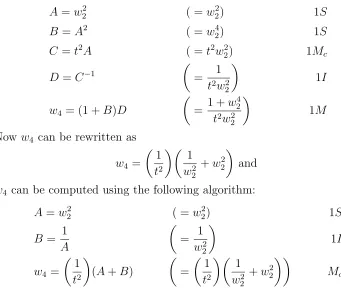
![Table 1] lists costs for point arithmetic using Jacobian representation.](https://thumb-us.123doks.com/thumbv2/123dok_us/1848302.141316/94.612.108.444.140.311/table-lists-costs-point-arithmetic-using-jacobian-representation.webp)