Rochester Institute of Technology
RIT Scholar Works
Theses Thesis/Dissertation Collections
12-2016
Multi-robot Task Allocation using Agglomerative
Clustering
Maria Shoaib
Follow this and additional works at:http://scholarworks.rit.edu/theses
Recommended Citation
Multi-robot Task Allocation using Agglomerative
Clustering
APPROVED BY
SUPERVISING COMMITTEE:
Dr. Zack Butler, Supervisor
Dr. Raymond Ptucha, Reader
Multi-robot Task Allocation using Agglomerative
Clustering
by
Maria Shoaib, B.S.
THESIS
Presented to the Faculty of the Golisano College of Computer and
Information Sciences
Rochester Institute of Technology
in Partial Fulfillment
of the Requirements
for the Degree of
Master of Science in Computer Science, Department of Computer Science
Rochester Institute of Technology
Acknowledgments
I wish to thank many people who have helped and motivated me. First
of all, my adviser Dr. Zack Butler for advising, helping, and guiding me
throughout the process. The process itself made a significant impact on my
graduate school experience. I sincerely benefited from his expertise in the area
and deeply appreciate his help in writing several reports (Pre-proposal,
Pro-posal, DARS paper and, this thesis report). In addition to this, his insightful
comments on the reports helped me improve my writing style. I would like
to thank the other members of my thesis committee, Dr. Hans-Peter Bischof,
and Dr.Raymond Ptucha for their time and valuable feedback on all of the
reports. I would also like to thank my friends and family for all the support,
in particular my mother and best friend, Uzma and father, Shuaib, without
whom I would not have made it through graduate school.
Abstract
Multi-robot Task Allocation using Agglomerative
Clustering
Maria Shoaib, M.S.
Rochester Institute of Technology, 2016
Supervisor: Dr. Zack Butler
The main objective of this thesis is to solve the problem of balancing
tasks in the Multi-robot Task Allocation problem domain. When allocating a
large number of tasks to a multi-robot system, it is important to balance the
load effectively across the robots in the system. In this thesis an algorithm
is proposed in which tasks are allocated through clustering, investigating the
effectiveness of agglomerative hierarchical clustering as compared to K-means
clustering. Once the tasks are clustered, each agent claims a cluster through
a greedy self-assignment. This thesis investigates the performance both when
all tasks are known ahead of time as well as when new tasks are injected into
the system periodically. To account for new tasks, both global re-clustering
cost, 2) maximum distance traveled per robot, and 3) balancing cost index
are used to compare the performance of the overall system in environments
both with and without obstacles. The results collected from the experiments
show that agglomerative hierarchical clustering is deterministic and better
at minimizing the total travel cost, especially for large numbers of agents,
whereas K-means works better to balance costs. In addition to this, the greedy
approach for clustering new tasks works better for frequently appearing tasks
Table of Contents
Acknowledgments iii
Abstract iv
List of Figures vii
Chapter 1. Introduction 1
Chapter 2. Background 6
2.1 Auction based techniques . . . 6 2.2 Learning based methods . . . 9 2.3 Inference and clustering techniques . . . 10
Chapter 3. Methodology 13
3.1 Clustering . . . 13 3.2 Self-Assignment . . . 20 3.3 Task execution . . . 22
Chapter 4. Results and Discussion 24
Chapter 5. Conclusion and Future Work 42
Chapter 6. Appendix 45
List of Figures
3.1 High Level Architecture. . . 14 3.2 Agglomerative Hierarchical Clustering. . . 16 3.3 Clusters for A-n32-k5 dataset: (left) Clusters using
agglomera-tive hierarchical clustering (right) Clusters using K-means with k=7. . . 19 3.4 Path traversal with A* for 32 tasks and 3 agents: (left) Initial
cluster configuration (right) Path traversal. . . 23
4.1 Results for VRP data set A-n32-k5 as a function of the number of agents present: (top) Total travel cost (middle) Maximum distance per robot (bottom) Balancing cost index. . . 26 4.2 Results for 32 randomly generated tasks as a function of the
number of agents present: (top) Total travel cost (middle) Max-imum distance per robot (bottom) Balancing cost index. . . . 27 4.3 Results for VRP data set A-n32-k5 with tasks entering
fre-quently, as a function of the number of agents present: (top) Total travel cost (middle) Maximum distance per robot (bot-tom) Balancing cost index. . . 31 4.4 Results for 32 randomly generated tasks with tasks entering
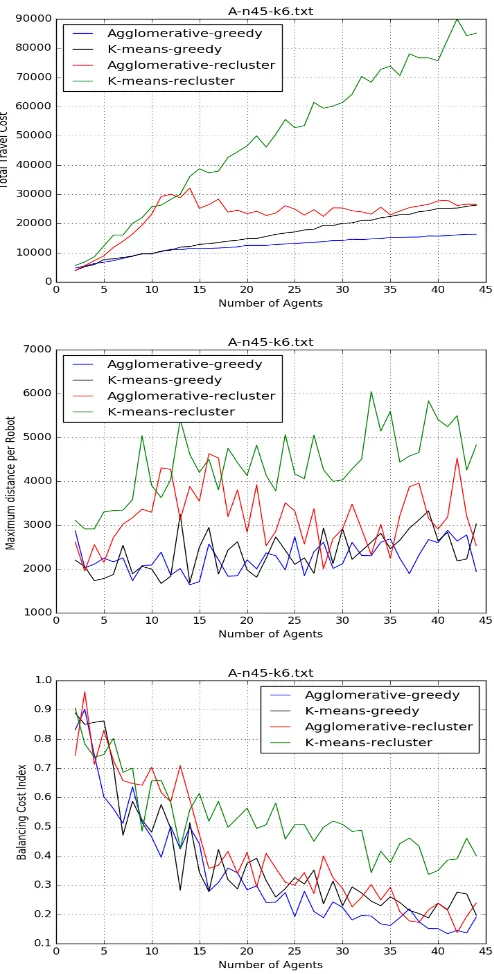
fre-quently, as a function of the number of agents present: (top) Total travel cost (middle) Maximum distance per robot (bot-tom) Balancing cost index. . . 32 4.5 Results for VRP data set A-n45-k6 with tasks entering
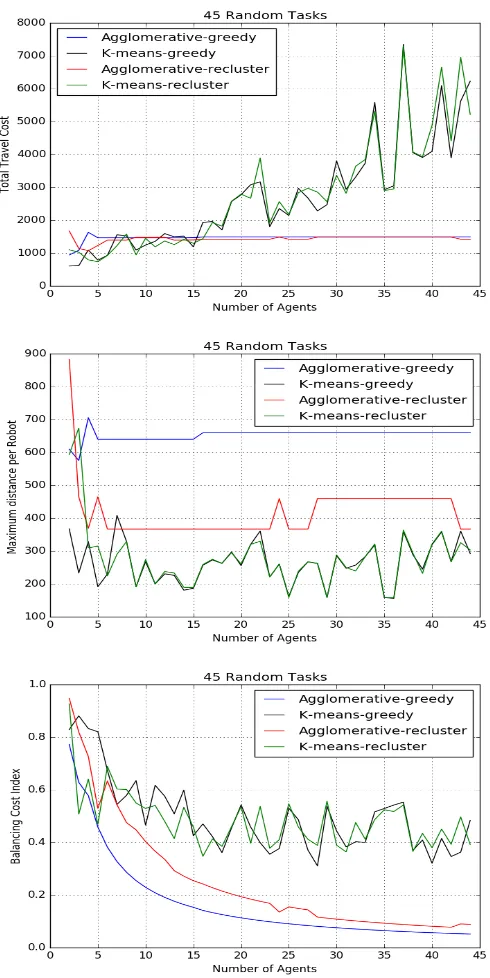
fre-quently, as a function of the number of agents present: (top) Total travel cost (middle) Maximum distance per robot (bot-tom) Balancing cost index. . . 33 4.6 Results for 45 randomly generated tasks with tasks entering
fre-quently, as a function of the number of agents present: (top) Total travel cost (middle) Maximum distance per robot (bot-tom) Balancing cost index. . . 35 4.7 Results for VRP data set A-n45-k6 with tasks entering
4.8 Results for 45 randomly generated tasks with tasks entering in-frequently, as a function of the number of agents present: (top) Total travel cost (middle) Maximum distance per robot (bot-tom) Balancing cost index. . . 39
6.1 Results for VRP data set A-n55-k9 as a function of the number of agents present: (top left) Total travel cost (top right) Maxi-mum distance per robot (bottom left) Balancing cost index. . 45 6.2 Results for 55 randomly generated tasks as a function of the
number of agents present: (top left) Total travel cost (top right) Maximum distance per robot (bottom left) Balancing cost in-dex. . . 46 6.3 Results for VRP data set A-n69-k9 as a function of the number
of agents present: (top left) Total travel cost (top right) Maxi-mum distance per robot (bottom left) Balancing cost index. . 47 6.4 Results for 69 randomly generated tasks as a function of the
number of agents present: (top left) Total travel cost (top right) Maximum distance per robot (bottom left) Balancing cost in-dex. . . 48 6.5 Results for VRP data set A-n80-k10 as a function of the number
of agents present: (top left) Total travel cost (top right) Maxi-mum distance per robot (bottom left) Balancing cost index. . 49 6.6 Results for 80 randomly generated tasks as a function of the
Chapter 1
Introduction
The Multi-Robot Task Allocation (MRTA) problem is a challenging
problem in the robotics domain with numerous practical applications. In the
past, several techniques for task allocation have been proposed for numerous
application domains such as multi-robot coverage [8], search and rescue [20],
surveillance [22], and health care [5]. For example, in multi-robot search and
rescue missions, the motive is to explore the surroundings and rescue
sur-vivors. Each of the sub-tasks constitutes of exploring a smaller area of the
environment and finding survivors. The successful completion of each of these
sub-tasks results in the completion of the entire mission. As the size of the
survivors (available tasks) and robot teams increase, the process of allocation
becomes more difficult [30]. In general, these algorithms operate by selecting
robots to perform individual tasks as they arrive, and attempt to increase
system performance and reliability in terms of total task execution time and
robustness in cases of robot failures. Due to the nature of some complex tasks,
these tasks may be even difficult for a single robot to complete in reasonable
time. We are interested in reducing the total effort expended by the team
and/or the final task completion time by utilizing many robots that are able
Many different types of algorithms have been proposed. The most
com-mon technique is using market-based methods to allocate tasks to robots. In
market-based approaches, the environment is considered as a virtual
econ-omy and the robots are agents operating in it. Several pioneering auction
algorithms like ALLIANCE, MURDOCH, RETSINA, CBBA, and open agent
architecture are market-based [4, 9]. Some techniques like RETSINA and open
agent architecture are centralized, working with a single broker [9]. Following
the centralized methodologies, distributed methods like the consensus-based
auction algorithm, CBAA were introduced. CBAA was intended to solve the
MRTA problem of a fleet of autonomous mobile robots [4]. The advantage
of decentralized techniques is their resilience. In cases of critical failures, if
one of the robots break down, the other robots are capable of executing tasks
independently or in teams with others [21]. As opposed to auctions, machine
learning techniques have also been proposed. The algorithm makes individual
task utility estimates and task assignments to form teams of agents. The
plan-ning process includes Markov Decision Processes and Reinforcement Learplan-ning
based short term and long term planning, which helps in allocating tasks and
determine the position of the individual robots. Other approaches include
determining computational models and probabilistic inference to define
rela-tionships which depict coordination between teams and clustering tasks to
balance load in the system. However, in the majority of the papers, less
atten-tion is paid to explicitly considering the balanced MRTA problem. In many of
simulation [7, 10, 31]. While some of the works, particularly the auction based
techniques consider environments with obstacles, others like clustering
meth-ods do not consider the impact of obstacles on their algorithm, experiments,
and results [7, 31]. Many multi-robot planning techniques use single item or
multi-item auctions instead of combinatorial auctions because combinatorial
auctions make bid evaluation, communication, and auction clearing intractable
[9]. Due to this, their ability to provide a quick response to a large number
new tasks entering the system is hindered. Although replanning is crucial in
dynamic environments only few methods incorporate peer to peer trading of
tasks [9].
In the proposed method, we will divide n tasks into k clusters, which
will then be assigned tom number of agents. The method will allow for
multi-robot missions that support run time allocation for both tasks that are known
beforehand and new tasks entering the system, frequently and in frequently.
The idea is to cluster similar tasks together based on a similarity metric where
each agent decides and allocates a cluster of tasks to itself based on its belief
of what is the most beneficial for itself. The metric is arbitrary and can vary
for different kinds of problems. For example, for an exploration and mapping
problem, where the tasks are well distributed in the geometrical space the
euclidean metric would work much better as opposed to the cosine similarity
metric. Also, the term beneficial can mean different things for different types
of problems — for example, in systems with different types of tasks, the type
belief propagation to determine the most beneficial action for each agent in
the system [25]. For this thesis, the cluster which minimizes the euclidean
distance from the agent to the cluster centroid is considered most beneficial and
is selected by the agent. Each agent communicates with a centralized agent,
who will give advice on the basis of how beneficial it would be for the system to
allocate a particular task to that agent. The central agent rectifies any overlaps
between two or more agents. As there is no direct communication between
agents, this method has less network usage than auction techniques. This
makes the system scalable to larger numbers of agents. In the past, K-means
has been used to form clusters of sub-tasks, coupling it with auction techniques
[7]. The problem with K-means is that it is sensitive to outliers and it implicitly
assumes that each cluster has an equal number of observations. Since the
cluster size is pre-defined for K-means, it can result in over-fitting. We have
used agglomerative hierarchical clustering as it results in more appropriate
clustering for different data sets, thereby reducing the total travel cost. The
following metrics are used to compare the performance of the overall system:
1. Total travel cost is the total path distance traveled by all the robots.
2. Maximum distance traveled per robot is the maximum distance traveled
by a robot in one round of task assignment. This signifies the time taken
to execute a round of assignment.
3. Balancing cost index is the measure of balancing the workload over all
the more the value of this index is closer to 1, more balanced is the
workload in the system (more detail in results chapter).
Furthermore, we have considered the impact of obstacles in an
envi-ronment by using the floor plan maps. The rest of this report is organized as
follows. After the introduction, Chapter 2 overviews auction based techniques,
learning based methods, and inference and clustering techniques. Chapter
3 introduces the methodology and the framework of the system. Chapter 4
Chapter 2
Background
Numerous problems in the robotics domain require multiple robots to
perform complex tasks for many practical problems, such as batch
manufactur-ing systems, foragmanufactur-ing, surveillance, and exploration. Due to the nature of these
complex tasks, several methods focusing on the Multi-Robot Task Allocation,
MRTA have been proposed. Based on the type of techniques, the methods
can be further subdivided as: 1) auction based techniques, 2) learning based
methods and, 3) inference and clustering techniques.
2.1
Auction based techniques
Several of the proposed methods in the past for distributed task
allo-cation use variants of a market-based approach using auctions, as described
in Dias’s survey paper [6]. The motivation behind this method is that robots
should be allocated tasks such that each task is performed using minimum
resources. It uses the concept of divide and conquer, with the goal of a team
being able to perform a large task by dividing it into smaller sub-tasks. The
large task is decomposed and the sub-tasks are performed by the sub-teams
sub-tasks can be performed with a cost or an objective function, which is
maximized e.g. profit or reward for a particular action or minimized e.g. time
taken to move a box from one location to the other. In the process of an
auction, an auctioneer initiates the auction for the assignment of every small
task. It accepts bids from other members which are determined by calculating
the cost function or the objective function for each robot or sub-team. The
auctioneer then chooses to allocate the task to a team or robot by maximizing
or minimizing this function. Auctions are very common in market-based
ap-proaches. Each of the teams or robots submits a bid and the winner is the one
with the highest bid. Bids are submitted to the auctioneer who itself can be
a sub-team or a separate agent dedicated to taking the role of an auctioneer.
The following steps explain the different stages in the auctioning process [9]:
• A message for the introduction of the task is sent by an agent referred
to as the auctioneer into the network. This is a new task that is to be
performed.
• Each robot who has the resources receives this message and evaluates its
own fitness and returns the bid in a message.
• After some time, the auctioneer determines the fittest through the
re-ceived messages and notifies the winner and the losers.
The classical algorithm, MURDOCH was shown to be an
a contribution to the area of intentional co-operation based multi-agent
dis-tributed systems [9]. In MURDOCH, after some time each auctioneer
deter-mines whether the initial winner is able to perform the task or is it stuck at
some point because of a failure. In the case of failure, it reassigns the task to
someone else based on fitness. Such a monitoring mechanism provides a way
to execute the task even in the case of robot failures. Before MURDOCH,
RETSINA [28] and open agent architecture [19] were also proposed. Unlike
MURDOCH, these approaches are centralized with one broker [9].
To summarize, an auctioneer initiates the auction for the assignment
of every task. It accepts bids from agents that are computed by calculating
the cost function or the objective function for each robot or sub-team. The
auctioneer then chooses to allocate the task to a team or robot by maximizing
or minimizing this function.
The most common type of auction is a single-item auction in which
only one task is offered at a time. Other type of auctions are combinatorial or
multi-item auctions in which a bundle of tasks is offered in every round. As
compared to single item auctions, combinatorial auctions allow many tasks to
be allocated in a single round. As combinatorial auctions make bid evaluation,
communication, and auction clearing computationally complex, they are not
2.2
Learning based methods
Learning based approaches for task allocation have also been proposed
[26]. This research work describes the problem as sequential decision making
in a partially observable environment, and as such can use Markov Decision
Processes and reinforcement learning to perform task allocation in a team
of robots. It combines short-term planning and a value function together to
generate a dynamic scheduler for multi-robot task allocation. It terms it as
partially observable as the tasks will be entering the system randomly and
thus, while planning for a set of tasks one cannot be aware of what set of
tasks will be entering the system later on. As the agents in the system are
not aware of the complete system, there is a notion of belief space, which is
the probability distribution representing the current state of the system given
the observation history. Since the state space can be high dimensional and
technically belief space is infinite, there is a need for approximate methods.
The work also discusses the concept of short term and long term planning.
Short term planning assumes that the short-term future is predictable and
it is then treated as static planning. However in the long term, everything
is unpredictable and requires a method that caters tasks entering the system
randomly. It mentions about the proposed hybrid planning and learning
sys-tem in which in the short term planning, it ignores new tasks entering the
system up to a particular threshold of time.
A concurrent learning approach has also been studied [21]. In this
if the problem can be decomposed into sub-problems independently. Based
on how accurately the agents have learned, they get a reward, split equally
amongst all the learners. This work mentions two issues of using machine
learning techniques on multiple agents to solve problems. Firstly, multiple
agents cause the search space to be large because of the many ways in which
these agents can interact with one another. Even the smallest change to the
environment of one agent can impact the system as a whole. Secondly,
multi-agent learning can involve a single learner or multiple learners. Since these
agents are not completely independent of one another they actually have to
learn things in context to one another.
2.3
Inference and clustering techniques
In auction-based methods, messages are always exchanged explicitly.
Although this is rarely a problem and significant methods have been
intro-duced that cater to the communication failure, implicit coordination can also
be used. For example, in the work of Stulp et al. [27] a computational model
is developed for coordination between agents, models of teammate behavior
are then computed and used for implicit coordination on real robots. Some
algorithms use Bayesian probabilistic inference to determine the belief of a
robot in a task allocation problem [11, 16, 25]. The method proposed by
Schw-ertfeger uses the chain of sight problem domain to demonstrate this approach
[25]. In the chain of sight problem, robots form a chain between a
auction/market-based methodology, this approach allows robots to infer task
assignments locally through Bayesian belief propagation. The algorithm
con-verts belief to task assignments where each robot decides its own task based on
the belief of others and itself. Each robot computes a probability distribution
using the Bayesian belief propagation algorithm over all the possible sub-tasks
in the system.
In the past, the idea of clustering similar tasks in order to balance the
distribution of load in a multi-agent system has been proposed [10, 12]. In
Elango’s work, K-means has been used to form clusters of sub-tasks, coupling
it with auction techniques [7]. However in this approach, a combinatorial
scheme of bidding has been used. In cases of a large number of incoming tasks
and many robots, combinatorial auctions are known to make bid evaluation,
communication, and auction clearing intractable [9]. Also, the presence of
obstacles has not been considered in experiments.
Clustering has also been used to solve the problem of coverage with
multiple robots [8]. This approach has considered the impact of obstacles in
their experiments but have only used K-means for clustering. For the
perfor-mance evaluation of these methods, only a small number of tasks, robots, and
cluster combinations are used even when working in simulation [7, 8, 10].
After reviewing the research performed in the past, it is evident that
there have been tremendous advances in solving the MRTA problem. In this
area, although mostly research aims in developing systems that will be
problem domain. Also, in the majority of the papers, very little progress is
made in performing complex heterogeneous tasks in a tightly coupled
sce-nario and balancing tasks across all robots in a system. While some of the
works, particularly the auction based techniques consider environments with
obstacles, others like clustering work with an ideal environment of an empty
world.The problem with coupling auctions with clustering techniques is that a
combinatorial scheme of bidding has been used. In cases of a large number of
incoming tasks and many robots, combinatorial auctions make bid evaluation,
communication, and auction clearing intractable. In many of the methods,
only a small number of tasks, robots, and clusters are used even when working
Chapter 3
Methodology
The proposed algorithm consists of three major components. Fig. 3.1
shows a high-level architecture of the methodology. First, every task which
has entered the system is clustered on the basis of their similarity. Tasks can
be known beforehand (e.g. for this thesis, the VRP traveling salesman dataset
is used [2]) or can enter the system periodically or irregularly (e.g. if large
batches of tasks enter from time to time). Second, the mapping of each cluster
to an agent is determined via self-assignment. Each agent sends a message to
the centralized agent containing the selected cluster’s ID and the associated
cost. The centralized agent detects overlaps in individual assignments, rectifies
them, and determines the final assignment. The agents then execute their
assigned tasks. The following sections explain each component in detail.
3.1
Clustering
Clustering can be broadly defined as dividing a set of objects in such
a way that objects in the same cluster are more similar to each other as
compared to those in other clusters. The similarity metric is defined according
Figure 3.1: High Level Architecture.
Euclidean distance or L2 norm is used frequently as a similarity measure.
The cosine similarity, which measures similarity between two vectors based on
the cosine of the angle between them, can also be used to determine points
which are similar with respect to orientation in the geometrical space. In
order to balance workload in the system, we will use the clustering technique
with the L2 norm to group the n tasks into k clusters where each cluster of
task/tasks will be assigned to an agent. We use K-means and agglomerative
hierarchical clustering techniques and compare the performance of the overall
task allocation system. Eq. 3.1 describes the similarity relationship.
where x1 and x2 are two tasks and d is the result of the measure
of similarity between these two tasks. In specific scenarios, x1 and x2 may
represent location of boxes (box pushing problem) or the areas to be explored
(exploration problem).
K-means is a widely used method for clustering. In the past, K-means
has been used to form clusters of tasks, coupling it with auction techniques
[7]. However, it makes some assumptions that can make the balancing of
tasks inefficient. In particular, it implicitly assumes that the variance of the
distribution of each attribute is spherical and all attributes have the same
variance and that the prior probability for allk clusters are the same, i.e. each
cluster has roughly an equal number of observations. In addition, the number
of clusters must be given ahead of time.
The method introduced in this thesis, proposes using agglomerative
hierarchical clustering to divide the n sub-tasks into k clusters. It is possible
that a task (e.g. consider a searching task where the similarity metric is the
Euclidean distance between the agent and the goal location) will be similar
to other tasks but might be misclassified and assigned to a different cluster
because the distribution in the geometrical space might not be spherical.
K-means technique can be very sensitive to outliers. Due to this, when this
cluster will be assigned to a agent it is possible that these tasks might not
be similar e.g. considering the euclidean distance metric, it might be a task
which requires the team to go to a farther location than a closer one. This will
Figure 3.2: Agglomerative Hierarchical Clustering.
does not have such limitations when compared with K-means, it will result in
more accurate clustering, thereby reducing the total travel cost.
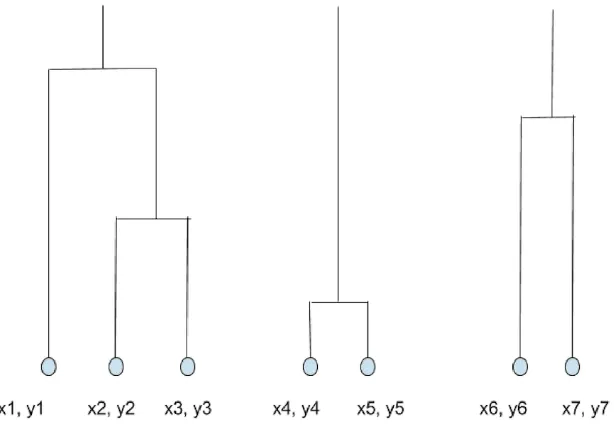
An example of using hierarchical agglomerative clustering is shown in
Fig. 3.2. Consider a box pushing task where the user asks to push boxes
lo-cated at multiple locations. Each point is a target location in two-dimensional
space specified as (x,y) coordinates. The similarity measure can be visualized
as a dendrogram shown in Fig. 3.2 where each merge is represented by a
hori-zontal line. The height of the horihori-zontal line denotes the similarity of the two
locations that were merged, with the higher value being less similar. Moving
from bottom to top, each location is treated as a single cluster initially. The
Since agglomerative clustering does not use a fixed number of clusters,
we need to specify the point for ending the clustering process. We use a
threshold mechanism based on the average of pair-wise distances within a
cluster. Initially each point is in its own cluster and we iteratively merge the
two closest clusters until all the points are merged into a single cluster. From
this hierarchical structure, we form flat clusters such that the original data
points in each flat cluster have no greater pairwise distance than d. Eq. 3.2
explains about the calculation of the threshold.
Given the pair-wise distances between points, we can select the
mea-sure for intercluster similarity, also known as the linkage criterion. Since the
tasks in the benchmark datasets and synthetic datasets are well distributed in
space, we use the euclidean metric for the distances and mean linkage as the
intercluster similarity measure. Mean-linkage is a trade-off between
complete-linkage, which is sensitive to outliers and single-linkage clustering, which can
potentially form clusters which do not satisfy the natural notion of clusters
forming spherical distributions. In each iteration, the pair of clusters with
the highest cohesion are merged together. However, it is important to note
that the selection of a similarity metric and linkage criterion will influence
the shape of the clusters, and must be selected according to the nature of
the problem. When comparing K-means to agglomerative clustering, since the
number of clusters for K-means must be pre-defined, it is set to be equal to
the number of agents in the experiments. In order to be fair in comparison to
threshold is implemented. In this case, the value of k is determined by using
the threshold from Eq. 3.2. The initial value of k is set to 1 and is increased
iteratively until it converges to a value, such that in each cluster the distance
of every observation to the cluster centroid is within the value of the threshold.
When new tasks enter the system while tasks are already being
exe-cuted, two different approaches; greedy and reclustering can be used. In the
greedy approach, the new task(s) are added to whichever cluster is closest
based on the cluster mean, while in re-clustering, new clusters are created
from all current and new tasks. For this thesis, both techniques are
imple-mented and the results are compared with each other. Python’s Scikit learn
clustering functions are used for K-means and agglomerative clustering [1].
There are two important things to consider with respect to the
imple-mentation:
1. The number of clusters is determined using a threshold mechanism for
agglomerative technique by computing the average of pair-wise distances
for n tasks.
daverage =
Pp
i=1pi
p (3.2)
where d is the threshold, and p is the number of pairs. To be fair in
comparison to agglomerative clustering, the number of clusters for
K-means is set to be equal to the number of agents in the experiments.
the system. We have used greedy and re-clustering techniques in the
[image:28.612.131.502.167.315.2]experiments and have compared the results.
Figure 3.3: Clusters for A-n32-k5 dataset: (left) Clusters using agglomerative hierarchical clustering (right) Clusters using K-means with k=7.
Fig. 3.3 shows the clusters generated from agglomerative hierarchical
and K-means clustering for one of the benchmark datasets. On the left side of
Fig. 3.3, we can see that the agglomerative clustering produces 7 clusters. On
the right side is one instance of K-means clustering — here we have specified
7 clusters as a comparison to the agglomerative approach, but any number
can be computed. Also, since K-means involves an initial random seed of
cluster means, these clusters will not always be repeated for this data set.
Not only must the number of clusters be decided in advance, K-means can
result in classifying data points in counter-intuitive ways. In this particular
case, we can see that the points (61,59) and (61, 62), shown in green and
red respectively, have been separated by K-means in two different clusters.
method uses agglomerative hierarchical clustering to divide the n sub-tasks.
Agglomerative clustering is a bottom-up approach in which each data point
starts as an individual cluster and pairs of clusters are merged on the basis of
a similarity metric and linkage criterion. Since K-means uses the cluster mean
to decide how to divide the tasks, it can be very sensitive to outliers, and may
put tasks in a cluster where they are not particularly similar (i.e. nearby) to
the others, whereas agglomerative clustering should not suffer from the same
issues. However, since agglomerative clustering does not use a fixed number
of clusters, we need to specify at what point the clustering process stops.
3.2
Self-Assignment
Once the clusters have been determined, each agent should assign tasks
to itself. Here we use a greedy approach where each agent will determine which
cluster is most beneficial for it by minimizing the cost of executing that task.
The cost function depends on the nature of the problem e.g. for a box pushing
problem it can be the robot travel cost i.e. the distance between the robot
and the goal location.
For this thesis, once the clusters are made, each robot chooses a cluster
based on the minimal euclidean distance to the cluster center. The algorithm
consists of the following steps:
1. The robot greedily finds the closest cluster, the one that has the
containing the cluster ID and travel cost to a centralized agent.
2. The centralized agent checks for overlap of robots and clusters. If there
is an overlap of agents, it updates the assignment of each overlapping
agent by finding the next closest cluster and the associated travel cost.
Also, if the number of clusters is less than the number of agents, then
agents with minimum cost are chosen.
3. The centralized agent sends an acknowledgment message to the robots
with the final assignment. These agents can start executing the assigned
tasks.
4. The agents receive the final assignment in the acknowledgment message
and start executing the tasks based on the assignment. The order of
executing tasks is computed. After finishing the tasks in the calculated
order, each agent sends an acknowledgment message to the centralized
agent.
In this work, both techniques are tested with same initial robot
loca-tions and tasks. In testing, as the algorithm exchanged messages and agent
locations are updated, the overlaps were seen to be reduced. SimPy, a
process-based discrete-event simulation framework, is used to exchange messages
be-tween agents. Its event dispatcher, based on Python’s generator functions,
3.3
Task execution
After each assignment, it is required to determine the following for
performing task execution by each robot in the system:
1. Order of execution: The order of execution is the order in which the
assigned tasks are completed by each robot.
2. Individual path traversal: The individual path traversal is the path taken
by each robot to execute the tasks assigned.
We can observe that each round of assignments is equivalent to a
Trav-eling Salesman Problem (TSP). Every robot’s current position is the starting
location and the assigned tasks are analogous to the locations to be visited.
The order of execution is determined by solving the TSP for each robot’s
start-ing position and the assigned tasks. The dynamic programmstart-ing approach has
been used for implementing this solution, which is known to be faster than
the brute force solution to this NP-complete problem [3]. This solution has
a worst case O(n2.2n) running time. Since the value of n is a subset of the
number of actual tasks in the system, for the analysis of this thesis the value
ofn is always small. The path traversal for each ordered set of tasks (ordered
by TSP) is then calculated through the A* algorithm, which is widely known
to produce an efficiently traversable path between multiple points, known as
nodes in the geometrical space [14]. Eq. 3.3 is the heuristic function that has
h=|x1−x2|+|y1−y2| (3.3)
where the coordinates for individual task locations (nodes) are (x1,y1)
and (x2,y2).
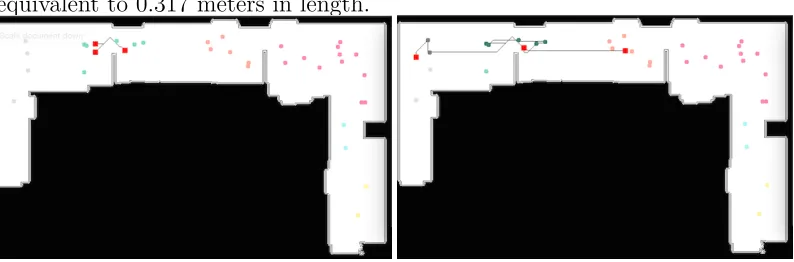
Fig. 3.4 shows a floor plan and some traversed paths for the A-n-32
dataset for 3 agents and 32 tasks from one of our experiments. Each pixel in
the image is considered as a node and space is discretized to contain 8 possible
actions in order to move to any other node in space where a 1-pixel move is
[image:32.612.119.516.327.458.2]equivalent to 0.317 meters in length.
Chapter 4
Results and Discussion
To evaluate the performance of the proposed method, both clustering
techniques are implemented in a simple simulation. Different environments
and task distributions were studied. First, the experiments are performed
with the benchmark VRP dataset, which contains examples with 32, 45, 55,
69, and 80 tasks in an environment without obstacles. For an environment with
obstacles we used the floor plan in Fig. 3.4 with tasks from a uniform random
distribution. The metrics are calculated from an average of ten random sets to
remove any bias due to the type of distribution. In each case, both clustering
techniques are tested and the number of agents are varied. To evaluate the
resulting task assignments, total travel cost, maximum distance traveled per
robot and balancing cost index are calculated. The total travel cost is the
total path distance traveled by all the robots. The balancing cost index is the
measure of balancing the load over all robots in the framework, calculated as:
b = Pr
i=1ci/m
r (4.1)
where b is the balancing cost index, ci is the travel cost for robot i, m is the
maximum travel cost across all robots, and r is the number of robots. The
the more balanced is the load in the system. A value of 1 signifies that all
the robots in the system have the same travel cost corresponding to the tasks
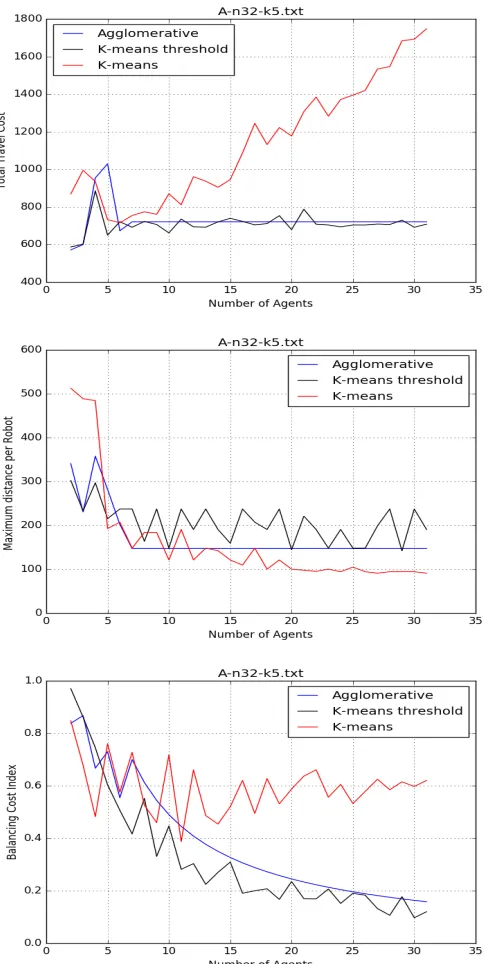
The results for one representative test of the VRP tasks is shown in
Fig. 4.1. For the first case of K-means, the number of clusters is set to the
number of agents, so as the number of agents increases, at least one task will
be assigned to each robot. As expected, the total cost of the system then
increases since all robots must travel some distance to a task, even when two
robots are going to very nearby tasks. To be fair, for the second case of
K-means (K-means threshold), the threshold (which is calculated using the
average pairwise distance) is used to determine the value of the number of
clusters. The value of k is increased (starting from 1) iteratively until the
resulting clusters are within the same diameter as the threshold. The value of
k after the convergence is used.
As we increase the number of agents, the total travel cost for the
sys-tem under agglomerative clustering becomes constant while the travel cost for
K-means increases. This is the point where the number of agents is equal to
the number of clusters created using the agglomerative clustering threshold.
Since each cluster is assigned to an agent, no matter how many agents are
available, excess robots are not utilized and the total cost does not change.
One can observe from the plots for the maximum distance traveled per robot
and the balancing cost index, that the higher value for a balancing cost
in-dex corresponds to a lower value for maximum distance traveled per robot
(essentially conveying the same information). We can see that the maximum
distance traveled for any robot (and thus the overall completion time for the
However, when comparing K-means threshold and agglomerative, a
very slight difference is seen between the two methods when comparing the
three evaluation metrics. A major benefit of using agglomerative clustering
is the stability due to it’s deterministic behavior when using the threshold on
the hierarchical tree structure. K-means threshold, due to its stochastic
na-ture results in different values of travel cost even when the same value of k is
used. For other tests in the VRP dataset (shown in the Appendix), different
numbers of clusters were created by agglomerative clustering but the same
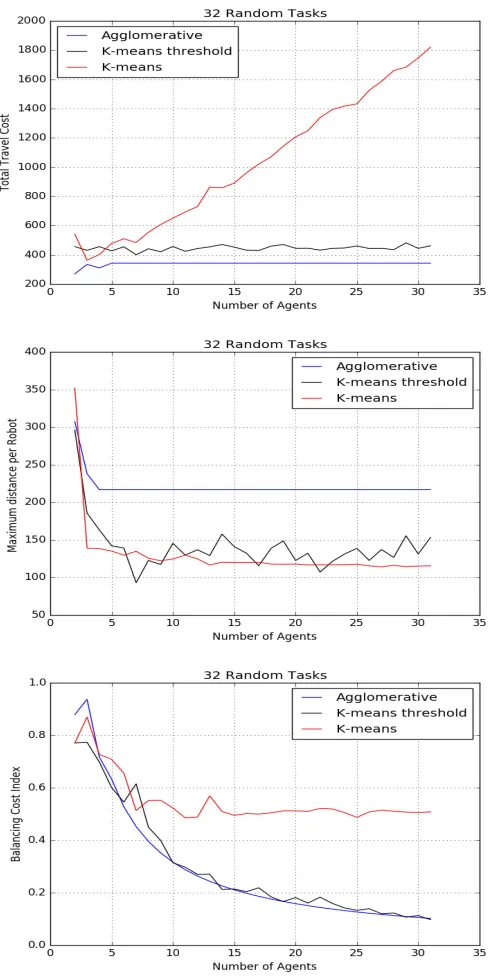
patterns held in all cases. We also found generally similar results for random
tasks in an environment with obstacles as shown in Fig. 4.2, though in this
case the agglomerative clustering was generally more efficient, presumably due
to the more uniform distribution of tasks being suited to this type of clustering
compared to the VRP tasks. In this case agglomerative selects a lower value
for the number of clusters than K-means threshold, thereby reducing the total
travel cost.
On the other hand, if we are instead concerned with balancing the load
across the agents, the balancing cost index is seen to decrease more sharply
towards 0 (i.e. less load balance across the robots) for agglomerative clustering
as the number of agents increase. This reflects that the number of robots used
is capped by the number of clusters found by this technique, so that each
robot travels longer distances (more time) as opposed to K-means which uses
all robots so each one may travel shorter distances. The main advantage of
size for individual datasets based on the thresholds.
In the remaining experiments, we investigated the performance of the
system when new tasks are added dynamically over time. We have tested both
the greedy and reclustering techniques for incorporating new tasks over the
same sets of tasks. In the first of these experiments, we regularly introduce
tasks by giving one new task as each task is completed, for a total number of
n times where n is the initial number of tasks. Results of one representative
Similar to the results for fixed tasks, for frequently entering dynamic
tasks, agglomerative hierarchical clustering has a lower total travel cost. The
results also show that when tasks are added over time, the greedy
cluster-ing method works better than global reclustercluster-ing for both the K-means and
agglomerative approaches. The impression from these experiments is that
the greedy approach works better because it takes into account not only the
original distribution of tasks in space but also retains the current robot
as-signments. However, in the presence of obstacles, as shown in Fig. 4.6, there
In the final set of experiments, we are interested in the performance
of the system when a large number of tasks are added infrequently. To test
this case, we set up an experiment in which n tasks are given initially, and
once the number of clusters is less than or equal to the number of agents, an
additional n tasks are added. Results for random tasks in the environment
Similar to other experiments, agglomerative has a lower cost than
K-means, and the greedy approach to adding tasks gives better results than global
reclustering. This may seem counterintuitive, in that for a large number of
infrequent tasks, reclustering should work better since it will be able to choose
an appropriate cluster size for the new distribution. However, reclustering
with new tasks can create additional clusters, so instead of robots adding a
few nearby tasks, a different idle robot is assigned to these tasks from farther
We can draw a number of conclusions from the conducted experiments.
Firstly, the travel cost by using agglomerative clustering does not vary beyond
the point where the number of agents becomes equal to the number of clusters.
This is because the number of clusters produced is independent of the number
of agents and no matter how many agents we increase, they are not going to
be utilized. In K-means, adding more number of agents means utilizing them
which will increase the travel cost. However, K-means will result in lower
completion time (seen from the maximum distance per robot plots) and will
also balance tasks in a better way (as observed from higher values for balancing
cost index) as compared to agglomerative clustering.
Secondly, in K-means, when we increase the number of agents
(in-creasing the cluster size), the K-means clustering approach starts to look for
patterns that dont actually exist in the underlying data, causing overfitting.
Thirdly, when new tasks are added frequently, one at a time, the greedy
approach works better. The greedy approach maintains the current robot to
task assignments while assigning new tasks to existing clusters, inherently
incorporating the current robot positions with respect to the assigned tasks.
Since the added tasks correspond to a uniform random distribution between
the minimum and maximum value of existing tasks, it is beneficial to cluster
them greedily by assigning the new appearing task to the cluster with the
nearest cluster mean.
Lastly, although it makes intuitive sense that when a large number of
depict an opposite behavior. The reason for this pattern is that reclustering
does not take into account the current robot positions requiring the robots to
Chapter 5
Conclusion and Future Work
This thesis proposes a clustering and greedy assignment based method
for solving the balanced MRTA problem. In the process of doing so, the
agglomerative hierarchical and K-means clustering techniques are compared
to obtain the best cluster size and develop a greedy task assignment strategy.
The experimental results demonstrate the effectiveness and efficiency
of the proposed method, with agglomerative clustering performing better than
K-means in terms of reducing the total travel cost. The agglomerative
hierar-chical clustering can not only reduce the total travel cost but can also select
an appropriate cluster size even in cases of a large number of initial tasks, new
dynamic tasks, and presence of obstacles. However, in the case where there
are a large number of agents, agglomerative clustering produces assignments
with fewer clusters and therefore higher maximum cost per robot (and higher
execution time) than K-means (seen from the maximum distance per robot
plots). In cases of new tasks, the greedy approach results in lower travel cost
by inherently incorporating the current robot positions with respect to the
as-signed tasks. Also, it is evident from the higher values for balancing cost index
clustering.
Some of the conducted experiments (fixed tasks) use K-means threshold
method to determine the number of clusters by an iterative search of
increas-ing k until the resulting clusters are consistent with the threshold. Other
conducted experiments use the number of clusters for K-means to be the same
as the number of agents. In the future, other experiments can be conducted
using this method for frequent and infrequent dynamic tasks. Also, for cluster
selection in agglomerative, an iterative search of varying the threshold can be
used. This will result in a direct comparison between the balancing cost index
for agglomerative hierarchical and K-means clustering methods. For example,
it is no surprise that the balancing cost index is always higher for K-means
considering that we keep more robots busy by creating as many clusters as
agents.
In the method proposed in this thesis, the assignment of agents to
clus-ters is a greedy self-assignment process which may not be optimal. In the
future, the cluster to agent assignment can be made optimal by using
poly-nomial time combinatorial optimization algorithms. One of such algorithm is
the Hungarian method in which the problem is to find the lowest-cost way to
assign jobs to resources and is able to find the optimal solution in polynomial
time[17].
The proposed method can be extended to account for robot failures and
perform clustering considering obstructed paths. The obstructed distances will
quality. Future work will focus on a more distributed approach to cluster
assignment as well as providing automated techniques to tune the system
Chapter 6
[image:54.612.126.302.259.550.2]Appendix
Bibliography
[1] scikit-learn 0.17 : Python package index.
[2] Vehicle routing data sets, http://www.vrp-rep.org.
[3] Richard Bellman. Dynamic programming treatment of the travelling
salesman problem. J. ACM, 9(1):61–63, January 1962.
[4] H. L. Choi, L. Brunet, and J. P. How. Consensus-based decentralized
auctions for robust task allocation. IEEE Transactions on Robotics,
25(4):912–926, Aug 2009.
[5] Gautham P. Das, Thomas M. McGinnity, Sonya A. Coleman, and
Laxmid-har Behera. A distributed task allocation algorithm for a multi-robot
system in healthcare facilities. Journal of Intelligent & Robotic Systems,
80(1):33–58, 2015.
[6] M. B. Dias, R. Zlot, N. Kalra, and A. Stentz. Market-based
multi-robot coordination: A survey and analysis. Proceedings of the IEEE,
94(7):1257–1270, July 2006.
[7] Murugappan Elango, Subramanian Nachiappan, and Manoj Kumar
Ti-wari. Balancing task allocation in multi-robot systems using k-means
clustering and auction based mechanisms. Expert Syst. Appl., 38(6):6486–
[8] A. Gautam, J. K. Murthy, G. Kumar, S. P. A. Ram, B. Jha, and S.
Mo-han. Cluster, allocate, cover: An efficient approach for multi-robot
cover-age. InSystems, Man, and Cybernetics (SMC), 2015 IEEE International
Conference on, pages 197–203, Oct 2015.
[9] B. P. Gerkey and M. J. Mataric. Sold!: auction methods for
multi-robot coordination. IEEE Transactions on Robotics and Automation,
18(5):758–768, Oct 2002.
[10] Bradford Heap and Maurice Pagnucco. Analysis of cluster formation
techniques for multi-robot task allocation using sequential single-cluster
auctions. In AI 2012: Advances in Artificial Intelligence - 25th
Aus-tralasian Joint Conference, Sydney, Australia, December 4-7, 2012.
Pro-ceedings, pages 839–850, 2012.
[11] Bradford Heap and Maurice Pagnucco. Minimising undesired task costs
in multi-robot task allocation problems with in-schedule dependencies.
In Proceedings of the Twenty-Eighth AAAI Conference on Artificial
In-telligence, AAAI’14, pages 2542–2548. AAAI Press, 2014.
[12] Bradford Gregory John Heap and Maurice Pagnucco. Repeated
se-quential auctions with dynamic task clusters. In Proceedings of the
Twenty-Sixth AAAI Conference on Artificial Intelligence, July 22-26,
2012, Toronto, Ontario, Canada., 2012.
[13] Matthew Hoeing, Prithviraj Dasgupta, Plamen Petrov, and Stephen O’Hara.
the 6th International Joint Conference on Autonomous Agents and
Mul-tiagent Systems, AAMAS ’07, pages 280:1–280:8, New York, NY, USA,
2007. ACM.
[14] Huang Jin, Wu Wei, and Ling Ziyan. Multi-agent pathfinding system
implemented on xna. In Proceedings of the 2012 Fourth International
Conference on Computational Intelligence and Communication Networks,
CICN ’12, pages 651–655, Washington, DC, USA, 2012. IEEE Computer
Society.
[15] E. G. Jones, B. Browning, M. B. Dias, B. Argall, M. Veloso, and A. Stentz.
Dynamically formed heterogeneous robot teams performing tightly-coordinated
tasks. In Proceedings 2006 IEEE International Conference on Robotics
and Automation, 2006. ICRA 2006., pages 570–575, May 2006.
[16] Aaron Khoo and Ian Douglas Horswill. Grounding inference in
dis-tributed multi-robot environments. Robotics and Autonomous Systems,
43(2-3):121–132, 2003.
[17] H. W. Kuhn and Bryn Yaw. The hungarian method for the assignment
problem. Naval Res. Logist. Quart, pages 83–97, 1955.
[18] L. Luo, N. Chakraborty, and K. Sycara. Provably-good distributed
al-gorithm for constrained multi-robot task assignment for grouped tasks.
[19] David L. Martin, Adam J. Cheyer, and Douglas B. Moran. The open
agent architecture: A framework for building distributed software
sys-tems. Applied Artificial Intelligence, 13(1-2):91–128, 1999.
[20] K. Nagatani, Y. Okada, N. Tokunaga, K. Yoshida, S. Kiribayashi, K. Ohno,
E. Takeuchi, S. Tadokoro, H. Akiyama, I. Noda, T. Yoshida, and E.
Koy-anagi. Multi-robot exploration for search and rescue missions: A report
of map building in robocuprescue 2009. In 2009 IEEE International
Workshop on Safety, Security Rescue Robotics (SSRR 2009), pages 1–6,
Nov 2009.
[21] Liviu Panait and Sean Luke. Cooperative multi-agent learning: The state
of the art. Autonomous Agents and Multi-Agent Systems, 11(3):387–434,
November 2005.
[22] A. Pustowka and E. F. Caicedo. Market-based task allocation in a
multi-robot surveillance system. In Robotics Symposium and Latin American
Robotics Symposium (SBR-LARS), 2012 Brazilian, pages 185–189, Oct
2012.
[23] Eric Schneider, Ofear Balas, A. Tuna Ozgelen, Elizabeth I. Sklar, and
Simon Parsons. An empirical evaluation of auction-based task allocation
in multi-robot teams. In Proceedings of the 2014 International
Con-ference on Autonomous Agents and Multi-agent Systems, AAMAS ’14,
pages 1443–1444, Richland, SC, 2014. International Foundation for
[24] Eric Schneider, Elizabeth I. Sklar, Simon Parsons, and A. Tuna ¨Ozgelen.
Auction-Based Task Allocation for Multi-robot Teams in Dynamic
En-vironments, pages 246–257. Springer International Publishing, Cham,
2015.
[25] J. N. Schwertfeger and O. C. Jenkins. Multi-robot belief propagation for
distributed robot allocation. In2007 IEEE 6th International Conference
on Development and Learning, pages 193–198, July 2007.
[26] Malcolm J. A. Strens and Neil Windelinckx. Combining planning with
reinforcement learning for multi-robot task allocation. In Daniel
Ku-denko, Dimitar Kazakov, and Eduardo Alonso, editors, Adaptive Agents
and Multi-Agent Systems, volume 3394 ofLecture Notes in Computer
Sci-ence, pages 260–274. Springer, 2005.
[27] F. Stulp, M. Isik, and M. Beetz. Implicit coordination in robotic teams
using learned prediction models. InProceedings 2006 IEEE International
Conference on Robotics and Automation, 2006. ICRA 2006., pages 1330–
1335, May 2006.
[28] Katia Sycara, Massimo Paolucci, Martin Van Velsen, and Joseph
Gi-ampapa. The retsina mas infrastructure. Autonomous Agents and
Multi-Agent Systems, 7(1-2):29–48, July 2003.
[29] G. Thomas and A. B. Williams. Sequential auctions for heterogeneous
Cybernetics, 2009. SMC 2009. IEEE International Conference on, pages
1995–2000, Oct 2009.
[30] P. Ulam, Y. Endo, A. Wagner, and R. Arkin. Integrated mission
specifi-cation and task allospecifi-cation for robot teams - design and implementation.
InProceedings 2007 IEEE International Conference on Robotics and
Au-tomation, pages 4428–4435, April 2007.
[31] Kai Zhang, Emmanuel G. Collins, Jr., and Dongqing Shi. Centralized and
distributed task allocation in multi-robot teams via a stochastic clustering
auction. ACM Trans. Auton. Adapt. Syst., 7(2):21:1–21:22, July 2012.
[32] Y. Zhang, L. E. Parker, and S. Kambhampati. Coalition coordination
for tightly coupled multirobot tasks with sensor constraints. In 2014
IEEE International Conference on Robotics and Automation (ICRA),