A STUDY ON
KABASURAM
Dissertation submitted to
THE TAMILNADU DR. M.G.R MEDICAL
UNIVERSITY
Chennai-32
For the partial fulfillment of the requirements to the Degree of
DOCTOR OF MEDICINE (SIDDHA)
(Branch IV - Kuzhanthai Maruthuvam)
DEPARTMENT OF KUZHANTHAI MARUTHUVAM
GOVERNMENT SIDDHA MEDICAL COLLEGE
PALAYAMKOTTAI – 627 002.
ACKNOWLEDGEMENT
First of all I extremely grateful to the LORD ALMIGHTY who empowered me with his blessings. I wish to express my gratitude to My Parents for their sincere prayers and best wishes.
I deem it is my duty to express my thanks to The Vice Chancellar, The Tamilnadu Dr.M.G.R.University, Chennai, The Commissioner of Indian Medicine and Homeopathy, Chennai and The Joint Director of Indian Medicine and Homeopathy, Chennai giving permission to undertake this
dissertation work.
I sincerely thank Our Principal Dr. R. Devarajan MD(S),Vice Principal Dr. S. Soundararajan, MD(S), Govt. Siddha Medical College, Palayamkottai for granting permission to under go a study on this
dissertation topic and also for providing all the basic facilities in order to
carry out this work.
I owe my cordial thanks to Dr. N.Chandra Mohandoss, MD(S), Professor and Head of the Department, and Dr. N. Shyamala , MD(S) , Asst.Lecturer, and of Dr. S.Soundararajan , Lecturer, Post graduate Department of Kuzhanthai Maruthuvam, Govt. Siddha Medical college,
Palayamkottai for their encouragement, valuable suggestions and necessary
guidance during this study and for their whole hearted admiration and
I Sincercely thank to Dr.R.Patturayan, MD(S), Head of the Department of Post graduate Kuzhanthai Maruthuvam ,National Institute of
Siddha, Chennai for his encouragement, valuable suggestions and necessary
guidance during this study.
It is my pleasure and previlage to record my deep sense of gratitude
to Dr. Kathir Subramaniyam, M.D., DCH, Professor and Head of the Department, Dr. M. Mathivanan, M.D., DCH, Assistant Professor , Department of Paediatrics, Tirunelveli Medical college who gave me the
confidence to embarc on this dissertation work.
My thanks goes to Mr. M. kalaivanan, M.Sc., M.Phil, Lecturer and staffs of the Department of Pharmacology, Govt. Siddha Medical College,
palayamkottai for helping me in the pharmacological analysis.
My sincere thanks to Mrs. N. Nagaprema, M.Sc., HOD and Technical experts of Department of Bio chemistry, Govt. Siddha Medical
college, Palayamkottai for their kind consent to analyse the bio-chemical
aspects of the trial drug.
My heartful thanks to Dr. S. Bagirathi, MBBS, Head and Staff of the Department of Clinical pathology for their helps in the clinical investigation
I also thank Dr.V.S.Padma, MBBS., D.M.R.D, Dept of Radiology G.S.M.C, Palayamkottai for their help for radiological investigation.
My thanks goes to Dr.R.Napoleon B.Sc, Microbiologist, Malar Micro Diagnostic Centre, Palayamkottai for helping me to carry out the
Microbiological studies of the trial medicines.
I wish to acknowledge the help and encouragement provided by My Friends and Colleagues to complete this work successfully.
My special thanks to Mars Educational Centre, Vadakangulam for their co-operation and patience in bringing out this dissertation work in an
excellent format.
CONTENTS
Page No
1.
Introduction
1
2.
Aim
and
Objectives
4
3. Review of Siddha Literature
5
4. Review of Modern Literature
38
5.
Materials
and
Methods
56
6.
Results
and
Observations
60
7. Discussion
69
8. Summary
74
9. Conclusion
76
ANNEXURES
i.
Preparation and properties of
trial
drug.
77
ii.
Bio-
chemical
Analysis
90
iii.
Pharmacological
Analysis
94
iv.
Anti
Microbial
study
107
v.
Proforma
of
case
sheet
109
1
INTRODUCTION
The Siddha system was traditionally belived to have originated from creator, the fountain head of Mercy, with his three fold founctions of creation, preservation of good and destruction of evil. This goes very well with what is expressed in the words
“The physician treats the God cures”.
This system was spread to the world through sages, saints and haloed man. The siddha system grew through the works of Agasthiar, Thirumoolar, Bogar, Pulipani, Yugi, Theriar and others.
2
“ FWFW ele;J rpWifePl;b
,l;Lk; njhl;Lk; ft;tpAk; Joe;Jk; nea;Ail mbrpy; nka;gl tpjph;j;Jk; kaf;FW kf;fis ,y;Nyhh;f;Fg;
gaf;Fiw ,y;iy jhk; thOehNs”
- GwehD}W 188
These few lines highlight the gloriness of childhood.
Balavagadam or Kulanthi Maruthuvam is that branch of medical science of Siddhars which deals with the diseases of children, their essential nature, especially on the functional changes together with planetary influence, marbid diathesis etc. and the treatment .
– Tvs Volume 5 Pg. 3301.
The classification of diseases from birth to late child hood, according to Paruvangal and description of various lines of treatment with specific herbs, is a distinct feature of pediatric medicine in Siddha.
3
KABASURA CHOORANAM and KABASURA KUDINEER were choosen for this study reference from Anubhava Vithiya Deva Ragasiyam and Agasthiyar Mani 4000. These medicines have been told to be effective and safe for pediatric usage.
4
AIM AND OBJECTIVES
AIM
Kabhasuram is one of the most common infectious disease in children. It affects the children in their active period of life and cause severe embracement. The study was carried out to create an awareness about the Siddha Science and to highlight the efficacy of Siddha drugs among the public.
OBJECTIVES
1. To collect and review the ideas mentioned in the ancient Siddha literature about the disease.
2. To explore definition, etiology, clinical features, diagnosis, investigations and treatment of kabasuram as laid down from various siddha literature
3. To study the disease kabasuram on the basis of Tridosha, Envagaithervugal, Neerkuri, Neikuri, Udal Thathukkal, Taste, Paruvakaalangal, Age, Sex and economic status.
4. To make the correlative study of the siddha and modern aspect of this disease.
5. To use the modern parameters in the investigation of the disease that enhances to observe the progess of the patient.
6. To have clinical trial of the action of i. Kabhasura chooranam
ii. Kabhasura kudineer internally on this disease.
5
REVIEW OF SIDDHA LITERATURE
fgRuk;
ekJ cly;; mZf;fshy; MdJ. xt;nthU mZtpYk; njhz;Z}w;whW jj;Jtq;fs; mlq;fpAs;sd. ,e;j jj;Jtq;fSs; caph;j;jhJf;fs; %d;W MFk;. mitahtd: thjk;> gpj;jk;> fgk;.
,e;j %d;W caph;j;jhJf;fSk; ,ay;ghd epiyapy; cs;sNghJ clYk; ,ay;G epiyapy; ,Uf;Fk;. caph;j;jhJf;fspy; khWghLfs; Vw;gLk;NghJ gytpjkhd Neha;fs; Vw;gLfpd;wd. ,tw;Ws; fgk; vd;w caph;j;jhJ ghjpf;fg;gLk; NghJ Njhd;Wk; Neha; epiyfSs; xd;W
fg
Ruk;
.
Mjyhy; fgj;ijg; (Iak;) gw;wp tphpthff; fhz;Nghk;.Iak; thOkplq;fs;
,ja fkyj;jpd; NkNyAs;s ghfq;fspy; fgk; thOk;.
rkhd thA> RopKid> ntz;zPh;> jiy> Mf;fpid> ehf;F> cs;ehf;F> nfhOg;G> kr;ir> FUjp> %f;F> khh;G> euk;G> vYk;G> %is> ngUq;Fly;> fz;> fPy;fs; vd;Dk; ,itfs; Iak; thOk; ,lq;fshFk;.
Iaj;jpd; njhopy;
¾ nea;g;G> td;ik> nrwpT> jz;ik> gUj;jy;
¾ vd;gpy; VNjh g+rg;gl;lJ Nghd;w czh;r;rp
¾ fPy;fs; njhopy; GhpahjpUj;jy;
¾ cly; ntSj;jy;
¾ Cz; tpiutpy; nrhpahik
¾ kpFe;j Jhf;fk;
¾ ehtpy; ,dpg;Gr;Rit Njhd;wy;
¾ Njhy;> fz;> kyk;> rpWePh; ntz;zpwkiljy;
¾ njhopy; Ghptjpy; $h;ikapd;ik
6
Iak; td;ikailAk;NghJ cz;lhff;$ba MW
Fzq;fshtd
(Own qualities)
1) gST - heavy 2) Fsph;r;rp - cold 3) <uk; - unctuous 4) kpUJ - soft 5) tOtOg;G - viscid 6) ,dpg;G - sweet
Iaj;Njhl td;ikia ePf;ff;$ba MW vjph;f;Fzq;fshtd
(Opposite qualities)
1) ,yF - light 2) cl;lzk; - hot 3) twl;rp - dry 4) fbdk; - rough 5) fufug;G - sandy 6) fhuk; - pungent
,e;j MW Fzq;fis cila czTfisf; nfhz;L Ia Njhlj;ijr; rkdk; nra;ayhk;.
Iak; kpF Fzk;
(Features of increased kabam)
¾ mf;fpdp ke;jkiljy;
¾ tha;ePh; Cwy; Cf;fk; Fiwjy;
¾ cly; fdkhfj; Njhd;WtJld; ntz;zpwj;ijAk; Fsph;r;rpiaAk; milAk;.
¾ cly;fl;Lfs; jsuy;
7
Iak; Fiw Fzk;
(Features of decreased kabam)
¾ jiy Row;wy;
¾ fPy;fspy; gir Kw;Wk; ePq;fp mit jsh;r;rp miljy;> mjdhy; fPy; vYk;Gfs; ed;whf ntspapy; Njhd;Wjy;
¾ Iak; thOkplq;fspy; Iak; Fiwe;Jk;> EiuaPuiyg; gw;wpa Iak; fiue;Jk;> EiuaPuy; ,y;yhjJ Nghyj; Njhd;wpAk;> kaph;f; fhy;fspdpd;W tpah;it ngUfpAk; fhzg;gLk;.
¾
jkufj;jpy; glglj;j xyp Mfpaitfshk;.Iaj;jpd; gphpTfs;
Iak; Itifg;gLk;. mitahtd:
1) mtyk;gfk; - serum 2) fpNyjfk; - saliva 3) Nghjfk; - lymph
4) jw;gfk; - cerebrospinal fluid 5) re;jpfk; - synovial fluid
Ruk;
Neha; ,ay;G
(Definition)
Flypy; rPjk; mjpfkhfp clypd; ,aw;ifr; #L jd;dsTf;F kpQ;rp vOe;J> fz; vhpjy;> tha; Fkl;ly;> cly; Nehjy;> the;jpahjy; Mfpa gyFwpfisj; Njhw;Wtpf;Fk;.
“ nrhy;yNt Ruj;jpDl jpwikNfsha;
rlj;jpYs;s gpzpf;nfy;yh kpuhrhthFk; vy;ynt ekDf;F nkhf;F nkhf;F
8
“js;sNt jf;fdpl Nts;tpidj;jhd; rhk;grptd; Nfhgj;jh yopj;jNghJ ney;yNt new;wpf;fz; Rthiyj;jd;dpy; Neuhfg;Gwg;gl;L Neh;e;jjhNk”
- A+fpitj;jpa rpe;jhkzp
Ruk; cyfj;jpYs;s Neha;fs; vy;yhtw;wpw;Fk; muriug; Nghd;wJ. ,J vkDf;F epfuhdJ. rptDila Nfhgj;jpw;Fr; rkkhdJ. j~Dila ahfj;ij mopj;j NghJ gukrptdpd; %d;whk; fz;fspypUe;J cz;lhd RthiyapypUe;J Vw;gl;lJ vd;W Ruj;jpd; tuyhW gw;wp ruNge;jpuh; jhd; ,aw;wpa RuNuhf rpfpr;ir vd;Dk; Ehypy; $Wfpwhh;. (gf;. 17-18)
NtWngah;
“ ntk;ik ntg;G ntWf;Fq; fha;r;ry; Jk;khf; fhq;if #L joydy;
Rk;ikg; gpwg;gpy; ,wg;gpy; njhlh;Neha; gk;ky;Neha; fhe;jy; gy ngah; RuNk”
-rpj;jkUj;Jtk; (nghJ)
Ruj;jpw;F
z ntk;ik z ntg;GNeha; z fhe;jy; z fhq;if z fha;r;ry; z #L z mdy;
z gpwg;gpYk; ,wg;gpYk; njhlUk; Neha; z gk;ky; Neha;
9
Neha; tUk;top (
AETIOLOGY
)
“ Fly;jd;dpy; rPjkyhJ RuKk; thuhJ”
vd;w Njud; thpfspd;gb>
Kjypy; ,iug;igapy; rPjk; ngUfp mjd; nra;ifahy; ntg;gk; kpFe;J Ruk; cz;lhfpwJ.
1. kyk; jilgly; 2. ehl;gl;l Iak;
3. cztpy; Vw;gLk; khWghLfs; 4. gytifg;gl;l eQ;Rfs;
5. Jhf;fkpd;ik
6. ,sntapy; fLntapy;fspy; elj;jy; 7. jhq;nfhzhg;grpiag; nghWj;jy; 8. cz;bNky; cz;b cz;zy;
9. vz;nza; Nja;j;J ePuhba gpwF Iak; kpFe;j nghUs;fis cz;zy;
10. mjpf Nfhgq;nfhs;sy;
11. gjpdhd;F Ntfq;fis mlf;Fjy; 12. jhq;f Kbahj Rik Rkj;jy; 13. gLf;if NtWgLjy;
14. gotpidfs; #o;jy;
15. mjpf Fsph;e;j ePiug;gUFjy; 16. nfl;l vz;zq;nfhs;sy; 17. cs;sk; khWghliljy;
10
Neha; vz; (
CLASSIFICATION)
rpj;jh;fspd; ghh;itapy; RuNeha; tiffs;
t.
vz; E}ypd; ngah;
Ru Neha; tiffspd; vz;zpf;if
1 ghythflk; - kU.nghd;. FUrpNuhd;kzp 20
2 gps;isg;gpzp kUj;Jtk; - kU.m.Re;juuhrd; 32
3 rpj;j kUj;Jtk; nghJ-kU.f.eh.Fg;Grhkp Kjypahh; 64
4 rPtul;rhkph;jk; - MWKfk; gps;is 312
5 rhk;grptk; gps;is mfuhjp 64
6 The Hand Book of Indian Medicine by T.G. Ramamoorthi
Iyer 85
7 mfj;jpah; uj;jpd RUf;fk; IE}W 85 (64)
8 Njiuah; thflk; 40
9
“ ……….
njspe;j
FWKdp
nrg;gpdd; Gtpapy; ………..RukJ jhDk; Njhd;wpL
ehw;gJ
” -
4448 tpahjpfs;40
11
ghythflk;
ghythflj;jpy; Fwpg;gpl;Ls;s Ruq;fshtd 1. thjRuk;
2. gpj;jRuk; 3. fgRuk;
4. kPshj IaRuk; 5. khe;j Ruk; 6. mjprhuRuk; 7. MkRuk;
8. jPuhj MkRuk; 9. rPjRuk;
10.Fsph;Ruk;
11.tplRuk; 12.khww;Ruk; 13.fzr;Ruk;
14.cl;fha;r;ry; Ruk; 15.,uj;jRuk;
16.khq;fprRuk; 17.mj;jpRuk; 18.jhgRuk;
19.clk;G Neha;f;fha;r;ry; 20.md;gdhjpRuk;
gps;isg;gpzp kUj;Jtk;
gps;isg;gpzp kUj;Jtk; Ehypy; Fwpg;gpl;Ls;s Ruq;fshtd
1. mrPuz Ruk;
2. ngUq;fopr;ry; Ruk; 3. vd;GRuk;
4. mdy; Ruk;
5. md;dghdhjpRuk; 6. MkRuk;
7. jPuhj Mk Ruk;
8. clk;Gtypf; fha;r;ry; 9. cl;Ruk;
10.fz Ruk; 11.Cz; Ruk; 12.Ia Ruk; 13.Fsph; Ruk; 14.rd;dp Ruk; 15.Njhl Ruk;
16.gpj;j Ruk; 17.jhg Ruk; 18.Fsph;gpj;j Ruk; 19.gpj;j Fsph;Ruk; 20.khe;j Ruk;
21.njhe;jkhe;j Ruk; 22.ghy; Ruk;
23.khwy; Ruk;
24.khwy; Fsph; Ruk; 25.khq;fp~ khkpr Ruk; 26.,uj;j Ruk;
12
Kw;FwpFzq;fs; (
Premonitory Symptoms
)
¾
cz;Zk; vg;nghUspYk; tpUg;gk; ,y;yhjpUj;jy;¾
clk;G fdkha; ,Uj;jy;¾
cly; epwk; khwy;¾
czT nrhpahik¾
ehr;Rit mwpahik¾
,utpy; J}f;fkpd;ik¾
njhil> nfz;ilr; rij Nehjy;¾
ehtwl;rp¾
,dpg;G> Gspg;G> cth;g;G Rit cs;s nghUl;fspy; ntWg;G¾ clypy; tpah;it Njhd;wy;
Mfpa ,f;Fwpfs; Ruk; cz;lhtjw;F Kd;dh; fhzg;gLk;
fgRuj;jpd; FwpFzq;fs;
fgRuj;jpd; FwpFzq;fs; fPo;f;fz;lthW rpj;j kUj;Jt E}y;fspy; $wg;gl;Ls;sJ.
gps;isg;gpzp kUj;Jtk;
“ nrhd;dh rpNyw;g RukJ jhd; Njhd;Wk; FspUk; gpd;Rukha; kd;dh hpUK fhr;rYkha;
kyKk; gpbj;J tapW}Jk; Fd;dhh; tpl;L tpl;NlNd
Fsph;e;J fhy;if mijj;J tUk; ,d;dh hpe;jf;Fzk; fz;lhy;
,JNghk; ehSk; gjpNdNo”
13
¾ FspUk;> gpd; RuKk; Vw;gLk;
¾ ,Uky;
¾ kyk; fl;bf;nfhz;L tapW CJk;
¾ if> fhy; typ Mfpa FwpFzq;fs; fgRuj;jpy; fhzg;gLk;.
NkYk;
¾ Nrhk;Gjy;
¾ tha; jpj;jpg;G
¾ %j;jpuKk; kyKk; ntSj;jy;
¾ epj;jpiu kpFjy;
¾ the;jp
¾ neQ;R jOjOg;G
¾ tha; ePh; nfhs;Sjy;
¾ jpkph; epj;jpiu Mfpa Fwp Fzq;fSk; fg Ruj;jpy; fhzg;gLk; vd gps;isg; gpzp kUj;Jtk; $WfpwJ.
ghythflk;
“ khq;fpre; jd;dpy; thj kJgpj;jk; jhDe;Njhypy; Jhq;fpL nkYk;gpiyaQ; Rfkwj; Njhd;wpg; gpd;dh; rhq;fpa khf epd;W rhPuj;jpy; NehAk; gz;Zk;
Mq;fpijr; nrhy;y nthz;zh jjPjkhk; Nuhfe;jhNd”
14
ruNge;jpuh; itj;jpa Kiwfs;
“ re;jhg khdrpNyj; Jkr;Ruj;ijr;
rhw;wplNt ehf;F Kfk; ntSj;Jf; fhzy; ke;jhg khh;Nehj ypUkypisg;G
tUFjy;tha; Jth;j;JNk AUrpapy;iy Ke;jhg %r;Rtplg; Nghfhkw;whd;
Kaq;fpNa tpf;fnyhL jhfq;fhzy; rpe;jhg kplWnehe;J Nkd;%r;rhjy;
jpdntLj;jy; jaq;fpLjy; rpNyj;JkkhNk”
¾ ehf;F> Kfk; ntSj;jy;
¾ khh;G typ
¾ ,Uky;
¾ ,isg;G
¾ thapy; Jth;g;G Rit
¾ kaf;fk;
¾ %r;Rj;jpzwy;
¾ cztpd; Rit ehtpy; njhpahJ
¾ tpf;fy;
¾ jhfk;
¾ Nky;%r;R
¾ mhpg;G
Kjypa FwpFzq;fs; fgRuj;jpy; fhzg;gLtjhf ruNge;jpuh; $Wfpwhh;.
A+fp itj;jpa rpe;jhkzp
“ gUfNt Rue;jhDk; gyfh Yz;lhk; ghukh Alk;ngq;Fk; typAz;lhFk;
mUfNt abffbf;F tpah;itahFk;
15
cUfNt tapnwy;yh Kisr;ryhFk; cg;gprK Nky;%r;R kpUkYz;lhk;
fUfNt ehtuz;L ePh;jhfpf;Fk;
fdkhd RurpNyl;gq; fhzr; nrhy;Ny”
- ghly; vz; 407
gyKiw Ruk; Vw;gLk;> clk;G typ> tpah;it> czT cz;lTld; the;jp> tapW cisr;ry;> cg;gprk;> Nky;%r;R> ,Uky;> ehtwl;rp> jhfk; Mfpa FwpFzq;fs; fgRuj;jpy; fhzg;gLk;.
guuhrNrfuk; - ghyNuhf epjhdk;
“ nrd;dpkpff; fdj;jpbj;Jr; rPwpKf Kq;fdj;J kpd;Dkdy; Nghw;RuK nkd;NkY NkKLfp kd;Drpuj; Jhljpf typapbg;G NkahFk;
md;deil kpdNdap jwpitNrw; gdRuNk ”
jiyghuk;> rpdk; nfhs;Sjy;> Kfq;fdj;jy;> Ruk; nkd;NkYk; mjpfhpj;jy;> mjpfkhd jiytyp Mfpait fgRuj;jpy; fhzg;gLk;.
Ruthflk;
“miwAQ; Nrj;k RukJjh
dilNt Alk;G nfhe;jow;Wk; epiwa ,Uk ypisg;Gz;lhk;
neQ;R kpsfp kde;JtSe; jpiuNr ud;dq; nfhs;shJ
jpUl;b apUl;bj; jpLk;gpd;id AiwA Klypy; kyrye;jh
16
“tpiutha;j; Japy;t jhpjhFk; tpopJQ; rhJ kpff;fhAk; Giuth Alk;G Fsph;e;jpUf;F
gPis topA kpUfz;Zk; jpiuNrh; eQ;R kKjhf;FQ;
rptidj; Jjpah jth;rkaj; JiuNghy; tapW Kld;fopA
Kly;ntg; ghfp AoiyAz;il”
IaRuj;jpy;> cly; nehe;J mow;wy;> ,Uky;> ,isg;G> fisg;G> neQ;R ,sFjy;> kde;Jtsy;> czT rhg;gplhik> kyk;> ePh; ntSj;jy;>vg;nghUspYk; ntWg;giljy;> Jhf;fkpd;ik> kpFe;j Ruk;> clk;G Fsph;jy;> fz;fspy; gPis rhuy;> tapW fopjy; Mfpa FwpFzq;fs; cz;lhFk;.
b.tp. rhk;grptk;gps;is jkpo; - Mq;fpyk; mfuhjp
fghjpf;fj;jpdh Yz;lhd Ruj;jpy;> if> fhy; fdj;jy;> rpurpy; ePh; nfhz;L typ> clk;G ,isj;jy;> tpl;L tpl;L Ruk; mbj;jy;> neQ;Rtyp> eLf;fk;> jiyapy; tpah;it> mNuhrpfk;> mjpf Jhf;fk;> tapw;wpy; vhpr;ry;> thapy; ,dpg;G> ,UkYld; Nfhio> the;jp> Nrhh;T Mfpa FwpFzq;fs; fhzg;gLk;.
Fw;w Kjypa NtWghLfs;
17
,e;j Ia milahdJ> clw;F td;ik jUk; czitr; nrhpg;gpf;fhjgb nra;Jk; mt;thW rhptur; nrhpah cztf;Fok;igAk; mZfp> ehNlhWk; mf;Fok;igr; nrYj;Jfpd;w JisfisAk; milj;J kaph;f;fhy;fspd; fz;izAk; kiwf;Fk;.
mjd;gpwF Flw;Fr; (gf;Fthrak;) nrd;W mq;F ,aw;ifaha; ,aq;Fk; clw;wPiaAk; tprpwp NknyOg;gp cly; Kw;Wk; mt;tdiyg; gutr;nra;Ak;. ,t;thW fjpj;njOe;j mdNy Ruk; vdg;gLk; vd;W mfj;jpah; Fzthflk; $WfpwJ.
ehb eil
thjfg ehb
' ghq;fhd thjj;jpy; Nrj;Jk ehbg; ghprpj;jhy; jpkph; NkT Kisr;ryhFk; ……….. Xq;fhDQ;RuKlNd Rthrfhrk;
cz;lhFk; ntF Neha;f;F KWjpjhNd”
Ia ehb
“ jhdKs;s Nrj;J ke;jhdpsfpy; ntg;G rakPis apUky; ke;jhu fhrk;
……….. VO
Ruq;fs;
gyJf;fk; tpl Kz;lhNk”.fggpj;j ehb
“ ,lkhd Nrj;Jkj;jpy; gpj;j ehb
vOe;jZfpy; tplKlNd tPf;fKz;lhk; jplkhd Fsph; fha;r;ry; ……… ntF
RuKk
;
ehtwl;rp ghz;LNuhfk;18
Nkw;Fwpg;gpl;l rjf ehb ghly;fspypUe;J fgRuj;jpy; thjfg ehb my;yJ fg ehb my;yJ fggpj;j ehb Mfpa ehb eilfs; fhzg;glyhk;.
RuNehapd; Jiz Neha;fshtd
ePh;f;fLg;G> vd;GUf;fp
Fuy;fk;ky;
rd;dpNjhlk;
fhkhiy>ghz;L>Nrhig> fy;yPuy; kyh;r;rp>
kz;zPuy; kyh;r;rp
ePuopT
fopr;ry;
ePh;Ntl;if
fhrk;> ,isg;G
rPo;tbAk; fl;bfs;
fiz Neha;
#iy
nrhwp
Gz;fs;
igj;jpa Neha;
Flypy; thA
,Og;G Neha;
IaRuj;jpd; Jiz Neha;fs;
“RukNj fgk jhFk;” “RukNj ,Uk yhFk;”
- mfj;jpah; RuEhy; 300
Ia Ruj;jpdhy; ek; clypd; FUjp Fiwe;J> EiuaPuy; ntg;gkilAk;. mjd; jd;ikAk;> nraYk; Nflile;J Iaj;ij ntspg;gLj;jhky; <isiaj; jq;fr; nra;Ak;. ,jdhy; IaNeha;fs; gpwe;J cly; tw;Wk;
60
kPshj IaRuk;
“IaRuj;jpd; Fzq;Nfsh afL nghUkpf; fz;ntSf;Fk; ifAk; fhYQ; Nrhh;e;JtpOk; fz;f Ss;Ns jhd;tPOk; njha;ay; RuKk; tplhjJTk; nrhy;Ye; Njhl khdhw;Nghy; nka;A ehf;F Nktuz;L tpf;f nyLf;F kPshNj nka;apy; te;j itaRuk; tpl;L tpl;Nl jhd;ntJk;gpf;
ifAq; fhY NkntJk;gpf; fd;dq; fhA neQ;rpbf;Fk; ca;A Koiy the;jpAz;lh Nkhb Nahbf; fl;Lk/
ijak; gpiog;g jhpJz;lh ajpf khFQ; Rue;jhNd ”
- ghythflk;
kPshj IaRuj;jpy; fhzg;gLk; FwpFzq;fs;
¾ tapW nghUky;¾ fz;fs; ntSj;jy;
¾ iffhy; Nrhh;jy;
¾ fz;Fop tpOjy;
¾ tplhj Ruk;
¾ clk;G> ehf;F twz;L Nghjy;
¾ tpf;fy;
¾ tpl;Ltpl;L Ruq;fhAk;
¾ iffhy;> fd;dk; ,t;tplq;fspy; ntJk;gpf; fha;jy;
¾ neQ;Rtyp> khh;G Nehjy;
¾ the;jp
¾ clypy; ,q;Fkq;Fk; fdj;Jf; fl;bNghy; fhzhky; kiwjy;
¾ Ruj;jpd; Ntfk; msT fle;J fhzy;
60
LINE OF TREATMENT
Siddha treatment is not only for complete healing but also prevention and rejuvenation. It is essential to know the disease, aetiology, mukutra nilai, nature of the patients and severity of the illness. The aim of the treatment is based on
a. To bring the three doshas into normal equilibrium state. b. Treatment of the disease by internal medicines.
c. Diet Regimen d. Restoration
To bring the three doshas into normal equilibrium state by the following methods
gl;bdp kUj;Jtk;
“ Nrj;Jk Ruj;Jf; Nfw;wnjhd; gJehs; ……….
gl;bdp itf;fg; gzpAQ;Ruq;fs;……”
- rpj;j kUj;Jtk; nghJ
“yq;fzk; gukhtpljk;”
- Njud; fhg;gpak; “ cw;w Ruj;Jf;Fk; cWjpahk; tha;Tf;Fk;
mw;Nw tUkl;Lk; md;dj;ijf; fhl;lhNj”
- jpU%yh;
60
the;jp
IaRuj;jpy; ,aw;ifahf EiuaPuypYk;> rikfsj;jpYk; Nfhiof; fl;bf; nfhs;Sk;. vdNt Nehahspapd; td;ik> Nehapd; td;ikf;F Vw;wthW the;jp kUe;Jfisf; nfhLf;f Ntz;Lk;.
tpah;it gpbj;jy;
tpah;it gpbj;jyhy; Iaj;jhy; Vw;gLk; jiy ghuk;> kpFe;j ntg;gk;> tplhj Ruk; Mfpait ePq;Fk;.
Treatment of the disease by internal medicines
Regarding treatment of kaba suram, various medicines are stated in siddha literatures. Among them the trial medicine kabasura chooranam and kabasura kudineer has been selected.
Dosage
1. Kabasura chooranam - 300 mg to 1 gm 2 times daily with honey after meals.
2. Kabhasura kudineer - 15 to 30 ml two times daily with honey and Thippili Chooranam before meals.
Diet Regimen
During the course of treatment, the patients were advised to follow certain restrictions regarding diet and physical activities.
cztpd; Ritapdhy; fgj;jpy; Vw;gLk; khWghL
“GspJth; tpQ;Rq;fwp ahw;g+hpf; Fk;thjk;
xsp Ath;ifg; Ngwpy; gpj;Jr; rPWk; - fpspnkhopNa fhh;g;gpdpg;G tpQ;rpw; fgk;tpQ;R Q;rl;bujr;
60
“ thjNkypl;lhy; kJuk; GspAg;G
NrjKwr; nra;AQ; rpiwak; - Xjf;Nfs; fhue; Jth;frg;Gf; fhl;LQ; Rit nay;yhk; rhug; ghpfhuQ; rhw;W’
- Neha; ehly;> Neha; Kjy;ehly; jpul;L ghfk; - I Nkw;fz;l ghly;fs; %yk;> ,dpg;G RitAs;s czTfshy; Iak; kpFjpahFk; vd;gijAk; fhh;g;G> Jth;g;G> ifg;G ,k;%d;W RitfSk; IakpFjpia rkdg;gLj;Jk; vd;gijAk; mwpayhk;.
Ruj;jpw;F Mfhg; nghUl;fs;
“ghnyz;nza; ,sePh; Nghfk; gUfpLq; Fsphe;j NrhW fhy;eil japh;G spg;G
fLNtiy apdpg;G ghF khy;jU klkhd; fd;Nw
te;jpLQ; Ruj;jpw; fhfh QhyNky; kdpjh; Nghpy;
ehl;bbw; re;ep ahNk “gr;irkP dpiwr;rp Nfhop
goq;fwp Njq;fha; khq;fha; ,r;irnea; gUg;G Kl;il
naopYs GDF re;jk; er;Rs tpitf nsy;yhk; ehl;ba Ruj;jpw; fhfh nfhr;irkh dplh;fs; nfhz;lhy; nfhbajhk; kuzk; NeUk; Njhirg; gpl;Lg; gzpahuk;
60
Ntir Awf;fk; kQ;rthil
Ntz;lhk; goq;fwp goq;fQ;rp MirAlNd nghUs; Njly;
ahf;if Awf;f kpitahfh Njhl kpFe;J gygpzpaha;r;
nrhy;ypy; kuzk; te;jpLNk”.
- ghythflk; (mNahj;jpjhrh;)
ghy;> vz;nza;> ,sePh;> Fsph;e;j NrhW> japh;> Gspg;G> ,dpg;Gg;ghF> gr;irkPd;> ,iwr;rp> Nfhop> goq;fwp> Njq;fha;> khq;fha;> nea;> gUg;G> Kl;il> Njhir> gpl;L> gzpahuk;> gapW> mty;> nghhp> kQ;rs; thil> goq;fQ;rp Mfpa nghUs;fis RuNeha; cs;s NghJ cz;zf; $lhJ.
kpFe;j fhy;eil> kpFe;j Ntiy> kpFe;j cwf;fk;> MirAld; nghUs; Njly;> re;jdk;> GDF Nghd;w nghUs;fis gad;gLj;Jjy; Mfpa nray;fisAk; jtph;f;f Ntz;Lk;.
ePf;fg;gl;l ,itfisr; Nrh;j;Jf; nfhz;lhy; re;epNjhl Kz;lhFk;.
After treatment, efforts should be taken to clear the residual efforts of the disease to bring back the normal body condition of the patient. Reasuranes of disease recovery was given to all patients.
They were also advised to adhere to the preventive methods like,
¾ To avoid chill and cold weather
¾ To avoid cold food stuffs, ice cream etc.
¾ To use only boiled water
¾ To find out and avoid agents causing allergy.
60
Kf;Fw;w ,ay;
“tspKjyh naz;zpaKf; Fw;w nky;yhk; tho;tnjDk; NjfKw;Wk; gk;gpg;gue;J njspTwr; rhw;Wk; ehgpf; Ff;fPo; thjk; jPapd;$ whkoNyh ce;jp ahtpf; nfhspjUnre; ePhpaf;Fk; ,jaj;jpilapy; cWjpfdk; nea;g;gpsf;f Cl;Lk; Iak; espdj;jpd; Nky; jq;Fk; jhd nkdNt
etpy;t uwp kUj;Jt Ehy; ey;Nyhh;jNk”
- rpj;j kUj;Jthq;fr; RUf;fk; thjk; Kjypa Kf;Fw;wq;fs; cly; Kw;Wk; gutp tho;git. vdpDk;> thjk; - nfhg;GOf;Ff; fPOk;
gpj;jk; - ehgpf;Fk; ,jaj;Jf;Fk; ,ilNa cs;s ghfj;jpYk;
fgk; - ,ja fkyj;jpd; NkNyAs;s ghfq;fspYk; nghJthf thOk; vd;W kUj;Jt EhNyhh; $Wth;.
tsp
tsp xd;whf ,Ug;gpDk; ,lk;> njhopy; Kjypatw;why; gj;J tifg;gLk;.
60
1. gpuhdd; thOkplk;
jkufj;jpypUe;J %f;F tiu miye;J jphpAk;. capUld; fye;J jiy khh;G> fOj;J ,t;tplq;fspy; thOk;.
njhopy;
1. kdk;> Gj;jp> Ik;nghwp ,itfisf;fl;Lg;gLj;Jjy; 2. %r;R tply;> thq;fy;
3. cz;Zk; cztpid cl;nrYj;Jjy;.
2. mghdd;
thOkplk;
kythapdpd;W mbtapW> ,Lg;gpd; G+l;L> ePh;g;ig> Fwpfs;> njhil Mfpa ,t;tplq;fspy; thOk;.
njhopy;
tpe;J> ehjk;> kyk;> rpWePh; fU ,tw;iw ntspg;gLj;Jk;
3. tpahdd; thOkplk;
cly;Kw;Wk; gutpapUf;Fk;. jkufk; ,jd; ,Ug;gplk; njhopy;
1. elj;jy;> cly; cWg;Gfis mirj;jy; 2. fz; ,ikj;jy;
3. tpopj;jy; 4. cjhdd;
thOkplk;
khh;G> nfhg;g+o;> fOj;J> %f;F Mfpa ,lq;fsp;y; thOk;
njhopy;
60
2. Kaw;rp> kdjplk;> cly; td;ik> cly; epwk;> cly; xsp> epidg;G Mfpa ,tw;iw cz;lhf;Fk;
5. rkhdd;
thOkplk; clypd; eLthd gf;Fthrak; njhopy;
1. cz;l czT> ePh;g;nghUl;fs; ,tw;iwr; nrhpkhdk; nra;tjw;Fhpa jPia tpUj;jp nra;Ak;.
2. rhuj;ijAk;> jpg;gpiaAk; ntt;Nthwhfg; gphpj;J> clypd; vy;yh ghfq;fSf;Fk; rhuj;ij gfph;e;J nfhLj;J tsh;f;Fk;. 6. ehfd;
thOkplk; fz; njhopy;
1. vy;yh fiyfisAk; fw;Fk; mwpit vOg;Gk; 2. fz;fisj; jpwf;fTk; ,ikf;fTk; nra;Ak; 3. kaph;fisr; rpyph;f;fr;nra;Ak;
7. $h;kd;
thOkplk; kdk;> fz; njhopy;
1. ,ikiaf; nfhl;Ltpf;Fk; 2. nfhl;lhtp tplg;gz;Zk; 3. thia %lg;gz;Zk; 8. fpUfud;
thOkplk; ehf;F njhopy;
1. ehtpw;frpitAk;> ehrpapw;frpitAk; cz;lhf;Fk;. 2. kpFe;j grpia cz;lhf;Fk;
60
9. Njtjj;jd;
thOkplk; Fjk;> Fa;ak; njhopy;
1. Nrhk;gy;> cly; Khpj;jiy cz;lhf;Fk; 2. Jhq;fp vOk;NghJ mah;r;rpia cz;lhf;Fk; 3. fz;fis gy ,lq;fspy; Xl;b cyhTtpf;Fk;
4. jhq;Fjy;> rz;ilaply;> jh;f;fk; Ngry;> kpFe;j Nfhgk; Kjypatw;iw cz;lhf;Fk;
10. jdQ;nrad; thOkplk; : %f;F njhopy;
1. clk;G KOtJk; tPq;fr;nra;Ak; 2. fhjpy; ,iur;ry; Vw;gLj;Jk;
3. ,we;jgpd; %d;whtJ ehspy; jiy ntbj;jg;gpd; ntspNaWk;
moy;
moy; jd; ,lk;> njhopy; Ntw;Wikahy; Ie;J tifg;gLk; mitahtd:
1. ghrfk; (mdw;gpj;jk;)
,iug;igf;Fk;> gf;Fthraj;jpw;Fk; ,ilapypUe;J> cz;l czit nrhpf;Fk;gb nra;Ak;
2. ,uQ;rfk;
,iu FlypypUe;J nfhz;L cztpUe;J gphpe;Jz;lh rhw;Wf;Fr; nre;epwj;ijf; nfhLf;Fk;
3. rhjfk;
60
4. MNyhrfk;
fz;fspy; tho;e;Jf;nfhz;L> vy;yhg; nghUs;fspd; tbtj;ij mwpar;nra;Ak;
5. gpuhrfk;
Njhypy; tho;e;J nfhz;L NjhYf;F xspiaf; nfhLf;Fk;
Iak;
Iaj;jpd; gphpTfs;
mtyk;gfk;
,Ug;gplk; : EiuaPuy;
njhopy; :1. jphpf];jhdj;jpw;Fk;> jkufj;jpw;Fk; mbg;gilahapUj;jy;
2. kw;w ehd;F Iaq;fSf;Fk; gw;Wf;NfhlhapUj;jy;
fpNyjfk;
,Ug;gplk; : ,iug;ig
njhopy; : czT> ePh; Kjypaitfis <ug;gLj;jp>
nkd;ikahf;fp czT nrhpkhdj;jpw;F cjtp GhpAk;.
Nghjfk
;
,Ug;gplk; : ehT
njhopy; : Ritfis mwptpj;jy;
jw;gfk;
,Ug;gplk; : fz;
60
re;;jpfk;
,Ug;gplk; : fPy;fs;
njhopy; : vy;yh fPy;fisAk; xd;Nwhnlhd;W nghUj;jpj; jsur; nra;J mtw;wpd; mirtpw;F cjTk;
fgRuj;jpy; Kf;Fw;wq;fspd; epiy
thjk;
gpuhzd;> cjhdd;> tpahdd;> rkhdd;> fpUfud; Mfpa thjj;jpd; gphpTfs; ghjpf;fg;gLfpd;wd.
gpj;jk;
ghrfk;> ,uQ;rfk;> rhjfk; Mfpait ghjpf;fg;gLfpd;wd. fgk;
mtyk;gfk;> fpNyjfk;> jw;gfk; Mfpait ghjpf;fg;gLfpd;wd.
Itif epyq;fs;
kf;fspd; jd;ik mth;fs; trpf;Fk; epyj;ijg; nghWj;J khWgl;L mikAk;. fPo;f;fz;l ml;ltizapy; Ie;J tif epyq;fisAk;> mq;F trpf;Fk; kf;fisg; ghjpf;Fk; Neha;fisAk; fhzyhk;.
t.vz; jpiz Neha;fs;
1 FwpQ;rp ,uj;jj;ij cwpQ;Rfpd;w Ruk;> fgNeha;> Mikf;fl;b
2 Ky;iy gpj;j Neha;fs;
3 kUjk; thj> gpj;j> fg Njhlq;fs; FzkhFk; 4 nea;jy; thjNeha;> cly; ngUFk;> ahidf;fhy;
Neha;> Flyz;l tpUj;jp
60
PARUVA KAALAM (SEASON)
As the earth resolves around the sun it gets sunlight at various positions. With reference to the position of the earth towards the sun, year is divided into six seasons.
They are,
1. Karkaalam – (Avani, Puratasi) August, September
2. Koothirkaalam – ( Iyppasi, Karthigai) October, November 3. Munpanikaalam – ( Margazhi, Thai) December, January 4. Pinpanikaalam – (Masi, Panguni) February, March 5. Elavenilkaalam – (Chithirai, Vaigasi)April, May 6. Mudhuvenilkaalam – (Aani, Aadi) June, July.
Kabasuram mainly occurs due to variation of Kabha. Kabam thannilai sirapurum kaalam –Karthigai to Masi (November to February)
“ %tU kPwp epidT nfhshky; jj;jk; epiyapy; jd;durpaYk; fhytiujidf; fpsuf; Nfz;kpd; Mbahjpaha; Ig;grp <uha; mdpykjw;Nfh uhrpay; fhyk;
kPd; Kjyhsp tPW nfhs; ke;jphp
Njs; Kjd; khrp Nrdhgjpf;Nf
”
60
UDAL THATHUKKAL
Saaram
It is the energy part of end product of digestion. It strengthens the body and mind. It is deranged in Kabasuram due to loss of appetite causing tiredness in the body and mind.
Senneer
It is responsible for knowledge, strength, boldness and healthy complexion. This is deranged in some patients with weakness.
Oon
It gives the structure to the body and is responsible for the movement of the body and is not affected in Kabasuram.
Kozhuppu
When the organs are doing their work this gives lubrication and facilitates their work and is not affected in Kabasuram.
Enbu
60
Moolai
It is present in the core of the bone which strengthens and maintains the normal condition of the bone, is not affected in Kabasuram.
Sukkilam / Suronitham
It is not applicaple for children
gpzpawp Kiwik
(Diagnosis)
rpj;jkUj;Jt Kiwapy; Neha; fzpg;gjw;F fPo;fhZk; tpjpKiwfs; gpd;gw;wg;gLfpwJ.
mitahtd
1. nghwpahy; mwpjy; 2. Gydhy; mwpjy; 3. tpdhjy;
nghwp
Njhy; ( Skin) eh ( Tongue) fz; (Eye) %f;F (Nose) nrtp (Ear)
Gyd;
CW - Sensation of touch Rit - Taste
60
kUj;Jtd; jd;Dila nghwp Gyd;fshy;> NehAw;wtDila nghwpGyd; topaha; czh;tijf; nfhz;L Neha;fs; fzpf;fg;gLfpwJ.
tpdhjypy; Nehapddpd; Jd;gq;fspd; msT> fhyk;> trpf;Fk; ,lk;> mJ rhh;e;j jpiz> Nehapddpd; nghUshjhu> r%f Nkk;ghl;bd; epiy (socio-economic status) Mfpa ,itfs; Nfl;L njspg;gl Ntz;ba mk;rq;fshFk;.
NkNy Fwpg;gplg;gl;Ls;s gpzpawp Kiwikfs; vz; tifaha; tFf;fg;gl;Ls;sJ.
“ ehbg;ghprk; ehepwk; nkhoptpop kyk; %j;jpukpit kUj;JtuhAjk;” vd;gjpdhYk;>
“ nka;f;Fwp epwe;njhdp tpopehtpUkyk; iff;Fwp”
vd;Dk; Njiuah; thf;fpdhYk; mwpayhk;.
vz;tifj;Njh;Tfs;
60
fgRuKk;> vz;tifj; Njh;TfSk;
1)
ehb
vz;tifj; Njh;Tfspy; ehb gpujhdkhd xd;whFk;. gpzpia ehbahywpe;J kUe;J Cl;LjNy rpwe;jJ vd;W rpj;jh;fs; $Wfpd;wdh;.
“Kg;gpzp kUtp KdpTnfhs; Fwpg;ig jg;ghjwpAe; jd;ikAk; thj
gpj;jitag; gphpitAkitjhk; Vwpapwq;fp ,ize;Jf; fye;J khwp khwptUQ; nra;ifahw; gpzp Neh;ik awpe;J ePl;LkUe;Nj
rPhpajh nkdr; nrg;Gth; rpj;jNu”
- rpj;j kUj;Jt Neha; ehly; Neha; Kjdhly; jpul;L ghfk; - 1
MapDk; Foe;ijfSf;F ehbeil nfhz;L Neha; fzpj;jy; vd;gJ rw;W ,ayhj xd;whFk;. Vnddpy; Foe;ijfspy; ehbeil rhpahfj; Njhd;whJ vd;gij fPo;f;fz;l ghly; %yk; mwpe;J nfhs;syhk;.
“nfhz;blNt faNuhfp fhrNuhfp
Fwpg;ghfr; rpw;wpd;gk; nra;j Ngh;fs; mz;blNt jhpj;jpuh;fs; tpUj;jh; ghyh;
md;ghfj; jz;zPhpy; %o;fpNdhh;fs; nfhz;blNt ,th;fsJ cWg;gpd; jhJ $wNt KbahJ vth;f;Ff; fpl;Lk;
gz;blNt apg;hPl;ir ahh;jhd; fhz;ghh; guhguj;jpd; kfpikapJ ghUghNu”
60
2. ];ghprk;
NehAw;wtiuj; njhl;L ghh;j;jypd; NghJ> Njhypd; nrhunrhug;G jd;ik> kpUJ jd;ik> clw;fhq;if> tpah;j;jy;> cyh;jy;> tPf;fk;> jbg;G Mfpaitfis czuhyk;.
fgRuj;jpy; clw;fhq;if> tpah;it> cly; jpdT Mfpait czug;gl;lJ.
3 eh
,e;j ghpNrhjidapd; %yk; ehtpd; epwkhw;wk;> cyh;e;jpUj;jy;> khT gbe;jpUj;jy;> ntSj;jy;> Nfhio tbjy;> Gz;fs;> Ngr;rpd; jd;ik Mfpait fz;lwpag;gLfpwJ.
fgRuk; fz;l rpy Foe;ijfspy; ehT khT gbe;Jk;> ntSj;Jk; fhzg;gl;lJ. rpyUf;F Rit mwpahik> tha; ePh; mjpfkhf Cwy; fhzg;gl;lJ.
4. epwk;
,e;j Nrhjidapy; Njhypd; epwkhw;wj;ijf; nfhz;L Nflile;Js;s caph;j;jhJtpidf; fz;lwpayhk;.
rpy Foe;ijfspd; Njhy; fgRuj;jhy; ntSj;Jf; fhzg;gl;lJ. 5.
nkhop
,e;j Nrhjidapy; Ngr;rpd; jd;ik> mOif Mfpait fzpf;fg;gLfpwJ.
60
6.
tpop
,jd; epwk;> ghh;it jpwd;> ntsptUk; ePh;> gPis Mfpait ghpNrhjpf;fg;gLfpwJ.
fgRuj;jhy; ghjpf;fg;gl;l rpyFoe;ijfSf;F fz;gPis rhuy;> fz; nrhUFjy; fhzg;gl;lJ.
7. kyk;
,jd; msT> epwk;> ehw;wk;> Eiu> nrhpahik> kyf;fl;L> fopr;ry; Mfpait fzpf;fg;gLfpwJ.
rpyFoe;ijfSf;F kyf;fl;Lk; NtW rpyUf;F fopr;rYk; Fiwe;j mstpy; fhzg;gl;lJ.
ePh;f;Fwp
“te;j ePh;f;fhp vil kzk; Eiu vQ;rnyd; iwe;jpaYstit aiwFJ KiwNa”
- Neha;ehly; - Kjy; ghfk; ePh;f;Fwpapy; ePhpd; ,ay;Gfshd
60
Rug;gpzp ePh;epwk;
“Rug;gpzp mhprdj;Njhaq; fhl;LNk”
vd;gjdhy; RuNehapy; ePhpd; epwk; kQ;rshf ,Uf;Fk;.
“RuNkDk; Nkfj;Jdp NaDk; ,Uf;fpy; ngUfpa %j;jpuk; gphpf;Fk; capiuNa”.
RuNeha; my;yJ NkfNehapy; mjpfkhf ePh; ntspNawpdhy; caph; ePq;Fk;.
nea;f;Fwp
Nehahspapd; rpWePiu xU Nrhjid tl;bypy; Nrfhpj;J> mjpy; xU Jsp ey;nyz;nzia tpuypdhy; vz;nza; rpjwhky; tpl;L> ntapy; me;ePhpy; gLk;gb itf;fNtz;Lk;. fhw;wpdhy; vz;nza;j;Jsp MlhjthW ghh;j;Jf; nfhs;sNtz;Lk;. vz;nza;j;Jsp rpWePhpy; nry;Yfpd;w topia ftdpf;f Ntz;Lk;.
‘muntd ePz;bd/Nj thjk;”
vz;nza;j;Jsp ghk;igg; Nghy; ePz;lhy; mJ tspNehiaf; Fwpf;Fk;
“Mop Nghw;gutpd; m/Nj gpj;jk;”
Nkhjpuk; Nghy; ,iltpl;L gutpdhy; mJ gpj;j Nehiaf; Fwpf;Fk;
“
Kj;njhj;J epw;fpd; nkhoptnjd;fgNk
”
vz;nza;j;Jsp tpl;lJ tpl;lthNw rpwpJk; guthky;
60
REVIEW OF MODERN LITERATURE
According to the above said siddha literatures about kabha suram, it reveals that kabha suram is a disease associated with respiratory tract. Fever (Ruk;), Cough (,Uky;) Dyspnea (%r;Rjpzwy;) Wheezing (,isg;G) Were the predominant symptoms mentiond by various siddhars. So it should be a respiratory infections disease. Hence, the author has compared the symptoms of kabha suram which more or less correlates with the symptoms of the Acute bronchitis in modern medicine. Anatomy and Modern aspect of Acute bronchitis is briefly discussed here.
ANATOMY OF RESPIRATORY SYSTEM
Respiration is defined as exchange of gases between body tissues and environment. The respiratory system is formed by the following organs,
1. Nose (Nasal cavity) 2. A part of the pharynx. 3. Larynx
4. Trachea 5. Bronchi 6. Lungs
60
called voice box. It is situated in the anterior part of the neck, and in front of the pharynx. The trochea (wind pipe) is a tubular passage extending down from the larynx.
BRONCHI
The trochea divides into right bronchus and left bronchus at the level of the lower border of the 4th thoracic vertebra.
THE RIGHT PRINCIPAL BRONCHUS
The right principal bronchus is wider, shorter and more vertical than the left. It is about 2.5 cm long. It gives rise to its 1st branch, the superior lobar bronchus and then enters the right lung opposite to the 5th thoracic vertebra. Its greater width and more vertical course explain the greater frequency of foreign bodies entering the right principal bronchus than the left.
It crosses the posterior aspect of the pulmonary artery to enter the pulmonary hilum. And then divides into a middle and an inferior lobar bronchus.
THE LEFT PRINCIPLE BRONCHUS
60
BRONCHOPULMONARY SEGMENTATION
Primary branches of the right and left lobar branchi are termed segmental bronchi because each ramifies in a structurally seperate, functionally independent unit of lung tissue called a bronchopulmonary segment.
The main segments are named and numbered as follows:
RIGHT LUNG
1.
Superior lobe :
apical posterior anterior 2.Middle Lobe :
LateralMedial
3.
Inferior Lobe :
Superior (apical) Medial basal Anterior basal Lateral basal Posterior basalLEFT LUNG
1. Superior lobe:
Apical PosteriorAnterior
60
2.
Inferior lobe:
Superior( apical) medial basalAnterior basal Lateral basal
Posterior basal
The segmental bronchi divide repeatedly to form very small branches called terminal bronchioles still smaller branches are called respiratory bronchioles. Each respiratory bronchiole aerates a small part of the lung known as a pulmonary unit. The respiratory bronchiole ends in microscopic passages which are termed as i) alveolar ducts ii) atria iii) air saccules and iv) pulmonary alveoli. Gaseous exchange takes place in the alveoli.
BLOOD SUPPLY
The bronchial arteries supply nutrition to the bronchial tree and to the pulmonary tissue. The venous blood is carried by the bronchial veins.
LYMPHATIC DRAINAGE
There are two sets of lymphatics, both of which drain into broncho pulmonary nodes.
NERVE SUPPLY
1. Parasympathetic nerves are derived from the vagus
60
THE LUNGS
The lungs are essential organs of respiration. There are right and left lungs. The lung is situated within the pleural cavity. Each lung has about 650 grams. Right lung has 3 lobes. The left lung has 2 lobes. The medial surface of each lung shows the hilum. Through the hilum structures entering and leaving the lung.
DEVELOPMENT OF THE BRONCHI
The laryngotracheal diverticulum develops into the lung bud, which divides into two bronchial buds by the end of 4th week. As the bronchial bud enlarges it forms two primary bronchi (the right and left primary bronchi) in 5th week. The right main bronchus is slightly larger and more vertical than the left. By the end of 5th week, the secondary bronchi start to form. By the week 8, the segmental bronchi develop and together with the splanchnic mesenchyme from the bronchopulmonary segment.
PHYSIOLOGY OF RESPIRATION
Respiration may be defined as the exchange of gases between an organism and its environment. All the physiological processes that contribute to the uptake of oxygen and elimination of carbon dioxide constitute respiration.
60
MUSCLES OF RESPIRATION
Respiratory muscles are of two types namely, inspiratory muscles and expiratory muscles.
PRIMARY RESPIRATORY MUSCLES
During normal breathing, the muscles, which are involved in the change in size of thoracic cage, are called the primary respiratory muscles. Primary inspiratory muscles
Diaphragm
External intercostals muscles Primary expiratory muscles
Internal inter costal muscles
ACCESSORY REPIRATORY MUSCLES
During forced respiration, some more muscles are put into action, which are called accessory respiratory muscles.
Acessory inspiratory muscles
Sternomastoid, scaleni, anterior serrati, elevators of scapulae and pectorals.
60
MECHANISM OF RESPIRATION
Inspiration
The inspiration is the process of entry of air into the lungs. The following change occur during insipiration
1. Chest expands during inspiration
2. The diaphragm moves downwards so the vertical diameter of the thorax is increased.
3. Inter- costal muscles acts on the ribs. So the ribs are turned out and elevated.
This causes enlargement of the chest cavity. The enlargement of the chest cavity permits the enlargement of lungs. When the lung is enlarged, pressure inside the lung is reduced. This leads to entry of more air into the lungs.
Expiration
This is the process of expulsion of air out of the lungs. The following changes occur during expiration.
1. The diaphragm is released and move upwards. 2. Inter costal muscles are relaxed.
60
Intra alvelolar pressure
The pressure existing in the alveoli of the lung is called the intra alveolar pressure or intrapulmonary pressure. This pressure in alveoli causes flow of air in and out of alveoli. During inspiration, since the pressure in the alveoli is negative, the atmospheric air enters the alveoli, and as the intra thoracic pressure becomes positive during expiration, the air is expelled out of alveoli. The intraalveolar pressure also helps in the exchange of gases between the alveolar air and the blood.
REGULATION OF RESPIRATION
The respiration is regulated byi. Natural Regulation ii. Chemical regulation iii. Reflex Mechanism
Natural Regulation
The respiratory centre is situated in the medulla oblongata and pons. Efferent impulses are passed from the brain to the diaphragm and inter costal muscles. Afferent impulses are carried from the lungs to the brain via the vagus.
Chemical Regulation
60
carotid body is situated at the terminal end of the common carotid artery. The aortic body is situated in the arch of aorta. The impulses are carried from the chemoreceptor to the respiaratory centre of the brain.
Reflex Mechanism( Hering- Breuer Reflex)
The lungs contain some stretch receptors. Expansion of lungs stimulates these receptors. As the result the respiratory centre is inhibited, so inspiration stops and expiration begans. During expiration, the lungs contract. So inhibition of respiratory centre stops. As the result inspiration starts again. This reflex is called HERING- BREUER REFLEX.
ACUTE BRONCHITIS
60
DEFINITION
Acute infection of the mucus membrane of trachea and bronchi produced by virus, bacteria or external irritants that cause reversible bronchial inflammation.
ETIOLOGY
1.
Infections
i. Viral (Primary)
a. Respiratory syncytial virus (RSV) b. Influenza virus
c. Para influenza virus types 1 and 3 d. Rhino virus
e. Adeno virus
ii. Bacterial (Less common) a. Mycoplasma pneumonia b. Streptococcus pneumonia c. Staphylococcus aureus. iii. Fungus
Very rarely an infection caused by fungus can cause acute bronchitis.
2.
Physical and chemical irritants
i. Inhaled dust ii. Steam
60
3.
Acute bronchitis is commonly associated with the following
conditions
i. Influenza ii. Measles
iii. Whooping cough iv. Typhoid fever
A
cute bronchitis may rarely be a manifestation of cystic fibrosis or hypogammaglobulinaemia.4.
Some basic underlying causes are
i.Congenital heart disease ii. Bronchiectasis
iii. Sinusitis iv. Rickets.
5. Pre disposing factors
1. Undernutrition 2. Over crowding 3. allergy
4. Chronic upper respiratory infection 5. Rickets
PATHOLOGY
60
The mucus membrane of the trachea and large bronchi is red, swollen and covered with tenacious excudates which may be mucoid or purulent.
Microscopically the mucosa is greatly congested and infiltrated with leucocytes.The latter are often of mononuclear rather than polymorphonuclear type. The ciliated epithelium may be desquamated and the mucus glands are distended with mucus and show marked catarrhal change. The lumen of the bronchi is filled with pus.
Usually the attack resolves with out residual damage, though infants with their small airways sometimes develop bronchiolitis obliterans or other more serious injury. Acute bacterial bronchitis is uncommon except as a complication of viral bronchitis, chronic bronchitis or asthma. In these conditions, small foci of acute inflammation are often superimposed on the underlying chronic inflammation. Less often acute bronchitis is due to inhalation of an irritant gas or aspiration of irritating fluids, usually from the stomach.
CLINICAL FEATURES OF ACUTE BRONCHITIS.
1. CoughIt is an important symptom of acute bronchitis
• The cough is initially frequent, dry, nonproductive and gradual onset.
60
• With in several days the cough becomes productive, the sputum changes from clear to purulent (greenish or yellowish mucus) and occasionally is flacked with blood.
• Within 5-10 days the mucus become thin and the cough disappears gradually.
• Duration of cough that defines whether bronchitis is acute or chronic, which is differentiated by duration longer than one month.
• Coughing paroxysms or gagging on secretion is associated occasionally with vomiting.
• The presence of cough denotes extension of the infection to the trachea and bronchi.
2. Malaise
The clinical illness usually is preceded by 24-48 hrs of malaise. It may continue for one week or more (other acute symptoms have subsided)
3. Rhinitis 4. Sore throat
5. Fever – Initially the child is usually afebrile or has low grade fever. 6. Headache
60
10.
Wheezing – In the chest often reveal scattered rhonchi and rales over both the infrascapular areas. An audible wheeze may be heard in some cases.11.
Bronchitis caused by Adenoviridae may cause systemic and gastrointestinal symptoms as well.CLINICAL PICTURE OF ACUTE BRONCHITIS
The clinical illness is preceded by 24 to 48 hours of lassitude or malaise. Subsequently fever and cough develop. These finding may persist for as long as one week. A relatively slow recovering phase, spanning 1 to 2 weeks. Secondary bacterial infection can complicate the recovery period, causing exacerbation of fever and other clinical findings.
Physical examination Findings of Acute bronchitis
Inspection
Normal chest wall movement or symmetrically diminished
No mediastinal displacement
Palpation
No abnormal findings
Percussion
60
Auscultation
¾ Decreased intensity of breath sounds.
¾ Wheezing
¾ Widespread rhonchi
¾ Coarse crepitations.
¾ Prolonged expiration are the auscultatory findings
DIAGNOSIS
1. The diagnosis of bronchitis is generally clinical, based on the history and findings of the physical examination.
2. Laboratory Investigations a. Raised white blood cells
b. Elevated C- reactive protein (due to bacterial infection) – These two findings indicate inflammation
3. Nasopharyngeal swab culture for viral infection 4. Sputum examination
a. Presence of neutrophil granulocytes (inflammatory white Blood Cells)
b. Sputum culture showing pathogenic micro organisms.Eg: Streptococcus species.
5. Radiological Investigations
60
COMPLICATIONS
1. Pneumonia
2. Chronic bronchitis
3. Acute exacerbation of bronchial asthma 4. Sinusitis
5. Otitis media
In healthy children complication of acute bronchitis are very few.
DIFFERENTIAL DIAGNOSIS
The differential diagnosis is somewhat limited, but acute bronchitis should be distinguished from
¾ Chronic bronchitis
60
¾ Pneumonia
¾ Tuberculosis
¾ Bronchial carcinoma
CHRONIC BRONCHITIS
History of cough for a long time (three consecutive months in a year for more than two successive years) with sputum. Late development of wheeze and breathlessness are present. Family history is absent. Symptom free phage in childhood is present. Middle aged smokers are usually victoms of it.
ASTHMATIC BRONCHITIS
Attack is characterized by marked dyspnea, bouts of cough and expiratory wheezing. Cyanosis, pallor, sweating, exchaustion and restlessness are often present. The disease should be seriously considered if the cough occurs in the early morning hour dust, because of exposure to house dust, before the child falls asleep or is induced by physical exertion.
ACUTE BRONCHIOLITIS
60
reveals hyper resonant lung on percussion and diffuse crepitations with rhonchi on auscultation.
PNEUMONIA
Both bacterial and viral, are invariably accompanied by cough. Fever, varying degrees of respiratory distress, prostration. And on auscultation, crepitations may be present. Decreased breath sounds with localized crepitations and dullness of percussion note favour consolidation. In viral pneumonia are not as severe as in bacterial pneumonia.
Treatment
Inhalation of Steam have a very soothing effect particularly in the young children. Broncho spasm is relieved by bronchodilator drugs. The appearance of the sputum is the best guide to the efficacy of treatment in acute bronchitis.
Delay recovery Conditions
Heart / other lung diseases
Living in an area with air pollution60
Prevention
1. Exercise regularly 2. Frequently wash hands 3. Eat healthy Foods
60
METERIALS AND METHODS
The clinical study on kabhasuram was carried out at the post graduate Department of Kuzhanthai Maruthuvam both out patient department and inpatient word, Government Siddha Medical College, Palayamkottai, to estimate the efficacy of the selected drug in an open clinical trial.
Selection of Patients
The cases were selected according to the symptoms and signs mentioned in the siddha text. And certain criteria were followed for the selection of patients. 20 cases were treated in IP and 75 cases were treated as OP according to the severity.
Parameters of case selection were,
¾ Fever
¾ Cough with expectoration
¾ Headache
¾ Dyspnea
¾ Wheezing
¾ Body aches
¾ Chest pain
¾ Fatigue
¾ Loss of appetite.
Inclusion Criteria
1. Patients having classical symptoms of kabhasuram.
60
Exclusion Criteria
1. High grade fever
2. Cough with haemoptysis
3. Dyspnea not associated with respiratory causes. 4. Congenital heart disease
5. Convulsions
6. Sudden reduction of weight. 7. Jaundice
8. Distended abdomen or any other serious illness.
Withdrawl criteria
1. Adverse drug reactions
2. Occurrence of any other serious illness.
Diagnosis
1. Siddha diagnosis was made with the help of following methods i) Poriyal arithal
ii) Pulanal arithal iii) Vinathal
iv) Envagai thervugal v) Neerkuri
vi) Neikuri
vii) Mukkutra nilai viii) Udal Thathukkal ix) Ivagai Nilangal
60
2. According to modern medicine the following investigations were done:
i) Blood
a. Total W.B.C. count
b. Differential count of W.B.C
c. Erythrocyte sedimentation rate (ESR) d. Haemoglobin percentage
ii) Urine analysis a. albumin b. sugar c. deposits
iii) Examination of stools a. Ova
b. Cyst
c. Occult blood
iv) Radiological examination Chest X – ray
SELECTION OF DRUG AND ITS ADMINISTRATIONS
The trial drugs are selected from
1. Agasthiyar Vaidhya Deva Ragasiyam- 4th part Written by J. Seetharam Prasath and
60
Drug Regimen
1. Kabhasura Chooranam
Age Dose 1 – 5 years 300 to 500 mg BD
6 – 12 years 500 to 1 gm BD
2. Kabhasura kudineer
Age Dose 1 – 5 years 15 ml BD
6 – 12 years 30 ml BD
Biochemical analysis and pharmacological analysis of the trial drugs were done at the Department of Biochemistry and Department of Pharmacology, Government Siddha Medical college, Palayamkottai respectively. Anti microbial study was also done and the details are given in the annexure.
Case Proforma
60
RESULTS AND OBSERVATIONS
Results were observed with respect to the following criteria.
1.
Age/ Paruvam distribution
2.
Sex distribution
3.
Religion distribution
4.
Food habit
5.
Socio- economic status
6.
Paruvakaalangal
7.
Thinaigal
8.
Mukkuttrangal
9.
Udal Kattugal
10.
Envagai Thervugal
11.
Neikuri
12.
Clinical presentation
13.
Hematological investigation
14.
Radiological Investigation
15.
In patient case report
60
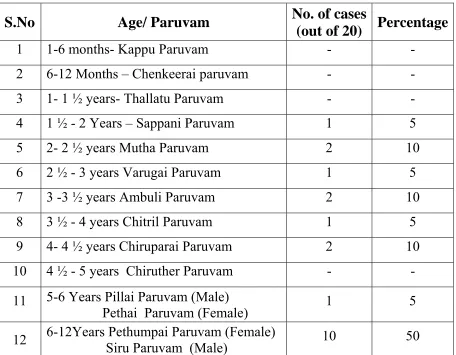
Table 1- AGE DISTRIBUTION
S.No Age/
Paruvam
No. of cases
(out of 20)
Percentage
1 1-6 months- Kappu Paruvam - - 2 6-12 Months – Chenkeerai paruvam - - 3 1- 1 ½ years- Thallatu Paruvam - - 4 1 ½ - 2 Years – Sappani Paruvam 1 5 5 2- 2 ½ years Mutha Paruvam 2 10 6 2 ½ - 3 years Varugai Paruvam 1 5 7 3 -3 ½ years Ambuli Paruvam 2 10 8 3 ½ - 4 years Chitril Paruvam 1 5 9 4- 4 ½ years Chiruparai Paruvam 2 10 10 4 ½ - 5 years Chiruther Paruvam - -
11 5-6 Years Pillai Paruvam (Male)
Pethai Paruvam (Female) 1 5 12 6-12Years Pethumpai Paruvam (Female) Siru Paruvam (Male) 10 50
60
Table 2-
SEX DISTRIBUTION
S.No
Sex
No. of cases (out of 20)
Percentage
1 Male 10 50
2 Female 10 50
[image:69.612.109.508.292.395.2]Among 20 cases of study 10 were males (50%) and 10 were females (50%).
Table 3- INCIDENCE OF RELIGION
S.No
Religion
No. of cases (out of 20%) Percentage.
1 Hindu 16 80
2 Christian 3 15
3 Muslim 1 5
Out of 20 cases 80% were Hindus, 15% were Christians and 5% were Muslim.
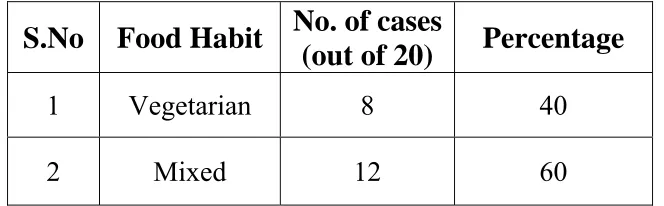
Table 4 - FOOD HABIT
S.No Food
Habit
No. of cases
(out of 20)
Percentage
1 Vegetarian 8 40
2 Mixed 12 60
[image:69.612.141.473.522.625.2]60
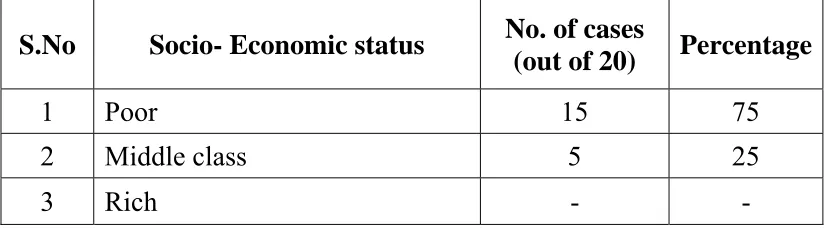
Table 5- SOCIO- ECONOMIC STATUS
S.No Socio- Economic status No. of cases
(out of 20) Percentage
1 Poor 15 75
2 Middle class 5 25
3 Rich - -
Out of 20 cases 75% belongs to Poor socio economic status and 25% belongs to Middle class.
Table 6- DISTRIBUTION OF PARUVAKAALANGAL
S.No Paruvakaalam No. of cases
(out of 20) Percentage 1 KAAR (Aavani, Purattasi) 10 50 2 KOOTHIR (Iyppasi, Karthigai) 5 25 3 MUNPANI ( Maarkazhi, Thai) - - 4 PINPANI ( Maasi, Pankuni) - - 5 ELA VENIL(Chithirai, Vaikasi) - - 6 MUTHUVENIL (Aani, Aadi) 5 25
[image:70.612.96.519.336.522.2]60
Table 7-
DISTRIBUTION OF LANDS
S.No THINAI No.of cases
(out of 20) Percentage
1 KURINJI (HILL) - -
2 MULLAI ( FOREST) - -
3 MARUTHAM ( FERTILE) 18 90 4 NEITHAL ( COASTAL) 2 10
5 PAALAI (DESERT) - -
[image:71.612.100.516.367.631.2]According to this table 90% of cases were from Marutha Nilam and 10% of cases came from Neithal Nilam.
Table 8 - UYIR THATHUKKAL
i. Derangement of VathamS.No Types of Vatham No. of cases (out
of 20) Percentage
1 Pranan 20 100
2 Abanan - -
3 Viyanan 20 100
4 Uthanan 20 100
5 Samanan 15 75
6 Naagan - -
7 Koorman - -
8 Kirukaran 15 75
9 Devathathan - -
10 Dhananjeyan - -
60
ii. Derangement of Pitham
S. No
Types of Pitham
No. of cases
(out of 20)
Percentage
1 Pasakam 15 75
2 Ranjakam 6 30
3 Saathakam 20 100
4 Pirasakam - -
5 Aalosakam - -
Due to derangement of Pitha the following symptoms occur. Avalambakam causes loss of appetite. Ranjakam causes anaemia. Saathakam causes fatigue and malaise.
iii. Derangement of Kabam
S.No Types of Kabam No. of cases
(out of 20) Percentage
1 Avalambakam 20 100
2 Kilethakam 15 75
3 Pothakam - -
4 Tharpakam 20 100
5 Santhikam - -
60
Table 9- UDAL THATHUKKAL
S.No Udal thathukkal No. of cases
(out of 20) Percentage
1 Saaram 20 100
2 Senner 8 40
3 Oon - -
4 Kozhuppu - -
5 Enbu - -
6 Moolai - -
7 Sukkilam / Suronitham - -
In Ezhu udal kattukal, Saram is affected in all cases and Senner affected in 40% of cases.
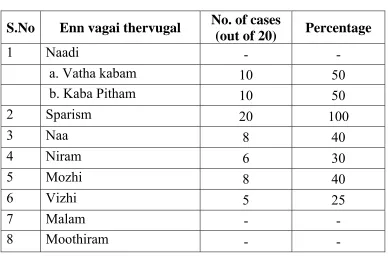
Table 10- ENNVAGAI THERVUGAL
S.No Enn vagai thervugal No. of cases
(out of 20) Percentage
1 Naadi - -
a. Vatha kabam 10 50
b. Kaba Pitham 10 50
2 Sparism 20 100
3 Naa 8 40
4 Niram 6 30
5 Mozhi 8 40
6 Vizhi 5 25
7 Malam - -
8 Moothiram - -
[image:73.612.113.501.383.642.2]60
[image:74.612.81.559.261.381.2]In Ennvagai thervugal, Naadi examination shows the derangement of Thrithodam. Fever and sweating were observed by Sparisam. Excessive salivation, impairment of the sense of taste, coating of tongue indicates fever. Hoarseness of voice, cough indicates respiratory infection. Paleness of sclera indicates anaemia. Vizhi examination shows malaise and dullness of body.
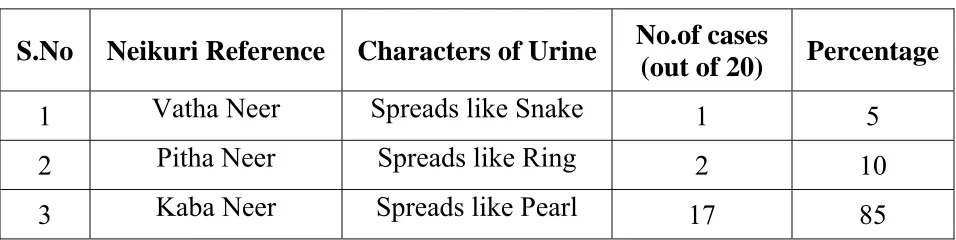
Table 11 - NEIKURI
S.No Neikuri Reference Characters of Urine No.of cases
(out of 20) Percentage
1 Vatha Neer Spreads like Snake 1 5 2 Pitha Neer Spreads like Ring 2 10 3 Kaba Neer Spreads like Pearl 17 85
According to this table 5% of the cases shows Vatha Neer, 10% of the cases shows Pitha Neer and 85% of the cases shows Kaba Neer.
Table 14-
RADIOLOGICAL INVESTIGATION
S.No Nature of Lesion No.of cases
(out of 20) Percentage
1 Normal Study 16 80
2
Hyper Inflation of
bronchial vessels 4 20
[image:74.612.81.429.502.619.2]60
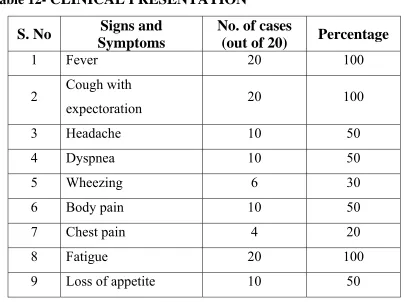
Table 12-
CLINICAL PRESENTATION
S. No
Signs and
Symptoms
No. of cases
(out of 20)
Percentage
1 Fever 20 100
2 Cough with
expectoration 20 100
3 Headache 10 50
4 Dyspnea 10 50
5 Wheezing 6 30
6 Body pain 10 50
7 Chest pain 4 20
8 Fatigue 20 100
9 Loss of appetite 10 50
Table 16- RESULT
Among 20 cases the results were observed as follows
S.No Remarks No.of cases (out of 20) Percentage
1 Good 14 70%
2 Fair 6 30%
3 Poor - -
[image:75.612.88.443.457.566.2]60
DISCUSSION
Kabasuram is one of the common disease affecting the pediatric population. This disease has been clearly described in several siddha text. Kabasuram more or less resembles Acute bronchitis in Modern medicine.
In this study, several cases were diagnosed at the OP according to the clinical features mentioned in siddha texts. 20 patient were selected and they were admitted in the post graduate Kulanthai Maruthuvam InPatient ward, Govt. Siddha Medical College, Palaymankottai. 75 patients were treated in the Out-patient department. Siddha method of diagnosis were carried out and recorded in proforma with the help of Modern investigation.
The diagnosis was confirmed and treated with the drug Kabasura chooranam and Kabasura Kudineer.From the results and observations mentioned in previous part discussion was made out.
1. Incidence with reference to age
Out of 20 cases, 5% of the cases belong to the age group of 1½ - 2years, 2 ½ - 3 years ,3 ½ - 4 years and 5-6 years 10% of cases belong to the age group of 2-2½ years , 3 -3 ½ years and 4-4 ½ years and 50% of cases belong to the age group of 6 - 12 years.
2. Incidence with reference to Sex
60
3. Incidence with reference to religion
Out of 20 cases 80% were Hindus 15% were Chirstians and 5% were Muslims.
4. Indidence with reference to Food Habit
Out of 20 cases, 40% were vegetarian and remaining 60% were mixed diet.
5. Incidence with reference to socio –economic status
Most of the patients (75%) belonged to poor socioeconomic status, 25% of patients belonged to middle class.
6. Incidence with reference to Paruva kaalangal
Out of 20 cases 50% of cases came during Kaar kaalam 25% of cases were in koothir kaalamand 25% of cases were Muthuvenilkaalam.
7. Incidence with reference to Thinaigal
Lands of Tirunelveli and its surroundings areas are Maruthanilam. 90% of cases of clinical study were admitted from these areas. 10% of cases from Neithal Nilam. According to Siddha Literatures, no disease occurs to the people living in Maruthanilam. This may be due to altered life style and environment.
8. Incidence with refernce to Mukkutrangal
60
i) Derangement of Vatham
Due to the derangement of Vatham the following symptoms occur. Pranan causes dyspnea, wheezing. Viyanan causes fatigue. Uthana causes cough. Samanan causes loss of appetite.And Kirunkaran causes cough, nasal discharge and loss of appetite.
ii) Derangemant of Pitha
Due to the derangemant of pitha the following symptoms occur. Anala pitham causes loss of appetite. Ranjakam causes anaemia. And Saathagam causes fatigue and Malaise.
iii) Derangement of Kaba
Due to the derangement of kabam the following symptom occurs. Avalambakam causes dyspnea and cough. Kilethakam causes loss of appetite. And Tharpagam causes feeling hot and fever.
9. Incidence with reference to ezhu udarkattugal Saaram and senneer affected due to anorexia.
10. Envagai thervugal
60
11. Incidence with reference to Neikuri
In neikuri, most of the cases (85%) showed kaba neer. This proves that the disease was due to dearangement of kabam.
12. Incidence with reference to clinical presentation
The selected cases had the following clinical features. These symptoms and signs correlated with acute bronchitis in children. Among the 20 cases 100% of the patients had fever, cough and fatigue, 50% of cases had headache, dyspnea.bodypain and loss of appetite, 30% of cases had wheezing and 20% of cases had chest pain.
13. Investigations
Routin examination of blood was done for all cases. Almost 50% of cases had increased Esonophil, and Erythrocyte, Sedimentation rate.
20% of cases showed bronchitis changes in chest X ray.