0022-538X/96/$04.0010
Copyrightq1996, American Society for Microbiology
Characterization of the ZI Domains in the Epstein-Barr Virus
BZLF1 Gene Promoter: Role in Phorbol Ester Induction
ANA M. BORRAS,1JACK L. STROMINGER,1
ANDSAMUEL H. SPECK2*
Division of Tumor Virology, Dana-Farber Cancer Institute, Harvard Medical School, Boston, Massachusetts 02115,1
and Departments of Pathology and Molecular Microbiology, Washington University School of Medicine, St. Louis, Missouri 631102
Received 31 January 1996/Accepted 15 March 1996
Induction of the Epstein-Barr virus lytic cycle is mediated through the immediate-early BZLF1 gene and the coordinately regulated BRLF1 gene. The BZLF1 gene product, Zta, transactivates its own promoter, as well as the promoters of a number of lytic genes, thereby initiating a cascade of viral gene expression. Previous work identified four related elements (ZIA, ZIB, ZIC, and ZID) and a cyclic AMP response element binding–AP-1 element (ZII) that are involved in the induction of the BZLF1 promoter (Zp) by the phorbol ester 12-O -tetradecanoylphorbol-13-acetate (TPA) (E. Flemington and S. H. Speck, J. Virol. 64:1217–1226, 1990). Here we report a detailed characterization of TPA induction mediated by the ZI domains. Mutation of individual ZI domains within the context of the intact promoter significantly diminished TPA induction. Cloning of indi-vidual ZI domains upstream of a minimal promoter demonstrated that the ZIA, ZIC, and ZID domains, but not the ZIB domain, are TPA responsive. Furthermore, cloning of the ZII domain downstream of the ZI domains significantly augmented TPA induction. The critical regions within the ZIA and ZIC elements involved in binding of cellular factors were identified by using methylation interference and electrophoretic mobility shift analyses of ZI domain mutants. Four specific complexes were observed with the ZIA and ZID domains, all of which could be specifically competed for by either the ZIA or ZID domain. Methylation interference analyses of bound complexes revealed the presence of two overlapping binding sites for cellular factors in the ZIA domain, and functional studies provided evidence that both of these sites are involved in TPA induction. Functional analyses of the ZIC domain revealed that the 5* region of this domain is largely responsible for mediating TPA induction. Binding data correlated well with functional activity and revealed that the ZIC domain binds only a subset of the cellular factors that bind to the ZIA and ZID domains. Analysis of factor binding to the ZIB domain revealed only a single shifted complex, which correlated with the most slowly migrating complex observed with the ZIA and ZID domains. These data provide a direct demonstration of TPA induction mediated by the ZIA, ZIC, and ZID domains and also provide the first evidence that the ZI domains exhibit distinct functional characteristics.
Epstein-Barr virus (EBV) is a human gamma herpesvirus which is capable of immortalizing B lymphocytes in vitro. In cell culture, EBV establishes predominantly a latent infection, with little or no viral replication. A number of reagents are capable of inducing the lytic cycle to various degrees in latently infected lymphocytes, including 12-O-tetradecanoylphorbol-13-acetate (TPA), calcium ionophore, anti-immunoglobulin, and butyrate (2, 21, 24, 30, 32, 35). On the basis of analysis of viral transcripts induced upon triggering of the lytic cycle, two immediate-early lytic genes, BZLF1 and BRLF1, have been identified (13, 30). Of these two, the BZLF1 gene, which en-codes the transcriptional activator Zta (also known as ZEBRA or EB1), is capable of initiating the viral lytic cascade when introduced by itself into latently infected B lymphocytes (5, 7, 26). Zta, a member of the bZIP family of transcription factors (3, 15, 22, 27, 31), triggers the productive cycle by transacti-vating a number of viral and cellular genes (2a, 4, 6, 8, 11, 19, 20). The Zta protein can also activate its own promoter and thereby amplify the amount of Zta available to initiate the lytic cycle (10, 23, 33).
For EBV to maintain viral latency in B lymphocytes, it is
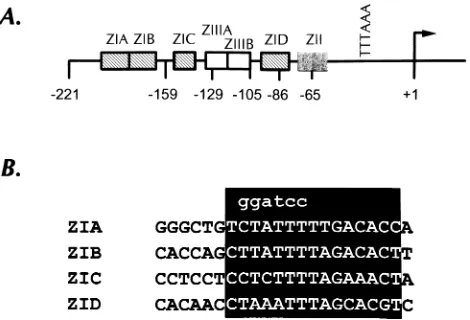
imperative that transcription of the BZLF1 gene be tightly controlled. Our early characterization of the BZLF1 promoter (Zp) identified a ca. 250-bp region (2221 to112) which was responsive to known inducers of the viral lytic cycle (9, 10). Furthermore, this small promoter region exhibited extremely low basal activity in B cells in the absence of lytic cycle induc-ers. Thus, the region from 2221 to112 bp harbors the nec-essaryciselements for induction of Zp and maintenance of low basal promoter activity. Further efforts to identify criticalcis elements led to the identification of four related domains (ZIA, ZIB, ZIC, and ZID) and a cyclic AMP response element binding–AP-1 element (ZII) that bind cellular factors involved in TPA induction of Zp (Fig. 1A) (9). In addition, there are two domains (ZIIIA and ZIIIB) which are binding sites for the BZLF1 gene product, Zta, and are involved in autoactivation of Zp (Fig. 1A) (10). Previously published data (9, 10) are consistent with a model for lytic activation in which initial stimulation with the phorbol ester TPA results in low-level transcription of the BZLF1 gene. Since Zta can transactivate its own promoter, a TPA-induced signal of sufficient magni-tude and duration will generate enough Zta to result in syner-gistic activation of Zp by Zta and TPA. This presumably leads to production of levels of Zta adequate to activate other viral and cellular promoters.
In this study, we further analyzed TPA induction mediated through the ZI domains. These experiments demonstrate that all four ZI elements play a significant role in the TPA induc-* Corresponding author. Mailing address: Departments of
Pathol-ogy and Molecular MicrobiolPathol-ogy, Washington University School of Medicine, 600 S. Euclid Ave., St. Louis, MO 63110. Phone: (314) 362-0367. Fax: (314) 362-4096. Electronic mail address: speck@pathology .wustl.edu.
3894
on November 9, 2019 by guest
http://jvi.asm.org/
tion of Zp. When individual ZI domains were multimerized and cloned upstream of a chloramphenicol acetyltransferase (CAT) reporter construct driven by a minimal promoter, ZIA, ZIC, and ZID were responsive to TPA induction. This induc-tion was greatly enhanced by introducinduc-tion of a single copy of the ZII domain, which on its own exhibits little responsiveness to TPA. Extensive mutational analyses of the ZIA and ZIC elements defined discrete regions which were crucial for this response. DNA binding assays employing crude B-cell nuclear extracts revealed four specific complexes that formed with the ZIA and ZID domains, while with the ZIB and ZIC domains only a subset of these complexes was observed. These experi-ments provide the first functional dissection of the ZI eleexperi-ments and provide evidence that these elements have distinct func-tional properties.
MATERIALS AND METHODS
Cell culture, transfections, and CAT assays.The EBV-negative Burkitt’s lym-phoma B-cell line DG75 was grown at 378C in RPMI 1640 medium (GIBCO Laboratories) supplemented with 10% fetal calf serum, glutamine, and penicil-lin-streptomycin (Mediatech). DG75 cells were transfected with DEAE-dextran as described previously (12), with the following modifications. Cells (107per
transfection) were pelleted at 1,0003g, washed once with sterile phosphate-buffered saline (PBS), and resuspended in 0.25 ml of PBS per transfection. Cells were added to sterile tubes containing 2ml of the appropriate vector in 0.25 ml of DEAE-dextran (1 mg/ml), incubated at room temperature for 20 min, and subjected to dimethyl sulfoxide shock (final concentration of 7%) for 2 min. Each tube was washed with 10 ml of PBS, resuspended in 10 ml of complete medium, and cultured at 378C in a 5% CO2incubator. For TPA induction, duplicate
samples were transfected together in the same tube and, following transfection, split into two cultures resuspended in complete medium with or without TPA. The final TPA concentration was 20 ng/ml.
Cells were harvested 48 h posttransfection by centrifugation at 1,0003g, washed once in PBS, and resuspended in 100ml of 0.25 M Tris-chloride, pH 7.5. The samples were lysed by three consecutive rounds of freeze-thawing, and the cellular debris was removed by centrifugation in a microcentrifuge at maximal speed. Eighty percent of the supernatant was used in CAT assays as previously described (18). The extent of acetylation was determined by counting the acety-lated species of chloramphenicol with a Betascope (Betagen).
Construction of vectors.The construction of the2221ZpCAT plasmid and most of the mutants used in this study has been described previously (9, 10). All plasmids contain the genomic BZLF1 promoter (2221 to112 bp) cloned up-stream of the CAT gene in the pGL2 vector (Promega). New combinations of ZI domain mutations were generated by site-directed mutagenesis as previously
described (16). The 6-bp mutation introduced is shown in Fig. 1. The heterolo-gous ZI constructs were cloned into BGCAT (14), which has the minimalb -glo-bin promoter upstream of the CAT reporter gene in the pGL2 vector. This minimalb-globin promoter contains a 37-bp sequence with the TATA box and downstream sequences through the site of transcription initiation (14). Double-stranded oligonucleotides containing the three ZI (33ZI) elements were then cloned into theAvaI-XbaI restriction sites upstream of theb-globin TATA box. The single ZII (13ZII) element was cloned into theXbaI-BamHI sites. The BS(SVp/e) and BS(SVp/e)Zwt expression plasmids have been previously de-scribed (10). The sequences of the sense strands of the oligonucleotides used for cloning were as follows: 33ZIAwt, 59-CCGGGGGCTGTCTATTTTTGACAC CAGGCTGTCTATTTTTGACACCAGGCTGTCTATTTTTGACACCAT-39; 33ZIBwt, 59-CCGGACCAGCTTATTTTAGACACTTACCAGCTTATTTTA GACACTTACCAGCTTATTTTAGACACTTT-39; 33ZICwt, 59-CCGGGCTC CTCCTCTTTTAGAAACTACTCCTCCTCTTTTAGAAACTACTCCTC CTCTTTTAGAAACTAT-39; 33ZIDwt, 59-CCGGGACGTGCTAAATTTAG GTGTGTACGTGCTAAATTTAGGTGTGTACGTGCTAAATTTAGG TGTGTT-39; 33ZIAwt-m4-wt, 59-CCGGGGGCTGTCTATTTTTGACACCA GGCTGTCTGGGTTTGACACCAGGCTGTCTATTTTTGACACCAT-39; 13ZIIwt, 59-CTAGACGTCCCAAACCATGACATCACAGAGGAG-39. For the 3-bp changes introduced into the ZIA and ZIC mutants, see Fig. 8 and 9. Oligonucleotides with these base changes were synthesized and cloned into the appropriate restriction sites.
Electrophoretic mobility shift assays (EMSAs).DG75 crude nuclear extracts were prepared as described previously (34). A total reaction volume of 20ml containing 5mg of extract, 5ml of buffer D (20 mMN
-2-hydroxyethylpiperazine-N9-2-ethanesulfonic acid [HEPES, pH 7.9], 20% glycerol, 0.1 M KCl, 0.2 mM
EDTA, 0.5 mM phenylmethylsulfonyl fluoride, 0.5 mM dithiothreitol), 4.5mg of bovine serum albumin, 0.5ml of 0.1 M dithiothreitol, and 2mg of salmon sperm DNA was incubated at room temperature for 5 min. When competitor oligonu-cleotides were used, they were added at this point. The relevant32P-labeled
double-stranded oligonucleotide (0.4 ng per reaction, corresponding to 200,000 to 300,000 cpm) was added, and the mixture was incubated at room temperature for 30 min. Samples were loaded onto a running nondenaturing 4% acrylamide– 0.1% bisacrylamide gel. The gel was run in 0.53TBE (13TBE is 90 mM Tris, 64.6 mM boric acid, and 2.5 mM EDTA, pH 8.3). The 13ZI oligonucleotides used were designed to include the entire region protected from DNase I diges-tion (9). The sense strands of these oligonucleotides are as follows: ZIAwt, 59-CCGGGAACTGGGCTGTCTATTTTTGACACCAGT-39; ZIBwt, 59-CCG GGTTGACACCAGCTTATTTTAGACACTTCT-39; ZICwt, 59-CTAGAACT ACCTCCTCCTCTTTTAGAAACTATG-39; ZIDwt, 59-CCGGGTTGGGACG TGCTAAATTTAGGTGTGTCT-39. For the 3-bp mutations introduced into the ZIA and ZIC mutants, see Fig. 8 and 9. Oligonucleotides with these base changes were synthesized and used in the assay.
Methylation interference.Double-stranded DNA probes that were used for the EMSAs were32P labeled at only the 59or 39end as previously described (1,
25), except that 200 ng of the probe was used. Methylation interference was carried out essentially as previously described (1). A quarter of the sample was then partially methylated with dimethyl sulfate for 3 min. For the binding reac-tion, the EMSA protocol was scaled up sixfold and 13106to 23106cpm of the
probe was added. A onefold sample without extract was also run. After electro-phoresis, the samples were transferred to a DEAE membrane with a semidry electrophoretic transfer unit, the membrane was exposed for autoradiography, and the relevant bands were cut out and eluted (29). The DNA was cleaved at the methylated bases by using 1 M piperidine at 908C for 30 min. The samples were loaded onto a 10% polyacrylamide-urea sequencing gel in 13TBE running buffer.
RESULTS
The ZI domains are crucial for TPA induction of Zp and contribute to Zta transactivation of Zp. To evaluate the im-portance of the ZI domains in the induction of Zp by TPA, 6-bp mutations were introduced individually into the con-served region of the ZIA, ZIB, or ZIC domain (Fig. 1B) within the context of the2221ZpCAT reporter construct. These mu-tants were transfected into the EBV-negative Burkitt’s lym-phoma cell line DG-75, and the cells were stimulated with TPA for 48 h. As shown in the Fig. 2 inset, mutation of any one of these ZI elements resulted in a dramatic reduction in TPA inducibility. Notably, mutation of two ZI elements did not appear to result in a further reduction in TPA inducibility (data not shown), although this was difficult to quantitate given the low level of TPA-induced activity observed with these mu-tants. To assess the impact of these mutations on transactiva-tion of Zp by its gene product, the transfectransactiva-tions were repeated in the presence of a Zta expression vector (Fig. 2). Notably, FIG. 1. (A) Organization ofciselements in the BZLF1 promoter (Zp) as
previously identified by DNase I footprinting in conjunction with functional analyses (9, 10). The ZI domains were functionally grouped together on the basis of sequence similarity and binding competition studies (9). The ZII domain contains a consensus cyclic AMP response element–AP-1 binding site, while the ZIIIA and ZIIIB domains are binding sites for the BZLF1 gene product, Zta, which serves to positively autoregulate Zp activity. (B) Sequence alignment of the ZI domains present in Zp. The core homology domain is highlighted in the shaded rectangle, while the mutation introduced into the homology region of the individual ZI domains is shown above the ZI sequences.
VOL. 70, 1996 ZI DOMAINS IN BZLF1 PROMOTER 3895
on November 9, 2019 by guest
http://jvi.asm.org/
[image:2.612.61.296.71.231.2]mutation of the ZIA, ZIB, or ZIC domain diminished Zta transactivation of Zp and also diminished the synergy observed between Zta and TPA. Again, no significant difference was observed between mutants with single ZI domain and muta-tions Zp mutants in which two ZI domains were mutated (data not shown). Unlike the situation with TPA inducibility of the single and double ZI domain mutants which exhibited little activity, here we could easily measure Zta transactivation of the ZI domain mutants. The lack of significant differences in the activities of the single and double mutants suggests that the ZI domains functionally cooperate to synergize with Zta bound to the ZIIIA and ZIIIB domains.
The ZIA, ZIC, and ZID domains, but not the ZIB domain, are TPA responsive when multimerized in a minimal heterol-ogous reporter construct. To directly assess the function of each ZI domain in the absence of otherciselements present in Zp, we cloned individual ZI domains (13ZI and 33ZI) up-stream of a minimalb-globin promoter driving transcription of the CAT reporter gene. Initially, we cloned the ZI sites up-stream of a single copy of the ZII domain in the context of the minimalb-globin promoter, since in the context of Zp the ZII domain is also critical for TPA induction (i.e., both domains might be required for TPA induction). As shown in Fig. 3, a single copy of the ZII domain exhibited no detectable TPA response. This was consistent with the behavior of Zp con-structs containing mutated ZI domains (Fig. 2). However, cloning of a single copy of the ZIC domain upstream of the ZII domain resulted in detectable TPA induction, which was sig-nificantly enhanced when three copies of ZIC were present (Fig. 3).
When three copies of the individual ZI domains were cloned alone upstream of the minimalb-globin promoter-driven CAT reporter gene, all but the ZIB domain exhibited detectable TPA inducibility (Fig. 4). TPA inducibility was greatly en-hanced by the addition of a single copy of the ZII domain between the ZI domains and the minimalb-globin promoter. In this context, even the ZIB domain exhibited weak but de-tectable TPA induction. The 33ZIA-ZII construct exhibited
the highest activity, while 33ZIC-ZII and 33ZID-ZII also exhibited strong TPA induction that was only slightly less than that of the 33ZIA-ZII reporter construct. The weak TPA inducibility of the 33ZIB-ZII reporter construct indicates that the ZI domains are not functionally identical and that the ZIB domain may have functional properties distinct from those of FIG. 2. TPA and Zta transactivation of wild-type and ZI mutant Zp reporter
constructs. The Zp reporter constructs contain promoter sequences from2221 to 112 bp fused to the CAT reporter gene as described in Materials and Methods. The mutation introduced into the ZI domains is shown in Fig. 1B. The reporter constructs were transfected into the EBV-negative Burkitt’s lymphoma B-cell line DG75 in the presence or absence of a Zta expression vector as described in Materials and Methods. Cells were cultured for 48 h in the presence or absence of 20 ng of TPA per ml posttransfection. All activities are given relative to the activity of the wild-type (wt) ZpCAT construct in the presence of Zta and phorbol ester. The data shown represent the results of three indepen-dent transfections.
FIG. 3. TPA inducibility of heterologous promoter reporter constructs con-taining the ZIIciselement from Zp, either alone or in conjunction with the ZIC
[image:3.612.315.554.436.648.2]ciselement, cloned upstream of a minimalb-globin promoter. The structures of the heterologous promoter constructs employed are schematically illustrated to the left of the CAT reporter gene assay. These constructs were transfected into the DG75 cell line as described in Materials and Methods, and cells were cultured for 48 h posttransfection in medium in the absence or presence of TPA (20 ng/ml). The results shown represent a typical assay and demonstrate the heterosynergy observed between the ZIC and ZII domains. For the compiled activity data shown in Fig. 4, 8, and 9, results of assays in which greater than 60% of the chloramphenicol was acetylated (as was the case for the activity of the 33ZIC–13ZII–b-globin–CAT construct shown in this figure) were considered to be out of the linear range of the assay and the analyses of CAT activity were repeated with less cell extract.
FIG. 4. TPA inducibility of heterologous promoter constructs containing three copies of the individual ZI domains, with and without the ZII domain, cloned upstream of a minimalb-globin promoter driving expression of the CAT reporter gene. The structures of the heterologous promoter constructs are de-scribed in Materials and Methods. These constructs were transfected into DG75 cells as described in the legend to Fig. 3 and in Materials and Methods. Activities are shown relative to the activity of the 33ZIA–13ZII–b-globin–CAT construct in the presence of TPA. The results shown represent compiled data from three independent transfections.■, uninduced;o, plus TPA.
on November 9, 2019 by guest
http://jvi.asm.org/
the other ZI domains. It is unlikely that the region we cloned as the ZIB domain lacked some essential sequences required for TPA induction, since the ZIB oligonucleotides incorpo-rated into the reporter constructs include the entire region protected by nuclear extract, as determined by DNase I foot-printing (9). In addition, data to be published elsewhere (23a) have demonstrated that the 33ZIB-ZII reporter is strongly responsive to a combination of phorbol ester and calcium iono-phore, indicating that ZIB functional elements are present in this reporter construct. Finally, as shown in the next section, analysis of cellular factors binding to the ZI domains clearly demonstrated a differences between the ZIB domain and the other ZI domains.
Distinct patterns of cellular factor binding to the ZI do-mains. EMSAs employing double-stranded oligonucleotides containing a single copy of each ZI element and nuclear extract prepared from the DG-75 cell line revealed four specific com-plexes (Fig. 5). This pattern did not change when extracts from TPA-induced DG-75 cells was used (data not shown). The more slowly migrating complex, referred to as complex 1, was absent with the ZIC probe and was the only complex seen with the ZIB probe. Cross-competition analyses employing 50, 100, or 200 ng of an unlabeled double-stranded oligonucleotide containing the individual ZI domains demonstrated that the ZIA, ZIB, and ZID domains could efficiently compete for complex 1. Even though there was no detectable complex 1 binding to the ZIC oligonucleotide, 200 ng of cold ZIC was able to weakly compete for complex 1 binding to the other ZI domains. However, ZIC was able to more efficiently compete for complexes 2 to 4 than were the other ZI elements. ZIB exhibited no significant ability to compete for complexes 2 to 4, except very weakly at the highest competitor concentration. All four complexes were present when the ZIA or ZID probe was used. As a negative control for the competition experiments, 200 ng of an oligonucleotide containing the ZII domain was employed and, as expected, was unable to compete for binding of any of the complexes. These results provide direct evidence that the ZI elements bind similar cellular factors. The failure of the ZIB oligonucleotide to bind complexes 2 to 4 could explain why this element was not TPA inducible in our heterologous promoter construct. The importance of the ZIB domain for TPA induction of the 2221Zp CAT construct indicates that this domain, while it is unable to mediate phorbol ester induc-tion, contributes some other critical function to the promoter which is required for activity.
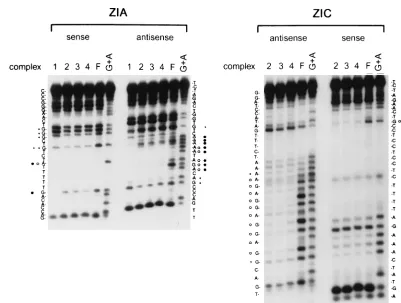
To further address cellular factor binding to the ZI domains, the regions involved in the binding of each of the complexes were analyzed by methylation interference. Given the ability of individual ZI domains to cross-compete for specific complexes bound to the other ZI domains (Fig. 5), we focused on the mapping of binding and functional domains within the ZIA and ZIC elements. Analysis of complex 1, employing the ZIA domain as a probe (Fig. 6), revealed that factor binding was centered over the region of homology between the ZI domains (Fig. 1). However, characterization of the protection pattern exhibited by complexes 2, 3, and 4, employing the ZIA and ZIC domains as probes (Fig. 6), demonstrated that all of these complexes bind to the same region of the ZI elements which is shifted slightly upstream of the region of homology between the ZI domains (summarized in Fig. 7). The latter result could indicate that the same cellular factor is bound in complexes 2, 3, and 4 and that the interaction of other factors which do not contact the DNA gives rise to the different complexes ob-served. Alternatively, DNA binding factors with related DNA binding domains may be involved in binding to the ZI domains. Given the differences in the regions protected, it is likely that
the DNA binding factor(s) present in complex 1 is distinct from those present in complexes 2, 3, and 4.
[image:4.612.336.534.67.517.2]The ZIA domain has two distinct, overlapping binding re-gions, both of which are important for TPA induction.Having established the importance of the ZI elements in TPA activa-tion of Zp, as well as having identified the regions which bind cellular factors, we deemed it important to determine the exact regions within the ZI domains involved in phorbol ester induc-tion. Therefore, extensive mutagenesis of the ZIA and ZIC domains was carried out. Three-base-pair mutations across the FIG. 5. EMSAs of individual ZI domains and competition for binding by individual ZI domains employing crude nuclear extract from the DG75 cell line. The probes employed for each experiment are indicated to the left, and their sequences are given in Materials and Methods. The specific complexes are numbered to the right. Unlabeled oligonucleotide probes were used to demon-strate specific competition, and the specific competitor employed is identified above each set of competition reactions. The amount (nanograms) of unlabeled competitor is indicated above each lane. Nonspecific competition was controlled for by employing a competitor oligonucleotide probe containing the unrelated ZII domain (shown in the last lane on the right).
VOL. 70, 1996 ZI DOMAINS IN BZLF1 PROMOTER 3897
on November 9, 2019 by guest
http://jvi.asm.org/
ZIA domain were constructed, 33ZI multimers of these mu-tants were cloned upstream of a single ZII element, and their activities were assessed in DG75 cells in the presence and absence of TPA (Fig. 8A). Mutants ZIAm1 through ZIAm6 strongly diminished TPA induction. Furthermore, mutation of one of the three ZIA copies, as seen with 33ZIAwt-m4-wt– ZII, resulted in a significant reduction in TPA inducibility. This
result underscores the importance of multiple copies of the ZI elements for proper TPA activation (see the discussion above). EMSA analyses of the ZIA mutants (Fig. 8B) confirmed the results of the methylation interference analysis, which demon-strated the presence of two distinct, overlapping domains for the binding of cellular factors. Mutants ZIAm1 through ZIAm3 did not show demonstrable binding of the three faster-migrat-ing complexes (complexes 2 to 4), while the ZIAm4 mutant exhibited weak binding of these complexes. Both the ZIAm1 and ZIAm2 mutants were unimpaired in the ability to bind the factor(s) constituting complex 1, while ZIm3 through ZIm6 were unable to bind this complex. Binding to ZIAm7 was indistinguishable from binding to unmutated ZIA in this assay. Thus, these data suggest that there are two separate binding regions in ZIA. The 59region is responsible for binding com-plexes 2 to 4, while the 39 region binds the more slowly mi-grating complex 1. The activity profile of the mutants (Fig. 8A) indicates that both regions play a role in the TPA response of the ZIA element. Overall, there was a very good correlation between the binding data and TPA inducibility of the ZIA domain.
[image:5.612.102.503.65.368.2]The 5* region of ZIC is TPA responsive. Three-base-pair mutations were introduced across the ZIC domain, analogous to the mutations introduced into the 33ZIA-ZIICAT reporter construct, and TPA inducibility was assessed in the DG75 cell line (Fig. 9A). Mutants ZICm1 through ZICm5 were almost completely unresponsive to TPA induction, while the ZICm6 FIG. 6. Methylation interference analysis of cellular factor binding to the ZIA and ZIC domains. Specific complexes, as described in the legend to Fig. 5, formed with a partially methylated probe were excised from an EMSA gel and analyzed as described in Materials and Methods. The sequences of the sense and antisense strands are indicated adjacent to the gels. Filled circles indicate bases whose methylation strongly blocked formation of complex 1 for the ZIA probe, while open circles denote bases whose methylation strongly blocked binding of complexes 2, 3, and 4 for both the ZIA and ZIC probes. Asterisks represent bases whose methylation had an intermediate effect on binding. The cleavage pattern observed with an unbound probe (F) is shown to the right of the patterns obtained with the specific complexes. A G1A sequencing ladder is also shown for reference.
FIG. 7. Summary of methylation interference analyses of specific complexes formed with the ZIA and ZIC domains. Bases whose methylation strongly affected binding are indicated by open circles, while bases whose methylation exhibited an intermediate effect on complex formation are indicated by asterisks.
on November 9, 2019 by guest
http://jvi.asm.org/
[image:5.612.58.296.551.693.2]mutant exhibited intermediate activity. The activity of the ZICm7 mutant was only slightly less than that of the unmu-tated ZIC domain.
Overall, the DNA binding data were in agreement with the activity studies. Complexes 2, 3, and 4 were absent when mu-tants ZICm2 through ZICm4 were used as probes, while the ZICm1 and ZICm5 probes exhibited weak binding of these complexes which was readily competed for by low levels of an unlabeled wild-type competitor oligonucleotide (Fig. 9B). Bind-ing to the ZICm7 probe gave the same pattern and intensity as the wild-type probe. Taken together, these data indicate that it is the 59 region of the ZIC domain which binds the cellular factors involved in the TPA inducibility of this element.
DISCUSSION
The BZLF1 gene of EBV encodes an important activator of viral and cellular genes which is critical for induction of the
lytic cycle (2a, 5, 6, 26). In this report, we have characterized the phorbol ester induction of Zp mediated by a combination of the ZI and ZII domains. Mutation of individual ZI domains in Zp demonstrated that each of these domains plays an im-portant role in induction by phorbol ester. Furthermore, func-tional analyses of the individual ZI domains cloned into het-erologous promoter constructs demonstrated that the ZIA, ZIC, and ZID domains are TPA responsive when multimer-ized. However, three copies of ZIB exhibited no detectable TPA induction. Cloning of the ZII domain downstream of three copies of the individual ZI domains greatly augmented TPA inducibility. It should be emphasized that this architec-ture closely mimics the organization of Zp, in which multiple copies of the ZI elements are present upstream of a single copy of the ZII domain. However, these heterologous constructs are a simplified version of the promoter with the elements posi-tioned closer to each other. Furthermore, they may lack addi-tional and uncharacterized suppressor elements. This may ac-count for the fact that three copies of a ZI element plus on copy of ZII give a detectable TPA response, while within
2221Zp, mutation of any one of the ZIs results in a marked reduction of the TPA response, even though three wild-type ZI domains remain. Nevertheless, these results confirm and ex-tend our earlier mapping of the ZI and ZII domains as the principal TPA response elements in Zp.
The DNA binding data showed that there are two distinct
FIG. 8. (A) TPA inducibility of ZIA mutants in the context of 33ZIA– 13ZII–b-globin–CAT reporter constructs. The specific mutations introduced into the ZIA domain are indicated, and each specific mutation was present in all three copies of the ZIA domain in the heterologous promoter. The reporter constructs were transfected into the DG75 cell line as described in Materials and Methods and in the legend to Fig. 3. The activity of the 33ZIA/wt,m4,wt– 13ZII–b-globin–CAT reporter construct, in which the m4 mutation was intro-duced only into the middle ZIA domain, is also shown. The results represent compiled data from three independent transfections.■, uninduced;o, plus TPA. wt, wild type; cntl., control. (B) Analysis of cellular factor binding to ZIA mutants. Binding activities of double-stranded oligonucleotide (oligo) probes containing a single copy of the ZIA domain and the relevant mutations indicated in panel A were assessed by employing crude nuclear extract prepared from the DG75 cell line as described in Materials and Methods. The labeled probe employed is indicated above each set of lanes, and specific competition was carried out with 100 or 200 ng of the unlabeled wild-type (WT) ZIA probe as indicated above the lanes. The autoradiograph shown was slightly overexposed to demonstrate formation of complex 1 with the ZIAm7 mutant.
FIG. 9. (A) TPA inducibility of ZIC mutants in the context of 33ZIC– 13ZII–b-globin–CAT reporter constructs. The specific mutations introduced into the ZIC domain are indicated, and each specific mutation was present in each copy of the ZIC domain in the heterologous promoter. The reporter constructs were transfected into the DG75 cell line as described in Materials and Methods and in the legend to Fig. 3. The results represent compiled data from three independent transfections.■, uninduced;o, plus TPA. wt, wild type; cntl., control. (B) Analysis of cellular factor binding to ZIC mutants. Binding activities of double-stranded oligonucleotide (oligo) probes containing a single copy of the ZIC domain and the relevant mutations indicated in panel A were assessed by employing crude nuclear extract prepared from the DG75 cell line as described in Materials and Methods. The labeled probe employed is indicated above each set of lanes, and specific competition was carried out with 100 or 200 ng of the unlabeled wild-type ZIC probe as indicated above the lanes.
VOL. 70, 1996 ZI DOMAINS IN BZLF1 PROMOTER 3899
on November 9, 2019 by guest
http://jvi.asm.org/
[image:6.612.63.294.71.377.2] [image:6.612.321.544.355.611.2]binding regions within the ZI domains and that in ZIA, and presumably in ZID, these domains overlap. The 59region is responsible for binding of complexes 2, 3, and 4, while the core ZI homology region binds complex 1. Mutation of either one of these regions in the 33ZIA-ZII reporter had a significant effect on TPA-induced activity. It is important to note that the 6-bp mutations introduced into2221Zp were localized in the overlap region, such that these mutations abrogated binding of all four complexes seen in the EMSAs. The cross-competition binding studies showed a difference between competition for complex 1 and competition for complexes 2 to 4. This could be due to differences in the abundance of the factors that bind the different complexes, or it could reflect actual differences in binding affinity. Studies to identify the factors that bind to these two regions are under way, and once they are identified, this question can be addressed.
The low TPA inducibility of heterologous reporter con-structs containing the ZIB domain suggests that the ZI ele-ments are not functionally identical. Analysis of cellular factors binding to the ZI domains provided further evidence that these elements exhibit distinct properties. The ZIB and ZIC do-mains appear to bind only a subset of the cellular factors that bind to the ZIA and ZID domains. Thus, the lack of TPA inducibility of the ZIB domain most likely reflects this differ-ence in cellular factor binding. As will be described elsewhere, we have recently observed that the ZIB domain, in conjunction with the ZII domain, is strongly induced by a combination of phorbol ester, which activates the protein kinase C pathway, and calcium ionophore. The latter result correlates well with previous mapping studies which identified this region as im-portant for induction of Zp by cross-linking of surface immu-noglobulin (7, 28), an induction pathway which is thought to involve both activation of protein kinase C and intracellular calcium mobilization. Furthermore, we have recently shown that induction of Zp by TPA plus calcium ionophore is syner-gistic and that this synergy can be inhibited by the immuno-suppressant cyclosporin A (17). Thus, the ZIB element may be important for mediating the activation signal triggered by cal-cium ionophore. It is interesting to consider, however, that mutation of the ZIB domain in the context of Zp strongly inhibits TPA induction. This observation suggests that while the ZIB domain is not directly involved in the response to induction by phorbol ester, the cellular factor(s) bound to this domain synergizes with the activation signal mediated through the other ZI domains, as well as the ZII domain.
Autoactivation of Zp by Zta was also affected by mutation of the ZI domains, most dramatically by mutation of either the ZIA or ZIB domain in the presence or absence of phorbol ester induction. This further underscores the role of these domains in the activation of transcription from Zp and indi-cates that the architecture of this promoter is very sensitive to mutation of any of the cellular factor binding sites. It should be noted, however, that we have previously shown that mutation of the consensus cyclic AMP response element binding site within the ZII domain, which largely abrogates TPA inducibil-ity of Zp, has little impact on Zta induction of Zp or the synergy between Zta and TPA in inducing Zp (10). The latter result suggests that Zta transactivation through the ZIIIA and ZIIIB domains replaces the requirements supplied through the cyclic AMP response element binding site in responding to phorbol ester induction.
In summary, in this report we have documented the roles of individual ZI domains in mediation of induction by phorbol ester and have also demonstrated the strong heterosynergy exhibited by the factors which bind to the ZI and ZII domains. In addition, an initial characterization of cellular factor binding
to the ZI domains has been presented and has indicated that the individual ZI domains exhibit distinct binding characteris-tics. These differences are likely to account for the observed differences in their functional behavior. Further studies are required to identify the cellular factors which bind to these sites and to identify which of these factors are involved in binding to Zp in the context of the viral genome in EBV-infected cells. Finally, it should be noted that we have previ-ously identifiedciselements homologous to the ZI domains in the EBV BRLF1 promoter and in the c-Jun promoter (9). Binding of a cellular factor(s) to both of these domains could be competed for by a cold oligonucleotide competitor contain-ing the ZIB domain (9). Whether these domains play a role in inducibility of these promoters remains to be determined.
ACKNOWLEDGMENTS
This work was supported by NIH research grant R01 CA52004 to S.H.S. and NIH grant CA47554 to J.L.S.
We thank Erik Flemington, Brian Schaefer, and Miguel Campanero for helpful comments and critical reading of the manuscript.
REFERENCES
1. Ausubel, F. M., R. Brent, R. E. Kingston, D. D. Moore, J. G. Seidman, J. A. Smith, and K. Struhl.1992. Short protocols in molecular biology, 2nd ed. John Wiley & Sons, Inc., New York.
2. Bauer, G., P. Hofler, and H. zur Hausen.1982. Epstein-Barr virus induction by a serum factor. I. Induction and cooperation with additional inducers. J. Virol.121:184–194.
2a.Cayrol, C., and E. K. Flemington.1995. Identification of cellular target genes of the Epstein-Barr virus transactivator Zta: activation of transforming growth factorbigh3 (TGF-bigh3) and TGF-b1. J. Virol.69:4206–4212. 3. Chang, Y.-N., D. L.-Y. Dong, G. S. Hayward, and S. D. Hayward.1990. The
Epstein-Barr virus Zta transactivator: a member of the bZIP family with unique DNA-binding specificity and dimerization domain that lacks the characteristic heptad leucine zipper motif. J. Virol.64:3368–3369. 4. Chevallier-Greco, A., E. Manet, P. Chavrier, C. Mosnier, J. Daillie, and A.
Sergeant.1986. Both Epstein-Barr virus (EBV)-encoded trans-acting fac-tors, EB1 and EB2, are required to activate transcription from an EBV early promoter. EMBO J.5:3243–3249.
5. Countryman, J., H. Jenson, R. Seibel, H. Wolf, and G. Miller.1987. Poly-morphic proteins encoded within BZLF1 of defective and standard Epstein-Barr viruses disrupt latency. J. Virol.61:3672–3679.
6. Countryman, J., and G. Miller.1985. Activation of expression of latent Epstein-Barr herpesvirus after gene transfer with a small cloned subfragment of heterogeneous viral DNA. Proc. Natl. Acad. Sci. USA82:4085–4089. 7. Daibata, M., S. H. Speck, C. Mulder, and T. Sairenji.1994. Regulation of the
BZLF1 promoter of Epstein-Barr virus by second messengers in anti-immu-noglobulin treated B cells. Virology198:446–454.
8. Farrell, P. J., D. T. Rowe, C. M. Rooney, and T. Kouzarides.1989. Epstein-Barr virus BZLF1 trans-activator specifically binds to a consensus AP-1 site and is related to c-fos. EMBO J.8:127–132.
9. Flemington, E., and S. H. Speck.1990. Identification of phorbol ester re-sponse elements in the promoter of the Epstein-Barr virus putative lytic switch gene BZLF1. J. Virol.64:1217–1226.
10. Flemington, E., and S. H. Speck.1990. Autoregulation of Epstein-Barr virus putative lytic switch gene BZLF1. J. Virol.64:1227–1232.
11. Flemington, E., and S. H. Speck.1990. Epstein-Barr virus BZLF1trans
activator induces the promoter of a cellular cognate gene, c-fos. J. Virol. 64:4549–4552.
12. Flemington, E. K., A. M. Borras, J. P. Lytle, and S. H. Speck.1992. Char-acterization of the Epstein-Barr virus BZLF1 protein transactivation do-main. J. Virol.66:922–929.
13. Flemington, E. K., A. E. Goldfeld, and S. H. Speck.1991. Efficient transcrip-tion of the Epstein-Barr virus immediate-early BZLF1 and BRLF1 genes requires protein synthesis. J. Virol.65:7073–7077.
14. Flemington, E. K., J. P. Lytle, C. Cayrol, A. M. Borras, and S. H. Speck. 1994. DNA-binding-defective mutants of the Epstein-Barr virus lytic switch activator Zta transactivate with altered specificities. Mol. Cell. Biol.14:3041– 3052.
15. Flemington, E. K., and S. H. Speck.1990. Evidence for coiled-coil dimer formation by an Epstein-Barr virus transactivator that lacks a heptad repeat of leucine residues. Proc. Natl. Acad. Sci. USA87:9459–9463.
16. Foss, K., and W. H. McClain.1987. Rapid site-specific mutagenesis in plas-mids. Gene59:285–290.
17. Goldfeld, A. E., P. Liu, S. Liu, E. K. Flemington, J. L. Strominger, and S. H. Speck.1995. Cyclosporin A and FK506 block induction of the Epstein-Barr virus lytic cycle by anti-immunoglobulin. Virology209:225–229.
on November 9, 2019 by guest
http://jvi.asm.org/
18.Gorman, C. M., L. F. Moffat, and B. H. Howard.1982. Recombinant ge-nomes which express chloramphenicol acetyltransferase in mammalian cells. Mol. Cell. Biol.2:1044–1051.
19.Grogan, E., H. Jenson, J. Countryman, L. Heston, L. Gradoville, and G. Miller.1987. Transfection of a rearranged viral DNA fragment, WZhet, stably converts latent Epstein-Barr viral infection to productive infection in lymphoid cells. Proc. Natl. Acad. Sci. USA84:1332–1336.
20.Hardwick, J. M., P. M. Lieberman, and S. D. Hayward.1988. A new Epstein-Barr virus transactivator, R, induces expression of cytoplasmic early antigen. J. Virol.62:2274–2284.
21.Kallin, B., J. Luka, and G. Klein.1979. Immunochemical characterization of Epstein-Barr virus-associated early and late antigens inn-butyrate-treated P3HR-1 cells. J. Virol.32:710–716.
22.Kouzarides, T., G. Packham, A. Cook, and P. Farrell.1991. The BZLF1 protein of EBV has a coiled coil dimerisation domain without a heptad leucine repeat but with homology to the C/EBP leucine zipper. Oncogene 6:195–204.
23.Lieberman, P., and A. Berk.1990. In vitro transcriptional activation, dimer-ization, and DNA-binding specificity of the Epstein-Barr virus Zta protein. J. Virol.64:2560–2568.
23a.Liu, S., P. Liu, A. Borras, and S. H. Speck.Unpublished data.
24.Luka, J., B. Kallin, and G. Klein.1979. Induction of the Epstein-Barr virus (EBV) cycle in latently infected cells by n-butyrate. Virology94:228–231. 25.Maniatis, T., E. F. Fritsch, and J. Sambrook.1982. Molecular cloning: a
laboratory manual. Cold Spring Harbor Laboratory, Cold Spring Harbor, N.Y.
26.Miller, G., M. Rabson, and L. Heston.1984. Epstein-Barr virus with heter-ogeneous DNA disrupts latency. J. Virol.50:174–182.
27. Packham, G., A. Economou, C. M. Rooney, D. T. Rowe, and P. J. Farrell. 1990. Structure and function of the Epstein-Barr virus BZLF1 protein. J. Virol.64:2110–2116.
28. Shimizu, N., and K. Takada.1993. Analysis of the BZLF1 promoter of Epstein-Barr virus: identification of an anti-immunoglobulin response se-quence. J. Virol.67:3240–3245.
29. Singh, H., R. Sen, D. Baltimore, and P. A. Sharp.1986. A nuclear factor that binds to a conserved sequence motif in transcriptional control elements of immunoglobulin genes. Nature (London)319:154–158.
30. Takada, K., and Y. Ono.1989. Synchronous and sequential activation of latently infected Epstein-Barr virus genomes. J. Virol.63:445–449. 31. Taylor, N., E. Flemington, J. L. Kolman, R. P. Baumann, S. H. Speck, and
G. Miller.1991. ZEBRA and a Fos-GCN4 chimeric protein differ in their DNA-binding specificities for sites in the Epstein-Barr virus BZLF1 pro-moter. J. Virol.65:4033–4041.
32. Tovey, M., G. Lenoir, and J. Lours-Begon.1978. Activation of latent Epstein-Barr virus by antibody to human IgM. Nature (London)276:270–272. 33. Urier, G., M. Buisson, P. Chambard, and A. Sergeant.1989. The
Epstein-Barr virus early protein EB1 activates transcription from different responsive elements including AP-1 binding sites. EMBO J.8:1447–1453.
34. Zimber-Strobl, U., E. Kremmer, F. Grasser, G. Marschall, G. Laux, and G. W. Bornkamm.1993. The Epstein-Barr virus nuclear antigen 2 interacts with an EBNA2 responsivecis-element of the terminal protein 1 gene pro-moter. EMBO J.12:167–175.
35. zur Hausen, H., F. O’Neil, and U. Freese.1978. Persisting oncogenic her-pesvirus induced by the tumor promoter TPA. Nature (London)272:373– 375.
VOL. 70, 1996 ZI DOMAINS IN BZLF1 PROMOTER 3901