The Ability of Integrin
␣
v

3
To Function as a Receptor for
Foot-and-Mouth Disease Virus Is Not Dependent on the
Presence of Complete Subunit Cytoplasmic Domains
SHERRY NEFFANDBARRY BAXT*
Foot-and-Mouth Disease Research Unit, United States Department of Agriculture, Agricultural Research Service, Plum Island Animal Disease Center, Greenport, New York 11944
Received 26 April 2000/Accepted 29 September 2000
The integrin ␣v3 has been shown to function as one of the integrin receptors on cultured cells for
foot-and-mouth disease virus (FMDV), and high-efficiency utilization of the bovine homolog of this integrin is dependent on the cysteine-rich repeat region of the bovine3subunit. In this study we have examined the role
of the cytoplasmic domains of the␣vand3subunits in FMDV infection. We have found that truncations or
extensions of these domains of either subunit, including deletions removing almost all of the cytoplasmic domains, had little or no effect on the ability of the integrin to function as a receptor for FMDV. The lysosomotropic agent monensin inhibited viral replication in cells transfected with either intact or cytoplasmic domain-truncated␣v3. In addition, viral replication in transfected cells was inhibited by an␣v3
function-blocking antibody but not by function-function-blocking antibodies to three other RGD-directed integrins, suggesting that these integrins are not involved in the infectious process. These results indicate that alterations to the cytoplasmic domains of either subunit, which lead to the inability of the integrin receptor to function normally, do not abolish the ability of the integrin to bind and internalize this viral ligand.
Integrins are heterodimeric cell surface receptors consisting
of␣andsubunits that are involved in binding extracellular
matrix proteins, cell-cell interactions, and signal transduction (20, 23). The two subunits interact noncovalently at the cell surface to bind their natural ligands via a ligand-binding region which is made up of elements of both subunits (16). Integrin subunits are type I membrane proteins consisting of a large N-terminal extracellular domain and smaller transmembrane
and cytoplasmic domains. The cytoplasmic domains of the␣
and  integrin subunits, specifically certain sequence motifs
within those domains, have been shown to be involved in in-side-out and outside-in signal transduction, integrin activation, and conformational changes leading to alterations in ligand-binding affinities and connections to the cytoskeleton (6, 7, 18, 22, 27, 37, 38, 41, 44).
Foot-and-mouth disease virus (FMDV), an aphthovirus in
the familyPicornaviridae, utilizes the integrin␣v3as a
recep-tor in cultured cells (4, 35, 36). We have recently molecularly cloned the bovine homolog of this integrin and shown that the high-efficiency utilization of the bovine integrin as a receptor for FMDV is dependent on sequences found within the
cys-teine-rich repeat region of the bovine3subunit extracellular
domain (35). As part of an ongoing study of the roles that the various functional domains within the integrin subunits play in FMDV infection, we have examined subunits with altered cy-toplasmic domains for their ability to retain viral receptor function.
Generation of bovine␣vand3subunits with altered
cyto-plasmic domains. We generated two truncation mutants and
one extension mutant for each of the subunits, as shown in Fig.
1, utilizing the plasmids pBov␣vZEO and pBov3ZEO, which
encode the bovine ␣v and 3 integrin subunits, respectively
(35). pBov␣vZEO was used as the template for a 20-cycle PCR
with the N-terminal PCR primer 5⬘GGAAGGTGCCTACGA
AGCTGAG3⬘ and the following C-terminal primers: for
␣v⌬30, 5⬘GGAATTCCTTACATCCTGTACATTACAA3⬘;
for ␣v⌬20, 5⬘GGAATTCCTTATTGAGGTGGCCGTACAC
G3⬘; and for␣vX29, 5⬘GGAATTCCTTAGTTTCAGAGTTT
CCTTCGCC3⬘. Plasmids encoding the altered ␣v subunits
were created utilizing BstEII and EcoRI sites shared by
pBov␣vZEO and the PCR products. pBov3ZEO was also
used as the template for a 20-cycle PCR using the N-terminal
PCR primer 5⬘CCACGCGTGGTGTGAGCTCCTG3⬘ and
the following C-terminal primers: for3⌬39, 5⬘CGGGATCC
TTAGTCATGGATGGTGATGAG3⬘; for3⌬31, 5⬘CGGG
ATCCTTAGGCTCTGGCTCTCTCTTC3⬘; and for 3X32,
5⬘CGGGATCCTTAAGTGCCCCGGTACGTGATATTG3⬘.
Plasmids encoding the altered3subunits were created
utiliz-ingMluI andBamHI sites shared by pBov3ZEO and the PCR
products. All of the plasmid constructs were sequenced through the region that was subcloned.
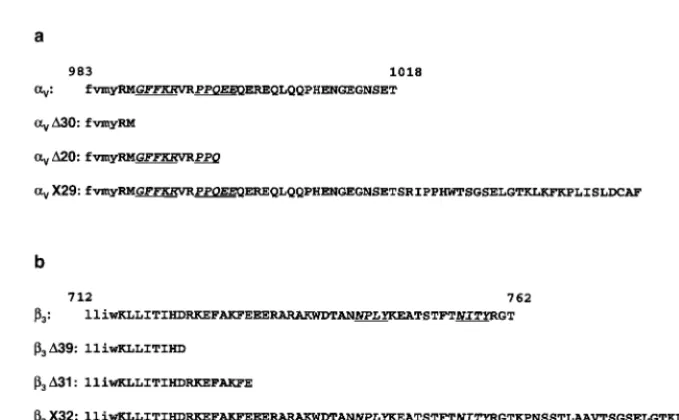
The amino acid sequences of the cytoplasmic domains of the wild-type and altered subunits are shown in Fig. 1. There is some question as to where the exact borders between the transmembrane and cytoplasmic domains occur in the integrin subunits. We have marked the border as lying at the YR
junction for the␣vsubunit (Fig. 1a) and the WK junction for
the3subunit (Fig. 1b). A recent study suggests that the first
five residues of the ␣v subunit (RMGFF) and the first six
residues of the3subunit (KLLITI) cytoplasmic domains, as
we have represented them, are located within the cell mem-brane in the absence of interactions with intracellular proteins and become exposed to the cytoplasm upon binding to
intra-* Corresponding author. Mailing address: USDA, ARS, Plum Island Animal Disease Center, P.O. Box 848, Greenport, NY 11944-0848. Phone: (631) 323-3354. Fax: (631) 323-2507. E-mail: [email protected] .usda.gov.
527
on November 9, 2019 by guest
http://jvi.asm.org/
cellular proteins, resulting in conformational changes leading
to integrin activation and signaling (1). The mutant␣vsubunits
are shown in Fig. 1a. The first,␣v⌬30, retains only two
cyto-plasmic domain amino acids and is truncated before the
GFFKR motif, which is conserved among all␣subunits. This
motif maintains integrins in a low-affinity state (8, 37, 49) and has been reported to be necessary for stabilization of the
integrin ␣complex (48). This mutant is also lacking the
PPQ(L)EE(DD) motif, which defines a-turn in the␣subunit
cytoplasmic domain and is found in seven other␣subunits. A
human␣v3heterodimer with a truncated␣subunit
cytoplas-mic domain lacking this motif cannot bind to either vitronectin
or fibronectin (18). The second mutant, ␣v⌬20, contains the
GFFKR motif and the five amino acids downstream of it but is truncated at the last residue of the PPQEE motif. The final
mutant,␣vX29, contains the complete cytoplasmic domain of
the␣vsubunit with an additional 29 amino acids added to the
C terminus.
The mutant3 subunits are shown in Fig. 1b. The first of
these,3⌬39, retains only 8 amino acids while3⌬31 retains 16
amino acids of the3cytoplasmic domain. Neither of these two
constructs contain the NPL(X)Y or the NI(X)T(X)Y motifs that have been shown to be important for signal transduction, integrin affinity states, and interaction with cytoplasmic inte-grin-associated proteins (7, 9, 10, 13, 15, 17, 25, 28, 31, 32, 44, 46, 54). Both of these truncations, however, still retain the membrane-proximal region of the subunit cytoplasmic domain, which has also been reported to control ligand-binding affinity
and to regulate signal transduction (21, 22). The third3
sub-unit mutant,3X32, retains both the NPLY and NITY motifs
along with an additional 32 amino acids added to the C ter-minus of the cytoplasmic domain. Additions to the cytoplasmic
domains of both the␣andsubunits were made because the
specific conformations of these domains appear to play a role in the way they control ligand affinity and signal transduction (21).
Analysis of integrins with altered cytoplasmic domains.
Coupled in vitro transcription-translations were performed to check that the mutant-encoding plasmids that were generated were encoding proteins of the expected sizes. In all cases, the relative sizes of the resulting altered integrin subunits com-pared to the corresponding wild-type subunits were as ex-pected (not shown).
To analyze whether integrin subunits with truncated or ex-tended cytoplasmic domains could still function as receptors for FMDV, we utilized a previously described transient-expres-sion assay system in COS-1 cells (35). Cells were plated at a
density of 105 cells/well on six-well plates the day prior to
transfection. Transfections were performed with 2.0g of each
integrin-encoding plasmid utilizing the transfection reagent FuGENE 6 (Roche Molecular Biochemicals) according to the manufacturer’s instructions. Twenty-four hours after transfec-tion, the cells in each well were trypsinized and replated onto two wells of a 24-well plate. After a further 18 h of incubation, one well for each transfected condition was infected with
FMDV type A12, strain 119ab, at a multiplicity of infection
(MOI) of 10 PFU/cell and labeled between 4 and 18 h after
infection with [35S]methionine. The other well was fixed with
acetone-methanol (50:50) and analyzed by
immunohistochem-istry for integrin expression using the anti-␣v3 monoclonal
antibody (MAb) LM609 (MAB1976; Chemicon International) as previously described (35). Only transfections in which equal amounts of immunostaining were detected in all experimental conditions were used to analyze the results of viral infection (35). To evaluate FMDV replication in the infected-radiola-beled cultures, cell lysates were prepared in 1% Triton X-100. Equal amounts of trichloroacetic acid-precipitable counts per minute were immunoprecipitated (IP), using a virus-specific MAb, and proteins were analyzed by sodium dodecyl sulfate-polyacrylamide gel electrophoresis (SDS-PAGE) using a 10% polyacrylamide gel as described (35).
The results in Fig. 2 are representative of one such
trans-FIG. 1. Predicted amino acid sequences of wild-type and altered integrin subunit cytoplasmic domains. The sequences of the cytoplasmic domains are in uppercase letters. The last four residues of the transmembrane domains are in lowercase letters. Functionally important sequence motifs, as noted in the text, are italicized and underlined.
on November 9, 2019 by guest
http://jvi.asm.org/
[image:2.612.137.477.62.272.2]fection. Viral replication is evident in cells transfected with
both wild-type bovine␣v- and3-expressing plasmids, as
evi-denced by the synthesis of viral proteins which are not present in nontransfected-infected cells. When cells are transfected
with a wild-type␣vsubunit and any of the altered3subunits,
viral replication appears to be unaffected. Similarly, when any
of the three altered␣vsubunits are transfected with the
wild-type3subunit, levels of infection reach those seen when both
wild-type subunits are present. Viral replication was also un-affected when the two subunits with the shortest cytoplasmic
domains (␣v⌬30 and3⌬39) were expressed together.
Viral replication mediated by integrins with truncated cyto-plasmic domains in the presence of monensin.We have pre-viously shown that the lysosomotropic ionophore monensin inhibited the replication of representative strains of all seven serotypes of FMDV (2). Monensin interferes with proton and pH gradients and raises the pH of endocytic vesicles (33, 40). In the presence of monensin, the virus adsorbed to cells nor-mally; however, it was unable to undergo the initial alteration of the 140S virion to 12S pentameric subunits, which probably occurs within acidified endocytic vesicles and results in the release of the genome RNA (2, 3). To examine whether virus utilizing expressed integrins with truncated cytoplasmic do-mains as receptors infected cells through an eclipse mechanism similar to that of virus utilizing intact receptors, we transfected cells with intact and cytoplasmic domain-truncated integrin subunits, followed by infection in the presence or absence of monensin.
Cells were cotransfected with either␣vand 3subunits or
␣v⌬30 and3⌬39 subunits. Forty-eight hours after
transfec-tion, cultures were incubated in the presence or absence of 50 M monensin for 30 min prior to infection with FMDV type
A12. Viral replication was determined by pulse-labeling cells
with [35S]methionine between 5 and 6 h postinfection and
analyzing cell extracts by IP and SDS-PAGE. The results are shown in Fig. 3. Cells cotransfected with intact integrin sub-units and infected in the presence of monensin failed to syn-thesize viral proteins, indicating that the drug interfered with viral replication. Interestingly, cells cotransfected with cyto-plasmic domain-truncated integrin subunits and infected in the presence of monensin also failed to synthesize viral proteins. In contrast, cells cotransfected with either intact or truncated integrins synthesized normal amounts of viral proteins when monensin was added at 2 h after infection, indicating that monensin inhibited an early event in viral replication, probably at the eclipse phase, as we have shown previously (2). There-fore, complete integrin subunit cytoplasmic domains are not necessary for internalization of virions into endocytic vesicles.
Thus, bovine ␣v3 is able to function as a receptor for
FMDV in the absence of motifs that are known to be required for the normal function of integrins in the context of their natural ligands. The truncations of the cytoplasmic domains of
either the␣vor3subunits and the addition of random amino
acids to the subunits’ cytoplasmic domains did not affect the ability of integrins to serve as receptors for FMDV, and the results show that when utilized as receptors, integrins altered in this manner were utilized as well as intact integrins.
Effect of integrin function-blocking antibodies on viral in-fection in transfected cells.The internalization of natural in-tegrin ligands has not been extensively studied. The NPXY
[image:3.612.94.253.70.239.2]motif, found in the cytoplasmic domains of allsubunits and
FIG. 2. Analysis of viral protein synthesis in COS-1 cells trans-fected with integrin subunit cDNAs. Cells were transtrans-fected with plas-mids encoding integrin subunits as shown. Transfected cells were in-fected with FMDV type A12at an MOI of 10 PFU/cell and labeled
between 4 and 18 h with [35S]methionine. Cell extracts were analyzed
by IP and SDS–10% PAGE as described in the text. The locations of viral structural proteins IP from infected and labeled BHK-21 cells (lane M) are shown on the left. con, nontransfected-infected cells (control).
FIG. 3. Analysis of transfected COS-1 cells infected in the presence of monensin. Cells were cotransfected with integrin subunits contain-ing intact cytoplasmic domains or␣v⌬30 and3⌬39 as shown. Thirty
minutes prior to infection, the medium was removed from some wells and replaced with medium containing 50M monensin (lanes mon
⫺30min). Cells were infected in either the presence or absence (con) of monensin as noted. At 2 h after infection, the medium was removed from other wells and replaced with medium containing 50M monen-sin (lanes mon⫹2hr). At 4.5 h after infection, all cultures were incu-bated in minimal essential medium without L-methionine, with or
without monensin, for 30 min. [35S]methionine (75Ci) was added,
and cells were labeled for 1 h. Cell extracts were prepared, and analysis of viral proteins by IP and SDS–10% PAGE was done as described in the text. The locations of marker FMDV structural proteins (lane M) are shown on the left.
on November 9, 2019 by guest
http://jvi.asm.org/
[image:3.612.354.510.393.590.2]other transmembrane receptors, has been reported to be
re-quired for internalization of bacteria mediated by1integrins
(47), internalization mediated by the nonintegrin low-density lipoprotein receptor (12), and a signal for clathrin complex assembly (11). More recent results have shown that sequences surrounding the NPXY motif are important in association of
the␣v5receptor with clathrin-coated pits via the5
cytoplas-mic domain (13). The internalization of vitronectin by␣v3,
however, appears to require a signal as a result of the ligation
of the␣51integrin (39). This cross talk between the␣v3and
␣51 integrins requires the 3 cytoplasmic domain (5). Our
results would rule out a cross talk mechanism of viral internal-ization, since important cytoplasmic domain motifs have been deleted from some of the subunit constructs. The results, how-ever, might indicate that other cell surface molecules are acting
as coreceptors for viral infection or that the expression of␣v3
in COS cells is activating another receptor and the integrin itself is not involved in viral binding or internalization. Al-though, at this time, we have no evidence that a coreceptor, either integrin or nonintegrin, is required for infection, we examined the possibility that other RGD-directed integrins
might be involved in the infectious process in␣v3-transfected
COS cells.
Cells were transfected with␣v3cDNAs, as described, and
30 min prior to infection with FMDV type A12, they were
incubated with function-blocking antibodies to ␣v3, ␣v5,
␣v6,␣5, or1. All of these integrins interact with their natural
ligands through an RGD sequence (42), and the␣v6integrin
has recently been shown to be a receptor for FMDV (24), a result we have confirmed in our laboratory (not shown). In this experiment, we measured productive viral replication by de-termining the plaque titer of infectious virus immediately fol-lowing a 45-min adsorption period and after 24 h of incubation. As a control, to determine the level of FMDV replication in COS cell cultures, a nontransfected culture was infected with
an FMDV type O1Campos variant containing a
heparin-bind-ing site in VP3 (43), which we have previously shown to require only the presence of cell surface heparan sulfate (HS), and not
␣v3, to infect cells (36). The results of this experiment are
shown in Fig. 4.
In nontransfected COS cells, there was no increase in titer of
type A12at 24 h, indicating that viral replication did not take
place in these cells, as we have previously shown in experi-ments utilizing detection of radioactively labeled viral proteins
(35) (Fig. 2). In contrast, the heparin-binding type O1variant
showed an increase in titer of about 10-fold after 24 h in nontransfected cells, also confirming previously reported
re-sults (36). In␣v3-transfected COS cells, the type A12virus
titer increased about 10-fold, again confirming results obtained by detection of viral proteins in infected cells (35) (Fig. 2). When transfected cells were treated with integrin
function-blocking antibodies, only the antibody to␣v3and not those
against any of the other integrins was capable of inhibiting viral replication (Fig. 4). The same experiment performed in cells
transfected with the ␣v⌬30 and3⌬39 cDNAs yielded nearly
identical results (not shown). These results indicate that, in this
transfection system, the␣v3integrin is absolutely required for
productive viral infection and at least three other
RGD-di-rected integrins (␣v5, ␣v6, and ␣51) do not appear to be
involved in this process. In addition, since the anti-1antibody
has been shown to inhibit the function of at least two other1
integrins (␣21and␣41) (19), other integrins of this subclass
are also probably not involved in viral infection. At this time, however, we cannot rule out a role for other cell surface mol-ecules as coreceptors for either FMDV adsorption or internal-ization. We can, however, rule out HS as a coreceptor for type
A12, as we have previously shown that this virus can replicate in
␣v3cDNA-transfected HS-deficient CHO cells (36).
These results are similar to those reported for three other picornaviruses (poliovirus, rhinovirus 14, and coxsackievirus B3), all of whose single-subunit receptors appear to function normally in the absence of cytoplasmic domains (26, 45, 52). Human adenovirus (Ad) requires interaction with the integrin
␣v5or␣v3for internalization into cells through a
clathrin-coated pit pathway requiring dynamin (51, 53). We have not yet examined the role of dynamin in FMDV internalization, but in studies with two other picornaviruses, human rhinovirus 14 required dynamin for productive infection while poliovirus did not (14). Recently it has been shown that Ad internaliza-tion requires signaling through the focal adhesion kinase path-way involving phosphoinositide-3-OH kinase and GTP-binding proteins, all of which are activated following binding of
inte-FIG. 4. Effect of anti-integrin function-blocking MAbs on viral rep-lication in transfected COS-1 cells. Cells were cotransfected with␣v3
-encoding plasmids as described in the text. Thirty minutes prior to infection, paired transfected cell cultures were incubated at room temperature with the following function-blocking anti-integrin MAbs at a concentration of 25g/ml (all antibodies were from Chemicon International Inc): anti-␣v3 (clone LM609; MAB1976), anti-␣v5
(clone P1F6; MAB1961), anti-␣v6(clone 10D5; MAB2077Z), anti-␣5
(clone CLB-705; MAB1986), and anti-1 (clone 6S6; MAB2253).
Transfected and nontransfected cultures were infected in pairs with type A12at an MOI of 1 PFU/cell in the presence of the antibodies.
One nontransfected culture pair was infected with the HS-binding O1
Campos variant vCRM4 (43) at an MOI of 1 PFU/cell. After an adsorption period of 45 min at 37°C, all cultures were washed with a low-pH buffer (25 mM MES [morpholineethanesulfonic acid, pH 5.5], 140 mM NaCl) to inactivate any nonadsorbed or noninternalized virus. After the addition of medium, one of the infected pairs was immedi-ately frozen at⫺70°C to determine viral infectivity remaining at the end of the adsorption period (shaded bars). The other pair was incu-bated for 24 h at 37°C (solid bars) and then placed at⫺70°C. After thawing, cell debris was removed by centrifugation, and plaque titer was determined on BHK-21 cells.
on November 9, 2019 by guest
http://jvi.asm.org/
grins to their natural ligands (29, 30). In addition, the
cytoplas-mic domain of the5subunit of the␣v5integrin is essential
for Ad-mediated gene delivery via host cell membrane
pene-tration from endosomes (50). However, truncations of the5
cytoplasmic domain, which still retains the NPXY motif, and
do not allow Ad-mediated gene delivery do not abolish␣v5
-mediated Ad internalization (50). At least two picornavirus receptors, the coxsackievirus and adenovirus receptors, and ICAM-1 also do not require their transmembrane domains for
receptor function (45, 52). Soluble human ␣v3 lacking both
the transmembrane and cytoplasmic domains of both subunits can still bind to its natural ligands with high affinity (34); however, we have not examined either soluble or
glycosylphos-phatidylinositol-anchored␣v3for virus binding or the ability
to act as a functional receptor.
The results we have presented, however, indicate that dele-tions of any of the important cytoplasmic domain motifs had little or no effect on receptor utilization by FMDV. In fact, the results showing that monensin still inhibited infection
medi-ated by cytoplasmic domain-truncmedi-ated␣v3suggest that these
receptors are internalizing FMDV through the same mecha-nism as complete integrins. In addition, we have also shown that three other RGD-directed integrins do not appear to play any role in productive viral infection. Further studies will be necessary to delineate the exact mechanism by which intact and altered integrin subunits internalize virus.
We thank Michael LaRocco for excellent technical assistance.
REFERENCES
1.Armulik, A., I. Nilsson, G. von Heijne, and S. Johansson.1999. Determina-tion of the border between the transmembrane and cytoplasmic domains of human integrin subunits. J. Biol. Chem.274:37030–37034.
2.Baxt, B.1987. Effect of lysosomotropic compounds on early events in foot-and-mouth disease virus replication. Virus Res.7:257–271.
3.Baxt, B., and H. L. Bachrach.1980. Early interactions of foot-and-mouth disease virus with cultured cells. Virology104:42–55.
4.Berinstein, A., M. Roivainen, T. Hovi, P. W. Mason, and B. Baxt.1995. Antibodies to the vitronectin receptor (integrin␣v3) inhibit binding and
infection of foot-and-mouth disease virus to cultured cells. J. Virol.69:2664– 2666.
5.Blystone, S. D., F. P. Lindberg, S. E. LaFlamme, and E. J. Brown.1995. Integrin3cytoplasmic tail is necessary and sufficient for regulation of␣51
phagocytosis by␣v3and integrin-associated protein. J. Cell Biol.130:745–
754.
6.Blystone, S. D., F. P. Lindberg, M. P. Williams, K. McHugh, and E. J. Brown.
1996. Inducible tyrosine phosphorylation of the3integrin requires the␣v
integrin cytoplasmic tail. J. Biol. Chem.271:31458–31462.
7.Blystone, S. D., M. P. Williams, S. E. Slater, and E. J. Brown.1997. Re-quirement of integrin3tyrosine 747 for3tyrosine phosphorylation and
regulation of␣v3avidity. J. Biol. Chem.272:28757–28761.
8.Briesewitz, R., A. Kern, L. B. Smilenov, F. S. David, and E. E. Marcantonio.
1996. The membrane-cytoplasm interface of integrin␣subunits is critical for receptor latency. Mol. Biol. Cell7:1499–1509.
9.Calderwood, D. A., R. Zent, R. Grant, D. Jasper, G. Rees, R. O. Hynes, and M. H. Ginsberg.1999. The talin head domain binds to integrinsubunit cytoplasmic tails and regulates integrin activation. J. Biol. Chem.274:28071– 28074.
10. Chang, D. D., C. Wong, H. Smith, and J. Liu.1997. ICAP-1, a novel1
integrin cytoplasmic domain-associated protein, binds to a conserved and functionally important NPXY sequence motif of1integrin. J. Cell Biol.
138:1149–1157.
11.Chen, W. J., J. L. Goldstein, and M. S. Brown.1990. NPXY, a sequence often found in cytoplasmic tails, is required for coated pit-mediated inter-nalization of the low density lipoprotein receptor. J. Biol. Chem.265:3116– 3123.
12. Davis, C. G., J. L. Goldstein, T. C. Sudhof, R. G. W. Amderson, D. W. Russell, and M. S. Brown.1987. Acid-dependent ligand dissociation and recycling of LDL receptor mediated by growth factor homology region. Nature320:760–765.
13. De Deyne, P. G., A. O’Neill, W. G. Resneck, G. M. Dmytrenko, D. W. Pumplin, and R. J. Bloch.1998. The vitronectin receptor associates with
clathrin-coated membrane domains via the cytoplasmic domain of its5
subunit. J. Cell Sci.111:2729–2740.
14.De Tulleo, L., and T. Kirchhausen.1998. The clathrin endocytic pathway in viral infection. EMBO J.17:4585–4593.
15. Eigenthaler, M., L. Ho¨fferer, S. J. Shattil, and M. H. Ginsberg.1997. A conserved sequence motif in the integrin3cytoplasmic domain is required
for its specific interaction with3-endonexin. J. Biol. Chem.272:7693–7698.
16.Ferna´ndez, C., K. Clark, L. Burrows, N. R. Schofield, and M. J. Humphries.
1998. Regulation of the extracellular ligand binding activity of integrins. Front. Biosci.3:684–700.
17.Filardo, E. J., P. C. Brooks, S. L. Deming, C. Damsky, and D. A. Cheresh.
1995. Requirement of the NPXY motif in the integrin3subunit cytoplasmic
tail for melanoma cell migrationin vitroandin vivo. J. Cell Biol.130:441–450. 18. Filardo, E. J., and D. A. Cheresh.1994. Aturn in the cytoplasmic tail of the integrin␣vsubunit influences conformation and ligand binding of␣v3.
J. Biol. Chem.269:4641–4647.
19.Gao, J. X., J. Wilkins, and A. C. Issekutz.1995. Migration of human poly-morphonuclear leukocytes through a synovial fibroblast barrier is mediated by both2(CD11/CD18) integrins and the1(CD29) integrins VLA-5 and
VLA-6. Cell. Immunol.163:178–186.
20. Gonza´lez-Amaro, R., and F. Sa´nchez-Madrid.1999. Cell adhesion mole-cules: selectins and integrins. Crit. Rev. Immunol.19:389–429.
21. Haas, T. A., and E. F. Plow.1997. Development of a structural model for the cytoplasmic domain of an integrin. Protein Eng.10:1395–1405.
22. Hughes, P. E., T. E. O’Toole, J. Yla¨nne, S. J. Shattil, and M. H. Ginsberg.
1995. The conserved membrane-proximal region of an integrin cytoplasmic domain specifies ligand binding affinity. J. Biol. Chem.270:12411–12417. 23. Hynes, R. O.1992. Integrins: versatility, modulation, and signaling in cell
adhesion. Cell69:11–25.
24. Jackson, T., D. Sheppard, M. Denyer, W. Blakemore, and A. M. Q. King.
2000. The epithelial integrin␣v6is a receptor for foot-and-mouth disease
virus. J. Virol.74:4949–4956.
25.Jenkins, A. L., L. Nannizzi-Alaimo, D. Silver, J. R. Sellers, M. H. Ginsberg, D. A. Law, and D. R. Phillips.1998. Tyrosine phosphorylation of the3
cytoplasmic domain mediates integrin-cytoskeletal interactions. J. Biol. Chem.273:13878–13885.
26. Koike, S., I. Ise, and A. Nomoto.1991. Functional domains of the poliovirus receptor. Proc. Natl. Acad. Sci. USA88:4104–4108.
27. Law, D. A., F. R. DeGuzman, P. Heiser, K. Ministri-Madrid, N. Kileen, and D. R. Phillips.1999. Integrin cytoplasmic tyrosine motif is required for outside-in␣IIb3signaling and platelet function. Nature401:808–811.
28. Lerea, K. M., K. P. Cordero, K. S. Sakariassen, R. I. Kirk, and V. A. Fried.
1999. Phosphorylation sites in the integrin3cytoplasmic domain in intact
platelets. J. Biol. Chem.274:1914–1919.
29. Li, E., D. Stupack, G. M. Bokoch, and G. R. Nemerow.1998. Adenovirus endocytosis requires actin cytoskeleton reorganization mediated by rho fam-ily GTPases. J. Virol.72:8806–8812.
30. Li, E., D. Stupack, R. Klemke, D. A. Cheresh, and G. R. Nemerow.1998. Adenovirus endocytosis via␣v integrins requires phosphoinositide-3-OH
kinase. J. Virol.72:2055–2061.
31.Liu, H.-Y., S. A. Timmons, Y.-Z. Lin, and J. Hawieger.1996. Identification of a functionally important sequence in the cytoplasmic tail of integrin3by
using cell-permeable peptide analogs. Proc. Natl. Acad. Sci. USA93:11819– 11824.
32. Mastrangelo, A. M., S. H. Homan, M. J. Humphries, and S. E. LaFlamme.
1999. Amino acid motifs required for isolated cytoplasmic domains to regulate “in trans”1integrin conformation and function in cell attachment.
J. Cell Sci.112:217–229.
33. Maxfield, F. R.1982. Weak bases and ionophores rapidly and reversibly raise the pH of endocytic vesicles in cultured mouse fibroblasts. J. Cell Biol.
95:676–681.
34. Mehta, R. J., B. Diefenbach, A. Brown, E. Cullen, A. Jonczyk, D. Gussow, G. A. Luckenbach, and S. L. Goodman.1998. Transmembrane-truncated ␣v3integrin retains high affinity for ligand binding: evidence for an
“inside-out” suppressor? Biochem. J.330:861–869.
35. Neff, S., P. W. Mason, and B. Baxt.2000. High-efficiency utilization of the bovine integrin␣v3as a receptor for foot-and-mouth disease virus is
de-pendent on the bovine3subunit. J. Virol.74:7298–7306.
36. Neff, S., D. Sa´-Carvalho, E. Rieder, P. W. Mason, S. D. Blystone, E. J. Brown, and B. Baxt.1998. Foot-and-mouth disease virus virulent for cattle utilizes the integrin␣v3as its receptor. J. Virol.72:3587–3594.
37. O’Toole, T. E., Y. Katagiri, R. J. Faull, K. Peter, R. Tamura, V. Quaranta, J. C. Loftus, S. J. Shattil, and M. H. Ginsberg.1994. Integrin cytoplasmic domains mediate inside-out signal transduction. J. Cell Biol.124:1047–1059. 38. Pfaff, M., S. Liu, D. J. Erie, and M. H. Ginsberg.1998. Integrincytoplasmic domains differentially bind to cytoskeletal proteins. J. Biol. Chem.273:6104– 6109.
39. Pijuan-Thompson, V., and C. L. Gladson.1997. Ligation of integrin␣51is
required for internalization of vitronectin by integrin␣v3. J. Biol. Chem.
272:2736–2743.
40.Pressman, B. C.1976. Biological applications of ionophores. Annu. Rev. Biochem.45:501–530.
on November 9, 2019 by guest
http://jvi.asm.org/
41.Puzon-McLaughlin, W., T. A. Yednock, and Y. Takada.1996. Regulation of conformation and ligand binding function of integrin␣51by the1
cyto-plasmic domain. J. Biol. Chem.271:16580–16585.
42.Ruoslahti, E.1996. RGD and other recognition sequences for integrins. Annu. Rev. Cell Dev. Biol.12:697–715.
43. Sa´-Carvalho, D., E. Rieder, B. Baxt, R. Rodarte, A. Tanuri, and P. W. Mason.1997. Tissue culture adaptation of foot-and-mouth disease virus selects viruses that bind to heparin and are attenuated in cattle. J. Virol.
71:5115–5123.
44. Schaffner-Reckinger, E., V. Gouon, C. Melchior, S. Planc¸on, and N. Kieffer.
1998. Distinct involvement of3integrin cytoplasmic domain tyrosine
resi-dues 747 and 759 in integrin-mediated cytoskeletal assembly and phospho-tyrosine signaling. J. Biol. Chem.273:12623–12632.
45. Staunton, D. E., A. Gaur, P. Y. Chan, and T. A. Springer.1992. Internaliza-tion of a major group human rhinovirus does not require cytoplasmic or transmembrane domains of ICAM-1. J. Immunol.148:3271–3274. 46. Tahiliani, P. D., L. Singh, K. L. Auer, and S. E. LaFlamme.1997. The role
of conserved amino acid motifs within the integrin3cytoplasmic domain in
triggering focal adhesion kinase phosphorylation. J. Biol. Chem.272:7892– 7898.
47. Tran Van Nhieu, G., E. S. Krukonis, A. A. Reszka, A. F. Horwitz, and R. R. Isberg.1996. Mutations in the cytoplasmic domain of the integrinchain
indicate a role for endocytosis factors in bacterial internalization. J. Biol. Chem.271:7665–7672.
48. Vallar, L., C. Melchior, S. Planc¸on, H. Drobecq, G. Lippens, V. Regnault, and N. Kieffer.1999. Divalent cations differentially regulate integrin␣IIb
cytoplasmic tail binding to3and to calcium- and integrin-binding protein.
J. Biol. Chem.274:17257–17266.
49. Vinogradova, O., T. Haas, E. F. Plow, and J. Qin.2000. A structural basis for integrin activation by the cytoplasmic tail of the␣IIb-subunit. Proc. Natl.
Acad. Sci. USA97:1450–1455.
50. Wang, K., T. Guan, D. A. Cheresh, and G. R. Nemerow.2000. Regulation of adenovirus membrane penetration by the cytoplasmic tail of integrin5.
J. Virol.74:2731–2739.
51. Wang, K., S. Huang, A. Kapoor-Munshi, and G. Nemerow.1998. Adenovirus internalization and infection require dynamin. J. Virol.72:3455–3458. 52. Wang, X., and J. M. Bergelson.1999. Coxsackievirus and adenovirus
recep-tor cytoplasmic and transmembrane domains are not essential for coxsack-ievirus and adenovirus infection. J. Virol.73:2559–2562.
53. Wickham, T. J., P. Mathias, D. A. Cheresh, and G. R. Nemerow.1993. Integrins␣v3and␣v5promote adenovirus internalization but not virus
attachment. Cell73:309–319.
54.Yla¨nne, J.1998. Conserved functions of the cytoplasmic domains of integrin beta subunits. Front. Biosci.3:877–886.