Rochester Institute of Technology
RIT Scholar Works
Theses
Thesis/Dissertation Collections
1975
The effects of density and bleach concentration on
efficiency and resolution in phase holograms
Mark Gardiner
Dennis Moran
Follow this and additional works at:
http://scholarworks.rit.edu/theses
This Thesis is brought to you for free and open access by the Thesis/Dissertation Collections at RIT Scholar Works. It has been accepted for inclusion in Theses by an authorized administrator of RIT Scholar Works. For more information, please [email protected].
Recommended Citation
THE EFFECTS OF DENSITY AND BLEACH
CONCENTRATION ON EFFICIENCY AND RESOLUTION
IN PHASE HOLOGRAMS
by
Mark E. Gardiner
and
Dennis J. Moran
A Thesis submitted in partial fulfillment of the
requirements for the degree of Bachelor of Science in the School of Photographic Arts and Sciences in the College of Graphic Arts and Photography of the Rochester Institute of Technology.
June 1975
b
(\1^ACKNOWLEDGEMENTS
The authors would like to thank the following for their
help in completing this thesis:
Prof. J.F. Carson R.I.T. Dr. N. Goldblatt R.I.T. Mr. R. Norman R.I.T.
Mr. R. Anwyl Eastman Kodak Co.
Mr. R. Newell Eastman Kodak Co. Mr. H.M. Smith Eastman Kodak Co.
and especially, we would like to thank the Central Intelligence
Kgcm-Jf J.-L1J. a. icSEaiCti gjiomv.
TABLE OF CONTENTS
Introduction p. 1
Experimental Procedure p. 3
Experimental Apparatus p. 5
Measuring Apparatus p. 7
Results > - p. 10
Observations * p. 13
Conclusions - p. 15
References > p. 16
Bibliography p. 17
Appendix p. 19
LIST OF FIGURES
Figure I- Holographic System p. 6
Figure II- Apparatus for Measuring Reconstruction Ratio p. 7
Figure III- R.I.T. Resolution Target(Areas used to de
termine noise and reconstruction ratio) p. 9
Figure IV- Apparatus for Resolution Determination p. 10
Figure V- Graph showing the relationship between recon struction ratio and pre-bleach density of the
holographic emulsion p. 11
Figure VI-Graph showing the relationship between holo graphic image noise and pre-bleach density of
the holographic emulsion p, 12
LIST OF NOMENCLATURE
Noise- the amount of flux, upon reconstruction, from an area
which contained no flux at exposure.
Reconstruction Ratio (R)- the ratio of the amount of light in a holographic image of an object to the light in the image of the object itself, bofh images being
ABSTRACT
An experiment was run to quantitatively define the effects
of
density
and bleach concentration on noise, resolution, andreconstruction ratio for phase holograms. Results showed bleach
concentration has no significant effect on the response vari
ables, while density shows a quadratic increase in reconstruc
tion ratio and noise with no effect upon resolution.
INTRODUCTION
Since 1963, there has been a dramatic increase in re
search and applications of holography. Although much has been
published, some specific parameters concerning holographic
imaging
have not been quantitatively examined. Much investigation has been done with regard to the optics and physics of
holography, however, the quality of the holographic image is
fundamentally dependent upon the photographic recording medium
and its related processing parameters. Work done by Leonard
and Upatnieks , for example, has shown that the quality of the holographic image varies with different bleaching techniques.
McMahon and Franklin have demonstrated that optical quality
also depends on the developed density of the silver halide
emulsion. Little has been published however, concerning the correlation of the various processing parameters and their
quantitative effects upon the holographic image.
This thesis is concerned with the effects of developed den
sity and bleach concentration on noise,resolution and recon
struction ratio of the holographic image. Bleaching the sil ver halide emulsion results in a phase hologram which is capable of greater diffraction efficiency than unbleached,
amplitude holograms. It is important to note that optical
M< I<mjl
by a relief
image,
due to a tanning bleach, and an indexMotff"*<*~>&
change( the variation of the refractive index of the emulsion
layer
)
. Both concentration of the tanning bleach and thepre-bleached
density
affect the height of the relief image and ultimately,
diffraction. Work done by Altman shows a linearrelationship between density and the relief height for Kodak
649-F plates. Likewise, Lamberts^ has found that changing
the concentration of Kodak R-10 bleach (a tanning bleach),
and bleaching 649-F plates, produces a significant change in
the height of the relief image.
It is known that as density of the pre-bleached emulsion
is
increased,
the result is an increase in diffraction efficiency . Associated with this increase in diffraction efficiency
is a corresponding increase m noise{seat uereii iigax irom xnc
emulsion). The effect that this noise increase has upon reso
lution is not fully known. The purpose of this analysis,
therefore, is to quantitatively define how bleach concentra
tion and density affect the holographic image with respect
EXPERIMENTAL PROCEDURE
The film chosen for this analysis was Eastman Kodak High
Speed Holographic Film( prototype of Kodak SO-253 ). Its
relatively high speed( approximately 100X faster than 649-F
materials )r and spectral sensitivity were well suited for the
3.0 mW Helium-Neon laser source used in this particular holo
graphic system. The emulsion thickness is 9 micrometers and is coated on a 100 micrometer clear polySster base. Holographic
exposures on this film were processed in Kodak Developer D-19,
which is the recommended developer for this emulsion. D-19
has been used widely in the past as a holographic developer due
to its ability to yield high speed and contrast from holographic
i J.J.IU5s
Since this investigation involves phase holograms, a suit
able bleach was needed to yield high diffraction efficiency. Kodak R-IO Bleach was chosen and the formula is as follows*
Kodak R-10 Bleach
Stock Solution A
Distilled water
Ammonium Bichromate Concentrated Sulfuric
Acid Distilled water to make
Stock Solution B
Sodium Chloride
Distilled water to make
Dilutions Usedi a) 1 part A, 1 part B,10 parts distilled
water.
b) 1 part A, 1 part B,20 parts distilled water.
The R-10 formulation was used in the three dilutions listed
on the previous page in order to determine the quantitative ef
fects upon noise, resolution and reconstruction ratio when
bleach concentration is varied. Holograms that were developed,
fixed and washed were bleached in one of the three bleach
concentrations for 3 minutes using continuous tray rock agi
tation.
The second parameter under investigation was the pre-,
bleached density of the hologram. Preliminary sensitometric
analysis of the film showed that a large density range of con
stant slope existed. It is important that exposures be
made on this portion of the characteristic curve in order to
keep harmonic distortion of the incident wavefront constant.
The mean pre-bieached densities were achieved by varying
the exposure time and keeping the development time constant.
Density levels chosen were net densities of 0,73, 2.22.and
4,48 briggs(diffuse density). It is important to note that
these were average densities, since an actual fringe pattern
is made up of varying density values.
The processing sequence for each exposed hologram was
as followsj
Process Step Solution Used Time
Development D-19 5 rain.
Stop Bath Distilled Water 30 sec.
Fixer Kodak F-6 5 min.
Wash Tap Water 5 min.
Bleach R-10( a, b or c
)
3 min.Wash Tap Water 20 min.
The agitation method used during development, stdp and
fix was ANSI standard tray rock. Continuous tray rock was
used
during
bleaching.This experiment was statistically designed and
conduct-p
ed in a 3 twice replicated, crossed factorial design(see
appendix).
EXPERIMENTAL APPARATUS
The holographic system used in this analysis is illustra
ted in Figure 1 . An off-axis hologram is made of an R.I.T.
Alphanumeric Resolution Target RT-1-71 , which has an
ad-T ry*% *rs-4- mV-4-J-
--->3,*-V *3"^rt* 4-V*T* -to Unon "T*^**^ mooC'nV'
i *"*0" *"*",/-*---
-4--- ir-,
_m_
tion ratio. The angle between the object and reference beams is
26 degrees and this yields a mean fringe frequency of 710 cycles/mm
at the film plane. This particular angle was chosen because
it is convenient to make off-axis holograms at acute angles
near 30 degrees so that non-uniform illumination does not
become a problem. In addition, if the angle between the object
and reference beams exceeds 56 degrees, the resolving power
capability of the film type becomes an important factor. The
film used in this experiment has a resolving power of approx
imately 1500 cycles/mm and exceeding 56 degrees between the
object and reference beams will no longer yield a hologram.
The size of the hologram being formed was 7.62 X 7.62 cm
FIGURE 1
HOLOGRAPHIC SYSTEM
Laser (A= 632.8 nm)
Plane
Mirror
Film Holder
/ Microscope Objective Sc
/^ Spatial Filter
Reference Beam
Processed Phase Hologram
Objective Lens f= 150 mm
Mask
Photomultiplier
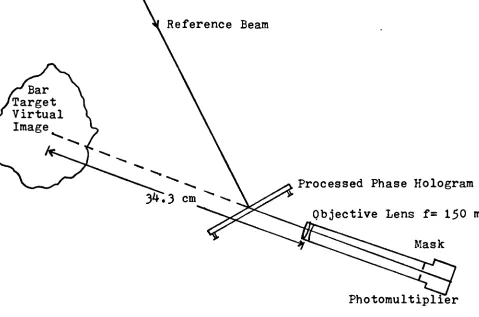
FIGURE 2 APPARATUS FOR MEASURING RECONSTRUCTION RATIO
used to promote even illumination over this 7.62 X 7.62 cm
area.
The reference to object beam ratio was 116:1 and this high
value was chosen to avoid a halo effect that is caused by
multiple reflections at small beam ratios. At a beam ratio
o
of 116:1 , the modulation of the fringe pattern is 0.18 .
MEASURING APPARATUS
The measurement of reconstruction ratio R,( the ratio of
the amount of light in a holographic image of an object to
the light in the object itself y is illustrated in Figure 2 .
This is accomplished by
imaging
the reconstructed image of [image:14.548.38.517.42.359.2]8
circular mask (diameter= 4 mm). The mask permits only
a selected portion of light from the white patch to pass.
The flux passing through this mask is incident on a photo
multiplier tube and the ratio of the flux from the holo
graphic image to the flux measured from the original target
is defined as the reconstruction ratio, R . The object dis
tance was 34.3 cm and this accounted for flux from an area
of 21 mm (in the object) to be incident on the photomultiplier.
The parameter called reconstruction ratio that is described
above, is related to a more common expression, diffraction
efficiency, by the following equation :
R k X
(
Diffraction Efficiency)
- where k is the beam ratio.
Noise in a holographic image is caused by emulsion scatter
and is difficult to measure because it depends on the collecting
aperture of the radiometer and from what part of the image the
scattered flux is collected. Therefore, only a relative meas
ure of noise was determined in this experiment. For this analy
sis, noise is defined as the amount of flux,upon reconstruc
tion, from an area which contained no flux at exposure.
Noise was measured with the spot reading photomulti
plier described previously in this section and with the
9
OSES
P
1
3E5
2B3B
I^^hI
3ESB
Ml
a iiii 'EBS 4 SB 3
>|||
5 SES sill
6 3B5 ?BE3
O
sriKjunc. j>_ n.,j.,i, nxiowLuiauFh iaiuj-Ex, ^ircxes xnaicaxe areas used for flux measurements to determine noise and reconstruction ratio.
ratio determinations. Figure 3 illustrates the two areas from
which reconstruction ratio and noise were determined. The white
circle indicates the area where there was no flux during the
exposure. The flux measured from this spot, upon reconstruc
tion, was used to determine the value of relative noise. The
black circle indicates the area from which reconstruction ra
tio was determined. A flux measurement was made in this area
before exposure and upon reconstruction. These two measure
10
Reference Beam
Bar Target Virtual
Image
35.5 cm
Processed Phase Hologram
Telescope(ang. mag.=l6x)
Eye
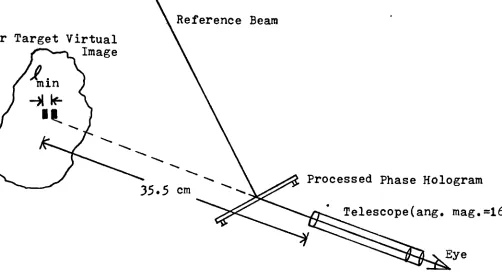
FIGURE 4 APPARATUS FOR RESOLUTION DETERMINATIONS
Resolution data for each hologram was obtained subjective
ly from an observer viewing the reconstructed image of the
alphanumeric target through a telescope(object distance=35.5 cm,
angular magnification^ 16X). See Figure k ,
RESULTS
The data for noise, resolution and reconstruction ratio
as a function of density and bleach concentration were analyzed
by regression analysis. Specifically, a Forward Doolittle
,12
regression method was used and from this,the(.the significant
factors, mathematical relationships and interactions of the
[image:17.548.22.524.60.337.2]11
1.4..
1.2.
E-J 1.0 .
m 0.8
E-< O X> 05
W 0.6-|
o o w *
0.4J
0.2
*
0
AL. L, o_ .r,l,
DENSITY' D*
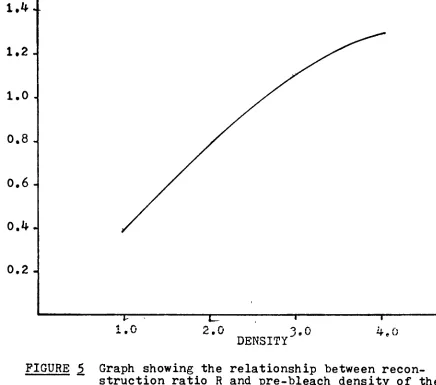
FIGURE Graph showing the relationship between recon
struction ratio R and pre-bleach density of the
holographic emulsion.
Statistical analysis of the data verifies that changes in
bleach concentration do not significantly affect noise,
resolu-tion or reconstruction ratio. However, the analysis did show
that as pre-bleach density is increased, the reconstruction
ratio increases according to a quadratic equation. See
Figure 5 .
The second response variable under consideration was
[image:18.548.23.459.57.442.2]0.9--0.8.. 0.7^ w o > w 0.3-0.2. 0.1-12
^
J^
$: JVUW) -: 1.0 2.0 DENSITY3.0 4.0 5-0
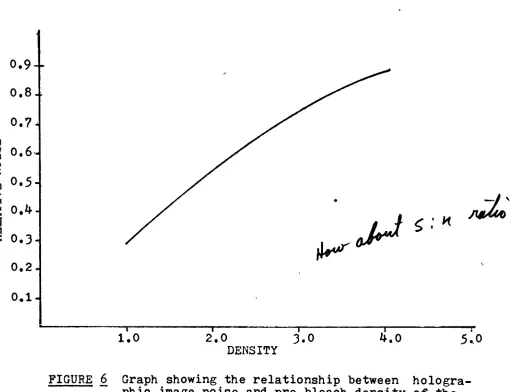
FIGURE 6 Graph showing the relationship between hologra
phic image noise and pre-bleach density of the
holographic emulsion.
was found to increase in a quadratic relationship with
P^'
density.
The third response variable in this experiment was resolu
tion which was found to be unaffected by an increase in the
pre-bleach density of the hologram. The average angular res
olution of this system was 8.87 X
10"
radians (measured from
the hologram to the image plane). The reason that resolu
tion is unaffected by an increase in
density
can be seen [image:19.548.16.526.62.454.2]13
that if
density
is increased from 2.00 to 4.00 , the Rvalue increases by a factor of 1.65 . Likewise, in Figure
6,
if
density
is also increased from 2.00 to 4.00 . the noiselevel increases by a factor of 1.67 . Since noise and re
construction ratio increase by approximately the same magni
tude, the signal-to-noise ratio essentially stays constant.
In summary,
increasing
thedensity
of the holographicfilm will cause the reconstruction ratio to increase but
will not change the resolution of the system .
OBSERVATIONS
During the course of experimentation, repeatability of
results was found to be affected by development temperature,
bleach temperature and the agitation method used in each
of these solutions. The agitation used in the bleach has
to be sufficiently vigorous or patches of silver will be
present at the completion of the processing step.
For all processing runs made, a pre-exposed control strip
on a 35 mm black and white film was processed along with
each set of holograms in order to monitor the development stage
of the sequence. All processing runs used in the data analysis
were found to be acceptable in terms of variability.
Aside from processing chemistry, it is important to note
the drying method used for processed phase holograms. When
14
left on the emulsion surface. If water spots are left on the
emulsion surface, non-uniformities may result which show up
as semi-opaque when the hologram is reconstructed. Since the
viewing position of the observer was fixed when resolution
measurements were made, an opaque area of the hologram might
cause erroneous data. Any hologram showing this defect was not
15
CONCLUSIONS
The intent of this thesis was to quantitatively define the
effects upon three important factors in a holographic image
which may vary due to bleach concentration and density level.
As our experimentation and data indicate, the exposure in
cident upon the film( and its corresponding density
)
has thesingle greatest effect on the brightness of the hologra
phic image. This increase that results from high densities,
however, also increases the noise in the image. These two
effects combine and, consequently, do not yield holograms of
increased resolution.
It was also determined in this investigation that the
concentration of the bleach solution has no effect upon
noise, resolution or reconstruction ratio.
In general then, it can be concluded for the system used in
this investigation that high densities can be used to record
efficient phase holograms without any loss of resolving
16
REFERENCES
Upatnieks, J., C. Leonard, "Diffraction Efficiency of Bleached,
Photographically
Recorded Interference Patterns", AppliedOptics. Vol.
8,
January 1969, pp. 85 ,2
McMahon, D., A. Franklin, "Efficient, High-Quality, R-10
Bleached Holographic Diffraction Gratings", Applied Optics,
Vol.
8,
September 1969, pp. 1927 .^
Lamberts, R.L., "Characterization of a Bleached Photographic
Material", Applied Optics, Vol. 11, January 1972, pp. 33
u,
Altman, J.H., "Pure Relief Images on Type 649-F Plates", Ap
plied Optics. Vol. 5, October 1966, pp. 1689 .
5
Lamberts, R.L., "Characterization of a Bleached Photographic
Material", Applied Optics. Vol. 11, January 1972, pp. 33
MeMahon, D., A. Franklin, "Efficient. High-Qua!ity, R-iO
Bleached Holographic Diffraction Gratings", Applied Optics,
Vol.
8,
September 1969, pp. 1927 .?
Anwyl, Robert D., Kodak Scientific Photography Markets, Per
sonal communication, November 19t 1974.
Smith, H.M., Kodak Research Laboratories, Personal communi
cation, March 26, 1975.
^
Smith, H.M., Improved Developers for Amplitude Holograms,
Paper presented at the Spring Meeting of the Optical Society
of America, Denver, Colorado, March 13-16, 1973. P- 1
10
Ibid., p. 1 .
11
Smith, H.M., Principles of Holography, New York, McGraw Hill,
Inc., 1969, P. 222 .
12
Rickmers, A.D., H.N. Todd, Statistics: An Introduction, New
17
BIBLIOGRAPHY
Altman, J.H., "
Pure Relief Images on Type 649-F Plates",
Ajd-plied Optics. Vol. 5, October 1966, pp. 1689 .
Beesley, M.J., Lasers and Their Applications, New York, Barnes
and Noble, 1972, 234 pp.
Champagne , E.B., N.G. Massey,"Resolution in Holography", Ap
plied Optics. Vol.
8,
September 1969, pp. 1879 .Chenoweth, A.J., "Humidity Testing of Bleach Holograms", Ap
plied Optics. Vol. 10, April 1971, pp. 913
Collins, L.F., "Diffraction Theory Description of Bieached Hol
ograms", Applied Optics, Vol. 7, June 1968, pp. 1236 .
Friesem, A.A., A. Kozma, G.F. Adams, "Recording Parameters of Spatially Modulated Coherent Wave Fronts", Applied Optics.
Vol.
6,
May 196?, pp. 851 .Iwata, F., J. Tsujiuchi, "Characteristics of a Photoresist Hol
ogram and Its Replica", Applied Optics, Vol. 13t June 197^,
pp. 1327 .
Lamberts, R.L., "Characterization of a Bleached Photographic Material", Applied Optics, Vol. 11, January 1972, pp. 33
Lamberts, R.L., C.N. Kurtz, "Reversal Bleaching for Low Flare
Light in Holograms", Applied Optics, Vol. 10, June 1971, pp.
1342 .
Laming, F.P., S.L. Levine, G. Sincerbox, "Lifetime Extension
of Bleached Holograms", Applied Optics, Vol. 10, May 1971,
pp. 1181 . v
Latta, J.N., "The Bleaching of Holographic Diffraction Gratings
for Maximum Efficiency", Applied Optics, Vol. 7, December 1968,
pp. 2409 .
Lehmann, M., Holography: Technique and Practice, New York, Fo
cal Press, 1970, 148 pp.
McMahon, D.H., A.R. Franklin, "Efficient, High Quality, R-10
Bleached Hlographic Diffraction Gratings", Applied Optics. Vol.
18
Moran, J.M., I.P. Kaminow, "Properties of Holographic Gra
tings Photoinduced in Polymethyi Methacrylate", Applied Op
tics, Vol. 12, August 1973, PP. 1964 .
Pernick, B.J., D. Yustein, C. Bartolotta, "Film
Transmittance-Exposure Characteristics for 649-F at 6328 A", Applied Optics,
Vol. 7, April 1968, pp. 714 .
Ross, M., Laser Applications. Vol. 1, New York, Academic Press,
1971, 308 pp":
Russell, B.R., "Resolution Limitations in Holographic Images",
Applied Optics. Vol.
8,
May 1969, pp. 971 .Russo, V., S. Scottini, "Bleached Holograms", Applied Optics, Vol. 7, January 1968, pp. 202 .
Smith, H.M., Principles of Holography. New York, McGraw Hill,
Inc., 1969, 239 PP.
Stroke, G.W., An Introduction to Coherent Optics and Holography,
New York, Academic Press, 1969, 358 pp.
Upatnieks, J., C, Leonard, "Diffraction Efficiency of Bleached,
Photographically Recorded Interference Patterns", Applied Op
tics, Vol.
8,
January 1969, pp. 85 .Vilkoraerson, D.H.R., D. Bostwick, "Some Effects of Emulsion
Shrinkage on a Hologram's Image Space", Applied Optics, Vol.
6,
19
APPENDIX
A 3 Factorial
FACTOR A- DENSITY
L o
w
o
cq
O O
En
25 W
o
sz
o
X
o
g
Me
d l
u
ra
H i g h
Low Medium High