THEORY OF MIND AND
INTELLIGENCE
RELATIONSHIP BETWEEN
AMONG CHILDREN
Dissertation submitted to
The Tamil Nadu Dr. M.G.R. Medical University
In part fulfilment of the requirement for
M.D. branch XVIII - Psychiatry final examination
DECLARATION
I hereby declare that this dissertation titled “Relationship between Theory of Mind and Intelligence among children” is a bonafide work done by me under the guidance
of Dr. Paul S.S. Russell, Professor of psychiatry, Christian Medical College, Vellore.
This work has not been submitted to any university in part or full.
DECLARATION
I hereby declare that the investigations, which form the subject matter of this thesis,
“Relationship between Theory of Mind and Intelligence among children”, were
carried out by Dr. R. Anto Praveen Rajkumar, a bonafide trainee in psychiatry, under
my guidance. This has not been submitted to any university in part or in full.
Dr. Paul S. S. Russell, M.D., D.P.M., Dip.N.B., Professor of psychiatry,
ACKNOWLEDGEMENTS
I acknowledge my gratitude to Dr. Paul S.S. Russell, Professor of psychiatry, and my guide for being a constant source of help, support and encouragement and for making me understand the intricacies of this exciting topic.
I thank Dr. Prathap Tharyan, Professor& Head of Department of Psychiatry for allowing me to include the patients under his care, in this study. I am grateful to Dr. K.S. Jacob, Professor of Psychiatry for being an incessant source of inspiration.
I am indebted to Dr. Simpson, special educator and my co investigator for taking the pains to visit many places and toil for our data collection. I thank Dr. Robyn Langdon, cognitive psychologist, Macquarie University, Sydney for her kind deed of providing the essential Theory of Mind assessment task. I am thankful to my junior registrar, Dr. Anoop for his kind help through out the study period. I am grateful to Mr. Santhosh, social worker, who helped me to obtain timely permission from various private schools. I thank Mrs. Sushila Russell, psychologist, for her kind guidance regarding the choice & the technical aspects of employed assessment tools. I value the help of Mrs. Caroline, Ms. Dhanya, Mrs. Mumtaj, Mrs. Bhagya and other staff members of Nambikkai Nilayam, for the smooth progress of the study.
I like to express my gratitude to all the children who participated in this study and to their parents, teachers and school administrators. I thank the research committee of Christian Medical College, Vellore for approval of funding of this project. I appreciate all my consultants and colleagues who rendered their co-operation during the study period. I am obliged to my parents, sisters and friends who facilitated me to endure the challenge.
CONTENTS
SECTION PAGE
1. INTRODUCTION 9
2. REVIEW OF LITERATURE 13
2.1. History of ToM 2.1.1. First phase 2.1.2. Second phase 2.1.3. Third phase
2.2. Theories about ToM 16 2.2.1. Theory theory.
2.2.2. Modularity theory. 2.2.3. Simulation theory.
2.3. Components of ToM 19 2.3.1. Fundamental components
2.3.2. Neuro physiological components. 2.3.3. Social components.
2.3.4. Developmental components.
2.4. Assessment of ToM 23 2.4.1. False belief tests.
2.4.2. Abstract language tests. 2.4.3. High order tests.
2.5. Theory of mind impairment. 25 2.5.1. ToM & pervasive developmental disorders
2.5.4. ToM & other disorders
2.6. ToM and cognition. 28 2.6.1. Evidence against ToM as a specific cognitive domain 2.6.2. Evidence for ToM as a specific cognitive domain 2.6.3. ToM & Language ability.
2.7. ToM and Intelligence. 32 2.7.1. Importance of relationship between ToM & IQ.
2.7.2. ToM & Intellectual disability.
2.7.3. ToM & Children with above average IQ.
2.8. Indian scenario. 36
3. AIMS AND OBJECTIVES 38
4. METHODOLOGY 40
4.1. Study design. 4.2. Setting.
4.3. Sample size estimation. 4.4. Sampling.
4.5. Selection criteria.
4.5.1. Inclusion criteria. 4.5.2. Exclusion criteria. 4.6. Sample population.
4.7. Measures.
4.7.1. Socio demographic data. 4.7.2. Binet Kamat Test
4.7.5. Picture Sequencing Task.
4.7.6. Unexpected contents Theory of Mind Task. 4.8. Assessment.
4.9. Ethics.
4.10. Data analysis.
5. RESULTS. 51
5.1. Sample flow 5.2. Sample attrition
5.3. Sample characteristics.
5.4. Psychological measures of the participants.
5.5. Socio demographic characteristics between groups. 5.6. Psychological measures between groups.
5.7. Bivariate correlation between ToM and IQ 5.8. Partial correlation between ToM and IQ.
5.9. Analysis of relationship between ToM and IQ within groups. 5.10. Regression analysis of ToM ability.
6. DISCUSSION 69
6.1. Interpretation of results.
6.2. Comparison with previous literature. 6.3. Methodological strengths.
6.4. Methodological Limitations. 6.5. Clinical implications. 6.6. Future directives.
7. CONCLUSION 75
9. APPENDICES 94 9.1. Informed consent form.
9.2. Data collection sheet. 9.3. Picture sequencing Task.
Theory of Mind (ToM) is the cognitive ability to impute mental states to the self and to others (Premack & Woodruff, 1978), to predict and to explain behaviours in terms of mental states. It underlies the ability to comprehend and predict the behaviour of other people and to interpret the actions of others as meaningful and intentional (Rowe & Morris, 2001). It allows one to attribute mental states to others, to understand that other people may hold and act upon beliefs different from one’s own. Theory of mind includes the nature and development of our understanding of the inner mental world inhabited by beliefs, desires, attitudes, emotions, thoughts, perceptions, intentions, and other mental states. This appreciation of alternate perspectives is crucial for successful social interaction, communication, adaptation and functioning.
Research on theory of mind has proven to be of interest, not only to psychiatrists but also to researchers and practitioners in fields such as philosophy, developmental psychology, neuro psychology, social psychology, clinical psychology, cultural psychology, cognitive psychology, and education. Many authors have documented Theory of Mind deficits in pervasive developmental disorders, deaf mute children, schizophrenia, acute psychosis, mood disorders and in intellectual disabilities. Theory of Mind deficits has been postulated to be etiologically associated with autism spectrum disorders and with schizotypy, which renders high vulnerability to major psychotic disorders.
imaging, and neurological lesion studies supporting the presence of Theory of Mind as independent specific cognitive domain, this controversy still lingers due to the existence of conflicting clinical, neuropsychological and research evidence (Fine & Blair, 2001; Zelazo, 2002). Hence, it is indispensable to study the relationship between Theory of Mind and general cognitive abilities such as intelligence, before plunging in to further depths of its deficit related research.
Intelligence is broadly defined as an overall ability for learning and problem solving. There are various standardized test batteries available to quantify Intelligence Quotient (IQ). Children with normal or high IQ may have low theory of mind ability and vice versa. Intelligence is considered to be the prime confounding factor in any assessment of Theory of Mind. However, the direct relationship between IQ and Theory of mind functioning has been less studied systematically (Brune, 2003; Muris, et al, 1998; Yirmiya, et al, 1996; Happe, 1994). Understanding the relationship between theory of mind ability and intelligence quotient is also essential for better planning of care for children with intellectual disabilities. Hence, clarifying the role of IQ is the need of the hour to guide future research and clinical practice.
2.1. HISTORY OF ToM
The view of the human mind as an intentional agent that contains mental states such as beliefs and desires was present even in ancient Vedic texts. Psychological theorists such as Descartes and Freud have postulated the genesis and development of one’s own mental world and it’s distinction from the mental world of others. However, the conceptualization of this mentalizing ability as a specific skill, distinct from other cognitive functions, and the term “theory of mind”, have emerged relatively recently from the fields of philosophy and developmental psychology. The concept of ToM evolved over the last century, in three major phases (Flavell, 2004). First phase started with Piagetian model of cognitive development. A second phase was the extensive work on Meta cognitive development and the explosion of experimental endeavours to examine existing hypotheses marked the third phase.
2.1.1. First phase
2.1.2. Second phase
A second wave of theory and research in this area was the extensive work on Meta cognitive development that began in the early 1970s. Meta cognition has been defined as any knowledge or cognitive activity that takes as its object, or regulates, any aspect of any cognitive activity (Flavell & Miller, 2002). Many studies have investigated children's Meta memory, that is, their knowledge about variables affecting memory performance and, especially, their knowledge and use of memory strategies. Research in the Meta cognitive development has been performed on cognition concerning comprehension, communication, language, perception, attention, and problem solving. Prior to 1983, most investigators of children's knowledge about the mind would probably classify their work as either Meta cognitive or in the general Piagetian tradition. The impetus for the term “Theory of Mind” was in 1978, when a seminal paper, “Does the chimpanzee have a ‘theory of mind’?” was published (Premack& Woodruff, 1978). They reported the possibility that chimpanzees are implicitly aware that different individuals can have different thoughts and use this ability to predict their behaviour. Wellman and his co-workers had also independently conceptualized children's developing Meta cognitive knowledge and understanding of mental terms as the development of a Theory of Mind (Wellman, 1985). Then on, the term ‘Theory of Mind” is in vogue in the developmental and cognitive psychology literature.
2.1.3. Third phase
Wimmer and Josef Ferner in 1983. In a highly influential series of studies, they used the "unexpected transfer" method to test young children's understanding of false belief (Wimmer & Ferner, 1983). This led to an alliance of Meta cognitive researchers with other researchers who were working with related cognitive modalities such as children's knowledge about perception and about the appearance-reality distinction. This alliance became the Theory of Mind movement, which secured further identity and coherence by two conferences that were held in the spring of 1986. The presentations given at these two conferences were later published in a book entitled “Developing Theories of Mind” (Astington & Olson, 1988), and the movement was officially launched.
Much of the earliest work was focused on documenting a salient improvement between three and five years of age in children's performance on various false-belief, appearance-reality, and visual perspective-taking tasks. Then, research has progressed concurrently in a variety of directions and majority of the literature over the last 20 years deals with such experimental ventures to study the development and deficits of mentalizing and central coherence in normally developing children and children with psychopathology and neurological impairment (Stuss & Alexander, 2001).
2.2. THEORIES ABOUT ToM:
on the roles of experience, neurological maturation and role taking in the development of ToM respectively.
2.2.1. Theory Theory:
The theory theory views theory of mind as a developing, evolving theory about other minds that is revised with experience over time. This theoretical stance posits several different theories of mind that replace one another as an individual’s appreciation of alternate, cognitive perspectives becomes increasingly more sophisticated (Gopnik & Wellman, 1994). Theory-theory holds that theory of mind is not an innate ability; however it may be based upon an innate, general theory formation mechanism, or even on an innate, primitive, mind oriented, starting state theory (Gopnik & Meltzoff, 2000). Theory theory does not view theory of mind as a specific cognitive domain, but rather as a specialized, cognitive skill dependent on the operation of more general inferential abilities, and perhaps dependent upon general theory-formation mechanisms as well. It does not support a specific, dedicated neural system for theory of mind. A number of steps in children's progression toward the adult theory of mind have been described. Children begin with a desire psychology, then progress to a desire belief psychology, and finally attain adult belief desire psychology, in which one recognizes that what people believe, as well as what they desire, crucially affects how they behave (Bartsch& Wellman, 1995). Theory theorists argue that experience plays a major formative role in children's theory of-mind development.
2.2.2. Modular theory:
their capacity from the environment, by a process termed as parameterization. Such parameters are essentially variables whose predetermined potential values can be set by experience (Segal, 1996). Theory of Mind is theorized to be a diachronic module which has a specific innate basis but developmentally dynamic by its interaction with environment. Hence, modular theorists claim that Theory of Mind exists as a distinct, cognitive ability that is functionally dissociable from other cognitive functions. In addition, they assert that the Theory of Mind module is innate, follows a pre-set developmental course, and matures relatively independently from other cognitive skills (Leslie & Roth, 1993). Modular theorists also make a clear distinction between inferencing about abstract mental states, which is a theory of mind skill, and inferencing about the physical world, which is considered to be a general inferencing skill, unrelated to theory of mind (Binnie & Williams, 2003). They support the existence of one or more neural structures specifically dedicated to theory of mind. Experience may be necessary to trigger the operation of these neural mechanisms, but it does not determine their nature.
2.2.3. Simulation theory:
Simulation theorists propose that theory of mind ability can be most accurately conceived of as an act of role taking (Langdon & Coltheart, 2001). From this perspective, individuals simulate what reality would look like to another person by mentally placing themselves into that person’s perspective, and then predicting what they themselves would do in the other person’s place. Simulation theory does not differentiate between abstract, cognitive perspective taking and concrete, visual perspective-taking that involves mental manipulation of a physical environment. This is in contrast with modular theory, which clearly differentiates mental state inferences from inferences about the concrete, physical world. In addition, simulation theory does not require the meta-representational computations about reality that are imposed by some modular theorists (Leslie & Roth, 1993). Little empirical evidence exists for this general perspective taking, simulation theory. This theory does not predict the existence of a specialized, distinct neural architecture for theory of mind ability. Like theory theorists, simulation theorists also assume that experience plays a crucial formative role, in that it is through practice in role taking that children improve their simulation abilities.
2.3. COMPONENTS OF ToM:
2.3.1. Fundamental components
Theory of Mind has explicit mental state language and implicit behavioural components. They involve two major fundamental components. They are ontological component, that is ability to distinguish between real and mental world and causal component that is ability to understand mutual casual relationships between mental states and physical behavioural world (Yirmiya, et al, 1998; Wellman, 1990).
2.3.2. Neuro physiological components
A review of functional neuro imaging studies reveal a system with three neural components consistently activated during both implicit and explicit mentalizing tasks. They are medial prefrontal cortex, temporal poles and posterior superior temporal sulcus. The functions of the medial prefrontal cortex can be elucidated the basis of a decoupling mechanism that distinguishes mental state representations from physical state representations; the posterior superior temporal sulcus region is probably the basis of the detection of agency, and the temporal poles might be involved in preference for social stimuli. The activation of these components in concert appears to be critical to theory of mind functioning (Frith& Frith, 2003). Other related neural components, particularly amygdala and mirror neurons are also found to play some role in the development of the circuitry mediating theory of mind (Fine & Blair, 2001).
2.3.3. Social components
There are two distinct social components of a Theory of Mind. They are social-cognitive component and social perceptual component. They are proposed to have distinct neurobiological substrates which are dissociable. They may be selectively impaired or spared in specific conditions such as William’s syndrome in which social perceptual component is spared but the social cognitive component is impaired (Tager- Flusberg & Sullivan, 2000).
2.3.4. Developmental components
During the development of children’s understanding of mind, diverse components appear in a programmed chronological order. It is proposed that the late-developing components of Theory of Mind rely on a different neural mechanism from the early-developing components, and that these mechanisms remain distinct into adulthood (Saxe & Wexler, 2005). These components include elements dealing with visual perception, attention, desires, beliefs, emotions, knowledge, pretense, thinking and Meta thinking. Hence, the componential view of Theory of Mind slices the understanding of mind in to various levels of development of these elements.
Even infants pay attention to other people's attending and seem to have some understanding of its implications (Tomasello & Haberl, 2003). In subsequent years, they appreciate that attention is selective and limited and that different people may mentally represent the same attended input differently (Fabricius & Schwanenflugel, 1994). By the age of three, children not only use some desire terms correctly, they also seem to grasp simple causal relations among desires, outcomes, emotions, and actions. For example, they understand that people will feel good if they get what they want and feel bad if they do not (Bartsch & Wellman, 1995).
It has been documented that young preschoolers actually attribute inner feelings to people who display emotions (Wellman & Sinclair, 1995). Then, children learn more advanced truths about emotions, that people do not always really feel what they appear to feel and that people's emotional reactions to an event may be influenced by earlier emotional experiences with similar events or by their current mood (Flavell & Miller, 1998). Some important elementary knowledge concerning thinking such as construing it as an internal human activity that represents real or imaginary things develops during the early preschool years (Wellman& Schult, 1996).
known information that they have just learned during the experimental session (Taylor & Bennett, 1994). An important early middle-childhood discovery is their burgeoning conception of the mind as an interpretive device for knowledge acquisition. Similarly, children develop understanding of pretense, Meta thinking and their implications sequentially (Harris, 2000; Flavell & Flavell, 1995).
2.4. ASSESSMENT OF THEORY OF MIND:
Over the past three decades, several tasks or tests for the assessment of Theory of Mind have been developed. Their methodology widely varies depending on their differing theoretical backdrop. Even though most of these tests were not formally validated and there are rousing controversies over their ability to assess Theory of Mind, they did facilitate the accumulation of current knowledge and progress of this field. These assessments can be broadly classified as tests of false belief, abstract language and high order tasks such as emotion recognition and social perception tests.
2.4.1. False belief tests
order false belief attribution if he predicted that Jim, upon re entering the room, would look for the cookie in its old location rather than its new hiding place. In order to make this correct prediction, the individual must be able to look beyond, or inhibit, his own knowledge of reality, and rely instead on his understanding of the false belief held by another person. Children can correctly make first order false belief mental state attributions at three to four years of age (Wimmer & Ferner, 1983).
Second order false belief tests are more difficult tasks that establish whether an individual can correctly attribute a false belief about a belief. For example, if unbeknownst to Sara but known to the individual being tested, Jim peeked back into the room and observed Sara changing the hiding place of the cookie; Sara would then falsely believe that Jim believes the cookie is still hidden in its original location. Sara would hold a false belief about Jim’s belief. Children generally pass second order false belief tests at age six or seven (Wimmer & Ferner, 1983).
2.4.2. Abstract language tests
2.4.3. High order tests
Further high order tasks include tests of emotion recognition and of social components. In Reading the Mind in the Eyes task, subjects view a series of eye region photographs, and select from given choices the emotion expressed in the eyes. There are also other emotion recognition and emotion behaviour tasks such as empathic accuracy task (Buitelaar & van der Gaag, 1999.). Tests for social perception and social cognition are also available (Samson & Humphreys, 2005). Although such high- level tasks require attribution of mental states, the validity of these tasks as specific measures of theory of mind ability has yet to be established. Such tasks are confounded by a coincident increase in level of cognitive difficulty and demands on working memory. They require the participant to understand non- literal language, to infer implicit meanings, and to recognize and understand complex social situations. Even though investigators generally attempt to control for confounding cognitive variables such as these, high-level Theory of Mind tasks require a high-level of complex cognitive skill that is very difficult to control for. Performance on these tasks and other, non traditional theory of mind tasks should be interpreted cautiously, as they may require alternative cognitive skills in addition to or instead of the attribution of mental states to others. These difficulties are partially overcome by adding questions of comprehension, assessing general inferencing ability and providing written or pictorial recall materials during testing.
2.5. THEORY OF MIND IMPAIRMENT
cerebral vascular accidents. It can also be predisposing as in schizotypy or be residual as in remitted mood disorders, in relation to other psychiatric disorders.
2.5.1. ToM & pervasive developmental disorders
Selective Theory of Mind impairment is a core cognitive feature of autism and its spectrum conditions (Baron-Cohen, 2001). Autistic children have weak central coherence, which is the impaired ability to integrate information in context with intact or superior ability to perceive local details (Frith, 1989). Children with autism usually have impaired mental physical distinction, appearance reality distinction, spontaneous pretend play, imagination and poor performance during false belief, mental lexicon tasks and tests of deception and pragmatics. They may fail to reflect one’s own imagination (Leslie, 1987) or to switch attention flexibly from ‘reality mode’ to ‘pretend mode’ (Russell, 1997) or both. Even though these impairments are early occurring and universal in autistic children, they are not in any way diagnostic. Such impairments are documented in Aspergers’s syndrome (Ponnet et al, 2004) and in pervasive developmental disorder NOS. Parents of children with autism spectrum conditions may also show difficulties in attributing mental states in emotion recognition tasks (Baron-Cohen & Hammer, 1997), suggesting genetic vulnerability and broader cognitive phenotype. As early diagnosis and intervention of these deficits improve performance with limited generalization (Howlin & Hadwin, 1998), study of Theory of Mind deficits in pervasive developmental disorders may lead to fruitful clinical and research avenues.
2.5.2. ToM & Schizophrenia
account for many positive and negative symptoms in schizophrenic disorders (Frith, 1992). There are alternative views, which construe ToM deficits as a result of executive function deficits (Hardy-Bayle´ & Sarfati, 2003) or even hyper ToM in schizophrenia causing psychotic symptoms (Abu-Akel, 1999). Specialized tests have been designed to test ToM abilities in schizophrenia (Frith & Corcoran 1996; Langdon et al. 1997; Sarfati et al.1997). There is good empirical evidence for ToM deficits in schizophrenia and that many psychotic symptoms may best be understood in light of a disturbed capacity in patients to relate their own intentions to executing behaviour, and to monitor others’ intentions (Brune, 2005). Similar deficits phenomenologically manifests as schizotypy with psychotic like traits and impoverished social awareness of variable expression and severity which denote high vulnerability for psychotic disorders (Langdon & Coltheart, 1999). However, it is still debated how an impaired ToM in schizophrenia is associated with other aspects of cognition, whether it is a state or trait variable, and how this affects the patients’ use of language and social behaviour. In addition to these potential research areas, future studies need to address whether patients could benefit from cognitive training in this domain.
2.5.3. ToM & Mood disorders
emotion recognition tasks. Such deficits admonish a decline of skilful social relationships. Strategies based on improving basic ToM reasoning could be incorporated into current therapeutic interventions for depression to provide better social adjustment.
2.5.4. ToM & other disorders
Theory of mind impairment is extensively studied in divergent clinical conditions such as Alzheimer’s dementia (Gregory, et al, 2002), acquired neurological lesions (Damasio, 1994), seizure disorder (Farrant, et al, 2005), delusional disorder (Craig, et al, 2004), intellectual disability (Yirmiya et al., 1998), behavioural disorders (Hughes & white, 1998), Attention Deficit Hyperactivity Disorder (Papadopoulos, et al., 2005), personality disorders (Dolan & Fullam, 2004 ), child sexual offenders (Keenan & Ward, 2000), normal aging (Happe & Brownell, 1998) and deaf mutism (Courtin & Melot, 2005). This highlights the fact that ToM impairment is widely prevalent and has high clinical and research priority.
2.6. ToM & COGNITION
Mind by modularity theorists is also merely interpreted as one example of the general cognitive capacity for using embedded rules (Frye & Palfai, 1995). The endeavours till date to resolve this debate have indeed granted clinical, neuro psychological and research evidence providing strength to both sides of this controversy.
2.6.1. Evidence against ToM as a specific cognitive domain
2.6.2. Evidence for ToM as a specific cognitive domain
Convincing neuro physiological and neuro imaging studies indicate evidence of specific localization of Theory of Mind ability and selective Theory of Mind impairment with spared executive function component skills in pervasive developmental disorders and in acquired neurological lesions. They contradict the claims of general executive function based explanation of Theory of Mind. In a study investigating a link between Theory of Mind and episodic memory, most Theory of Mind abilities showed no interrelations with episodic memory during development (Naito, 2003). Another series of experiments investigating the models regarding the
role of the amygdala in the development of theory of mind and the degree of dissociation between theory of mind and executive functioning, concluded that theory of mind is not simply a function of more general executive functions and that executive functions can develop and function on-line, independently of theory of mind (Fine & Blair, 2001). Evolutionary history of prefrontal cortex also indicates the cognitive specialization of Theory of Mind ability (Povinelli & Preuss, 1995).
ToM (Happe, et al., 1999). In short, even though, any break through evidence to clearly demarcate theory of mind as an independent cognitive domain distinguished from general cognitive abilities has not so far emerged, there is enough available evidence to pose such claim.
2.6.3. ToM & Language ability:
There is a wealth of literature investigating the relationship between Theory of Mind ability and general language ability. In contrast to visuo spatial ability, language consistently correlates with social understanding (Tager- Flusberg & Sullivan, 1994). Direct studies have established that general language ability is more related to false belief tasks than semantics and syntax, per se (Ruffman, et al., 2003). Even the knowledge of a second language significantly improves young children's understanding of mental representations (Berguno & Bowler, 2004).
In three available longitudinal studies about the relationship between language and Theory of Mind, two studies (Astington & Jenkins, 1996; De villiers & Pyers, 2002) reported early language development predicted later theory of mind development whereas the reverse relationship rarely held. One study found out a bidirectional relationship between language and theory of mind development. It added that such relationship was robust even after accounting for the children’s age and the verbal complexity of the tasks employed (Slade & Ruffman, 2005).
children develop better explicit Theory of Mind skills depending on the extent of their language skills which provide the terminology to reflect on and refine implicit intuitions (Ruffman, et al., 2003; Hale &Tager-Flusberg, 2003). The major confounding factors in these studies are children’s chronological age, intelligence and their interactions and period effects with general language ability.
2.7. ToM & Intelligence:
Intelligence is broadly conceptualized as an overall ability for learning and problem solving. There is no single universally accepted definition for intelligence (Barett & Breuning, 1983). It is operationally defined, “Intelligence is the aggregate or global capacity of the individual to act purposefully, to think rationally, and to deal effectively with his environment” (Wechsler, 1958). They are various theories describing the nature of intelligence which can be broadly classified as factor theories and process oriented theories (Morgan& King, 2002). Intelligence may be expressed as Intelligence Quotient (IQ) which is a ratio between a particular score an individual attains and the score which an average individual of his age may be assumed to attain on the same test. William stern first proposed the concept of intelligence quotient in 1912. IQ is usually documented as a percentage score of a ratio between mental and chronological age. There are many well-standardized test batteries available at present to quantify IQ and to identify verbal and non-verbal performance IQ.
2.7.1. Importance of the relationship between ToM & IQ
deficits in children with intellectual disability and about relatively more pronounced Theory of Mind deficits in children who have the co morbidity of low IQ and psychiatric disorders such as autism and psychosis. Secondly, most Theory of Mind investigators favour matching their sample on IQ or accounting for the role of IQ with regression analysis to bye pass this fundamental issue while dealing with more advanced research quests. Despite the fact that intelligence is considered to be one of the prime confounding factors in any sort of Theory of Mind assessment, the existing literature regarding the direct relationship between IQ and Theory of Mind abilities is strangely sparse.
Available studies argue for a model of chronological age, verbal IQ, paternal education, maternal mental state language (Adrian, et al., 2005) and for a model of verbal memory, performance IQ, age and gender (Buitelaar, et al., 1999b), as the best predictors of variables of Theory of Mind ability. A study of relationship between Wechsler IQ profile and Theory of Mind in autistic children, comprehension sub test had stronger correlation with Theory of Mind ability than block design subtest (Happe, 1994). A well-validated TOM test scores has been found to be positively associated with Wechsler Intelligence Scale for Children IQ scores (Muris, et al, 1999). Another study failed to find any significant correlation between IQ and The Eyes Test values in unaffected first-degree adult relatives of schizophrenia (Kelemen, et al., 2004). A
preliminary investigation indicates that even male hormones and Body Mass Index may predict Theory of Mind abilities and they have a negative correlation with ToM and crystallized intelligence (Azurmendi, et al. 2005).
2.7.2. ToM & intellectual disability:
compromised intelligence, the extent of Theory of Mind deficits in such children in comparison with normal controls and those with psychiatric morbidity and the disparity of those deficits among different aetiologies of intellectual disability.
A Meta analysis of theory of mind studies in children with intellectual disability asserts that Theories of Mind deficits are prominent in children with intellectual disability (Yirmiya et al., 1998). Adolescents with intellectual disability performed worse than children without intellectual disability even when they were matched for mental age. They performed better on first order false belief tests than on second order false belief tests (Benson, 1993). Individuals with schizophrenia and pre morbid intellectual disability showed greater impairment of Theory of Mind skills than those with schizophrenia alone (Doody, et al., 1998).
Such Theory of Mind deficits differ depending on various aetiology of intellectual disability. Theory of mind can be selectively spared relative to general cognitive functions in cases of Down’s syndrome and Prader Willi syndrome. Social cognition impairments of children with fragile X syndrome were also reported (Cornish, et. al., 2005). How ever, the deficits in Down’s syndrome were more global and severe than those of fragile X syndrome (Abbeduto L, 2001). There is a conflict of evidence for (Tager- Flusberg & Sullivan, 2000) and against (Sullivan & Tager-Flusberg, 1999) specific social cognitive component impairment in children with Williams syndrome. Children with poor control of Phenyl ketonuria (PKU) were found to be similar to autistic children in relation to dopaminergic dysfunction and Theory of Mind impairment (Dennis, et al., 1999).
Children with intellectual disability have limited narrative language skills which substantially contribute to their failure on the false belief task. Screening out children who failed to meet linguistic and cognitive prerequisites for dealing with the performance demands of the false belief task yielded only non significant correlations between false belief performance and the verbal IQ (Abbeduto, et al., 2004). Further work investigating the psychometric properties of similar tasks is required with both typically and atypically developing children, given the important interpretations made regarding the Theory of Mind skills of children on the basis of their responses in such experimental tasks
2.7.3. ToM & children with above average IQ
level of challenge (Caine & Caine, 1991) and their brain will maintain its level of development only if such students are appropriately cognitively challenged (Clark, 1997).
Second-order thinking or Meta cognition is important for the development of critical thinking and self-reliant learning. Teaching specific social interactional and conversational skills and providing explicit and systematic instruction in the underlying social cognitive principles necessary to infer the mental states of others have shown effectiveness in the performance on Theory of Mind tasks (Ozonoff & Miller, 1995). However, this aspect is generally not given its due priority while planning education programs, especially for the gifted students (Starko & Schack, 1989).
In the past, the concept of giftedness was associated primarily with high IQ. It was assumed that gifted students were born with high intelligence, were identifiable by their high grades and test scores, and were capable of excelling in all areas of school and of life. These assumptions are still prevalent, although they are beginning to change. Cognitive science, developmental psychology, and new understandings of educational psychology are influencing the way giftedness is defined and conceptualized. It is clear that there are different ways of being gifted rather than a definitive list of gifted qualities. It is logical to assume Theory of Mind abilities will be superior in children who are gifted. Preliminary work with gifted children has also shown that they have better Meta cognitive attitude (Schwanenflugel, et al., 1997). However, this claim has not been validated with systematic studies.
2.8. Indian scenario
endeavours to explain the neuronal basis for mentalizing and spiritual abilities which were traditionally given high priority in ancient India.
The objectives of this study are:
1. To establish the relationship between the Theory of Mind (ToM) and Intelligence Quotient (IQ) in children.
2. To establish the relationship between the Theory of Mind (ToM) and various domains of general intelligence in children.
4.1. Study design
This is a cross sectional study.
4.2. Setting
Vellore district lies between 12° 15’ to 13° 15’ North latitudes and 78° 20’ to 79° 50’ East longitudes in the state of Tamilnadu, India. The geographical area of this district is 6077 sq. Kim. The total population as per 2001 Census is34, 77,317. Vellore district has 1891 primary schools among which 400 are in urban area and 1491 are rural primary schools. This study was conducted at Nambikkai Nilayam, which is a facility for children with Intellectual Disability, Christian Medical College, Vellore, and other three private institutes providing care for children with Intellectual Disability in Vellore district. Nambikkai Nilayam is a tertiary care, teaching facility with out any geographically defined catchment area. However, a good proportion of children are not referred from other clinics but come on their own for assessment and management. Nambikkai Nilayam provides both in patient and day care special education programs for the children with intellectual disability. All programs include the parents in therapy and a multi disciplinary team comprising child psychiatrists, clinical psychologists, special educators, occupational therapists, specialist nurses and other support staff are involved in the assessment and management of these children. Nambikkai Nilayam is a part of a general hospital and has consultation and liaison with other clinical specialties for their children whenever indicated. This study also included 12 Governmental and private sector primary schools in Vellore district.
4.3. Sample size estimation
correlation coefficient at 0.3, the sample size requirement is estimated to be eighty four to establish the correlation between Theory of Mind and IQ. As we anticipated 20% drop out between the two points of assessment, we decided to recruit at least 100 children for this study.
4.4. Sampling
A convenient sampling method was employed to establish the relationship between theory of Mind and IQ over broad IQ ranges. In this study, we attempted to recruit children in three groups differing on their academic performance, which is considered as a pragmatic proxy measure of IQ. Approximately thirty children were planned to be recruited in each of the three groups. They are children with sub average intelligence, average intelligence and the children with above average IQ.
4.5. Sample population
Children with sub average intelligence were recruited from the above mentioned four facilities providing care for the children with intellectual disability. Normally developing children and the children with above average IQ were recruited from the twelve leading primary schools of Vellore district.
4.6. Selection criteria
As we tend to elucidate the relationship between two entangled cognitive variables, this study desired to keep the confounding variables at the feasible minimum. The selection criteria were as follows,
4.6.1. Inclusion criteria
1. Children from eight to eleven years of age.
4.6.2. Exclusion criteria
1. Children with any present or past psychiatric morbidity. 2. Children with severe or long term physical illness.
3. Children with neurological deficits such as cerebral palsy, seizure disorder and head trauma.
4. Children with sensory deficits such as visual or hearing impairment. 5. Children with severe behavioural problems.
6. Children with present or past history of long term use of any medication. 7. Children who had already received prior training for Theory of Mind tasks. 8. Children who were not willing to provide their verbal assent to participate in
this study.
4.7. Measures
4.7.1. Socio demographic data
A semi structured data collection sheet (Appendix 9.2.) was used specifically in this study to collect data regarding the socio demographic profile, academic profile, medical history, family history, and parental and sibling details.
4.7.2. Binet Kamat Test (BKT)
measures intelligence under six sub scales namely memory, language, conceptual thinking, reasoning, numerical reasoning, visuo motor coordination and social intelligence. The correlation quotient is nearly 0.5 for the IQ (Kamat, 1967).
4.7.3. Vineland Adaptive Behaviour Scale (VABS)
optional Maladaptive Behaviour domain of the Survey Form determines maladaptive levels.
VABS has good internal consistency, test-retest reliability, and inter rater reliability. Two statistics were typically used to report reliability – the reliability coefficient and the standard error of measurement (SEM). The test-retest reliability coefficients for the domains and adaptive behaviour composite are very good, with the majority of the coefficients in the .80s and .90s. For the adaptive behaviour composite, test-retest and inter rater reliability coefficients were .99 and .98 respectively. Median correlations between pairs of domains ranged from .39 to .55, indicating only a modest overlap among the domains.
4.7.4. Strength Difficulties Questionnaire (SDQ)
low needs among five subscales for Pro-social Behaviour, Hyperactivity, Emotional Symptoms, Conduct and Peer problems. This is useful to employ further diagnostic assessment for high needs children and to plan treatment with the special consideration of their strengths. SDQ can identify children with psychiatric morbidity with a specificity of 94.6% and a sensitivity of 63.3% and can identify more than 70% of children with conduct, hyperactivity, depressive and anxiety disorders (Goodman, et al., 2000).
4.7.5. Picture Sequencing Task (PST)
Picture sequencing task measures the Theory of Mind by assessing false belief reasoning and general sequencing ability. The PST employed in this study was adapted with the permission and the guidance of Dr. Robyn Langdon, cognitive psychologist, Macquarie University, Sydney, who developed and extensively used the original version in her Theory of Mind research endeavours (Langdon & Coltheart, 1999). PST employed 14 sequences which included two practice, four false belief, four mechanical and four social script sequences. Each sequence was made up of a series of four pictures made up of black and white sketches. These sequences were presented to all children in a same prefixed order. The pictures within a sequence were shuffled with out the knowledge of the child and the child was asked to reorganize them in a meaningful order. The reorganized order and response time for each sequence were recorded. If the child placed the first or the last pictures in their correct position, he/ she received two points each. One point each was awarded for placing the middle ones in their correct position and hence, a total of six points were given for correctly reorganized sequence. There were no points for the first two practice sequences.
mechanical and social script sequences derived a general sequencing ability. A selective accuracy measure of Theory of Mind ability was calculated by subtracting the general sequencing ability from the mean score obtained from false belief sequences. Similarly, a selective time measure was calculated in the same way using the mean response times.
PST is a relatively novel experimental task and the psychometric properties of this task have not yet been evaluated in depth. The discriminant validity and construct validity of PST has been demonstrated in studies of Theory of Mind functioning in schizophrenia (Harrington, et al., 2005). There are no test-retest reliability statistics currently available. Yet, PST was considered to be the most appropriate test for this study in view of the following rationale,
1. PST places less demand on general language ability and working memory, which are known confounders in any Theory of Mind assessment.
2. Selective accuracy measure of Theory of Mind ability obtained from PST, is disentangled from the general sequencing ability and has more conceptual authenticity.
3. PST provides an objective outcome of Theory of Mind ability as a single continuous numerical variable, akin to IQ and is more suitable for correlation analysis.
4. PST uses simple sketches, which lack exquisite details, and appears less culturally unfair for Indian children.
However, the need for further psychometric evaluation of most of Theory of Mind assessment tasks, including the PST cannot be denied and is indeed desired.
4.7.6. Unexpected contents Theory of Mind Task
Even though tests of deception are simple, and brief, they are valid indicators of Theory of Mind functioning. The “Unexpected contents Theory of Mind Task” employed in this study was creative, but it followed a set of questions used in previous studies (Zelazoa, et al., 2002). The child was offered the carton of a crayon box, which had pictures of crayons over it. At first, he/ she was asked to tell about the contents of the box without opening it. Most of them answered that the box contained crayons but were tricked when they opened the box and found two erasers in side. They were asked to name the real contents and were once again asked what they thought being inside when they had first seen that box. They were also asked what another child would answer about the contents of the box if he/ she had not opened that. Their answers to these four questions were considered as appearance, reality, representational change and false belief variables and were scored with one point each for every correct response. This deception task was used to screen the ability of the children to participate in further assessment and to gain additional information regarding their Theory of Mind ability.
4.8. Assessment
devoid of psychiatric morbidity as evidenced by low needs in SDQ and was able to participate in Theory of Mind assessment tasks as arbitrarily defined by a score of two or more in unexpected contents Theory of Mind task. Order of sequencing and response times were recorded for every sequence of PST.
Second assessment session was carried out by an independent co investigator, a senior faculty of our department, who possessed more than 25 years of experience in the field of special education. Blinded to the Theory of Mind ability of the child, he employed Binet Kamat Test for intelligence and Vineland Adaptive Behaviour Scale for adaptive functioning. Those results remained blinded to the principal investigator till the end of final statistical analysis.
4.9. Ethical considerations
4.10. Data analysis
The data were analysed at three levels. Firstly, the socio-demographic data, cognitive profile, adaptive behaviours and ToM details for the study sample were analysed using descriptive statistics.
Secondly, the socio-demographic data, cognitive profile, adaptive behaviours and ToM details between groups with different levels of IQ were analysed using parametric tests, because the obtained data were not significantly skewed. Chi-square tests for categorical measures and one-way ANOVA for continuous variables were carried out. The linear correlation between the ToM and various domains of IQ was analysed using Pearson’s correlation coefficient tests with two tailed assumptions.
5.1. Sample flow
All the 105 children who met the selection criteria were invited to take part in the study. All of them consented to participate and underwent the first assessment session. The children with sub-average intelligence were recruited from four institutes caring for children with intellectual disability. The children with average and above average intelligence were recruited from twelve primary schools in the Vellore district.
5.2. Sample attrition
However, only 95 children completed the second assessment session, because the parents of four children withdrew their consent, four children lost to follow up because of changing their residence to places outside the catchment area, and two children were excluded when the past history of seizure disorder was made available. The overall dropout rate was 9.52%.
5.3. Sample characteristics
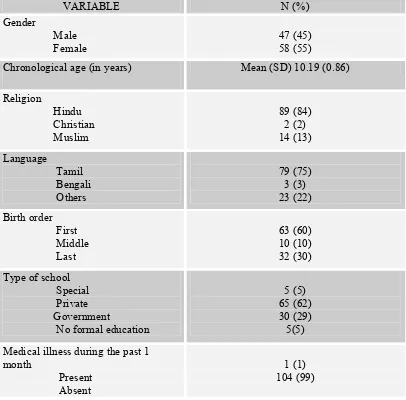
Table I: Socio demographic profile of children (N=105) participated in this study.
VARIABLE N (%)
Gender
Male
Female 47 (45) 58 (55)
Chronological age (in years) Mean (SD) 10.19 (0.86) Religion Hindu Christian Muslim 89 (84) 2 (2) 14 (13) Language Tamil Bengali Others 79 (75) 3 (3) 23 (22) Birth order First Middle Last 63 (60) 10 (10) 32 (30) Type of school
Special Private Government
No formal education
5 (5) 65 (62) 30 (29) 5(5) Medical illness during the past 1
month
Present Absent
1 (1) 104 (99)
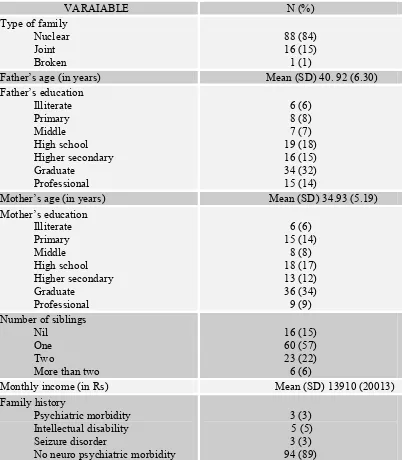
Table II: Socio demographic profile of families of children (N=105) participated in this study.
VARAIABLE N (%)
Type of family Nuclear Joint Broken 88 (84) 16 (15) 1 (1)
Father’s age (in years) Mean (SD) 40. 92 (6.30) Father’s education Illiterate Primary Middle High school Higher secondary Graduate Professional 6 (6) 8 (8) 7 (7) 19 (18) 16 (15) 34 (32) 15 (14)
Mother’s age (in years) Mean (SD) 34.93 (5.19) Mother’s education Illiterate Primary Middle High school Higher secondary Graduate Professional 6 (6) 15 (14) 8 (8) 18 (17) 13 (12) 36 (34) 9 (9) Number of siblings
Nil One Two
More than two
16 (15) 60 (57) 23 (22) 6 (6)
Monthly income (in Rs) Mean (SD) 13910 (20013) Family history
Psychiatric morbidity Intellectual disability Seizure disorder
No neuro psychiatric morbidity
3 (3) 5 (5) 3 (3) 94 (89)
5.4. Psychological measures of the participants.
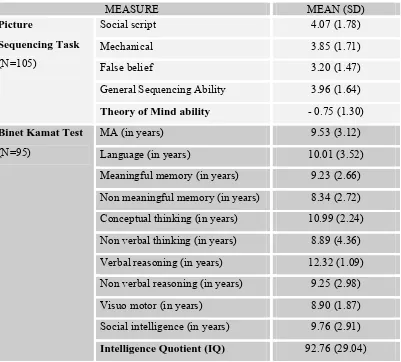
[image:55.612.123.524.195.557.2]The mean IQ of the participants was 92.76 (SD = 29.04) with a range of 32 to 144. The picture sequencing task and Binet Kamat Test of intelligence profile of the overall sample was as follows:
Table III: Psychological variables of children participated in this study.
MEASURE MEAN (SD)
Social script 4.07 (1.78)
Mechanical 3.85 (1.71)
False belief 3.20 (1.47)
General Sequencing Ability 3.96 (1.64)
Picture
Sequencing Task
(N=105)
Theory of Mind ability - 0.75 (1.30)
MA (in years) 9.53 (3.12)
Language (in years) 10.01 (3.52)
Meaningful memory (in years) 9.23 (2.66) Non meaningful memory (in years) 8.34 (2.72) Conceptual thinking (in years) 10.99 (2.24) Non verbal thinking (in years) 8.89 (4.36) Verbal reasoning (in years) 12.32 (1.09) Non verbal reasoning (in years) 9.25 (2.98) Visuo motor (in years) 8.90 (1.87) Social intelligence (in years) 9.76 (2.91)
Binet Kamat Test
(N=95)
Intelligence Quotient (IQ) 92.76 (29.04)
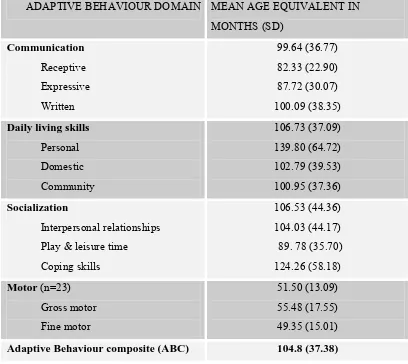
Table IV: Adaptive variables of children (N = 95) participated in this study
ADAPTIVE BEHAVIOUR DOMAIN MEAN AGE EQUIVALENT IN MONTHS (SD) Communication Receptive Expressive Written 99.64 (36.77) 82.33 (22.90) 87.72 (30.07) 100.09 (38.35)
Daily living skills
Personal Domestic Community 106.73 (37.09) 139.80 (64.72) 102.79 (39.53) 100.95 (37.36) Socialization Interpersonal relationships Play & leisure time Coping skills
106.53 (44.36) 104.03 (44.17) 89. 78 (35.70)
124.26 (58.18)
Motor (n=23)
Gross motor Fine motor
51.50 (13.09) 55.48 (17.55) 49.35 (15.01)
Adaptive Behaviour composite (ABC) 104.8 (37.38)
Table V: Strengths and Difficulties Questionnaire profile of the children (n=105).
Scale N (%)
Pro social : Low needs Mean (SD)
105 (100%) 9.14 (0.86)
Hyper activity: Low needs 105 (100%)
Conduct problems: Low needs 105 (100%)
Emotional symptoms: Low needs 105 (100%)
Peer problems: Low needs 105 (100%)
Total difficulties: Low needs 105 (100%)
5.5. Socio demographic characteristics between groups
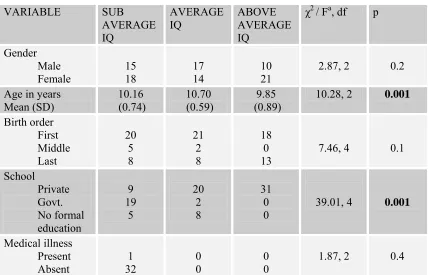
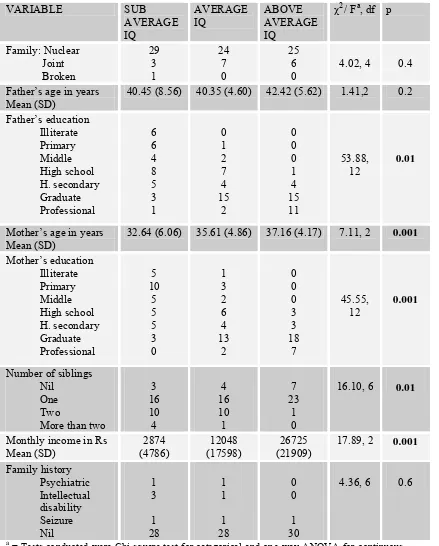
Socio demo graphic profiles of three groups of children with, sub average (N=33), average (N=31) and above average IQ (N=31) were compared in table VI and table VII.
Table VI: Comparison of socio demographic profile of children among three groups.
VARIABLE SUB
AVERAGE IQ
AVERAGE
IQ ABOVE AVERAGE IQ
χ2 / Fa, df p Gender
Male
Female 15 18 17 14 10 21 2.87, 2 0.2
Age in years
Mean (SD) (0.74) 10.16 (0.59) 10.70 (0.89) 9.85 10.28, 2
0.001 Birth order First Middle Last 20 5 8 21 2 8 18 0
13 7.46, 4 0.1
School Private Govt. No formal education 9 19 5 20 2 8 31 0
0 39.01, 4 0.001
Medical illness Present Absent 1 32 0 0 0 0
1.87, 2 0.4
a = Test conducted were Chi-square test for categorical and one-way ANOVA for continuous
[image:57.612.117.545.387.662.2]Table VII: Comparison of socio demographic profile of families of children among three groups.
VARIABLE SUB
AVERAGE IQ
AVERAGE
IQ ABOVE AVERAGE IQ
χ2 / Fa, df p Family: Nuclear Joint Broken 29 3 1 24 7 0 25 6
0 4.02, 4 0.4
Father’s age in years
Mean (SD) 40.45 (8.56) 40.35 (4.60) 42.42 (5.62) 1.41,2 0.2 Father’s education Illiterate Primary Middle High school H. secondary Graduate Professional 6 6 4 8 5 3 1 0 1 2 7 4 15 2 0 0 0 1 4 15 11 53.88, 12 0.01
Mother’s age in years
Mean (SD) 32.64 (6.06) 35.61 (4.86) 37.16 (4.17) 7.11, 2 0.001 Mother’s education Illiterate Primary Middle High school H. secondary Graduate Professional 5 10 5 5 5 3 0 1 3 2 6 4 13 2 0 0 0 3 3 18 7 45.55, 12 0.001
Number of siblings Nil
One Two
More than two
3 16 10 4 4 16 10 1 7 23 1 0
16.10, 6 0.01
Monthly income in Rs
Mean (SD) (4786) 2874 (17598) 12048 (21909) 26725 17.89, 2
0.001 Family history Psychiatric Intellectual disability Seizure Nil 1 3 1 28 1 1 1 28 0 0 1 30
4.36, 6 0.6
a = Tests conducted were Chi-square test for categorical and one-way ANOVA for continuous
Due to convenient sampling and their inherent predispositions, three groups had significantly differed in many socio demographic variables, such as chronological age (P= 0.001), type of school (P= 0.001), monthly income (P= 0.001), father’s education (P= 0.01), mother’s education (P= 0.001), number of siblings (P= 0.01) and mother’s age (P= 0.001). However, these groups did not significantly vary on gender, birth order, father’s age, type of family, presence of medical illness, and on their family history of neuro psychiatric morbidity.
5.6. Psychological measures between groups
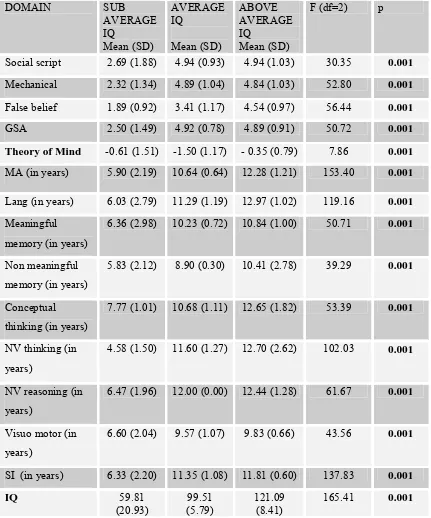
As these groups were principally categorized according to their IQ scores, they were bound to differ significantly on their Intelligence profile and indeed; they differed significantly (P= 0.001) on all domains of Binet Kamat Test of Intelligence. Tests on verbal reasoning domain were not possible with most of the children with sub average intelligence and they were employed only in the other two groups. There was similar significant (P= 0.001) difference among the measures of Picture Sequencing Task, including the mean scores of false belief, social script and mechanical sequences, the general sequencing ability and the selective accuracy measure of Theory of Mind ability. Those results were revealed in table VIII.
Table VIII: Comparison of psychological profile of children among three groups.
DOMAIN SUB
AVERAGE IQ Mean (SD) AVERAGE IQ Mean (SD) ABOVE AVERAGE IQ Mean (SD)
F (df=2) p
Social script 2.69 (1.88) 4.94 (0.93) 4.94 (1.03) 30.35 0.001
Mechanical 2.32 (1.34) 4.89 (1.04) 4.84 (1.03) 52.80 0.001
False belief 1.89 (0.92) 3.41 (1.17) 4.54 (0.97) 56.44 0.001
GSA 2.50 (1.49) 4.92 (0.78) 4.89 (0.91) 50.72 0.001 Theory of Mind -0.61 (1.51) -1.50 (1.17) - 0.35 (0.79) 7.86 0.001
MA (in years) 5.90 (2.19) 10.64 (0.64) 12.28 (1.21) 153.40 0.001
Lang (in years) 6.03 (2.79) 11.29 (1.19) 12.97 (1.02) 119.16 0.001
Meaningful memory (in years)
6.36 (2.98) 10.23 (0.72) 10.84 (1.00) 50.71 0.001
Non meaningful memory (in years)
5.83 (2.12) 8.90 (0.30) 10.41 (2.78) 39.29 0.001
Conceptual thinking (in years)
7.77 (1.01) 10.68 (1.11) 12.65 (1.82) 53.39 0.001
NV thinking (in years)
4.58 (1.50) 11.60 (1.27) 12.70 (2.62) 102.03 0.001
NV reasoning (in years)
6.47 (1.96) 12.00 (0.00) 12.44 (1.28) 61.67 0.001
Visuo motor (in years)
6.60 (2.04) 9.57 (1.07) 9.83 (0.66) 43.56 0.001
SI (in years) 6.33 (2.20) 11.35 (1.08) 11.81 (0.60) 137.83 0.001
IQ 59.81
(20.93) (5.79) 99.51 121.09 (8.41) 165.41
0.001
GSA- General Sequencing Ability; MA- Mental Age; Lang- Language; NV- Non Verbal; SI- Social Intelligence; IQ- Intelligence Quotient.
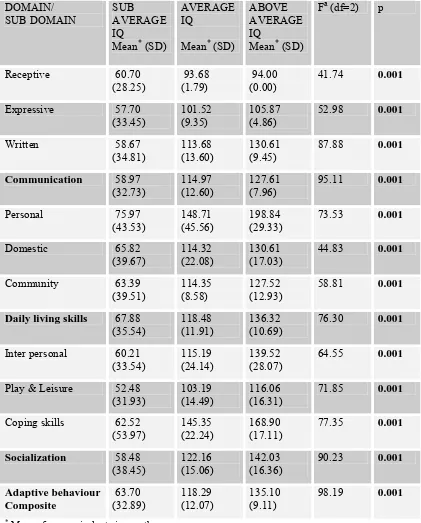
Table IX: Comparison of adaptive profile of children among three groups. DOMAIN/ SUB DOMAIN SUB AVERAGE IQ
Mean* (SD)
AVERAGE IQ
Mean* (SD)
ABOVE AVERAGE IQ
Mean* (SD)
Fa (df=2) p
Receptive 60.70
(28.25) 93.68 (1.79) 94.00 (0.00) 41.74
0.001
Expressive 57.70 (33.45)
101.52 (9.35)
105.87 (4.86)
52.98 0.001
Written 58.67
(34.81) 113.68 (13.60) 130.61 (9.45) 87.88
0.001
Communication 58.97
(32.73)
114.97 (12.60)
127.61 (7.96)
95.11 0.001
Personal 75.97
(43.53) 148.71 (45.56) 198.84 (29.33) 73.53
0.001
Domestic 65.82
(39.67) 114.32 (22.08) 130.61 (17.03) 44.83
0.001
Community 63.39
(39.51)
114.35 (8.58)
127.52 (12.93)
58.81 0.001
Daily living skills 67.88
(35.54) 118.48 (11.91) 136.32 (10.69) 76.30
0.001
Inter personal 60.21 (33.54)
115.19 (24.14)
139.52 (28.07)
64.55 0.001
Play & Leisure 52.48
(31.93) 103.19 (14.49) 116.06 (16.31) 71.85
0.001
Coping skills 62.52
(53.97) 145.35 (22.24) 168.90 (17.11) 77.35 0.001
Socialization 58.48
(38.45)
122.16 (15.06)
142.03 (16.36)
90.23 0.001
Adaptive behaviour Composite
63.70
(32.89) 118.29 (12.07) 135.10 (9.11) 98.19 0.001
* Mean of age equivalents in months
a = Test conducted were Chi-square test for categorical and one-way ANOVA for continuous
5.7. Bivariate correlation between ToM and IQ
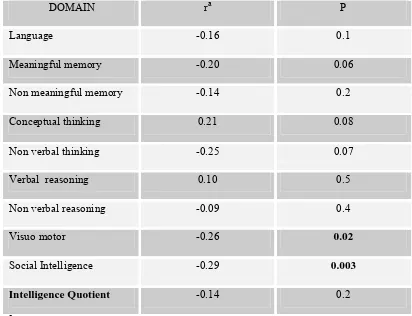
[image:62.612.112.524.314.630.2]When the continuous variables of Theory of Mind and intelligence Quotient were analyzed for their bivariate linear correlation with two tailed Pearson correlation coefficient, there was no significant (P= 0.2) relationship between ToM and IQ. Further analysis for the linear relationship between various domains of intelligence and ToM revealed that ToM had significant correlations with visuo motor (P=0.02) and social intelligence (P=0.003) domains. They were summarized in table X.
Table X: Bivariate correlation between Theory of Mind ability and intelligence domains (N=95).
DOMAIN ra P
Language -0.16 0.1
Meaningful memory -0.20 0.06
Non meaningful memory -0.14 0.2
Conceptual thinking 0.21 0.08
Non verbal thinking -0.25 0.07
Verbal reasoning 0.10 0.5
Non verbal reasoning -0.09 0.4
Visuo motor -0.26 0.02
Social Intelligence -0.29 0.003
Intelligence Quotient -0.14 0.2
5.8. Partial correlation between ToM and IQ
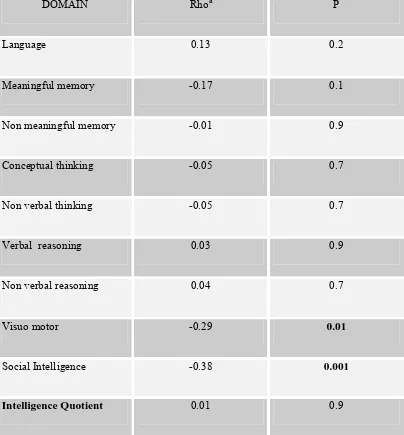
As there were significant differences of socio demographic and adaptive variables among three study groups, partial correlation analysis was carried out while controlling for the effects of chronological age, mother’s age, income, father’s education, Mother’s education, type of schooling, number of siblings and Vineland Adaptive Behaviour Scale Adaptive Behaviour Composite age equivalent. These variables were chosen due to their statistically significant differences and for their importance of being major confounders as shown in review of literature. Partial correlation analysis also demonstrated no significant relationship between Theory of Mind and Intelligence Quotient and between Theory of Mind and most of the domains of intelligence. However, the Theory of Mind’s correlation with visuo motor and social intelligence domains attained more statistical significance with partial correlation.
Table XI: Partial correlation between Theory of Mind ability and intelligence domains (N=95).
DOMAIN Rhoa P
Language 0.13 0.2
Meaningful memory -0.17 0.1
Non meaningful memory -0.01 0.9
Conceptual thinking -0.05 0.7
Non verbal thinking -0.05 0.7
Verbal reasoning 0.03 0.9
Non verbal reasoning 0.04 0.7
Visuo motor -0.29 0.01
Social Intelligence -0.38 0.001
Intelligence Quotient 0.01 0.9
Controlled for chronological age, mother’s age, income, father’s education, Mother’s
education, type of schooling, number of siblings and Adaptive Behaviour Composite age
equivalent.
5.9. Analysis of relationship between ToM and IQ within groups
[image:65.612.115.530.289.626.2]Similar correlation analysis was performed within three study groups. Theory of Mind did not have significant relationship with Intelligence quotient in any group, while accounting for the confounders. In the sub average intelligence group, Theory of mind had significant correlation with non-verbal thinking (P=0.02) and with social intelligence (P=0.003), as revealed in table XII.
Table XII: Partial correlation between Theory of Mind ability and intelligence domains in the sub average intelligence group.
DOMAIN Rhoa P
Language 0.06 0.8
Meaningful memory -0.08 0.7
Non meaningful memory -0.28 0.2
Conceptual thinking -0.75 0.1
Non verbal thinking -0.56 0.02
Verbal reasoning - -
Non verbal reasoning -0.08 0.7
Visuo motor -0.36 0.2
Social Intelligence -0.57 0.003
Intelligence Quotient -0.26 0.2
Controlled for chronological age, mother’s age, income, father’s education, Mother’s education, type of schooling, number of siblings and Adaptive Behaviour Composite age equivalent.
Even if this analysis was further controlled for General Sequencing Ability, Non-verbal thinking domain held (Partial correlation coefficient = -0.65; P= 0.008) more significant correlation with Theory of Mind ability. Similarly, when this partial correlation was further controlled for Vineland Adaptive Behaviour Scale socialization domain age equivalent, Social Intelligence domain still held a significant correlation (Partial correlation coefficient = -0.51; P=0.01) with Theory of Mind ability. How ever, there were no such significant correlations between any domains of intelligence and Theory of Mind ability in average and above average groups. Those results were presented in table XIII and in table XIV.
Table XIII: Partial correlation between Theory of Mind ability and intelligence domains in the average intelligence group.
DOMAIN Rhoa P
Language -0.03 0.8
Meaningful memory -0.26 0.2
Non meaningful memory 0.05 0.8
Conceptual thinking -0.27 0.2
Non verbal thinking - -
Verbal reasoning - -
Non verbal reasoning -0.35 0.09
Visuo motor -0.26 0.2
Social Intelligence -0.03 0.9
Intelligence Quotient -0.27 0.2
Controlled for chronological age, mother’s age, income, father’s education, Mother’s education, type of schooling, number of siblings and Adaptive Behaviour Composite age equivalent.
Table XIV: Bivariate correlation between Theory of Mind ability and intelligence domains in the above average group.
DOMAIN ra P
Language 0.15 0.4
Meaningful memory -0.03 0.9
Non meaningful memory 0.07 0.7
Conceptual thinking -0.29 0.1
Non verbal thinking -0.01 0.9
Verbal reasoning 0.04 0.8
Non verbal reasoning -0.12 0.5
Visuo motor -0.05 0.8
Social Intelligence -0.20 0.3
Intelligence Quotient 0.05 0.8
a Pearson correlation coefficient (two tailed)
#Partial correlation could not be computed in this group.
5.10. Regression analysis of ToM ability
Theory of Mind ability as dependent variable was explored using multiple linear regression analyses with chronological age, monthly income, father’s education, mother’s education, type of school and number of siblings as independent variables, because they were not balanced between groups. Multiple liner regression was considered over the logistic regression because of the large number of confounders that needed control and the participant numbers were inadequate for a logistic regression. Thus the theory of mind was treated as a continuous variable in the regression.