UNIVERSITI TEKNIKAL MALAYSIA MELAKA
Development of an Electronic Board that Identify and Check the
Functionality of the Commonly Used Arduino’s Component
(Assorted Component Checker)
This report is submitted in accordance with the requirement of the Universiti Teknikal Malaysia Melaka (UTeM) for the Bachelor of Electronic Engineering
Technology (Industrial Electronics) with Honours.
by
MOHD ARSHAD BIN AZMAN B071410536
951017-01-5211
BORANG PENGESAHAN STATUS LAPORAN PROJEK SARJANA MUDA
TAJUK: Development of an Electronic Board that Identify and Check the Functionality
of the Commonly Used Arduino’s Component
SESI PENGAJIAN: 2017/18 Semester 1
Saya MOHD ARSHAD BIN AZMAN
mengaku membenarkan Laporan PSM ini disimpan di Perpustakaan Universiti Teknikal Malaysia Melaka (UTeM) dengan syarat-syarat kegunaan seperti berikut:
1. Laporan PSM adalah hak milik Universiti Teknikal Malaysia Melaka dan penulis. 2. Perpustakaan Universiti Teknikal Malaysia Melaka dibenarkan membuat salinan untuk
tujuan pengajian sahaja dengan izin penulis.
3. Perpustakaan dibenarkan membuat salinan laporan PSM ini sebagai bahan pertukaran antara institusi pengajian tinggi.
4. **Sila tandakan ( )
SULIT
TERHAD
TIDAK TERHAD
(Mengandungi maklumat yang berdarjah keselamatan atau kepentingan Malaysia sebagaimana yang termaktub dalam AKTA RAHSIA RASMI 1972)
(Mengandungi maklumat TERHAD yang telah ditentukan oleh organisasi/badan di mana penyelidikan dijalankan)
Disahkan oleh:
Cop Rasmi:
Tarikh: _______________________
** Jika Laporan PSM ini SULIT atau TERHAD, sila lampirkan surat daripada pihak berkuasa/organisasi berkenaan dengan menyatakan sekali sebab dan tempoh laporan PSM ini perlu dikelaskan sebagai SULIT atau TERHAD.
Alamat Tetap:
No 138 Fasa 2 Taman Sri Temenggung
Jln Temg. Ahmad
84000, Muar Johor
i
DECLARATION
I hereby, declared this report entitled “Development of an Electronic Board that Identify and Check the Functionality of the Commonly Used Arduino’s Component” is the results of my own research except as cited in references.
Signature : ……….
Author’s Name : Mohd Arshad Bin Azman
ii
APPROVAL
This report is submitted to the Faculty of Engineering Technology of UTeM as a partial fulfillment of the requirements for the degree of Bachelor of Engineering Technology (Industrial Electronic) (Hons.). The member of the supervisory is as follow:
iii
ABSTRAK
iv
ABSTRACT
v
DEDICATION
vi
ACKNOWLEDGEMENT
Bismillahirrahmanirrahim,
Alhamdulillah. Thanks to Allah SWT, who with His willing give me the opportunity to complete Bachelor Degree Project with title “Development of an Electronic Board that Identify and Check the Functionality of the Commonly Used Arduino’s Component”. This bachelor degree project was prepared for Universiti Teknikal Malaysia Melaka (UTeM), basically for student in final year to complete the undergraduate program that leads to the degree of Bachelor of Engineering Technology (Industrial Electronic) (Hons.). This report is based on the methods given by the university.
vii
TABLE OF CONTENT
Declaration i Approval ii Abstrak iii Abstract iv Dedication v Acknowledgement vi
Table of Contents vii
List of Tables x
List of Figures xi
List of Abbreviations, Symbols And Nomenclature xiii
CHAPTER 1: INTRODUCTION 1
1.0 Introduction 1
1.1 Background Study 1
1.2 Problem Statement 2
1.3 Objectives 3
1.4 Scope of Work 4
1.5 Project Contribution 5
CHAPTER 2: LITERATURE REVIEW 6
2.0 Introduction 6
2.1 Component Used 6
2.1.1 Arduino Mega 2560 6
2.1.2 Light Emitting Diode(LED) 7
2.1.3 Buzzer 8
2.1.4 Resistor 9
2.1.5 7-Segment Display 10
2.1.6 Round Pin Female Header 11
2.1.7 Liquid Crystal Display(LCD) 12
viii
2.1.11 Water sensor 16
2.1.12 Light Dependent Resistor(LDR) 17
2.1.13 Joystick 18
2.1.14 Humidity Sensor 19
2.1.15 LM35 Temperature Sensor 20
2.1.16 Servo Motor 21
2.1.17 Push Button 22
2.1.18 RG LED 23
2.2 Related Project 24
2.2.1 Component Tester 24
2.2.2 Transistor Tester 25
2.2.3 IC Tester 26
2.2.4 Digital Multimeter 27
CHAPTER 3: METHODOLOGY 28
3.0 Introduction 28
3.1 Flow of Project 28
3.2 Project Layout 33
3.3 Block Diagram of ACC 34
3.4 Estimated Cost 35
3.5 Circuit Simulation 36
CHAPTER 4: RESULT & DISCUSSION 38
4.0 Introduction 38
4.1 Result Testing Hardware 38
4.1.1 Ultrasonic Sensor 38
4.1.2 Servo Motor 40
4.1.3 Buzzer 41
4.1.4 RGB LED 42
ix
4.1.6 LM35 45
4.1.7 Humidity Sensor 46
4.1.8 Seven Segment 47
4.1.9 Resistor 48
4.1.10 Joystick 49
4.1.11 LDR Sensor 50
4.1.12 Push Button 51
4.1.13 RG LED 52
4.1.14 LED 53
4.2 Data Analysis of Survey 54
CHAPTER 5: CONCLUSION & RECOMMENDATION 61
5.1 Conclusion 61
5.2 Recommendation 62
REFERENCES 63
APPENDICES
1 Arduino Mega2560 Data Sheet 2 Servo Motor Data Sheet 3 LM35 Data Sheet
4 Seven Segment Data Sheet 5 Ultrasonic Sensor Data Sheet 6 Joystick Data Sheet
x
3.1 Estimated Cost 35
3.2 Pins Connection table 36-37
4.1 Ultrasonic sensor tested result 38-39
4.2 Servo motor tested result 40
4.3 Buzzer tested result 41
4.4 RGB LED tested result 42-44
4.5 Water sensor tested result 44-45
4.6 LM35 tested result 45-46
4.7 Humidity sensor tested result 46-47
4.8 Seven segment tested result 47-48
4.9 Resistor tested result 48-49
4.10 Joystick tested result 49-50
4.11 LDR sensor tested result 50
4.12 Push Button tested result 51
4.13 RG LED tested result 52-53
xi
LIST OF FIGURES
2.1 Arduino Mega2560 7
2.2 Light Emitting Diode(LED) 7
2.3 Buzzer 8
2.4 Resistor 9
2.5 7-segment display 10
2.6 Female header 11
2.7 Liquid Crystal Display(LCD) 12
2.8 Keypad(4x4) 13
2.9 RGB LED 14
2.10 Ultrasonic sensor 15
2.11 Water sensor 16
2.12 Light Dependent Resistor(LDR) 17
2.13 Joystick 18
2.14 Humidity sensor 19
2.15 LM35 sensor 20
2.16 Servo motor 21
2.17 Push Button 22
2.18 RG LED 23
2.19 Prototype of Component Tester in Year 2013 24 2.20 Prototype of Transistor Tester in Year 2015 25
2.21 IC Tester in Year 2015 26
2.22 Digital Multimeter 27
3.23 General Flowchart of ACC operation 29
3.24 Flowchart function of ACC 30
3.25 Project Layout 33
3.26 Block Diagram of ACC 34
3.27 Circuit Simulation 36
4.28 First question in survey form 54
xii
4.32 Fifth question in survey form 57
4.33 Sixth question in survey form 58
4.34 Seventh question in survey form 59
4.35 Eighth question in survey form 59
4.36 Ninth question in survey form 60
xiii
LIST OF ABBREVIATIONS, SYMBOLS AND
NOMENCLATURE
ACC - Assorted Component Checker RGB LED - Red, Green, Blue LED
LDR - Light Dependent Resistor RG LED - Red, Green LED
LED - Light Emitting Diode LCD - Liquid Crystal Display TFT - Thin-Film Transistor
EPB - Electromagnetic Passive Buzzer PIR - Passive Infrared sensor
UART - Universal Asynchronous Receiver-Transmitter USB - Universal Serial Bus
ICSP - In-Circuit Serial Programming PWM - Pulse Width Modulation MHz - Mega Hertz
GND - Ground
BJT - Bipolar Junction Transistor FET - Field Effect Transistor IC - Integrated Circuit
ISP - In-System Programmable
MOSFET - Metal Oxide Semiconductor Field Effect Transistor NPN - Negative-Positive-Negative
1
CHAPTER 1
INTRODUCTION
1.0 Introduction
The aim of this chapter is to create the framework of this project. All the requirements needed to be achieve at the end of the associated project. The background of this project will be described briefly. Thus, entire structure of the project is accurately being described. In this chapter, the topics that will be clearly stated about this project such as problem statement, objectives, scope of work and project contribution.
1.1 Background Study
According to TheFreeDictionary.com (2003), electronic component is a component which can amplify or control voltages or currents without mechanical or other nonelectrical command, or to switch currents or voltages without mechanical switches; examples include electron tubes, transistors, and other solid-state devices. Based on Analysts, (2017) the global market of electronic component is projected to reach US$191.8 billion by 2022 that cause by highly needed electronic in modern life. Due to that, people nowadays tends to create new device by using the electronic component.
2 This project aims to create an electronic component tester board named Assorted Component Checker (ACC) that have the ability to check the functionality of 14 commonly used electronic component for Arduino project.
1.2 Problem Statement
Most of the commercial electrical appliances sell in the retail shop can be tested their functionality at the retail shop after purchasing their appliances. But when it comes to purchasing the electronic components, there is no option to test the components at the shop. From this, it can be said that there is no guarantee that all the appliances are in good condition.
Besides that, for a simple component might be easy to test. For examples, an LED can easily be tested by using a simple electrical circuit. If the LED is turns ON when tested on the circuit, it means that LED is in good condition and if not, that LED is in bad condition. Meanwhile for TFT, it required a complex circuit connection and source code to test it functionality.
3 The objectives for this project are:
1. To design a proof of concept a trainer kit that can test 14 type of components. The design of trainer kit consists of two parts. First part is external hardware design. This part is about designing the casing of the trainer kit. The second part is internal hardware design which consists of electronic circuit and software design which consist of source code.
2. To build the proof of concept of the compatible that is 8cm x 12 cm and low cost that is less than RM300 educational kit that using Arduino Mega as the controller. The external casing will be the plastic. It is because it easy to cut. It also cheap compare to the other material. So the cost of the project can be reduced. The microcontroller is Arduino Mega 2560. It is because Arduino Mega 2560 more cheaply compare to other microcontroller such as Raspberry Pi.
3. To verify the functionality of the trainer kit by demonstrating it in experiment to expert which are lecturers. This will be done by testing one by one of the component on the kit and see the output results that is follow the expected output or not.
4 1.4 Scope of Work
This project utilizes LCD 20x4 just as the output. The component that can be test is 14 just that is LED, resistor, RGB LED, LDR sensor, joystick, seven segment, ultrasonic sensor, push button, Electromagnetic Passive Buzzer (EPB), RG LED, LM35 sensor, humidity sensor, water sensor and servo motor. All component part that needs to be test is the input of this project. Another main part is the keypad that will help the user effortlessly handle this project.
There is limitation in designing the external hardware. The material that used to make this external hardware is Polyvinyl chloride (PVC). It is because PVC is easy to cut. It also cheap compares other material. So, the cost of the project can be reduced. PVC is a lightweight material. The user will easy to carry this educational kit. The dimension size of this project is 8cm x 10cm. I choose this dimension size because it enough to represent the entire component for my Final Years Project.
This project just covers five kind of sensor that is ultrasonic sensor, LDR sensor, humidity sensor, water sensor and LM35 sensor. In addition, the project also includes a common cathode of seven segment and RGB LED.
5 Based on the first problem statement, it states that the user need to test their electrical appliances at the retail shop to check the functionality. So, this ACC project can overcome this problem because this project is easily to be used which means the user can bring their electrical appliances back to home and test it by using ACC.
For the second problem statement, it states that a simple component such as LED can be check easily while the complex component such as TFT is hardly to check by using simple circuit. By using ACC, the user didn’t have to worry about that because this ACC project can check the functionality of the complex component.
6
CHAPTER 2
LITERATURE REVIEW
2.0 Introduction
Literature review is an important part before commencing any project. It provided all information needed based on your project and the correct way to develop your project so that the project can perform depends on what you needed. For this chapter, we will have explained the component or equipment that we use in the project and the related past project.
2.1 Component Used
2.1.1 Arduino Mega 2560
Based on Arduino.cc, (2017), “Arduino Mega 2560 is microcontroller board that consists 54 digital input/output pins which 15 pins can be use as PWM outputs,16 analogue inputs,4 UARTs (hardware serial ports), a 16 MHz crystal oscillator, a USB connection, a power jack, an ICSP header, and a reset button”.
7 Figure 2.1: Arduino Mega2560 (Arduino.cc, 2017).
2.1.2 Light Emitting Diode (LED)
According to Merriam-webster.com, (2017) ,“LED is a semiconductor that emits light when voltage is supply to it and this led is usually used in electronic devices”.
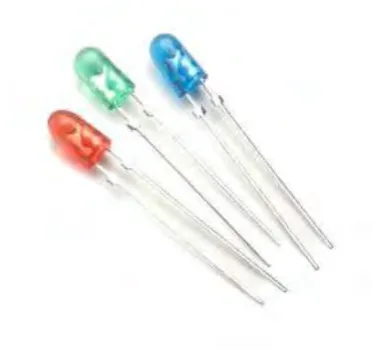
In this project, LED is used as one of the component that will be tested and the LED colour we used to be blue, red and green. Figure 2.2 shows the led that used.
[image:22.595.232.419.541.716.2]8 2.1.3 Buzzer
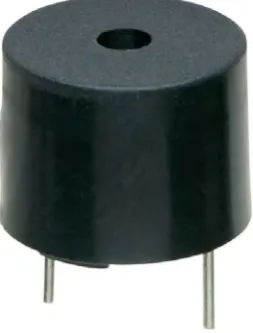
According to Futureelectronics.com, (2017) ,“A buzzer is a mechanical, electromechanical, magnetic, electromagnetic, electro-acoustic or piezoelectric audio signalling device. A piezo electric buzzer can be driven by an oscillating electronic circuit or other audio signal source. A click, beep or ring can indicate that a button has been pressed.”.
[image:23.595.256.383.352.519.2]In this project, buzzer also one of the component that we will tested. We choose this buzzer because the sound produced by this buzzer can notify the user that the buzzer is working properly. Figure 2.3 shows the buzzer that we used.
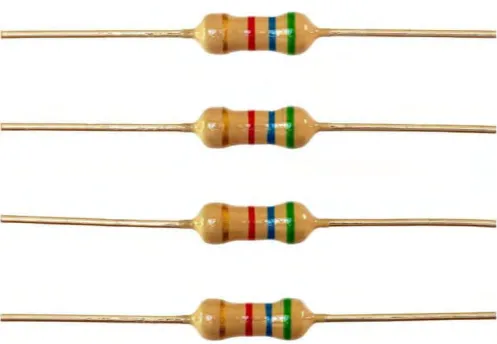
9 According to Allaboutcircuits.com, (2005), “Resistor is an electrical component that reduce the electric current. They are typically constructed of metal wire or carbon, and engineered to maintain a stable resistance value over a wide range of environmental conditions”.
[image:24.595.194.443.300.472.2]For this project, resistor acts as the input where the value of resistor is being read and as to complete the connection of LDR sensor. Figure 2.4 shows the resistor used in this project.