By
M. V. D. CHANDRARATNA
B.A.(Ceylon); M.Soc.Admin(Flinders, S.A.); M.A.(Sheffield, U.K.).
Submitted in fulfilment of the requirements for the decree of
Doctor of Philosophy University of Tasmania
organizations is obvious, but I must especially acknowledge the help given by those officers who underwent social work training at some point in the course of the study. From them
I gathered the most. Theoretical proficiency in itself is insufficient unless grounded in experience and I benefitted
by the experience of those officers in addition to my involvement in doing this research. My role as a fieldwork educator
facilitated access to the main organizations.
My supervisor, Dr. R. J. K. Chapman has always been a constant source of help and encouragement. To him I am deeply grateful.
I would also like to thank Mr. A. W. Jamrozik, Head of the School of Social Work, Tasmanian College of Advanced Education, for reading and commenting on the manuscript. I have also
benefitted from the Staff at the Institute of Criminology, University of Sheffield in many ways. During the year I was at the University of Sheffield I was fortunate in being able to discuss with a
professional groups involved in the personal services which are designed to mould, remould, and adjust the social and psychological wellbeing of a large proportion of the population, have demanded a comprehensive approach to serving their clients. This is a
resultant of a recognition of social problems in a new light,
dependent upon the increased knowledge and skill of the professional experts as well as a felt gap in the amelioration of such social problems. This study has identified the latter problem as
belonging to the area of interorganizational coordination and as deserving of careful and detailed study. Evidence is gathered to show that it is an area of concern to the professionals in the field, welfare administrators, as well as to the sociologists
interested in social welfare.
By
using existing literature on the sociology of organizations, the concept of coordination has been treated as embodying thoseinteractions between organizations whi.ch are of a facilitative nature. Along the conventional paradigms of problem oriented sociological research three types of variables, namely, analytic
(information about members), structural (information about relations among members and the frameworks within which such relations occur), and global (information about systems of organizations), have been
substantive area of sociology commonly designated as 'inter-organizational relations'. Moreover, the usefulness of major theoretical perspectives in sociology, such as
structural-functionalism, exchange theory and systems theory has been demonstrated in relating the different variables to the theory. From the refined theoretical framework twelve hypotheses were enunciated to test out empirically the nature of coordinating networks in three welfare organizations in Hobart.
The results of the empirical study have shown the
extent and intensity of facilitative interorganizational interactions that take place in the welfare scene in Hobart, seen from the
vantage points of the three organizations included in the study. It has also shown how the efforts of the workers in the three organizations resulted in a network of both private and public organizations, whose function, program, and the strength of the
interaction could be fully understood in terms of the essentials of the postulated theory. We have seen that the differential emphasis given to outside transaCtions has many antecedent
variables, analytic, structural, as well as global. For example, there was ufficient evidence to argue that lines of authority, notions of hierarchy, control of decision making power, combined
with individual attributes of workers, moulded not only the internal dynamics of an organization, but outside exchanges as well. There was a negative association between organizational attributes such as hierarchy and centralized decision making,
and interorganizational behaviour of employees. The professionally qualified workers in the two main organizations studied regarded the presence of such organizational guidelines as less valid for them than the dictates of their own professional training. Furthermore, professional expertise as demonstrated by credentials and performance did not necessarily mesh with the rationality of the 'bureaucracy' as exemplified by the actions of managers
in the area of coordination. The use of the exchange perspective and systems theory helped to explain the phenomenon of
10
coordination as a two-way process between organizational structureand environment rather than a passive result of environmental or organizational determinism. Most significantly, the study of welfare organizations has revealed the intriguing nature of their loose but productive structures and their impact on the behaviour of organizational employees. It is an organizational theory that takes account of such diversity in forms that can
instill a common frame of reference to sociologists interested in the study of organizations.
The study consists of Ls7e\-/l chapters. The first three chapters are primarily theoretical. The third chapter is the culmination of arguments developed in the preceding chapters and deals with the classification, refinement, and systematization of
six describe and analyse the data from the three organizations and use some statistical techniques in the testing out of the
hypotheses. The'-final chapter draws out the implications of the study. As anticipated in chapter one, the study clearly points out the strains and problems produced by the growing expansion of social welfare and the demand for a comprehensive approach to the treatment of clients. In the final chapter,
submitted for a degree of diploma in any
University; and that to the best of my knowledge and belief it does not contain any material
previously published or written by another person except where due reference is made in the text.
TABLE OF CONTENTS
Page ACKNOWLEDGEMENTS • • • • • • (iii)
ABSTRACT • • • • . . (v)
LIST OF TABLES . • • • • • (xiv)
LIST OF ILLUSTRATIONS .. .. • • • (xvii)
Chapter I STATEMENT OF PURPOSE: INTERORGANIZATIONAL COORDINATION AS AN AREA OF CONCERN
1.1 Introduction • • • • . I
1.2 Conceptions of Social Welfare . 2 1.3 Troubles and Issues--A Change in
Orientation .. 00 40 .0 0. 00 13
1.4 Practitioners and Interorganizational
Coordination .. 0. .0 e0 00 20
1.5 Interorganizational Coordination as an
Administrative Strategy .0 O. 26
1.6 Research into Welfare Organizations:
Current Trends O. • 30
1.7 Summary 00 • 41
Chapter 2 DEFINITION OF TERMS AND REVIEW OF LITERATURE PERTAINING TO INTERORGANIZ-ATIONAL COORDINATION
2.1 Introduction 44
2.2 Definition of Interorganizational
Coordination . .0 .. O. • .0 45
2.3 Directions in Previous Studies . 53 2.4 Structural Functional Analysis and
Interorganizational Coordination . . 63 2.4 (a) Fallacies of Reductionism • • 63 2.5 Analytic Properties .. .0 • 65
2.5(c) Informal Power of Lower Participants 74 2.5(d) Orientation of Executive Cadre . 77 2.6 Structural Properties • • • • • • • • •• . 80 2.6(a) Organizational Goals . . 82 2.6(,b) Resources . • • .. .. . 88 2.6(c) Client Careers • • • • • • . . 91 2.6(d) Age of Organization . •• • • • • • 96 2.6(e) Internal Structure and Diversity . . 101 2.7 Global Properties .. .. • . 103 2.8 Social Exchange Theory .. .. .. .. 105 2.8(a) The Principle of Social Scarcity . 106 2.8(b) The Principle of Reciprocity . . 107 2.8(c) Exploitation and Power .. .. 109 2.8(d) Social Exchange and Social Solidarity 115 2.9 The Systemic Analysis .. 117 2.9(a) The Theoretical Orientation • • 117 2.9(b) Structure of the Interorganizational
System .. 119
2.9(c) Process .. 125
2.9(d) Location and Role of Units vis-A-vis
Other Units 128
2.9(e) Interorganizational Linkage Mechanisms 130 2.10 Summary •
•• • • • • 132
Chapter 3 TOWARDS A THEORY OF COORDINATION
3.1 Building a Typology of Variables . .. . . 134 3.2 Basic Dimensions and Analytic Properties . . 139 3.3 Basic Dimensions and Structural Properties . . 145 3.4 Basic Dimensions and System Properties . . 150 3.4(a) Control Process Variables .. .. . 150 3.4(b) Performance Variables .. • • • . . 154 3.5 General Notes Regarding the Typology .. 160 3.6 Summary . .. .. .. .. .. • • .. 166
Chapter 4 INTERORGANIZATIONAL COORDINATION IN THREE WELFARE ORGANIZATIONS: RESEARCH PROCEDURE AND DESIGN
4.1 The Research Setting . . 167 4.2 Research Instruments .. .. 00 • 0 178
4.3 Hypotheses of the Study and the Operational
Procedures . .. 00 SO S. 184
4.4 Analytic Properties .. .. 188 4.5 Structural Properties . .. .. 198 4.6 Global Properties • • • • 205
4.7 Conclusion • • . . 208
Chapter 5 INTERORGANIZATIONAL COORDINATION: ANALYSIS OF DATA FROM THREE ORGANIZATIONS
5.1 Introduction .. • .. • 210 5.2 General Variables .. SO 410 O. SO 2T4
5.2(a) The Number of Organizations in the
Network .. 215
0 5.2(b) Auspice of Organizations in the
Network .. • • .. .. .. 224 5.2(c) Functions of Organizations in the
Network .. 00 00 S. 00
5.2(d) Frequency of Contacts .. 242 5.2(e) Intensity Levels of Coordination
in the Network 248
5.3 Summary and Conclusion • • • • • 258
Chapter 6 1NTERORGANIZATIONAL COORDINATION: TESTING OF HYPOTHESES
6.1 Introduction .. . • • • • • • • • 261 6.2 Analytic Properties .. • . • .. 262 6.3 Structural Properties . • .0 0. 285
6.4 Structural and Analytic Properties--A
Concluding Comment 00 00 00 O. • 297
6.6 Conclusion •• • • •• •• • • •• 317
Chapter 7 CONCLUSIONS, ASSESSMENT AND IMPLICATIONS OF THE STUDY
7.1 Introduction • • • •• •• •• •• •• 319
7.2 Research Findings .. • • •• •• •• 321
7.2(a) Building a Theory of Coordination •• 321
7.2(h) General Variables .. •• • •• 324
7.2(c) Hypotheses of the Study . •• 326
7.2(d) The Role of Management . •• 329
7.2(e) The Form of Organization . . • • 333
7.3 Measurement, Reliability and Bias • • • • 338
7.4 Implications of the Study .. • • 346
APPENDIX A QUESTIONNAIRE AND SEMI-STRUCTURED INTERVIEW
WITH WELFARE WORKERS .. • • • 354
APPENDIX B SEMI-STRUCTURED INTERVIEWS WITH SUPERVISORS
AND OTHER MANAGERS • • • • 363
APPENDIX C PEARSONIAN CORRELATION VALUES AMONG VARIABLES--
DEPARTMENT OF SOCIAL WELFARE .. 366 APPENDIX D PEARSONIAN CORRELATION VALUES AMONG VARIABLES--
URBAN AND RURAL DIVISIONS OF AUSTRALIA,
1947-1971 ..
• • • 377
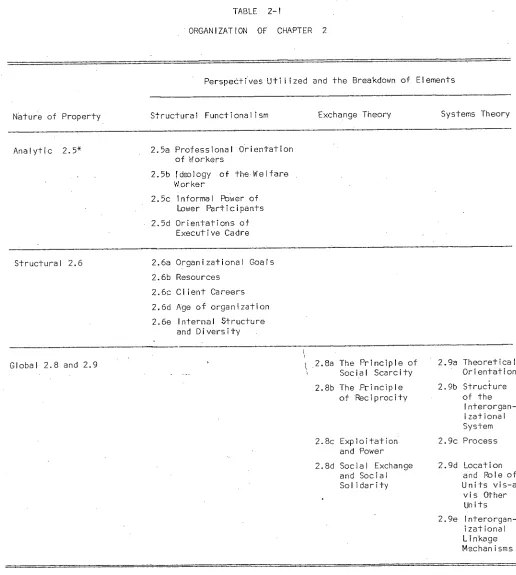
2.1 Organization of Chapter 2 • OS 00 • 46
2.2 Hypotheses Relating Client Careers .to
Organizational Interests .. • 94
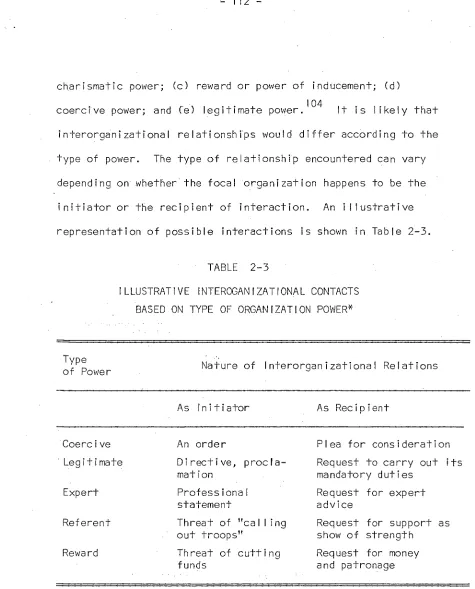
2.3 Illustrative Interorganizational Contacts Based
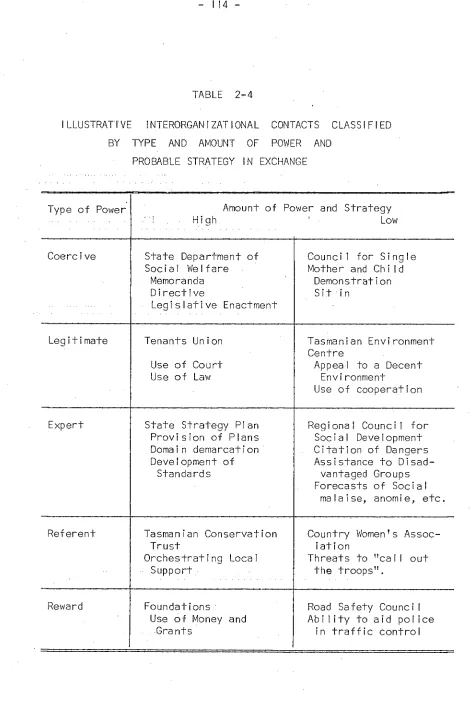
on Type of Organization Power .. 112 2.4 Illustrative Interorganizational Contacts
Classified by Type and Amount of Power and
Probable Strategy in Exchange .. 114 2.5 Differences between People Processing Organizations
and People Changing Organizations .. 00 00 127
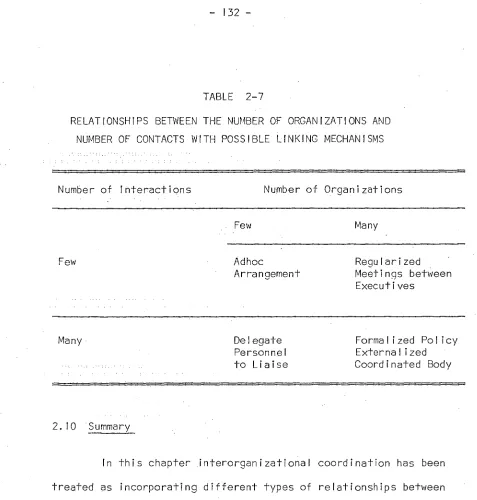
2.6 Linkages in Organizations .. • .. 131 2.7 Relationships between the Number of Organizations
and Number of Contacts with Possible Linking
Mechanisms • • • • • • • • • • • • • • • • • 132 3.1 Classification of Analytic Properties in Terms
of Four Basic Dimensions .. 00 80 SO 140
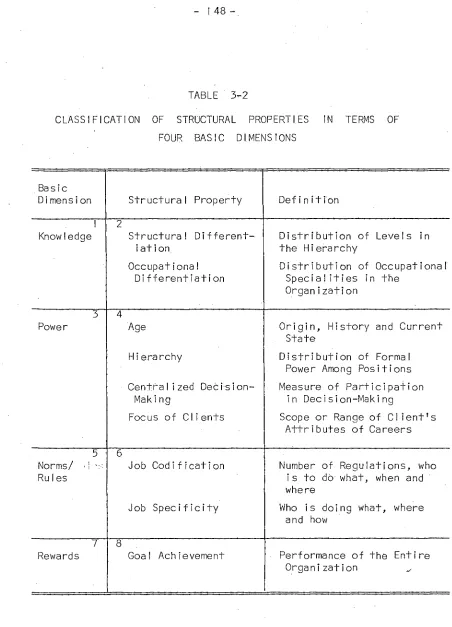
3.2 Classification of Structural Properties in Terms
of Four Basic Dimensions 148
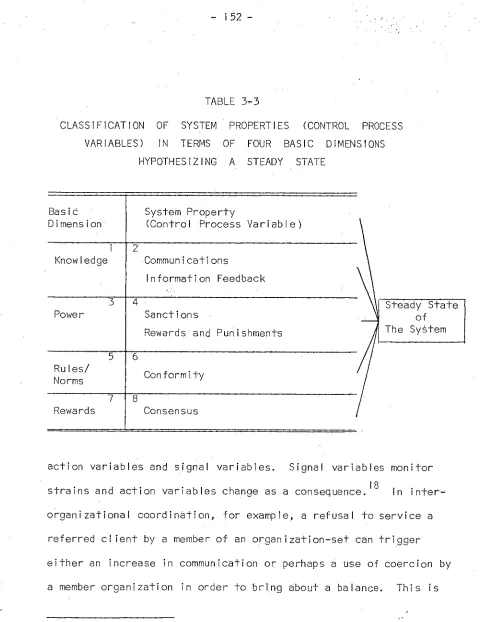
3.3 Classification of System Properties (Control Process Variables) in Terms of Four Basic
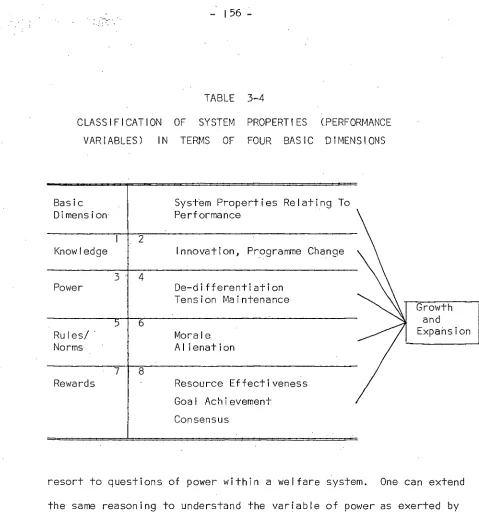
Dimensions Hypothesizing a Steady State . 152 3.4 Classification of System Properties (Performance
Variables) in Terms of Four Basic Dimensions 156 3.5 Bureaucratic and Interorganizational Patterns as
Depicted by Clark .. 165
4.1 Examination of the Theory of Coordination: Variables
[image:14.568.46.527.40.802.2]4.2 Observed Relationships between Domain
Consensus and Input Constituency .. .. . .. 207 5.1 Number of Organizations Contacted by the
Welfare Workers .. .. •• •• •• . . 215 5.2 Number of Voluntary Welfare Organizations
Started in Southern Region of Tasmania since
1950 ... .. .. .. .. .. .. .. .. .. . . 219 5.3 Voluntary Organizations Formed since 1975 and
their Objectives .. .. .. .. .. .. .. .. 222 5.4 Number of Organizations Contacted by PPS
Classified as Auspice .. .. .. .. • .. . . 226 5.5 Number of Organizations Contacted by DSW
Classified as Auspice .. .. .. .. • .. . . 227 5.6 Number of Organizations Contacted by DIAS
Classified as Auspice .. .. • .. . . 228 5.7 Distribution of Contacted Organizations by
Function .. .. .. .. ... .. .. .. • . 236 5.8 Distribution of Contacted Organizations by
Generic Function .. .. .. .. .. .. .. . . 237 5.9 Frequency of Contacts Classified by Auspice . . . 242 5.10 Frequency of Contacts Classified by Auspice and
the Number of Organizations .. •• 243 5.11 Classification of the Welfare Workers by the
Conception of Social Welfare Function •• • 246 5.12 Frequency of Contacts by Intensity Levels •• 250 5.13 Proportion of Government Finance in Voluntary
Organizations 251
5.14 Relationship Between Intensity Level and Auspice
of Contacted Organization 255
6.1 Product-Moment Correlations Between Awareness and Organization Contacts, Controlling for Intensity
Level. •• •• •• •• •• •• •• •• •• 263
6.2 Correlations Between Awareness and Contacts
Controlling for Auspice ... • 264 6.3 Comparison of Organizational Scores and Professional
Scores Controlled for the Variables of Awareness
and Contact Levels 271
6.4 Ratio of Informal to Formal Communications Associated with Intensity Levels I and 2
Controlled for Auspice .. • .. 275 6.5 Relationship Between Awareness of Supervisors
and Contacts by Welfare Workers .. 279 6.6 Degree of Complexity and Organizational Contacts 288 6.7 Correlation of Formalization Indices with
Interorganizational Contact Variates • • 291 6.8 Correlation of Centralized Decision Making Index
with Interorganizational Variates 293 6.9 Correlation Between Number of Long Term Clients
LIST OF ILLUSTRATIONS
Figure Page
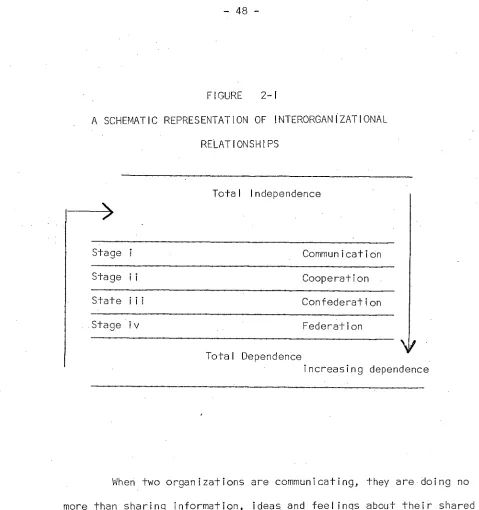
2.1 A Schematic Representation of Interorganiz-
ational Relationships .. • 48 4.1 Administrative Structure of the Department of
Social Welfare .0 04 00 O. 00 170
4.2 Administrative Structure of the Probation and
Parole Service .. 175
6.1 Process Leading to Level Three Interactions 263
Map
4.1 Map of Tasmania with Regional Divisions of the
Department of Social Welfare • .. 169 4.2 Map of Tasmania with Regional Divisions of the
INTERORGANIZATIONAL COORDINATION AS AN AREA OF CONCERN
1.1 Introduction
Social welfare deals with one of the most compelling issues of human wellbeing in modern industrial societies. In keeping with the recent rediscovery of social problems in a new light it is no exaggeration to call institutionalized social welfare as a social movement in its own right. The obvious consequence has been the bureaucratization of 'personal social services'. The personnel
involved in the delivery of social services have demanded a
of this chapter is to demonstrate the importance of that neglected area of interorganizational coordination to the professionals in the field, welfare administrators, as well as to the sociologists
interested in social welfare.
1.2 Conceptions of Social Welfare
One of the most difficult tasks in social analysis is the demarcation of various social systems within a society. Human activities are so interconnected and interdependent as to give any society the character of a seamless web. Given the somewhat seamless character of the web of interdependence it is difficult to break up the totality of interaction into manageable complexes. The problem seems further complicated when we consider the fact that the boundaries between various action systems vary from society to society. In one society we may find, for example, a clear
definition of economic and political functions whereas in another the two functions may fuse together considerably. 1
Sociologists have tried to overcome the above mentioned difficulty by developing a list of functions common to all social systems. Thus the sequence of acts that have an economic character would comprise the economic system and the system of actions
comprising all of those elements that have a political character would be the political system. The separation of functions in this manner permits the use of analytical boundaries, rather than natural boundaries to examine a social system. Through a clear definition of functions one can begin to understand the inter-relationships of content; for what interests us is the content of that reality. Perhaps, the form and content may not always be
intrinsically separate, yet they are recognizable in analysis.
All human societies demand the satisfactory performance of certain essential social functions. The content of such basic social functions such as child rearing, production, consumption, and distrib-ution of goods and services tends to be defined not entirely by the parties to the contract but by the norms and sanctions of a larger social system. The norms and sanctions governing a particular social function which remain stable or constant over time are called an institutionalized set of principles, or, in short, an institution. 2
Institutions are the networks of relationships that determine the accepted way of carrying out these essential social functions and
implied in that statement is the idea of a social constraint. Collective ways of acting and thinking have a reality outside the
individuals who make up that social system.
There is no single institution, however, that is the total guardian of any social function and, by way of example, Gilbert and Specht remark that:
"while the primary institution f6r, socialization in our society is the family, it is by no means the only one. Religious and educational organizations and social service organizations also assume some responsibilities for socialization, but this is not the primary or core function of these institutions". 3
The social scientist in fact does recognize that only a minority of social institutions in today's society is consciously
procedures, the institution permits contracts by either narrowing the range or establishing a basis for negotiation. The
institution thereby allows negotiators to form alliances without resorting to the creation of a complete social struc- ture anew. Emile Durkheim,
The Division of Labour in
Society,
trans. and ed., George Simpson, (New York: The •Macmillan Company, 1933), Ch. 7, pp. 220-229. Emile
Durkheim,
The Rules of Sociological Method,
(New York: Free Press, 1964), pp. xvi-xviii and xxii.3. Neil Gilbert and Harry Specht,
Dimensions of Social Welfare
Policy,
(Englewood Cliffs, New Jersey: Prentice-Hall,designed while the majority has just grown as the undesigned results of human actions. Obviously therefore one has to accept that social
institutions have a functional or an instrumental value as means to the attainment of certain invaluable social ends. Popper reminds us that they should be studied and analyzed "as machines rather than as organisms". 4
The major institutional activities of a society may be analytically separated into five categories--production;
distribution and consumption; socialization; social control;
social integration; and mutual support. Table I-I is a diagrammatic representation of the:essential social functions carried out by the major institutions in any society.
4. Viewed in a historical perspective the two views--that social institutions are either "designed" or that they just "grow"-- correspond to the functionalist and the evolutionalist views. However, the functionalists claim that even the "undesigned" social institutions may emerge as unintended consequences of rational actions. Arguments about the questions of origin are quite independent of the questions as to their role
TABLE 1-1
SOCIAL FUNCTIONS, INSTITUTIONS, AND INSTRUMENTALITIES
MAJOR KEY
SOCIAL FUNCTION INSTITUTION INSTRUMENTALITY*
Socialization Family+ Family
Integration Religion Church
Production, Distribution,
and Exchange Economy Firm
Social Control Polity Government
Mutual Support Social Welfare Welfare Organization
Key instrumentality is the major organization or apparatus that is identified with the particular social function.
'The Family' as a social institution does not designate a palpable phenomenon here. It refers to a set of ideas, norms and sanctions about a particular social construct within which men and women relate to each other. These normative principles set guidelines as to the territory within which actions occur; the number of persons who occupy that
It is easy to understand that, as societies become differentiated, there is a tendency to evolve new institutions specializing in functions that were originally in the domains of the existing institutions. 5 For example, in Table I-1, the first four functions, institutions and instrumentalities have been generally accepted as key structural components of every social system. This
is because these are the essential stable conditions of social action, and, as such, contribute to the uninterrupted functioning of social systems. The key instrumentality mentioned in Table I-I against each main institution is the main organizational structure through which the stipulated social function is carried out. This
does not suggest that any other organization is prohibited from contributing some activity. To elaborate the above argument
further, formal government, for example, is the main instrument of
social control but many other social units including the family, church, work organizations, and social agencies may also contribute significantly to the social control function.
5. The term institution is conceptualized at two levels of
abstraction. It can be used to mean a particular organization such as a business organization carrying out economic functions; or the sum of all organizations, norms, procedures, and
In Table I-1 the most problematic of all social institutions is social welfare. The core function that it is responsible for, namely, mutual support may occur through a variety of institutions and, in simple societiesj it has been, and still is so. As societies become complex, organizations develop specially to carry out mutual support activities, such as voluntary agencies and government.
Titmuss has pointed out that the Increasing division of labour in modern society and the increasing differentiation of
roles, statuses, organizations and situations lead to new categories for concern.6 It is also true that as we make finer distinctions among types of people and their situations there is an inevitable pressure to expand the supportive services of the welfare
state and the inevitable growth of the institution of social welfare. Gilbert and Specht argue with reason, therefore, that "a comprehensive listing of social functions appropriate to contemporary industrialized societies should include the
institution of social welfare which is that patterning of relationships which develops in society to carry out mutual
The demarcation of social welfare as a separate 'social institution'--a synonym for a system process--is complicated by its funct4onal diffuseness. While the other accepted institutions of society carry out social functions which overlap only at the periphery, social welfare tends to be "defined in terms that are
7. Gilbert and Specht,
Social Welfare Policy,
p. 5. Durkheim also noted that a consequence of an increasingdifferent-iation was the need for coordinating and solidifying the interactions among individuals whose interests become prog-ressively diversified. Although Durkheim locates this
integration largely in the institution of the legal structure, similar integrative forces are discerned elsewhere in society. Social Welfare is one such institution. See Durkheim,
The Division
of
Labour,
p. 131 and pp. 353-354.8. See Kenneth Boulding, "The Boundaries of Social Policy",
Social Work,
12,1 (January 1967): pp. 3-11, for anemphasis on integrative elements; Richard M. Titmuss,
Commitment to
Welfare, (London: George Allen & Unwin,1968), Ch. 16, pp. J88-200, for an emphasis on distributive and consummatory elements in social welfare. Admittedly, a truly analytical scheme that permits derivation of . the
multiplicity of functions in any social institution is the one proposed by Parsons. According to him the basic functions of any institution would be adaptation, goal attainment,
relative to and dependent upon the other institutional functions". 9 If we subscribe to such a . derivative notion it becomes slightly inappropriate to list alongside other primary functions of society.
The definition of social welfare in relative terms infers that societies have bigger investments in the other social
institutions, for social order is assumed to weigh heavily on their proper performance. It is true that some social groups and
ideologies are served better by devaluing the function of social welfare and hence we should not be surprised if some social
theories fail to emphasize its significance. This is an issue that has immediate consequences for social progress and in social welfare literature it is debated under the rubric of residual versus institutional orientations to social welfare.
The controversy surrounding the residual and institutional views is highlighted by Wilensky and Lebeaux. The 'residual' view of social welfare, in vogue before the Great Depression, sees social welfare as an emergency function to be utilized
when the normal institutional channels fail to perform adequately. It is a temporary substitute for the failure of individuals and is construed as a negative and undesirable set of activities. The 'institutional' view of social welfare, on the other hand,
none of the stigma of the 'dole' or charity but is accepted as a normal mechanism through which individuals, families, and communities fulfill their social needs of a modern technological society. 10
Whether the institutional or residual notions of social welfare prevail in modern society depends in large measure on how we comprehend the causes and the incidence of unmet needs in society. In both conceptions, there is a significant common element of inadequacy of other institutional structures in meeting people's needs. The fundamental issue becomes one of the social structure. What Wilensky and Lebeaux observe with
regard to the American Society still holds true in any contemporary industrial society.
10 Harold Wilensky and Charles Lebeaux,
Industrial Society and
Social Welfare,
(New York: Russel Sage, 1968), p. 138. Alsosee Milton Friedman on the pitfalls and misconceptions in our present welfare programmes. Even though categorization is always hazardous, his position can roughly be classified as being in harmony with the residual orientation of social welfare. However, his comments are important in that they reflect the views of, what may well be, a majority of Society. Milton Friedman,
Capitalism and Freedom,
"While these two views seem antithetical, in practice American social work has tried to combine them, and
current trends in social welfare present a middle course. Those who lament the passing of the old order insist that the second ideology is undermining individual character and the national social structure. Those who bewail our future to achieve utopia today argue that the residual conception is an obstacle which must be removed before we can produce the good life for all. In our view neither
ideology exists in a vacuum; each is a reflection of... broader cultural and social conditions....With further
industrialization the second is likely to prevail."
Wilensky and Lebeaux also argue that under continuing industrialization all institutions will take on social welfare aims. The "welfare state" will become a "welfare society". This society, presumably the end point of the development of the
institutional view, will recognize "the inability of the individual to provide for himself, or meet all his needs in family and work settings;... and the helping services achieve regular institutional status". 12
When social welfare assumes the role of a major social institution whose core function is mutual support, an elaborate system of public and private organizations developsfor the purpose. As the organizations develop, patterns of agency operation become a crucial element in the delivery of services. Historically, the agency has become the locus of practice and professional services are wholly provided within and through administrative structures.
Wilensky and Lebeaux,
Industrial Society and Social Welfare,
p. 140.111
Organizational conditions have greater relevance for the social worker than for the physician and lawyer. "The social worker...
13 is a sophisticated and accomplished 'organization man'" .
1.3 Troubles and Issues--A Change in Orientation
The institutional conception of social welfare arose from the notion that massive manifestations of social problems imply a weakness in the social structure of modern society. Mills called attention to the most fruitful distinction with which the sociolog-
ical imagination works as between the 'personal troubles of
the milieu' and 'the public issues of the social structure'. He says: "What we experience in various and specific milieux, ...
is often caused by social changes. Accordingly, to under- stand the changes of the many personal milieux, we are required to look beyond them. And the number and variety of such structural changes increase as the institutions
within which we live become more embracing and more intricately connected with one another. To be aware of the idea of social structure and to use it with sensibility is to be capable of tracing such linkages among a great variety of milieux."I 4
13. Robert D. Vinter, "The Social Structure of Service", in
Issues in American Social Work,
ed., Alfred J. Kahn (New•
York: Columbia University Press, 1959), p. 263.
Mills clarifies the notion that massive manifestations of social problems imply that there are weaknesses in the social structure that need rectification. He points out that to some extent personal problems are the result of structural changes and transitions in society that have to be understood and dealt with. Social workers have been preoccupied for a long time with the same issue--the dichotomy between social work as cause and as function and, hence, "the relative merits of what have been
referred to as retail and wholesale approaches to the solution of social problems". I5
The charge that social welfare is too closely identified with social casework is a sequel to the above controversy.
15. Paul E. Weinberger, ed.,
Perspectives on Social Welfare,
(New York: MacMillan Co., 1969), p. 15. Even the radical versions of social work, like community sociotherapy have not been free of criticism. Viewed in historical perspective one sees a consistency in ideology, in promoting individual conformity without political movements as forces of change. As far back as 1918 Thomas and Znaniecki wrOtein their study of the Polish peasant that "the case method...may bring efficient temporary help to the individual [but] it does not continue the social progress of the community." In 1975 Galper astutely observes that even the best of radical approaches have failed "not as much because of its slowness and the modesty of its immediate goals as because of the fact that chipping away does not chip away. Reformism is anIndividual psychological orientation to social problems is challenged because it diverts attention away from the need for basic social changes. Therefore it is evident that modern professional social welfare is more in sympathy with a broad social orientation, similar to a Millsian 'Sociological
Imagination'. Many writers of the last decade were pessimistic that increasing professional ization will make social workers move in the direction of becoming technicians rather than social change agents. In fact, increasing endeavours in professionalization
in other areas such as medicine and law, have resulted in demands for higher social status, higher incomes, etc., and an aloofness from structural concerns that many social work writers predicted a similar de-emphasis in the social reform tradition in social work. 16 Weinberger, writing more than a decade later, says that these misapprehensions have turned out to be premature. 17
There can be no choice between serving private troubles and dealing with public issues, according to Mills. He says, "It is the task of the liberal institution, as of the liberally educated man, continually to translate troubles into issues and issues into the terms of their human meaning for the individual". 18 Seen.in
16. Herbert Bisno, "How Social Will Social Work Be?"
Social Work,
1,1 (April, 1956): pp. 12-18. Ernest Greenwood, "Attributes of a Profession",Social Work,
2,3 (July 1957), pp. 45-55. 17. Weinberger,Perspectives on Social Welfare,
p. 15.this light every agency becomes an arena for the conversion of private troubles into public issues. The agency has to provide a service that is of consequence to both individuals and society. The problems that beset individuals in modern society cannot be completely resolved by either peer groups or familial mutual aid systems. They demand a vast volume of resources and an institutional structure that can guarantee continuity and stability.
There is a wealth of sociological evidence to support the growth of welfare services. Social welfare today is demonstrably guided by the need to help clients who seem to deviate from the value system of capitalist society. Obviously we can see that the greatest •pressure towards deviance is on the lowest status
occupational groups--groups that comprise more than three quarters of the population--in any industrial society. The American sociological schools led by the Chicago sociologists who espoused the theory of social disorganization and the anomie theorists led by Merton have showed that the lowest socioeconomic classes suffered the highest rates of mental illness, crime, neurosis, and a host of other societal ills. Though these
statistics and theories have been contested as to their adequacy of causation, none can deny the fact that any adverse effects of economic growth are usually felt more by the poor and other powerless minorities. it so happens that these groups
--the worst off sector-in society, require the mediation of official social agencies to prevent a worsening of the situation and indirectly lending further support to the theories that claim a straight forward correlation between- all forms of deviance
and
lower socioeconomic status.
As a consequence, enormous increases in health, education, and welfare services, borne primarily by public funds dispensed in large bureaucracies, are commonplace in recent years. Both Federal and State legislation regarding mental health, poverty, unemploy- ment, delinquency, and in the general areas of quality of life, have created organizations whose resources far outweigh the private
charity and welfare of a few decades ago. As Vinter remarks: "New services constantly emerge, and existing agencies - continue to expand. Aid and succor once available only from kin, friend, or neighbour are now routinely
'administered' according to 'policies and procedures' as a part of a 'coordinated plan' (with appropriate
recording and review' ).,120
Gunnar Myrdal points out in,
Beyond the Welfare State,
how the industrialized countries of the West began their separate interventions into the economy in response to discrete crises or problems. There was no overall plan or strategy. The growth in the number and scope of acts of intervention created in an
indirect way the need to see them in some kind of relationship to
one another. This pragmatic and piecemeal determination of coals by the political process has created new problems and needs, addressed to by many governmental officials. Myrdal points out that even the nascent interorganizational service systems have been plagued by a
lack of goal consensus, lack of unifying purposes and, furthermore, an unequal, power distribution. The result is an overlapping
system, waste of public and private resources, administrative confusion, and an uncoordinated delivery system. 21
Most governmental officials tend to converge upon these problematic elements, as exemplified by their concern with functional planning. In organizing services according to the functions to be carried out rather than populations served, the questions they ask have a manifest objective of merger, regrouping, or abandoning certain tasks. The organizational and political
problems that eventuate in such a process are very real.
However, among many who are knowledgeable about these matters, there is also a kind of reluctance to encourage comprehensive or functional planning, which grows out of a concern with bureau-cracy..
The fear of bureaucracy has been reinforced by studies into large scale complex organizations. 22 The professionalization of
21. Gunnar Myrdal,
Beyond the Welfare State,
(New. Haven: Yale University Press, 1960), P. 63.22. One Only-has to consider the impact that Michels' determinism had on the attitude of people towards the workings - of
organ-izations. "Who says organization, say Oligarchy", was his aphoristic expression. See Robert Michels,
Political
organizations by which is meant that decisions are made by experts qualified in specialized fields of competence enhances not only the internal efficiency of organizations, but also their external power. Administrative decisions, especially of senior personnel, entail the exercise of much power. This does not mean that a sinister power elite conspires to subdue the rest. What produces the fundamental problem in modern society is the unplanned nature of the structure of organizations and the systems of interrelated organizations, including the fact that these organizations command the unstinted loyalties of many capable men who often quite
selflessly discharge their responsibilities in the interests of organizations that they serve.
It has become evident that "there are inherent limits
to what can be accomplished by large hierarchical organizations". 23 Perhaps it is reasonable to suggest that beyond a certain point increase in the scale of organization results in a breakdown of communication, in a lack of flexibility, in bureaucratic
stagnation and insensitivity. Large scale organizations seem to produce a cold formalism that runs counter to the public demands for substantive justice. All these point towards the need for
mature, serious concern with the question of interorganizational behaviour before there is any consideration of comprehensive
'social engineering'. The processes of interorganizational
behaviour are, as yet, incompletely understood and described, with little experience accumulated. Yet it is an expanding and
growing activity, mandated by complexity, competition, resource limitations, and a desire to protect precious but also disparate values.
1.4 Practitioners and Interorganizational Coordination
As social service organizations are proliferating in size and their roles are expanding so the subject of interorganizational relationships is becoming increasingly important to practitioners
in the field of social welfare.24 Because social welfare problems are complex and interrelated, and resource allocation a continuing difficulty, welfare organizations are becoming more sensitive to other agencies and services within their environments.
Administrators are aware that to maintain and increase organizational effectiveness they must combine their efforts. Many believe that
24. It is only recently that sociologists have begun to study the area of interorganizational relationships. In 1959 Etzioni specified in a pessimistic note, that although sociologists have devoted considerable attention to the study of formal organizations, their chief focus has been on patterns within rather than between organizations. Also
see Amitai Etzioni, "Organizations and Society: Three Dimensions of Recent Studies". Paper presented to the annual meeting
it is only by such concerted efforts that the demands made by clients and constraints placed by funding bodies can be met. The kind of interdependence sought may be sharing of personnel, knowledge, equipment and other facilities. Not only with those organizations that provide inputs into the focal organizations that links have to be built but also with those for which outputs are geared. The ease with which one's products are marketed becomes the means through which some agencies evaluate their success. 25 The area of interorganizational relationships, properly handled, becomes a major strategy in optimal utilization of available
limited resources in the community.
Kahn pointed out that even under narrow definitions, "Social Welfare" covers such diverse fields as public assistance, child welfare, family services, services for the del iquents, programmes for the aged, and so on. 26 Outside the United States, education and health services are usually included. The boundaries of a service or a field of practice, as it is usually called, are the product of historical circumstances, vested interest,
professional assessment and a host of other factors, both rational and irrational. Changes in either one or a combination of those factors can generate a redefinition of boundaries. In an earlier
25. Sol Levine, Paul E. White, and Benjamin D. Paul, "Community Interorganizational Problems in Providing Medical Care and Social Services",
American Journal of Public Health,
58(1963): pp. 1183-95:
work Kahn concluded that one of the reasons for failure of agencies and organizations serving children in trouble was that services of diverse agencies which concurrently affect a given case sequentially, are not meshed.27 In such circumstances coordination of measures of intervention implies a reconsideration of services for the
purpose of examining how they combine to promote the welfare of the total community.
Patterns of interorganizational behaviour are important also from the perspective of the clients who have to learn how
to use organizational resources to their advantage. In the intricate maze of social services delivery the characteristic nature of the populations serviced is altering; their numbers are increasing, proportions of young people to old are shifting. The trend towards client or consumer participation in the decision making process is on the increase. Service recipients are becoming increasingly organized, vocal, and demanding. Social services are viewed not as privileges but rather as rights. The demand for an equitable distrib-ution of service, and the explicit recognition of the debilitating effects of the agency structure has led to advocacy towards a deliberate modification of agency patterns to resolve the dilemmas
encountered; for example, they exhort, "treat the illness that the person has, rather than the person who has the illness" .28
Innovations in certain agency settings such as therapeutic milieux in mental hospitals, cottage homes in children's
residential services, half way houses in probation and parole units, open prisons in the adult correctional services are,
in large part, a movement towards designing organizational
arrangements so as to enhance their organizational effectiveness. The point to be noted is the conscious effort on the part of decision makers to re-examine every feature of the institutional structure, and the interrelations, among staff and clients which are governed by it. Specific modifications envisioned in this approach are directed at minimizing the status differentials
between higher professionals and lower echelon staff and
consumers, reducing the powerlessness of the consumers and increasing
28. Mark Lefton, "Client Characteristics and Structural Outcomes: Toward the Specification of Linkages", in
Organizations and
Clients,
eds. William R. Rosengren and Mark Leftontheir participation in decision making. 29 The changes, proposed in the organizational structures with regard to referral, follow up, as well as treatment plans have elements of interorganizational relevance.
Certain social trends also draw attention to the need for facilitative arrangements between service organizations. The. rising costs of equipment and training of personnel, as well as changing treatment technologies, continue to strain the social welfare system. In the field of mental health, new drug treatments enable more people to return to the community rather than to be
institutionalized for long periods. Another very important
process with momentous implications for the practice of welfare has
29. This does not discount the general observation still prevalent, about people in trouble dealt with by helping professions, and to quote Merton, "Clients are normally in a state of anxiety when they do seek out a professional. Concerned with troubles important to them, clients cannot easily
remain emotionally detached, for involvement in a contingent situation where the outcome matters is an excellent
generator of hostility". Robert K. Merton and Elinor
Barber, "Sociological Ambivalence", in
Sociological Thoery,
V2Zues, and Cultural Change,
ed. Edward A. Tiryakin (New York: Harper and Row, 1967), p. 108. The welfare client shares with clients of other professions the basicsituation of being in trouble and in need of help. There is a great deal of research on the process of public labelling imputation of stigma and other aspects of the dependency
.syndrome that produce alientiOn, disaffection, withdrawal, or overt rebellion. See, for a lucid analysis, Eliot Friedson, "Disability as Social Deviance, in
Sociology and Rehabilitation,
ed. Marvin B. Sussman, (Washin0-on: American SociologicalAssociation, 1965): pp. 71-79.
been the 'decarceration' movement in the area of social deviance. 3°
There has developed in recent times an elaborate attempt to convince the policy makers of the value of community care and community corrections. Community treatment has been elevated to the pinnacle of therapeutic practice. Whatever the success or failure of the community treatment concept may be, at least in the short run the obvious result has been a rapid expansion of community alternatives and a broad band of community workers acting as liaising agents for both statutory and voluntary organizations.
A decisive factor in moving into community care has been the sociological understanding of the effect of institutions on their
inmates. A spate of research (the most obvious being that of Goffman's study on Asylums) has demonstrated the baneful effect of institutions and the structural flaws that cast serious doubts on their therapeutic usefulness. The conclusion of all this has been the popularization of community care and in the nineteen-sixties a good part of social work treatment has moved into the community, at least in that direction. As a result ,we see traditional social services being expanded and supplemented:
foster homes for the mentally retarded, half way houses and sheltered workshops for released mental hospital patients, day care centres
for children, drop-in-centres for youths, are examples of new agencies. To be effective these need to be fitted in with the traditional and existing organizations. Arrangements for the
planning and utilization of all services demand interorganizational coordination.
1.5 Inter-organizational Coordination as an
Administrative Strategy
Attendant upon this vast expansion and experimentation, increased attention has been directed towards issues concerning effectiveness of welfare services. Assertions are made by many persons that the social service agencies at the community level are too numerous, too limited in function, and too isolated from one another. "It is not enough...simply to improve the ability of each provider of services to perform the particular role. We must also promote communication among the various providers, joint planning among them, coordinated program operations, and
comprehensive systems of dealing with the needs of people". 31
These assertions raise a number of questions for the administrator.
If it is in fact the case that helping agencies are too limited in function and isolated from one another, than, are communication, joint planning and coordinated programme operations--in other
words, an interorganizational solution--the best approach to the problem?"32 Despite the lack of adequate empirical support, the presumption that coordinative interorcanizational relations are positively associated with organizational effectiveness is a com-pelling one. Social Welfare workers, along with many other
profess-ional groups, are quick to declare their faith in the generic, the whole man, and the comprehensive approach to service clients. "They recognize the complexity of social causation and the interdependencies among mental, physical and other environmental factors that influence the client's social functioning and his life chances". 33
It has to be noted, however, that this tendency is counter to the thrust among a small group of professionals within welfare services itself towards specialization, and the development of technical skills along narrowly defined fields
32. Stephen M. Davidson, "Planning and Coordination of Social Services in Multi-Organizational Contexts",
Social
Service
Review,
50, 1 (March 1976); pp. 117-137. Davidson is correctin remarking that, although these assertions are shared by many in the social welfare field, they are not developed
deductively from empirical data. Until appropriate evaluation criteria are established and relevant data accumulated the assertions are open to challenge. However, it is not the
intention of this dissertation to substantiate the above
claims. Perhaps it may be a rewarding task for the evaluative researcher.
of expertise.
n one sense coordination of services is advocated to mitigate the strains caused by such opposing tendencies. 34 Coordination is also proposed as a remedy for fragmentation for yet another reason. Although many organizational experts feel that the alternative to fragmentary structures is centralization of services, it is often the case that centralization tends to
increase the organizational distance between clients and organizational decision makers.35 Centralization, which Simon recommends as the
most effectiVe of all coordination principles, can lead to an internalization or perhaps a heightening of previously existing interorganizational strains. Moreover, the potential for conflict is sharpened, especially, when a variety of heretofore autonomous agencies find themselves in one organizational mould, yet having
34. This problematic facet of service delivery has been amply documented and analyzed in the literature. See, for example, Richard A. Cloward and Frances F. Piven, "The Professional Bureaucracies: Benefit Systems as Influence Systems", in
The
Role of Government in Promoting Social Change,
ed. MurraySilberman, (New York: Columbia University, School of Social Work, 1965), Irving Piliavin, "Restructuring the Provision
of Social Service",
Social Work
13:1, (January, 1968), pp. 34-41. Martin Rein,Social Policy: Issues of Choice and Change,
(New York: Random House, 1970).
35. In the British situation Townsend sounds a note of caution about the newly created Local Authority Social Service
different goals, technologies and even different problem orientations. 36
There is also another drawback in the consolidation of services under one unitary framework. It can limit service access-
ibility to one organizational door. The 'single door' concept is self limiting in that it functions under one set of rules and regulations; service network intake happens to be controlled by
a few gatekeepers bound by the same set of administrative procedures. Gilbert and Specht maintain that:
"Operationally, the 'single door' could prove to be a mechanism to rationalize service delivery from the standpoint of case referral and continuity, and/or an impervious barrier to the local services network for those individuals and groups that, inadvertently or by design, do not fit the administrative criteria of eligibility for service." 37
However, the advocates of coordination believe that the organizational resources to be shared are many. They include such elements as personnel, facilities, clients and information; funds equipment and organizational data, such as performance records and evaluation methods. Cooperative effort t include the joint usage of client referral systems, comprehensive treatment plans, case
conferences, community relations and fund raising programmes,
36. Herbert A. Simon,
Administrative Behaviour, (New
York: Free Press, 1965), p. 238.shared staff training programmes, and so on.
The inter-organizational field consists of three types of agencies. First, the functionally similar agencies, which have similar goals and manifest similar means to attain those goals. Second, the functionally complementary services that add up to comprehensive care; and third, the functionally supportive services such as supplying financial resources, expertise and
community support. It is asserted by many authors that coordination is made effective by close collaboration of the above mentioned three types of agences.38
1.6 Research into Welfare Organizations: Current Trends
The increasing organizational base of social welfare
delivery' has certainly been accompanied by an increase in the •interests of researchers in that field. Research interests have shown a
variety of approaches to the subject. Broadly viewed, these studies can be categorized into three different groups.
Firstly, there are those studies of organizations that look at the impact of the organization on the individual members; these
deal with the manifestations of bureaucratization at the role level. The major theme around which empirical work coalesced has been
"The Professional Social Worker Versus the Bureaucracy". While
acknowledging that the bureaucrat and the professional share certain characteristics, most empirical work has supported the contention that they operate within different systems of authority and control, respond to different reward systems, hold different attitudes
towards service and make decisions on different criteria. By way of illustration only certain studies can be mentioned here. 39 Peabody in his study has concentrated on the various controls
limiting the professional freedom of the workers. The intensity of the conflicts engendered by controls from above varied with the type of supervision, the length of experience, and the basic orientation of the worker whether professional or bureaucratic. His study concluded that even though the agency under study was not highly professional ized (in terms of goals and the constituent personnel), conflict produced by superiors' orders was frequent.40
39. For an extensive comment and source material see, Peter M. Blau and Richard W. Scott,
Formal Organizations: A
Comparative Approach,
San Fransisco: Chandler, 1962). 40. Robert L. Peabody,Organizational Authority
(New York:Peabody's findings were confirmed by another study
conducted within a setting of professionally trained social case workers in voluntary social casework agencies with high professional standards.41 This study, by Billingsley, assumed that the social worker was involved and must cope with conflicting expectations of four sub-systems: client needs, professional standards, agency policies, and community expectations. It was found that workers in the two agencies studied, resolved the conflicting expectations in favour of agency policy. Blau's research conducted in a public welfare agency explored the consequences of bureaucratic constraints for worker's orientations toward recipients of public assistance. In another study by Blau and Scott it was found that the helping professions' categorization of clients according to predetermined bureaucratic rules, interfered with effective service.42
41. Andrew Billingsley, "Bureaucratic and Professional Orientation Patterns in Social Casework",
Social Service Review,
38(December 1964), pp. 400-407.
Other sociologists have seen the implicit and explicit conflicts that exist between the profession of social work and the philosophy and practice of bureaucratic welfare organization as embedded in the relationship between the profession and bureaucratic structure. Nina Toren remarks:
"This is not surprising in View of the fact that these two patterns of activity and organization are - becoming
increasingly interwoven". 42
The dominant theme of this aspect in the literature is the contradictions and conflicts between bureaucratic organizations and professions rather than their points of convergence, the substantive content of social work practice being the professional control as exercised from within by an internal code of ethics, a knowledge base gathered by arduous training and peer group pressures, as against bureaucratic authority which emanates from a formal hierarchical position44.
43. Nina Toren,
Social Work, The Case of a Semi Profession,
(London: Sage Publications, 1972), p. 50.At this point, the general comment has been an acceptance of the position and lament over the relative powerlessness of the social worker in the agency. Because bureaucracies do not change easily there has been a lot of descriptive comment on the pernicious
institutional resources'-which are abrasive and harmful to the clients as well as the professional employee. The emotional and physical fatigue caused by the large caseloads and structural constraints have been thoroughly documented.45 As Dahrendorf pointed out, "in bureaucratic organizations all employees, regardless of their hierarchical status are essentially.. .on the same side of the fence that divides the positions of dominance from those of subjection."46 The professional social worker is prevented from
offering the service he would otherwise be able to provide unfettered by the constraints without coming into conflict with the agency. The defeatism and cynicism in the social work literature on organizations connote more than poor morale; they are part of a system of beliefs that another author described as the "institution-alization of hypocrisy".47
45. Harry Wasserman, "The Professional Social Worker in a Bureaucracy",
Social Work
13:1 (January 1971), pp. 89-95. 46. Ralph Dahrendorf,Class and Class Conflict in Industrial
Society,
(Stanford, Calif.: Stanford University Press, 1959), p. 296.47. See Kenneth Kenniston, "Youth, Change, and Violence",
Other variables that are related to organizational functions, such as proportion between sexes,48 the social class background of personnel,49 and heteronomy of semi-professionalism50 have also attracted the attention of researchers.
The second direction taken by research into organizational aspects of social welfare has been the identification of the key characteristics of welfare organizations. In the main these
attempts have been to point out the problems facing such organizations, setting them apart from other types of formal organizations.
Certain distinctive attributes of welfare organizations can be abstracted from these studies; some of these attitudes are reviewed briefly in the following pages because of their relevance to
this research.
48. Richard L. Simpson and J. H. Simpson, "Women and Bureaucracy in the Semi-Professions", in
The Semi-Professions and their
Organization,
ed., Amitai Etzioni (New York, The Free Press,1969).
49. Alfred Kadushin, "Prestige of Social Work Facts and Factors",
Social Work,
3,(A011, 1958), pp. 37-43.50. See Richard W. Scott, "Reaction to Supervision in a Heter-onomous Professional Organization",
Administrative Science
Quarterly,
I0,(June, 1965), pp. 65-81. The term heteronomy comes from Weber; "A corporate group may either be autonomous or heteronomous. Autonomy means that the order governing the group has been established by its own members on their own authority....In the case of heteronomy, it has beenWe locate those key attributes as (a) value laden nature of the raw material world upon (b) ideological character of goals, (c) indeterminate technology, (d) importance of staff-client relations, and (e) nonexistence of valid measures of effectiveness.
a/ In contrast to other organizations, the raw material to be worked upon in welfare organizations is not value neutral.51 Goffman's insights into "total organizations" succintly showed how the decisions made by the organization in relation to its clients affected the moral identity of the clients. 52 Organizations dealing with human material must also develop mechanisms to deal with the self activating properties of clients to ensure that the
organization's activities are not rendered ineffective by the former. These mechanisms are classified by Etzioni as forming the basis of a compliance system whose basis of power may be coercive, utilitarian or normative, or any mixture of the three. The choice of the particular congruent compliance system will be a function of
51. In this dissertation welfare organizations mean those organ- izations whose primary function is to mould, remould, repair and adjust the social and psychological attributes of a person in order to enhance his social well being. Some theorists refer to them as "human service" or "service"
organizations to differentiate them from other bureaucracies. A good conceptual view of "human service" organizations is provided in
Human Service Organizations,
eds., Yaheskel Hasenfeld and Richard A. English (Ann Arbor: The University of Michigan Press, 1974), Ch. I.the larger social milieu and of the moral assessment system of the organization.53 Some of the problematic issues of welfare organizations can be attributed to the value laden nature of the property that it works with.
b/ In welfare organizations the definition of goals is always problematic because their goals are defined in relation to values, norms, and standards such that they become ideological
in nature. Goals of organizations normally are defined in relation to a task environment but this simple task becomes problematic in welfare when its subjects are defined as
malfunctioning individuals. This is because there is no accepted notion of 'total normalcy' in society. The result is often an attempt to broaden the scope of the organization with regard to the biographical space 6f the client. For example, in attempting to define the goals, the juvenile court encounters diverse interest groups which have an influence on its domain and mandate. 54
In trying to encompass such a diverse task ehvironment the court may define goals in abstract and intangible terms and such
53. Amitai Etzioni,
A Comparative Analysis of Complex
Organ-izations,
(Glencoe, Illinois: Free Press, 1961).54. Robert D. Vinter and Rosemary C. Sarri, "The Juvenile Court: Organization and Decision-Making", in
Juvenile Court
definition may, in turn, create the likelihood of goal displacement and thereby decrease internal coherence and consistency. 55
Related to the above, these organizations must, in addition, cope with the personal goals of the clients, which may deviate
markedly from the goals of the organization.56 The ambiguity surrounding goals in welfare is a peculiarity that marks them off from other organizations.
c/ The technology of welfare organizations is predominantly indeterminate. This is the function of the lack of consensus on the desired outcome for the clients, particularly as it relates to the large variations in the attributes of the clients.57
d/ Staff-client relations comprise the core activity of the organization. The duration of the relations, the frequency with which relations occur, the intensity of interaction, the scope and range of client attributes it takes care of, and the
55. K. W. Warner and A. E. Havens, "Goal Displacement and Intang-ibility of Organizational Goals",
Administrative Science
Quarterly,
12 (March 1968), pp. 539-55.56. Stanton Wheeler, "The Structure of Formally Organized Socialization Settings", in
Socialization After Childhood,
eds., Orville G. Brim, Jnr., and S. Wheeler, (New York: Wiley, 1966), pp. 51-116. The organizations that have little control over their intake develop "cooling out" mechanisms to reject those clients who don't accept them, leading to areduction in the legitimation of the organization - and its domain of activity.
number of participants in the relations, re important constituents in the relations between staff, and clients.
Welfare organizations are therefore frequently referred to as:
"front line organizations, in the sense that much of the action that occurs between staff and clients is removed
from the control and support systems of the organization; and the latter are highly dependent on the feedback from the staff at the front. 56
For this reason these organizations rely heavily on professionals who are supposed to embody a commitment to the service ideal
which is also the organizational mandate. 59
e/ Service organizations lack reliable and valid measures of effectiveness. Service organizations tend to develop extrinsic
rather than intrinsic measures of effectiveness. These are measures of means or programme effort rather than the ends as a measure of success. For example, probation success tends to be viewed in terms of the number of manpower hours spent with the client, or else it could also be measured in terms of costs per client. Such extrinsic measures cannot give unambiguous and
58. D. Smith, "Front-Line Organizations of the State Mental Hospital",
AdMinistrative Science Quarterly,
10, (December1965), pp. 381-99.
specific indicators of organizational effectiveness. 60 Many such measures can be devised which are little related to the overall objectives of an organization. One can even count the number of professionals in a welfare agency as an indicator of effectiveness.
The category of research dealing with the attributes and problems facing service organizations discussed in the above section falls within the area of intraorganizational analysis. The
problems and issues discussed relate heavily to the structural barriers preventing the attainment of rational norms in a type of formal organization. These attributes indicate that the tools of analysis that are appropriate to the routine bureaucracies may not
lend themselves easily to the study of welfare service organizations.
The third category of research is directly concerned with the understanding of interorganizational relationships. Even in the general field of organizational theory many writers have remarked that "while there is an extensive literature on intra-organizational relationships, work on interintra-organizational relations has been, and still is, largely undeveloped.61 The increasing
60. Tony Tripodi, Phillip Fell in and Irwin Epstein,