Vol.43,No. VIROLOGY, July1982, 352-356
0022-538X/82/070352-05$02.00/0
Herpesvirus saimiri Strain
Variability
RONALDC. DESROSIERS*ANDLAWRENCEA. FALK
Harvard MedicalSchool, NewEnglandRegionalPrimate Research Center,Southborough,Massachusetts
01772
Received 18January1982/Accepted12March 1982
Herpesvirus saimiri was isolated from 22squirrelmonkeys by cocultivation of peripheral lymphocytes with permissive owl monkey kidney monolayer cells.
Comparison ofvirion DNA fragments produced from restriction endonuclease digestion was used as a sensitive measure of strain variability. Although all isolates contained similarities and common features, 19 ofthe 22 were readily
distinguished. Threeof theisolates,however,were
indistinguishable
andpossiblywere related
epidemiologically.
Distinctsubtypes
ofH. saimiriwerenotevidentbythesecriteria;Peruvian,
Colombian,
Guyanan,
and Boliviansquirrel
monkeysyieldedisolates without characteristic features
peculiar
tothegeographic
region.Threeof three colony-born squirrel
monkeys
thatweretestedyielded
a strainofvirusdistinct fromthatobtainedfrom the mother. Inseparate
experiments,
twoof three animals chosen at random yielded a strain of virus different from thatoriginally obtained 16 and 22 months
previously; only
oneof the three animals examinedyielded the same strain of virus 22 months after theoriginal
isolation.The degree ofrestriction endonuclease
fragment
variability
among H. saimiristrains appearedtobe greater than
previously
observed for otherherpesviruses.Herpesvirus saimiri naturally infects most
squirrel monkeys (Saimiri sciureus) in which it causes noapparentdisease.H.saimiriinfection of other species of New World primates
fre-quently results in lymphoma or leukemia.
Squirrel monkeys, the natural hosts, are
com-monly foundinthe rainforestsofSouth Ameri-ca, and animals obtained from different South American regions have previously been shown tohavedistinct physicalappearancesand
karyo-types(15).
Previous analyses ofH. saimiri virion DNA
revealedahighdegreeofintramolecular
hetero-geneity in
guanine-plus-cytosine
(G+C)content(forreview seereference 11). Unsheared DNA
purified from virions iscomposedofabout90%
infectiousDNA thatbands at adensityof1.705
g/cm3 (45%G+C)inCsClandabout 10%
defec-tive,noninfectiousDNA that bands at adensity
of1.730
g/cm3
(71%G+C) in CsCl. Thedefec-tive DNA consists of identical tandem repeat
units of 1.3 kilobase pairs (kb). Because of its high G+C content and density in CsCl, repeti-tive DNA is called H-DNA. Infectious virion
DNA that bands at adensity of1.705
g/cm3
iscomposed of 115 kb of unique DNA with an
averageG+C content of36%(density in
CsCl,
1.695g/cm3)
to which H-DNA repeat units arecovalently attached in the same orientation at each end. Since the number ofH-DNA repeat units ateach endvaries,thesizeofinfectiousH. saimiriDNA is somewhat variable;theaverage
size ofintactinfectious DNA is around 160 kb.
Infectiousvirion DNA is called
M-DNA,
andthe centralunique
115 kb is calledL-DNA.Analysis
ofsize and number ofherpesvirus
DNA
fragments
generated
by
restrictionendo-nuclease
digestion
has been usedby
others todistinguish
different strains ofherpes
simplex
virus(5, 18), Epstein-Barr
virus(2, 12,
22),
cytomegalovirus
(13),
varicella-zostervirus(20),
and
equine
herpesvirus
(23),
totracethespread
of
herpes
simplex
virus(3, 5, 17),
andtoestab-lish
equine herpesvirus
subtypes
1 and 4(23).
Theresults haveindicatedthat
epidemiological-ly
unrelatedherpesvirus
isolatescanbereadily
distinguished by
the number anddistributionof restriction endonucleasecleavage
sites intheirDNAs. This report presents some unique
as-pectsofH. saimiri strain
variability.
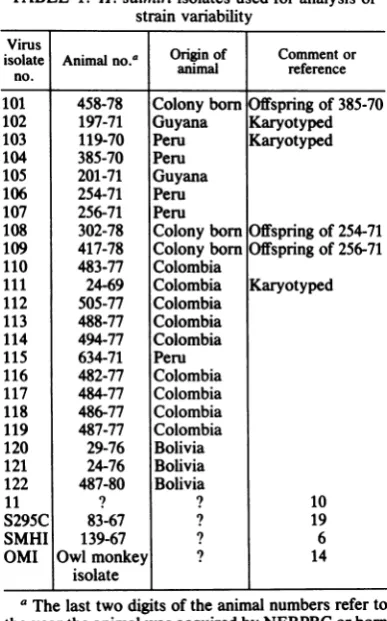
AllnewH. saimiriisolatesused inthis
study
(numbered
101 to122in Table 1)wereobtainedfrom
squirrel
monkeys
of the NewEngland
Regional
Primate Research Center(NERPRC)
colony.
Theorigin
ofimported
squirrelmonkeys
was determined primarily from phenotypic
ap-pearance and
importation
records; the propersubspecies
assignment
was further verified forfour of theanimals
by
karyotypeanalysiskindly
provided
by
N. Ma of NERPRC (Table1).
ColombianandPeruviansquirrel monkeyswere housedin separate group cages containing 15to
30 members with no
intermixing
ofmonkeys
from thetwogeographicregions. It ispossible,
352on November 10, 2019 by guest
http://jvi.asm.org/
NOTES 353
TABLE 1. H. saimiri isolates used for analysis of
strainvariability
isolate
isolate
Animal.no.
Animal noa Origin ofanimal Commentreferenceor no.101 458-78 ColonybornOffspring of 385-70
102 197-71 Guyana Karyotyped
103 119-70 Peru Karyotyped
104 385-70 Peru 105 201-71 Guyana
106 254-71 Peru 107 256-71 Peru
108 302-78 Colonyborn Offspring of254-71
109 417-78 Colonyborn Offspring of256-71
110 483-77 Colombia
111 24-69 Colombia Karyotyped
112 505-77 Colombia
113 488-77 Colombia
114 494-77 Colombia
115 634-71 Peru 116 482-77 Colombia
117 484-77 Colombia
118 486-77 Colombia
119 487-77 Colombia
120 29-76 Bolivia 121 24-76 Bolivia 122 487-80 Bolivia
11 ? ? 10
S295C 83-67 ? 19
SMHI 139-67 ? 6
OMI Owlmonkey ? 14
isolate
aThe last twodigits of the animalnumbersrefer to
theyear theanimalwasacquiredbyNERPRCorborn
into the colony. For example,squirrel monkey254-71
wasimportedfrom Peru in1971,andsquirrel monkey 302-78wasbornin 1978.
however, that many of these animals were
ex-posedtosquirrelmonkeysfromother
geograph-ic regions, forexample, during importation or
through contact with adjacent cages. Squirrel
monkeys 458-78, 302-78, and 418-78, born to
Peruvian parents, were kept in the samegroup cagewiththeirPeruvianparentsand other
Peru-vian squirrel monkeys.
Peripheral lymphocytes were separated fiom
whole blood collected from apparently healthy
squirrelmonkeys by bandingover Ficoll-Hypa-que (density, 1.076 g/cm3). Lymphocytes were
cocultivatedwith monolayersofpermissive owl
monkey kidney cells in culture until
virus-in-duced cytopathic effect was complete.
Virus-induced foci of the cytopathic effect usually becameevident 5to10daysafter cocultivation.
More than 90%o ofvirus rescue attempts were successful. The celllysates wereused as virus
stock to inoculate owl monkey kidney cells in
150-cm2 flasks for purification of virions and
extractionof virionDNAaccordingto
previous-lypublished procedures (1).
Virion M-DNA wasanalyzedwith the follow-ing restriction endonucleases:
SmaI,
KpnI,
BamHI,
EcoRI, HpaII,Sacl,
TaqI,PstI, HpaI,and FnuDII. Maps have been published for strains 11, S295C, OMI, and SMHI by using
restrictionendonucleases
SmaI,
KpnI,BamHI,
andEcoRI (11). These last fourenzymes were
sufficientfordistinguishingmany of theisolates,
butthe other enzymes which cleave H. saimiri
DNA more frequently were used to establish more definitively the identity or nonidentity of any two isolates.
Sacl,
HpaII, and EcoRI +SmaIwerechosen to depict the strainvariability
(Fig. 1). Of 22 isolates, 19 were readily distin-guished by these criteria, and when the 4 previ-ously used laboratory strains were included in the analysis, 23 of the 26 isolates were
distin-guishablefrom one another. Three new isolates (102, 106, and 109) could not be distinguished
and appeared to be identical. Isolate 106 was obtained from an animal born in the Peruvian
group cage. It seems likely that these three animals wereinfected by the same strain of virus throughsomecommonsource atNERPRC,but the
possibility
that this virus strain was intro-duced into the colony independently by more than oneimported animal cannot beexcluded.Based on themolaritiesoffragmentsand sum molecularweights,thepatterns shown in Fig. 1 and others not shown weregenerallyconsistent
with asingle virus strain beingpresent in each isolation. This is in spite of the facts that viruses were not plaque purified and that a crude cell
lysate
was used forpreparation of viral DNA.Only isolate 104 gave several less-than-molar
fragments, suggesting that more thanone virus
strain was present (Fig. 1). Also, isolate 113
yielded an unusual Sacl fragment greater than two molar; this probably arose from a
popula-tion ofdefectiveDNAmolecules(Fig. 1).Sufficient similarity existed among these
iso-lates to certify that we were indeed
analyzing
variousstrains ofH.saimiri. Forexample, SmaIcharacteristically
cleaved several times in each repeat unit of H-DNA but did not appear tocleaveL-DNA; the
supermolar fragments
inthelowerportionof the EcoRI + SmaI
gel
ofFig. 1were derivedfrom the
repetitive
H-DNA.Nev-ertheless, a single discriminating enzyme such as
HpaII
or Sacl was usually sufficient fordistinguishinganytwononidenticalisolates.
Dif-ferences in the degree ofvariability observed withenzymes thatcleavedwithsimilar
frequen-cywere
consistently
noted. Forexample,
mostdifferences in EcoRI
fragments
among strainscould be
explained by
asimple gain
orloss of one tothree cleavage sites. WithBamHI,how-ever,twoisolateswere
frequently
found to differ at50%o
or more of thecleavage
sites (datanotshownandseereference
11).
Thegreatest
vari-VOL.43, 1982
on November 10, 2019 by guest
http://jvi.asm.org/
354 NOTES
a)C
0)an -I0)
(N C
MG UIHXX 'A606
b
0$ 60 80
201I
E6 90
cal1
+ 1901
Ol £01|
101
CD t4% 'I
1I10UIH XX
096?3S
0 I6
so 911
60 80
?IO
20
I a C] ZQ
901
901
901
bDI ZlI
110
£11
11l
601
801
2l01
£01
101
t-,
". '.,
tm rl 0n a? U') ;,r-%
_e...~ ~ ~ ~ ~ ~ ~
40)
> 04.)
4.) 0
'04-wn4)'r >4 *> _
CU
o< 3)
4)1z
E
S,E04) c0 Z 4)
o c .0 o
. 0
4)'
0.0
o coT
00 .0 CU, >
'U
oe°
- g-0 4
on November 10, 2019 by guest
http://jvi.asm.org/
NOTES 355
ability among isolates was observed with the
restrictionendonuclease HpaII. As anextreme example, strain S295C yielded 16 HpaII frag-mentsgreater than 1 kb, and strain 11 yielded 17 HpaII fragments greater than 1 kb, with total sizes ofaround 115 kb; yet only twofragments comigrated on agarose gels (Fig. 1). This is
remarkablesince thedigestionpatterns of these twostrains with otherenzymes aresimilar,- and
hybridization analyses have indicated a high degree ofcrosshomology(>90%o)withless than
3% base mismatch(16).
The variability in restriction endonuclease cleavage sites is certainly greater among H. saimiri strains than that previously observed
amongstrains of Herpesvirus tamarinus, a her-pes simplex-related virus also indigenous to
squirrelmonkeys (7). Thevariabilityincleavage patterns also appears to beconsiderablygreater than previously published for herpes simplex
virus (5, 18), Epstein-Barr virus (2, 12, 22),
equine herpesvirus (23), cytomegalovirus (13),
andvaricella-zoster virus (20).
Unlike someotherviruses, herpesvirusesare noteasily spread from individual to individual
throughcoughing, sneezing,etc., and it has been
hypothesizedthat the spread of herpes simplex virus within a region or community may be
restricted, beinglimitedtofamilymembersand
close contacts (21). To obtainevidence on the
frequency ofoffspring infectionfrom the moth-er, H. saimiri isolates obtained during the 1st year of life from three colony-born squirrel monkeys (101, 108, and 109) were compared withisolatesobtained simultaneouslyfromtheir mothers (104, 106, and 107). Offspring were
nursed by their mothers in the same Peruvian
group cage. None of the three
colony-born
squirrel monkeys
yielded
the same strain of virus isolated from the mother. Isolate 109, although different fromisolate 107 obtained from theoffspring's mother, wasthe same as isolate 106obtainedfromanother mother(Table 1 andFig. 1). These results may not be
surprising,
since aconsiderable
amount of interactionoc-cursbetween
offspring
and all the other animals in a groupcage. However, wecannot be surethat these
offspring
were not infected by theirmothers at some
time,
since resultspresented
below indicate that
squirrel monkeys
may beinfectedwithmorethanonestrain of H. saimiri
or readily become reinfected with a different strain ofH. saimiri.
It was not
possible
to group the H. saimiriisolatesinto
subtypes
basedonsimilarities in therestrictionendonucleasefragmentation
patterns.
Furthermore, no characteristic features werenotedinisolatesobtainedfrom
squirrel monkeys
imported
fromthedifferentgeographic
regions.
Squirrel monkeys
197-71,
488-77, and 484-77were bled for additional virus isolations at22, 16, and 22months,respectively,after the origi-nal isolations. Isolates obtained from animal 484-77wereidentical at the two different times, butdifferentstrains of virus wereobtainedfrom animals 197-71 and 488-77 at the two bleedings (datanotshown).Thesecond bleedingof197-71
yielded an isolate apparently identicaltoisolate 105fromsquirrelmonkey201-71; although these two animals were imported at the same time, there is norecord of their beinghousedtogether
at NERPRC. The second bleeding of 488-77 yielded an isolate different from any other iso-late wehaveexamined.Thenumber ofcleavage
site differences observed in isolates from ani-mals 197-71 and488-77 atdifferent times is too large to be reasonably accounted for by alter-ations of a virus strain while present in the animal. Marmosets infected with anattenuated
strain of 11 stably retain restriction
endonucle-ase cleavage sites as long as 4 years after the
original infection (9; data not shown). Thus, these results indicated that animals 197-71 and 488-77 had been infected with more than one strain of H. saimiri. We cannotdeterminefrom these data whether each animal was infected with two or more strains of virus before our
originalbleeding, with only one strain
predomi-nating at any one time, or whether the animals were reinfected exogenously after the original bleeding, with the reinfecting virus becoming predominant. Upon examination ofherpes
sim-plex virus type 2 recrudescent lesions, two of
eight patientsyielded different strains ofviruson
successive isolations(4). These results withH.
saimiriand herpes simplexvirus do not
neces-sarily
meanthat the immune system isinefficientinpreventing exogenous reinfection bya
differ-ent strain of herpesvirus. It is
possible
thatseronegative individualscanbeinitially infected
withseveraldifferent strainsof virus
during
thesusceptible
period,
butonly
oneofthesestrainsmay predominate duringavirus isolation. Fur-therwork isneededto
distinguish
thesepossibil-ities.
weare gratefulto SharonTracy,Joseph Eannuzzo,and
Daniel P. Silva fortechnicalassistance, Carel Mulder and Nancy Ma for helpful discussion, and Linda Rennie for
preparationof themanuscript.
These studies were supported by Public Health Service
grantRR00168from theDivisionofResearchResourcesto NERPRC, byPublic HealthServicegrant R01CA27225-02 from theNational Institutes ofHealth,byagrantfrom the MiltonFund,andbyafellowshipfrom theMedical
Founda-tion,Inc.,ofBoston.
LITERATURECITED
1. Bornkamm,G.,H.Delius,B.Fleckenstein, F.-J.Werner, and C. Mulder. 1976. StructureofHerpesvirus saimiri
genomes:ar-angementofheavyandlightsequences in the Mgenome. J. Virol.19:154-161.
2. Bornkamm,G.,H.Delius,U.Zlmber,J.Hudewentz, and
VOL.43, 1982
on November 10, 2019 by guest
http://jvi.asm.org/
M.A.Epstein. 1980. ComparisonofEpstein-Barrvirus strainsof differentorigin byanalysisof the viral DNAs.J.
Virol.35:603-618.
3. Buchman,T.G., B.Rodzman,G.Adams,and B. H.Stover.
1978. Restriction endonuclease fingerprintingofherpes
simplex virus DNA: a novelepidemiologicaltoolapplied to anosocomialoutbreak. J. Infect. Dis. 138:488-498. 4. Buchman,T., B.Roinman,andA.Nahmias. 1979.
Demon-stration of exogenous genital reinfection with herpes
simplexvirus type 2byrestriction endonuclease
finger-printingofviralDNA.J.Infect.Dis. 140:295-304. 5. Buchman,T., T.Simpson,C.Nosal,B.Rozman,andA.
Nahmias. 1980. The structure ofherpes simplex virus DNA and itsapplicationtomolecularepidemiology, p. 279-290. In P. Palese and B. Roizman (ed.), Genetic
variation of viruses. New YorkAcademy ofSciences,
NewYork.
6. Daniel, M. D., D. Silva,D. Jackman, P. Sehgal, R. B.
Baggs,R.D.Hunt, and L. V. Melendez. 1975. Reactiva-tionof squirrel monkeyheart isolate(Herpesvirus saimiri
strain) from latently infected human cell cultures and
induction ofmaignantlymphomain marmosetmonkeys,
p. 392-395. In J. Clemmesen and D. S. Yohn (ed.),
Comparative leukemia research. Bibhaemat no. 43. S. KargerAG,Basel.
7. Desrosders,R., and L. Fak. 1981.Herpesvirus tamarinus
andits relation to herpes simplex virus. J. Gen. Virol.
56:119-130.
8. Desroslers, R., C. Mulder, and B. Fleckenstein. 1979.
Methylation of Herpesvirus saimiri DNA in lymphoid tumor celllines.Proc.Nati.Acad. Sci.U.S.A. 76:3839-3843.
9. Falk, L., R.Desroders, and R. Hunt.1980.Herpesvirus
saimiriinfection in squirrel and marmoset monkeys, p.
137-143. InM. Essex, G. Todaro, and H. zurHausen (ed.), Virusesinnaturallyoccurring cancers,ColdSpring HarborLaboratory, Cold Spring Harbor,N.Y. 10. FaLk,L., L.Wolfe, and F.Deinhardt. 1972. Isolationof
Herpesvirus saimirifrom blood ofsquirrelmonkeys (Sai-mirisciureus).J.Natl. CancerInst.48:1499-1505.
11. Fleckenstein,B., and C.Mulder.1980.Molecular
biologi-calaspectsofHerpesvirus saimiriandHerpesvirusateles,
p. 799-812. In G. Klein (ed.), Viral oncology. Raven Press,NewYork.
12. Heller, M., T. Dambaugh, and E. Kieff. 1981.
Epstein-Barrvirus DNA. IX. Variation among viral DNAs from
producerandnonproducer infected cells.J.Virol.
38:632-648.
13. Huang,E.,S.Huong,G.Tegtmeier,and C.Alford.1980.
Cytomegalovirus:geneticvariation of viralgenomes, p.
332-346. In P. Palese and B. Roizman (ed.), Genetic
variation of viruses. New York Academy ofSciences,
NewYork.
14. Hunt,R.D.,F. G.Garcia,H. H.Barahona,N. W.King,
C.E. 0.Fraser,and L.V.Melendez.1973.Spontaneous Herpesvirus saimiri lymphoma in an owl monkey. J.
Infect.Dis.127:723-725.
15. Jones,T.C.,andN.S. F. Ma.1975.Cytogeneticsofthe
squirrel monkey (Saimiri sciureus).Fed. Proc.
34:1646-1650.
16. Keil,G.,I. Muller,B.Fleckenstein,J. Koomey,and C. Mulder.1980.Generationofrecombinants between differ-ent strains ofHerpesvirus saimiri, p. 145-161. In M.
Essex,G.Todaro,andH.zurHausen(ed.),Virusesin
naturally occurringcancers.ColdSpringHarbor Labora-tory,ColdSpringHarbor,N.Y.
17. Llnnenann,C.,T.Buchman,I.Light,J.Ballard,and B.
Rolzman.1978.Transmissionofherpes simplexvirustype
1 ina nursery for the newborn: identification of viral isolatesbyDNA"fingerprinting."Lancet1:964-966.
18. Lonsdale, D. M., S. M. Brown, J. Lang, J. H. Subak-Sharpe, H.Koprowski,andK.G. Warren. 1980. Varia-tions inherpes simplexvirusisolatedfromhumanganglia
andastudyofclonalvariationinHSV-1,p.291-308.In P. Palese and B.Roizman(ed.),Geneticvariation ofviruses.
New YorkAcademyofSciences,New York.
19. Melendez, L. V., M. D.Daniel,R. D.Hunt,andF.G.
Garcia. 1968. Anapparently newherpesvirusfrom
pri-mary kidney cultures of the squirrel monkey (Saimiri sciureus).Lab. Anim. Care18:374-381.
20. Richards, J. C., R. W. Hyman, and F. Rapp. 1979.
Analysisof the DNAsfromsevenvaricella-zoster virus isolates.J.Virol. 32:812-821.
21. Rolzman, B., and T. Buchman. 1979. The molecular epidemiology of herpes simplex viruses. Hosp. Pract. January:95-104.
22. Rymo, L., T. Lindahl, and A. Adams. 1979. Sites of
sequence variability in Epstein-Barr virus DNA from differentsources.Proc. Natl. Acad. Sci. U.S.A.
76:2794-2798.
23. Studdert,M.,T.Simpson, and B. Roizman. 1981. Differ-entiation ofrespiratoryand abortigenic isolates of equine
herpesvirus 1 by restriction endonucleases. Science
214:562-564.
on November 10, 2019 by guest
http://jvi.asm.org/