City, University of London Institutional Repository
Citation: Pates, D. and Sumner, N. (2016). E-learning spaces and the digital university.
International Journal of Information and Learning Technology, 33(3), pp. 159-171. doi: 10.1108/IJILT-10-2015-0028This is the accepted version of the paper.
This version of the publication may differ from the final published
version.
Permanent repository link: http://openaccess.city.ac.uk/15621/
Link to published version: http://dx.doi.org/10.1108/IJILT-10-2015-0028
Copyright and reuse: City Research Online aims to make research
outputs of City, University of London available to a wider audience.
Copyright and Moral Rights remain with the author(s) and/or copyright
holders. URLs from City Research Online may be freely distributed and
linked to.
City Research Online: http://openaccess.city.ac.uk/ [email protected]
For Peer Review
E-learning spaces and the digital universityJournal: International Journal of Information and Learning Technology
Manuscript ID IJILT-10-2015-0028.R1
Manuscript Type: Case Study
Keywords: Learning spaces, Active learning, Higher education, Organizational change, Teaching, Universities
For Peer Review
E-LEARNING SPACES AND THE DIGITAL UNIVERSITY
Introduction
Higher education in the developed world is arguably undergoing one of the most profoundly turbulent set of challenges in living memory. Global
economic, technological and pedagogical currents are interweaving to produce paradigmatic changes that challenge many of the traditional practices and environments of higher education institutions (HEIs). A discourse concerning the extent to which HEIs are being disrupted by the impact of these
developments has now become well-established (Christensen et al, 2001; Barber et al, 2013).
In the UK, for example, the longstanding state ambition to have 50% of 18-24 year olds in HE has almost been met (Adams, 2013). This vast increase in the sheer number of students puts significant pressure on the existing
infrastructure of HEIs. It has also happened largely in parallel with a dramatic rise in the level of tuition fees that HEIs can charge. The UK has seen an eightfold rise from £1,000 per annum in 1998 to up to £9,000 per annum in 2012. Although the full impact of these changes have yet to work through the system, there appears to be a shift taking place in the attitudes of students who, in some ways, are now positioned as consumers rather than scholars of higher education (Robbetts, 2015).
A further development, which challenges the conventional role of HEIs as exclusive knowledge providers, is the explosion of open educational resources available across the Web and the increasing accessibility of the online
classroom (Bates, 2015). The recent rapid growth in MOOCs that has occurred since 2009 is an example of this. These developments serve to de-centre the pivotal role of the traditional academic as a sage on stage (King, 1993), since students are now able to easily access a world of knowledge on their own digital devices unavailable to previous generations of learners. HEIs today face rising student expectations, which can include greater
personalisation of the study experience, a reliable technological infrastructure, digitally literate staff, and support for developing their own digital literacies (JISC, 2015). These factors collectively contribute to a shifting dynamic between learners in HE and their institutions, which is in part reflected in the emergence of new models of learning and teaching.
One example of how this shifting dynamic is becoming manifest is through a growing understanding that the traditional lecture, based as it is on a largely transmissive and behaviourist model of instruction, is a largely ineffective method of knowledge construction and does not meet the needs of today’s learners or prepare them for the modern workplace (Cuseo, 2007; Kaddoura, 2011; Fukawa-Connelly, 2012; Broadwater, 2013; Severiens et al, 2015). Whilst such a view of the effectiveness of lecture-based instruction is not new in itself (Pulliam, 1963), more recent responses from the educational
development community have been to promote more active and collaborative
For Peer Review
forms of learning. This is based on constructivist pedagogies and is invariably supported through appropriate use of educational technologies. The current trend towards the flipped classroom, as noted in a recent HE edition of the Horizon Report (Johnson et al, 2014), is an example of such a constructivist-aligned, technology-enhanced approach. What implications do these
developments have for the provision of learning spaces on the traditional campus?
This paper serves to illustrate one way in which a British HEI, City University London (City), is facing up to these challenges via an extensive programme of redevelopment, reconfiguration and refreshment of several of its formal learning spaces that has followed on from significant research,
experimentation and evaluation around the rethinking of the HE learning space. This programme includes a rebuilding of parts of its estate and a major development of existing digital infrastructure coupled with a strong focus on staff development, including efforts to provide staff with the knowledge and skills to realise the potential of the digitally-enhanced classroom. The paper sets out to examine these developments and includes identifying the drivers for change, the role and interests of the various stakeholders involved in designing and promoting new learning spaces, and the challenges and
opportunities which we have encountered in developing a set of processes and practices for implementing learning space redesign. This is an emerging area in the study of Higher Education and the paper is offered as a means for sharing experience, stimulating discussion and debate, as well as contributing towards the development of research-informed practice. In framing this paper, we have been influenced by Fullan’s (2003) lessons about change, which we will return to in the conclusion.
Principles Underpinning Developing Learning Spaces
Over the last 40 years, there has been a gradual shift in the pedagogic models that underpin the delivery of teaching and learning practices in developed world HEIs. The traditional lecture theatre design, relatively unchanged for centuries, has been shaped by a broadly transmissive approach. This was reflective of a period when access to knowledge was restricted, expensive and often shaped by the scarcity of resources (Beichner, 2014; Bates, 2015). However, in recent decades, there has been a significant shift in our
understanding of what constitutes effective pedagogies. There is now a broad acceptance (Fry et al, 2014) that constructivist and social constructivist approaches can be more effective in terms of enabling student learning. Coterminous with this development, the emergence of the Internet and then the Web have transformed the availability and accessibility of information and therefore traditional practices on which university curricula are based.
So, how far do the traditional tiered lecture theatre and conventional seminar rooms with their serried ranks of inflexible furniture meet the new demands that are indicated above? Over the past 20 years, HEIs in Australia, the US and the UK have attempted to answer this question through the redevelopment of their existing spaces, the design and creation of entirely new digitally-enhanced active learning spaces, and the provision of experimental ‘sandbox’
For Peer Review
environments for the exploration of new possibilities in teaching and learning within HE.
Renowned examples range from the collaborative, circular-tabled large capacity classrooms of North Carolina State University’s SCALE-UP project in the mid-1990s (Beichner, 2014) and MIT’s Technology Enhanced Active Learning (TEAL) environments (Rimer, 2009), to the swivel-seated lecture space of Iowa State University’s LeBaron Hall Auditorium (Twetten, 2006) and Loughborough Design School’s lecture theatre with its modular sofa-seating (Peberdy, 2014).
Changes in the physical environment within some of these HE learning spaces have included the provision of more flexible furniture, which facilitate the reconfiguration of the teaching and learning space in multiple ways, expanded writing surfaces, the decentring of the teaching podium as the sole focus of the direction of attention, an expansion in the availability of power sockets, and ubiquitous wifi connectivity. This period has also seen the introduction of a wide range of digital technologies into lecture theatres and seminar rooms. In some spaces, students have access to a wider range of better-positioned display screens and the provision of electronic voting systems. Many students will also bring the expectation of wireless connectivity and the opportunity to charge their own devices in these spaces.
The academic toolkit can now include web-enabled teaching podiums that consist of desktop PCs, touch panel controllers, audio-visual projection including visualisers, inputs for own devices, and interactive screens, as well as whiteboard capture technologies, and, increasingly, lecture capture capabilities. Enabling faculty to make effective use of these technologies in the classroom is one of the major challenges facing the educational
development community.
Radcliffe et al’s Pedagogy-Space-Technology (PST) framework (2009), which emerged from the Next Generation Learning Spaces 2008 Colloquium at the University of Queensland, can serve as a helpful starting point for those new to considering learning space development. The framework highlights how pedagogy, space and technology can influence each other in reciprocal ways and was designed for use by multiple stakeholders and across varying projects. It is applicable to both the design and evaluation of a learning space.
Teachers and learners with specific physical requirements are often
constrained within traditional tiered spaces with fixed furniture and can have limited room for manoeuvre. An additional benefit of increasing the flexibility of a learning space is that accessibility to learning can be extended to all users of the space. This benefits individual users whilst also ensuring institutional compliance with anti-discrimination legislation, such as the UK’s 2010 Equality Act. The three principles of Universal Design for Learning (UDL; National Center on Universal Design for Learning, 2012) suggest a more inclusive approach to curriculum development with recommendations for providing multiple means of representation, action and expression, and of
For Peer Review
engagement. The application of UDL principles to learning spaces is, however, beyond the scope of this paper.
What follows is an exploration of some of the ways in which City has responded to these challenges. This will cover an examination of the
overarching policy framework, evaluation of completed projects, reference to the stakeholder interests that have driven these changes, and an outline of current projects and practices developed by the Learning Spaces theme team within the Learning Enhancement and Development department (LEaD).
New Learning Spaces at City
City currently has 102 multipurpose, non-specialised teaching rooms across the institution that can be utilised by different schools for timetabled classes. These rooms are where a significant amount of teaching and learning takes place across the institution and run alongside other spaces specifically set aside for individual schools or for specialised teaching requirements and other spaces for students and academic staff such as dedicated computer and meeting rooms. At the time of writing (Autumn 2015), a total of 51 of these multipurpose rooms, described as flexible learning spaces, have been launched over the last five years. These are defined by City as “rooms… which have flexible furniture to support group-based learning and discussions” (Flexible Learning Spaces, nd). At 50% of all multipurpose learning spaces, this amounts to a significant institutional and financial investment for fostering a broad range of models of teaching and learning. This estate redevelopment is part of City’s Vision for 2016, which strives to establish City amongst the top 2% of global universities (Building the Vision, nd).
An early indicator of rethinking of learning space provision at City can be traced to the renaming of the Classroom Experience Steering Group, largely comprised of IT staff, to the Learning Spaces Group, a collective which also included students, academics from different disciplines and other senior Professional Services members such as Properties and Facilities (PAF) and Information Services, alongside educational technologist staff (Bowdler, 2011). Amongst other considerations, this group was tasked with reviewing under-utilised rooms across campus, leading to a number of key initiatives in investigating experimental and flexible spaces.
One new room was characterised by multi-height furniture, which was
designed to explore creating natural groups within the space. Two others were developed as alternatives to traditional computer rooms. These two were to incorporate both lecturing and student computer work, and were driven by a requirement to support a new curriculum devised around problem-based learning for the School of Health Sciences (Bullimore et al, 2013). They comprised of a room with pop-up computers embedded in circular tables (see Plate 1 for a similar room type at City) and a room that included a new form of tablet chair (known as a node chair; see Plate 2), supported by a laptop locker in an adjacent room that enabled easy access to mobile devices in support of the learning activities. The then Associate Dean for Education for
Plate 1: Example of City learning space with pop-up PCs in circular tables
For Peer Review
the school commented that “these flexible learning spaces have enabled us to transform the way we deliver the curriculum to our students…”
(Attenborough, in Bullimore et al, 2013)
Evaluations of these rooms were conducted via user surveys and an open house event for academics that taught in them (Bullimore et al, 2013). These identified significant majorities in favour of the new flexibility, but also issues that required addressing as part of the iterative development of the spaces. These issues included environmental factors, such as temperature, availability of natural light and the quality of room acoustics, as well as technical factors, including several logistical challenges that prevented the laptop lockers from being widely used.
Other node chair room experiments were also
conducted, including one where a flexible room set-up with node chairs, extended wall-mounted writing surfaces and a teaching pod were augmented with an iPad Cart (Plate 3), a mobile multi-tablet storage and syncing device (Reader et al, 2013). The iPad Cart was used initially on five different courses within the School of Arts and Social Sciences, and involved
reimagining many activities that had been run previously, but conducted instead via tablet technologies. These activities had either previously been administered on paper or in traditional computer labs. Academics reported via semi-structured interviews (ibid) significant time-saving when going paperless, the benefits of the opportunity to explore new pedagogies, and a general
enhancement of the student experience, despite occasional dropouts of connectivity.
Further influences on City’s Learning Spaces project came from papers by Fisher (2005a, 2005b) and Cuseo (2007), and an extensive internal review of learning spaces literature (Pamplin, 2013). Chickering and Gameson’s (1987) seven principles for good practice in undergraduate education were mapped to learning space configurations to produce a set of Guiding Design Principles (Cancienne, 2013a). One example from the Chickering and Gameson mapping is given below (original principle italicised, suggestions for learning spaces not italicised):
Plate 2: Node chairs in group seating formation
Plate 3: Open iPad Cart
For Peer Review
3. Encourages active learning techniques• Furniture and space are as flexible as possible, to enable dynamic group working as well as traditional ‘lecturing’ within the same room
• Walls can be additional collaboration surfaces to work through ideas
• Lecture room technology should be intuitive and usable by students as appropriate
(ibid) These research and evaluation efforts and stakeholder discussions were amongst the major contributory inputs that culminated in the creation of a Learning Spaces Manifesto:
Our learning spaces will be bright, inviting agile spaces, able to accommodate the full breadth of teaching and learning
approaches. Students and lecturers will be able to communicate with one another easily, and share and develop ideas between themselves in these spaces. Our spaces will communicate the pride we have in our learning, and help engage students in the university academic community through being world class spaces that meet their learning needs. (Cancienne, 2013b)
This statement has framed the ongoing and extensive redevelopment of City’s stock of formal and informal learning spaces.
Campus development projects such as these inevitably draw out differing perceptions of what the primary educational drivers are, depending on the position of the interested stakeholder. For example, the further scaling-up in size of the student body may seem to demand ever larger lecture theatres that in turn support the continuation of transmissive modes of teaching. Greater room flexibility, however, may require an increase in the availability of actual empty space. The involvement of City’s Education Committee in approving flexible seating in new lecture spaces (Cancienne, 2013c) is an example of where the issue of academic quality of space prevailed over timetabling needs. Two other groups with typically differing perceptions of educational
requirements – students and the University executive – engaged with each other via a Student Community Working Group paper for Senate as a part of this process (Cancienne, 2013b).
Further operational decisions and ideas around City’s new learning spaces were explored within the forum of the Learning Spaces Group, which acted in an advisory capacity to various other committees that granted permissions in developing additional spaces, and which included heads of PAF, key members of Information Services, Associate Deans of Education, the Pro-Vice
Chancellor and senior LEaD staff. That these decisions and investigations were forged in a forum of such senior level staff of differing focuses is suggestive of the scale of the challenge when attempting to move an institution such as this towards improving its core infrastructure for better supporting its users and usages. It could be further observed that the wider the
For Peer Review
engagement of appropriate stakeholders, the more likely that suitable solutions can be found. This also increases the complexity of the development
challenge.
City’s Learning Spaces Team
In 2014, a new Learning Spaces-themed team of dedicated educational technologists was created within LEaD. This team was tasked with running a focused programme of staff development, including raising awareness amongst faculty of the potential of these new spaces, encouraging or supporting them in the adoption of more interactive and collaborative practices in their teaching, working on the integration of digital technologies in the face-to-face classroom, and contributing to the design and development of new and additional formal learning spaces. These multi-faceted approaches for reaching and engaging the academic staff within the institution can be largely grouped into the following areas – staff development,
communications, and research and evaluation.
Staff development work includes generic and bespoke group training sessions and workshops, and acting in advisory capacities for individual academics on curriculum enhancement ideas. Workshops have covered sessions on core technologies, such as lecture capture or in-class use of the web-based BYOD (Bring Your Own Device) voting tool Poll Everywhere, as well as sessions each term for all academics looking at approaches for large or small group teaching within these spaces, or for extending classroom teaching through multimedia tools.
Communications activities have so far included email and poster campaigns, sections on learning spaces within e-newsletters, posts on the main LEaD blog (http://bit.ly/CityLS ) and a short film
(https://www.youtube.com/watch?v=sAVtiuHCfCM) produced in collaboration with LEaD’s Multimedia team to promote the range of new rooms and their affordances to academic staff.
Research and evaluation activities have drawn from and built on the work completed before the theme team came together and have included evaluations of new rooms launched and supported technologies used at City, as well as horizon scanning investigations into technologies yet to be deployed but which could potentially provide further enhancements to the teaching and learning experience, such as in wireless collaboration. Examples of work conducted in these areas follows.
An extensive mixed methods investigation (Kogan et al, 2015) into staff and student perceptions of City’s physical learning spaces (flexible or otherwise) involved an all-staff survey, lecturer interviews, and other data collection activities with both students and academics from across the institution. This investigation concluded that many of the new institutional learning spaces have an overall positive impact on user stakeholders, yet also identified areas for improvement. A City swivel-seat lecture theatre received favourable comments from academics that had used it, such as “swivel seating really works…(allowing) you to combine formal lectures with group activities in a
For Peer Review
really flexible way”. 23 of 40 respondents to the all-staff survey indicated preferences for more flexible furniture in learning spaces to better facilitate group work, with similar majorities also in favour of the availability of more in-class technologies, including student response systems, power sockets for student devices and wireless projection for staff devices. Issues arising included reliability of equipment, maintenance of rooms, lack of time to experiment with both physical learning spaces and educational technologies, as well as comparisons with traditional spaces that included being more familiar with teaching in a standard lecture theatre.
Direct impact of space on student learning is inherently difficult to assess given the range of conceptions of both what learning is, how it occurs, and the variety of factors that impact on it (Pearshouse et al, 2009). However, as key stakeholders in learning space usage, student feedback has also necessarily been sought, primarily via the feedback-gathering exercise assessed by Kogan et al (2015). In this investigation, 132 City students provided free-text
responses on physical learning spaces at the institution overall, giving positive and negative comments. Clear majorities favoured brightness (preferably from natural light), effective room layouts and good acoustics, with preferences expressed for spaces that felt spacious and/or new, and 11 favourable
comments received regarding the above-mentioned swivel seat lecture theatre. At this stage of the research, it is too early to draw any direct correlation between changes to learning environments and learning gains. Kogan et al’s (ibid) investigation, however, has suggested that several of the learning spaces introduced at City following initial experiments had, on balance, been well received by both students and staff, and utilised to some extents for intended purposes of enabling flexibility and encouraging collaboration.
A literature review of best practices for evaluating learning spaces (Pates, 2014) was also conducted, which identified tools like Radcliffe et al’s PST framework (2009) that shaped later work of the team, such as in a conference workshop on planning for active learning in flexible spaces. Other evaluations conducted or under way that are yet to report results include student focus groups and staff interviews on new rooms opened in academic year 2014-15, and explorations of other new in-class technologies such as whiteboard capture or ceiling visualisers.
Developing Staff and Student Digital Literacies
The NMC Horizon Reports (HE editions) have often described a lack of digital media literacies amongst staff and students as a significant or even critical challenge that is impeding the adoption of such technologies in higher education. The 2010 edition (Johnson et al) proposed that “digital literacy must necessarily be less about tools and more about ways of thinking and seeing” (p 5). In the most recent edition (Johnson et al, 2015), the indication was that HEIs have now recognised that faculty need to be better equipped in order for digital literacies to be instilled in their students, but that there remains an absence of consensus as to what digital literacy comprises. The two examples that follow relate to the digital technologies used at City in face-to-face teaching for enhancing the learning experience, rather than the use of distance or asynchronous tools such as blogs or online forums.
For Peer Review
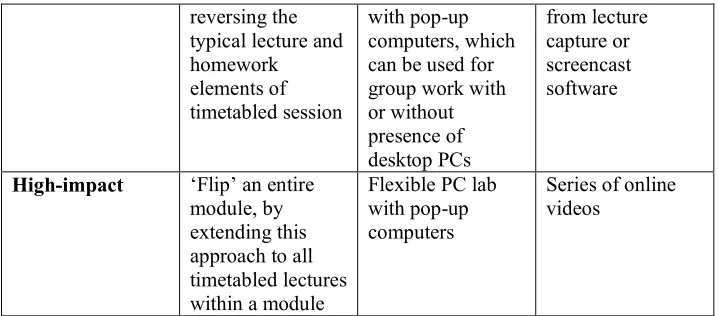
An academic wishing to use a personal response tool such as Poll Everywhere with a ‘live class’ may face additional performance pressures that extend beyond how to build and configure polls or that are not present in the use of asynchronous teaching tools. Effective incorporation into a lecture can also require imagining the range of mobile devices that students may (or may not) bring to the lecture, knowing that what will be displayed on the screens of student devices will differ from what is displayed on the main room projector, as well as the actual live operation of the poll. LEaD provides workshops for individuals or groups of academics wishing to investigate this particular tool, ensuring a focus on the challenges and benefits of using mobile devices for learning and differences between using these and dedicated ‘clickers’ for in-class voting. This can include question design for effective assessment. The addition of video-based lecture capture to City’s learning spaces (currently available in 51 teaching spaces at City) is another opportunity for educational technology staff seeking to help academics find efficient solutions for capturing and editing a lecture which can include adding interactive elements. While the recordings are automated, the output can be enhanced by tagging and/or adding chapters to the recording. Although not deployed at City, lecture capture systems can also incorporate captioning as a means of making the material more widely accessible to all learners. However, the scalability of such an approach is likely to be limited, given the likely high costs of transcription when done at significant scale. Costs to consider include academic staff time to develop innovative pedagogies which make fuller use of the affordances of lecture capture technologies, educational technologist support for the processes, as well as the necessary IT infrastructure. In shifting from traditional teaching practices to such new and technology-enhanced ones as those described here, the ever-pressured academic needs support to make better use of the affordances of these spaces. Similar time pressures face those attempting to incorporate forms of blended learning into their teaching, which is also where a possible way forward can also be found. Alammary et al (2014) propose three different approaches for designing blended learning courses, described as low, medium and high-impact blends. This framework is already being used by LEaD as an approach for advising City academics on blended learning (Fox, 2015), and could be further adapted for advising academics on designing for learning spaces, particularly if used in conjunction with the PST framework. Table 1 below suggests how the
approach taken for designing for blended learning can be adapted for designing for learning spaces (note that the table contents are ideas for adapting a standard lecture, and are not based on any actual examples used).
Pedagogy Space Technology
Low-impact Add short
discussion-based activities to single lecture
Lecture theatre with swivel seating (over raked seating) for quick group formation
Poll Everywhere for voting with mobile devices
Medium-impact ‘Flip’ a lecture by Flexible PC lab Short video lecture
For Peer Review
reversing thetypical lecture and homework elements of timetabled session
with pop-up computers, which can be used for group work with or without presence of desktop PCs
from lecture capture or screencast software
High-impact ‘Flip’ an entire
module, by extending this approach to all timetabled lectures within a module
Flexible PC lab with pop-up computers
[image:12.612.122.481.66.224.2]Series of online videos
Table 1: Designing for learning spaces, with impact levels and the PST framework
As indicated above, this table would be completed with options for teaching activity, choice or utilisation of learning space, and appropriate educational technology to use according to the teaching requirements. The low-impact design, for example, would take limited planning, with some parts being doable ‘on-the-fly’. The example of a high-impact design would take significant planning, which would include the preparation of the learning resources, selection of teaching activities to be applied throughout the module, and consideration of how best to configure that space.
Beetham (2014) suggested, that “the confidence of teaching staff has a strong impact on students’ satisfaction with the use of technology,” but that, despite rising expectations, many students are “still unclear about how the
technologies they use at university can help them to succeed”. While
providing support for developing students’ digital literacies goes beyond the remit of City’s educational technologists, encouraging faculty to include such considerations in their teaching and assisting staff with their own development makes some contribution towards student literacies.
Conclusion
City has now amassed significant experience in researching, developing, implementing and supporting flexible and innovative HE learning spaces at an institution-wide scale. This has included experimenting iteratively with designing new forms of learning space, conducting extensive and broad ranging research and evaluation, actively involving multiple stakeholders in the process, and incorporating a varied programme of staff development. Drawing on innovative work from HEIs in the US, UK and Australia has informed City’s discussions as to what constitutes effective contemporary learning spaces, as have visits to sector leaders in this area and inviting pioneering thinkers to contribute to the evolving vision. These have collectively provided evidence for many of the learning space innovations developed at City in tandem with research conducted within the institution. The existence of a multi-stakeholder specialist group as a forum has fed into senior decision makers deliberations, and has therefore been instrumental in driving the changes from both operational and strategic levels. Making the best use of the available space under budget restraints, balancing pedagogic needs with the pressures of massification, and sourcing and supporting appropriate in-class technologies have all shaped how City has responded to
For Peer Review
the need for upgrading our learning spaces. Staff development initiatives, including workshops for promoting and sharing good practice, the provision of resources for teaching activities within these spaces, and help with the use of in-class technologies, have built on the successful implementation of institution-wide flexible learning spaces. However, there is still much work to do to achieve a transformation of learning. teaching and learning space
redesign here at City. We recognise that as Fullan (2003) instructs, change is a journey, rather than a blueprint, and that the process of successful
management of change requires input from multiple stakeholders. Ongoing challenges remain, around engaging academic staff in new pedagogical
approaches, raising the standard of digital literacies, and continuing to explain, promote and justify to the wider stakeholder community why the development of digitally-enhanced learning spaces must remain a priority.
These are all steps along the route to realisation of the full potential of flexible learning spaces that City has taken. It is the authors’ hope that these
experiences will be helpful to other individuals and institutions engaged in promoting the effective use of learning spaces in the digital university.
Acknowledgements:
We would like to acknowledge Annemarie Cancienne and Stef Smith’s input and advice related to this paper and thank them for their contributons. We would also like to acknowledge the contributions of colleagues Jorge Freire and Santanu Vasant for their active engagement in promoting the learning spaces agenda at City.
References
Adams, R. (2013, April 24). Number of students going on to higher education almost reaches 50%. The Guardian. Retrieved from
http://www.theguardian.com/education/ 2013/apr/24/students-higher-education-almost-50-per-cent
Alammary, A., Sheard, J. & Carbone, A. (2014). Blended learning in higher education: Three different design approaches. Australian Journal of Educational Technology, 2014, 30(4), pp:440-454
Barber, M., Donnelly, K., Rizvi, S. (2013). An avalanche is coming: higher education and the revolution ahead. Institute for Public Policy Research. Bates, A. (2015). Teaching in a digital age. Retrieved from
http://opentextbc.ca/teachinginadigitalage/
Beetham, H. (2014, June 23). Students’ experiences and expectations of the digital environment. JISC Blog. Retrieved 27/04/15 from
http://www.jisc.ac.uk/blog/students-experiences-and-expectations-of-the-digital-environment-23-jun-2014
Beichner, R. J. (2014). History and evolution of active learning spaces. New Directions for Teaching and Learning, 2014, 9-16.
Bowdler, R. (2011, December 9). A day in the life of a teaching pod.
Educational Vignettes. Retrieved from
For Peer Review
https://blogs.city.ac.uk/educationalvignettes/2011/12/09/a-day-in-the-life-of-a-teaching-pod/#.VT3qBK1VhBc
Broadwater, P. (2013). Death of the lecture? Bucknell Magazine. Retrieved from https://www.bucknell.edu/x80297.xml
Building the vision. (nd). London: City University London. Acessed 27/04/15 at http://www.city.ac.uk/building-the-vision
Bullimore, A., Reader, K., & Sultany, A. (2013). Flexible learning spaces evaluation report. Learning at City Journal, 3(1), 79-91.
Cancienne, A (2013a). Guiding design principles: Flexibilty, visibility, vibrancy (Unpublished document mapping Chickering & Gameson’s “Seven Principles for Good Practice in Undergraduate Education” to learning space design). Accessed 22/04/15.
Cancienne, A. (2013b). Learning spaces manifesto (Unpublished manifesto document). London: City University London.
Cancienne, A. (2013c). Large lecture theatre position statement (Unpublished position statement. London: City University London.
Chickering, A. W., & Gamson, Z. F. (1987). Seven principles for good practice in undergraduate education. American Association of Higher Education Bulletin, 39(7) 3-7.
Christensen, C., Aaron, S., & Clark, W. (2001). Disruption in Education. Educause. Retrieved 23/12/15 from
https://net.educause.edu/ir/library/pdf/FFPIU013.pdf
Cuseo, J. (2007). The empirical case against large class size: Adverse effects on the teaching, learning, and retention of first-year students. The Journal of Faculty Development, 21(1) 5-21.
Fisher, K. (2005a). Research into identifying effective learning environments.
Paper forOECD/PEB, Evaluating Quality in Educational Facilities(pp. 159-167). Lisbon, Portugal.
Fisher, K. (2005b). Proposed planning principles: Linking pedagogy and space. Victoria, Australia: Department of Education and Training Victoria University.
Flexible learning spaces. (nd). London: City University London. Accessed 26/04/15 at http://www.city.ac.uk/visit/timetabling-rooms/priority-rooms Fox, O. (2015, July 14). Supporting your blended learning approach.
Educational Vignettes. Retrieved from
https://blogs.city.ac.uk/educationalvignettes/2015/07/14/supporting-your-blended-learning-approach/#.Vgxb3HvqLvD
Fry, H., Ketteridge, S., & Marshall, S. (2014). A handbook for teaching and learning in higher education: Enhancing academic practice. London: Routledge.
Fukawa-Connelly, T. P. (2012). A case study of one instructor’s lecture-based teaching of proof in abstract algebra: Making sense of her pedagogical moves. Educational Studies in Mathematics, 81(3), 325-345.
Fullan, M. (2003). Theoretical models of change. DSBM Phase 4 Module 2: leading and managing change. National College for Teaching and Leadership. Retrieved from
https://www.nationalcollege.org.uk/transfer/open/dsbm-phase-4-module- 2-leading-and-managing-change/theoretical-models-of-change/fullans-model.html
For Peer Review
Hargreaves, A. (2003). Teaching in the knowledge society. New York: Teachers College Press.
Holtham, C., & Cancienne, A. (2014), Collective learning spaces: Constraints on pedagogic excellence. In J. Branch, P. Bartholomew, C. Nygaard, & L. Scott-Webber (Eds.), Learning space design in higher education
(pp.225-240). Faringdon, Oxfordshire: Libri Publishing.
JISC. (2015). Digital students are different (posters). Retrieved from
https://drive.google.com/file/d/0B4y3qNoTbFdYd0ttdEx1STVyeDRFOG dvMVhkeWhMdjZYcVBR/view?pli=1 [Accessed 02/04/15].
Johnson, L., Adams Becker, S., Estrada, V., & Freeman, A. (2015). NMC horizon report: 2015 higher education edition. Austin, Texas: The New Media Consortium.
Johnson, L., Adams Becker, S., Estrada, V., & Freeman, A. (2014). NMC horizon report: 2014 higher education edition. Austin, Texas: The New Media Consortium.
Johnson, L., Levine, A., Smith, R., Stone, S. (2010). The 2010 horizon report: Higher education edition. Austin, Texas: The New Media Consortium. Kaddoura, M. A. (2011). Critical thinking skills of nursing students in
lecture-based teaching and case-lecture-based learning. International Journal for the Scholarship of Teaching and Learning, 5(2).
King, A. (1993). From Sage On The Stage to Guide on the Side. College Teaching, v41, no1, p30-35.
Kogan, P., Ntonia, I., & Smith, S. (2015). An evaluation of learning spaces at City University London (Unpublished report). London: City University London.
National Center on Universal Design for Learning (2012). About UDL. Retrieved from http://www.udlcenter.org/aboutudl/whatisudl
Pamplin, M. (2013). Learning spaces in higher education: A literature review (Unpublished literature review). London: City University London. Pates, D. (2014). Effective practice for the evaluation of learning spaces.
(Unpublished literature review). London: City University London. Pearshouse, I., Bligh, B., Brown, E., Lewthwaite, S., Graber, R.,
Hartnell-Young, E., Sharles, M. (2009). A study of effective evaluation models and practices for technology supported physical learning spaces (JELS). JISC. Peberdy, D. (2014). Active learning spaces and technology: Advances in
higher and further education. Droitwich Spa: DroitwichNet.
Pulliam, L. (1963). The lecture: Are we reviving discredited teaching methods?
The Phi Delta Kappan, 44(8), 382-385.
Radcliffe, D.,Wilson, H., Powell, D., & Tibbetts, B. (Eds.). (2009). Learning spaces in higher education: Positive outcomes by design. Proceedings of The Next Generation Learning Spaces 2008 Colloquium. University of Queensland, Brisbane. Brisbane, Australia: University of Queensland and the Australian Learning and Teaching Council, Brisbane. Retrieved from
http://www.uq.edu.au/nextgenerationlearningspace/proceedings
Reader, K., Pamplin, M., Cancienne, A., & Solkin, L. (2013, June).
Energizing the classroom: Reconceptualising learning spaces for higher education in the 21st century. Paper for EDEN Annual Conference 2013. Oslo, Norway.
For Peer Review
Rimer, S. (2009, January, 13). At M.I.T., large lectures are going the way of the blackboard. The New York Times. Retrieved from
http://www.nytimes.com/2009/01/13/us/13physics.html
Robbetts, K. (2015). Consumer Rights Act 2015 - students as consumers.
University Business. Retrieved 02/01/16 from
http://universitybusiness.co.uk/Article/consumer-rights-act-2015---students-as-consumers
Severiens, S., Meeuwisse, M., & Born, M. (2015). Student experience and academic success: Comparing a student-centred and a lecture-based course programme. Higher Education (in press). doi: 10.1007 / s10734-014-9820-3
Twetten, J. (2006). Iowa State University: LeBaronHall Auditorium. In D. Oblinger (Ed.). (2006). Learning spaces (Chapter 22). Educause. Retrieved from https://net.educause.edu/ir/library/pdf/P7102cs9.pdf