City, University of London Institutional Repository
Citation:
Scarbrough, H., Swan, J., Amaeshi, K. & Briggs, T. (2013). Exploring the role of trust in the deal-making process for early-stage technology ventures. Entrepreneurship: Theory and Practice, 37(5), pp. 1203-1228. doi: 10.1111/etap.12031This is the accepted version of the paper.
This version of the publication may differ from the final published
version.
Permanent repository link:
http://openaccess.city.ac.uk/6758/Link to published version:
http://dx.doi.org/10.1111/etap.12031Copyright and reuse: City Research Online aims to make research
outputs of City, University of London available to a wider audience.
Copyright and Moral Rights remain with the author(s) and/or copyright
holders. URLs from City Research Online may be freely distributed and
linked to.
EXPLORING THE ROLE OF TRUST IN THE
DEAL-MAKING PROCESS FOR EARLY-STAGE
TECHNOLOGY VENTURES
1Harry Scarbrough, Jacky Swan, Kenneth Amaeshi and Tony
Briggs
This is the final version (before the galley proofs) of the paper published in:
Entrepreneurship Theory and Practice,
37(5): 1203-1228.
DOI: 10.1111/etap.12031
1This work was supported by the UK’s Economic and Social Research Council [grant number RES-185-31-0021
], under the
Abstract
The deal-making process requires entrepreneurial actors to create and maintain wide networks of
weak ties, while simultaneously developing stronger collaborative ties that will enable
opportunities to be realized. We currently lack an adequate account of how these activities are
integrated by makers under conditions of risk and uncertainty. In an empirical study of
deal-making in early stage technology ventures, we find that deal-makers rely on different forms of
trust in the early and later phases. Based on this study, we develop a process model and
INTRODUCTION
Deal-making is a process, involving multiple phases (Tyebjee and Bruno, 1984), through
which different entrepreneurial actors secure resources (make deals) in pursuit of entrepreneurial
opportunities. Relevant actors (henceforth ‘deal-makers’) include innovators, investors and
financiers, and professional intermediaries such as lawyers and technology transfer officers
(Uzzi, 1999; Vohora et al., 2004; Payne et al., 2009). In this paper, our focus is on deal-making
as a social process (i.e. encompassing those features of deal-making not explicable in terms of
narrowly economic mechanisms (Venkataraman,1997; Eckhardt & Shane, 2003), involving the
creation and exploitation of social ties. As such, deal-making is viewed as encompassing two
major strands of activity. First, deal-makers’ are engaged in selecting particular ties from a large
number of weak ties available at the outset of the process (Karnoe, 2004; Macmillan et al.,
1987). As previous studies indicate, deal-makers have to make decisions about a large number
of propositions which are still at a formative stage, and which often lack clearly defined routes to
production and market (Fiet, 1995; Mason & Harrison, 1999). In selecting from such ties then,
the deal-making parties often lack first-hand, personal experience and may possess relatively
little solid, verifiable information about each other (McKnight & Chervany, 2006). The ratio of
ties selected to those rejected thus tends to be very high, with estimates ranging from one in 20
(Mason and Harrison, 1994; Riding et al, 1993) to one in 3000 (Stevens and Burley, 1997) initial
ideas actually proceeding to negotiation in the USA and the UK.
Second, deal-makers need to develop strong collaborative ties that will support the
intensive information exchange and joint problem-solving required between the parties
ties necessarily takes place over time, it helps to establish a temporal order for the deal-making
process (Harrison, Dibben, & Mason, 1997). Thus, the selection of ties in an early phase of
deal-making is followed by a later phase in which deal-makers support stronger dyadic ties that
support collaboration and negotiation, and ultimately either exit from the tie, or achieve
successful completion (Fried & Hisrich, 2003; Eckhardt & Shane, 2003) .
Previous work has developed a range of perspectives on this process. Some studies focus
on the decision-making criteria which investors apply to the selection of ties (e.g. Wright et al.,
2006). This work helps us understand the ‘filters’ which are applied to the selection of ties (Hall
and Hofer, 1993; Maxwell, Jeffrey, & Lévesque, 2011). Other work emphasizes the means by
which entrepreneurs secure resources through the information signals which they send to
potential investors, thus highlighting the importance of information exchange within the process
(Ahuja, 2000; Dushnitsky, 2010; Spence, 1974). A further strand of work addresses the
development of a particular collaborative tie between entrepreneurial actors (Shepherd &
Zacharakis, 2001).
In this paper, however, in response to recent calls in the literature (Welter & Smallbone,
2006; Zahra et al., 2006), we seek to integrate and extend this existing work by addressing the
role of trust in the deal-making process. To date, the great majority of previous studies have
addressed this role in the context of the stronger, dyadic ties of the later phases of the
deal-making process (e.g. Liao and Welsch, 2005; Tyebjee & Bruno, 1984; Payne et al., 2009;
Larson, 1992), and especially the collaborative and monitoring relationships post-investment
(e.g. Harrison et al. 1997). Relatively few studies have examined the role of trust in the selection
of weak ties in the early phase (e.g. Welter & Smallbone, 2006). This division within existing
theoretical challenges posed by deal-making; namely, the question of how deal-makers maintain
and integrate the networks of weak and strong ties involving in accessing and realizing
opportunities. This challenge comes about because, on the one hand, the pursuit of opportunities
requires deal-makers to devote significant time and resources to the wide network of weak ties
needed to seek opportunities, and to obtain non-redundant information (Uzzi, 1997; Harrison et
al., 1997; Granovetter, 1983). On the other hand, deal-makers need to concentrate their resources
on developing the dense networks of strong collaborative ties capable of realizing such
opportunities (Greve, 1995).
The challenge of integrating these networks within finite resources poses some broad
theoretical questions about trust and the role which it plays in deal-making. A widely accepted
definition of trust is “the intention to accept vulnerability upon positive expectations of the
intention or behaviour of another” (Rousseau, Sitkin, Burt, & Camerer, 1998: 401). One question
which arises is whether, and how, trust supports deal-makers’ ability to efficiently balance the
conflicting demands of these networks of weak and strong ties. Uzzi (1997) has highlighted the
time economies and collaborative advantage created by the trust which emerges within strong,
embedded, ties. However, we know relatively little about the role of trust in the process by
which certain weak ties become strong, collaborative ties. Previous work in entrepreneurial
settings has failed to address this role adequately because it has been primarily concerned with
the development of existing ties, thus failing to embrace the deal-making process as a whole. To
address these issues, we set ourselves the broad research aim of exploring the role of trust
throughout the deal-making process, including both the selection of ties in the early phase and
built amongst deal-makers in different phases of that process, and the effect of such trust on the
way ties were selected and progressed.
To explore these questions in more depth, we focussed our study empirically on a setting
which represents an extreme case for both the selection and development of ties; namely, early
stage technology ventures (Eisenhardt & Graebner, 2007). As a result of the dynamic nature of
technology and markets, deal-making in this setting is characterised by shifting networks of
weak ties which are a product of the creation and destruction of large numbers of new ties
(Auerswald & Branscomb 2003). At the same time, the commercialization of new technologies
is subject to high levels of risk and uncertainty, helping to deter collaboration (Goldenberg et al.,
2001; Amabile et al., 2001; Faems et al, 2005). Yet, deal-makers need to make significant
investments in collaborative relationships to be able to evaluate and progress particular deals
(Gans and Stern, 2003; Rost, 2011).
In this study, we found that trust was built in different ways in the early versus the later
phase of the deal-making process. Also, deal-makers relied on these different forms of trust in
deciding which ties to select and develop to a deal-making outcome. Based on the findings from
this empirical study, we develop a process model of the role of trust which addresses some of the
above-noted limitations of previous work. In particular, this view helps to account for
deal-makers’ ability to integrate both the strong and weak ties needed for deal-making, within finite
resources of time and attention.
TRUST IN ENTREPRENEURIAL SETTINGS
Trust has been viewed from a wide range of different ontological and epistemological
across studies (Inkpen & Currall, 2004). These divisions in the literature are difficult to
reconcile, since as McEvily and Tortoriello (2011) note, they also reflect the context-dependent
nature of trust and the diversity of settings in which it has been studied. In relation to
entrepreneurial settings, however, trust has been widely identified as a positive factor in helping
entrepreneurial actors to overcome the risk and uncertainty which afflict collaborative
relationships in entrepreneurial settings (Welter, 2012). It is seen as limiting opportunistic
behaviour in collaborative relationships (Uzzi 1996), reducing monitoring costs, and overcoming
the information asymmetry between actors (Larson, 1992; Shane & Cable, 2002) by facilitating
information transfer (Harrison et al., 1997; Sapienza & Korsgaard, 1996; Payne et al., 2009).
Despite the emphasis which is given to the positive role of trust in entrepreneurial
activity, less attention has been paid to the question of how trust is built in different social
settings encompassed by such activity (Welter 2012). Previous studies here have tended, as
noted above, to focus on trust building behaviours associated with the development of dyadic
ties. Thus, Shepherd and Zacharakis (2001), for example, describe the emergence of trust in
terms of a ‘gradual and incremental process of signalling commitment’ in a dyadic relation
between partners (p.135). Relevant actions include; signalling commitment and consistency;
being fair and just; obtaining a good fit with the partner; and frequent and open communications.
Similarly, Maxwell et al. (2012) describe a number of trust-building behaviours observed in face
to face interactions between entrepreneurs and investors.
However, studies of trust building within a dyadic tie have struggled to explain the
paradox of how trust can be built in the early phase, when deal-makers are confronted by many
possible weak ties and information is very limited (Aldrich & Fiol 1994; Zahra, Yavuz, &
the notion of ‘swift trust’ as found in temporary groups is relevant here, based on assessments of
an individual’s trustworthiness (Meyerson, Weick, & Kramer, 1996). Other studies seek to
address this issue with reference to a cyclical process of trust building which is initiated by an act
of trust. Shepherd and Zacharakis (2001: p.135), for example, argue that trust is initiated by
“initial act of vulnerability” when “one party ‘trusts’ the other (makes themselves vulnerable to
the partner’s opportunistic behaviour)”. Maxwell and Leveque (2012) similarly outline a process
of trust-building which begins with an investor ‘trusting’ an entrepreneur.
The circularity implied by these ‘leaps of faith’ (Mollering, 2006; Welter 2012) seems an
inadequate explanation for the competitive environment of early-stage technology ventures.
More relevant to this setting are studies which acknowledge different forms of trust as applying
to different social situations. One highly influential framework here is provided by Zucker
(1986) who identifies three major “modes” of producing trust. Firstly, “institutionally-based
trust” is defined as the product of formal mechanisms, including, for example, the educational
system, professional bodies, regulation and legal institutions. Because this type of trust “does not
rest on personal characteristics or on past history of exchange” (p.61), it may be signalled via
limited, but specific, information. Secondly, “characteristic-based trust” is seen as the product of
social similarities such as family background and gender, and only requires “information
concerning social similarity” (p. 61), on the basis that others with similar characteristics will
share background understandings, smoothing exchange paths. Thirdly, process-based trust is
seen as produced through a record of exchange between actors, and requires “a considerable
amount of person-specific information” (p. 60). In outlining these different ‘modes’ then,
Zucker’s analysis relates forms of trust to the information which actors can acquire about each
Building on this and other typologies of trust, other authors have developed a processual
perspective which relates the building of trust to the staged development of social relationships.
Lewicki and Bunker, for example, argue that “trust develops gradually as the parties move from
one stage to another” (Lewicki & Bunker, 1996: 124), taking on a different character in the early,
developing and mature stages of a relationship. In broad terms, they see trust within a dyadic tie
shifting over time from a calculative to a relational basis, encompassing the following forms of
trust; “calculus-based” (a calculation of costs versus benefits of the tie), “knowledge-based”
(involving a history of interaction that supports mutual knowledge) and “identification-based”
(where parties understand and appreciate each other’s wants).
To address the role of trust in the particular empirical setting of the deal-making process,
we adopted an inclusive approach which sensitized us to the different forms of trust highlighted
above, as well as to the processual dynamics highlighted in previous work.
METHODOLOGY
Research Design
Despite consensus in the definition of trust, it is widely seen as a difficult concept to
operationalize in empirical work (Currall & Judge, 1995; Neergard et al. 2006). This is partly
because of the different theoretical perspectives applied to trust (Kramer, 1999), but also because
trust is a context-dependent and largely tacit phenomenon which manifests itself in different
ways according to circumstances (McEvily and Tortoriello, 2011). Surveys and experimental
techniques are subject to a number of limitations in terms of their ability to explore the dynamics
consequential case-studies are examined (e.g. Neergaard & Ulhøi, 2006), generalizations of trust
may be impaired by the idiosyncratic features of a given deal process.
Given these challenges, and the lack of previous studies of trust in this particular
empirical setting, we chose an inductive, qualitative study design based on interview techniques
(described below) in order to explore trust (what builds trust as well as its outcomes) in the
deal-making process. Our first challenge was to decide how to operationalise trust in our study. Some
writers view respondents’ explicit references to trust, in interviews for example, as relevant
evidence (Uzzi, 1997). However, such references are not only subject to social desirability bias
(Welter, 2012), but tend to be associated with close, embedded ties – ties that may not
necessarily be characteristic of early deal making. A recent study of investors and entrepreneurs,
(Maxwell & Levesque, 2011) suggests that trust may be more observable when viewed in terms
of concrete decisions and behaviors (e.g.”trust-building” or “trust-damaging” behaviors). Trust,
itself, was operationalised in this study as a “decision variable”, whose operation could be
inferred from decisions to accept risk by pursuing or not pursuing particular ties in response to
entrepreneurs’ behaviors.
In line with this approach, and to ground the concept of trust in our study, we decided to
couple two well established approaches used in the social sciences to explore novel phenomena
and process: grounded theory (Glaser, 1998; Lincoln & Guba, 1985) and the critical incident
technique (Glaser & Strauss, 1967; Neergaard & Ulhøi, 2006). Key informants were asked to
describe specific deal-making processes, both those that had been successful and those that had
been unsuccessful or abandoned. We then focussed on critical incidents; i.e. specific instances
where decisions to progress in, or withdraw from, the deal-making process were discussed.
deal-making process. At the same time, such incidents also help to contextualize the acceptance
of risk by relating this to the other actors and the information exchanged. Our detailed methods
follow.
Data Collection
Data collection began with a preconception stage (Glaser, 1998), the goals of which were
to identify the general elements of the deal making process and guide the development of the
interview schedule for the second stage. Nine informants were recruited for “grand-tour”
interviews (Spradley, 1979), of 1.5 to 3 hours, where they were asked open-ended questions
about the deal making process, and the variety of key actors, artefacts and practices ‘typically’
associated with entrepreneurial deal making. These informants had long-established careers in
technology venturing and substantial experience in various entrepreneurial roles. From these
interviews, we collated comprehensive lists of actors and artefacts and developed a general
process description of deal-making itself. We went from the accounts given by these key
informants back to the themes identified in the literature to ensure that our interview schedule for
the second stage was sufficiently open and inclusive.
The second stage began by developing our semi-structured interview template (Kahn &
Cannell, 1957), in which we used the critical incident technique (Flanagan, 1954; Spradley,
1979; Chell & Allman, 2003). Here dealmakers were asked to outline multiple examples of early
stage technology investments encompassing all phases of the deal-making process, ranging from
those which had not got beyond initial contacts through to those which achieved successful
commercialization. Interviewers generally discussed three salient examples of deals: (1) a deal
process that went very well, (2) a deal process that went very poorly, and (3) a deal process that
that deal-making is usually a lengthy process. The advantage of focusing on “incidents” here was
thus not to refer to a single discrete event but to focus our respondents on different concrete
processes of decision-making that they had experienced.
We conducted 27 interviews with dealmakers, each lasting around one hour (average)
and conducted in the workplace of the informant. The interview template comprised two main
sets of questions: (1) questions on phases – on finding opportunities and preselecting, or
deselecting, potential partners and on selecting and further developing (or abandoning) an
securing the deal; (2) questions on practice and processes – on what were the biggest factors
(kinds of information and features of the key actors) that led dealmakers to pursue a deal further
(or not).
Because trust is an abstract and value-laden concept (Welter & Smallbone, 2006), we did
not encourage interviewees to discuss it directly, although a number did spontaneously address
it. Rather, as noted above, we tried to observe trust through informants’ explanations of the
factors leading to their decisions to proceed (or not) on a deal (i.e. to accept or reject risk). Of
course, these often included factors that were not much concerned with trust – for example,
simply that the technology was ‘bad’ or that ‘there was no market for it’. While these are of
course important, our focus is on trust-based accounts. To check for interviewee bias in such
accounts, however, we also probed as to whether more straightforward technology or
market/economics-based explanations could instead be sufficient to explain their decisions. For
example, a venture capitalist, when probed on how important the technology was in progressing
the deal, responded;
“ActuallyI think more than anything it's judging individuals. So, more than
background of an individual? I'm not sure it's completely obvious because I think
more than anything VCs have to judge people. I can buy in expertise on the
technology”.
All interviews were recorded and transcribed, resulting in 267 pages of usable transcripts
and stories of around 90 different deals. Purposeful sampling was used to identify respondents
with a high level of deal-making experience, so as to avoid idiosyncrasies due to lack of
expertise (Fiet 2007). Informants were identified through a combination of targeted (e.g. via
professional bodies) and snowball sampling, including from contacts identified in the
preconception stage. Our sample thus included members of professional bodies in the areas of
technology transfer, venture capital and angel investors. Of the 36 total informants, 8 were
currently entrepreneurs, 6 were technology transfer officers, 6 were in corporate business
development and licensing, 5 were angel investors, 4 were corporate venture capitalists, and 7
were traditional venture capitalists. The study was carried out with a sample that included
deal-making actors in the United Kingdom and the United States. The role of national context is not
the focus of the present paper, however, except to note that that, in relation to trust, our study did
not indicate obvious differences between the two contexts.
Data Analysis
To analyse and present our findings (below) we deploy established grounded theory
techniques used to good effect previously (in particular, Gioa et al, 2010; Pratt et al, 2006; Uzzi,
1997). Our analysis aimed at identifying key features entailed in building (or breaking) trust in
deal making ventures and at linking these features to the different phases of the deal-making
To analyse key features of trust building in the deal-making process, we began by
identifying in our data set all of the statements that addressed the informants’ reasons for
progressing (or terminating) deals and/or ties with other actors via open coding (Locke, 2001).
Given the particular purpose of this paper, we then focussed on statements that pertained to
trust-based reasons/accounts (rather than more narrow economic concerns –see above). We then
organized our data by drawing together similar kinds of statements to form provisional
categories (first-order codes). These broader categories were adjusted periodically throughout the
analysis until no further amendments or additions emerged. For example, statements such as “the
first step is to judge their cv”, “I checked her credentials and thought ‘these look impressive’”, “a
red flag is when they don’t seem to know the business”, were grouped together under the first
order code ‘credibility/competence of the individual’. During this process we compared
emerging themes with initial expectations from the literature, retaining some and abandoning
others, in order to produce our emerging framework (cf. Uzzi, 1997).
We then moved to axial coding (Strauss and Corbin, 1990), integrating first order
categories into higher order, researcher-induced themes pertaining to the role of trust in
deal-making. For example, first order categories relating to “individual credibility/competence”,
“team and/or company credibility/ competence”, and “other (weak and strong) ties verify
credibility”, were grouped together into the theoretical theme of “assessment of
credibility/competence”. Having determined a potential framework, we again went back to the
literature and reexamined how far the original categories fitted with our emergent theoretical
understanding (Glaser & Strauss, 1967; Locke, 2001). For example, our observations around the
importance of institutional signals chimed well with the concept of institutionally-based trust
Having identified features of trust building across the deal-making process, we moved to
a comparison of process phases to see whether, and how, the role of trust varied across phases.
Our “grand tour” interviews, supplemented by the existing literature, had revealed a set of steps
typically taken in the deal-making process, ranging from opportunity identification and initial
preselection of potential partners through evaluation of the merits of a chosen idea to deal
finalization. To ease comparison and theorization, we reduce these for analytical purposes to two
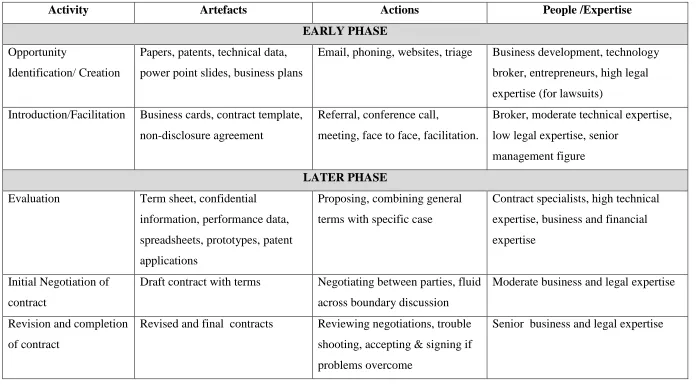
key phases, or episodes, in the deal making process: early phase and later phase (see Table 1).
The early phase entailed the initial identification and preselection of deal-making opportunities
to the point where a decision was made to put more time into pursuing a particular tie. Passages
in deal-maker interviews (incidents) were thus labelled as “early phase” where they encompassed
statements regarding investment opportunities coming to the attention of investor, the initial
screening of potential ties and initial decisions by investors on whether (or not) to preselect and
put more time into investigating a particular tie. The “later phase” entailed the further
development and evaluation of the merits of a particular, preselected tie, including assessment of
the tie and its proponents, development of the business plan, due diligence, and negotiations on
the contract for a deal (cf. Riding & Orser, 2000).
INSERT TABLE 1 NEAR HERE
Following the approach taken by Uzzi (1997) we performed a ‘cross-site display’ by
looking at the frequency of references to different trust features identified in the first step of our
analysis (first order codes) for incidents labelled as ‘early’ or ‘later’ phase. While we are aware
that this kind of data reduction approach loses data richness, it does provide additional evidence
to support our emerging framework on the role of trust in the deal-making process (Uzzi, 1997).
To try to ensure reliability in our analysis and resulting findings (cf. Lincoln and Guba,
1985), we followed the two-fold approach described by Gioa et al (2010), based on ‘peer
debriefings’ and ‘intercoder agreement assessments’. With respect to inter-coder assessments,
one author took primary responsibility for coding but in discussion with a second author who had
also been directly involved in the interviews. This provided an opportunity to discuss the scope,
refinement and labelling of codes, as well as any ambiguities in the data, and helped to establish
reliability, prior to one author completing the coding of the data. A representative sample of
transcripts was then coded independently by two of the authors using the first order codes
developed for the data-set as a whole. Following this, a selection of first order categories were
independently sorted into second order themes. The level of agreement reached on coding for the
13 first order codes was 81% , and overall for the five second order themes, a level of 85% -
levels deemed acceptable for this type of study (Miles and Huberman, 1995; Boyatzis, 1998).
Identification of phases was also discussed between two of the authors on a sample of the
incidents in order to check that the point between early (preselecting) and later
(selecting/developing) could be reliably ascertained in our data, and also that it provided a
reasonable point in the overall process to compare and contrast. With respect to peer debriefings,
one of the authors played a more detached ‘outsider’ role in relation to data analysis, and so was
sometimes able to point to ‘gaps’or alternative explanations in the findings.
FINDINGS
Features of trust in deal-making
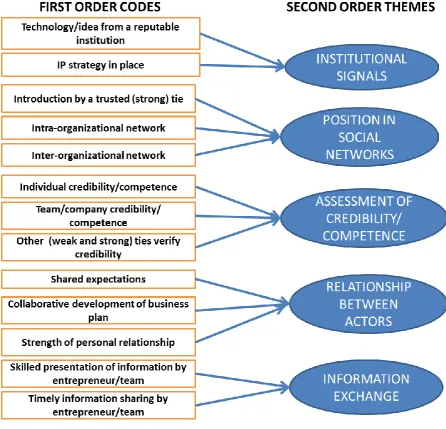
Figure 1 shows the final structure and ordering of our coding scheme (first order codes
and second order themes) for features of trust building found to be salient in interviewees’
major themes that emerged from our analysis. This analysis identified five important features of
trust building in the deal making process as follows:
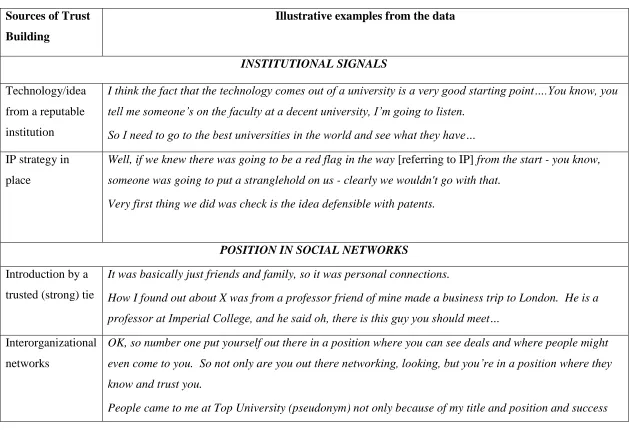
1. Institutional signals –i.e. trust based on formal institutions and institutional
mechanisms, not dependent on personal characteristics or a previous history of exchange (e.g.
ties in high status institutions or grounded in formal IP processes).
2. Position in social networks – i.e. trust based on an actor’s membership and
position in relevant social networks, including (passive) introductions from other trusted (strong)
ties in an actor’s network (e.g. referrals from friends and family) and more proactive
involvement and information seeking in inter-organizational and intra-organizational networks of
weak ties (e.g. emailing colleagues or external contacts to see whether they see potential in an
idea or partner).
3. Assessment of credibility/competence – i.e. trust based on a positive assessment
of the competence and credibility of an individual entrepreneur and/or their team or company,
including prior experience, skills, personal and professional background and domain knowledge
as well as verification of their credentials by other ties (e.g. due diligence on a management team
or company, verification of specific competencies by involving another expert with domain
knowledge).
4. Relationship between actors – i.e. trust based on the strength of the interpersonal
relationships between actors, including their ability to collaborative on the development of a
business plan, shared expectations and the strength of the interpersonal relationship (for
example, being willing to work together in putting a development plan and contract in place,
5. Information exchange– i.e. trust based on the timely exchange of information and
the ability of the entrepreneurs to present that information in a skilful and timely manner (e.g. the
ability of the lead scientist to articulate the key idea and its commercial potential). Notably,
while the content of information on the technology itself was of course important, this latter
feature of trust was less about the technology per se and more about strengthening the
relationship between the investor and the entrepreneur through a visible demonstration of skill in
‘selling’ the technology, and showing a willingness to share relevant information openly.
INSERT FIGURE 1 AND TABLE 2 NEAR HERE
It is clear from our analysis that the trust which deal-makers relied on in progressing
deals did not only come from dyadic relationships between actors or the information they
exchanged (although these were undoubtedly important). Assessments of actors’ competencies
and credibility, as judged against relevant reference groups (e.g. those with ‘entrepreneurial
skills’, ‘business acumen’ and ‘domain knowledge’), as well as their relative positioning within
social networks, were also important facets of trust building. Other important features of trust,
however, were institutionally-based and stood outside of the perceived characteristics, networks
and previous exchanges between particular actors. These institutional signals also played a key
role in speeding investor decisions about the preselection and filtering of a few deals to pursue
from the many ties available. They also helped investors decide where to look for potential deals
in the first instance, with many references to ‘top institutions’ and ‘decent places’.
We can relate the features of trust building found here to previous research on the
development of trust in inter-organizational settings. This has highlighted, for example, the
importance of trust building in processes of network formation (Ring & van de Ven, 1994), and
inter-organizational research teams (Newell & Swan, 2000). Our findings resonate, in particular, with
the previous work by Zucker (1986) outlined earlier. Thus major features of trust building in our
study (the second order codes) broadly encompass all three modes of trust production outlined in
Zucker’s framework. In particular, the ‘institutional signals’ identified in our study relate the
distinctive features of our empirical setting (the importance of IP and scientific institutions, for
example) directly to Zucker’s notion of ‘institutionally-based trust’. Position in social networks
speaks to the importance of social similarity and membership of shared networks as expressed by
‘characteristic-based trust’. Similarly, our codes on positive information about the credentials
and competencies of actors can also be related to characteristics-based trust. These assessments
were drawn, at least initially, not from repeated interaction with entrepreneurs, but at arms-length
(e.g. reviewing a CV, or asking others to check out someone’s credentials). They entailed
judging an individual (or their team/company) against an implicit ‘ideal’ type of entrepreneur
(with such comments as “they just had the ‘wow’ factor”). The importance of the relationship
between actors, in contrast, can be readily related to process-based trust, as such relationships are
the product of interpersonal interactions over time. Finally, the salience of information exchange
in our coding can also be related to Zucker’s framework, inasmuch as her different ‘modes’
emphasize the centrality of exchanges of information between actors as a means of producing
trust.
While our findings do not map directly onto Zucker’s categories – which is not to be
expected given the specificity of our empirical setting - her framework is broadly
accommodating of the findings from our inductive analysis. With due reference, then, to the
framework as an inclusive vehicle for further conceptualizing (and labelling) the different forms
of trust displayed by actors across the deal-making process.
The role of trust across deal making phases
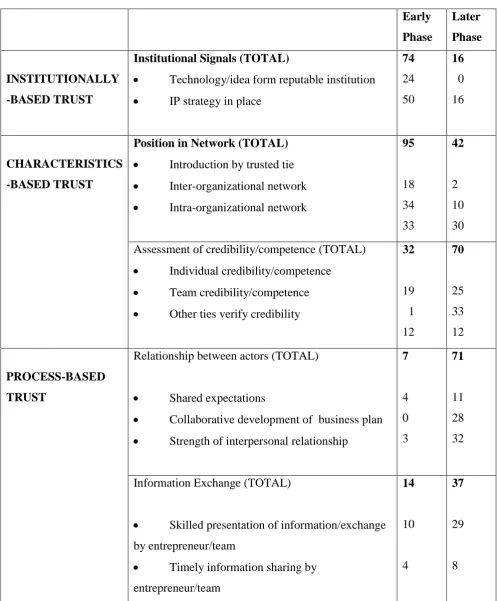
Table 3 shows the cross-site summary of frequency with which different features of trust
were referenced in different phases of the deal making process, aggregated across accounts of
incidents by deal-makers. This indicates the relative prevalence of references to
institutionally-based trust (institutional signals) in the early phase and, in contrast, to process-institutionally-based trust
(relationship between actors, information exchange) in the later phase of deal making.
INSERT TABLE 3 NEAR HERE
With respect to characteristic-based trust (based on membership of social networks and
assessments of competencies, as judged against reference groups), this was frequently discussed
in both early and later phases. However in the early, preselection, phase this typically entailed an
actor ‘sounding out’ potential ties with other members of their (intra- and inter-organizational)
networks of weak ties (i.e. “what do you think of this?”) and/or more coincidental referrals when
coming into contacts with others (i.e. “you might want to check this out”). In contrast, the later
phase typically entailed more in-depth assessments of the competencies and credibility of
selected ties. However, if the relationship (i.e. process-based trust) strengthened between
investors and entrepreneurs, this initial assessment of characteristic-based trust could be
confirmed or questioned. For example, one investor reported a deal that she pursued despite
concerns about the commercial competence of the lead scientists:
“First there were just two academics. Our referencing backed up the idea that
have the commercial background…the business plan they put together did not
hold water, the projections were unrealistic, the financial requirements were
unrealistic. But we introduced John [a local Chief Finance Officer] to the team.
He got on phenomenally well with them, saw the opportunity, worked alongside
them…”.
This interaction between trust based on assessments of competence (characteristic-based)
and trust grounded in interpersonal relationships (process-based), while not the main focus of our
analysis, echoes previous work on the role of trust in the development of innovation in
inter-organizational research teams (Newell et al, 2000), and reflects Zucker’s (1986) own analysis of
the way in which process-based trust confirms, and is confirmed by, other forms.
In the following sections, we present our findings in a more narrative form, which allows
us to develop propositions related to particular features of each deal-making phase.
Deal-making phases and propositions
Early phase
This phase encompasses, first, opportunity identification activities, including the
involvement of a variety of deal-makers such as entrepreneurs, business development individuals
and brokers. The key artefacts circulated amongst them include papers, patents, technical data,
PowerPoint slides and business plans. These artefacts provide more codified and public forms of
information, and are used to identify potential deal makers. In this phase, potential deal making
opportunities are identified, sometimes via individuals providing referrals and acting as brokers,
or by actively searching for deals in networks of weak ties inside or outside the firm. As one
“ Some individuals come to us with ideas. Sometimes we have ideas of our own
and we’ll go to different markets and groups and say ‘hey we really think you
should spend some time working this area up’. And that sort of comes at the sort
of wide end of the funnel. Sometimes ideas are crazy, and sometimes they’re not
so crazy, and through that we work up a .. number of pitches that we think are the
ones we can develop business opportunities around”.
Initial introductions and meetings typically then follow where contact information as well
as generic deal templates may be shared. Together these activities comprise the earliest phase of
the deal making process and typically take only a few minutes to a few days.
We found that deal-makers were keen to interact with weak and potential ties in this
phase. There was a concern to ensure ‘deal flow’ through such contacts, with some venture
capitalists, for example, having meetings with up to 20-25 entrepreneurs a week. In this early
phase, deal-makers were concerned with gathering and evaluating the institutional signals
associated with a variety of weak or potential ties. As outlined in Table 3, we found 74
references to such signals in the early phase, against 14 in the later phase. Relevant institutional
signals here included the presence of IP regimes, national institutions, legal systems, educational
systems, professional bodies, quality and sources of technology.
In this phase, social networks were widely seen as important in providing referrals. As
one of our respondents observed; “Yes, clearly if a deal is introduced by somebody you know
well and respect, then you're going to pay more attention to that than something which comes
through from someone you don't know”. As this suggests, referred ties were ‘given more
attention’ in the selection process. Thus referrals helped to provide the characteristic-based trust
want to know who the person is. I want to know if he knows the people that I know”. In some
cases, the involvement of a known individual was seen as significantly enhancing trust in the
quality of a particular tie. One US VC observed of a deal, for example, that “these were neat
ideas, but the wow factor was, Daniel. Daniel’s a huge wow factor, he's very, very smart and
very credible in the pharmaceutical and the biotechnology industry”.
However, in addition to these referrals, deal-makers often referenced an impersonal form
of trust that could be built through information on a tie’s positioning within the institutional
context. Given the interest in early-stage technology, an important part of that context was
affiliation with, or validation by highly regarded institutions, which was seen as providing an
assurance of scientific excellence or novelty. As one UK deal-maker put it: “First, there were
very strong academic institutions in that area so lots of clever people dreaming up new
things….then someone might have a good idea to patent the thing. But you’ve got to make it
happen”. Ties which failed to provide these signals of institutional trust were unlikely to be
selected. As one US venture capitalist (VC) explained; “If you tell me someone’s been in his
basement for ten years and has invented a perpetual motion machine, I’m probably going to be
sceptical”. Another VC in the UK commented on the role which a Tech Transfer Office could
play in helping to validate a new tie: “Our relationship (with the Tech Transfer Office) now is
very much...they will phone up and say, 'we've got a project that looks like this, and it's sort of
this shape … What do you think?' And if we say, 'well, sounds quite interesting,' then they'll start
working”.
The contrast in deal-makers’ responses to weak or potential ties – ranging from ‘crazy’ to
‘sceptical’ and ‘interesting’ – suggests that institutional signals are helping to build their trust in
pool. This institutionally-based trust is a ‘swifter’ form of trust in that the information signals
around different weak ties are readily available via one-way information exchanges, and thus ties
can be readily compared and assessed. These features of deal-making in the early phase suggest
the following propositions:
i. In the early phase of deal-making, institutional signals help build deal-makers’
trust in the quality of certain weak ties relative to others.
ii. Weak ties which signal such institutionally-based trust are more likely to be
selected for further development.
iii. Weak ties which build characteristic-based trust due to their social network
positions are more likely to be selected for further development.
Later Phase
The later phase of the deal process involves several distinct activities, centred on the
evaluation and realization of the potential deal. Thus, at the end of the early phase, there is
usually a scramble to pull together materials; both those that are publicly available as well as
proprietary information accessed via non-disclosure agreements. This activity will involve
reaching out to a number of parties that were not introduced at the beginning. Some will be
investors, but many will be technical specialists used to assess the quality and value of the
technology. Key artefacts exchanged here typically include deal term sheets, confidential
information, performance data, spreadsheets, prototypes and patent applications. At some point,
evaluation gets to the point where a proposed term sheet for the deal is shared. This leads to
often fraught and lengthy negotiations between and within the parties involved. If these
negotiations are successful, the finalization of the deal can be quick (up to a week), but even
In this phase of deal-making, decision-making concerns shifted away from the selection
of ties to the question of how more developed ties could be steered towards a successful
outcome. As opposed to the arms-length arrangements and the multitude of weak ties found in
the early phase, the later phase involved much closer collaborative, dyadic ties between
deal-makers. The need for such ties was reinforced by the uncertainties attached to early-stage
technology, requiring significant problem-solving efforts on the part of deal-makers. As one UK
corporate business development executive described such collaboration: “We do our own
research; they do some research; the tech transfer people do some research, and we sort of build
a business plan together. But it's not always committed to paper. It's sort of committed into the
strategy.”
Building trust in the quality of these collaborative ties was no longer centred on the kind
of information which could be freely signalled across weak network ties. For one, the
information which is relevant in this phase is more personal, as deal-makers become intensively
interested in the kind of person they are seeking to collaborate with. Even though a dyadic tie has
now been developed, deal-makers need to do ‘due diligence’ to be sure of the competencies and
intentions of their potential partners. This interest is focussed on those personal attributes which
are most relevant to developing the collaborative tie. One US VC explained how intensively they
assessed individual entrepreneurs in this phase:
“I mean, we do criminal checks on the key management. I want to look over his
CV. I want to be able to truly look up his ********. Has he …had wife or
spousal abuse problems? I’ll walk away from a deal. I’ll walk away from a deal
if I think the guy is 50 pounds overweight, smokes and has got a bad lifestyle, you
A UK VC summarised their concerns with the entrepreneur’s personal attributes as
follows: “What we're looking for is basically if the entrepreneur is up for the task …and that if
he's going to be the type of person that can drive a business forward, so that there's a genuine
desire to make a successful business”. The personal qualities needed to ‘drive a business
forward’ were seen as important indicators of the quality of a collaborative tie. However, they
could not be readily gauged from the objective, institutionally-based information which might
help deal-makers to select from a pool of weak ties. It was not enough, for example, for a
scientist to have a faculty position at a university. As one of our UK VCs put it; “The other
things we look for...we've got to have the scientist who's committed and enthusiastic. If they see
this as just a way of getting more grant funding, we're not going to take it further
forward….They've got to want to commercialize it, and they've got to have a bit of a commercial
view about what's happening in the market”.
As outlined in Table 3, process-based trust thus emerges as a much more significant
factor in the later phase of deal-making (a total of 108 references to related themes versus 21 in
the early phase). This form of trust centred on the quality of these collaborative ties and was built
through interpersonal relationships that developed over time, providing further information on
the competence and reliability of other deal-makers. This information is specific to the tie,
because it relates not simply to a collaborator’s competence and intentions, but also how well
this fits with their partner. As one UK VC put it, there needed to be a ‘connection’; “I think that
in order for a venture capitalist to invest, usually there will have to be a level of trust, which
connects absolutely, immediately. It will be either a slightly strange or an extremely masochistic
venture capitalist who invested in circumstances where that were not the case”. Reflecting this
collaborator as a pre-condition for further development of a tie. As one UK business
development executive put it; “We were able to establish a good working relationship quickly. It
didn’t take a lot of socialising. It was just that we were the right size of company for them, they
were right for us. The interpersonal chemistry worked, and worked very quickly”.
A key consideration in determining the fit within these collaborative ties was matching
deal-makers’ expectations. Shared expectations helped to build process-based trust as actors
worked towards a common goal. Conversely, the emergence of conflicting expectations might
lead to a breakdown in the relationship and exit from the tie. As one UK venture executive noted:
“We weren’t comfortable doing business with them. They aren’t a partner; that’s
the point. They weren’t prepared to be a partner and that’s OK. We were looking
for a partner; they were looking to buy something in. It was just a wrong
expectation.”
In the later phase of the process then, deal-makers are developing a much smaller number
of dyadic ties, and, as evidenced by references to ‘comfort’ and ‘chemistry’, are concerned with
the quality of collaboration secured by these ties. Private information is now being intensively
shared between a small group of deal-makers, and this information, and the way it is shared (i.e.
an actor’s behaviour being itself evidential), informs the emergence of process-based trust on the
part of the deal-makers. In this phase, trust in the collaborative, dyadic tie is built through
information on the competences and intentions of other parties (cf. Pollock, Porac & Wade,
2004). It is important to note, however, that the vulnerabilities expressed by deal-makers in this
phase were not to do with the trustworthiness of their partner per se, but rather their intention or
ability to contribute to the collaborative quality of the tie. Process-based trust around these
Characteristic-based trust complemented the importance of process-based trust in this
phase, as deal-makers assessed and confirmed the competence and credibility of collaborating
parties through information drawn from social networks. Such networks were often exploited as
a source of expertise to validate quality – drawing in ‘private information’ on the collaborative
quality of the deal (Shane and Cable, 2002). One UK deal-maker, for example, observed how an
individual specialist was brought in to “really kick the tires of the technology and the
architecture”. In other instances, respected colleagues were involved in due diligence around a
particular collaborative tie. Where a dyadic tie was found not to build trust in these ways, or
such trust was breached – as, for example, by the discovery that expectations are mis-matched -
this could lead one party to ‘walk away from the deal’, as one of our respondents put it.
These findings lead to the following propositions:
iv. In the later phase of deal-making, reciprocal sharing of information on
competencies, intentions and expectations builds process-based trust in the collaborative quality
of strong dyadic ties.
v. The greater the process-based trust between the parties, the more likely that a
dyadic tie will be developed towards a successful outcome.
vi. Dyadic ties which build characteristic-based trust through validation by
deal-makers’ wider social networks are more likely to be developed towards a successful outcome.
These propositions have important implications for our understanding of the role of trust
in deal-making. One important implication has to do with the impact of information exchange on
trust-building. Our propositions suggest that in the early phase of deal-making, information
indicate the symbolic importance of information exchanges over their substantive content; an
observation which finds support from recent work on the importance of ‘symbolic management’
for entrepreneurs securing resources (Zott & Huy, 2007). Even information exchanges which are
apparently substantive in nature, such as the exchange of business plans, may play more of a
symbolic role for new ventures (Karlsson and Honig, 2009). In the later phase, however,
deal-makers are interested in the collaborative quality of a tie. At this point, the sharing of detailed
private information required for collaboration, and the willingness and ability to share
appropriate information, becomes an important ingredient in developing (or failing to develop)
process-based trust.
This difference between phases makes the timing and form of information exchanges
critical, since information relevant to the collaborative quality of a tie, such as a business plan,
may have a negative effect (signalling a lack of competence, for instance) if disclosed in the
early phase when deal-makers are only concerned with the quality of a weak tie relative to
others. One of our US VC respondents, for example, described how in the early phase of
evaluating a possible deal he had been sent a ‘massive tome, a 200 page business plan’. He
observed that ‘somebody had gone a little overboard’, and that he had decided not to proceed
with that tie.
This suggests a further proposition based on our study, as follows:
vii. Information exchanges which build trust in the early phase of deal-making may have a
DISCUSSION
As outlined in Table 3, and in the narrative sections above, we found that forms of trust
were differentially distributed across phases of the deal-making process. Taken together, with
our discussion of the means by which trust is built, these findings suggest an important analytical
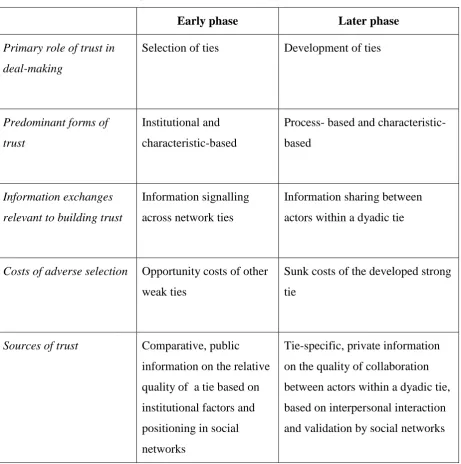
distinction between early and later phases of deal-making, and between the different forms of
trust which are built in these phases. This analysis is summarised in Table 4. The process view
which emerges from our study can be contrasted with the tendency of previous studies of trust in
entrepreneurial settings to focus on the dyadic relationship between trustor and trustee, where the
underlying dispositions of the trustor and the trustworthiness of the trustee are highly salient
(Maxwell & Lévesque, 2011; McKnight et al., 1998; Rotter, 1980). This interpersonal focus can
be contrasted with the way our study situates the building and effects of trust within the
dynamics of the deal-making process, and particularly decisions about the selection and
development of ties under conditions of risk and uncertainty. The interpersonal aspect of trust
only emerged later in that process, and, even here it featured less in terms of the quality of
personal relationships than as a consideration in assessing the collaborative quality of dyadic ties.
This finding also reinforces the view that trust in persons is not generalized, but is focussed by
particular situations and the decisions taken within them (Nooteboom & Six, 2003; Welter &
Smallbone, 2006).
In presenting our propositions in relation to distinct phases here, we are not suggesting
that the deal-making process unfolds as two discrete steps. Rather, the aim is to elucidate the
dynamic and temporal ordering of that process through an analytical comparison of distinct
points within it. For any given pool of weak ties, progression between these points is gradual and
and development in the later phase, these activities may co-exist, depending on the setting, for
the greater part of the process.
INSERT TABLE 4 HERE
Information exchange and trust building
In emphasizing the importance of information exchange over strictly relational means of
building trust, our study builds on previous work which relates the strength of ties between actors
to the quality or ‘bandwidth’ of information exchanged between them (Rousseau, Sitkin, Burt, &
Camerer, 1998). Thus, Hansen (1999) found that weak ties offered advantages for the exchange
of simple (i.e. codified and independent) forms of information, while strong ties were more
suited to the exchange of complex (non-codified and integrated) forms of information. Likewise,
Uzzi and Lancaster (2003) found that weak ties were effective in providing access to ‘public’
information, but strong (i.e. ‘embedded’) ties were better equipped to handle ‘private’
information. As they note: “Arm’s-length ties prompt the transfer of comparative, objective, and
unrestricted information, while embedded ties prompt the transfer of idiosyncratic, interpretative,
and restricted information.” (p. 393). In our study, we found that in the early phase, deal-makers
were able to use information that was highly codified and compressed to confirm or disconfirm
trust, thus helping to make rapid selections from amongst a large pool of weak or potential ties
(cf. Shepherd & Zacharakis, 2001; Hansen & Haas, 2001; Uzzi, 1997). In the later phase, the
stronger ties between deal-makers helped to mitigate concerns about the opportunistic use of
information (cf. Uzzi, 1996), and supported more reciprocal exchanges of complex forms of
information within the tie - what Uzzi (1997) terms ‘fine-grained information transfer’.
ties and the bandwidth of information exchanges can be extended to encompass the function of
such exchanges within the deal-making process. Thus, in the early phase we find information
signalling through the use of codified, public forms of information. Because these information
signals lend themselves to ready distribution and comparability, they help to build an
institutionally-based form of trust which informs the rapid and low cost selection of ties. In the
later phase, however, we see a greater emphasis on the intensive and reciprocal sharing of
private information through the bandwidth of a stronger dyadic tie. This serves to contextualize
and personalize information exchanges. For more developed ties, this sharing of information
seems to be closely intertwined with the emergence of process-based trust, helping to activate
what has been termed a ‘cooperative logic of exchange’ between the parties (Uzzi and Gillespie
1999, p. 33).
One further important implication of our analysis and propositions is to suggest a
resolution for the paradox of tie development discussed earlier; that is, how trust is built in a
weak tie in the early phase of deal-making, when information is limited and no previous
relationship exists. Rather than the ‘leap of faith’ or initial trusting step proposed in other studies
(Welter 2012; Maxwell & Lévesque, 2011; Shepherd & Zacharakis, 2001), our research suggests
that institutionally-based trust can be built through information which, in effect, signals not the
intrinsic quality of a particular tie (because so little can be known at this point about particular
ties), but its relative quality compared to other ties. By informing the selection of ties for further
development, the application of institutionally-based trust thus enables a more process-based
form of trust to emerge around the strong collaborative ties of the later phase. Unlike the
process-based account of trust development proposed by Lewicki and Bunker (1996) then, this
and not in the dynamics of a dyadic tie.
Implications for further research
The process model outlined above helps to integrate insights from the different
perspectives previously applied to deal-making. Our understanding of the decision criteria for
investments, for example, may benefit from greater recognition of differences in the forms and
costs of trust as deal-making progresses from a large number of arms-length ties to a smaller
number of more exclusive ties (Baum & Silverman, 2004; Payne et al., 2009; Maxwell et al.,
2011). There is also a need for further research on the expectations of success, and signals of
credibility in the deal-making process for various stakeholders. Work in these areas could
respond to the recent call for research on the factors which build trust in different contexts
(Welter, 2012), including early versus later periods in the development of a tie (McKnight and
Chervany, 2006). In contributing to this work, our findings show how the temporal ordering of
contexts influences both the building of trust and its outcomes.
Further, while the deal-making process rather than network structures were the focus of
our study, our findings on the role of trust also speak to research on the development of networks
and relational embeddedness within entrepreneurial settings (Hite, 2004), by highlighting trust as
in important enabler of the integration of weak and strong tie networks by deal-makers. More
broadly, our findings on the importance of information exchange adds to an emerging strand of
work which views information signals and social ties in these settings not as substitutes, as in
previous work (Podolny, 1994), but as involving a complementary interplay between information
exchanges and ‘network actions’ such as tie formation and selection (Hallen & Eisenhardt,
CONCLUSIONS
To return to the introductory questions of this paper, we have sought to establish whether
and how trust could support deal-makers in integrating the networks of strong and weak ties
required for successful deal-making. We observed in our study how deal-makers were able to do
this by drawing on different forms of trust that enabled them to accept the risk and vulnerability
involved in selecting and developing particular ties. The analysis of our empirical study
suggested that three features of the role of trust were crucial to this outcome. First, signals of
institutionally-based trust supported the initial selection of ties under conditions of uncertainty,
thus overcoming the paradox of developing trust in a particular weak tie. Second, the
development of ties over time enabled a new mode of information exchange (characterised as
‘sharing’ versus ‘signalling’) which helped to build the process-based form of trust required for
late phase collaboration between deal-makers. Third, we observed in our empirical study how
deal-makers relied differentially on forms of trust across phases of deal-making. This shift
between different forms of trust seems to have enabled deal-makers to operate more efficiently –
exploiting the cheapest available information sources to gain the positive benefits of trust
without incurring too many of its costs. Thus, where previous studies have suggested that trust is
an unavoidable necessity in early stage entrepreneurial settings because of a lack of information
(Aldrich & Fiol, 1994), our study suggests a more positive view; that gathering the information
to build different forms of trust helps deal-makers to better contextualize and exploit the
This study is not without limitations. Its qualitative approach limits its generalizability
(Yin and Campbell, 2003). The use of interview data around critical incidents helps to provide an
insight into the deal-making process as a whole, but at the expense of our ability to quantify the
variables involved, or to track that process or associated network ties longitudinally.
Policy and practitioner implications
Although exploratory, the findings of our study have important implications for actors
involved in the deal-making around early stage technology ventures. For public policy makers,
our discussion of the role of institutionally-based trust highlights the need for strong institutions
in relation to intellectual property, corporate governance, and technology transfer to economize
on the information needed to build trust in the early phase of deal-making.
For entrepreneurs and investors, our study underlines the social and networked character
of the deal-making process. Deal-makers’ willingness to invest time and accept opportunity costs
is based on initial assessments of certain ties relative to other ties. To influence investors’
decision-making, therefore, entrepreneurs need to build trust gradually by linking the kinds of
information exchanged to a form of trust appropriate to the strength of their relationship. This
involves attuning their information exchanges temporally, symbolically and materially to
particular phases of deal-making. This may be more of a challenge for new entrepreneurs than
investors in the early-stage technology arena, but our analysis of what builds trust applies to both
sets of actors. Entrepreneurs need to put potential investors through a due diligence process as
well, and not base their trust on the possession of financial resources alone.
While the analysis presented here is not a normative one, it does suggest that by relying
on different types of trust, investors will be more efficient and effective in exploiting the wide
of ‘over-trusting’ (Zahra et al., 2006) by allowing deal-makers to make better and cheaper use of
the information available in selecting ties, thereby limiting investments in time and resources to
higher quality opportunities.
REFERENCES
Ahuja, G. (2000). Collaboration networks, structural holes, and innovation: A longitudinal study.
Administrative Science Quarterly, 45(3), 425-455.
Aldrich, H., & Fiol, C. (1994). Fools rush in: The institutional context of industry creation.
Academy of Management Review, 19, 645-670.
Auerswald, P. E., and Branscomb, L. M. (2003). Valleys of Death and Darwinian Seas:
Financing the Invention to Innovation Transition in the United States. Journal of Technology
Transfer, 28 (3), 227-239.
Baum, J. A. C., and Silverman, B. S., (2004). Picking winners or building them? Alliance,
intellectual, and human capital selection criteria in venture financing and performance of
biotechnology startups. Journal of Business Venturing19, 411-436
Boyatzis, R. (1998). Transforming qualitative information: Thematic analysis and code
development: Sage Publications, Inc.
Chell, E., and Allman, K. (2003). Mapping the motivations and intentions of technology
orientated entrepreneurs. R and D Management, 33 (2), 117-134.
Dushnitsky, G. (2010). Entrepreneurial optimism in the market for technological inventions.
Organization Science, 21(1), 150-167.
Eckhardt, J. T. and Shane, S. A. (2003). Opportunities and entrepreneurship. Journal of
Management, 29(3):333-349
Eisenhardt, K., & Graebner, M. (2007). Theory building from cases: Opportunities and