City, University of London Institutional Repository
Citation
:
Lisi, M. & Gorea, A. (2016). Time constancy in human perception. Journal of Vision, 16(14), 3.. doi: 10.1167/16.14.3This is the published version of the paper.
This version of the publication may differ from the final published
version.
Permanent repository link: http://openaccess.city.ac.uk/17624/
Link to published version
:
http://dx.doi.org/10.1167/16.14.3Copyright and reuse:
City Research Online aims to make research
outputs of City, University of London available to a wider audience.
Copyright and Moral Rights remain with the author(s) and/or copyright
holders. URLs from City Research Online may be freely distributed and
linked to.
City Research Online: http://openaccess.city.ac.uk/ [email protected]
Time constancy in human perception
Matteo Lisi
$
Universit ´e Paris Descartes, Sorbonne Paris Cit ´e, Paris, France CNRS, Laboratoire Psychologie de la Perception, UMR 8242, Paris, France
Andrei Gorea
Universit ´e Paris Descartes, Sorbonne Paris Cit ´e, Paris, France CNRS, Laboratoire Psychologie de la Perception, UMR 8242, Paris, France
Estimated time contracts or dilates depending on many visual-stimulation attributes (size, speed, etc.). Here we show that when such attributes are jointly modulated so as to respect the rules of perspective, their effect on the perceived duration of moving objects depends on the presence of contextual information about viewing distance. We show that perceived duration contracts and dilates with changes in the retinal input associated with increasing distance from the observeronly when the moving objects are presented in the absence of information about the viewing distance. When this information (in the form of linear perspective cues) is present, the time-contraction/dilation effect is
eliminated and time constancy is preserved. This is the first demonstration of a perceptualtime constancy, analogous to size constancy but in the time domain. It points to a normalization of time computation operated by the visual brain when stimulated within a quasi-ecological environment.
Introduction
Time (or duration) perception has been known to be context dependent for at least a century (Allman, Teki, Griffiths, & Meck,2014; Buhusi & Meck, 2005; Eagleman, 2008; Fraisse, 1963; Gorea, 2011; Hass & Durstewitz, 2014; James, 1890; van Wassenhove, 2009). It fluctuates with speed, with temporal frequency or the number of events per time unit, with numerosity and size, and with sensory adaptation, not to mention factors extrinsic to the sensory stimulation (e.g., attention, emotion, drugs). Many of these contextual influences arise from modulations of spatiotemporal features of the stimulation (e.g., size, speed). For
example, the perceived temporal interval between two stimulations increases with their spatial separation (Abe, 1935), and the perceived duration of a dynamic visual event (e.g., a moving object) dilates with increasing speed (Gorea & Kim, 2015; Kanai, Paffen, Hogendoorn, & Verstraten, 2006; Kaneko & Muraka-mi, 2009; Linares & Gorea, 2015).
In ecological conditions, the spatial features of a visual event are largely dependent on the viewing distance: We live in a perspective world, where faraway objects tend to have smaller retinal projections, move more slowly, and cover shorter retinal distances. As they cross the retinas, the perceived duration of dynamic visual events would therefore be expected to vary with their distance from the observer, as a consequence of the changes in their retinal features. Moreover, on the basis of the studies already men-tioned, some of the changes in the retinal stimulation associated with different viewing distances would be expected to contract perceived duration and others to dilate it. For example, the slower speed of a distant object should lead to time contraction (Gorea & Hau,
2013; Kanai et al., 2006), while its smaller size
(Mcgraw, Roach, Badcock, & Whitaker, 2012) and the well-known Ponzo illusion (Ponzo, 1911) should enhance the apparent length of the trajectory it covers, which in turn should lead to time dilation (Gorea & Hau, 2013). Also, the larger size of near objects should lead to time dilation (Rammsayer & Verner, 2014; Xuan, Zhang, & Chen, 2007). Are all these synergic and conflicting modulators of our time perception elimi-nated in the perspective world we live in? Do we live in a unified time-perspective world?
It is well known that humans show size constancy: Our assessment of the objective (or distal) size of objects remains largely unaffected by changes in the
retinal (orproximal) size entailed by the viewing distance (Boring,1942). Size constancy depends on the presence of information about the viewing distance (Holway & Boring, 1941), to which linear perspective provides a strong cue (Aks & Enns, 1996; Fineman, 1981). Based on a conjecture of Gorea and Hau (2013), we designed a series of experiments to test whether our perceptual system also showstime constancy1in a 3-D world as it is represented by its 2-D projection.
The time-constancy hypothesis predicts that the perceived duration of visual events should be largely unaffected by changes in their distance from the observer, and therefore of their proximal visual attributes, provided that information about the viewing distance is present. However, when information about viewing distance is absent, the same changes of the proximal attributes should induce systematic distor-tions of the perceived duration.
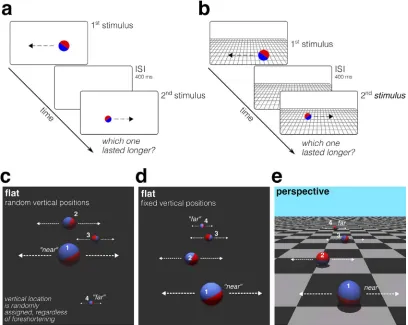
We tested this hypothesis in a series of experiments by asking observers to judge the duration of simple dynamic events consisting of 3-D rendered balls rolling along horizontal paths placed at different distances from the observer in fronto-parallel planes. Each of the durations (that is, the intervals between the appearance and disappearance of the rolling ball) was rendered as one uniquely defined event in the virtual dimension. The same duration (or visual event) could be rendered as if it were placed at different distances from the observer, so that each distance resulted in a different level of foreshorteningof the rolling ball (i.e., different combinations of the ball’s proximal attributes: size, speed, and length of the motion path). Our stimuli therefore can be described as different combinations of temporal duration and foreshortening of the rolling ball. The stimuli were presented in two different contextual conditions: either on a uniform gray background (hereafter referred to as theflatcondition; for details, see Figure 1a, c, and d and Methods) or on a linear perspective projection of a checkerboard ‘‘floor’’ below a blue ‘‘sky’’ (hereafter, theperspective
condition; Figure 1b and e). The flat condition allows testing whether the foreshortening of the moving ball, in the absence of other information about viewing distance, does systematically distort the perceived duration. The perspective condition, on the other hand, is meant to reveal whether contextual information about the viewing distance (in the form of simple linear perspective cues) can eliminate these distortions, provided that perspective rules are respected.
In the experiments, each event (the ball travelling along its path) could last for one of four durations, logarithmically spaced (600, 780, 1014, and 1318 ms). These durations were obtained in two distinct experi-ments (see Methodsfor details) by either slightly modulating the ball’s distal speed so as to maintain the length of the motion path constant in the virtual
dimension (constant-lengthexperiment) or by letting the distal trajectory length vary while keeping the distal speed constant (constant-speedexperiment). This al-lowed us to control for the potential use of the trajectory length (or speed) as a proxy for duration judgments. As anticipated, the rolling ball assumed one of four levels of foreshortening. In the perspective conditions (Figure 1e), each level was always associated with one of the four vertical locations on the screen (corresponding to four depth planes in the virtual dimension), so that speed, path length, and size scaled in agreement with the perspective rules. In two of three flat conditions, however, the different levels of foreshortening of the rolling balls were randomly associated with the balls’ vertical locations on the screen (Figure 1c). As a consequence, the distal event constancy(i.e., the ability to recognize the event as having the same properties in the virtual dimension despite changes in its 2-D
representation on the screen) over locations was
compromised. (Note that we will hereafter use the term
foreshortening to indicate proximal changes in the
stimulus in both the flat and perspective conditions.) In a third flat condition the level of foreshortening of the rolling ball scaled systematically with the vertical location of the ball, just like in the perspective condition (Figure 1e). In this case, the four different durations were always obtained by varying the length of the trajectory of the rolling ball (hence keeping constant its distal speed). This flat condition was meant to isolate the pure contribution of the perspective-rendered back-ground to duration perception.
To assess the contribution of the foreshortening of the rolling balls to perceived duration, we used the method of conjoint measurement (Ho, Landy, & Maloney, 2008; Luce & Tukey, 1964). The method is ideally suited for assessing how judgments made on a single perceptual dimension (here, perceived duration) are affected by changes along multiple, heterogeneous physical dimensions (here, physical duration and foreshortening). The method requires that stimuli be presented in pairs and that observers order them in each pair according to some criterion—here, perceived duration (i.e., which of the two stimuli lasted longer; for details, see Figure 1a and b and Methods).
Methods
Stimuli and apparatus
real-time framework for Linux (http://www.xenomai.org). The viewing distance was about 45 cm. Rolling balls of four sizes (on-screen diameter of about 2.2, 1.2, 0.7, and 0.4 cm) covered horizontal trajectories of variable lengths and speeds at one of four vertical locations (7.8, 11.0, 12.9, and 14.0 cm from the bottom edge of the screen). The duration of the ball motion could take one of four logarithmically spaced temporal values (600, 780, 1014, and 1318 ms). The screen either was uniform dark gray (0.8 cd/m2) or displayed a linear perspective projection of a checkerboard ‘‘floor’’ (mean luminance¼2.3 cd/m2) below a blue ‘‘sky’’ (10.3 cd/m2). In the latter case the foury-locations translated into four depth planes equally spaced in log units as seen by the observer (1.8, 3.2, 5.8, and 10.5 squares of the checkerboard floor). The width of the squares as rendered on the screen was 14.6 cm for the central square at the lower edge of the display, decreasing to 0.2 cm at the level of the horizon. When placed at the corresponding elevations, the four ball sizes translated
into a unique size in the virtual 3-D world: The largest ball placed in the nearest depth plane had the same size (in virtual dimension) as the smallest ball placed in the most remote depth plane. Note that in order to
distinguish the characteristics of the moving ball in the virtual 3-D world from their 2-D projection on the screen, we use the termsdistalandproximal, respectively.
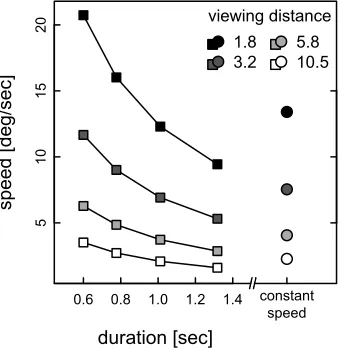
[image:4.612.103.511.61.386.2]Two different experiments were run, in which the four durations were obtained either by varying the distal trajectory length while keeping the distal speed constant (constant-speed experiment) or by varying the distal speed and keeping the distal length of the trajectory constant (constant-length experiment; see Figure 2). In the constant-length experiment the distal trajectory length was always equal to the mean of the distal lengths used in the constant-speed experiment (averaged over the four physical durations). Each experiment consisted of two separate conditions, with and without the perspective checkerboard background floor (perspective
and flat conditions; respectively, Figure 1b and e and Figure 1a, c, and d). For the perspective background condition, the proximal sizes, speeds, and trajectory lengths of the rolling balls covaried with the location of the ball in the perspective plane so as to be commen-surate with the foreshortening laws of linear perspective, resulting in four levels of foreshortening of the moving ball. For the flat background condition, the proximal ball size and speed or length also covaried, resulting in four foreshortening levels, identical to those of the perspective condition but randomly displayed at one of the foury-locations on the screen (Figure 1c). An additional control experiment with a flat (uniform) background was run, where they-location of the moving ball on the screen covaried with the foreshortening of the ball just like in the perspective condition (flat with fixed vertical positions; Figure 1d).
Participants
Eight human observers (five women and three men; mean age¼35 years,SD¼11.87) paticipated in the perspective and flat conditions of Experiment 1
(constant-speed experiment), eight (two women and six men; mean age¼38.13 years,SD¼12.46) in the perspective and flat conditions of Experiment 2 (constant-length experiment), and eight (three women, five men; mean age¼32.37 years, SD¼14.68) in the control experiment with flat background and fixed positions; two observers (the authors) were shared by the three groups. The number of participants was chosen so as to permit us to obtain sensible estimates of standard deviations for the random-effects terms of the models used in the analysis (Bates, 2010; for details on the models, see the Conjoint measurement models subsection). All had normal or corrected-to-normal vision and gave their informed consent to perform the experiments. The study was conducted in accordance with French regulations and the requirements of the Helsinki Convention.
Procedure
We used the method of conjoint measurement (Ho et al.,2008; Knoblauch & Maloney, 2012; Luce & Tukey, 1964). The method calls for a simple psychophysical task: Two stimuli are presented in succession (or at different locations), and the observer is required to order them according to some criterion. In our task, observers were asked to report which of the two stimuli in a pair lasted longer (Figure 1a and b), allowing us to assess the contamination of duration judgments by contextual variables (for details, see the Conjoint measurement model subsection). The contextual vari-able here was the foreshortening of the moving ball (that is, the joint variation of the proximal speed and size of the ball and the length of its motion path), measured in different conditions where information about viewing distance (the checkerboard floor ren-dered in linear perspective) was present or absent.
One trial unfolded as follows: The empty or
perspective background was presented for 400–500 ms (uniformly distributed) before the appearance of the first rolling ball for one of four durations at one of four vertical locations, followed by an interstimulus interval of 400 ms and then the appearance of the second rolling ball also for one of four durations at one of four vertical locations. The next trial was initiated immedi-ately after the response. The trajectories covered by the moving ball were presented always centered with respect to the screen, with some horizontal jitter (uniformly distributed within a range of 640% of the side of the checkerboard square on which the ball was located). The direction of motion (leftward or right-ward) of the first and second rolling ball in a pair were independently randomized.
[image:5.612.82.252.61.235.2]There were 16 possible stimuli in each experiment (4 durations34 levels of foreshortening), yielding 120 Figure 2. Relationship between proximal speed and duration in
the constant-length experiment. The proximal speeds (in8/s) of the rolling balls used in the constant-length experiment are plotted as a function of the tested durations. Different symbol shades indicate the four foreshortening levels, which corre-spond to four different viewing distances in the virtual dimension (reported in the inset as the number of squares of the checkerboard plane). The different speeds were obtained by choosing one unique trajectory length (defined in the virtual dimension, and corresponding to the average of the trajectory lengths of all durations in the constant-speed experiment; see main text for details). In the constant-speed experiment, the speed of the ball was constant for all durations and translated into four proximal speeds depending on the level of
different stimulus pairs (with order discarded and repetitions forbidden within a pair). Each stimulus pair was presented four times (with the order of the stimuli balanced across repetitions of the same pair) in each experiment, yielding 480 trials per condition and per observer, translating into a duration of about 35 min. per condition. We did not manipulate all the properties of the stimulus independently (e.g., proximal size, proximal speed, vertical location), because the number of possible stimulus pairs would have then increased to a prohibitive number. The order of the flat and perspective experimental conditions (in both constant-length and constant-speed experiments) was counter-balanced across observers so that half of the observers started with the condition with the perspective back-ground and the other half started with the condition with no background.
Conjoint measurement models
We modeled the data within the framework pro-posed by Ho et al. (2008) and Knoblauch and Maloney (2012) for conjoint measurement experiments. We started by fitting an additive model to our data. The model assumes that perceived duration results from the linear sum of separate contributions of the physical duration and foreshortening. More specifically, the perceived durationwof a given stimulus was modeled as
wij ¼DiþFj ð1Þ
where the indicesi {1, 2, 3, 4} and j {1, 2, 3, 4} indicate, respectively, the level of physical duration (D) and foreshortening (F) of the stimulus (see Stimuli and apparatus subsection). If perceived duration is not affected by variations in depth, thenFshould be equal to zero for allj. When two stimuli are compared, we assume that observers base their decisions on the noise-contaminated variableD:
Dijkl ¼wijwklþe¼ ðDiþFjÞ ðDkþFlÞ þe
e;N ð0;4r2Þ
ð2Þ
so thatwijwill be judged as longer thanwklwhenD.0 (withe representing a normally distributed judgment error). For model identifiability, we anchored the perceptual scales by setting the scale values for the first stimulus level of each dimension to zero (i.e.,D1¼F1¼
0). Following Gerardin, Devinck, Dojat, and Kno-blauch (2014), we scaled the estimated values ofDand
Fso that they would be on the same scale as the sensitivity indexd0 (Green & Swets, 1966).
In addition—and different from Ho et al. (2008), who fitted a model for each observer—we fitted a single
mixed-effects (or hierarchical) additive model for each condition and experiment, under the assumption that the scale valuesDandFare normally distributed across observers. Within the mixed-effects modeling frame-work, the perceived duration of a given stimulus is modeled as a linear combination offixed(DandF) and
random, or observer-specific, effects (us); for example,
for a given observer s, the perceived duration of a stimulus with physical duration level i and foreshort-ening level j is
wij;s ¼DiþuDi;sþFjþuFj;s
u;N ð0;RÞ ð3Þ
whereR indicates the variance-covariance matrix for the multivariate Gaussian distribution of the random (observer-specific) effects u. This model can be formu-lated as a generalized linear mixed-effects model (Knoblauch & Maloney, 2012) with observer as the grouping factor. We estimated its parameters by maximum likelihood using R (R Core Team, 2015) and the lme4 library (Bates, Maechler, Bolker, & Walker, 2014).
Since the estimated values for the perceptual scales (Dand F) in our experiment showed a clear linear dependence on the stimulus levels, we introduced an additional simplification and fitted an additive-linear
model, where these scales are modeled as linear functions of the stimulus indices. In the additive-linear model the decision variable can be notated as
Dijkl ¼ ðibDþjbFÞ ðkbDþlbFÞ þe
¼ ðikÞbDþ ðjlÞbF¼dikbDþdjlbF ð4Þ where thebvalues are the linear slopes;i,j,k, andlare the indices indicating the levels of the stimuli; and d
indicates the differences between the indices. This model can also be formulated as a generalized linear mixed-effects model, where the slope for each observer
s is modeled as a sum of fixed (b) and random (bs) effects:
U1pðDijkl.0jsÞ
¼dikðbDþbD;sÞ þdjlðbFþbF;sÞ
b;N ð0;RÞ
ð5Þ
Here Uindicates the cumulative distribution func-tion of the standard normal distribufunc-tion, andp(Dijkl. 0js) corresponds to the probability that the observers
judges the stimulus with physical duration and
foreshortening levelsiandj, respectively, to last longer than the stimulus with physical duration and fore-shortening levels k andl.
In order to test the effect of foreshortening on the duration judgments, we compared for each condition and experiment the additive-linear model with an
fore-shortening is set to zero (that is, a model wherebF¼0). Across the two models (additive-linear and indepen-dence), we kept constant the structure of the random componentsb. Since the independence model is nested within the additive-linear model, we compared the two models using a likelihood-ratio test. Additionally, we tested the effect of the perspective background at the within-observer level by fitting both conditions (flat and perspective) with a single model that included parameters for the changes in the slopes between the two conditions, and by comparing these models via likelihood-ratio tests with reduced models where the changes in slopes were forced to be zero.
Finally, in order to evaluate whether the additive-linear model provides an adequate description of the data, we fitted asaturatedmodel where we introduced an additional coefficientbFD that was applied to a product of the indices to obtain an additional interaction term that could account for interactions between physical duration and foreshortening. As with the independence model, this saturated model was compared to the additive-linear models with likelihood-ratio tests (keeping the structure of the random effects constant).
Results
The effect of foreshortening on the observers’ responses averaged over all durations and observers (that is, the marginal effect of foreshortening) is represented as different shades of the discs in the top panels of Figure 3. Duration judgments in the flat conditions (left and middle top panels in Figure 3) were clearly dependent on the magnitude of the proximal attributes: On average, observers tended to judge ‘‘near’’ events (i.e., larger balls moving faster over a longer path) to last longer than ‘‘far’’ events. This was not the case for the perspective condition (right top panel in Figure 3), where duration judgments appear to have been unaffected by the foreshortening of the rolling balls.
To quantify the interaction between physical dura-tion and the foreshortening of the moving balls, we initially fitted the data with an additive model (Ho et al.,2008; Knoblauch & Maloney, 2012; see Conjoint measurement models subsection). The parameters of the model represent the additive contributions to the perceived duration of each level of stimulus physical duration and of foreshortening (except for the shortest and smallest values, respectively, which were set to 0 for model identifiability), expressed in units ofd0(Gerardin et al., 2014; Green & Swets, 1966). The strength of this modeling approach is that it allows measurement of the effect of different, heterogeneous physical variables on
a common perceptual scale, even when these variables are defined on different domains (here, temporal and spatial). Hereafter, the notation Drefers to the coefficients coding for the contribution of physical duration, and Fto the coefficients coding for the contribution of foreshortening. They denote the contribution to the perceived duration of their physical counterparts. We estimated the set of scale values that best capture observer’s judgments of the perceived duration difference between the stimuli in each pair by maximizing the likelihood of observer’s responses under the additive model (for details, see Methods). The estimated scale values (averaged over observers) are represented in Figure 3 (bottom panels) as a function of the stimulus level (1 to 4), where stimulus level refers to either physical duration (the four durations used, in increasing order; open symbols) or foreshortening (the four combinations of proximal attributes, ordered from near to far; shaded symbols). The values for F show different trends depending on the experimental condition: They decrease in the flat conditions, indicating a contraction of perceived duration with increasing levels of foreshortening (from near to far), while they stay around 0 in the perspective conditions. This indicates that the net effect of
perspective foreshortening, in the flat condition, is to make the perceived duration contract, the more so as the speed, size, and length of the moving ball decrease. This effect is abolished in the perspective condition.
An interesting feature of the estimated scale valuesD
information criterion (Akaike, 1974), a measure of the relative quality of statistical models. We did the comparison separately for each experiment and condi-tion: Differences in the Akaike information criterion ranged between 18 and 36, and in all cases favored the additive-linear model. Thus the assumption that all observers have linear perceptual scales allows for a model that uses fewer parameters while fitting the data equally well as the additive model.
We statistically tested the effect of foreshortening by comparing the additive-linear model with the indepen-dence model (for details, see the Conjoint measurement models subsection). The likelihood-ratio test revealed that the slope coding for the influence of foreshortening was significantly different from 0 in both constant-speed,v2(1)¼11.81,p ,0.001, and constant-length,
v2(1)¼11.89, p,0.001, experiments, confirming that
foreshortening induces in these conditions a significant contraction of the perceived duration. Additionally, the effect of foreshortening was significant in the control experiment with a flat background and fixed vertical positions, v2(1)¼7.84,p¼0.005, where stimuli appeared at the same screen locations as in the
[image:8.612.101.507.60.376.2]length,v2(1)¼2.28,p¼0.13, experiment. The effect of foreshortening on the apparent duration, as summa-rized by the slopes of the component scales, is represented in Figure 4for all experiments and conditions. Overall, for the stimuli tested, foreshort-ening made a contribution of about 23%to perceived duration in the flat condition (ratio of the slopes for foreshortening and physical duration) and only 2% in the perspective condition.
The perspective and flat conditions of the constant-length and constant-speed experiments were performed by the same groups of observers, so we tested whether the differences in slope between these conditions resulted in significant within-subject interactions (for details, see Methods). We found a significant change in the slope for the contribution of foreshortening in both constant-speed,v2(1)¼53.33,p,0.001, and constant-length,v2(1)¼5.91,p¼0.01, experiments, revealing that the contribution of foreshortening to perceived duration depended on the presence or absence of perspective cues. Conversely, no significant change in slope between flat and perspective conditions was found for the contribution of physical duration, in either the constant-speed,v2(1)¼2.84,p¼0.09, or constant-length,v2(1)¼0.36,p.0.25, experiments. To sum up, in agreement with our hypothesis of time constancy, we find that duration judgments are unaffected by changes in the proximal aspects of the stimulus (foreshortening) only when those changes are made in conditions where information about viewing distance is present (linear perspective cues).
The comparison with the saturated model (see the Conjoint measurement models subsection) had
non-significant results (all ps.0.5) for all experiments and conditions. We therefore conclude that modeling the interaction between temporal duration and foreshort-ening as a simple additive contamination of the former by the latter provides an adequate description of observers’ responses.
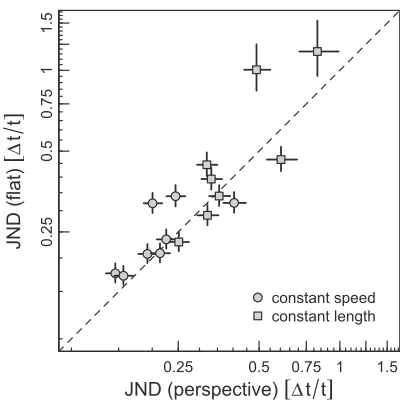
Finally, to allow for comparison of the performance in our task with that of other studies on time perception, we derived for each condition each observer’s discrim-ination threshold. Thresholds were inferred from a probit analysis combining stimuli with all levels of foreshortening, and were defined as the proportion of duration increase that yielded a change from 0.5 to 0.75 in the probability of the second stimulus being judged as having a longer duration than the first. Figure 5presents the individual thresholds in the flat (random vertical positions) condition as a function of the thresholds measured in the perspective condition. The average discrimination thresholds were 0.24 (SD¼0.07) and 0.22 (SD¼0.08) in the flat and perspective conditions of the constant-speed experiment, respectively; 0.54 (SD¼
0.35) and 0.44 (SD¼0.19) in the flat and perspective conditions of the constant-length experiment; and 0.55 (SD¼0.51) in the experiment with a flat background and fixed positions. For the observers who performed both the flat and perspective conditions, we did not find any significant difference in the discrimination
[image:9.612.345.545.56.256.2]thresh-Figure 4. Effects of foreshortening on perceived duration. The linear slopes of the component scales coding for the effect of foreshortening on perceived duration are represented for each experiment and condition, along with bootstrapped 95% confidence intervals. The magnitude of the slope indicates by how much (in units ofd0) the perceived duration of a stimulus contracts after a 30% increase of the viewing distance. It is only in the flat conditions (filled black dots) that the confidence intervals did not include 0.
[image:9.612.75.259.61.207.2]olds—constant-speed:t(7)¼1.11,p¼0.30; constant length:t(7)¼1.35,p¼0.22.
Discussion
It is known that the perceived duration of a visual event in the second-to-subsecond range depends largely on the spatiotemporal properties (e.g., size, speed) of the stimulation. While traditionally these modulators of perceived duration have been studied in isolation, in this study we examined their joint effects on the perceived duration of an object moving at different viewing distances within a realistic perspective rendering of a 3-D environment. We find that when the fluctuations in the proximal (i.e., retinal) spatial properties of the moving object are arranged so that they respect realistic perspective rules, and when contextual information about viewing distance is present (perspective conditions; Figure 1band e), their respective effects on the perceived duration of the moving object seem to cancel out, so that duration judgments are unaffected by changes in viewing distance. Conversely, when the same exact proximal stimuli are presented in the absence of additional distance cues (flat condition; Figure 1d), these effects result in a contraction of the perceived duration that is proportional to the foreshortening of the moving object. Taken together, our results indicate that when information about viewing distance is available, the brain compen-sates for the changes in the proximal properties of the visual events so as to preserve a constant perceived duration independent of the events’ location in depth. This time-constancy phenomenon is the temporal equivalent of the well-known size constancy: Both phenomena refer to the fact that our perception (of the real size of objects and of their physical duration) remains constant regardless of the changes in the retinal input caused by variations in the viewing distance.
It has been proposed that judgments about space and time rely on a generalized magnitude processing
mechanism (Cai & Connell,2015; Walsh, 2003), an idea that is in agreement with the numerous reports of interaction between space and time in perception. However, this theory is not constrained by any specific timekeeping mechanism (Bueti & Walsh, 2009), and the brain mechanisms subserving time estimation remain largely debated (Finnerty, Shadlen, Jazayeri, Nobre, & Buonomano, 2015; Merchant, Harrington, & Meck, 2013). One view is that there are modality-specific mechanisms for perceived duration of sensory events (e.g., visual and auditory; Burr & Morrone, 2006; Burr, Tozzi, & Morrone, 2007; Johnston, Arnold, & Nishida, 2006; Yuasa & Yotsumoto, 2015) that could be based, for example, on mechanisms for coding speed (Gorea & Kim, 2015; Kaneko & Murakami, 2009) or temporal
frequency (Kanai et al., 2006; Linares & Gorea, 2015). A common characteristic of these studies is that they relate perceived duration to the strength of the neural response evoked by the stimulus (Eagleman & Pariyadath, 2009; Pariyadath & Eagleman, 2007). The present results, however, demonstrate that, provided that information about viewing distance is available, the brain can correctly compare durations of similar events even when these events are placed at different viewing distances and therefore evoke very different neural responses (i.e., they result in different proximal stimuli). Although it has been shown that viewing distance (in the form of linear perspective cues) can rescale the spatial extent of neural activity as early as the primary visual cortex (He, Mo, Wang, & Fang, 2015; Murray, Boyaci, & Kersten, 2006; Ni, Murray, & Horwitz, 2014), we argue that this modulation cannot fully account for the present results: While the degree of rescaling seems limited to a fraction of the objects’ sizes, presumably due to feed-forward inputs to V1 (Murray et al., 2006), the spatial extent of the visual events that were perceived as having equal durations in the perspective (but not flat) conditions of our experiments could vary up to a factor of 5.5 (ratio between the farthest and nearest trajectory lengths and ball sizes). Our results therefore call for a more general mechanism (or brain system) for time perception that not only collects information from modality-specific brain areas to assess the duration of an event (Merchant et al., 2013) but also weights these inputs according to ecological contextual cues, such as viewing distance.
In sum, we have presented the first demonstration to our knowledge of perceptual constancy in the time domain. It suggests that the brain not only uses spatial aspects of the visual stimulation to time visual events in the subsecond-to-second range (Abe,1935; Kanai et al., 2006; Kaneko & Murakami, 2009) but also adjusts the weights of these cues to normalize perceptual time across the viewing distance. In this view, one could speculate that time distortions induced by the physical features (such as speed and size) of stimuli whose duration is to be judged have in fact evolved phylogenetically so as to ensure time constancy in a 3-D world.
slope of the linear function representing the contribu-tion of physical duracontribu-tion in the perspective condicontribu-tion (Figure 3, bottom right panel) with respect to the flat condition (Figure 3, bottom middle panel), reflecting larger perceptual intervals between the four physical durations. This was not the case: The respective slopes were not significantly different, revealing that discrim-ination accuracy (for comparisons made within the same level of foreshortening) was not influenced by the experimental condition (flat vs. perspective). Yet another alternative interpretation of the present results could be that the observed time constancy is but a consequence of speed constancy (Brown, 1931; Mckee & Smallman, 1998; Tozawa, 2008) or size constancy (Gregory, 1963), which equalized the perceived features of the stimulus across the different levels of foreshort-ening. Because we did not measure perceived speed, size, or traveled distance, this possibility cannot be excluded. Further research is needed to test this hypothesis and determine whether time constancy generalizes over more complex visual environments including factors such as self-motion (e.g., Combe & Wexler, 2010) and stereopsis.
The constancy of perceived time is an aspect of human perception that we take for granted, as it is hard to conceptualize how otherwise we could share the sense of time in a 3-D visual world. The present results point to a link between time and size/speed constancies. They suggest a common process that infers physical (or distal) properties of the world and drives perception of both space and time. A failure of such a shared process might be at the origin of deficits in both interval timing (Bonnot et al.,2011; Carroll, O’Donnell, Shekhar, & Hetrick, 2009) and size constancy (Kidd, 1964;
Macdorman, Rivoire, Gallagher, & MacDorman, 1964; Weckowicz, Sommer, & Hall, 1958) reported in individuals with schizophrenia.
Keywords: time perception, perceptual constancy, visual perception, linear perspective, Ponzo illusion
Acknowledgments
We thank Pierre Pouget for contributing with the OpenGL software. This work was supported by Grant ANR-12-BSH2-0005 from the French National Re-search Agency to A. Gorea and Grant FRM-ING20121226433 from the Foundation pour la Recherche M´edicale to P. Pouget and A. Gorea.
Commercial relationships: none. Corresponding author: Matteo Lisi. Email: [email protected].
Address: Universit´e Paris Descartes, Sorbonne Paris Cit´e, Paris, France.
Footnote
1
We point out that because time (duration) does not exist by itself (i.e., it is always associated with an event), the notion ofproximal stimulusis undefined in the time domain. For the current purposes we call proximal the
ensemble of physical features that reach the senses and define the event. Accordingly, with respect to our experiments, the termconstancy indicates that two different proximal events (different sizes and speeds but identical durations) are judged to be perceptually identical in the presence of 3-D cues but different in their absence. Hence, constancy according to this definition refers to the fact that different proximal stimuli in a 2-D worldbecomeperceptually equivalent in a 3-D world.
References
Abe, S. (1935). Experimental study of the corelation between time and space. Tohoku Psychologica Folia, 3, 53–68.
Akaike, H. (1974). A new look at the statistical model identification. IEEE Transactions on Automatic Control, 19(6), 716–723, doi:10.1109/TAC.1974. 1100705.
Aks, D. J., & Enns, J. T. (1996). Visual search for size is influenced by a background texture gradient.
Journal of Experimental Psychology: Human Per-ception and Performance, 22(6), 1467–1481, doi:10. 1037/0096-1523.22.6.1467.
Allman, M. J., Teki, S., Griffiths, T. D., & Meck, W. H. (2014). Properties of the internal clock: First-and second-order principles of subjective time.
Annual Review of Psychology, 65, 743–771. Bates, D. M. (in preparation).lme4: Mixed-effects
modeling with R. New York: Springer. Retrieved from http://lme4.r-forge.r-project.org/lMMwR/ lrgprt.pdf
Bates, D., Maechler, M., Bolker, B., & Walker, S. (2014). lme4: Linear mixed-effects models using Eigen and S4 (R package version 1.1-7) [Computer software]. Retrieved from http://cran.r-project.org/ package¼lme4
Bonnet, C. (1984). Discrimination of velocities and mechanisms of motion perception. Perception,
13(3), 275–282, doi:10.1068/p130275.
Paris, 105(4–6), 164–169, doi:10.1016/j.jphysparis. 2011.07.006.
Boring, E. G. (1942).Sensation and perception in the history of experimental psychology. New York: Appleton-Century.
Brown, J. F. (1931). The visual perception of velocity.
Psychologische Forschung, 14(1), 199–232, doi:10. 1007/BF00403873.
Bueti, D., & Walsh, V. (2009). The parietal cortex and the representation of time, space, number and other magnitudes.Philosophical Transactions of the Royal Society B: Biological Sciences, 364(1525), 1831– 1840, doi:10.1098/rstb.2009.0028.
Buhusi, C. V., & Meck, W. H. (2005). What makes us tick? Functional and neural mechanisms of interval timing. Nature Reviews Neuroscience, 6, 755–765, doi:10.1038/nrn1764.
Burr, D. C., & Morrone, M. C. (2006). Time perception: Space–time in the brain. Current Biology,16(5), R169–R171, doi:10.1016/j.cub.2006. 02.042.
Burr, D., Tozzi, A., & Morrone, M. C. (2007). Neural mechanisms for timing visual events are spatially selective in real-world coordinates. Nature Neuro-science, 10(4), 423–425, doi:10.1038/nn1874.
Cai, Z. G., & Connell, L. (2015). Space-time interde-pendence: Evidence against asymmetric mapping between time and space. Cognition, 136, 268–281. Carroll, C. A., O’Donnell, B. F., Shekhar, A., &
Hetrick, W. P. (2009). Timing dysfunctions in schizophrenia span from millisecond to several-second durations. Brain and Cognition, 70(2), 181– 190, doi:10.1016/j.bandc.2009.02.001.
Combe, E., & Wexler, M. (2010). Observer movement and size constancy.Psychological Science,21(5), 667–675, doi:10.1177/0956797610367753.
Eagleman, D. M. (2008). Human time perception and its illusions. Current Opinion in Neurobiology, 18, 131–136, doi:10.1016/j.conb.2008.06.002.
Eagleman, D. M., & Pariyadath, V. (2009). Is
subjective duration a signature of coding efficiency?
Philosophical Transactions of the Royal Society B: Biological Sciences, 364(1525), 1841–1851, doi:10. 1098/rstb.2009.0026.
Fineman, M. B. (1981). Complexity of context and orientation of figure in the corridor illusion.
Perceptual and Motor Skills, 53(1), 11–14, doi:10. 2466/pms.1981.53.1.11.
Finnerty, G. T., Shadlen, M. N., Jazayeri, M., Nobre, A. C., & Buonomano, D. V. (2015). Time in cortical circuits. The Journal of Neuroscience,
35(41), 13912–13916, doi:10.1523/JNEUROSCI. 2654-15.2015.
Fraisse, P. (1963). The psychology of time. New York: Harper and Row.
Gerardin, P., Devinck, F., Dojat, M., & Knoblauch, K. (2014). Contributions of contour frequency, am-plitude, and luminance to the watercolor effect estimated by conjoint measurement. Journal of Vision,14(4):9, 1–14, doi:10.1167/14.4.9. [PubMed] [Article]
Gogel, W. C., & McNulty, P. (1983). Perceived velocity as a function of reference mark density. Scandina-vian Journal of Psychology, 24(4), 257–265, doi:10. 1111/j.1467-9450.1983.tb00499.x.
Gorea, A. (2011). Ticks per thought or thoughts per tick? A selective review of time perception with hints on future research. Journal of Physiology Paris, 105(4–6), 153–163, doi:10.1016/j.jphysparis. 2011.09.008.
Gorea, A., & Hau, J. (2013). Time in perspective.
Psychological Science, 24(8), 1477–1486, doi:10. 1177/0956797612473486.
Gorea, A., & Kim, J. (2015). Time dilates more with apparent than with physical speed. Journal of Vision,15(1):7, 1–11, doi:10.1167/15.1.7. [PubMed] [Article]
Green, D. M., & Swets, J. A. (1966). Signal detection theory and psychophysics. Oxford, England: John Wiley.
Gregory, R. L. (1963). Distortion of visual space as inappropriate constancy scaling.Nature,199(4894), 678–680.
Hass, J., & Durstewitz, D. (2014). Neurocomputational models of time perception. In H. Merchant & V. de Lafuente (Eds.), Neurobiology of interval timing
(pp. 49–71). New York: Springer, doi:10.1007/ 978-1-4939-1782-2_4.
He, D., Mo, C., Wang, Y., & Fang, F. (2015). Position shifts of fMRI-based population receptive fields in human visual cortex induced by Ponzo illusion.
Experimental Brain Research, 233(12), 3535–3541, doi:10.1007/s00221-015-4425-3.
Ho, Y. X., Landy, M. S., & Maloney, L. T. (2008). Conjoint measurement of gloss and surface texture.
Psychological Science, 19(2), 196–204, doi:10.1111/ j.1467-9280.2008.02067.x.
Holway, A. H., & Boring, E. G. (1941). Determinants of apparent visual size with distance variant. The American Journal of Psychology, 54(1), 21–37, doi: 10.2307/1417790.
principles of psychology(pp. PP–PP). New York: H. Holt & Co.
Johnston, A., Arnold, D. H., & Nishida, S. (2006). Spatially localized distortions of event time. Cur-rent Biology, 16(5), 472–479, doi:10.1016/j.cub. 2006.01.032.
Kanai, R., Paffen, C. L. E., Hogendoorn, H., & Verstraten, F. A. J. (2006). Time dilation in dynamic visual display.Journal of Vision, 6(12):8, 1421–1430, doi:10.1167/6.12.8. [PubMed] [Article]
Kaneko, S., & Murakami, I. (2009). Perceived duration of visual motion increases with speed.Journal of Vision,9(7):14, 1–12, doi:10.1167/9.7.14. [PubMed] [Article]
Kidd, A. H. (1964). Monocular distance perception in schizophrenics. Journal of Abnormal and Social Psychology, 68(1), 100–103, doi:10.1037/h0045150.
Knoblauch, K., & Maloney, L. (2012).Modeling psychophysical data in R. New York: Springer, doi: 10.1007/978-1-4614-4475-6.
Linares, D., & Gorea, A. (2015). Temporal frequency of events rather than speed dilates perceived duration of moving objects.Scientific Reports, 5, 1– 9, doi:10.1038/srep08825.
Luce, D. R., & Tukey, J. W. (1964). Simultaneous conjoint measurement: A new type of fundamental measurement.Journal of Mathematical Psychology,
1(1), 1–27, doi:10.1016/0022-2496(64)90015-X.
Macdorman, C. F., Rivoire, J. L., Gallagher, P. J., & MacDorman, C. F. (1964). Size constancy of adolescent schizophrenics.Journal of Abnormal and Social Psychology, 69(3), 258–263, doi:10.1037/ h0042347.
Mcgraw, P. V., Roach, N. W., Badcock, D. R., & Whitaker, D. (2012). Size-induced distortions in perceptual maps of visual space. Journal of Vision,
12(4):8, 1–14, doi:10.1167/12.4.8. [PubMed] [Article]
Mckee, S. P., & Smallman, H. S. (1998). Size and speed constancy. In V. Walsh & J. Kulikowski (Eds.),
Perceptual constancy (pp. 373–408). Cambridge, UK: Cambridge University Press.
Merchant, H., Harrington, D. L., & Meck, W. H. (2013). Neural basis of the perception and estimation of time.
Annual Review of Neuroscience, 36, 313–336, doi:10. 1146/annurev-neuro-062012-170349.
Murray, S. O., Boyaci, H., & Kersten, D. (2006). The representation of perceived angular size in human primary visual cortex. Nature Neuroscience, 9(3), 429–434, doi:10.1038/nn1641.
Ni, A. M., Murray, S. O., & Horwitz, G. D. (2014).
Object-centered shifts of receptive field positions in monkey primary visual cortex. Current Biology,
24(14), 1653–1658, doi:10.1016/j.cub.2014.06.003.
Pariyadath, V., & Eagleman, D. M. (2007). The effect of predictability on subjective duration.PLoS One,
2(11), e1264, doi:10.1371/journal.pone.0001264.
Ponzo, M. (1911). Intorno ad alcune illusioni nel campo delle sensazioni tattili sull’illusione di Aristotele e fenomeni analoghi [On some tactile illusions, Aristotle’s illusion, and similar phenom-ena]. Archive fu¨r die Gesamte Psychologie, 16, 307– 345.
R Core Team. (2015). R: A language and environment for statistical computing [Computer software]. Vienna, Austria: R Foundation for Statistical Computing. Retrieved from http://www.r-project. org/
Rammsayer, T. H., & Verner, M. (2014). The effect of nontemporal stimulus size on perceived duration as assessed by the method of reproduction.Journal of Vision, 14(5):17, 1–10, doi:10.1167/14.5.17.
[PubMed] [Article]
Rogers, M., Knoblauch, K., & Franklin, A. (2016). Maximum likelihood conjoint measurement of lightness and chroma.Journal of the Optical Society of America A,33(3), A184–A193, doi:10.1364/ JOSAA.33.00A184.
Tozawa, J. (2008). Speed constancy and the perception of distance. Perception,37(1), 3–21, doi:10.1068/ p5585.
van Wassenhove, V. (2009). Minding time in an amodal representational space. Philosophical Transactions of the Royal Society B: Biological Sciences,
364(1525), 1815–1830, doi:10.1098/rstb.2009.0023.
Walsh, V. (2003). A theory of magnitude: Common cortical metrics of time, space and quantity.Trends in Cognitive Sciences,7(11), 483–488, doi:10.1016/j. tics.2003.09.002.
Weckowicz, T. E., Sommer, R., & Hall, R. (1958). Distance constancy in schizophrenic patients. The British Journal of Psychiatry, 104(437), 1174–1182, doi:10.1192/bjp.104.437.1174.
Xuan, B., Zhang, D., & Chen, X. (2007). Larger stimuli are judged to last longer.Journal of Vision,7(10):2, 1–5, doi:10.1167/7.10.2. [PubMed] [Article]