1
Radical-Mediated C–H Functionalization: A Strategy for Access to Modified
Cyclodextrins
Dimitri Alvarez-Dorta,† Elisa I. León,† Alan R. Kennedy,‡ Angeles Martín,*,† Inés Pérez-Martín,† and Ernesto Suárez*,†
†Síntesis de Productos Naturales, Instituto de Productos Naturales y Agrobiología del CSIC Carretera de La Esperanza 3, 38206, La Laguna, Tenerife (Spain)
‡
WestCHEM Department of Pure and Applied Chemistry
University of Strathclyde, 295 Cathedral Street, Glasgow G1 1XL, Scotland (UK)
ABSTRACT
A simple and efficient radical C-H functionalization to access modified cyclodextrins (CDs) has been developed. The well-defined conformation of glycosidic and aglyconic bonds in -, -, and
-CDs favors the intramolecular 1,8-hydrogen atom transfer (HAT) promoted by the 6I-O-yl radical
2 glucoses or alternatively triggers the inversion of one -D-glucose into a 5-C-acetoxy--L-idose
unit possessing a 1C4 conformation. The 6I,IV- and 6I,III-diols of - and -CDs behave similarly to the monoalcohols, forming mostly compounds originating from two 1,8-HAT consecutive processes. In the case of 6I,II-diols the proximity of the two 6-O-yl radicals in adjacent sugar units allows the formation of unique lactone rings within the CD framework via a 1,8-HAT–-scission
tandem mechanism. X-Ray diffraction carried out on the crystalline 1,4-bis(trioxocane)--CD derivative shows a severe distortion toward a narrower elliptical shape for the primary face.
INTRODUCTION
Over the past decades, cyclodextrins (CDs) have been extensively investigated for their valuable applications in several areas.1 These naturally-occurring cyclic oligosaccharides are composed of glucose units in 4C1 chair conformations, with a hydrogen bond network formed between the secondary hydroxyl groups, creating a conical shape with an internal hydrophobic cavity, conferring the ability to form host-guest or inclusion complexes with a great variety of molecules and rendering them one of the most important supramolecular host families. Because of these inclusion properties, CDs are displayed as being potentially useful as drug and gene delivery systems,2 artificial enzymes3 or catalysts,4 just to cite a few.
3 obtain diverse patterns of functionalization, which act as platforms to access amphiphilic CDs,5 and hence, sophisticated molecular architectures.6
It should be pointed out that most of these methodologies have addressed the structural changes retaining the 4C1 chair conformation of the glucose units, but a few of them describe modifications of the cavity by altering the conformations of these units. Thus, the reported synthesis of 3,6-anhydro-CDs shows the conformational change of the pyranose units to 1C4, and consequently, a significant change in their binding properties.7 Moreover, the formation of a mono-2,3-epoxide- -CD followed by a nucleophilic ring opening generates an altrose unit in a 1C4 which distorts the cavity from conical to elliptical.8 The introduction of several altrose moieties reflects a rapid equilibrium between 1C4 and 4C1 conformers and their ratio depends on the number of residues and their position in the macromolecule.9 The cycloglycosylation syntheses of cyclodextrin analogues composed exclusively of L-sugars or incorporating both L- and D-sugars residues have been
reported.7a Finally, it has been found that in the crystalline structure of permethylated -CD one of the D-glucose residues is inverted from the normal 4C1 to the 1C4 chair conformation.10
Interestingly, in the methodologies employed to create this structural diversity in CDs, regardless of conformational changes, radical reactions are practically unknown and this fact is not surprising if we consider that in simple carbohydrates they mainly involve the anomeric position which is committed in the cyclic CD structure.11 Only one example has been reported in the literature and is focused on the intermolecular attack of reactive-oxygen-centered free radicals on CDs in aqueous solution using EPR detection experiments.12
4 interest is a novel 1,8-hydrogen atom transfer reaction (1,8-HAT) which takes place, through a rather unusual nine-membered transition state (TS), between both pyranose units in a Hexp-(1→4)-Hexp disaccharide system. The hydrogen abstraction at C5II is promoted, in a highly regioselective manner, by the electrophilic 6I-O-yl radical I generated from the corresponding alcohol under oxidative conditions, producing a C5II radical II (Scheme 1).
Scheme 1. Radical polar crossover mechanism for the HAT reaction promoted by 6-O-yl
radicals in Hexp-(1→4)-Hexp systems of carbohydrates. DIB = (diacetoxyiodo)benzene.
5 C1II, C4I, and C5I) as the conformation of the glycosidic ( = H1II–C1II–O4I–C4I) and aglyconic ( = C1II–O4I–C4I–H4I) bonds. In fact, when these stereochemical and conformational requisites are not suitable for the 1,8-HAT to take place, the alkoxyl radical I may alternatively abstract the hydrogen at C1II via a 1,6-HAT to produce a new C1II radical V which, after oxidation to the respective oxacarbenium ion VI and cyclization, gives the spiro ortho ester VII.
For the -maltose disaccharide, -D-Glcp-(1→4)--D-Glcp, the reaction proceed with complete regioselectivity, yielding compounds formed exclusively from the 1,8-HAT.13a In this case, the corresponding glycosidic and aglyconic bonds in the TS involved ( = –32.7, = –37.3o) are arranged in an exo-syn conformation, where the alkoxyl radical and the H5II are at an optimal distance of 3.1 Å for the initial abstraction step.14
With this result in mind, we decided to investigate whether this radical-polar crossover methodology could be extended to more complex carbohydrates such as CDs, since in these systems the D-glucose units are linked in a similar fashion (cyclo-[-D-Glcp-(1→4)]n). The
measures of distances and angles made on the reported X-ray structure of permethylated -CD15 as well as on its minimized structure indicate that there is sufficient inter-residue flexibility in the macromolecule to adopt an exo-syn conformation similar to -maltose. Therefore, from a theoretical point of view, the 1,8-HAT process could take place between two vicinal units of the macrosystem to provide modified CDs on their primary face, which could exhibit important distortions in their cavities.
6
RESULTS AND DISCUSSIONS
Initially, the most common and readily available -cyclodextrin was the substrate of choice in order to investigate the viability of this radical process. The corresponding monoalcohol 2I-VII,3I-VII,6 II-VII-icosa-O-methyl--CD (1) necessary to assay the reaction was prepared from the commercial
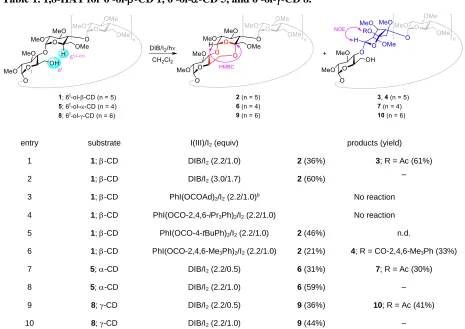
-CD following a well-known three-step sequence consisting in monosilylation of one primary alcohol, O-methylation of the remaining hydroxyl groups and finally removal of silyl-ether.17 This protocol has the advantage of using methyl ethers as protecting groups which usually allow an increase in solubility both in water and in organic solvent.18 To our delight, visible light irradiation of alcohol 1 with diacetoxyiodobenzene (DIB) (2.2 equiv) and iodine (1 equiv) at 30 oC proceeded nicely in 30 minutes delivering the expected 1,3,5-trioxocane 2 (36%) and the acetate 3 (61%) as the major compound (Table 1, entry 1).19 Lower reaction temperatures or fewer equivalents of reagents (DIB or I2) only gave rise to slower and incomplete reactions while the increase in the reaction times or the amount of reagents allowed us to obtain exclusively trioxocane 2 in 60% yield (entry 2). The reaction is plausibly explained by a sequential intermolecular nucleophilic attack by acetate anion to give 3 followed by an intramolecular cyclization leading to 2. A competitive addition of both nucleophiles to the oxacarbenium ion intermediate may also be considered.20 Obviously, both products, 2 and 3, derived from the same C5VII radical intermediate, through an intramolecular 1,8-HAT reaction promoted by the 6I-O-yl radical. No compounds resulting from abstraction at C1VII via a 1,6-HAT process were detected.
7 all D-glucopyranose units are preferentially in 4C1 chair conformations as we can be deduced from the values of the coupling constants of the anomeric hydrogens (3J1,2 ≈ 3.6 Hz).
Table 1. 1,8-HAT for 6I-ol--CD 1, 6I-ol--CD 5, and 6I-ol--CD 8.a
entry substrate I(III)/I2 (equiv) products (yield)
1 1; -CD DIB/I2 (2.2/1.0) 2 (36%) 3; R = Ac (61%)
2 1; -CD DIB/I2 (3.0/1.7) 2 (60%)
– 3 1; -CD PhI(OCOAd)2/I2 (2.2/1.0)b No reaction
4 1; -CD PhI(OCO-2,4,6-iPr3Ph)2/I2 (2.2/1.0) No reaction
5 1; -CD PhI(OCO-4-tBuPh)2/I2 (2.2/1.0) 2 (46%) n.d.
6 1; -CD PhI(OCO-2,4,6-Me3Ph)2/I2 (2.2/1.0) 2 (21%) 4; R = CO-2,4,6-Me3Ph (33%)
7 5; -CD DIB/I2 (2.2/0.5) 6 (31%) 7; R = Ac (30%)
8 5; -CD DIB/I2 (2.2/1.0) 6 (59%) –
9 8; -CD DIB/I2 (2.2/0.5) 9 (36%) 10; R = Ac (41%)
10 8; -CD DIB/I2 (2.2/1.0) 9 (44%) – aReaction conditions: A solution of the alcohol in dry CH
2Cl2 containing the organoiodine(III) reagent and I2 was stirred under
nitrogen while irradiated with two 80 W tungsten-filament lamps. n.d. = not determined. b Ad = 1-Adamantyl.
8 inversion of configuration at C5VII and consequently the original -D-glucopyranose has been transformed into a 5-C-acetoxy--L-idopyranose unit,22 flipping from 4C1 to 1C4 chair conformation. As far as we know, this is the first precedent of a -CD molecule having a -L-idose unit in its structure. Conversely, in the formation of trioxocane 2, the intramolecular nucleophilic addition to the oxacarbenium ion occurs with retention of configuration at C5VII or by a double inversion if we consider 3 to be an intermediate.
To achieve additional insight into the incorporation of acetate, we decided to explore the reaction with different bis(acyloxyl) hypervalent iodine(III) reagents to evaluate the nucleophilic addition of other acyloxyl groups to the C5 position.23 As depicted in Table 1, in the cases of the sterically demanding 1-adamantylcarboxyl (entry 3) or 2,4,6-triisopropylbenzoyloxyl (entry 4), the reaction did not proceed, recovering most of the unchanged starting material in both cases. This may be caused by the steric hindrance of the acyl hypoiodite intermediate which precludes entirely the formation of the 6I-O-yl radical.24 When the ester was the 4-tert-butylbenzoyloxyl (entry 5), TLC analysis showed the completion of the reaction and the presence of two main products. However after chromatographic separation we were able to isolate only the cyclized compound 2 in 46% yield, presumably due to intramolecular hydrolytic cleavage of the ester. Only the reaction with bis(2,4,6-trimethylbenzoyloxy)iodobenzene allowed us to isolate both products, 2 and 4, albeit in moderate yield, 21% and 33% respectively, together with a significant amount of starting material (39%) (entry 6). The NMR data for 4 show clearly that, also in this case, the ring chair conformation of unit VII has been inverted.
9 analogous manner to the -CD case, generating the corresponding trioxocane derivatives 6 and 9
and acetates 7 and 10, albeit in somewhat lower overall yields (Table 1, entries 7‒10). While the trioxocane derivatives are stable for long periods of time at room temperature and can be easily manipulated, the acetates seem to be acid- and base-sensitive compounds. The use of an excess of iodine (entries 8 and 10), aqueous work up or standard silica gel column chromatographic purification preclude their isolation and the reaction gives exclusively the respective trioxocane derivatives 6 and 9 in variable yields. Fortunately, pure acetates 7 and 10 could be obtained using 0.5 equiv of iodine, avoiding any work up and after careful flash chromatography employing silica gel scraped from commercially coated TLC plates (entries 7 and 9).
As described above for the -CD derivative 3, the structures and conformations of the acetyl derivatives 7 and 10 were corroborated by 1D TOCSY and 2D HSQC and HMBC experiments. Remarkably, the conformation of unit VI of compound 7 exhibits changes in the TOCSY experiments by varying from CDCl3 to C6D6. The observed values of the coupling constants of this unit in CDCl3 [3J1,2 = 2.8 Hz (calcd 1.4 Hz), 3J2,3 = 3.2 Hz (calcd 2.5 Hz), and 3J3,4 = 2.8 Hz (calcd 3.3 Hz)] indicate predominantly a 1C4 conformation while in C6D6 these values [3J1,2 = 3.5 Hz (calcd 3.2 Hz), 3J2,3 = 8.5 Hz (calcd 9.7 Hz), and 3J3,4 = 7.9 Hz (calcd 9.2 Hz)] preferentially point to a 4C1 conformation.21 In contrast, the acetates 3, 4, and 10, derived from - and -CD, show the same 1C4 conformation in both solvents. The inversion barrier seems to be significantly lower in the more strained hexameric ring.
Encouraged by these promising results with mono-alcohols, we decided to investigate what would happen in this HAT process if we have two primary hydroxyl groups in the molecule which can react simultaneously, a situation hitherto little studied.27 Taking into account the structure of - and
10 With the aim of obtaining cyclized compounds, we examined the relative stability of the expected final products, the 1,4-, 1,3-, and 1,2-bis(1,3,5-trioxocane) compounds. A preliminary analysis using molecular mechanic calculations revealed that the energetic differences among the three isomers, in either - or -CD, are very small (approx. 2 kcal/mol), providing evidence for the thermodynamic feasibility of the cyclization step.28
Therefore, we decided to synthesize the three isomeric diols of each CD using a similar protection-deprotection sequence employed for the monoalcohols, as has been described previously,17a and assess the scope of this methodology.
The study was begun with the more distant 1,4-diol derivatives, that we believe have greater possibilities of success. Firstly, we carried out the reaction of the 6I,IV-diol--CD derivative 1117a
11 tentatively as R on the basis of NOE interactions between H1III or H1VII and the respective acetyl methyl protons.
Scheme 2. 1,8-HAT for the 6I,IV-diol--CD 11 and 6I,IV-diol--CD 14
Next, we explored the behavior of 6I,IV-diol--CD derivative 1425,29 under these oxidative radical conditions. The reaction afforded the bis- and mono-trioxocanes 15 and 16 as sole compounds, not detecting any product from incorporation of acetate into the molecule, and thus, revealing the greater steric hindrance in this hexamer (Scheme 2). Moreover, compound 15 is a crystalline solid whose structure was unambiguously confirmed by X-ray crystallographic analysis, showing two trioxocane rings in a restricted boat-chair (BC) conformation with a guest n-hexane molecule in the CD cavity (Figure 1).30 The simplified 1H and 13C NMR spectra are consistent with the C2 symmetry of the proposed structure.
12 the primary face of the molecule. This distortion is clearly observed when comparing the geometrical parameters of the irregular hexagon comprising the side-chain carbon atoms (C6n), which points toward a much narrower elliptical shape for this rim (see Tables S2 and S3 in the Supporting Information). Conversely, the presence of the bis(trioxocane) rings does not significantly alter the secondary face of the molecule. Thus, for instance, the distances and angles between the six interglycosidic oxygen atoms (O4n), as well as the radii of the gravity center of the hexagon formed by these O4n oxygen atoms are quite similar in both X-ray structures. The most significant differences are observed in the tilt angles made by the O4n mean plane and the mean planes through the glucose units principally in residues II and V adjacent to the trioxocane rings. What do not seem to be affected either are the 4C1 chair geometries of the six glucose units, as shown by the Cremer–Pople puckering parameters which describe slightly distorted chairs similar to those found in the permethylated -CD (see Tables S2 and S3).32
13
Scheme 3. HAT for the 6I,III-diol--CD 17
14 Curiously, the expected bis(trioxocane) was not detected in the crude reaction mixture, even after longer reaction times.
Analogously, the incorporation of the acetate has taken place with inversion at C5 and transformation of the sugar into a -L-idose unit. This appears to be a general trend for all compounds even in the cases of compounds 13 and 19 where two units in a 1C4 inverted chair conformation exist as part of the heptameric ring.
On the other hand, the positional isomers 20 and 21 can be differentiated by a careful study using 2D HSQC and HMBC and 1D TOCSY and ROESY experiments. The H1I and H4II 1D ROESY correlation that has been observed in both compounds can be used to distinguish between both isomers. The H4II protons, that have been clearly identified by 1D TOCSY, appear at 3.90 ppm (d, 3J3II
,4II = 9.0 Hz) for compound 20 and at somewhat lower field 4.11 ppm (d, 3J3II,4II = 2.9 Hz) for the isomer 21, which undoubtedly confirms the proposed structures.
15 Hz)], which in this stereoisomer presents a 1,3-diaxial interaction with the C1II–OII bond. An obvious experiment that could be important for the determination of this stereochemistry such as the study of NOE correlations from H2II could not be performed due to signal overlap. Fortunately, this problem does not exist in the 1H NMR spectrum of the analogous spiro ortho ester 30 and the results confirm the proposed stereochemistry (vide infra).
In contrast with the previous results, when the reaction is performed with the hitherto unknown 6I,III-diol--CD 23, we only obtained the bis- and the two possible mono-trioxocanes 24, 25 and 26
respectively, in 66% overall yield, not detecting products with inverted -L-idose units in the molecule (Scheme 4). This is in agreement with the results obtained in the 6I,IV-diol series where we did not find inverted sugar units in the reaction of 6I,IV-diol--CD 14 (Scheme 2).
16 Although, all structures were analogously determined by NMR spectroscopy the preparation of the acetyl derivatives 27 and 28 from both mono-trioxocanes was necessary to differentiate these positional isomers. The NOE interaction between H1I and H4II [4.26 ppm (d, J = 9.2 Hz)] in compound 27 and the corresponding correlation between H4VI and H1V [5.04 ppm (d, J = 3.2 Hz)] in the isomer 28 firmly stablished the proposed structures.
Finally, to complete the study of the diols, the reactions of 1,2-diols of - and -CDs were carried
out. The reaction of the 6I,II-diol--CD 2917a under the usual oxidative conditions led to the formation of four compounds in moderate overall yield: the spiro ortho ester–trioxocane 30 (5%), the ten-membered lactone 31 (10%) and a mixture of two products, 32 and 33, which after acetylation was readily separated as the mono-trioxocane 34 and the -lactone 35, in 22% and 11% yield respectively (Scheme 5). The relative position of the spiro ortho ester with respect to the trioxocane rings in 30 and the primary acetate with respect to the trioxocane in 34 was readily established by spectroscopic means. The ring coupling constants for the sugar units involved were determined by 1D TOCSY and ROESY experiments but in any case, the alternative structures for the positional isomers should have a very different 1H and 13C NMR pattern. The spiro quaternary carbon stereochemistry C1I in compound 30 was assigned as R on the basis discussed above for analogous spiro ortho ester 22. The absence of NOE interactions between H2I and the pro-S H6II, which was expected for the S-isomer, provides additional support for the anomeric configuration as R.
17 decanolide structure proposed, while additional support is provided by HMBC 1,3-correlations, being of special significance that observed between the carboxyl carbon at C5I and the two protons at H6II.
Scheme 5. HAT for the 6I,II-diol--CD 29
The -lactone 35 has also a one carbon dehomologated skeleton and the more notable features of its structure are the large deshielding observed for the chemical shift of the anomeric hydrogen at HI [5.56 ppm (d, J = 3.2 Hz)] and the 1,3-HMBC correlation of this proton with the carboxylic carbon at C5I.
18 hand, the mechanism for the formation of lactones 31 and 33 from diol 29 certainly implies a prior abstraction of hydrogen at H5I by the 6II-O-yl radical to give the trioxocane VIII (Scheme 6). The excess of reagent generates a new 6I-O-yl radical from the free primary alcohol which by -scission with loss of formaldehyde produces a C5I tertiary radical IX.34 This intermediate evolves following two competitive paths: (i) it may experience a second -scission of the C1I–OI bond leading to the C1I-radical X, which by one-electron oxidation and nucleophilic attack by the acetate anion finally gives the ten-membered lactone 31 and (ii) it can be directly stabilized by oxidation–nucleophilic attack to give the -lactone 33 previous hydrolysis of ortho ester intermediate XI. Neither intermediate VIII nor XI could be detected in the crude reaction mixture.
Scheme 6. Proposed mechanistic pathway for the formation of lactones 31 and 33
Analogously to the -CD derivative, the C–H functionalization of the 6I,II-diol--CD 3635
19 Although, as commented previously, the formation of the 1,2-bis(trioxocane)s in - and -CDs may be thermodynamically possible, we have been unable to detect any of them. Therefore, the possibility of a second 1,8-HAT on the logical precursors, the isolated mono-trioxocanes 32 and
38, was studied by molecular mechanics.28 In the minimized structures of these compounds the distances between the 6II-O-yl radical and the extractable hydrogens at H5I are excessively long (4.7 and 5.5 Å, respectively) and 1,8-HAT reactions should be clearly unfavorable (see Figure S2 and Table S4 in the SI for more details). Notwithstanding, the alternative 1,6-HAT of the H1I appears possible in the case of compound 32 (dO6II–H1I = 2.7 Å) that would explain the formation of spiro ortho ester 30 in the -CD series. This 1,6-HAT reaction is very unlikely in the -CD series, since in 38 a calculated distance O6II–H1I of 4.6 Å would prevent the formation of the corresponding spiro ortho ester.
20 To gain insight into the reaction mechanism and clarify the different behavior of the 6I,II-diols in the C–H functionalization with respect to the other positional isomers, we carried out the process with the corresponding diol in a more simple and conformationally flexible molecule such as the hexamethyl -maltose derivative 41 obtained in three steps from D-(+)-maltose through the
silyl-ether derivatives 40 and 40 (Scheme 8). In this case, the reaction generated a complex mixture from which we were able to isolate the ten-membered lactone 42 together with compound 43 in only 20% overall yield. Both compounds were found to be unstable toward chromatographic purification. This instability does not prevent complete characterization but is presumably responsible for the small yield obtained.
Scheme 8. HAT for the 6I,II-diol--maltose 41
21 presence of NOE interactions between H1I and all the protons positioned on the -face of the decanolide ring (H2I, H4I, H4II, and pro-S H6II) seems to indicate a stereoselective -attack of the nucleophile and an R configuration for the C1I. The relative position of the involved ring protons and the 3JH,H coupling constants has been checked on a minimized structure where the ten-membered lactone adopts a boat-chair-chair (BCC) conformation with an (R)-configuration for the C1I.36
While the decanolide formation could be explained by the mechanism shown above, the new disaccharide 43 could arise from initial 1,6-hydrogen abstraction by the 6I-O-yl radical from the proximal methoxyl group at C4I followed by oxidation and cyclization to form a 1,3-dioxane ring.37 Then, a second 1,8-abstraction now by the 6II-O-yl radical generates a C5I-radical which finally collapses to the oxacarbenium ion and the incorporation of acetate with inversion of configuration. Also in this case, the coupling constants for the vicinal ring protons account for a preferred 1C4 chair conformation for the L-idose unit. The occurrence of this compound sheds some light on the mechanism, the less hindered environment permitting this second 1,8-abstraction which in neither case was observed when the more restricted 6I,II-diols of - and -CDs were used, namely compounds 29 (Scheme 5) and 36 (Scheme 7).
Until now, only mono- and di-alcohols have been investigated. We thought that this study would not be complete without trying the reaction with per-6-ol models derived from - and -CDs, 2 I-VII,3I-VII-tetradeca-O-methyl--cyclomaltoheptaose38,5f and 2I-VI,3I-VI-dodeca-O-methyl-
22 mixtures of products being observed in all instances. Such a result is not very surprising if we consider the many possibilities of abstraction and the presumed instability of the products formed.
CONCLUSIONS
In summary, we have successfully applied for the first time the remote C–H functionalization logic to CD systems. The process is initiated by the 6I-O-yl radical which abstracts with complete regioselectivity the hydrogen atom at C5II located in the adjacent D-glucose by a favored geometrically restricted nine-membered transition state. Using this methodology with monoalcohols derived from -, -, and -CDs two types of structurally modified CDs can be obtained in moderate to good yields: a) a new stable 1,3,5-trioxocane ring is formed between the two glucopyranose units involved and b) one of the 4C1 glucopyranose residues has been transformed into a 1C4 -L-idose unit by inversion of configuration at C5II. Interestingly, in the case of -CD derivative 7, the conformation of the -L-idose ring is solvent-dependent, and the 1C4
conformer is favored in CDCl3 while the equilibrium is strongly shifted toward the 4C1 chair in C6D6 solution. This phenomenon that can be readily detected at 26 oC by 1D TOCSY experiments is not observable in - and -CD analogs 3, 4, and 10.40
This methodology was also applied to 6I,II-, 6I,III-, and 6I,IV-diols of - and -CDs with the intention of assessing the viability of two hydrogen abstractions in a simultaneous or tandem fashion, a hitherto unknown process.27
The 6I,IV-diol--CD derivative 11 behaved as if the two primary alcohols were independent, the
expected products with two trioxocane rings 12 and two inverted -L-idose units 13 being formed
23
15 was also formed. However, in this more restricted hexameric ring, the corresponding products with one or two -L-idose units were not detected.
Among the products that can be generated by a double 1,8-abstraction in the reaction of 6I,III
-diol--CD 17, three (19, 20 and 21) out of four possible have been obtained (Scheme 3). The only one
that could not be isolated was the corresponding bis(trioxocane). Instead, the trioxocane–spiro ortho ester 22, formed also by a double abstraction, this time 1,8- followed by 1,6-HAT, was obtained. Unexpectedly, any attempt to cyclize the plausible intermediates 19-21 by acid catalysis failed to produce the bis(trioxocane). A mixture of chromatographically more polar unstable compounds presumably containing CD ring fragmentation products was obtained in all cases.
In sharp contrast to the situation encountered above with 6I,III-diol--CD 17, the reaction of 6I,III -diol--CD 23 led to the bis(trioxocane) 24 as the major product. (Scheme 4). Apart from the acid instability of the intermediates, we have no satisfactory explanation at the moment to account for the fact that the 1,3-bis(trioxocane) is easily formed in the -CD and not in the -CD reaction.
In the case of the 6I,II-diol- of - and -CD, 29 and 36 respectively, the proximity of the two alkoxyl radicals in adjacent sugar units, facilitates the possibility of interaction between them. This situation which has not been presented in the previous diols is responsible for the formation of the ten-membered lactones (31 and 37) and the -lactones (35 and 39). These compounds are obtained by the proposed mechanism (vide supra) where the two alkoxyl radicals are involved in the formation of the lactonic rings (Schemes 5, 6, and 7).
24 modified CDs and obtain macrocyclic rings with a different range of functionalization, otherwise difficult to achieve, and with potential synthetic and pharmaceutical applications.
EXPERIMENTAL SECTION
General Experimental Methods. Melting points were measured on a hot-stage apparatus. Optical rotations were recorded on a polarimeter at a wavelength of 589 nm at room temperature in CHCl3 solutions. IR spectra were recorded on a FT-IR spectrophotometer in film. 1H NMR spectra were determined at 500 MHz in CDCl3 or C6D6. Chemical shifts are reported in parts per million (ppm) and are calibrated to residual solvent peaks (CHCl3 7.26 ppm and C6H6 7.15 ppm). 13C NMR spectra were determined at 125.7 MHz in CDCl3 or C6D6. Chemical shifts are reported in parts per million (ppm) and are calibrated to residual solvent peaks (CHCl3 77.0 ppm and C6H6 128.0 ppm). NMR peaks assignments and stereochemistries have been established using COSY, TOCSY, DEPT, HMBC, HSQC, and ROESY experiments. Low and high resolution mass spectra were recorded with a TOF analyzer spectrometer by using electrospray (ESI+). Flash column chromatography was performed on Merck silica gel 60 PF (0.063–0.2 mm). Sensitive compounds were purified by medium-pressure column chromatography using TLC silica gel 60 F254, scraped from Merck Millipore aluminum sheets (Product No. 1055540001), as adsorbent. Reaction progress was monitored by thin-layer chromatography (TLC) carried out on 0.25 mm coated commercial silica gel plates impregnated with a fluorescent indicator (254 nm). The spray reagents for TLC analysis were conducted with 0.5% vanillin in H2SO4–EtOH (4:1) and further heating until
development of color. Commercially available reagents and solvents were analytical grade or were purified by standard procedures prior to use.
25 containing DIB (33.4 mg, 0.105 mmol) and I2 (15.5 mg, 0.06 mmol) was stirred under nitrogen at 30 oC for 0.75 h while irradiated with two 80 W tungsten-filament lamps. An excess of solid Na2S2O3 was then added and stirring continued until complete disappearance of the iodine color. The reaction mixture was then filtered and concentrated under reduced pressure. Silica gel [Merck 60 PF (0.063–0.2 mm)] column chromatography of the reaction residue (hexanes–acetone, 65:35) afforded cyclo-5VII,6I-anhydro-(5VIIR)-(2,3,6-tri-O-methyl--D -xylo-hexos-5-ulopyranosyl)-(1→4)-2,3-di-O-methyl--D-glucopyranosyl-[(1→4)-2,3,6-tri-O-methyl--D-glucopyranosyl]5
(2) (30 mg, 0.021 mmol, 60%): colorless oil, []D +138.5 (c 1.78, CHCl3); IR (film): 2929, 1143,
26 Method B: A solution of alcohol 1 (100 mg, 0.071 mmol) in dry CH2Cl2 (2.9 mL) containing DIB (50.3 mg, 0.156 mmol) and I2 (18 mg, 0.071 mmol) was stirred under nitrogen at 30 oC for 0.5 h while irradiated with two 80 W tungsten-filament lamps. The reaction mixture was then poured into 10% aqueous Na2S2O3, extracted with CH2Cl2, dried over Na2SO4, and concentrated. The residue was purified by silica gel [Merck 60 PF (0.063–0.2 mm)] column chromatography (hexanes–acetone, 65:35) to give 2 (36.3 mg, 0.026 mmol, 36%) and cyclo-(5R)-5VII -O-acetyl-2,3,6-tri-O-methyl--D-xylo-hexos-5-ulopyranosyl-(1→4)-2,3-di-O-methyl--D -glucopyranosyl-[(1→4)-2,3,6-tri-O-methyl--D-glucopyranosyl]5 (3) (62.9 mg, 0.043 mmol, 61%). Compound 3:
colorless oil, []D = +134.5 (c 1.32, CHCl3); IR (film): 3524, 2929, 1734, 1109, 1041 cm–1; 1H
27 3.2 Hz, 1H), 5.10 (d, J = 2.8 Hz, 1H), 5.20 (d, J = 3.2 Hz, 1H), 5.27 (d, J = 3.8 Hz, 1H), 5.32 (d, J = 3.5 Hz, 1H), 5.45 (d, J = 3.8 Hz, 1H), 5.52 (d, J = 1.6 Hz, 1H, H1II); 13C NMR (125.7 MHz, CDCl3): 22.08 (CH3), 57.27 (CH3), 57.45 (CH3), 58.04 (CH3), 58.37 (CH3), 58.65 (CH3), 58.68 (CH3), 58.72 (CH3), 58.86 (2 × CH3), 58.93 (CH3), 58.96 (3 × CH3), 59.17 (CH3), 60.16 (CH2), 61.18 (CH3), 61.25 (CH3), 61.34 (CH3), 61.45 (CH3), 61.52 (CH3), 61.67 (CH3), 70.33 (CH2, C6VII), 70.60 (CH), 70.80 (CH2), 70.91 (CH), 70.91 (CH2), 71.01 (CH, C4VII), 71.13 (2 × CH), 71.13 (2 × CH2), 71.31 (CH2), 71.35 (CH), 71.47 (CH), 75.22 (CH, C3VII), 76.64 (CH, C2VII), 79.43 (CH), 79.93 (CH), 80.61 (CH), 81.20 (CH), 81.31 (CH), 81.47 (CH), 81.59 (CH), 81.74 (2 × CH), 81.75 (CH), 81.97 (CH), 82.00 (CH), 82.08 (CH), 82.22 (CH), 82.26 (CH), 82.28 (CH), 82.30 (CH), 83.15 (CH), 97.59 (CH, C1VII), 99.25 (3 × CH), 99.52 (CH), 99.87 (CH), 100.34 (CH), 105.03 (C, C5VII), 170.19 (C); MS (ESI+-TOF): m/z (%) 1495 [(M + Na)+, 100]; HRMS (ESI+ -TOF): m/z [M + Na]+ calcd for C64H112NaO37 1495.6780; found 1495.6727. Anal. calcd for C64H112O37: C, 52.17; H, 7.66. Found: C, 52.29; H, 7.58.
Oxidative HAT of 2I-VII,3I-VII,6II-VII-icosa-O-methyl--cyclomaltoheptaose (1) with bis(4-tert-butylbenzoyloxy)iodobenzene and iodine. A solution of alcohol 1 (30 mg, 0.021 mmol) in dry CH2Cl2 (0.85 mL) containing bis(4-tert-butylbenzoyloxy)iodobenzene (25.8 mg, 0.046 mmol) and I2 (5.3 mg, 0.021 mmol) was stirred under nitrogen at 25 oC for 1.5 h while irradiated with two 80 W tungsten-filament lamps. The reaction mixture was then directly loaded onto a silica gel (TLC Silica gel 60 F254, scraped from Merck Aluminum sheets) column chromatography (hexanes– acetone, 70:30→65:35) to give 2 (13.7 mg, 0.01 mmol, 46%).
28 and I2 (16.2 mg, 0.064 mmol) was stirred under nitrogen at 28 oC for 2 h while irradiated with two 80 W tungsten-filament lamps. The reaction mixture was then directly loaded onto a silica gel (TLC Silica gel 60 F254, scraped from Merck Aluminum sheets) column chromatography (hexanes– acetone, 70:30) to give 2 (19.3 mg, 0.014 mmol, 21%) and cyclo-(5R)-5VII -O-(2,4,6-trimethylbenzoyl)-2,3,6-tri-O-methyl--D-xylo-hexos-5-ulopyranosyl-(1→4)-2,3-di-O-methyl-
-D-glucopyranosyl-[(1→4)-2,3,6-tri-O-methyl--D-glucopyranosyl]5 (4) (33.1 mg, 0.021 mmol,
33%). Compound 4: amorphous solid, []D +132.5 (c 1.10, CHCl3); IR (film): 2928, 1727, 1455,
29 (CH), 71.83 (CH), 75.16 (CH), 76.44 (CH), 78.98 (CH), 80.10 (CH), 80.63 (CH), 81.31 (CH), 81.39 (CH), 81.52 (CH), 81.63 (CH), 81.78 (2 × CH), 81.84 (CH), 81.94 (CH), 81.954 (CH), 82.13 (CH), 82.26 (CH), 82.31 (CH), 82.36 (2 × CH), 83.19 (CH), 97.40 (CH), 99.13 (CH), 99.26 (CH), 99.40 (CH), 99.57 (CH), 99.88 (CH), 100.26 (CH), 106.38 (C), 128.37 (2 × CH), 131.24 (C), 135.26 (2 × C), 139.10 (C), 169.51 (C); MS (ESI+-TOF): m/z (%) 1599 [(M + Na)+, 100]; HRMS (ESI+-TOF): m/z [M + Na]+ calcd for C72H120NaO37 1599.7406; found: 1599.7413. Anal. calcd for C72H120O37: C, 54.81; H, 7.67. Found: C, 54.60; H, 7.66.
Oxidative HAT of 2I-VI,3I-VI,6II-VI-heptadeca-O-methyl--cyclomaltohexaose (5). Method A: A solution of alcohol 525 (30 mg, 0.025 mmol) in dry CH2Cl2 (1 mL) containing DIB (17.6 mg, 0.055 mmol) and I2 (6.3 mg, 0.025 mmol) was stirred under nitrogen at 21 oC for 1 h while irradiated with two 80 W tungsten-filament lamps. An excess of solid Na2S2O3 was then added and stirring continued until complete disappearance of the iodine color. The reaction mixture was then filtered and concentrated under reduced pressure. Silica gel [Merck 60 PF (0.063–0.2 mm)] column chromatography of the reaction residue (hexanes–acetone, 65:35) afforded cyclo-5VI,6I -anhydro-(5VIR)-(2,3,6-tri-O-methyl--D-xylo-hexos-5-ulopyranosyl)-(1→4)-2,3-di-O-methyl--D
-glucopyranosyl-[(1→4)-2,3,6-tri-O-methyl--D-glucopyranosyl]4 (6) (17.7 mg, 0.015 mmol, 59%)
as a colorless oil: []D +127.6 (c 1.24, CHCl3); IR (film): 3052, 2929, 2832 1454, 1365, 1196, 1107
31 for C53H92NaO30 1231.5571; found 1231.5543. Anal. calcd for C53H92O30: C, 52.64; H, 7.67. Found: C, 52.46; H, 7.76.
Method B: A solution of alcohol 5 (45 mg, 0.037 mmol) in dry CH2Cl2 (1.5 mL) containing DIB
(26.2 mg, 0.081 mmol) and I2 (4.7 mg, 0.019 mmol) was stirred under nitrogen at 22 oC for 1.5 h
while irradiated with two 80 W tungsten-filament lamps. The reaction mixture was then directly
loaded onto a silica gel (TLC Silica gel 60 F254, scraped from Merck Aluminum sheets) column
chromatography (hexanes–acetone, 65:35) to give 6 (14 mg, 0.012 mmol, 31%) and cyclo-(5R)-5VI
-O-acetyl-2,3,6-tri-O-methyl--D-xylo-hexos-5-ulopyranosyl-(1→4)-2,3-di-O-methyl--D
-glucopyranosyl-[(1→4)-2,3,6-tri-O-methyl--D-glucopyranosyl]4 (7) (13.9 mg, 0.011 mmol, 30%).
Compound 7: colorless oil, []D +127.8 (c 0.90, CHCl3); IR (film): 3509, 2933, 1758, 1107, 1041
cm–1; 1H NMR (500 MHz, CDCl
3): 2.05 (s, 3H), 3.15 (dd, J = 10.1, 3.2 Hz, 1H), 3.15 (dd, J =
10.1, 3.2 Hz, 1H), 3.16 (dd, J = 9.8, 3.5 Hz, 1H), 3.17 (dd, J = 10.1, 3.5 Hz, 1H), 3.21 (dd, J = 9.5,
3.2 Hz, 1H), 3.36 (s, 3H), 3.368 (s, 3H), 3.373 (s, 6H), 3.38 (s, 3H), 3.43 (s, 3H), 3.456 (s, 3H),
3.464 (s, 3H), 3.48 (s, 3H), 3.50 (s, 3H), 3.52 (s, 3H), 3.607 (s, 3H), 3.609 (s, 3H), 3.613 (s, 3H),
3.62 (s, 3H), 3.64 (s, 3H), 3.68 (s, 3H), 3.91 (d, J = 10.4 Hz, 1H), 3.98 (dd, J = 3.0, 3.0 Hz, 1H),
4.02 (d, J = 10.4 Hz, 1H), 4.21 (d, J = 3.2 Hz, 1H), 4.23 (m, 1H), 4.97 (d, J = 3.5 Hz, 1H), 5.02 (d,
J = 3.5 Hz, 1H), 5.03 (d, J = 3.8 Hz, 1H), 5.05 (d, J = 3.2 Hz, 1H), 5.06 (d, J = 3.5 Hz, 1H), 5.23
(d, J = 2.8 Hz, 1H); 1H NMR (500 MHz, CDCl
3, 1D-TOCSY, irradiation at H1VI, 5.23 ppm):
3.43 (br s, 1H, H2VI), 3.99 (dd, J = 3.2, 3.2 Hz, 1H, H3VI), 4.21 (d, J = 2.8 Hz, 1H, H4VI); 1H NMR
(500 MHz, C6D6): 1.89 (s, 3H), 3.12 (dd, J = 9.6, 3.3 Hz, 1H), 3.15 (dd, J = 9.8, 3.2 Hz, 1H),
3.24 (s, 3H), 3.25 (s, 3H), 3.28 (s, 6H), 3.30 (s, 3H), 3.32 (s, 3H), 3.33 (s, 3H), 3.36 (s, 3H), 3.39
(s, 3H), 3.42 (s, 3H), 3.50 (s, 3H), 3.61 (s, 3H), 3.70 (s, 3H), 3.73 (s, 3H), 3.76 (s, 3H), 3.84 (s,
32
(d, J = 3.5 Hz, 1H), 5.20 (d, J = 3.8 Hz, 1H), 5.22 (d, J = 3.5 Hz, 1H), 5.27 (d, J = 3.5 Hz, 1H); 1H
NMR (500 MHz, C6D6, 1D-TOCSY, irradiation at H1VI, 5.27 ppm): 3.49 (dd, J = 8.5, 2.8 Hz,
1H, H2VI), 3.73 (dd, J = 7.9, 7.9 Hz, 1H, H3VI), 4.74 (d, J = 7.9 Hz, 1H, H4VI); 13C NMR (125.7
MHz, CDCl3): 21.88 (CH3), 57.27 (CH3), 57.74 (CH3), 57.80 (CH3), 58.11 (CH3), 58.33 (CH3),
58.36 (CH3), 58.71 (CH3), 58.82 (CH3), 58.86 (CH3), 58.93 (CH3), 59.04 (CH3), 59.08 (CH3), 61.21
(CH2), 61.48 (CH3), 61.62 (CH3), 61.66 (CH3), 61.77 (CH3), 61.92 (CH3), 70.84 (CH), 70.92 (CH2),
71.14 (CH2), 71.16 (CH), 71.35 (2 × CH2), 71.68 (CH), 71.79 (CH), 71.83 (CH2), 72.17 (CH),
74.04 (CH), 76.44 (CH), 77.31 (CH), 80.57 (CH), 81.10 (CH), 81.21 (CH), 81.41 (CH), 81.49
(CH), 81.54 (CH), 81.57 (CH), 81.92 (CH), 82.19 (CH), 82.25 (CH), 82.33 (2 × CH), 82.40 (CH),
82.57 (CH), 82.65 (CH), 97.26 (CH), 98.28 (CH), 99.78 (CH), 99.89 (CH), 100.41 (CH), 101.39
(CH), 103.99 (C), 169.76 (C); 13C NMR (125.7 MHz, C
6D6): 22.36 (CH3), 57.35 (CH3), 57.54
(CH3), 57.81 (CH3), 57.83 (CH3), 58.22 (2 × CH3), 58.80 (CH3), 58.82 (CH3), 58.93 (CH3), 59.01
(CH3), 59.87 (CH3), 60.41 (CH3), 61.60 (CH3), 61.71 (CH3), 61.75 (CH3), 61.79 (CH3), 61.80
(CH3), 62.77 (CH2), 71.94 (CH), 72.01 (CH), 72.01 (CH2), 72.17 (2 × CH2), 72.31 (CH), 72.60
(CH2), 72.60 (CH), 73.22 (CH2), 73.39 (CH), 79.60 (CH), 80.56 (CH), 80.96 (CH), 81.10 (CH),
81.94 (CH), 81.98 (CH), 82.28 (CH), 82.39 (CH), 82.41 (CH), 82.57 (2 × CH), 82.60 (CH), 82.73
(CH), 82.94 (CH), 83.09 (CH), 83.16 (CH), 83.26 (2 × CH), 98.68 (CH), 99.22 (CH), 99.58 (CH),
99.99 (CH), 100.28 (CH), 100.62 (CH), 104.57 (C), 169.11 (C); MS (ESI+-TOF): m/z (%) 1291
[(M + Na)+, 100]; HRMS (ESI+-TOF): m/z [M + Na]+ calcd for C
55H96NaO32 1291.5782; found
1291.5819. Anal. calcd for C55H96O32: C, 52.04; H, 7.62. Found: C, 52.25; H, 7.49.
Oxidative HAT of 2I-VIII,3I-VIII,6II-VIII-tricosa-O-methyl--cyclomaltooctaose (8). Method A: A
solution of alcohol 826 (31 mg, 0.019 mmol) in dry CH
2Cl2 (0.78 mL) containing DIB (113.5 mg,
33
irradiated with two 80 W tungsten-filament lamps. An excess of solid Na2S2O3 was then added and
stirring continued until complete disappearance of the iodine color. The reaction mixture was then
filtered and concentrated under reduced pressure. Silica gel [Merck 60 PF (0.063–0.2 mm)] column
chromatography of the reaction residue (hexanes–acetone, 60:40) afforded cyclo-5VIII,6I
-anhydro-(5VIIIR)-(2,3,6-tri-O-methyl--D-xylo-hexos-5-ulopyranosyl)-(1→4)-2,3-di-O-methyl--D
-glucopyranosyl-[(1→4)-2,3,6-tri-O-methyl--D-glucopyranosyl]6 (9) (13.6 mg, 0.008 mmol, 44%):
colorless oil, []D +130.9 (c 1.380, CHCl3); IR (film): 2929, 1141, 1104, 1039 cm–1; 1H NMR (500
MHz, CDCl3): 3.14–3.29 (m, 8H), 3.34 (s, 3H), 3.36 (s, 3H), 3.37 (s, 3H), 3.377 (s, 3H), 3.379
(s, 3H), 3.39 (s, 3H), 3.459 (s, 3H), 3.464 (s, 3H), 3.47 (s, 3H), 3.48 (s, 3H), 3.491 (s, 3H), 3.495
(s, 6H), 3.50 (s, 3H), 3.51 (s, 3H), 3.54 (s, 3H), 3.58 (s, 3H), 3.59 (s, 3H), 3.603 (s, 3H), 3.606 (s,
3H), 3.611 (s, 3H), 3.639 (s, 3H), 3.643 (s, 3H), 5.08 (d, J = 3.8 Hz, 1H), 5.18 (d, J = 3.2 Hz, 1H),
5.20 (d, J = 3.8 Hz, 1H), 5.21 (d, J = 3.8 Hz, 1H), 5.22 (d, J = 4.1 Hz, 1H), 5.24 (d, J = 2.2 Hz,
1H), 5.25 (d, J = 2.8 Hz, 1H), 5.58 (d, J = 3.5 Hz, 1H); 13C NMR (125.7 MHz, CDCl
3): 57.46
(CH3), 57.74 (CH3), 58.34 (CH3), 58.41 (CH3), 58.48 (CH3), 58.51 (CH3), 58.85 (2 × CH3), 58.88
(CH3), 58.93 (2 × CH3), 58.96 (CH3), 58.99 (CH3), 59.20 (2 × CH3), 59.60 (CH3), 59.99 (CH3),
60.37 (CH3), 60.98 (CH3), 61.02 (2 × CH3), 61.20 (CH3), 61.70 (CH3), 64.44 (CH2), 66.25 (CH),
69.00 (CH), 69.90 (CH), 70.18 (CH), 70.22 (CH2), 70.55 (CH), 70.78 (CH), 70.91 (CH), 71.04
(CH2), 71.08 (2 × CH2), 71.21 (CH), 71.64 (CH2), 71.94 (CH2), 72.18 (CH2), 74.47 (CH), 77.13
(CH), 77.62 (CH), 77.92 (CH), 78.05 (CH), 78.58 (CH), 79.62 (CH), 79.72 (CH), 80.67 (CH),
81.17 (CH), 81.58 (CH), 81.63 (CH), 81.69 (3 × CH), 81.81 (CH), 82.28 (CH), 82.31 (CH), 82.46
(CH), 82.61 (CH), 82.76 (CH), 83.02 (CH), 83.18 (CH), 92.88 (CH), 95.20 (CH), 96.85 (CH),
34
(%) 1639 [(M + Na)+, 100]; HRMS (ESI+-TOF): m/z [M + Na]+ calcd for C
71H124NaO40 1639.7567;
found 1639.7531. Anal. calcd for C71H124O40: C, 52.71; H, 7.73. Found: C, 52.86; H, 7.55.
Method B: A solution of alcohol 8 (45 mg, 0.028 mmol) in dry CH2Cl2 (1.2 mL) containing DIB (20 mg, 0.062 mmol) and I2 (3.6 mg, 0.014 mmol) was stirred under nitrogen at 24 oC for 2.5 h while irradiated with two 80 W tungsten-filament lamps. The reaction mixture was then directly loaded onto a silica gel (TLC Silica gel 60 F254, scraped from Merck Aluminum sheets) column chromatography (hexanes–acetone, 65:35) to give 9 (15.6 mg, 0.01 mmol, 36%) and cyclo-(5R)-5VIII -O-acetyl-2,3,6-tri-O-methyl--D-xylo-hexos-5-ulopyranosyl-(1→4)-2,3-di-O-methyl--D
-glucopyranosyl-[(1→4)-2,3,6-tri-O-methyl--D-glucopyranosyl]6 (10) (19.2 mg, 0.011 mmol,
41%). Compound 10: colorless oil, []D +131.6 (c 0.91, CHCl3); IR (film): 3539, 2925, 1738, 1152,
1100, 1037 cm–1; 1H NMR (500 MHz, CDCl3): 2.06 (s, 3H), 3.16 (dd, J = 9.5, 3.2 Hz, 1H), 3.19 (dd, J = 9.8, 3.5 Hz, 1H), 3.19 (dd, J = 9.8, 3.5 Hz, 1H), 3.19 (dd, J = 9.8, 3.5 Hz, 1H), 3.21 (dd, J = 9.6, 3.6 Hz, 1H), 3.23 (dd, J = 9.5, 3.8 Hz, 1H), 3.26 (dd, J = 9.8, 3.8 Hz, 1H), 3.330 (s, 3H), 3.334 (s, 3H), 3.34 (s, 3H), 3.36 (s, 3H), 3.369 (s, 3H), 3.374 (s, 3H), 3.40 (s, 3H), 3.42 (s, 3H), 3.44 (br d, J = 3.9 Hz, 1H, H2VIII), 3.473 (s, 6H), 3.476 (s, 3H), 3.477 (s, 3H), 3.51 (s, 3H), 3.556 (s, 3H), 3.558 (s, 3H), 3.58 (s, 3H), 3.60 (s, 6H), 3.62 (s, 3H), 3.64 (s, 3H), 3.649 (s, 3H), 3.654 (s, 3H), 3.71 (s, 3H), 3.99 (d, J = 9.8 Hz, 1H), 4.025 (d, J = 9.8 Hz, 1H), 4.03 (br s, 1H, H4VIII), 4.24 (dd, J = 2.2, 2.2 Hz, 1H, H3VIII), 5.01 (d, J = 3.5 Hz, 1H), 5.08 (d, J = 3.2 Hz, 1H), 5.09 (d, J = 3.5 Hz, 1H), 5.12 (d, J = 3.8 Hz, 1H), 5.18 (d, J = 3.8 Hz, 1H), 5.19 (d, J = 3.5 Hz, 1H), 5.23 (d, J = 1.6 Hz, 1H, H1VIII), 5.60 (d, J = 4.1 Hz, 1H); 1H NMR (500 MHz, CDCl3, 1D-TOCSY, irradiation at H1II, 5.23 ppm): 3.45 (d, J = 3.9 Hz, 1H, H2VIII), 4.03 (br s, 1H, H4VIII), 4.25 (dd, J = 2.4, 2.4
35 (s, 3H), 3.304 (s, 3H), 3.31 (s, 3H), 3.322 (s, 3H), 3.325 (s, 3H), 3.35 (s, 3H), 3.36 (s, 3H), 3.37 (s, 3H), 3.39 (s, 3H), 3.46 (s, 3H), 3.59 (s, 3H), 3.65 (s, 3H), 3.70 (s, 3H), 3.72 (s, 3H), 3.726 (s, 3H), 3.733 (s, 3H), 3.81 (s, 3H), 4.30 (dd, J = 2.5, 2.5 Hz, 1H), 4.32 (br s), 4.40 (d, J = 9.8 Hz, 1H), 4.46 (br d, J = 12.0 Hz, 1H), 4.51 (d, J = 9.8 Hz, 1H), 5.16 (d, J = 3.2 Hz, 1H), 5.17 (d, J = 3.2 Hz, 1H), 5.29 (d, J = 3.5 Hz, 1H), 5.36 (d, J = 3.8 Hz, 1H), 5.37 (d, J = 3.8 Hz, 1H), 5.57 (d, J = 3.8 Hz, 1H), 5.61 (d, J = 3.8 Hz, 1H), 5.65 (d, J = 1.6 Hz, 1H); 13C NMR (125.7 MHz, CDCl3): 22.11 (CH3), 57.40 (CH3), 58.07 (CH3), 58.18 (CH3), 58.38 (CH3), 58.40 (CH3), 58.46 (CH3), 58.60 (CH3), 58.84 (CH3), 58.88 (CH3), 58.96 (4 × CH3), 59.10 (CH3), 59.64 (2 × CH3), 60.12 (CH3), 60.22 (CH2), 61.02 (CH3), 61.33 (CH3), 61.39 (CH3), 61.46 (CH3), 61.55 (CH3), 61.70 (CH3), 70.18 (CH), 70.42 (CH2), 70.60 (CH), 70.71 (CH2), 70.78 (CH), 70.88 (CH2), 70.92 (CH2), 70.99 (CH2), 71.12 (CH), 71.12 (CH2), 71.21 (2 × CH), 71.58 (CH), 71.68 (CH2), 72.36 (CH), 72.48 (CH), 75.45 (CH), 76.33 (CH), 78.79 (CH), 78.99 (CH), 79.35 (CH), 80.43 (CH), 80.45 (CH), 81.37 (CH), 81.57 (3 × CH), 81.74 (2 × CH), 81.97 (CH), 82.04 (CH), 82.07 (CH), 82.33 (2 × CH), 82.38 (CH), 82.57 (CH), 82.60 (CH), 82.99 (CH), 96.50 (CH), 97.53 (CH), 97.85 (CH), 98.07 (CH), 98.71 (CH), 99.05 (CH), 100.00 (CH), 101.56 (CH), 105.34 (C), 170.23 (C); MS (ESI+-TOF): m/z (%) 1699 [(M + Na)+, 100]; HRMS (ESI+-TOF): m/z [M + Na]+ calcd for C73H128NaO42 1699.7778; found 1699.7756. Anal. calcd for C73H128O42: C, 52.26; H, 7.69. Found: C, 52.15; H, 7.53.
2I-VI,3I-VI,6II,III,V,VI-Hexadeca-O-methyl--cyclomaltohexaose (14), 2I-VI,3I-VI,6II,IV-VI
-Hexadeca-O-methyl--cyclomaltohexaose (23), and 2I-VI,3I-VI,6III-VI-Hexadeca-O-methyl-
-cyclomaltohexaose (36). A solution of dry -cyclodextrin (4.69 g, 4.825 mmol) and imidazole
(1.148 g, 16.9 mmol) in dry DMF (246 mL) was added TBDMSCl (2.654 g, 9.7 mmol) in one
portion at room temperature under nitrogen and the mixture stirred at this temperature for 2 h. After
36
stirred for 30 min and then at room temperature for 1 h. After recooling to 0 oC, MeI (34.2 mL, 549
mmol) was then added dropwise and the stirring continued at room temperature overnight. The
excess of NaH was destroyed with MeOH and the mixture poured into ice-water and extracted with
CHCl3 (5 × 100 mL). The organic phase was dried over Na2SO4 and concentrated under reduced
pressure. The residue in dry MeOH (290 mL) was treated with NH4F (6.28 g, 170 mmol) and heated
at reflux temperature under nitrogen for 22.5 h. The solvent was evaporated under reduced pressure
and the residue redissolved in CHCl3 (200 mL), filtered over Celite and concentrated to give a
crude mixture (12.15 g) that was purified by column chromatography (CHCl3 → CHCl3–MeOH,
96:4) to give the known permethylated -CD (628 mg, 0.513 mmol, 10%), 2I-VI,3I-VI,6II-VI
-heptadeca-O-methyl--cyclomaltohexaose (5)25 (1602 mg, 1.324 mmol, 27%), and a mixture of
the three possible diols that was subjected to a second careful flash chromatography on 60 PF silica
gel (0.04–0.063) (CHCl3–MeOH, 98:2→95:5) to give the diols 1425,29 (385 mg, 0.322 mmol, 7%),
23 (731 mg, 0.611 mmol, 13%), and 3635 (936 mg, 0.783 mmol, 16%). A more polar fraction
containing a mixture of triols and other polyols was not studied. Compound 23: colorless oil, []D
+141.2 (c 0.97, CHCl3); IR (film): 3472, 2929, 1454, 1365, 1107, 1039 cm–1; 1H NMR (500 MHz,
CDCl3): 3.13–3.19 (m, 6H), 3.389 (s, 3H), 3.397 (s, 3H), 3.398 (s, 6H), 3.489 (s, 3H), 3.492 (s,
3H), 3.495 (s, 6H), 3.50 (s, 6H), 3.63 (s, 3H), 3.647 (s, 6H), 3.649 (s, 3H), 3.650 (s, 3H), 3.66 (s,
3H), 5.03 (d, J = 3.8 Hz, 1H), 5.035 (d, J = 3.8 Hz, 1H), 5.05 (d, J = 3.5 Hz, 1H), 5.06 (d, J = 3.5
Hz, 1H), 5.07 (d, J = 3.5 Hz, 1H), 5.08 (d, J = 3.5 Hz, 1H); 13C NMR (125.7 MHz, CDCl
3): 57.85
(2 × CH3), 57.90 (2 × CH3), 58.03 (CH3), 58.08 (CH3), 58.93 (CH3), 59.01 (CH3), 59.09 (CH3),
59.15 (CH3), 61.63 (2 × CH3), 61.75 (2 × CH3), 61.77 (CH3), 61.79 (CH3), 62.32 (CH2), 62.40
(CH2), 71.19 (CH), 71.28 (2 × CH), 71.43 (CH2), 71.51 (CH), 71.53 (CH2), 71.55 (CH2), 71.69
37
81.97 (CH), 82.00 (CH), 82.06 (2 × CH), 82.12 (CH), 82.17 (2 × CH), 82.22 (2 × CH), 82.29 (CH),
82.35 (CH), 99.36 (CH), 99.58 (CH), 99.84 (CH), 99.87 (2 × CH), 99.90 (CH); MS (ESI+-TOF):
m/z (%) 1214 [(M + NH4)+, 100]; HRMS (ESI+-TOF): m/z [M + NH4]+ calcd for C52H96NO30
1214.6017; found 1214.6023. Anal. calcd for C52H92O30: C, 52.17; H, 7.75. Found: C, 52.05; H,
7.61. Compound 36: colorless oil, []D +143.3 (c 1.21, CHCl3); IR (film): 3468, 2933, 1456, 1365,
1109, 1037 cm–1; 1H NMR (500 MHz, CDCl
3): 3.12–3.19 (m, 6H), 3.386 (s, 6H), 3.390 (s, 6H),
3.477 (s, 3H), 3.485 (s, 6H), 3.492 (s, 3H), 3.497 (s, 3H), 3.501 (s, 3H), 3.632 (s, 3H), 3.637 (s,
3H), 3.640 (s, 3H), 3.642 (s, 3H), 3.644 (s, 3H), 3.65 (s, 3H), 5.01 (d, J = 3.5 Hz, 1H), 5.04 (d, J =
3.2 Hz, 4H), 5.08 (d, J = 3.5 Hz, 1H); 13C NMR (125.7 MHz, CDCl
3): 57.85 (CH3), 57.90 (3 ×
CH3), 57.97 (2 × CH3), 58.94 (2 × CH3), 59.00 (CH3), 59.09 (CH3), 61.67 (CH3), 61.72 (3 × CH3),
61.77 (2 × CH3), 62.20 (CH2), 62.54 (CH2), 71.14 (CH), 71.17 (CH), 71.25 (2 × CH), 71.44 (CH2),
71.51 (2 × CH2), 71.60 (CH2), 72.59 (CH), 72.98 (CH), 81.26 (2 × CH), 81.30 (4 × CH), 81.99 (3
× CH), 82.06 (2 × CH), 82.15 (2 × CH), 82.16 (CH), 82.22 (CH), 82.26 (CH), 82.45 (CH), 82.58
(CH), 99.58 (CH), 99.66 (CH), 99.76 (CH), 99.86 (CH), 99.89 (CH), 99.94 (CH); MS (ESI+-TOF):
m/z (%) 1219 [(M + Na)+, 100]; HRMS (ESI+-TOF): m/z [M + Na]+ calcd for C
52H92NaO30
1219.5571; found 1219.5576. Anal. calcd for C52H92O30: C, 52.17; H, 7.75. Found: C, 52.30; H,
7.74.
Oxidative HAT of 2I-VII,3I-VII,6II,III,V-VII-nonadeca-O-methyl--cyclomaltoheptaose (11). A
solution of alcohol 1117a (80 mg, 0.057 mmol) in dry CH
2Cl2 (2.3 mL) containing DIB (55 mg,
0.171 mmol) and I2 (24.6 mg, 0.097 mmol) was stirred under nitrogen at 30 oC for 1 h while
irradiated with two 80 W tungsten-filament lamps. The reaction mixture was then poured into 10%
aqueous Na2S2O3, extracted with CH2Cl2, dried over Na2SO4, and concentrated. The residue was
38
65:35→50:50) to give cyclo-5VII,6I-anhydro-(5VIIR)-(2,3,6-tri-O-methyl--D-xylo
-hexos-5-ulopyranosyl)-(1→4)-2,3-di-O-methyl--D-glucopyranosyl-(1→4)-2,3,6-tri-O-methyl--D
-glucopyranosyl-(1→4)-5III,6IV-anhydro-(5IIIR)-(2,3,6-tri-O-methyl--D-xylo
-hexos-5-ulopyranosyl)-(1→4)-2,3-di-O-methyl--D-glucopyranosyl-[(1→4)-2,3,6-tri-O-methyl--D
-glucopyranosyl]2 (12) (16.2 mg, 0.012 mmol, 20%), an inseparable mixture of mono-trioxocane–
mono-acetyl positional isomers (11.9 mg, 0.008 mmol, 3:2, 14%) and cyclo-(5R)-5VII-O
-acetyl-2,3,6-tri-O-methyl--D-xylo-hexos-5-ulopyranosyl-(1→4)-2,3-di-O-methyl--D
-glucopyranosyl-(1→4)-2,3,6-tri-O-methyl--D-glucopyranosyl-(1→4)-(5R)-5III-O-acetyl-2,3,6-tri-O-methyl--D
-xylo-hexos-5-ulopyranosyl-(1→4)-2,3-di-O-methyl--D-glucopyranosyl-[(1→4)-2,3,6-tri-O
-methyl--D-glucopyranosyl]2 (13) (42.3 mg, 0.028 mmol, 49%). Compound 12: colorless oil, []D
+110.9 (c 0.79, CHCl3); IR (film): 2933, 1454, 1365, 1139, 1065, 1044 cm–1; 1H NMR (500 MHz,
CDCl3): 3.11 (dd, J = 9.8, 3.2 Hz, 1H), 3.13 (dd, J = 9.5, 3.2 Hz, 1H), 3.179 (dd, J = 9.5, 3.5 Hz,
1H), 3.181 (dd, J = 9.5, 3.5 Hz, 1H), 3.21 (dd, J = 9.8, 3.8 Hz, 1H), 3.28 (dd, J = 9.5, 3.2 Hz, 1H),
3.28 (dd, J = 9.5, 3.2 Hz, 1H), 3.37 (s, 3H), 3.378 (s, 3H), 3.380 (s, 6H), 3.39 (s, 3H), 3.465 (s,
3H), 3.468 (s, 3H), 3.47 (s, 3H), 3.478 (s, 3H), 3.484 (s, 3H), 3.50 (s, 3H), 3.52 (s, 3H), 3.59 (s,
3H), 3.601 (s, 3H), 3.604 (s, 3H), 3.62 (s, 3H), 3.63 (s, 3H), 3.67 (s, 3H), 3.69 (s, 3H), 5.02 (d, J =
3.5 Hz, 1H), 5.04 (d, J = 2.8 Hz, 1H), 5.053 (d, J = 3.5 Hz, 1H), 5.058 (d, J = 3.8 Hz, 1H), 5.066
(d, J = 4.1 Hz, 1H), 5.21 (d, J = 3.8 Hz, 1H), 5.22 (d, J = 3.5 Hz, 1H); 13C NMR (125.7 MHz,
CDCl3): 57.74 (CH3), 57.94 (2 × CH3), 58.04 (CH3), 58.08 (CH3), 58.33 (CH3), 58.43 (CH3),
58.95 (4 × CH3), 59.06 (CH3), 61.09 (2 × CH3), 61.66 (CH3), 61.86 (CH3), 61.89 (CH3), 62.18
(CH3), 62.25 (CH3), 64.71 (CH2, C6I or C6IV), 65.14 (CH2, C6I or C6IV), 66.65 (CH, C5I or C5IV),
67.21 (CH, C5I or C5IV), 70.76 (CH
2), 70.85 (CH), 70.87 (CH), 70.92 (CH), 70.98 (CH2), 71.10
39
79.14 (CH), 79.28 (CH), 79.95 (CH), 80.10 (CH), 80.48 (CH), 80.83 (CH), 80.98 (CH), 81.11
(CH), 81.35 (CH), 81.50 (CH), 81.63 (2 × CH), 81.74 (CH), 81.94 (2 × CH), 82.78 (CH), 83.26
(CH), 83.36 (CH), 96.92 (CH), 97.05 (CH), 97.78 (CH), 98.28 (CH), 99.08 (CH), 99.78 (CH, C1I
or C1IV), 100.59 (CH, C1I or C1IV), 100.77 (C, C5I or C5IV), 101.17 (C, C5I or C5IV); MS (ESI+
-TOF): m/z (%) 1419 [(M + Na)+, 100]; HRMS (ESI+-TOF): m/z [M + Na]+ calcd for C
61H104NaO35
1419.6256; found 1419.6250. Anal. calcd for C61H104O35: C, 52.43; H, 7.50. Found: C, 52.48; H,
7.34.
Some spectroscopic data of the inseparable mixture of mono-trioxocane–mono-acetyl positional
isomers could be obtained: colorless oil, 1H NMR (500 MHz, CDCl3, complex spectrum, only
clearly distinguished signals are reported): 2.062 (s, 3H), 2.064 (s, 3H), 4.15 (dd, J = 2.5, 2.5 Hz, 1H), 4.17 (dd, J = 2.4, 2.4 Hz, 1H), 4.96 (d, J = 3.5 Hz, 1H), 5.01 (d, J = 3.5 Hz, 1H), 5.041 (d, J = 3.5 Hz, 1H), 5.05 (d, J = 4.4 Hz, 2H), 5.06 (d, J = 3.2 Hz, 2H), 5.07 (d, J = 3.2 Hz, 1H), 5.10 (d, J = 3.5 Hz, 1H), 5.12 (d, J = 3.5 Hz, 1H), 5.14 (d, J = 2.2 Hz, 1H), 5.17 (d, J = 2.2 Hz, 1H), 5.227 (d, J = 3.4 Hz, 1H), 5.229 (d, J = 3.5 Hz, 1H); 13C NMR (125.7 MHz, CDCl3, complex spectrum, only clearly distinguished signals are reported): 22.02 (CH3), 22.06 (CH3), 60.31 (CH2), 60.37 (CH2), 64.84 (CH2), 64.91 (CH2), 66.91 (CH), 67.07 (CH), 96.98 (CH), 97.01 (CH), 97.21 (CH), 97.33 (CH), 97.46 (CH), 97.89 (CH), 99.12 (CH), 99.24 (CH), 99.62 (CH), 99.83 (CH), 100.17 (CH), 100.24 (CH), 100.40 (CH), 101.05 (C), 101.45 (C), 101.93 (CH), 104.51 (C), 104.55 (C), 170.14 (C); MS (ESI+-TOF): m/z (%) 1479 [(M + Na)+, 100]; HRMS (ESI+-TOF): m/z [M + Na]+ calcd for C63H108NaO37 1479.6467; found 1479.6475.
Compound 13: colorless oil, []D +130.8 (c 0.75, CHCl3); IR (film): 2933, 1732, 1454, 1367,
1193, 1106, 1046 cm–1; 1H NMR (500 MHz, CDCl
3): 2.04 (s, 6H), 3.12 (dd, J = 9.3, 2.7 Hz, 1H),
40
(dd, J = 9.8, 3.5 Hz, 1H), 3.367 (s, 6H), 3.370 (s, 3H), 3.38 (s, 3H), 3.39 (s, 3H), 3.40 (s, 6H), 3.458
(s, 3H), 3.461 (s, 3H), 3.463 (s, 3H), 3.49 (s, 3H), 3.50 (s, 3H), 3.52 (s, 3H), 3.588 (s, 3H), 3.591
(s, 3H), 3.595 (s, 3H), 3.598 (s, 3H), 3.617 (s, 3H), 3.619 (s, 3H), 3.90 (d, J = 9.8 Hz, 1H, H6),
3.95 (d, J = 9.8 Hz, 1H, H6), 4.00 (d, J = 9.8 Hz, 1H, H6), 4.03 (d, J = 9.8 Hz, 1H, H6), 4.05 (br d,
J = 2.5 Hz, 1H, H4VII), 4.08 (dd, J = 2.5, 2.5 Hz, 1H, H3III), 4.16 (dd, J = 2.5, 2.5 Hz, 1H, H3VII),
4.33 (br dd, J = 11.0, 7.3 Hz, 1H), 4.41 (br dd, J = 11.5, 5.8 Hz, 1H), 4.97 (d, J = 2.8 Hz, 1H), 4.98
(d, J = 3.2 Hz, 1H), 5.03 (d, J = 3.5 Hz, 1H), 5.04 (d, J = 3.2 Hz, 1H), 5.09 (d, J = 3.2 Hz, 1H),
5.11 (d, J = 1.9 Hz, 1H, H1III), 5.14 (d, J = 1.9 Hz, 1H, H1VII); 1H NMR (500 MHz, CDCl 3,
1D-TOCSY, irradiation at H1VII, 5.14 ppm): 3.40 (br s, 1H, H2VII), 4.05 (br s, 1H, H4VII), 4.17 (dd,
J = 2.5, 2.5 Hz, 1H, H3VII); 1H NMR (500 MHz, CDCl
3, 1D-TOCSY, irradiation at H1III, 5.11
ppm): 3.32 (br s, 1H, H2III), 4.02 (br s, 1H, H4III), 4.09 (dd, J = 2.5, 2.5 Hz, 1H, H3III); 1H NMR
(500 MHz, C6D6, 18 oC): 1.74 (s, 3H), 1.78 (s, 3H), 3.16 (s, 3H), 3.18 (s, 3H), 3.19 (s, 3H), 3.21
(s, 3H), 3.26 (s, 3H), 3.270 (s, 3H), 3.274 (s, 6H), 3.30 (s, 9H), 3.40 (s, 3H), 3.61 (s, 3H), 3.62 (s,
3H), 3.66 (s, 3H), 3.72 (s, 3H), 3.822 (s, 3H), 3.825 (s, 3H), 3.85 (s, 3H), 4.44 (d, J = 9.8 Hz, 1H),
4.51 (d, J = 9.8 Hz, 1H), 5.08 (d, J = 3.2 Hz, 1H), 5.09 (d, J = 3.5 Hz, 1H), 5.15 (d, J = 2.5 Hz,
1H), 5.18 (d, J = 3.8 Hz, 1H), 5.19 (d, J = 2.8 Hz, 1H), 5.59 (d, J = 1.3 Hz, 1H), 5.63 (d, J = 1.3
Hz, 1H); 1H NMR (500 MHz, C
6D6, 70 oC): 1.79 (s, 3H), 1.83 (s, 3H), 3.21 (s, 3H), 3.23 (s, 3H),
3.25 (s, 3H), 3.27 (s, 3H), 3.29 (s, 3H), 3.308 (s, 3H), 3.312 (s, 3H), 3.313 (s, 3H), 3.319 (s, 3H),
3.322 (s, 3H), 3.34 (s, 3H), 3.39 (s, 3H), 3.60 (s, 3H), 3.61 (s, 3H), 3.699 (s, 3H), 3.702 (s, 3H),
3.79 (s, 3H), 3.80 (s, 3H), 3.83 (s, 3H), 4.10 (dd, J = 11.2, 3.9 Hz, 1H), 4.40 (d, J = 9.8 Hz, 1H),
4.44 (d, J = 9.8 Hz, 1H), 5.05 (d, J = 3.2 Hz, 1H), 5.07 (d, J = 3.5 Hz, 1H), 5.11 (d, J = 2.5 Hz,
1H), 5.13 (d, J = 3.5 Hz, 1H), 5.16 (d, J = 2.8 Hz, 1H), 5.56 (d, J = 1.6 Hz, 1H), 5.65 (d, J = 1.3
Hz, 1H); 13C NMR (125.7 MHz, CDCl
41
57.68 (CH3), 57.75 (CH3), 57.86 (CH3), 58.84 (CH3), 58.90 (CH3), 58.99 (4 × CH3), 59.03 (CH3),
59.34 (CH3), 59.68 (CH3), 59.91 (CH2), 60.37 (CH2), 61.02 (CH3), 61.11 (CH3), 61.55 (CH3), 61.72
(CH3), 61.77 (CH3), 70.44 (CH), 70.48 (CH2), 70.60 (CH2), 70.66 (CH2), 70.86 (CH2), 70.87 (CH2),
71.08 (CH), 71.30 (2 × CH), 71.59 (CH), 71.67 (CH), 72.16 (CH), 76.11 (CH, C3VII), 76.65 (CH,
C2VII), 76.86 (CH, C2III), 77.06 (CH, C3III), 77.99 (CH), 80.39 (CH), 81.55 (CH), 81.60 (2 × CH),
81.67 (CH), 82.02 (CH), 82.06 (CH), 82.15 (CH), 82.17 (CH), 82.20 (CH), 82.34 (CH), 82.68
(CH), 82.84 (CH), 83.13 (CH), 97.70 (CH, C1III), 98.39 (CH, C1VII), 99.67 (CH), 99.70 (CH),
99.82 (CH), 100.24 (CH), 101.71 (CH), 104.92 (C, C5III), 105.15 (C, C5VII), 170.08 (C), 170.14
(C); MS (ESI+-TOF): m/z (%) 1539 [(M + Na)+, 100]; HRMS (ESI+-TOF): m/z [M + Na]+ calcd
for C65H112NaO39 1539.6678; found 1539.6642. Anal. calcd for C65H112O39: C, 51.44; H, 7.44.
Found: C, 51.49; H, 7.60.
Oxidative HAT of 2I-VI,3I-VI,6II,III,V,VI-hexadeca-O-methyl--cyclomaltohexaose (14). Method A:
A solution of alcohol 1425,29 (90 mg, 0.075 mmol) in dry CH
2Cl2 (3 mL) containing DIB (53 mg,
0.165 mmol) and I2 (9.5 mg, 0.038 mmol) was stirred under nitrogen at 26 oC for 1.5 h while
irradiated with two 80 W tungsten-filament lamps. The reaction mixture was then directly loaded
onto a silica gel (TLC Silica gel 60 F254, scraped from Merck Aluminum sheets) column
chromatography (hexanes–acetone, 65:35→55:45) to give cyclo-5VI,6I-anhydro-(5VIR)-(2,3,6-tri-O
-methyl--D-xylo-hexos-5-ulopyranosyl)-(1→4)-2,3-di-O-methyl--D
-glucopyranosyl-(1→4)-2,3,6-tri-O-methyl--D-glucopyranosyl-(1→4)-5III,6IV-anhydro-(5IIIR)-(2,3,6-tri-O-methyl--D
-xylo-hexos-5-ulopyranosyl)-(1→4)-2,3-di-O-methyl--D-glucopyranosyl-(1→4)-2,3,6-tri-O
-methyl--D-glucopyranosyl (15) (25.6 mg, 0.021 mmol, 29%) and cyclo-5VI,6I-anhydro-(5VIR
)-(2,3,6-tri-O-methyl--D-xylo-hexos-5-ulopyranosyl)-(1→4)-2,3-di-O-methyl--D
-42
glucopyranosyl-(1→4)-2,3,6-tri-O-methyl--D-glucopyranosyl (16) (17.5 mg, 0.015 mmol, 19%).
Compound 15: Crystalline solid m.p. 250–252 C (from n-hexane–EtOAc); []D +133.0 (c 1.176,
CHCl3); IR (film): 2929, 1454, 1365, 1139, 1109, 1063 cm–1; 1H NMR (500 MHz, CDCl3): 3.14
(dd, J = 9.1, 3.5 Hz, 2H), 3.20 (dd, J = 9.5, 3.5 Hz, 2H), 3.25 (dd, J = 9.8, 3.5 Hz, 2H), 3.368 (s,
6H), 3.369 (s, 6H), 3.47 (s, 6H), 3.48 (s, 6H), 3.50 (s, 6H), 3.53 (dd, J = 9.5, 9.5 Hz, 2H), 3.61 (s,
12H), 3.69 (dd, J = 9.3, 9.3 Hz, 2H), 3.74 (s, 6H), 3.77 (dd, J = 9.5, 9.5 Hz, 2H), 3.93 (d, J = 9.5
Hz, 2H), 3.98 (d, J = 9.8 Hz, 2H), 4.99 (d, J = 3.8 Hz, 2H), 5.02 (d, J = 3.5 Hz, 2H), 5.19 (d, J =
3.2 Hz, 2H); 13C NMR (125.7 MHz, CDCl
3): 57.62 (2 × CH3), 57.80 (2 × CH3), 58.13 (2 × CH3),
58.98 (2 × CH3), 59.14 (2 × CH3), 61.28 (2 × CH3), 62.06 (2 × CH3), 62.14 (2 × CH3), 64.01 (2 ×
CH2), 66.49 (2 × CH), 70.69 (2 × CH2), 70.91 (2 × CH), 72.25 (2 × CH2), 78.32 (2 × CH), 80.38
(2 × CH), 80.67 (2 × CH), 80.83 (2 × CH), 81.24 (2 × CH), 81.42 (2 × CH), 81.73 (2 × CH), 82.07
(2 × CH), 82.21 (2 × CH), 97.28 (2 × CH), 98.63 (2 × CH), 99.13 (2 × CH), 100.37 (2 × C); MS
(ESI+-TOF): m/z (%) 1215 [(M + Na)+, 100]; HRMS (ESI+-TOF): m/z [M + Na]+ calcd for
C52H88NaO30 1215.5258; found 1215.5253. Anal. calcd for C52H88O30: C, 52.34; H, 7.43. Found:
C, 52.41; H, 7.26. Compound 16: colorless oil, []D +108.2 (c 1.48, CHCl3); IR (film): 3475, 2929,
1454, 1365, 1141, 1107, 1046 cm–1; 1H NMR (500 MHz, CDCl
3): 3.12–3.21 (m, 5H), 3.25 (dd,
J = 9.8, 3.2 Hz, 1H), 3.36 (s, 3H), 3.37 (s, 3H), 3.379 (s, 3H), 3.380 (s, 3H), 3.47 (s, 3H), 3.47 (s,
6H), 3.48 (s, 3H), 3.50 (s, 3H), 3.53 (s, 3H), 3.60 (s, 3H), 3.61 (s, 3H), 3.618 (s, 3H), 3.620 (s, 3H),
3.71 (s, 3H), 3.73 (s, 3H), 4.96 (d, J = 3.5 Hz, 1H), 4.97 (d, J = 3.5 Hz, 1H), 5.03 (d, J = 3.5 Hz,
1H), 5.04 (d, J = 3.5 Hz, 1H), 5.16 (d, J = 3.8 Hz, 1H), 5.19 (d, J = 3.5 Hz, 1H); 13C NMR (125.7
MHz, CDCl3): 57.65 (CH3), 57.83 (CH3), 57.85 (CH3), 57.86 (CH3), 58.39 (CH3), 58.72 (CH3),
59.07 (3 × CH3), 59.09 (CH3), 61.25 (2 × CH3), 61.64 (CH3), 61.89 (CH3), 61.95 (CH2), 61.98
43
71.81 (CH), 72.03 (CH2), 72.07 (CH2), 72.10 (CH), 78.18 (CH), 80.09 (CH), 80.37 (CH), 80.46
(CH), 80.75 (CH), 80.83 (CH), 80.86 (CH), 81.26 (CH), 81.33 (CH), 81.50 (CH), 81.61 (CH),
81.65 (CH), 81.79 (CH), 81.96 (CH), 82.14 (CH), 82.45 (CH), 82.59 (CH), 82.78 (CH), 97.30
(CH), 97.97 (CH), 98.34 (CH), 99.39 (2 × CH), 99.52 (CH), 100.79 (C); MS (ESI+-TOF): m/z (%)
1217 [(M + Na)+, 100]; HRMS (ESI+-TOF): m/z [M + Na]+ calcd for C
52H90NaO30 1217.5415;
found 1217.5419. Anal. calcd for C52H90O30: C, 52.25; H, 7.59. Found: C, 52.33; H, 7.37.
Method B: A solution of alcohol 14 (45 mg, 0.038 mmol) in dry CH2Cl2 (1.5 mL) containing
DIB (30 mg, 0.095 mmol) and I2 (14.5 mg, 0.057 mmol) was stirred under nitrogen at 28 oC for
1.5 h while irradiated with two 80 W tungsten-filament lamps. The reaction mixture was then
directly loaded onto a silica gel (TLC Silica gel 60 F254, scraped from Merck Aluminum sheets)
column chromatography (hexanes–acetone, 65:35→55:45) to give 15 (13 mg, 0.011 mmol, 29%) and
16 (7.2 mg, 0.006 mmol, 16%).
Method C: A solution of alcohol 14 (47 mg, 0.039 mmol) in dry CH2Cl2 (1.6 mL) containing DIB (37.7 mg, 0.117 mmol) and I2 (16.8 mg, 0.066 mmol) was stirred under nitrogen at 28 oC for 1.5 h while irradiated with two 80 W tungsten-filament lamps. The reaction mixture was then directly loaded onto a silica gel (TLC Silica gel 60 F254, scraped from Merck Aluminum sheets) column chromatography (hexanes–acetone, 65:35) to give 15 (15.9 mg, 0.013 mmol, 34%).
Oxidative HAT of mono-trioxocane alcohol (16). A solution of alcohol 16 (12 mg, 0.01 mmol)
in dry CH2Cl2 (0.45 mL) containing DIB (7 mg, 0.022 mmol) and I2 (1.3 mg, 0.005 mmol) was
stirred under nitrogen at 28 oC for 2 h while irradiated with two 80 W tungsten-filament lamps. The
reaction mixture was then directly loaded onto a silica gel (TLC Silica gel 60 F254, scraped from Merck
Aluminum sheets) column chromatography (hexanes–acetone, 65:35) to give bis(trioxocane) 15 (6