City, University of London Institutional Repository
Citation: Morewedge, C. K., Yoon, H., Scopelliti, I., Symborski, C. W., Korris, J. H. &
Kassam, K. (2015). Debiasing Decisions. Improved Decision Making With A Single Training Intervention. Policy Insights from the Behavioral and Brain Sciences, 2(1), pp. 129-140. doi: 10.1177/2372732215600886This is the accepted version of the paper.
This version of the publication may differ from the final published
version.
Permanent repository link: http://openaccess.city.ac.uk/12324/
Link to published version: http://dx.doi.org/10.1177/2372732215600886
Copyright and reuse: City Research Online aims to make research
outputs of City, University of London available to a wider audience.
Copyright and Moral Rights remain with the author(s) and/or copyright
holders. URLs from City Research Online may be freely distributed and
linked to.
RUNNING HEAD: Debiasing Decisions
Debiasing Decisions:
Improved Decision Making With A Single Training Intervention
Carey K. Morewedge and Haewon Yoon Boston University, Questrom School of Business
Irene Scopelliti
City University London, Cass Business School
Carl W. Symborski Leidos
James H. Korris
Creative Technologies Incorporated
Karim S. Kassam
Carnegie Mellon University, Dietrich School of Humanities and Social Sciences
ABSTRACT
From failures of intelligence analysis to misguided beliefs about vaccinations, biased judgment and decision making contributes to problems in policy, business, medicine, law, and private life. Early attempts to reduce decision biases with training met with little success, leading scientists and policy makers to focus on debiasing by using incentives and changes in the presentation and elicitation of decisions. We report the results of two longitudinal experiments that found medium to large effects of one-shot debiasing training interventions. Participants received a single training intervention, played a computer game or watched an instructional video, which addressed biases critical to intelligence analysis (in Experiment 1: bias blind spot, confirmation bias, and
fundamental attribution error; in Experiment 2: anchoring, representativeness, and social projection). Both kinds of interventions produced medium to large debiasing effects immediately (games ≥ -31.94% and videos ≥ -18.60%) that persisted at least 2 months later (games ≥ -23.57% and videos ≥ -19.20%). Games, which provided personalized feedback and practice, produced larger effects than did videos. Debiasing effects were domain-general: bias reduction occurred across problems in different contexts, and problem formats that were taught and not taught in the interventions. The results suggest that a single training intervention can improve decision making. We suggest its use alongside improved incentives, information presentation, and nudges to reduce costly errors associated with biased judgments and decisions.
Highlights:
• Biases in judgment and decision making create predictable errors in domains such as intelligence analysis, policy, law, medicine, business, and private life
• Debiasing interventions can be effective, inexpensive methods to improve decision making and reduce the costly errors that decision biases produce
• We found a short, single training intervention (i.e., playing a computer game or watching a video) produced persistent reductions in six cognitive biases critical to intelligence analysis
“Indeed, it appears that in some instances analysts’ presumptions were so firm that they simply disregarded evidence that did not support their hypotheses. As we saw in several instances, when confronted with evidence that indicated Iraq did not have WMD, analysts tended to discount such information. Rather than weighing the evidence independently, analysts accepted information that fit the prevailing theory and rejected information that contradicted it. While analysts must adopt some frame of reference to interpret the flood of data they see, their baseline assumptions must be flexible enough to permit revision by discordant information. The analysts’ frame of reference on Iraq’s WMD programs—formed as it was by Iraq’s previous use of such weapons, Iraq’s
continued efforts to conceal its activities, and Iraq’s past success at hiding such programs—was so strong, however, that contradictory data was often discounted as likely false.”
- Report to the President of the United States (Silberman et al., 2005, p. 169)
Biased judgment and decision making is that which systematically deviates from the prescriptions of objective standards such as facts, rational behavior, statistics, or logic (Tversky & Kahneman, 1974). Decision bias is not unique to intelligence analysis. It affects the intuitions and calculated decisions of novices and highly trained experts in numerous domains including business, medicine, and law (Morewedge & Kahneman, 2010; Payne, Bettman, & Johnson, 1993) underlying phenomena such as the tendency to sell winning stocks too quickly and hold on to losing stocks too long (Shefrin & Statman, 1985), the persistent belief in falsified evidence linking vaccinations to autism
(Lewandowsky, Ecker, Seifert, Schwarz, & Cook, 2012), and unintentional discrimination in hiring and promotion practices (Krieger & Fiske, 2006). Biased judgment and decision making affects people in their private lives. Less biased decision makers have more intact social environments, reduced risk of alcohol and drug use, lower childhood delinquency rates, and superior planning and problem solving abilities (Parker & Fischhoff, 2005).
Decision making ability varies across persons and within person across the lifespan (Bruine de Bruin, Parker, & Fischhoff, 2007; Dhami, Schlottmann, &
the extent to which they are biased and have difficulty debiasing their decision making (Scopelliti, Morewedge, McCormick, Min, LeBrecht, & Kassam, 2015; Wilson & Brekke, 1994). Considerable scientific effort has been expended developing strategies and methods to improve novice and expert decision making over the last 50 years (for reviews, see Fischhoff, 1982; Soll Milkman, & Payne, in press). Three general debiasing approaches have been attempted, each with its pros and cons: changing incentives, optimizing choice architecture (e.g., improving how decisions are presented and elicited), and improving decision making ability through training.
INCENTIVES
Changing incentives can substantially improve decision making. Recalibrating incentives to reward healthy behavior improves diet (Schwartz, Mochon, Wyper, Maroba, Patel, & Ariely, 2014), exercise (Charness & Gneezy, 2009), weight loss (John et al., 2011), medication adherence (Volpp et al., 2008), and smoking cessation (Volpp et al., 2009). In one study, during a period in which the price of fresh fruit was reduced by 50% in suburban and urban school cafeterias, sales of fresh fruit increased four-fold (French, 2003). Incentives are not a solution for every bias, bias is prevalent even in high-stake multibillion-dollar decisions (Arkes & Blumer, 1985).
acceptable, a price to watch the children a little longer (Gneezy & Rustichini, 2000). When incentives are too great, they can make people choke under pressure (Ariely, Gneezy, Loewenstein, & Mazar, 2009). If people apply inappropriate decision strategies or correction methods because they do not know how or the extent to which they are biased, increasing incentives can exacerbate bias rather than mitigate it (Lerner & Tetlock, 1999). In short, incentives can effectively improve behavior, but they require careful calibration and implementation.
OPTIMIZING CHOICE ARCHITECTURE
Optimizing the structure of decisions, how choice options are presented and how choices are elicited, is a second way to effectively debias decisions. People do make better decisions when they have the information they need and good options to choose from. Giving people more information and choices is not always helpful, particularly when it makes decisions too complex to comprehend, existing biases encourage good behavior, or people recognize the choices they need to make but fail to implement them because they lack self-control (Bhargava & Loewenstein, 2015; Fox & Sitkin, 2015). Providing calorie information does not necessarily lead people to make healthier food choices, for instance, and there is some evidence that smokers actually overestimate the health risks of smoking—debiasing smokers may actually increase their health risks (Downs, Loewenstein, & Wisdom, 2009).
Earned Income Tax Credits, for example, when benefit information is simplified and prominently displayed (e.g., “…of up to $5,657”; Bhargava & Manoli, in press). Consumers are better able to recognize that small reductions in the fuel consumption of inefficient vehicles saves more fuel than large reductions in the fuel consumption of efficient vehicles (e.g., improving 16MPG to 20MPG saves more than improving 34MPG to 50MPG) when the same information about vehicle fuel consumption is framed in gallons per 100 miles (GPM) rather than in MPG (Larrick & Soll, 2008). Both novices and trained experts benefit from the implementation of simple visual representations of risk information, whether they are evaluating medical treatments or new counterterrorism techniques (Garcia-Retamero & Dhami, 2011; 2013). Moreover, statistical analyses of voting patterns in the 2000 United States Presidential Election suggest that had the butterfly ballots used by Palm Beach County, Florida been designed in a manner not inconsistent with basic principles of perception, Al Gore would have been elected President (Fox & Sitkin, 2015).
Even when people fully understand their options, if one option is better for them or society but choosing it requires effort, expertise, or self-control, its selection can be increased if small nudges in presentation and elicitation methods are implemented (Thaler & Sunstein, 2008). Nudges take many forms such as information framing, commitment devices, and default selection. Voters are more mobilized by message frames that emphasize a high expected turnout at the polls (implying voting is normative) than message frames that emphasize low expected turnouts (implying each vote is
to commit to foregoing cash rebates that they currently receive on healthy foods if they fail to increase the amount of healthy food that they purchase by 5% (Schwartz et al., 2014), and employees substantially increase their contributions to 401k programs when they commit to allocating money from future raises to their retirement savings before receiving those raises (Thaler & Benartzi, 2004).
People are more likely to choose an option if it is a default from which they must opt-out than if it is an option that they must actively choose (i.e., “opt-in”). In one study, university employees were 36% more likely to receive a flu shot if emailed an
appointment from which they could opt-out, than if emailed a link from which they could schedule an appointment (Chapman, Li, Colby, & Yoon, 2010). Organ donation rates are at least 58% higher in European countries in which the default is to opt-out of being a donor than in which the default is to opt-in (Johnson & Goldstein, 2003). Selecting better default options is not necessarily coercive. It results in outcomes that decision makers themselves prefer (Goldstein, Johnson, Herrman, & Heitmann, 2008; Huh, Vosgerau, & Morewedge, 2014).
The potential applications of optimizing of choice architecture are broad, ranging from increasing retirement savings and preserving privacy, to reducing the gasoline, soda, and junk food that people consume (Acquisti, Brandimarte, & Loewenstein, 2015;
Larrick & Soll, 2008; Schwartz et al., 2014; Thaler & Benartzi, 2004). Optimizing choice architecture is a cheap way to improve public welfare while preserving freedom of choice, as it does not exclude options or change economic incentives (Camerer,
reduce decision bias in one, not multiple contexts, and do not address the underlying structural causes of biased decisions such as poorly calibrated incentives or bad options (Bhargava & Loewenstein, 2015).
TRAINING
Training interventions to improve decision making, to date, have met with limited success mostly in specific domains. Training can be very effective when accuracy
requires experts to recognize patterns and select an appropriate response, such as in weather forecasting, firefighting, and chess (Phillips, Klein, & Siek, 2004). By contrast, even highly trained professionals are less accurate than very simple mathematical models in other domains such as parole decisions, personnel evaluations, and clinical
psychological testing (Dawes, Faust, & Meehl, 1989). Whether domain-specific expertise is achievable appears to be contingent on external factors such as the prevalence of clear feedback, the frequency of the outcome being judged, and the number and nature of variables that determine that outcome (Kohler, Brenner, & Griffin, 2002; Harvey, 2011).
Evidence that training effectively improves general decision making ability is inconclusive at present (Arkes, 1991; Milkman, Chugh, & Bazerman, 2009; Phillips et al., 2004). Weather forecasters are well calibrated when predicting the chance of precipitation (Murphy & Winkler, 1974), for example, but are overconfident in their answers to general knowledge questions (Wagenaar & Keren, 1986). Even within their domain of expertise, experts struggle to apply their training to new problems.
physicians exhibit the same preference reversals as untrained patients for equivalent medical treatments when those treatments are framed in terms of survival or mortality rates (McNeil, Paulker, Sox, & Tversky, 1982). Several studies have shown that people do not apply their training to unfamiliar and dissimilar domains because they lack the necessary metacognitive strategies to recognize underlying problem structure (for reviews, see Barnett & Ceci, 2002; Reeves & Weisberg, 1994; Willingham, 2008).
Debiasing training methods teaching inferential rules (e.g., “consider-the-opposite” and “consider-an-alternative” strategies) that are grounded in two-system models of reasoning hold some promise (e.g., Lilenfield et al., 2009; Milkman, Chugh, & Bazerman, 2009; Soll, Milkman, & Payne, in press). Two-system models of reasoning assume that people initially make an automatic intuitive judgment that can be
subsequently accepted, corrected, or replaced by more controlled and effortful thinking: through “System 1” and “System 2” processes, respectively (Evans, 2003; Morewedge & Kahneman, 2010; Sloman, 1996). Recognizing that “1593 x 1777” is a math problem and that its answer is a large number, for instance, are automatic outputs of System 1
processes. Deducing the answer to the problem requires the engagement of effortful System 2 processes.
and logic when reasoning about everyday problems to which they apply (Nisbett et al., 1987).
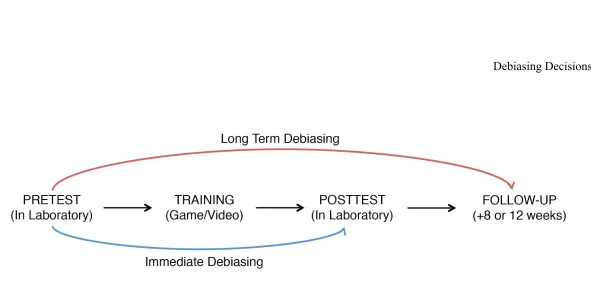
PERSISTENT DEBIASING WITH A SINGLE INTERVENTION We tested whether a single debiasing training intervention could effectively produce immediate and persistent improvements in decision making. In two experiments, we directly compared the efficacy of two debiasing training interventions, a video and an interactive serious (i.e., educational) computer game. Videos and games are scalable training methods that can be used for efficient teaching of cognitive skills (e.g., Downs, 2014; Haferkamp, Kraemer, Linehan, & Schembri, 2011; Sliney & Murphy, 2008). The experiments, funded by Intelligence Advanced Research Projects Activity BAA-11-03, tested whether debiasing training could produce persistent reductions in six cognitive biases identified by our program sponsor as affecting all types of intelligence analysis.
Experiment 1 targeted three cognitive biases: bias blind spot (i.e., perceiving oneself to be less biased than one’s peers; Scopelliti et al., 2015), confirmation bias (i.e., gathering and interpreting evidence in a manner confirming rather than disconfirming the hypothesis being tested; Nickerson, 1998), and fundamental attribution error (i.e.,
others’ emotions, thoughts, and values are similar to one’s own; Epley, Morewedge, & Keysar, 2004; Robbins & Krueger, 2005).
Many tasks crucial to intelligence analysis are influenced by these biases (for a review, see Heuer, 1999). Analysts must assess evidence with uncertain truth value (e.g., anchoring, bias blind spot, confirmation bias). They must infer cause and effect when evaluating past, present, and future events (e.g., confirmation bias, representativeness), the behavior of persons, and the actions of nations (e.g., fundamental attribution error, projection). Analysts regularly estimate probabilities (e.g., anchoring, confirmation bias, projection bias, representativeness), evaluate their own analyses, and evaluate the analyses of others (e.g., anchoring, bias blind spot, confirmation bias, projection bias). Although each of these cognitive biases may have its unique influence, multiple biases are likely to act in concert in any complex assessment (Cooper, 2005).
Attempting to reduce these biases with videos and games allowed us to administer short, one-shot training interventions (i.e., approximately 30 and 60 minutes,
Each video instructed viewers about three cognitive biases, gave examples of each bias, and provided mitigating strategies (e.g., consider alternative explanations, anchors, possible outcomes, perspectives, base-rates, countervailing evidence, and potential situational influences on behavior). Each of the interactive computer games elicited the same three cognitive biases during gameplay by asking players to make in-game
decisions based on limited evidence (e.g., testing a hypothesis, evaluating the behavior of a character in the game, etc.). In an after-action review (AAR) at the end of each of three levels of each game, players were given definitions and examples of the three biases, personalized feedback on the degree to which they exhibited each bias, and mitigating strategies and practice. Like the video, the mitigating strategies taught in the game included: consider alternative explanations, anchors, possible outcomes, perspectives, base-rates, countervailing evidence, and consider potential situational influences on behavior. In addition, the games taught formal rules of logic (e.g., the conjunction of two events can be no more likely than either event on its own), methods of hypothesis testing (e.g., hold all variables other than the suspected causal variable constant when testing a hypothesis), and relevant statistical rules (e.g., large samples are more accurate
representations than small samples), as well as encouraging participants to carefully reconsider their initial answers.
training interventions. The follow-up was administered online and measured the
persistent debiasing effects of the training interventions over a longer term. Sample sizes were declared in advance to our government sponsor, and independent third-party
analyses of the data were performed that confirmed the accuracy of our results (Kopecky, McKneely, & Bos, 2015).
EXPERIMENT 1: BIAS BLIND SPOT, CONFIRMATION BIAS, AND FUNDAMENTAL ATTRIBUTION ERROR
Method Participants
Two hundred and seventy-eight people in a convenience sample recruited in Pittsburgh, PA (132 women; Mage = 24.5, SD = 8.52) received $30 for completing a laboratory training session, and an additional $30 payment for completing a follow-up test online. Most (80.2%) participants had some college education, 14.3% had graduate or professional degrees. A total of 243 participants successfully completed the laboratory portion of the experiment (Game n = 160; Video n = 83); 196 successfully completed the online follow-up (Game n = 130; Video n = 66).2
Training Interventions
Video. Unbiasing Your Biases is a 30-minute unclassified training video
presents vignettes in which actors commit each bias, gives an additional example of fundamental attribution error and confirmation bias, and suggests mitigating strategies. The last two minutes of the video is a comprehensive review of its content.
Game. Missing: The Pursuit of Terry Hughes is a computer game designed to elicit and mitigate bias blind spot, confirmation bias, and fundamental attribution error (produced by Symborski, Barton, Quinn, Morewedge, Kassam, & Korris, 2014). It is a first person point-of-view educational game, in which the player searches for a missing neighbor (i.e., Terry Hughes) and exonerates her of criminal activity. During interactive gameplay in each of three levels, players make judgments designed to test the degree to which they exhibit confirmation bias and the fundamental attribution error. After-action reviews at the end of each level feature experts explaining each bias and narrative examples. To elicit bias blind spot, players then assess their degree of bias during each level. Next, participants are given personalized feedback on the degree of bias they exhibited. Finally, participants perform additional practice judgments of confirmation bias (5 in total) and receive immediate feedback before the next level begins or the game ends.1
Bias Measures
and follow-up. Scoring of each subscale ranged from 0 (no biased answers) to 100 (all answers biased). Confirmation bias scale scores were calculated by averaging the six CB scales at pretest, posttest, and follow-up. Overall bias commission scores at pretest, posttest, and follow-up were calculated by averaging the three bias subscale scores at that time point (i.e., BBS, FAE, CB).
Ancillary scales measuring bias knowledge were developed to assess changes in ability to recognize instances of the three biases and discriminate between them. Bias knowledge scales were scored on a 0-100 scale, with higher scores indicating greater ability to recognize and discriminate between the three biases.
Testing Procedure
In a laboratory session, each participant was seated in a private cubicle with a computer. Participants first completed the pretest measure, consisting of three subscales assessing their commission of each of the three cognitive biases (i.e., BBS, CB, and FAE). Participants also completed a bias knowledge scale at this time. Next, each participant was randomly assigned to receive one of the training interventions, to either play the game or watch the video, without repetition. Immediately after training,
each of the three biases (i.e., BBS, CB, and FAE). He or she had seven days to complete the follow-up measure in one sitting. Participants also completed a bias knowledge measure at this time. The specific bias scales serving as the pretest, posttest, and follow-up measures of bias commission and bias knowledge were counterbalanced across participants.
Results Scale Reliability
Subscales were reliable. Bias blind spot (Cronbach’s ): .77pretest, .82 posttest, and
.76follow-up. Confirmation bias: .73pretest, .73 posttest, and .76follow-up. FAE: .68pretest, .77 posttest, and .78follow-up.
Bias Commission
Main effects of training on bias commission overall and for each of the three cognitive biases were analyzed using 2 (training: game vs. video) x 2 (timing: pretest vs. posttest or pretest vs. follow-up) mixed ANOVAs with repeated measures on the last factor. To compare the efficacy of the game and video, between subjects (training: game vs. video) ANCOVAs were performed to compare the debiasing effects of the training methods at posttest and follow-up, controlling for pretest scores. Means of bias
commission scores for overall bias and each of the three biases by training intervention conditions are presented in Figure 2 (bias knowledge scores are only reported in the text).
Overall bias. Overall, training effectively reduced cognitive bias immediately and two months later, F(1, 241) = 439.23, p < .001 and F(1, 194) = 179.88, p < .001,
large for the game post = 1.68 and dpre-followup = 1.11) and medium for the video (dpre-post = .69 and dpre-followup = .66). The game more effectively debiased participants than did the video immediately and two months later, F(1, 240) = 68.8, p < .001 and F(1, 193) = 12.69, p < .001, respectively.
Bias blind spot. Training effectively reduced BBS immediately and two months later, F(1, 241) = 151.66, p < .001 and F(1, 194) = 104.51, p < .001, respectively. Debiasing effect sizes for BBS were large for the game (dpre-post = .98 and dpre-followup = .89) and medium for the video (dpre-post = .49 and dpre-followup = .49). The game more effectively debiased participants than did the video immediately and two months later, F(1, 240) = 17.31, p < .001 and F(1, 193) = 13.18, p < .001, respectively.
Fundamental attribution error. Training effectively reduced FAE immediately and two months later, F(1, 241) = 183.74, p < .001 and F(1, 194) = 85.32, p < .001, respectively. Debiasing effect sizes for FAE were large and medium for the game (dpre-post = 1.12 and followup = .72) and medium and small for the video (post = .38 and dpre-followup = .52). The game more effectively debiased participants than did the video
immediately and two months later, F(1, 240) = 50.06, p < .001 and F(1, 193) = 6.53, p < .05, respectively.
immediately and two months later, F(1, 240) = 33.54, p < .001 and F(1, 193) = 5.17, p < .05, respectively.
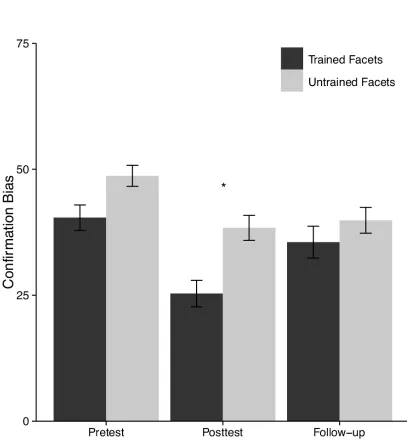
Our scales tested six different facets of confirmation bias, but our game only taught three. This testing structure allowed us to test the generalization of debiasing training across trained (Snyder & Swann, 1978; Tschirgi, 1980; Wason, 1960) and untrained facets of confirmation bias (Downs & Shafir, 1999; Nisbett & Ross, 1980; Wason, 1968). Compared to their pretest scores, participants exhibited a reduction in confirmation bias on the trained facets at posttest and follow-up, t(159) = 9.81, p < .001, d = .78 and t(129) = 2.69, p < .01, d = .24, respectively. More important, compared to their pretest scores, participants exhibited reduced confirmation bias for untrained facets at posttest and follow-up, t(159) = 10.05, p < .001, d = .79 and t(129) = 7.42, p < .001, d = .65, respectively. Controlling for their pretest scores, participants performed better on trained than untrained facets of confirmation bias at posttest, t(159) = 2.56, p < .05, d = .20, but there were no significant differences between trained and untrained facets at follow-up, t < 1 (for means, see Figure 3).
Bias Knowledge
the game immediately, F(1, 240) = 15.52, p < .001, but was no more effective two months later, F < 1.
EXPERIMENT 2: ANCHORING, PROJECTION BIAS, AND REPRESENTATIVENESS
Method Participants
Two hundred and sixty-nine people in a convenience sample recruited in Pittsburgh, PA (155 women; Mage = 27.8, SD = 12.01) received $30 for completing a laboratory training session, and an additional $30 payment for completing a follow-up test online. Most (94.1%) participants had some college education, 19.3% had graduate or professional degrees. A total of 238 participants successfully completed the laboratory portion of the experiment (Game n = 156; Video n = 82); 192 successfully completed the online follow-up (Game n = 126; Video n = 66).2
Stimuli
Training video. Unbiasing Your Biases 2 (Intelligence Advanced Research Projects Activity, 2013) had the same structure as the video in Experiment 1, but addressed anchoring, projection, and representativeness.
making decisions testing their commission of each of the cognitive biases during game play. Experiment 2 introduced adaptive training in the AARs. When players gave biased answers to practice questions, they received additional practice questions (up to 16 in total) and feedback.1
Scale Development
Scales measuring commission of anchoring, projection, and representativeness, and scales measuring bias knowledge were developed and scored following a procedure similar to that used in Experiment 1 (see Supplemental Materials).
Testing Procedure
The experiment adhered to the same testing procedure as described in Experiment 1, with the exception that the follow-up was administered 12 weeks after participants completed their laboratory session.
Results Scale Reliability
Subscales were reliable: Anchoring (Cronbach’s α): .60pretest, .52 posttest, and
.62follow-up. Projection bias: .63pretest, .78 posttest, and .77follow-up. Representativeness: .86pretest, .87 posttest, and .93follow-up.
Bias Commission
Overall Bias. Overall, training effectively reduced cognitive bias immediately and three months later, F(1, 236) = 719.58, p < .001 and F(1, 190) = 246.17, p < .001,
respectively. Debiasing effect sizes for overall bias were large for both the game (dpre-post = 1.74 and dpre-followup = 1.16) and video (dpre-post = 1.75 and dpre-followup = 1.07). However, the game more effectively debiased participants than did the video immediately, F(1, 235) = 13.44, p < .001, and marginally three months later, F(1, 189) = 3.66, p = .057.
Anchoring. Training effectively reduced anchoring immediately and three months later, F(1, 236) = 127.94, p < .001 and F(1, 190) = 78.42, p<.001, respectively. Debiasing effect sizes for anchoring were medium for the game (dpre-post = .70 and dpre-followup= .63) and large to medium for the video (dpre-post =.80 and dpre-followup = .66). The game and video were equally effective immediately and three months later, Fs < 1, ps > .62.
Projection. Training effectively reduced projection immediately and three months later, F(1, 236) = 197.29, p < .001 and F(1, 190) = 34.52, p < .001, respectively.
Debiasing effect sizes for projection were large to medium for the game (dpre-post = 1.11 and dpre-followup= .54) and medium to small for the video (dpre-post = .49 and dpre-followup = .14). The game more effectively debiased participants than did the video immediately and three months later, F(1, 235) = 34.42, p < .001 and F(1, 189) = 13.49, p < .001,
respectively.
video immediately, F(1, 235) = 10.85, p < .01, but was no more effective three months later, F < 1, p = .37.
Bias Knowledge
Training effectively improved bias knowledge immediately and three months later, F(1, 236) = 506.52, p < .001 and F(1, 190) = 216.36, p < .001, respectively. Bias knowledge increased for participants who played the game (Mpretest = 35.89, Mposttest = 63.16, Mfollow-up = 50.65, dpre-post = .1.42 and dpre-followup = 1.05) and watched the video (Mpretest = 39.03, Mposttest = 74.11, Mfollow-up = 52.04, dpre-post = 1.53 and dpre-follow-up = 1.09). The video more effectively taught participants to recognize and discriminate bias than did the game immediately, F(1, 235) = 11.07, p < .001, but was no more effective three months later, F < 1.
CONCLUSIONS AND RECOMMENDATIONS
People generally intend to make good decisions, which are in their own and society’s best interest, but biases in judgment and decision making often lead them to make costly errors. More than 40 years of judgment and decision making research suggests feasible interventions to debias and improve decision making (Bhargava & Loewenstein, 2015; Fischhoff, 1982; Fox & Sitkin, 2015; Soll et al., in press). This research and its methods can be used to align incentives, present information, elicit choices, and educate people so they are able to make decisions in their best interest.
them. Commuting ranks among the most unpleasant daily experiences (Kahneman, Krueger, Schkade, Schwarz, & Stone, 2004), for instance, but people are relatively insensitive to the duration of a prospective commute unless they are provided with a familiar comparison standard (Morewedge, Kassam, Hsee, & Caruso, 2009). For some decisions such as whether to be an organ donor, one option must be specified as the default even if one defers the decision. Selecting a default option that is beneficial for the decision maker or society can improve the public good while preserving freedom of choice (Camerer et al., 2003; Thaler & Sunstein, 2003; 2008). Furthermore, people actively seek out many kinds of debiasing interventions such as timesaving
recommendation systems (Goldstein et al., 2008) and commitment devices to give them the willpower to make choices that are unappealing in the present but will benefit them more in the future (e.g., Thaler & Benartzi, 2004; Schwarz et al., 2014).
Debiasing interventions are not, by default, more costly than the status quo. New incentives do not have to impose a financial cost to taxpayers or decision makers. Social influence is an underutilized but powerful nonpecuniary motive for positive behavior change, for instance, that can produce significant reductions in environmental waste and energy consumption (Cialdini, 2003; Schultz, Nolan, Cialdini, Goldstein, & Griskevicius, 2007). Moreover, existing incentives are only effective if they motivate behavior as they were intended. If incentives are misaligned, misinterpreted, or poorly framed, they may be costly and ineffective or counterproductive.
stimulus was spent (Epley, Mak, & Idson, 2006). In a field study run in the United
Kingdom, adding a single sentence to late tax notices that truthfully stated the majority of UK citizens pay their taxes on time increased the clearance rate of late payers to 86% (£560 million out of £650 million owed), compared to a clearance rate of 57% the previous year (£290 million out of £510 million owed; Cialdini, Martin, & Goldstein, 2015).
Training interventions have an upfront production cost, but the marginal financial and temporal costs of training many additional people are minimal. The results of our experiments suggest that even a single training intervention, such as the games and videos we tested in this article, can have significant debiasing effects that persist across a variety of contexts affected by the same bias. Participants who played our games
exhibited large reductions in cognitive bias immediately (-46.25% and -31.94%), which persisted at least 2 or 3 months later (-34.76% and -23.57%) in Experiments 1 and 2, respectively. Participants who watched the videos exhibited medium and large reductions immediately 18.60% and -25.70%), which persisted at least 2 or 3 months later
(-20.10% and -19.20%) in Experiments 1 and 2, respectively. The greater efficacy of the games than the videos suggest that personal feedback and practice increase the debiasing effects of training, but more research is needed to determine precisely why it was more effective. Most important, these results suggest that despite its rocky start (Fischhoff, 1982), training is a promising avenue through which to develop future debiasing interventions.
testing new practical interventions. Laboratory experiments provide a safe and
Figure 2. Bias commission by training intervention in Experiments 1 and 2. Left and right columns illustrate the mitigating effects of training on bias commission overall and for each of the three cognitive biases in Experiments 1 and 2, respectively. Scales range from 0-100; higher scores indicate more biased answers (95% CI). Both training interventions effectively debiased participants. Overall, the game more effectively debiased
FOOTNOTES
1. There were four variants of the Experiment 1 game, including whether a game score or narrative examples were included or excluded in the AARs. Moreover, half of participants in the game condition played the full game, and half played only the first round. We did not observe a significant difference across these game and methodological variations in their reduction of overall bias at posttest and follow-up, Fs ≤ 2.29, ps ≥ .13. In Experiment 2, all players completed the whole game, but there were four variants including whether hints or game scores were provided. We did not observe a significant difference across these variants in their reduction of overall bias at posttest and follow-up, all ts ≤ 1.77, ps ≥ .08. In both experiments, we report the results collapsed across these variations.
ACKNOWLEDGEMENTS
This work was supported by the Intelligence Advanced Research Projects Activity via the Air Force Research Laboratory contract number FA8650-11-C-7175. The views and conclusions contained herein are those of the authors and should not be interpreted as necessarily representing the official policies or endorsements, either expressed or implied, of IARPA, AFRL, or the U.S. Government. We thank Marguerite Barton, Abigail Dawson, Sophie LeBrecht, Erin McCormick, Peter Mans, H. Lauren Min, Taylor Turrisi, and Shane Schweitzer for their assistance with the execution of this research.
Author to whom all correspondence should be addressed: Carey K. Morewedge, Associate Professor of Marketing; Boston University, Questrom School of Business, Rafik B. Hariri Building, 595 Commonwealth Ave., Boston, MA 02215;
References
!
Acquisti, A., Brandimarte, L., & Loewenstein, G. (2015). Privacy and human behavior in
the age of information. Science, 347, 509-514.
Ariely, D., Gneezy, U., Loewenstein, G., & Mazar, N. (2009). Large stakes and big
mistakes. The Review of Economic Studies, 76, 451-469.
Arkes, H. R. (1991). Costs and benefits of judgment errors: Implications for
debiasing. Psychological Bulletin, 110, 486-498.
Arkes, H. R., & Blumer, C. (1985). The psychology of sunk cost. Organizational
behavior and human decision processes, 35, 124-140.
Barnett, S. M., & Ceci, S. J. (2002). When and where do we apply what we learn?: A
taxonomy for far transfer. Psychological Bulletin, 128, 612-637.
Barton, M., Symborski, C., Quinn M., Morewedge, C. K., Kassam, K. S., Korris, J. H.
(2015, May). The use of theory in designing a serious game for the reduction of
cognitive biases. Digital Games Research Association Conference, Lüneberg,
Germany.
Bhargava, S., & Loewenstein, G. (2015). Behavioral Economics and Public Policy 102:
Beyond Nudging. American Economic Review, 105, 396-401.
Bhargava, S., & Manoli, D. (in press). Psychological frictions and incomplete take-up of
social benefits: Evidence from an IRS field experiment. American Economic
Review.
Bruine de Bruin, W., Parker, A. M., & Fischhoff, B. (2007). Individual differences in
adult decision-making competence. Journal of Personality and Social
Camerer, C., Issacharoff, S., Loewenstein, G., O'donoghue, T., & Rabin, M. (2003).
Regulation for conservatives: Behavioral economics and the case for "asymmetric
paternalism." University of Pennsylvania Law Review, 1211-1254.
Chapman, G. B., Li, M., Colby, H., & Yoon, H. (2010). Opting in vs opting out of
influenza vaccination. Journal of the American Medical Association, 304, 43-44.
Charness, G., & Gneezy, U. (2009). Incentives to exercise. Econometrica, 77, 909-931.
Cialdini, R. B. (2003). Crafting normative messages to protect the environment. Current
Directions in Psychological Science, 12, 105-109.
Cialdini, R. B., Martin, S. J., & Goldstein, N. J. (2015). Small behavioral science–
informed changes can produce large policy-relevant effects. Behavioral Science
and Policy, 1.
Cooper, J. R. (2005). Curing analytic pathologies: Pathways to improved intelligence
analysis. Center for the Study of Intelligence: Central Intelligence Agency.
Dawes, R. M., Faust, D., & Meehl, P. E. (1989). Clinical versus actuarial
judgment. Science, 243, 1668-1674.
Dhami, M. K., Schlottmann, A., & Waldmann, M. R. (2011). Judgment and decision
making as a skill: learning, development and evolution. Cambridge, UK:
Cambridge University Press.
Downs, J. S. (2014). Prescriptive scientific narratives for communicating usable
science. Proceedings of the National Academy of Sciences, 111, 13627-13633.
Downs, J. S., Loewenstein, G., & Wisdom, J. (2009). Strategies for promoting healthier
Downs, J. S., & Shafir, E. (1999). Why some are perceived as more confident and more
insecure, more reckless and more cautious, more trusting and more suspicious,
than others: Enriched and impoverished options in social judgment. Psychonomic
Bulletin & Review, 6, 598-610.
Epley, N., Mak, D., & Idson, L. C. (2006). Bonus of rebate?: The impact of income
framing on spending and saving. Journal of Behavioral Decision Making, 19,
213-227.
Epley, N., Morewedge, C. K., & Keysar, B. (2004). Perspective taking in children and
adults: Equivalent egocentrism but differential correction. Journal of
Experimental Social Psychology,40, 760-768.
Evans, J. S. B. (2003). In two minds: dual-process accounts of reasoning. Trends in
Cognitive Sciences, 7, 454-459.
Fischhoff, B. (1982). Debiasing. In D. Kahneman, P. Slovic, & A. Tversky (Eds.),
Judgment under uncertainty: Heuristics and biases (pp. 422–444). Cambridge,
United Kingdom: Cambridge University Press.
Fox, C. R., & Sitkin, S. B. (2015). Bridging the divide between behavioral science and
policy. Behavioral Science & Policy, 1.
French, S. A. (2003). Pricing effects on food choices. The Journal of Nutrition, 133,
841S-843S.
Garcia-Retamero, R., & Dhami, M. K. (2011). Pictures speak louder than numbers: on
communicating medical risks to immigrants with limited non-native language
Garcia-Retamero, R., & Dhami, M. K. (2013). On avoiding framing effects in
experienced decision makers. The Quarterly Journal of Experimental Psychology,
66, 829-842.
Gerber, A. S., & Rogers, T. (2009). Descriptive social norms and motivation to vote:
Everybody’s voting and so should you. The Journal of Politics, 71, 178-191.
Gilbert, D. T. (1998). Ordinary personology. In D. T. Gilbert, S. T. Fiske, & G. Lindsey
(Eds.), The handbook of social psychology (Vol. 2, pp. 89-150).
Goldstein, D. G., Johnson, E. J., Herrmann, A., & Heitmann, M. (2008). Nudge your
customers toward better choices. Harvard Business Review, 86, 99-105.
Gneezy, U., Meier, S., & Rey-Biel, P. (2011). When and why incentives (don't) work to
modify behavior. The Journal of Economic Perspectives, 191-209.
Gneezy, U., & Rustichini, A. (2000). A fine is a price. Journal of Legal Studies, 29, 1–17.
Haferkamp, N., Kraemer, N. C., Linehan, C., & Schembri, M. (2011). Training disaster
communication by means of serious games in virtual environments.
Entertainment Computing, 2, 81-88.
Harvey, N. (2011). Learning judgment and decision making from feedback. In M. K.
Dhami, A. Schlottmann, and M. R. Waldmann (eds.), Judgment and decision
making as a skill: Learning, development, and evolution (pp. 199-226).
Cambridge, UK: Cambridge University Press.
Haynes, L., Goldacre, B., & Torgerson, D. (2012). Test, learn, adapt: developing public
policy with randomized controlled trials. Cabinet Office-Behavioural Insights
Heuer, R. J. (1999). Psychology of intelligence analysis. Center for the Study of
Intelligence: Central Intelligence Agency.
Hirt, E. R., & Markman, K. D. (1995). Multiple explanation: A consider-an-alternative
strategy for debiasing judgments. Journal of Personality and Social
Psychology, 69, 1069-1086.
Huh, Y. E., Vosgerau, J., & Morewedge, C. K. (2014). Social Defaults: Observed
Choices Become Choice Defaults. Journal of Consumer Research, 41, 746-760.
Intelligence Advanced Research Projects Activity (2011). Sirius Broad Agency
Announcement, IARPA-BAA-11-03. Retrieved from:
http://www.iarpa.gov/index.php/research-programs/sirius/baa
Intelligence Advanced Research Projects Activity (2012). Unbiasing your biases I.
Alexandria, VA: 522 Productions.
Intelligence Advanced Research Projects Activity (2013). Unbiasing your biases II.
Alexandria, VA: 522 Productions.
John, L. K., Loewenstein, G., Troxel, A. B., Norton, L., Fassbender, J. E., & Volpp, K.
G. (2011). Financial incentives for extended weight loss: a randomized, controlled
trial. Journal of general internal medicine, 26, 621-626.
Johnson, E. J., & Goldstein, D. G. (2003). Do defaults save lives?. Science, 302,
1338-1339.
Jones, E. E.; Harris, V. A. (1967). "The attribution of attitudes". Journal of Experimental
Social Psychology, 3, 1–24.
Kahneman, D. (2003). A perspective on judgment and choice: mapping bounded
Kahneman, D., Krueger, A. B., Schkade, D. A., Schwarz, N., & Stone, A. A. (2004). A
survey method for characterizing daily life experience: The day reconstruction
method. Science, 306, 1776-1780.
Kahneman, D., & Tversky, A. (1972). Subjective probability: A judgement of
representativeness. Cognitive Psychology, 3, 430-454.
Kohler, D. J., Brenner, L., & Griffin, D. (2002). The calibration of expert judgment:
Heuristics and biases beyond the laboratory. In T. Gilovich, D. Griffin, and D.
Kahneman (Eds), Heuristics and biases: The psychology of intuitive judgment
(pp. 686-715). New York, NY, US: Cambridge University Press.
Kopecky, J. J., McKneely, J. A., & Bos, N. D. (2015). Personal communication.
Krieger, L. H., & Fiske, S. T. (2006). Behavioral realism in employment discrimination
law: Implicit bias and disparate treatment. California Law Review, 997-1062.
Larrick, R. P., Morgan, J. N., & Nisbett, R. E. (1990). Teaching the use of cost-benefit
reasoning in everyday life. Psychological Science, 1, 362-370.
Larrick, R. P., & Soll, J. B. (2008). The MPG Illusion. Science, 320(5883), 1593-1594.
Lerner, J. S., & Tetlock, P. E. (1999). Accounting for the effects of
accountability. Psychological bulletin, 125, 255-275.
Levin, I. P., & Gaeth, G. J. (1988). How consumers are affected by the framing of
attribute information before and after consuming the product. Journal of
Consumer Research,15, 374-378.
Lewandowsky, S., Ecker, U. K., Seifert, C. M., Schwarz, N., & Cook, J. (2012).
Misinformation and its correction continued influence and successful debiasing.
Lilienfeld, S. O., Ammirati, R., & Landfield, K. (2009). Giving debiasing away: Can
psychological research on correcting cognitive errors promote human
welfare?. Perspectives on Psychological Science, 4, 390-398.
Mazarr, M. J. (2007). The Iraq war and agenda setting. Foreign Policy Analysis, 3, 1-23.!
McNeil, B. J., Pauker, S. G., Sox Jr, H. C., & Tversky, A. (1982). On the elicitation of
preferences for alternative therapies. New England Journal of Medicine, 306,
1259-1262.
Mellers, B., Ungar, L., Baron, J., Ramos, J., Gurcay, B., Fincher, K., ... & Tetlock, P. E.
(2014). Psychological strategies for winning a geopolitical forecasting
tournament. Psychological Science, 25, 1106-1115.
Milkman, K. L., Chugh, D., & Bazerman, M. H. (2009). How can decision making be
improved?. Perspectives on Psychological Science, 4, 379-383.
Moore, D. A., Swift, S. A., Sharek, Z. S., & Gino, F. (2010). Correspondence bias in
performance evaluation: Why grade inflation works. Personality and Social
Psychology Bulletin, 36, 843-852.
Morewedge, C. K., Kassam, K. S., Hsee, C. K., & Caruso, E. M. (2009). Duration
sensitivity depends on stimulus familiarity. Journal of Experimental Psychology:
General, 138, 177-186.
Morewedge, C. K., & Kahneman, D. (2010). Associative processes in intuitive
judgment. Trends in cognitive sciences, 14, 435-440.
Murphy, A. H. & Winkler, R. L. (1974). Subjective probability forecasting experiments
in meteorology: Some preliminary results. Bulletin of the American
Nickerson, R. S. (1998). Confirmation bias: A ubiquitous phenomenon in many
guises. Review of general psychology, 2, 175-220.
Nisbett, R. E., Fong, G. T., Lehman, D. R., & Cheng, P. W. (1987). Teaching reasoning.
Science, 238, 625-631.
Nisbett, R. E., & Ross, L. (1980). Human inference: Strategies and shortcomings of
social judgment. Englewood Cliffs, NJ: Prentice Hall.
Parker, A. M., & Fischhoff, B. (2005). Decision!making competence: External validation
through an individual!differences approach. Journal of Behavioral Decision
Making, 18, 1-27.
Payne, J. W., Bettman, J. R., & Johnson, E. J. (1993). The adaptive decision maker.
Cambridge University Press.
Peters, E., & de Bruin, W. B. (2011). Aging and decision skills. In M. K. Dhami, A.
Schlottmann, and M. R. Waldmann (eds.), Judgment and decision making as a
skill: Learning, development, and evolution (pp. 113-140). Cambridge, UK:
Cambridge University Press.
Phillips, J. K., Klein, G., & Sieck, W. R. (2004). Expertise in judgment and decision
making: A case for training intuitive decision skills. Blackwell handbook of
judgment and decision making, 297-315.
Reeves, L., & Weisberg, R. W. (1994). The role of content and abstract information in
analogical transfer. Psychological Bulletin, 115, 381-400.
Robbins, J. M., & Krueger, J. I. (2005). Social projection to ingroups and outgroups: A
Ross, L., Greene, D., & House, P. (1977). The “false consensus effect”: An egocentric
bias in social perception and attribution processes. Journal of experimental social
psychology, 13, 279-301.
Schultz, P. W., Nolan, J. M., Cialdini, R. B., Goldstein, N. J., & Griskevicius, V. (2007).
The constructive, destructive, and reconstructive power of social norms.
Psychological Science, 18, 429-434.
Schwartz, J., Mochon, D., Wyper, L., Maroba, J., Patel, D., & Ariely, D. (2014).
Healthier by precommitment. Psychological Science, 25, 538-546.
Schwitzgebel, E., & Cushman, F. (2012). Expertise in moral reasoning? Order effects on
moral judgment in professional philosophers and non!philosophers. Mind &
Language, 27, 135-153.
Scopelliti, I., Morewedge, C. K., McCormick, E., Min, H. L., Lebrecht, S., & Kassam, K.
S. (2015). Bias Blind Spot: Structure, Measurement, and Consequences.
Management Science.
Shefrin, H., & Statman, M. (1985). The disposition to sell winners to early and ride losers
too long: Theory and evidence. Journal of Finance, 40, 777-790.
Silberman, L. H., Robb, C. S., Levin, R. C., McCain, J., Rowan, H. S., Slocombe, W. B.,
Studeman, W. O., Wald, P. M., Vest, C. M., & Cutler, L. (March 31, 2005). The
Commission on the Intelligence Capabilities of the United States Regarding
Weapons of Mass Destruction: Report to the President of the United States.
Soll, J., Milkman, K., & Payne, J. (in press). A user’s guide to debiasing. In G. Keren and
G. Wu (eds), Wiley-Blackwell handbook of judgment and decision making. New
Sliney, A., & Murphy, D. (2008, February 10-15). JDoc: A serious game for medical
learning. Proceedings of the First International Conference on Advances in
Computer-Human Interaction (ACHI-2008), Sainte Luce, Martinique. doi:
10.1109/ACHI.2008.50
Sloman, S. A. (1996). The empirical case for two systems of reasoning.Psychological
bulletin, 119, 3-22.
Snyder, M., & Swann, W. B. (1978). Hypothesis-testing processes in social
interaction. Journal of Personality and Social Psychology, 36, 1202-1212.
Symborski, C., Barton, M., Quinn M., Morewedge, C. K., Kassam, K., Korris, J. (2014,
December). Missing: A serious game for the mitigation of cognitive bias.
Interservice/Industry Training, Simulation and Education Conference, Orlando,
FL.
Thaler, R. H., & Benartzi, S. (2004). Save more tomorrow™: Using behavioral
economics to increase employee saving. Journal of political Economy, 112,
S164-S187.
Thaler, R. H., & Sunstein, C. R. (2003). Libertarian paternalism. American Economic
Review, 175-179.
Thaler, R.H., & Sunstein, C.R. (2008). Nudge. New Haven, CT: Yale University Press.
Tschirgi, J. E. (1980). Sensible reasoning: A hypothesis about hypotheses. Child
Development, 51, 1-10.
Tversky, A., & Kahneman, D. (1974). Judgment under uncertainty: Heuristics and
Volpp, K. G., Loewenstein, G., Troxel, A. B., Doshi, J., Price, M., Laskin, M., &
Kimmel, S. E. (2008). A test of financial incentives to improve warfarin
adherence. BMC Health Services Research, 8, 272.
Volpp, K. G., Troxel, A. B., Pauly, M. V., Glick, H. A., Puig, A., Asch, D. A., . . .
Audrain-McGovern, J. (2009). A randomized, controlled trial of financial
incentives for smoking cessation. New England Journal of Medicine, 360, 699–
709.
Wagenaar, W. A., & Keren, G. B. (1986). Does the expert know? The reliability of
predictions and confidence ratings of experts. In Intelligent decision support in
process environments (pp. 87-103). Springer: Berlin Heidelberg.
Wason, P. C. (1960). On the failure to eliminate hypotheses in a conceptual
task. Quarterly Journal of Experimental Psychology, 12, 129-140.
Wason, P. C. (1968). Reasoning about a rule. The Quarterly journal of experimental
psychology, 20(3), 273-281.
Willingham, D. T. (2008). Critical thinking: Why is it so hard to teach?. Arts Education
Policy Review, 109, 21-32.
Wilson, T. D., & Brekke, N. (1994). Mental contamination and mental correction:
unwanted influences on judgments and evaluations. Psychological Bulletin, 116,
117-142.
SUPPLEMENTAL MATERIALS
EXPERIMENT 1: SCALE DEVELOPMENT
For each bias, we conducted a literature review to identify canonical questions,
paradigms, and generated similar additional items (approximately 200 in total). BBS
questions were developed following the question format of Scopelliti and colleagues
(2015). FAE questions were based on the attitude attribution, quizmaster, silent
interview, and moral attribution paradigms (Gawronski, 2004). CB questions were
developed based on six paradigms: Wason’s (1960) card selection task, Wason’s (1968)
triplets task; Tschirgi’s (1980) cause identification paradigm, Snyder and Swann’s (1978)
trait hypothesis testing paradigm, an enriched versus impoverished profiles choice
paradigm (Downs & Shafir, 1999), and a judgment of covariation paradigm (Nisbett &
Ross, 1980). Three interchangeable versions (i.e., subscales) were created for each scale,
so that each participant would see different questions at pretest (before training), posttest
(immediately after training), and follow-up (8 weeks after training).
One sample of 288 Amazon Mechanical Turk (AMT) workers answered all FAE
and BBS items. A separate sample of 310 AMT workers answered all CB items. We
performed scale purification using an iterative procedure. In order to ensure that three
valid and interchangeable versions of each scale were developed, questions with low
item-total correlations were removed until random sampling suggested that a subsample
of one third of the items on each bias scale would achieve a minimum of α ≥.7 reliability
at least 95% of the time. This purification resulted in a 27-item BBS scale, a 45-item FAE
(1980), and three 18-item scales based on Snyder and Swann (1978), Downs and Shafir
(1999), and Nisbett and Ross (1980). Exploratory factor analyses of the purified scales
indicated a unidimensional structure for each scale, with average variance explained =
36%. All items correlated positively with their respective factor, with an average
minimum r = .41.
Seven to 11 days after completing the full scales, 305 participants completed
purified versions of the same scales. Responses indicated high test-retest reliability and
stability over time, Mr = .79. We divided each scale into three interchangeable subscales
by iteratively selecting the three items with the highest average correlations and placing
them into separate subscales, all subscale α’s ≥ .65. Items were divided among subscales
so that subscales were maximally similar.
Item scoring logic varied due to their different formats. All item scores varied
between 0 and 1, with 1 indicating greater bias (i.e., choosing confirming answers,
making dispositional attributions, indicating less susceptibility to bias than one’s peers).
We calculated subscale scores by summing all individual items (i.e., all BBS items, FAE
items, or CB items) and transforming totals into a score ranging from 0 (no biased
answers) to 100 (all answers biased).
Bias knowledge questions had two forms. Recognition questions described an
instance in which one of the three biases was committed and required participants to
identify the bias in a free recall format. Discrimination questions described an instance of
bias and tested its identification in a multiple-choice format. The final questionnaires
contained 24 questions with satisfactory face validity (12 for recognition and 12 for
EXPERIMENT 2: SCALE DEVELOPMENT
Three interchangeable subscales were created for each scale, so that each
participant would see different questions at pretest (before training), posttest
(immediately after training), and follow-up (8 weeks after training). For each bias, we
conducted a literature review to identify canonical questions, paradigms, and generated
similar additional items (423 in total). Anchoring questions used self-generated or
experimenter provided anchors that were relevant or irrelevant (Strack & Mussweiler,
1997; Tversky & Kahneman, 1974; Simmons, Nelson, & LeBoeuf, 2010). Projection
questions were developed from three bias facets: the false consensus effect (Ross,
Greene, & House, 1976), attributive similarity (Holmes, 1968; Kreuger & Stanke, 2001),
and the curse of knowledge (Birch & Bloom, 2007). The curse of knowledge dimension
was not included in the final instrument based on factor analyses suggesting its exclusion.
Representativeness questions were based on conjunction fallacy, base rate neglect,
gambler’s fallacy, perceptions of random sequences, and sample size neglect paradigms
(Tversky & Kahneman, 1974).
After an initial purification stage, three samples of AMT workers (N = 624)
completed the scales. Purification resulted in a 54-item anchoring scale, a 69-item
projection scale, and a 78-item representativeness scale. Questions were then split into
three interchangeable subscales for each bias. All the subset scales had acceptable
internal consistency, Mα = .68, and test re-test reliability, Mr = .61. Item and subscale
scoring logic followed the procedure used in Experiment 1.
All bias knowledge questions for Experiment 2 were multiple choice
face validity, divided into subscales with 7 questions each. Knowledge scales were scored
on a 0-100 scale with higher scores indicating greater knowledge.
References!
Birch, S. A., & Bloom, P. (2007). The curse of knowledge in reasoning about false
beliefs. Psychological Science, 18, 382-386.
Gawronski, B. (2004). Theory-based bias correction in dispositional inference: The
fundamental attribution error is dead, long live the correspondence bias. European
review of social psychology, 15(1), 183-217.
Downs, J. S., & Shafir, E. (1999). Why some are perceived as more confident and more
insecure, more reckless and more cautious, more trusting and more suspicious,
than others: Enriched and impoverished options in social judgment. Psychonomic
bulletin & review, 6, 598-610.
Holmes, D. S. (1968). Dimensions of projection. Psychological Bulletin, 69(4), 248-268.
Krueger, J., & Stanke, D. (2001). The role of self-referent and other-referent knowledge
in perceptions of group characteristics. Personality and Social Psychology
Bulletin, 27(7), 878-888.
Nisbett, R. E., & Ross, L. (1980). Human inference: Strategies and shortcomings of
social judgment. Englewood Cliffs, NJ: Prentice Hall.
Scopelliti, I., Morewedge, C. K., McCormick, E., Min, H. L., Lebrecht, S., & Kassam, K.
S. (2015). Bias Blind Spot: Structure, Measurement, and Consequences.
Management Science.
Simmons, J. P., LeBoeuf, R. A., & Nelson, L. D. (2010). The effect of accuracy
motivation on anchoring and adjustment: do people adjust from provided
Snyder, M., & Swann, W. B. (1978). Hypothesis-testing processes in social
interaction. Journal of Personality and Social Psychology, 36(11), 1202-1212.
Strack, F., & Mussweiler, T. (1997). Explaining the enigmatic anchoring effect:
Mechanisms of selective accessibility. Journal of Personality and Social
Psychology, 73(3), 437-446.
Tschirgi, J. E. (1980). Sensible reasoning: A hypothesis about hypotheses. Child
development, 1-10.
Wason, P. C. (1960). On the failure to eliminate hypotheses in a conceptual
task. Quarterly journal of experimental psychology, 12(3), 129-140.
Wason, P. C. (1968). Reasoning about a rule. The Quarterly journal of experimental
psychology, 20(3), 273-281.