Rochester Institute of Technology
RIT Scholar Works
Theses Thesis/Dissertation Collections
8-1-2013
Workforce planning and facility utilization using a
two-stage stochastic recourse approach
Anirudha Kulkarni
Follow this and additional works at:http://scholarworks.rit.edu/theses
This Thesis is brought to you for free and open access by the Thesis/Dissertation Collections at RIT Scholar Works. It has been accepted for inclusion in Theses by an authorized administrator of RIT Scholar Works. For more information, please [email protected].
Recommended Citation
i
Workforce Planning and Facility Utilization using a
Two-stage Stochastic Recourse Approach
Anirudha Kulkarni
August, 2013
Department of Industrial and Systems Engineering
Kate Gleason College of Engineering
Rochester Institute of Technology
Thesis Advisor
Dr. Scott Grasman
Thesis Committee
Dr. Michael Hewitt
Submitted in partial fulfillment of the requirements
iii
Department of Industrial and Systems Engineering
Kate Gleason College of Engineering
Rochester Institute of Technology
August 05, 2013
______________________________________________________________________________
M.S. DEGREE THESIS
______________________________________________________________________________
The M.S. degree thesis of Anirudha Kulkarni
has been examined and approved by the
thesis committee as satisfactory for the
thesis requirement for the
Master of Science degree
Approved by
______________________________________________________________________________
Dr. Scott Grasman
Head of Department, Industrial and Systems Engineering Department
Rochester Institute of Technology
______________________________________________________________________________
Dr. M.R. Hewitt
Assistant Professor, Industrial and Systems Engineering Department
iv
Acknowledgements
I wish to express my sincere gratitude toward all who provided me with their support and help in
completing my thesis.
I like to thank Dr. Scott Grasman for providing me with an opportunity to work on this
wonderful problem. Dr. Grasman showed the way when I was lost and he was the light whenever
I found myself in the darkness. He encouraged me to grow not only academically but also
professionally. I also like to thank Dr. Hewitt for deeply ingraining the basics of Operations
Research through his courses.
This thesis is an extension of the doctoral dissertation by Dr. Jarugumilli who has been constant
source of guidance right from the day we first met at Informs Annual Meeting, Phoenix. He
taught and corrected me for my own benefit like friend and sometimes like a teacher. I will like
to thank you for your patience and understanding and I know I owe you big time. I like to thank
Dr. Keng from Intel for his valuable inputs, feedback and knowledge that allowed us to build a
better system that fits to practical needs of an industry. This work is part of Dr. Grasman's
ongoing research in workforce headcount solver and graciously supported by the Intel
Corporation.
Further, I like to thank my parents, especially my father for being a source of inspiration. Your
love for Mathematics motivates me to build better and robust systems using simpler logic. I also
like to thank my extended family at Rochester, my friends Chaitu, Amey, Omkar, Atul, Anshul,
Nisharth and Mugdha for making this journey so memorable. Finally, I will take a moment to
deeply thank God for getting all these amazing people in my life and for providing me with His
v
Table of Contents
Acknowledgements ...iv
List of Tables ...vi
List of Figures ... vii
Abstract ... 1
1 Introduction ... 2
2 Literature Review ... 6
3 Problem Description ... 13
3.1 Model Development ... 14
3.2 Notation ... 18
3.3 Objective Function ... 21
3.4 Constraints ... 22
4 Solution Methodology ... 26
4.1 Two-Stage Stochastic Linear Problem with Recourse ... 26
4.2 Scenario Based Approach ... 27
4.3 Conversion of Formulation to Extended Deterministic Form ... 28
5 Numerical Experiments ... 31
5.1 Data ... 31
5.2 Resulting Solution ... 34
5.3 Computational Experiment ... 37
6 Conclusions and Future Work ... 38
References ... 40
vi
List of Tables
Table 2.1: Comparison of Relevant Literature... 10
Table 5.1: Qualification Matrix ... 33
Table 5.2: Scenario wise requirement and probability ... 33
Table 5.3: Qualification Matrix ... 33
Table 5.4: Size and Composition of Workforce ... 33
Table 5.5: Scenario wise overtime requirement ... 33
vii
List of Figures
1
Abstract
Hi-tech manufacturing uses sophisticated and capital intensive processes that require a highly
skilled workforce. Fluctuating demand leads to either a shortage of skilled workers that causes
unmet demand or an excess of skilled labor that causes worker idleness. This mismatch in the
available and required skillsets is a source of potential loss for the organization. This thesis
formulates an industry-motivated workforce planning and facility utilization problem as a
two-stage stochastic recourse program that considers fluctuating demand over a long planning
horizon and includes business and labor rules, e.g., hiring, firing, overtime, cross-training, and
shift swapping, that govern the structure of the workforce. Solutions to this problem are
computed using a scenario-based approach and indicate that the cost of workforce formation can
2
1
Introduction
Manufacturing firms maintain diverse segments of products that require different manufacturing
techniques, and have to balance their production to meet the demand for all product segments
reasonably. Therefore, manufacturing organizations invest heavily in manufacturing technology
and workforce. Composed of various intricate and capital-intensive processes, hi-tech
manufacturing requires highly skilled workers who are greatly in demand in the labor market
(Morrison et al. 2008). Due to the uncertain nature of the demand, organizations have to manage
the available workforce on a regular basis. Organizations need to meet the market demand by
making workers with necessary skills available to do the required tasks and, at the same time,
manage the idleness among the highly skilled workforce. Therefore, workforce planning and
facility utilization is one of the most important aspects that organizations with labor-intensive
manufacturing need to address. Short product lifecycles, on-demand production, high training
and recruitment costs, and different personal learning patterns also directly affect organizational
success.
Problems with Short-term Personnel Planning Models
Personnel planning models, e.g., those formulated by Jarugumilli et al. (2010) perform well with
known demand. These models assign individual multi-skilled workers to operations over single
and multiple shifts in an attempt to reduce the “gap” in worker assignments, i.e., the mismatch in
the required and available skills. Though these models assign workers to operations very
efficiently, gaps occur when there are not enough workers to operate the processes. As these are
short planning horizon models, they ignore actions such as hiring and cross-training. To satisfy
the unmet demands, these models assign workers to overtime or idle workers are assigned to
3
can be improved by making a right mix of workforce available by applying various actions such
as hiring, cross-training, and shift swapping.
The cross-training model developed by Gandhi et al. (2013), an extension of Jarugumilli et al.
(2010), is used to assign workers to cross-training jobs in order to increase flexibility within the
workforce. Cross-training is a strategic decision, and requires trainee and trainer to leverage their
efforts toward an activity that does not directly contribute to the daily production routine, but
offers an opportunity to add an extra resource for future production cycles. Therefore, it is
important for the model to cross-train the correct number of workers that are anticipated to
contribute to production work in the future while not hampering the daily production. Better
decisions can be delivered using this model if mismatch in the workforce can be predicted before
the actual demand occurs.
Actions for Workforce Planning
To support their ongoing production, industries maintain a workforce composed of workers with
varied skill-sets to operate the processes. Each worker has a fixed work schedule, which remains
the same unless changed. Such workers are referred as regular workers. Work schedule depends
on skill-sets possessed by the worker and market demand, and the size of this regular workforce
can be altered using various actions.
Based on requirements, an organization can change the work schedules for the regular workers
by changing the time s/he reports to work, i.e., changing the worker’s shift. This action is termed
as shift swapping. Regular workers can also be assigned to overtime wherein workers work for a
longer duration than their regular required effort. For this extra effort, they are paid at a higher
4
Conerly et al. (2013) identifies cross-training as one of best business strategies for it increases
workforce flexibility. In cross-training, a worker can be formally trained to perform a particular
operation so that the worker can contribute to production. Cross-training is advantageous as it
lowers the cost of workforce formation since the training is performed during the regular worker
hours. However, time for cross-training may vary depending on the cognitive abilities of the
trainee, availability of both trainer and trainee, and demand scenarios.
Hiring, on the other hand, can be used to add new workers to the regular workforce. Hiring
involves a onetime fixed cost, which is usually very high. Hiring is useful when there are no idle
workers for cross training or available workers, e.g., startup organizations. Therefore, both
cross-training and hiring decisions require a long planning horizon and they cannot be effectively
implemented over in the short term (Jordan et al. (2004) and Bowen et al. (1991)).
The right size and mix of a workforce needs to be determined well in advance in order to provide
enough time to the organization to recruit and cross-train workers before short-term planning
models are solved. Considering the time involved in planning for hiring and cross-training, the
organization will determine the size of the workforce for a long planning horizon, e.g., quarterly,
to reduce the overall operations cost. Further, this workforce size should be robust enough to
handle uncertain demand. Thus, there is a need for flexible workforce-planning models that
manage a multi-skilled workforce over a long planning horizon with uncertain demand. The aim
of these workforce-planning models will be to utilize the available workforce effectively.
In this thesis, the workforce-planning problem is modeled as a two-stage stochastic program with
recourse. In the first stage, based on the nature of the demand distribution, the size of the
5
actions such as hiring, cross-training and shift swapping will be taken to determine the
composition of the workforce. In the second stage, once the value of the demand is revealed,
short-term decisions such as overtime may be used to satisfy the demand. This model is
implemented as a strategic workforce management system equipped with interactive user
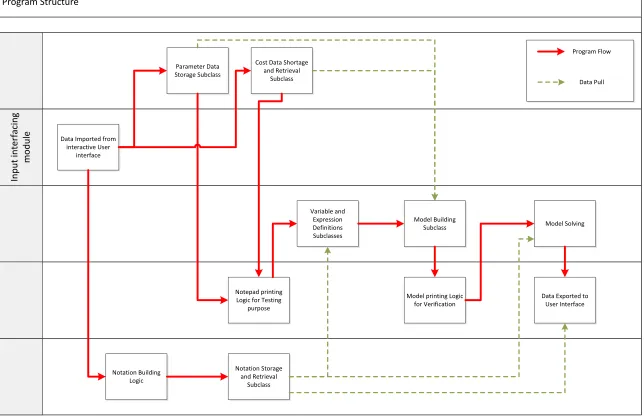
interfaces for importing/exporting data, implemented on .Net platform using C# object oriented
programming framework, and CPLEX concert libraries to solve the mathematical model.
The thesis is organized as follows: Section 2 presents a review of literature related to workforce
planning and personnel scheduling, and highlights the existing gap in the research that calls for a
stochastic workforce-planning model over a long planning horizon. In Section 3, we describe the
industrial setting considered in this problem, and present notation. This section also discusses the
mathematical model used to solve the problem including the intuition behind constraint building.
Section 4 describes the general form of a stochastic linear program and parallels are drawn
between the problem formulated in Section 3 and the general form. Solution methodology used
to solve this problem is also illustrated in this section. As a solution methodology, we discuss a
scenario-based approach and show how the formulation mentioned in Section 3 translates to that
form. Section 5 presents numerical experiments conducted to validate the model. This section
presents the data used as input to the model and using a simple example, the functionality of the
model is explained. A summary of larger test cases and the computational time is also described
in this section. Finally, Section 6 discusses the conclusions and the future works. Appendix is
dedicated to the implementation of the formulation into software. This section describes the
6
2
Literature Review
There has been extensive research in the field of workforce planning, aimed at solving problems
in functional areas such as manufacturing, healthcare, and other services. Comprehensive
reviews by Ernst et al. (2004) and Van et al. (2013) reference 250 research papers published
between 1970 and 2012. Papers are divided into categories based on personnel characteristics,
solution methodology, and areas of applications. These works provide strong support to the work
undertaken here. Similar work, e.g., Wang et al. (2005) and Brecht et al. (2010), provide insights
into work undertaken in the scope of workforce scheduling in a variety of industries.
Apart from these reviews there are other works in the field of strategic workforce planning and
management that are more relevant with respect to the nature of problem solved. These works
can be broadly divided as deterministic and stochastic models. Apart from this distinction, there
are models that manage homogenous (single-skilled) as well as heterogeneous (multi-skilled)
workforces. These models can also be distinguished based on various actions used to form a
workforce.
Deterministic Workforce Planning Models
As mentioned, earlier deterministic personnel planning models formulated by Jarugumilli et al.
(2011) can be used over a short planning horizon. The workforce problem is formulated as a
mixed integer program and is solved using an iterative decomposition algorithm. Though these
models assign workers to operations very efficiently, they do not compute the required size of
the workforce and might result in 'gap' in the assignments. As these are short-term planning
horizon models, they cannot use strategic actions such as hiring and cross-training, and have to
7
this action generally cannot satisfy a prolong shortage as effectively as long term planning
actions such as hiring and cross-training.
Subramanian et al. (2008) models a deterministic workforce-planning problem for a service
industry by formation of a multi-skilled workforce using cross-training. The work integrates the
hiring, firing and contracting of employees of desired skills for the given time period into the
model, which is solved using an algorithmic approach. As the desired skill is the primary focus,
the model also considers the lead time for cross-training employees. Fowler et al. (2008) states
that though cross-training adds flexibility to the workforce not all employees have the same
learning curves. To portray this behavior, Fowler et al. (2008) designed heuristics to solve the
workforce-planning model that integrates hiring, firing, and cross-training of multi-skilled
employees, along with considering their different cognitive abilities.
Drexl et al. (2008) obtains substantial cost savings by solving a multi-skilled workforce-planning
problem for a multi-process industrial setting over a long planning horizon. This problem is
formulated as an integer program, solved using a column generation technique for generating
bounds and a local search to arrive at an integer solution. This model determines the aggregate
optimal level of the workforce required for deterministic demand.
Al-Salamah et al. (2011) integrates the workforce planning problem and multi-product
production management problem to determine the optimal temporary workforce to satisfy a
deterministic demand over a long planning horizon. To determine the optimal size of the
workforce, regular and temporary contractual workers with finite contract validity are used. The
8
While implementing production planning for a multi-product line production, Techawiboonwong
et al. (2003) formulates a model to build a homogenous workforce using swapping of workers
between production lines and assigning overtime. It also uses hiring/firing of workers to satisfy a
deterministic forecasted demand over a given planning horizon. It also considers product
inventory and subcontracting of the demand.
Stochastic Workforce Planning Models
Ozgur et al. (2008) builds a multi-skilled workforce using cross-training and firing. It formulates
the problem over a single period as a scenario-based two-stage stochastic problem and solves it
using Bender’s decomposition algorithm. Bard et al. (2007) models a workforce-planning
problem as a two-stage stochastic recourse problem over a long planning horizon and solves it
using a scenario-based approach. In this model, the size of the workforce, in the form of the
number of regular and part-time workers, is determined in the first stage and worker assignment
to specific shifts and estimation of the number of overtime and temporary workers is made in the
second stage. Slack variables in the model facilitate hiring decisions, if required. The random
demand is quantified as the number of required workers and is divided over shifts and days. This
model is based on the assumption of a single operation and a single skill and a scenario-based
approach with the three demand scenarios (low, medium and high).
Zhu et al. (2007) uses a methodological framework similar to that of Bard et al. (2007) to build a
multi-skilled workforce for a financial firm with functional (skill) demand located in different
centers (processes) that have different capacity and recruitment constraints. To satisfy the
9
stage, and transferring the demand to a different shift and center in the second stage. Bender's
decomposition algorithm is used to solve the problem.
Leung et al. (2005) estimates the required workforce size in a stochastic aggregate planning
model by formulating a multi-product, single-skill problem as two-stage stochastic problem and
solving using robust optimization. Apart from the traditional aggregate planning decisions such
as hiring, firing and overtime, Leung et al. (2005) adds subcontracting as one of first stage
decisions. In the second stage, backordering and inventory decisions are made that are out of
scope of the current problem. Using discrete convexity, Ahn et al (2005) delves into optimal
staffing policies for firms that employ a multi-skilled workforce. This problem is solved for a
stochastic demand and does not consider cross-training as a demand fulfillment action.
Assuming stochastic demand, Song et al. (2008) uses hiring, firing, and labor swaps to determine
the optimal size of an homogenous workforce. This problem is formulated as a multi-stage linear
stochastic program and solved by a successive convex approximation method. Campbell et al
(2010) formulates a two-stage stochastic model to assign regular and cross-trained workers to
jobs. This problem is solved over a shorter planning horizon in order to address the cross-training
of individual workers. Ertogral et al. (2008) aims at building a flexible workforce that is used to
satisfy demand on a daily basis. This work uses two models, one of which considers flexible
workers and other which those not.
Dellaert et al. (2011) determines the budget allocation required to satisfy stochastic demand
using permanent and contingent workers. The approach followed by Dellaert et al. (2011)
determines the size of the workforce for the entire planning horizon.
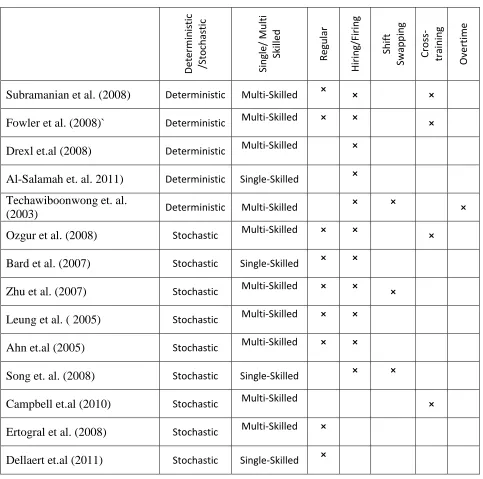
10 D et erm in is tic /Sto cha stic Si n gle/ M u lti Skil led Regu lar H iri n g/ Fi rin g Sh ift Swap p in g Cro ss -train in g Ov er tim e
Subramanian et al. (2008) Deterministic Multi-Skilled × × ×
Fowler et al. (2008)` Deterministic Multi-Skilled × × ×
Drexl et.al (2008) Deterministic Multi-Skilled ×
Al-Salamah et. al. 2011) Deterministic Single-Skilled ×
Techawiboonwong et. al.
(2003) Deterministic Multi-Skilled
× × ×
Ozgur et al. (2008) Stochastic Multi-Skilled × × ×
Bard et al. (2007) Stochastic Single-Skilled × ×
Zhu et al. (2007) Stochastic Multi-Skilled × × ×
Leung et al. ( 2005) Stochastic Multi-Skilled × ×
Ahn et.al (2005) Stochastic Multi-Skilled × ×
Song et. al. (2008) Stochastic Single-Skilled × ×
Campbell et.al (2010) Stochastic Multi-Skilled ×
Ertogral et al. (2008) Stochastic Multi-Skilled ×
[image:18.612.66.549.65.544.2]Dellaert et.al (2011) Stochastic Single-Skilled ×
Table 2.1: Comparison of Relevant Literature
While planning for uncertain demand, a more flexible workforce can be formed by using
shift-swapping, cross-training and hiring in a single optimization model. Identifying the mismatch in
required and available skills in the workforce, and taking actions to reduce it well before the
11
idle workers can sometimes be beneficial in reducing the need for hiring and firing, and can
often reduce the need of overtime for the planning horizon.
Long planning horizons reduce the deterministic nature of the demand. The previously
mentioned, deterministic models are inadequate as they cannot model the stochastic nature of the
demand, and are not recommended for long planning horizons. Previously mentioned stochastic
models are more focused on determining the size of the workforce using the respective actions
than managing the available workforce efficiently. Though models formulated by Song et al.
(2008) and Ertogral et al. (2008) determine the level of the workforce required but ignore the
various actions used to form workforce. Models by Bard et al (2007), Song et al. (2008) and
Dellaert et al. (2011) consider homogenous (single-skilled) workforce, an assumption that
doesnot hold for most of the manufacturing settings. These models prove inefficient for
managing multi-skilled workforces, since cross-training is not considered. Models of Leung et al.
(2005) and Ahn et al. (2005) use hiring/firing in addition to a multi-skilled regular workforce that
in real world can greatly increase the cost of workforce management which can reduced using
other workforce management actions. Workforce planning models by Zhu et al. (2007),
Campbell et.al (2010) and Ozgur et al. (2008) do not consider all actions for managing a flexible
multi-skilled workforce.
In this thesis, the strategic workforce management problem is modeled as a two-stage stochastic
program with recourse. In the first stage, the size of the workforce is determined that will remain
constant throughout the planning horizon. Long-term actions such as hiring, cross-training, and
shift swapping will be taken to determine the composition of the workforce. These actions add
12
In the second stage, once the value of the demand is revealed, short-term decisions such as
13
3
Problem Description
Consider an organization that utilizes highly skilled workers to operate processes. A worker
qualified to operate a process has the necessary certification. There are different levels of
certifications, and workers with a mix of certifications are required for a process.
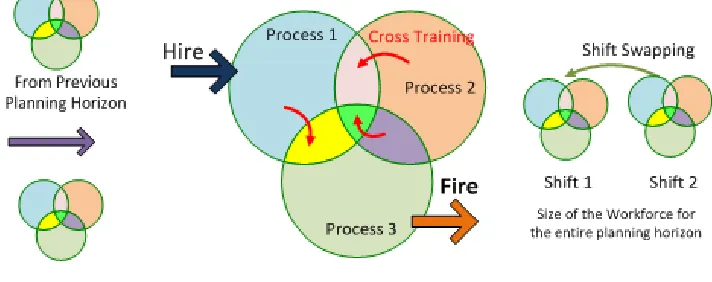
The mentioned industrial environment is depicted in the Figure 1. Each of the circles represents
the set of workers qualified to operate a process, three such processes are shown in the diagram.
The workers that are qualified to operate more than one process form the part of the overlapping
regions of the respective process sets. A Venn diagram formed by the overlapping of these three
process sets represents a single shift; two such shifts are shown. To build its workforce, an
organization takes various actions such as shift swapping, cross-training, and hiring/firing. In the
figure, movement of workers to overlapping regions is shown by the red arrows. Shift swapping
and hiring are shown using green and blue arrows respectively. Workers can be assigned to
overtime if on the same day if there is shortage of skilled workers in a different shift. As per
organization policies, there is a limit on total overtime and shift swapping for the entire planning
horizon. The objective of the organization is to minimize the cost of workforce required to meet
14
Figure 3.1: Strategic Workforce Model
3.1 Model Development
Consider an industry for which we need to determine the size of the workforce for a long
planning horizon t. This industry utilizes J intricate processes such that each process j,j {1…J}
requires highly skilled workers. A worker i belongs to the set of I workers, i {1…I}. A worker
i is qualified to operate a process j if the worker has the necessary certification. There are L
certification levels for all J processes. If a worker i,i {1…I} undergoes a certification for skill
level l {1…L} and process j, j {1…J}, the worker can said to be qualified to operate
process j with skill level l, l {1…L}.
Each process requires workers with a mix of skill levels. A worker i may be certified to operate
more than one process. Such a worker is referred as a flexible worker; On the contrary, a worker
with a single certification (qualified to operate a single process) is referred as an inflexible
worker (Jarugumilli, 2011). An entire production cycle is divided into K shifts and shift k lasts k
{1…K}. The workers are assigned to a particular shift k are part of the regular workforce and
termed as regular workers. Workers operate processes for a shift k and, once that shift is over
15
Uncertain market demand Rjkl, is converted to required number of workers per process j, skill
level l and shift k, and has a known discrete distribution with probability mass function of
. This conversion is based upon the type of the machines, speed of the machines,
criticality of the process, and type of skills required. Let be the size of the workforce formed
to satisfy the Rjkl demand for shift k, process j and skill level l for the given planning horizon.
Regular Workforce
There are available regular workers at the start of the planning horizon for process j with
skill level l for shift k. Due to the flexibility in workforce, there may be number of
workers in shift k who are qualified to operate processes j and j’, j' {1…J} and j ≠ j', with skill
levels l and l’ , l' {1…L} and l ≠ l', respectively. As a result, it can also be inferred that
where net size of the workforce from the previous planning horizon. Let
be the maximum of the number of workers that are retained in shift k to perform process j
with skill level l out of the number of workers. The organization pays to retain a
worker who can perform process j with skill level l in the kth shift.
Shift Swapping
Workers may be rotated through the shifts depending upon organizational rotation policies.
Therefore, at the start of the planning horizon a worker can be transferred from shift k to k'
depending on the requirement, a procedure defined as shift-swap. Shift swapping requires a
worker to work as a regular worker in a different shift for a period of some weeks or for the
entire planning horizon. workers can be swapped from shift k to k' to perform process j
16
shortage of workers in one shift and an excess in another. There is a limit on the number of
workers that can be swapped.
Cross-training
Cross-training is one of the strategic decisions for building a workforce. Cross-training increases
the flexibility among the workers as they might be skilled to perform more than one process. If
there is a prolonged shortage of skill l at a process j and a prolonged surplus of skillat a different
process, cross-training of the workers can be undertaken. Also through cross-training, lower
skilled workers can undergo necessary certifications that allow them to perform higher skilled
tasks. To differentiate the cross-training activities in this work, the latter is termed as skill
training. At the start of the planning horizon and number of workers can be considered
for cross-training and skill training by paying cost of and respectively, per worker for
a given process j with skill level l in kth shift. Availability of the trainers lies outside the scope of
this problem.
Overtime Assignment
A worker i from shift k with skill level l may be assigned to overtime if for the same process j on
the same day there is shortage of skill set l in a different shift k'. As per organization policies and
labor rules, only α workers can be assigned to overtime within the entire planning horizon. To
assign workers a cost of per worker assigned to process j with skill level l in kth shift
is incurred.
17
In case of unavailability of workers within the regular workforce to satisfy the demand,
organizations use hiring ti introduce new workers in the regular workforce. In the scope of this
work, hiring can be analogous to shift swapping where in the workers are transferred to a shift k
from a fictitious shift, k = 0. Based on this convention, whenever a worker i is hired, the worker
can be said to have transferred from a zeroth shift, where the zeroth shift can be said have infinite
capacity. It is assumed that whenever the workers are hired by an organization they shall be
directly recruited into the required shifts and that these hired resources are not available to be
cross-trained during the planning horizon. In the start of the planning horizon, the organization
will hire number of workers respectively, to perform process j with skill level l in shift k at
a cost of per worker.
Excess/ Shortage
It is imperative for the organization to satisfy the demand, at the time same time reduce the
idleness among the workers. Let be the number of idle workers in shift k for process j, skill
level l, and is the cost incurred per worker. Similarly, let be the shortage of workers for
process j, skill l and shift k, and is the cost paid per worker.
Cost Structure
In this section, we shall discuss the cost parameters that will be used in the objective function of
the model. Retaining the workers from the previous planning horizon in the same shift to
perform the same process with the same skill is considered the most desirable action. Shift
swapping involves workers operating the same process with the same skill level but in a different
shift. Therefore, workers should be transferred to the other shifts only if there is an excess in
18
the same shift. Cross-training requires the trainee and the trainer to leverage their effort toward a
process that does not contribute to production. Therefore, cross-training should be performed
only if there is an excess of workers in a process/skill-level and shortage in the other. Further, as
cross-training involves addition of certifications, it is costlier than shift swapping. Hiring adds an
extra resource to the workforce, however is considered to the costliest action. Assigning
overtime can be cheaper over a shorter planning horizon; therefore this cost is more than the cost
of retaining workers in the same shift but is less than shift swapping cost. However, for a long
planning horizon, the cumulative cost of overtime assignment is generally greater than the cost
of shift swapping, hiring, and cross-training. Relative costs for workforce planning actions are
considered in this problem. Jarugumilli, 2011 proves that proper relative cost structure leads to a
optimal formulation.
The objective of the organization is to build a flexible workforce for the entire planning horizon
such that the overall cost of workforce formation is the least. As we are planning over a long
planning horizon, an aggregate planning approach will be used; thus, all variables are positive
rational numbers.
3.2 Notation
The following notation will be used throughout the thesis. Any additional notation may be
introduced as required.
Sets
19
Cost Parameters
: Cost of retaining workers for skill level l for process j during shift k;
Cost of swapping workers with skill level l for process j during week t from shift k to k’;
: Cost for overtime workers for skill level l for process j during shift k;
: Cost of cross-training workers for skill level l for process j during shift k;
: Cost of skill-training workers for skill level l for process j during shift k;
Cost of having shortage or surplus workers for process j with skill l in shift type k;
Other Parameters
The requirement with probability mass function of workers for process j with skill
level l during shift type k;
: The number of worker with skill l for process j from the previous planning horizon;
Limit on the total overtime both primary and secondary within a planning horizon;
Limit on the swapping of workers among the shifts within a planning horizon;
Total number of workers, without double counting available, at the start of planning horizon;
Total number of workers, that are qualified on process j and skill level l as well as
process j' and skill level l' in a shift k.
20
: is the maximum number of workers with skill l for process j from previous planning that
can be retained from previous planning horizon;
: is number of workers in shift k that can perform process j with skill level l in the given
planning horizon;
: is number of workers swapped from shift k to k’ that can perform process j with skill level
l;
Note: Hiring decisions when k =0
: is number of overtime workers allocated to perform process j with skill level l during shift
k
is number of workers that can undergo cross-training to perform process j with skill level l
during shift k;
is number of workers that can undergo skill-training to perform process j with skill level l
21
Deviational Variables
are the deviational variables to indicate the excess/shortage workers allocated to perform
process j with skill level l during shift k;
3.3 Objective Function
Using the above notation, the model is formulated as follows:
(3.1)
where,
(3.2)
As this model is a two-stage stochastic program with recourse, the size of the workforce will be
22
from the previous planning horizon will be carried into the next planning horizon and remain in
the same shift unless they are swapped to a different shift. The swapping variable will capture
the transfer of workers and the hiring and firing activity. Cross-training and skill-training are
long-term decisions and therefore, also form the part of first stage. Based on the availability of
the workers, cross-training variables will be used to increase flexibility of workers that should
lead to a reduction in idleness.
The objective function (3.1) is a combination of the cost of the building regular workforce, shift
swaps, hiring/firing, cross-training, and an expected value function. The expected value function
(3.2) consists of the cost of using second stage variables to take recourse once the actual demand
is revealed. Overtime can be assigned to meet the demand that is left unsatisfied after first stage.
Deviational variables in the expected value function penalize the excess or shortage of worker
hours.
3.4 Constraints
In constraint set (3.3), regular workforce is formed using the workers from the previous planning
horizon, shift swapping, cross-training, and hiring. As the workforce is flexible, only a part of the
workforce from the previous planning horizon may be assigned. Shift swapping variables will
capture the shift swapping as well as the hiring and firing activity. To satisfy the revealed
demand, along with the workforce built in constraint (3.3), overtime will be used as shown in
constraint set (3.4). Any excess or shortage in the required worker hours is captured by the slack
and surplus variables.
(3.3)
23
Both the maximum number of workers that can be assigned to an process, and the number of
workers that can be swapped out of a shift are bounded by the total number of available workers
from the previous planning horizon as shown in constraint sets (3.5) and (3.6), respectively.
(3.5)
(3.6)
In cross-training, workers skilled in one task are trained to perform another task. Therefore,
cross-training constraint set (3.7) restricts the number of cross-training workers for a given
process below the total number of workers available to perform different processes. Contrary to
the cross-training constraints, the skill-training constraints will look for lower skilled workers in
the same process. Constraint set (3.8) restricts the number of workers promoted from a lower
skill level to a higher skill level in the same process to below the number of workers available in
the lower skills.
(3.7)
(3.8)
Business rules may set a limit on the workers that can be assigned to overtime and/or swapped
out of a shift. Constraint sets (3.9) and (3.10) model these business rules, respectively. Note that
constraint set (3.10) implicitly restricts the movement of workers into the shifts.
(3.9)
24
To model a flexible workforce, it is very important to avoid double counting of the workers.
Suppose that at the start of planning horizon there are 10 workers who can do task A and 10
workers who can do task B. Let the requirement for both processes A and B be 10 workers. In
this case, each task can be assigned 10 workers each if there are no workers who are qualified to
do both the tasks. If there are 5 workers who can perform both task A and B, the actual size of
the workforce becomes 10 + 10 - 5 = 15, which cannot satisfy a total demand of 20. This
phenomenon is due to counting the flexible workers in all processes for which they are qualified.
To avoid double counting of the flexible worker hours, constraint set (3.11) imposes a limit on
the workforce built for a process, skill, and shift. The workforce is less than the sum of actual
number of workers from the previous planning horizon and number hired/fired. As per constraint
set (3.12), the sum of the maximum number of workers assigned to each process in a shift, the
number of workers cross-trained and the number of workers swapped out of shifts should be less
than the actual number of workers available.
(3.11)
(3.12)
It is required to restrict the maximum number of regular workers that can be assigned to any two
processes. Using the information about the number of flexible workers in a shift for any two
processes skill-level pair, constraint set (3.13) states that the summation of the maximum number
of workers that can be assigned from the previous planning horizon should be less than or equal
to actual (net) number of workers who are qualified on either of the two processes skill-level
pairs. This actual (net) number can be obtained by adding the number of workers available from
25
(3.13)
Constraint set (3.14) ensures that if there are no workers skilled to operate a process with a
required skill, overtime cannot be assigned until a worker is cross- trained or hired.
(3.14)
Constraint set (3.15) imposes non-negativity restrictions on all variables.
26
4
Solution Methodology
In real world scenarios, there are instances in which values of the parameters are uncertain.
Unlike deterministic modeling, stochastic modeling is the class of mathematical programs that
consists of parameters whose values are not known before solving the problem. Values of these
parameters are in a form of a probability distribution that can be used in the stochastic
problem-solving framework in order to obtain a solution.
4.1 Two-Stage Stochastic Linear Problem with Recourse
A two-stage stochastic problem consists of two phases of decision-making: the first and second
stage decisions. First stage decisions are made before the actual values of uncertain parameters in
the model are revealed by assuming values based on the distribution of the uncertain parameter.
In the second stage, the value of the uncertain parameters is revealed and is used, along with the
values of first stage variables, to determine the second stage decisions. Second stage variables,
known as recourse variables, patch the solution to reduce the effect caused due to the actual
values of the uncertain parameters.
The following expression is the general form of a two-stage stochastic linear program with
recourse. (Birge and Louveaux, 1997)
(4.1)
where
(4.2)
27
The first stage decisions are represented by vector x and the second stage decisions are
represented by vector y. Let the cost vector for first and second stages variables be represented
by vectors Cand Q, respectively. The objective function for a general two-stage stochastic linear
problem is minimization of the summation of the cost of first stage variables and the expected
value function of the second stage variables. In other words, the expected value function is the
cost incurred due to the uncertainty in the model. W, h and T are the components of the expected
value function that form a constraint to establish the relation between the first stage and second
variables. In this constraint, the vectors W and T are deterministic parameter multipliers of
variable vectors y and x, respectively, while h is the uncertain constant. From the general form it
can clearly be seen that the values of the second stage decisions y are dependent on the values of
x, while the first stage variables are independent.
The model formulated in Section 3 has a structure analogous to that of the above general form
(Equations 4.1- 4.3) of the two- stage stochastic program with recourse. It can be seen that
decisions of retaining workers, shift swapping, hiring and cross-training are the first stage
decisions (analogous to vector x) that will be taken before the actual value of demand R
(analogous to vector h) is revealed. These decisions collectively contribute to determining the
size and composition of the workforce for the entire planning horizon. In the second stage, once
the actual values of the demand are revealed, overtime (analogous to vector y) will be used as
recourse to satisfy the actual value of the demand.
4.2 Scenario Based Approach
The two-stage stochastic recourse problem can be solved using scenarios, converting the
problem to an extended deterministic problem (Birge and Louveaux, 1997). Using the known
28
the parameters along with the probability of occurrence of each of these point values. Let S be
the set all scenarios and s such that be the subscript that denotes the scenarios. Let hs be
the value of the random parameter for scenario s and let Ps denote its respective probability,
which will be used in the expected value objective function. While solving a two-stage stochastic
program using a scenario-based approach, the first stage variables take on values irrespective of
the scenario and therefore, these variables will not have a scenario subscript. Once the actual
demand is revealed, the second stage will build a matrix of the customizable options based on the
value of uncertain parameters that were not satisfied using the first stage variables.
Upon solving this problem using a scenario-based approach, we get a single vector for the first
stage variables and |S| vectors for second stage variables. These |S| vectors can be used as
recourses depending on the actual value of the uncertain parameter. On applying this solution
methodology to equations 4.1 - 4.3, we obtain an extended deterministic form as shown in
equations 4.4 - 4.6. In this form of problem, the expected value function is represented by the
known scenario wise probability vector Ps and scenario wise point value vector of uncertain
parameter hs.
(4.4)
where
(4.5)
(4.6)
4.3 Conversion of Formulation to Extended Deterministic Form
The above approach can be used to solve the problem formulated in section 3. Using equations
29
adding an extra subscript s to the uncertain parameter R and introducing a probability vector Ps.
Let Rs be the demand vector for scenario s and let Ps denote its respective probability. The first
stage variables take on values irrespective of the scenario and, therefore regular, cross-training,
hiring and shift swapping variables will not have a scenario subscript, while the overtime
variables will be scenario dependent. The original formulation in Section 3 is updated as below;
Extended deterministic formulation
Objective Function
(4.7)
where,
(4.8)
Subject to:
(4.9)
30
(4.11)
(4.12)
(4.13)
(4.14)
(4.15)
(4.16)
(4.17)
(4.18)
(4.19)
(4.20)
31
5
Numerical Experiments
Using the model developed in the previous section, insights can be gathered on workforce
planning. Experiments are conducted to verify and validate the functionality of the model.
5.1 Data
For illustrative purpose, a dataset is created similar to that contributed by our industrial
collaborator. This dataset consist of information for an industrial setting with 57 flexible and
inflexible workers, three processes, four shifts, and two skill levels. Each process requires a
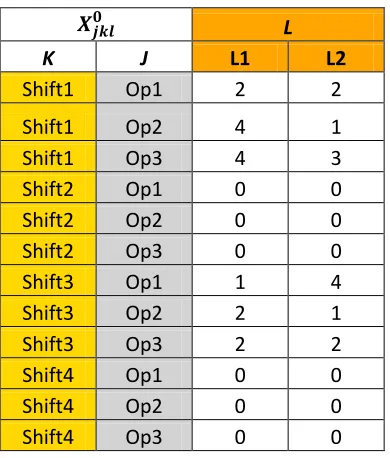
different mix of workers with varied skill levels L1 and L2. Table 2 shows the gross number of
workers at the start of the planning horizon.
L
K J L1 L2
[image:39.612.210.405.318.547.2]Shift1 Op1 2 2 Shift1 Op2 4 1 Shift1 Op3 4 3 Shift2 Op1 0 0 Shift2 Op2 0 0 Shift2 Op3 0 0 Shift3 Op1 1 4 Shift3 Op2 2 1 Shift3 Op3 2 2 Shift4 Op1 0 0 Shift4 Op2 0 0 Shift4 Op3 0 0
Table 5.1: Available Workers at the start of the planning horizon
To solve the model using the scenario-based approach, a known number of scenarios for a
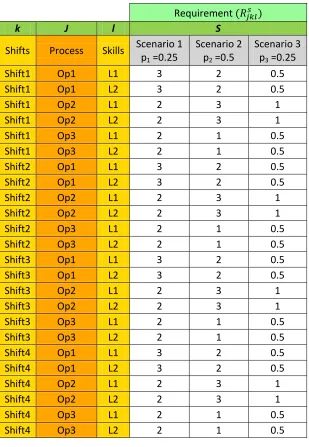
discrete distribution of demand were provided by an industrial collaborator. Table 5.2 shows the
requirement for each of the processes for the given three scenarios and its respective probability.
32
Requirement
k J l S
Shifts Process Skills Scenario 1 p1 =0.25
Scenario 2 p2 =0.5
Scenario 3 p3 =0.25
Shift1 Op1 L1 3 2 0.5
Shift1 Op1 L2 3 2 0.5
Shift1 Op2 L1 2 3 1
Shift1 Op2 L2 2 3 1
Shift1 Op3 L1 2 1 0.5
Shift1 Op3 L2 2 1 0.5
Shift2 Op1 L1 3 2 0.5
Shift2 Op1 L2 3 2 0.5
Shift2 Op2 L1 2 3 1
Shift2 Op2 L2 2 3 1
Shift2 Op3 L1 2 1 0.5
Shift2 Op3 L2 2 1 0.5
Shift3 Op1 L1 3 2 0.5
Shift3 Op1 L2 3 2 0.5
Shift3 Op2 L1 2 3 1
Shift3 Op2 L2 2 3 1
Shift3 Op3 L1 2 1 0.5
Shift3 Op3 L2 2 1 0.5
Shift4 Op1 L1 3 2 0.5
Shift4 Op1 L2 3 2 0.5
Shift4 Op2 L1 2 3 1
Shift4 Op2 L2 2 3 1
Shift4 Op3 L1 2 1 0.5
[image:40.612.153.462.69.516.2]Shift4 Op3 L2 2 1 0.5
Table 5.2: Scenario wise requirement and probability
Table 5.3 shows a qualification matrix that provides information about workers and their
individual qualifications. There are total of 57 workers at the start of the planning horizon,
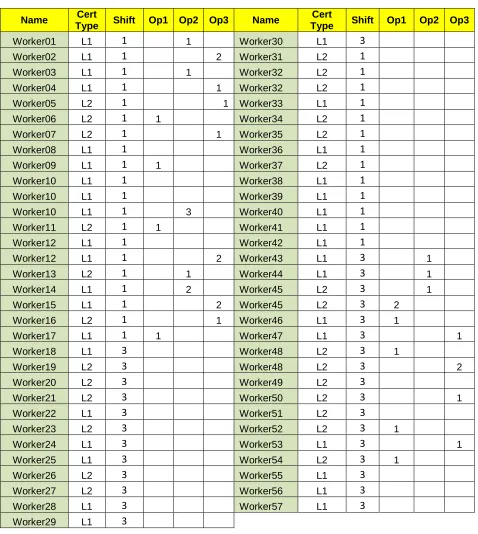
i.e., , with 27 workers qualified on at least one task, inclusive of all skill levels. Further, 29
workers are not qualified on any task. From the previous planning horizon, 27 workers are
assigned to Shift 1 and 30 workers are assigned Shift 3, while shift 2 and Shift 4 have no workers
33
Name Cert
Type Shift Op1 Op2 Op3 Name
Cert
Type Shift Op1 Op2 Op3
Worker01 L1 1 1 Worker30 L1 3
Worker02 L1 1 2 Worker31 L2 1
Worker03 L1 1 1 Worker32 L2 1
Worker04 L1 1 1 Worker32 L2 1
Worker05 L2 1 1 Worker33 L1 1
Worker06 L2 1 1 Worker34 L2 1
Worker07 L2 1 1 Worker35 L2 1
Worker08 L1 1 Worker36 L1 1
Worker09 L1 1 1 Worker37 L2 1
Worker10 L1 1 Worker38 L1 1
Worker10 L1 1 Worker39 L1 1
Worker10 L1 1 3 Worker40 L1 1
Worker11 L2 1 1 Worker41 L1 1
Worker12 L1 1 Worker42 L1 1
Worker12 L1 1 2 Worker43 L1 3 1
Worker13 L2 1 1 Worker44 L1 3 1
Worker14 L1 1 2 Worker45 L2 3 1
Worker15 L1 1 2 Worker45 L2 3 2
Worker16 L2 1 1 Worker46 L1 3 1
Worker17 L1 1 1 Worker47 L1 3 1
Worker18 L1 3 Worker48 L2 3 1
Worker19 L2 3 Worker48 L2 3 2
Worker20 L2 3 Worker49 L2 3
Worker21 L2 3 Worker50 L2 3 1
Worker22 L1 3 Worker51 L2 3
Worker23 L2 3 Worker52 L2 3 1
Worker24 L1 3 Worker53 L1 3 1
Worker25 L1 3 Worker54 L2 3 1
Worker26 L2 3 Worker55 L1 3
Worker27 L2 3 Worker56 L1 3
Worker28 L1 3 Worker57 L1 3
[image:41.612.71.549.64.598.2]Worker29 L1 3
Table 2.3: Qualification Matrix
As per the business rules there is a limit on the number of workers that can assigned to overtime
34 5.2 Resulting Solution
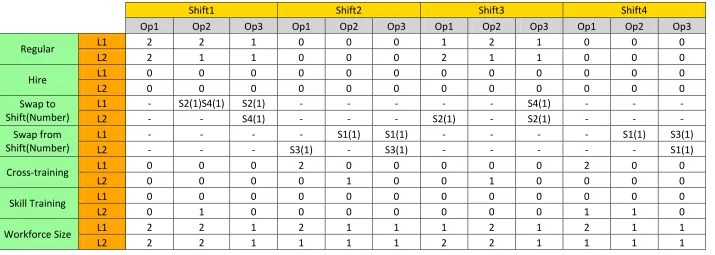
In this section, the solution is obtained using the data in the section 5.1. In the first stage, the
output of the model sets the level of the workforce that is to be formed before the start of the
planning horizon as shown in Table 5.4. Table 5.4 also shows the composition of the workforce
in the form of workers from the previous planning horizons, workers hired, swapped, or cross
35
Shift1 Shift2 Shift3 Shift4
Op1 Op2 Op3 Op1 Op2 Op3 Op1 Op2 Op3 Op1 Op2 Op3
Regular L1 2 2 1 0 0 0 1 2 1 0 0 0
L2 2 1 1 0 0 0 2 1 1 0 0 0
Hire L1 0 0 0 0 0 0 0 0 0 0 0 0
L2 0 0 0 0 0 0 0 0 0 0 0 0
Swap to Shift(Number)
L1 - S2(1)S4(1) S2(1) - - - S4(1) - - -
L2 - - S4(1) - - - S2(1) - S2(1) - - -
Swap from Shift(Number)
L1 - - - - S1(1) S1(1) - - - - S1(1) S3(1)
L2 - - - S3(1) - S3(1) - - - S1(1)
Cross-training L1 0 0 0 2 0 0 0 0 0 2 0 0
L2 0 0 0 0 1 0 0 1 0 0 0 0
Skill Training L1 0 0 0 0 0 0 0 0 0 0 0 0
L2 0 1 0 0 0 0 0 0 0 1 1 0
Workforce Size L1 2 2 1 2 1 1 1 2 1 2 1 1
[image:43.792.40.755.70.325.2]L2 2 2 1 1 1 1 2 2 1 1 1 1
36
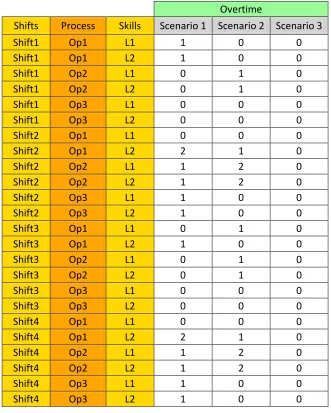
Table 5.5 shows the overtime assignments based on revelation of the actual value of demand.
From the experimental result, it can be seen that the model utilizes the overtime completely
unless there is surplus. Hiring decisions are taken by the model only after the entire available
workforce and the overtime is utilized. Model assigns idle workers to cross-training and
skill-training before the hiring decisions are taken.
Overtime
Shifts Process Skills Scenario 1 Scenario 2 Scenario 3
Shift1 Op1 L1 1 0 0
Shift1 Op1 L2 1 0 0
Shift1 Op2 L1 0 1 0
Shift1 Op2 L2 0 1 0
Shift1 Op3 L1 0 0 0
Shift1 Op3 L2 0 0 0
Shift2 Op1 L1 0 0 0
Shift2 Op1 L2 2 1 0
Shift2 Op2 L1 1 2 0
Shift2 Op2 L2 1 2 0
Shift2 Op3 L1 1 0 0
Shift2 Op3 L2 1 0 0
Shift3 Op1 L1 0 1 0
Shift3 Op1 L2 1 0 0
Shift3 Op2 L1 0 1 0
Shift3 Op2 L2 0 1 0
Shift3 Op3 L1 0 0 0
Shift3 Op3 L2 0 0 0
Shift4 Op1 L1 0 0 0
Shift4 Op1 L2 2 1 0
Shift4 Op2 L1 1 2 0
Shift4 Op2 L2 1 2 0
Shift4 Op3 L1 1 0 0
[image:44.612.141.472.219.632.2]Shift4 Op3 L2 1 0 0
37 5.3 Computational Experiment
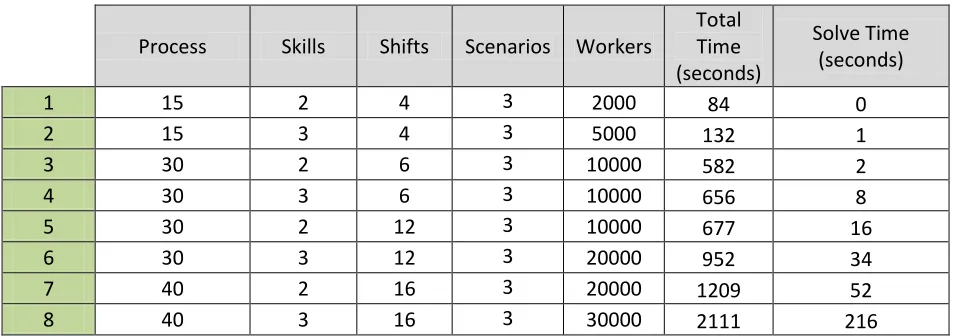
Using the data contributed by the industrial collaborator, sample data was created to generate test
cases to validate the model. This sample data was created by varying the number of processes,
skills, shifts, number of workers but keeping the number of scenarios same. For all the test cases,
the model determines the optimal size of the workforce using various workforce-planning
actions. The model was implemented on .Net platform using C# and mathematical model was
solved using CPLEX 12.5. For details of the software implementation, refer to Appendix 1.
Table 5.6 shows the size of the problem, and the total computational time required to solve the
problem. The actual time required to solve the model is given by “Solve time.”
The actual industrial level problem consists of 40 processes, three skills levels, 14 shifts, and
three scenarios that can be solved using this model as shown in test case 8. The so developed is
flexible that allows for solving larger size problems involving more than three scenarios, and
larger number of skills, shifts and processes. However as the size of the problem increases the
solve time also increases.
Process Skills Shifts Scenarios Workers
Total Time (seconds)
Solve Time (seconds)
1 15 2 4 3 2000 84 0
2 15 3 4 3 5000 132 1
3 30 2 6 3 10000 582 2
4 30 3 6 3 10000 656 8
5 30 2 12 3 10000 677 16
6 30 3 12 3 20000 952 34
7 40 2 16 3 20000 1209 52
[image:45.612.71.551.466.634.2]8 40 3 16 3 30000 2111 216
38
6
Conclusions and Future Work
In this thesis, a strategic workforce management system is developed to determine the size of the
workforce over a long planning horizon under uncertain demand. Using two-stage stochastic
programming the workforce is formed using actions such as shift-swapping, cross-training, and
hiring assuming a known distribution of the demand. This model utilizes the available workforce
from the previous planning horizon by identifying the potential number of workers that can be
swapped within shifts or cross-trained, adding flexibility to the workforce. In the second stage,
the requirements of overtime during the entire planning horizon are revealed.
In all the experiments that were conducted by varying the number of processes, skills levels, and
shifts, model determined optimal size of the workforce required to satisfy an uncertain demand.
From the experimentation, it can be seen that model is flexible and can handle problems of larger
size.
Workforce planning using this model can be used as parameters in the short-term cross-training
planning models developed by Gandhi et al. (2013). Decisions obtained can be used to conduct
cross-training programs before the actual demand occurs in an attempt to reduce the overtime
requirement, allowing the decision makers with ample amount of time to hire and cross-train
workers. Even though overtime is used as recourse, it is costly to use over a longer period. Such
prolonged unsatisfied demand can easily be satisfied using the hiring, cross-training, and
shift-swaps.
A variant of the model developed by Kulkarni et al. (2013) manages workforce in an industrial
setting with products with independent demands, i.e., product demands are not correlated.
Therefore, for n processes and r point demands there exist rn scenarios. The assumption of
39
computational challenging. Thus, future work will address approaches to reduce the model
40
References
Ahn, H. S., Righter, R., and Shanthikumar, J. G. (2005). Staffing decisions for heterogeneous workers with turnover. Mathematical Methods of Operations Research, 62(3), 499-514.
Al-Salamah, M. (2011). Temporary workforce planning with firm contracts: A model and a simulated annealing heuristic. Mathematical Problems in Engineering, 2011
Bard, J. F., Morton, D. P., and Wang, Y. M. (2007). Workforce planning at USPS mail processing and distribution centers using stochastic optimization. Annals of Operations Research, 155(1), 51-78.
Berman, O., Larson, R. C., and Pinker, E. (1997). Scheduling workforce and workflow in a high volume factory. Management Science, 43(2), 158-172.
Bersin and Associates, (2011). New U.S. Research Finds Dramatic Shift in Recruitment Spending Towards Professional and Social Networks and Away from Agencies and Job Boards (http://www.bersin.com/News/Content.aspx?id=14998)
Birge, J. R., and Louveaux, F. V. (1997). Introduction to stochastic programming. Springer.
Bowen, D. E., Ledford, G. E., and Nathan, B. R. (1991). Hiring for the organization, not the job. The Executive, 5(4), 35-51.
Brecht Cardoen, Erik Demeulemeester, Jeroen Beliën, Operating room planning and scheduling: A literature review, European Journal of Operational Research, Volume 201, Issue 3, 16 March 2010, Pages 921-932, ISSN 0377-2217, 10.1016/j.ejor.2009.04.011.
Brusco, M. J., and Jacobs, L. W. (1998). Personnel tour scheduling when starting-time restrictions are present. Management Science, 44(4), 534-547.
Burns, R. N., and Carter, M. W. (1985). Work force size and single shift schedules with variable demands. Management Science, 31(5), 599-607.
Campbell, G. M. (2010). A two-stage stochastic program for scheduling and allocating cross-trained workers. Journal of the Operational Research Society, 62(6), 1038-1047.
Conerly,W. (2013).Seven Business Strategies for Capturing the Next Golden Swan (http://www.forbes.com/sites/billconerly/2013/03/08/seven-business-strategies-for-capturing-the-next-golden-swan/)
Corominas, A., Ojeda, J., and Pastor, R. (2004). Multi-objective allocation of multi-function workers with lower bounded capacity. Journal of the Operational Research Society, 56(6), 738-743.
Dellaert, N., Jeunet, J., and Mincsovics, G. (2011). Budget allocation for permanent and contingent capacity under stochastic demand. International Journal of Production Economics, 131(1), 128-138.