City, University of London Institutional Repository
Citation
:
Abdi, M. (2015). Multi-electrode stimulation and measurement patterns versus prior information of fast 3D EIT. (Unpublished Masters thesis, City, University of London)This is the accepted version of the paper.
This version of the publication may differ from the final published
version.
Permanent repository link:
http://openaccess.city.ac.uk/16089/Link to published version
:
Copyright and reuse:
City Research Online aims to make research
outputs of City, University of London available to a wider audience.
Copyright and Moral Rights remain with the author(s) and/or copyright
holders. URLs from City Research Online may be freely distributed and
linked to.
City Research Online: http://openaccess.city.ac.uk/ [email protected]
measurement patterns versus prior
information for fast 3D EIT
A Thesis Presented to
The School of Engineering and Mathematical Sciences
City University London
In fulfilment
of the requirements for the Degree
Masters of Philosophy
by
Montaserbellah H. M. Abdi
No portion of the work referred to in this thesis has been submitted in support of an
application for another degree or qualification of this or any other university or other
Electrical Impedance Tomography or as referred to as EIT, is a typical inverse
problem of estimating the unknown interior material impedance properties inside a
conductive medium through measurements performed at the periphery of the
containing medium. Due to its inverse nature, EIT’s poor spatial resolution is still
one of its biggest downfalls since meaningful images are hard to obtain without
incorporating some sort of prior information about the material distribution
characteristics.
Given the ill–posedness of the EIT problem coupled with the limited number of
collectable boundary voltage measurements, the resulted discrete system is heavily
underdetermined and ill–conditioned. Therefore, a sensible step to overcome this
problem is to collect as many measurements as the number of the finite elements
composing the medium. From one hand, this is not practically possible, on the other,
an increased number of measurements will contribute towards unrealistically high
computational overheads both for the assembly and the inversion of the resulted
dense system matrix.
For any given EIT configuration, the discrete Picard’s stability criterion can be
deployed as a practical measure of the system performance against noise
contaminated measurements. Herein, this study includes extensive use of this
measure to quantify the performance of impedance imaging systems for various
injection patterns. In effect, it is numerically demonstrated that by varying electrode
distributions and numbers, little improvement, if any, in the performance of the
impedance imaging system is recorded. In contrast, by using groups of electrodes in
the 3D current injection process, a step increase in performance is obtained.
Numerical results reveal that the performance measure of the imaging system is 29%
for a conventional combination of stimulation and prior information, 97% for groups
of electrodes and the same prior and 98% for groups of electrodes and a more
accurate prior. Finally, since a smaller number of electrodes are involved in the
measurement process, a smaller number of measurements are acquired. However, no
· Abdi, M. and P. Liatsis. EIT in Breast Cancer Imaging: Application to
Patient–Specific Forward Model. inDevelopments in E–systems Engineering
(DeSE). 2011.
· Kantartzis, P., M. Abdi, and P. Liatsis,Stimulation and measurement patterns
versus prior information for fast 3D EIT: A breast screening case study.
I take this opportunity to show gratitude to the almighty God for making the
completion of this thesis possible despite the hurdles that I came across throughout
my studies. At the same time, this research would not have been possible without the
support of many people. I wish to express my gratitude to my dear supervisor,
Professor Panos Liatsis who was abundantly helpful and offered invaluable
assistance, tolerance, support and guidance. Deepest gratitude is also offered to Dr.
Panagiotis Kantartzis without whose knowledge and assistance this study would not
have been successful. I would also like to thank my beloved parents, for their
unconditional love, support and patience throughout my life. Last but not least, I
would like to thank the school of Engineering and Mathematical Sciences at City
Abstract ... iii
List of Symbols ... xi
List of abbreviations ... xiii
Chapter 1: Introduction ... 1
1.1 Electrical Impedance Tomography (EIT) ... 1
1.2 Inverse problems ... 3
1.3 The toilsome EIT ... 5
1.4 EIT hardware... 6
1.5 EIT as an imaging modality ... 7
1.6 Thesis aim and objectives ... 7
1.7 Thesis contribution ... 9
1.8 Thesis organisation ... 9
Chapter 2: The EIT forward problem...11
2.1 Overview of the forward problem ...11
2.2 EIT problem formulation ...13
2.3 Electrode models ...15
2.3.1 Continuum Electrode Model ...16
2.3.2 Gap Electrode Model ...17
2.3.3 Shunt Electrode Model ...17
2.3.4 Complete electrode model ...18
2.4 Finite Element Methods in the solution of solving the EIT forward problem ...19
2.4.1 Continuous domain setting...20
2.4.2 Discrete domain setting ...23
2.5 Current injection and data collection strategies in EIT ...25
2.5.1 Adjacent method...27
2.5.2 Opposite method...28
2.5.3 Adaptive method ...28
2.6 Solving the linear system of the forward problem ...30
2.6.1 Direct methods ...31
2.6.2 Iterative methods ...32
2.7 The EIT inverse problem ...33
2.7.1 Calculating the Jacobian matrix ...36
2.8 Summary ...37
Chapter 3: The EIT image reconstruction problem ...38
3.1 Introduction ...39
3.4.1 Standard Regularisation ...46
3.4.2 Truncated Singular Value Decompositions (TSVD) ...46
3.4.3 Direct algorithms: Standard Tikhonov Regularisation ...47
3.4.4 Iterative regularisation techniques ...50
3.5 The discrete Picard criterion ...53
3.6 Summary ...54
Chapter 4: Multi stimulation and measurement patterns for fast EIT ...55
4.1 Introduction ...55
4.2 Numerical stability of simulation studies ...57
4.2.1 Conservation of Energy ...58
4.2.2 Boundary conformity ...59
4.3 Overview of simulations studies ...59
4.4 Computational efficiency ...60
4.5 A comparison between the conventional opposite 2–electrode pair stimulation and multi– injection protocols based on Picard’s stability and GSVD techniques ...63
4.5.1 Conventional opposite 2–electrode pair stimulation protocol – 2D and 3D scenarios ...64
4.5.2 Proposed Multi–injection stimulation protocol – 2D and 3D scenarios ...65
4.6 Multi–injection versus prior information ...74
4.7 Image reconstruction ...77
4.8 Summary ...83
Chapter 5: Conclusions and future work ...84
5.1 The problem and the solution ...84
5.2 Thesis deliverables ...86
5.3 Further Work ...86
References ...89
Appendix A...97
Appendix B ... 107
Figure 1.1 A simple 16–electrodes 2D configuration containing a perturbation. The left– hand side picture shows the single adjacent current injection protocol while on the right– hand side shows opposite multi–injection one. The data collection strategy as shown in the figure is of adjacent nature. That is due to measurements collected from adjacent electrode pairs. ... 2
Figure 1.2 ITS, P2000 Electrical Resistance Tomography System at City University
London. ... 3
Figure 2.1 2D domain, marking clearly the domain W, boundary ¶W, electrodes Gi, and inter–electrodes gaps ¡j ...13
Figure 2.2 Adjacent method of data collection for a 16-electrode configuration system. For each stimulation pattern, 13 voltage measurements are collected from non-injecting
electrodes (a) First set of injected current I(1) . (b) Second set of injected current I(2). ...27
Figure 2.3 Opposite method of data collection for a 16-electrode configuration system. For each stimulation pattern, 12 voltage measurements are collected from non-injecting
electrodes. (a): First stimulation pattern I(1), (b): Second stimulation pattern I(2). ...28
Figure 2.4 Adaptive method of data collection for a 16-electrode configuration system. For each stimulation pattern, 15 voltage measurements are collected from non-injecting
electrodes. (a): First stimulation pattern I(1) , (b): Second stimulation pattern I(2)...29
Figure 3.1 Groups of Reconstruction algorithms [47] ...39
Figure 3.2 The L–curve of a specific problem, the L–curve is a log–log plot of the solution norm Rx 22 versus the residual norm Ax b- 22 ...49
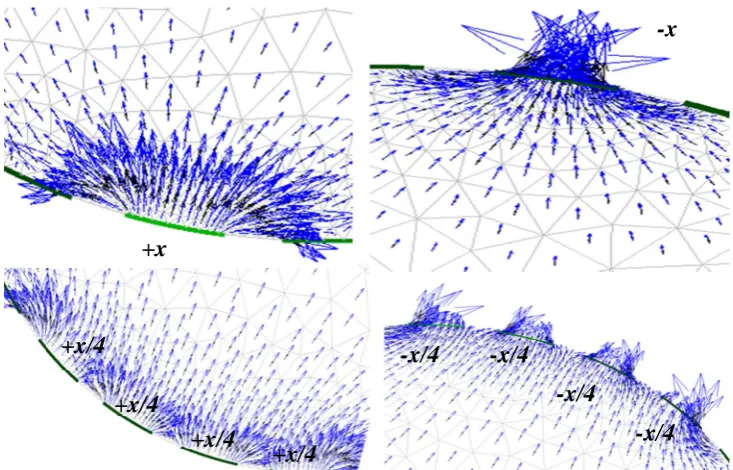
Figure 4.1 Principle of energy conservation. The two top images show the conventional opposite 2–electrode pair injection mechanism, whilst two bottom images show the multi– injection protocol with 4–electrodes per group...58
Figure 4.2 The potential distribution and calculated boundary voltages. (a) The field from the first current pattern for the conventional opposite 2–electrode pair stimulation protocol, (b) the field from the first current patter for the multi–injection protocol with 4
electrodes/group, (c) the measured boundary voltages for the conventional opposite 2– electrode pair stimulation protocol, and (d) the measured boundary voltages for the multi– injection protocol. ...62
Figure 4.3 The current streamlines for (a) the conventional opposite 2–electrode pair and (b) multi–injection stimulation protocols. ...63
Figure 4.4 Conventional opposite 2-electrode pair stimulation protocol gains for a 2D circular medium with a single inhomogeneity located at 2 2 2
(x-0.45) +(y-0.4) -0.2 <0 and
20%
ds = + of the background value. ...67
Figure 4.5 Proposed multi-injection stimulation protocol gains, for a 2D circular test phantom where a single inhomogeneity is located at 2 2 2
(x-0.45) +(y-0.4) -0.2 <0 of
20%
ds = + of the background value. ...68
Figure 4.6 Conventional opposite 2-electrode pair stimulation protocol gains for a 3D cylindrical medium, where a single inhomogeneity is located at
2 2 2 2
(x+0.5) + -(y 0.3) + -(z 0.4) -0.1 <0 ofds = +20% of the background value. A maximum of 3
rings of electrodes are allowed. ...69
Figure 4.7 Multi-Injection stimulation protocol gains for a 3D cylindrical medium, where a single inhomogeneity is located at 2 2 2 2
(x+0.5) + -(y 0.3) + -(z 0.4) -0.1 <0 of ds = +20% of the
background value. A maximum of 3 rings of electrodes are allowed. ...70
Figure 4.9 Proposed multi-injection stimulation protocol gains, for a 3D cylindrical medium, where a single inhomogeneity is located at 2 2 2 2
(x+0.5) +(y-0.3) + -(z 0.4) -0.1 <0 of ds = +20%
of the background value. A maximum of 4 rings of electrodes are allowed. ...72
Figure 4.10 Conventional versus proposed opposite protocol for various numbers n elec_ of electrodes per group per stimulation group. (a) n_elec=1 (Conventional), (b) n elec_ =2, (c)
_ 6
n elec= , (d) n elec_ =8 electrodes per group. The results shown in the left column assume a simple identity prior whilst in the right column, the NOSER prior is used. ...76
Figure 4.11 Conventional opposite protocol. The first column is the original 3D perturbation presented as 2D coronal slices of the cylindrical phantom at levelsh.The columns (2–10) are the reconstructions for various values of the regularisation parameter l
= {1.00000e–001, 1.33352e–002, 1.77828e–003, 2.37137e–004, 3.16228e–005, 4.21697e– 006, 4.62341e–007, 7.49894e–008, 1.00000e–008}, and the last column represents the reconstructed image resulted from the regularisation parameter produced though the L–curve criterion. ...79
Figure 4.12 Proposed opposite protocol (2–electrodes per group). The first column is the original 3D perturbation presented as 2D coronal slices of the cylindrical phantom at levels
h.The columns (2–10) are the reconstructions for various values of the regularisation
parameter l = {1.00000e–001, 1.33352e–002, 1.77828e–003, 2.37137e–004, 3.16228e–005, 4.21697e–006, 4.62341e–007, 7.49894e–008, 1.00000e–008}, and the last column represents the reconstructed image resulted from the regularisation parameter produced though the L– curve criterion. ...80
Figure 4.13 Proposed opposite protocol (6 electrodes per group). The first column is the original 3D perturbation presented as 2D coronal slices of the cylindrical phantom at levels
h.The columns (2–10) are the reconstructions for various values of the regularisation
parameter l = {1.00000e–001, 1.33352e–002, 1.77828e–003, 2.37137e–004, 3.16228e–005, 4.21697e–006, 4.62341e–007, 7.49894e–008, 1.00000e–008}, and the last column represents the reconstructed image resulted from the regularisation parameter produced though the L– curve criterion. ...81
Figure 4.14 Proposed opposite protocol (8 electrodes per group). The first column is the original 3D perturbation presented as 2D coronal slices of the cylindrical phantom at levels
h.The columns (2–10) are the reconstructions for various values of the regularisation
parameter l = {1.00000e–001, 1.33352e–002, 1.77828e–003, 2.37137e–004, 3.16228e–005, 4.21697e–006, 4.62341e–007, 7.49894e–008, 1.00000e–008}, and the last column represents the reconstructed image resulted from the regularisation parameter produced though the L– curve criterion. ...82
Figure A–1 A rough illustration of a 2D with L electrodes attached at its boundary. Right: Continuous domain, and left is the discretised one. ...97
Figure A-2 (a) Linear triangular element in the xy-plane. (b) Linear triangular element in the
ξη-plane. ...98
Figure C-1 2D reconstructions when using conventional opposite 2-electrode pair protocol ... 111
Figure C-2 2D reconstructions when deploying the proposed multi-injection protocol ... 112
Figure C-3 3D reconstructions at different heights when using the conventional 2-electrode pair protocol, a maximum of 3 electrode rings is allowed... 113
Figure C-4 3D reconstruction at different heights when deploying the proposed multi-injection protocol, a maximum of 3 electrode rings is allowed. ... 114
Figure C-5 3D construction at different heights when using conventional 2-electrode pair protocol, a maximum of 4 electrode rings is allowed. ... 115
Table 4.1 Percentage reduction time when using the multi–injection protocol ...62
Table 4.2 Conventional opposite 2–electrode pair stimulation protocol gains for a 2D
circular test phantom. ...73
Table 4.3 Conventional opposite 2–electrode pair stimulation protocol gains, when a
maximum of 3–rings of electrodes is allowed. ...73
Table 4.4 Conventional opposite 2–electrode pair stimulation protocol gains, when a
maximum of 4 rings of electrodes is allowed. ...73
Table 4.5 Multi–injection stimulation protocol gains for a 2D circular test phantom. ...73
Table 4.6 Multi–injection stimulation protocol gains, when a maximum of 3 rings of
electrodes is allowed. ...73
Table 4.7 Multi–injection stimulation protocol gains, when a maximum of 4 rings of
electrodes is allowed. ...73
Throughout the thesis, column vectors and matrices are identified in bold upper–case
letter, whereas continuous functions are identified in italic letters. The ( , )i j thentry of matrix A isAij, similarly the ithentry of a vector x is xi.
W modelled body
¶W medium boundary
Ñ del operator
B magnetic flux density
H magnetic field intensity
r charge density
m magnetic permeability
D electric flux density
E electrical field intensity
j current density inside a medium (continuous function)
j total current density inside the medium, it is the summation of the
conduction and source current densities i.e., j = jc+js
J the Jacobian or sensitivity matrix
L nonlinear forward operator that maps the change in the interior
conductivities onto the change in the collected boundary voltage
measurements
s conductivity distribution (continuous function)
s vector containing discrete conductivity values (the entries
1,.., k k= K s
represents conductivity values at the faces of simplices composing the
discretised medium)
ds vector containing the change in conductivity values with respect to a
reference conductivity s0
ˆ
n outward unit normal
( ) i
f discrete values of electrical potential at the nodes of the simplices
e electrical permittivity or at some locations is additive noise
w relaxation parameter in Landweber iteration
G union of electrodes Gl
l
G area (in 3D) or length (in 2D) of thelth electrode
l
z contact impedance of thelth electrode
l
V electric potential at thelth electrode
y boundary measured voltages as a function of conductivity change
y vector containing the finite boundary measured voltages
fwd
y vector containing the finite boundary voltages calculated via FEM
dy vector containing the change between the measured and calculated boundary
voltages
n number of nodes in the mesh
I current pattern
K number of elements in the mesh
a regularisation parameter
d change in a given quantity
D an update in a given quantity mainly used in iterative formulae
( ) ( )
n n
t
¶ 
nth partial derivative with respect to time
L total number of electrodes
m number of voltage measurements collected at the medium’s boundary
g generalised singular values
h levels at which the 3D model is sliced (for visualisation purposes)
D[.] a given operator applied to a function
( )
R x residual function
Abbreviation Meaning
CEM Complete Electrode Method
CG Conjugate Gradients
CG Conjugate Gradient
CT Computer Tomography
EIT Electrical Impedance Tomography
FEM Finite Element Method
GSVD Generalised Single Value Decomposition
MRI Magnetic Resonance Imaging
PCG Preconditioned Conjugate Gradient
PDE Partial Differential Equation
PET Positron Emission Tomography
SPECT Single Photon Emission Computerised Tomography
STR Standard Tikhonov Regularisation
SVD Singular Value Decomposition
TGSVD Truncated Generalised Singular Value Decomposition
Introduction
Research is to see what everybody else has seen, and to think what nobody else has thought
Albert Szent–Gyorgyi
1.1 Electrical Impedance Tomography (EIT)
Electrical Impedance Tomography (EIT) has been a topic of increasing interest to the
Medical Imaging community in the last few decades. Since 1970s, EIT has been
actively researched where the number of published papers and journals has been
notably growing. As the name suggests, EIT is the process of producing 2D and 3D
images of the inside of a medium. This process takes place through injecting a given
medium with a sequence of electrical currents via an array of electrodes attached to
its periphery, and measuring the resulted voltages. These measurements are then used
to reconstruct visual images of the inside of that medium.
The non–invasive nature of the EIT technology, its practicality and portability in
producing images have shown promising results which may lead to adopting this
technology in medical or industrial applications.
One advantage that distinguishes EIT from other imaging modalities is the use of
low–amplitude AC currents in the injection process. Although for some, this is
considered a disadvantage during to the scattering effect [1], but for others, it is an
advantage due to low power (heat) injected into the medium especially when used for
medical purposes and the medium is the human body.
The set of electrodes, either current–injecting or voltage–measuring, can be arranged
in different ways to achieve the best rate of object detection or distinguishability.
electrical currents are fired into the medium and voltages are measured across
various electrodes at the boundary. Figure 1.2 shows the ERT (Electrical Resistance
Tomography) system used in the Information Engineering and Medical Imaging
[image:16.595.136.506.170.339.2]Centre at City University London.
Figure 1.1A simple 16–electrodes 2D configuration containing a perturbation. The left–hand side picture shows the single adjacent current injection protocol while on the right–hand side shows opposite multi– injection one. The data collection strategy as shown in the figure is of adjacent nature. That is due to measurements collected from adjacent electrode pairs.
Historically, the 2D EIT has suffered from producing limited spatial resolution due to
its ability to only produce a cross sectional image of a 3D medium let alone the
limitation in the electrodes configuration. Both make the 2D EIT modality less
resembling to real life problems. However, the application of 3D EIT through
employing two or more equally spaced electrodes sequence around a body in specific
planes has introduced enhancements in the reconstructed images as reported in [2]
and [3]. The use of EIT imaging modality in many applications such as biomedical,
industrial, geophysical, etc., is almost the same; that is due to the image
reconstruction process, which differs only in the use of the prior information and the
Figure 1.2 ITS, P2000 Electrical Resistance Tomography System at City University London.
It is important to note at this stage that images produced from deploying the EIT
modality are of a differential nature i.e., imaging the impedance difference between
two states; the reference state which depicts our prior knowledge of the medium, and
object/phantom which lies/occurs within that medium. This narrows down the EIT
applications to moving objects or 2–state phantoms only, e.g., moving objects in a
medium or the inhale and exhale process of the lungs. Other EIT modalities have
been developed such as the Multi–frequency EIT which entails injecting the medium
with electrical currents of various frequencies, this is outside the scope of this thesis.
To achieve this, the medium is first injected with reference electrical currents and
voltage measurements are then taken from the boundary. Another set of
measurements are collected at a different state of medium (when the resistive change
takes place). Using the difference in voltages and currents, an image is then
reconstructed to represent the change in medium’s resistivity. Therefore, EIT can be
widely used in many medical applications based on difference imaging such as, the
gastric imaging, detection of intrathoracic fluid volumes, detection of haemorrhage,
and monitoring of hyperthermia.
The EIT modality along with many imaging applications are a part of class of
problems referred to as inverse problems. These problems generally arise when one
wishes to compute information about internal or otherwise hidden data from the
external (or otherwise accessible) measurements. Inverse problems, in turn, belong to
the class of ill–posed problems. The term was coined in the early 20th century by
Hadamard who worked on problems in mathematical physics, and believed that ill–
posed problems did not model the real world, however, he proved to be wrong.
Hadamard defined a linear problem to be well–posed if it satisfied the following
three requirements [5]:
· Existence: the problem must have a solution
· Uniqueness: there must be only one solution to the problem
· Stability: the solution must depend continuously on the data
If a problem violates one or more of these requirements, it is said to be ill–posed.
The EIT problem involves estimating the unknown material conductivity distribution
s from the collected boundary measurements y. Clearly, this problem is nonlinear;
therefore, one can introduce a forward operator L as
( )s y
L = Eq.(1.1)
where s is the medium’s conductivity distribution and y is the observable
boundary measurements vector. However, in order to solve this system, one opts to
discretise Eq.(1.1), using Taylor’s expansion for example, and yields the following
discrete linearised system
¶ = 
J s y Eq.(1.2)
where J is the discrete form of the operator L (Jacobian or sensitivity matrix), ¶s
is the finite number of conductivities across the faces of the simplices comprising the
model, and ¶y is the finite number of collected boundary voltage measurements. (A
thorough discussion of the linearised EIT inverse problem is discussed in the
following chapters).
Generally speaking, the relatively poor spatial resolution of the reconstructed images
imaging techniques with good resolution. In this respect, it must be clarified that the
motivation of EIT is somewhat different from that of conventional imaging
techniques. Despite its limited resolution, the main ask is to provide a reliable, real–
time, portable and cost efficient imaging tool. However, the process of conductivity
estimation in EIT is a highly nonlinear, ill–conditioned1 and ill–posed problem. The
sensitivity matrix J, which relates interior conductivity difference to perturbations in
the boundary voltage data is heavily ill–conditioned with respect to inversion. So, it
requires special treatment in the form of regularisation or a truncation of a singular
value expansion [5]. When approaching an ill–posed problem, instead of attempting
to solve the original problem one often opts to solve a similar one which is less
computational exhaustive. Therefore, effective EIT image reconstruction algorithms
are required.
1.3 The toilsome EIT
As mentioned earlier, the problem of recovering an unknown conductivity
(reciprocal of resistivity) from boundary data is severely ill–posed, and it is
Hadamard’s third criterion which is violated. In practice, for any given measurement
precision, there are randomly large changes in the conductivity distribution which are
untraceable by boundary voltage measurements at that precision. This is a direct
indication that low frequency electrical imaging does not provide an accurate
conductivity change and boundary voltage correlation. However, the ‘partial’
solution of this problem is to incorporate additional information about the
conductivity distribution. When sufficient prior information is known, it limits the
solution so that the huge variations causing the instability are eliminated.
Further, the first two Hadamard’s requirements can be overcome more easily than the
third; as the existence of a solution is not an arguable issue. That is due to the fact
that the body naturally does have conductivity on the inside. The catch here is that,
the data should be sufficiently accurate to be consistent with the conductivity
1
distribution. Minute errors in measurement can violate consistency conditions, such
as reciprocity. One of the ways to overcome this problem is to project this unviable
data onto the closest viable set. Finally, the problem of solution uniqueness is often
referred to by mathematicians as sufficiency of data [5].
Generally speaking, the conductivity inverse boundary value problem (or
Calderónproblem) is to establish a complete knowledge of the relationship between
voltage and current at the boundary and to determine the conductivity in a unique
manner. This has been demonstrated under a variety of assumptions about the
smoothness of the conductivity [6]. However, since only a finite number of
measurements from the electrodes can be collected, and since the electrodes cover
only a portion of the surface of the body, and not all of them are involved in the
measurement process, the number of independent measurements made and the
accuracy of the measurements limit the number of degrees of freedom of a
parameterised conductivity that one can recover.
1.4 EIT hardware
Most of the factors limiting measurement accuracy in EIT systems lie with the data
acquisition system. In most practical systems, the measuring device applies a known,
current pattern on two or more electrodes, and measures the developed voltages
across the others. As reported in [7], a practical EIT system will normally have the
following components: waveform synthesiser, current source, differential amplifier,
and a demodulator or some combination of their components. A comprehensive
discussion on EIT hardware components can be found in [7] and [8]. Rigaud and
Morucci [8], [9] published a review on the hardware solutions developed for EIT and
outlined the progress which has taken place in recent years, in terms of measurement
strategy and development to overcome hardware error sources that have undesired
effects on image recovery [8]. In effect, it appears that there are significant
instrumentation problems, due to the interaction of finite current drive output
impedance, recording amplifier common mode rejection, and unequal skin–electrode
impedances. A number of different EIT systems were successfully constructed or are
employ varying strategies, such as additional electrodes, multiple electrode current
injection, or recording at multiple frequencies, to improve image accuracy with great
success.
1.5 EIT as an imaging modality
There are currently three ways to image the distribution of impedance within the
body [7], according to the nature of the application: static, multi–frequency or
dynamic corresponding to single frequency, multi–frequency and “real–time”
imaging types. The first two ways are normally concerned with producing images
that show how the different types of tissue are distributed in the body, known as
tissue characterisation or anatomical imaging. In such applications, EIT is used as an
alternative to X–rays, CT and MRI, with certain practical advantages. The third
technique produces images of physiological function, such as imaging short (e.g.,
millisecond) changes in the physiological state of the body.
In electrical impedance tomography, images are reconstructed from sets of electrical
measurements made on the surface of the body. To obtain high–quality images,
independent measurements with good accuracy, precision and repeatability are
needed from the data acquisition system. Noise, optimal current patterns, and
electrode–electrolyte impedance are among other factors that impose stringent
requirements on the accuracy of an EIT data acquisition system. Despite these
hurdles, useful images at relatively low resolution have been obtained. In [3], a
spatial resolution of about 10% of image background for a centrally located object in
the cross–sectional plane, using a 64–electrode data acquisition system is reported.
Using a 32–electrode system, Casas et al [12] obtained a spatial resolution of 14%
for a similar scenario. Although, the spatial resolution of EIT is limited, its temporal
resolution and sensitivity in dynamic imaging is rather good [13]. It appears that
better spatial resolution ought to be achievable by improving either the data
acquisition system and/or the performance of the reconstruction algorithm [14].
One of the downfalls of EIT is its limited spatial resolution of the conductivity
distribution on the inside of a conductive continuum. However, the addition of a third
dimension, has added the flexibility needed to add more electrodes, and therefore,
more measurements to be incorporated in the reconstruction process. Indeed, that
helped to capture the conductivity distribution from different axes and angles, but
added an exhaustive process in acquiring the measurements resulted from increasing
the number of injecting electrodes.
Therefore, the aim of this thesis is to develop enhancements in EIT current injection
protocols, reducing the acquisition time, whilst maintaining the quality of the
produced EIT images. The aim of this thesis will be addressed in terms of the
following objectives:
1. Utilising the concept of multi–injection protocol over 2D shapes, and
comparing it against the existing opposite 2–electrode pair stimulation
protocol in terms of quality and acquisition time.
2. Extending the concept to cover 3D shapes, with different levels of electrode–
rings, and comparing the quality based on the gain of the selected stimulation
pattern quantifier, that is, the ratio of the generalised singular values that meet
Picard’s criterion [15] over the total number of available generalised singular
values.
3. Assessing the effect of deploying the multi–injection protocol on the quality
of the resulting reconstructed images.
In the EIT forward model simulations, high–resolution fine meshes generated by the
Netgen mesh generator [16] are developed. The numerical costs associated with this
can be dealt with quite easily due to the use of Finite Element Analysis (FEA) to
solve the forward problem. On the other side, for the inverse problem, coarser
meshes are generated using the same platform, and that is for two reasons, the first is
to avoid the so–called inverse crime resulting from employing the same model to
generate, as well as invert, the given data [17], while the other reason is to ease off
the inverse calculations due to calculating the inverse of the Jacobian matrix whose
model. Finally, throughout the simulations carried out in this thesis, it is assumed
that the voltages are not measured on the current carrying electrodes, e.g., [18]–[19].
1.7 Thesis contribution
This work done has contributed to the Electrical Impedance Tomography imaging
technology by adding an adjustment to the current injection and voltage
measurement processes. The thesis scope is a follow up to the guidelines of the work
done in [20], in which the authors have made use of deploying multi–current
injection patterns over 2D mediums. This has produced a lesser number of collected
measurements and therefore reduced computational overheads when solving the
forward problem.
In addition, the thesis extends the scope to include 3D models, where a greater
number of electrodes and patterns is often available. The work develops the 3D
multi–current injection stimulation pattern; that is, injecting alternating electrical
currents through selected opposite groups of electrodes instead of injecting through
only a pair.
On the other hand, the contribution of this work differs from the one in [20]; in this
work, the groups of variable electrode numbers to apply the desired stimulation
protocol are accounted for. This implies a variable reduction in the number of
collected measurements (and thus data acquisition times) without compromising the
quality of the reconstructed images.
A detailed overview of the EIT forward model including the various interpretations
of electrode–boundary interactions, the solution of the governing Laplacian equation,
and the formulation of the EIT forward and inverse problems and the derivation of
the Jacobian matrix are encapsulated in Chapter 2.
Afterwards, Chapter 3 proceeds with illustrating the inverse nature of the EIT
problem, and the various techniques and methods used to solve the linearised EIT
inverse problem. It also discusses the concept of regularisation, and different
methods, direct or iterative, to perform the regularisation process over the EIT
problem. A quantifier referred to as the Discrete Picard condition, to assess the
performance and robustness of an EIT system under the existence of noise is
discussed.
Chapter 4 sets out the simulation framework as it starts off with a demonstration of
the multi–injection protocol in 2D models, which is expanded to cover 3D ones.
Picard graphs and image reconstructions quantifying the performance of each
stimulation protocol including the gain calculations are also presented within. The
thesis finally concludes with Chapter 5 which contains the conclusions and any
The EIT forward problem
Research is what I’m doing when I don’t know what I’m doing.
Wernher Von Braun
In this chapter, the formulation of the EIT forward problem is derived from the basic
principles of Maxwell’s equations. This is followed by a discussion of various
electrode configurations and current injection/voltage acquisition protocols used
throughout the history of EIT. Afterwards, the study expands to cover the use of
some of the common analytical and numerical methods to solve such equations. The
emphasis will be applied on the use of the Finite Element Method (FEM) which
benefits and downfalls will be highlighted. Finally the chapter concludes with the
derivation of the EIT inverse problem and the associated system which, along with
other factors, accounts for the image reconstruction problem discussed in the
following chapter.
2.1 Overview of the forward problem
In order to produce meaningful images of the interior of a given conductive medium
with an object/phantom lying/occurring within, two interconnected and subsequent
processes are considered; The forward problem; where one opts to estimate the
boundary voltages excited across the boundary electrodes as a result of injecting the
medium with a specific electrical current pattern. The second process, which is
referred to as the Inverse problem, is the process in which the mathematically
calculated voltages along with the experimentally are used to find an estimation of
the difference of the medium’s inner conductivity in a form of an image.
Mathematically speaking, assuming a uniform medium with homogenous
conductivity distribution, continuous boundary and a known current pattern driven at
fwd m
Î
y ¡ , where m is the number of voltage measurements across boundary
electrode.
This includes solving the governing Laplacian equation,
( ) ( )
(
)
. s f 0
Ñ x Ñ x = Eq.(2.1)
where f
( )
x ÎH1( )
W 2 [1] is a scalar function representing the electric potential inside the continuum, s( )
x ÎL2( )
W 3is the material conductivity (real material
conductivity is assumed throughout). Both the electric potential and conductivity are
functions of the spatial distribution xÎW and the body W Ì¡n
which is a closed
and bounded subset of a 2D (i.e.,n = 2) or 3D (i.e., n= 3) space with a smooth (or
sufficiently smooth) boundary ¶W. Figure 2.1 illustrates a simple 2D medium
configuration.
For Eq.(2.1) to be solved uniquely, one ought to couple it with a set of boundary
conditions that represents restrictions imposed on the problem at hand, such as
smoothness of the boundary or confinement of energy. This can be achieved by
either deploying analytical [21], i.e., calculating the potentials at any points inside a
given medium, or numerical solutions [22], i.e., which find estimates of the
potentials at the nodes of the finite elements composing the model. Through the
course of EIT history, numerical techniques have proved to be superior over the
analytical ones, due to their adaptability to complex geometries, which the analytical
techniques have shown to be very computationally exhaustive in dealing with.
However, another important factor in solving Eq.(2.1) is the accurate modelling of
the phantom under study. This includes the geometry and boundary of the model.
2
Having the electrical potential f
( )
x to be in the Sobolev space i.e., f( )
x ÎHk( )
W for an integerk indicates that the square of thekth derivative has a finite integral over the domain W . For non-integer and negative powers, Sobolev spaces are defined by taking the Fourier transform, multiplying by a power of frequency and demanding the result is square integrable i.e., ( )
2
( )k d
f
W
W < ¥
ò
x .3
The locations of the electrodes on the surface are also of prime importance; their
characteristics might affect their reliability and applicability in real life applications.
In the next section, Maxwell’s equations are used as mathematical links which tie the
conditions imposed over the medium’s boundary with the electrical fields inside the
[image:27.595.168.476.199.467.2]medium.
Figure 2.1 2D domain, marking clearly the domain W, boundary ¶W, electrodesGi, and inter–electrodes gaps ¡j
2.2 EIT problem formulation
In this section, Maxwell’s equations for electro–magnetics [23] are used to derive the
generic EIT governing Equation Eq.(2.1). Without loss of generality, the medium is
assumed to be uniform, conductive, isotropic, non–dispersive, and linear. The current
injection is confined within the electrodes’ areas and is normal to the boundary ¶W.
The electrodes are assumed as disjoint uniform boundary segments (as shown in
Figure 2.1). There is no current traffic on the inter–electrode areas (labelled as ¡l in Figure 2.1). Finally, the eddy (leakage) currents will be assumed zero, i.e., the
amount of currents injected into the medium is exactly equal to the amount exiting.
Further, Maxwell’s equations state that the curl of the electrical field intensity
E
is equal to the negative time–derivative of the magnetic flux densityB,t ¶ Ñ´ =
-¶ B
E Eq.(2.2)
and that the curl of magnetic field intensity H is essentially the current density
flowing inside the medium plus the rate of change of the electric flux densityD, as
t 
Ñ´ = +
¶ D
H j Eq.(2.3)
where E, B, H, D, and j refer to the electric field intensity, magnetic flux density, magnetic field intensity, electric flux density, and current density, respectively.
From Gauss’s law for magnetism, the divergence of
B
through a closed surface isequal to zero i.e.,
. 0
Ñ B= Eq.(2.4)
and according to Gauss law, the charge density
r
can be given as the divergence ofDas,
. r
Ñ D= Eq.(2.5)
The conduction current density can be represented as
c =s
j E Eq.(2.6)
However, the total current is then j= +jc js, the sum of the conduction and source currents. EIT assumes that the source current js is typically zero at frequency w .
EIT assumes that the injected electrical currents are of a low frequency nature, in
which a change in conductivity would have some effect on any measurement of
surface voltage [24]. This assumption makes it possible to neglect the magnetic field
effects or simply assuming a direct current case.
Hence, taking the divergence of Eq.(2.3) as,
(
)
. .
t 
æ ö
Ñ Ñ ´ = Ñ ç + ÷

è ø
D
H j Eq.(2.7)
(
)
. . . 0
t

Ñ Ñ´ = Ñ + Ñ =

H D j Eq.(2.8)
Substituting Eq.(2.5) into Eq.(2.8) results in,
. 0
t
r 
+ Ñ =
¶ j Eq.(2.9)
Since the system is assumed to be running under the quasi–static assumption, the
term
t
r

¶ therefore plunges to zero, resulting in,
. 0
Ñ =j Eq.(2.10)
Eq.(2.10) is another way of looking at Kirchhoff’s current law; the amount of the
current going into the medium is the same as the amount of currents going out
(conservation of energy). Using relation jc =sE, Eq.(2.10) can be rewritten as
( )
(
(
)
)
(
)
.
s
0 .s
f
0 . 0s f
Ñ E = Þ Ñ -Ñ = Þ Ñ Ñ = Eq.(2.11)
2.3 Electrode models
As previously mentioned, in order to solve Eq.(2.1) efficiently, a set of boundary
conditions ought to be incorporated. Through the history of EIT, several electrode
configurations demonstrating these conditions have been developed in order to
interpret the electrode interactions with the medium to which they are attached. A
detailed description can be found in [25].
Throughout the thesis, unless otherwise stated, the electrodes are considered as a set
of disjoint boundary segments Gl where
1 L
l l=
G =
U
G ;L is the total number of electrodes Eq.(2.12)represents the total boundary segment occupied by the electrodes with each having a
length (2D shapes) or an area (3D shapes) of Gl units. On the other hand, the
boundary segments denoted by ¡l where
1
\ L
l l=
characterises the total inter–electrode boundary gaps.
2.3.1 Continuum Electrode Model
The continuum electrode model [26] is the simplest of the models used in electrical
impedance tomography. This model does not account for the attached electrodes, and
assumes that the injected current is a continuous function, that is,
( )
( ) cos
I t =
u
wt Eq.(2.14)where u and w are the constants corresponding to current amplitude and frequency,
respectively.
Hence, according to the continuum model, the injected current density can be
randomly set on the entire boundary of the medium
ˆ ˆ
. .
int = - inj
j n j n on ¶W Eq.(2.15)
where nˆ is the outward normal vector to ¶W, and jinj is the injected current density.
This configuration only considers the normal components of the injected current, as
electrodes (supposed to be perfect conductors) would shunt the tangential
components of the electric field. Using Ohm’s law and recalling that E is
conservative, Eq. (2.15) can be expressed as a Neumann boundary condition
ˆ .
ˆ inj
f s ¶ =
-¶n j n on ¶Ω Eq.(2.16)
Additionally, the conservation of charge must be preserved
( )
ˆ
. .d 0
inj ¶W
¶W =
ò
j n Eq.(2.17)and the condition
( )
.d 0
f
¶W
¶W
ò
= Eq.(2.18)to make the model complete by assigning a reference voltage. The continuum model
is a very rough approximation of the electrode/medium interface and hence, the
difference between the voltages resulting from the forward calculations and the
2.3.2 Gap Electrode Model
The Gap Electrode Model [24] is an enhancement of the previously described
continuum model. It is the first model to consider the electrodes as a set of discrete
subdomains (as shown in Figure 2.1), and it approximates the current density at each
electrode by a constant value
on for 1,...,
ˆ
0 on for 1,...,
l
l l
l
l
I
l L
j
l L
f s
ì G =
¶ ï G
= = í
¶ ï
¡ =
î
n Eq.(2.19)
where Il is the injected current atlelectrode The conservation of charge is imposed as
0 l l
I =
å
Eq.(2.20)Unfortunately, the assumption that the current density is constant on the interface of
each electrode is an oversimplification for many practical EIT applications.
Moreover, both the continuum and gap models ignore both the shunting effect of the
electrodes and their contact impedances.
2.3.3 Shunt Electrode Model
The Shunt Electrode Model [24] modifies the Gap Electrode Model by considering
that the current density characteristics underneath the electrodes are assumed to be
unknown. The model simply assumes that the total current density injection through
the electrodes should be equal to the injected current. This means replacing the
condition in Eq.(2.19) by
ˆ
j=s ¶f
¶n on G Eq.(2.21)
The main difference from the gap model is that the shunt model accounts for the
shunting effect i.e., considering the potential at each electrode to be constant as
( )
l Vlf
G = Eq.(2.22)As mentioned earlier, Vl represents the electric potential value at thelth electrode.
0 l l
V =
å
Eq.(2.23)However, this model underestimates the resistivities, since it ignores the contact
impedance of the electrodes.
2.3.4 Complete electrode model
The complete electrode model (CEM) [27], [28] is the most refined description of the
interface between the electrodes and the boundary of the medium. The model is an
update of the Shunt Electrode Model as it includes the effect of the contact
impedance with the boundary.
The alternating currents are fired from a set of electrodes fixed at the periphery in a
direction normal to the boundary surface. This gives arise to a current density j of
ˆ
j=s ¶f
¶n on G Eq.(2.24)
and since the injection is limited to the electrodes, the inter–electrode gaps exhibit no
flow of current through them. Also, the eddy currents escaping these areas are
assumed to be negligible,
0 ˆ
f s ¶ =
¶n on
¡
Eq.(2.25)Finally, what differentiates the complete electrode model from its predecessors is its
consideration of the voltage drop across the thin layer (resistance) connecting the
electrode to the medium. Mathematically speaking,
ˆ
l l
z f V
f+ s ¶ =
¶n on Gl Eq.(2.26)
where zl ¹0 is the electrode contact impedance which could vary over Gl but
assumed constant i.e., zlΡ. Another way of writing the expression in Eq.(2.26) is
ˆ .
l l
z V
f+ s fÑ n= on Gl
It has been proven in [27] that this model produces a unique solution when the
conservation theorem hold, i.e.,
1 0 0 L l l I ¶W =
= Û
å
=ò
j Eq.(2.27)1
0 0
L l l
V
f
¶W = Û
å
= =ò
Eq.(2.28)The Complete Electrode Mode is a well–posed problem and has a unique solution. It
is also the most refined electrode model in EIT so far.
2.4 Finite Element Methods in the solution of solving the EIT
forward problem
In order to solve for the electrical potentials and boundary voltages, the governing
equation in Eq.(2.1), along with a boundary condition selection (as described in
Section 2.3.4) are coupled together to construct an integrated system which, with the
aid of discretisation, turns into a linear system of equations that can be solved either
via direct or iterative methods.
The basic idea of Finite Element Methods (FEM) [29] is to approximate the domain
of interest
W
as a union of a finite number of elementsWk, which for simplicity can be assumed to be simplices. In a two dimensional scenario, a simplex is a triangle,and in a three dimensional one, it is a tetrahedron. A collection of such simplices is
called a finite element mesh.
Assuming a domain W having K simplices with n vertices. The continuous
electric potential
f
( )
x inside the mesh i.e., xÎW can be approximated using this mesh by functions, which are linear on each simplex, and continuous across thefaces. These functions, also referred to as interpolation or basis functions, have the
appealing feature that they are completely determined by their values at the mesh
vertices. A natural basis is the set of functions N xi
( )
that are one on vertexi
andzero at the other vertices, i.e.,
( )
1 on vertex ,0 otherwise.
i
i
N = íì
î x
( )
( )
( )
1( )
( )
1 1 2 2 n
i i i
n n
N
N N N
f f j
j j j
=
@ =
@ + + +
å
x x
x x x
%
L
Eq.(2.29)
and the vector [ ,...,j1 jn]T Ρn represents the discrete approximations of the electric potential.
However, it is not difficult to note that these basis functions have to be either
quadratic or at least twice differentiable in order satisfy equation Eq.(2.1) [1] due to
the second order derivative nature of the Laplacian operator. However, the resulting
complexity resulting from using such basis functions can be avoided by utilising a
method referred to as TheMethod of Weighted Residuals (MWR) [30], the latter will
be elaborated in more details in the following sections.
2.4.1 Continuous domain setting
The forward problem under consideration, in this context, is the one described by
Eq.(2.1), and the set of boundary conditions Eq.(2.24) – Eq.(2.28). As mentioned
before, in order to apply the finite element concept and discretise the system, the
weak formulation of the problem should be derived first.
2.4.1.1 Weak formulation of the EIT Partial Differential Equation
(PDE)
Many authors refer to the PDE described by Eq.(2.1) as thestrong formulation. This
is due to the fact that in order to solve this equation, one must be able to compute the
highest order derivative term in the PDE. In other words, the electric potential
function
f
( )
x must be at least twice differentiable and should not disappear when its second derivatives are taken. Hence, one way to weaken this requirement, integrationby parts can be applied to the strong formulation to derive the weak formulation of
the problem. The weak formulation, therefore, allows the use of the first–order linear
The Method of Weighted Residuals or MWR [30] is a family of methods mainly
used to obtain approximate solutions to differential equations. Mathematically
speaking, if one assumes a linear operator D acting on a potential function f( )x to produce a function p x( ),
[
( )]
( )D f x = p x
and the function f( )x is to be approximated as in Eq.(2.29). Then, by substituting the discretised value of f( )x , i.e., f% into the differential operator, D, does not, in general, result in p x( ). Hence, an error or residual exists,
( )
( )
0R x =Dé ùë ûf% -p x ¹
The idea behind the method of weighted residuals is to essentially force the residual
function to zero in some average sense over the domain W, i.e.,
( ) ( )
0, 1, 2,...,w R d i n
W
W = =
ò
x x Eq.(2.30)where w x( ) is the weight function.
In this context, for the EIT forward problem governing equation, the function p x
( )
is zero, and denoting the Laplacian in Eq.(2.1) by Dé ùë ûf% and residual function R x
( )
in Eq.(2.30) is essentially
( )
( )
(
)
(
)
. 0 .
R D f p
s f s f
é ù = ë û -= Ñ Ñ -= Ñ Ñ
x % x
Eq.(2.31)
Therefore, inserting this result into Eq. (2.30), results in
(
. ( ))
0w s f
W
Ñ Ñ =
ò
onW
Eq.(2.32)Using Green’s second identity and the vector identity
(
)
(
)
. w
s f s f
. w w .s f
Ñ Ñ = Ñ Ñ + Ñ Ñ Eq.(2.33)
Eq.(2.32) changes to
0 from equation (2.32) . (ws f) d s f . w d w .(s f)d
W W W
=
Ñ Ñ W = Ñ Ñ W + Ñ Ñ W
ò
ò
ò
1442443
Eq.(2.34)
Invoking the divergence theorem
(
)
(
)
ˆ. ws f d ws f dS .
W ¶W
Ñ Ñ W = Ñ
and given that the current density is zero outside the electrodes, as in Eq.(2.25), yields, ˆ .( ) . ˆ .
w d w dS
w dS
s f s f
s f
W ¶W
G G
Ñ Ñ W = Ñ
= Ñ
ò
ò
ò
n n Eq.(2.36)Eq.(2.32) can be rewritten using the observation of Eq.(2.36) as,
ˆ
. w d w dS .
s f s f G
W G
Ñ Ñ W = Ñ
ò
ò
n Eq.(2.37)Rearranging the boundary condition in Eq.(2.26) gives,
(
)
1 ˆ . l l V zs fÑ n= -f on
G
Eq.(2.38)where zl ¹0 is the contact impedance between the electrode and medium boundary.
Therefore, incorporating Eq.(2.38) into Eq.(2.37) gives,
(
)
1 1 . l l L l l lw d V w dS
z
s f f G
=
W G
Ñ Ñ W =
å
-ò
ò
Eq.(2.39)or more conveniently,
1 1
1 1
. 0
l l
l l
L L
l
l l l l
wd wV dS w dS
z z
s f G f G
= =
W G G
Ñ Ñ W -
å
+å
=ò
ò
ò
Eq.(2.40)Finally, the injection current into the medium has the constraint
ˆ l
l
l
I s fdSG
G
¶ =

ò
n Eq.(2.41)which indicates that the amount of current injected into the medium can be kept at
certain values through controlling the voltages at the boundaries. This is beneficial
when using EIT in medical applications and excessive current values might lead to
tissues damage.
Eq.(2.40) is the weak formulation of the governing boundary value problem of
Eq.(2.1) with current density applied through the electrodes.
In addition, if the weight functions w x
( )
are chosen from the same set of functions as the basis functions N xi( )
, i.e.,( )
( )
for 1, 2,...,the featured weighted residual method is referred to as the Galerkin method [30].
The Galerkin method is discussed in the context of this thesis rather than the
variational approach due to its simplicity and its intuitive interpretation. The use of
variational methods in the solution of boundary value problems is discussed in [31]–
[33] and the references therein.
2.4.2 Discrete domain setting
Next, we discuss the process of discretising the weak formulation of Eq.(2.40). That
is, computing the solution over a given medium with smooth predefined boundaries.
This is done by discretising the domain into a collection of subdomains and
calculating the electrical potentials across the nodes (connectors) of these
subdomains.
In order to do so, we follow the Galerkin approach by choosing the weight and basis
functions to be from the same family. Hence, the weak formulation of Eq.(2.40) turns
into,
1 1 1
1 1
0
l l
l l
n L L
i j i i j i i l
i l l l l
N N d N N dS N dS V
z z
s j G j G
= W = G = G
ì ü ì ü
ì ü ï ï ï ï
Ñ Ñ W + - =
í ý í ý í ý
î þ ïî ïþ ïî ïþ
å
ò
å
ò
å
ò
Eq.(2.43)and from Eq.(2.41), the current injected from each exciting electrode can be
represented as,
(
)
1 1 1 1 1 1 1 l l l l l l l l l l nl i i
i
l l
n
l l i i
i
l l
I V dS
z
V dS N dS
z z
V N dS
z z f j j G G G = G G G = G = -ì ü ï ï
= - í ý
ï ï
î þ
ì ü
ï ï
= G - í ý
ï ï î þ
ò
å
ò
ò
å ò
Eq.(2.44)where Gl is the area (or in two dimensions, length) of thel th
electrode.
If IΡL is the vector containing a current pattern, then another vector bΡn L+ can
conductance or stiffness matrix with entries indicated below, then using Eq.(2.43)
and Eq.(2.44) the EIT forward problem can take the form of a linear set of equations
as [1]
=
Ax b Eq.(2.45)
where M T Z W n L n L
W D + ´ + + é ù Î ê ú ë û
A A A
A =
A A ¡ having the entries:
M
A is an n n´ symmetric matrix, and has entries AMi j, ,
, . for , 1,...,
Mi j s Ni N dj i j n W
=
ò
Ñ Ñ W =A Eq.(2.46)
which represents the solution of Eq.(2.1) discarding all boundary conditions.
However, the conductivity distribution s is to be approximated over the mesh. An
intuitive method is to choose s to be constant on each simplex (e.g., piecewise
constant (PWC) [1]).
Assuming ci to be the characteristic function which has the value of one on the jth
simplex and zero elsewhere, we have an approximation to s
1 K j j j s c = »
å
s Eq.(2.47)
whereK is the total number of subdomains consisting the medium.
The constant sj can be taken outside the integral for each simplex. Therefore,
Eq.(2.46) can be rewritten as,
, 1
.
k
K
Mi j k i j k k
N N d
s
= W
=
å ò
Ñ Ñ WA Eq.(2.48)
The matrix AZ is ann n´ matrix that has entries AZ i j,
, 1
1
for , 1,..., and 1,...
l l
L
Z i j i j l l
N N dS i j n l L
z G
= G
ì ü
ï ï
= í ý = =
ï ï
î þ
å ò
A Eq.(2.49)
Furthermore, the matrix AW is an n L´ matrix having entries AWi j, , 1
for 1,..., and 1,...
l l
Wi i
l
N dS i n l L
z G
G
= -
ò
= =and matrix AD is an
L L
´
diagonal matrix, having entries , 1 , for , 1,..., 0, otherwise i j l l D j i jz i j L
ìæ ö
G =
ïç ÷
=íè ø =
ï î
A Eq.(2.51)
Hence, Eq.(2.45) can be rewritten including the previous components as,
M Z W
T
W D
+
é ù é ù é ù
=
ê ú ê ú ê ú
ë û ë û
ë û
A A A 0
A A V I
F
Eq.(2.52)
and solved for the approximated potential distribution F =
[
j1,K,jn]
T. The vector1 n L+ ´
Î
x ¡ has the form x=
[
F V]
T where F Ρn is the nodal potentialdistribution in the interior of the medium and V =
[
V1,K,VL]
T ΡL are the potentialson the boundary electrodes. The derivations of the matrix A and composing sub–
matrices for a simple 2D domain are shown in Appendix A.
The previous configuration is often referred to as the Neumann–to–Dirichlet
mapping [1]. That is, the injected current, governed by the Neumann boundary
condition, is the fixed known quantity, whilst the electric potentials at the surface,
governed by Dirichlet condition, are the primary unknown quantity. The Dirichlet–
to–Neumann mapping can also be considered for the solution of the forward
problem, however, it is intuitive that controlling the current injected into the body,
while fixing the voltages at the boundary is purely dictated by Ohm’s law, therefore,
increasing the risk of injecting excessive amounts of electrical current into the body
and threatening the validity of EIT in the medical/clinical context.
2.5 Current injection and data collection strategies in EIT
Once the forward problem, demonstrated in Eq.(2.45), has been constructed, and
prior to solving the system, the conditions expressed by Eq.(2.27) and Eq.(2.28)
should be imposed in order to preserve the existence and the uniqueness of the


![Figure 3.1 Groups of Reconstruction algorithms [47]](https://thumb-us.123doks.com/thumbv2/123dok_us/1466752.99315/53.595.159.509.402.616/figure-groups-of-reconstruction-algorithms.webp)