Visible light-responsive DASA-polymer conjugates
Sebastian Ulrich
†,a,d, James R. Hemmer
†,b, Zachariah A. Page
c, Neil D. Dolinski
c, Omar
Rifaie-Graham
d, Nico Bruns
d, Craig J. Hawker
b,c, Luciano F. Boesel*
,a, Javier Read de Alaniz*
,ba Empa, Swiss Federal Laboratories for Materials Science and Technology, Laboratory for Biomimetic Membranes
and Textiles,9000 St. Gallen, Switzerland.
b Department of Chemistry and Biochemistry and c Materials Department, Materials Research Laboratory,
Universi-ty of California, Santa Barbara, California 93106, United States
d Adolphe Merkle Institute, University of Fribourg, Chemin des Verdiers 4, 1700 Fribourg, Switzerland
†Equal contributors
E-mail: [email protected] and [email protected]
KEYWORDS. Photoswitch, activated ester, DASA, stimuli-responsive polymer, rewriteable data storage
ABSTRACT: A modular synthesis of Donor-Acceptor Stenhouse Adduct (DASA) polymer conjugates is described.
Pen-tafluorophenyl-ester chemistry is employed to incorporate aromatic amines into acrylate and methacrylate copolymers, which are subsequently coupled with activated furans to generate polymers bearing a range of DASA units in a modular manner. The effect of polymer glass transition temperature on switching kinetics is studied, showing dramatic rate en-hancements in going from a glassy to a rubbery matrix. Moreover, tuning the DASA absorption profile allows for selective switching, as demonstrated by ternary photopatterning, with potential applications in rewriteable data storage.
Organic photoswitches that rapidly alter their proper-ties upon irradiation have been a subject of intense re-search for stimuli-responsive materials platforms. Light as a stimulus offers unique advantages, including excellent spatial and temporal precision, along with selective acti-vation1 to control material properties. Photoswitches have been incorporated within polymer scaffolds, nanoparti-cles, and biomolecules, with applications ranging from actuators to sensors to drug delivery.2-6 However, tradi-tional photoswitches require the use of high-energy ultra-violet (UV) light, which has limited their development and utility, especially with regard to biomedical applica-tions where the UV light presents a skin hazard, causes fatigue, and limits penetration depth. To overcome these limitations a novel class of visible light-responsive nega-tive photoswitches, termed donor-acceptor Stenhouse adducts (DASAs), were recently developed.7-10 The 1st gen-eration DASAs, possessing dialkylamino-donors, have been employed in a number of applications, ranging from sensing to drug delivery.11-18 However, transitioning to aromatic amine-based donors provides 2nd generation DASA derivatives, allowing for tunable absorption (450– 750 nm) and improved switchability in a variety of sol-vents.19-20 To fully exploit these new properties in visible light-responsive materials it became apparent that a syn-thetic strategy to conjugate DASAs to polymers needed to be developed. Herein we describe a modular approach using activated ester chemistry.
Both pentafluorophenyl acrylate (PFPA) and methacry-late (PFPMA) have found widespread use in polymer conjugation due to their high selectivity/reactivity to-wards primary amines.21-23 Their successful application in a variety of polymeric systems ranging from polymer brushes and layer-by-layer assemblies to nanogels demonstrates their versatility as a synthetic platform.24-28 In exploiting this chemistry and post-polymerization functionalization strategies, aromatic amine precursors were installed and subsequently reacted with activated furans to incorporate the corresponding DASA adducts. Given the modular nature of this approach, a variety of DASA-polymer-conjugates with tunable color were syn-thesized and structure-property relationships ascertained. In particular, the ability to tune switching kinetics based on polymer glass transition temperature (Tg) and ability to selectively photopattern uniform thin films based on tunable DASA absorption profile is demonstrated.
acti-vated furan to yield pendant DASAs. A set of two aro- matic amine precursors, N-(4-methoxyphenyl)-1,3-
Figure 1. DASA-polymer conjugate platform. (a) General synthesis of DASA-polymer conjugates. Reagents and conditions: (i)
[image:2.612.65.548.58.263.2]aniline precursor/TEA and THF/40 °C/1-2 days for acrylate and DMF/50 °C/2-3 days for methacrylate copolymers, (ii) furan adduct/THF/rt/several days. (b) Structures of aromatic amine precursors and activated furans. (c) Structures of all synthesized DASA-polymer conjugates P1-P7.
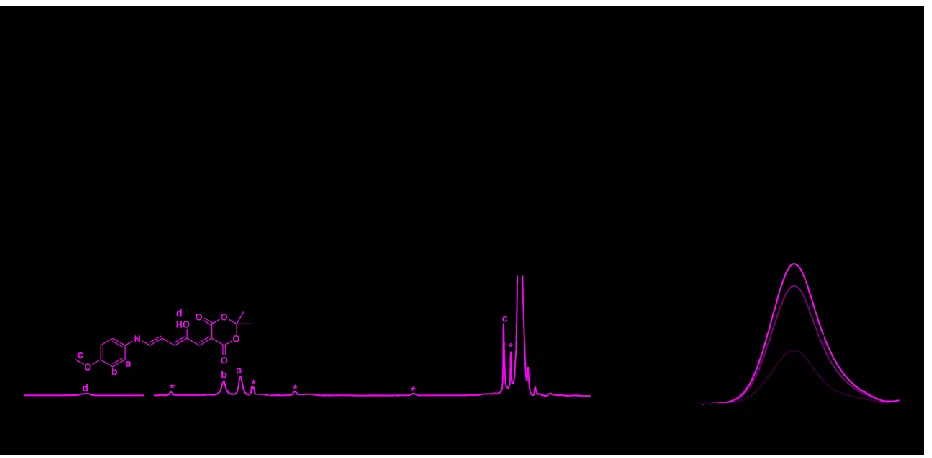
Figure 2. Synthesis monitoring and characterization of DASA-polymer conjugate P1. (a) Diffusion-edited 1H-NMR of synthetic steps to P1 (closed state DASA signals indicated by an asterisk). Vertical lines illustrate the disappearance of aromatic amine signals. (b) 19F-NMR tracking of active ester aminolysis. (c) UV-Vis absorption spectroscopic tracking of DASA formation.
diaminopropane (MPDP) and 2-(indolin-3-yl)ethan-1-amine (rTryp), and two activated furans based on, Mel-drum’s acid (Meld) and Barbituric acid (Barb) were em-ployed (Figure 1b). Taking advantage of this modular protocol led to the generation of a library of DASA-polymer conjugates (Figure 1c). First, DASA-polymers bearing pendent MPDP-Meld DASAs (~4 mol%) were synthe-sized, altering the matrix from poly(methyl acrylate) (PMA) to poly(butyl methacrylate) (PBMA), poly(propyl methacrylate) (PPMA), and poly(ethyl methacrylate) (PEMA), which corresponds to copolymers P2, P3, and
P4, respectively. While the DASA architecture is the same
for P1-P4, the Tg values for the parent polymer vary by ~55 °C, with literature reports of 9, 20, 35, and 65 °C for
[image:2.612.75.541.324.553.2]group) were incorporated into PMA copolymers. Specifi-cally, this yielded MPDP-Barb, Meld, and
rTryp-Barb derivatives, corresponding to P5, P6, and P7,
re-spectively.
Conveniently, the syntheses could be tracked using a combination of 19F- and 1H-nuclear magnetic resonance (NMR) spectroscopies (Figure 2) with further characteri-zation by diffusion-edited 1H-NMR, ultraviolet-visible (UV-vis) absorption, and Fourier transform infrared spec-troscopy (FT-IR) (Figures 2, S1-7). For example, 19F-NMR spectroscopy with pentafluorophenol as an internal standard reveals the incorporation of PFPA (~3 mol%) in a copolymer of poly(methyl acrylate-co-PFPA)
P(MA-co-PFPA) (Figure S1). Reaction of this copolymer with MPDP results in the clean appearance of anisidine proton
signals at 6.75 and 6.60 ppm with 1H-NMR monitoring suggesting high selectivity of the primary amine over the aromatic secondary amine (Figure 2a). Significantly, the complementary loss in fluorine signal with 19F-NMR mon-itoring reveals quantitative conversion (Figure 2b). Sub-sequently, reaction with an excess of Meld yields the DASA-polymer conjugate P1 after ~5 days. DASA for-mation was monitored over time with UV-vis spectrosco-py, where a diminishing change in absorbance was used to indicate reaction completion (Figure 2c, see SI for more details). Complete DASA formation was confirmed by 1H-NMR with the disappearance of the anisidine sig-nals and the appearance of the DASA sigsig-nals of the open
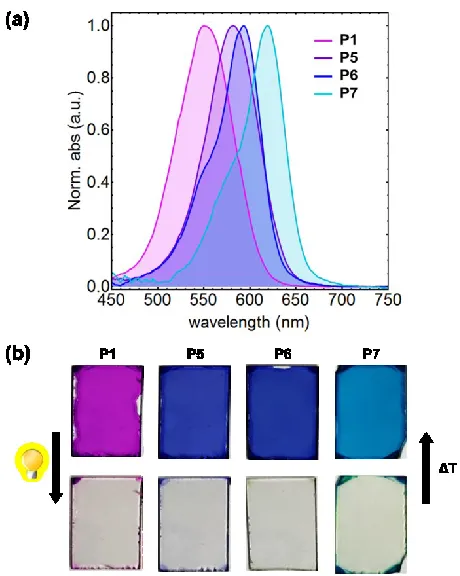
Figure 3. Spin-coated uniform thin films of DASA-polymer
conjugates P1 and P5-7. (a) Normalized thin film UV-vis absorption profiles. (b) Photographic images of thin films before and after white light illumination or thermal equili-bration, respectively (for details see supporting information).
and the equilibrium closed state being diagnostic (marked by asterisk). Preparative size exclusion chroma-tography (SEC) was utilized as an efficient means to puri-fy P1, and subsequent DASA-polymer conjugates with the strong dye character of the DASA-polymer conjugates allowing this process to be conveniently monitored by eye.
A key advantage of 2nd generation DASA is their color tunability over a wide range.19 To investigate the absorp-tion profile of the DASA-polymer conjugates, uniform thin films were spin coated from solution for all DASA derivatives (P1, P5-P7) with their UV-vis absorption spec-tra being shown in Figure 3a. Impressively, the solid-state absorption maximum was shifted from 554 to 620 nm, when comparing P1 to P7, which is related to the relative donor and acceptor strength. To qualitatively study their photochromic behavior, the thin films were then irradiat-ed with white light, resulting in discoloration, which could be reversed upon heating (Figure 3b). The ability to generate several DASA-polymer conjugates with re-versible photochromism from one PFP-copolymer high-lights the versatility and modularity of the presented approach.
[image:3.612.59.289.368.656.2]rapid switching of P4, but not P2. The distinct effect of Tg on switching kinetics provides a tunable handle for
DASA-polymer conjugates, which will aid in the devel-opment of next generation smart materials.
[image:4.612.65.549.65.273.2]
Figure 4. Effect of Tg on switching kinetics in thin films. (a) Chemical structures for P1-P4 in going from a colorless to a colored state. (b) Thermal equilibration of P1-P4 at 40 °C, showing faster equilibration for P1 and P2, which are above the Tg of the par-ent polymer matrix, compared to P3 and P4, which are near and below Tg of the parent polymer matrix, respectively. The ab-sorbance is normalized to that obtained after annealing above Tg, showing that P3 and P4 get “trapped” in a glassy matrix. (c) Transitioning from a glassy to a more viscous state for P3 using a temperature ramp from 20-65 °C, providing a fast increase in absorption upon heating. (d) Photoswitching P2 and P4 with white light at 40 °C and corresponding kinetics.
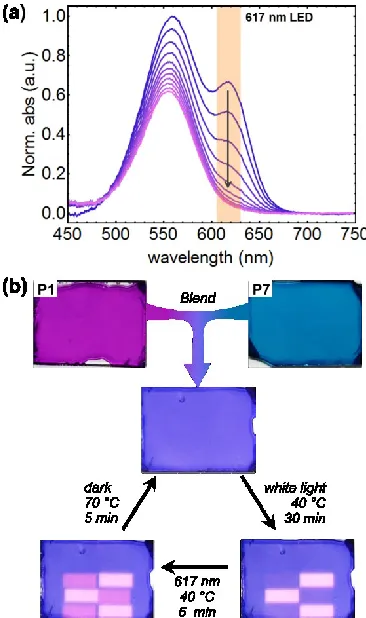
Varying DASA absorption provides an alternative tuna-ble handle that allows for selective switching. As demon-strated earlier modifying the donor and acceptor compo-nents provided P1 and P7, which have little absorption overlap at ~620 nm. Blending the two copolymers and casting a uniform thin film leads to a linear combination of absorption profiles, as shown in Figure 5a, suggesting a lack of ground state charge transfer. Significantly, irra-diating the film with orange light (λmax = 617 nm) gives rise to a rapid decrease in absorption for the low energy peak that corresponds to P7, leaving behind P1 DASA in its colored state (Figure 5a). This has potential applica-tions in rewriteable data storage that extends beyond binary coding given the system’s reversible switchability and selectivity.30 As a demonstration the blended polymer film was irradiated through a photomask with white light, switching both DASA components to their colorless state (Figure 5b). Subsequent irradiation with orange light through an alternate photomask selectively switches P7, providing a ternary pattern containing three states: both colored – purple, both bleached – colorless, and P1 col-ored/P7 colorless – pink. The pattern can then be com-pletely erased through heating the sample above Tg, re-turning the film to the full color state.31-32 This efficient pattern transfer is made possible by covalently binding the DASAs to polymers, since it eliminated phase separa-tion and allows for the facile fabricasepara-tion of uniform films. Furthermore, fine patterns with structural features below
100 µm could be achieved (Figure S17). Figure 5. Selective switching of DASA-polymer conjugates in
[image:4.612.344.527.373.682.2]P1, P7, and P1+P7 thin films, and photopatterning of the
blended film to generate a ternary pattern. Sample dimen-sions are 15x20 mm2.
In summary, second generation DASA-polymer conju-gates were synthesized by taking advantage of selective PFP-ester chemistry. NMR, FTIR, and UV-vis analyses demonstrate quantitative post-polymerization functional-ization for the incorporation of aromatic amine deriva-tives, followed by ring-opening to form a library of DASA derivatives. The modular platform provides access to polymer matrices with varied Tg and pendent DASAs with tunable absorption, both of which act as handles to alter switching kinetics. The demonstrated selectivity will guide and encourage the development of next generation smart materials in areas such as sensing and data storage.
ASSOCIATED CONTENT
Experimental conditions and supplementary data. This mate-rial is available free of charge via the Internet at http://pubs.acs.org.
AUTHOR INFORMATION
Corresponding Author
* E-mail: [email protected] and [email protected]
Author Contributions
† These authors contributed equally. All authors have given approval to the final version of the manuscript.
Notes
The authors declare no competing financial interests.
ACKNOWLEDGMENT
We thank the National Science Foundation (MRSEC program, DMR 1121053) and California NanoSystem Institute (CNSI) Chal-lenge Grant Program for support. The Swiss National Science Foundation (SNSF) is acknowledged for the partial financial support to LFB through Grant no. 200021_172609 (“Teleflow”), to the partial financial support to the NMR hardware through grant no. 150638, and to financial support to NB through grant no. PP00P2_144697 and the NCCR Bio-Inspired Materials. We thank Dr. Alexander Mikhailovsky for his help constructing the optical setup used for the cycling and selective switching experiments. We thank Dr. Daniel Rentsch (Empa) for NMR measurements and support.
REFERENCES
1. Lerch, M. M.; Hansen, M. J.; Velema, W. A.; Szymanski, W.; Feringa, B. L. Nat. Commun. 2016, 7, 12054.
2. Pauly, A. C.; Schöller, K.; Baumann, L.; Rossi, R. M.; Dustmann, K.; Ziener, U.; Courten, D. d.; Wolf, M.; Boesel, L. F.; Scherer, L. J. Sci. Technol. Adv. Mater. 2015, 16 (3), 034604.
3. Schöller, K.; Küpfer, S.; Baumann, L.; Hoyer, P. M.; de Courten, D.; Rossi, R. M.; Vetushka, A.; Wolf, M.; Bruns, N.; Scherer, L. J. Adv. Funct. Mater. 2014, 24 (33), 5194-5201.
4. Klajn, R. Chem. Soc. Rev. 2014, 43 (1), 148-184.
5. Klajn, R.; Stoddart, J. F.; Grzybowski, B. A. Chem. Soc. Rev. 2010, 39 (6), 2203-2237.
6. Zhang, J. J.; Zou, Q.; Tian, H. Adv. Mater. 2013, 25 (3), 378-399.
7. Helmy, S.; Leibfarth, F. A.; Oh, S.; Poelma, J. E.; Hawk-er, C. J.; Read de Alaniz, J. J. Am. Chem. Soc. 2014, 136 (23), 8169-8172.
8. Helmy, S.; Oh, S.; Leibfarth, F. A.; Hawker, C. J.; Read de Alaniz, J. J. Org. Chem. 2014, 79 (23), 11316-11329.
9. Laurent, A. D.; Medveď, M.; Jacquemin , D. ChemPhysChem 2016, 17 (12), 1846-1851.
10. Lerch, M. M.; Wezenberg, S. J.; Szymanski, W.; Feringa, B. L. J. Am. Chem. Soc. 2016, 138 (20), 6344-6347.
11. Mason, B. P.; Whittaker, M.; Hemmer, J.; Arora, S.; Harper, A.; Alnemrat, S.; McEachen, A.; Helmy, S.; Read de Alaniz, J.; Hooper, J. P. Appl. Phys. Lett. 2016, 108 (4), 041906.
12. Diaz, Y. J.; Page, Z. A.; Knight, A. S.; Treat, N. J.; Hem-mer, J. R.; Hawker, C. J.; Read de Alaniz, J. Chem. Eur. J. 2017, 3562–3566
13. Singh, S.; Friedel, K.; Himmerlich, M.; Lei, Y.; Schlingloff, G.; Schober, A. ACS Macro Lett. 2015, 4 (11), 1273-1277.
14. Balamurugan, A.; Lee, H.-i. Macromolecules 2016, 2568–2574.
15. Poelma, S. O.; Oh, S. S.; Helmy, S.; Knight, A. S.; Bur-nett, G. L.; Soh, H. T.; Hawker, C. J.; Read de Alaniz, J. Chem. Commun. 2016, 52 (69), 10525-10528.
16. Sinawang, G.; Wu, B.; Wang, J.; Li, S.; He, Y. Macromol. Chem. Phys. 2016, 217 (21), 2409-2414.
17. Dolinski, N. D.; Page, Z. A.; Eisenreich, F.; Niu, J.; Hecht, S.; Read de Alaniz, J.; Hawker, C. J. ChemPhotoChem 2017, 125–131
18. Jia, S.; Du, J. D.; Hawley, A.; Fong, W.-K.; Graham, B.; Boyd, B. J. Langmuir 2017, 2215–2221.
19. Hemmer, J. R.; Poelma, S. O.; Treat, N.; Page, Z. A.; Do-linski, N. D.; Diaz, Y. J.; Tomlinson, W.; Clark, K. D.; Hooper, J. P.; Hawker, C.; Read de Alaniz, J. J. Am. Chem. Soc. 2016, 138 (42), 13960-13966.
20. Mallo, N.; Brown, P. T.; Iranmanesh, H.; MacDonald, T. S. C.; Teusner, M. J.; Harper, J. B.; Ball, G. E.; Beves, J. E. Chem. Commun. 2016, 52 (93), 13576-13579.
21. Eberhardt, M.; Mruk, R.; Zentel, R.; Théato, P. Eur. Polym. J. 2005, 41 (7), 1569-1575.
22. Mohr, N.; Barz, M.; Forst, R.; Zentel, R. Macromol. Rap-id Commun. 2014, 35 (17), 1522-1527.
23. Das, A.; Theato, P. Chem. Rev. 2015. , 116 (3), 1434-1495. 24. Kessler, D.; Jochum, F. D.; Choi, J.; Char, K.; Theato, P. ACS Appl. Mater. Interfaces 2011, 3 (2), 124-128.
25. Choi, J.; Schattling, P.; Jochum, F. D.; Pyun, J.; Char, K.; Theato, P. J. Polym. Sci., Part A: Polym. Chem. 2012, 50 (19), 4010-4018.
26. Nuhn, L.; Tomcin, S.; Miyata, K.; Mailander, V.; Land-fester, K.; Kataoka, K.; Zentel, R. Biomacromolecules 2014, 15 (11), 4111-4121.
27. Scherer, M.; Kappel, C.; Mohr, N.; Fischer, K.; Heller, P.; Forst, R.; Depoix, F.; Bros, M.; Zentel, R. Biomacromolecules 2016, 3305–3317.
28. Seo, J.; Schattling, P.; Lang, T.; Jochum, F.; Nilles, K.; Theato, P.; Char, K. Langmuir 2010, 26 (3), 1830-1836.
29. Wood, L. A. J. Polym. Sci. 1958, 28 (117), 319-330. 30. Wei, P.; Li, B.; de Leon, A.; Pentzer, E. J. Mater. Chem. C 2017. ASAP. DOI:10.1039/c7tc00929a.
31. Wu, N. M.-W.; Wong, H.-L.; Yam, V. W.-W. Chem. Sci. 2017, 8 (2), 1309-1315.