A theoretical foundation for multi-scale regular vegetation patterns 1
Corina E. Tarnita1,2,*, Juan A. Bonachela3,*, Efrat Sheffer4, Jennifer A. Guyton1, Tyler C. 2
Coverdale1, Ryan A. Long5, Robert M. Pringle1,2 3
4
1
Department of Ecology & Evolutionary Biology, Princeton University, Princeton, NJ 08544, 5
USA 6
2
Mpala Research Center, Box 555, Nanyuki, Kenya 7
3
Marine Population Modeling Group, Department of Mathematics and Statistics, University of 8
Strathclyde, Glasgow, G1 1XH, Scotland, UK 9
4
The R.H. Smith Institute for Plant Sciences and Genetics in Agriculture, The Faculty of 10
Agriculture, Hebrew University of Jerusalem, Rehovot 7610001, Israel 11
5
Department of Fish and Wildlife Services, University of Idaho, Moscow, ID 83844 12
*
Equal contribution. 13
14 15
Self-organized regular vegetation patterns are widespread1 and thought to mediate 16
ecosystem functions such as productivity and robustness2-4, but the mechanisms underlying 17
their origin and maintenance remain disputed. Particularly controversial are landscapes of 18
overdispersed (evenly spaced) elements (Fig. 1), such as North American Mima mounds, 19
Brazilian murundus, South African heuweltjies, and, famously, Namibian fairy circles 20
(FCs)5-13. Two competing hypotheses are currently debated. On the one hand, models of 21
scale-dependent feedbacks (SDF), whereby plants facilitate neighbors while competing with 22
distant individuals, can reproduce various regular patterns identified in satellite 23
imagery1,14,15. Due to its deep theoretical roots and apparent generality, SDF is widely 24
viewed as a unifying and near-universal principle of regular-pattern formation1,16,17 despite 25
scant empirical evidence18. On the other hand, many overdispersed vegetation patterns 26
worldwide have been attributed to subterranean ecosystem engineers such as termites, 27
ants, and rodents3,4,7,19-22. Although potentially consistent with territorial competition 19-28
21,23,24
, this interpretation has been challenged theoretically and empirically11,17,24-26 and 29
(unlike SDF) lacks a unifying dynamical theory, fueling skepticism about its plausibility 30
and generality5,9-11,16-18,24-26. Here we provide a general theoretical foundation for self-31
organization of social-insect colonies, validated using data from four continents, 32
demonstrating that intraspecific competition between territorial animals can generate the 33
large-scale hexagonal regularity of these patterns. However, this mechanism is not 34
mutually exclusive with SDF. Using Namib-Desert FCs as a case study, we present novel 35
field data showing that these landscapes exhibit multi-scale patterning²previously 36
undocumented in this system²that cannot be explained by either mechanism in isolation. 37
These multi-scale patterns and other emergent properties, such as enhanced resistance to 38
and recovery from drought, instead arise from dynamic feedbacks in our theoretical 39
framework that couples both mechanisms. The potentially global extent of animal-induced 40
regularity in vegetation²which can modulate other patterning processes in functionally 41
important ways²underscores the need to integrate multiple mechanisms of ecological self-42
2
Hypotheses about the origin of regularly patterned (i.e., spatially periodic with characteristic 44
cluster size) landscapes are typically presented as strict alternatives, leading to strident and long-45
lasting debates5-12,17,22,28. The Namib FCs provide a fascinating case in point. FCs are bare discs 46
2±35m wide surrounded by rings of tall perennial grasses, found in sandy desert soils along a 47
sliver of southwestern Africa (Figs. 1f, 4a)7,28. Recently, Juergens7 documented strong 48
correlations between FCs and sand-termite (Psammotermes allocerus) activity and proposed a 49
conceptual model in which termites engineer FCs by killing plants, thereby creating bare patches 50
that concentrate moisture7,8. This hypothesis elicited a barrage of counterarguments advocating 51
SDF9-13,18, with debate revolving heavily around the large-scale hexagonal distribution of FCs 52
(each FC has ~6 neighbors on average). It has EHHQ DUJXHG IRU H[DPSOH WKDW VRFLDO LQVHFWV ³DUH 53
not able to create such extremely ordered, and at the same time large-scale homogeneous 54
SDWWHUQV ´ OHDYLQJ 6') DV ³WKH PRVW UHDVRQDEOH ZRUNLQJ K\SRWKHVLV´17. Parallel disputes simmer 55
over the origins of other regular vegetation patterns worldwide, pitting soil fauna versus SDF5. 56
Although often implicitly presented as alternatives, these two mechanisms are not 57
mutually exclusive. Here we reconcile these competing perspectives by theoretically integrating 58
both mechanisms for the first time and testing their predictions against empirical observations. 59
First, we develop a dynamic spatial model to characterize the population dynamics and territorial 60
behavior of a generic soil-nesting social-insect population, showing that intraspecific 61
competition can theoretically generate large-scale hexagonal patterns found in termite mound-62
fields3, heuweltjies22, murundus5, and FCs10. Second, to explore the dynamic interaction and 63
emergent effects of multiple simultaneous self-organization processes, we couple this faunal 64
model to one of SDF-driven vegetation self-organization. We illustrate the power of this merged 65
framework using Namib FCs as a case study: by parameterizing our merged model specifically 66
for that system and testing its predictions against remotely sensed imagery and novel field 67
observations, we show that the interplay of both mechanisms (a) characterizes the vegetation 68
patterns of Namib FC landscapes more completely than either mechanism can in isolation, and 69
(b) predicts the emergence of features in these landscapes that have escaped the notice of prior 70
investigators. This analysis moves beyond dichotomous debates to explore the multi-trophic 71
dynamics and feedbacks that underpin multi-scale regular patterning in complex ecosystems. 72
To model social-insect self-organization, we used a spatially explicit model of colony 73
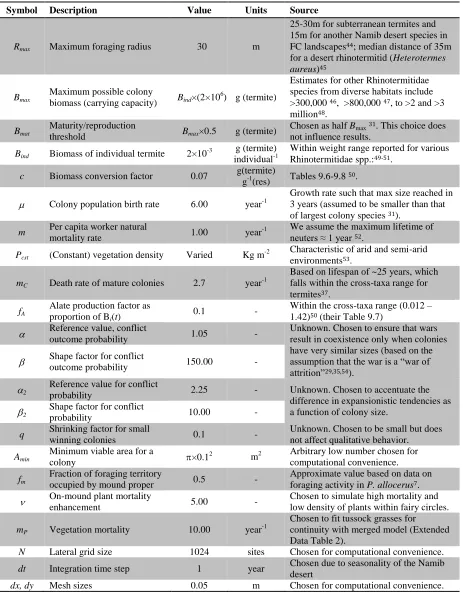
dynamics in a discrete landscape, parameterized from the literature (Extended Data Table 1). 74
Colonies build central nests and forage outwards to acquire resources to fuel colony-population 75
growth and survival. Mature (established) colonies produce alates (reproductive future 76
queens/kings) that disperse randomly throughout our simulated landscapes and attempt to initiate 77
new colonies. Resource availability is constant and uniformly distributed. When the expanding 78
foraging areas of neighboring colonies overlap, conflicts ensue via territorial aggression 79
(Extended Data Fig. 1a), as is common among social insects29. Conflict outcomes depend 80
probabilistically on relative colony size: larger colonies are more likely to eliminate smaller 81
ones, but similar-sized colonies coexist, whereupon a shared boundary emerges (Extended Data 82
Fig. 1b). These conflicts are the primary cause of young-colony mortality (and are intensified by 83
environmental stressors such as drought), while mature colonies have additional probabilistic 84
death rates consistent with typical lifespans reported in the literature. 85
Although this system is intrinsically dynamic due to continual births and deaths of 86
colonies (Supplementary Video 1), the quantities of interest eventually reach stationarity 87
(fluctuating around a well-defined constant average) (Extended Data Fig. 2a,b). We can thus 88
size of mature colonies increased²and mean nest diameter, foraging area, and nearest-neighbor 90
distance decreased²with increasing resource density (Extended Data Fig. 2c-f). This occurred 91
because colonies in resource-rich environments require smaller foraging areas to achieve a given 92
increase in population size. Moreover, colony sizes in low-resource environments were always 93
food-limited (Extended Data Fig. 2f), consistent with prior experimental work20. 94
We quantified predicted nest distributions (Fig. 1a) using standard point-pattern analyses: 95
Voronoi diagrams, pair-FRUUHODWLRQ IXQFWLRQ DQG 5LSOH\¶VL (see Methods). Regardless of 96
resource density, mature nests in our simulations were regularly and hexagonally overdispersed, 97
with ~6 neighbors on average (Fig. 1g-i, Extended Data Fig. 2g). In contrast, immature (typically 98
short-lived) colonies were randomly distributed or clumped, as observed in many ant and termite 99
populations20,21,25,26. These theoretical results correspond well with our analyses of empirical nest 100
distributions for diverse social-insect species from Africa, North and South America, and 101
Australia (Fig. 1, Extended Data Fig. 3,4, Supplementary Text 4.1). Although the degree of 102
hexagonal regularity differs somewhat among sites due to variable topo-edaphic and floristic 103
uniformity, the repeated emergence of such patterns in diverse contexts worldwide²despite the 104
ubiquity of environmental heterogeneity²affirms the generality of the phenomenon27. 105
Our general social-insect model also reproduced the spatial distribution of Namibian 106
FCs10 (Fig. 1f-i, Extended Data Figs. 3,4), showing that the large-scale hexagonal pattern of 107
mature circles and the small-scale heterogeneity of immature circles22,28 can theoretically be 108
explained by termite activity, contrary to recent arguments17. However, this finding does not 109
exclude the possibility that SDF concurrently drives vegetation patterning in this arid system. 110
Therefore, we next developed a theoretical framework incorporating simultaneous social-insect 111
and vegetation self-organization and applied it to the Namib FC system. In the model, termites 112
increase grass mortality on/around nest sites7,8 and forage on dead biomass in the surrounding 113
matrix. To model vegetation (parameterized as a generic tussock grass, like the Stipagrostis spp. 114
bushman-grasses that dominate the Namib), we modified a widely-used partial-differential-115
equation SDF model15 previously applied to Namib FCs9,10 by (a) incorporating stochastic 116
rainfall, based on 10-year records from NamibRand Nature Reserve (Extended Data Fig. 5) and 117
(b) allowing for asymmetric root-biomass growth and water uptake in areas with higher moisture 118
concentrations. We parameterized this model using appropriate values from the literature 119
(Extended Data Tables 1,2). 120
In this coupled model, termites and vegetation dynamically self-organize and interact. 121
Bare FC discs with elevated soil moisture emerge around nests under arid conditions (Fig. 2, 122
Extended Data Fig. 6). If rainfall increases, however, plant regeneration outpaces termite-123
induced mortality, and FCs revegetate (Extended Data Fig. 7), possibly explaining why FCs are 124
absent from Psammotermes nests in mesic regions17 (moisture-mediated plasticity in termite-125
foraging behavior has been suggested as another explanation22). Asymmetric root-biomass 126
growth and water uptake by plants surrounding the moisture-rich bare discs (Fig. 2d,e) promotes 127
HPHUJHQFH RI GHQVH WDOO JUDVV ULQJV OLNH WKH )& ³SHUHQQLDO EHOWV´7 (Fig. 2b,c,f), an important 128
feature not predicted by prior SDF models9,10. FC life cycles emerge in our model, driven by 129
colony establishment, growth, and death (Fig. 3, Supplementary Video 2). FCs emerge quickly 130
following colony establishment, but disappear more slowly after colonies die (Fig. 3k-p) as 131
grasses invade and eventually fill the bare patches (Fig. 3, Extended Data Fig. 6e,f). The weakly 132
bimodal distribution of lifespans ranges broadly from <5 to >165 years (Extended Data Fig. 8), 133
with a peak at <15y and another at ~30±60y, consistent with the existing range of empirical 134
4
criteria proposed to characterize the Namib FC system6,7,12,17,22. 136
Our coupled model also predicts a previously unrecognized feature of the Namib 137
landscape. Prior studies have focused exclusively on the FCs and largely ignored the matrix in 138
between. In our model, SDF induces dynamic self-organization of the matrix vegetation, but at 139
smaller spatial scales more compatible with ecohydrologically realistic grass-water feedback 140
distances (Supplementary Video 3). Following wet seasons, small, regular clumps of matrix 141
vegetation emerge, interspersed with larger, randomly distributed clumps (Fig. 2c). These larger 142
clumps are rare in the SDF-only model without termites, but arise in the coupled model from 143
small-scale soil-moisture variability in the matrix (Fig. 2d; consistent with data22)²itself a ripple 144
effect created by the FCs (Extended Data Fig. 6). To evaluate these theoretical predictions, we 145
photographed NamibRand matrix-vegetation distributions from 10-m height in February 2015 146
and characterized both model-predicted and observed patterns using Fourier-transform analyses 147
(see Methods). We found strong agreement between model outputs and field data (Fig. 4). 148
Thus, by treating SDF and faunal engineering as complementary processes rather than 149
competing alternatives, our model achieves the most comprehensive and realistic description of 150
this system to date. Whereas prior SDF models can reproduce only the formation and qualitative 151
dynamics of hexagonally patterned bare discs9,10,13, our incorporation of termite self-organization 152
and its feedbacks with SDF yields emergent properties absent from prior models but present in 153
the real landscape, including vegetation size structure and the hitherto undocumented small-scale 154
patterning of matrix vegetation. 155
Finally, we asked how the interplay of faunal engineering and SDF influenced ecosystem 156
responses to climatic perturbations. Simulated drought (20% reduction in rainfall sustained over 157
1, 5, or 10 years) reduced system-wide vegetation biomass, but these losses were smaller (i.e., 158
landscapes more drought-resistant) when termites were present. This occurred because the 159
densely vegetated rings and large matrix tussocks generated by the termite-SDF interaction are 160
more drought-resistant and persist after the small matrix patches disappear. Returning rainfall to 161
baseline after drought enabled regeneration of matrix vegetation in both systems; however, 162
recovery occurred faster in the coupled termite-SDF system, because the perennial rings and 163
large matrix clumps act as drought refugia and post-drought sources (Supplementary Video 4). 164
Thus, plant-water-consumer feedbacks sustain the productivity of the Namib by enhancing both 165
its resistance to and recovery from climatic perturbations, as recently hypothesized7. 166
Collectively, our results not only show that interactions among social-insect colonies and 167
vegetation can explain a diverse global suite of regular spatial patterns, but also underscore the 168
potential for co-occurrence and complementarity among distinct patterning mechanisms in 169
generating multi-scale regularity4,30. This highlights the need to focus theoretical and empirical 170
effort on the ways in which multiple mechanisms interact across scales to structure ecosystems27. 171
Advances in remote sensing have buoyed the study of ecological self-organization, but remain 172
insufficient to reveal small-scale patterns. Likewise, evaluating the causes of particular patterns 173
and elucidating multi-mechanism feedbacks will require manipulative field experimentation and 174
8and competitive dynamics of cryptic ecosystem-engineer species; the ways in which plants and 175
SDF respond to bioturbation and climatic variability; and the movement of water through soil in 176
different environmental contexts. Equipped with such knowledge, it may be possible to identify 177
reliable signatures of different mechanisms and specify the scales at which they act and interact. 178
1. Rietkerk, M. & van de Koppel, J. Regular pattern formation in real ecosystems. TREE 23, 181
169±175 (2008). 182
2. Scheffer, M. et al. Early-warning signals for critical transitions. Nature 461, 53±59 183
(2009). 184
3. Pringle, R. M., Doak, D. F., Brody, A. K., Jocqué, R. & Palmer, T. M. Spatial pattern 185
enhances ecosystem functioning in an African savanna. PLoS Biol. 8, e1000377 (2010). 186
4. Bonachela, J. A. et al. Termite mounds can increase the robustness of dryland ecosystems 187
to climatic change. Science 347, 651±655 (2015). 188
5. Cramer, M. D. & Barger, N. N. Are mima-like mounds the consequence of long-term 189
stability of vegetation spatial patterning? Palaeogeogr. Palaeocl. Palaeoecol. 409, 72±83 190
(2014). 191
6. Tschinkel, W. R. The life cycle and life Span of Namibian fairy circles. PLoS ONE 7, 192
e38056 (2012). 193
7. Juergens, N. The biological underpinnings of Namib Desert fairy circles. Science 339, 194
1618±1621 (2013). 195
8. Vlieghe, K., Picker, M., Ross-Gillespie, V. & Erni, B. Herbivory by subterranean termite 196
colonies and the development of fairy circles in SW Namibia. Ecol. Entomol. 40, 42±49 197
(2015). 198
9. Zelnik, Y. R., Meron, E. & Bel, G. Gradual regime shifts in fairy circles. Proc. Natl. Acad. 199
Sci. USA 112, 12327±12331 (2015). 200
10. Getzin, S. et al. Adopting a spatially explicit perspective to study the mysterious fairy 201
circles of Namibia. Ecography 38, 1±11 (2015). 202
11. Getzin, S. et al. Discovery of fairy circles in Australia supports self-organization theory. 203
Proc. Natl. Acad. Sci. USA 113, 3551±3556 (2016). 204
12. Cramer, M. D. %DUJHU 1 1 $UH 1DPLELDQ µIDLU\ FLUFOHV¶ WKH FRQVHTXHQFH RI VHOI-205
organizing spatial vegetation patterning? PLoS ONE 8, e70876 (2013). 206
13. Fernandez-Oto, C., Tlidi, M., Escaff, D. & Clerc, M. G. Strong interaction between plants 207
induces circular barren patches: fairy circles. Phil. Trans. Roy. Soc. A 372, 20140009 208
(2014). 209
14. Meron, E. Modeling dryland landscapes. Math. Model. Nat. Phenom. 6, 163±187 (2011). 210
15. Gilad, E., Hardenberg, von, J., Provenzale, A., Shachak, M. & Meron, E. A mathematical 211
model of plants as ecosystem engineers. J. Theor. Biol. 244, 680±691 (2007). 212
16. Deblauwe, V., Couteron, P., Lejeune, O., Bogaert, J. & Barbier, N. Environmental 213
modulation of self-organized periodic vegetation patterns in Sudan. Ecography 34, 990± 214
1001 (2011). 215
17. Getzin, S. et al. Clarifying misunderstandings regarding vegetation self-organisation and 216
spatial patterns of fairy circles in Namibia: a response to recent termite hypotheses. Ecol. 217
Entomol. 40, 669±675 (2015). 218
18. Tschinkel, W. R. Experiments testing the causes of Namibian fairy circles. PLoS ONE 10, 219
e0140099 (2015). 220
19. Levings, S. C. & Traniello, J. Territoriality, nest dispersion, and community structure in 221
ants. Psyche (1981). 222
20. Korb, J. & Linsenmair, K. E. The causes of spatial patterning of mounds of a fungus-223
cultivating termite: results from nearest-neighbour analysis and ecological studies. 224
Oecologia 127, 324±333 (2001). 225
6
of a mound-building termite species. Insect. Soc. 57, 477±486 (2010). 227
22. Juergens, N. et al. Weaknesses in the plant competition hypothesis for fairy circle 228
formation and evidence supporting the sand termite hypothesis. Ecol. Entomol. 40, 661± 229
668 (2015). 230
23. Laurie, H. Optimal transport in central place foraging, with an application to the 231
overdispersion of heuweltjies. S. Afr. J. Sci. 98, 141±146 (2002). 232
24. Ryti, R. T. & Case, T. J. The role of neighborhood competition in the spacing and 233
diversity of ant communities. Am. Nat. 139, 355±374 (1992). 234
25. Schuurman, G. & Dangerfield, J. M. Dispersion and abundance of Macrotermes 235
michaelseni colonies: a limited role for intraspecific competition. J. Trop. Ecol. 13, 39±49 236
(1997). 237
26. Adams, E. S. & Tschinkel, W. R. Spatial dynamics of colony interactions in young 238
populations of the fire ant Solenopsis invicta. Oecologia 102, 156±163 (1995). 239
27. Pringle, R. M. & Tarnita, C. E. Spatial self-organization of ecosystems: integrating 240
multiple mechanisms of regular-pattern formation. Annu. Rev. Entomol. 62, in press 241
(2017). 242
28. Juergens, N. Exploring common ground for different hypotheses on Namib fairy circles. 243
Ecography 38, 001±003 (2015). 244
29. Thorne, B. L. & Haverty, M. I. A review of intracolony, intraspecific, and interspecific 245
agonism in termites. Sociobiology 19, 115±145 (1991). 246
30. Liu, Q.-X. et al. Pattern formation at multiple spatial scales drives the resilience of mussel 247
bed ecosystems. Nature Commun. 5, 5234 (2014). 248
249
Supplementary Information is linked to the online version of the paper at www.nature.com/nature. 250
251
Acknowledgments: This research is a product of U.S. National Science Foundation grant DEB-252
1355122 to C.E.T. and R.M.P. J.A.B. was supported by the Marine Alliance for Science and 253
Technology for Scotland (MASTS) pooling initiative, funded by the Scottish Funding Council 254
(HR09011) and contributing institutions. WorldView-2 satellite imagery was obtained through a 255
grant from the DigitalGlobe Foundation to R.A.L. We thank: the Government of Namibia and 256
the NamibRand Nature Reserve for permission to conduct research; A. Lamb, D. Doak, G. 257
Barrenechea, P. Davies, S. Levin, R. Martinez-Garcia, I. Rodriguez-Iturbe, A. Sabatino, J. Ware 258
for helpful discussions; I. Arndt for Australian termite-mound images used in analysis and shown 259
in ED Fig. 3; and F. Lanting for connecting us to NamibRand and for use of the image in Fig. 3d. 260
261
Author contributions: C.E.T., J.A.B., and R.M.P. conceived the study and developed the 262
models, with input from E.S. J.A.B performed point-pattern analyses and all simulations. E.S. 263
performed Voronoi and Fourier Transform analyses. J.A.G., T.C.C., and R.A.L. contributed field 264
data and remote-sensing analyses. C.E.T., J.A.B., and R.M.P. drafted the paper, and all authors 265
provided comments. 266
267
Author information: Data are available on Dryad. Reprints and permissions information is 268
available at www.nature.com/reprints. The authors declare no competing financial interests. 269
Correspondence and requests for materials should be addressed to [email protected] and 270
Fig. 1. Social-insect nest distributions, in theory and in nature. a. Model results: dots = 272
centers of mature nest sites; parameterization in Extended Data Table 1. See Supplementary 273
Video 1 for model dynamics. b-e. Remotely sensed images of hexagonal termite and ant nests in 274
(b) Kenya (false-color composite Quickbird satellite image, red circles indicate Odontotermes 275
montanus mound locations); (c) Brazil (Syntermes dirus; GoogleEarth); (d) Arizona, USA 276
(Pogonmyrmex barbatus; GoogleEarth); (e) Mozambique (Macrotermes sp.). Features shown in 277
(b±e) have been ground-truthed as social-insect nests (see Methods and Supplementary Text 4.1). 278
f. Fairy circles (FCs) in Namibia (GoogleEarth). g. Neighbor-number distributions from 279
Voronoi-diagram analysis; bars left-to-right correspond to legend top-to-bottom. h-i. Pair 280
FRUUHODWLRQ DQG 5LSOH\¶VL functions (red curves) for model results (top), Kenya (middle), and 281
FCs (bottom). Shaded areas represent 95% simulation envelopes to discern from complete spatial
282
randomness. Details of images and analyses in Methods and Supplementary Information. 283
284
Fig. 2. Simulation of FC emergence from termite engineering and vegetation feedbacks. a. 285
Termite nest (blue dot) with circular foraging territory. b-c. Characteristic FC vegetation arising 286
around nest site after (b) dry and (c) wet seasons; brown = soil; green = vegetation; darker green 287
indicates greater biomass according to color gradient bar (units = kg/m2). d-f. Predicted soil-288
moisture, root-density, and plant-density profiles along 30-m transects through FCs (0 = nest 289
center). Parameterization in Extended Data Tables 1 and 2. 290
291
Fig. 3. FC life cycle in the coupled termite-vegetation model. a. Nest centers and foraging 292
territories [blue dots = mature colonies; red dots = incipient nests (including the initial diggings 293
of an alate pair)]. b-c. FCs and matrix vegetation following (b) dry and (c) wet seasons; color 294
scheme per Fig. 2b. d. Oblique aerial photo of FCs at NamibRand (image courtesy of Frans 295
Lanting). e-p. Termite-colony dynamics (e-j) and, below each panel, corresponding FC 296
vegetation dynamics (k-p). Red arrow in k-p indicates location of FC shrinkage and 297
disappearance following colony death (red arrow in e). Blue arrow in n-p indicates location of 298
FC appearance and growth following colony establishment (blue arrow in h-j). See 299
Supplementary Video 2 for model dynamics. Parameterization in Extended Data Tables 1 and 2. 300
301
Fig. 4. Predicted and observed regular patterning of FC matrix vegetation. a. Panorama of 302
NamibRand FC landscape showing matrix-vegetation clumps. b. Low-altitude (10-m) 303
photograph of matrix vegetation. Scale bar same as in panel c. c. Model output used for 304
comparison with b. Parameterization in Extended Data Tables 1 and 2. d. Normalized radial 305
spectra of field images (n=27 samples) and model simulations (n=52 samples), as functions of 306
wavenumber. See dynamics of matrix vegetation in Supplementary Video 3. 307
8 313
Methods. 314
Termite dynamics. To characterize the emergent spatial organization of termite nests, we 315
developed a general mechanistic model for termite colony growth, reproduction, foraging 316
behavior, and intraspecific competition (see complete description in the Supplementary 317
Information). For computational convenience, we update these dynamics on a yearly basis. We 318
consider a finite landscape consisting of a regular square lattice. As the initial condition, a single 319
colony founds a nest at a random location within the grid, with a starting population of 2 termites 320
(queen and king) and a minimum viable foraging area Amin. This inaugural colony grows,
321
reproduces, and seeds the rest of the system with new incipient colonies; the system develops 322
with time according to the rules detailed below. Each colony, i, is characterized by its population 323
biomass, Bi(t), and total foraging-territory area, Ai(t).
324
Foraging territory area: Termites forage outward from the nest, which is situated at the 325
center of the initial territory. Thus territories expand in a circular fashion; however, because 326
expansion in certain directions may be blocked by other colonies (see Competition), territory 327
shape does not necessarily remain circular or centered on the nest proper. Ri(t) denotes the
328
largest radial distance within the territory, measured from the center of the nest; this radius is 329
constrained physiologically by Rmax, the maximum distance that a foraging termite can travel.
330
Nest: We assume that the physical nest proper occupies a circular area, Mi(t) (centered at
331
the center of the initial territory), whose radius is a fraction of Ri(t) given by fm.
332
Colony growth: We model colony size and growth in terms of biomass and, consistent 333
with empirical data31, we assume that termite colonies grow logistically. Production of new 334
colony members, P LV GHWHUPLQHG E\ WKH TXHHQ¶V FRQVWDQW UDWH RI HJJ-laying. The carrying 335
capacity, Bmax, represents the maximum possible biomass that a colony can reach, a limit that we
336
assume to be imposed by intrinsic physiological constraints (e.g., how big a nest structure the 337
colony can construct) and thus equivalent for all colonies. Colony members die at a per capita 338
mortality rate m. The effective carrying capacity is therefore Bmax(1 m/µ). To meet basic
339
energetic maintenance costs and achieve growth, colonies require resources. Specifically, the 340
resources needed to maintain colony i at size Bi(t) are given by: éÜ •‡‡† L
$Ü:P; ?, where c is the
341
termite assimilation capacity (i.e., the conversion factor from resource biomass into termite 342
biomass). This resource requirement is to be compared with the resources available in the 343
foraging territory. Since we model termites that feed exclusively on dead plant material, we 344
assume that resource availability for colony i at time t at any given location x within that 345
FRORQ\¶V WHUULWRU\ LV HTXDO WR WKH DPRXQW RI GHDG SODQW PDWHULDO WKDW KDV DFFXPXODWHG DW WKDW 346
location during the previous year. Assuming that plant mortality occurs at a constant rate, mP,
347
and given that colony i occupies area Ai(t) at time t, the resources available to colony i, Ui(t), are:
348
éÜ:P;L ± ± IÉ2:T&áP";@P"@T& 5›‡ƒ”
ºÔ:ç;
where P(x, t) is the live plant biomass at location x and time t. This will be obtained from the 349
dynamics of the vegetation model below. Because termite dynamics are updated annually, 350
resource requirement and availability are compared at the beginning of each year. If Ui•Uineed,
351
the colony will try to adjust its foraging territory accordingly: if resources are insufficient (Ui <
352
Uineed), the colony will expand its foraging territory trying to obtain the necessary resources;
353
conversely, if resources are in excess (Ui > Uineed), termites will not need to travel as far to harvest
354
the minimum necessary resources, and the foraging territory will shrink. Such shrinkage 355
foraging territory. If territory expansion is hindered for any reason (e.g., lack of available space, 357
or Rmax being reached), then colony biomass will grow only as much as allowed by the resources
358
available up to the point of hindrance. 359
Territorial competition: If territory expansion leads to overlap with the territory of 360
another colony, we assume that a conflict ensues at the border between the two territories in the 361
form of direct interference competition, avoidance, and/or aggressive territorial defense (such 362
antagonism between intraspecific colonies is common among many, perhaps most, species of 363
termites and ants29,32). These conflicts can simply remain as border skirmishes (i.e., offsetting 364
PRUWDOLWLHV QHLWKHU FRORQ\ JDLQV DQ\ QHW JURXQG RU FDQ OHDG WR ³ZDUV´ WKDW PD\ UHVXOW LQ WKH 365
extermination of one colony. We assume that smaller, growing colonies exhibit more 366
aggressively expansionist tendencies than do larger established ones, in keeping with evidence 367
that aggression declines with distance from the nest33 (Fig. S1A). The outcome is probabilistic, 368
with Pr (i and j at war) = Pr (i seeks war) u Pr (j seeks war), where: 369
3U EVHHNV ZDU L
s
sEA? .k5? .ÌÔ:ç;o ZLWK 5Ü:P;L
$Ü:P;
$PD[
War results either in the death of one colony (highly probable if there is a substantial size 370
discrepancy since we assume ~1:1 mortality in conflict) or in coexistence (if sizes are similar), in 371
ZKLFK FDVH WKH ZRUNHUV¶ IRUDJLQJ UDGLXV LV WUXQFDWHG D ERXQGDU\ LV HVWDEOLVKHG DQG H[SDQVLRQ 372
ceases in that direction. If colonies i and j fight, then i wins with probability: 373
3U:EEHDWVF;L
s
sEA? :5? ÌÕ:ç; ÌÔ:ç;
If colony i dies in conflict, the winning colony j also suffers losses in the form of reductions in 374
both territory and population biomass: Ajc=Aj Ai, and Bj is reduced proportionally [i.e. Bjc=Bj
375
(Ajc/Aj)]. In the rare event that the winning colony has a smaller territory and biomass than the
376
losing one, then both territory and population biomass are decreased to a fraction q of the 377
original: Ajc=qAj. In either case, the winning area cannot be reduced below the minimum, Amin.
378
Reproduction: We assume that when colonies reach a certain population biomass, Bmat <
379
Bmax, they become reproductively mature (a.k.a. established) and produce alates (winged
380
dispersing future queens and kings) as follows. If, during the current time step, colony i shrinks 381
in biomass due to resource limitation, then it forgoes reproduction even if its newly reduced 382
biomass exceeds Bmat; otherwise, it produces a number of alates proportional to a fraction fA of its
383
biomass. In our simulations we assume that these alates disperse randomly and in pairs over the 384
entire grid. If an alate pair lands within the territory of an established colony or does not have 385
enough space to initiate (i.e., available area at the landing point < Amin), the alates die. Otherwise,
386
they start a new colony. The landing point is assumed to be the center of the new nest. 387
Mortality: There are two sources of mortality for colonies. The first is conflict between 388
neighbors (see above), which we assume to be the primary cause of death in small colonies, but 389
to decline in importance as colonies grow. Indeed, empirical observations from multiple systems 390
suggest that territorial conflict eliminates many incipient colonies but seldom leads to the death 391
of a mature colony, whereas mature colonies show signs of perpetual conflict at outer edges of 392
their foraging territories34-36. The second source of mortality is an intrinsic stochastic death rate, 393
which primarily affects established colonies. We let mC be stochastic mortality for large colonies
394
and set it to replicate a realistic lifetime for mature colonies31,37. 395
Termite engineering: Here, we focus on the scenario in which termites locally deplete 396
plant biomass, as hypothesized for the sand termite Psammotermes allocerus (Rhinotermitidae), 397
10
rate of plant biomass to be elevated by a fixed proportion Q: IÉRII LIÉâ IÉ ml Lå IÉRII. For
399
full model details and analysis see SI; for parameterization see Extended Data Table 1. 400
401
Vegetation dynamics. To model vegetation dynamics, we modified a model that has been used 402
repeatedly to describe and reproduce the patterns of self-organization that are typical of 403
vegetation in semi-arid environments15. The model considers the dynamics of vegetation (P), soil 404
water (W), and surface water (O) densities. Assuming a flat terrain, the model can be written as: 405
406
!É:ë&áç;
!ç L)É:T&áP;2:T&áP; @sF É:ë&áç;
Ä AFIÉ2:T&áP;E&ÉÏ
62:T&áP;
(1) 407
!Ð:ë&áç;
!ç LÛ
É:ë&áç;>ÊÐ,
É:ë&áç;>Ê 1:T&áP;F0@sF
ËÐÏàÎÉ:ë&áç;
Ä A9:T&áP;F)Ð:T&áP;9:T&áP;E&ÐÏ
69:T&áP; 408
(2) 409
!È:ë&áç;
!ç L4ÔÜáÙÔßßFÛ
É:ë&áç;>ÊÐ,
É:ë&áç;>Ê 1:T&áP;E&ÈÏ
6:16:T&áP;; (3) 410
where’2 represents the nabla operator (second spatial derivative) and the values and meaning of 411
parameters can be found in Extended Data Table 2. The first term in Eq.(3) represents rainfall, 412
the second term represents infiltration of surface water into the soil, and the third term represents 413
water (superficial) diffusion. The first term in Eq.(2) represents the increase in soil water due to 414
infiltration, whereas the second term represents evaporation, the third term represents soil water 415
uptake, and the last term soil water diffusion. Lastly, the first term in Eq.(1) represents plant 416
growth due to water uptake, the second term represents mortality, and the third term vegetation 417
biomass diffusion (via e.g. seed dispersal). In turn, GP and GW, plant growth rate and soil water
418
consumption rate respectively, depend on the extension of the root system. Thus, if the root 419
system is encoded in the kernel: 420
):T&áT&ñáP; L 5
6 Ì,.‡š’dF
ë&?ë&ñ.
6cÌ,k5>¾É:ë&áç;og
.h (4)
421
the effect of roots on growth and water consumption, respectively, is given by: 422
)É:T&áP;L&ìÅ):T&áT&ñáP;9:T&ñáP;@T&ñ 423
)Ð:T&áP;L ìÅ):T&ñáT&áP;2:T&ñáP;@T&ñ 424
where the integrals consider the totality of the system38. The kernel determines to what extent 425
roots from a body of vegetation biomass (e.g. clump) can use water and influence other parts of 426
the system. Specifically, the Gaussian kernel above sets this distance through its standard 427
deviation, the root-system size, given by 54ksE'2:T&áP;o. 428
Variable rainfall: We used data to replace the constant average rainfall (typically used in models 429
such as the one above) by a more realistic variable rainfall function Rainfall(t) that captures the
430
typical Namib yearly rainfall. To that end, we used data from 2004-2014 from multiple Namib 431
desert locations (provided by Vanessa Hartung) to calculate mean monthly rainfall in a 432
³DYHUDJH´ \HDU DORQJ ZLWK VWDQGDUG HUURUV UHIOHFWLQJ DPRQJ-year variation in monthly totals. The 433
resulting Rainfall(t) depicts the two distinct seasons (wet and dry) characteristic of this region (see
434
Extended Data Fig. 5): 435
4ÔÜáÙÔßß:P;L44sr
qgl@:ß6-2; A>sE
êËß:P;? (5)
436
Here, t is the month of the year, and the second term in brackets represents noise (random 437
number uniformly distributed between 0 and VR) that takes into account an additional source of
438
Asymmetric roots: One important feature of the vegetation model above is that the root system 440
represented by the Gaussian kernel, Eq. (4), is symmetric and therefore root density is equivalent 441
in all directions, regardless of heterogeneities in water availability. However, desert-plant roots 442
in sandy substrates both (a) grow preferentially in the direction of localized moisture 443
concentrations (hydrotropism) and (b) exhibit enhanced proliferation, branching, and biomass 444
growth in moist vs. dry soil, breaking the symmetry of root architecture in ways thought to 445
HQDEOH ³SUHFLVH H[SORLWDWLRQ RI ZDWHU SDWFKHV DQG GURXJKW DYRLGDQFH39. We therefore modified 446
the above model to incorporate the possibility of hydrotropism and asymmetric root proliferation 447
(or asymmetric exploitation of soil moisture) in response to localized differences in soil-water 448
availability. Once the soil-moisture difference dissipates, the root system in that direction returns 449
to its original growth pattern. We introduced an additional term in the plant-growth equation, 450
Eq.(1), that modifies plant growth rate by a specific factor. This is calculated by adding to the 451
existing term GP(x,t), an additional contribution from any direction in which soil water surpasses
452
a site-specific threshold, Wth: )èÉ:T&áP;L)É:T&áP;>sEññ(ƒ•›•:T&áP;?, where Zc is a 453
(dimensionless) diminishing factor (in our simulations, Zc = 0.5), necessary to prevent numerical 454
instabilities leading to unrealistic features such as system-wide plant clusters, and Fasym is the
455
improvement function per se, given by: 456
(ƒ•›•:T&áP; LÃ9:T&"áP; 9:T&áP;Äë&ñ
(6) 457
ThH «! V\PERO UHSUHVHQWV VSDWLDO DYHUDJHV DV IROORZV IROORZLQJ (T (4), the standard 458
deviation of the Gaussian root system is given by 54ksE'2:T&áP;o; therefore, a rough estimate 459
of the maximum length of the root system is given by three times that standard deviation. Thus, 460
the spatial averages in Eq. (6) consider locations at a distance T&FT&" Nu54:sE'2:T&áP;; and 461
use the immediate neighborhood of these locations to assess the average water availability and 462
how different it is from 9:T&áP;. Because our simulations occur on a square lattice, such spatial 463
average only considers the 4 neighbors of a location T&". However, only nearest neighbors of T&" 464
fulfilling: 465
Ð:ë&ñÙÙáç;
Ð:ë&áç; F9çÛåPr 466
are considered for the average, which ensures that only a sufficiently large contrast between the 467
focal location x and the neighborhood of T&" triggers this differential root growth. In our 468
simulations, we set Wth=4.
469 470
Parameterization and sensitivity analysis. We thoroughly searched the existing literature to 471
identify plausible (and internally consistent) values of individual-, colony-, and population-level 472
parameters such as termite individual biomass, thresholds for maturity and reproduction, as well 473
as the parameters related to the vegetation model (Extended Data Tables 1 and 2). For the latter, 474
we modified prior parameterizations15 to tailor the model to Namib-desert conditions (e.g., the 475
variable rainfall function described above, low surface-water diffusivity). In addition, we 476
conducted sensitivity analyses to test the dependence of the model outputs on each of the 477
different parameters. Finally, because we used a spatial discretization to enhance the speed of our 478
simulations, we conducted additional sensitivity analyses to test the appropriateness of (i) the 479
spatial grain and (ii) topology (square vs. hexagonal lattice) of the underlying grid, showing that 480
these assumptions did not affect the results. 481
482
Insect-nest distributions: field data. We used high-resolution satellite imagery to quantitatively 483
12
mounds in Kenya (Macrotermitinae: Odontotermes montanus; Fig. 1b), Mozambique 485
(Macrotermitinae: Macrotermes spp.; Fig. 1e), Brazil (Termitidae: Syntermes dirus; Fig. 1c), and 486
Australia (Termitidae: Amitermes meridionalis), along with harvester ant nests in the 487
southwestern USA (Formicidae: Pogonomyrmex spp.; Fig. 1d). We further re-analyzed the 488
Namibian FC sites of a prior study10 to ensure concordance and comparability with our other 489
analyses. In all cases, these features were clearly distinguishable in imagery (Fig. 1, Extended 490
Data Fig. 3) and the identities of the insect species that built them have been unambiguously 491
established in published field studies (Supplementary Text 4.1). The regions and locations 492
analyzed are as follows: 493
Kenya²Two topographically, edaphically, and floristically homogeneous rectangular 494
areas (0.975 km2 and 1.201 km2, comprising 205 and 241 mounds, respectively) in clay-rich 495
vertisols DW 0SDOD 5HVHDUFK &HQWUH a ƒ ¶ 1 ƒ ¶ ( ZKHUH RXU SULRU ZRUN KDV H[WHQVLYHO\ 496
ground-truthed mound locations3, from multispectral QuickBird satellite imagery. 497
Mozambique²A subsection of a 0.630-km2 rectangular area of mixed Acacia/palm 498
savanna-woodland in *RURQJRVD 1DWLRQDO 3DUN a ƒ ¶ 6 ƒ ¶ ( FRPSULVLQJ a WRWDO 499
mounds, from multispectral WorldView-2 satellite imagery; this analysis was comprehensively 500
ground-truthed by mapping all mounds on foot. 501
Brazil²Two areas (0.209 and 0.409 km2, comprising ~452 and 751 mounds, 502
UHVSHFWLYHO\ LQ %DKLD 6WDWH a ƒ ¶ 6 ƒ ¶ : IURP *RRJOH (DUWK 503
North America²Two areas of 0.308 and 0.179 km2, comprising ~510 and 224 nests, 504
UHVSHFWLYHO\ LQ $UL]RQD a ƒ ¶ 1 ƒ ¶ : IURP *RRJOH (Drth. 505
Namibia²Three Namib-Desert sites within the Giribes Plain (G) and Marienfluss Valley 506
(MV), within the same rectangular areas analyzed in prior work10, with aerial extents of 0.288 507
(G1), 0.294 (G2), and 0.322 km2 (MV), and comprising 1181, 1288 and 676 FCs, respectively, 508
from Google Earth. 509
Australia²Two oblique aerial photographs (courtesy of photographer Ingo Arndt) of 510
Amitermes mounds in Litchfield National Park, comprising 249 and 295 mounds, respectively. 511
Specific geographic coordinates for these images are unknown, and we were unable to analyze 512
these mounds in satellite images JHQHULF FRRUGLQDWHV IRU /LWFKILHOG DUH a ƒ ¶ 6 ƒ ¶ ( 513
514
Insect-nest distributions: quantitative analysis. We analyzed the spatial distribution of termite 515
PRXQGV DQW QHVWV DQG IDLU\ FLUFOHV KHQFHIRUWK ³SRLQWV´ :H FRPSXWHG 9RURQRL 516
tessellations10,40 for the point patterns, from which we extracted the following information: (1) 517
distributions of nearest-neighbor numbers for each point, i.e., the number of corners of each 518
Voronoi tile, which provides information on the regularity of the pattern (Fig. 1g, Extended Data 519
Fig. 3); (2) distributions of tile areas (mean area and coefficient of variation); and (3) 520
distributions of the distances of all points to their nearest neighbor10. We further calculated 521
SDLUZLVH FRUUHODWLRQ 3&) DQG 5LSOH\¶VL functions41 for each different area (see Supplementary 522
Information and Extended Data Fig. 4 :H XVHG ERWK WKH ³VSDWVWDW´ SDFNDJH41 in R and our own 523
)RUWUDQ FRGH WR FDOFXODWH ERWK IXQFWLRQV :H DOVR XVHG 5¶V ³VSDWVWDW´ IRU WKH FDOFXODWLRQ RI 524
significance envelopes. We used the same approach to analyze the output of the theoretical 525
model (Fig. 1g, Extended Data Figs. 2,3,4). 526
527
Vegetation patterns: field data. We collected low-altitude aerial imagery of Namibian FC and 528
matrix vegetation at the Namib Rand Nature Reserve (NRNR) in southern Namibia (25.04º E, 529
characterized6,7,12. Mean annual precipitation is 70-80 mm6, falling mostly from December-May. 531
The site consists of Kalahari sand plains and dunes typical of the habitat in which Fairy Circles 532
are found6,7,12. The flora is co-dominated by three congeneric bushman-grasses: Stipagrostis 533
obtusa, S. uniplumis, and S. ciliata12. In February 2015, we selected 10 sites spanning ~35km 534
within NRNR. At each site, we haphazardly selected 10 pairs of fairy circles and measured the 535
distance between circles (from one outer ring edge to another) and the size of each FC (average 536
of two perpendicular diameters within the vegetation ring). The mean (± SEM) diameter of FCs 537
in our dataset was 5.94 ± 0.23 m, and the mean distance between circles was 6.9 ± 0.4 m. Low-538
altitude imagery was collected at a subset of three sites: the most northern (24.94º E, 25.95º S), 539
the most southern (25.25º E, 16.02º S), and the most central (25.13º E, 16.01º S). We 540
photographed matrix vegetation at the midpoint between 30 pairs of neighboring FCs (n = 10 541
pairs per site; Fig. 4b) using a digital camera (Canon PowerShot S110), mounted on an 11-m 542
carbon-fiber pole (Ron Thompson Gangster Carp Pole) such that it could be held parallel to the 543
ground at 10-m height. Prior to imaging, we manually removed fallen leaf litter that might have 544
obscured spatial patterns in standing vegetation. Exposure was controlled manually to maintain 545
consistency in changing light conditions. For all images, this camera rig was held at constant 546
height by the same individual (TCC). A reference object was placed in all images and used to 547
scale them to a pixel size of 0.333 cm. 548
549
Vegetation patterns: quantitative analysis. Images were scaled and a large rectangular sub-550
area of similar size (1340 × 1340 pixels for two sites, and 900 × 900 pixels for a site in which 551
fairy circle density was higher) was selected from each image to comprise only grass and soil 552
(i.e., no fairy circles) and no visible disturbance (n=27 images; three of the images were 553
excluded because they did not have a large enough area between circles). Images were processed 554
as in4. For comparison with the model simulations with stochastic seasonal rainfall, we selected 555
snapshots of the simulated vegetation in the wet season in different years (we used snapshots 556
from February, corresponding to when the field images were collected in 2015). From these 557
snapshots, we selected 2 subsections (73 × 73 and 135 × 135 pixels) between neighboring FCs (n 558
= 52, 26 years × 2 subsections year-1). We transformed the patterns of biomass density from the 559
model into binary images (vegetation vs. bare soil; see Fig. 4c) according to a lower threshold
560
found from temporal and spatial analyses of the model data (0.015 Kg/m2). We used the two-561
dimensional (2D) Fourier transform and a subsequent computation of the 2D periodogram (i.e., 562
power spectrum42), to provide a quantitative characterization of the spatial patterns43. We then 563
calculated the radial spectrum r (sum of the periodogram values on concentric ring-shaped 564
regions of the 2D surface), to quantify the portion of image variances that can be accounted for 565
by a simple cosine wave repeating itself r times (wavenumber) along a travel direction of the 566
periodogram. We normalized the radial spectra for: (a) wavenumber, by dividing r by the size of 567
the domain in the analyzed image (ca. 4.45 and 3 m for field images and 3.65 to 6.75 m for 568
simulations); and (b) amplitude of the radial spectrum, by dividing by the maximum of the mean. 569
570
31. Collins, N. M. Populations, age structure and survivorship of colonies of Macrotermes 571
bellicosus (Isoptera: Macrotermitinae). J. Anim. Ecol. 50, 293±311 (1981). 572
32. Holldobler, B. Territoriality in ants. Proc. Amer. Phil. Soc. 123, 211±218 (1979). 573
33. Adams, E. S. Territory size and shape in fire ants: a model based on neighborhood 574
interactions. Ecology 79, 1125±1134 (1998). 575
14
the termite Macrotermes michaelseni in Kajiado, Kenya. J. Zool. 198, 237±247 (1982). 577
35. Palmer, T. M. Wars of attrition: colony size determines competitive outcomes in a guild of 578
African acacia ants. Anim. Behav. 68, 993±1004 (2004). 579
36. Abe, T., Bignell, D. E. & Higashi, M. Termites: Evolution, Sociality, Symbioses, Ecology. 580
(Springer, 2000). 581
37. Keller, L. Queen lifespan and colony characteristics in ants and termites. Insect. Soc. 45, 582
235±246 (1998). 583
38. Gilad, E. & von Hardenberg, J. A fast algorithm for convolution integrals with space and 584
time variant kernels. J. Comput. Phys. 216, 326±336 (2006). 585
39. Guevara, A. & Giordano, C. V. Hydrotropism in lateral but not in pivotal roots of desert 586
plant species under simulated natural conditions. Plant and Soil 389, 257±272 (2014). 587
40. Illian, J., Penttinen, A., Stoyan, H. & Stoyan, D. Statistical Analysis and Modelling of 588
Spatial Point Patterns. (John Wiley & Sons, Ltd, Chichester, UK, 2008). 589
41. Baddeley, A., Rubak, E. & Turner, R. Spatial Point Patterns: Methodology and 590
Applications with R. (Chapman and Hall/CRC, 2015). 591
42. Mugglestone, M. A. & Renshaw, E. Detection of geological lineation on aerial 592
photographs using two-dimensional spectral analysis. Comput. Geosci. 24, 771±784 593
(1998). 594
43. Couteron, P. & Lejeune, O. Periodic spotted patterns in semi‰arid vegetation explained by 595
a propagation‰inhibition model. J. Ecol. 89, 616±628 (2001). 596
44. Tschinkel, W. R. The foraging tunnel system of the Namibian desert termite, 597
Baucaliotermes hainesi. J. Insect Sci. 10, 65 (2010). 598
45. Baker, P. B. & Haverty, M. I. Foraging populations and distances of the desert 599
subterranean termite, Heterotermes aureus (Isoptera: Rhinotermitidae), associated with 600
structures in southern Arizona. J. Econ. Entom. 100, 1381±1390 (2007). 601
46. Jones, S. C. Colony size of the desert subterranean termite Heterotermes aureus (Isoptera: 602
Rhinotermitidae). Southwest. Nat. 35, 285±291 (1990). 603
47. Haagsma, K. A. & Rust, M. K. Colony size estimates, foraging trends, and physiological 604
characteristics of the western subterranean termite (Isoptera: Rhinotermitidae). Environ. 605
Entomol. 24, 1520±1528 (1995). 606
48. Grace, J. K., Abdallay, A. & Farr, K. R. Eastern subterranean termite (Isoptera: 607
Rhinotermitidae) foraging territories and populations in Toronto. Canad. Entomol. 121, 608
551±556 (1989). 609
49. Husseneder, C., Powell, J. E., Grace, J. K., Vargo, E. L. & Matsuura, K. Worker size in 610
the Formosan subterranean termite in relation to colony breeding structure as inferred 611
from molecular markers. Environ. Entomol. 37, 400±408 (2008). 612
50. Wood, T. G. & Sands, W. A. The role of termites in ecosystems. In Production Ecology of 613
Ants and Termites (ed. Brian, M. V.) pp. 245±292 (Cambridge Univ. Press, 1978). 614
51. Matsuura, K. Colony-level stabilization of soldier head width for head-plug defense in the 615
termite Reticulitermes speratus (Isoptera: Rhinotermitidae). Behav. Ecol. Sociobiol. 51, 616
172±179 (2002). 617
52. Darlington, J. P. E. C. Turnover in the populations within mature nests of the termite 618
Macrotermes michaelseni in Kenya. Insect. Soc. 38, 251±262 (1991). 619
53. Hadley, N. F. & Szarek, S. R. Productivity of desert ecosystems. BioScience 31, 747±753 620
(1981). 621
caste in termites: influence of intraspecific competition and accelerated inheritance. Proc. 623
Natl. Acad. Sci. USA 100, 12808±12813 (2003). 624
55. Golodets, C. et al. Climate change scenarios of herbaceous production along an aridity 625
gradient: vulnerability increases with aridity. Oecologia 177, 971±979 (2015). 626
56. Cain, M. L. & Damman, H. Clonal growth and ramet performance in the woodland herb, 627
Asarum canadense. J. Ecol. 85, 883±897 (1997). 628
57. Milton, S. J. & Dean, W. Disturbance, drought and dynamics of desert dune grassland, 629
South Africa. Plant Ecol. 150, 37±51 (2000). 630
58. Evangelides, C., Arampatzis, G. & Tzimopoulos, C. Estimation of Soil Moisture Profile 631
and Diffusivity Using Simple Laboratory Procedures. Soil Sci. 175, 118±127 (2010). 632
59. Danin, A. Plants of Desert Dunes (Springer Science & Business Media, 2012). 633
60. Sheffer, E., Yizhaq, H., Shachak, M. & Meron, E. Mechanisms of vegetation-ring 634
formation in water-limited systems. J. Theor. Biol. 273, 138±146 (2011). 635
636
Data availability statement. The datasets generated and analysed during the current study are 637
available in the Dryad repository. The computer code is available from the corresponding authors 638
upon request. 639
640
Extended Data Figure Legends 641
642
Extended Data Figure 1. Probability functions associated with conflicts in the termite 643
model. a. probability for colony i and colony j WR HQJDJH LQ D ZDU DV D IXQFWLRQ RI HDFK FRORQ\¶V 644
population biomass. b. If colonies i and j engage in a war, probability function for colony j to 645
win the war as a function of the ratio of colony population biomass. 646
647
Extended Data Figure 2. Results of the termite self-organization model with a fixed 648
resource density level, Pcst. a-b. Temporal behavior of mature colonies in the termite model for 649
Pcst = 50 g/m2. a. Average diameter of mature nests (blue shading represents
r
1 SD). b. Average650
distance between nearest neighbors, (where neighbors are nests that share territory borders). Both 651
observables reach a clear stationary state after a transient period of ~200 years. c-f. Emergent 652
behavior for the colonies at the stationary state as a function of the (annually) available level of 653
resources. c. Average mound diameter, which reflects foraging-territory area, decreases as 654
resource availability increases. d. Mean nearest-neighbor distance also decreases with increasing 655
resource density. e. Termite population density (# of individuals/m2) increases with available 656
resources. f. Average colony biomass density (individuals/colony) increases with available 657
resource density, and reaches a saturation value around Bmax(1 m/µ) (see Supplementary
658
Information). g. Frequency distribution of neighbor numbers from Voronoi analysis for the 659
model with different resource densities (inset: mean number of neighbors). Higher resource 660
densities result in a higher number of colonies (numbers in parentheses in the legend) and 661
therefore more powerful results. Results are obtained by averaging over 100 simulations for each 662
resource level; error bars show ± 1 SD. 663
16
Extended Data Figure 3. Average number of neighbors in various field locations. Upper left 665
panel: Average number of neighbors (± 1 SD) from Voronoi analysis of model and field data; 666
number of nests at each location is shown in parentheses. All other panels: Satellite imagery 667
and/or photographs used for data analysis. Mounds are highlighted for ease of observation. If a 668
white rectangle is present then only the points within the rectangle were analyzed; otherwise, the 669
whole image was analyzed. Scale bars = 100m. (Aerial imagery of Amitermes mounds in 670
Australia courtesy of Ingo Arndt. Satellite imagery: Kenya (QuickBird); Mozambique 671
(WorldView-2); all others are from Google Earth. 672
673
Extended Data Figure 4. Spatial point-pattern analyses of various field locations. Left: Pair 674
correlation function as a function of distances between nests. Right: 5LSOH\¶VL function for the 675
same examples. 95% pointwise simulation envelopes (shaded areas) were calculated using the
676
default function from the R package spatstat. These envelopes allow us to reject the null
677
hypothesis (complete spatial randomness) at a confidence level of 95%; thus, if the focal
678
function (red line) falls out of the envelope for a given distance r, the function differs from the
679
expectation for a completely-random point distribution. Both sets of panels show peaks (left 680
panels) or valleys (right panels) of regularity that indicate the presence of overdispersion for each 681
of these examples. Note the different number of nests present in the samples from each location 682
(Extended Data Figure 3), which leads to different levels of noise in the calculation of the two 683
statistics. 684
685
Extended Data Figure 5. Rainfall data from NamibRand. Top: 10-year time-series of 686
monthly rainfall totals 2004-2014, averaged across multiple sites within NamibRand Nature 687
Reserve (data provided by Vanessa Hartung). Bottom: Mean monthly rainfall (i.e., averaged for 688
each month across all years) in NamibRand from 2004-2014 (green line, ± 1SD in red) and 689
proposed rainfall function (blue). The noise term included in Rainfall(t) [Eq.(5) in Methods]
690
ensures that the rainfall function variability is high during the rainy season and low in the dry 691
season, consistent with the data. 692
693
Extended Data Figure 6. Vegetation dynamics with and without termite engineering. a-b. 694
Comparison of the stationary pattern obtained with the vegetation model alone using a. the 695
original symmetric implementation for the root kernel and b. the modified root kernel that is 696
allowed to grow asymmetrically; c-d. Stationary pattern obtained with the naïve setup (i.e. one 697
single, static colony in the center of the system; constant rainfall); c. the resulting pattern using 698
the original, symmetric root kernel; d. the pattern obtained when the asymmetric root system 699
growth is implemented; e-f. Simulation run measuring the recovery time after the death of a 700
colony in the coupled model with variable rainfall and asymmetric roots. e. System a few months 701
before reaching stationarity; a ring of taller and denser vegetation is formed around the gap, and 702
matrix vegetation is reaching its stationary clumpy distribution. f. Several decades after colony 703
death, the gap closes fully, and the remaining large matrix clumps disappear shortly thereafter. 704
Brown = soil; green = vegetation. Color intensity indicates vegetation density. Parameters are as 705
in Extended Data Tables 1 and 2. 706
707
Extended Data Figure 7. The effect of decreasing termite-induced plant mortality or 708
rainfall is high, vegetation growth outpaces termite engineering and, consequently vegetation is 710
found also on nests, disrupting (and for high enough rainfall values completely removing) the 711
bare discs. a. Low mortality enhancement (Q = 1.1); b. Intermediate mortality enhancement (Q = 712
1.25); values in (a-b) are both lower than in Extended Data Table 1 but have same average 713
rainfall as Extended Data Fig.5; c. Intermediate mortality enhancement (Q = 1.25) and average 714
rainfall increased by 10%. Brown = soil; green = vegetation. Color intensity indicates vegetation 715
density. d-f. Corresponding underlying termite territories and nests. Blue dots = established 716
nests; red dots = incipient nests (including the initial diggings of an alate pair, leading to 717
occasionally high local densities as shown in f). Snapshots taken for a peak in vegetation after 718
the system has reached stationarity. Rest of the parameters as in Extended Data Tables 1 and 2. 719
720
Extended Data Figure 8. Distribution of FC lifetimes measured in the coupled model. For n 721
= 9 replicates of the merged model, we kept track for ~300 years (until the end of the simulation) 722
of 100 randomly selected FCs that were born after the stationary state (reached after ~100 years). 723
53 of these FCs disappeared before the end of the simulation, allowing lifespan estimates for that 724
subset. The resulting lifespans range from <5 years to >165 years, within reported estimates for 725
Namib FCs. Note that the distribution is truncated on the right tail due to the limit of available 726
simulation times; however, the overall shape of the distribution should not be strongly affected 727
2
b
e
f
d
c
Distance (m)
Pair correlation function Ripley·s L
Model
Kenya 2
Namib G2
0 20 40 60 80 100 120 0 20 40 60 80 100 120 0.2
0.6 1 1.4 0.6 1 0.2 0.6 1 1.4
0 -2 -4 -6 -8 2 0
-10
-20 0 -0.4 -0.8 -1.2 0.4
Number of neighbors
g
100m
100m
40 80 120 160 2 4 6 8 10 12
1.4
40 80 120 160 2 4 6 8 10 12
100m
100m
3 4 5 6 7 8 9 10
0.0 0.1 0.2 0.3 0.4 0.5
i
h
0.2
f
g
h
i
j
k
yr 0
l
yr 7
m
yr 13
n
yr 18
o
yr 21
p
e
5m
c
d
b
a
10m
0.7
0.6
0.5
0.4
0.3
0.2
0.1
1
Supplementary Information for
12
A theoretical foundation for multi-scale regular vegetation patterns
34
Corina E. Tarnita1,2,*, Juan A. Bonachela3,*,, Efrat Sheffer4, Jennifer A. Guyton1, Tyler C. 5
Coverdale1, Ryan A. Long5, Robert M. Pringle1,2 6
7
correspondence to: [email protected], [email protected] 8
9 10
This supplement contains detailed descriptions of the self-organization models for termites 11
(section 1), vegetation (section 2), and termites and vegetation combined (section 3), along with 12
methods and protocols for collection of empirical data (section 4) and data analysis and 13
comparison with model outputs (section 5). Our models apply generally to territorial, central-14
place-foraging social insects; throughout the below, however, we refer interchangeably to 15
“termites” (in lieu of the more generic “social insects”), both for convenience and because most 16
of the empirical systems under investigation (and hence our parameterizations) involve termites. 17
18
1. Termite self-organization model 19
20
To characterize the emergent spatial organization of termite nests, we developed a general 21
mechanistic model for termite colony growth, reproduction, foraging behavior, and intraspecific 22
competition. For computational convenience, we update these dynamics on a yearly basis. The 23
basic elements of the model are: 24
25
Landscape and initial condition. We consider a finite landscape consisting of a regular square 26
lattice—i.e., an N ! N grid mesh with discrete positions (sites) equally spaced by a horizontal
27
distance dx and a vertical distance dy=dx. This discretization, which uses a very fine spatial grain 28
relative to the landscape and to colony sizes (Extended Data Table 1), allows for considerably 29
faster simulations without, in our case, any loss of accuracy (see sensitivity analysis discussion 30
immediately prior to section 1.1 below). As the initial condition, a single colony founds a nest at 31
a random location within the grid, with a starting population of 2 termites (queen and king) and a 32
minimum viable foraging area Amin. This inaugural colony grows, reproduces, and seeds the rest
33
of the system with new incipient colonies; the system develops with time according to the rules 34
detailed below. 35
36
Colony. Each colony, i, is characterized by its population biomass, Bi(t), and total foraging-37
territory area, Ai(t). Because we assume the biomass of each individual to be equal and constant
38
(Bind), keeping track of the population biomass also provides the trajectory of the number of 39
individuals for the colony, i.e. colony size or population size (see full list of parameter values 40
and units in Extended Data Table 1). 41
42
Foraging territory area. Termites forage outward from the nest, which is situated at the center of 43
the initial territory. Thus territories expand in a circular fashion; however, because expansion in 44
certain directions may be blocked by other colonies (see Competition), territory shape does not
45