Rochester Institute of Technology
RIT Scholar Works
Theses Thesis/Dissertation Collections
5-18-2012
The Effect of interruptions on prospective memory
in the emergency department
Kate Walders
Follow this and additional works at:http://scholarworks.rit.edu/theses
This Thesis is brought to you for free and open access by the Thesis/Dissertation Collections at RIT Scholar Works. It has been accepted for inclusion in Theses by an authorized administrator of RIT Scholar Works. For more information, please [email protected].
Recommended Citation
Rochester Institute of Technology College of Liberal Arts Department of Psychology
THE EFFECT OF INTERRUPTIONS ON PROSPECTIVE MEMORY
IN THE EMERGENCY DEPARTMENT
A Thesis
By
Kate Cushman Walders
BFA, The Ohio State University, Dance, 1988
Submitted in partial fulfillment of the requirements for the degree of Master of Science in Applied Experimental and Engineering Psychology
ii
THE EFFECT OF INTERRUPTIONS ON PROSPECTIVE MEMORY
IN THE EMERGENCY DEPARTMENT
Thesis Research
by
Kate Cushman Walders
Rochester Institute of Technology
May 18, 2012
Faculty Advisor and
Chair of the Thesis Committee: ____________________________________ Dr. Nicholas DiFonzo Professor, RIT
Reader: ____________________________________
Rollin J. Fairbanks, MD, MS, FACEP Assistant Professor of Emergency Medicine & of Community and Preventive Medicine University of Rochester, Rochester, NY
Reader: ____________________________________
iii
Table of Contents
Abstract 1
Introduction 4
AGM Activation and Retrieval 6
Summary 10
Purpose of Research 11
Methods 12
Brief Overview 12
Participants 12
Methods and Measures 13
Procedure 14
Results 15
Interruption Frequency and Type 15
Physician’s Perceptions of Interruption 18
Justification and helpful/harmfulness rating for direct reminders, indirect reminders and
forgetting 19
Justification and helpful/harmfulness rating for no memory event 22 Justification and helpful/harmfulness rating correlations 23
Shift Phase (pre-shift, during-shift, post-shift) Comparisons 25
Helpful/Harmfulness Shift Phase Comparisons 25
Justification Pre-shift, During-shift and Post-shift Rating Comparison 27
Discussion 28
Summary 28
Implications for the Role of Interruptions in Facilitating ED Physician Memory 29 Implications for Understanding Interruptions as Part of Communication 33 The Paradoxical Memory of Future and Past Interruptions 35
Importance of this Study 36
Strengths and Limitations 37
Future Work 38
iv Appendix
A. Pre-shift Interruption Survey/Interview 45
B. Individual Interruption Rating Form 48
C. Post-shift Interruption Survey 49
D. URMC Approval Form 50
E. RIT IRB Approval From 52
F. Recruitment Email 53
v
Acknowledgments
I would like to thank my thesis advisor, Nicholas DiFonzo, and my thesis committee members, Terry Fairbanks, and Lindsay Schenkel for their time and continued support throughout this endeavor. Nicholas DiFonzo shared with me his wealth of knowledge and his reliable sense of direction, Terry Fairbanks opened the door to medical human factors for me, and Lindsay
Schenkel provided me with much-needed encouragement. I’d like to thank Madelyn Garcia, who helped me through the URMC IRB process and with recruitment of study participants. Finally, I want to acknowledge the URMC Emergency Department and all of the providers who
participated in this study. I am sincerely grateful for your contribution to this research. Lastly, I thank my husband, my family and my friends for their unfailing support, encouragement and understanding.
1 Abstract
Using the activation goal memory framework, this study categorized 256 separate
emergency department interruptions in a large research hospital setting. Prior to and following
their shift, twelve physicians completed a semi-structured qualitative survey about their
experiences with, and perceptions of, interruptions at work. During their shift, these physicians
were shadowed and the interruptions they experienced were documented. Frequencies of four
types of interruptions were tallied: Direct reminders, indirect reminders, memory lapses and no
reported memory change. Memory events were a significant proportion of interruptions (47%).
Direct reminders comprised the largest majority, followed by memory lapses, indirect reminders
and combination memory events. Both prior to and following their shifts, physicians
overestimated both the harmfulness of interruptions to themselves and the helpfulness of
2
The Effect of Interruptions on Prospective Memory
in the Emergency Department
A recent flurry of interruption research has focused on the potential negative effects of
interruption in aviation, nuclear power, and healthcare work activities. This research has
suggested that interruptions can occur frequently (Brixey, et al., 2008; Chisholm, Collison,
Nelson, & Cordell, 2000; Chisholm, Dornfeld, Nelson & Cordell, 2001; Coiera, et al., 2002;
Fairbanks, Bisantz & Sumn, 2007), extend the time required to perform a given task (Eyrolle &
Cellier, 2000; Monk, Boehm-Davis & Trafton, 2004) and negatively affect performance (Speier,
Vessey & Valavich, 2003). In addition, interruptions can increase the chance of errors, thus
increasing the potential for adverse consequences (Dismukes, Young & Sumwalt, 1999;
Latorella, 1996; Peterson, Wu & Bergin, 1999). It has been reported that stress, poor quality
care, and inefficiency stem from interruptions in the workplace (Carayon, 2007). Perlow (1999)
found that engineers were distracted merely anticipating potential interruptions.
However, not all research is in agreement on the negative effects of interruptions,
and more importantly, in the healthcare field, only one study on medication dispensing
errors showed a direct causal relationship between interruptions and subsequent errors
(Flynn, et al., 1999). In 2008, Grundgeiger and Sanderson reviewed interruption literature in
healthcare and determined that, other than the above-mentioned study, there is no solid
evidence that interruptions jeopardize patient safety. In fact, interruptions by mobile phones
were found to reduce medical errors in the Emergency Department (ED) by reducing delays
in communication (Soto, Chu, Goldman, Pampil, and Ruskin, 2006). The continual
reshuffling of priorities is a potent characteristic of the ED, and successful job performance
3
environment, and communicate with other staff. The ED staff must shift focus to optimize
care and interruptions may provide a means to gather and disseminate important
information. For example, in the hospital’s ED used for this study, they have instituted a
“planned” interruption. Any patient who enters the ED exhibiting any heart attack symptom
is promptly administered an EKG. Because of the urgent need for immediate care for a
potential heart attack victim, an EKG technician is required to have an attending Emergency
Physician, immediately interpret and sign off on the patient’s EKG results, regardless of
what activity she is engaged in. This often involves the EKG technician interrupting the
attending physician. This interruption may be beneficial to the patient as well as possibly
disruptive.
In the business domain, Dabbish & Kraut (2004) found that spontaneous communication,
including interruptions, plays an important role in organizational continuity and results in
benefits such as the transfer of knowledge and establishment of new work routines. Further,
O'Conaill and Frohlich (1995) analyzed the content of 129 interruptions and determined that the
initiator benefitted 33% and the recipient 21% of the time from the interruption. 43% of the
time, the interruption benefitted both parties. “Thus, in 64% of the interruptions the recipient
received some benefit from the interaction having taken place” (O'Conaill, B. & Frohlich, D.,
1995, pg. 263).
The present research sought to study ED interruptions within the activation goal memory
(AGM) framework (Altmann & Trafton, 2002), which is based on the spreading activation
model of memory and uses the constructs of activation to advance understanding of
intention/goal directed behaviors. This study specifically investigated whether interruptions
4
(which may have been the result of a previous interruption), and whether interruptions caused a
physician to experience memory lapses. In addition, this research gathered physician’s
perceptions of the justification and helpfulness of the interruptions they experienced.
Introduction
The 2005 edition of the New Oxford American Dictionary defines interrupt as: “To stop
the continuous progress of an activity or process.” Previously, interruption research, in both
healthcare and non-healthcare fields, has lacked a consistent uniform definition. However, in
2007, Brixey, et al. employed Walker & Avant’s method of concept analysis to the term
interruption to develop a theoretical definition to be used for interruption research in healthcare.
The definition used for this research and based on Brixey is: a break in the performance of a task,
which results in suspension of that primary task to perform an unplanned task with the
assumption that the initial task will be resumed (Brixey, 2007). The following is a simplified
version of Brixey’s (2007) model of interruption, which is used as a theoretical framework from
which to study interruptions:
TASK A | Step i | Interruption Lag | INTERRUPTION | Resumption Lag | Step r |TASK A
Task A represents the initial task that the future recipient of the interruption is engaged in during
the pre-interruption phase. An important component of the interruption definition and this model
of interruption is that individual must be engaged in an initial task at the time of the interruption.
Consider an example of a teacher grading homework assignments. In the middle of her task, a
student pops his head into her office to ask, “Are you busy?” Grading homework assignments is
the initial task. If the teacher has just finished grading the assignments and put them down when
the student arrived, this does not qualify as an interruption as the teacher was between tasks or at
5
The student’s action, asking the teacher, “Are you busy?” constitutes a “break.” A break
describes the period when the recipient’s attention is captured by the initiator of the interruption
while the recipient is engaged in an activity. Step i (the beginning of the “break”) is the
notification of an impending interruption, in this case, the recipient, the teacher, hears the
initiator of the interruption, the student, say, “excuse me.” The interruption lag denotes the
period of time between Step i, and actually engaging in the interruption, which could simply be
the teacher putting down her pencil and turning around in her chair to face the student. In this
case, the interruption is a conversation between the teacher and student. Another important
feature of interruption, which differentiates it from a distraction, is that an individual must
suspend the initial task to perform the interruption task. There are times when a break does not
constitute an interruption. Chisholm, Collison, Nelson, & Cordell (2000) defined interruption as
“Any event that briefly required the attention of the physician but did not result in switching to a
new task”. Ebright, Patterson, Chalko & Render (2003) defined interruption as “Every time the
participant was distracted from the immediate task or issue on which she was focused.”
Merriam-Webster Dictionary (2012) defines distract as “to divert attention”. The interruption
definition used for this research specifically states that in addition to diverting attention, an
individual must suspend their primary task for the action to be considered an interruption. For
example, a distraction would be if the teacher heard the student say, “excuse me” but chose to
ignore it and his inquiry and continued on with her grading. However, if the teacher stops her
task to address the student (an unplanned task) then this becomes an interruption. The
interruption, a conversation between the teacher and student, lasts until the teacher ends the
conversation by saying “goodbye.” The time period between the end of the conversation and the
6
resumption lag is the time required to physically and mentally reorient to the initial task. Step R
is the point of resumption.
Interruptions are communication events. In their study, Alvarez & Coiera’s (2005)
“conversation-initiating” interruption was defined, as “A conversation-initiating interruption is a
communication event that is not initiated by the observed physician, and occurs using a
synchronous communication channel such a face-to-face conversation or the telephone.” The
prime reason individuals interrupt is to communicate and transfer information.
AGM Activation and Retrieval
Historically, the study of goal or intention recovery after an interruption has fallen into the
cognitive realm of prospective memory (PM). Einstein and McDaniel define prospective
memory as “memory for actions to be performed in the future”(Einstein & McDaniel, 1996, pg.
115) and further, Ellis defines prospective memory in terms of interruption recovery as “realizing
delayed intentions” (Ellis, 1996, pg. 1). In this research, intention and goal was used
synonymously to describe the intention to complete a certain task, activity or plan of action.
Most recently, the activation goal memory (AGM) model (Altmann & Trafton, 2002) has been
applied to study the processes of retrieval and reactivation of prior goals or intentions following
an interruption (Hodgetts & Jones, 2006; Kleigel & Mackinlay, 2008; Li, Blandford, Cairns &
Young, 2008; Monk, Trafton & Boehm-Davis, 2008). The activation goal model is based on the
spreading activation model of memory and uses the constructs of activation to advance
understanding of intention/goal directed behaviors. The spreading activation model is a semantic
network consisting of nodes and links. The nodes represent concepts, and the links represent
associations between semantically related concepts. Nodes exhibit levels of activation or energy
7
(Willingham, 2007). These nodes become active through stimulation when an item is presented
to the system from the environment, and once stimulated can pass activation onto neighboring
nodes, thus increasing the level of activation of nearby concepts. For example, the concepts
exercise, run or gym might become active through hearing the word treadmill. Short-term
memory is sometimes described as that part of long-term memory that is currently active
(Nairne, 1996). The amount of activation given to connected concepts is assumed to be a
function of distance; the closer some concept is in memory to the connected concept or retrieval
cue, the more it will be activated and thus, remembered (Ratcliff & McKoon, 1988).
Consequently, the spread of activation is used as a significant retrieval component (Dosher &
Rosedale, 1989). Input from the environment, such as reminder cues, can heighten activation
and assist memory retrieval.
When a person searches their memory, generally they will obtain the most active intention.
Interruptions can facilitate prospective memory performance by increasing the activation level of
the underlying goal representation and in turn, the sensitivity of the targeted goal (Mantyla &
Sgaramella, 1997). For instance, if the nurse previously interrupted the doctor to remind him to
check Patient B’s x-ray, this reminder may have heightened the activation of this goal and
consequently, would be more likely to be chosen than another suspended. Specific input from the
environment, such as an interruption that contains a reminder, can counteract decay, as well as
interference from other information in memory, heighten activation of the intended goal, and
thus, direct action (Altmann & Trafton, 2002).
Kvavilashvili and Ellis (1996) present four stages of prospective memory: encoding,
storage, retrieval and performance. With respect to interruptions, the retrieval phase is the most
8
and Loftus (1980) reported from a survey of psychologists interested in memory that they
believed that “retrieval failures accounted for most cases of forgetting” (Roediger & Guynn,
1996, pg. 198).
In an effort to discover whether forgetting was due to encoding, storage or retrieval
difficulties, Tulving and Pearlstone (1966) conducted an experiment in which a group of students
were given a list of 48 words with 2 words in each of 24 categories. For example, “bird: robin,
blue jay.” Participants were asked to remember the words for a test. In two of the conditions,
the encoding and storage conditions were held constant. However, at the retrieval phase, one
group was given a free recall test and the other group was presented with the category names as
recall cues. The students in the free recall group recalled an average of 19 words correctly. The
students in the cued recall group remembered an average of 36 words. Their results indicate that
when encoding and storage conditions are held constant but the retrieval condition is varied, the
information (words) in the free recall condition was stored but not retrievable. Retrieval cues
almost doubled the number of words remembered.
Interruptions that contain reminder cues may serve as retrieval cues by activating decayed
goals that assist a doctor in resuming a suspended task. Accurate and efficient resumption of
goals in a multitask environment, such as an ED, can be improved by the availability of good
cues and for associative priming at resumption of the forgotten task. In addition to the
presentation of a retrieval cue, an individual must recognize the cue as a stimulus for resuming
an intention (Ste-Marie & Jacoby, 1993). To resume a suspended intention after an interruption,
the goal needs to become active again through a priming process that boosts the activation level
to link the retrieval cue to the forgotten intention. At this point an individual needs to recognize
9
resume her intent and initiate action (Ellis, 1996). Ellis (1996) suggests that recall can often
occur as a result of a deliberate act that originates from another person, such as an interruption.
For example, it is reasonable to assume that following an interruption by a nurse to ask a doctor a
question regarding patient F, the doctor might then remember that he wanted to check patient F’s
blood tests. This interruption contained an indirect reminder that activated an older goal in the
physician’s memory. Interruptions that contain direct reminders and/or indirect reminder have
the potential to facilitate a physician’s prospective memory.
Conversely, interruptions also have the potential to cause memory lapses. Interference
during the retention period, such as changing tasks abruptly without explicitly encoding an
intention to return to the task, can cause memory performance losses (Nairne, 1996). For
example, if a physician is interrupted while viewing a Patient B’s x-ray by a nurse asking him to
check on a patient, she may not remember what she was doing prior to the interruption or if she
does remember she was looking at an ray, she may not remember which particular patient’s
x-ray. In human memory, old goals and items decay gradually and sometimes non-target goals
(distracters) can cause interference that makes it difficult to retrieve an intended memory
(Altmann & Trafton, 2002). The physician’s difficulty remembering may be caused by the
several other patient’s x-rays she viewed prior to the interruption, and the ones she was
anticipating receiving in the future. The patient’s x-rays, both the ones viewed in the past and
the ones to be viewed in the future, serve as distracters that make it difficult for her to remember
which x-ray she was reviewing at the time of the interruption.
Moreover, interruptions that contain reminder cues and interruptions that cause memory
lapses can be interwoven. For instance, it is possible for a physician to experience an
10
a memory lapse as a result of that same interruption. Another possible scenario is that an
interruption that contains a reminder cue may help a physician to remember a task that he had
started but not completed due to a previous interruption. In this case, a reminder cue assisted the
physician in “recovering” from a prior interruption but did not assist in recovering from the
interruption that contained the reminder cue.
Summary
1. Interruptions may provide outright reminders that help a provider remember to complete a
task, e.g., a nurse saying, “Remember, Patient X still needs to have his discharge form
printed.” Generally in prospective memory tasks, the intention to perform a task has to be
remembered by the individual; however, an interruption can serve as a direct reminder to aid
in memory retrieval of a suspended intention.
2. Interruptions may provide indirect linking reminders, either by reiteration or semantic
relation that stimulate recognition of retrieval cues for prior intentions. Repetition priming
suggests that individuals show a memory bias for concepts that are reiterated. In addition, the
spreading activation theory suggests that the content of an interruption can stimulate the node
representing a concept and can spread heightened activation throughout the network of
semantically related concepts. This boost in activation of those concepts can stimulate
recognition of the retrieval cue and suspended intention. For example, a nurse tells you that
Patient B is requesting more pain medicine and that reminds you that you need to check
Patient B’s x-ray results. The mention of Patient B would be reiteration of the linking
reminder. “Repetition of priming effects indicates that activation of nodes last an hour or
more.” In addition, the intention superiority effect indicates that memory for intentions, over
11
neutral items (Goschke & Kuhl, 1993, pg. 63). With the presentation of a linking reminder,
these instances of heightened activation should facilitate intention retrieval from memory.
3. Interruptions can cause interference in memory recall. Interruptions can cause “I forgot”
occurrences, in which staff members forget what they were doing or thinking about at the
moment of interruption. Changing tasks abruptly without explicitly encoding an intention to
return to the task can cause memory performance losses (Nairne, 1996). Older goals and
items in memory decay gradually and cause “memory clutter” that makes it difficult to
retrieve an intended memory (Altmann & Trafton, 2002).
Purpose Of This Research
Interruption content can contain reminder cues, cause interference that may precipitate
forgetting or have no apparent memory effect on the individual who was interrupted. A direct
reminder occurs when the interrupter causes the physician to remember a prior goal by telling
her that she needs to remember that specific prior goal. An indirect reminder is when the
interrupter inadvertently causes the physician to remember a prior goal by presenting a related
cue in the content of an interruption that stimulates activation for a physician’s prior intention.
An “I forgot” occurrence is when the content or the act of interrupting itself causes the physician
to forget what he or she was doing or thinking. Another result from an interruption is that no
apparent memory event occurs; the physician will experience the interruption and return to his
task without specifically remembering or forgetting.
This study used the goal activation model to investigate ED interruptions. It specifically
addresses the question: to what extent do interruptions serve as retrieval cues (direct or indirect
12
and to what extent do they cause memory lapses? There have been no studies in the research
literature that investigate these questions.
This project also sought to determine the extent to which ED medical staff believed that
the interruptions they experienced were helpful or harmful to themselves and the interrupter with
respect to accomplishing their intention to perform a work task, and were justified, that is, did
the interrupter have good reason or cause to make the interruption.
Methods
Brief overview
Prior to and following their shift, twelve physicians completed a semi-structured
qualitative survey about their experiences with, and perceptions of, interruptions at work.
During their shift, these physicians were shadowed and the interruptions they experienced were
documented. Physicians provided ratings of the justification and helpful/harmfulness for each
individual interruption they experienced. In addition, frequencies of four types of interruptions
were tallied: Direct reminders, indirect reminders, memory lapses and no reported memory
change.
Participants
Fourteen attending or resident physicians from the University of Rochester Medical
13
Thursdays and therefore, for comparison purposes, Thursdays were omitted.
Materials and Measures
A semi-structured qualitative survey with quantitative spreading activation theory-based
questions was administered to the physicians preceding their shift (See appendix A). The
physicians were asked general questions about their experiences with, and perceptions of,
interruptions at work. For example, they were asked how many times they believe that they are interrupted during an average work hour, and what is the most common reason for them to be interrupted. In addition, they were asked if they have experienced interruptions that reminded them to return to a suspended task or made them forget what they were doing and if so, how often did they believe they experienced these. They also were asked to provide an overall justification and helpful/harmful rating of the interruptions they experience. This interview was audio taped.
Individual interruption rating forms (See appendix B) were used to categorize
interruptions and obtain ratings while shadowing the physician. Prior to their shift, the physicians
were shown the rating sheets and the shadowing procedure was described:
[I will be following you for three hours during your ED shift today and documenting the interruptions that you experience during this time. For this study, an interruption is considered a break in the performance of your activity, which results in suspension of your task to perform an unplanned task with the assumption that your initial task will be resumed. I am interested in whether the interruptions you experience directly or indirectly remind you to do something you either forgot or suspended, or cause you to forget what you were doing. A direct reminder, for example, is when a nurse says, “Don’t forget to check on Patient B”. An indirect reminder is when the person who interrupts you says something that causes you to remember some other task that you had started or meant to complete but for some reason hadn’t yet. An “I forgot”
occurrence is when you forget what you were doing or thinking after being interrupted. No memory event is when you are interrupted and then resume your task or start a new one with no occurrence of any specific memory event.
14
The occurrence of seven types of interruption events were recorded: direct reminders, indirect reminders, forgetting, direct and indirect reminders, direct reminders and forgetting, and indirect reminders and forgetting, and no reported memory event.
After their shift, a subset of the structured qualitative survey was administered to the
physicians (See appendix C).
Procedure
The researcher met with each attending or resident physician prior to the observation shift
to explain the rationale for the study. Informed consent was obtained. The researcher then
administered the pre-shift survey. This interview was audio taped. Following this, the
researcher explained the focus of the study, informed them of the shadowing process, and
showed them the interruption rating form.
During the shift, each physician was shadowed for 180 minutes. The 3-hour time period
was always 7pm to 10pm of a 3pm – 11pm shift, with the exception of 2 senior resident
physicians who work 2:30 – 11:30pm shifts. This time period allowed the physician to be at least
halfway into a shift and have started some tasks that were suspended. In addition, physicians
were more likely to be working on documentation tasks, which exhibit higher rates of
interruption than other tasks (Westbrook, et al., 2010). During the three-hour observation
period, the researcher shadowed the physician and documented the interruptions. The physicians
classified the memory events that occurred during the interruption and provided ratings to the
researcher. Ratings were gathered, at the earliest, after the physician reoriented to the primary
task so that any memory lapse that occurred as the doctor returned to the primary task would be
15
possible. This study did not compromise patient care/safety. Because of workflow and safety concerns and because the ratings themselves would often introduce another interruption, the
ratings were generally obtained every 20-30 minutes. The doctors were encouraged to give
ratings more often if they were available. The physician always had the opportunity to postpone completing the Rating Form.
Physicians were also able to indicate that the interruption/event represented a personal matter (e.g. personal phone call or conversation not related to work). Further, it was at the physician's discretion whether any situation/event/information which the investigator witnessed was excluded from this study, as it might represent an invasion of physician or patient privacy. For example, the physician could ask the investigator to step out if they needed to discuss sensitive/legal or private matters (e.g. providing information of a particular accident or abuse case to law enforcement/social work.) None of the physicians requested that the researcher step out at any point during this study.
Within several days following the shadowed shift, the researcher conducted a post-shift
survey to reassess the physician’s perceptions and gather ratings.
Results Interruption Frequency and Type
Over 36 hours of data were collected (12 physicians x 3 hours each). A total of 256 separate interruptions were recorded and classified. The mean per hour interruption rate for each physician was7.11 (N = 12, SD = 2.58, 95% CI [5.47, 8.75]). Two rating sheets had missing data, therefore for the following analysis those interruptions were omitted (N = 254).
16
that is, the memory events were not mutually exclusive. For example, the interruption could contain a direct reminder and also make the physician forget what she was thinking at the time she was interrupted. Since the physician was rating each interruption in which potentially more than one memory event could occur, the memory categories were combined to reflect all the possible combinations of memory events. The three categories were paired to make 6 total categories (direct reminders, indirect reminders, forgetting, direct and indirect reminders, direct reminders and forgetting, and indirect reminders and forgetting). During this study, no
interruption contained all three memory events, therefore this category was excluded. None
describes the interruptions in which no memory events occurred.
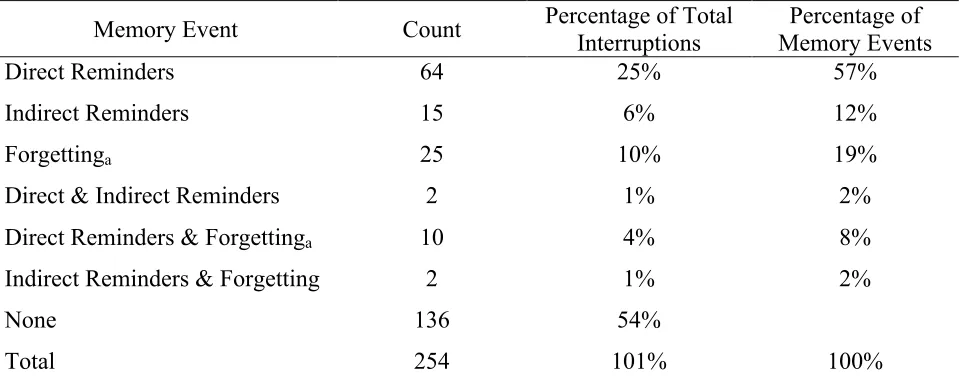
Descriptive statistics were calculated to identify the frequency of the six categories of memory events (direct reminders, indirect reminders, forgetting, direct and indirect reminders, direct reminders and forgetting, and indirect reminders and forgetting), as well as the proportions of memory events. Sums, percentage of total interruptions, and percentage of memory events (percentage excluding the none category) are reported in Table 1. Almost half (47%, N = 254, 95% CI [40.86, 53.14]) of all interruptions contained at least one memory event. Out of 254 interruptions, there were 64 direct reminders. One example of a direct reminder during the
observation period occurred when a resident physician called and interrupted an attending
physician who was in the trauma bay to remind him to come see a patient who he had meant to
17 intended to complete.
Of the 254 interruptions, there were 15 indirect reminders (I) and 19 overall indirect
reminders (I + DI + IF). During the shadowing period, a nurse interrupted a physician to “make
him aware of a patient” who was getting restless. This indirectly reminded the physician that he
needed to check this patient’s, as well as another patient’s, test results. 8% (N = 254, 95% CI [4.66, 11.34] of all interruptions contained an indirect reminder for a physician to remember to return to a task they intended to complete.
Ten percent (N = 254, 95% CI [6.31, 13.69]) of all interruptions caused physicians to forget what they were doing or thinking at the time of the interruptions. One of the instances of
forgetting occurred while a physician was discussing a patient with another doctor. The
physician was interrupted by a phone call from Emergency Medical Services (ambulance) to tell
her about a patient who was in transport and provide her with a time estimate of arrival. The
interruption lasted 2-3 minutes. When the physician hung up, she had forgotten what she had
been discussing and it took her several seconds to reorient to her suspended conversation. Out of
254 interruptions, there were 25 instances of forgetting (F) and 37 total memory lapses (F
+DF+IF) after being interrupted.
18 Table 1
Separate Memory Events Counts, Percentage of Total Interruptions and Percentage of Memory Events
Memory Event Count Percentage of Total Interruptions Memory Events Percentage of
Direct Reminders 64 25% 57%
Indirect Reminders 15 6% 12%
Forgettinga 25 10% 19%
Direct & Indirect Reminders 2 1% 2%
Direct Reminders & Forgettinga 10 4% 8%
Indirect Reminders & Forgetting 2 1% 2%
None 136 54%
Total 254 101% 100%
Note: Rounding accounted for the extra 1% under the percentage of total interruptions.
aThe physician who experienced one of the highest interruption rates (29 overall) accounted for 23 of the
occurrences of forgetting; 16 of the single forgetting category and 7 direct reminders and forgetting. This data was not omitted from this analysis because it was deemed reasonable that in the overall population of physicians, some physicians would have less experience with, and poorer strategies for, dealing with a multitude of interruptions and would suffer increased forgetting as a result.
Physician’s Perceptions of Interruptions
During the shift, each interruption was rated by the physician for harmfulness/helpfulness
to the interrupter and themselves, and for justification (good cause to interrupt). Table 2 displays
per physician unweighted means and standard deviations for the during-shift helpful/harmfulness
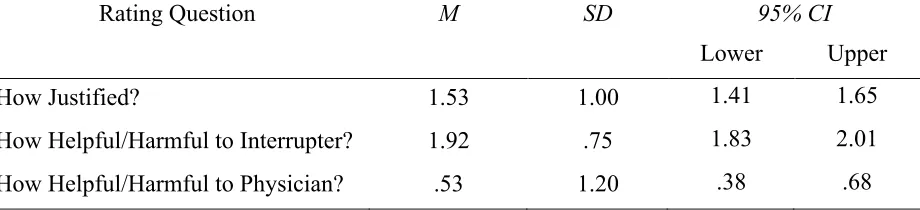
and justification ratings for all interruptions. Physicians perceived interruptions to be helpful to
the interrupter, t(11) = 8.87, p < .001 but not to themselves, t(11) = 1.51, p < .16, and justified,
19 Table 2
During-shift Unweighted Average of Mean Physician Justification and Helpful/Harmfulness Ratings.
Rating Question M SD 95% CI
Lower Upper
How Justified? 1.53 1.00 1.41 1.65
How Helpful/Harmful to Interrupter? 1.92 .75 1.83 2.01
How Helpful/Harmful to Physician? .53 1.20 .38 .68
N = 12; Scale was -4 (harmful/unjustified) to +4 (helpful/justified). Justification ratings ranged from -.8 to 3.16.
Harmful/helpful to the interrupter ratings ranged from .4 to 3.04 Harmful/helpful to the physician ratings ranged from -2.46 to 2.84.
Each physician’s ratings were averaged. The mean reported here is the mean of all the physician’s separate justification and helpful/harmful rating averages.
Justification and helpful/harmfulness rating for direct reminders, indirect reminders and forgetting. Table 2 shows the means and standard deviations for the during-shift helpful/harmfulness and justification ratings for all interruptions. Table 3 displays the mean
justification, helpful/harmful to the physician and helpful/harmful to the interrupter ratings for
each of the three major memory events: direct reminders, indirect reminders and forgetting, as
well as the unweighted mean rating, standard deviations and 95% confidence intervals. The table
also shows how many direct reminders, indirect reminders and instances of forgetting that each
physician experienced. Each physician’s ratings were added together and divided by n, the total
number of physician’s experiencing each memory event resulting in an overall mean rating. For
example, 11 physicians experienced direct reminders. Physician number 1 experienced 3 direct
reminders. The justification ratings for those three direct reminders were averaged together to
get physician 1’s average justification rating for direct reminders (e.g. 2.67). This process was
20
justification ratings were added together and divided by n (11), the number of physicians
experiencing direct reminders, to obtain a mean justification rating of 2.73. Listed directly
below the weighted mean ratings are the unweighted mean rating and associated standard
deviations and 95% confidence intervals. Interruptions that contained direct reminders, indirect
reminders, and caused a physician to forget were considered helpful to the interrupter and
justified. While physicians did not consider indirect reminders and forgetting as helpful to
22 Table 3 continued.
Note: Combination categories excluded.
Because each physician experienced a different number of events in each memory category, the n will be different for each memory event and is displayed with the memory event title in the column heading. For example, 11 physicians experienced direct reminders while only 5 physicians experienced instances of forgetting. For the unweighted mean rating, each physician’s ratings were added together and divided by n, the total number of physician’s experiencing each memory event resulting in an overall mean rating. For example, 11 physicians experienced direct reminders. Physician number 1 experienced 3 direct reminders. The justification ratings for those three direct reminders were averaged together to get physician 1’s average justification rating for direct reminders (e.g. 2.67). This process was repeated for each physician. Following this, each of the physician’s individual averaged justification ratings were added together and divided by n (11), the number of physicians experiencing direct reminders, to obtain a mean justification rating of 2.73.
SD and 95% CI are associated with the weighted mean rating.
Helpfulness to the interrupter ratings for direct reminders, t(10) = 13.98, p < .001, indirect reminders, t(6) = 6.68, p < .001 and forgetting t(4) = 3.30, p < .01; Justification ratings for direct reminders, t(10) = 11.12, p < .001, indirect reminders t(6) = 7.53, p < .001, and forgetting, t(4) = 7.51, p < .01; Helpfulness to the physician for direct
reminders, t(10) = 3.25, p < .10.
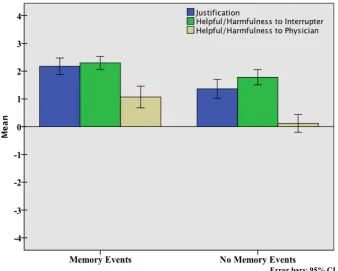
Justification and helpful/harmfulness rating for no memory event (none). Figure 1
23
Figure 1. Justification, helpful/harmfulness to interrupter and helpful/harmfulness to physician ratings for memory events and no memory events (None). Error bars are 95% confidence intervals. Scale -4 (harmful) to +4 (helpful).
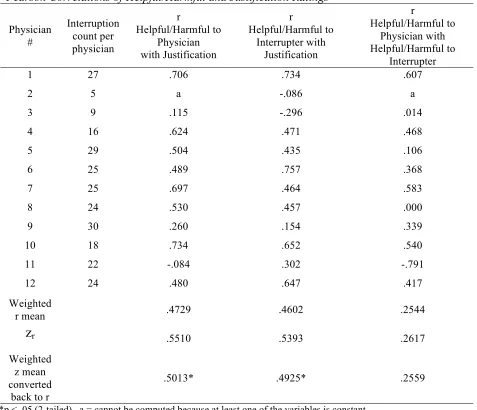
Justification and helpful/harmfulness rating correlations. In order to assess the relationship between helpful/harmfulness ratings and justification ratings, Pearson correlations were performed for each pair of ratings (helpful/harmfulness to physician with
helpful/harmfulness to interrupter, helpful/harmfulness to physician with justification ratings, and helpful/harmfulness to interrupter with justification ratings) per physician. Table 4 reveals a strong significant relationship between helpful/harmfulness ratings for both the physician,
r(21.79) = .5013, p < .05, and the interrupter, r(21.79) = .4925, p < .05, with justification ratings. If the physician perceived the interruption as justified, he also tended to perceive that
24
[image:30.612.73.550.180.590.2]if the physicians viewed the interruptions as helpful for themselves, it was unhelpful or neither harmful nor helpful to the interrupter and vice versa.
Table 4
Pearson Correlations of Helpful/Harmful and Justification Ratings
Physician # Interruption count per physician r Helpful/Harmful to Physician with Justification r Helpful/Harmful to Interrupter with Justification r Helpful/Harmful to Physician with Helpful/Harmful to Interrupter
1 27 .706 .734 .607
2 5 a -.086 a
3 9 .115 -.296 .014
4 16 .624 .471 .468
5 29 .504 .435 .106
6 25 .489 .757 .368
7 25 .697 .464 .583
8 24 .530 .457 .000
9 30 .260 .154 .339
10 18 .734 .652 .540
11 22 -.084 .302 -.791
12 24 .480 .647 .417
Weighted
r mean .4729 .4602 .2544
z
r .5510 .5393 .2617Weighted z mean converted
back to r
.5013* .4925* .2559
*p < .05 (2-tailed), a = cannot be computed because at least one of the variables is constant r = .5013, n= 23.79, p (2-tailed) =.0175, t = 2.7, df = 21.79
r = .4925, n= 23.79, p (2-tailed) =.0199, t = 2.64. df = 21.79 r = .2559, n= 23.79, p (2-tailed) =.2504, t = 1.24, df = 21.79
25
Shift phase (pre-shift, during-shift, post-shift) comparisons
Because interruptions have a poor reputation possibly due to selective memory, the
question of how adept physicians were at judging how helpful and justified interruptions are
prior to and after their shift was also explored. Shift phase comparisons were calculated, that is,
comparing the physician’s total pre-shift mean estimate rating and their total post-shift mean
rating with the mean of their actual during-shift ratings. Because the helpful/harmfulness and
justification rating data for all three shift phases (pre-shift, during shift, post-shift) will be
compared to each other in the following analysis, it is important to note that on the pre-shift and
post-shift surveys,each physician gave a single estimated helpful/harmful to themselves,
helpful/harmful to the interrupter and justification rating. However, during the shift, each
physician gave multiple ratings equal to the number of times they were interrupted during their
shift. For example, one physician in this study experienced 22 interruptions over the course of
the three hours. Thus the mean of the actual 22 during-shift justification ratings were compared
to one pre-shift justification rating and one post-shift justification rating.
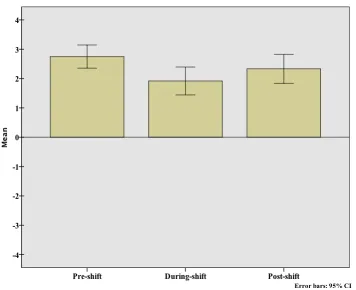
Helpful/harmfulness shift phase comparisons. Figure 2 illustrates the
mean ratings for helpful/harmfulness to the interrupter with 95% CI (N = 12) for all three shifts, (pre-shift M = 2.75, SD = .62, during-shift M = 1.92, SD = .75, post-shift M = 2.33, SD = .78). Paired sample t-tests were performed between the pre-shift estimate rating and actual shift mean rating, and between the actual shift mean rating and the post-shift rating to judge whether any significant differences exist. Prior to their shift but not after, physicians overestimated the
26
Figure 2. Helpful/harmfulness to interrupter pre-shift, during-shift and post-shift rating comparisons. Error bars are 95% confidence intervals. Scale -4 (harmful) to +4 (helpful).
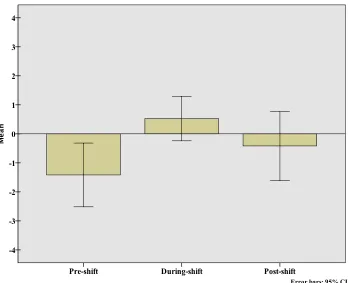
Figure 3 below shows the mean ratings for helpful/harmfulness to the physician with 95% CI (N = 12) for all three shift, (pre-shift M = -1.42, SD = 1.73, during-shift M = .53, SD = 1.21, post-shift M = -.42, SD = 1.88). Paired samplet-tests revealed that physicians
underestimated the helpfulness of interruption to themselves both prior to the shift (t(11) = -3.49,
p < .01, and after the shift (t(11) = 2.05, p < .10. Moreover, observation of pre-shift 95% CI
showed the physicians predicted that interruptions would be harmful to them, but in actuality
27
Figure 3. Helpful/harmfulness to physician pre-shift, during-shift and post-shift rating comparisons. Error bars are 95% confidence intervals.
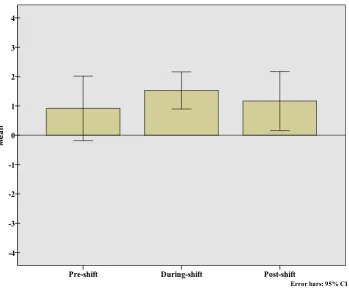
Justification pre-shift, during-shift and post-shift rating comparison. There were no significant differences between the pre-shift, during-shift and post-shift mean justification
ratings. The means are listed here and displayed below in Figure 3 (N =12, 95% CI, pre-shift M
= .92, SD = 1.73, during-shift M = 1.53, SD = 1.00, post-shift M = 1.17, SD = 1.59). However,
the 95% CIs indicate that, overall, physicians did not predict interruptions would be justified, but during the shift they clearly rated them as justified. In summary, pre-shift perceptions of
interruptions overestimated their helpfulness to the interrupter and their harmfulness to the physician, and also underestimated how justified they would be. Post-shift perceptions followed a similar pattern, though not as extreme. The findings lend support to the idea that
28
Figure 4. Justification pre-shift, during-shift and post-shift rating comparisons. Error bars are
95% confidence intervals.
Discussion
Summary
This study showed that memory events were a significant component of interruptions
(47%). Direct reminders comprised the largest majority (25%), followed by memory lapses
(10%) and lastly, indirect reminders (6%). Combination memory events consisted of another 6%.
Physicians perceived the interruptions that contained memory events as more justified and more helpful for both the interrupter and themselves than interruptions that contained no memory events.
29
with and without memory events, and surprisingly even including those that caused physician memory loss, were deemed helpful to the interrupter and perceived as justified. If the physician perceived the interruption as justified, he also tended to perceive that interruption as beneficial to himself and the interrupter.
On the pre-shift survey, physicians underestimated the helpfulness of interruptions to themselves, and overestimated the helpfulness of interruptions to the interrupter. Moreover, after their shift, the physicians misremembered the interruptions they experienced during-shift as less
helpful than they reported during the shift.
Implications for the Role of Interruptions in Facilitating ED Physician Memory Dodhia & Dismukes (2003) argue that interruptions intrinsically create prospective memory tasks. If a physician is interrupted while engaged in a task, he or she must remember to return to complete the task at a later time. The goal activation theory postulates that input from the environment can counteract interference and memory decay and reorient an individual to a
suspended or forgotten task (Altmann & Trafton, 2002), and since “retrieval failures are believed
to account for most cases of forgetting” (Loftus and Loftus, 1980), a direct reminder from
medical staff to a physician may assist a physician’s prospective memory. In this study,
physicians experienced an average of two interruptions per hour that supplied them with a direct
reminder to resume the completion of a previously unfinished task. These interruptions aid
physicians’ memory of a prior intention by presenting them with a salient and directed memory
retrieval cue. Given the amount of cognitive load that physicians experience, reminders can be
considered beneficial not only in terms of helping medical staff to remember to complete a task
30 recall on their own.
An important component of the goal activation theory is that memory retrieval directs behavior back to the suspended task. During this study, there were many times after being interrupted with a direct reminder that the physicians immediately stopped the activity they were
engaged in to complete the “reminder” activity. While this study did not track whether a
physician completed all the tasks they were reminded of, these reminders did assist the physician
in returning to and completing some suspended or forgotten tasks at the time the reminder cue
was presented to them.
Past research has found that interruption frequency and duration are not as disruptive as task similarity and processing demands (Cellier & Eyrolle, 1992; Gillie & Broadbent, 1989, Hess & Detweiler, 1994.) The interruption-similarity effect assumes that similarity between an
interrupted primary task and the interruption can result in competing memory traces and consequently make memory recall of the primary task difficult (Edwards & Gronlund, 1998). Interruptions that provide direct reminder cues overcome this obstacle by assisting physician due to their specific nature. In this study, not only did the direct reminders to physicians by medical staff heighten activation and target specific uncompleted goals, but they also instigated full primary task retrieval as well as directed task completion. It should be noted that the interruption could also result in the physician changing tasks to complete the “reminder” task and not
returning to the initial task she was engaged in at the time of interruption, therefore creating
another unfinished task (Westbrook, et al., 2010).
Additionally, the physicians (11 of 12) who experienced direct reminders perceived these
interruptions as moderately to very justified (M = 2.73), moderately to very helpful to the
31
direct reminders were perceived as somewhat beneficial to the physician, they were perceived to be more helpful to the interrupter.Because much of ED patient care relies on physician’s
decisions (e.g., requests for care instructions, signatures on orders, etc), direct reminder interruptions also facilitate the disposition of a patient and benefit the interrupter through the immediate completion of a task required by the interrupter to continue their workflow.
Since the spread of activation is used as a significant retrieval component (Dosher &
Rosedale, 1989), even if the physician did not immediately execute the task associated with the
direct reminder, these reminders, along with the indirect reminders they experienced, had the
potential to heighten the activation of a memory thereby keeping it “fresher” in their mind. While
the number of indirect reminders was comparatively low (8% overall), this type of interruption
has the potential to heighten the activation of a prior intention. Thus when another memory cue
is presented in the environment, the higher activation level may facilitate retrieval of the
suspended goal, which in turn, increases the likelihood that the physician will remember to
complete the forgotten task. Out of 254 total interruptions experienced during this study, the
physicians were presented with 95 memory cues for them to remember and return to a suspended
or forgotten task.
Mantyla and Sgaramella (1997) examined the effects of interruption on memory for intentions. Their findings suggest the “interruption of an ongoing activity facilitates subsequent prospective memory performance, possibly by increasing the level of activation of the
32
Interruptions have been listed as a contributing factor of errors in complex systems.
Specifically, interruptions are thought to cause temporary memory lapses or loss of activation
errors. This study showed that some physicians do suffer memory lapses as a result of an
interruption. However, one of the surprising outcomes of this study was that during their three-hour shifts, less than half of the doctor (5 out of 12) experienced an interruption that initiated a memory lapse. This study did not investigate why memory lapses occurred following some interruptions but not others. Previous research suggests that interruption characteristics such as higher processing demands and task similarity (Edwards & Gronlund, 1998), or incomplete memory encoding (Dodhia & Dismukes, 2009) may contribute to memory loss. In this study, a single resident physician experienced 59% or 16 of the 25 single memory category occurrences
of forgetting. This may suggest that a lack of experience or an insufficient strategy to sufficiently
cope with the high number of interruptions may account for this physician’s higher number of
reported memory lapses. It is reasonable to assume that experience and better interruption coping
strategies may prevent some instances of memory loss.
Regardless of the fact that these interruptions precipitated a memory lapse, the physicians
still deemed them justified, which suggests that the contents of the interruptions were important
enough to warrant the action of interruption, and that the occurrence of a memory lapse did not
counteract a justified rating.
An important finding of this study was that 59% of memory events were direct reminders (N=11) as compared to 19% of instances of forgetting (N=5). Essentially, physicians
experienced more than 2.5 times as many direct reminders (64) than instances of forgetting (25).
33
interruptions that contained no memory events.
Implications for Understanding Interruptions as Part of Communication
Throughout interruption literature, interruptions are categorized as work stressors or causes of error, but rarely conceptualized as communication events. Interruptions themselves serve as communication vehicles. A common finding throughout this study was that
interruptions, both with and without memory events, and during all three-shift phases, were perceived as justified and helpful to the interrupter. Moreover, if the physician perceived the interruption as justified, he also tended to perceive that interruption as beneficial to himself or the interrupter. While this study did not investigate how interruptions helped the interrupter, this researcher observed that interruptions offered an effective communication vehicle for the
interrupter in the transfer of valuable patient information.Patient updates, delivery of
information, requests for care instructions and signatures on orders, etc, were often presented to the physician in the form of interruptions. Specifically, interruptions benefitted the interrupter by the receipt of information necessary to facilitate the disposition of a patient. The interrupter was also aided by having the opportunity to request that the physician complete a task, required by the interrupter, to continue their workflow.
face-34
to-face conversation though they are caring for the same patient. As a result, “Nurses must go out of their way to approach the physician with questions or concerns”, (Eisenberg, et al., 2005). And, with the implementation of networked electronic patient charting and tracking systems, medical staff are also more likely to be located at their own computers than at a “community” whiteboard or centralized location where they are more likely to engage in face-to-face
interaction. This lack of communication protocol and specified centralized information transfer location makes interruptions necessary to receive or disseminate information, especially if the information is time-sensitive. Waiting until a doctor is free of tasks may be unrealistic in such a busy environment and inadvisable if delays of information transfer can put a patient at risk. In a busy environment where there is high workload and difficulty in locating staff members at any given time, this researcher observed that interruptions are also initiated by a chance passing, as when an interruption is initiated by a memory that is retrieved by simply seeing a staff member. For instance, as a nurse passes a doctor while talking to a technician, the nurse, upon seeing the doctor, remembers that he needs to ask this doctor a question about a patient and thus, interrupts him, because it is convenient. Given that there are no specific communication protocol set up for nurses to ask physicians questions, the nurse takes his chance and interrupts the doctor to garner needed information.
35
The Paradoxical Memory of Future and Past Interruptions
Schneider, Gallery, Schafermeyer, and Zwemer (2003) found that crowding was present in 100% of the 250 emergency departments that they randomly sampled across the U.S. Overcrowding can create unmanageable task loads as medical staff contends with the care of an increasing number of patients. Chisholm et al. (2000) revealed that interruptions are positively correlated with the average number of patients being simultaneously managed. Furthermore, interruptions contribute to medical staff cognitive workload by creating more multitasking behaviors that result from splitting the interruptee’s attention between a primary task and an interruption. Both interruptions and multitasking have a detrimental effect on medical staff. Excessive interruptions can increase stress levels and decrease an individual ability to concentrate or make good decisions (Applebaum, Marchionni & Fernandez, 2008; Carayon, 2007; Cohen, 1980). While duration and frequency of interruptions are considered troublesome, the processing demands of an interruption were found to be even more disruptive (Cellier & Eyrolle, 1992; Gillie & Broadbent, 1989, Hess & Detweiler, 1994). Moreover, simply querying physicians about their perceptions of the interruptions they experience can revive the continued experiences of stress and frustration related to being interrupted. The result is that “People are generally very familiar with the subjective idea that interruptions affect their performance”, (McFarlane & Latorella, 2002), which suggests that an individual’s perceptions about interruptions are affected by their previous experiences. This may explain why physicians predicted, and later remembered, that interruptions were harmful to themselves when during the
36
explain why interruption research focuses on the negative aspects of interruptions and why there is little research into the reasons people interrupt in the first place.
Importance of this Study
No previous research exists of physician’s self-report of justification or benefits of interruptions. This research gathered physician’s perceptions of justification, helpfulness and harmfulness of the interruptions they experience. It has been implied in previous research that the majority of interruptions are unnecessary and harmful, however the findings of this study provides some evidence that good cause existed for the majority of interruptions and that the doctors believe that the interruptions they experience are justified.
Further this study compared the actual during-shift ratings to doctor’s perceptions prior to and after their shift. This study confirms that physician’s pre-shift and post-shift perceptions of interruptions do not always match their perceptions of the actual events. This research showed that doctors underestimate the helpfulness of interruptions to themselves. They also believe that there are benefits to interruptions.
This study confirms that memory events comprise a large part of interruptions. This research shows that many interruptions have benefits such as reminder cues that aid a physician’s memory and help reorient a physician to a suspended task. Additionally, physicians perceived interruptions that contained memory events (forgetting included) as more helpful to themselves and the interrupter, and more justified than those interruptions that did not contain memory events.
37
It is unclear whether the results of this study can be generalized to linear (serial) task environments where the individual has a set number of tasks to complete in a certain order such as flying a plane or teaching a class. However, this study can be generalized to other multi-parallel task environments.
Strengths and Limitations of this Study
One of the strengths of this study was that it was conducted during normal medical staff shifts onsite in an ED environment. This allowed for the data to be obtained as the physicians experienced each interruptions or shortly thereafter, in a real work setting. In addition, the physician’s perceptions were gathered before, during and after the shifts. As the comparison in this study shows, physician’s pre-shift and post-shift perception of the interruptions they experience can differ from the actual shift data suggesting that memory does affect their perceptions of interruptions.
This study did not include a random sampling of shifts. The time observed was always
7-10pm during the night shift. Other variables such as the length of interruption, severity of interruption and severity of task that was interrupted were not studied, but may have affected the results. Obtaining each rating would introduce another interruption, and sometimes the
physician’s workflow or tasks did not allow for an interruption from the researcher to gather a rating, therefore the rating collection was grouped, generally every 20-30 minutes or sooner if the physician signaled their availability. The more time that elapsed between the interruption and the rating could increase the chance that the physicians forgot whether they experienced a direct or indirect reminder or forgot what they were doing at the time of the interruption.
38 Future Work
Future research should be directed towards investigating the role and content of
interruptions, in addition to their effect. Since the physicians considered the interruptions helpful to the interrupter, it is recommended that interruptions be not only evaluated from the
perspective of the interruptee, in this case the physician, but also from the interrupter’s
perspective specifically, to find out what they gained from interrupting and if and how it helped
them in their overall work. Moreover, since 78% of all interruption were perceived to be
justified, research could be directed toward investigating what were the content of interruptions
that were believed to be justified and what sorts of interruptions were perceived to be unjustified.
Previous research has shown that interruptions can delay task completion (Eyrolle & Cellier, 2000; Monk, Boehm-Davis & Trafton, 2004). In the case of this study, physicians’ workflow would be affected and tasks would take longer to accomplish. However, it would be
39 References
Anderson, J. R. (1983b). A spreading activation theory of memory. Journal of Verbal Learning
and Verbal Behavior, 22, 261-295.
Altmann, E.M., Trafton, J.G. (2002) Memory for goals: an activation-based model. Cognitive
Science, 26, 39-83.
Applebaum, S., Marchionni, A., Fernandez, A. (2008). The multi-tasking paradox: perceptions,
problems and strategies. Management Decisions, 46 (9), 1313-1325.
Arroyo, E., Selker, T., Stouffs, A. (2002) Interruptions as multimodal outputs: Which are the less
disruptive? Proceedings of the Fourth IEEE International Conference on Multimodal
Interfaces.
Bjork, E.L., Bjork, R.A. (eds.) (1996) Handbook of perception and cognition: memory. San
Diego, CA: Academic Press, Inc.
Brandimonte, M., Einstein, G., O., McDaniel, M., A., (1996) Prospective memory theory and
applications. Mahweh, NJ: Lawrence Erlbaum Associates.
Brixey, J. J., Robinson, D.J., Johnson, C.W, Johnson, T.R, Turley, J.P, Patel, V., & Zhang, J.
(2007). A concept analysis of the phenomenon interruption. Advances in Nursing Science,
30 (1), E26-E42.
Brixey, J. J., Tang, Z., Robinson, D.J., Johnson, C.W., Johnson, T.R., Turley, J.P., & Zhang, J.
(2007). Interruptions in a level one trauma center: A case study. International Journal of
Medical Informatics, 77(4), 235-241
40
Safety. Mahweh, NJ: Lawrence Erlbaum Associates.
Chisholm, C.D., Collison, E.K., Nelson, D.R. & Cordell, W.H. (2000). Emergency department
workplace interruptions: are emergency physicians interrupt-driven and multitasking?
AEM, 7(11), 1239-1243.
Chisholm, C.D., Dornfeld, A.M., Nelson, D.R., & Cordell, W.H., (2001). Work interrupted: a
comparison of workplace interruptions in emergency departments and primary care
offices. Annals Of Emergency Medicine, 38(2), 146-151.
Coiera EW, Jayasuriya RA, Hardy J, Bannan A, & Thorpe ME. (2002). Communication loads on
clinical staff in the emergency department. The Medical Journal Of Australia, 176(9),
415-418
Collins, A., Loftus, E. (1975) A spreading-activation theory of semantic processing.
Psychological Review, 82 (6), 407-428.
Dismukes, K., Young, G., & Sumwalt, R. (1999). Cockpit interruptions and distractions. Flying
Safety, 55(6), 16-20.
Dosher, B.A., Rosedale, G. (1989) Integrated retrieval cues as a mechanism for priming in
retrieval from memory. Journal of Experimental Psychology: General, 118 (2), 191-211.
Ebright P. R., Patterson E., Chalko B., Render, M. (2003). Understanding the complexity of
registered nurse work in acute care settings. Journal of Nursing Administration, 33(12),
630-8.
Edwards, B.E., Gronlund, S.D., (1998) Task interruption and its effects on memory. Memory,
6(6), 665-687.
41
approaches and some new empirical findings. In Brandimonte, M., Einstein, G.,O.,
McDaniel, M. (eds.), Prospective memory theory and applications. Mahweh, NJ:
Lawrence Erlbaum Associates, 115-141.
Eisenberg, E. M., Murphy, A. G., Sutcliffe, K., Wears, R., Schenkel, S., Perry, S., & Vanderhoef, M. (2005). Communication in emergency medicine: Implications for patient safety.
Communication Monographs, 72(4), 390-413.
Ellis, J. (1996). Prospective memory or the realization of delayed intentions: A conceptual
framework for research. In Brandimonte, M., Einstein, G.,O., McDaniel, M. (eds.),
Prospective memory theory and applications. Mahweh, NJ: Lawrence Erlbaum
Associates, 1-22.
Einstein, G. O., McDaniel, M. A., Williford, C. L., Pagan, J. L., & Dismukes, R. K. (2003).
Forgetting of intentions in demanding situations is rapid. Journal of Experimental
Psychology: Applied, 9(3), 147-162.
Eyrolle, H., Cellier, J.M. (2000) The effects of interruptions in work activity: field and laboratory
results. Applied Ergonomics, 31, 537-543.
Fairbanks, R. J., Bisantz, A. M., & Sunm, M. (2007). Emergency department communication
links and patterns. Annals of Emergency Medicine, 50(4), 396-406.
Fairbanks, R. J., Guarrera, T.K., Kairn, K.S., Caplan, H.C., Shah, M.N. & Wears, R.L. (2008). In
Press: Interface design characteristics of a popular emergency department information
system. Proceedings of the Human Factors and Ergonomics Society.
Goschke, T., Kuhl, J. (1993) Representation of Intentions: Persisting Activation in Memory.