City, University of London Institutional Repository
Citation
:
Vishnick, Martin Lawrence (2014). A Survey of Extended Techniques on the Classical Six-String Guitar with Appended Studies in New Morphological Notation. (Unpublished Doctoral thesis, City University London)This is the draft version of the paper.
This version of the publication may differ from the final published
version.
Permanent repository link: http://openaccess.city.ac.uk/id/eprint/4164/
Link to published version
:
Copyright and reuse:
City Research Online aims to make research
outputs of City, University of London available to a wider audience.
Copyright and Moral Rights remain with the author(s) and/or copyright
holders. URLs from City Research Online may be freely distributed and
linked to.
City Research Online: http://openaccess.city.ac.uk/ [email protected]
Volume 2: Studies in New Morphological Notation
4 PrologueVolume 2 offers a study of selected extended techniques morphologies whose varied range of spectral quality is of prime importance for the development of a new notation. Both techniques and notation directly relate to the critique in Volume 1.
The choice of which techniques to be included in this volume is based on morphological and technical considerations. For example, in order to fit the author’s envisaged soundworld, extended techniques are chosen for their intrinsic sound qualities. Moreover, physiological concerns are also taken into account, especially as hand actions have a bearing on performative and
compositional deliberations. Therefore, as responsiveness to left- and right-hand interactions are paramount, direct hand contact with strings between the head-nut and bridge is utilized. (See Volume 1 Introduction, chapter sections 1.9.1, and 3.1, plus Chapter 7 in this volume.)
Fusing spectral content with hand functions led to certain constraints that influence the creative process, the impact of controlling musical tension through manipulating morphologies on guitar technique, for instance. To manage these restraints, the extended techniques employed had to possess adaptive
performance potential that accounted for their diverse noise to pitch ratio, as well as spectral quality and resonance values.
These chosen techniques fall between customary extended techniques, snap pizzicati for instance, and those that produce more extended morphologies. Existing extended techniques are considered with regard to the detail of their
pitch and noise content, while new techniques (developed by the author143) are
characterised by their type of spectral activity.144
In the Conclusions section of Volume 1 I argued that when it comes to sections of exclusive extended techniques usage of note, there is a void in the
repertoire. Moreover, Corghi in Consonancias y Redobles (1974) is the only
composer to combine two contrasting morphologies. Furthermore, there was no evidence of composers amalgamating three extended techniques for extended
143 Every effort to check the veracity of this statement has been made. The author would be very
happy to receive any conflicting information on the subject of his development of guitar techniques.
144 Comprehensive details may be found in Figure 51, and explanations at the start each of
sections. (See section 1.10, and Chapter 3.) Therefore, by examining the spectral possibilities from the selected extended techniques, including layering contrasting morphologies, processes that help produce new pieces may be contemplated. Consequently, the manipulation of consecutive, merged, and combined morphologies suggested to me a new notation that is more responsive
to this soundworld.145 The model for my system is based on appropriate guitar
repertoire, the author’s invention, and the work of significant composers who have written for other instruments.
For the player, this research is a resource for understanding how composers incorporate extended guitar techniques in their work, the resultant impact on performer actions, and the meaning of instrument-specific scoring. The composer can gain a wider view of what notational methods have been
employed, how morphological detail is conveyed, and application of elements of freedom.
Before a set of didactic compositions are presented, a detailed taxonomy of certain chosen techniques is followed by an explanation of morphologies inherent in the guitar sounds and the process of using them to create the structures and principles underpinning the music composed for Volume 2; discussion of notation in the studies themselves centres on general and specific issues around these morphologies and compositional principles.
For the thirty-four studies composed for Volume 2 relevant information is centred on practical performance issues, where a specific method designed for using extended techniques is offered; amounting to an alternative view of how music based on the spectra from particular extended techniques can be
exploited. Some of the numerous possibilities for further development are found in the final section.
The aim in Volume 2 is to unlock some of the mystery behind contemporary guitar playing from the unorthodox perspective of realising extended techniques morphologies. Guitarists can then learn to sculpt guitar sounds by focusing on a distillation of the energy and forces involved; pitch relations, rhythmic and durational elements, dynamics, articulation, phrasing and textual instruction, for
145 The notion of manipulating consecutive, merged, and combined sounds was first mentioned
instance. The purpose of the scores is to serve guitarists’ musicianship and intensify their perception of morphologies and response to sound.
The scores in Volume 2 form directives that facilitate the experiential aspects of music encountered through performing guitar morphologies. Here,
the main attention is on comprehending and assimilating all necessary
parameters. Through studying the detailed historical and notational aspects from the Volume 1 survey, guitarists interested in playing the Volume 2 music can obtain the necessary technical and theoretic skills. Learning to play the studies means engaging in music where the emphasis is on understanding this particular notational approach to performance sensibilities, critical listening, and
morphological awareness.
Furthermore, by making relevant connections between the Volume 2 studies and key repertoire in Volume 1, the benefits of playing music comprising only extended techniques occurs on two enhancement levels. Firstly, through
pushing performance boundaries further than normal, which means engagement with exploring the physical and/or acoustic nature of morphologies. (See section 1.10.) Secondly, engaging with the heightened awareness that occurs when personal technique and musical approach fuse with understanding the
morphological structuring principles expounded in Chapter 5.
In addition, learning to develop elements of freedom within the area of structuring consecutive, merged, and combined morphologies will help towards enrichment of improvisational skills, as can be gleaned from sections 1.6 and 7.2.
4.1 Background to the studies
I have keenly explored new sound possibilities for the six-string classical guitar since the late 1960s, a preoccupation that intensified with the discovery of
works such as Henze’s Memorias de 'El Cimarrón' (1970), Brouwer’s La
Espiral Eterna (1971), and Bedford’s Asked for It (1973). Further composition and improvisation study related to such avant-garde repertoire led over several decades to the idea of a soundworld based on the spectral content from certain guitar morphologies.
who have written for instruments other than guitar integrate extended
techniques in their work, the notational implications of including only extended techniques in extended sections, and general conclusions on tablature-based notation usage.
Volume 2 has been produced in order to realize the author’s extensive thinking on creating music that comprises only extended guitar techniques. The outcome is an exploratory study of one particular way of notating certain extended techniques, a method specific to the instrument. For the guitarist with an interest in investigating such a soundworld, a viable methodology for a working schema is offered. The resultant notation system is then used for a set of instructive compositions.
As Volume 1 shows, some contemporary composers who have written for the six-string classical guitar use only conventionally-played sounds, others include the occasional extended technique, whereas a number of composers mix
extended techniques and conventionally-played sounds. For example, in Elogio
de la Danza (1964) Leo Brouwer has infrequent golpé down beats, whereas in
Apnea (2004-2005) Edgar Guzmán utilizes bottleneck and snap pizzicati with conventionally-played sounds, merged bi-tones and consecutive rapid mute morphologies alongside or combined with normally-plucked pitches. (See
Figure 2, sections 1.5.1 and 1.6 for more information on Apnea.)
Volume 1 further cites three underlying methods adopted by composers to notate sections that involve only extended techniques; scores that comprise text
only, combine standard notation with tablature, and tablature. Bryars The
Squirrel And The Ricketty-Racketty Bridge (1971), Lachenmann’s Salut für Caudwell, and Corghi’s Consonancias y Redobles (1974) are typical. Bryars uses a text-based system that amounts to a written form of tablature,
Lachenmann utilizes a mix of standard notation and tablature running
concurrently, and Corghi sometimes employs a tablature-based system to help the performer realize the musical designs. (See section 2.1.)
The Notation in the repertoire section provides the main reasons for
When compositional thinking is allied to depicting spectral content, there is a strong tendency towards including schemes founded in tablature. The main arguments for adopting a tablature-based notation system were formed by exploring notation in the repertoire. (See Volume 1, Chapter 2.) Topics covered are thoughts on musical sound apprehension (section 2.3.1), discussion on significance of spectral content in the repertoire (section 2.3.2), and conveying information related to the inherent sound in the morphologies (section 2.3.3). Furthermore, examples are given in section 2.3.4 on the subject of melodic aspects, comparison of works by Durville, Riehm and Corghi in relation to the scoring system used in Volume 2.
When it comes to depicting extended techniques morphologies in notation form, tablature can be seen a more effective and useful vehicle for conveying morphological detail and information on elements of freedom, arguably more successful than the standard stave system. (See section 2.4.) Therefore, we will concentrate on tablature usage for the music in this volume, noting from Figure 2 and the discussion in section 2.3 that other guitar composers also use systems involving tablature.
My findings in Volume 1 further suggest that no solo six-string guitar pieces comprising only extended techniques exist that are depicted solely in a
tablature-based notation. In this sense, the music presented in Volume 2 is perhaps a new venture. That said, there are other composers who have employed forms of tablature for other instruments in order to convey
morphologies from extended techniques, and we shall indeed be examining the connections between their work and the studies.
The two examples discussed here are Helmut Lachenmann’s
groundbreaking work Pression for Cello (1969) and the recently composed no
one both,for violin, viola and cello (2013) by Charlie Sdraulig. The key areas in these works are the visual representation of procedures, which impacts on generating morphologies, instrument-specific scoring, the importance of physicality in relation to resultant sound, offering a schema for performer interaction, and responses where actions and listening are critical.
In her article Pression – a performance study, Tanja Orning tells us that:
musique concrète instrumentale” (Orning 2012: 12).146 Except for one central normally-played sound, Lachenmann uses only extended techniques for the Cello in this work. Rather than functioning in a traditional way, Lachenmann establishes and conveys musical information in the score through mapping actions for the performer. The player is asked to create sounds using various forces, for example, squeezing, pressing, jerking, sliding, hitting, as well as stroking various parts of the instrument and the bow. Orning encapsulates Lachenmann's style as: “an aesthetic direction that, by using traditional
instruments in non-traditional ways, avoids classical hierarchical structures such as prioritizing work over performance and compositional traditions over pure sound” (Orning 2012: 13). We can see in Figure 49 that the notation used by Lachenmann is a tablature-based system.
Figure 49: Sample from Pression by Lachenmann, page four of the score.
146 Tanja Orning Pression – a performance study (2012), Music Performance Research, Volume
5, Royal Northern College of Music, UK. Orning’s article contains an explanation of musique
There are several connections with the notation system used in Volume 2, of which two stand out. Firstly, the scoring is instrument-specific. In order to produce morphologies, Lachenmann's tablature shows where to place the fingers: designed for navigating a cello in a related form to my guitar usage. (See Chapter 6.) Secondly, comparable to the durational system applied in the Volume 2 studies, Lachenmann transcends the traditional limitations of
tablature by adding horizontal lines to indicate start and end points. (The scores start on page 328.)
Furthermore, there is a significant correlation between musical notation and producing gestures and phrases, especially in the realm of physical movement. The notated sign evokes an inherent performative action that gives life to the music; descriptive representation of sound and corporeal actions are
intertwined. Similar to the scores in this volume, performance and score are linked through the body of the musician and the structure of the instrument. For example, applying downward energy from fingertips against the guitar
fingerboard creates bi-tone morphologies. (See section 7.9.1.)
In no one both by Charlie Sdraulig, the performers play a small repertoire of
very quiet sounds that are varied in a number of ways. The music is created around a system of interactions and responses. In the score, a fixed linear tablature notation gradually gives way to a modular system of interaction.
Analogous to Pression, the notation provides a schema for navigating
through and responding to sounds produced exclusively by extended techniques, creating an environment that prioritises action and close listening. Sdraulig requests that each performer plays only on string IV throughout the entire piece, and this is reflected in the vertical line of the tablature; the richest morphologies are produced on this string. Horizontal lines indicate bridge, the end of the fingerboard closest to the bridge, middle of the fingerboard, and nut positions.
Figure 50 is a copy of Sdraulig’s tablature instruction.147
Figure 50: Sdraulig’s tablature system for no one both.
There are similarities here with the rapid mute playing in Volume 2, which produce unfretted noise-oriented morphologies; especially in the area of hand positions that span the guitars string length between bridge and nut. (See section 7.11.) Other connections to the Volume 2 studies include use of scordatura, and varying the amount of finger pressure employed to depress strings towards the fretboard.
In a comparable manner to the Volume 2 studies, Sdraulig utilizes text for performer instruction. He gives the performers appropriate performative
guidance, with an emphasis on aural perception. For example, Sdraulig advises: ‘It will be necessary to aurally assess your own sound’. This is akin to the instructions on perception of pitch contour that occur later in this volume. See section 7.2.4, for example. Further to Sdraulig’s usage, text instructions found in the Volume 2 scores sometimes include technical detail and advice on making improvisatory decisions. (See Chapter 7, and section 7.2.5.)
To summarize, the contents of Volume 1 can be seen as an examination of how the morphological approach to apprehending spectral content adopted in Volume 2 connects to composers who have used extended guitar techniques. The results of my findings have led to theorizing the possible methodology expounded in this volume, which is based on the interconnectedness of experiencing and observing guitar morphologies.
For the performer, this means gaining theoretical knowledge, mainly
developing technical, performance, compositional, improvisational, listening, and awareness skills are expounded. Then ideas for fostering future
development and use of amplification are elucidated in the final section, Chapter 9.
The main ambition of this volume is to push the existing performative boundaries of extended techniques by exploring combinations of the physical and acoustic aspects of producing particular guitar morphologies. This can be seen as cultivating the work of some of the groundbreaking composers discussed in Volume 1; musicians such as Ferneyhough and Kampela for physicality, Durville and Murai for maintenance of sound, Scelsi and
Lachenmann for resonance, Riehm and Corghi for a fusion of physicality and
resonance.148 However, the Volume 2 scores also contain a mixture of all three
aspects, resonance, physicality, and maintenance of sound. (See section 1.10, and from Chapter 7 Studies onwards.)
4.2 Apprehending sound
Critical listening skills are essential for heightened perception of extended techniques morphologies. The musical components that form a sound event are interdependent. However, in standard notation, frequency level and length of morphologies are presented as the principle factors, whereas dynamic levels and quality of sound are subordinate. This is in line with the detailed elucidation
given by Pierre Boulez in On Music Today. He explains:
“It seems to me essential to think of the interchangeability of the sound-components as a basic structural phenomenon: at the same time, it should be stressed that they can be graded according to a scale of decreasing importance. Pitch and duration seem to me to form the basis of a compositional dialectic, while intensity and timbre belong to secondary categories” (Boulez 1971: 37).
The traditional hierarchies described by Boulez above are re-ordered for the Volume 2 scores. Introducing morphological quality takes the notation into an
148 It is understood by the author that resonance, physicality, and maintenance of sound aspects
added dimension, especially as the underlying purpose of the notation system is to describe sound morphology and facilitate learning to articulate morphologies in the time-continuum. Consequently, musical parameters are founded on apprehending sound; depicting the behaviour of sound events through time, based on the archetypal attack/resonance morphology and variants of the archetype. (See Chapter 5.)
The spectral content of a sound morphology is implied in the conventionally notated pitch/duration model. However, even in extremely detailed scores there are important aspects of the sound experience that conventional notation is simply not designed to capture. In order to convey the necessary information, my notation for the studies had to be liberated from the traditional pitch (vertical) and duration (horizontal) paradigm. The aim was to investigate moving away from this usual emphasis contained in the standard Western system and focus on what contributes to musical sound apprehension.
In On Sonic Art, Trevor Wishart describes how standard notation appears to
show music occurring primarily on a two-dimensional plane (vertical and horizontal). He reminds us that, “music does not have to be lattice-based at all’ (Wishart 1998: 11). Furthermore, Wishart asserts: “musical notation has intrinsic limitations” (Wishart 1997: 1). Relating this to guitar playing, in various musical situations it is possible to vary the pitch of a guitar sound by a variety of means, among the possibilities are detuning, depth of vibrato, glissandi, and microtonal fluctuations. In the conventional notation system, however, this can only be communicated approximately, due to the use of discrete frequency levels (vertical); moreover, in the time continuum units are
divided mathematically (horizontal).149 Wishart refers to the vertical and
horizontal aspects of stave notation as a, “restraining grid (of) the pitch-duration lattice” (Wishart 1997: 1).
In standard notation, symbols may occur that have no information about how the performer accomplishes the articulation. For example, ornaments are sometimes employed, representing subtle articulations of pitch. Graphic symbols are usually used, indicating which pitch is to be ornamentally articulated. The performer learns what to do through performance practice
149 Conventionally notated music is tied within the restrictions of a summative rhythm; durations
convention. In a tablature-based system, subtle variations in pitch material can be incorporated into the overall design. Therefore, the composer or guitarist can think of writing or organising pitch articulation over the full possible continuum in an unrestricted fashion, and also think in terms of a soundworld that includes the spaces between the ‘lattice’.
For this research therefore, developing a method for expressing the quality of the sound itself was essential in giving an impression of the noise content and spectral detail from extended techniques morphologies. Moreover, the symbols used in the notation can help the player learn to orientate and engage with all aspects of the sound - pitch, noise, duration, dynamics, and structure. For example, this interaction with the spectral aspect can be clearly seen in the two
types of cross stroke technique. (See section 7.6.)
As the notation looks at and describes morphology, and the guitarist is encouraged to progressively learn about engaging with inherent morphological properties, it may give the wrong impression of allowing very little
interpretative freedom in execution. In fact, human agency is not minimised but rather enhanced through a learning process. As the performer becomes involved in the process of deciphering symbols and then working towards a performance, the notation helps to direct a realisation of the appropriate soundworld by describing the composer’s sonic intentions and expressing the grammatical structure of the music. Similar to reading from standard notation, for the simpler scores this may happen in real time after a basic level of performance is
attained. However, for the more complex scores, a carefully planned preparation regime is advocated.
Akin to conventional notation, the performer has a limited amount of interpretive freedom in the fixed sections of the Volume 2 studies; he or she endeavours to understand and follow the given directions. Hugo Cole reminds us that: “The function of a sign is to serve as a trigger to action” (Cole 1974: 15). However, a ‘trigger to action” does not mean unimaginative, robotic execution. The morphological symbols used in the Volume 2 scores act as a guide, they are not absolute. The player must be free to examine the relationship between the graphic representations presented in the score and the sound
microtonal refractions of ‘snare drum’ lateral glissando morphologies, and interpretive freedom.
When interpreting the improvised sections in the studies, the player can learn to indulge in articulations of time aurally. Trevor Wishart states: “Notated rhythm is limited by the problem of notational economy. We can divide time infinitely and in performance can judge directly the effectiveness of the most subtle placements of sounds.” (Wishart 1998: 23). One important aspect of the studies in Volume 2 is to train the guitarist to evaluate and engage in the placement of morphologies naturally and effectively. For example, there are occurrences where the player has the freedom to choose one or more parameters while all other relevant information is given. (See sections 4.1, 3.2.2, and 5.2.4 for more details.)
The convention of music notation is to describe an array of musical facets that the composer requires from the performer. The further intention here is to supplement this function by helping the performer to heighten his or her
awareness and perceiving of the inherent soundworld. Therefore, the scores are a set of instructions for engendering a musical experience through the
apprehension of guitar morphologies.
5 Morphology and morphological structures
The discussion for Chapter 5 Morphology andmorphological structures will
centre on the intrinsic structure of guitar sounds, an examination that facilitates an understanding of the compositional strategies used in this volume.
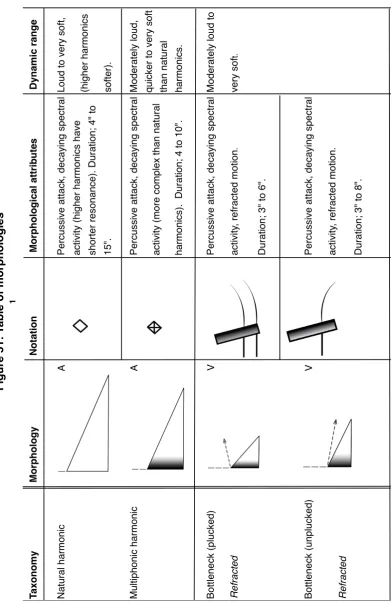
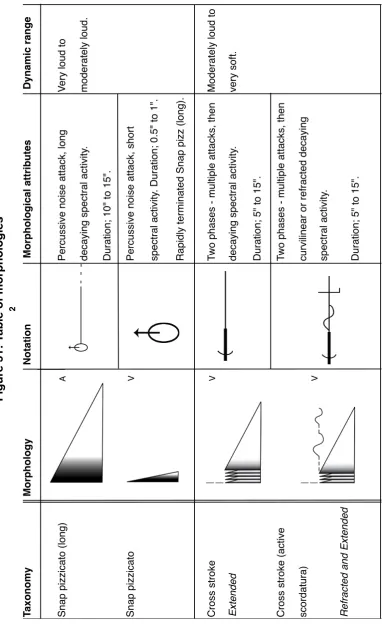
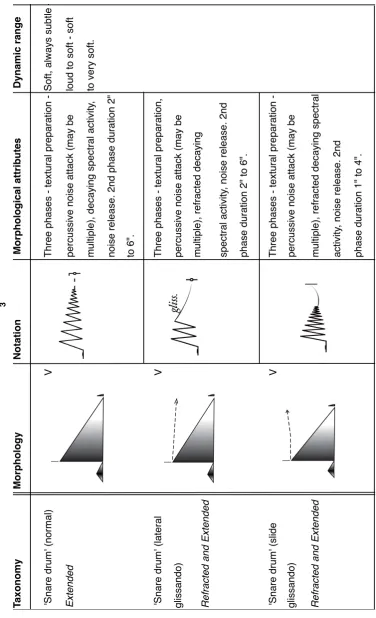
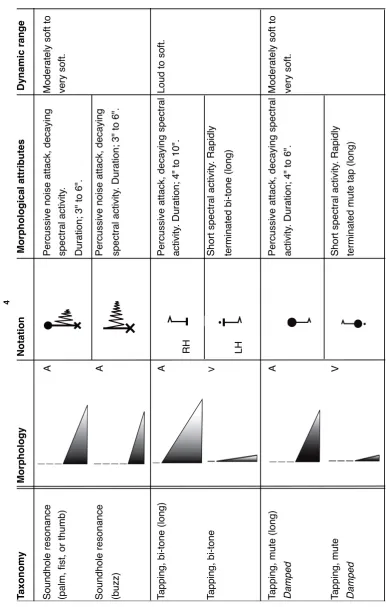
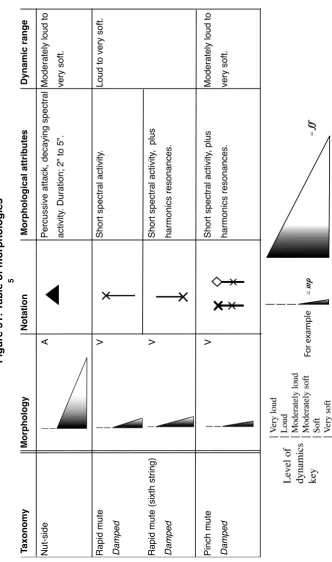
A table that indicates morphological and notational information has been devised as an aid to understanding guitar morphology (Figure 51). A typical morphology is based on two interlinked phases - an attack force followed immediately by a resonance that decreases in spectral richness as the sound decays through time. With the creation of variants, this archetypal
attack/resonance model can be developed further. Although a single
morphology can be regarded as a sound object in its own right, by combining successions and combinations of morphologies musical pieces are formed.
5.1 Table of morphologies; archetype and variants
A table of twenty-one morphologies is set out in Figure 51. Spectral content is
used as a basis to order morphologies, starting with the natural harmonic, where
a fundamental pitch dominates the spectrum, finishing with the noise-oriented
pinch mute. Morphologies with a balanced mix of pitch and noise, like 'snare drum', occur mid-way. The letter A indicates archetypes and the letter V is used
for variants. (See Figure 51 morphology column.)
The morphological diagrams represent the progress of spectral content through time, each morphology being depicted at the loudest level of sound it is
possible to produce for each technique. The Level of dynamics key (Figure 51:
5) shows that six gradations, which correspond to six vertical lines indicating attack force, are employed to represent dynamic range. To aid comprehension,
two examples are given as part of the key. A mute tap morphology is expressed
in the first shape. As the loudest mute tap morphology is moderately soft, the
attack phase covers only half the possible dynamic range. The loudest snap
pizzicato (long) level is very loud, and so no visible vertical lines can be seen in the second shape.
Alongside the morphological diagrams are the notational symbols used in
the scores.150 Some symbols are based on standard notation, while others
150 Notation symbols from Figure 51 are dealt with in detail for each technique, starting at
represent timbral aspects, or a mixture of both. For example, from playing standard repertoire, a guitarist will be familiar with diamond heads for natural harmonics and cross-shaped ones for percussive sounds. However, for more timbrally oriented resonances, graphic shapes are used to convey physical action and the notion of phases. In the morphological attributes column, a brief description of the relevant temporal phases is given for each technique, as well
as an approximate duration.
Each morphology possesses a varying degree of pitch and noise. Shading is used to reflect the changing noise-to-pitch aspect: the blacker the shading the noisier the spectral content. For instance, when playing a multiphonic harmonic loudly (black to grey), the noise from the force of attack is followed
immediately by a mostly stable, distinct and easily identifiable pitch content (grey to white).
Most of the morphologies consist of a single sound, executed on one of the six strings. However, three of the morphologies occur when more than one
string is used simultaneously. These are the ‘snare drum’ group, and bottleneck
5.2 Archetypal morphology
The archetypal morphology occurs when a percussive attack gesture, activated by the left or right hand, sets a spectrum resonating; a fixed fundamental pitch emerges. The resultant contour embodies internal spectral behaviour, where the richness of the spectrum is allied to its gradual decay towards termination. The contour of a natural harmonic morphology reflects an unimpeded attack/resonance archetypal model. Other morphologies that follow the same design are, multiphonic harmonic, snap pizzicato (long), soundhole resonance
(palm, fist, or thumb), soundhole resonance (buzz), bi-tone (long), mute tap
(long) and nut-side.
5.2.1 Variants
Although several morphologies follow the archetypal shape, others possess different qualities. In the four variant types, an action alters the progress of the
spectral content whether by refraction,extension, dampening, or interruption.
5.2.2 Refraction
Refracted morphologies follow the archetypal shape but possess a different
pitch trajectory (denoted as refracted in Figure 51). The player causes spectral
change by altering the fundamental pitch with the left hand, resulting in
ascending or descending glissandi, as in bottleneck (plucked) and (unplucked),
as well as 'snare drum' (glissandi) morphologies.
5.2.3 Extensions
Realising cross stroke and 'snare drum' techniques involves the shaping of
additional phases (denoted as extended in Figure 51). For instance, cross stroke
morphologies have two phases; the second is an extension of the first. The first
phase is caused by repeated intervention with the right hand, creatinga series of
iterative attacks that act as an upbeat to the second phase, which is a release of
energy. 'Snare drum' morphologies have three phases, a preparation that induces
5.2.4 Combining refraction and extension
Refraction and extension can be combined to create further variants, for
example, cross stroke (active scordatura), which includes a multiple attacks
phase, followed by a resonance where the contour is shaped by left-hand
intervention. 'Snare drum' (lateral glissando), and 'snare drum' (slide glissando)
morphologies consist of a percussive noise attacks, followed by a refracted resonance, and a noise cessation.
5.2.5 Damping
Damped morphologies involve an action to subdue the sound, using a particular part of the right or left hand to reduce the amplitude of string oscillation
(denoted as damped in Figure 51), thereby shortening the duration. All damped
morphologies are dominated by attack noise. For instance, through active
control of the vibrating string in rapid mute, the performer produces a
morphology that filters frequencies. The result is a noise-oriented morphology
with a relatively small amount of pitch content.151
5.2.6 Interruption
Interruption is always a dormant possibility for all resonances. Of the many
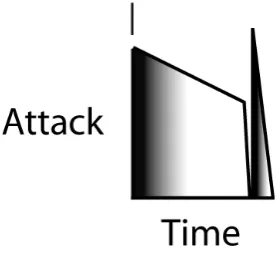
possibilities, Figure 52 shows a typical example of a snap pizzicato (long)
[image:22.595.133.272.520.648.2]morphology interrupted by a snap pizzicato.
Figure 52: Interrupted resonance.
151 The effect of filtering frequencies in relation to string length and harmonics node points is
5.3 Spectral variety
In Figure 53, the possibilities for shaping the spectral content of morphologies are summarised. The way that pitch content is manipulated, whether left to resonate, refracted, extended, or interrupted, facilitates the creation of morphological variety.
Attack, resonance, and termination, function in various ways. For example,
the attack phase can work as a downbeat, typically as in a snap pizzicato (long)
morphology. Alternatively, the multiple attacks of a cross-stroke morphology or
the preparation phase of a ‘snare drum’ morphology can operate as an
anacrusis. Morphologies terminate naturally when the sound reaches silence, or prematurely through performer intervention.
The pitch content of archetypal and variant damped morphologies is fixed,
whereas the other variants are refracted glissandi, whose contours are either
linear, in a direct line between two pitches – ascending or descending – or
curvilinear. A curvilinear morphology may follow a uniformly curved path –
oscillation, or be an irregular pattern – undulation. Refracted morphologies may be symmetrical or asymmetrical. A symmetrical example might be a glissando of approximately a semitone upwards, followed by a return downwards to the starting point. With an asymmetrical contour, the upwards and downwards distances of the glissando would not be the same.
Figure 53: Shaping of spectral content.
5.4 Morphological structures
morphologies results in the integration of spectral components, creating more complex sound qualities. In particular, the player works towards an awareness of the subtle intrinsic nature of resonances, where the spectral content of several morphologies is frequently blended, to the extent that the participating
morphologies are not aurally separable. The diagrams therefore highlight how merging and superimpositions work, something that is not so apparent in standard tablature-based or notation systems, which are more concerned with providing information on how to execute morphologies. Furthermore, such graphic representation shows the continuity of dynamic shaping more
immediately than is possible with conventional notational indications like the Italian dynamic abbreviations. In order to interpret the studies in Volume 2, the player needs to be fully sensitised to the progress of spectral and morphological shaping.
Listening to the sound examples in conjunction with the morphological diagrams will help train the guitarist in understanding subtleties of spectral detail and verify accuracy of sound image apprehension.
5.4.1 Integrating morphologies
To help establish a basis for building compositional strategies, the archetype and its variants may be incorporated into more complex structures. For
example, in Figure 54 multiphonic harmonic morphologies are used to illustrate three possibilities for connecting similar morphological types, from relative separation to merging.
Figure 54a shows relative separation - two morphologies are juxtaposed, the second starting near the termination point of the first decay period. Figures 54b and 54c show merged morphologies, composite sounds that arise when
Figure 54: Consecutive and merged multiphonic harmonic structures.
[image:25.595.120.515.380.451.2]Merged morphologies may be synchronous, as in simultaneous attacks on two strings, or may occur at different times (as in Figure 54). Two main features of merging similar morphologies are firstly, closely related recurring sounds, and secondly, a contour of dynamic levels initiated by a varying attack force. Figure 55 shows a structure of natural harmonics morphologies with varying dynamic levels and degrees of merging.
Figure 55: Natural harmonic structures.
Here is an analysis of Figure 55:
A loud attack downbeat/ fixed resonance
three merged morphologies of decreasing dynamic level
two moderately soft synchronised morphologies - short pause (breath)
Figures 56 and 57 are examples of configurations that could arise when
multiphonic harmonics and snap pizzicati morphologies occur in consecutive, merged, and combined situations. Although they both share a percussive attack, snap pizzicati are more noise-orientated. Moreover, multiphonic harmonics and snap pizzicato (long) both have decaying spectral activity. Also, the dynamic ranges of snap pizzicati and multiphonic harmonics have a contrasting nature, and the duration of multiphonic harmonics is shorter than snap pizzicato (long).
(See Figure 51: 1 and 2.)152
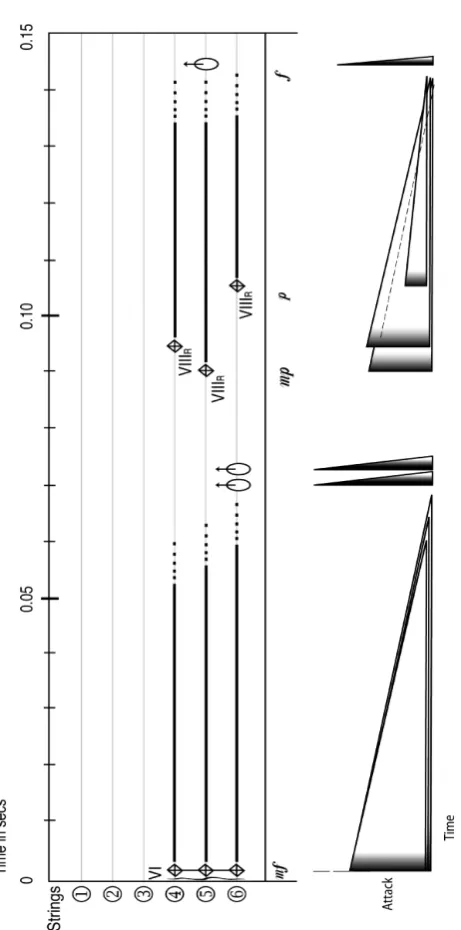
Figure 56 shows attack/resonance/termination of morphologies, spectral activity, timeline, and dynamic levels. The morphologies are aligned under the relevant score extract, acting as a guide to spectral quality; a continuation of the
ideas formulated in Figures 54 and 55. Sound example, track 13 is a realisation
of Figure 56.
Figure 56: Consecutive snap pizzicato and merged multiphonic harmonic
morphologies.
Figure 57 shows the combining of multiphonic harmonics and snap pizzicati
over a period of 15”. The lower section shows the resultant superimposition of
morphologies; resonances are combined. Sound example, track 14 is a
Figure 57: Combined multiphonic harmonic and snap pizzicato morphologies.
Figures 56 and 57 represent the cumulative complexity of sound spectra. While Figure 56 shows a string of morphologies that are consecutive, or merged, Figure 57 demonstrates a more complex combining of resonances, layering extended technique on extended technique.
Learning to play the guitar using these principle as a foundation is not conventional, as the research is centred on seeking to establish new ideas based on prior and acquired knowledge; an approach to comprehending guitar sounds that enables musicians to engage with spectral and morphological
representations and procedures.
The following text, Chapters 6, 7, and 8, offer a framework for
6 Notation in the studies: General and specific
The aim was to generate an appropriate notation system that facilitates learning
music based on the principles expounded in the Morphological structures
section, which underpins all the scores. (See Chapter 5.) Most importantly, any new schema had to have ties with guitar tradition. This necessitated devising a method that is both instrument-specific and practical when indicating where to execute sounds.
My notation for the Volume 2 studies is the result of an exploration into developing an alternative to the standard five-line stave system, aspiring to produce lucid and uncluttered scores. The resultant tablature-based system is not conventional, and some aspects of it may even appear at first sight to be counterintuitive. For instance, pitch is not conveyed on a vertical axis, which is
prevalent in the usual Western system.153 However, learning to master new
notation systems and signs are common practice for guitarists and other instrumentalists, a matter of course in the area of contemporary music. The notational scheme here is related to recent developments. Most
pertinently, the approach to apprehending sound was inspired by the pioneering
researchers in the field of Acousmatic music.154Furthermore, the notation used
in this dissertation is necessarily new because it focuses on morphological properties for which there were no pre-existing signs in music notation.
An approach that has its origins in early guitar tablature has been developed. It is intended as a comprehensible scheme, open to all guitarists whatever their musical backgrounds, including classical, folk, jazz, world, country, and popular musics, from the classical guitarist who possesses a seeking spirit, to electric players where the notion of extending guitar techniques, and noise as an inherent constituent of morphologies, may be regarded as common practice. When referring to the electric guitar, Barry Seroff mentions, “…extended technique is built into the DNA of the instrument. Noise is so inherent in
electric guitar music that it is regularly taught not as extended technique, but
153 See chapter 4.2 for an explanation of why my notation was extricated from the conventional
pitch (vertical) and duration (horizontal) paradigm.
154 The expression acousmatic music is “music intended for performance on an 'orchestra' of
loudspeakers and without an accompanying visual component”. This definition is taken from
simply technique” (Seroff 2010).155 Indeed, today there are many adventurous professional guitarists who play in more than one style and use extended techniques in their compositions and improvisations. For example, Fred Frith, Maurizio Pisati, and Marc Ribot are cited in this dissertation.
Building a tablature-based system has enabled an opportunity to re-evaluate how resonance durations are expressed, especially in regard to placing
morphologies in a time continuum, and learning to improvise using extended techniques. For example, when precision is needed, unlike conventional notation where noteheads are not string-specific, start points of sound event symbols can be placed accurately on particular strings at points in time, making the time-line a form of proportional notation. Moreover, as well as being left to resonate and decay to silence, morphologies can merge with similar resonances or combine with contrasting morphologies, and terminations may be specifically positioned to show, for example, the desired termination points of overlapping resonances.
In Volume 1, Notation in the repertoire is a detailed investigation into how
key composers use tablature to indicate the actions necessary for conveying morphological detail in terms of spectral content and performance technique. (See Chapter 2.) By making relevant evaluations, all of the points discussed have an impact on the music presented here - apprehension of sound, spectral content in the repertoire, relations to standard notation, compositional structures in relation to melodic contours, rhythmic strategies, and signs and symbols - in particular, actions involving the pitch/noise paradigm and their associations with spectral components.
Observation of any Volume 2 score will show these points. Taking the placement of spectral content as an example, the opening morphology in
Natural harmonics Study 1: Dynamics, which is played on string 2 1.5” before the second on string 4, comes to a natural termination just before 5”. A
composite resonance occurs when the third morphology (on string 3), which is initiated after 3.5”, merges with the previous two resonances. (See section 7.2.1,
and Volume 2, page 328.)
155 Taken from personal email correspondence of 9th April 2010. Barry Seroff is a guitarist,
Before discussing the studies in further detail, we will have a more specific look at my notation. In the standard historical model of tablature depiction, which is based on fret indication, conventionally plucked pitches are located in the horizontal or vertical planes. (See Figure 38.) However, in the Volume 2 scores, the horizontal aspect is used primarily for placing sound events. This enables a system that opens up the potential for developing pitch- or noise-biased morphologies that emanate from extended techniques. Related extended techniques morphologies are now depicted in the horizontal and vertical aspects, natural and mutliphonic harmonics are an example. Moreover, combining contrasting extended techniques can occur through layering morphologies in the vertical aspect, bottleneck and soundhole resonances for instance. (See Chapter 8.) In other words, the tablature system used here is a vehicle that facilitates the structuring of morphological contours.
String numbers are vertically positioned and aligned with each other at the end of each system, enabling a clear visual reference when interpreting
morphologies. Symbols and text are located under the top horizontal time-line; corresponding string and fret indications are positioned vertically for left- and right-hand placement. As in conventional tablature, standard units that indicate rhythmic activity may be placed above or below in the horizontal plane when needed. Dynamic levels are positioned in the area under the bottom horizontal line.
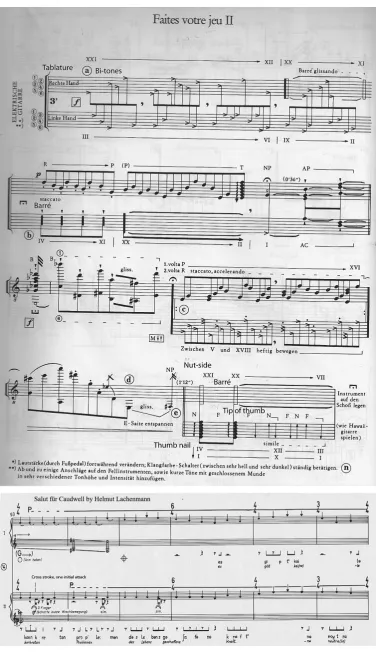
From the authors’ perspective, it is the pictorial aspect of tablature that makes it an imaginative model for depicting guitar morphologies. This research has shown that graphic representations are used to convey information in scores that incorporate tablature systems. Figure 58, for instance, shows how Mauricio
Kagel depicts bi-tone and nut-side playing in Faites votre jeu II (1964).156
Moreover, similar to some symbols used in the Volume 2 scores, physical actions are sometimes expressed using graphic shapes. For example, Helmut
Lachenmann’s symbol for a cross stroke morphology with no resonance in Salut
für Caudwell, is simply an initial attack. (See Figure 58.)
156 Taken from 'Pro Musica Nova' studies for playing contemporary music for guitar by
Figure 58: Example of graphic representation from Faites votre jeu II byKagel
The method used to describe musical language in the Volume 2 scores contains more graphic representations than text. Although conventional symbols are sometimes used (such as the practice of using a diamond-shaped head for harmonics), illustrative constructions focus on the intrinsic qualities of the particular extended techniques. For example, the symbol used to depict the three phases of cross stroke morphologies provides a means of conveying their
distinctive characteristics. Additionally, the player can acquire a sense of morphological outcome from the visual image, and this extends to each extended technique. (See section 7.6.)
7 Studies
From Volume 1 it is evident that existing sections comprising only extended techniques exist. The research in Volume 2 takes this idea a stage further by including studies that intensify in nature and are based on the spectral content from certain selected extended techniques morphologies. The aim is to initiate the possibility of producing a new repertoire.
The studies provide a basis for exploring the techniques listed in Figure 51 (pages 194-198). It is intended that learning the music will enable guitarists to gain experience in performing and apprehending guitar morphologies, thereby developing a deeper level of awareness in regard to spectral content. Listening to guitar morphologies can also help the guitarist, or guitarist-composer, in the areas of practicing, and composing. The emphasis will be on developing a practical means of working exclusively with extended guitar techniques.
The choice of which extended techniques to include is based on two factors, first, their intrinsic sonic attributes (spectral content), and secondly, the type of hand actions needed in performance situations. In other words, inclusion is founded on morphological and technical considerations. Furthermore, the tablature-based system employed in this volume is designed to help the
performer learn to express spectral content in relation to the temporal placing of morphologies. For example, compositional structures are developed through melodic aspects that manifest as a consequence of manipulating the placement of consecutive, merged, and combined morphologies. This is tied to the relationships that occur in shaping phrases, being aware of pitch relations, and exploring dynamic levels. Melodic contours of phrases are mostly derived from the archetypal or variant models; however, deviations to this are formed by the use of dynamic levels.
One of the explanations of a merged pitch-based melodic aspect may be
found in the Natural harmonics study 1: Dynamics (See section 7.2.1.) For
a composite resonance with the least spectral density; pitches involved are F#6,
A5, and B5. (See Volume 2, pages 329 and 330.)
In the Volume 2 scores, elements of freedom are developed in a progressive manner. There are many instances. For example, the first occurrence of an
improvisation aspect may be found in Natural harmonics study 3: Arpeggios,
interruption and echoes, a section where the player chooses dynamic levels; location of pitches on the guitar are given along the time-line. (See section
7.2.3.) The next case in point occurs during Natural harmonics study 4:
Improvisation where greater freedom is given to the performer; free choice of frets is added to dynamic levels, while instruction on which strings to use and resonance values of morphologies are intimated. (See section 7.2.4.) This leads to Study 5, where the performer endeavours to improvise freely on the given musical ideas. (See section 7.2.5.)
To summarize, the studies concentrate on the manipulation of consecutive, merged and combined morphologies, the principles of which were discussed in the chapter that outlines morphological structures. (See Chapter 5.) They are to be regarded as a starting-point for practicing the chosen extended techniques in a musical context as well as discovering their compositional possibilities. The performer is expected not only to interpret fixed notation appropriately, but also to engage in improvisatory decision-making, thereby taking on an active
compositional role. Elements of freedom occur in passages where decisions need to be made about choosing fret positions, dynamic levels, placing of morphologies in the time continuum, or a mixture of the three. The player will learn to start building phrases by establishing a method for making apt
performance decisions.
To strengthen the compositional principles mentioned above, a number of other organisational devices are employed in the studies. They are designed to help the guitarist to recognise relationships through listening; for example, contrasting elements, incorporating relative silence, building and releasing tension. By encouraging guitarists to experiment with the sonic outcome from the extended guitar techniques, the notion of a music based on the intrinsic texture of sound emerges.
Volume 2 have an underlying pulse. There is no need for conventional rhythmic
configurations. From observing the first study in Volume 2, Natural harmonics
study 1: Dynamics, pages 329 and 330, it is obvious that the temporal
movement is in seconds, indicating a pulse equal to 60 bpm; placement of sound
events clearly align with the temporal indications. In contrast, in Mute tapping
study 2: Iterative rhythmic patterns, pages 375 and 376, specific Bach-type rhythm indication is employed. However, note that this pulse that underlys the music in the timeline scores should be strictly adhered to. In both the above cases the players is encouraged to work towards interpretion by using a metronome and stop watch as part of practice methodology.
When there is a compositional need to give the performer extra clear-cut
rhythmic indication, a more emphatic pulse occurs. An example is Rapid mute
study 2: Synchronous morphologies, which is built around a network of precise rhythmic figures that denote rapidly repeated and arpeggiated morphologies.
(See Volume 2, page 379, and listen to sound example, track 82.) Although
resonance value is present, the player is encouraged towards the idea of more established rhythmical units.
For most of the music in Volume 2 an underlying pulse relates to working
towards an awareness of seconds in a performace situation. In Natural and
multiphonic harmonics combined study: Improvisation, which is a prime example, the pulse is obviously given and constitutes an underlying factor. In this case, for the performer it translates into the importance of engageing with the interelations of spectral components and resonance values. (See section 8.1.2, and Volume 2, page 387.)
Furthermore, although a rigorous and thoughful compositional approach has been applied, by design the music that results has a spontaneous sounding
nature; listen to sound example, track 90. On the other hand, an emphatic pulse
is employed when it is important for the player’s attention to be drawn away from an improvisatory-type outcome and engage with a more defined pulse. In
Rapid mute (normal) study 1, for example, the emphasis is on right-hand articulation; the player concentrates on clearly defined groups of repeated and arpeggiated patterns. (See section 7.11.1, and Volume 2, page 378.)
In addition, from the Mute tapping study 2: Iterative rhythmic patterns
be used when elements of freedom are present; helping to point the way towards a successful interpretation. To ellucidate further, when an even greater degree of performer decision-making occurs in the studies, boxes are sometimes used to convey musical information that includes rhythm indications; allowing and helping the performer to concentrate on developing improvisational
components, and engage with the structural outcome.
These improvisational ideas are most potently manifested in some of the
combined studies. For example, conventionally-based rhythmic information in
the opening box of the Rapid mute and pinch mute combined study is built
around smooth transformations of consecutive morphologies involving both
techniques, and freely improvising on given configurations. (See Volume 2,
page 391.) Rhythmic figures are based on conventional usage and textual
information is used to instruct the player further. As pinch mute is a newly
devised technique, it would appear that moving imperceptibly between rapid
mute and pinch mute morphologies is unique in the repertoire. For more
information, see section 8.1.4.
Discussion on the three sets of studies will focus on the pedagogical and compositional points that apply to playing the extended guitar techniques individually and in combinations of two or three. Performance instructions relate to technical detail about left- and right-hand usage, perception of pitch contour, as well as advice on making decisions.
Relevant connections between the studies and the repertoire surveyed in Volume 1 will inevitably occur. When these relationships arise, they will be explained in the appropriate chapter sections; note that composers cited in Figure 48 (works that have the closest links to my studies) dominate these associations.
Consecutive and merged morphologies are used in the first set of studies, following the order set out in Figure 51, leading to the second and third set, which are based on forming combined morphological relationships. To add musical variety and interest as the first set of studies progresses, related morphologies are introduced.
• Figure 51 - learn all the archetypal and variant morphologies listed. Utilize the given information in conjunction with the studies.
• Morphologies - for each technique, strive to discover the fullest range of morphological variation by varying dynamic levels, durations, and intervallic nature of pitch content. For example, when appropriate, experiment with varying right-hand positioning and angles of onset attacks, and examine the distance between onsets of morphologies: changes in tempo can help build tension. Keep listening to the detail of spectral content, extend knowledge of the fretboard, and develop sound quality.
• Phrases - construct varying phrase-lengths using slurs, vibrato, iteration, and glissandi appropriately. Think in terms of building phrases into phrase groups. Although the scores are pictorial-based, resultant pitch contour is embedded in the system. Therefore, by fully comprehending the instructions given below, the guitarist will learn to understand about extracting and shaping the musical phrases. Use rests to frame phrases.
• Listen to other practitioners.157
7.1 Harmonics
Natural harmonics produced on or near frets XII, VII, V, IV, and III have been extensively used in Western classical guitar music. Mauro Giuliani (1781-1829) and Fernando Sor were the first guitarists and composers to use natural
harmonics. They composed the first known extant pieces to feature harmonics. For example, in order to play a triadic melody in variation number seven of his
Eight Variations Op. 6 (1811), Giuliani used the third, fourth, fifth, and sixth harmonics on the guitar A-string. (See Figure 59.)
Figure 59: Harmonics extract from variation number seven of Eight Variations
Op. 6 by Giuliani.
From around the middle of the last century onwards, composers have occasionally employed natural harmonics on fret V or near frets III and IV to
Polifemo de Oro (1949) by R. Smith Brindle are two examples taken from the
repertoire listed in Index II. (See page 172.)158 In the opening movement of El
Polifemo de Oro, natural harmonics are used as an integral part of the lyrical serial texture. Natural harmonics on fret XII, strings 5 and 3, occur on either
side of predominantly dissonant intervals. Sound example, track 15 is a
recorded performance of the opening section.159 In Prelude no. IV, H. Villa
Lobos uses natural harmonics (on frets V and just behind IV) to form part of the
melodic moderato section; they act as a contrast to the opening lento. Sound
example, track 16 is a realisation of both sections.
Harmonics played on frets XII (an octave above the fundamental pitch) and VII (a perfect twelfth higher than the fundamental) are the closest to normal sounds. However, for the studies in Volume 2 we move away from typical harmonics and focus on those that begin two octaves higher than the fundamental, and above. Moreover, hitherto relatively unexplored natural harmonics are utilized.
7.1.1 Higher harmonics
Harmonics found between frets I and III, mostly located on the three lower
strings, produce high-pitched sounds termed higher harmonics. (See Figure 61:
2.) As they tend to have less intensity than ordinary natural harmonics - those found between frets XII to V for example - higher harmonics are dominated by the attack phase; therefore, pitch content will be less prominent. (See 7.2.2, and Figure 61: 1.) Higher harmonics should be used with care. They may be
affected by inherent random elements, an example being the risk involved in achieving an appropriate amount of clear pitch content during execution; the margin for error is very small.
Higher harmonics are occasionally found in the repertoire. One example is
Murail, who uses a single morphology in the Figure C section of Tellur (1977).
(See Figure 2, and chapter section 1.5.4.) Another is Durville’s inclusion of
higher harmonics with conventionally plucked pitches in Mouvement apparent
(1998). (See Figure 2, and chapter section 1.4.1.)
158 Index II comprises conventionally played solo guitar works with standard notation.
7.1.2 Soundhole harmonics
Explorations of harmonics found around the soundhole area, termed soundhole
harmonics, are scarce. As location of node points differs on each instrument and is dependent on constructional positioning of the soundhole, the hazards
involved in performing soundhole harmonics are similar to higher harmonics. As there are no frets, orientation is difficult. However, the player will become familiar with location through practice and studying Figure 60: 5 (page 225). Soundhole harmonics (SH) have their equivalent normal harmonics. One
example is fret V and SH on string 6 - both produce an E4 pitch. However, the
difference in string length between node point and bridge affects the resultant sound; the shorter string length of soundhole harmonics results in a less rich morphology, filtering of some partials occurs. Apart from the Volume 2 music, it appears that Durville is the only composer to have used them. (See section 1.4.1.)
7.1.3 Locating harmonics
Figure 60 shows how the pitches correspond to strings and frets.160 For
example, an E4 natural harmonic can be located on string 6 fret V, whereas
plucking the multiphonic harmonic just to the right of fret IV on string 5
produces four partials, A4, C#4, B5, and G6.
Fret positions, in terms that help the performer to locate precise node points
using appropriate left-hand fingers, are set out in the fret key. (See Figure 60:
1.)161 Harmonics found directly over the frets use Roman numerals only.
However, as many of the harmonics are located between frets, a more complex system has been devised. The result is that harmonics found just before or after
frets are expressed with a small L or R, to indicate left or right; IIIL for
example. Those found mid-fret use a forward slash, III/IV for instance, and between mid-fret and just before or after are termed LL, or RR.
To indicate the varying degree of presence when played loudly, three
different noteheads are used: most, a normal diamond shape - less, a black
160 Figure 60 consists of five pages. It is laid out in a similar way to most guitar tutors, charting
the relationship between strings, from open strings (to the left) and bridge (to the right), with string 6 at the bottom.
diamond - and least present, a rectangle. (See Figure 60: 1.) Presence is defined in terms of relative clarity, relating to the most resonance.
For natural harmonics, which adhere to the harmonic series, the order of
overtones is indicated under each partial; open string fundamental pitches (1)
areplaced at the beginning of each string, an octave above the fundamental (2)
at fret XII, a fifth of the octave (3) at fret VII, and so on. A capital M is used for
Figure 60: Natural and multiphonic harmonics.
It is possible to produce ninety-nine natural harmonics - fifteen across the
three lower strings between frets I and II/III, fifty-fouracross six strings
multiphonic harmonics. (See Figure 60.) There is a choice of thirty-nine across
the three lower strings.162
In the scores, all harmonics pitches are indicated by where they are plucked, not by the resultant pitch. For example, a natural harmonic that is an octave
above the fundamental on string 6 is found on fret V, whereas a Major 10th
above the fundamental is played at IVL. (See 7.2 below.)
7.2 Natural harmonics
The sound of a guitar harmonic conforms to the attack/resonance archetype. This comprises an initial attack that contains noise, caused by the nail, flesh, or mixture of the two striking the string, followed immediately by a decaying resonant phase that has a fixed pitch content. The decay time varies according to which string is plucked, and is directly proportional to thickness of string and
materials used to make it.163 Timbral variation is limited because the right-hand
attack will need to make sure it avoids any sympathetic node points.164 For this
reason guitarists tend to play harmonics near the bridge. However, with creative use of the right hand, a certain variation in tone colour is possible, for example by changing the angle of attack when a string is plucked, or using only the flesh of the right-hand fingertip.
A player executes this technique by placing a left-hand finger lightly on the string exactly over a node point, before attacking that string with the right hand. Figure 61 shows that fundamental guitar harmonics are found on fret XII, dividing a string into two equal vibrating lengths; a harmonic one octave higher
results. Dividing a string into three equal lengths produces two nodes, where the
harmonics at both points, frets VII and XIX, will sound one octave and a fifth
higher than the open string.
Figure 61: Natural harmonics node points.
162 For a detailed explanation of multiphonic harmonics, see 7.3 (page 239).
163 Traditionally, nylon is used for upper strings and a mixture of metal - for outer windings -
with an inner core of nylon for the lower strings.
164 Node points from harmonics played near frets II, III and IV occur in the area between the
Natural open-string harmonics are notated in the conventional diamond-shaped manner, and the range of harmonics sounds (using conventional tuning)
is E4 to E8. (See Figure 51: 1.) Learning to perform the technique well is
exacting. Inexperienced players should start by exploring harmonics on frets
XII and VII, before progressing to frets V, IVL, and IIIR; in all other Figure 60
harmonics, the margin for error is even greater. Listen to sound example, track
17, which is a loudnatural harmonic on string 6 fret V (an E6 pitch). Figure 62
[image:49.595.121.517.263.526.2]shows the left-hand position, using finger 1 in this instance.165
Figure 62: Natural harmonic on fret V (E6).
Full performance information is given in Study 1, and elements of freedom
are subsequently specified, free choice of frets (from 39”) in Study 2. (See
pages 329 and 331.) Studies 4 and 5 involve further interpretative decision-making. Three factors characterise the soundworld of the studies - the archetypal character of harmonics morphologies (mentioned above), the dominance of pitch in spectral content, and the intrinsic quality that emanates from composite resonances, stemming from initial attacks.