Performance of SDMA Systems Using Transmitter
Preprocessing Based on Noisy Feedback of Vector-Quantized
Channel Impulse Responses
Du Yang, Lie-Liang Yang and Lajos Hanzo
School of ECS, University of Southampton, SO17 1BJ, UK Tel: +44-23-8059 3364; Fax: +44-23-8059 4508
E-mail: dy05r,lly,[email protected]; http://www-mobile.ecs.soton.ac.uk
Abstract—In this contribution we investigate the performance of Spatial Division Multiple Access (SDMA) multiple-input multiple-output (MIMO) systems using transmitter preprocessing, when the channel knowledge required for preprocessing is acquired by the receiver and conveyed to the transmitter via noise feedback channels that may also conflict fading. Specifically, in our system the MIMO channel impulse responses (CIRs) are vector quantized. Then, the CIR magnitudes and phases are conveyed to the transmitter via a feedback channel, which is noise contaminated and may also experience Rayleigh fading. At the transmitter, the CIRs used for transmit preprocessing are recovered using a soft estimator, which is optimum in the minimum mean-square error (MMSE) sense, and is implemented based on the so-called Hadamard soft-decoding principles. Our study and simulation results demonstrate that vector quantization combined with soft-decoding constitutes an efficient technique of feeding back the CIRs from the receiver to the transmitter. However, it is also known that the performance of the zero-forcing (ZF) or MMSE transmit preprocessing schemes is highly sensitive to the effect of quantization errors as well as to the feedback channel induced errors.
I. INTRODUCTION
In recent years transmitter preprocessing techniques have received wide research attention [1]–[4], since the DownLink (DL) multiuser interference (MUI) may be mitigated by carrying out the required signal processing at the base-station (BS), where the associated com-plexity increase is less critical than at the mobile. Consequently, power-efficient and low-complexity mobile terminals (MTs) may be implemented. However, in order to carry out transmitter preprocessing at the BS for the sake of mitigating the MUI, the BS has to have the knowledge of all DL channels in advance, i.e. even before these channels are actually encountered by the transmitted DL signalling. In time-division duplex (TDD) systems, the knowledge of DL channels can be extracted from the UpLink (UL) channels, since in TDD mode the DL and UL TDD channels are reciprocal. However, in wireless sys-tems using frequency-division duplexing (FDD), the employment of transmitter preprocessing becomes much more challenging in compar-ison to the TDD-type systems. This is because in FDD-type wireless systems the UL and DL channels are usually not reciprocal. Therefore, in FDD-type systems the DL CIRs would have to be estimated by the receiver and explicitly fed back from the MTs to the BS.
In contrast to [1]–[4], where ideal knowledge of the DL CIRs was assumed, in this contribution we consider the more realistic transmitter preprocessing scenario, when the BS has limited and pos-sibly channel-infested knowledge about the downlink CIRs, which are conveyed through noise feedback channels experiencing fading. When transmitter preprocessing is carried out under the above-mentioned realistic conditions, it is important to design efficient CIR-signalling schemes and to investigate the impact of the recovered imperfect CIR knowledge on the achievable performance. In this contribution, realistic transmitter preprocessing using error-prone CIR signalling is investigated in the context of a SDMA system, which supports either single or multiple DL users. We assume that the CIRs between the BS transmit antennas and the MT’s receive antennas are vector quantized (VQ) [5], where both the VQ codebook design and VQ code index assignment are considered. The bits representing the quantized CIRs are binary phase-shift keying (BPSK) modulated and conveyed to the BS transmitter through a fading channel impaired by additive Gaussian noise. At the BS’s transmitter we assume that the CIRs used for
transmit preprocessing are recovered using a soft-decoding scheme, in order to enhance the accuracy of CIR detection.
Note that one of our main objectives in this contribution is to quan-tify the number of bits required for representing the required channel information in the context of various feedback channel scenarios, so that the resultant bit error rate (BER) performance remains close to that achieved when the BS transmitter employs perfect knowledge of the DL CIRs.
II. PRELIMINARIES
A. Transmitter Preprocessing
Let us consider a MIMO system employingN transmit antennas,
which transmit a vector of K symbols to the remote MT or MTs,
where we assume that N ≥ K. At the receiver side, there are a
total ofKreceive antennas, which may belong to one or several MTs.
Consequently, when linear transmitter preprocessing is applied, it can
be shown that theK-length vectoryyyreceived by theKantennas can
be expressed as
yyy=HHHTPPPxxx+nnn, (1)
wherexxx = [x1, x2, . . . , xK]T contains theKtransmitted symbols.
It is assumed that E|xk|2 = 1and xk is an independently and
identically distributed (iid) uniform random variable. In (1)nnnis the
K-length noise vector, hosting complex Gaussian random variables
having a zero mean and a variance ofσ2/2 = 1/2SNR per dimension,
where SNR represents the signal-to-noise ratio averaged over all
the N transmission channels. In (1)PPP is the(N ×K) transmitter
preprocessing matrix, which is given by
PPP = [ppp1, ppp2, . . . , pppK], (2)
wherepppk represents a vector for preprocessingxk, k = 1, . . . , K.
Furthermore, in (1) the matrixHHH containing the CIRs between the
transmit and receiver antennas can be expressed as
HHH= [hhh1, hhh2, . . . , hhhK]
h
hhk= [hk1, hk2, . . . , hkN]T, k= 1,2, . . . , K, (3)
wherehhhkis the CIR, which is often referred to as the spatial signature,
corresponding to thekth receive antenna, wherexkis detected.
In this contribution three different-complexity preprocessing schemes are considered in our simulations, which are based on the principles of transmitter matched-filtering (TMF), transmitter zero-forcing (TZF) and transmitter minimum mean-square error (TMMSE) processing [1]–[4]. Specifically, in the context of TMF, the
prepro-cessing matrixPPPis given by [4]
P
PP=HHH∗βββ, (4)
whereβββ=diag{β1, β2,· · ·, βK}is a matrix of normalization factors
required for maintaining a constant transmitted power, which can be chosen to satisfy
Tr
PPPPPPH
where Tr(XXX)represents thetraceofXXX. In the context of TZF-assisted
preprocessing, the preprocessing matrixPPPis given by [2], [4]
PPP=HHH∗
H HHTHHH∗
−1
β β
β. (6)
Finally,the matrixPPPused for TMMSE-assisted preprocessing is given
by [2]–[4]
P P P =HHH∗
HHHTHHH∗+σ2IIIK
−1
βββ. (7)
As seen by comparing (6) and (7), TZF carries out multiuser pre-processing without taking into account the effects of the background noise, while TMMSE jointly minimizes the effects of the MUI and of the background noise. Correspondingly, as shown in [3], [4], TZF-assisted preprocessing suppresses the MUI at the cost of potentially amplifying the background noise.
B. Vector Quantization
Let us initially assume that the source {αααn}, which has to be
quantized, namely the MIMO CIR vector, can be modeled by a zero-mean, stationary and ergodic vector process. This MIMO CIR vector is encoded using vector quantization [5], which is described as follows.
The VQ source encoder carries out the mappingE:RV → IU, which
maps theV-dimensional unquantized, i.e. continuous valued source
vectorαααn∈ RVinto a finite precision representationIn∈ IU, where
we have In = E(αααn), while IU = {0,1, . . . , U−1} represents
the U number of VQ centroids. The encoder’s mapping functionE
is defined by a VQ partition{Ri}Ui=0−1 of theV-dimensional MIMO
CIR hyperspace RV, so that we have αααn ∈ Ri ⇒ In = i.
Hence, the unquantized MIMO CIR setRiis quantized into theith
VQ region or cell. Let us define the VQ-encoded centroids,{ccci}Ui=0−1
asccci E[αααn|In=i] = E[αααn|αααn∈ Ri]. The VQ-centroid set
{ccci}Ui=0−1is stored in the VQ-encoded codebook, which has a size ofU
entries, whilei∈ IUis referred to as the index of theith codeword.
Letbl(i)∈ {−1,+1}, l= 0,1, . . . , V−1be the bits in the binary
representation of the integer VQ codebook indexi∈ IU. Whenbl(i)
is transmitted via a feedback channel from a MT to the BS, the channel
observation forbl(i)at the BS’s receiver can be expressed as
yl(f)(i) =h(lf)bl(i) +n(lf), l= 0,1, . . . , V −1, (8)
where the superscriptfindicates the feedback channel,h(lf)represents
the Rayleigh faded channel gain experienced by thelth bit, whilen(lf)
denotes the corresponding noise sample, which is assumed to be a Gaussian distributed random variable with zero-mean and a variance
of1/2SNR(f)per dimension.
Note that, in this contribution we investigate the performance of transmit preprocessing schemes using finite-precision channel
knowl-edge at the transmitter, when assuming that the elements ofHHH in
(3) are either independent or correlated in the spatial-domain. For
the scenario when the elements ofHHH are independent and complex
Gaussian distributed, the MIMO channel’s CIR matrix HHH can be
readily generated with the aid of the complex Gaussian distribution.
By contrast, when the elements of the MIMO CIR matrix HHH are
correlated, in our simulations the correlated MIMO CIR matrixHHH is
generated using the approach proposed in [6]. This approach creates the spatially correlated MIMO channels using the virtual channel rep-resentation (VCR) associated with the 2-dimensional Discrete Fourier Transform (DFT).
III. MIMO CIR QUANTIZATION ANDCODEBOOKDESIGN
During our initial study we found that when the CIRs are vector quantized, the phases and amplitudes should be quantized separately using two vectors. The reason for the above observation is that the phase and amplitude are distributed significantly differently. More explicitly, the former is uniformly distributed, while the latter is assumed to be Rayleigh distributed in this contribution. Furthermore, in our initial studies, the BER performance of SDMA systems using
transmitter preprocessing was found to be more sensitive to phase errors than to amplitude errors, hence the phase potentially requires a more accurate VQ.
Our codebooks are generated using the generalized Lloyd algo-rithm [5], which is described as follows:
Step 1 : Generate a sufficiently large number ofM empirical data
samplesXXX= [ααα1, ααα2, . . . , αααM], whereαααiisV-dimensional and represents either the amplitudes or phases of the MIMO
CIR matrixHHHto be quantized;
Step 2 : Set m = 1 and randomly choose U columns in the
empirical dataXXXas the initial codebookCCCm, which can be
expressed as
C CCm=
ccc0(m), ccc1(m), . . . , ccc(Um−)1
; (9)
Step 3 : Use Lloyd procedure for updating the codebookCCCm to
generateCCCm+1as follows:
(a) Associate each column inXXX with a codeword inCCCm.
Specifically, a vectorαααtinXXXis associated withccc(im), if
it satisfies
d
α α αt, ccc(im)
< d
α ααt, ccc(jm)
;for allj=i,
whered(·,·) represents the Euclidean distance of the
arguments. Provided thatd
α ααt, ccc(im)
=d
α α αt, ccc(jm)
,
thenαααtis associated withccc(im)ifi≤j, otherwise, it is
associated withccc(jm)ifi > j;
(b) All the unquantized CIR vectors{αααi}that will be
repre-sented by the same VQ codeword, sayccc(im), form a VQ
cell referred to asRi, i= 0,1, . . . , U−1;
(c) Based on the updated cells {Ri}, recompute the VQ
centroids representing the quantized CIRs in the context of all the VQ cells, and correspondingly update the
codebook toCCCm+1=
ccc0(m+1), ccc1(m+1), . . . , ccc(Um−+1)1
;
Step 4 : Based on the updated codebookCCCm+1, compute the VQ
scheme’s overall distortion measured in terms of its mean-square error (MSE), which is expressed as
Dm+1= 1
M
U−1
i=0
αααj∈Ri
αααj−ccc(im+1)
2
; (10)
Step 5 : If the relative distortion reduction|Dm+1−Dm|achieved
during themth VQ training step is sufficiently small,
cur-tail the iterations and useCCCm+1 as the codebookCCC =
[ccc0, ccc1, . . . , cccU−1]. Otherwise, setm+ 1 → mand repeat
the process from Step 3.
After obtaining the codebookCCC = [ccc0, ccc1, . . . , cccU−1], the indices
of the VQ codewords can be re-ordered, so that the quantized CIR VQ codewords exhibiting similarity are represented by indices having sim-ilar binary representations. When the codeword indices are arranged in this way, the effect of transmission errors caused by noise and fading imposed by the transmission channels can be minimized.
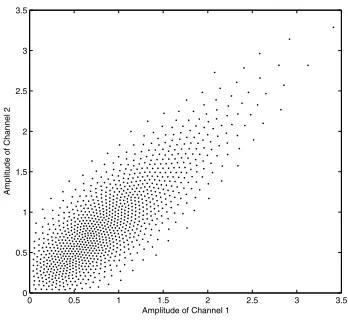
Figs. 1 and 2 show the codeword distributions for the amplitudes and phases of two spatially correlated MIMO channels having a correlation
coefficient ofρ≈0.8, when vector quantization based on the
above-mentioned algorithm is employed. Both the amplitudes and phases were quantized into 1024 legitimate codewords. Correlated Rayleigh
fading channels having a correlation coefficient of ρ ≈ 0.8 were
assumed. It can be observed that the codewords representing both the amplitudes and phases tend to be indeed closely correlated.
IV. SOFT-DECODINGASSISTEDMIMO CIR RECOVERY
We assume that the VQ index, sayIn = irepresentingαααn, and
0 0.5 1 1.5 2 2.5 3 3.5 0
0.5 1 1.5 2 2.5 3 3.5
Amplitude of Channel 1
[image:3.595.77.251.62.222.2]Amplitude of Channel 2
Fig. 1. Illustration of the 1024 codewords for the amplitudes of two spatial
correlated MIMO channels having a correlation coefficient ofρ≈0.8, when
vector quantization is employed.
−4 −3 −2 −1 0 1 2 3 4
−4 −3 −2 −1 0 1 2 3 4
Phase of Channel 1
[image:3.595.78.252.288.446.2]Phase of Channel 2
Fig. 2. Illustration of the 1024 codewords for the phases of two spatially
correlated MIMO channels having a correlation coefficient ofρ≈0.8, when
vector quantization is employed.
modulation is assumed, the observations for the VQ indexIn = i
at the BS’s transmitter can be expressed as
yl(f)(i) =h(lf)bl(i) +n(lf), l= 0,1, . . . , V −1, (11)
whereV is the number of bits required by the binary representation
of In = i, which is expressed as bbbi = {bV−1(i),· · ·, b0(i)},
h(lf) represents the fading gain, while n(lf) is the Gaussian noise.
Furthermore, provided that the phase associated with a specific fading
gainh(lf)is known, after removing the effects of the phase, (11) can
be expressed as
y(lf)(i) =|h(lf)|bl(i) +n(lf), l= 0,1, . . . , V −1. (12)
The received CIRs of the MIMO channel are recovered with the aid of a soft source decoder, which is a non-linear MMSE estimator [7].
Its objective is to compute the estimate αααˆn of αααn, based on the
observations ofy(lf)(i)forl= 0,1, . . . , V −1, whereαααnrepresents
either a set of amplitudes or a set of phases. Let the vector
yyy(f)= y(0f)(i), y1(f)(i), . . . , y(Vf−)1(i)
, (13)
host theV observations corresponding toαααn. Then,αααnis estimated
by the MMSE estimator according to [7]
ˆ αααn =
U−1
j=0
E[αααn|In=j]P
In=j|yyy(f)
= U−1
j=0
cccjP
In=j|yyy(f)
, (14)
wherecccj = E[XXXn|In=j],j = 0,1, . . . , U −1, is the codeword
or centroid of thejth VQ partition described in Section III. In (14)
P
In=j|yyy(f)
represents the a-posteriori probability of the VQ
codebook indexIn =jgiven the observation vector ofyyy(f), which
can be expressed as
P
In=j|yyy(f)
=P[In=j]p
yyy(f)|In=j
p(yyy(f)) , (15)
whereP[In=j]is thea-prioriprobability of the eventIn=j, which
can be found according to the specific channel statistics encountered,
whilep
yyy(f)|In=j
is the probability density function (PDF) of
the event, when the natural binary representation of In = j is
transmitted over the feedback channel. Assuming that the consecutive samples of the MIMO feedback channel’s CIRs encountered during the transmission of the VQ bits are independent of each other, we can express it as
p
yyy(f)|In=j
=
V−1
l=0
p
y(lf)(i)|b=bl(j)
, (16)
where p
y(lf)(i)|bl(j)
is the probability density of observing
yl(f)(i), given thatb=bl(j)was transmitted, which can be expressed
as
py(f)
l (i)[y|b=bl(j)] =
1 √
2πσexp
−
y− |h(lf)|bl(j)
2
2σ2
,
(17)
whereσ2is the variance of the Gaussian noise.
Finally, in (15)p
yyy(f)
is the probability density of the observation
yyy(f), which can be expressed as
p
yyy(f)
=U−1
j=0
P[In=j]p
yyy(f)|In=j
. (18)
In our simulations the so-called Hadamard soft-decoding tech-nique [8] is employed for implementing the above-mentioned MMSE estimation in procedure of [7] in terms of the individual bits represent-ing the transmitted VQ index [8]. To be more specific, with the aid of
the Hadamard soft-decoding technique of [7], theith VQ centroid can
be expressed as
ccci=TTTmmmi, (19)
wheremmmiis theith column of a(U ×U)Sylvester-type Hadamard
matrixMMM [8]. To elaborate a little further, let us express the natural
binary representation of the integeriasbbbi ={bV−1(i),· · ·, b0(i)}.
Then, it can be shown that theith columnmmmiinMMM can be generated
as [8]
m mmi=
1 bV−1(i)
⊗
1 bV−2(i)
⊗ · · · ⊗
1 b0(i)
. (20)
In (19)TTTis the Hadamard transform matrix which is fully determined
by the encoder centroids and can be expressed as [8]
T TT= 1
whereCCCis the codebook obtained according to Section III.
Upon substituting (19) into (14), the MMSE estimateαααˆnofαααncan
be expressed as
ˆ α ααn=TTT
U−1
j=0
m mmjP
In=j|yyy(f)
. (22)
Following a number of further steps and by referring to Section III,αααˆn
can be expressed as
ˆ α ααn=TTT
RRRmmmqqq
yyy(f)
rrrTmmmqqq(yyy(f))
, (23)
where we have
R R Rmmm=
U−1
i=0
P(In=i)×mmmimmmTi,
rrrmmm= U−1
i=0
P(In=i)×mmmi. (24)
Furthermore,qqq
yyy(f)
in (23) can be expressed as
qqq
yyy(f)
=
1 ˆbV−1
⊗
1 ˆ bV−2
⊗ · · · ⊗
1 ˆ b0
, (25)
whereˆbk, k= 0,1, . . . , V −1represents thea-posterioriestimation
ofbk, which is given by
ˆbk=Ebk|y(f)
l (i)
P(bk=±1)=0.5
=P
bk= +1|yl(f)(i)
−P
bk=−1|yl(f)(i)
= 1
2p
y(lf)(i) py(f)
l (i)[y|bk= +1]
−py(f)
l (i)[y|bk=−1]
, (26)
while py(f)
l (i)[y|bk= +1] and pyl(f)(i)[y|bk=−1] can be
ex-pressed from (17). Furthermorep
yl(f)(i)
is given by
p
yl(f)(i)
= 12
b=±1
py(f)
l (i)[y|bk=b]. (27)
Let us now provide some performance results in the next section.
V. PERFORMANCERESULTS ANDCONCLUSIONS
Figs.3 and 4 show the BER performance of the multiple-input single-output (MISO) system using four transmit antennas and a single receive antenna, when communicating over the four correlated
Rayleigh fading channels having a correlation coefficient ofρ≈0.8.
In this example four specific scenarios concerning the knowledge of the CIR used for transmit preprocessing were considered. 1) The first scenario assumes that the transmitter employs perfect CIR knowledge for preprocessing. 2) The second investigation assumes that finite-precision, but instantaneous CIR knowledge is conveyed via an ideal feedback channel imposing no noise and no fading. 3) By contrast, the third and fourth cases assume that instantaneous, finite-precision CIR knowledge is fed back from the receiver to the transmitter via an imperfect feedback channel, which is either a Gaussian channel or an AWGN-contaminated Rayleigh fading channel. In our simulations characterized in Figs.3 and 4 we assume that both the amplitudes and phases of the non-dispersive CIR taps are ideally estimated, both of
which are quantized usingV = 12bits corresponding toU = 4096
VQ codewords. Furthermore, for the feedback channel the signals received by the BS’s four receive antennas are coherently diversity
0 1 2 3 4 5 6 7 8 9
SNR per bit (dB) 10-5
2 5
10-4 2 5
10-3
2 5
10-2 2 5
10-1
Bit
Error
Rate
Perfect CIR Knowledge Ideal Feedback Channel
AWGN Feedback Channel Receiver-diversity=4 SNR=1dB AWGN Feedback Channel Receiver-diversity=4 SNR=3dB AWGN Feedback Channel Receiver-diversity=4 SNR=4dB Rayleigh Feedback Channel Receiver-diversity=4 SNR=10dB Rayleigh Feedback Channel Receiver-diversity=4 SNR=12dB
[image:4.595.42.296.152.513.2]Quantization MSE Envelope: 0.00485 Phase: 0.0503 rad2
Fig. 3. BER versus SNR per bit performance of a MISO channel using
four transmit antennas and a single receive antenna, when communicating
over independent Rayleigh fading MIMO channels, where12bits are used for
quantizing both the amplitudes and phases, respectively.
0 2 4 6 8 10 12 14 16 18 SNR per bit (dB)
5
10-4 2 5
10-3
2 5
10-2
2 5
10-1 2 5
Bit
Error
Rate
Perfect CIR Knowledge Ideal Feedback Channel
AWGN Feedback Channel with Receive-diversity SNR=1dB AWGN Feedback Channel with Receive-diversity SNR=2dB AWGN Feedback Channel with Receive-diversity SNR=4dB Rayleigh Feedback Channel with Receive-diversity SNR=14dB Rayleigh Feedback Channel with Receive-diversity SNR=18dB
[image:4.595.343.501.284.405.2]Quantization MSE Envelope: 0.0017 Phase: 0.0035 rad2
Fig. 4. BER versus SNR per bit performance of a MISO channel using
four transmit antennas and a single receive antenna, when communicating over
correlated Rayleigh fading MIMO channels associated withρ≈0.8, where12
bits are used for quantizing both the amplitudes and phases, respectively.
combined, so that the CIRs can be estimated more reliably. Observe from the results of Fig.3, that if the four channels corresponding
to the four transmit antennas are independent, using U = 4096
codewords for the quantization of both the amplitudes and phases is still insufficiently accurate. As shown in Fig.3, an approximately 0.5
dB of SNR loss is experienced at the BER of10−4 by VQ scheme.
By contrast, when the four transmission channels are correlated, as shown in Fig. 4, the BER performance achieved over a wide SNR range is close to that obtained by using perfect CIR knowledge for transmitter preprocessing. From the results of Figs.3 and 4 we infer that a Gaussian feedback channel having a SNR of 4dB is sufficiently reliable for conveying the CIR information. By contrast, for Rayleigh fading feedback channels, the SNR required for reliably conveying the channel information is about 12 dB, when the four receive-diversity channels are independently fading, as evidenced by Fig.3. When the four channels are correlated, the required SNR becomes 18dB, as shown in Fig. 4. The reason for this is that uncorrelated fading results in a higher diversity gain for the feedback channel than experienced in the correlated fading scenario. Furthermore, when comparing the results of Figs.3 to those of Fig. 4, it can be observed that the MIMO system experiencing independent fading outperforms that experiencing correlated fading. Again, this is because a significant diversity gain loss is encountered due to the correlation among the MIMO transmission channels.
0 5 10 15 20 25 30 SNR per bit (dB)
10-3
2 5
10-2
2 5
10-1
2 5
1
Bit
Error
Rate
. . . . . .
. . . .
. .
. .
. . .
Perfect CIR Knowledge
.
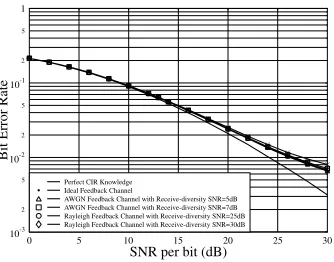
Ideal Feedback Channel [image:5.595.77.244.74.203.2]AWGN Feedback Channel with Receive-diversity SNR=3dB AWGN Feedback Channel with Receive-diversity SNR=5dB AWGN Feedback Channel with Receive-diversity SNR=7dB Rayleigh Feedback Channel with Receive-diversity SNR=25dB Rayleigh Feedback Channel with Receive-diversity SNR=30dB
Fig. 5. TZF: BER versus SNR per bit performance of a MIMO channel using
two transmit antennas, two receive antennas and supporting two users, when
communicating over correlated Rayleigh fading channels associated withρ≈
0.8, where10bits are used for quantizing both the amplitudes and phases,
respectively, of each user.
0 5 10 15 20 25 30
SNR per bit (dB) 10-3
2 5
10-2
2 5
10-1
2 5
1
Bit
Error
Rate
. . . . . . . ..
. . . .
. . . .
Perfect CIR Knowledge
.
Ideal Feedback ChannelAWGN Feedback Channel with Receive-diversity SNR=5dB AWGN Feedback Channel with Receive-diversity SNR=7dB Rayleigh Feedback Channel with Receive-diversity SNR=25dB Rayleigh Feedback Channel with Receive-diversity SNR=30dB
Fig. 6. TMMSE: BER versus SNR per bit performance of a MIMO channel
using two transmit antennas, two receive antennas and supporting two users, when communicating over correlated Rayleigh fading channels associated with
ρ≈0.8, where10bits are used for quantizing both the amplitudes and phases,
respectively, of each user.
using two transmit antennas, two receive antennas and supporting two users, while employing the soft decoding aided recovery of the VQ indices over noisy channels for either the TZF (Fig. 5) or for the TMMSE (Fig. 6) based preprocessing schemes mentioned in section II, when communicating over correlated Rayleigh fading MIMO channels
having a correlation coefficient ofρ≈0.8. The results of Figs. 5 and 6
demonstrate that as expected, VQ of the CIR results in a performance loss, when the downlink SNR is relatively high. When the downlink
SNR is below15 dB, the performance loss imposed by the vector
quantization of the CIR is hardly noticeable.
Finally, in Fig. 7 we compare the attainable BER performance, when using TMF, TZF and TMMSE-assisted transmitter preprocessing.
Specifically, we assumed a MIMO system usingNt = 4transmit
antennas, Nr = 4 receive antennas and supporting K = 4users,
when communicating over correlated Rayleigh fading channels having
a correlation coefficient ofρ≈0.8. The results seen in Fig. 7 reflect
how sensitive the BER performance achieved by the transmitter pre-processing schemes is to the non-ideal CIR knowledge. As the results seen in Fig. 7 demonstrate, the TMF scheme achieves the worst BER performance among the preprocessing schemes considered. However, it is nonetheless a robust preprocessing scheme, hence its performance
0 5 10 15 20 25 30
SNR per bit (dB) 10-5
10-4
10-3 10-2
10-1 1
Bit
Error
Rate
. . . ...
. . . . ....
. . . ....
.
Perfect TMF Ideal TMF
[image:5.595.340.507.74.203.2].
Perfect TZF Ideal TMF Perfect TMMSE Ideal TMMSE AWGN Feedback TZF SNR=4dBFig. 7. Performance comparison of the TMF, TZF and soft decoding for vector quantization over noisy channels with memory TMMSE assisted preprocessing schemes for the MIMO system using 4 transmit antennas, 4 receive antennas and supporting 4 users, when communicating over correlated Rayleigh fading
channels associated withρ≈0.8, where12bits are used for quantizing both
the amplitudes and phases of each user.
does not degrade significantly upon increasing the channel estimation error. By contrast, both the TZF and TMMSE assisted preprocessing schemes are highly sensitive to the accuracy of the CIR knowledge, especially, in the relatively high SNR region, where a significant BER performance degradation can be observed.
In conclusion, we have investigated the achievable performance of SDMA MIMO systems using various transmitter preprocessing schemes, when the CIR knowledge used for preprocessing is vector quantized and conveyed via noise feedback channels from the MT’s receivers to the BS’s transmitter. Our study demonstrated that vector quantization combined with soft-decoding is an efficient technique of signalling the CIR knowledge to the BS’s transmitter. However, our study also shows that the performance of the TZF and TMMSE transmitter preprocessing schemes are highly sensitive to the non-ideal CIR knowledge.
ACKNOWLEDGEMENT
The author would like to acknowledge the financial assistance of the EPSRC of UK, and of the EU under the auspices of the Newcom and Phonix projects.
REFERENCES
[1] R. Esmailzadeh, E. Sourour, and M. Nakagawa, “Prerake diversity
combin-ing in time-division duplex CDMA mobile communications,”IEEE Trans.
on Veh. Tech., vol. 48, no. 3, pp. 795 – 801, May 1999.
[2] B. Vojcic and W. Jang, “Transmitter preprocessing in synchronous
mul-tiuser communications,”IEEE Transaction on Communications, vol. 46,
no. 10, pp. 1346–1355, Oct. 1998.
[3] R. L.-U. Choi and R. D. Murch, “New transmit schemes and simplified
receivers for MIMO wireless communication systems,”IEEE Transaction
on Wireless Communications, vol. 2, no. 6, pp. 1217–1230, Nov. 2003. [4] M. Joham, W. Utschick, and J. A. Nossek, “Linear transmit processing in
MIMO communications systems,”IEEE Transaction on Signal Processing,
vol. 53, no. 8, pp. 2700 – 2712, Aug. 2005.
[5] A. Gersho and R. M. Gray,Vector Quantization and Signal Compression.
Boston/Dordrecht/London: Kluwer Academic Publishers, 1991. [6] H. Tong and S. A. Zekavat, “Spatially correlated MIMO channel:
gener-ation via virtual channel representgener-ation,” IEEE Communication Letters,
vol. 10, no. 5, pp. 332 – 334, May 2006.
[7] M. Skoglund, “Soft decoding for vector quantization over noisy channels
with memory,”IEEE Trans. on Inf. Theory, vol. 45, no. 4, pp. 1293–1307,
May 1999.
[8] M. Skoglund and P. Hedelin, “Hadamard-based soft decoding for vector
quantization over noise channels,”IEEE Trans. on Inf. Theory, vol. 45,
no. 2, pp. 515 – 532, Mar. 1999.
[9] L. Hanzo, et.al,OFDM and MC-CDMA for Broadband Multi-User
[image:5.595.77.244.302.433.2]