MUIR
Massey University Institutional Repository
Bathurst, R.; Sayers, J.; Monin, N. (2007). Re-conceiving
management education: Artful teaching and learning. (Department
of Management and International Business Research Working
Paper Series 2007, no. 9). Auckland, NZ: Massey University.
Department of Management and International Business.
Massey Authors:
Bathurst, Ralph
Sayers, Janet
Monin, Nanette
Research
Working
Paper Series
Department of Management and International
Business
2007, no. 9
Ralph Bathurst
Janet Sayers
Nanette Monin
Keywords
Re-conceiving Management Education: Artful Teaching and Learning
Artistry Dewey Dialogue Cartoon Irony Satire
Service work
Contact Details
Ralph Bathurst
Department of Management & International Business Massey University (Auckland) Private Bag 102 904
North Shore, MSC Auckland, New Zealand Ph 64 9 443 9799 ex 9570 Email [email protected] Copyright
© 2007 Ralph Bathurst, Janet Sayers and Nanette Monin
ABSTRACT
All the world’s a stage,
And all the men and women merely players
‘As You Like It’ William Shakespeare
Contemporary business schools have been criticised for their lack of attention to thoughtful inquiry, becoming more like factories that churn out graduates with the same simple answers to complex issues confronting organizations, rather than places of deep philosophical inquiry (Mintzberg, 2003). The popular press has picked up this plea for a better educated student populace, advocating for a liberal arts holistic education as a better preparation for students entering the business world (Hart, 2007).
In this paper we take up this concern by asking how educational processes in a management school might be artful. To address this question we discuss theoretical issues that underpin the introduction of artful approaches and in doing so we examine the nature of artistry and propose ways in which this translates into the learning environment. We offer an example of a traditional service management course, showing how students responded to the invitation to consider artful means of engagement with course content. We explore in detail a student assignment that uses cartooning as a method for describing the complex social and political relationships that underpin service work. First, though, we examine the philosophical grounds for taking this artful approach, discussing John Dewey’s forays into the world of art creation.
ART COMES OUT OF LIFE EXPERIENCE
According to John Dewey, art making begins with daily experiences: spontaneous responses to life’s events that might result in emotions that ‘may be at the beginning hope or despair, and elation or disappointment at the close’ (Dewey, 1934, p. 44). Such responses are unbridled, often surprising and sometimes uncomfortable, yet form the basis for artistic expression. However, according to Dewey, these multifarious emotions are not in themselves
To explain this expressive process, Dewey offers wine making as a metaphor. Grapes are pressed, squeezed of their juices, freeing the liquid from the rest of the grape. To complete the metaphor, Dewey poses that the resulting fermentation forms the artefact which the artist displays. He then translates this metaphor by defining a process where impulses are
compressed within the psyche and then expressed in works of art. This order is important, for artistic expression cannot occur without a sustained period of compression, a phase during which the artist makes sense of the myriad of daily encounters and experiences. To this end Dewey writes:
An impulsion cannot lead to expression save when it is thrown into commotion, turmoil. Unless there is com-pression nothing is ex-pressed. The turmoil marks the place where inner impulse and contact with environment, in fact or in idea, meet and create a ferment.
(Dewey, 1934, p. 69)
In sum, by using this imagery of compression and expression, Dewey claims that it is what we do with our emotional responses that form the ground from which artistry grows. Hence an artistic approach maximises life’s experiences by reflexively and deliberately exploring spontaneous feelings. In this way expression is wrung from daily life by a heightened awareness of sometimes even banal events.
Within the educational environment, the artful teacher’s role is to find ways in which students can compress their life experiences. In this paper, we propose that as management educators consider how to provide a climate that facilitates compression and expression in students’ hearts and minds, then the classroom becomes artful.
Further, we maintain that the artful classroom is a dialogic space where both students and instructors learn. Such a space, however, requires several characteristics in order for dialogue to flourish. Dewey notes that a unique energy underpins artful experience and in order for this energy to be creative, there must be both rhythm and resistance.
in differentiating a part within the whole, adds to the force of what went before while creating a suspense that is a demand for something to come’ (Dewey, 1934, p. 161).
Rhythm, with its ‘ordered variation of changes’ (Dewey, 1934, p. 160) is dialogic in that it implies ‘movement’ (Bohman, 1996, p. 58) from one state to another. Furthermore, according to Kosnoski, movement within a dialogic context establishes ‘a rhythm of challenges and responses, revelations and acknowledgments, appeals and acceptances’ (Kosnoski, 2005, p. 658). However, for each of these rhythmic elements to accrue towards movement, there must be resistance.
Dewey argues that resistance collects energy and it is this energy that maintains rhythmic cycles. Hence as one position becomes the prevailing view, resistance builds up until it is replaced by a new reading of that established position. He writes that ‘Each gains intensity for a certain period, but thereby compresses some opposed energy until the latter can overcome the other which has been relaxing itself as it extends’ (Dewey, 1934, p. 161).
Thus, Kosnoski’s (2005) notions of ‘challenge’, ‘revelations’, and ‘appeals’ offer resistance to current beliefs and opinions, thereby giving way to ‘responses’, ‘acknowledgements’ and ‘acceptances’. In this way, the rhythms of challenge and acceptance and the resultant forward movement maintains an active dialogic space where learning can occur.
How, though, do these artful elements translate into the classroom environment? We propose that the discursive vehicle of irony and the tools of the satirist provide a context for artful learning in that they create resistance to prevailing ideologies and challenge current practices. Irony allows students to interrogate what is immediately evident and to present alternatives. Working within its doubting frame (Rorty, 1989) enables them to both compress their experience and then express it in multidimensional satiric art forms such as parody, burlesque and comic strip.
IRONY AND PARODY
Irony in all its assorted presentations always harkens back to the character in Greek comedy called the eiron: a dissembler who seemed to naively speak simply of what he saw those around him acting out. His words, conveying more than he overtly seemed to intend, allowed
pretensions and stupidities of the self-deceiving behaviours and pronouncements of those in legitimate positions of authority that surrounded him.
In ironic performances it is this etymologically traceable notion of dissembling that still informs both the production and the reception of an ironic work of art: the artist who produces a work that speaks directly, in a familiar language and of a dominant subject, is all the while creating spaces for an-other image, story, quality or idea to take the stage. And because seeking out the story within the story is a demanding interpretive process, the audience as they push aside the dominant front and open up the counterpointing story, also become intimately involved in the creative process. Each movement, image or textual moment of an ironic art experience is both prelude and finale, rhythmically opening up interpretive angles on one view while closing down exploration of another that simultaneously initiates a return to the first.
If this kind of dialogic intensity is maintained an ironic art experience may enable response that initiates the establishment of a new position; but such a change depends on the intensity of the energy that is basic to the artful experience as previously described in terms of rhythm and resistance. If, for a moment, we think of the play of irony in satiric art forms as yet another colony of metaphor, we see that it works by yoking the known to the unknown: we identify with the familiar (experience, story, image, idea or aesthetic) and simultaneously learn something new about it when shown what it is like in some unexpected, unfamiliar or unlike context.
For instance, when Swift could not make English politicians and farmers understand the horror of their Irish tenants’ poverty, a situation with which they were certainly familiar, he wrote a ‘Modest Proposal’ for them (Swift, 1729/1964). In the dispassionate voice of an accounting bureaucrat outlining a perfectly rational agricultural economic policy, he suggested that the Irish (whose only success was the breeding of children) should farm their offspring for profit, thereby providing tasty morsels for gentlemen’s tables; ridding themselves and England of a burdensome population, and providing themselves with an income. To have simply accused the English: ‘You are effectively eating the Irish’ arguably would not have provoked a learning experience similar to that of reading his treatise.
or dramatic, and whether it is discovered in subtle word play, ludicrous parody, or witty lampoon, it is left to readers to tease out suggested, rather than stated, meaning and to share responses that enable and reveal different interpretations of the erstwhile familiar. The reader’s comfortable recognition of the familiar in the text prompts identification with it, while the incongruity of form and content, or perhaps the juxtaposition of like with unlike in the content, challenges stable interpretations to make way for at least dichotomous, and very probably multiple, readings. When the response is laughter – amused or black – a thinking response has melded with a feeling response: the reader has begun to ‘feel their thought as immediately as the odour of the rose’ (Eliot, 1951, p. 287), to have thought that is an experience capable of modifying sensibility.
For Richard Rorty the ironist becomes pre-eminent; the prosopopoeia who is able to see beyond surface readings and explore deeper meanings inherent within the text. In order to understand this shift, Rorty relates the word irony closely to doubt (Rorty, 1989). He characterises an ironist as having an ability to doubt, to accept doubt as a necessary condition of existence and then within this doubting frame, understand that language is in constant re-descriptive flux.
The language of irony avoids positions becoming fixed; and while doubt accepts the validity of a set of beliefs and firmly held positions, at the same time it ‘constantly questions and doubts’ those assumptions (Rehn, 2002, p. 47). Rorty explains this fluidity by arguing that ‘the terms in which [we] describe [our]selves are subject to change, always aware of the contingency and fragility of [our] final vocabularies, and thus of [our]selves’ (Rorty, 1989, p. 74). For Rorty the less certain the final vocabulary, the more open we become to actively and continually negotiated meaning. Through irony an idea is interrogated by inquiring into what lies beyond that concept. In Rorty’s inimitable language, irony searches for the ‘painted backdrop’ behind the painted backdrop (Rorty, 1989, p. 54), notions that are not seen but are nonetheless present, and yet that are still to be seen and acknowledged.
ironic contrast. By holding this position it is not possible to be pompous or lecturing, qualities that are often the subject of satire and parody. Here the language game is more strident and pointed, where the satirist is more likely to point out contradictions between an
observation and a reality, especially if it involves human suffering. Irony, on the other hand, is both an attitude and a tool used by comedians, writers, and other artists – including musicians (Sheinberg, 2000) – to probe beyond prevalent ideologies, thereby offering new ways of viewing the world. Finally, it should be noted that irony is not necessarily funny and it does not have to involve humour.
Irony is thus central to the satirical works of the many genres that fall within the generic realm of burlesque. Terms for species of burlesque such as parody, lampoon and travesty are often used indiscriminately because there are no fixed boundaries around their forms and functions, but most critics would probably agree that all satires aim to evoke laughter, indignation or contempt as correctives of human foibles follies, and vices. Mocking a self-important or elevated subject by presenting it in an incongruously undignified manner is a form of parody that is an immediately accessible and an endlessly creative learning experience for students being introduced to critical thinking.
Having scoped the idea of artful encounters through satire we now turn to a discussion on how this plays out within the classroom. We work with the notion that parody uncovers prevailing ideologies, and through artful expression, readers are invited to reflect on the issues that the students explored.
CASE STUDY: PARODY AND THE ARTFUL PROCESS
The fast-food industry is used throughout the course because fast-food enterprises, as modelled by McDonalds, have been influential on many other service non-fast-food businesses. Students are familiar with fast-food as consumers, and some as employees; young peoples’ first employment experience is often in fast-food. Fast-food also tends to have an easily observable production process, because a large part of the business is visible to the customer. An initial descriptive familiarisation assignment affirms students’ experience, making the abstract course concepts immediately relevant to their daily lives. In addition students learn the language of the service management field which provides the essential techniques of the service manager.
Having learnt some of the techniques of service management, the students were then given a brief to ‘create a parody using some aspect of customer service that you have learnt during the course.’ Students were briefly introduced to parody as a rhetorical method, and examples were shown in class. Examples of service parodies proliferate on the Internet in sites such as YouTube which are devoted to lampooning aspects of customer service that people find frustrating (see Parker, 2006, for a discussion of this type of organizational flotsam). Students were encouraged to use visual methods to construct their parody, and a range of possibilities were suggested to them including: video, song, Power-Point presentation, comedy skit, cartoon, comic strip and animation. One of the reasons for asking students to create visual rather than text-based parodies was that English was not the first language of many of the students and the instructor wanted them to have an opportunity to use a visual mode of communication that was more universally accessible.
The students were asked to engage with a core philosophy in service management; that customers actively participate in the service process, and that the service experience is
Students responded using a variety of media. The example we use here as an illustration is a comic strip that was generated by two students who focused on the role of the employee delivering customer service to a difficult customer in a fast-food restaurant. In our exploration we present the comic strip, teasing out relevant aspects such as the mode of communication, and pedagogical ideas.
Before we begin discussing the comic strip, we briefly introduce the comic-strip code, because the medium communicates much of the message we discuss in this paper (McLuhan, 1973). Cartoons and comics have a long history and expressions of the form proliferate in contemporary times. With their origins traced to pre-linguistic cave-drawing, where animal figures and handprints drawn deep in caves were the first evidence of symbolic representations of human experience (Hogben, 1949), they are now commonly accepted as a mainstream art form (Sabin, 1996).
In scoping its history Randall Harrison notes that the cartoon is a modern adaptation of these visual pictograms, with the English artist William Hogarth (1697–1764) being credited as the ‘first cartoonist’ in Western history. Furthermore, it should be noted that the Japanese have claims to cartooning originating back to the 12th century (Harrison, 1981, p, 74).
Hogarth and later European and North American cartoonists popularised the idiom as a means of political protest and persuasion, and its spread was assisted by reproductive print technologies. Over time these political cartoons were absorbed into newspapers and periodicals as they drew readership to editorial pages, entertaining and providing graphical crystallisations of the complex issues of the day.
Humour cartoons developed almost as a separate genre and tended to focus on everyday issues, and were often structured like verbal jokes. In the 1880s, a major innovation in cartooning was the advent of the comic strip, where a story is told in a sequence of pictures. The comic strip grew rapidly in popularity, and has evolved to take advantage of new technologies with comic books, graphic novels, narrative art, and animation (moving cartoons).
cartoonists are able to distil a message down to its core substance, and this is achieved through the three basic techniques. First by levelling the cartoonist radically reduces the perceptual field from 3 dimensions to a 2-dimensional frame, colour is stripped making it monochromatic black on white, and only the outline of a figure is retained, thereby only offering hints of the form’s texture, shade and shape. All needless objects and details are dropped. Second, the technique of sharpening highlights the important items in the image stand out, making them more important. For instance, a person’s head in a cartoon is often bigger than the body, and as emotional expression becomes more important, the head, and its features expressing emotion, such as the mouth and eyes, expand. The third technique,
assimilation, involves exaggeration and interpolation where the image is translated through larger symbols so that the fiction being created in the cartoon makes sense for the reader. Consequently, a ‘square-jawed hero becomes even more firm of jaw. The dull person is made to look positively idiotic and the mean one becomes thoroughly villainous’ (Harrison, 1981, p. 57).
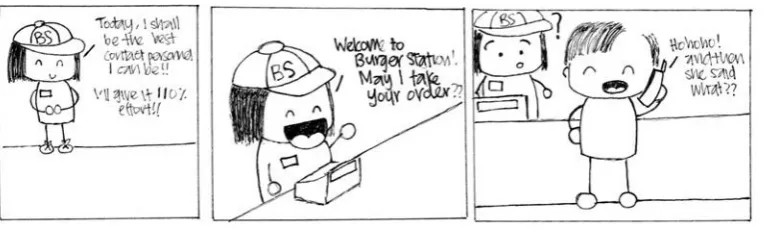
[image:12.595.76.460.570.685.2]The student exemplar we explore is a cartoon of an over-the-counter fast-food encounter. The central character is a young, female fast-food worker, at ‘Burger Station’, with a baseball cap (signalling the North American origins of the production process) on her head monogrammed an ambiguous BS, and a simple uniform and name tag. This young woman is determined to be ‘the best contact personnel’ she can be, determined to give ‘110% effort!’ She displays her commitment by an enthusiastic mantra ‘Welcome to Burger Station! May I take your order?’ Figure 1 The Customer Service Relationship Begins shows her first customer for the day; someone who is about to challenge her commitment to offering high quality service by ignoring her and talking on his cell phone.
Figure 1 The Customer Service Relationship Begins
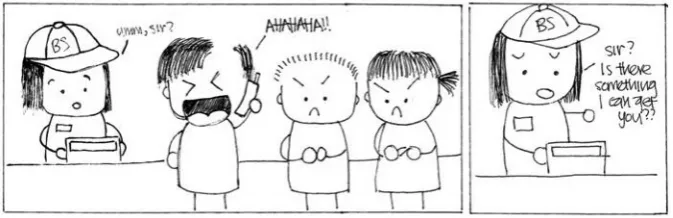
plaintively repeat her request, ‘Sir? Is there something I can get you?’ In Figure 2 The Plaintive Request her consternation is show with upturned eyebrows, in contrast to the
[image:13.595.73.410.151.260.2]customers waiting in line who have their eyebrows turned down in anger.
Figure 2 The Plaintive Request
These frames from the beginning of the story demonstrate the translation between cartoon characters and the larger archetypes that they represent. The female customer service representative (CSR) personifies an ideal fast-food service employee and is the heroine of the story; the person that the audience is asked to identify with the most. The male customer symbolises the selfish and hedonistic consumer and the waiting couple accentuates the power of the consumer over the CSR. The invisible presence of the standardised fast-food service management system pervades the comic strip through the uniform, name tag, menu board, and the employee’s service script. The employee’s emotional labour (Hochschild, 1983) is shown as she tries to make her feelings conform to her manager’s expectations, and the customers’ threats of complaint.
Figure 3 Service Concepts Explored
Another 15 minutes later the CSR is relieved that the customer has finally finished his phone call and is ready to be served, only to find that he now makes a completely unreasonable order, asking for items that do not exist on the menu board. In Figure 4 Ordering, the CSR attempts to explain that his desired options are not available at this restaurant. The customer, again, becomes angry that his needs are not being met.
Figure 4 Ordering
[image:14.595.79.544.398.480.2]Figure 5 Customer is King
The unseen set of interests in this cartoon is the management system that is inherently present because of the threats of complaint that both sets of customers make. This threat makes the employee feel more vulnerable. The manager, though, is not physically present, but rather is metaphysically omnipresent. The CSR becomes smaller and smaller, not only in the face of the customers’ tantrums, but in the expectation that her manager will be on the customers’ side. Customers are, after all, also managers and purveyors of her service quality (Rosenthal, Peccei, & Hill, 2001) which is how her initial desire (to be the best contact personnel she can be) is to be judged. She is caught in the cross-fire of two sets of expectations: those placed on her by her invisible employer, and then the immediate presence and dominance of the customer in the service exchange. As a result she shakes with both contained emotion and trepidation as the unreasonable customer slams the door in the final frame.
Through parody, the question, ‘What is a contact person to do?’ is addressed to us the audience, and the value of the cartoon as an artistic artefact, and its wider themes become a discussion tool. The comic strip pulls the audience into the action through the code that promotes identification through laughter. Furthermore, its evident satirical tone makes it appealing. As an audience we resonate with what is pictured: the frustrations of waiting in line while other customers refuse to conform to queuing norms. Here we confront others’ lack of social training in minimising time spent in the service interaction. But, our sympathies remain firmly with the CSR worker as the central figure and hero of the cartoon. As the under-dog, at the bottom of the organisational power structure, our empathy for her situation is accentuated. The consumer is revealed as being arrogant, selfish, hedonistic and generally stupid, and yet the entire performance of the organisation is judged by and through this consumer. The CSR is, paradoxically everything to the service interaction, and yet
arrogance (repeated to a lesser extent even by the waiting couple) is revealed as being erroneous, pompous and destructive.
The strip illustrates in many ways the process of compression and expression referred to in the beginnings to this paper. The students’ spontaneous experiences of the fast-food encounters are fermented in this cartoon artefact. What however, are the implications that can be drawn from this case that facilitate a re-conception of artful practices in management development and education?
THE ARTFUL CLASSROOM
Dewey claims that art-making begins with daily experience, and the use of students’ experiences as both customers and workers in a food restaurant, is exploited in the fast-food comic strip as the context for the narrative. This context is appropriate for undergraduate cohorts because fast-food service is a very common role for students to hold while they are studying. According to Dewey, it is this kind of ordinary experience that forms the context for art making. The inner engagement with feelings and perceptions that spring from daily experiences are distilled into an artistic expression.
In our artful classrooms, when we work with experience and irony to foster creativity and critical thinking skills, we follow a process that evolves through several steps. Essentially a successful parody is introduced as being built around a sound understanding of a management text, typically the firmly established but often formulaic text which is a set reading. In addition to achieving a solid grasp of what the selected text means, students are invited to relate it to their own experiences and to discern in these lived experiences emotions and behaviours for which the formulaic text does not allow. Drawing on these experiences they try out the recipe provided, noting the aspects, angles and insights of their own recollection that do not fit, recording these disparities.
cartoon. In this way they turn everyday experience into an artefact. They make profound that which is commonplace, enabling us the audience to engage with their experience. The two students who created the cartoon strip clearly have drawing and design skills, abilities that are not normally valued in an academic environment. In a discipline that privileges writing in black ink on a white page, rarely are business studies students asked to express themselves in diverse media. The skills of the visual artist or musician are often left untapped in classroom learning. In this particular Service Management class, other students chose to use digitally-oriented devices to compensate for their lack of formal artistic training. Hence movies recorded with domestic video cameras and visual narratives, created using cut-and-paste functions with standard computer software, were also used by class members. Today’s young people are growing up in an increasingly visual culture, and they absorb a great deal about narrative form and structure through their constant interactions with multi-media forms and popular culture. Although some critics may quibble that the carton used here works well because these students have artistic abilities that we cannot expect from management students, our experience has been that almost all students are able to represent their ideas through visual means in a variety of ways. Other examples using artful approaches include: students creating theatrical performances (see Sayers & Monin, 2007); storyboarding with photographs; animations; multimedia Power-point presentations; short movies; documentaries; short stories; and movie scripts.
Through artful facilitation, instructors can assist students to explore their latent talents and develop new skills by sharing published examples of visual, enacted and discursive workplace satires. The artful expressions the students create use the fully recognisable original (management) text, place them in an incongruous setting, juxtapose them with an unexpected other, or give the text ludicrously exaggerated features. These alterations, or re-readings of the original text, contort using salient aspects of the students’ experiences. Students perceptively present their re-reading from a position of affirmation of their own experiences, and so are often able to present their new deepened understanding of the original text as being incomplete (perhaps sexist, naïve, condescending or irresponsible), with considerable confidence, wit and verve.
formal resolution in the aesthetic realms’ (Jameson, 1981, p. 79). The contradictions and ambiguities inherent in service are not only economic, but also emotional, moral and intellectual. These contradictions and ambiguities have been highlighted and explored in the literature about management which has sought to explore these complexities in more detail (for explorations see Korczynski, Shire, Frenkel, & Tam, 2000; Leidner, 1993; Sturdy, 1998), but these issues rarely, if ever, get mentioned in most service management texts. For example Korczynski and Ott (2004) maintain that capitalism is beset by a fundamental contradiction between rationalised, disciplined production co-existing with unconstrained and hedonistic consumption. They argue that, when managing the consumer, production both reinforces the customer’s sovereignty, but at the same time directs them through rational systems of the service interaction (for instance the menu and its presentation, and a script service workers must follow) to act in certain ways conducive to appropriate rational acts within the system, thereby compromising that sovereignty. The comic strip produced by the students implicitly recognises this contradiction: the tension between rational production and individuated hedonistic consumption. The point of tension is the CSR who is pictured at the centre of this maelstrom of expectations, vividly illustrating the lived reality of a young fast-food worker.
Satire works with such contradictions, ambiguities and tensions. As it de-familiarizes the mundane it simultaneously exposes and challenges assumptions such as inherent power structures. In its alternative narrative it develops and reveals potentially multiple, as well as alternative views, an enlightenment that opens up the possibility of new, different and changing attitudes and values emerging from the artful classroom. It appeals to the reader on multiple levels, for our shared knowledge of the subject text invites complicity and the smugness of being in the know, while in the laughter generated by a humorous portrayal of incongruity, exaggeration and ignorance there is also persuasion to accept that this should not be so, that change should be accepted. Our laughing response leads us to acknowledge that the subject is in some ways lacking or ridiculous, and a combination of these outcomes, laughter and acknowledgement, leads us to accept, and identify with, the different view now revealed.
described by Dewey (1934) that is central to artistic engagement. So it is essential that the instructor create the space within which expression can occur. If the classroom is fully dialogic then not only are both instructors and students learning at the same time – as emerges from the unique and often spontaneous conversations that occur – but also as each individual courageously takes up the position that emerges from a synthesis of their experience, emotion and reflection, they must also try to grasp positionings alternative to their own.
This demands commitment from both instructors and students, and the introduction of this artful assignment offered an opportunity to enliven management learning that is more often static in its concepts and epistemologies. The key ideas of service management are trotted out in text upon text: with little variation of the key steps to success in customer service management. Such texts are formulaic, and much writing that is interesting and provocative about service management is rarely, if ever, acknowledged and referred to in them. In classrooms where the development of critical thinking skills is a declared aim, the ability to speak to such established theories in an ironic voice is demonstrably valuable, for it provides us with a succinct way of demonstrating knowledge of the dominant story, with all of its inbuilt assumptions, as well as providing an ever-present, alternative and divergent narrative. One of the dialogic strengths of incorporating irony into the classroom learning experience is that interpretive outcomes are created by a combination of both the depth and diversity of thoughtful reception. As a general rule we have found that the more subtle the irony in the artwork, the more pressing is the need for readers to creatively respond – to write the unwritten story that the written story suggests – and that sharing these many individual interpretations in group discussions enriches all.
An artful teaching approach, then, requires an acceptance of both the critical and the prescriptive, and a working knowledge of a complex body of theory and practice. There is resistance between the two, but an artful approach welcomes this ambiguity.
Acknowledgment: Thanks to Katy Ko and Sammi Lu Fang who have given permission for
REFERENCES
Bohman J (1996) Public deliberation: Pluralism, complexity, and democracy, Cambridge, MA, MIT Press.
Dewey J (1934) Art as experience, New York, Capricorn. Eliot T S (1951) Selected essays, London, Faber and Faber.
Harrison, R P (1981) The cartoon: Communication to the quick, Beverly Hills, Sage. Hart S (2007, February 12) The art of business success, The New Zealand Herald, p D1. Hochschild A R (1983) The managed heart: Commercialization of human feeling, Berkeley
CA, University of California Press.
Hogben L T (1949) From cave painting to comic strip: A kaleidoscope of human communication, New York, Chanticleer Press.
Jameson F (1981) The political unconscious: Narrative as a socially symbolic act, Ithaca, NY, Cornell University Press.
Korczynski M and Ott U (2004) When production and consumption meet: Cultural contradictions and the enchanting myth of customer sovereignty, Journal of Management Studies 41(4): 575–599.
Korczynski M, Shire K, Frenkel S and Tam M (2000) Service work in consumer capitalism: Customers, control and contradictions, Work, Employment and Society 14(4): 669– 687.
Kosnoski J (2005) Artful discussion: John Dewey's classroom as a model of deliberative association, Political Theory 33(5): 654–677.
Leidner R (1993) Fast food, fast talk: Service work and the routinization of everyday life,
Berkeley CA, University of California Press.
McLuhan M (1973) Understanding media: The extensions of man, London, Sphere Books. Mintzberg H (2003) Managers, not MBA’s: A hard look at the soft practice of managing and
management development, San Francisco, CA, Berrett-Koehler.
Rehn A (2002) Pretty ugly: Notes on the moral economy of method, Ephemera: Critical Dialogues on Organisation, 2(1): 43–52.
Rorty R (1989) Contingency, irony, and solidarity, Cambridge, Cambridge University Press. Rosenthal P, Peccei R and Hill, S. (2001). Academic discourses of the customer: ‘Sovereign
beings’, ‘management accomplices’ or ‘people like us’? in Sturdy A, Grugulis I and Willmott H (Eds.) Customer service: Empowerment and entrapment, pp18–37, Basingstoke, Palgrave.
Sabin, R (1996) Comics, comix & graphic novels: A history of comic art, London, Phaidon. Sayers J and Monin N (2007) Love®: A critical reading of Lovemarks, Journal of
Organizational Change Management 20(5): 671–684.
Sheinberg E (2000) Irony, satire, parody and the grotesque in the music of Shostakovich: A theory of musical incongruities, Aldershot, Ashgate.
Sturdy A (1998) Customer care in a consumer society: Smiling and sometimes meaning it?
Organization 5(1): 27–53.
MASSEY UNIVERSITY
MASSEY RESEARCH ONLINE http://mro.massey.ac.nz/
Massey Documents by Type Working and Discussion Papers
Re-conceiving management education:
Artful teaching and learning
Bathurst, Ralph
2007http://hdl.handle.net/10179/652