UNIVERSITI TEKNIKAL MALAYSIA MELAKA
IMPROVING PRODUCT DESIGN USING KANO MODEL
This report is submitted in accordance with the requirement of the Universiti Teknikal Malaysia Melaka (UTeM) for the Bachelor’s Degree in Manufacturing
Engineering Technology (Product Design) with Honours.
by
NG CHAI LEIK B071310527 930909-14-6126
UNIVERSITI TEKNIKAL MALAYSIA MELAKA
BORANG PENGESAHAN STATUS LAPORAN PROJEK SARJANA MUDA
TAJUK: Improving Product Design using Kano Model
SESI PENGAJIAN: 2016/17 Semester 1
Saya NG CHAI LEIK
mengaku membenarkan Laporan PSM ini disimpan di Perpustakaan Universiti Teknikal Malaysia Melaka (UTeM) dengan syarat-syarat kegunaan seperti berikut:
1. Laporan PSM adalah hak milik Universiti Teknikal Malaysia Melaka dan penulis. 2. Perpustakaan Universiti Teknikal Malaysia Melaka dibenarkan membuat salinan
untuk tujuan pengajian sahaja dengan izin penulis.
3. Perpustakaan dibenarkan membuat salinan laporan PSM ini sebagai bahan pertukaran antara institusi pengajian tinggi.
4. **Sila tandakan ( )
SULIT
TERHAD
TIDAK TERHAD
(Mengandungi maklumat yang berdarjah keselamatan atau kepentingan Malaysia sebagaimana yang termaktub dalam AKTA RAHSIA RASMI 1972)
(Mengandungi maklumat TERHAD yang telah ditentukan oleh organisasi/badan di mana penyelidikan dijalankan)
Alamat Tetap:
D2-4, Jalan BS 5/27A,
Taman Bukit Serdang,
43300 Seri Kembangan,
Selangor Darul Ehsan.
Tarikh: ________________________
Disahkan oleh:
Cop Rasmi:
Tarikh: _______________________
DECLARATION
I hereby, declared this report entitled “Improving Product Design using Kano Model” is the results of my own research except as cited in references.
Signature :
Author’s Name : NG CHAI LEIK
APPROVAL
This report is submitted to the Faculty of Engineering Technology of UTeM as a partial fulfillment of the requirements for the degree of Bachelor’s Degree in Manufacturing Engineering Technology (Product Design) (Hons.) The member of
the supervisory is as follow:
i
ABSTRAK
ii
ABSTRACT
iii
DEDICATION
iv
ACKNOWLEDGEMENT
I would like to express thank to my supervisor Mr. Tan Hauw Sen Rimo for his help and guidance throughout the project. The completion of project would not have been possible without his guidance. I have learned a lot from him not only the way writing thesis more organized but also the way he taught me to think a problem from different perspectives. This is not only allowed me to complete the project but also benefits me in future life with a new mindset he taught.
Besides, I would also like to thank Zhen Lin Furniture & Renovation Work and the designer Mr. Patrick for willing to help in providing data which contributes to the project. They facilitate my project process and I am grateful to gain experience from them.
Also, I would like to thank my friends and respondents who help me along the way in completing my project. Last but not least, I would like to offer my sincere gratitude to my family members for mentally supporting me throughout the project. They are my motivation to complete the project.
v
TABLE OF CONTENT
Abstrak………...i
Abstract………...………...…..ii
Dedication………iii
Acknowledgement………...………iv
Table of Content………...v
List of Tables……….…viii
List of Figures………...…….………..ix
List Abbreviations, Symbols and Nomenclatures………...x
CHAPTER 1: INTRODUCTION ... 1
1.0 Overview ... 1
1.1 Introduction ... 1
1.2 Problem Statement ... 3
1.3 Objective ... 4
1.4 Scope ... 4
1.5 Structure of Project ... 4
CHAPTER 2 : LITERATURE REVIEW ... 6
2.0 Introduction ... 6
2.1 Product Design Concept ... 6
2.2 Voice of Customer ... 7
2.3 Quality Function Deployment ... 8
2.3.1 Mechanism of Quality Function Deployment ... 8
2.3.2 Application of Quality Function Deployment... 10
2.3.3 Advantage of Quality Function Deployment ... 11
vi
2.4 Kano Model ... 12
2.4.1 Mechanism of Kano Model ... 13
2.4.1.1 Kano Questionnaire ... 13
2.4.1.2 Kano Evaluation Table ... 14
2.4.1.3 Kano Evaluation Rule ... 15
2.4.2 Application of Kano Model ... 15
2.4.3 Advantage of Kano Model ... 16
2.4.4 Disadvantage of Kano Model... 16
2.4.5 Relationship between QFD and Kano ... 17
2.5 Pugh’s Evaluation Method... 17
2.6 Computer Aided Design Software ... 18
CHAPTER 3 : METHODOLOGY ... 19
3.0 Introduction ... 19
3.1 Planning of Study... 19
3.2 Gantt Chart ... 21
3.3 Research Methodology... 21
3.3.1 Problem Formulation ... 25
3.3.2 Objective Setting... 26
3.3.3 Identifying Customer Requirements and Needs ... 26
3.3.4 Development of Kano Survey ... 27
3.3.5 Analyzing Kano Survey Result ... 27
3.3.6 Development of House of Quality (HOQ) ... 28
3.3.7 Preparing Conceptual Sketches ... 28
3.3.8 Product Design Improvement ... 29
3.3.9 Analyzing New Design ... 29
3.3.10 Conclusion and Recommendation... 29
vii
4.0 Introduction ... 31
4.1 Identify Phase ... 31
4.1.1 Product Selection ... 31
4.1.2 Market segment analysis ... 33
4.1.3 Gather Customers’ Opinion ... 34
4.2 Define Phase Activities ... 36
4.2.1 Apply Kano Model ... 36
4.2.2 Conduct Kano Analysis ... 37
4.2.2.1 Kano Discrete Analysis ... 37
4.2.2.2 Kano Continuous Analysis ... 38
4.2.3 House of Quality (HOQ) ... 41
4.3 Design Phase ... 41
4.3.1 Design Concept Generation ... 42
4.3.2 Concept Screening ... 46
4.3.3 New Design Analysis ... 48
CHAPTER 5 : CONCLUSION ... 50
5.0 Introduction ... 50
5.1 Summary of Research ... 50
5.2 Significance of Research ... 51
5.3 Problem Encountered throughout Research ... 51
5.4 Recommendation ... 52
REFERENCES………..53
APPENDICES………...…58
A:Survey Questionnaire for Product Study 2………59
B: House of Quality ……….……….67
viii
LIST OF TABLES
1.1 Organization Structure of Project for Final Year Project... 5
2.1 Kano evaluation table ... 14
4.1 Benchmarking ... 33
4.2 Rating Score Indicator amendment in Kano Questionnaire ... 37
4.3 Kano Discrete Analysis ... 38
4.4 Summary of Dissatisfaction Coefficient and Satisfaction Coefficient ... 39
4.5 Summary of Kano Analysis ... 41
4.6 Pugh’s Method ... 46
ix
LIST OF FIGURES
2.1 Complete Quality Function Deployment Phases ... 9
2.2 House of Quality ... 10
2.3 Relationship between product features and customer satisfaction ... 12
2.4 Kano question example ... 14
2.5 Pugh Concept Selection Matrix ... 18
3.1 Process Flow of Study ... 20
3.2 FYP 1 Gantt Chart ... 22
3.3 FYP 2 Gantt Chart ... 23
3.4 Research Methodology Flow ... 25
4.1 Customization Order from 1.1.2016 until 1.6.2016 ... 32
4.2 Short Interview Result 1... 34
4.3 Short Interview Result 2... 35
4.4 Short Interview Result 3... 35
4.5 Kano Model Diagram ... 40
4.6 Design Concept 1 ... 42
4.7 Design Concept 2 ... 43
4.8 Design Concept 3 ... 44
4.9 Design Concept 4 ... 45
4.10 Design Concept 5 ... 45
4.11 Final Design before Extend The Compartment ... 47
x
LIST OF ABBREVIATIONS, SYMBOLS AND
NOMENCLATURE
DC - Dissatisfaction Coefficient FYP - Final Year Project
HOQ - House of Quality
QFD - Quality Function Deployment SC - Satisfaction Coefficient
1
Chapter 1
INTRODUCTION
1.0 Overview
Chapter 1 will provide general insight to the reader on the topic which will be done in this project which is about designing a product based on customer requirement. This chapter includes problem statement, objective as well as structure of the project to give a basic idea about the project to the readers. In this chapter, the scope is also set to limit a certain extent of study which is uncontrollable. Besides, Chapter 1 comprises the structure of project as well in order to clarify how the project goes.
1.1 Introduction
Good product design is a product designed which fulfills customer needs. In simple terms, a good product performs the function that what customers exactly need. The core reason that customers usually buy a product is that they need it to solve their problem. Everyone faces problem in daily life and some of them will make an attempt to solve those problems. Therefore, product or service is there as a solution for people to solve their problems. Conversely, customers will not want to purchase that product at all if that particular product fails to meet customer requirements and unable to function as customers expected.
2 varies from time to time. The designers can hardly to identify the customer requirements or sometimes they might overlook the hidden customer wants to be put into the product specifications. As a result, the product designed will fails in satisfying customer and gaining customer loyalty and next it leads to low competitiveness compared to the other competitors in the current market.
As the customer requirements are crucial in product development, designers struggle in the process of determining customer needs where they need to identify which kinds of customer needs they have to concern. This is due to each people has different needs on products and there are many uncertain issues which affect their decision on it. There are generally 2 types of customer needs, which are known and unknown customer requirements. The customer usually purchases the product with some expectations to it and expects the certain product should fit with certain features. The product is considered as a fail to them if the product lacks function that they expected yet those existing product features are not the solutions for the problem countering. On the other hand, most of the customers are unaware of what they want and all of the time they are merely want to solve their problem. Customers usually do not know what solution which helps them to get the job done and these unspoken customer needs is the key that a company should determine.
Nevertheless, a product cannot satisfy all people even though customer needs are well determined. This is because different kinds of customers have their individual preferences and different level of requirements based on their needs. This is the reason why there are usually different series launched for the same product. The markets are segmented for the product so that company can serve a higher range of customer needs and wants. For instance, a phone which fitted with better camera specifications and good speaker usually impress young people, but not for senior citizens. Therefore, some company also comes out with phone designs which ease senior citizens to use such as greater icons and text to be displayed and good accessibility.
3 By referring Kano analysis, designers can make or improve a design which can meet customer requirement.
Kano model is well recognized as a tool to gather customer requirement and many researchers adopted the Kano model into the product design. In Yadv et al study (2016), Kano model is applied to corporate customer satisfaction with the design specifications and then come out with car profile design with aesthetical aspects. Kano model is not only applicable to product design but in service field too. There is an example where Kano model has been applied in home delivery service. A study has been done to determine the relationship between service convenience and customer satisfaction by using Kano model. The finding of this study shows a positive result bias that indicates that there is an increment in customer satisfaction after improving service by applying Kano model to identify customer needs (Chang and Chen, 2011).
In this project, Kano model will be applied in the product design field to determine customer needs. A product will be selected and a new design will be made according to Kano analysis result in order to meet customer requirement and increase customer satisfaction.
1.2 Problem Statement
4 1.3 Objective
The general purpose of this project is to redesign a more suitable product for customers’ requirement. New product design will be made by applying Kano model to determine customer needs. Specific objectives will be stated as the following:
To determine customer needs and requirement using Kano model
To interpret the voice of customer into product specification using House of Quality
To come out with new product design
1.4 Scope
In this project, Kano model survey is used to identify customer needs. Product design process has 3 main sections which are analysis (gather information), define the concept (comes out with a new design) and synthesis (apply and examine design). In this project, the first 2 sections (analysis and define concept) will be done instead of applying and examining the design. Other than that, there will be only 1 type of product selected to be designed in this project. The manufacturing process of the new design as well as financial and cost analysis of the design or its sustainability will not be discussed in this project. There is only the first phase out of four in House of Quality will be performed as this project is limited to redesign the product instead of taking manufacturing process and costing into consideration. The result of Kano model is applied to the House of Quality phase to improve the product design but quality improvement will not be discussed in this project.
1.5 Structure of Project
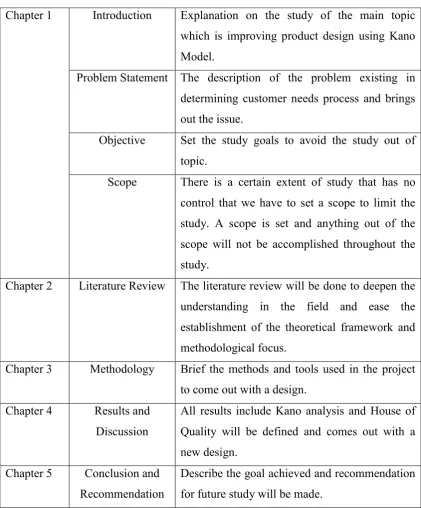
5 Table 1.1: Organization Structure of Project for Final Year Project
Chapter 1 Introduction Explanation on the study of the main topic which is improving product design using Kano Model.
Problem Statement The description of the problem existing in determining customer needs process and brings out the issue.
Objective Set the study goals to avoid the study out of topic.
Scope There is a certain extent of study that has no control that we have to set a scope to limit the study. A scope is set and anything out of the scope will not be accomplished throughout the study.
Chapter 2 Literature Review The literature review will be done to deepen the understanding in the field and ease the establishment of the theoretical framework and methodological focus.
Chapter 3 Methodology Brief the methods and tools used in the project to come out with a design.
Chapter 4 Results and Discussion
All results include Kano analysis and House of Quality will be defined and comes out with a new design.
Chapter 5 Conclusion and Recommendation
6
Chapter 2
LITERATURE REVIEW
2.0 Introduction
Chapter 2 provides an overview of previous research concerning the project. This chapter includes information about product design concept and Quality Function Deployment as well as the Kano model concept. The literature review is conducted based on the relevant journals, case studies, and books published in the recent years. At the end of this chapter, the literature review will be narrowed down to the work measurement method which will be applied to the study later.
2.1 Product Design Concept
Product design is the whole process of generating new idea or concept about the product until the production of the product and an improvement will be made continuously. According to Reid and Sanders (2012), product design is the process of defining the product characteristics or features. Product design will solve user’s problem and always adaptive to the ever-evolving world. Companies nowadays recognize the importance of product design which meets customer demands and there are many solutions are made to improve product design to satisfy customers. The development of most product design usually consists of certain steps as the following:
1. Idea Development 2. Product Screening
7 The development of product design begins with an idea. An idea often origins from problems in daily life and a product is designated to satisfy customer need. The idea is evaluated and a screening process is usually done after the process of idea development. This is then followed by preliminary design and testing. Marketing testing and prototype analysis are conducted in this process and final design of the product is determined and produced (Reid and Sanders, 2012).
2.2 Voice of Customer
8 customer in the process of developing product design. This indicates that the capturing of VOC is paid concern recently in product design or service field as well as marketing field.
2.3 Quality Function Deployment
Quality Function Deployment (QFD) is a method developed in 1960’s by Professors Shigeru Mizuno and Yoji Akao which transform voice of customer to engineering specification. Bu and Park (2016) views QFD as a tool to translate voice of customer in product development which can satisfy customer needs. Altun et al. (2016) characterize that QFD is a well-established methodology used in new product development to ensure the product design development process is driven by customer requirements. Zadry et al (2012) and Jaiswal (2012) also describe that QFD is an effective method to segment customer requirement according to product qualities.
2.3.1 Mechanism of Quality Function Deployment
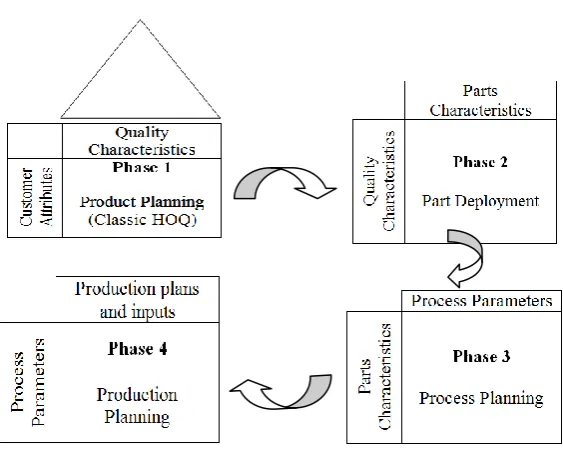
According to Jaiswal (2012), a comprehensive QFD generally provides four phases which are product planning, product design, process planning and production planning or process control. Product planning phase involves building a House of Quality (HOQ), a matrix form as a tool to translate product technical requirement to establish a relationship between customer and technical requirement. The second phase will be the product design which involves the translation of technical requirement to key part characteristics in the system. It is then followed by process planning stage which identifying the process operations to achieve the key part characteristics. The last phase will be production planning process which establishing process plan and controlling the operation.
9 QFD which are QFD cycle which has 4 broad phases and prioritization and correlation as depicted in Figure 2.1.
1. QFD Cycle
a) Translate voice of customer and competitor analysis into product features
b) Translate product features into specifications
c) Translate the product features into process performance features d) Translate product design requirement into process specification
2. Correlation and Prioritization
[image:23.595.183.465.337.562.2]Analysis the relationships among needs, features and requirements by using matrix
Figure 2.1: Complete Quality Function Deployment Phases
10 relationships between technical requirement elements. QFD matrices also comprise matrixes which involving the prioritization of technical requirement and customer competitive assessment as well as technical competitive assessment. The following is Figure 2.2 which depicts HOQ form.
Figure 2.2: House of Quality
2.3.2 Application of Quality Function Deployment
QFD is originally introduced for the product design in manufacturing field to serve a purpose which produces a product that meets customer needs (Jaiswal, 2012). Nevertheless, it can be widely used in many fields other than applying in manufacturing field itself nowadays. There is a trend in conducting researches about the application of QFD in different fields such as
3: HOWS Quality characteristics 1: WHATs Customer requirements Im po rtanc e t o cus to m
er 4: WHATs vs HOWs
How well quality characteristics contribute to customer requirements
2: WHYs
Customer competitive assessments
5: HOW MUCHes
At what level must we perform? Technical competitive assessments
Importance to product