A Normative Framework for Agent-Based Systems
Fabiola L´opez y L´opez
??University of Puebla
M´exico
Michael Luck
††University of Southampton
United Kingdom
Mark d’Inverno
‡‡University of Westminster
United Kingdom
Abstract
One of the key issues in the computational representation of open societies relates to the introduction of norms that help to cope with the heterogeneity, the autonomy and the diversity of interests among their members. Research regarding this issue presents two omissions. One is the lack of a canonical model of norms that facilitates their implementation, and that allows us to describe the processes of reasoning about norms. The other refers to considering, in the model of normative multi-agent systems, the perspective of individual agents and what they might need to effectively reason about the society in which they participate. Both are the concerns of this paper, and the main objective is to present a formal normative framework for agent-based systems.
1
Introduction
Norms have long been used as mechanisms to limit human autonomy in such a way that coexistence be-tween self-interested and untrusted people has been made possible. They are indispensable to overcome problems of coordination of large, complex and het-erogeneous systems where total and direct social con-trol cannot be exerted. From this experience, the in-troduction of norms that help to cope with the hetero-geneity, the autonomy and the diversity of interests among agents has been considered as a key issue to-wards the computational representation of open soci-eties of agents (Luck et al., 2003).
Although efforts have been made to describe and define the different types of norms that agents have to deal with (Dignum, 1999; Singh, 1999), work has not led into a model that facilitates the computational representation of any kind of norm. Each kind of norm appears to be different, which also suggests that different processes of reasoning should be proposed. There are some work that introduces norms in sys-tems of agents to represent societies, institutions and organisations (Dellarocas and Klein, 2001; Dignum and Dignum, 2001; Esteva et al., 2001; Shoham and Tennenholtz, 1995). This research is primarily fo-cused at the level of multi-agent systems, where norms represent the means to achieve coordination among their members. There, agents are assumed to be able to comply with norms, to adopt new norms, and to obey the authorities of the system but noth-ing is said about the reasons why agents might be willing to adopt and comply with norms, nor about
how agents can identify situations in which an au-thority’s orders are beyond its responsibilities. That is, although agents in such systems are said to be au-tonomous, their models of norms and systems reg-ulated by norms do not offer the means to explain why autonomous agents that are working to satisfy their own goals, still comply with their social respon-sibilities. In addition, although the importance of modelling compliance with norms as an autonomous decision has been identified by several researchers (Castelfranchi et al., 2000; Conte et al., 1999a; Conte and Dellarocas, 2001; Conte et al., 1999), the issue is only partly addressed by others whose proposals for norm compliance generally rely on specific decision-making strategies based on how much an agent gains or loses by complying with (Barbuceanu et al., 1999; Dignum et al., 2000), and on the probability of being caught by a defender of a norm (Boella and Lesmo, 2001). We consider these cases as very specific and, therefore, inadequate to model different kinds of nor-mative behaviour of autonomous agents.
first order logic (Spivey, 1992). The organisation of the paper is as follows. First, a formal definition of an autonomous agents is given. After that, an analy-sis of different properties of norms is provided. This analysis is then used to justify the elements that a gen-eral model of a norm must include in order to enable autonomous agents to reason about them. Next, the main properties of systems of autonomous agents that are regulated by norms are discussed and a model is presented. Then, we describe our proposal to enable agents to reason about norms. Finally, our conclu-sions are provided.
2
Autonomous Agents
The foundations of this work are taken from Luck and d’Inverno’sSMARTagent framework (d’Inverno and Luck, 2003) whose concept of motivations as the driving force that affects the reasoning of agents in satisfying their goals is considered as the underly-ing argument for agents to voluntarily comply with norms and to voluntarily enter and remain in a soci-ety. In the SMART agent framework, an attribute represents a perceivable feature of the agent’s envi-ronment, which can be represented as a predicate or its negation. Then, a particular state in the envi-ronment is described by a set of attributes, a goal represents situations that an agent wishes to bring about, motivations are desires or preferences that af-fect the outcome of the reasoning intended to satisfy an agent’s goals, and actions are discrete events that change the state of the environment when performed. For the purposes of this paper, we formally describe environmental states, goals, actions and autonomous agents. Details of the remaining elements are not needed, so we simply consider them as given sets.
[Attribute,Motivation]
EnvState==P
1Attribute
Goal==P
1Attribute
Action==EnvState →EnvState
AutonomousAgent
goals :PGoal; capabilities:PAction;
motivations:PMotivation;
beliefs :P
1Attribute
importance:P(PGoal×PMotivation)→N
goals 6=∅; motivations6=∅
∀x :PGoal,y :PMotivation•
(x,y)∈domimportance|
x ⊆goals∧y⊆motivations
In the above schema, an autonomous agent is de-scribed by a set of goals that it wants to bring about,
a set of capabilities that it is able to perform, a non-empty set of motivations representing its preferences, and a set of beliefs representing its vision about the external world. We also assume that the agent is able to determine theimportanceof its goals, which de-pends on its current motivations.
3
Norms
Norms facilitate mechanisms to drive the behaviour of agents, especially in those cases when their be-haviour affects other agents. Norms can be charac-terised by their prescriptiveness, sociality, and social pressure. In other words,
• a norm tells an agent how to behave (prescrip-tiveness);
• in situations where more than one agent is in-volved (sociality);
• and since it is always expected that norms con-flict with the personal interest of some agents, socially acceptable mechanisms to force agents to comply with norms are needed (social pres-sure).
By analysing these properties, the essential com-ponents of a norm can be identified.
3.1
Norm Components
Norms specify patterns of behaviour for a set of agents. These patterns are sometimes represented as actions to be performed (Axelrod, 1986; Tuomela, 1995), or restrictions to be imposed over an agent’s actions (Norman et al., 1998; Shoham and Tennen-holtz, 1995). At other times, patterns of behaviour are specified through goals that must either be satisfied or avoided by agents (Conte and Castelfranchi, 1995; Singh, 1999). Now, since actions are performed in order to change the state of an environment, goals are states that agents want to bring about, and restrictions can be seen as goals to be avoided, we argue that by considering goals the other two patterns of behaviour can be easily represented (as shown in (L ´opez and Luck, 2003)).
only consider what must be done but also for whom it must be done. Then, agents that benefit from the satisfaction of normative goals may also be included.
In general, norms are not applied all the time, but only in particular circumstances or within a specific context. Thus, norms must always specify the situ-ations in which addressee agents must fulfill them. Exception states may also be included to represent situations in which addressees cannot be punished when they have not complied with norms. Exceptions represent immunity states for all addressee agents in a particular situation (Ross, 1968). Now, to ensure that personal interests do not impede the fulfillment of norms, mechanisms either to promote compliance with norms, or to inhibit deviation from them, are needed. Norms may include rewards to be given when normative goals become satisfied, or punish-ments to be applied when they are not. Both rewards and punishments are the means for addressee agents to determine what might happen whatever decision they take regarding norms. They are not the respon-sibility of addressees agents but of other agents al-ready entitled to either reward or punish compliance and non-compliance with norms. Since rewards and punishments represent states to be achieved, it is nat-ural to consider them as goals but, in contrast with normative goals that must be satisfied by addressees, punishments and rewards are satisfied by agents enti-tled to do so.
In other words, a norm must be considered for fulfillment by an agent when certain environmental states, not included as exception states, hold. Such a norm forces a group of addressee agents to satisfy some normative goals for a (possibly empty) set of beneficiary agents. In addition, agents are aware that rewards may be enjoyed if norms become satisfied, or that punishments that affect their current goals can be applied if not. The formal specification of a norm is given in theNormschema where all the components of norms described here are included, together with some constraints on them. First, it does not make any sense to have norms specifying nothing, norms directed at nobody, or norms that either never or al-ways become applied. Thus, the first three predicates in the schema state that the set of normative goals, the set of addressee agents, and the context must never be empty. The fourth predicate states that the set of attributes describing both the context and exceptions must be disjoint to avoid inconsistencies in identi-fying whether a norm must be applied. The final constraint specifies that punishments and rewards are also consistent and, therefore, they must be disjoint.
Norm
normativegoals:PGoal
addressees:PNormativeAgent
beneficiaries :PNormativeAgent
context :EnvState
exceptions :EnvState
rewards :PGoal
punishments:PGoal
normativegoals6=∅
addressees6=∅
context 6=∅
context∩exceptions=∅
rewards∩punishments=∅
3.2
Considerations
The term norm has been used as a synonym for obli-gations (Boella and Lesmo, 2001; Dignum et al., 2000), prohibitions (Dignum, 1999), social laws (Shoham and Tennenholtz, 1995), and other kinds of rules imposed by societies (or by an authority). The position of our work is quite different. It considers that all these terms can be grouped in a general defini-tion of a norm, because they have the same properties (i.e. prescriptiveness, sociality and social pressure) and they can be represented by the same model. They all represent responsibilities for addressee agents, and create expectations for beneficiaries and other agents. They are also the means to support beneficiaries when they have to claim some compensation in the sit-uations where norms are not fulfilled as expected. Moreover, whatever the kind of norm being consid-ered, its fulfillment may be rewarded, and its viola-tion may be penalised. What makes one norm dif-ferent from another is the way in which they are cre-ated, their persistence, and the components that are obligatory in the norm. Thus, norms might be created by an agent designer as built-in norms, they can be the result of agreements between agents, or they can be elaborated by a complex legal system. Regarding their persistence, norms might be taken into account during different periods of time, such as until an agent dies, as long as an agent stays in a society, or just for a short period of time until its normative goals become satisfied. Finally, some components of a norm might not exist; there are norms that include neither pun-ishments nor rewards, even though they are complied with. Some of these characteristics can be used to provide a classification of norms into four main cate-gories: obligations, prohibitions, social commitments and social codes. Despite these differences, all types of norms can be reasoned about in similar ways.
that are either fulfilled or unfulfilled. However, since most of the time a norm has a set of agents as ad-dressees, the meaning of fulfilling a norm might de-pend on the interpretation of analysers of a system. In small groups of agents, it might be easy to consider a norm as fulfilled when every addressee agent has fulfilled the norm; by contrast, in larger societies, a proportion of agents complying with a norm will be enough to consider it as fulfilled. Instead of defining fulfilled norms in general, it is more appropriate to define norms being fulfilled by a particular addressee agent. To do so, the concept of norm instances is in-troduced as follows. Once a norm is adopted by an agent, a norm instance is created, which represents the internalisation of a norm by an agent (Conte and Castelfranchi, 1995). A norm instance is a copy of the original norm that is now used as a mental atti-tude from which new goals for the agent might be in-ferred. Norms and norm instances are the same con-cept used for different purposes. Norms are abstract specifications that exist in a society and are known by all agents (Tuomela, 1995), but agents work with in-stances of these norms. Consequently, there must be a separate instance for each addressee of a norm. Due to space constraints, formal definitions and examples of categories of norms, norm instances and fulfilled norms are not provided here but can be found else-where (L´opez and Luck, 2003).
3.3
Interlocking Norms
The norms of a system are not isolated from each other; sometimes, compliance with them is a condi-tion to trigger (or activate) other norms. That is, there are norms that prescribe how some agents must be-have in situations in which other agents either com-ply with a norm or do not comcom-ply with it (Ross, 1968). For example, when employees comply with their obligations in an office, paying their salary be-comes an obligation of the employer; or when a plane cannot take-off, providing accommodation to passen-gers becomes a responsibility of the airline. Norms related in this way can make a complete chain of norms because the newly activated norms can, in turn, activate new ones. Now, since triggering a norm de-pends on past compliance with another norm, we call these kinds of norms interlocking norms. The norm that gives rise to another norm is called the primary norm, whereas the norm activated as a result of ei-ther the fulfillment or violation of the first is called the secondary norm.
In terms of the norm model mentioned earlier, the context is a state that must hold for a norm to be complied with. Since the fulfillment of a norm is assessed through its normative goals, the context of
the secondary norm must include the satisfaction (or non-satisfaction) of all the primary norm’s normative goals. Figure 1 illustrates the structure of both the pri-mary and the secondary norms and how they are inter-locked through the primary norm’s normative goals and the secondary norm’s context.
satisfied (or unsatisfied) normative goals
normative goals . . . context exceptions . . .
normative goals . . . context exceptions . . . primary norm
[image:4.595.313.522.180.292.2]secondary norm
Figure 1: Interlocking Norm Structure
Formally, a norm is interlocked with another norm by non-compliance if, in the context of the secondary norm, an instance of the primary norm can be consid-ered as violated. This means that when any addressee of a norm does not fulfill the norm, the correspond-ing interlockcorrespond-ing norm will be triggered. The formal specification of this is given below, wheren1 repre-sents the primary norm andn2is the secondary norm.
lockedbynoncompliance :P(Norm×Norm)
∀n1,n2:Norm •
lockedbynoncompliance(n1,n2)⇔
(∃ni:NormInstance|
isnorminstance(ni,n1)•
¬fulfilled(ni,n2.context))
Similarly, a norm is interlocked with another norm by compliance if, in the context of the secondary norm, an instance of the primary norm can be con-sidered as fulfilled. Thus, any addressee of the norm that fulfills it will trigger the interlocking norm. The specification of this is given as follows.
lockedbycompliance :P(Norm×Norm)
∀n1,n2:Norm •
lockedbycompliance(n1,n2)⇔
(∃ni:NormInstance|
isnorminstance(ni,n1)•
fulfilled(ni,n2.context))
4
Normative Multi-Agent
Sys-tems
Since norms are social concepts, they cannot be stud-ied independently of the systems for which they are created and, consequently, an analysis of the norma-tive aspects of social systems must be provided. Al-though social systems that are regulated by norms are different from one another, some general charac-teristics can be identified. They consist of a set of agents that are controlled by the same set of norms ranging from obligations and social commitments to social codes. However, whereas there are static sys-tems in which all norms are defined in advance and agents in the system always comply with them (Bo-man, 1999; Shoham and Tennenholtz, 1995), a more realistic view of these kinds of systems suggests that when autonomous agents are considered, neither can all norms be known in advance (since new conflicts among agents may emerge and, therefore, new norms may be needed), nor can compliance with norms be guaranteed (since agents can decide not to comply). We can say then, that systems regulated by norms must include mechanisms to deal with both the modi-fication of norms and the unpredictable normative be-haviour of autonomous agents. So, normative multi-agent systems have the following characteristics.
• Membership. Agents in a society must be able to
deal with norms but, above all, they must recog-nise themselves as part of the system. This kind of social identification means that agents adopt the society norms and, by doing so, they show their willingness to comply with these norms.
• Social Pressure. Effective authority cannot be
exerted if penalties or incentives are not ap-plied when norms are either violated or com-plied with. However, this control must not be an agent’s arbitrary decision, and although it is only exerted by some agents, it must be socially accepted.
• Dynamism. Normative systems are dynamic
by nature. New norms are created and ob-solete norms are abolished. Compliance or non-compliance with norms may activate other norms and, therefore, force other agents to act. Agents can either join or leave the system. The normative behaviour of agent members might be unexpected, and it may influence the behaviour of other agents.
Given these characteristics, we argue that multi-agent systems must include mechanisms to defend norms, to allow their modification, and to identify au-thorities. Moreover, their members must be agents
able to deal with norms. Each one of these con-cepts is discussed in detail and formalised in (L ´opez and Luck, 2004), here, we present just a summary of them.
4.1
Normative Agents
The effectiveness of every structure of control relies on the capabilities of its members to recognise and follow its norms. However, given that agents are au-tonomous, the fulfillment of norms can never be taken for granted (L´opez et al., 2002). A normative agent is an agent whose behaviour is partly shaped by norms. They are able to deal with norms because they can represent, adopt, and comply with them. However, for autonomous agents, decisions to adopt or com-ply with norms are made on the basis of their own goals and motivations. That is, autonomous agents are not only able to act on norms but also they are able to reason about them. In what follows, all nor-mative agents are considered as autonomous agents that have adopted some norms (norms) and, has de-cided which norms to comply with (intended norms) and which norms to reject (rejected norms). Although their normative behaviour is described in the next sec-tion, their representation is given now in the schema below.
NormativeAgent AutonomousAgent
norms,intented,rejected:PNorm
intented ⊆norms
rejected⊆norms
4.2
Enforcement and Reward Norms
Particularly interesting for this work are the norms triggered in order to punish offenders of other norms. We call them enforcement norms and their addressees are the defenders of a norm. These norms repre-sent exerted social pressure because they specify not only who must apply the punishments, but also un-der which circumstances these punishments must be applied (Ross, 1968). That is, once the violation of a norm becomes identified by defenders, their duty is to start a process in which offender agents can be pun-ished. For example, if there is an obligation to pay accommodation fees for all students in a university, there must also be a norm stating what hall managers must do when a student refuses to pay.
the structures of both norms are related. By mod-elling enforcement norms in this way, we cause an offender’s punishments to be consistent with a de-fender’s responsibilities. Addressees of an enforced norm (i.e. the primary norm) know what could hap-pen if the norm is not complied with, and addressees of an enforcement norm (i.e. the secondary norm) know what must be done in order to punish the of-fenders of another norm. Enforcement norms allow the authority of defenders to be clearly constrained.
normative goals . . . context . . . punishments
unsatisfied normative goals
enforced norm
enforcement norm
[image:6.595.326.507.97.206.2]normative goals . . . context exceptions . . .
Figure 2: Enforcement Norm Structure
Formally, the relationship between a norm directed to control the behaviour of some agents and a norm directed at punishing the offenders of such a norm can be defined as follows. A norm enforces another norm if the first norm is activated when the second is violated, and all punishments associated with the violated norm are part of the normative goals of the first. Every norm satisfying this property is known as an enforcement norm.
enforces :P(Norm×Norm)
∀n1,n2:Norm•enforces(n1,n2)⇔
lockedbynoncompliance(n2,n1)∧
n2.punishments⊆n1.normativegoals
So far we have described some interlocking norms in terms of punishments because these are one of the more commonly used mechanisms to enforce com-pliance with norms. However, a similar analysis can be applied to interlocking norms corresponding to the process of rewarding members doing their du-ties. These norms must be interlocked by compli-ance and all the rewards included in the primary norm (rewarded norm) must be included in the normative goals of the secondary norm (reward norm). The re-lation between these norms is shown in Figure 3.
Formally, we say that a norm encourages compli-ance with another norm if the first norm is activated when the second norm becomes fulfilled, and the re-wards associated with the fulfilled norm are part of
normative goals . . . context . . . rewards
satisfied normative goals
rewarded norm
reward norm
[image:6.595.87.269.230.342.2]normative goals . . . context exceptions . . .
Figure 3: Reward Norm Structure
the normative goals of the first norm. Every norm satisfying this property is known as a reward norm.
rewardnorm :P(Norm×Norm)
∀n1,n2:Norm •rewardnorm(n1,n2)⇔
lockedbycompliance(n2,n1)∧
n2.rewards ⊆n1.normativegoals
It is important to mention that this way of repre-senting enforcement and reward norms can create an infinite chain of norms because we would also have to define norms to apply when authorities or defenders do not comply with their obligations, either to punish those agents breaking rules or to reward those agents that fulfill their responsibilities (Ross, 1968). The de-cision of when to stop this interlocking of norms is left to the creator of norms. If a system requires it, the model (and formalisation) for enforcing and en-couraging norms can be used recursively as neces-sary. There is nothing in the definition of the model itself to prevent this.
Both enforcement and reward norms acquire par-ticular relevance in systems regulated by norms be-cause the abilities to punish and reward must be re-stricted for use only by competent authorities (ad-dressees of enforcement and reward norms). Oth-erwise, offenders might be punished twice or more if many agents take this as their responsibility. It could also be the case that selfish agents demand un-just punishments or that selfish offenders reject being punished. That is, conflicts of interest might emerge in a society if such responsibilities are given either to no one or to anyone. Only through enforcement and reward norms can agents become entitled to punish or reward other agents.
4.3
Legislation Norms
establish-ment of commitestablish-ments, and others still to unify the be-haviour of agents as a means of social identification. However, neither all conflicts nor all commitments can be anticipated. Consequently, there must exist the possibility of creating new norms (to solve unex-pected and recurrent conflicts among agents), modi-fying existing ones (to increase their effectiveness), or even abolishing those that become obsolete. As above, these capabilities must be restricted to avoid conflicts of interest. That is, norms stating when ac-tions to legislate are permitted must exist in a nor-mative multi-agent system (Jones and Sergot, 1996). Formally, we say that a norm is a legislation norm if actions to issue and to abolish norms are permit-ted by this norm in the current environment. These constraints are specified below.
legislate :P(Norm×EnvState)
∀n :Norm; env :EnvState•
legislate(n,env)⇔
(∃issuingnorms,abolishnorms:Action•
permitted (issuingnorms,n,env)∨
permitted (abolishnorms,n,env))
4.4
Normative
Multi-Agent
Systems
Model
A normative multi-agent system is formally repre-sented in the NormativeMAS schema. It com-prises a set of normative agent members (i.e. agents able to reason about norms) and a set of general norms that govern the behaviour of these agents
(generalnorms). Norms issued to allow the creation
and abolition of norms (legislationnorms) are also included. There are also norms dedicated to enforc-ing other norms (enforcenorms) and norms directed to encouraging compliance with norms through re-wards (rewardnorms). Legislation, enforcement and reward norms are better discussed in (L ´opez and Luck, 2004). The current state of the environment is represented by the variable environment. Con-straints over these components are imposed as fol-lows. Although it is possible that agents do not know all the norms in the system, it is always expected that they at least adopt some norms, represented by the first predicate. The second predicate makes explicit that addressees of norms must be members of the system. Thus, addressee agents of every norm must be included in the set of member agents because it does not make any sense to have norms addressed to nonexistent agents. The last three predicates respec-tively describe the structure of enforcement, reward and legislation norms. Notice that whereas every en-forcement norm must have a norm to enforce, not
every norm may have a corresponding enforcement norm, in which case no one in the society is legally entitled to punish an agent that does not fulfill such a norm.
NormativeMAS
members:PNormativeAgent
generalnorms,legislationnorms:PNorm
enforcenorms,rewardnorms:PNorm
environment:EnvState
∀ag :members•
ag.norms∩generalnorms6=∅
∀sn :generalnorms•
sn.addressees⊆members
∀en:enforcenorms•
(∃n :generalnorms•enforces(en,n))
∀rn:rewardnorms•
(∃n :generalnorms•rewardnorm(rn,n))
∀ln:legislationnorms•
legislate(ln,environment)
4.5
Normative Roles
Defining normative multi-agent systems in this way allows the identification of the authorities of the sys-tem as formalised in theAuthoritiesNMAS schema. The set of agents that are entitled to create, mod-ify, or abolish norms is called legislators. No other members of the society are endowed with this au-thority, and generally they are either elected or im-posed by other agents. Defender agents are directly responsible for the application of punishments when norms are violated. That is, their main responsibil-ity is to monitor compliance with norms in order to detect transgressions. Moreover, they can also warn agents by advertising the bad consequences of being rebellious. By contrast, promoter agents are those whose responsibilities include rewarding compliant addressees. These agents also monitor compliance with norms in order to determine when rewards must be given, and instead of enforcing compliance with norms, they simply encourage it.
AuthoritiesNMAS NormativeMAS
legislators:PNormativeAgent
defenders :PNormativeAgent
promoters:PNormativeAgent
∀lg:legislators •(∃l:legislationnorms•
lg ∈l.addressees)
∀df :defenders•(∃e:enforcenorms•
df ∈e.addressees)
∀pm:promoters •(∃r :rewardnorms•
5
Autonomous Normative
Rea-soning
Whereas agents that always comply with norms are important for the design of societies in which total control is needed (Boman, 1999; Shoham and Ten-nenholtz, 1995), agents that can decide on the basis of their own goals and motivations whether to com-ply with them are important for the design of dy-namic systems in which agents act on behalf of dif-ferent users and, while satisfying their own goals, are able to join a society and cooperate with other agents. Autonomous norm reasoning is important to address those situations in which an agent’s goals conflict with the norms that control its behaviour in-side a society. Agents that deliberate about norms are also needed in systems in which unforseen events might occur, and in those situations in which agents are faced with conflicting norms, and they have to choose between them. It should be clear that violation of norms is, sometimes, justified. To describe norma-tive reasoning, therefore, we have to explain not only what might motivate an agent to adopt, dismiss or complying with a norm, but also the way in which this decision affects its goals. In consequence we propose three different processes: one for agents to decide whether to adopt a norm (the norm adoption process), another to decide whether to comply with a norm (the norm deliberation process), and the other to update the goals, and therefore the intentions of agents ac-cordingly (the norm compliance process). All these processes must take into account not only the goals and motivations of agents, but also the mechanisms of the society to avoid violation of norms such as re-wards and punishments. Thus, agents consider the so called social pressure of norms before making any decision.
5.1
The Norm Adoption Process
The norm adoption process can be better defined as the process through which agents recognise their re-sponsibilities towards other agents by internalising the norms that specify these responsibilities. Thus, agents adopt the norms of a society either once they have decided to join it or in the case a new norm is issued while they are still there. For autonomous agents to join and stay in a society the social sat-isfaction condition must hold (L ´opez et al., 2004). An agent considers this condition as satisfied if, al-though some of its goals become hindered by its re-sponsibilities, its important goals can still be satis-fied. Thus, we consider that the following conditions must be satisfied for agents to adopt a norm: the agent must recognise itself as an addressee of the norm; the
norm must not already be adopted; the norm must have been issued by a recognised authority; and the agent must have reasons to stay in the society. No-tice that to adopt a norm as an end, only the first three conditions are needed, whereas the last condi-tion is an indicator that the decision to adopt a norm is made in an autonomous way. Due to space con-straints, theNormAdoption schema only formalises the first three conditions but details of the fourth con-dition can be found elsewhere (L ´opez et al., 2004).
NormAdoption
∆NormativeAgent
new? :Norm
issuer?,self :NormativeAgent
authorities :PNormativeAgent
issuedby:P(Norm×NormativeAgent)
self ∈new?.addressees
new?6∈norms
(new?, issuer?)∈issuedby⇔
issuer?∈authorities
norms0=norms∪ {new?}
5.2
The Norm Deliberation Process
To comply with the norm, agents assess two things: the goals that might be hindered by satisfying the nor-mative goals, and the goals that might benefit from the associated rewards. By contrast, to reject a norm, agents evaluate the damaging effects of punishments (i.e. the goals hindered due to the satisfaction of the goals associated with punishments.) Since the satis-faction of some of their goals might be prevented in both cases, agents use the importance of their goals to make these decisions. This, to deliberate about a norm, an agents pursues the following steps.
• A set of active norms is selected from the set of adopted norms (norm instances). Active norms are those that agents believe must be complied with in the current state, which is not an excep-tion state (i.e. those norms for which the context matches the beliefs of the agent).
• The agent divides active norms into non-conflicticting and conflicting norms. An active norm is non-conflicting if its compliance does not cause any conflict with one of the agent’s current goals. Thus, no goals of the addressee agent are hindered by satisfying the normative goals of the norm. By contrast, an active norm is conflicting if its fulfillment hinders any of the agent’s goals.
intended or rejected are given in (L ´opez et al., 2002). After norm deliberation, the set of in-tended norms consists of those conflicting and non-conflicting norms that are accepted to be complied with by the agent, and the set of re-jected norms consists of all conflicting and non-conflicting norms that are rejected by the agent.
The state of an agent that has selected the norms it is keen to fulfill is formally represented in the
NormAgentState schema. This represents a
nor-mative agent with a variable representing the sets
of active norms at a particular point of time. The
conflicting predicate holds for a norm if and only if
its normative goals conflict (hinder) with any of the agent’s current goals. The next three predicates state that active norms are the subset of adopted norms that the agent believes must be complied with in the cur-rent state and that, the set of active norms has already been assessed and divided into norms to intend and norms to reject. The state of an agent is consistent in that its current goals do not conflict with the intended norms and, consequently, no normative goal must be in conflict with current goals. Moreover, since re-wards benefit the achievement of some goals, so that agents do not have to work on their satisfaction be-cause someone else does, these goals must not be part of the goals of an agent. The final predicate states that punishments must be accepted and, therefore, none of the goals of an agent must hinder them.
NormAgentState NormativeAgent
activenorms,conflicting :PNorm
∀n :activenorms •conflicting n⇔
hinder(goals,n.ngoals)6=∅
activenorms ⊆norms
∀an :activenorms •
logcon(beliefs,an.context)
activenorms =intended∪rejected
hinder(goals,normgoals intended) =∅
benefit(goals,rewardgoals intended)
∩goals =∅
hinder(goals,punishgoals rejected) =∅
For a norm to be intended, some constraints must be fulfilled. First, the agent must be an addressee of the norm. Then, the norm must be an adopted and currently active norm, and it must not be already in-tended. In addition, the agent must believe that it is not in an exception state and, therefore, it must com-ply with the norm. Formally, the process to accept a single norm as input (new?) to be complied with is specified in theNormIntend schema. The first five predicates represent the constraints on the agent and
the norm as described above. The sixth predicate rep-resents the addition of the accepted norm to the set of intended norms and the final predicate represents the set of rejected norms remains the same.
NormIntend
new? :Norm
∆NormAgentState
self ∈new?.addressees
new?∈norms
new?∈activenorms
new?6∈intended
¬logcon(beliefs,new?.exceptions)
intended0 =intended∪ {new?}
rejected0 =rejected
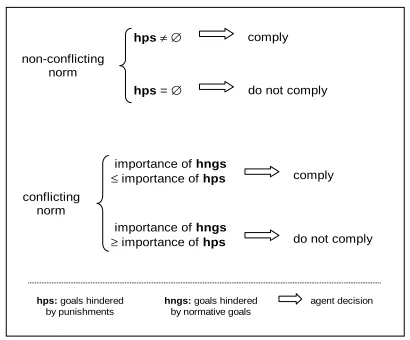
The process to reject a norm (NormReject) can be defined similarly. Now, there are different ways to se-lect the norms to be intended or rejected as explained in (L´opez et al., 2002). Here, we describe what is called a pressured strategy where an agent fulfills a norm only in the case that one of its goals is threat-ened by punishments. That is, agents are pressured to obey norms through the application of punishments that might hinder some of their important goals. In this situation, the agent faces four different cases.
1. The norm is a non-conflicting norm and some goals are hindered by its punishments.
2. The norm is a non-conflicting norm and there are no goals hindered by its punishments.
3. The norm is a conflicting norm and the goals hindered by its normative goals are less impor-tant than the goals hindered by its punishments.
4. The norm is a conflicting norm and the goals hindered by its normative goals are more impor-tant than the goals hindered by its punishments. The first case represents the situation in which, by complying with a norm, an agent does not put at risk any of its goals (because the norm is non-conflicting), but if the agent decides not to fulfill it, some of its goals could be unsatisfied due to punishments. Con-sequently, fulfilling a norm is the best decision for this kind of agent. To formalise this, we use the
NormIntend operation schema to accept complying
with the norm, and we add two predicates to specify that this strategy is applied to non-conflicting norms whose punishments hinder some goals.
PressuredNCComply NormIntend
¬conflicting new?
In the second case, by contrast, since punishments do not affect an agent’s goals, it does not make any sense to comply with the norm, so it must be rejected. Formally, theNormRejectoperation schema is used when the norm is non-conflicting (first predicate) and its associated punishments do not hinder any existing goals (second predicate).
PressuredNCReject NormReject
¬conflicting new?
hinder(goals,new?.punishments) =∅
According to our definition, a conflicting norm is a norm whose normative goals hinder an agent’s goals. In this situation, agents comply with the norm at the expense of existing goals only if what they can lose through punishments is more important than what they can lose by complying with the norm. For-mally, a conflicting norm is intended if the goals that could be hindered by punishments (hps) are more important than the set of existing goals hindered by normative goals (hngs). This is represented in the
PressuredCComply schema where theimportance
function uses the motivations associated with the set of goals to find the importance of goals.
PressuredCComply NormIntend
conflicting new?
lethps ==hinder(goals,
new?.punishments)•
lethngs ==hinder(goals,new?.ngoals)•
importance(motivations,hps)>
importance(motivations,hngs)
However, if the goals hindered by normative goals are more important than the goals hindered by pun-ishment, agents prefer to face such punishments for the sake of their important goals and, therefore, the norm is rejected. Formally, a conflicting norm is re-jected by using theNormRejectoperation schema if the goals hindered by its punishments (hps) are less important than the goals hindered by its normative goals (hngs).
PressuredCReject NormReject
conflicting new?
lethps ==hinder(goals,new?.punishments)•
lethngs ==hinder(goals,new?.ngoals)•
importance(motivations,hps)≤
importance(motivations,hngs)
All these cases are illustrated in Figure 4
conflicting norm
hps ≠∅
non-conflicting norm
hps = ∅
comply
do not comply
hngs: goals hindered
by normative goals
hps: goals hindered
by punishments
importance of hngs
≤ importance of hps comply
do not comply importance of hngs
≥ importance of hps
[image:10.595.315.520.94.264.2]agent decision
Figure 4: Pressured Norm Compliance
5.3
The Norm Compliance Process
Once agents take a decision about which norms to ful-fill, a process of norm compliance must be started in order to update an agent’s goals in accordance with the decisions it has made. An agent’s goals are af-fected in different ways, depending on whether the norm is intended or rejected. The cases can be listed as follows.
• All normative goals of an intended norm must be added to the set of goals because the agent has decided to comply with it.
• Some goals are hindered by the normative goals of an intended norm. These goals can no longer be achieved because the agent prefers to com-ply with the norm and, consequently, this set of goals must be removed from the agent’s goals.
• Some goals benefit from the rewards of an in-tended norm. Rewards contribute to the satis-faction of these goals without the agent having to make any extra effort. As a result, those goals that benefit from rewards must no longer be con-sidered by the agent to be satisfied, and must be removed from the set of goals.
• Rejected norms only affect the set of goals hin-dered by the associated punishments. This set of goals must be removed; this is the way in which normative agents accept the consequences of their decisions.
or goals that benefit from rewards can be empty if a norm does not include any of them. After norm com-pliance, the goals are updated and, consequently, the intentions of agents might change. The process to comply with the norms an agent has decided to fulfill is specified in theNormComply schema. Through this process, the set of goals is updated according to our discussion above.
NormComply
∆NormAgentState
letngs ==S{gs :PGoal|
(∃n :intended •gs =n.ngoals)} •
lethngs ==S{gs:PGoal |(∃n:intended•
gs =hinder (goals,n.ngoals))} •
letbrs ==S{gs :PGoal|(∃n :intended•
gs =benefit(goals,n.rewards))} •
lethps ==S{gs :PGoal|(∃n :rejected•
gs =hinder (goals,n.punishments))} •
( goals0 = (goals∪ngs)\
(hngs∪brs∪hps))
6
Conclusions
In this paper, we have presented a normative frame-work which, besides providing the means to compu-tationally represent many normative concepts, can be used to give a better understanding of norms and nor-mative agent behaviour. The framework explains not only the role that norms play in a society but also the elements that constitute a norm and that, in turn, can be used by agents when decisions concerning norms must be taken. In contrast to other proposals, our normative framework has been built upon the idea of autonomy of agents. That is, it is intended to be used by agents that reason about why norms must be adopted, and why an adopted norm must be complied with. Our framework consists of three main compo-nents: a canonical model of norms, a model of nor-mative multi-agent systems and a model of nornor-mative autonomous agents.
The model of norms differs from others (Boman, 1999; Shoham and Tennenholtz, 1995; Tuomela, 1995) in the way in which patterns of behaviour are prescribed. To describe the pattern of behaviour pre-scribed by a norm, other models use actions, so that agents are told what exactly they must do. By con-trast, we use normative goals, which is an idea more compatible with autonomous agents whose behaviour is driven by goals. Agents can choose the way to sat-isfy the normative goals, instead of being told exactly how it must be done. Our work also emphasises that all norms can be represented by using similar compo-nents, and that they are analysed by agents in similar
ways. However, what makes one norm different from another is the way in which norms are created, how long they are valid, and the reasons agents have to adopt them. These factors enable norms to be divided into categories such as obligations and prohibitions, social commitments and social codes.
A collateral result of our work is the proposed model for interlocking norms. These relations be-tween norms have already been mentioned in several papers, especially from philosophical and legal per-spectives (Ross, 1968), but no ways to model them have been provided. Dignum’s concept of authori-sations (Dignum, 1999) attempts to describe norms activated when others are not fulfilled; however, his idea and models are incomplete. We claim that this form of representing connections between norms can be used not only to represent enforcement and reward norms, but also to represent things as complex as con-tracts and deals among agents.
In contrast to current models of systems regulated by norms (Balzer and Tuomela, 2001; Dignum and Dignum, 2001; Esteva et al., 2001; Shoham and Ten-nenholtz, 1995) in which no distinction among norms is made, our work emphasises that besides the general norms of the system, at least three kinds of norms are needed, namely norms to legislate, to punish, and to reward other agents. By making this differentiation, agents are able to determine when an issued norm is valid, when an entitled agent can apply a punishment, and who is responsible for giving rewards. In addi-tion, order is imposed on agents responsible for the normative behaviour of other agents, because their authority is defined by the norms that entitle them to exert social pressure. Roles for legislators, defenders, and promoters of norms become easily identified as a consequence of the different kinds of norms consid-ered. Thus, in this framework, the authority of agents is always supported and constrained by norms.
Acknowledgements
The first author acknowledges funding from the Fac-ulty Enhancement Program (PROMEP) of the Mex-ican Ministry of Public Education (SEP), project No PROMEP/103.5/04/767.
References
R. Axelrod. An evolutionary approach to norms. The American Political Science Review, 80(4):1095– 1111, 1986.
M. Barbuceanu, T. Gray, and S. Mankovski. The role of obligations in multiagent coordination. Applied Artificial Intelligence, 13(1/2):11–38, 1999.
G. Boella and L. Lesmo. Deliberative normative agents. In C. Dellarocas and R Conte, editors, So-cial Order in Multi-Agent Systems, pages 85–110. Kluwer Academic, 2001.
M. Boman. Norms in artificial decision making. Ar-tificial Intelligence and Law, 7(1):17–35, 1999.
C. Castelfranchi, F. Dignum, C. Jonker, and J. Treur. Deliberative normative agents: Principles and ar-chitecture. In N. Jennings and Y. Lesperance, edi-tors, Intelligent Agents VI, LNAI 1757, pages 206– 220. Springer, 2000.
R. Conte and C. Castelfranchi. Cognitive and Social Action. UCL Press, 1995.
R. Conte, C. Castelfranchi, and F. Dignum. Au-tonomous norm-acceptance. In J. M ¨uller, M. Singh, and A. Rao, editors, Intelligent Agents V, LNAI 1555, pages 319–333. Springer, 1999a.
R. Conte and Ch. Dellarocas. Social order in info societies: An old challenge for innovation. In C. Dellarocas and R Conte, editors, Social Order in Multi-Agent Systems, pages 1–15. Kluwer Aca-demic, 2001.
R. Conte, R. Falcone, and G. Sartor. Agents and norms: How to fill the gap? Artificial Intelligence and Law, 7(1):1–15, 1999.
C. Dellarocas and M. Klein. Contractual agent soci-eties: Negotiated shared context and social control in open multi-agent systems. In C. Dellarocas and R Conte, editors, Social Order in Multi-Agent Sys-tems, pages 113–133. Kluwer Academic, 2001.
F. Dignum. Autonomous agents with norms. Artifi-cial Intelligence and Law, 7(1):69–79, 1999.
F. Dignum, D. Morley, E. Sonenberg, and L. Caven-don. Towards socially sophisticated BDI agents. In Edmund H. Durfee, editor, The Fourth Interna-tional Conference on Multi-Agent Systems, pages 111–118. IEEE Computer Society, 2000.
V. Dignum and F. Dignum. Modelling agent soci-eties: Coordination frameworks and institutions. In P. Brazdil and A. Jorge, editors, Progress in Artificial Intelligence Knowledge Extraction, Multi-agent Systems, Logic Programming, and Constraint Solving, LNAI 2258, pages 191–204. Springer-Verlag, 2001.
M. d’Inverno and M. Luck. Understanding Agent Systems. Springer-Verlag, second edition, 2003.
M. Esteva, J. Padget, and C. Sierra. Formalizing a language for institutions and norms. In J. Meyer and M. Tambe, editors, Intelligent Agents VIII, LNAI 2333, pages 348–366. Springer, 2001. A. Jones and M. Sergot. A formal characterisation of
institutionalised power. Logic Journal of the IGPL, 4(3):429–445, 1996.
F. L´opez y L´opez and M. Luck. Modelling norms for autonomous agents. In E. Ch´avez, J. Favela, M. Mej´ıa, and A. Oliart, editors, The Fourth Mexi-can Conference on Computer Science, pages 238– 245. IEEE Computer Society, 2003.
F. L´opez y L´opez and M. Luck. A model of normative multi-agent systems and dynamic relationships. In G. Lindemann, D. Moldt, and M. Paolucci, edi-tors, Regulated Agent-Based Social Systems, LNAI 2934, pages 259–280. Springer-Verlag, 2004. F. L´opez y L´opez, M. Luck, and M. d’Inverno.
Con-straining autonomy through norms. In C. Castel-franchi and W.L. Johnson, editors, The First Inter-national Joint Conference on Autonomous Agents and Multi Agent Systems AAMAS’02, pages 674– 681. ACM Press, 2002.
F. L´opez y L´opez, M. Luck, and M. d’Inverno. Nor-mative agent reasoning in dynamic societies. In N. Jennings, C. Sierra, L. Sonenberg, and L Tambe, editors, The Third International Joint Conference on Autonomous Agents and Multi Agent Systems AAMAS’04, pages 730–737. ACM Press, 2004. M. Luck, P. McBurney, and C. Preist. Agent
Technology: Enabling Next Generation Comput-ing (A Roadmap for Agent Based ComputComput-ing). AgentLink, 2003.
T. Norman, C. Sierra, and N. Jennings. Rights and commitments in multi-agent agreements. In Yves Demazeau, editor, The Third International Confer-ence on Multi-Agent Systems (ICMAS-98), pages 222–229. IEEE Computer Society Press, 1998. A. Ross. Directives and Norms. Routledge and Kegan
Paul Ltd., 1968.
Y. Shoham and M. Tennenholtz. On social laws for artificial agent societies: Off-line design. Artificial Intelligence, 73(1-2):231–252, 1995.
M. Singh. An ontology for commitments in multi-agent systems: Toward a unification of normative concepts. Artificial Intelligence and Law, 7(1):97– 113, 1999.
J. M. Spivey. The Z Notation: A Reference Manual. Prentice-Hall, 1992.