Impact for Agents
Tom Wagner
Les Gasser
Michael Luck
James Odell
Todd Carrico
1. Introduction
Impact for agents. Most of the agent research community
has been predicting greater impact for years and many of us have been working to help the process along. Yet the tremen-dous growth on the research front has not been met with a corresponding growth in commercial applications. This pa-per contains a diverse set of thoughts on the issue of devel-oping impact for agents. The authors were not given a set of questions to address but were asked to focus on the problem of developing greater impact for agents from their particu-lar vantage point. Sections range from those that are very ap-plied, e.g., how to “sell” a concept to those that examine the issues from a more intellectual level. Each section is pref-aced with a small biography on the author of that section to properly place his/her comments in context. While the ma-terial is diverse, it is our hope that these thoughts are either directly useful or help to articulate issues of interest.
2. Motivating Investment – Tom Wagner
Tom Wagner is currently serving a four year term as a Program Manager for the Defense Advanced Research Projects Agency (DARPA) in the IPTO office. Prior to this, Wagner was a principal research scientist at Honeywell Lab-oratories where he led the agent research group. Previous positions include being an assistant professor at the Uni-versity of Maine and having leadership roles in several en-trepreneurial efforts.
Most of our research community believes that the in-herently distributed nature of modern computing mandates agent-based solutions and that with the increasing prolifer-ation of wireless and mobile computing devices, of varying capacities and configurations (i.e., heterogeneous), this will only be more true in the future. However, even with these of-ten uncontested visions for the future, motivating investment in agent technology has been an uphill battle. Without invest-ment, research will be hampered, commercial relevance will be slow in coming, and impact will be muddied at best.
Copyright held by the author(s). AAMAS’05, July 25-29, 2005, Utrecht, Netherlands. ACM 1-59593-094-9/05/0007
Information Processing Technology Office, Defense Advanced Re-search Projects Agency, [email protected]
Graduate School of Library and Information Science, University of Illi-nois, [email protected]
Computer Science, University of Southampton, [email protected]
Agentis Software, [email protected]
Cougaar Software, [email protected]
The expression “motivating investment” means getting someone to invest in your technology. This section focuses on that topic in a fairly applied fashion – it is my experi-ence that often we have many of the critical elements needed for impact but that we aren’t business people by trade and often do not know how to motivate investment. Where you look for such investment and how you approach it depends on your specific goals and how near term you are focused. There are many involved ways to classify work in terms of time to deployment – for simplicity let us simply state that these remarks tend to be more relevant for those interested in mid to near term deployment, i.e., those interested in hav-ing impact on the world of computhav-ing in the near term. Note that these remarks are not facts and should not be confused
with such.
Know your customer and understand his/her problem.
Pitches that focus on general technology or “my technol-ogy can do these neat things” tend not to get you what you want. Most often a given stakeholder has a particular set of problems that he/she will invest in because there are busi-ness drivers behind those problems. You may not be able to structure a complete business case for your idea but it is very helpful if you can structure your remarks to be as close as possible to the area of interest for the stakeholder.
If you don’t know your customer’s problem, create a vi-sion. It is rare for a customer/stakeholder to come to a
re-searcher with a ready made problem. If you don’t know their problem, or are seeking more mid-term grade investment, create a vision or concept that is in your customer’s inter-est area and speak to that. Note that this process is inherently more difficult because then you are in the position of hav-ing to sell both the problem and sell the solution [5]. How-ever, you may also be able to grab someone’s interest with a particularly compelling and novel idea.
Understand your customer’s product/market mix. An
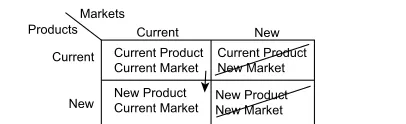
im-portant tool when developing a new concept is Ansoff’s product-market-expansion grid, shown in Figure 1. This is a basic tool that business people use to make sure they ex-pand from a position of strength. In the matrix, exex-panding right or down from the current state is desirable while ex-panding diagonally is not. As a researcher, you are generally limited to the one downward transition.
Know your value proposition. You must be able to
bet-Products Markets
Current
Current Product New Market New Product New Market New Product
Current Market Current Product Current Market
New Current
[image:2.612.90.293.76.138.2]New
Figure 1.Product/Market Expansion Grid
ter) they are more meaningful.
You have 3.5 minutes to make your point. The number
may be 5 minutes but it is not 30. If you cannot clearly artic-ulate, in short order, what you offer, why they should care, and what resources you need to accomplish your task, you should go back over your materials. Make your point at an executive level but be ready with backup.
Shooting too near term is problematic for researchers. By
definition, we aren’t commercial software developers and we don’t generally manage commercial projects. Accordingly we tend to be expensive and not very credible at commer-cial efforts. We also generally still have a research issue or two that we want to work and this will invariably come out during conversations with your stakeholder – such items hin-der very near term investment.
There is always an opportunity cost. Resources are
lim-ited. Investing in the maturation of research ideas must have a high estimated return to compensate for the high risk in-volved. (Even then the dollars may go to lower risk/lower re-ward activities such as enhancing existing products.)
Early adopters versus originators. Unless some idea is
right on the corporate vector, e.g., new brewing technology for Starbucks, many business would rather let someone else incur the initial product development risk and then copy the ideas (or license them) if they turn out to be good ideas.
The term “agent” may not buy you anything. When
us-ing the word “agent” I have had reactions that range from (a) “Agents? I already have them” to (b) “Isn’t that all just more AI hype?” to (c) “I’ve never heard of an agent. What do you mean?” The first reaction might imply that the person thinks of agents as distributed objects (this may be a good thing if that is how you view agents also). The problem here is that if they already have them, or perceive them as a simple pro-gramming tool, they don’t need your (costly) expertise. They can just download an SDK and away they go. The second re-action stems from how overloaded the term is and its unclear semantics (and yes, some hyping of “agents”). The third re-action might seem like an invitation but often that conversa-tion is a red herring. You might wind up discussing agents in general terms and the unclear semantics / wide range of pos-sible topics might leave your listener with a wrong or con-fused impression. You will also invariably be asked who else is using agents and how it is benefiting their business. Data on that front is sparse at best. Because of these reactions, I no longer use the term “agent” in certain kinds of talks. I’ll
re-fer you back to knowing your customer (above) and solving his/her problem (also above). Don’t sell agents – sell a solu-tion.
Autonomy is not desired in many domains. Autonomy can
be a frightening word in some contexts. Consider using a dif-ferent expression and for more critical applications keep the human in the loop, i.e., think “decision support.”
Distributed computing is not universally recognized as a “good thing.” Be ready to make an argument for why a given
problem cannot simply be solved in a centralized or mono-lithic fashion.
If they ask about software issues, you have already sold them on your overall concept. If your customer starts asking
about how bullet-proof your agent software is, they are inter-ested enough in the business concept or overall idea that they are trying to assess second level feasibility and risk. Gener-ally this is a very good position from which to operate.
Selling frameworks or middleware seems to be inherently difficult. This is because the value proposition is not clear to
anyone who isn’t in the middleware business, i.e., first they have to pay for it then they have to figure out what applica-tions to build with it.
The world may be more primitive than you think. As
re-searchers we are used to focusing on future visions – take a look at Windows Notepad before going into your meeting to pitch a non technical person.
You are asking for someone else’s money. Whether it is
corporate funds, venture capital, or the funds of your gov-ernment, you are asking for someone else’s money. In most cases there isn’t a line item in the budget that says “fund agent research” or even one that says “fund AI research” (and possibly not one that says “fund research” or anything close). Be aware that your potential customer probably has no com-pelling reason to give you their money but must be motivated by you to do so.
Leave the “snake oil” at home. Identify realistic pursuits
for your efforts and engage them. If you have to bend and twist your interests too far you either won’t be compelling or you won’t be happy with the work even if you obtain the resources.
Even if you do it perfectly, you may not get anything.
There are barriers to agents, and any leading edge technol-ogy, that are beyond your control in the near term. (In the long term, the very act of you trying to obtain investment for a more near term project will help remove these barri-ers.) The best you can do is present your material well and try-try-again if you do not get traction the first time around.
per-centage of the community recognizes the value of this work and engages in the challenge.
3. Build on strengths and remove barriers – Les
Gasser
Les Gasser is an Associate Professor of Library and In-formation Science, with joint appointments in Computer Sci-ence and Computational SciSci-ence/Engineering, at the Uni-versity of Illinois at Urbana-Champaign. He has published over seventy technical papers and five books in multi-agent systems. He is currently Past-President of the International Foundation for Multi-Agent Systems (IFMAS), and is one of the founders of the field. A former Program Director for the National Science Foundation handling MAS areas, he has also been a principal or advisor with a number of technol-ogy startup firms.
For over 25 years the MAS community has been debating how to make apparent and increase its impact in the AI and computing communities. Twenty-five years ago, F. Hayes-Roth famously justified a new multi-agent viewpoint on AI, saying “All real systems are distributed” [6]. In 1980 he had
to point it out. Today this is taken for granted. Because the
distributed nature of knowledge and action are now so perva-sively natural, the impacts of three decades of MAS research effort often seem to have vanished.
Nonetheless, MAS research and technology has built two strong pillars of progress. First, it has clarified many dis-tributed, contingent, and interdependent features of knowl-edge and action. Today we know that smart machines can’t act alone, and thanks to MAS research we have much deeper models that explain why managing interdependent activity is so hard. Second, MAS research has actually built technolo-gies that provide generalized solutions to hard distributed problems, such as:
Tractably creating, monitoring, and adapting joint plans that are sensitive to resource and quality constraints. Deciding when, with whom, and what to communicate to meet collective goals
Designing constraints on interactions so that agents’ be-haviors converge on collectively useful solutions that fall within desirable bounds.
MAS theories and technologies have already provided significant benefits even with partial adoption in commer-cial settings [9, 8]. In commercommer-cial setting, as Parunak said (2000) “The question is no longer to prove whether agents
can solve realistic problems.” Two MAS application
do-mains where adoption has been more than partial are /em systems modeling and /em entertainment. A major and quite evident successes of MAS in academia, business, and in gov-ernment/policy arenas is the use of MAS for modeling social, economic, environmental, and governmental systems. Multi-agent models are proving to be critical and high-leverage
un-derpinnings for policy discussions, negotiations, and science in many of these areas. They are critical partly because of the types of problems faced (complex, analytically difficult); partly due to MAS tools that provide easy entry and worked examples; and partly because of human-in-the-loop features of modern MAS models. Another area of major current im-pact for agents is in entertainment and games, including film production (e.g., realistic computer-generated scenes in-volving multiple agents), massive multiplayer games (MM-PORGs), and the like.
Perhaps more importantly, the basic landscape of AI has changed as research into agent-based systems has grown. Today, the ultimate goal of artificial intelligence is widely seen as understanding how to build active, embodied, inte-grated agents that behave in socially-realistic ways (i.e., can integrate with people’s activities, attend to social conven-tions, and operate under people’s oversight), and that can reason and act collectively and in coordination with oth-ers. Research continues into component theories and tech-nologies, such as learning, planning, memory, perception, and representation. But all of these are now seen as compo-nents of a larger, integrated picture. This new picture always accommodates social realism and always includes multiple participants, with different representations, values, and life histories—in short, diversity. The AI tide has turned strongly toward multi-agent systems, and this sea-change is itself a major impact of the MAS perspective on the science of AI and on many other sciences.
Nonetheless, several critical barriers seem to prevent the partial successes of MAS from growing into more complete acceptance, and offering even greater impacts.
Parallel and invisible MAS origins: It often seems that
Solve the problems of others: An accomplished
the-ater/TV director and teacher once said that the quickest route to a sustainable career in the entertainment indus-try was “make money for other people” [10]. If MAS tech-nolgies principally address issues that are defined by MAS researchers, that appear in MAS-based applica-tions, and whose visible payoffs accrue to actors in MAS communities, their ability to create feedback loops that in-troduce new problems and resources into MAS communities will be lost. Viable economic progress depends on prof-itable trade with an outside world. To grow, MAS experi-ments and tools have to address critical problems in the do-mains of others, that those others can’t efficiently solve themselves.
Focus on fundamentals: Many issues that arise in
multi-agent worlds are fundamental problems of distributed sys-tems of information. Indeed, the prospect of impacting fun-damentals is a principal motivation for many serious MAS researchers. Fundamental problems being fundamental, they appear in many guises in many fields—no field “owns” them. For instance, coordination, possibly the most ubiqui-tous long-term issue in MAS, is also a salient problem in eco-nomics, in ecology, in sociology, in distributed operating sys-tems, in mechanics, and in biology to name just a few. To the extent that MAS technologies give good models and results for fundamental problems, the broader scientific and techno-logical communities benefit, and both impact and awareness will grow. MAS researchers should reach for these connec-tions.
Win cost-effectiveness and elegance races: When
prob-lems are fundamental and critical, they appear in many disci-plines and many people address them. MAS researchers need to create approaches and solutions that are provably more el-egant, insightful, cost-effective, and integratable than those appearing elsewhere—not just equal, but better. In some cases this has occurred. MAS researchers’ computability and tractability analyses of equilibrium states in games and mar-kets has led to new algorithm designs, where tractability wasn’t yet a concern in other fields. In other areas such as programming languages and communication systems, MAS techniques haven’t yet shown clear advantages of effective-ness and elegance. What are the make-or-break practical ad-vantages of using a specialized agent communication lan-guage and infrastructure such as FIPA-ACL over CORBA, WSDL, SOAP, UDDI, HTTP, or a protocol specific to an ap-plication area such as Z39.50 or the OAI protocol for infor-mation services? MAS developers may not yet take the in-terdisciplinary race seriously enough.
Create identity for results, and exploit it: Product
repu-tations grow through naming and branding. The lasting cur-rency of MAS, like most science and technology, comes in two forms: surprising, entertaining insights or phenomena, and efficiency- or effectiveness-producing techniques. These
are what need naming and branding. Some MAS brands are loosely established within the field, but not usually propa-gated outward; examples include the Cohen-Levesque joint
intentions framework, the PGP and GPGP planning proto-cols, and the adjustable autonomy concept. But many more
MAS ideas need clear identities that get propagated outside the MAS community.
Reinforcement politics: Most of the impact-enhancing
strategies discussed above are rationalist: they imagine rais-ing impact by linkrais-ing MAS to better/faster/cheaper solu-tions to recognized, critical problems. In the 1970s, stud-ies of computing adoption posed “reinforcement politics” (RP) as an alterative to economic or technical rationalism in the adoption of new computing models [3]. Under this RP model, computing arrangements are chosen that reinforce dominant biases and structures of control. There is currently little sociotechnical analysis or research for MAS; nonethe-less, from the RP perspective, to the extent dominant indus-trial and commercial bureaucratic models become decentral-ized and autonomic, MAS should gain impact. So the place to act would be in transforming bureacracies and ideologies, rather than selling MAS per se on rationalist grounds.
4. Where’s the Agent? – Michael Luck
Michael Luck is a professsor of Computer Science who has worked in the area of agent-based computing for over 10 years. He was Director of AgentLink II, and is an Exec-utive Director of AgentLink III, both tasked with promoting take-up and deployment of agent-based systems. He has in-stigated the development of several industry-facing activities and events to try to reach out to the broader IT community.
The rise of research into agent-based computing has not yet been shadowed by similar success in industry. In this sec-tion, I examine some of the reasons for the apparent lack of take-up of agent-based computing, and explore why re-cent, more general, developments in computing will likely provide the missing impetus, and why industry will need to move quickly to catch up.
A killer application? In their Scientific American article
specific new techniques for managing interactions, coordi-nation, negotiation, and so on.
If agents do cause these problems, why should they be important? The answer lies in the increasingly dynamic, de-centralised and open nature of modern computing and infras-tructure. New paradigms for developing distributed systems such as Web Services and peer-to-peer computing possess agent-like characteristics, regardless of whether designers ar-ticulate them as agent-based systems. When most systems are closed systems the commercial case for agents may be debatable. But visions for the future of computing (including Autonomic Computing, Ambient Intelligence, Grid Comput-ing, Semantic Web, etc) all take openness for granted, and eventually the two most important attributes motivating the agent approach, dynamism and openness, will prevail.
My point is simple: Next-generation computing sys-tems will exhibit the same characteristics that motivate the agent approach. Agent technologies (rather than the agent paradigm itself, which may or may not gain trac-tion) are needed to realise these kinds of system, and are beginning to gain increased visibility across a range of do-mains.
Where are the case studies? The current problem is how
to focus the commercial sector on these emerging areas and the available solutions. From my own interactions with a range of commercial organizations, both inside and outside the agent community, it appears that case-studies with real articulated business benefit will best encourage deployment of agent systems. However, we don’t yet possess a suffi-cient range of successful commercial deployment examples for agent systems. Demonstrators, proof-of-concept systems and prototypes are all valuable, but they alone don’t over-come naturally risk-averse commercial attitudes toward new technologies.
Too few agent companies and commercial agent sys-tems exemplify full deployment with clear business bene-fit. Many successful deployed systems occupy niches, mak-ing them limited drivers for the full range of agent technolo-gies. For example, in the US, Nutech (which recently ac-quired Bios Group) has gained recognition for work on opti-misation problems using agent-based simulations. Similarly, Magenta in the UK has developed systems for routing oil tanker fleets. Other high visibility examples include the use of agents in The Two Towers film, and on the factory floor at DaimlerChrysler, but these demonstrate value in specific sub-areas, not across the range of agent-based computing.
The answer includes developing an application case study catalogue spanning the range of agent technologies, that shows business benefit for a spectrum of applications. To do this, AgentLink (www.agentlink.org) is enumerating specific applications in different domains, across a varety of tech-niques, in different geographical locations. As ever, though, more is needed.
Take-up, drivers, and opportunities Why have agent sys-tems achieved such limited commercial visibility? Though
real benefits have been delivered, business case focus has of-ten been limited and market entry has been sometimes pre-mature. Until recent Web Services developments, for exam-ple, many agent solutions required a whole new infrastruc-ture, which required too heavy a cost in disruption and en-terprise re-engineering. The Web Services substrate provides two key benefits for the ready deployment of agents. First, it enncourages designers and users to naturally view systems as independent interacting entities, entirely consistent with the agent view. Second, effective, standard infrastructures (like Web Services) facilitate more sophisticated agent techniques such as coordination and negotiation.
The Semantic Web (SW), Grid Computing (GC), and other drivers produce similar effects. The credibility of the World Wide Web consortium backs SW, and natural devel-opments in internal company management efforts increase its industrial currency. Companies clearly see SW as an im-portant future step for large-scale information and knowl-edge management, and bringing relevant technologies such as agent-based computing into focus too. Less mature, GC is also visible: Sun recently launched a pay-as-you-go ser-vice whereby customers rent computing serser-vices hourly. This kind of infrastructure and utility computing will fos-ter agent-based application development, building virtual or-ganisations that coordinate and deliver composite services, in ways not otherwise possible. In both cases, agents (indi-vidually or through the realisation of virtual organisations) release these driving visions’ power [4, 1].
In summary, the rise of Semantic, Service, and Grid tech-nologies will enable new dynamic and open application sys-tems. Such systems demand new technologies, and agent-based computing provides many relevant solutions. The ben-efits include new processes heretofore unrealizable, as well as increased flexibility for existing processes. Companies such as IBM focus on areas like autonomic computing for just these reasons: a step change in computing will only arrive by facilitating autonomous components that dynam-ically respond to open and changing circumstances. Manag-ing the resultManag-ing complexity will require agent technologies.
5. Commercial settings: What is needed to get
trac-tion? – Jim Odell
Figure 2. Technology Adoption Life Cycle[7]
the development of the UML and UML 2.0, and remains co-chair of the OMG’s Object Analysis and Design Task Force. Most recently, Mr. Odell is involved in agent-based and com-plex systems and their application to business systems (in-cluding an agent-based UML, called AUML). He is on the board of FIPA and the chair of its Modeling Technical Com-mittee, as well as the chair of the OMG’s Agents Special Interest Group. His consulting clients represent many busi-ness sectors and include major companies, such as Netscape, Amazon.com, DHL, Oracle, IBM, Hewlett-Packard, and oth-ers, spanning 17 countries. Most recently, he has joined Agentis Software, where he directs the methodology and modeling efforts.
Throughout most of my thirty-five year career, develop-ing commercially successful software systems has been a primary activity. Over that period, software development has gone through a number of technology life cycles, including relational, object oriented (OO), and now agent-based tech-nologies. While these approaches differ, their adoption life cycle is the same. In Crossing the Chasm, Geoffrey Moore [7] looks at the challenge of marketing high technology and distinguishes between successive groups of adopters (Fig. 1). Agent technology is currently in the chasm period of adop-tion: the time gap between the visionaries and the pragma-tists (early adopters). Pragmapragma-tists are the solid citizens who avoid the risks of pioneering but readily see the advantages of tested technologies. They are the vanguard of a mass mar-ket.
An agent approach can only get traction if it provides sig-nificant advantage with a reasonable investment return. But how can agent technology foster that competitive edge cost effectively? For early-adopter companies, agents must:
Enable a solution that can not be done practically using any other kind of approach.
Promote better developer productivity.
Leverage existing technology.
Enabling a solution. Agent enthusiasts and visionaries
suggest that almost every application is appropriate for agent technology. But let’s be honest: other options exist. Any claim that agent solutions are unique is an exaggeration. The IT pragmatist knows that a top-down, centralized OO ap-proach to business process management (BPM) is possible,
because most companies now use it. However, many BPM practitioners realize that processing bottlenecks and scala-bility problems plague these conventional implementations. In contrast, agent-based decentralized approaches enable a more efficient solution. To cross the chasm, the IT pragma-tist needs to understand which applications can most benefit from little centralized control. BPM is just one compelling application in which early adopters are employing agent technology. Others include order processing, item tracking, equity trading, and supply chains, for example. As more of these applications successfully employ agents, commercial IT enterprises will more easily accept them.
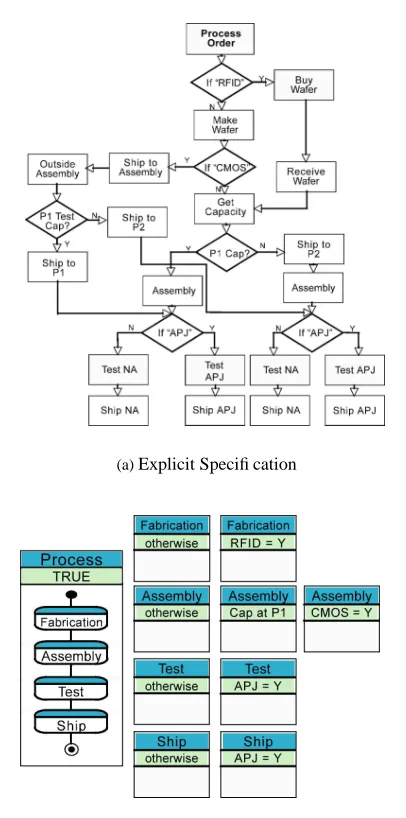
Agents’ processing autonomy is also catching early adopters’ attention. With conventional approaches, sys-tems must explicitly micromanage every decision (Fig. 2a). However, BDI-style agents provided by companies such as AOS and Agentis can dynamically choose and exe-cute their own plans based on changing environment states (Fig. 2b). Goal-based applications that require contex-tual processing increase the effectiveness of agent-based approaches over conventional ones. Common application ar-eas here include insurance policy rating, pricing, and item tracking.
Promote better productivity: Pragmatic IT managers will
estimate the potential development productivity of agent technology by examining items such as methodology, mod-eling notation, and design effort. Without an accepted methodology and modeling language, they won’t cross the technology chasm. Even with these, developer-retraining costs become a consideration. The greater the difference be-tween agent and conventional approaches, the greater the perceived cost and the lower the pragmatist’s adoption prob-ability. To succeed, the agent approach and convention must not differ greatly. Based on current market sentiment, agent extensions to UML, RUP, and MDA are being pro-posed, developed, and accepted by many early-adopter IT departments. While this may distress some agent re-searchers, agent technologies won’t be accepted without it.
Furthermore, any higher cost for agent-based design and implementation effort over the conventional will impede chasm-crossing. Without productivity-enhancing tools, most pragmatists will never adopt an agent approach. Happily, commercial-grade agent tools are just now appearing and leading-edge IT departments are authorizing expenditures for them.
Leverage existing technology: Totally new and
rela-(a)Explicit Specification
[image:7.612.76.279.78.487.2](b)Plan Spec. For Implicit Execution
Figure 3. Explicit Versus Implicit Approaches
tional, component-based software packages, and so on. Finally, agent developers need to integrate existing stan-dards and, where appropriate, their extensions. Current standards emanate from the OMG, W3C, and Oasis.
6. Agent Business Case – Todd Carrico
Todd Carrico is the President of Cougaar software and a former DARPA program manager. Cougaar Software is a fast-growing startup company focused on commercializing the Cognitive Agent Architecture (Cougaar) technology , the result of 7+ years of DARPA investment in applied intelli-gent aintelli-gent development performed by a world-class team of contractors from across industry and academia.
Like many companies struggling to make agent technol-ogy real in the marketplace, we are often faced with con-structing an effective ‘business case’ for agents. In this brief section, I thought I would share some insights from our ex-perience in building such arguments with our customers in hopes that it might help others to advance the adoption and legitimization of agent technology.
First, technologists must realize that the business world does not care about your technology. There may be some early adopter visionaries who are champions for the sake of the technology, but this is a small and specialized group. Business decision makers want solutions to hard problems in the form of operational capabilities at price points and on performance envelopes comparable to or better than their al-ternatives. The question we should be asking ourselves is ‘What problems can agents solve exceptionally well that other technologies cannot?’
Unfortunately the truthful answer to that question is that there is nothing, in the strictest sense, that cannot be done with any other architectures. This unfortunate fact is fre-quently pointed out by the IT groups of potential customers. Since it is understood that any program can be reduced to a Universal Turing Machine[12], this simple truth causes us no end of grief. The more discriminating question might be ‘What problems can agents solve more naturally then other technologies?’
These questions, from our experience, yield a few inter-esting answers that can serve as the foundation of a busi-ness case. Your mileage may vary, but I recommend a sim-ilar exercise to construct a business case for your potential customers to convince a potential customer of the virtues of your technology.
The Value of Situated Reasoning. Business people
un-derstand the value of agility, and know too well the lack of agility provided by today’s Enterprise Resource Plan-ning (ERP) systems. A strong business case can be built around the value of having agent-based planning and rea-soning that can situationally aware. The subtle ability to ad-just plans, processes and behaviors in response to the cur-rent state of the world affords a number of efficiencies and avoids several common problems. It ensures the plan is ef-ficient with respect to the operational parameters and avail-able resources, while attempting to work around equipment failures, resource shortages and facility constraints. Factors like weather can effectively be represented in the situation and reasoned about through agents more naturally then can legacy ERP systems. Whenever resources can be used more flexibly and appropriately in the execution of business oper-ations, real value is created.
Capture Knowledge in a Reusable Form. A problem most
ob-ject models, ontologies and domain behaviors. The explicit capture of this knowledge, especially those forms that can be produced by the domain operator, is typically the foun-dation of an agent application. A subtle but critical reality is that today, far too much of what makes a business effective is the result of human leadership. Two stores, identical in every physical way, can have two dramatically different profit lines due solely to the subtle differences in how the stores oper-ate. Successful companies go to great lengths to understand what makes one store successful and impart that through policy and training to the other stores. Through agent tech-nology, knowledge can be captured, utilized, evaluated and ‘good’ knowledge shared across the enterprise. The capture and reuse of knowledge provides significant business value to the enterprise.
Utilizing Humans as Decision Makers. With the
com-plexity of today’s information space, people tend to spend a great deal of time performing information gathering and pro-cessing, and less time analyzing and deliberating decisions. Agent technology is extremely well suited to providing au-tomation of complex information processing activities, even when operating over vast amounts of data, on behalf of the user. As agents are capable of taking up more of the infor-mation gathering and processing burden, it frees humans to focus on what they do best, and agents do poorly - draw-ing insightful conclusions from which to base a decision. To show the expense and inefficiency in having people perform routine information activities versus agile and adaptive agent systems automating the same activities under user direction demonstrates real business value over conventional infras-tructures.
These are three areas we have found to be good toeholds on which to form a solid business case. While these are by no means sufficient to justify a business investment in agent technology, they are often sufficient to motivate further dia-log and exploration. The key to building a good business case for agents is to make it about the problems that can be solved and the value those solutions provide, not about the technol-ogy being employed. The technoltechnol-ogy is part of the ‘how’ of the solution, not the ‘what’. I hope these simple points on building an effective business case for agents serves you well. As a community, we need to do a better job on helping our business benefactors to understand the value and poten-tial of our technology, and in doing so we increase our op-portunities for application, adoption and support for future research.
7. Conclusion
It is interesting, given the diversity of commentary on de-veloping impact for agents, that common themes appear in some/all of the sections. In particular, the issue of applica-tions or problems on which to apply agent technologies
re-peats with high frequency. One consistent message is solve
a problem in contrast to focusing on general purpose
tech-nologies for which there is no direct need or pull. Note that a given problem may be an instance of a class of problems so that a technology developed to solve the class may be di-rectly useful on many different instances. The question then is how broad or general a given approach should be – de-termining that balance is dependent on the technologies and your impact goals.
Developing impact for agents is clearly a much larger potential topic-of-conversation and a conversation that the community needs to have on a regular basis. The ideas con-tained in this paper are articulated by us but in some sense the community as a whole has contributed to them. It is our hope that these ideas assist in the sustained growth of agent research and in connecting-the-dots so that our research pays the dividends that we believe it can pay.
References
[1] Tim Berners-Lee, James Hendler, and Ora Lassila. The se-mantic web. Scientific American, May 2001.
[2] Adam Bosworth. Microsoft’s vision for
xml. In SGML/XML Wurope ’98, 1998.
http://www.infoloom.com/gcaconfs/WEB/paris98/bosworth.HTM. [3] J. N. Danziger, W.H. Dutton, R. Kling, and K.L. Kraemer.
Computers and Politics. New York: Columbia University Press, 1982.
[4] I. Foster, N. R. Jennings, and C. Kesselman. Brain meets brawn: Why grid and agents need each other. In Proc. 3rd
Int. Conf. on Autonomous Agents and Multi-Agent Systems,
New York, USA, 2004.
[5] Les Gasser. Private conversation with Tom Wagner, 2004. [6] Frederick Hayes-Roth. Towards a framework for distributed
ai. SIGART Newsletter, 1980.
[7] Geoffrey Moore. Crossing the Chasm. HarperCollins, NY, 1991.
[8] H. Van Parunak. Practical and industrial applications of agent-based systems. Technical Report, Altarum, 1998. Online at: http://agents.umbc.edu/papers/apps98.pdf.
[9] H. Van Parunak. A practitioners’ review of industrial agent applications. Autonomous Agents and Multi-Agent Systems, 3(4), 2000.
[10] Don Richardson. Private communication with L. Gasser, 1985.
[11] Adam Rifkin. Relax, everything is
deeply intertwingled: Weblications.
ifind-karma.typepad.com/relax/2004/12/weblications.html. [12] A.M. Turing. Computability and lambda definability. The
Journal of Symbolic Logic, 2, 1937.
[13] Mark Weiser and John Seely Brown. The com-ing age of calm technology. Xerox PARC, 1996.
![Figure 2. Technology Adoption Life Cycle[7]](https://thumb-us.123doks.com/thumbv2/123dok_us/8514441.351089/6.612.69.297.76.162/figure-technology-adoption-life-cycle.webp)