London East 2003-2005
5
W
orkf
or
ce
Development
Str
ateg
Hospitality
Our
main
par
tner
and
stakeholder
• Avenance • Britannia Hotel • Café Spice Namaste • Conran Restaurants • Eaton Fine Dining • Everson Hewett • Excel
• Four Seasons • Great Eastern Hotel • Hilton Docklands • Holiday Inn • Holiday Inn Express • Ibis Hotel
• Post House Hotel
• Queen Mary’s Westfield College • Sodexho
• The City of London Gentlemen’s Club • Tower Thistle Hotel
• Travel Inn • Travel Lodge
• World Trade Centre London
• Basic Skills Agency • Business Link for London • Connexions
• Education Business Partnerships • Further education colleges • Higher education institutions • Hospitality & Leisure Manpower • Hospitality Training Foundation (HtF) • Jobcentre Plus
• Local authorities
• London Development Agency • London First
• London Tourist Board • Regeneration partnerships • Skillsmatch
• South London Economic Development Alliance (SLEDA) • Springboard UK
• TourEast London • Trade unions
• Work-based learning providers We, the Learning and Skills Council
London East, fund training and education for those over age 16 in Barking and Dagenham, Bexley, City of London, Greenwich, Hackney, Havering, Lewisham, Newham, Redbridge and Tower Hamlets.
Learning and Skills Council London East Boardman House, 64 Broadway, Stratford, London E15 1NT
Telephone: 0845 019 4151 e-mail: [email protected] www.lsc.gov.uk
©LSC 2003. Published by the
Learning and Skills Council.
You may copy extracts from this publication for non-commercial, educational or training purposes as long as you acknowledge the source and do not misrepresent the findings.
Readers please note:
• in this publication where ‘we’ is used, it refers to the Learning and Skills Council London East
• we have used footnotes in this publication, shown as small numbers in the text, to acknowledge our sources of information, and the research done by other organisations, and
HOSPIT
ALITY
PA
GE
C
ontents
Foreword
Introduction
Executive summary
Chapter 1
Chapter 2
Chapter 3
Chapter 4
Chapter 5
Appendix/Glossary
Chapter 6
Pull-out section inside the back cover2
3
4
5 The main features of the hospitality sector
5 Introduction
5 The size of the industry 6 Our area
8 Employer demand
8 The economy, and the effect of the London Tourism Strategy 9 Regulations
9 Population trends, social change and customer behaviour 9 Technology
10 Employment forecasts
12 Skills gaps and skills shortages – now and in the future
13 Skills supply to the sector
15 The main issues for the sector
15 Economic factors 16 Skills issues 17 Recruitment 17 Retention
17 The image of the industry 18 The way forward
19 Strategic recommendations
20
The action plan
For
ewor
d
In every sector there is potential for growth. The proposal for major housing development in the Thames Gateway by the Deputy Prime Minister, in February 2003, is a boost for the construction industry. The Strategic Rail Authority and Transport for London have ambitious plans to develop the transport infrastructure. Health and social care, and financial services have their own challenges to meet as legislative changes place new demands on the workforce. The cultural and creative industries are thriving, and the retail sector can continue to grow with future town-centre redevelopments planned.
Our task, with you, our partners, is to make sure that London East is ready to meet these challenges with a highly skilled workforce. The consultation paper,Success for All1,in June 2002 set out the role of
learning providers. It stated that “learning in an area must meet national and local skill needs… and be responsive to local employers and communities.” This view was reinforced in the formal publication of Success for Allwhich set out the joint plans of the DfES and the Learning and Skills Council, in November 2002, to reform the learning and skills sector and raise standards.
This series of workforce development strategies explains the issues affecting each industrial sector. Each strategy then suggests some realistic action to support the skills development of local people. The aims are to meet employers’ needs, and to give individuals positive learning and employment experiences.
By delivering the actions in these 10 sector strategies, we will be helping to:
• fulfil our corporate objectives which we outlined in the Local Strategic Plan 2002-2005
• meet the requirements of the Learning and Skills Council’s National Policy Frameworkfor workforce development
• support the objectives outlined in London’s Framework for Regional Employment and Skills Action (FRESA)published by the London Skills Commission, and
• meet the aims of the Skills Strategy White Paper (2003).
We hope that all partners and stakeholders in the various sectors will help deliver the plans presented in these very positive strategy documents. This will enable local people to improve their skills and make the most of the new opportunities being created in the Thames Gateway area.
We are in the middle of an
exciting period of change.
London East’s 2 million
residents have seen many
changes in the last 10 years.
The new developments
announced for the Thames
Gateway show that there
will be further investment
and increased opportunities
during the next 10 years.
Mary Conneely
Executive Director
HOSPIT
ALITY
PA
GE
Intr
oduction
1DfES,Success for All – Reforming Further Education and Training,Discussion Document, June 2002; DfES,Success for All – Reforming Further Education and Training – Our Vision for the Future, November 2002. 2 This does not include higher education provision.
The Learning and Skills
Council is responsible
for funding and planning
education and training
for those over 16 years
old in England
2.
Workforce development is one of the most challenging and exciting parts of our work, and in November 2002, the national office published its Workforce Development Strategy – National Policy Framework to 2005.
The National Policy Frameworkwas published at the same time as the Government report,In Demand: Adult Skills in the 21st century – part 2, produced by the Strategy Unit. These two documents suggested action that would promote workforce development. They state that we should:
• “raise informed demand for employment-related skills among individuals and employers
• support improvements to the responsiveness and flexibility of the supply side, and
• contribute to the development of an underpinning framework of better skills and labour market intelligence, responsive vocational qualifications and improved links to the wider educational agenda.”
Each sector strategy has an action plan which shows how we, at LSC London East, will take practical steps to meet those three objectives. By carrying out the action proposed for each sector, with you, our partners, we will directly contribute to delivering the LSC's goals, which are to:
• “raise the participation and achievement of young people
• increase the demand for learning and equalise opportunities through better access to learning
• engage employers in improving skills for employability and competitiveness
• raise the quality of education and training delivery
• improve effectiveness and efficiency”.
This workforce development strategy for the hospitality sector is one of ten sector-based strategies. Each one describes the current issues in the sector nationally and locally. They give details of the current levels of employment and skills in the sector, and suggest where improvements in skills are necessary to meet the needs of the local and national economy.
The action plan for each sector gives details of the funding opportunities that are being made available to help individuals and organisations fulfil their potential.
Workforce Development Strategies for London East
1 Construction
2 Cultural and creative industries 3 Financial services
4 Health and social care 5 Hospitality
6 Manufacturing 7 Public administration 8 Retail
Ex
ecutive
summary
About 5% of the workforce
in London East’s area is
employed in the hospitality
sector. The issues that affect
employers and employees
in London East are similar
to those faced by the sector
elsewhere in the capital.
There are difficulties in
recruiting and keeping staff,
as well as making sure that
staff are appropriately skilled.
The hospitality industry is made up of hospitality businesses, and hospitality services. The businesses include hotels, restaurants, pubs, clubs and bars, as well as contract-catering companies. In 2001, around 20,300 people were employed in 2,400 restaurants in London East, with a further 12,035 being employed in 1,355 pubs, clubs and bars. The hospitality services subsector includes catering activities in organisations whose main business is not hospitality, such as health and education. Around 44% of hospitality businesses’ employees were in the City of London and Tower Hamlets, which includes the Canary Wharf developments.
The hospitality sector is of major importance to London East and an essential part of a growing economy. The success of the capital’s broader tourism strategy depends on a high-quality hospitality industry.
The main factors that shape the industry are the general economy, regulations, social change, and technology. London East may receive a boost from the London Tourism Strategy, and the Thames Gateway developments.
The industry as a whole needs to respond to the demand for higher levels of customer service and quality products.
The hospitality industry in London suffers from the following skill shortages.
• Chefs and cooks
• Waiters and waitresses
• Bar staff
• Catering assistants
The skills gaps identified included:
• communication
• customer care
• food hygiene, and
• food preparation and cooking.
There are issues in raising the supply level to meet demand. We need to increase the demand from learners for learning provision by making the employment opportunities more attractive. We also need to make sure that more learners who enrol on publicly-funded courses stay to complete them.
In smaller companies more should be done to foster a learning culture in spite of the difficulties of high staff turnover.
HOSPIT
ALITY
PA
GE
Introduction
About 5% of the workforce in our area is employed in the hospitality sector. The issues that affect employers and employees in London East are similar to those faced by the sector elsewhere in the capital. There are difficulties in recruiting and retaining staff, and making sure that staff are appropriately skilled.
There are comparatively fewer large hotels in London East than in Central London, but there is a large number of restaurants including a wide range of Asian restaurants. The challenge for the industry is to continue to grow as more investment is made in London East and the Thames Gateway. The industry can provide employment for local people, help the tourist market expand eastwards on the banks of the Thames, as well as contributing to the economy of the new and regenerated communities throughout the subregion.
The tasks are to:
• increase the supply of qualified and interested applicants to the hospitality industry
• improve the skills of those already in employment
• continue to use quality-assurance frameworks to raise standards, and
• provide rewarding career structures that encourage staff to stay in the sector.
The size of the industry
The hospitality industry is made up of hospitality businesses, and hospitality services. The businesses include hotels, restaurants and pubs, clubs and bars, as well as contract-catering companies. The hospitality services subsector includes catering activities in industries whose main business is not hospitality, such as health and education. The national and regional figures show the numbers employed in both types of work. However, there is potential for staff to move from hospitality services into the hospitality businesses subsector. The subregional figures for London East concentrate on the hospitality businesses.
The Hospitality Training Foundation identified almost 1.5 million people employed in hospitality occupations in the UK in 20013. Almost 1 million people
worked in hospitality businesses, and a further 385,000 were employed in hospitality services. In the London region, just under 126,000 people were employed in hospitality businesses, and a further 40,000 in hospitality services.
The hospitality sector
is of major importance
to London East and an
essential part of a growing
economy. The success
of the capital’s broader
tourism strategy depends
on a high-quality
hospitality industry.
Chapter
1
The
main
featur
es
of
the
hospitality
sector
3 HtFLabour Market Review 2002.
Our area
The bulk of employment in London East is in the restaurants subsector. Contract caterers are the second largest employers, with bar work third. Around 20,300 people were employed in 2,400 restaurants in London East with a further 12,035 being employed in 1,355 pubs, clubs and bars in 20014. This shows one of the main
characteristics of the catering industry – it operates through large numbers of outlets with relatively low numbers of employees in each outlet. There are significant numbers of SMEs and microbusinesses in the sector that need, but are not always able to provide, workforce development. There are also some large employers, particularly in the hotel and contract-catering subsectors, which are delivering services locally and on an international basis. There were some 889 establishments in London East’s area employing more than 13,000 people in contract catering in 2001. Hospitality Training Foundation (HtF), in its Labour Market Review 2002, saw changes in the contract-catering market generally. There have been some mergers and takeovers resulting in more larger organisations. Meanwhile, more small firms have emerged, operating in niche or local markets. As a result of both these developments, there has been a drop in the number of medium-sized companies in the subsector. Finally, there were 2,832 people employed in 111 hotels in the London East area.
Table 1shows the total number of employees by subsector, and figures 2and 3
show the percentages of establishments and employees by subsector.
The Tourism Means Business Report5in
its sub-regional analysis showed that East London had only about 7.5% of London’s hotel subsector, whereas it had 14.5% of the restaurants and 16.2% of the pubs, clubs and bars.
The London hospitality business has some different characteristics to the national picture. Although the restaurant subsector draws significantly on a young workforce, many of whom are between 16 and 25, it also depends fairly highly on temporary labour of various types. This includes both home and overseas students who want short-term employment as well as immigrant groups looking for their first jobs in the UK. They often carry out low-skilled tasks. The high labour turnover in some areas of the industry often has an effect on training and development activity. The pubs, clubs and bars subsector, although still using temporary labour, tends to have an older age profile, and a more settled labour force. Permanent, rather than temporary, part-time staff are more evident in the pubs, clubs and bars of London than in its restaurants. The capital also has a higher percentage of full-time staff compared with the rest of the country. In this respect, London is ahead of the general trend which is towards more full-time appointments in the sector as a whole.
From national figures, in occupational terms, most managerial staff are in full-time posts, but up to 3/4of the waiting staff,
bar staff and kitchen-porter jobs are part time. Again, the national picture will show that most of the workforce is female, but most managerial posts are held by men.
table 1
Employees in hospitality businesses, London East, 2001
Hospitality subsectors
Hotels 2,832
Restaurants 20,300 Pubs, clubs and bars 12,035 Contract catering 13,221
Total 48,388
HOSPIT
ALITY
PA
GE
28% Bars
19% Catering
2% Hotels
51% Restaurants
figure 1
Percentages of hospitality establishments by subsector, London East, 2001
Source: Annual Business Inquiry 2001, ONS Crown copyright (2003)
25% Bars
27% Catering
6% Hotels
[image:9.842.31.248.299.434.2]42% Restaurants
figure 2
Percentages of hospitality employees by subsector, London East, 2001
[image:9.842.405.566.506.698.2]Source: Annual Business Inquiry 2001, ONS Crown copyright (2003)
table 2
Hospitality employees by borough, 2001
All subsectors Barking and Dagenham 2,030
Bexley 3,549
City of London 13,638 Greenwich 3,414 Hackney 3,814 Havering 4,122 Lewisham 3,282
Newham 2,507
Redbridge 4,630 Tower Hamlets 7,402
Total 48,388
Source: Annual Business Inquiry 2001, ONS Crown copyright (2003)
The main areas for hospitality
employment are the City of London and Tower Hamlets, which includes the Canary Wharf developments. In fact, 44% of the employees for London East were found in these two areas. This included 8,500 restaurant staff and nearly 4,000 bar staff in 2001. We also found greater numbers of hotel staff in the inner-London area, with Hackney and Tower Hamlets having 50% of the staff in this subsector. There is a relatively even distribution of employment over the rest of London East with the outer London boroughs of Havering and Redbridge having slightly higher numbers of employees in the hospitality sector. Because there are employment
opportunities in all boroughs, local training and education need to be made available in all areas to meet this need. This is particularly true as the industry tends to pay lower than average wages, and draws in less well-qualified entrants than many other industries.
4 These are the latest available statistics at the time of writing the strategy. 5Tourism Means Business, Skills and Employment Foresight Report for London 2001,
The economy, and the effect of the London Tourism Strategy
The hospitality industry in London East will come under a range of different pressures in the current decade. In brief, they are:
• the general economy, and the effect of the London Tourism Strategy, and
• the Thames Gateway developments, and the growth of sustainable communities.
The sector is affected more than many others by shifts in the economy. Economic growth and high levels of employment lead to higher levels of disposable income and bring about greater spending in restaurants, bars and hotels. The UK tourist industry reached a high point, in income terms, around 1999-2000. Since then, particularly with the effect of events on 11 September 2001, and a downturn in the world economy, the hospitality sector has seen a reduction in the use of its services.
This is particularly significant for London East. Tourist spending in areas such as Greenwich has been dented. As seen in the previous chapter, the City and Canary Wharf have large numbers of jobs in restaurants and bars under threat as staff cuts in financial services are made, and local spending power is reduced.
We expect that the economy will improve and return to its long-term pattern. As a result, the hospitality sector must be geared up to meet the staffing levels it will need.
London East should also be ready to benefit from any increased business that arises from the London Tourist Strategy being managed by the London Development Agency (LDA) on behalf of the Mayor. This was launched in September 2002, when £3 million was pledged to deliver the strategy, to be followed by a further £4 million in 2003. There was also hope that the private sector would match this support for London tourism. The strategy’s aim was to “reinvigorate tourism in London, bringing new leadership to the promotion and marketing of London”. The LDA aimed to target “domestic and business tourism”. And, it proposed that new tourism products should be developed, “drawing on London's diversity and broadening the appeal of London beyond the established central London attractions”.
Perhaps of even more long-term
significance are the announcements from the Office of the Deputy Prime Minister. The Government has pledged £446 million to the Thames Gateway area through a new development expected to create up to 300,000 jobs by 2031. As a result, the new businesses and new homeowners based in the area will create demands for hospitality services. Developments that arise from major transport initiatives will also need the support of the hospitality sector. The most high-profile and immediate of these projects is the Stratford station redevelopment prompted by the building of the Channel Tunnel Rail Link. The whole project will include an increase in the shopping, community and leisure facilities next to the station in Newham.
Chapter
2
Emplo
yer
demand
The main issues that
will shape the demand for
employees, and skills are:
• the economy, and the
effect of the London
Tourism Strategy
• regulations
• population trends, social
change and customer
behaviour, and
HOSPIT
ALITY
PA
GE
Regulations
A less glamorous, but essential factor of change in the sector, is the regulatory framework. Keeping to health and safety and hygiene regulations is a necessary part of employers’ and employees’ roles. As we can see in chapter 3 on supply, a high percentage of the part-time learning, carried out through public-sector
provision, is in this area. The high turnover of staff in the industry means that much of the training has to be repeated. For some staff on short-term assignments, the amount of training may also be limited. Having to keep to the Working Time Directives, the Minimum Wage regulations and other changes in employment conditions from the UK Government and European legislation is extra to the range of managerial tasks that already need to be done.
Population trends, social change and customer behaviour
Although London East does not show quite the same characteristics as the rest of the UK in its age profile, it is, nevertheless, seeing some shifts. There are 800,000 people between 30 and 59 out of the population of almost 2 million. This provides a strong customer base for the hospitality industry.
The temporary downturn locally in the numbers aged between 15 and 24, also has staffing implications for restaurants particularly, which in terms of national figures draw 40% of their staff from the age range 16 to 25.
In terms of social change, there has been a tendency to demand more ready-cooked meals. The large numbers of takeaway establishments and fast-food restaurants are evidence of this trend. This has been a culture shift from which the sector has benefited in volume terms. It is likely to continue, but food choices may change. McDonald’s Corporation has realised this and now offers new menu choices in its core business. It had also anticipated this change by acquiring a share in Prêt à Manger, the chain of high-street shops that sell freshly-prepared sandwiches.
The other change affecting the sector has been the demand for higher standards in both food quality and service.
Technology
There are two areas in which technology has affected the hospitality industry – IT and food preparation.
Across the whole industry IT skills are in greater demand. IT skills for business administration are essential. This ranges from ordering food supplies for restaurant meals, to booking systems for hotel rooms. While large companies may have specialist staff dealing with these issues, the managers and owners of many small hospitality businesses have to add IT skills to their range of skills.
Employment forecasts
Looking forward over the next seven years, further investment will be made in the sector. The current minor downturn in employment levels will stabilise, and by 2010 will return to almost 50,000.
In figure 3we can see a steady increase in investment is expected. The chart shows the information worked out using 1995 prices. This will remove any distortion caused by inflation. This means that we get a truer picture of the expected growth in the sector.
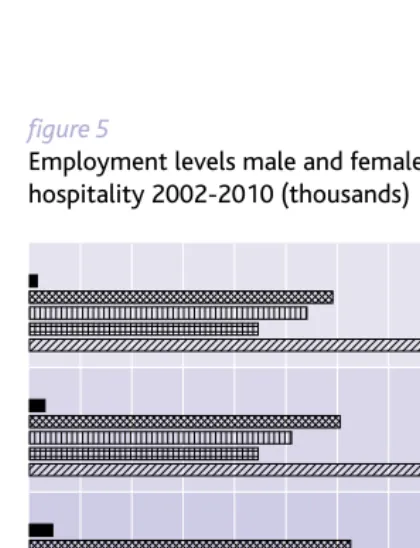
The forecasts of the future shape of the workforce show men increasing their share of full-time and part-time employment.
100
2002 2004 2006 2008 2010 105
110 115 120 125 130 135 140 145 150
[image:12.842.33.229.288.428.2]Investment levels figure 3
Hospitality sector investment levels, London East, 2002-2010
(£million – standardised to 1995 price levels)
Source: CE/IER LEFM 2002
2002 2003 2004 2005 2006 2007 2008 2009 2010 47.5
48 48.5 49 49.5 50 50.5
Levels figure 4
Hospitality sector employment levels, London East, 2002-2010 (thousands)
Source: CE/IER LEFM 2002
2002 2004 2006 2008 2010 Investment levels (£1995 million) 116.2 125.1 127.7 131.3 142.9 Source: CE/IER LEFM 2002
HOSPIT
ALITY
PA
GE
[image:13.842.28.238.274.548.2]2002 2004 2006 2008 2010 figure 5
Employment levels male and female, hospitality 2002-2010 (thousands)
0 2 4 6 8 10 12 14 16 18 20 Female self-employed
Male self-employed Female part time Source: CE/IER LEFM 2002
Male part time Female full time Male full time
table 3
Employment levels male and female, hospitality 2002-2010 (thousands)
2002 2004 2006 2008 2010
Male full time 15.3 15.6 16.3 17 18
Female full time 9.5 9.1 9 8.9 8.9
Male part time 9.2 9.3 9.8 10.2 10.8
Female part time 14 13.1 12.6 12.1 11.8
Male self-employed 1.6 1.2 0.9 0.6 0.3
Female self-employed 0.5 0 0 0 0
[image:13.842.29.379.656.769.2]Skills gaps and shortages – now and in the future
The recent report for the LDA6confirmed
a number of issues from earlier reports, which are also well documented by the Hospitality Training Foundation.
In London, the most frequently reported skill shortages were:
• chefs and cooks
• waiters and waitresses
• bar staff, and
• catering assistants.
Skills gaps most often mentioned were:
• communication
• customer care
• food hygiene
• food preparation and cooking
• ability to follow instructions, and
• the ability to show initiative.
Part of the industry’s problem is the willingness of employers to recruit staff who do not have the skills needed to fulfil their jobs.
A challenge facing London East is also the number of workers who do not speak English as a first language. Evidence shows that there may be a significant problem, while some employers have highlighted the difficulty in accessing English courses for their staff at convenient times to meet their needs.
You will find a more detailed review of this major problem in Chapter 4: The main issues for the sector. Industry representatives interviewed in 2002 suggested the downturn in business was not an opportunity to reduce training commitments, but rather an opportunity to develop staff for the next upturn. Being an industry often looking to the short term, it may not happen. The role of the supply side, in terms of providing education and training, should be to prepare for an increase in job
opportunities, particularly in the east of London, noting the major infrastructure changes we believe will take place.
HOSPIT
ALITY
PA
GE
6London Tourism; Development through Partnership – The Workforce Development Plan for the Tourism and Cultural Sectors in London,LDA, October 2002.
Full-time hospitality programmes have not proved popular with students in England as a whole. The student numbers taken from the ISR show the pattern repeated in London East. Barking and Lewisham Colleges have the largest full-time provision in London East, while Hackney Community College has a wide range of part-time courses. Noting how even the demand is for employment across the area, some increase in provision would benefit the subregion.
There has been a tendency in recent years to adopt the NVQ as the main way of providing for full- and part-time study. Other courses originally designed for full-time study have been shunned by students, and, as a result, colleges have discontinued them. The most commonly taken programme in the part-time offer is the Basic Food Hygiene Certificate.
Chapter
3
Skills
suppl
y
to
the
sector
table 3
Individualised Student Record (ISR) by subprogramme areas, London East, 2000-2001
Food Enrolments Completions Achievements % Full time, full year 833 607 460 76 Full time, part year 152 129 105 81 Part time 2,634 2,039 1,774 87 3,619 2,775 2,339 84
Hospitality and catering Enrolments Completions Achievements %
Full time, full year 490267 213 80 Full time, part year 59 39 33 85
Part time 1,527 952 598 63
2,076 1,258 844 67
Other hotel and catering Enrolments Completions Achievements % Full time, full year 303 169 130 77 Full time, part year 13 2 1 50
Part time 133 84 44 52
In each subprogramme, the learner completion levels could be improved. The most problematic area is the failure to turn full-time enrolments into achievements. The message for all stakeholders must be to find ways of making the best use of the interest in the sector, and making sure learners on all types of course achieve.
The Individualised Student Records (ISR) present a picture of publicly-funded further education provision. There is, particularly in larger companies, in-house training provided. We cannot measure the amount of in-house training activity and private training provided locally across the sector. However, it is unlikely to be markedly different in London from the rest of the country. The HtF acknowledges, in its Workforce Development Plan, that the industry lacked a training culture. It did suggest that modest improvements in training activity had taken place, and other studies have shown that training has been available to 85% of employees in the sector. Unfortunately, smaller employers were less likely to give training after induction training, and only about 50% of independent businesses were likely to offer any training at all.
We currently fund (2002-2003) seven work-based learning providers offering programmes up to NVQ level 3, with five offering Foundation Modern Apprenticeships and two offering Advanced Modern Apprenticeships.
There are three challenges – to:
• make sure more learners who enrol on publicly-funded courses stay to complete them
• raise the demand from learners for learning provision by making the employment opportunities more attractive, and
HOSPIT
ALITY
PA
GE
Economic factors
Recent economic events
spanning the last two
years (2001-2003) have
seen a downturn in tourist
spending in London and a
drop in domestic spending
in restaurants and bars.
Looking forward, the London population is set to grow by 1/
2million people in the next 10 years. Substantial new housing developments will take place in East London, and improvements to transport will increase local and national traffic flow. When the economy improves, and the new developments in the Thames Gateway take place, demand for hospitality employees will rise significantly from current levels. There are already skills gaps and shortages in the sector which will mean the strategic action we have identified in this report will be needed sooner rather than later.
Chapter
4
The
main
issues
for
the
sector
Skills issues
The workforce development needs in the London East hospitality sector focus mainly on tackling skills shortages and skills gaps. There are skills shortages when there are not enough people available with the appropriate skills, knowledge and qualifications for the job. A skills gap exists when those currently employed do not have the necessary skills to carry out their job to the highest standard.
In London East, businesses are experiencing particular skills shortages in operational skills such as food preparation and cooking, food hygiene and health and safety, table service, customer handling, communication skills, language skills, management skills and IT skills.
According to HtF (Hospitality Training Foundation) the main skills gaps within the industry are as follows:
• communication skills
• job-specific skills
• customer-service skills
• ICT skills
• team working
• being flexible
• willingness to learn
• ability to follow instructions
• basic skills
• management skills
The five most important skills lacking were communication, job-specific skills, customer service, team working and being flexible. Another problem identified was ‘attitude’ to work, where the following attributes were not always evident: ‘speed’, ‘commitment’ and ‘enthusiasm’ for work.
The lack of communication skills may be made worse by the high number of people from abroad working in the industry, often temporarily, while learning English. Feedback from industry experts suggests that there is some reluctance from employers to fund the English-language training for employees who will leave as soon as they have a better command of the language. Others would be keen to fund this training for qualified staff such as chefs, but find the available courses either too expensive or not flexible enough for their employees.
The lack of job-specific skills in the industry may be related to the low achievements of a part of the industry’s workforce. (14.5% of the London
workforce does not hold any qualification.) Poor customer-service skills often reflect not enough training in that area. Other skills lacking, such as a willingness to learn, are softer skills and tend to be missing in employees across many industries.
ICT skills have come to play an increasing role in the hospitality industry. Many hotels depend on computers to run their reservation systems, while food sales in restaurants and bars are logged by computer. Managerial, administrative and front-line staff who lack ICT skills are putting the effectiveness and efficiency of their business at risk.
Small and medium-sized hospitality organisations that have yet to invest in IT systems, and in IT skills for their staff, will lose their competitive edge.
HOSPIT
ALITY
PA
GE
Recruitment
The recruitment issue is a major problem for the sector within East London.
For several years the industry has faced severe recruitment difficulties. Most of the vacancies are operational jobs such as chefs, cooks, bar staff, waiters and waitresses and catering assistants. Bar and waiting occupations are both forecast to grow over the next 10 years at a rate above the industry average. This will be the result of the projected expansion of hospitality outlets within East London.
In many cases the hospitality industry shows it is not able to market itself as a competitive employer alongside other service industries such as retail or call centres. This causes difficulties in a tight labour market. Although the public view is of a low-wage industry offering poor conditions of service, there are opportunities to make solid career progression and good salaries in all subsectors of the hospitality industry. This is particularly so in London in a competitive restaurant sector and in large, prestigious hotels.
Retention
The industry’s workforce within east London includes many young, female, part-time and underqualified workers. Many of the part-time staff are casual workers and are unlikely to stay in the industry. As a result, many employers are reluctant to provide training beyond that needed by law, such as health and safety training. This may have a negative effect on the drive to raise skills levels and to keep staff.
The sector still manages to attract a large percentage of young people. However, it does not seem able to keep them. The general lack of a training culture discourages people not only from entering the industry but from staying, particularly if people see little opportunity for developing their skills and career progression.
The relatively low wages offered by the sector is also a major problem in holding on to staff. The Hospitality Training Foundation (HtF) in its Labour Market Review 2002 analysed the statistics on pay and earnings. It said that “employees in the hospitality industry earn far less than their counterparts in other industries. Male manual workers earn 30.7% more in other industries than they do in the hospitality industry and non-manual workers earn 23.6% more elsewhere.”
Pay levels are not consistent across the industry, with contract catering being the ‘biggest payer’. It is also worth noting that some employment packages include accommodation or other benefits in kind.
The image of the industry
The negative image of the industry is still a major barrier in tackling skill shortages. People may be put off entering the industry because they think it offers long and unsocial hours for poor pay. It is important that the benefits of working in the industry are also publicised. From this, we hope that careers teachers and parents will influence young people to view careers in hospitality more favourably.
The industry also needs to nurture new recruits once they have been attracted to the sector. In the case of unskilled staff, this might take the form of internal promotion to make them feel valued by their employers.
The way forward
Employees within the hospitality sector in London East often have a low level of skills and educational achievement. The strategy will tackle these barriers by helping to develop a learning culture in the workplace. We will encourage employees to take part in learning through flexible delivery, work-based training and distance-learning.
In looking for solutions to the challenges faced by the industry, local stakeholders have suggested issues we should consider taking forward.
• Developing a lifelong learning culture in the workplace
One industry stakeholder, Cindy Bartello, Regional Manager London and South East, Springboard UK, put the issue into the wider business context as follows.
“In order to ensure that we have a hospitality industry that meets the best standards in the world, we must promote the value of good customer service. This can only be achieved through employers who make long-term investment in staff training and employees who continually strive to improve the service that they offer.”
Iijad Ullah, Manager at Café Spice, illustrated the need for flexible delivery. He felt that not enough support was being given to employees within the workplace to help them gain qualifications within working hours. Many staff have to attend training sessions in their own time, which can bring added pressure when people already have busy lives.
• The need to make the qualifications system more suitable for employers’ and employees’ needs
Kevin Cleaver, Head of Business and Hospitality at Lewisham College, said that there was a definite need to get funding for single units of study, as well as longer programmes, to reflect learners’ and employers’ needs.
• The potential for individual
development and career progression
Many people believe there is a lack of opportunities for career progression within the hospitality sector. The training proposed within this strategy will start to tackle this issue by supporting activities that will provide appropriate operational and generic skills which can be transferred within the sector, and which answer a growing need.
The strategy will help to change
employers’ attitudes. It will also encourage a positive attitude towards training and career progression among their employees.
HOSPIT
ALITY
PA
GE
We will:
• encourage all stakeholders to operate a shared approach to labour market information to make sure we meet the employment needs of the sector
• work with partners to raise the profile of the hospitality industry as a career path
• work with partners to make sure relevant and positive information, advice and guidance is available to adults and young people about the industry
• support employers, particularly small and microbusinesses in the hospitality sector in London East to raise the skill levels of their employees
• support the development of relevant learning materials through the hospitality qualifications awarding body
• encourage learning providers to offer training and development which matches the needs of the workforce
• try to make sure there is access to employment, training and development for unemployed people, and access to training and development for those who are employed
• tackle discrimination and issues of diversity in the workforce by making the business case for equal opportunities
• support employees in the sector who lack basic skills, IT skills, or English language skills to take advantage of appropriate learning opportunities, and
• encourage local people to get local jobs.
Chapter
5
Str
ateg
ic
recommendations
Glossary
generic skillsare those skills which can be used across large numbers of different occupations. They include what are defined as key skills – communication, problem-solving, team-working, IT skills, using number and an ability to improve personal learning and performance. (National Skills Task Force, 2000)
a microbusinessis usually defined as a small business employing fewer than 11 people.
regeneration activitiesreferred to in this document are programmes designed to improve the physical and economic conditions of local areas, usually led by government departments.
social exclusionis a term for what can happen when people or areas suffer from a combination of linked problems such as unemployment, poor skills, low incomes, poor housing, high-crime environments, bad health and family breakdown. (Government – Social Exclusion Unit)
social inclusioncovers the range of activities led by government agencies to help people and communities overcome the social problems they are experiencing.
A
ppendix
/Glossary
Appendix
Standard industrial Hospitality classification codes subsectors
55.1 Hotels and motels
55.3 Restaurants
55.4 Bars
55.52 Catering
Learning and Skills Council London East
Boardman House, 64 Broadway, Stratford, London E15 1NT
Telephone: 0845 019 4151 e-mail: [email protected] www.lsc.gov.uk
This strategy was written by Trevor Carr and members of the LSC London East Workforce Development team. Trevor Carr
McKerr Carr Ltd Telephone: 020 8349 2110 www.mckerrcarr.com Designed by Creative Leap Telephone: 020 7549 0700 www.creativeleap.com
Nordland Papier AG is committed to the tradition of sustainable forest management and minimisation of its impact on the local environment.