Language Learning at
Key Stage 3
The impact of the Key Stage 3 Modern Foreign
Language Framework and Changes to the
Curriculum on Provision and Practice
Research Report DCSF-RR091
Michael Evans and Linda Fisher
Research Report No
DCSF-RR091
Language Learning at Key Stage 3
The Impact of the Key Stage 3 Modern Foreign
Languages Framework and Changes to the
Curriculum on Provision and Practice
Michael Evans and Linda Fisher
University of Cambridge Faculty of Education
The views expressed in this report are the authors’ and do not necessarily reflect those of the Department for Children, Schools and Families.
© University of Cambridge 2009
ACKNOWLEDGEMENTS
We are greatly indebted to our Research Associates, Ruth Levine and Caroline Filmer-Sankey, for their hard work, critical insights and exceptional commitment at all stages of this project.
Thanks are also due to our Project Secretary, Ann Curtis, for her assistance throughout this project.
We are grateful to members of the Management Committee (Catherine Jenkinson-Dix, Neil Jones and Anne-Marie Watkinson) for their advice and discussion on our progress with the study. The detailed feedback and comments we received from the DCSF steering committee (Bernadette Holmes and Peter Spain) following the submission of each interim report have been invaluable. We are also very grateful to our project managers, Jenny Buckland and Konstantina Dimou, for their support over the period and for allowing us a useful degree of flexibility in the development of the study.
Contents
Executive Summary...1
1. Introduction and Background...9
2. Research Methodology...11
3 Literature Review...21
4 The extent and influence of the KS3 Framework for MFL...37
5 The impact of the primary languages initiative on KS3...54
6 The status of languages and the impact of Specialist Languages Colleges...75
7 The impact of non-compulsory languages in KS4 on KS3...87
8 Higher standards in KS3 language learning: drivers and challenges...105
9 Conclusion and implications...128
References...131
Appendix A Tables
Appendix B Questionnaires
Executive Summary
Introduction
In 2006 the Department for Children, Schools and Families (DCSF) commissioned Cambridge University to conduct a two year study to investigate provision and practice in language learning at Key Stage 3 (KS3) in order to understand the impact of the Key Stage 3 Framework for Modern Foreign Languages (MFL) and other recent initiatives. The study focused on maintained schools in England.
Key Findings
• The KS3 Framework for Languages has supported and influenced KS3 teaching and learning, with heads of languages departments in the surveys and case study
interviews expressing approval for aspects such as explicit learning objectives and explicit teaching of grammar. There was evidence of the Framework being largely embedded in languages teachers' pedagogical thinking and teachers reported a marked impact on pupils' understanding of the structure of the foreign language (e.g. sentence and text building, grammar), their skills development and their
independence as learners as a result of its implementation.
• Specialist Language Colleges (SLCs) in both survey and case study data reported strong positive impact from the gaining of specialist status. This impact was felt mainly in terms of increased outreach work with feeder primary schools and in improved resourcing (including Information and Communication Technology (ICT)). The impact of specialist status was less felt at the level of classroom teaching and learning.
• There was almost universal approval from headteachers, heads of department, teachers and pupils of the principle of teaching languages in primary schools. In practice, the impact of the primary initiative on the secondary curriculum was weak, with languages departments still generally unclear as to how to meet the challenges of the Year 7 mixed experience classes and ensure good progression on the
language work done in the primary school. There was some evidence in the second year of case study interviews that secondary teachers were more open to learning from the primary approach to language teaching than they were in the first year.
• The impact of the work of Specialist Language Colleges on that of other secondary schools more generally was low. Just under half of the schools in both years of the survey had no contact with an SLC, and those that did have contact mainly reported it to be only a little. This finding contrasts with the fact that many heads of department in non-SLCs viewed supporting languages in other schools as the main role of the SLC.
• Nearly half of the heads of department in the survey reported some negative effects of the optional status of languages at KS4 on teaching and learning at KS3. The majority of comments related to pupils’ attitudes and earlier disaffection in KS3. Schools reported attempting to offset this and to encourage uptake beyond KS3 by making language learning as enjoyable an experience as possible, which
• Heads of department identified resourcing (in particular ICT), good staffing levels and training as key factors that supported effective practice in KS3. Factors that were seen to constrain effective teaching were lack of time allocation to languages, poor timetabling, and class size.
Background and research questions
Recent years have seen major policy changes in the field of language learning in secondary schools in England. In 2002 the Languages Strategy set out the government's vision for languages, with three main objectives: to improve the teaching and learning of languages in schools (including an entitlement to languages for all pupils in KS2); to introduce a
recognition system (now known as ‘The Languages Ladder’); and to increase the number of people studying languages beyond school.
In order to improve teaching and learning in KS3, and forming the principal component within the Foundation Subjects strand of the KS3 National Strategy, the Framework for teaching modern foreign languages: Years 7, 8 and 9 was introduced in 2003. With the same purpose as other frameworks written for primary and Key Stage 3 teachers, the KS3 Framework for languages contains a structured and progressive set of teaching objectives for modern foreign languages, together with guidance on how to use them.
At around the same time in 2003, MFL was removed from the core curriculum at KS4 in England, as part of a government reform of curriculum and qualifications.
The research questions which guided the investigation were the following:
• What is the extent and influence of the use of the KS3 Framework for MFL?
• What is the impact of Key Stage 2 (KS2) language learning initiatives on the KS3 curriculum?
• What is the impact of Specialist Languages Colleges on KS3 curriculum and teaching?
• How can language learning at KS3 best encourage uptake of languages at KS4?
• What are the drivers for, and challenges to, higher standards in KS3 language learning?
Methodology
This was a longitudinal study involving a mixed mode research design.
Quantitative strand
Qualitative strand
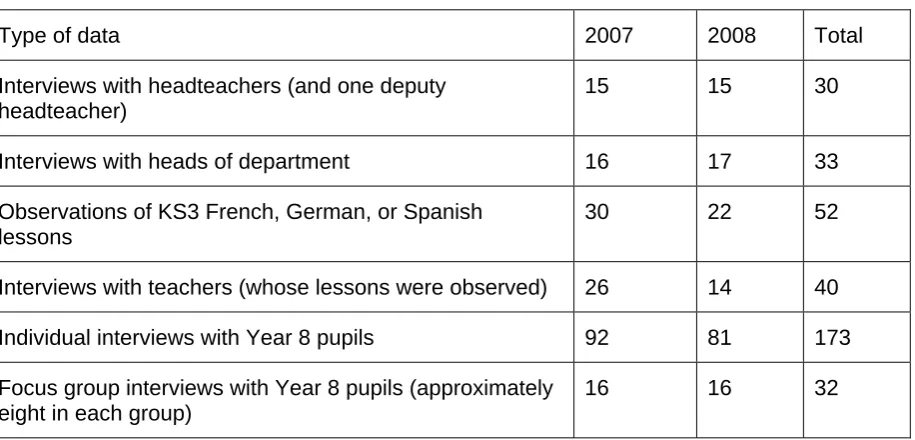
Qualitative data were gathered from in-depth case studies at 16 schools in England, each visited twice (2007 and 2008). These schools were chosen from the 276 respondents to the first survey who indicated they would be willing to be involved in the case study sample. The final 16 schools were chosen to achieve as representative a sample as possible in terms of geographical location and school type, while allowing schools of particular interest to the research to be included. During both rounds of case study visits lessons were observed and individual interviews were conducted with: the headteacher (30 interviews in total); the head of department (33 interviews); classroom teachers (40 interviews); and pupils (92 individual and 16 focus group interviews with Year 8 pupils in the first round, and 81 individual
interviews and 16 focus group interviews with the same pupils then in Year 9 in the second round).
Findings
What is the extent and influence of the KS3 Framework for Languages?
The surveys and case study interviews suggested that most of the heads of department strongly approved of the KS3 Framework for languages, with 75 per cent of heads of department reporting that the Framework was having a positive impact on teaching and learning at KS3, and 71 per cent listing the Framework as a 'supporting factor' in KS3 teaching and learning. This support for the Framework was based mainly on its conformity with teachers’ prior beliefs and approaches to language teaching. In both rounds of case study interviews, this was expressed as approval of a return to explicit teaching and learning, in the sense of explicit learning objectives and an explicit focus on grammar. In addition, 75 per cent of heads of department in the second survey reported a positive impact of the Framework on pupil learning.
There was evidence from both rounds of the case study interviews with heads of department and teachers that the Framework was largely embedded in their pedagogical thinking. This embedding was evident in departmental familiarity with the content of the Framework (shown both in the survey and the case study evidence). In the second round of the case studies the majority of teachers and heads of department responding to the question: ‘If the KS3
Framework had not existed, would you still be where you are with languages teaching?’ indicated that the Framework had been influential in a positive way on the quality of their teaching. The most frequently used phrase to explain the influence was ‘it makes it [teaching] more structured’. Almost all the teachers who thought that the quality of their work was unaffected by the Framework said this was because the Framework advocated an approach that they already believed in and adopted.
Pupil interviews in the first round of the case studies revealed an understanding of the
objectives and of the structure of lessons. The purpose of learning grammar and grammatical concepts had been made explicit to them. Pupils were also able to use grammatical
terminology to discuss their learning. There were frequent references made to the progression from word level work to more complex work on building sentences and even texts, indicating that the KS3 Framework was having an impact on pupils’ awareness of the processes involved in learning how to extend their target language output.
There was an increased focus in the second round of case study visits on the development of pupils’ independent learning, which was usually framed by the teachers interviewed as the development of pupils’ thinking skills. This was achieved through a pedagogy that
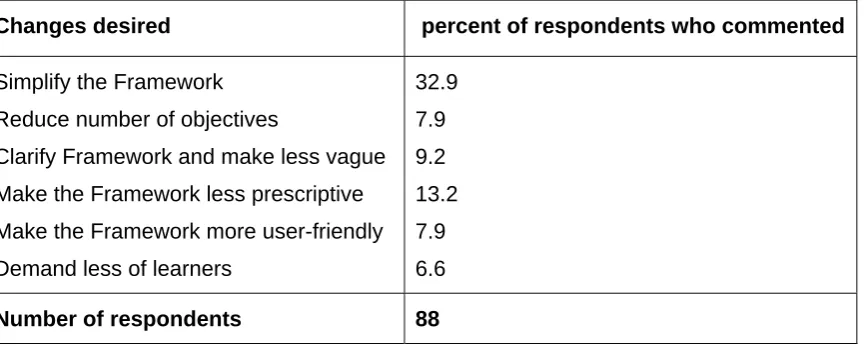
The most frequently mentioned way in which the Framework (and National Strategies in general) had impacted on language teaching was the practice of Assessment for Learning (AfL), in particular target-setting and peer assessment. There seems to have been an increased focus in this area between the two case study visits. This focus on AfL was reflected in the pupil data; the majority of pupils in both rounds of case study visits reported knowing what they needed to do to get better at language learning for example: revising; making more varied and complex sentences, and using more tenses; practising listening skills.
While in both rounds of the case studies, nearly all pupils reported that their teachers used the target language frequently in their lessons, the interviews with teachers and heads of department suggested that one of the consequences of the increased focus on explicit teaching of grammar had been a reduction of the amount of teacher use of target language, with the risk of an overall reduction of pupil exposure to communicative target language input. The majority of the case study heads of department, including those in Specialist Language Colleges, reported a decrease in target language use.
The survey revealed that the Framework has not had as great an influence on the teaching of culture, with only 12 per cent of respondents saying that it had affected their practice
significantly. This was confirmed in both rounds of case study interviews with heads of department who nevertheless believed that cultural objectives should be integrated in KS3 teaching.
What is the impact of KS2 language learning initiatives on the KS3 curriculum?
Most headteachers, heads of department, teachers and pupils in the case study schools approved of the principle of teaching languages in primary schools. Schools which had the greatest liaison with feeder primaries over language provision were most positive about its value.
However, the perception of the majority of secondary teachers and headteachers was that there was a lack of consistency at present in foreign language provision in
primary schools. This inconsistency was felt in terms of amount of language teaching taking place, the language being taught and the ways in which it was taught.
Concerns for secondary teachers were primarily to do with the challenges of ensuring progression in Year 7 groups where there was such a wide degree of mixed
experience.
Involvement of secondary languages departments with the primary languages initiative was not widespread. The data from the second survey and the second round of case studies suggested a growing awareness as to what was happening in the feeder primaries and of how the two sectors might begin to work together. In the first round of case study interviews, heads of languages and teachers mainly referred to the lack of language teaching expertise among primary colleagues and stressed the role of secondary languages teachers in
providing support. In the second round, however, the secondary teachers were more likely to talk about opportunities for both sectors to learn from each other, especially in terms of their own learning from primary methodology.
attainment, and there was little evidence from the qualitative data that the methodology of KS3 teaching was being affected by the introduction of language teaching in primary schools.
Headteachers and heads of department were generally unclear at interview about the direction in which their planning of KS2/3 language provision would proceed, though had better formulated ideas by the second survey. Heads of languages who already had a good level of experience of working with primaries identified more specific areas for development than those who had less experience including revising schemes of work, ensuring
progression through using the Languages Ladder and KS2 Framework in primaries, and running language summer schools.
Nearly half of the pupils interviewed in the first round of the case studies said they had had some experience of languages at primary level. They held mixed views on the impact of their own experience at KS2 on their learning at KS3.
What is the impact of Specialist Languages Colleges (SLCs) on KS3 curriculum and teaching?
Heads of department in SLCs reported that the gaining of specialist status had a strong positive impact on the development of the languages departments at these schools. Half of the SLCs responding to the first survey stated that the impact was very strong and over a third said it was quite strong, and this was similar in the second survey. The longer the duration of SLC status, the stronger the reported impact.
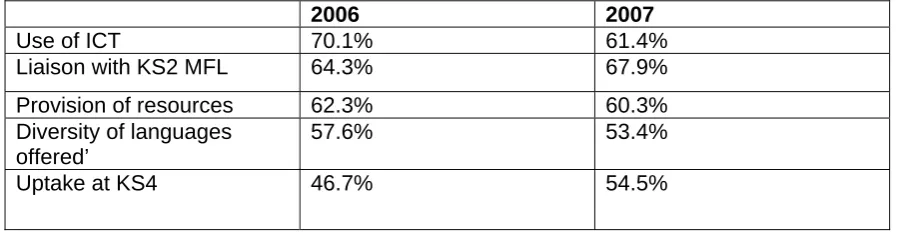
The most commonly reported areas of strong impact in the second survey were in: liaison with KS2 (68 per cent); the use of ICT (61 per cent); provision of resources more generally (60 per cent); uptake at KS4 (54 per cent); and diversity of languages offered at the school (53 per cent). At classroom level there was much less perceived impact on pedagogy. Improved links with industry were not noted.
There appeared to be a relatively low level of impact of the work of Specialist Language Colleges on that of other secondary schools more generally. Just under half of the non-SLC schools in both years of the survey had had no contact with an SLC, and those that did have contact reported it mainly to be only a little. The most commonly reported reasons for
absence of contact were: lack of communication, geographical distance, or doubts over usefulness of the contact. In the second survey, of those heads of department who had had contact with an SLC in the intervening year, 39 per cent (n=76) reported it to have had no impact on their department and 46 per cent (n=90) reported only a little impact.
In the survey, heads of department in both SLCs and non-SLCs were in agreement that the role of SLCs was: to promote the status of languages in school and beyond (94 per cent); to develop innovative teaching (90 per cent); to support other secondary schools in the area (85 per cent); to support provision of languages in primary schools (85 per cent); to support modern foreign languages teaching nationally (75 per cent); to be involved in the training of languages teachers (67 per cent). In an open question about the role for SLCs in the future, 95 per cent of respondent heads of department from non-SLCs referred to the desirability of SLCs providing support for other schools. In contrast, only about half of the heads of
How can language learning at KS3 best encourage uptake at KS4?
KS4 languages uptake in the sample
Both surveys suggested languages were optional for all pupils in approximately two thirds of schools. Where schools operated a selective policy for compulsory language learning, it was usually applied exclusively to pupils in higher sets. However, the first survey suggested that there was little support (18 per cent of heads of department) for compulsory languages for all
beyond KS3, a view confirmed by the case study interviews, but almost half of the survey respondents felt that it should be compulsory for most pupils. In the first round of case study interviews, reasons given by headteachers for making languages optional (which was the case in 12 of the 16 case study schools) were to do with offering choice, the belief that learners should enjoy what they were studying, the historically poor delivery of languages and poor pupil motivation.
46 per cent of heads of department in the survey reported some negative effects of the optional status of languages at KS4 on teaching and learning at KS3. The majority of comments related to pupils’ attitudes, with 45 per cent of respondent heads of department noting earlier disaffection in KS3. Some case study schools were trying to offset this effect by introducing exam-oriented languages courses in Year 9, through fast-tracking or similar strategies.
Common strategies to encourage uptake
In the survey heads of department said they encouraged uptake by doing presentations and talks, including inviting external speakers (46 per cent), planning trips and visits in the UK and abroad (35 per cent), and by using promotional materials. One third said the main way they sought to encourage uptake was by teaching good lessons at KS3 and making the learning experience as interesting and enjoyable as possible for pupils.Enrichment activities such as languages events, theatre visits and languages clubs were mentioned by 21 per cent of respondents. Guidance at GCSE choice time, including the targeting of individual pupils and involving parents in the decision-making process via letters home, was mentioned by 16 per cent. Offering a variety of courses at KS4 was seen by 9 per cent of respondents as likely to promote the study of languages beyond KS3. However, figures for a question asking which courses were on offer in respondents’ schools show that in fact the overwhelming majority offered just GCSE (81 per cent) at KS4.
It was clear from the case studies that departments were putting a lot of effort into promoting uptake in KS4. As well as some of the strategies used above some heads of department reported at interview that they used the following ways of encouraging pupils to continue with their studies beyond KS3: identifying and then ‘nurturing’ individual pupils whom they thought might enjoy and be good at languages; writing to parents; and using peer encouragement by having KS4 pupils talk to younger learners.
The pupils’ views
The most frequently cited reasons given by the case study Year 8 pupils for and against continuing with language study related to the extent of their enjoyment of language lessons. Another common factor in the individual interviews was how highly they rated themselves as language learners and how good a grade they were likely to get at GCSE. On the other hand in the focus group interviews, slightly greater prominence was given to vocational reasons for uptake.
What are the drivers for, and challenges to, higher standards in KS3 language learning?
Organisational factors, such as timetabling and resourcing, were named overwhelmingly by heads of department in both surveys as most likely to either constrain or support effective teaching. The following were felt to support effective teaching: teaching resources and in particular good ICT provision (73 per cent of respondents), staffing (59 per cent), training (53 per cent), and the use of Foreign Language Assistants (FLAs) (55 per cent). Factors that were seen to constrain effective teaching were lack of time allocation to languages (46 per cent), timetabling (54 per cent), and class size (45 per cent). Headteachers focused primarily on the quality of their languages staff as the key to the standard of language learning in their school.
The case study data indicated that collaboration with other teachers outside the school, for instance working with feeder primaries or in Strategic Learning Networks (SLNs), could provide a stimulus for innovation in teaching. However, involvement in SLNs was not
necessarily seen by all heads of department as productive. The second survey indicated that of the 56 per cent of heads of department who said they were part of an SLN, only 38 per cent said this had had some impact on language provision at KS3 and 61 per cent said there had been no impact.
Collaboration within school was also raised as positively impacting on KS3 work. Several of the case study teachers had enjoyed the experience of working collaboratively with other departments in their school, for example on a ‘Eurovision Song Contest’ with music where pupils wrote and performed songs in the target language and teaching the history of the First World War in French. Several teachers reported wanting to develop more of a context for their study of the foreign language and to teach in a way that allowed for the discussion to be on a more ‘adult footing’ which such forms of collaboration might allow.
There was evidence of increasing use of ICT over time in the case studies. More teachers reported that they were becoming more confident in using PowerPoint presentations and language learning websites in their teaching and some were beginning to use Virtual Learning Environments (VLEs) to support learning. There was also evidence that teachers who were already using ICT to a significant extent were thinking about how to use it
creatively and in ways which most appropriately support language learning e.g. podcasting, using digital video camera to support AfL in speaking work. There was evidence from interviews with pupils in both rounds that they were likely to view this as supporting their learning. Use of ICT, therefore, was largely felt by teachers and pupils to be a key driver for improving quality of language teaching and learning.
1. Introduction and Background
The last few years have seen the introduction of major structural policy initiatives in response to national reviews, enquiries and reports from stakeholders that have commented on the state of foreign language learning in schools in England and outlined recommendations for improvement in provision.
In 2000 the Nuffield Languages Inquiry (2000) chaired by Sir Trevor McDonald and Sir John Boyd, published its final report in which it made a far-reaching list of recommendations under the following main headings:
1. Develop a national strategy for languages as a key skill 2. Appoint a languages supremo
3. Raise the profile of languages in the UK 4. Establish business-education partnerships
5. Provide school children with a sound basis for language learning for life 6. Invest in an early start
7. Raise the quality of the provision for languages in secondary schools 8. Ensure wider participation beyond school
9. Promote languages for the majority of 16-19 year-olds
10. Develop a strategic approach to languages in higher education 11. Develop the huge potential of lifelong language learning 12. Intensify the drive to recruit more language teachers 13. Exploit new technologies to the full
14. Ensure policy is reliably and consistently informed 15. Establish a national standards framework for languages
The government subsequently implemented several of the more concrete recommendations in the context of schools in England (such as the appointment of a National Director for Languages, investment in the primary languages initiative, and the introduction of the
Languages Ladder as a framework for assessment). In addition, in 2002 the government set out its vision for languages education in a Languages Strategy that sought to address three main objectives: to improve the teaching and learning of languages in schools (including an entitlement to languages for all pupils in KS2); to introduce a national recognition system (known as the Languages Ladder); and to increase the number of people studying languages beyond school.
As far as provision in schools is concerned, the Strategy outlined three main areas of policy focus. Firstly, the Strategy turned to the primary sector as the springboard for the
Transforming language competence in this country means first of all transforming language learning in schools - we depend on embedding language learning in primary schools to make our strategy work and then ensuring that opportunity to learn languages has a key place in the transformed secondary school of
the future. (DfES, 2002: 7)
In addition to this longer term strategy of transforming language learning in schools from the primary upwards, improvement in the secondary sector was more immediately tackled through the introduction of a Framework for teaching languages at Key Stage 3, for which extra training and support was to be provided to languages teachers working with 11-14 year-olds. This was in order to ‘sharpen their skills and develop their understanding of the language learning process and its place within the overall learning experience’ (Ibid, p.23). Since then the government has confirmed the decision to require all primary schools in England to offer a foreign language by 2011. In 2006, at the start of this research study, there was evidence that 70 per cent of primary schools were providing languages within class time (Lines et al., 2007)
The Strategy also announced the planned increase in the number of Specialist Language Colleges and stressed that the role of these schools was to develop outreach work with primary schools, to share good practice and to provide professional development for both primary and secondary teachers (Ibid, p.24).
Finally, with regard to KS4 language learning, the Strategy document confirmed the
government’s decision to lift, as of September 2004, the statutory requirement that schools were obliged to teach a foreign language to all pupils to the age of 16. The immediate consequences of this decision has been the sharp decline of the proportion of all pupils in this country studying a foreign language, from 68 per cent in 2004 to 44 per cent in 2008 (CILT, 2008).
Since the publication of the Languages Strategy, there has been much public debate about the state of language teaching in schools and the relative effectiveness of the policy
measures. The government asked Lord Dearing and Dr King to conduct a Languages Review in 2006 based on consultation with stakeholders. In their final report, the authors conclude that a return to mandatory languages requirement at KS4 should not be
implemented for the time being, pending the outcome of other measures taken to promote language teaching in schools in this country.
During this interim period (2004-2011), prior to the introduction of statutory provision of foreign languages at KS2 and following the lifting of compulsory status of the study of foreign languages at KS4, the three years of language learning at KS3 may constitute for most children in England the only period of foreign language study in school. Large-scale national research has so far focused exclusively on developments in provision and learning at KS2 or KS4. No systematic study has been carried out that focuses on teachers’ and pupils’
2. Research
Methodology
2.1 Introduction
This section contains an outline of the main components of the research design and includes a profile of the survey and case study samples.
This was a longitudinal study involving a mixed mode research design consisting of a
questionnaire survey administered twice with a year’s interval, and qualitative case studies at 16 schools in England, each visited twice during the period. Both questionnaires were piloted in 10 secondary schools and all case study instruments were piloted in one school that did not participate in the main study. The research team also incorporated advice on the
questionnaires and interview schedules from members of a project advisory panel and from the DCSF steering committee.
2.2 Literature Review
The study was informed by a literature review that was carried out at the outset of the study and updated during the two years of the study’s progress. The main purpose of the review was to inform the focus of the collection and analysis of data relevant to the research questions. A secondary purpose was to provide an analytical account of the background literature which contributed to the literature review chapter in the final report.
Criteria that guided the review
In addition to the focus on the different topics identified in the 5 research questions, further criteria which informed the selection of studies consulted were as follows:
Studies based on maintained schools in England: Whilst some references to research conducted in overseas settings or in other parts of the UK were included in the review, the national focus of the study required an England-specific summary of prior findings in the first instance.
Recent studies and reports: Though there was no specific cut-off point to the publication dates of studies consulted, the contemporary focus of the study required an emphasis on recent (mostly since 2000) research.
Procedures
2.3 Quantitative data: surveys 1 and 2
• Questionnaire
The final version of survey 1 (see appendix B) was administered during the Autumn term, 2006, and comprised an eight page document consisting of 51 questions in a range of closed and open formats. The questions also varied in terms of focus on factual information or on evaluative information. Factual information related to departmental staffing, languages taught, systems of choice of language, length of compulsory MFL study, use of resources, links with other schools and with community, KS2/3 transition, approaches to teaching and assessment, use of KS3 Framework in MFL, and courses and uptake at KS4 and Sixth Form. The questionnaire also elicited evaluative information in the form of perception of the value and impact of language colleges, of different aspects of the KS3 MFL framework, of the current and potential impact of the KS2 initiative, of key factors for raising standards in MFL learning at the school, and of wider changes affecting language teaching.
The aim of the second questionnaire (administered in autumn 2007) was to gather
information on the current state of provision in the schools as well as to track change since the first year of the survey. The questionnaires were therefore sent out to the 612
respondents to survey 1. The second questionnaire (see Appendix B) was ten pages long and included 40 questions in a range of closed and open formats, some of which were designed specifically to track change from survey 1 and some of which were designed to follow up key questions raised by responses to survey 1.
• Sample and response rates
The aim was to base final report findings on returns from 10 per cent of schools in England with KS3 (achieved sample). There were 3,409 maintained secondary schools in England (www.eurydice.org accessed 2006). The target sample was therefore 340 schools for the second survey. In order to ensure sufficient completed questionnaires in the second year of the project, 1600 questionnaires were sent out representing approximately half of the total of maintained secondary schools in England (issued sample).
The sample of schools was drawn up through a random sampling procedure (provided by the National Foundation for Educational Research sampling service). The sample was stratified according to geographical region and school type (and reflects the national ratio of language specialist to non-specialist maintained schools i.e. 1:15).
The total number of returns received for the first questionnaire was 612, representing a response rate of 38 per cent. Completed questionnaires were coded and data entered on SPSS. Relevant frequency and crosstabulation tables are presented in appendices at the end of the report.
2.4 Qualitative data: Case studies
2.4.1 Selection of schools
276 respondents to survey 1 indicated that they would be happy to participate as case study schools in the research; of those, 16 were selected.
The overall aim in selecting the case study schools was to achieve as representative a sample as possible in terms of geographical location and school type while allowing schools of particular interest to the research to be included. Two main indicators, therefore, were taken into account:
• the location and characteristics of the school
• responses to key questions in Questionnaire 1.
In terms of location and characteristics of the school, the selection was made on the basis of geographical spread, character (urban/rural) and type of authority, as well as school level factors. These included school size, specialist status, languages taught, socio-economic indicators (for example, percentage of free school meals, ethnicity and pupils with English as an additional language), and attainment evidence. In order to achieve a geographical spread, respondents who were willing to participate further were plotted across the nine Government Office Regions, which were in turn grouped into North (North East: one school, North West: two, Yorkshire and the Humber: two), South (London: two, South East: two), East (East of England: two, East Midlands: two) and West (West Midlands: two, South West: one). In addition to three language colleges, the sample of schools included schools with the following specialisms: Arts (three), Sports (three), Technology (two), Business and Enterprise (one), Maths and Computing (one), as well as three non-specialist schools. In addition to the 16 ‘first choice’ schools, additional schools were selected across the regions in the event that first choice schools declined the research team’s invitation to participate.
The selection was also partly made on the basis of questionnaire responses in order to include schools where primary languages were perceived to be having an impact on
secondary provision, where the KS3 Framework was reported to be in active use and where schools were exploring alternative curricula for pupils with different needs.
2.4.2 Data collection and analysis
Heads of department in the identified schools were contacted initially by email and letter which described what their participation would entail. The invitation explained that the study would be conducted in two phases and that a researcher would visit each participating school for two or three days in spring 2007 and spring 2008. Each year the researcher would conduct:
• an interview with the headteacher (approximately 45 minutes)
• an interview with the head of department (approximately one hour)
• observation of one KS3 lesson of two teachers
• separate post-observation interviews with the two teachers (approximately 45 minutes each)
• one focus group interview with ten pupils: (in Year 8 in 2007, and with the same pupils in Year 9 in 2008) (approximately 30 minutes)
The core of the qualitative study is the data collected in the interviews. All additional data gathered, such as school documentation, served the purpose of providing the research team with contextual information that helped to assimilate and evaluate the information elicited at interview. The main purpose of the lesson observations was to provide focused points of reference in the follow-up interviews with the respective teachers in order to explore their conceptions of language teaching and learning.
[image:19.595.72.530.218.438.2]The following table indicates the total number of semi-structured interviews in each category and of lesson observations completed in this round of the case study part of the research:
Table 2.1: Case study data collected in schools
Type of data 2007 2008 Total Interviews with headteachers (and one deputy
headteacher)
15 15 30
Interviews with heads of department 16 17 33 Observations of KS3 French, German, or Spanish
lessons
30 22 52
Interviews with teachers (whose lessons were observed) 26 14 40 Individual interviews with Year 8 pupils 92 81 173 Focus group interviews with Year 8 pupils (approximately
eight in each group)
16 16 32
All interviews were recorded with the participants’ permission and transcriptions were later produced for analysis. The analytical procedure adopted consisted of a mixture of deductive and inductive methodology. Three coding frameworks (one for the headteacher, one for heads of department and teachers, and one for pupil interview data), which were linked to the main research questions and areas of focus highlighted in the questionnaire, were constructed prior to the analysis of the transcripts (see appendix C). All transcripts were entered on to NVivo and appropriately coded. Emergent themes formed the basis of the interpretation of the qualitative data.
The findings from the surveys are presented using percentages where N >100 and where N < 100 figures are used. At times where only a proportion of the sample responded to a particular item both N and the percentage is used.
2.5
Profile of survey 1 and survey 2 schools
49 per cent. Full tables for each of these background variables are reproduced in the Appendix.
Table 2.2: Geographical balance within the achieved sample
% of sample Specialist languages college 7.9
Non-specialist college 19.1 Specialist college (not languages) 68.6 Dual/combined specialism languages 10.5
The schools’ profile in this sample largely mirrored national figures. There were 45 single specialist language colleges in the sample, representing 7.4 per cent or 1:12 of the total sample. This can be compared with the 1:15 ratio of language colleges to other categories in the country as a whole (www.standards.dfes.gov.uk accessed 2006). In addition there was a smaller number of dual and combined specialist colleges in the cohort where languages were a specialism alongside other subjects (4.6 per cent). In sum, out of the total of 612
respondent schools, 73 of the respondent schools were ones where language was either a single or a shared specialism. In July 2006 the national statistics revealed that there were 297 schools in England with either sole or partial language specialist status: that is, 1: 11 compared with 1:8 in this sample (DfES, ibid).
Within this group of language colleges, the sample showed a spread of duration of specialist status: 16 of the 73 schools (21.9 per cent) have had more than five years’ experience and 21 schools (28.8 per cent) have had less than a year of language college status. This spread of duration of specialist status allows for examination of the impact of the status on the work of some schools over several years, as well as to examine the transitional effects on those schools which are at the start of the process.
The collective profile of the 389 schools that responded to the second survey was very similar to that of the 612 schools in the first survey in terms of distribution across
Government Office Regions, school types, percentage of pupils with statements of Special Educational Needs (SEN) and percentage of pupils with English as an Additional Language (EAL).
There was a slight increase in the number of schools with SLC status. Seven of the
respondent 62 SLCs in Questionnaire 2 had gained SLC status since last year. 9.0 per cent of the schools reported single specialism SLC status (8.7 per cent in 2006) and 6.9 per cent reported having languages as a combined or second specialism (5.4 per cent in 2006).
2.6
Profile of the languages staff
40.8 per cent of the respondents had been in post for at least six years.
1
0.3 per cent of the respondents in survey 2 reported that they had taken on the role of head of department in the intervening 12 months.The profile of departmental staffing within languages was less reassuring. In the 2006 survey 21.4 per cent of departments had fewer than three full-time members of staff. The most common number of staff was three (131 schools) or four (129 schools). The majority of schools had between 1 and 3 part-time teachers working in the languages department. Relatively few schools had advanced skills teachers (ASTs) working in the department (64 out of the 612).
In 2007 a significant change in the level of staffing in the MFL department was reported in 22.6 per cent of the schools. 4.7 per cent reported an increase while 17.6 per cent reported an overall fall in the number of languages teachers. SLC status appears to be a factor in the growth or decline of the number of languages teachers. There was an increase in the
number of teachers in MFL departments in 13.6 per cent of SLCs compared with 3.1 per cent of schools without a languages specialism and a decrease in the number of languages teachers in 8.5 per cent of SLCs compared with 19.3 per cent of other schools. The reasons given for an increase in the number of teachers included: higher uptake at KS4 (three schools); the introduction of a second specialism in languages (one school); the introduction of an additional language (one school); and involvement in KS2 teaching. Explanations for a fall in the number of languages teachers included: lower uptake at KS4 (20 schools); a reduction in time allocated to languages at KS3 (two schools); and a reduction in the number of languages taught (two schools).
A valuable additional support for staffing in languages is available through the Foreign Language Assistants (FLAs) scheme. It would seem, however, that whilst 31.5 per cent of schools in 2006 had two or more FLAs working in their languages department, 48.2 per cent of schools had no FLAs at all. The evidence suggests that non-specialist schools are less likely to employ a FLA with 60.7 per cent of the non-specialist, mainstream schools in the sample not having a foreign language assistant, compared with 15 per cent of language specialist schools (single, dual and combined grouped together). Survey 1 suggested that FLAs are used more in supporting the needs of able linguists than those of lower attaining pupils.
There was a slight increase in the 2007 survey in number of schools employing Foreign Language Assistants (FLAs). 54.9 per cent of the schools reported employing at least one FLA in 2007 compared to 51.7 per cent of the same schools in 2006. 37.3 per cent of schools in 2007 had two or more FLAs working in the department compared to 31.5 per cent of the same schools in 2006.
2.7 Direct
contact
with the foreign country
Direct contact with the people of the target country is often cited as potentially a key motivational and learning experience for pupils. The questionnaire sought information in relation to the three most common modes of contact: electronic links, residential visits, and home-to-home visits.
Of these three modes, residential visits were the most common. Survey 1 revealed that 73.5 per cent of schools have organised trips abroad (beyond day visits) as part of the language learning experience. On the other hand, home-to-home visits were relatively infrequent with only 26.5 per cent of schools organising this. Similarly, only 24 per cent of schools had electronic links with schools in the target country. This may in part be due to the level of availability of electronic resources in the partner schools.
Analysing the responses by school status, it emerged that single language colleges are the most active in their use of electronic links, (48.9 per cent), and in organising residential visits (91.1 per cent) and home-to-home visits (55.6 per cent), whilst non-specialist schools and non-language specialist schools were the most inactive.
Survey 2 sought information regarding new forms of contact established with native speakers since the previous year. 32.4 per cent of the respondent heads of department (126 schools) reported that new forms of contact had been made. The most commonly mentioned include: links through the internet, email or letters (39 schools); partnerships with schools abroad (27 schools); new native speaker member of staff or trainee teacher (15 schools) exchange visits (13 schools); visits from native speakers (12 schools); and the employment of FLAs (10 schools). 7.0 per cent of respondent heads of department (27 schools) reported that a form of regular contact with native speakers had been dropped in the intervening year. The most frequently mentioned reasons include: ceasing to employ FLAs (nine schools); ending exchange visits (eight schools); and cutting email contact (three schools).
[image:22.595.66.493.502.646.2]2.8
Foreign languages taught
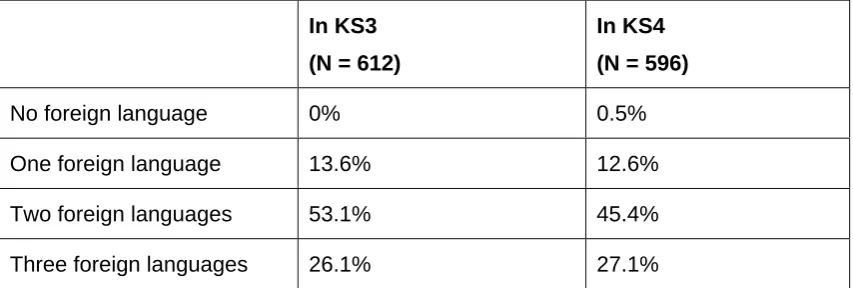
Table 2.3: Schools teaching 1, 2 or 3 foreign languages at KS3 and KS4 in first survey (2006)
In KS3
(N = 612)
In KS4
(N = 596)
No foreign language 0% 0.5% One foreign language 13.6% 12.6% Two foreign languages 53.1% 45.4% Three foreign languages 26.1% 27.1%
The most commonly taught language in 2006 in KS3 was French, with German and Spanish in second and third place respectively. Very few schools taught other languages at this level. French was taught at KS3 in almost all schools which taught languages (99.5 per cent), German was taught in 62.9 per cent of schools and Spanish in 49.7 per cent. Very few schools taught other languages at this level. Latin was taught in 2.9 per cent of schools at KS3. A similar pattern was repeated at KS4: French (96.5 per cent), German (62.9 per cent), Spanish (54.4 per cent).
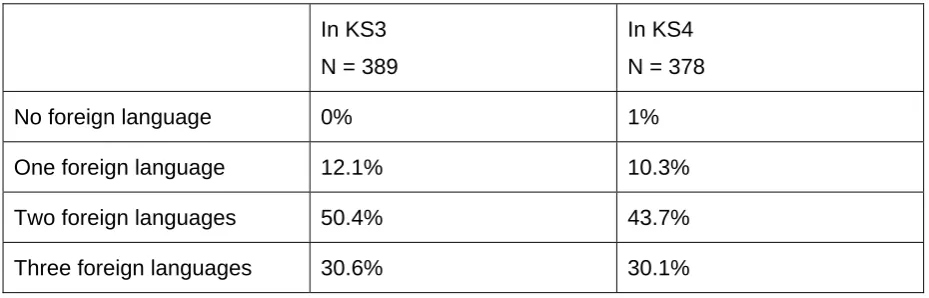
Table 2.4: Schools teaching 1, 2 or 3 foreign languages at KS3 and KS4 in second survey (2007)
In KS3
N = 389
In KS4 N = 378 No foreign language 0% 1% One foreign language 12.1% 10.3% Two foreign languages 50.4% 43.7% Three foreign languages 30.6% 30.1%
As can be seen for Table 2.4, the second survey showed that the most common number of languages taught in 2007 was two foreign languages in KS3 and KS4 as in 2006. Schools with SLC status were more likely to offer a wider range of languages in KS3 and KS4. 74.2 per cent of SLCs and 30.6 per cent of other schools offered at least three languages in KS3 while 80.6 per cent of SLCs and 36.1 per cent of other schools offered at least three
languages in KS4. Schools without a languages specialism were more likely to teach only one language in KS3 (13.8 per cent compared with 3.2 per cent of SLCs) and in KS4 (12.3 per cent compared with 1.6 per cent). Four schools did not teach any foreign language at KS4.
Since the first questionnaire 8.7 per cent (34) of the heads of department reported an increase in the range of languages taught at KS3 (14.5 per cent of SLCs and 7.6 per cent of other schools). 8.0 per cent (31) of the heads of department reported an increase in the range of languages taught at KS4 (14.5 per cent of SLCs and 7.0 per cent of other schools). Spanish was the language most often introduced at KS3 (15 schools) and KS4 (18 schools) and German was the language most frequently discontinued at KS3 (seven schools) and KS4 (five schools). The main reasons given for introducing additional languages were the following: as an extracurricular or enrichment activity (ten schools); as a result of SLC status (seven schools); to increase pupil choice (seven schools); to make use of the FLA’s
language (five schools); and to promote uptake at KS4 (five schools). Very few heads of department reported a reduction in the number of languages offered at KS3 (1.8 per cent of SLCs and 2.1 per cent of other schools) or at KS4 (1.6 per cent of SLCs and 4.7 per cent of other schools). The reason most often cited for dropping a language was low uptake at KS4 (eight schools).
figures for all types of schools represented in the sample, excluding those from which questionnaire returns were below 20.
Table 2.5: Specialisms of schools teaching two or more FLs at KS3 and three or more FLs at KS4 in first survey
Specialism 2 or more FLs
taught
at KS3
3 or more FLs taught at KS4
Total no. of schools with this
specialism in sample
Arts 39 28 67
Business & Enterprise 23 13 42
Science 22 15 49
Sport 23 11 46
Technology 48 26 84
Combined specialism (not MFL) 45 32 61 Combined specialism (with MFL) 19 23 29
Single specialism language college
33 40 44
Non-specialist school 84 29 117
A regional breakdown of the data reveals that the area with the highest percentage of schools teaching three or more foreign languages at KS4 were London (58.5 per cent), Yorkshire and North East (43.8 per cent), South West (42.6 per cent), South East (42 per cent), and Eastern region (35.4 per cent). With regard to the number of foreign languages taught at KS3 in a school: the lowest was East Midlands (25 per cent teaching only one foreign language) and the highest was London (46.2 per cent of schools teaching three or more languages), the South East (42 per cent), and the South West (36.8 per cent). Similar results were found in the second survey.
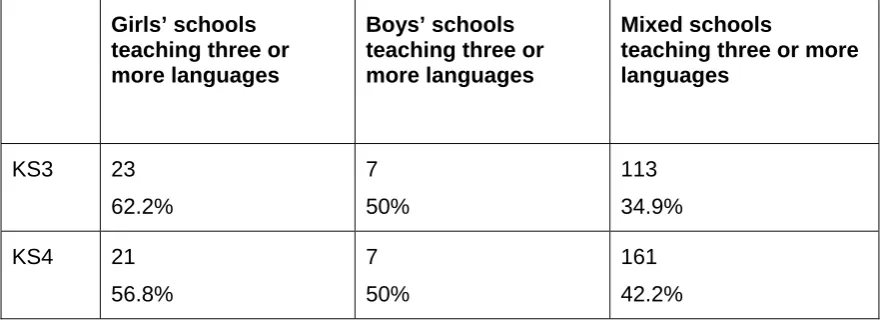
Table 2.6: Number of single sex and mixed schools teaching three or more languages at KS3 and KS4 in second survey
Girls’ schools teaching three or more languages
Boys’ schools teaching three or more languages
Mixed schools
teaching three or more languages
KS3 23 62.2%
7 50%
113 34.9% KS4 21
56.8%
7 50%
3 Literature
Review
3.1
Key findings
Impact of KS3 Framework for MFL
• QCA (2005) reported that the KS3 Framework, when implemented, seems to have a positive impact on KS3 teaching and learning especially in terms of grammar
teaching, range and effectiveness of classroom activities, and a focus on skills rather than on topics.
• Ofsted (2004b) reported improvement in pupils’ understanding of how language works and in confidence and accuracy in speaking. More recently, however, Ofsted (2008) reported that the level of speaking was good in less than a third of schools surveyed.
• The Framework seems to have had little impact on speaking for real purposes, reading for pleasure, writing at length and the development of cultural awareness.
Impact of KS2 initiative on KS3 languages
• In 2006 70 per cent of primary schools in England reported that they were teaching languages within class time (Lines et al. 2007). In 2007 a second survey suggested this had increased to 84 per cent of schools (Whitby et al. 2008).
• Findings from the literature indicate a limited impact so far on KS3 languages.
• Transition is identified as an issue. QCA (2004) reported that where primary and secondary language teachers co-operate well, there was good progression of language teaching and learning.
• There have been few reported cases of secondary schools modifying their language provision to provide continuity of language learning.
Impact of Specialist Language Colleges on KS3 teaching and learning
• In 2001 and 2005 Ofsted reported that foreign language provision in SLCs is more advanced than in most secondary schools in terms of offering a wider range of languages, working with primary schools, and attainment of GCSE grades.
• In 2008, however, Ofsted reported that pupil progress at KS3 in SLCs may be not as good as in other schools and that the demands of SLC status may distract from ensuring the appropriate levels of attainment of KS3 and KS4 pupils in the school.
Encouraging uptake at KS4 during KS3:
• There is no research, prior to the current study, on the effectiveness of measures taken during KS3 on languages uptake at KS4. The following recent findings refer to related issues such as the latest figures on languages uptake at KS4 and pupil motivation at KS3.
• Coleman et al. (2007) found that there is a link between the level of KS3 pupil motivation and the attitude of the school leadership and teachers towards language study.
• There is evidence that pupil motivation generally declines between Years 7 and 8.
3.2 Introduction
This chapter reports on the main findings from the research and policy literature that relate to the following main areas of focus of the study: the influence of the KS3 Framework for MFL; the impact of specialist languages colleges; the impact of primary languages on KS3 MFL; the impact of the lifting of compulsory languages at KS4 on KS3 languages provision.
3.3
What is the extent and influence of the KS3 Framework for MFL?
3.3.1 Introduction
The KS3 Framework for MFL is designed to be a key component of the MFL programme within the Secondary National Strategy for KS3. By providing teachers with a ‘mental map of language learning’, it is hoped that the Framework will support teachers to enable pupils to become ‘confident language learners, equipped with the skills and conventions of language learning’ (DfES, 2003).
The KS3 Framework for MFL was introduced in response to concerns about standards, teaching, and pupil motivation in languages (e.g. DfES, ‘National Developments in MFL’). The Office for Standards in Education (Ofsted), for example, reported in 2003 that pupils failed to make sufficient progress in MFL and that improvement in teaching and learning was slower in MFL than in other subjects. In an attempt to address this, the KS3 Framework for MFL focuses on knowledge about language and the application of knowledge and so aims to encourage ‘a rethink of where the emphasis should be in language learning’ (DfES, 2003). Given its recent introduction in 2003, through statutory inclusion in initial teacher training (ITT) programmes but non-statutory application in schools, one might argue that investigating the impact of the KS3 Framework for MFL in schools only three years after its inception is a little early in terms of assessing its assimilation in MFL departmental culture. However, there are indications (Ofsted, 2004a; Muijs et al., 2005) that aspects of the Framework have successfully filtered through to classroom practice. This may be partly due to the recruitment of newly trained languages teachers, and partly to the intensive core training programme provided on a national scale and more local in-service training (INSET) programmes and local authority (LA) support to schools on the implementation of the KS3 Strategy. In its annual report on MFL the Qualifications and Curriculum Authority (QCA) found that MFL teachers reported a positive impact from the Foundation Subjects strand of the KS3 Strategy, but that the subject-specific framework of objectives was not being widely integrated in planning and teaching of lessons (2004).
A revised version of the KS3 Framework for MFL is currently being developed by the DCSF with a view to dissemination to schools at the start of the 2009/10 academic year. This revision is aimed at a clearer alignment with the KS2 Framework and involves the
The QCA and Ofsted reports described above highlight areas where the original KS3 Framework for MFL, when implemented, seems to be having a positive impact on KS3 teaching and learning. They also identify aspects of the Framework which have been less influential to date and suggest that implementing the Framework may impact negatively on some aspects of the curriculum. The findings are summarised below.
3.3.2 Indications of positive influence on teaching and learning
Reports by QCA and Ofsted indicate that the KS3 Framework for MFL, as part of the KS3 Secondary National Strategy, is having a positive influence on KS3 MFL teaching and learning. In line with the stated intention that the Framework should encourage teachers to rethink the focus of language learning (DfES, 2003), according to QCA, many teachers view the KS3 Framework for MFL as an invaluable tool for reconsidering approaches to teaching and learning (2005a). In the 2004/05 Annual Report, Ofsted noted the following in schools where the Framework objectives were implemented: ‘more systematic good teaching of grammar, an increase in the range and effectiveness of classroom activities and in best practice, and greater focus on teaching skills as opposed to topics’(Ofsted, 2005).
Teachers reported revising how they planned and structured lessons in the light of the KS3 Strategy and the Framework for MFL, resulting in more focused approaches and greater pupil awareness of the learning objectives (QCA, 2005; Ofsted, 2004b). There is also evidence that teachers are using a range of Assessment for Learning strategies including self-assessment and peer assessment, in line with KS3 Strategy recommendations (QCA, 2005). In schools where the KS3 Framework for MFL was piloted, Ofsted judged the quality of teaching as good or better in more than two thirds of the lessons observed, and rarely unsatisfactory (2004b). This represents a higher proportion of good teaching than is normally observed (ibid) and so suggests that implementing the recommendations of the KS3
Framework for MFL has helped to improve standards of teaching.
Early observations indicated that, where implemented, the KS3 Framework for MFL has had a positive impact upon pupils’ learning. Ofsted noted that in 2004, for the first time, 50 per cent of Year 9 pupils nationally were working at National Curriculum Level 5, and suggested that this might reflect the impact of the KS3 Strategy and Framework (2005). In Ofsted’s Annual Report 2004/05, improvements were observed in pupils’ understanding of how language works and their confidence and accuracy in speaking, as well as in their ability to apply new language to their own chosen contexts’ (ibid). Similarly, the evaluation of the KS3 Strategy identified that pupils were developing increased knowledge of form and structure and were applying it to write at greater length and with more spontaneity and that some were also writing with greater accuracy (Ofsted, 2004b). Teachers, too, reported that pupils were more able to manipulate language as a result of implementing the Framework objectives (QCA, 2005). However, three years later Ofsted have reported that pupil progress at KS3 ‘is slower than it should be where work is insufficiently demanding [...] and where content is not sufficiently interesting and relevant’ (2008: 4).
3.3.3 Indications of areas where the Framework has had less influence
‘Cultural knowledge and contact’ represents one of the five strands of objectives in the KS3 Framework for MFL but seems to have had little influence in many schools (Ofsted, 2004b; QCA, 2004; Ofsted 2008). Ofsted concluded that in a significant number of schools the development of cultural awareness is limited by insufficient access to authentic texts in the target language (2004b).
There are other areas of concern where the Framework seems to have had little impact. For example, speaking for real purposes was rare (Lee, 2005), and there was limited time available for reading for pleasure and writing at length (Ofsted, 2005). Ofsted judged that teachers’ use of English was often unnecessary. Also, certain aspects of the KS3 Strategy were not widely established. These included the use of plenaries and assessment for learning (Ofsted, 2004b).
3.3.4 Evidence of extent of influence
Prior to this study it was not clear to what extent the KS3 Framework for MFL was used to inform planning and teaching. Ofsted reported that the implementation of the Framework was not widespread (2005). In 2004, QCA observed that schools other than those involved in the pilot were only beginning to integrate the Framework into planning and teaching (2004). In 2005 Ofsted noted that the Framework objectives were not built into the schemes of work of all MFL departments (2005a).
3.3.5 Summary
As outlined above, the reports which comment upon the influence of the KS3 MFL
Framework provide early indications that it has had a largely positive impact on KS3 MFL teaching and learning, where it has been implemented. However, as the KS3 Framework for MFL has only been in operation for about three years, little research into the nature and extent of its influence has been undertaken. The main findings outlined above are drawn largely from Ofsted and QCA reports. They emphasise the influence of the KS3 MFL Framework on the delivery of MFL, not its impact on learning. To date, there has been no substantial study into the factors influencing the extent of the impact of the KS3 MFL Framework on provision and practice.
3.4
What has the impact been of KS2 language learning initiatives on the
KS3 curriculum?
3.4.1 Introduction
The primary languages initiative has been seen by successive education ministers as a key policy initiative in the drive to raise standards in language learning in schools. As of 2011, foreign language learning will become a statutory requirement in primary schools in England. In anticipation of this date the majority of primary schools have begun to offer foreign
language learning to their pupils, albeit in an overall uneven pattern (Lines et al., 2007). It is hoped that as foreign language provision at KS2 becomes established, it will have a positive impact upon language teaching and learning in KS3. The KS2 Framework for Languages (DfES, 2005) provides support to embed foreign languages into the primary curriculum and the potential for a bottom-up approach on which secondary teachers can build for
progression in language learning. The support has included:
• funding for initial teacher training which incorporates development of language skills
• the establishment of regional and local learning networks to support language learning
• the development of the National Advisory Centre for early years primary language learning (National Advisory Centre on Early Language Learning (NACELL), based at the National Centre for Languages (CILT)
• the establishment of 19 local ‘Pathfinder’ authorities, where approaches to teaching languages were trialled in 1000 primary schools from 2003 to 2005.
• the development of the Primary Languages Training Zone
www.primarylanguages.org.uk, an online resource offering digital examples of current language classrooms, think piece articles on aspects of teaching and learning and guidance for teachers, leaders and trainers in primary languages methodology
• a national ‘training the trainers’ initiative managed by CILT which involves working with local authorities, Higher Education Institutions (HEIs) and schools to disseminate key messages about the Key Stage 2 Framework and the principles of language learning for primary age children
• the QCA has produced new schemes of work for French, German and Spanish.
• the British Council is providing opportunities for primary teachers to take part in a two- week project to improve their linguistic skills in a European country and primary schools can work with other schools to employ a foreign languages assistant. Currently, 250 assistants work in primary schools and the number is increasing. Over time, these measures should also promote greater consistency and coherence in primary foreign language provision (QCA 2005). Currently, however, foreign language
provision at KS2 and its impact on the KS3 curriculum varies significantly and this presents a considerable challenge for KS3 planning.
In what follows, the impact of KS2 language learning on the KS3 curriculum is described in terms of the challenges presented to KS3 planners and evidence of the positive and negative impact of KS2 provision on KS3.
3.4.2 Brief overview of foreign language provision at KS2
Foreign language provision at KS2 has been growing steadily but in an uneven and
disjointed pattern in recent years. A survey of 3,789 schools conducted in autumn 2007, with a response rate of 69 per cent, indicated that 84 per cent of schools in England were
providing pupils with the opportunity to learn a language within class time (Whitby et al. 2008).1 This represents a significant increase on the earlier findings of a survey in 2002-2004, that reported 44 per cent of primary schools offering some form of foreign language teaching in KS2, with only 35 per cent occurring in curriculum time, and taught mainly by class teacher (Driscoll et al., 2004). Lines et al. (2007) revealed that in 2006 91 per cent of the schools in their survey sample taught French, 25 per cent Spanish, and 12 per cent German. Similar findings were reported by Whitby et al (2008) based on evidence from a survey conducted in 2007. However, in its most recent report, Ofsted expresses concern
1
over the sustainability of language provision in individual schools, reporting that ‘in 2006/07 eight out of 30 schools that had introduced languages had subsequently abandoned them because of staff absence or departure: this highlights the need for a sustainable model’ (2008: 30). However, Ofsted noted that despite the difficulties in the early stages of introducing language teaching in the primary curriculum, pupils in their survey revealed ‘generally very positive attitudes towards learning languages’ (2008: 33).
3.4.3 Challenges to KS3 teaching
Range of provision
The range of provision and differing models of foreign language delivery in the primary sector at the moment present a challenge to all planners for KS2 to KS3 progression. In their
evaluation of the piloting of KS2 foreign languages in ‘Pathfinder’ LAs, Muijs et al.
commented that the complex patterns of KS2-KS3 transfer in the majority of Pathfinder LAs created real challenge in achieving continuity and progression (2005).
Transition arrangements
There seems to be a degree of uncertainty about how best to manage transition. Driscoll et al (2004) reported that only 49 per cent of specialist language colleges and 29 per cent of other secondary schools were satisfied with their transition arrangements. Half of all primary schools surveyed for their study (966 primary and middle schools) reported having no transition arrangements. Ofsted reported that details about the languages, skills and knowledge gained in KS2 are not always successfully transferred to the secondary school MFL department (2005). With inadequate understanding of primary foreign language developments, senior managers had little awareness of their impact upon the KS3 curriculum. Ofsted commented that even in the secondary schools where the language teachers were engaged in primary foreign language teaching, there seemed to be little appreciation of the need to change KS3 teaching in the light of KS2 initiatives.
Assessment
An additional challenge to planning for continuity and progression from KS2 has been the absence of systematic procedures for assessing attainment and progress in KS2 (QCA, 2004). As primary foreign language teachers see the main aims as ‘raising awareness’, ‘promoting interest and enthusiasm’ and ‘providing a positive, enjoyable language learning experience’, formal assessment and recording of learners’ progress is rare (QCA, 2005). Boodhoo et al. (2005) echo this, stressing that more transfer information is needed about individual pupils, and comment that when primary foreign language teachers provided written comments about learners’ aptitude and engagement, these enabled KS3 teachers to take account of prior learning.
3.4.4 Indications of the positive impact of KS2 language learning initiatives
The positive impact of KS2 language learning on KS3 MFL has been noted in the
development and use of transfer information, curricular changes and learners’ confidence and motivation as outlined below.
Transfer information
To enable appropriate KS3 MFL planning, some schools have developed transfer documents (Muijs et al., 2005; Ofsted, 2005; QCA, 2004). These may include indications of pupils’ levels of attainment, using schemes such as the Junior Portfolio2 and the Languages Ladder3. In some secondary schools, information about students’ prior learning and attainment was used to establish ability groups or individual learning targets. SLCs were more likely to differentiate MFL teaching and learning for pupils on entry in Year 7 (Driscoll et al. 2004).
Curricular changes
Some secondary schools have introduced changes in the language options available to provide continuity of learning. Ofsted, for example, reported that one secondary school offered two languages in Year 7 so that all students could continue learning the language taught at their primary schools (2005). As many of their students had learned Spanish at KS2, another school established a Spanish club, and increased the number of Year 8 Spanish classes (ibid).
In some schools, KS3 MFL teachers were rethinking the curriculum in the light of students’ KS2 learning. For example, KS3 teachers from one school worked with KS2 teachers to develop a bridging unit of work to ease transfer (Ofsted, 2005). In another school, the perfect tense was introduced in the first module of Year 7 (‘Les vacances’) to ensure all learners have a new challenge (Muijs et al., 2005).
Ofsted (2005) reported that a number of schools ‘fast-tracked’ learners as a result of their language learning at KS2. Several schools, mainly SLCs, set students early in Year 7 and ‘fast-tracked’ high attaining students to take GCSE at the end of Year 9 (ibid). In one Pathfinder LA, the SLC aimed for students to finish KS3 at the end of Year 8, and to follow the GCSE course in Year 9 and Year 10 (ibid).
Pupil confidence and motivation
QCA and Ofsted have reported that good experiences of language learning at KS2 seem to have a positive impact upon KS3 teaching. Teachers noted learners’ increased confidence and enthusiasm, as well as improved foreign language pronunciation (QCA, 2005). Where primary foreign language portfolios were used to acknowledge prior learning, students seemed to have increased confidence and motivation (Ofsted, 2005).
2
The Junior Portfolio is a version of the European Languages Portfolio. This is a Council of Europe initiative being implemented for learners at all stages of education across Europe. It comprises: a personalised learning diary making children aware of their achievements as they learn; a dossier where learners can file work and materials to illustrate the achievements recorded, and an overview of the learner’s knowledge and experiences of different languages, including cultural experiences.
3
See: http://www.dfes.gov.uk/languages/DSP_languagesladder.cfm. The system is intended to complement existing national qualification frameworks and provides a ‘ladder of recognition’ starting at an initial level of ‘break