P Bramston, G. Pretty and C Zammit University of Southern Queensland
Keywords: Stewardship motivation, social belonging, environmental concern, ecological knowledge
Word count: 3,600
Contact:
Dr Paul Bramston Psychology Department
University of Southern Queensland, Toowoomba Australia, 4350
Abstract
Environmental stewardship networks flourish across Australia. While the
environment benefits, this paper looks to identify what volunteers draw from their stewardship. We adapted 16 questions that purportedly tap environmental stewardship motivation and administered them to a convenience sample of 318 university students, and then to 88 people living in rural Australia who were either active members of environmental groups or voiced concern about local environmental issues. Our results suggest that the measure consisting of these questions demonstrates acceptable internal consistency. Factor analyses support three relatively independent aspects of environmental stewardship motivation: developing a sense of belonging, care-taking the environment and expanding personal learning. Scores on the scale were not strongly correlated with well-being, suggesting that the scale measures more than general feelings of positive affect. Discussion focuses on the benefits of being able to reliably assess environmental stewardship motivation and areas for further
Introduction
In many countries volunteers of all ages engage to address environmental issues either directly or indirectly, such as riparian restoration, fund raising, political activism, natural resource monitoring, community outreach and education. Such engagement has become the lifeblood of the environmental movement and has the potential to preserve, build and restore significant environmental and civic capacity of local communities (Overdevest, Orr & Stepenuck, 2004). However, while full of promise and opportunity, maintaining dynamic volunteer partnerships with
environmental professionals is not without challenges as Westphal and Childs (1994) noted amongst several successful urban forestry projects in the US. Also while there tends to be considerable concern about the state of the environment, this does not translate proportionally into actual time and effort in behaviours that address these issues (Seguin, Pelletier & Hunsley, 1998). So what motivates volunteers to
unselfishly contribute so much of their time and effort? This paper seeks to evaluate the psychometric properties of a set of questions compiled by Ryan, Kaplan and Grese (2001) to assess environmental stewardship motivation with the view to adapt and improve their composition for a new measure. To better understand the particular motives of volunteers in the environmental area, it is useful to review the substantial literature on volunteerism in general.
Volunteer Motivation
This body of research is generally founded on traditional theories of
early works have served as a springboard for the more recent motivational research into volunteerism. For example, similar motives are found in the four dimensions of altruism, social contact, personal interest and emotional need proposed by Yeung (2001) to encompass much of the previous motivational research amongst social service volunteers. Similarly consistent are the motives of egoism, altruism, collectivism and principlism described by Batson, Ahmad and Tsang (2002).
One of the most comprehensive models of volunteer motivation is the octagonal model recently derived by Yeung (2004) from their extensive
phenomenological data. The octagon is made up of four dimensions; getting-giving, continuity-newness, distance-proximity and thought-action. The getting-giving dimension emerged as the strongest of the elements and incorporates the egoism and altruism motives proposed earlier (Batson et al., 2002; Yeung, 2001). The continuity- newness dimension deals with the same self-development, personal interest and learning motives previously proposed by Yeung (2001) and Clary et al. (1998). The distance-proximity dimension incorporates the social, making friends dimension previously noted by Yeung (2001) and Clary et al. (1998) and finally the thought-action dimension includes values, spiritual growth and principles previously noted by Batson et al. (2002) and Clary et al. (1998). Such dimensions are generally believed to hold true for volunteers across a wide range of settings.
Environmental stewardship
worthwhile outcome for effort and learning new ecological facts attracted volunteers in a study by Grese, Kaplan, Ryan, and Buxton (2000).
Interest in a values based understanding of environmental volunteerism was stimulated by theoretical advances in the understanding of human values and attitudes (see Schultz, 2001; Stern & Dietz, 1994). Three attitudes or values associated with environmental stewardship emerged from the work of Schultz- egoistic, altruistic and biospheric. The egoistic motives included my health, my future, and my lifestyle; the altruistic referred to community belonging, being with people and children; and the biosphere to stewardship of plants, animals and birds. These findings are clearly consistent with the dimensions of the environmental motivation research already described.
Given that the number of grassroots volunteer groups dedicated to ecological preservation and restoration continues to multiply, their motives both to commit to and maintain their input are vitally important research matters. This is of particular importance as organisations are increasingly required to submit evidence of their human capacity and sustainability to administer government grants to support long term programs. Thus, the development of models and theories of environmental stewardship motivation needs to be followed up with related assessment tools that are psychometrically sound and “user-friendly”.
Assessment of environmental stewardship motivation
describe what motivates longevity in volunteerism. Long-term volunteers involved in environmental stewardship programs from three US states rated themselves on these questions and their responses factored into five dimensions; helping the environment, learning more about their physical surroundings, connecting socially, experiencing opportunities for personal reflection, and being part of a well-organised project team and organisation. The first factor, helping the environment, refers to the tangible improvements in the local environment that are a direct result of the volunteer work; learning refers to what the volunteers learn about the natural environment as a result of their activities; social connection incorporates the host of interpersonal benefits of meeting and interacting with like-minded people; personal reflection refers to the peaceful meditative experiences volunteers associated with natural environments; and finally project organisation includes the appeal and satisfaction of working in a well organised program (shown to be particularly important to long-term volunteers by Knoke, (1981). We proposed that some of these dimensions and the related questions would form a conceptual foundation for an environmental stewardship motivation scale with direct relevance to prospective, new and continuing volunteers. All of these dimensions refer to behavioural factors or experiences, all of which can be directly afforded by a volunteer program, as compared with attitudinal factors which are more difficult to influence and observe.
Method Participants
Two groups of participants were recruited for this study, a group of
undergraduate university students (n=318) to facilitate psychometric analysis of the scale and a group of rural adults (n=88) who were either members of environmental groups or interested enough in ecological restoration to volunteer to participate.
The students were first year undergraduate students who completed the scales for course credit. The mean age of this group was approximately 19 years with 68% female.
The rural participants were recruited in three small country towns selected randomly from the list of towns with a population of less than 10,000 people within two hours drive of a city. The rural group were recruited through a number of
just over half (56%) lived on a rural property. When asked how many people in their community they knew by name half (50%) responded „a few‟ and 44% „almost everyone‟. Forty eight percent reported liking their current community „very much‟ and 33% „a great deal‟.
Materials
The items compiled by Ryan et al. were adapted so as to be applicable to new or intending volunteers. Thirteen items were retained with minor adjustments to wording, 3 items were omitted because they dealt with efficiency of project organisation which was thought to be less of a concern for new or intending
volunteers and 3 questions were added to strengthen the emphasis on each dimension. The resultant measure, entitled the Environmental Stewardship Motivation Scale (ESMQ), is a 16 item intention to volunteer scale where respondents rate their agreement with statements on a 5-point Likert Scale from „completely disagree‟ to „agree completely‟.
The Comprehensive Quality of Life Scale (ComQol) (Cummins, 1997) was also administered to demonstrate that the ESMQ scores differed from ComQol and were not simply reflecting general feelings of well being. ComQol assesses well being within seven life domains: material well-being, health, productivity, intimacy, safety, community involvement, and emotional well-being and responses are scored on a 5-point Likert scale. ComQol has been shown to be internally consistent with Cummins repeatedly reporting satisfactory Cronbach‟s alpha coefficients amongst Australian samples.
Results
This project aimed to examine the psychometric properties of the newly developed ESMQ by identifying scale dimensions, assessing internal consistency and examining overlap with well being. Evidence for three reliable and distinct
motivational dimensions is presented and ESMQ scores are shown to be relatively distinct from feelings of general well-being.
Responses to the 16 items by the convenience sample of university students were entered into a principal components analysis and inspection of communalities and correlation matrices for this sample indicated that the data were suitable for this analysis. This was confirmed by a KMO sampling adequacy of .83 and a significant Bartlett‟s test of sphericity.
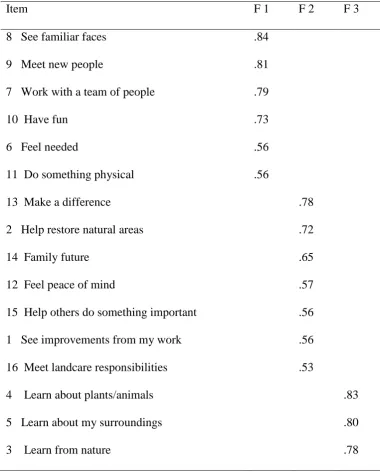
Four factors with eigenvalues above 1 emerged from this analysis, accounting for 64% of the total item variance. The solution was subjected to a promax rotation. A three factor solution gave the best fit and items loading on each factor are shown in Table 1.
Insert Table 1 about here
Given the above item loadings, we labelled Factor 1 as Social Belonging, with an emphasis on sense of community and the social benefits of working together. Factor 2 was labelled Caring for the Environment encompassing themes of making an ecological contribution and a responsibility to leave something worthwhile for future generations. The final factor has been labelled Learning in regard to ecological facts and skill development.
Having established a reliable and interpretable factor structure for the ESMQ using a convenience sample, the responses of the group of adults living in rural towns or on farms were analysed. This stage of the project aimed to establish discriminant validity and some preliminary rural normative data for the scale.
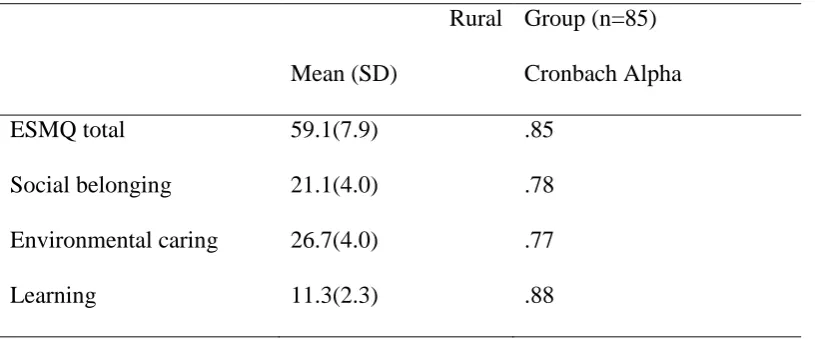
Means, standard deviations and reliability coefficients for the rural sample are presented in Table 2. No significant gender effects were found.
Insert Table 2 about here
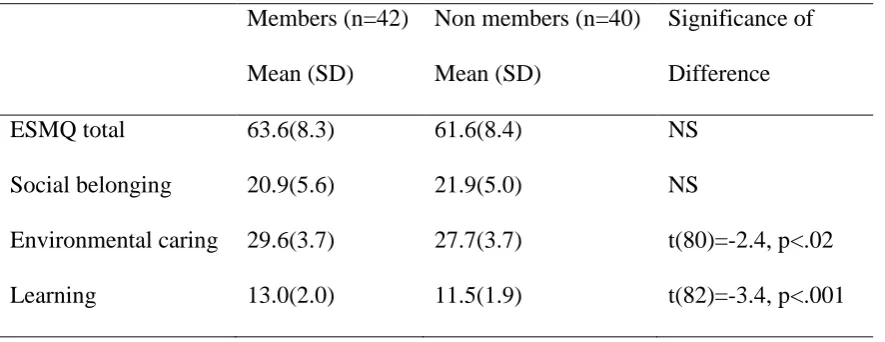
In order to investigate the sensitivity of the ESMQ, the means and standard deviation for members and non members of an environmental stewardship group or program in the rural sample were compared and presented in Table 3.
Insert Table 3 about here
Comparisons between the above means suggest that those rural people who are not involved in a voluntary natural resource management group report
significantly lower scores on the environmental caring and learning dimensions of the ESMQ.
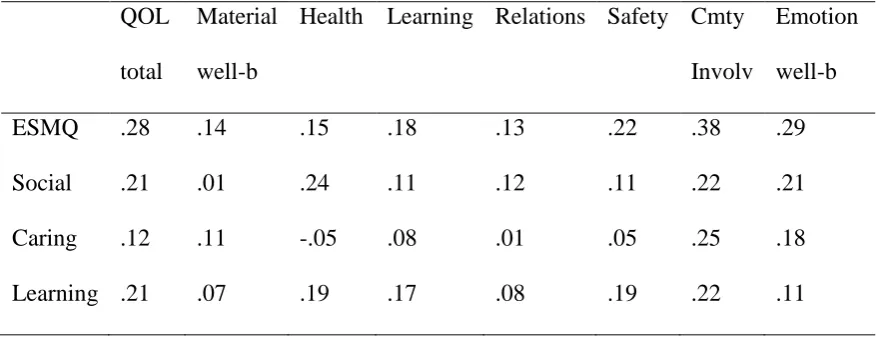
A well being scale (ComQol) was administered to gauge the degree to which volunteer motivations, as measured by the ESMQ, were merely reflections of general wellbeing or a trait-like positive affect. Pearson product moment correlations between responses to the two scales are presented in Table 4.
Insert Table 4 about here
The correlations in Table 4 suggest that there is little overlap between
Discussion
Through the commitment and toil of volunteers, ecological projects continue to protect and restore vulnerable environments. The crucial issue of what benefits volunteers perceive for their labour was explored by Ryan et al. (2001). Based on their work, this study presents a reliable and valid self-report measure of
environmental stewardship motivation with a three factor construction. Preliminary normative data for the scale are also presented for a small group of rural Australians.
The three dimensions that emerged from the ESMQ, social belonging, helping the environment, and learning have a strong foundation in the theoretical literature. For example, they parallel the tripartite classification of environmental concerns- self, other people and biosphere proposed by Schultz (2001) who empirically demonstrated that this three factor model was stable across a range of diverse samples from 10 countries. Three clusters of environmental value orientations were suggested by Stern, Dietz & Guagnano (1995)- egoistic, altruistic and biospheric that similarly mirror the dimensions of the ESMQ. Three of the four ESMQ dimensions match those of
Yeung‟s (2004) octagonal model. In summary, the three dimensions of environmental stewardship motivation as measured by the ESMQ are well supported within the environmental volunteer literature.
longer term volunteers. This dimension readily incorporates other important social motives of volunteers such as building intergenerational ties within a community as noted by Austin (2002) and reflects a growing recognition that people are an
important part of ecosystems (Schroeder, 2000).
The environmental biospheric factor that emerged in this study is a subset of a long recognised motivation of volunteers- to do something worthwhile (Cnaan & Goldberg-Glen, 1991). For example, helping the environment was found to be a strong motivation for forestry volunteers (Still & Gerhold, 1997) and the preventing the destruction of natural habitats for animals and birds was identified as the motive for volunteering by Grese et al. (2000). Making a difference, sense of loss and
attachment toward nature are closely related themes noted by Schroeder (2000) in his review of restoration newsletters in Illinois. A wide range of research suggests the motive of leaving something worthwhile for future generations is a particularly important focus of this dimension that may merit a direct question within this scale.
The learning factor that emerged in the current study deals with expanding ecological knowledge. Individual volunteers clearly value learning more about their surroundings and the ecology and biology of everything living in it and evidence of this motivation lies in the widespread popularity of information nights on ecological topics and nature walks. Learning and sharing knowledge were subthemes of a „personal rewards‟ theme found by Schroeder (2000).
Johnson (2007) and Walker and Ryan (2008). However our findings here are
consistent with studies that have questioned a strong association between connection to nature and pro- environmental behaviour (see Gosling & Williams, in press). Four items on the ESMQ (items 12-15) deal with values but in a rather general manner not specific enough to directly tap sense of place dimensions and nature connectivity. A consideration is that the participants in the student sample in this project may not, on average, have been at a stage where they were aware of their spiritual connections to the environment. Yeung (2004) presents persuasive data that motives for volunteer work change over time and it may be that first-year students have different priorities. Future research could profitably explore revisions to the wording of these items to ensure they refer more specifically to nature connectivity and a „spiritual‟ sense of attachment, and reflect dimensions of sense of place (Scannell & Gifford, 2010). While such inclusion would refer to affective and attitudinal dimensions rather than the behaviour focus we have taken here, it would further develop and more
comprehensively reflect the closely related themes and philosophical questions presented in Schroeder‟s review of restoration newsletters.
A final concern within the current study was the absence of scale items referring to organisational efficiency of environmental groups. This issue was found to be important to long-term volunteers by Ryan et al. (2001) and our assumption that it would not be a concern for new or intending volunteers requires further
investigation.
References
Austin, M.E. (2002). Partnership opportunities in neighbourhood tree planting initiatives: Building from local knowledge. Journal of Arboriculture, 28(4), 178-186.
Batson, C.D., Ahmad, N. & Tsang, J. (2002). Four motives for community involvement. Journal of Social Issues, 58(3), 429-445.
Clary, E.G., Snyder, M., Ridge, R.D., Copeland, J., Stukas, A.A., Haugen, J., & Miene, P. (1998) Understanding and assessing the motives of volunteers: A functional approach. Journal of Personality and Social Psychology, 4, 1516-1530.
Cnaan, R.A. & Goldberg-Glen, R. (1991). Measuring motivation to volunteer in human services. Journal of Applied Behavior Science, 27(3), 269-284
Cummins, R.A. (1997). Comprehensive Quality of Life Scale- Adult Manual: 5th ed., School of Psychology, Deakin University.
Donald, B. (1997). Fostering volunteerism in an environmental stewardship group. Journal of Environmental Planning and Management, 40(4), 483-505
Dutcher, D. D., Finley, J. C., Luloff, A. E. & Johnson, J. B. (2007). Connectivity with nature as a measure of environmental values. Environment and Behavior, 39(4), 474-493.
Ford, M.E. (1992). Motivating humans: Goals, emotions and personal agency beliefs. London: Sage
Gosling, E & Williams, K. (in press). Connectedness to nature, place
attachment and conservation behaviour: Testing connectedness theory among farmers. Journal of Environmental Psychology (2010).
Restoring nature: Perspectives from the social sciences and humanities. Washington DC: Island Press
Knoke, D. (1981). Commitment and detachment in voluntary organisations. American Sociological Review, 46, 141-158
Maslow, A.H. (1970). Motivation and personality, 2nd ed., Harper and Row, New York.
Miller, N.E. (1951). Learnable drives and rewards. In S.S. Stevens (ed.), Handbook of Experimental Psychology, Wiley, New York, pp. 345-472.
Overdevest, C., Orr, C.H., & Stepenuck, K. (2004). Volunteer stream
monitoring and local participation in natural resource issues. Human Ecology Review, 11(2), 177-185.
Ryan, R., Kaplan, R. & Grese, R. (2001). Predicting volunteer commitment in environmental stewardship programmes. Journal of Environmental Planning and Management, 44, 629-648.
Scannell, L. & Gifford, R. (2010). Defining place attachment: A tripartite organising framework. Journal of Environmental Psychology, 30, 1-10.
Schroeder, H.W. (2000). The restoration experience: Volunteers‟ motives, values and concepts of nature. In Paul H. Gobster and R. Bruce Hull (Eds.), Restoring nature: Perspectives from the social sciences and humanities pp. 247-264.
Washington DC: Island Press.
Schultz, P.W. (2001). The structure of environmental concern: Concern for self, other people, and the biosphere. Journal of Environmental Psychology, 21, 327-339.
Stern, P.C. & Dietz, T. (1994). The value basis of environmental concern. Journal of Social Issues, 50, 65-84.
Stern, P.C., Dietz, T., & Guagnano, G.A. (1995). Values, beliefs and proenvironmental action: Attitude formation toward emergent attitude objects. Journal of Applied Social Psychology, 25, 1611-1636
Still, D.T. & Gerhold, H.D. (1997). Motivations and task preferences of urban forestry volunteers. Journal of Arboriculture, 23(30), 116-130
Walker, A. & Ryan, R. L. (2008). Place attachment and landscape
preservation in New England: A Maine Case Study. Landscape & Urban Planning. 86(2). 141-152.
Weigel, R.H. & Weigel, J. (1978). Environmental concern: the development of a measure. Environment and Behaviour, 10, 3-15.
Westphal, L.M. & Childs, G. (1994). Overcoming obstacles: Creating volunteer partnerships. (10), 28-32.
Yeung, A.B. (2001). Manifold motives for volunteerism: A study on the motives of the people inspired to volunteer by a Salvation Army advertisement. Journal für Psychologie, 3, 37-47
Yeung, A.B. (2004). The octagon model of volunteer motivation: Results of a phenomenological analysis. Voluntas: International Journal of Voluntary and
Table 1: Item loadings for student sample N=318
Item F 1 F 2 F 3
8 See familiar faces .84
9 Meet new people .81
7 Work with a team of people .79
10 Have fun .73
6 Feel needed .56
11 Do something physical .56
13 Make a difference .78
2 Help restore natural areas .72
14 Family future .65
12 Feel peace of mind .57
15 Help others do something important .56
1 See improvements from my work .56
16 Meet landcare responsibilities .53
4 Learn about plants/animals .83
5 Learn about my surroundings .80
Table 2 Mean Scores on the Environmental Stewardship Motivation Scale Rural Group (n=85)
Mean (SD) Cronbach Alpha
ESMQ total 59.1(7.9) .85
Social belonging 21.1(4.0) .78
Environmental caring 26.7(4.0) .77
Table 3: Mean Scores on ESMQ for Members and Non-members
Members (n=42) Non members (n=40) Significance of
Mean (SD) Mean (SD) Difference
ESMQ total 63.6(8.3) 61.6(8.4) NS
Social belonging 20.9(5.6) 21.9(5.0) NS
Environmental caring 29.6(3.7) 27.7(3.7) t(80)=-2.4, p<.02
Table 4 Correlations between scores on ESMQ and ComQol factors (N=87) QOL
total
Material well-b
Health Learning Relations Safety Cmty Involv
Emotion well-b
ESMQ .28 .14 .15 .18 .13 .22 .38 .29
Social .21 .01 .24 .11 .12 .11 .22 .21
Caring .12 .11 -.05 .08 .01 .05 .25 .18