Activity and Learning Agreement
Pilots
Programme Theory Evaluation
Working Paper 5
Activity Agreements and Small Step Progression
Becci Newton, Tom Levesley, Joy Oakley,
Harriet Fearn and Claire Johnson
Research Report No
DCSF‐RR098
Activity and Learning Agreement Pilots
Programme Theory Evaluation
Working Paper 5 - Activity Agreements and
Small Step Progression
Becci Newton, Tom Levesley, Joy Oakley,
Harriet Fearn and Claire Johnson
Institute for Employment Studies
The views expressed in this report are the authors’ and do not necessarily reflect those of the Department for Children, Schools and Families.
Prepared by:
INSTITUTE FOR EMPLOYMENT STUDIES Mantell Building
University of Sussex Campus Brighton BN1 9RF
UK
Tel. + 44 (0)1273 686751
Fax + 44 (0)1273 690430
www.employment-studies.co.uk
Copyright © 2009 Institute for Employment Studies
Acknowledgements
The authors would like to thank the staff of the three Connexions Partnership areas who agreed to participate in this study and helped to provide the sample of young people. We would also like to thank Susanna Greenwood (DCSF) and Professor Ray Pawson (University of Leeds) for their advice, support and helpful comments throughout the project. Gerry Lyons showed persistence and dedication in the interview recruitment for the sample of young people. Gill Brown at IES provided administrative and secretarial support and also invaluable support as ‘researcher safety buddy’ during the fieldwork.
Finally, we would like to thank all of the young people and their Advisers who gave up their time to take part in this research.
Institute for Employment Studies
Contents
EXECUTIVE SUMMARY 1
1 INTRODUCTION 4
1.1 What is ‘programme theory evaluation’? 4
1.2 Background 5
1.3 Hypothesis and research aims 5
1.4 Methodology 6
1.5 Structure of the Working Paper 8
2 CONTEXTS AND STARTING POINTS 9
2.1 Experiences prior to the AA and why young people signed up 9
2.2 The framework of provision for Activity Agreements 10
2.3 Young people’s starting points and their activities 10
2.4 An initial model of what young people need to progress 14
3 PROGRESSION WITHIN THE AA 15
3.1 Brokering with young people 15
3.2 The role of sustained weekly support from an Adviser 17
3.3 Different types of small steps 19
3.4 Progression between activities 22
4 THE RELATIONSHIP BETWEEN PROGRESSION AND OUTCOMES 25
4.1 Progression as a turning point or continual process? 25
4.2 Ways of moving young people forward 27
4.3 Difficulties during the AA journey 34
4.4 Benefits from AA participation 35
4.5 Perceived impacts of the AA 39
4.6 What is seen to be distinctive about the AA? 40
4.7 The outcomes of AA participants 42
5 CONCLUSIONS 43
5.1 Refining the theory 43
5.2 Confidence is at the core of progression 44
5.3 Some implications for policy 45
BIBLIOGRAPHY 46
APPENDIX 1: TOPIC GUIDES 47
FOCUSED STUDY 5: TOPIC GUIDE, PARTICIPANTS REVISED VERSION 48
FOCUSED STUDY 5: TOPIC GUIDE, AA ADVISERS 53
APPENDIX 2: CONSENT FORMS 57
INITIAL RESEARCH CONSENT FORM 58
Executive Summary
Introduction and research aims
The Activity and Learning Agreements (ALA) Pilots were launched in 12 areas of England in April 2006. Activity Agreements (AA) operated in eight of the 12 areas and were designed for young people aged 16 or 17 who were not in employment, education or training (NEET). Young people had to be NEET for 20 weeks to be eligible. They received a weekly allowance (three variants of which were being tested in different pilot areas) and in return received continuous support and agreed to take part in tailored activities designed to help them progress towards an employment, or education and training, outcome. Learning Agreements (LA) operated in eight of the 12 pilots areas, and were aimed at 16 to 17 year olds who were in jobs without training (JWT). Under a Learning Agreement, young people took part in agreed activities, which included undertaking a designated course.
This paper is part of the programme theory strand of the ALA Pilots evaluation. This is a realist evaluation method which focuses on identifying and testing some of the key ‘theories’ that underlie the ALA policy to explore which components of the policy work (or do not work), how, for whom, why, and in what circumstances.
This is the fifth paper resulting from the ‘focused studies’ element within the programme theory evaluation and explores the Small Step Progression theory. It is based on research undertaken among a sample of young people in three Connexions Partnership areas who finished their AA between December 2007 and July 2008. The aim of this particular study was to gather evidence in relation to the effectiveness of Theory 18 (see box below).
Theory 18 (the ‘small steps’ theory): If the young person can be motivated to take a series of
‘small steps’ they will gradually move closer to their goal. In the AA, activities should be designed to build on one another - progression for most young people will be incremental and therefore the weekly nature of the AA process can facilitate this by breaking it down into ‘small steps’.
Methodology
Key findings
Confidence is the core of progression
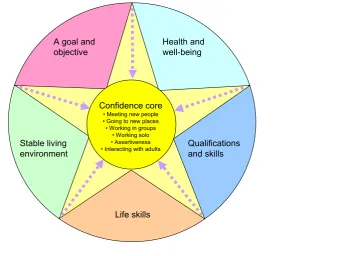
Building confidence is a core element of building progression, both within the AA and towards a positive outcome. This can be achieved in a number of ways, including specific confidence-building programmes and participation in other more general activities, such as those with skills development aims, group work as a focus, interaction with adults and a wider range of young people, and travelling to and attending activities outside their ‘normal’ travel zones.
Young people grew in confidence through learning in a non-school setting where they feel they are treated more like adults. They can also become more open about their problems in this environment, which can help them to identify barriers to learning, or explore new career directions and enable progression.
Young people may need their confidence built and re-built throughout the time they spend on the AA and through different scenarios. The AA encourages experimentation with new things and this can lead to false starts and set-backs. The value of the programme is that the Adviser can configure new activities and support the young person to ensure that they overcome any difficulties they experience during their journeys.
One size does not fit all
The research demonstrates how young people join the AA at different points in their lives: some are ready to move forward while others are still struggling with their barriers and issues. The speed at which barriers can be overcome varies greatly. What is most important is that the AA has the flexibility to be personalised to each individual’s needs and situations. No two paths are the same, although common features do appear, and what works is not a set programme but a series of ‘tricks of the trade’ that Advisers come to learn.
Depending on the young person’s needs the Adviser may be working to build trust and
confidence to take a small step forward and this may lead to further experimentation and more stretching activities. Some individuals require a lot of hand-holding while others are ready to move forward as soon as opportunities arise.
The key skill-set of the Advisers is in finding the right type of approach for each young person. Based on the individual’s needs, including their health and home life, Advisers configure activities that allow them to explore their interests, increase their skills, and/or stabilise their situation.
One-to-one support and flexibility are important
Regular one-to-one work with an Adviser underpins confidence building. Reflection, review, and planning for the next step help the young person to gain a sense of progression which in itself builds further confidence and creates a virtuous circle. It is therefore the relationship with the
Adviser combined with the personalised programme of activities that facilitates progression.
Small steps are needed by many
Most young people need a small step at the outset of their AA - several Advisers highlighted that they did not want to set young people up to fail at the first activity. For those with deeply entrenched barriers, something as straightforward as establishing a routine and turning up at the first few weekly meetings can be a huge success and instil confidence in the learner.
Use of the 'assess, plan, implement and review' system (APIR) and / or CV-building were also an important component of this small step as these provided an early benchmark
against which progression could be assessed, as well as building understanding between the young person and their Adviser.
Once they get started, young people who have a clear and realistic work or learning goal are the least likely to need small steps. For others, developing a clear and realistic goal in itself is a key outcome of their progression and using small steps such as APIR, careers
programmes, and work or learning tasters was an effective way of facilitating this.
Different types of small steps
Different ways of building small steps into young people’s AAs included taking time to build trust; identifying and providing support for wider barriers as early as possible; starting off with intensive support to restore confidence; broadening focus or building in back-up plans to progress in different ways; promoting tasters as a way for young people to try things out before making a full commitment, and breaking down longer-term goals into shorter, more achievable steps.
A variety of outcomes
For those who join the AA with lesser barriers, the AA offers the opportunity to define a goal, to work towards it through a series of activities (as a means of confirming its fit), and young people can be enabled to achieve an EET (education, employment or training) outcome following the AA.
1 Introduction
The Activity and Learning Agreement (ALA) Pilots were launched in 12 areas of England in April 2006. Activity Agreements (AA) operated in eight of the 12 areas, and were designed for young people (aged 16 or 17) not in employment, education or training (NEET). Young people had to be NEET for 20 weeks to be eligible. They received an allowance (three variants of which were being tested in different pilot areas), and in return received continuous support and agreed to take part in tailored activities designed to help them progress towards an employment, or education and training, outcome. Learning Agreements (LA) were aimed at 16 to 17 year olds in jobs without training (JWT) and also operated in eight of the 12 pilots areas (ie both pilots operated in four areas and they each operated separately in four others). Under a LA, young people took part in agreed activities, which included undertaking a
designated course. If successful, some young people received a monetary bonus (and in two areas their employers received wage compensation).
The evaluation had three main strands:
■ a quantitative element, using surveys of young people to measure the impact of the pilots
in comparison to a number of control areas
■ a programme theory element, focusing on testing some key aspects of the policy to
identify what works or not, and why
■ a process evaluation, examining how the pilots have been set up and delivered and the
main implementation issues.
1.1
What is ‘programme theory evaluation’?
Programme theory evaluation is considered a useful tool for conceptualising programmes,
guiding evaluations, planning empirical research, and analysing why programmes are
successful (or not). It seeks to identify the ‘theory of change’ that lies behind an intervention and assess to what extent, why and how this change has occurred. In doing so, any
unintended as well as intended outcomes are considered. The results of this type of
evaluation are explanatory rather than providing a clear-cut answer on whether a policy
‘works’, and can be fed back into the policy design in order to make improvements. The guiding principle of this approach is that policy interventions are originally underpinned by theories. Pawson et al. (2004) sum up the basic ‘if-then’ logic of this as follows:
‘If we deliver a programme in this way or we manage services like so, then this will bring about some improved outcome.’
The theories that underpin interventions are informed by assumptions about a) the reasons driving behaviour, and b) what might cause that behaviour to change. But these theories are also mediated by individual, social and institutional effects that influence how policy is delivered. Hence, a key focus of programme theory evaluation is to examine how policy
mechanisms are supposed to work and compare this to how they do work. The evaluation
can then assess whether there is any gap between the two, and if so, explore the extent, nature and causes of that gap, and resulting impacts on outcomes.
The programme theory approach to evaluation adopted by this study has two main elements. The first is to identify, assess and refine the theories that underpin the ALA policy (the ‘theory elicitation’ stage). The second is to then test these theories via empirical research, of which this study forms a part.
1.2 Background
The theory elicitation stage presented 25 different theories and sub-theories which were formulated based on a review of related research and in-depth interviews with a number of key policy architects and stakeholders. These theories and sub-theories were collated under different elements of the ALA policy: financial incentives, agreements, personalised support, flexible options, brokerage, and progression. Earlier focused studies concentrated on
financial incentives, personalised support, flexible provision, and brokerage. The final two papers explore the concept of progression.
1.3 Hypothesis and research aims
This paper is based on research undertaken among a sample of young people in three Connexions Partnership areas who completed an AA in the period between December 2007 and July 2008. The aim of this particular focused study was to gather evidence in relation to the following theory on progression within the AA:
Theory 18 (the ‘small steps’ theory): If the young person can be motivated to take a series of
‘small steps’ they will gradually move closer to their goal. In the AA, activities should be designed to build on one another − progression for most young people will be incremental and therefore the weekly nature of the AA process can facilitate this by breaking it down into ‘small steps’
.
While the theory does not specify that a positive outcome - of employment, education or training (EET) - is achieved, for the Department of Children, Schools and Families (DCSF) this was a key area of interest, and so the theory was explored through primary research with young people achieving (or having a planned) EET destination, and their Advisers.
Secondary analysis of matched young people and Adviser cases from Focused Study 3 on AA provision and brokerage was used to complement this method.
The aims of the project were to explore the ways in which young people are motivated to progress within the AA, and particularly:
■ how their goals and past experiences affect the AA paths they take
■ the extent to which their activities build on one another and AA journeys are formed of
incremental ‘small steps’
■ in what ways the weekly nature of the AA facilitates their progress and in what ways small
steps are needed
■ their Advisers’ role in negotiating and supporting their journey
1.4 Methodology
1.4.1
Research designThe study incorporated two approaches. New primary research was conducted, based on young person-centred case studies. In addition, supplementary data from Focused Study 3 were reviewed. The research design comprised:
■ 24 in-depth interviews with young people who had participated in the AA and progressed
into employment, education or training (EET) following it, or who had completed it and had a planned EET destination to start in the near future
■ 18 in-depth matched interviews with young people’s Advisers
■ a review of interview data from the Focused Study 3 (AA Provision) which provided a
further 26 cases of young people requiring a small step approach.
1.4.2
Area selectionThe particular variant of AA on offer was not integral to this research since progression was unlikely to differ by variant. However, the process evaluation and previous focused studies had shown that Connexions Partnerships differ in terms of range and accessibility of
provision. A priority was therefore to ensure coverage of a range of area contexts. Hence the research was conducted in three Connexions Partnerships: Area 1 was mixed
urban/suburban, Area 2 was urban and Area 3 was mixed urban and suburban1.
1.4.3
Generating the new sampleIt was agreed with DCSF that the sample of young people should focus on those who:
■ had entered an EET destination following AA, or had a EET destination planned
■ needed a series of small steps in their Activity Agreement to build towards this destination.
In all three Connexions Partnerships, Advisers were asked to identify young people who had completed (or were nearing the end of) their AA within a specified timeframe, who had an EET outcome achieved or planned, and who had required an incremental, small step
approach. The timeframe varied slightly, depending on the volumes of young people in each area, but concentrated on AA completers from the preceding three to four months.
Advisers were then asked to contact the young people they had identified to explore whether they would be willing to be contacted for the research, and if so, gain consent for their details to be passed to the research team. These leads were then followed up and interviews
undertaken with those young people willing to participate. The interviews suggested that not all cases fitted the criteria that had been set: some young people did not appear to have needed small steps or, if they did, they were compressed into a short period of time on the AA. This is likely to reflect the purposive method used to generate the primary young person sample. However, there was value in including these cases in that a contrast was produced between those who needed small steps and those who did not. In many respects, this led to a greater understanding of the small step cohort. Throughout the paper, we refer to these as the ‘Adviser-recommended cases’.
In addition to these new cases, evidence gathered as part of Focused Study 3 was reviewed and relevant cases analysed for this study, in order to broaden the evidence base available. In the following analysis, we refer to these as the provision sample.
An alternative to generating a new sample for the small steps study would have been to track the sample used for the provision research. A benefit of this would have been capturing more detail about young people’s journeys as they made them. Instead, the small steps sample was asked to reflect on their AA journey, in some cases, some time after they had completed it. It is possible that there is less detail about their AA activities and journey than there would have been if a tracking methodology had been used. However, maintaining contact with one sample, and associated costs with doing so, meant a tracking approach was not practical.
1.4.4
FieldworkYoung people had been briefed about the research by their Advisers, and had given permission for the research team to contact them. Interview recruitment was conducted by telephone. The fieldwork with young people took place between August and September 2008. The Adviser interviews were completed between September and October.
Due to time constraints, no pilot took place, but instead the research team reviewed the process and outcomes of the first five interviews with young people and Advisers, to ensure the topic guide coverage and interview dynamic was working as planned. Similar topic guides were used successfully in Focused Study 3, so these were already well-tested. All interviews with young people were undertaken by IES researchers who had been checked by the Criminal Records Bureau (CRB). An incentive of a £20 High Street voucher was offered to young people to take part in interviews.
The aim was to conduct 24 interviews with young people and 18 matched case interviews with their Advisers. These targets numbers were both met. One of Advisers interviewed discussed two different young people (so the number of individual Advisers interviewed was 17). There were a small number of no-shows and cancellations among young people. All were re-contacted to see if it would be possible to re-arrange the interview and some
responded positively and were therefore included. Where we could not broker participation in the research, replacement appointments were found.
All the Adviser interviews were conducted by telephone, with activity maps for the relevant young people emailed in advance, to aid the discussion and provide a shared starting point.
1.4.5
Producing the activity maps with young peopleCreating activity maps with young people required some skill on the part of the researchers particularly with the Adviser-recommended sample where young people had often left the AA some time prior to the research interview. It was often necessary to work backwards through their AA experience, to prompt for different activities undertaken and to prompt for when they had taken place: for instance, questioning whether an activity had happened earlier or later in their journey, and whether the activity had taken place before or after another.
In the provision study we had experimented with asking young people if they wished to complete the timelines for themselves. Most preferred not to, and as we did not have
information about their basic skills levels, overall it caused less anxiety if researchers led this process. We continued to make the offer, however few young people took it up.
Activity maps by telephone
Undertaking the interviews by telephone meant that some of these advantages were not available. Reflecting upon the experience of working with young people on their activity maps, researchers felt that the process could only be managed by telephone once substantial experience had been gained of doing them in person. The process lacked the visual clues of pointing to one activity and placing another in relation to it. However, with careful and clear questioning (eg Did you do the forklift course before or after the health and safety course? How long before or after?), the process could be managed.
Interpreting the activity maps
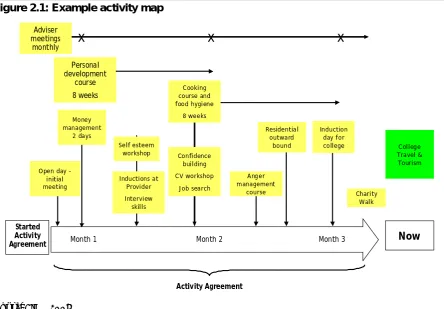
In the activity maps, the young person’s perspective is recorded on yellow ‘post-its’ while that of their Adviser is shown in light blue. Stars show critical turning points from young people’s perspective and in the Adviser-recommended cases, the bright blue post-it shows the young person’s EET destination.
1.5 Structure of the Working Paper
The remainder of this Working Paper is structured as follows:
■ Section 2 provides an overview of contexts, exploring young people’s starting points and
the drivers for their involvement in the AA
■ Section 3 reviews young people’s AA journeys, in terms of how progression was
developed, and the role of the Adviser in providing individualised support for progression
■ Section 4 explores the relationship between progression and the outcomes young people
achieved as a result of the AA. The types of young people needing a small step approach (or not) are explored in conjunction with what sort of small steps they might need
2 Contexts and Starting Points
In this section we explore young people’s educational and employment contexts prior to joining the AA. We then outline the broad types of activity envisaged on the AA, and their relative importance based on the young person’s initial focus.
2.1 Experiences prior to the AA and why young people signed up
Young people’s school experiences varied. Some had enjoyed it and done reasonably well; others liked the social element but had fared less well academically. A few had experienced significant difficulties such as bullying, and were relieved when school had come to an end.
Most young people had left school with no or low qualifications (GCSE Grade Ds and below). Many had difficulties with literacy, numeracy or both. It was notable that the
Adviser-recommended sample contained a higher proportion of young people who had stayed at school until they reached 16 and completed their exams. More of the provision study sample had left school before the age of 16 either through exclusion or withdrawal, including a young person who was home schooled and others who were required to attend pupil referral units or college to finish their education1.
Post-16, a number of young people had started college or sixth form courses in a variety of vocational and academic subjects, but had subsequently dropped out due to boredom or lack of support from their education provider. Others had tried work but these were generally jobs without training (JWT) and were low paid. Many had wanted to get a job but were unable either to find one, or to hold it down. Some had considered college but had either missed the application deadlines due to lack of motivation or did not achieve the grades they required to start their chosen course.
The Adviser-recommended sample contained more young people with some experience of education or employment before starting the AA, while more of the provision study sample had entered the Not in Education, Employment or Training (NEET) category directly after school, and stayed there.
Young people’s main reason for joining the AA was to get better access to help and support to reach their goals. The help that the young people wanted included:
■ advice and support in finding and applying for courses or jobs
■ trying vocational tasters / getting work experience
■ increasing levels of confidence and motivation
■ improving employability skills.
1 This difference may relate to the different sampling methods and criteria used in each study. In the provision
Others joined primarily because they were bored and wanted something to do. Some
indicated that the incentive payment and the financial support offered by the AA helped them to reach a decision, but only a few indicated that the money had been the main motivator (see Johnson et al., 20081 which shows that the incentive alone is not the attraction of the
AA. For many, the decision to join the AA was motivated by the incentive linked to the one-to-one support, activities, meeting new people or relieving boredom).
2.2 The framework of provision for Activity Agreements
The Activity Agreement is designed to be a personally negotiated action plan between a
Connexions Personal Adviser (PA) and the young person, identifying specific steps they should take to move into education, training or employment (preferably with learning) in return for access to financial support. The AA itself can last up to 20 weeks and, within this time, the policy envisages that young people will require a range of activities to enable them to progress. The amount of time spent on activities per week can be built up over the 20-week period, at the discretion of the Adviser, and depending on the needs and progress of the young person.
There is a broad range of activities that can be done as part of the AA and these can be seen as ‘journey-based’ in concept2:
■ Engagement at the outset (with reviews throughout) focusing on assessing the aspirations
and needs of young people. This type of activity enables barriers to be identified and, where possible, overcome through the other types of provision.
■ Personal, and skills, development to help break down immediate barriers to enable young
people to interact with activities, and vocational options and training to develop valuable skills and gain certificates.
■ Exit activities at the end of the AA aim to ensure young people have goals and plans to
sustain their engagement.
Following AA participation, a destination is recorded in administrative records. This can be entry to employment, education or training, or continued NEET status.
2.3 Young people’s starting points and their activities
2.3.1
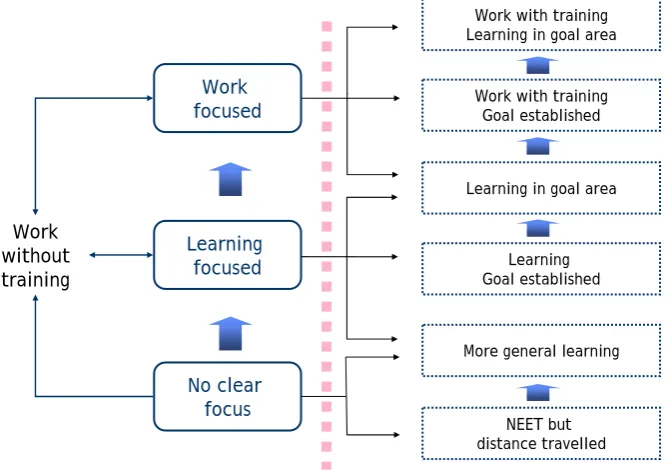
Starting pointsThe young people started the AA with a number of different aims and goals and the types of activities that they engaged in were largely dependent on their starting points. These starting points fell into three broad categories:
■ Work focused: mainly interested in getting a paid job. Some young people were sure of
the career path they wanted. Others just wanted to earn money, either for themselves or due to pressure to do so at home, and did not have a specific career path in mind.
1 Activity and Learning Agreement Pilots: Programme Theory Evaluation: Working Paper 1: Incentivising
Participation in Activity Agreements, Johnson C, Newton B, Usher T, Hillage J; DCSF Working Paper RW028; January 2008.
2 This ‘journey based’ concept of engagement-development-exit activities is similar to the approaches used in
■ Learning focused: young people interested in higher skilled work that they recognised
would require extra training. Little or no pressure to work from home.
■ No clear focus: not sure what they wanted to do. Often bored at home and may have
complex and multiple barriers.
There was a distinct difference between the primary sample (the Adviser-recommended cases) and the secondary analysis sample (arising from the AA provision research), in that more young people in the Adviser-recommended sample said they had an aim to enter work or learning when they joined the AA (although the strength of their focus and whether they had a particular career or subject in mind varied in much the same way as those in the previous research). In the sample for the provision study, more young people lacked a clear aim for their future.
Each group of young people completed different core, peripheral and additional activities to
help them reach their goals. In previous research on AA provision, Newton et al.1 developed
an adapted framework exploring the main and likely activities the young people completed, based on their initial starting points. This framework incorporated the role of the Adviser and how the Discretionary Fund (DF) was utilised for each group. This gave a much more comprehensive understanding of the ‘journeys’ young people undertook on the AA. This adapted framework is shown in Table 2.1.
1 Newton B, Fearn H, Johnson C (2009) Activity and Learning Agreement Pilots: Programme Theory
Table 2.1 Overview of activity patterns, use of ADF, and brokerage role for different groups of young people
Framework of Activities
Types of young
people Engagement Development
Personal
Development Study Skills
Employability
Skills Exit Activities
Use of DF (not
inc tailored) Adviser Role
Work Focused
Older Limited work history Need money
• Introduction
• CV
• Assessment of strengths
• Action plan
• Basic skills
• Work sampling
• Confidence building
• Social activities
• Training & short courses
• Job search
• Interview skills
• Job clubs
• Work placements
• Job and opportunity applications
• Immediate barriers (work clothes, equipment)
• Travel
• Bespoke/short courses
• Work goal realistic and owned by young person
• Establish back-up plans
• Support & review experiences
• Practicalities
Learning Focused Reasonable schooling Job goal requires qualifications
• Introduction
• CV
• Assessment of strengths
• Action plan
• Basic skills • Confidence building
• Social activities
• Training & short courses
• Research projects Learning tasters
• Job tasters
• Voluntary work/work placements
• College / training applications
• Course equipment
• Travel
• Bespoke courses
• Learning goal is the right choice for future plans
• Build motivation & confidence
• Support & review experiences
• Practicalities
Lacking Clear Focus
No clear goals Limited/no work history
Low confidence/ self-esteem Wider barriers
• Introduction
• CV
• Assessment of strengths
• Action plan
• Careers advice
• Intensive information, advice and guidance (IAG)
• Basic skills
• Work sampling
• Confidence building
• Team work
• Outdoor challenges
• Social inclusion activities
• Learning tasters •
Voluntary work/ Job tasters
• Travel
• Bespoke courses
• Engage
• Establish routine
• Signpost & deliver support
• Work to establish a goal and pathway
Key: Core Peripheral Other
2.3.2
Different journeys depending on focus [image:18.595.78.523.170.479.2]Young people completed activity “maps” during the interviews which were then checked for accuracy with the young person’s Adviser (with the young person’s consent). The idea of the maps was to explore how the activities were completed over the period of time spent on the AA, the links between them, and what outcomes were achieved. An example activity map is shown below.
Figure 2.1: Example activity map
Now Started Activity Agreement Activity Agreement Money management 2 days Anger management course Adviser meetings
monthly
x
x
x
College Travel & Tourism Confidence building CV workshop Job search
Month 1 Month 2 Month 3
Open day – initial meeting Inductions at Provider Interview skills Self esteem workshop Cooking course and food hygiene 8 weeks Charity Walk Personal development course 8 weeks Residential outward bound Induction day for college
Source: IES 2009
The ‘maps’ indicated that the ‘journeys’ the young people took through the AA fell into four broad categories (see Newton, Fearn and Johnson 2009, for further detail):
■ Those which built up an incremental pathway towards an agreed work or learning
outcome. These were generally young people who had a work or learning focus at the start of their AA (although they might not necessarily have a very specific objective within that aim, at the start).
■ Those which were more ‘scattergun’ in their approach, with the young person trying out lots
of different activities in order to form a clearer idea of what they wanted to do. This was most common among those who had no clear focus at the start of their AA. Often, these maps began to crystallise into a more coherent set of activities, from around 10-12 weeks onwards, as a clearer work or learning goal emerged, but sometimes they did not.
■ Finally, those maps which took several weeks to get started on activities other than the regular Adviser meetings. Often, these maps belonged to young people who had severe problems with self-confidence and self-esteem, who Advisers were concerned about in terms of their general level of engagement with the AA itself, and / or who faced multiple barriers to progression.
Identifying these journeys meant that the steps the young people took towards achieving a progression outcome could be analysed, and a better understanding of the key elements that achieved a successful AA outcome could be explored.
2.4 An initial model of what young people need to progress
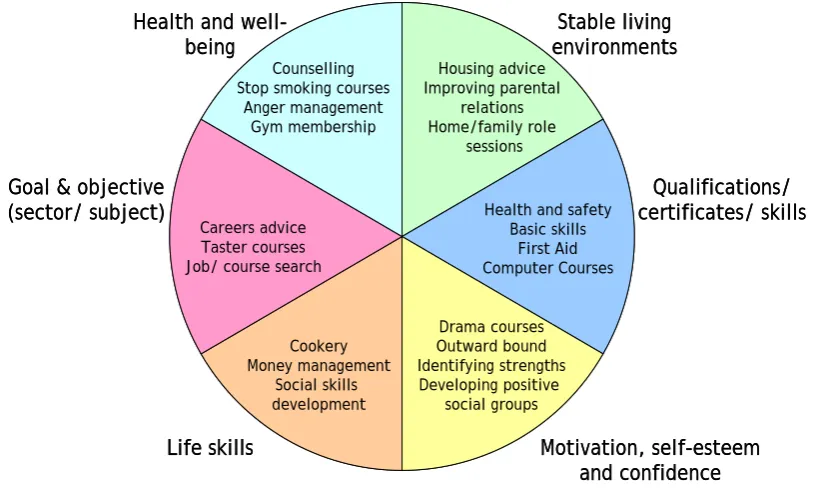
While the activities completed by young people on the AA can be conceptualised as a ‘journey’ it is also possible to view them as components that help to build towards a
progression or positive outcome. This concept is shown in Figure 2.2. Not all young people need each component.
[image:19.595.91.507.435.682.2]During the initial engagement phase the Adviser’s role is to diagnose the young person’s strengths, skills, barriers, motivation, and the extent, and realism, of their aims for an end goal. Activities are then chosen to overcome these issues from the menu of choice available to young people and their Advisers. As noted in the provision study (Newton, Fearn and Johnson 2009) Advisers guided young people to complete activities to help them overcome issues that the young person may or may not have identified themselves. So, while activity programmes were similar in nature based on the young person’s initial focus, there was usually some variation in the specific activities completed, based on the individual barriers that each young person faced.
Figure 2.2: Activities that support progression and areas that young people need support with
Housing advice Improving parental relations Home/family role sessions Stable living environments
Health and safety Basic skills First Aid Computer Courses Qualifications/ certificates/ skills Drama courses Outward bound Identifying strengths Developing positive social groups Motivation, self-esteem and confidence Cookery Money management Social skills development Life skills Careers advice Taster courses Job/ course search
Goal & objective (sector/ subject)
Counselling Stop smoking courses
Anger management Gym membership
Health and well-being Housing advice Improving parental relations Home/family role sessions Stable living environments
Health and safety Basic skills First Aid Computer Courses Qualifications/ certificates/ skills Drama courses Outward bound Identifying strengths Developing positive social groups Motivation, self-esteem and confidence Cookery Money management Social skills development Life skills Careers advice Taster courses Job/ course search
Goal & objective (sector/ subject)
Counselling Stop smoking courses
Anger management Gym membership
Health and well-being
3 Progression Within the AA
This section explores the Adviser’s role in facilitating progression and supporting the young person to recognise what steps they had made. The section also examines how activities helped to develop the young people and their ideas for the future, how different types of small steps were utilised by Advisers and incorporated into activity maps, and the extent to which there was progression between activities.
3.1 Brokering with young people
3.1.1
Getting started: developing trust and goal settingFor Advisers, the first stage before brokering activities was getting to know the young
people - their histories, their career intentions and their interests - from which Advisers could develop a suitable programme. Typically, therefore, Advisers and young people spent the first week or two (sometimes longer) in discussions to help the young person understand the AA, develop their CV, assess their skills or begin to explore the job market.
Marc joined the AA without a specific career goal in mind. He had tried with bricklaying after leaving school but it was not something he wanted to pursue further. He was hoping to gain skills and help to set a career goal. His AA journey included a four-week college placement, key skills course and personal development activities. Following his AA he was taking an apprenticeship.
‘At first it was just getting to know the Adviser and going through what I want to do, what I’m interested in and everything and you just look on the Internet for jobs and stuff because at first I wasn’t really sure what I wanted to do.’
Adviser: ‘What we do is when people give us their options, their choices that they are interested in we will then explore that with them and what we will offer are taster courses just for them to get a feel of what it actually is, for them to know what the job is and what is involved.’
As well as setting the context within which the AA would operate, this process helped to
establish trust between the young people and their Advisers. This trust became more
critical as the AA continued since the young person needed to know that the Adviser truly understood them, had their personal interests at heart and was not simply trying to coerce them into an unsuitable job or training programme.
‘What we usually do when we first start working with young people, we build up a relationship and trust and in that period, talk about what they want to do and what they're interested in. After a couple of weeks down the road we’ll do an activity plan with them.’
Adviser
Even when young people did have a specific aim in mind - a particular job, course or industry
sector - Advisers would need to assess how realistic this aim was. If necessary Advisers
would then help shape and refine the young person’s goals, offer alternatives or provide back-up plans. This was crucial in competitive markets, such as the entertainment industry, but even when young people had attainable and realistic goals, there was always a chance that the young person would not achieve their aspiration, would lose interest or change their
mind. For all young people, therefore, a diverse range of activities in the early stages of
‘I am working with a young woman who has got a criminal record and wants to work with children, which obviously is going to be a really, really hard task and she probably won’t be employed because of CRB check.‘
Adviser
‘Well, not a lot of young people that come on the project know exactly what they want and you’ve got to toy with different ideas and so on and find out what their interests are and what they’re passionate about and then just try new things, like tasters and things for different course.‘
Adviser
Having established achievable goals, in specific or general terms, most Advisers would then
adopt the small steps approach to break down these goals into manageable steps. They
would develop plans to move towards these goals but these were rarely stringent, narrow plans which set out the young person’s activities over the next 20 weeks. Typically, the plans would be to provide direction towards an end point, would be tentative, flexible and only set out the first one or two activities.
3.1.2
Building a personalised activity programmeWithout exception, Advisers endeavoured to ensure that the programmes of activities they developed for and with young people reflected the individual young person’s needs. This individualisation was achieved through discussion and negotiation with the young person. There was, still, a great deal of common ground between young people’s AA programmes - basic skills assessments and CV development were commonplace - but these ran before or alongside a wealth of activities to suit the individual.
The young person’s trust in their Adviser was assured if the young person felt that the Adviser was working for them as an individual - and this could not be achieved with an off-the-shelf programme. Many young people in the research had struggled with the education system to date, in part because their school could not offer the same level of individual attention that AA Advisers did. Young people could allow themselves to approach activities with an open mind without being worried about what their peers might think. This suggests
that the one-to-one nature of the AA and its setting helped to facilitate progression,
through encouraging young people to be more open about their needs and aspirations:
‘Some of these kids have never had a person who is purely there to support them. I think with [Adrian] he kind of said “Is it just for me?” and I said “the support from me is going to be around you not other people.” So I think once he got over that, and after the second time I saw him, he then started becoming open and it has worked quite well.’
Adviser
Where young people had very specific work or learning goals, Advisers concentrated on providing them with training, key skill activities and, where relevant, the equipment, to move steadily towards these goals. Where the target outcomes were less clear, the focus might be on equipping young people with information about jobs and training, developing first-hand experience through tasters, and building confidence through personal and social
The distinction between these groups was not clear-cut, however, since a taster programme could equally be used to test a young person’s goal against reality, or to introduce a young person to an area they may not have considered. Confidence-building and social skills - meeting and learning to get along with new people – also brought benefits to all young people regardless of how clear their goals were or whether they were oriented towards learning or work.
The common strand was that Advisers rarely committed young people to a single
course of action - intensive courses over a number of weeks for example. Rather they
would offer short, introductory activities which the young person could take further or try out and then move on to something new.
It was still entirely consistent to build core activities within this flexible and personal
programme since some generic activities were needed for most young people. Developing a CV was often a first step for young people on their AA, usually for distribution to prospective employers and sometimes as an exercise in highlighting the skills and experiences that the young people already had. The CV was a tangible and immediate outcome which young people valued.
‘[On being asked if developing the CV was important] Definitely, not just for him but for most young people, because when they’ve got it done and they see it, they have more skills and attributes than they think.’
Adviser
Assessing and, if necessary, developing and accrediting basic skills was another common early stage of the AA.
‘Yes we did the assessment with Gill and that’s something we do with every single young person because it’s vital that we identify that early, because obviously that’s the basis of their support.’
Adviser
3.2 The role of sustained weekly support from an Adviser
3.2.1
Building trust and developing understandingThe early interactions between Adviser and young person established an important relationship which continued throughout, and in some cases beyond, the life of the AA. By gaining the young person’s trust, the Adviser could develop a thorough understanding of
what the young person might benefit from1. Regular, ongoing contact, usually through
weekly, face-to-face discussions often supplemented by telephone calls and ad hoc contact,
maintained this trust and helped the young person feel secure and valued, even if they
made a mistake.
‘It gives her a bit of structure and getting to know her forced me to get to know her a bit better and what she wanted; she could be saying she wanted one thing and it could be another thing to her. Just having those regular contacts is useful.’
Adviser
1 Evaluations of the Neighbourhood Support Fund (NSF) and the Positive Activities for Young People (PAYP)
3.2.2
Progression through challenging perceptionsAdvisers recognised the importance of their role and the influence they had. They knew that it was important to steer, rather than attempt to push, the young person towards their goal. From descriptions by Advisers and the young people they worked with, it was apparent that the Adviser’s role was to support and guide the young person but also to challenge and stretch them.
‘So what we’re going to do is keep on raising the bar and keep on making it difficult and that’s a bit uncomfortable and you’re just a bit out of your comfort zone and that’s exactly where I want you to be. Because we can go here and then every week we can look back and see what it is you’ve achieved. And you can tell me why it was scary, what made it scary, how you felt while you were doing it and then, look at where you are now. How fantastic are you!’
Adviser
In order to challenge, without disengaging the young person, Advisers had to work alongside
them. They would balance support and encouragement with direction and gentle
discipline. Advisers wanted to ensure that young people knew exactly what they were
getting into, that they had a realistic view of their goal. This was achieved through ensuring the young person was informed (often by asking them to do their own research on a
particular job or course), by identifying or creating opportunities, by regularly reviewing achievements post-activity and adapting the goals as the AA went on.
‘They think about the money you can earn as a plumber, but before you have to train, you need maths and English and those kind of things, to make them aware. I’m not here to discourage. I’ll encourage the people if you want to be a plumber, then I’ll do everything I can to help you be a plumber.’
Adviser This combination of support, encouragement, guidance and direction underpinned by a strong trusting relationship was largely successful and Advisers were highly valued by the young people they worked with.
Helen did not have a clear focus at the start of the AA. She had taken a BTEC Diploma course after school although pulled out of the Advanced Diploma as she was anxious she would not cope. Her AA took the form of a training course four days a week and as a result of this she had started an E2E course with the same provider and was also looking for work.
3.2.3
Enabling a step by step approachThe programmes were not conceived at the outset and followed to the end point, rather they
evolved, responding to the young person’s needs, the degree to which they engaged with
each activity and how the activities shaped their goals.
Some young people had urgent, fundamental needs arising from their personal
circumstances, including housing and issues with anger or drug use. It was essential that these issues were addressed first in order to allow the young person to engage properly with the training and employment aspects of the AA.
‘A young person can’t be expected to progress onto education or training if they haven’t got their basic needs met, which could be social, emotional, socio-economics, anything like this, problems with the gender, anything like that. So it’s important to look at the personal development stuff before you put them into something like education or employment. So that’s what we work on first, the biggest barriers, trying to overcome them and then look at the vocational progression later on. ‘
Adviser
For most young people we interviewed, their problems were less severe but were
nonetheless important barriers to overcome. Advisers worked with young people to build their confidence or develop social interaction skills. They also introduced them gently to new situations and new environments to ensure that the young people felt safe and supported. One young person initially travelled everywhere with his mother. The Adviser worked to wean him towards more independence by phoning him at several points on a solo bus journey to check that he was all right. This was extreme but a common theme.
‘We always plan in a practice run of anything they are going to do … I’ll get them onto journeys planner and show them how to plan a journey so that in future when they have got an interview they have got the skills to be able to work out how to get there, making sure they have got enough time to get there and factoring it all in.’
Adviser
3.3 Different types of small steps
Advisers tended to think that most young people needed small steps of some sort even if this was not evident in their activity programmes or from their interviews. These types of ‘small steps’ clustered around the following:
■ Building up trust/taking the pressure off. This was particularly important at the start of
the AA and among young people who had significant issues around trusting adults perhaps because of difficult experiences at home or school. Some of these young people were working with youth offending teams (YOTs) and Advisers wanted the AA to be kept separate from this. The AA initially consisted of meetings only and activities were built up slowly over time. A lot of support work was often required for young people to return to any form of learning, even in the alternative settings provided by the AA.
‘One [activity] was to just to get him engaged and in a routine of getting up in a morning. A lot of the young people you work with don’t get up until about 1pm. Plus just working his way to see if that‘s what he wants.’
Activity map for Manoj Now Started Activity Agreement Activity Agreement Looked for jobs with a different Connexions
adviser
Plumbing/ brickwork etc. taster. 1 week
Assault course day out Adviser meetings
weekly
/fortnightly
x x x x x x x x x x x x x x x x x
3 weeks later got a job. Still in employment Bathroom fitting course. (taster) 1 week FLT licence (counterbalance). 1 week
Month 1 Month 2 Month 3 Month 4
Adviser away
Getting him engaged and into a routine
Adviser started encouraging a build up of more intensive
activities
Fun activity to keep him engaged Safe way to test career
ideas – no big commitment
Source: IES
■ Accessing support for wider barriers. This was critical for young people who had
significant barriers, particularly in the areas of health and well-being - such as substance misuse, mental health problems or learning difficulties. Sometimes progression for these young people meant being referred into more specialised support services.
■ A gentle nudge in the direction of their goal. These young people had a realistic and
achievable goal although they also had some anxieties about how to go about achieving it. Intensive support and the opportunity to do personal development activities that helped to build confidence for young people to attempt to achieve their main goal were involved. These activities might include meeting new people, working in teams.
‘Now I had a lad start last week who is very bright, he’s been applying for things for a long time and he hasn’t been able to find anything. Now, he’s a really articulate lad, really positive, really wanting to move forward and for him, we’ve done an assessment and the only thing that’s come up is a little bit of self-confidence, and I think that’s a bit because he’s had so many knock backs.’
Adviser
■ Broadening the focus. This type of small step was needed with those whose focus was
very narrow and would often be achieved as a result of the brokering process. Intensive support could help young people understand the benefits of personal development activities that would also help them to achieve their work or learning goal.
■ Back-up plans to the main goal. Young people who needed this type of small step had a
■ Trying out before making a full commitment. For a considerable group of the
Adviser-recommended cases, a main part of being in a position to progress had been the
opportunity to try something before making a commitment. This opportunity could take the form of course tasters or work experience. Advisers identified the benefits of these types of activities in informing decisions about whether the longer term goal was the right one or not.
Alesha joined the AA wanting to work but was also considering learning. As part of her AA she had wanted to gain work experience and had this opportunity in one of the subjects she was
considering taking a course in. She and her Adviser felt this had been important as it helped her to decide it was not the goal she wanted to pursue in the longer term.
‘I kept looking for work placements and then my mum said “There’s a job going in the hairdresser’s for a Saturday person”. I went down and she said “Yeah, we’ll train you”. I done that for three months plus seeing my Adviser, but after that three months my back was killing me so I thought, “No, it’s not me, hairdressing”, so I left and kept looking.’
Adviser: ‘With the work experience that was something she definitely wanted to do in both fields [of interest] so that made it clear about whether hairdressing is the right thing for her … because she realised that she didn’t like it. So … it just eliminates young people wasting their time.’
■ Breaking down goals into achievable steps. Advisers used this technique very
deliberately although they were not always explicit with the young people that this was what they were doing. By focusing on immediate and achievable goals, the young people worked towards an outcome without being overawed by something too daunting. This approach worked equally for personal issues as it did for training and employment goals.
Gill had difficulties in her home environment. Her mother was a borderline alcoholic and she was often left in charge of her younger siblings despite her mother being present in the house. Gill struggled with this situation - the relationship with her mother was at breaking point.
‘[Working with the Adviser] helped me to understand how to deal with that without losing my temper. I felt better about dealing with my mum.’
Adviser: ‘So the small steps then came into place, we had a discussion about trying to talk with her mum more, just general chit chat with her mum, just making conversation because they weren’t talking at all. So even from saying ‘Good morning’ or ‘Hello’ or ‘How you doing’ or making her a cup of tea, or anything like that. And then after a couple of weeks review it, if it improved, great, so then maybe we’d look at maybe tackling the anger situation.’
Gradually, the young people would accumulate a series of successes that the Advisers could build upon with more intensive and stretching activities.
‘This lad basically was kicked out of one school, kicked out of another, kicked out of another, and basically ended up not doing much. And I think he turned up thinking that you know maybe there’s a chance that I’ll get kicked out of this at some point, that’s all he’s been used to. So first of all it’s important not to set him up to fail. So in terms of small steps I booked him in for one activity, and that was to see me. So all he had to do was come in, have a chat with me and from that obviously we have a
discussion, we create an action plan. But that was his first target.’
Thus the sequencing and the intensity of the activities was an important part of getting AA provision right. Ensuring fundamental needs were met, ensuring the demands of the AA were not too onerous and therefore off-putting, yet helping the young people build up their
experience and demonstrate that they could apply themselves to work and/or training was at the heart of a successful AA.
Andrew was the main carer for his parent. He also had concerns about how a full-time income might affect his mother’s benefits and was not sure whether he would be able to hold down full-time work. His AA involved intensive support from his Adviser, a series of course and placement tasters, and a basic skills course. Following the AA he was hoping to go to college.
‘I got to pick everything I really wanted to do. Anything I was interested in there was something there.’
Adviser: ‘They are doing a scheme at the moment where if you work full time as a volunteer you can get £60 a week and because [the young person] has never had to do anything full time, and as much as he wants to do gardening he has always done it in the same place where he knows people, so I was thinking if he came to the induction he might be able to make a link with the volunteer worker there and start maybe doing one day a week and so he could still earn his activity agreement money but not be at risk of feeling under pressure by having to do full time.’
3.4 Progression between activities
The progression between activities, in terms of skills or movement towards a final outcome, was often clear when reviewing the activity maps. Taster sessions, for example, a college open day or a visit to a construction site, were a popular way of introducing young people to an employment or training option. They were a valuable way for Advisers to test out the young person’s interest before signing them up for a full course, which could be expensive. Many young people had taster sessions and moved on to other things or explored that area in more depth in subsequent activities.
‘Maybe provide a taster of the classes and courses you can do for the AA, let them try a session and then come out and talk about it. It’s important that they know they can come out if they don’t like it. It’s good to present them with a choice.’
Adviser
In both scenarios they moved forwards, closer to a final outcome, by having greater clarity
Activity map for Madeleine Now Started Activity Agreement Activity Agreement
Worked on CV
Sharing jobs Key Skills
Maths and English
3-4 weeks Started full-time
apprenticeship with provider Adviser meetings
weekly 1-10
x x x x x x x x x x
Connexions Adviser until started pre-apprenticeship
than Provider Adviser
Week 1 Week 2 Week 3 Week 4 Week 5 Week 6 Week 7 Week 8 Week 9 Week 10 Week 11 Week 12 Week 13 Interview at provider Training – mini
interview and test
Test assessment of key skills Training – mini interview and test
Test assessment of key skills
x
She spent a couple of weeks in hospital so took a break
from the AA
Continued to support her during initial phase of
apprenticeship
She was stuck in a rut and needed someone to pick her
up and help her move forward
Source: IES
Another common progression was in building skills, in particular working to improve or
consolidate young people’s maths, language or communication skills to support job
applications or to improve their interview technique. Basic skills could also be a pre-requisite for other qualifications that the young person wanted to pursue, so establishing a minimum level of achievement was often an early part of the AA.
However, progression, usually in the form of small increments, was most clearly evident in
the young people’s personal development.
‘The link between [Activity] and [training outcome] is the personal development. So we wanted to get [Helen] to build up the routine, that was the main thing because she wasn’t used to doing things on a regular basis, she didn’t have any particular routine … we wanted to look at her basic skills [and employability skills] as well because we didn’t want to put her in a college programme where she didn’t feel like she could get on as well as the other young people.’
Adviser
Adrian wanted to find work in a warehouse although had not had much success before joining the AA. His activities included a forklift course as well as support with his CV and distributing this to local companies. As a result of the AA he felt more confident about his career goal.
‘I’m a lot more confident in myself now …. I’m a lot more pleased now than I was, because I have got everything, I’m on track now.’
Adviser: ‘He had done quite a lot in 9-10 weeks, he had done quite a huge amount of things on a regular basis and the buzz he had when he passed because he had not achieved anything at school and it gave him tremendous support for his confidence.’
Advisers were careful not to put young people too far outside their comfort zone but to gradually push the boundaries.
Callum did not have a particular career in mind when he entered the AA but thought he would like to be working. He had substance misuse problems although was not aware how this was affecting his life. He also lacked confidence outside his normal peer group. He thought the AA would be something to do. Having choice and control over activities was important to him. As part of his AA, he attended a range of college tasters in music to enable him to find out more about the courses available and also started working with a drugs counsellor. His Adviser had accompanied him to the tasters to give him that extra bit of confidence. He had started a music course after the AA and was looking for work alongside this.
‘I’ve always had problems meeting new people and I’m very nervous. So to take me there for one day, with my Adviser rather than just throwing me in at the deep end, was better. So I could have a look around and meet people and things like that so it was much better for me.’
Reviewing achievements and experiences was an important part of ensuring, and
demonstrating progression to the young person. The review process also enabled
Advisers to help young people recognise the wider skill development that had evolved through seemingly fun activities that, as far as young people were concerned, did not contribute directly to their core goal.
‘What we try and do all the way through this, we try and work on transferable skills. So at every point we are tricking them into learning about eye contact, communication skills, appropriateness around other people, interpersonal skills, non-verbal
communication and different strategies for dealing with stress.’
Adviser
Young people also wanted to know they were making progress and, in many interviews, were proud to describe how they had achieved things they might have considered beyond them without the AA. Highlighting progression between activities with the young person was therefore very important and Advisers worked hard to show young people just how far they had come and what they needed to do to get to the next stage.
‘I think they need to know what they’re going to achieve at the end of it. It’s quite important as well to make them understand how they’re going to achieve it because I think sometimes they look at certain provision - it could even be basic skills - and it would scare them off because of previous experience, whether that be in school or you know LDD assessments, things like that. So it’s important to always make sure that the young person knows where they’re going, who they’re going with, what
they’re going to achieve or what the aims and objectives are of the sessions. So it’s all got to be quite meticulously planned out.’
4 The Relationship between Progression and Outcomes
This section reviews progression pathways to identify whether these revolved around a key ‘turning point’ or were part of a more continual, incremental process. It then looks at which types of progression were needed for young people in different circumstances and with different end goals. Finally, it explores the perceived benefits of the AA (from the
perspectives of both young people and their Advisers), and outcomes achieved as a result of the progress they made.
4.1 Progression as a turning point or continual process?
4.1.1
For most, it is the combination of weekly support and the activities that enables progressionMost young people felt progression to their goal (or towards it) had resulted from the
combination of individual support and activities. Their starting point and type of AA
journey did not really affect this perception. Young people tended to see the AA in holistic terms surrounding their support needs, the development of confidence and starting to do something on a regular basis or starting to set goals for their future. This in itself indicates the distance they travelled as part of their AA, and the kind of impact working with their Adviser had on their own understanding of their needs, particularly in terms of learning and work.
Deshi was interested in becoming a mechanic immediately after finishing school. While he recognised he would need qualifications he did not want to spend a lot of time in full-time
education. The AA helped him complete a number of activities that would help him reach his goal including developing a portfolio of the work he was doing on cars at home to show to employers, and First Aid training. He also completed fun activities related to his interests. At the end of the AA he had an apprenticeship in a garage. Despite having a clear work focus he recognised the value of the fun activities and felt that the AA was a much better option for him than college.
‘They say you’re going to learn, but you’re going to have fun as well; you’re going to be in a workplace where you learn, but we’re going to give you activities to go to, but during that time we’re going to look for your college. So, in that sense it was like, I’d go to college, but I’d get a fun thing out of it as well. So, it helps you out a lot.’
Adviser: ‘He was really eager to do lots of things, especially like short courses that would give him a certificate and increase, I guess, his employability. So, yes, he was willing to do the First Aid and the Health and Safety. So when I suggested it he was absolutely fine with it.’
From the Advisers’ perspective as well, a combination of support and activities helped to achieve progression during the AA, although their experience suggested that the
combinations related more closely to young people’s focus and how realistic this was. Generally it was felt that ‘having the activity or training available and your relationship with the young person as well’ enabled young people to move forward. Advisers also felt that being able to access a range of activities was important rather than simply those with a vocational focus (such as relevant learning or work experience).
‘I think all the activities are as important … obviously the vocational development but a young person can’t be expected to progress if they